Jim Baumer's Blog, page 18
September 11, 2018
The Masses
Years ago, I worked with a guy named Ken. Ken was world-weary and cynical. We hit it off.
We’d both landed at a company with a dubious past during a transitional time in our lives. I was in a cycle of dead-end jobs. Ken had his own issues he was trying to create distance from.
For whatever reason, he saw things about me that I hadn’t yet realized—namely that I had more talent than I gave myself credit for. He was always telling me not to sell myself short. Back in 1996, no one else was offering anything positive in terms of building me up. Coming from him—someone who had no truck with fools—this meant a great deal to me.
He and his live-in girlfriend didn’t have children. They took a real shine to Mark. I’ve learned to read how people relate to young children (and animals) as a sign of their intrinsic worth. Ken had two mastiffs that he loved like children.
Ken had some legal issues and eventually, he disappeared. He called me late one night a year after I’d lost touch with him. He was living in Oregon at the time, working at Home Depot. We talked for about 35-40 minutes. It was the last time I heard from him.
I often wonder what became of him. I don’t know how to get in touch with him. In a world of digital bread crumbs, he made sure not to leave any. He also burned his personal bridges. A man who basically became invisible.
Ken had a favorite saying about people: he’d look at me, frustrated with the managers at the piddling water treatment firm we were both doing sales with and say, “Baumer, the masses are asses.”
The past few months, I’ve heard him in my head saying, “Baumer, the masses are asses.” I can’t disagree with him.


September 8, 2018
Walking Away
Walking away from fundamentalist Christianity was a pivotal event in my life. It probably is one the most significant (and difficult) decisions I’ve ever made since. The year was 1985. After three semesters at a school that from the outside seemed like it was “blessed by God,” once I was on the inside (as a student) however, nothing was as I expected.
One of the things I know about organized religion is that reality regularly falls far short of the ideal. Then there were the practical matters that caused immediate red flags when we rolled up to Hyles-Anderson College in our overloaded U-Haul, during the oppressively hot Midwestern August, in 1983. First, there was the expectation that the school provided some support for students when they arrived. I’d been told that there was assistance at Hyles-Anderson in finding a job.
Our pastor back home had given us a point of contact. Clayton Busby had pastored a small church in Maine, but felt “called” to Hyles-Anderson. We stayed with the Busbys for a few days, and then moved into a condo project near the school, where many other students were living.
Two days after arriving, I met the man, Brother Phil Sallie, who was in charge of workforce assistance. My 21-year-old radar told me he was a fraud. Of course at the time, I thought this was “the devil” trying to trip me up. It was evident months later (and perfectly clear from where I sit, today) that this man was a sadist who derived pleasure from wielding control over people’s lives.
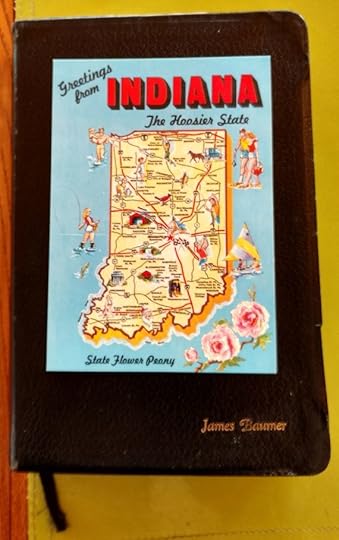
Twisted scripture, Northwest Indiana-style.
Back in the 1980s, in a place like Northwest Indiana, jobs were scarce. Unemployment was hovering just short of 15 percent (the national unemployment rate is currently 3.9 percent) and being able to land a job paying above minimum wage was seen as better than gold at the time. Sallie was a man who made my skin crawl. From West Virginia, with a distinctive drawl that I thought was Southern at the time, he probably could sense I didn’t really like him. That’s probably why he made sure that whenever he had a job, he sent out one of his Southern comrades to interview, and never had anything for me. Finally, he told me not to bother to come back—he’d never have a job for me. This was the school’s version of support for someone like me.
I’m not sure if it was always like this, but when I was there from 1983 to 1985, if you were from the South, you had a certain cache. Northerners could acquire standing if they feigned a love of Dixie and other redneck manifestations of that region below the Mason-Dixon. Being from Maine, it just wasn’t in my DNA to pretend I was proud of the Confederacy.
Things like this, as well as finding out that the culture and teaching at Hyles-Anderson College didn’t align with my expectations of what a Bible college was going to be. The authoritarian control mechanisms as well as the cult-like adulation of Jack Hyles ran contrary to what I knew about scripture. Later I’d learn that other pastors who had once been enamored of Hyles had begun sending up warning flares, well before Hyles and his church came off the rails.
Even though I knew things were not right, leaving the fold wasn’t easy. There was always the influence of peers, and the daily brainwashing and brow-beating that occurred in class and then, the chapel services. This was classic mind-fuckery going down.
This very small sampling is merely the tip of the iceberg from my experiences at Hyles-Anderson. Looking back, I see similarities between the idol worship that was directed towards Hyles by just about everyone at the Bible college in Crown Point, and the current adulation that conservatives (a good portion falling within the evangelical/fundamentalist realm) extend towards another failed human, Donald Trump. What’s the most galling about it is he doesn’t even need to dress-up his racism, xenophobia, and compulsive lying, and so-called Christians have his back.
If you know little or nothing about the world I inhabited for a time in my life, I’d suggest taking the time to read this article about First Baptist Church, Jack Schaap, the son-in-law of Jack Hyles, who followed him in the pulpit at First Baptist Church. It’s a pretty sordid tale.
I ponder where I found the courage as a young man in his early 20s, without any prospects of returning to Maine in short order, to walk away from what I think bordered on a cult. With a young family and financial struggles, it would have been easier to just go-along-to-get-along. Mark was two-years-old at the time I stepped away from the mess that was Hyles-Anderson College.
When I returned to Indiana to see what things were like 20 years after we came back to Maine, I drove to Fort Wayne to see a fellow student who was my best friend at Hyles-Anderson. He and I were about the same age (Dale was two years older, I think), with young families and similar doubts about some of the things we were observing and experiencing.
Dale was pastoring a small church in the city 125 miles east of where we both attended Bible school together. It became clear that our mutual experiences resulted in two divergent ideas about Hyles, and about fundamentalist religion.
I found that that he was running a business with his grown sons that rehabbed pallets and resold them. Dale was always a hustler in the best since of the term. A hard-worker, he was fully enmeshed in the ways of Hyles-Anderson when I drove out Route 30 for a visit.
When I called him, he was surprised, but pleased I’d looked him up. Once I got there, we ended up having a fairly frank conversation about where I was at and I don’t think he thought too highly of my choices in “falling away from God.” Our meeting was a bit awkward at times, but I appreciated him spending a few hours with me. We did have a shared history, even if our paths had forked in following two very divergent roads. What if I’d chosen a similar path like Dale did?
I have no way of knowing if Dale (and his wife, Alana) know about Mark’s death. They knew him when he was a baby and up until he was two, when we moved away from the apartments a block apart, in Hobart. We were the first ones to find a cheaper place to rent while students, and Doug and family followed us. We saw them one last time when we lived in Chesterton, after I left school, with Doug carrying on in a part-time capacity.
From time to time, I think of Dale and visiting him back in 2007. He’s still pastoring. I’m sure he’s found a way to compartmentalize the falsities of Hyles, Schaap, and whatever else has befallen a place that at one time was considered a Mecca in the world of the Independent Fundamentalist Baptist movement.
Certainly, I wasn’t the only one to walk away from the lie that was Hyles-Anderson College and First Baptist Church. One of Hyles’ daughters managed to get out and has written about it. Amazingly, student still are paying to have their minds and faith manipulated by those who remain in Crown Point and Hammond, Indiana.
August 31, 2018
Lonely Like the Blues
For the past two summers, I’ve felt like a ghost. Sitting alone at home for long periods of time, forgotten and lonely. Invisible, really.
I just read two books about loneliness. When you are lonely, what better thing to do than study the state that you are immersed in? Or, maybe not.
Well, the first one, by Johann Hari, dealt with depression, but it delved into the roles of loneliness (and trauma), rather than the chemicals in our brains, for causing so many to be depressed. I won’t argue for or against his premise. His book has caused a shitstorm in certain circles, mainly those places where pushing pills for every malady is the solution. My reaction after reading it was, “meh.”
The second book, by John T. Cacioppo and William Patrick, Loneliness: Human Nature and the Need for Social Connection, had more resonance with me. This was mainly due to the state of loneliness that I regularly find myself in.
In 2014, after a break-up with his girlfriend at the time, Mark went through a period of loneliness. I’ve pieced some of this together after his death. It was why, I think, that he made such a push the last years of his life to get out and engage with others. He even recognized the importance of doing this from a health perspective, which is what Cacioppo and Patrick spend time unpacking in the book. Their findings indicate that prolonged bouts of loneliness can be as harmful to health as smoking or obesity. They also demonstrate the therapeutic aspects of social connection.
The problem I encountered in plowing through both books is that it made me feel like somehow, being lonely was my fault. Like I’d been working overtime to create my current state of isolation. Finding a way to connect with people isn’t as easy as simply willing yourself to have friends. This is especially true in our digitally-based world. Losing a son I was especially close to hasn’t helped, either. Oh, and being a freelancer by necessity (often) also has been a solitary endeavor, especially the past few years.
I’m trying, though. Last Friday, I drove to Lisbon Falls for opening night of the Worumbo Blues Festival. Partly this was wanting to see Kevin Kimball, a blues guitarist of considerable talent play. The other reason (and I could almost hear Mark saying to me, “that’s great, Dad”) is that I thought I needed to get out of the house.
I haven’t spent much time in the ‘ole hometown over the past few years. To be honest, there’s not much there I’m particularly interested in. But, I have been hearing some reports of “revitalization.” On Main Street, the former hangout for the town’s senior set, Dr. Mike’s Madness Cafe, has experienced a makeover via new ownership. It is now Flux, an upscale eatery that people from away are finding interesting. Not sure if the locals are on-board or not.
Sitting at the bar, having a beer, I looked around and didn’t recognize a soul. Granted, lots of people live in Lisbon Falls (along with Lisbon and Lisbon Center) that I don’t know, so for all I know, it could have been jammed with locals.
Drinking alone isn’t much fun. It’s lonely really, especially when the bartender is too busy to carry on a conversation. I’m not complaining. I was happy to see Main Street flush with cars parked along it. A much different site than I’ve seen most times I’ve passed through town on Route 196. A few doors down, the former Kennebec Fruit Company hasn’t looked this good for decades.
I paid for my beer, looked around at the patrons laughing and having a good time, and made my way over to The Railroad Café (or pub/diner), a place that will never be mistaken for a high-end eatery. It’s a dive bar in the best sense of the term that serves passable food and occasionally, some decent grub. I’ve never had an issue with the place and in fact, have always found it welcoming. Except on this night.
Again, I wasn’t expecting to be greeted like a regular on an episode of Cheers when I walked through the door. I was taken aback by the emptiness of the place, however. There was a musician sitting at the bar when I ordered a drink. Another couple were seated at a table. That was it.
Outside, under the tent, a band was cranking through some electric Chicago blues. There were perhaps 20 people sitting there. Most were smoking, which was weird. It’s been awhile since I’ve gone to see music and had to ward off secondhand cigarette smoke. Being technically, “outside,” I guess it’s legal. It was off-putting for me.
They were raffling off a Moxie-orange Fender electric and a small amp. Missing my electric rig that I sold in 2008 to finance my trip to LA to visit Mark (and Gabi), I had hopes I might win. I bought an arm’s length. I didn’t win. But, the raffle helps fund the Maine Blues Society’s Scholarship Fund, which was what the festival was serving as a benefit for.
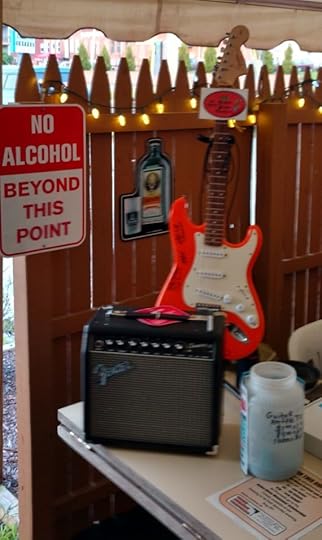
No orange guitar for me.
Not one conversation was to be had. That’s fine. People were there to listen to music (and smoke), not talk to me and mitigate my loneliness. There wasn’t a solitary person sitting there that I recognized.
Back in 2009 (or it might have been 2010), I was at the Railroad during Moxie Fest, listening to a band of locals “kick out the jams.” It felt like half the town of Lisbon was there that afternoon. I saw a bevy of old friends and high school buddies I hadn’t seen for years. It was like a homecoming of sorts, which is what Moxie used to be for me.
I didn’t make it over this year, but in 2017, I wandered up and down the parade route and save for seeing someone from the LHS Class of ’80 and Faye Brown, there wasn’t another familiar face lining Lisbon Street (or Main). On my way up High Street where I’d parked, I did see an older couple sitting on the porch of the house I used to visit daily back in the day, when I was good friends with their son. We chatted briefly, and then, I drove back to Brunswick. I was thinking, “this will probably be my last Moxie Festival.”
I don’t know what the answer to being lonely is. Some people will callously say, “have more friends,” as if having friends is like a game of tag. Tag. “You’re my friend.”
If life were only that easy.
The world-weariness inherent in the music of the late Jason Molina is something I’m familiar with.
August 28, 2018
Death of a Statesman
Death is never simple proposition. It becomes immensely more complicated when the person who has died is a public figure, especially a politician. That would be the late John McCain.
I won’t wax hypocritical about McCain, or default to hagiographic bromides that have begun and are inevitable with the death of someone as universally-known as the senator was. He was not my favorite politician, or a leader I was particularly enamored with. Partly this is due to McCain’s politics—they certainly sat to the right of my own.
But given all of that, I have been paying attention to the past year or so of his life. Once he was diagnosed with glioblastoma last July, a particularly aggressive brain tumor, I knew that this day was inevitable. McCain would succumb to cancer, and the accolades and tributes would begin pouring in.
One of the marks of greatness is dying with dignity and grace. In that regard, I’d say anyone with a shred of humanity would agree that McCain’s final year of his life was worthy of admiration.
McCain’s final run for the presidency, especially his naming someone that makes our current president seem like an intellectual (a feat nearly impossible to pull off), Sarah Palin, really irked me. I don’t know why, other than I thought somehow, Senator McCain was better than that. I now realize that he was, but politics being what it is, decisions get made in order to curry favor with groups that give you a chance to win. To win as a Republican is a particularly nasty process, although the Democrats haven’t done much to differentiate themselves as a group that’s markedly better. That was on grand display during our previous presidential election.
What I’m trying to say is that Mr. McCain’s politics could trigger a particularly visceral reaction in me (and did, much of the time), save for these past 12 months.
Once he was diagnosed, I started to pay more attention to his final acts in the Senate. It was no secret that he despised President Trump. Who could blame him? If you still have any respect at all for the presidency, the current occupant of the White House has made the office a place given to fiasco after fiasco. What’s particularly rich is for someone like Trump who received multiple draft deferments, so he never got to close to battle, danger, or death, to disparage McCain—a hero in all but the most cynical definition of the word—is yet another clear demonstration of what a truly heinous person our 45th president is. Even in death, Trump remains incapable of letting go of his obvious enmity towards McCain. This speaks volumes about the latter’s shortcoming, I think, as do others.
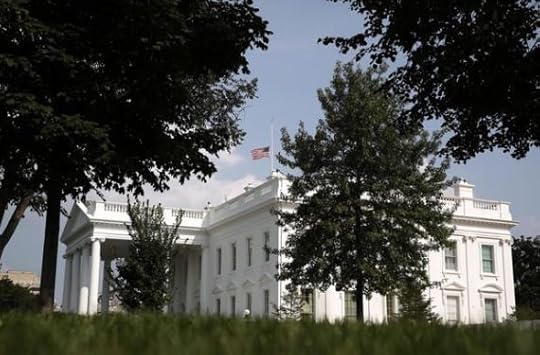
The president having difficulty honoring a hero. (AP photo)
On Monday, I hearkened back to something that one of my favorite writers wrote for Rolling Stone in 2000, about McCain. This was during the senator’s first run for president, and the late David Foster Wallace had been commissioned to be one of the “boys on the bus,” following McCain and the merry band of hopefuls around for a month.
Wallace’s nearly 25,000-word essay on McCain holds up well, 18 years after Wallace wrote it. In revisiting the epic piece of political (and personal) reporting, I’m reminded that McCain is like almost all of us—someone full of contradictions. He was a witty, straight-talking “maverick,” as he was branded back then. He’s worn that moniker well quite often, since. As a senator, he often voted with his party, which drove me crazy about him. Interestingly, those trolling McCain after his death criticize him for not voting as often as Republican leaders and the ideological hacks they pander to thought he should.
I urge you to read Wallace’s essay over the next few days. If you are a cynic like me (and Wallace certainly had his cynical side and it comes through in the piece), you’ll recognize that even the most jaded can’t help but recognize the heroic elements that are part and parcel of McCain’s legend, and Wallace the reporter teases these out in his lengthy treatment of McCain the candidate. This literary journalistic tour-de-force and thinking back upon it was something that frequently tempered my own anger and irritation towards the senator from Arizona framed some of my thoughts about him and his death. Again, human beings have a complexity that often diverges from the surface analysis. And at the end of his journey, I think the guy who held court on the Straight Talk Express and garnered reluctant admiration from writers like Wallace, was always present, even when he was at his most partisan, the side of McCain I deplored.
And as if on cue, Laura Miller derides Wallace and some of the articles that have been written referencing his Rolling Stone take on McCain. It’s always easier being a critic, than actually treading new ground as a writer, like Wallace did across his fiction and nonfiction.
Politics makes us ugly people. It is apt to reveal our worst selves. I’m guilty of that and not particularly proud of that, either.
Because of politics, I forgot that McCain was a man given to books and an appreciation of the written word. By all accounts, he was a voracious reader, counting Hemingway, Somerset Maugham, and F. Scott Fitzgerald as favorites. Has Mr. Trump ever read a literary work from front to back? I know that he’ll never grant an interview like this one by McCain, centered on books and reading.
He was a reader as well as a writer. He wrote a number of books with longtime collaborator, Mark Salter. Maine’s own William Cohen, a friend of McCain’s, spoke glowingly of McCain’s appreciation for the literary in an interview with Andrea Mitchell during the noon hour on Monday. I thought both Cohen and Salter were especially poignant in their reflections about their friend, so I’m posting it, here. Pay particular attention to Cohen’s words about McCain, and his appreciation of literature. Our local daily, the Portland Press Herald, ran a story with a similar orientation, on Sunday.
John McCain wasn’t a perfect man. But I think history will render kindness towards him and the story he wrote, over time.
August 21, 2018
Gifted
Back in 1996, Nada Surf had a major hit with their song, “Popular.” It was a take down of the fickle elements of high school popularity.
The band easily could have become just one more one-hit-wonder littering the pop-rock landscape. Their record label wanted another “Popular” and their follow-up didn’t have one. Then, like happens often, the A&R asshole at the label began imposing his total creative cluelessness on the true creatives who made up the band. This process never results in anything positive, and yet labels have been doing this kind of thing, forever. Elektra dropped the band mid-tour, while they were in Europe. So much for “developing talent,” A&R schmuck!
To Nada Surf’s credit, they persevered. This meant touring whenever they could to rebuild U.S. interest in their band, while taking on day jobs to pay the bills. Then, Let Go, their third record, and the true follow-up that they wanted to make to their debut record found a home on tiny Barsuk Records out of Seattle, Washington. The band got solid reviews and here we are, 15+ years later and Nada Surf are still going strong.
I have listened to Let Go as much as any record/disc I have in my library of music. Even though it came out in 2002, it has aged very well, not sounding dated like many other bands/artists I have from that era.
KEXP, one of my go-to streaming sources for music on the interwebs posted this about Barsuk and the station’s favorite records from the “little label that could,” now coming up on their special landmark anniversary like fellow Seattle label buddies, Sub Pop. For Barsuk, it’s 20 years!
Let Go is special, but I also adore their follow-up, which came out in 2005, The Weight Is a Gift. In some ways that record may be more meaningful for me at this juncture in life’s continuum. The album deals with the existential challenges of adulthood—the kind that when they happen to us test our mettle and make us wonder if we’ll be able to muddle through them.
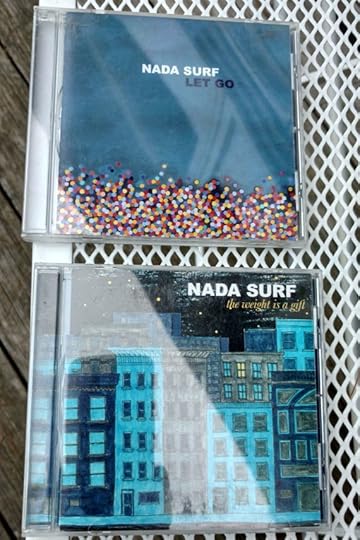
Nada Surfing is the best!
There is nothing about Mark’s death, that if I had the power to undo the horrible timeline, I wouldn’t time-travel to alter what happened. I’d take my son back in a heartbeat! But, I know that’s not possible. So, I’m left (along with Mary) to pick up the pieces and find our forward. Perhaps we’ll even learn things about ourselves that we never would have known if Mark were here with us. It still totally sucks though!
The Weight Is a Gift speaks on that kind of level, as does Let Go, albeit with a slightly different shading.
The DJs at KEXP love the band (because they have great tastes in music!), so the band’s played several times. One of the many things I love about KEXP is that they record these shows and we get to watch them again (and again).
This one has Nada Surf performing the entire Let Go record in the station’s studios.
August 14, 2018
A Year From Now
People love making plans. Dreaming can be fun, and looking ahead might be “the American pastime.” If not, it’s something that most of us do, like we’re guaranteed a future pregnant with certainty.
This weekend I read a story on the war that most of us have forgotten about in Afghanistan. I empathize with the soldiers and their sense that this war seems to lack a purpose or an end game. I also thought about those forced to live, waiting for a bomb to fall on their heads, or to having soldiers kick in the door under the guise of looking for “the enemy.” I’m pretty sure that for both the soldiers and the natives, planning for the future seems like a moot point. Life for them simply becomes an act of survival.

What Does the Future Hold?
I know a bit about what happens when one’s life gets flipped upside-down. One thing that goes away is the certainty (and a certain arrogance) that you actually control the ability to look out into the future. The present is affected, too. Then, there’s the tendency to hearken back to the past and the preference to “live” there.
A year ago last August, Mary and I were swimming in the details of perpetuating our son’s life. The problem with that is that Mark was gone and not coming back. But the Kafka-esque tasks of dealing with his house, tenants, and then or course, the logistics of actually selling it made for a summer that went by like a blur. This summer’s been different—not easy, but also with fewer urgent tasks to tend to, also.
Some of our friends know a little about what our lives have been like since Mark was killed at the start of 2017. People that ought to know (and care) seem too busy with the details of making plans for their own futures. I no longer care about them. Mary and I on the other hand try not to get too far ahead of ourselves. Living day-to-day and often, hour-to-hour is one of the results of losing an only son.
One of the myriad reasons we’ve managed to make it through 36 years of marriage and especially the past 19 months, is that we communicate with one another. We actually sit down across the table or room from one another (or have those “life” conversations in the middle of the night) while figuring out what to do next. It’s not particularly easy, but I’m glad Mary and I know how to talk to one another.
Just the other night, we were talking about our lease. We’ve loved living on a tidal cove for nearly two years. We’re re-upping for another 12 months. Being a renter forces us to have to look out further than we’re comfortable doing. Capitalism is kind of like that.
A year from now, we’ll be living somewhere else. Where, we’re not sure today. That’s too far for either of us to see right now.
August 10, 2018
Writing Fatigue
It’s rare for me, but I’m struggling a bit with my writing. Perhaps this has something to do with writing nearly 200,000 words about my only son, who I’m no longer able to commune with.
Sending out something this personal and connected to my grief journey is daunting. I’ll eventually learn whether anyone thinks my book is any good. Quite likely, I’ll have to weather a season filled with notes of rejection. I just received one this week.
Actually, I’m not tired of writing. I’ve developed a number of drafts detailing how shitty some people have been to Mary and me over the past 19 months. They’re honest that’s for sure. But I’m positive these assholes couldn’t handle having a mirror held up for them, showing them what fakes and phonies they are. So instead of posting, I’ve just been filing them away.
Possibly my recent lack of content development might also be associated with my personal physical challenges I’ve been living with this summer. SI joint pain hasn’t been fun. I am getting better, but if I do too much, I have setbacks.
I have been writing for hire. The auto trade folks have been assigning articles and my Island Journal piece on Bucksport finally landed. It was a year ago that I was gathering details, driving down the coast for interviews, and figuring out where I might find a home for an article on the demise of yet another paper mill in Maine. My persistence paid off even after I got several “thanks, but no thanks” replies from editors at big city papers and regional super mags. The Island Institute’s beautiful annual publication actually ended up being an excellent landing pad for my efforts, telling the story about what happens when a town’s legacy industry shuts down. Not only is Island Journal a good fit, but my byline sits side-by-side with some of Maine’s better-known freelance writers, like Edgar Allen Beem, Carl Little, Abigail Curtis, and Jennifer Van Allen.
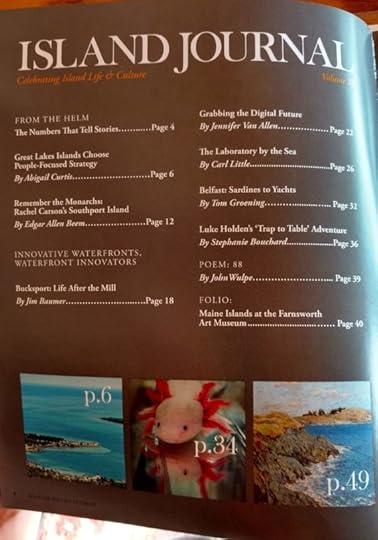
In good writing company.
In addition to freelance writing, the powers that be regulating Medicare insurance transactions require agents like me to be certified every year. While our liar-in-chief can continue spewing falsehoods every time he opens his big fat mouth, or send out washed-up former mayors to add more lies to a never-ending litany of obfuscation, Medicare is concerned about fraud. Give me a fucking break!
But, government is really good at being “penny-wise and pound-foolish” in seeking conformity at the nickel and dime level, while the political grifters at the very top get to perpetuate their never-ending graft and corruption.
As a consequence, I’ve been spending far more time memorizing byzantine details than is warranted for something that passes as a very part-time gig for me.
Writing Fatique
It’s rare for me, but I’m struggling a bit with my writing. Perhaps this has something to do with writing nearly 200,000 words about my only son, who I’m no longer able to commune with.
Sending out something this personal and connected to my grief journey is daunting. I’ll eventually learn whether anyone thinks my book is any good. Quite likely, I’ll have to weather a season filled with notes of rejection. I just received one this week.
Actually, I’m not tired of writing. I’ve developed a number of drafts detailing how shitty some people have been to Mary and me over the past 19 months. They’re honest that’s for sure. But I’m positive these assholes couldn’t handle having a mirror held up for them, showing them what fakes and phonies they are. So instead of posting, I’ve just been filing them away.
Possibly my recent lack of content development might also be associated with my personal physical challenges I’ve been living with this summer. SI joint pain hasn’t been fun. I am getting better, but if I do too much, I have setbacks.
I have been writing for hire. The auto trade folks have been assigning articles and my Island Journal piece on Bucksport finally landed. It was a year ago that I was gathering details, driving down the coast for interviews, and figuring out where I might find a home for an article on the demise of yet another paper mill in Maine. My persistence paid off even after I got several “thanks, but no thanks” replies from editors at big city papers and regional super mags. The Island Institute’s beautiful annual publication actually ended up being an excellent landing pad for my efforts, telling the story about what happens when a town’s legacy industry shuts down. Not only is Island Journal a good fit, but my byline sits side-by-side with some of Maine’s better-known freelance writers, like Edgar Allen Beem, Carl Little, Abigail Curtis, and Jennifer Van Allen.
In good writing company.
In addition to freelance writing, the powers that be regulating Medicare insurance transactions require agents like me to be certified every year. While our liar-in-chief can continue spewing falsehoods every time he opens his big fat mouth, or send out washed-up former mayors to add more lies to a never-ending litany of obfuscation, Medicare is concerned about fraud. Give me a fucking break!
But, government is really good at being “penny-wise and pound-foolish” in seeking conformity at the nickel and dime level, while the political grifters at the very top get to perpetuate their never-ending graft and corruption.
As a consequence, I’ve been spending far more time memorizing byzantine details than is warranted for something that passes as a very part-time gig for me.
July 31, 2018
Baseball Time Travel
This past weekend, the National Baseball Hall of Fame and Museum in Cooperstown, New York inducted another class of baseball greats. Their plaques will be added to the existing group of former players enshrined at the equivalent of the sport’s holy grail.
When we returned from Indiana in 1987, Mark’s formative baseball experience was centered on National League teams like the Chicago Cubs rather than New England favorites, the Boston Red Sox. This was in large part due to the influence of superstations like WGN in Chicago and Atlanta’s TBS.
We didn’t own a television for the first three years we were married. Then, in 1984, having a TV seemed important. We began watching Cubs’ games and Mark’s first professional game was attended at Wrigley Field in 1985.
In 1989, we crossed the river and began renting an affordable duplex in the town where I grew up, waiting for our first house to be built. We signed up for the cable package that happened to include TBS. We began following baseball on Ted Turner’s station. Mark became a fan of “America’s Team,” which is how Turner, the Braves’ owner, took to marketing his club.
If a film director was casting about for a movie set that epitomized small town America, he’d be hard-pressed to find a place more fitting than the village of Cooperstown, with a population slightly less than 2,000 year-round residents. Of course, on one weekend in July, the town becomes the destination for tens of thousands of hard-core hardball fans, who spend induction weekend rubbing elbows with greatest to have ever played the game.
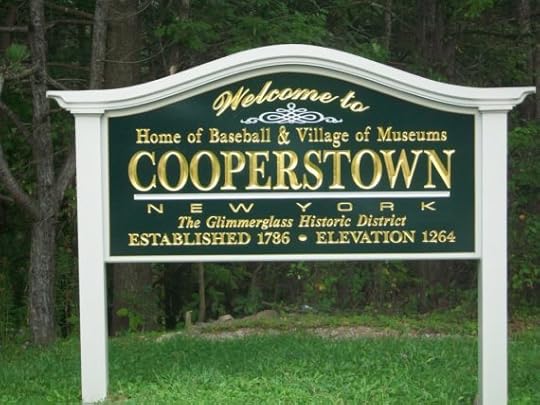
Cooperstown, NY: The home of baseball’s Hall of Fame.
There’s a variation of the game’s orgin that says that baseball was actually invented in a Cooperstown cow pasture by Abner Doubleday. The myth has been refuted, but it’s likely that baseball was being played in these rolling hills of upstate New York long before the game was urbanized and professionalized in the late 19th century.
While our world at times feels like it is in danger of spinning free of its axis, there is comfort to be found in what was once was known simply as “America’s Pastime,” in hearkening back to the date of June 12, 1939. This was when the eyes of the baseball universe looked to Cooperstown and 10,000 fans descended on the community. They’d arrived to celebrate both the 100th birthday of baseball as well as dedicate the newly minted National Baseball Hall of fame.
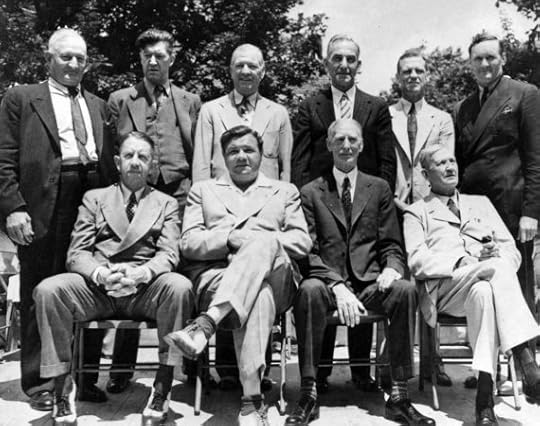
Baseball’s first induction class-Baseball HOF (1939)
With fans jamming Main Street, they witnessed the first class of immortals pass—including Babe Ruth and Cy Young—as strains of “Take Me Out to the Ball Game” got belted out by a small band. The vaunted baseball shrine had been officially christened. Since then, every July has brought a new group of legends to the shores of Lake Otsego. Fans flock there to be part of what’s become an event much larger than Stephen C. Clark, the local art collector, businessman, newspaper publisher, and philanthropist envisioned in founding a shrine for baseball’s greats in the unlikeliest of places—a town 200 miles from New York City.
I loved baseball. I inherited my connection for the game from my father and his brother, and passed it down to my son. By the time he was 11, Mark was already years into the throes of an affair with the game perfectly suited for summer, as well as forging an unbreakable bond between father and son, one that even death can’t sever.
My dad never took me to Cooperstown. It was always a place I’d hear about every year, when another group of former greats had a plaque forged and installed in the Hall of Fame’s main gallery.
The summer of 1994 was one of the last years our family of three took an extended vacation together. As Mark progressed as a player, finding a time to get away for a week that didn’t conflict with that summer’s baseball calendar became increasingly challenging. Unlike today and baseball’s diminished stature, when Mark was coming up—and especially in our household—baseball took precedent over all other things. Today, it’s tough for organized youth baseball coaches to count on a consistent contingent of players being there during the summer because parents feel it’s their purview to dictate everything, including scheduling of summer baseball games.
As such, August was usually when we’d take a camping trip to Baxter, or Rangeley, or somewhere to get away for a week once Mark’s baseball season ended, which in Little League, got extended by All-Stars.
We got to Cooperstown our first time the week when Major League Baseball decided to go on strike. Outside the Hall of Fame is a manual standings board. The standings never changed that week as we arrived the day before MLB struck, August 12, 1994. We enjoyed our pilgrimage nonetheless.
I didn’t know what to expect. Would Cooperstown be just another tourist trap, ballyhooed but when you actually arrived, delivering disappointment and a sense of being duped?
Au contraire. The place was everything we expected and more. This region of New York is rural. We camped at a nearby state park. In addition to the National Baseball Hall of Fame and Museum, there are a host of other museums and places to visit. The Finger Lakes wine country is a half day’s drive west.
Both Mark and I reverently toured the HOF and museum. Even Mary, who admittedly was skeptical about this trip, was totally impressed. Later, on a trip to Springfield, she toured the Naismith Memorial Basketball Hall of Fame and stated that baseball’s was better.
Two years later, we’d return to the area when I joined a group of Mainers playing in our over-30 league. Our caravan arrived in the Schenectady/Saratoga Springs-area to play in a competitive regional tournament. We joined a family we’d befriended through Little League, the Tarrs, and visited the hall once again. Mark was now 13 and well on his way for what would be a nice ride with baseball that would culminate in a trip to the Division III World Series as a college player not quite 10 years later.
My interest in baseball has waned over the past few years. Part of that is likely due to Mark’s death. I think my ardor for the sport cooled once I was no longer coaching and even playing. I did umpire for six years, but I no longer followed the game like I had when I was a youngster and a father following my son’s progress in the sport.
Oddly, as my back woes thrust me into another summer with long periods stuck at home, I’d take a break from writing or reading to watch part of the afternoon’s programming on the MLB Network. This ratcheted up once I returned from my Father’s Day road trip.
I learned out that this year’s inductees would two players that I’d followed from the mid-1970s. They were men who I’d followed across their careers and one, Chipper Jones, was a player Mark grew up watching and rooting for.
He joined a group of only three—legendary hitters able to hit both left and right-handed and propel baseballs upwards of 450 feet with a wooden implement. Yankee Mickey Mantle heads the class, followed Eddie Murray (who played most of his career with the Baltimore Orioles), and now Jones.
Jack Morris was a member of a pitching fraternity that paralleled my development as a fellow pitcher. We were all taught that starting pitchers were successful when they completed a start. To not do so was a form of failure. Now, pitchers are credited with a “quality start” when they toss six innings and turn it over to the bullpen 33 percent shy of completion
Morris told the story in an interview about how Sparky Anderson, his Detroit manager, instilled in him the importance of finishing what you start by leaving him out on the mound to get shelled on a couple of occasions. If you’ve never pitched, standing on the mound is the loneliest of places when the opposition is having a field day against you. There’s no place to run and hide. You have to gut it out and take it. Today, this never happens at the professional level. But even at the development level, players grow up with pitch counts and coddling. I get it. It’s all about “protecting” them from harm. Again, something’s gone missing and it would take a lengthy essay to unpack it all in the context of baseball, if not society at-large.
I watched all six induction speeches: First came Jones, Tiger great (and longtime Morris teammate) Alan Trammell, then the pitcher who arguably solidified the role of the modern day closer, Trevor Hoffman. Many are calling Hoffman’s address the highlight of the six given. Vladimir Guerrero, who played the first part of his career north the border in Montreal was followed by baseball’s equivalent of Paul Bunyan, slugger Jim Thome. Morris fittingly finished the speaking portion with an emotional address.
Watching the televised coverage, I was flooded with many memories of Mark and the baseball the two of us shared over his all-too-short 33 years of life. I missed being able to talk about Chipper Jones joining fellow Braves’ mates, Tom Glavine, Greg Maddux, and John Smoltz. This was a group of players that Mark watched from their rookie years up through the Braves World Series’ win in 1995. Jones was the last of the group to leave the game, retiring at the end of 2012. This was the summer following Mark’s completion of his MFA at Brown.
I thought it might be bittersweet to make it back to Cooperstown for a third visit.
July 26, 2018
The Business of America
Yesterday I saw an eagle. He was soaring over Route 1, along the Androscoggin River, between downtown Brunswick and Cook’s Corner. To see one is a rare gift.
When I was a pre-teen, you never saw eagles. They were near extinction.
This year, I’ve seen four eagles, including one night in April when I was sitting out on my deck overlooking Woodward Cove. Not more than 30 yards away from me was a large bald eagle, preening himself(?) in a tree. I watched for nearly 15 minutes with binoculars ’til it was too dark to see him.
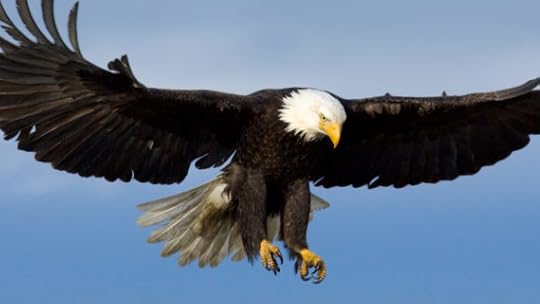
Don’t want to live in a world without bald eagles.
The reason that bald eagles have returned is that the Endangered Species Act did what it was intended to do—save the species under its care from extinction. It has done such a good job since being enacted—saving 99 percent of the species under its care from extinction that business interests in the U.S. want it relaxed and perhaps done away with: mainly so they can do what they do best—conduct America’s business, which is “bidness.”
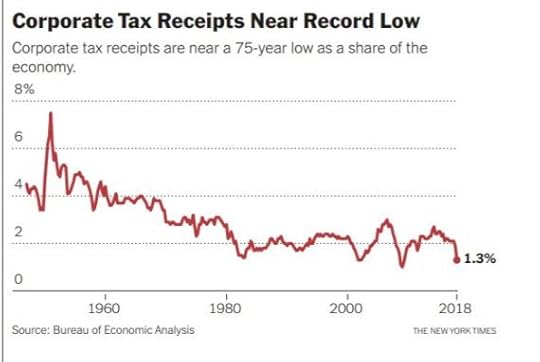
Taxes on corporations continue to fall. (NY Times graph)
To talk with a businessman, you’d think that the “gooverment” was trying to put them out of business. The graph above shows something entirely different.
I found an address (?), delivered by Robert Monks at Harvard (?) that delineates the real crux of what’s wrong in America today—it’s the corporate takeover and subsequent greed of the overlords running things. Trump gets all the headlines, but business is the driver behind why for most, America is an ideal that’s long gone, if it ever existed
Here is Monks’ opening paragraph:
Thanks to the American corporations today are like the great European monarchies of yore: They have the power to control the rules under which they function and to direct the allocation of public resources. This is not a prediction of what’s to come; this is a simple statement of the present state of affairs. Corporations have effectively captured the United States: its judiciary, its political system, and its national wealth, without assuming any of the responsibilities of dominion. Evidence is everywhere.
I do not want to contemplate a world where bald eagles no longer exist.