Jim Baumer's Blog, page 22
March 13, 2018
Thoughts from the Blizzard
Is being rigid and dogmatic a hedge against uncertainty and chaos? I think for some.
Society is awash with those convinced that they’re right. Like the guy in Sabattus. Another document fetishist—Constitution or Bible, it’s always the same—these guys (most of them are guys, white ones, too) are certain that some ancient document holds the key forward—or rather, backward.
I spent a little time this morning attempting to earn a shekel or two. Most apparently were like me—“working” from home. Oh, there were the hearty few, like Miss Mary, who went off into the white falling from the sky to visit some customers. She’s a trooper that girl.
By 11:00, I decided to call it “a day,” and hopped on my stationary bike to listen to a podcast. Unfortunately, the one I picked was annoying and I decided to go to my default, which is music.

Another March Northeaster in Maine.
Life isn’t predictable, nor is it ordered by some higher power. But, if you must tell yourself it is, please leave me out of your conversation.
Curiosity wasn’t something I learned from my family of origin. Any time I sought to expand my horizon during my pre-teen and teenage years, I was slapped down and made to feel bad that I wanted something more.
But perhaps if I’d fed Mark a steady diet of fear and uncertainty, he’d have settled down and never considered walking across the country once and then, a second time, too.
On Saturday night we went out with friends and saw a provocative play by David Mamet in Bath. Over beers (pre-show), I was talking with my friend Paul and I mentioned to him that lately I’ve been realizing how little I know about the world and how it works. It’s really a place of wonder and the opportunities are unlimited to learn if we’re open and aware. It’s also a place where tragedy strikes unexpectedly, too.
I’m not going to do the binary discussion thing anymore. Have them if you must. I’ll be elsewhere.
Growing up, no one ever told me, “Jim, you’re a visual learner.” But I was (and am).
More often than not I’m struck by how often I’m “late to the game” on things. But at least I get in before the buzzer goes off.
Jeff Conklin hosts a show on WFMU. I’ve listened to one of the last bastions of freeform on the FM dial since 2004, but never spent time with Jeff’s amazing playlists until two weeks ago. It’s hard to articulate how much I’ve been enjoying finding new things musically. Like a duo named MV & EE, who are part of some psyche folk, hippie vibe in Brattleboro, Vermont. Just read a long piece online yesterday about MV, also is known as Matt Valentine. It’s the kind of music writing I grew up with, discursive, and all-inclusive—the way rock music was written about in the pre-Pitchfork era. The journalist, Byron Coley, is an old-school guy and the piece ran in the defunct Arthur magazine and it’s worth seeking out.
Speaking of ‘FMU, on Saturday (pre-Mamet) I caught the amazing set by Yo La Tengo, by video live stream, as the Hoboken band played requests in exchange for pledges during the station’s fundraising marathon, the 21st year they’ve done so. It is epic, they don’t archive it, and I’ve never managed to catch it before.
YLT has always had a place in my heart since I got to see them “rip it up” in one of Bowdoin’s lounges back in 1993 or 1994. That was when I was doing my DJing and the school brought in some of the luminaries of that era of indie rock.
Looking out the window, the snow is coming down, the wind is whipping it around, but I’m grooving to “Dark Star,” by the Dead.


March 9, 2018
The Myth of Control
Apparently, there are prescribed ways to grieve. Not too public, because while we can share our thoughts about food, music, or the perfectly ordered life we all lead (sarcasm) on our blogs and via our social media feeds, I guess grief and loss are off limits.
That’s an interesting approach in terms of being transparent and “real.” Only sharing the good, but never touching on the tough times. Life’s a cakewalk when everything is going great. But if you write about your life, then why stop when things turn to shit? Something worth considering, I think.
A writer none other than iconic Joan Didion wrote in The Year of Magical Thinking, “Life changes fast. Life changes in the instant.” Didion’s book is masterful, bringing her unflagging skills as a journalist to what at times feels like her, “reporting out” on grief, while also passing through the experience, personally, after the sudden (and unexpected) death of her husband, John Gregory Dunne, in 2003.
Didion looks to Emily Post’s noted book on etiquette (published in 1922), where she draws upon Post’s chapter on funerals:
[Ms. Post] wrote in a world in which mourning was still recognized, allowed, not hidden from view. [An author] notes that beginning about 1930 there had been …a revolution in accepted attitudes toward death. ‘Death,’ he wrote, ‘so omnipresent in the past that it was familiar, would be effaced, would disappear. It would become shameful and forbidden.’ [Another author] had described this rejection of public mourning as a result of the increasing pressure of a new ‘ethical duty to enjoy oneself,’ a novel ‘imperative to do nothing which might diminish the enjoyment of others.’ … [T]he contemporary trend was to ‘treat mourning as morbid self-indulgence, and to give social admiration to the bereaved who hid their grief so fully that no one would guess anything had happened.’
One way in which grief gets hidden is that death now occurs largely offstage. In the earlier tradition from which Mrs. Post wrote, the act of dying had not yet been professionalized. It did not typically involve hospitals. Women died in childbirth. Children died of fevers. Cancer was untreatable. At the time she undertook her book of etiquette, there would have been few American households untouched by the influenza pandemic of 1918. Death was up close, at home. The average adult was expected to deal competently, and also sensitively, with its aftermath.”

We can learn from the past when it comes to grief and loss.
This passage is fascinating and Didion’s pondering America in the 21st century in how we don’t seem able to acknowledge grief in the same manner as previous generations. As we evolve (or at least tell ourselves that we are) with technology being the usual default for everything, we seem ever-more stunted, emotionally.
Grief has no predetermined duration in which mourning somehow reaches a point where it’s “completed.” Where does that kind of stilted, emotionally cut-off shit originate? Perhaps in some idyllic nod at Victorian nostalgia, but as Didion reveals, the Victorians were more adept at supporting the grieving than our happy-at-all-cost culture.
In our lives lived as reality television programs, we get to “edit out” the parts we don’t like and don’t want others to know about. And we also tell (lie to?) ourselves that we’re in control. Our lives are ordered around an illusion that fate can be manipulated by actions and mantras. But it can’t.
The entire self-help industry—which rakes in $10 billion (yes, with a “b”) or more a year—is premised on there being a lot of unhappy people. Rather than look a little deeper at the systemic dysfunction permeating life and society, many continue believing that happiness can be acquired by pills, books, mantras, offering gratitude, along with other hokum. Actually, pills are an even bigger industry than the one propped up with gurus. Americans spent $446 billion on medications in 2016—half of all the spending on pharmaceuticals in the world. Being unhappy is big business!
When parents lose an adult child like Mark—suddenly and without warning—the floor of your life falls away beneath your feet. It feels like you’re in a freefall, yet the ground isn’t coming up for you, but seems like it’s moving away. People also move away. Because your tragedy makes something obvious and if it’s obvious, then they have to deny it. It’s that no matter what, you can’t keep your children safe. You also can’t protect your spouse, your parents, or your neighbors.
Think about the rash of school shootings. At one time, parents could be almost certain that when their son or daughter left for school in the morning, they’d return home, later in the day. Not anymore!
Events like 9-11, suicide bombers, drivers plowing their vehicles into crowds of people—all of these things drive home the point that we’re not in control. An argument can be made that we never were.
We believe government will keep us safe. Or, if we have a gun (or many guns), then we’ll be safe. Again that illusion of control.
There are a host of strategies and work-arounds that people develop. Lists, mindfulness, diets, fitness routines—none of them will fend off the inevitable. We’re all going to die.
We’re really good at convincing ourselves that when things are going well—we’re feeling organized, have a system for mostly everything, we’re as productive as ever, and our health is good—then we are ensconced in the palace of control.
I wasn’t thrilled that Mark was out walking. But I wasn’t going to tell him he couldn’t do what he felt he needed to do. Who the hell was I to inflict my values and fears upon another, especially my adult son, who I loved. I learned that lesson all-too-well in my family of origin and I was damned and determined that I’d never inflict that on my son. There are those people from my past (ones, btw, who haven’t had anything to do with me for more than a year) who to this day think somehow I was negligent in not doing something that was impossible—getting Mark to come home. He wasn’t going to, no matter if I’d tried to entice him back to safety. I mean, was I supposed to kidnap him? I don’t think so! Instead, both Mary and I supported his efforts. We were even planning to meet him along his route west, in February. But we never got that chance.
Again, there’s that sense that we have control over our lives, right? Like the place Mark was at somehow, determined what happened to him.
Why do you think self-help gurus have created a cottage industry? Then, corporations, who are adept at extracting excessive value from the labor of workers (it’s called exploitation, aka, capitalism), now are pawning off mindfulness as a ploy to get workers to do more with less, yet find happiness in doing so. “Here are some scraps from our table—you will be happy with that, serf!”
Authors the likes of Sharon Salzberg and Tara Brach are just two of many who have become “authorities” in a movement that some have called, “the cult of mindfulness.” They’re likely laughing all the way to the bank teaching you that you should be happy (and accepting) for the garbage that others dump in your lap. Brach’s book even sticks the word “radical” in the title, as if being a doormat and accepting something as meaningless as having your son run down on the side of the road is something cutting edge. This is such absolute bullshit that it defies having to comment on it, but I will.
On top of having our lives destroyed, or at the very least, permanently altered by this tragedy, we’re having to deal with rejection by people who refuse to acknowledge that once more, we don’t have fucking control over anything. But maybe Mary and I weren’t grateful enough, or good enough, or kind enough, or whatever thing that people like to tell themselves that makes them different than those whose life has just been turned upside down.
Don’t like me writing about my experience over the last year? Fine. Read something else. Continue to believe that somehow, you can control things—until you can’t.
People like to judge.
I’ll leave you with this beautiful and haunting selection by Bipolar Explorer, a band I “discovered” a few weeks ago. I’ve been captivated by their new double-CD, “Sometimes in Dreams,” that I’m pretty sure is going to end up on my best of list for music in 2018. This track is from their previous outing, “Dream Together.” This is art created around grief and loss that has the power to touch and minister to others passing through that landscape.
March 5, 2018
What Does It All Mean?
Life now has a definitive before and after. What existed prior to tragedy is now gone—not in the sense that all of it’s disappeared entirely—but threads connecting me to that time have been forever altered.
If you are not familiar with passages through the dark, you probably won’t understand. That’s okay. All of us will at some point lose someone we love, though. All loss isn’t the same, either. Therese Rando posits that sudden, unanticipated death leaves those left behind traumatized due primarily from the psychological assault brought on by a death like Mark’s.
I continually run into people who don’t know my story. Why should they? It’s not like I’m hosting a reality TV program or anything. Of course, being the self-oriented people that we are, it’s easy to assume that everyone knows that my son was killed and expect them to acknowledge it. What’s interesting to me after slightly more than a year of acting out a common scene, is how people do react when they do find out. It runs the gamut from basically not acknowledging it (sort of like “oh,” and then moving on), offering some version of the platitude,” I’m sorry for your loss,” and then, there are those who engage with you in a human and empathetic fashion. This group is the smallest one.
Last Thursday, I was out visiting businesses—I think the sales parlance is, “cold-calling.” I’ve mentioned something about insurance before. Well, I ran into someone I worked with more than 20 years ago. We had a meaningful conversation mainly because he understood where I’d been and where I’m at right now, navigating grief’s journey. He’s also lost family members over the past two years.
Later, I went into a business I had a relationship during a prior period of my life, when I was with the Central/Western Maine Workforce Investment Board (one of the LWIBs that our governor has waged an ongoing, personal war against). My point of contact was no longer there. But the benefits manager was someone I knew from high school. What are the odds?
I was supposed to go out last night and see someone who is legendary in certain music circles. I even had my ticket. All week long I was dreading the show. I’d listen to something by the artist online and read an article and realize, I had no desire to see a troubadour with a guitar, grounding his songs in simplicity. Call me cynical if you like.

Grief and loss changes you forever.
Grief and loss changes you. Over the past few weeks, I’ve been listening to dream pop, ambient, shoegaze, avant garde works, and a new band I’ve discovered, Bipolar Explorer. A musical package from them is on the way. I am anticipating it. I’m sure I’ll have something more to write about how I came to find them and how their music has helped me navigate my sadness since I first heard them on WFMU.
I do have tickets to see an up-and-coming band from Philly, Alvvays, in May. Oh, and Robyn Hitchcock looms on the horizon, too.
Not sure what any of this means—at least to someone who hasn’t been affected by loss—or perhaps who hasn’t, but at least can summon some empathy. But, I’m writing it down and I am attempting to post more frequently. And if it doesn’t matter to others, it matters to me.
March 3, 2018
At the Museum
We live in a culture coarsening daily. Public discourse, from the very top, down, has been stripped of the most basic elements of etiquettes (look that work up, as in “etiquette and Emily Post” and see what comes up. At one time, to get ahead in the business world and even presidents actually cared about things like etiquette and how to act in a public setting.
A few weeks ago, Miss Mary and I visited the local art museum at the prestigious liberal arts college near our house. It had been years since we last took advantage of this cultural perk, one that’s free to visitors.
Today, we drove to Portland and spent more than two hours at the Portland Museum of Art. We even signed up for a membership. Again, we commented upon leaving that it had been “too long” since we last spent an afternoon surrounded by art.
Yes, you can view art on the interwebs. But spending time walking through a gallery or a museum is an entirely different, immersive experience. This article lists 10 reasons why visiting a museum is good for you (and probably, good for society). The author is also quite broad in what she allows for your museum—for instance, according to her, you could visit a zoo, science center, or botanical garden, too, among other options.
I liked this list of lessons that school children learn from art.
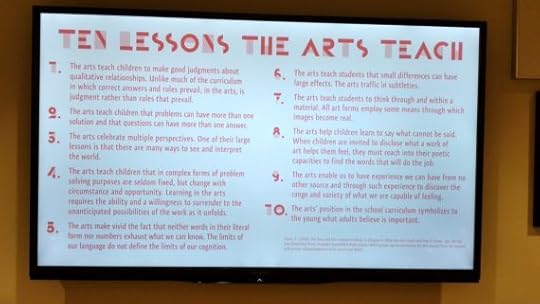
Lessons from art.
The supreme leader doesn’t think art and museums are very important. Republicans generally don’t care about funding the arts—they’re more into bombs, guns, and the paraphernalia of war and killing.
March 1, 2018
Good Journalism
Years ago (it was actually in 2003), I began blogging. I tried to consume the best bloggers in the blogosphere at the time. One of them was Andrew Sullivan.
His blog became a daily stop for me. There were few writers covering issues and writing about them with his clarity and erudition. He’s one of the few writers/journalists that I’ve found whose work regularly countered ideological defaults.
I recently signed up for a year-long subscription to New York magazine. Why? Because I’ve consistently been directed to stories on their website. Rather than be a “taker,” I figured a subscription was the least I can do to support what remains of viable journalism in America.
I wasn’t surprised that when my first issue arrived in my mailbox (replete with Clarence Thomas staring back at me from the cover) that there would be a Sullivan-written article on opioids.

New York Magazine cover (Feb. 19-March 4)
It’s the best writing on the topic I’ve read up to this point.
America’s in tailspin on multiple fronts. Simply talking about a crisis like the one afflicting the country won’t solve it, and like Sullivan points out, neither will trying to win it with a “declaration of war,” as has been tried with dismal results in the past.
Then there’s this:
One way of thinking of postindustrial America is to imagine it as a former rat park, slowly converting it into a rat cage. Market capitalism and revolutionary technology in the past couple of decades have transformed our economic and cultural reality, most intensely for those without college degrees. That dignity that many working-class men retained by providing for their families through physical labor has been greatly reduced by automation.
That’s not going away, as technology—which has overshot its intended mark time and time again—with its incessant over-promising and under-delivering, has left America awash in people and lives destroyed by opioids.
Read Sullivan and weep.
February 28, 2018
Three and Done
My new thing is to look at my Facebook page in the morning: I scroll through the first three updates. If anything is positive and appears like something other than the usual hand-wringing about _______________ (fill-in-the-blank), then I’ll keep reading until I come to a “road block.”
I’m finding that my time on Zuckerberg’s bulldozer has been minimal this week. That’s probably a good thing.
Not offering up any kind of panacea, either—sadness is still all-around.
February 26, 2018
Dreams and Direction
I had a dream about Mark just prior to my alarm going off this morning. I cherish having him “visit” me this way. I miss him so much each day and words are inadequate in capturing that feeling of loss.
What’s weird is that after having a dream, sadness usually follows. That means that for much of the day, I’m emotional in thinking about him. I guess that’s the downside of this experience, at least for me. The alternative is to push my memories and thoughts of my son aside and live in denial, which I refuse to do.
Today, not only was I sad, but I also was battling feelings of angst. It was a real battle this morning to pull out of that funk.
Part of what compounded everything was making the mistake of looking at a Facebook back-and-forth on the page of someone I respect. She’s a talented food writer and activist who is very up-front about her opinions on subjects beyond plant-based veganism. This morning, she was trying to facilitate a conversation about the recent school shooting in Florida. Given our Balkanized manner in America for the short-term if not longer, trying to be thoughtful and hold an opposing opinion invites trolling, or just plain ignorance and stupidity.
What I found so frustrating and I was tempted to weigh-in (but I didn’t), was the inability of commenters who disagreed with her to have an actual dialogue. It reminded me of two sides yelling across a chasm, lobbing rocks back-and-forth across it. Nobody wins when that occurs.
All this to say the following: I’m no longer interested in dealing with entrenched people who don’t understand how to have a conversation, or lack the ability to disagree without being assholes. I’m also not going to shit on Facebook or social media in general. The issue isn’t social media. The problem is that people have decided that they’d rather be jerks and won’t cede anything, whether they are right or not.
What ultimately pushed me over to “the other side” of functionality was a combination of choosing to listen to a Rich Roll podcast and exercising. I jumped on my Lifecycle and rode for 30 minutes during what is my usual lunch hour. No politics, not even someone I respect, like Amy Goodman, just Altucher’s ruminations on a host of wide-ranging topics, including his thoughts about Bitcoin. It happened to be a rare Trump-free zone, too.

James Altucher is a renaissance man.
If you don’t know who Altucher is, you should. Start with his website.
One thing that I found interesting about a guy who truly embraces the best of digital technology and who has adopted a minimalist lifestyle—moving for a period of time from one Airbnb to another, living out of a small duffle bag, is what he now chooses to allow for possessions.
He’s now renting a small apartment, and he said that he’s allowing himself a few things more than the 15 he was toting around with him. He told Roll that while he reads using a Kindle, and enjoys it, but types of books, and that the experience is different. “For certain types of fiction books, I have valued the physical book-reading experience more—like 10 times more.” That was really interesting.
Altucher is a guru of reinvention. He walks his talk and is never afraid to try something new. He doesn’t seem to be mellowing out, either, at 49. He recently began doing stand-up comedy as a practice that helps all the other things he’s doing in his life.
Something about listening to this today, and picking to listen to Roll interview Altucher, made me think about all the best things about Mark, the kinds of things I miss about him. And something about doing that made me think that if Mark knew I was doing what I was doing, he’d have been smiling down.
I’m also beginning to see that without him here on this temporal plane, I’ve got to work on a better way of living.
Two Altucher quotes:
“Happiness has nothing to do with well-being. So you can still have well-being and occasionally feel sad and melancholy (and miss things).”
“Whenever people hear the word ‘sad,” they want to cheer you up.”
February 21, 2018
Let Them Speak
Losing a child is an experience that alters your life forever. Parents never get over it. I know this firsthand.
Last Wednesday, 17 students lost their lives in Parkland, Florida. The grief and loss that follows parents burying their adult child brings with it shock, and a host of other powerful emotions. The only solace they might feel in the days, weeks, months (and beyond) often comes from the kind and empathetic people that come alongside them and share in their loss.
When a tragedy has a public component, then this means the media comes calling. Parents, along with fellow classmates, will be asked an incessant line of questions—some of them invasive and even, just plain heartless and worse—stupid.
My son wasn’t gunned down with an assault rifle, but when the car impacted his body along U.S. 90 in Crestview, Florida, killing him immediately, he was just as dead. My wife and I have been picking up the pieces of our lives ever since—we’ve now passed the one-year anniversary, and continue counting.
I’m not going to say I know exactly what the parents of the 17 classmates at Marjory Stoneman Douglas High School in Parkland are feeling today and have been for a week. I will say I have a sense about what the pain feels like—for me, it felt like my heart was ripped from my chest.
When a son or daughter is murdered like their children were, and the media turns it into a circus primarily to enhance ratings (and sell advertising), anger is never too far away. In my case, I ended up telling a writer from a major newspaper to “fuck off” when all she cared about was including Mark in her story about people crossing America who had been killed after being hit by a vehicle. She was heartless.
I have been amazed by the strength and resolve of students like Emma Gonzalez and Cameron Kasky, some of the more prominent classmates (among many), in speaking out forcefully in the aftermath of the mass shooting at their school. Not sure if the adults plan to follow their lead.

Students have become the leaders in Parkland, FL [Photo-Saul Martinez/NY Times]
Rachel Catania, 15, a sophomore at Stoneman Douglas High School in Parkland said she got a lot of non-answers from the politicians she spoke with Tuesday.“I know it’s going to be hard, but I know we can do it,” she said. “We’re not going to be the school that got shot, we’re going to be the school that got shot and made something happen. A change is going to happen.”
Then there are those, like Bill O’Reilly, a major media figure who is obviously short on the empathy side of things, offering counsel and a critique of a media that he did his darned-well-best to run into the ditch.
Apparently now is not the time to interview students and let them have a say because “Mr. Empathy,” O’Reilly, questioned whether or not the media should be promoting “opinions by teenagers who are in an emotional state and facing extreme peer pressure in some cases?”
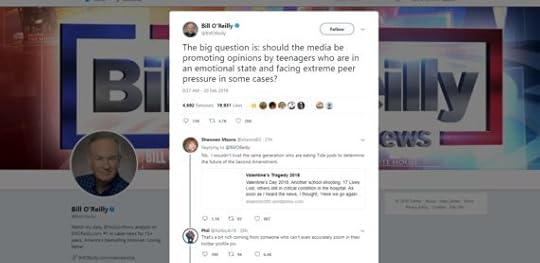
Bill O’Reilly knows best [not!]
Yes they should, Bill. You know why? Because what they have to offer is authentic and not scripted like the talking points you trotted out for years on your program from ideological hacks that you curried favor with, most of them politicians.Lastly, the main issue isn’t culture or mental illness. Listen to the students. The issue is guns.
Here’s some advice: if you’ve never lost a child suddenly and tragically and are like most—incapable of providing anything approximating empathy—then it’s all-too-easy to offer up Monday morning quarterbacking that’s wrong, useless, but extremely hurtful to those who are grieving and those who know something about grief and loss. How about just shutting up and letting those that know something (because they’ve earned that right through experience), speak.
February 13, 2018
Media’s Cock Roach
Living in Trump’s dystopian nation (if you haven’t ingested the Kool-Aid), sometimes you can forget that this American life sometimes delivers treats, too.
Last week, it was #InternationalClashDay. This afternoon, while listening to Maine Calling, hosted by Maine media vet, Jennifer Rooks, I found out it’s #WorldRadioDay. Hot damn! I love radio, so why not celebrate the hell out of the day? The verdict of Rooks and her guests was that radio’s still going strong and will continue to survive.
I grew up when you could still hear rock and roll on the AM dial. Now it’s the domain of conservative talk dirges and hosts positing an alternative version of America vastly different than the one I grew up in. Wanna’ make America great again? Flush Rush from the airwaves and play some music!
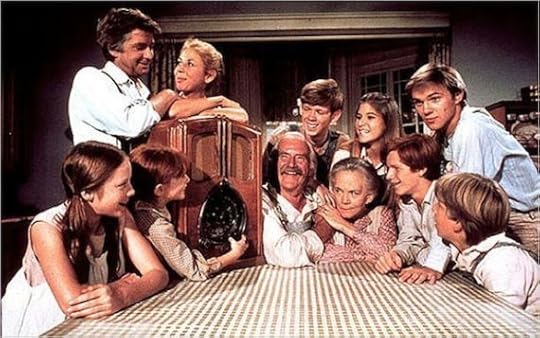
Happy families listen to the radio.
When I’m home and working, I stream music via several dial-based stations that I can’t pick up in Maine. This is one of the wonders of the internet and technology in my opinion. Here are my top four.
KEXP (Seattle, Washington)
WMFU (East Orange, New Jersey)
WMBR (Cambridge, Massachusetts)
WMPG (Portland, ME)
I can pull in WMPG’s signal on my stereo receiver and of course, in my car. I am a fan of their weekday afternoon “rock blocks,” especially Wednesday’s Radio Junk Drawer, with David Pence. More and more, I’m apt to be streaming KEXP most afternoons that aren’t Wednesday.
Both WMBR and WFMU archive all their shows (as does WMPG), and I have certain shows on their program schedule that I’ll seek out and listen after they’ve been broadcast.
One of Rooks’ guests (I think it was Paul Jacobs) called radio, a “cock roach media.” I loved this descriptor.
If you know anything about cockroaches, you know that they’re damned hard to exterminate. There’s a long-running meme that cock roaches would be able to withstand a nuclear blast. I guess that makes them the ideal mascot for our age, especially given our “supreme leader’s” itchy trigger finger.
I found a couple of articles online referencing “cock roach media,” here and here.
One of the points made towards the end of the show cited a study that apparently indicates that radio listeners are happier with radio than they are with Zuckerberg’s invention. I can see why that would be. Radio is easy, and if you avoid Rush Limbaugh, most broadcast radio brings enjoyment. If it doesn’t, you can simply visit another spot on the dial. The study I found, done in the UK, is somewhat dated. I’m guessing the results wouldn’t be much different if done today, in the U.S. But I might be wrong.
I’ll just keep on listening to the radio,radio.
February 7, 2018
Combat Rock
It’s difficult sitting here in 2018 Trumpworld, recalling how another hated politician spawned a musical revolution. But back in 1975, when Great Britain’s longest-serving post-WWII prime minister took office, the fury of the then-nascent punk scene hadn’t yet been funneled her way. Punks’ anger and rage found an able target in Margaret Thatcher just two years later.
Thatcher climbed atop her conservative perch, two years prior to the release of Never Mind the Bollocks, the Sex Pistols’ punk “shot heard round” the music world. Britain would never be the same, as Thatcher (much like Reagan in America), turned her attention to dismantling much of the country’s social infrastructure. And Trump seems hellbent on scrapping what remains of America’s.
While the Sex Pistols received the lion’s share of attention from the media for their outlandish “manners,” sneering frontman, Johnny Rotten, and McClaren-esque media savvy (not to mention their shot across the bow, “God Save the Queen”), it was a group of working class twenty-somethings from Brixton who embraced an incendiary ethic of rage, channeled through punk sensibilities and three-minute song structures, that would later evolve and incorporate reggae, rap, dub, and funk, demonstrating that punk could be more than three chords structures, played at breakneck speed.
The Clash were inspired by U.S. bands like the MC5 from Detroit, serving as the cultural arm of the White Panthers. In an interview with Clash frontman and founder, the late Joe Strummer, he told the interviewer that the Clash wanted to be “more like them, using our music as a loud voice of protest…” and he believed that punk in essence “should be protest music.”

#International Clash Day [the Clash, circa 1979]
And there was much to protest in Britain under Thatcher. With the nation’s postwar prosperity fading away, she used this as a pretext to cut social programs, which only amped up the poverty and social decay. As the economy tanked, skinheads began roaming the streets, looking to rough up (and worse) people of color. Racism and xenophobia were part of what was becoming an incendiary social scene in the once-great empire.The Clash hit the ground with the release of their debut record, The Clash, and songs like “Career Opportunities,” with lyrics like these:
They offered me the office, offered me the shop
They said I’d better take anything they’d got
Do you wanna make tea at the BBC?
Do you wanna be, do you really wanna be a cop?
Career opportunities are the ones that never knock
Every job they offer you is to keep you out the dock
Career opportunity, the ones that never knock
Strummer and his band mates headed to the U.S. in 1979, where the election of Reagan made for a “perfect storm,” and a new frontier where political malcontents armed with guitars and amps could introduce their British take on punk resistance to American audiences.
As Strummer recalled,
“Margaret Thatcher became Prime Minister of England and Ronald Reagan became President of the U.S….it was hard to tell who would be worse but we knew that a tremendous struggle was ahead…their tendencies leaned to the far-right if not fascism.”
I’m not naive enough to believe that in our fractured 21st century times, anything close to something like the Clash (and the Sex Pistols) might happen again, with music making a difference and shoving a stiv in the side of the establishment. Albums no longer matter, music-sharing services have made it such that musicians’ creative wares can be exploited by the lords at the top.
But, today is #International Clash Day, at least in select places around the world. KEXP, in Seattle, began this paean to the Clash, their music, and their values, back in 2013, and this marks the fifth year of a day being set aside to bands who mattered, or as critics and others wrote about the band during their heyday, “the only band that matters,” (actually, this was the CBS marketing slogan for the band). The city actually formally proclaimed this to be #International Clash Day. So did Austin, Texas (“The People’s Republic of Austin), Vancouver, BC, and a few others. All political oases in a growing sea of anger, and reactionary retreat.
Tune in, revel in the sentiment and spirit of the Clash and their music (and sincere politics at the time), and maybe, just maybe, some of that might seep out and counter some of the doom and hopelessness rampant in a country under siege, or as another favorite band of mine, X, once sang, a “Country At War.”