Jim Baumer's Blog, page 16
November 26, 2018
Writing Newsletters
Thanksgiving’s gift of an extended respite was a welcome one. No tutoring, insurance, and only one chance to sub at a nearby high school.
I read, tag-teamed in the kitchen with my better half on some amazing plant-based meals rooted in simplicity: I had my evenings free, which has been rare since September. Thursday, we drove into Maine’s snowy western mountain region for time with Mary’s family.
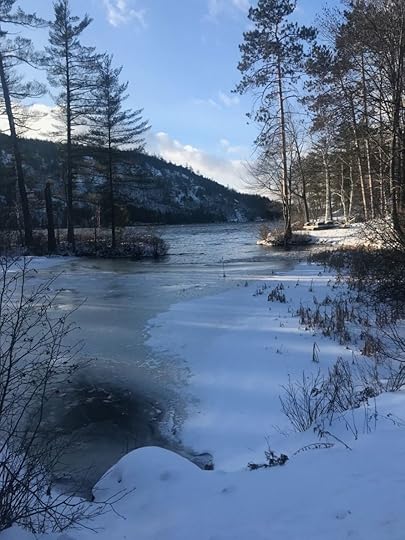
Western Mountain splendor.
Grief is “a process.” The idea of grief proceeding neatly through “five stages” has been imposed upon those grieving, thanks to Elizabeth Kubler-Ross. Fifty years ago, she described a progression of emotional states experienced by terminally ill patients after receiving their diagnosis. Because of her “theory,” those who mourn are often inflicted by well-meaning people with the belief that we should be “getting over” our sadness and loss. If it were only as simplistic as passing through five stages.
I’m not going to debate the veracity of Kubler-Ross’s framework. Others have already done that. But Mary and I know better than most that grief doesn’t proceed in an orderly fashion, even if some wish it would. Grieving people will always mourn the loss of someone special and loved, like we loved Mark.
I’ve spent a portion of my Thanksgiving break creating an end-of-the-year newsletter for the Mark Baumer Sustainability Fund. This is a throwback exercise I’m used to as a writer. It’s akin to crafting an article in many respects. Much more involved than puking out brain farts on Twitter like The Orange Menace does. My decision to deactivate my Facebook account was a wise one. I keep social media at an arms-length, much preferring former habits developed back in the early 2000s when I took Stephen King at his word and committed to the craft of being a writer.
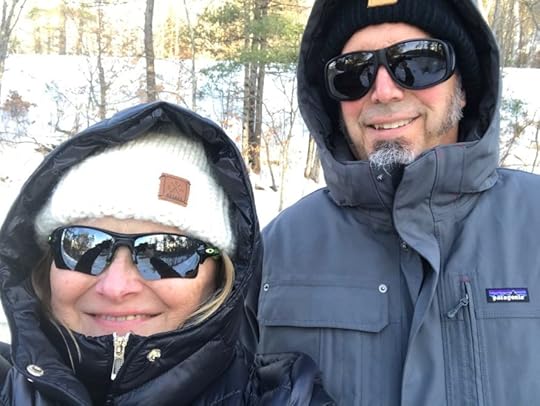
Nearly 40 years together and it never gets old.
The nonprofit foundation we launched to honor Mark’s memory and mission is committed to raising awareness about the planet, promoting social justice, and engaging with under-served populations directly, with a goal of promoting community renewal. If you are one of the 360+ people who our occasional newsletters then you know about the organizations we’ve decided to fund at the tail-end of 2018. Sea Change Yoga is one of them, as is Growing to Give.
We’re also working with two more nonprofit partners to finalize details of awards we’ll be making to them. If you aren’t on our email list and would like to receive updates, signing-up is as easy as filling in your email and clicking. When you do, you’ll automatically receive our latest one, delivered with care to your inbox.
Mary and I are again moving through the second (difficult) season of memories that often threaten to overwhelm: the holidays of Thanksgiving and Christmas, as well as Mark’s birthday on December 19, not to mention the approach of the second anniversary of his death in January. Sometimes it all seems like all-too-much to handle.
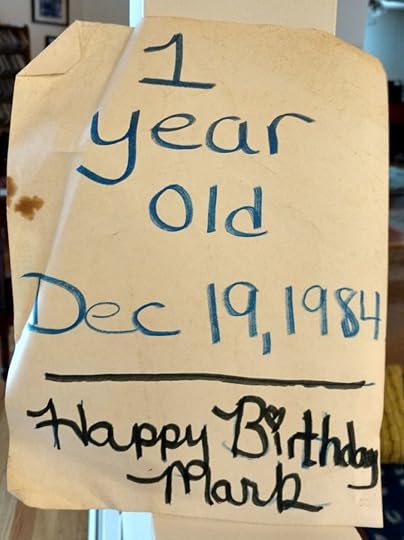
In a season of difficult anniversaries.
We’re grateful to our small coterie of special friends. Two in particular: Paul Scalzone and Dave Craig, have come alongside us and provided board support above-and-beyond what we anticipated when we asked them to join with us at the start of 2018.
Family members have stepped up, too. We just spent a really special Thanksgiving in Bryant Pond with family and their extended family members. The place will forever be known as “Providence,” a geographical space infused with memories of Mark dating back to his days at Wheaton. I’m sure I’ll have more to share about new developments about this in the future.
I never know who stumbles upon the blog. Because of this, I always like to encourage people to visit the website of Mark’s foundation. Whether you simply would like to learn more about Mark’s amazing, but all-too-short life, or about our ongoing work—maybe you’re looking for a place to make and end-of-the-year donation, or become a monthly supporter of our work to honor Mark’s memory and mission: the foundation site is always one worth bookmarking.
There’s a bonus of sorts, I think, from being engaged in the work of maintaining a foundation in our son’s memory. The work forces Mary and me to push through merely being sad and focus on doing good for others. It helps infuse us with some hope and creating something positive in a world desperate for meaning and purpose. I believe Mark would have wanted that for us.
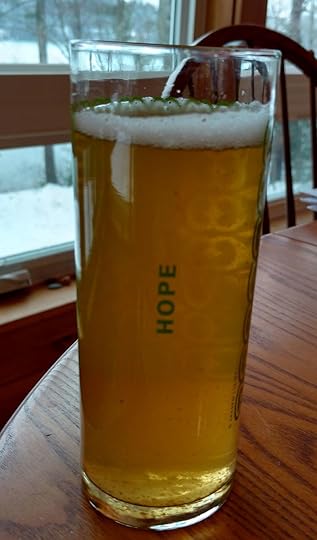
Still finding hope in Mark Baumer
It never gets easier, but putting together the final newsletter in 2018 (while looking out towards 2019), I couldn’t help but feel Mark would be smiling down on us, especially given our two new partnerships: one focused on the healing power of yoga and the other, committed to nourishing the Earth. These were values he embodied and modeled for us right up to the final moments of his life.


November 21, 2018
Save the Turkeys
It’s a given that every year, a week or two prior to Thanksgiving, there will be a host of stories related to food safety and the traditional turkey dinner. Inevitably, salmonella will be the villain. These stories are always framed in terms of “proper handling” and cooking your bird for a set amount of time at a certain temperature (to kill what’s most likely to affect humans consuming contaminated holiday-associated foods).

Proper handling of your Thanksgiving turkey. (NY Times Cooking)
Of course, if you’ve been paying attention, you’ll know that industrial meat (and poultry) manufacturing in America is one hot mess. Not even addressing the compassion angle about cruelty to animals, large, factory-farming operations are breeding grounds for disease and contamination. But why face reality when it comes to meat and poultry consumption? Let’s simply wing it when it comes to cooking ole’ Tom Turkey and hope for the best.
Just a year ago, there was an outbreak of the common bacterial disease that affects the intestinal tract. Salmonella bacteria typically live in animal and human intestines and are shed through feces. Humans become infected most frequently through contaminated water or food. The outbreak linked to raw turkey products, which began in California in 2017, has now spread across 35 states and sickened 164 people.
When I was still eating animal products, I believed somehow that chicken and turkey (white meat) was healthier. The reason I believed that was due to the clever marketing done by the poultry industry and their lobbyists. It was supposedly leaner and better for me as a carnivore. That was a lie, but like most Americans, being a duped consumer was part of my red, white, and blue DNA.
Only when I decided to forego meat and dairy back in the fall of 2016 after visiting Mark for the final time, was I able to I begin deprogramming myself from a lifetime of lies about meat, especially poultry products. This was when I began “digging into” Michael Greger’s How Not to Die: Discover the Foods Scientifically Proven to Prevent and Reverse Disease, a gift Mark had given us the Christmas prior. Of course, wearing my meat necklace at the time, I let the book sit on the shelf, gathering dust. Once I began reading, however, the element that hit me the hardest was his scientific take down of chicken. On page 92 of the book, he writes that eating chickens, not their eggs, “is actually the most common source of Salmonella poisoning.” Yummy!
If you think that poultry producers care about consumers, think again. Another particularly virulent strain of bacteria was unleashed on poultry-eating Americans in 2013. Foster Farms, the sixth-largest poultry manufacturer in the U.S. was responsible for a Salmomella outbreak that lasted from March 2013 to July 2014. What caused this long duration? Well, Foster Farms continuing churning out contaminated chicken “despite repeated warnings from the CDC.”
But I know you’re thinking, “this is an isolated case. Of course. Denial knows know bounds when it comes to glossing over the truth. From a well-documented article on Greger’s NutritionFacts website, we learn this:
Every year the Centers for Disease Control and Prevention tests the U.S. retail meat supply for the presence of fecal bacteria. When consumers think of manure in ground meat, hamburger comes to mind, but the latest survey found only 7 out of 10 samples of beef positive for E. coli , compared to more like 9 out of 10 samples of turkey, including the type blamed for human urinary tract infections. Turkey also had the highest contamination rates for Enterococcus faecalis and multidrug resistant Enteroccocus faecium .
Want a bit more “stuffing” to go with your turkey this Thankgiving? This is from Pew, another fact-based watchdog. But given that we are now living in the age of “the art of lying,” unleashed upon us by our obfuscator-in-chief, who gives a damn about veracity?
Contaminated meat and poultry products are responsible for an estimated 2 million illnesses in the United States each year. Significant health care costs arise from these infections: Estimates reach nearly $2.5 billion for cases linked to poultry, $1.9 billion for pork, and $1.4 billion for beef. From 2005 to 2015, potential contamination with one of three pathogens— Salmonella , Listeria monocytogenes , or Shiga toxin-producing E. coli —led to recalls representing about half of the roughly 425 million pounds of meat and poultry products removed from the marketplace for any reason.
According to Pew’s Sandra Eskin, who is the director of their safe food project:
“An effective food safety system includes measures to prevent contamination at every step along the meat and poultry supply chain,” said Eskin. “More can and should be done on farms and feedlots.”
More can (and should) be done, but it won’t. Why? Are you paying any attention to the administration of the Orange Menace? It’s staffed by industry hacks and others who don’t give a damn about safety when it comes to food or anything else for that matter.
Food safety shouldn’t be an ideological thing, but it is. This president has politicized everything—even Thanksgiving and whether or not your turkey dinner won’t make you sick, or worse.
I’ll stick to my vegetables and vegan mashed potatoes, thank you! You can have my share of turkey. [Although, I just learned that you need to avoid romaine lettuce: another reminder to “buy local.”-jb]
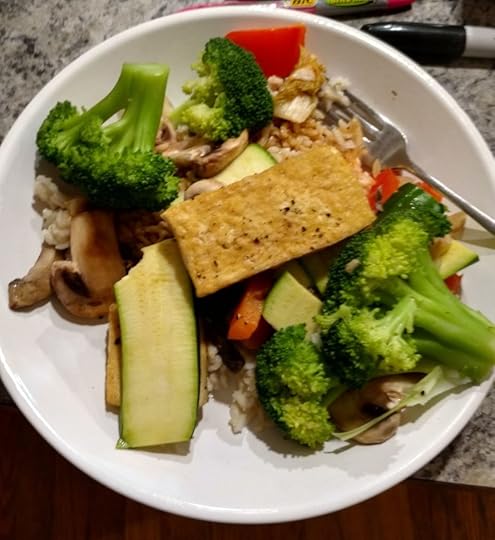
A plate of veggies and tofu is a safe bet.
November 16, 2018
Who is Wise?
Being wise was once considered a good thing. Wisdom is much more than simply “knowing a lot.” Some think that having “the ability to make sound judgments and choices based on experience” is another way of delineating who is wise and who is not.
Intelligence is more than a mere accumulation of facts. Gathering information is a good starting point. But what to do with that mountain of data? In most faith traditions, wisdom is lauded. Proverbs, a book in the Christian Bible, considers wisdom something that originates with God.

Socrates was wise.
I have been interested in the life of the mind for a long time. My quest to learn, often as an autodidact, dates back to a time in my early 30s when I realized I wasn’t that “sharp.” I began one summer to read. I’ve read voraciously ever since then.
During a key period in my life beginning in 2006, I had the good fortune to go to work for a brilliant man. Bryant Hoffman was also a good man: kind and thoughtful, too. He became an important figure in my life. He had his Ph.D. in English and had been a former college dean. He always deflected when I’d talk about this. He’d say, in he self-deprecating way that having an advanced degree didn’t make one deep, or particularly smart. In his case, I’d disagree. I had to work to keep up with things he’d toss off, facts about literary figures and Irish poets. He’d do this as naturally as most of us breathe.
I do believe he was onto something, though. Over the course of my time in the nonprofit world, when I was reading everything I could find on reinvention and personal growth, it was rare to find others who were doing the same. One so-called leader who had a prominent role in the LePage administration, once boasted that “I don’t read at all.” Not something to brag about in my way of seeing the world, but he didn’t think twice about sharing this ignorance with others, as braggadocio.
In my own life, most of my disagreements have been with people who refuse to acknowledge facts. Most often, these individuals clung to a position: political, ideological, religious—with great fervor, but without any factual basis.
We are living at a time when ignorance is rewarded. There is no better example of this than the election of Donald Trump. He has been able to peddle lies and factually incorrect information to a group of people who don’t read, don’t want to read, and yet, think they are markedly smarter than anyone else. What are they basing their pride and lack of intellectual acuity on?
I was struck Wednesday morning to learn that one of Maine’s senators thinks his constituents are below him, and that our wishes and votes don’t matter to him. He refuses to acknowledge Maine’s voting system that citizens of the state have voted for and ratified. That would be Bruce Poliquin. I like to call him “ole tree growth,” because I’ve never forgotten what a weasel he is, dating back to this time as the treasurer for the State of Maine. Back then, he wanted to skirt paying taxes on his palatial estate in Georgetown. He managed to make it work by manipulating the state’s tree growth regulations.
As I’ve written here at the JBE, I had my political differences with the late senator, John McCain. We didn’t see eye-to-eye on a lot of matters, left and right. But I also respected him and was saddened when he died.
I’ve also remembered that McCain was a reader. I recall him being interviewed, most likely on CSPAN’s Book TV, talking about the books he was reading. I was pleased to find this reading list of his. Pretty remarkable in my opinion, with several books I haven’t read (yet), and need to.
Wisdom, honesty, remaining oriented towards upholding the rule of law. These are three things that matter to me. They are part of the values I work at practicing in my own life. I’m saddened that so-called leaders fall far short on modeling these same things.
Spending most of my week working with teenagers in high school (and sometimes, middle schoolers), I wonder about holding them accountable for things that our president regularly refuses to practice. How can you demand honesty in students when the leader of the country isn’t honest? I don’t have an answer for that one. Do you?
November 11, 2018
Doomed to Repitition
I’m a bit early on my post that touches on Veterans Day. For most, I think it’s become just another holiday on the calendar that some don’t have to go to work for.
Time as a unit of measure marches on. This passage—known to those who study it as “history”—is too often ignored. Worse, men (and women) who ought to know better, dismiss it as mere dates, names, and numbers.
We know the quote, attributed to George Santayana, about ignoring our past. People love to quote it, and yet, those very same people—often learned and well-educated in a formal sense—rarely take the time to read and ruminate on the foundation that our nation, our ideals, and our form of government rests upon.
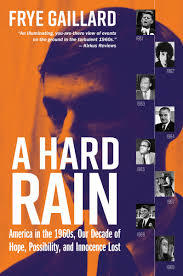
Books like this one expand our understanding of the past.
I spent a portion of October reading a splendid book about the 1960s. Southern historian Frye Galliard’s, A Hard Rain: America in the 1960s, Our Decade of Hope, Possibility, and Innocence Lost, offers an expansive unfolding of the time and key figures and events that framed one of our country’s most significant, and equally tumultuous decades. It took Galliard, a gifted historian nearly 700 pages to create this historical snapshot. He easily could have gone on I’m sure, but even at that length, the book is longer than most people are willing to sit with, even something so significant. It’s really too bad because I thought it was readable in a way that longer, historical tomes are often, not.
Tomorrow will be Veteran’s Day. This weekend, our ahistorical president, oblivious and ignorant to the symbolism and significance of the ending of World War I, performed like a petulant adult-child. This Orange Menace, who occupies our presidency, exhibited a truculence that was disrespectful to the country of France, his hosts, and he also was a sorry surrogate for Americans who remember the events of that horrible war, even if it was experienced during a long-ago history class in school. The president also demonstrated total disdain for the solemnity of Armistice Day, nor the memories of those who gave the ultimate sacrifice in a war where more than 16 million soldiers and civilians perished. It’s quite likely he didn’t even know what Armistice Day is.
We are living during a time of Twitter and truncation, so devoting several hundred pages to a subject that has the potential to broaden (rather than contract) understanding and the intellect is frowned upon. Is it any surprise that we find ourselves in the midst of our current crisis? It isn’t to me and I’m sure, it’s not to others who know the past and continue seeking to broaden their understanding.
As some say, “stupid is as stupid does.” Our ignorance as a nation and a people continues to find an able character to serve as our stand-in. Donald Trump would always be the perfect choice down at Central Casting to serve as the leader of an ignorant, historically illiterate amalgamation of citizens calling themselves “Americans.”
I know it will only get worse. History shows it to be so.
November 8, 2018
Moving Past the Midterm
I am a progressive, politically. I’m fine with the label, “radical,” also. There’s a tie-in to the late historian, Howard Zinn on the latter point. Zinn was a man who I admired and I’m glad Mark and got to hear him speak at Bates College one year during his Wheaton years, when he was home for Thanksgiving.
Tuesday’s election results are being interpreted in a myriad manner of ways. Much of the parsing of the final tallies of voter’s choices land along a narrow ideological divide. While certainly someone who can be called a “partisan,” Ari Melber’s trenchant analysis on MSNBC nailed it, IMHO. Spin it however you want: it was a historic night!
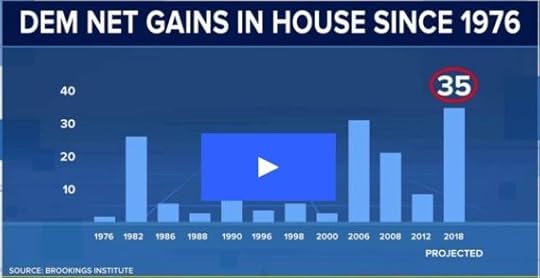
Tuesday was a historic night for Democrats.
For those deniers of “blue waves” or believers who thought Beto might win in Texas, a state redder than a ripe tomato, Wednesday morning delivered disappointment. If you were hoping for something less—simply restoring some check on the Orange-Menace-in-Chief—then you might be okay with the outcome. Of course, being the narcissist that he is, The Trumpinator made his push for Republicans what some were calling “a referendum.” As he told one reporter, “In a sense, I am on the ticket,” said The Donald following one of his rallies.
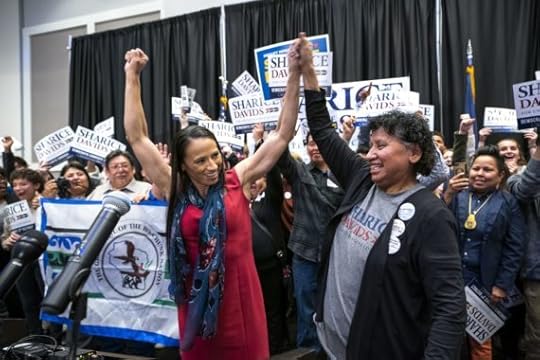
Sharice Davids, left, celebrates with mother, Tuesday night. (Jim Lo Scalzo photo)
Looking at some of these results and catching today’s Democracy Now broadcast with Amy Goodman, I’m quite pleased that there was a definite hue of diversity coloring Tuesday’s Democratic victories in the House of Representatives. Here’s a snapshot of some key elements and significant changes inherent in Tuesday’s results:
At least 100 women will be serving in the U.S. House for the first time in U.S. history.
Two Native American women (Sharice Davids and Deb Haaland) were elected for the first time.
Rashida Tlaib and Ilhan Omar are the first two Muslim women elected to Congress.
With their net gain of 30 House seats, Democrats now have veto power, again.
A majority of House committees and subcommittees will now be controlled by progressives: The Progressive Caucus will have about 90 members.
These results are not insignificant given Republican gerrymandering. Oh, and don’t forget that the party of Trump are masters of voter suppression.
President Trump wasted no time on Wednesday, firing embattle Attorney General, Jeff Sessions. He replaced him with a party loyalist and someone who surely is there to protect the president, rather than the rule of law.
The Senate remains firmly in Republican hands. Those of us who despise this club for geriatric white males, nothing significant has changed. We’ll still have to stomach Mitch McConnell and his partisan diatribes that get passed off by right-wingers as leadership.

“How Dare You Challenge Me,” says The Orange Demagogue to Jim Acosta, continuing his assault on the media. (The Guardian video)
The president also continued to wage war on the media. This time, it was CNN’s Jim Acosta, who was the target. The lesson continues to be, if you don’t flatter the pathological liar occupying the presidency, you’ll certainly be singled out for a tirade of some sort.
Sycophants who follow him might want to seek out a copy of Orwell’s 1984. I realize I’m engaging in fantasy, because nothing will deter their blind loyalty to the worst sort of demagogue.
October 31, 2018
What I Know
On Saturday I’ll be holding another one of my Publishing 101 Boot Camps. This one will be in Oakland, hosted by Mid-Maine Regional Adult Community Education.
The last time I held one of these intensive sessions was in 2013. The setting was also adult education, in Lewiston. I had a group of 10 to 11 students who wanted to learn from someone who actually knew how to take a book idea from start to finish. That would be me, author of four books, and someone with credits of books published on my own, as well as helping other authors bring their projects to market.
My world in 2013 was a different one than where I find myself in 2018. The biggest difference is that Mark is no longer around to confer with and share some of my thoughts with, as well as voice any frustration during preparation.
Publishing according to Jim Baumer
The guide I created in 2013 was one Mark laid out for me. Looking it over, it’s weathered the passage of time (at least the five years since I last handed it out) very well. There are a few things that need updating, but they are minimal.
This time, I can’t send changes to Mark in Providence via email. I’m going to have to figure out how to edit the PDF file on my own. I’m in the midst of completing that task this morning. This afternoon, I’ll be in front of seniors at another Medicare seminar. Tonight, I’ll be tutoring.
An email came across the transom this morning. A friend mentioned the loss of a mentor and the grief that accompanies that.
His note reminded me of my own grief in 2015 when a mentor of mine left this world. I think much of my own sense of being adrift during the months leading up to Mark’s death was actually a carryover from that event and things dating all the way back to 2012, when I was forced to move on from something I was really good at. Losing my son simply compounded what I was already experiencing, but exponentially.
Spending time the past few days reviewing my notes and reading through my original PowerPoint and other resources—all of them developed personally, from experience with trial and error as a publisher—has been oddly comforting. I might even say it’s offered something to tether to that’s been absent.
The past few weeks have offered something independent from the previous period of time dating back to January 21, 2017 when my life changed forever. I have been reminded of the reservoir of resilience that resides within. I knew it was there but drawing from it lately has felt different than when the pain of loss and the accompanying grief was so intense.
October 30, 2018
When Presidents Can’t Hear
Our demagogue-in-chief has landed in Pittsburgh, despite being asked by leaders of both the city and Jewish communities to stay away. He refused to heed their request.
My late son, Mark Baumer, said everything that needed to be said about our president, the day before he would be killed along a highway in rural Florida. I don’t have anything to add because Mark nailed it in foreshadowing who Trump would turn out to be as a leader, the day that our president was being sworn-in as the 45th president of the United States. To say he’s been divisive is understatement at its best.
I quote:
“We now officially have a president,” said Mark, “that does not believe in climate change. He wants the world to burn so he can profit. We have a president who hates women, who discriminates against women, who physically abuses women. We have a president who hates minorities, who wants to make minorities suffer. we have a president who hates disabled people, who doesn’t want to help people when they are in need. All he wants to do is profit. If you support this man, you do not support human life on this planet, plain and simple. You do not support the future of earth as a planet…”
I was reminded of this today, thinking about Textron coming to Maine, and this kind piece written by Steve Ahlquist the day after Mark was killed.
Choosing My Religion
Two weeks ago, the phone rang at 5:00 a.m. It was the automated call system that school districts now use in assigning substitute teachers when there are staff vacancies. I was being directed to report to a nearby junior high. I’d be covering 7th grade math. 90 minutes later, I was dressed and driving to my assignment.
I found out last year that tutoring was an amenable fit. It was more than that—I actually enjoyed working with youth and the assortment of experiences across my life allowed me to bring some breadth to my nightly tasks at the private school located 10 minutes away.
Last spring, I initiated an inquiry to my local school district about the possibility of subbing. It was near the end of the school year so getting started was impractical at the time. I made a note to follow-up during the summer. Then, I was off on my road trip and returned with issues related to my SI joint. Substitute teaching ended up on the back burner.
Summers now have morphed into completing my CMS/AHIP certification for Medicare, at least that’s what most of August is now about for me. I did manage to complete the required paperwork for the municipal school district and turned it in. Just prior to the first day of school, I received a call to complete my final payroll forms. I made an executive decision to do the same at a neighboring RSU. Now I’m on the roster for two school systems. I have the option of working daily if I want.
I am busy again and have been since the beginning of the school year. So far, my high water mark has been three sub assignments in a week. Not once have I regretted my decision or any assignment. Inevitably, there will always be a student or two who is determined to challenge a substitute. Somewhere along the line I must have picked-up some classroom management skills.

I’m enjoying being a substitute teacher.
During the current stretch of Medicare seminars, I’m also offering one of my publishing boot camps on Saturday. As a result, I’ve been forced to put my time in front of the classroom on hold. I still tutor five days a week, but this stretch has been a bit busier than I care for. I’m looking forward to saying “yes” to my automated calls, soon.
The day I went to the junior high also happened to be our first brutally-cold one. There had been a frost, and the wind was howling. I was smart to drop my winter hat and gloves into my backpack because I’d end up having outdoor duty just prior to lunch. I think it’s a great idea to have students get some fresh air and be able to run around a bit during the school day.
When I made it inside, the teacher-in-charge directed me to a section of the cafeteria where I’d be camped-out and supervising about 25-30 students eating lunch and then, directing them to bus and clean their own lunch tables. My how school has changed since I was in junior high. Back then, we left the lunch room where we ate in disarray, or that’s how I remember it.
My section happened to have 6th graders. While they were an enthusiastic group, I was impressed at how easy it was to obtain their cooperation when I asked them to begin picking up their table and to take a cleaning cloth and wipe it down.
A pack of young boys caught my attention. They were a bit rambunctious, not in a bad way, but the way the young boys will be boys when at 12 or 13, sitting still isn’t their favorite thing to do.
When I came over and asked them to finish eating and begin picking up, one of them asked me, “do you want to join our religion?” What a question. I chuckled.
“What religion is that? I asked.
I was told they made it up. One of them showed me one of their identifiers, what I would best describe as being a “safe” sign in baseball. I told them that. They thought it was funny. Another one of the boys showed me their symbol, a rudimentary drawing on the back of his hand. It was basically a circle or a line through it. This took me back a spell to my own middle school years. I doubt that any religious imagery or symbol lacking the Pope’s imprimatur would have been sanctioned and approved in the house where I grew up. I’m sure it would have caused an argument, or worse. Perhaps this young man is keeping his evangelism under wraps, hidden from his parents.

Max Muncy: part of a new religion? (Robert Hanshiro photo/USA Today via Reuters
“I’m not very religious,” I told them. I did share with them I’d been an umpire and demonstrated the “punch out” that home plate umpires use on a called third strike. Of course, they all had to show me their own impression. This made me laugh and for me in my life post-Mark, laughter is welcome.
As I got ready to dismiss them, I came over and said to them, “My young brothas: it’s time to leave.” They got such a charge out of that. “He called us young brothers,” one of them said, and they all laughed and boisterously exited the lunchroom.
I saw them later in the hall and I gave them the “safe” sign. They laughed again.
Seeing some of the World Series over the weekend, I couldn’t help thinking of my “young brothers” in from 6th grade. I’m looking forward to returning to check-in on their progress.
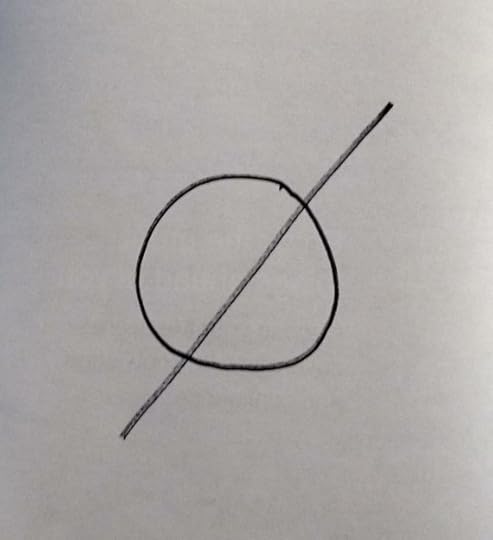
Signaling something new, perhaps.
October 28, 2018
A Different Kind of Candidate
Cynicism is a default that lends cover for some. Rather than risk being wrong, or having their hopes smashed, the position is an easier one to adopt, especially paired with a smug demeanor, allowing an attitude of being “above it all.” I know this all too well because I run to that place more than I care to admit. I’m also big enough to admit that I’m wrong when I do.
I don’t want to come down too hard on those who have opted-out of the political process. Our current political milieu breeds cynicism in batches. Politicians pander to it and keep it well-fed. Is hope even possible at this time? Are we delusional to harbor it?
On Friday, I visited Hyde School in Bath for their seventh annual Maine Youth Leadership Day. For the purposes of full disclosure, I tutor at Hyde five nights a week. This is my second year. I rarely participate in the daytime activities, though. I wouldn’t have been there on Friday if one of my fellow tutors hadn’t encouraged me to attend and mentioned that U.S. Senate candidate Zak Ringelstein would be there.
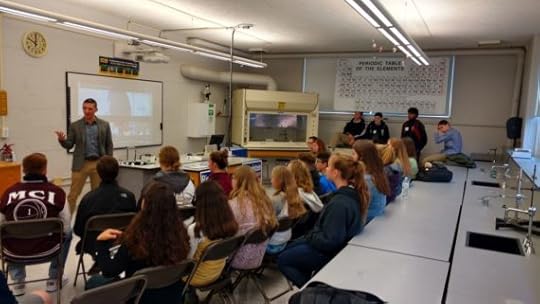
Zak Ringelstein with students at Hyde’s Youth Leadership Day.
At last year’s event, Travis Mills was the morning keynote. The young man I spent most of last year working with each night was enthralled by Mills, a true American hero, and his message. I knew that the day was a big event at Hyde and that they attract presenters worth showing up for.
This year, well over 1,200 students attended. These are youth committed to being leaders in their communities, who come along with faculty and other mentors. There were upwards of 50 schools there from across the state.
I am in the throes of Medicare’s AEP window. This week and next is filled with seminars. I actually had an appointment scheduled with a beneficiary later in the morning, but I decided to make the short drive to the school and catch the first workshop of the day. It happened to be the one that Ringelstein was facilitating. I am glad I went.
If the Boomers have run America into the ditch, then the Millennials will need to be the ones to set things right, or at least point us in a more favorable direction. The optimist that battles my cynical side wants to believe that.
According to Ringelstein, if he were to beat incumbent Angus King, he’d be the first Millennial elected to the Senate. Right now, there are only a handful of Millennials in the entire Congress. I was amazed by that statement. Of course, anytime I see a group of senators, like during the Kavanaugh travesty, it’s almost always a group of white, male seniors doing all the talking. If you surveyed a list of senators based on age, you’d find that nearly a third of them are between the age of 70 and 85. Pass whatever judgment you want on that factoid. For me, that’s too old. According to others, there’s agreement.
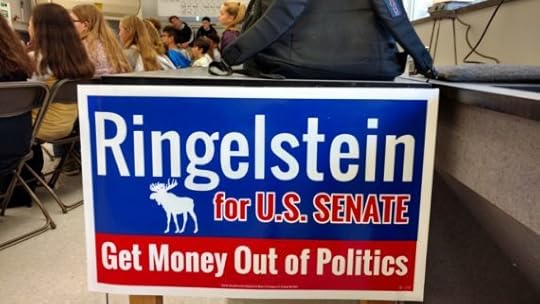
Zak Ringelstein for U.S. Senate
Ringelstein believes that big money taints our political process. He has refused all contributions from corporations and lobbyists, including PAC funding. Senator King on the other hand is in the opposite camp.
King’s image of being a political independent is carefully cultivated. A closer look at recent positions since he’s been senator show that King’s voted for deregulating banks, and finance, insurance, and real estate are his largest contributors. He’s also approved three-quarters of President Trump’s nominees and has voted with the president 47 percent of the time. If you care to look back further into King’s pre-Senate political past, this older article in The Bollard by the inimitable Crash Barry tells you plenty about King and whether a progressive should vote for what could certainly be characterized as the types of insider politics that breed cynicism.
Like his predecessor Olympia Snowe, King skates by with a certain political goodwill that’s unwarranted. It’s the kind of free pass that’s unearned.
Ringelstein is working-class to the core. His father was a social worker. In many ways, his background and positions put him in a class with House candidate, Alexandria Ocasio-Cortez of New York. Both are similar politically, both running as Democrats, even if their party would prefer that they go away. Ocasio-Cortez shocked the world of politics when she beat 10-term incumbent, Joe Crowley, in New York’s June Democratic primary election with no support from corporate Democrats. Her win proved that running an issue-oriented campaign targeting those issues that resonate with most middle and working-class voters can be victorious.
Will Ringelstein win? The pundits would say, “no.” But in Maine, a state on the cutting edge of electoral politics given that we now have Instant Run-off Voting (IRV), it’s now possible for candidates like Ringelstein to have a chance against well-funded incumbents. And like Ocasio-Cortez, he’s received nearly nothing from the state’s party machine.
Being there in-person, watching him an environment he’s familiar with (he’s a former teacher), sharing what he’s passionate about with what is hopefully Maine’s and our nation’s future leaders made me happy that I’d already cast my vote for him when I voted absentee, two weeks ago. I’m hoping that others will do the same on Election Day.
A recent New York Times article indicated that Ringelstein’s generation “thinks American capitalism does not work.” He believes that the system has “fostered inequality, robbed young people of opportunity, and perverted the values of a just society. His positions and his belief in taking steps towards “being the change we want” reminded me so much of my late son, Mark. It’s what he was engaged in during what was to be his final act, walking across America. If they’d have had a chance to meet, I know they would have had a lot to talk about.
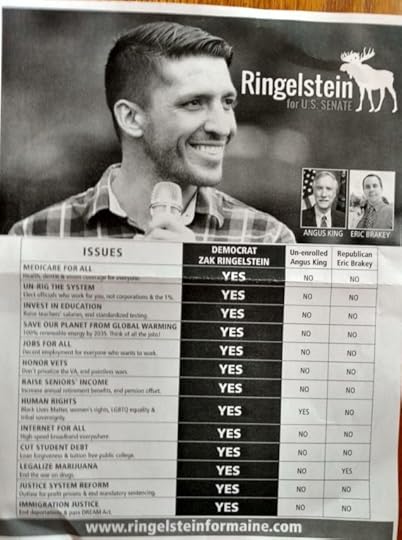
Senate candidate Zac Ringelstein on the issues.
October 26, 2018
Speaking in Public
An amalgamation of skills acquired across a lifetime continues to intrigue and also puzzle me. My skill set offers surprises, too. Where did it come from? Were there models in my life that I emulated that led me to them?
Public speaking is a primary one. My evolution as a speaker was a gradual one. I never envisioned when I was in my late teens or early 20s that I’d become someone who would eventually speak before a myriad of groups, and deliver a host of disparate topics, mainly after the age of 40.
When I was a player attending classes mainly to maintain my spot on the Maine Black Bears fall baseball roster and so I could pitch for John Winkin, I enrolled in Public Speaking 101. The class of primarily freshman and sophomores—most of whom dreaded getting up to speak—offered me that first taste of the thrill that I’ve always experienced standing before a group, and the sense of power inherent in being able to do that. While most people equate speaking in public with fear, cold sweats, and ostracism, I was learning back in 1980 that this skill was a valuable one to have in your back pocket.
At 18, I wasn’t committed to my craft. I simply chose a topic and basically got up and riffed on a few things I knew, threw in a joke or two, and thought I was something special. I wasn’t. What allowed me to pull this off back then was some belief I managed to summon from somewhere. I believed I could do it.
At Hyles-Anderson, preaching was required from time to time. I remember flying home to Maine in 1983 to visit family and being asked by the pastor at my home church to preach at Sunday night service. I think I preached on hell. Not a topic that wins friends and influences people. I spent a week preparing for that one.
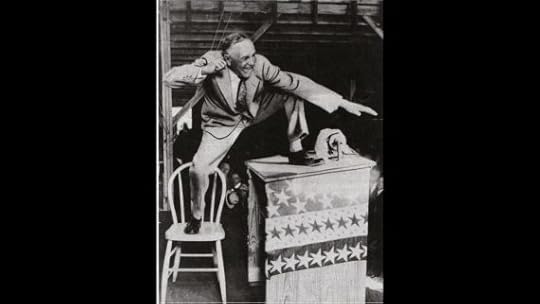
I could have been this guy.
After washing out with God and Jack Hyles and coming back to Maine, I rarely had occasion to speak in public. I do remember a few instances while working for one of Maine’s largest power utilities, standing up in a meeting, or confronting management across the table during union negotiations—I was a shop steward at the time in Local #1837 of the International Brotherhood of Electrical Workers. I was summoning the skills I had, but had done little to build and improve upon since my college days.
For seven years beginning in 2006, I traveled across the southern half of the state, speaking about workforce development and the importance of training a vibrant, 21st century cohort of workers in Maine. I was a regular on the Rotary circuit, in front of local Chambers of Commerce, in front of HR leaders at yearly conferences at The Samoset in Rockport, and any other place where I could find an audience. I ended up spearheaded an initiative called WorkReady. I ended up giving my own “state of the state’s workforce” address in 2012 right before I got “kicked to the curb” because Maine elected a thick-headed governor who thought he knew more than anyone else (but didn’t). I then gathered up my public speaking and the important ancillary and complimentary skills of facilitation into the realm of advocacy for people with disabilities, seniors staying in their homes, and local economic development.
This was the period of time when I got serious about my craft. I wanted to get better at it, even though I had some talent and experience. I read books about delivery, pacing, and mannerisms that hold people’s attention. I was committed to personal improvement. I haven’t even touched on the countless talks I’ve given about local town team baseball related to my first book. Then of course, there’s “the Moxie years” and my two books about the distinctly-different soft drink rooted in New England and its rabid cult of followers.
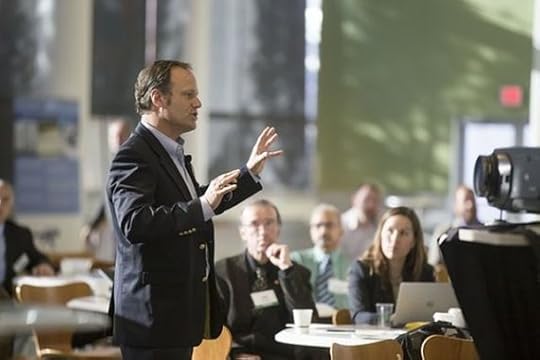
I think I’m more like this guy.
An opportunity to sell Medicare insurance came along in the fall of 2017. Because I was confident in my ability to stand before an audience of strangers and represent my chosen topic with confidence, capability, and cultivate a connection with those in the room, I chose to roll out “The ABCs of Medicare” as a means of marketing the Medicare Advantage plans I had in my portfolio.
This week, I’ve presented three Medicare seminars. I have two more next week. I’m writing business this AEP, unlike last year, which was my first rodeo with Medicare’s open enrollment season that runs from mid-October to early December.
Taking that public speaking class at Orono turns out to be a fortuitous choice. I didn’t know that nearly 40 years ago, and the generous returns it would yield down through the years. I anticipate that will continue in settings I don’t even know about.