Jim Baumer's Blog, page 12
June 3, 2019
Countering Contempt
I’ve heard Arthur C. Brooks before. I apparently didn’t pay close enough attention.
Perhaps I saw that he was president of a think tank that tilted away from my ideological proclivities. Or, like often happens in life when you first encounter something that will later possess greater meaning—you pass on it once, or several times.
Book TV, which broadcasts on C-Span 2 each weekend, is what the network bills as “television for serious readers.” It’s 48 hours of nonfiction books and authors discussing their works. For someone like me who gravitates towards that genre, it’s a place I usually end up at some point each week.
After Words is a feature where one author interviews another nonfiction writer about a book they’ve written and it usually has a thematic orientation. This week, Senator Ben Sasse (R-Nebraska) interviewed his friend Arthur C. Brooks about his latest book, Love Your Enemies: How Decent People Can Save America from the Culture of Contempt. Actually, I think the show was taped earlier and likely, I was viewing the rebroadcast.
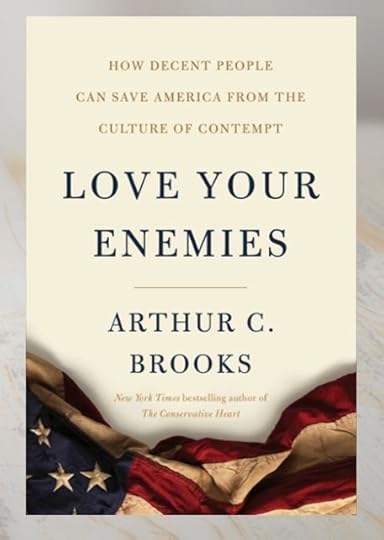
Arthur C. Brooks’ new book about countering contempt.
It was interesting that Sasse, a member of a party that cultivates the culture of contempt that Brooks posits we need salvation from. The Democratic party isn’t above reproach in this realm, either. I do know that Sasse is a different kind of Republican and whenever I’ve had the opportunity to hear him being interviewed, he’s impressed me as a man with integrity and who probably is a compassionate conservative, a term that offered hope when coined by George W. Bush during his first term.
Brooks is a compelling speaker and it’s obvious when you listen to him that he has a broad intellect. His bio demonstrates he’s no slouch and while I’m not often a fan of libertarianism (Brooks self-identifies as libertarian), I decided to spend time listening to most of the hour-long interview.
Brooks was a globally-renowned musician who then left orchestral music to pursue a Ph.D and an academic career. He’s a behavioral scientist who is often cited for his studies in happiness. Two of his books have been national bestsellers.
Anger and contempt are prevalent in our politics in the U.S. Contempt—a conviction that someone (usually someone on the “other side” from you, politically or ideologically) is utterly worthless. Brooks characterized it as a mix of anger and disgust, what he said is “kind of like ammonia and bleach.” It’s a toxic emotional mixture for sure.
I am anxious to read Brooks’ latest book. I’m also intrigued by some of the other elements he spoke about, especially how it’s possible to break our “addiction” to social media and the way it promotes this type of contempt. Also, countering contempt doesn’t mean we have “roll over” and agree with things we find disagreeable. The key, according to Brooks is to “disagree better, not less.”
Interestingly, I’m signed up for a USM summer session course related to social media ethics and privacy. I think Brooks and his latest book aligns nicely with that.
I plan to return to Brooks these ideas over the summer.


May 29, 2019
The Tutor
After the interminable summer of 2017—a summer oppressively sad following a major loss—I ended up taking a position: I would be tutoring youth at a nearby private school. Since it was 10 minutes from my house in Brunswick, the location seemed right. It was at night, so I had my days to be down and depressed (or in theory, be able to write).
I told the academic dean who hired me “the story.” I let him know that I couldn’t commit to anything long-term. Amazingly, he was okay with that. That was the extent of what I could handle at that moment in my life.
On my third night, I ended up paired with a young man who needed help with statistics. I hadn’t done statistics since I’d been taking night school classes during my CMP days in the mid-1990s. Somehow, I remembered enough to provide some help to my protégé.
He was back the following night. The two of us became a team, an academic Odd Couple of sorts. Over the remainder of the 2017-18 school term, we worked on English, History, and fortunately for me—he dropped statistics. The person supervising the night Guided Study program asked me if I’d want to work with Billy as a one-on-one assignment. Since I had nothing better to do with my evenings, I agreed.
An interesting thing happened for me, and I’m guessing for Billy, too. We found a place of commonality. He was a football player and later, during the winter, I learned he was an amazing wrestler. As a former coach, I guess I provided some mentoring structure in addition to the tutoring support I offered.
Billy learned differently. I picked up on cues by paying attention. I re-ordered some of my own ideas about pedagogy.
We read an amazing novel together, The Book Thief. It was the assigned selection in his English class. I’d learn later that Billy was dyslexic. Somehow, I figured out that reading aloud, taking turns, worked for him.
He loved offering his opinions on politics. He wasn’t scared away when I suggested that you could take a more leftward tack than he was used to. I assumed his father was conservative, politically, from what Billy told me and in the way he parsed his thoughts on government.
Weeks turned into months. Billy was in a post-grad year at the school and would be graduating in May. The final two weeks prior to graduation, he had to prepare to deliver a 90-second speech. Every senior receiving their diploma had to give one. Now a minute-and-a-half isn’t long, but I contend that the nature of the short address is misleading and often more difficult than a longer presentation. We developed a strategy and a contingency plan, too.
I’m still “poking the box.” [Seth Godin]
When he gave it, I knew he’d flubbed one line. I’d prepared him for this and my advice was to keep going. He did. I’d told him that the only two people who knew he’d made a mistake would be him and me. I was right. His family members were amazed. They didn’t think Billy would ever be giving a speech at graduation, especially one with a family joke, and an easy delivery.So many things about this random pairing are now obvious and there seemed to be a certain serendipity in how I managed to get matched-up with Billy. I contend to this day that I got more from our time together than he did. His parents probably disagree. They would tell me at graduation that I had as much to do with his graduating as anyone at this school that has attracted many high-profile students, including the children of Hollywood celebrities and musical heavy-hitters to the 19th century mansion and walled grounds sitting just off High Street in Bath.
Billy just completed his first year at a technical college in Boston. His mother reports that overall, it’s been a positive stretch. She texted me that she wished I lived closer so that I could tutor him a few days a week.
This year my role was remarkably different. I was put me in charge of the night-time academic study period for students who often didn’t want to study. Some of the 25 or so youth I was responsible for matching with other tutors didn’t want to be there. At times, I wasn’t sure I wanted to finish out the year. It’s hard to “fight” with students night after nigh and always be the “bad cop.” I didn’t get to tutor as much as last year, but I still managed to work with a few students. One of them got expelled. I hope what I told him his final night stays with him.
This evening will be our final night together. On Monday evening, I presented a book on leadership to a student who had been the source of aggravation. Jason and I butted heads numerous times. I’d also managed to garner some modicum of reluctant respect from a tough student who is graduating on Saturday.
He was touched that I’d given him a book. I told him I expected him to take a few things from the book over the summer and apply them to his life. He thanked me.
A few of the tutors have been with me since September of 2018. I don’t know if I’ll see them again after tonight. One of them gave me good advice this fall before he returned to France. He told me to “be gentle,” and not get too stressed. It was good advice. I tried to remember it during the time he was gone, when each night felt like triage because we were woefully short on tutors.
Some of last year’s tutors didn’t come back this fall. One of them died over the summer. He was about Mark’s age. Our two Bowdoin students who were amazing graduated last weekend. I’m sure they’ll go on to do big things. They’ll never know the impact they had on the students. They also reminded me of my son more often than not.
I don’t know what I’ll be doing next to supplement my writing, but I am grateful that I fell into tutoring. The gig reminded me that I’ve picked up a few things along my journey through life. Some of my advice even borders on wisdom these days. Amazingly, there’s even value in it for the youth of today.
May 19, 2019
Something Other Than Writing/Anyone Can Play Guitar
Spring speaks to certain sense of rebirth—at least in places like Maine where inhabitants are forced to endure the bleakness that inevitably comes during winter. When life gets reduced to finding a way forward post-tragedy, then any extension of hope can serve as a stand-in for a talisman.
Writing as a central element dates back to 2002 for me. That’s when, in a job that I hated, I latched onto cultivating my craft as a writer. I wanted to become a writer and I was willing to put the work in.
After Mark was killed, writing was all I had to sort through the randomness and pain that a tragic death like his delivers to the father left behind. I initiated the process of using narrative as a tool to find a few shards of meaning from the randomness of what I’d been dealt.
For two years I’ve written and rearranged words in an effort to craft a story centered in grief and loss. I recognize that none of it provided much solace for the emotional agony I’ve been feeling. In fact, like has happened countless times over the past 17 years of writing, editorial arbiters either ignored my writing, or sent back notes that served as the publishing world’s version of the “thanks but no thanks” notice of rejection.
I’ve wanted to be a guitar player for as far back as I can remember. My memory transports me back to weekly visits to a department store in Lewiston’s downtown shopping district where I recall staring at a cheap knock-off guitar and practice amp hanging on the wall. My parents didn’t buy it for me. I was 10-years-old and learning what the Rolling Stones sang about, as in “you can’t always get what you want.”
It wouldn’t be until Mark was a baby and I was working at a prison in Indiana that I finally acquired a guitar. The ad on a bulletin board for what turned out to be a beat-up copy of the classic Gibson Les Paul offered something new to me. This first six-string only set me back $25, which at that time strained our very tight household budget. A cassette boom box served a dual purpose and became my amplifier. A classmate at the Purdue satellite campus where I was taking classes taught me a few chords. I could barely form them, but I began coaxing a few semi-melodic squawks from my instrument.
Often, someone formative in our lives tells us something that isn’t true, but it stays with us. Their motives might not even be pure, yet we internalize the falsehood. With guitars, it was a friend (he later became my best man) who for whatever reason didn’t want me to play guitar, or at least play as well as he did. In high school when he was working on his chops, I had baseball and things he didn’t. He had his guitar so apparently it became important that he convince me that “my hands were too big,” and other lies.
Decades later, I realize that he wasn’t much of a friend. Yet for years after high school, his words still lived in my head.
When we moved back home to Maine after our years in Indiana, the guitar came with us. I added a small Gorilla practice amp. My friend was home for a short visit. We got together to play guitar at his parent’s house in my former hometown. At least that’s what I thought we were doing. He played a Pixies’ song. I asked him to show me the chord progression. He got pissed at me because I was “strumming the chords” and the session devolved from there. For him, it was another chance to tell me that I couldn’t play guitar.
I don’t remember what happened to my first electric. Later, I picked up a decent Yamaha acoustic that I still own. I eventually bought my first decent electric guitar. It was a Mexican-made strat popular with some of the indie band I was a fan of during the mid-1990s, like Polvo. That cheaper foreign labor meant that my new strat cost $300 bucks less than the classic Fender version. I did score a vintage Fender tube amp though. Later, I sold both of them to finance a trip to Los Angeles where Mark was living in 2008. I don’t regret the sale and I surely treasure those California memories, now.
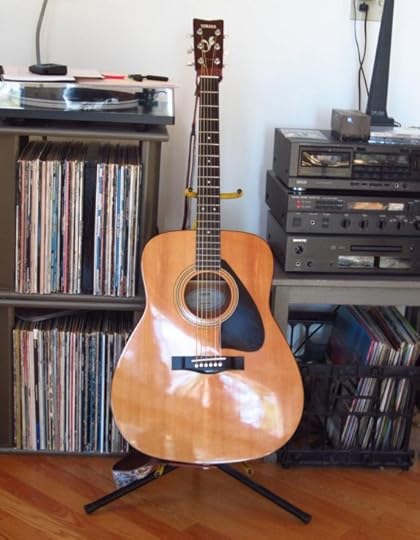
My trusty Yamaha acoustic.
Prior to selling the electric and my amp, I was playing as regularly as I’d ever done. I could play along with some songs on the stereo by bands like the Drive-By Truckers, Neil Young, and Teenage Fanclub. I felt like I was finally progressing as a player: still not very good but learning new things. I was a better player than I’d ever been.
Then, in 2001, 9/11 prompted Mary and I to briefly fall back into the God trap. Because I knew some chords and had a guitar, I was asked to lead a small worship/Bible group at the Vineyard church we were attending. I even got to get up in front of the congregation from time-to-time on Sunday nights with the worship band.
Writing has always pushed my guitar into the background. I’d made a commitment to the writing craft. Having put in the requisite time (see Malcolm Gladwell’s 10,000-hour rule), no one could ever tell me I wasn’t a writer. Once-in-awhile I’d dust off my guitar case, pull out my Yamaha and strum a few chords imagining what might happen if I actually gave a parallel commitment to my guitar that I gave to my writing. Then, back into the case it would go to sit for months, or even years.
When Mark was killed and we spent nearly every other weekend in Providence, I left my guitar with his housemate. I think I hoped to get rid of it. William left it behind when he moved to Vermont and I tossed the case in the backseat and brought it back to Maine with the remnants of Mark’s life.
Last summer, I decided it was time to pick-up the guitar again. I signed up for lessons with an experienced musician that were being offered through the local adult ed. Then, my SI joint fritzed out. Being unable to sit for more than 10 minutes made playing the guitar (or doing anything else, save for swimming) impossible.
At the end of the summer, I opened up the case that housed my acoustic. I spread some of the resource materials I’d acquired from the lessons I didn’t get to fully embrace over the summer across my kitchen table. I started to play some chords. I surprised myself in that I knew more progressions than I thought I did. I knew my E, F, C, G, Em, and A chords and didn’t have to think about my finger positions. I also remembered most of my barre positions, too. Maybe I wasn’t as bad as my “friend” had convinced me that I’d always be when it came to cradling a guitar.
Starting this fall, I set a goal to play every day. More often than not, I’d find 15, 20, or even an hour’s worth of time to play. I started watching YouTube videos of some other experienced guitar player teaching a song, or conducting full-blown lessons. One of these online gurus offered this piece advice about practice: frequency over duration. That resonated with me. Instead of trying to jam for two hours on the weekend after not playing for a week or longer, finding a few blocks of time each day seemed to work. Often, I’ll spend 30 to 45 minutes before I head out to tutor to go through a few songs and practice my scales.
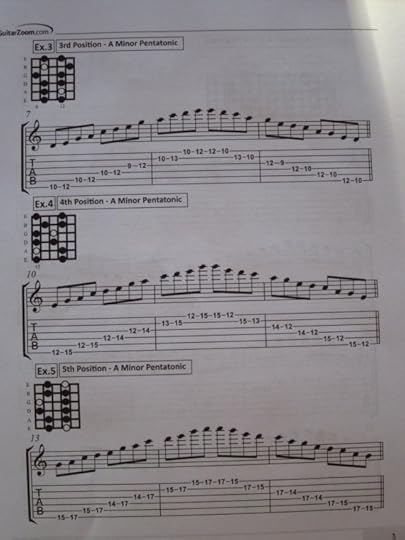
Practicing pentatonics.
Last week, I realized that I actually understood what a longtime guitar teacher named Steve Stine was holding court about chord theory and I-IV-V progressions via his online videos. You’ll never hear me play and say about me, “this guy’s amazing.” But I’m actually making weekly progress as a player.
In the past, I would think about playing the guitar, but would dismiss actually doing it to write, or work on a blog post. I think I feared if I didn’t write every single day that somehow, I’d forget how to write.
I have no idea where my guitar playing will go or if it will ever result in me doing anything more than playing at home. I do know that I’m finding it meaningful. In fact, it’s the first activity since Mark was killed that consistently brings me some joy. Often, if my day is feeling “shitty,” I’ll take out my guitar, tune it, and start playing. I always feel better.

On my guitar wish list.
By accident, I’ve discovered that my guitar offers something that writing and most people don’t. Sitting there on the stand, or resting in its case, waiting to be picked up and played, my guitar gently speaks to me, offering enjoyment and something more.
May 7, 2019
Racing in the Streets
A rainy spring it’s been. Everyone knows the adage that “April showers bring May flowers.” But weeks of rain and little or no sun drags down one’s spirit, no matter how hopeful your view of the future remains.
Early last week, Mary and I began counting down the days. We were anticipating yet another trip south related to our son’s death. We watched local weather and even Boston-area weather (via NECN) to determine—would it rain on Sunday?
It rained and the day was cold and raw. Nearly 50 people—all members of Team Every Mile Yeah—turned out for the Providence Rhode Races. They ran and some walked. Our group was arrayed in green t-shirts that Mary arranged to have produced for the event.
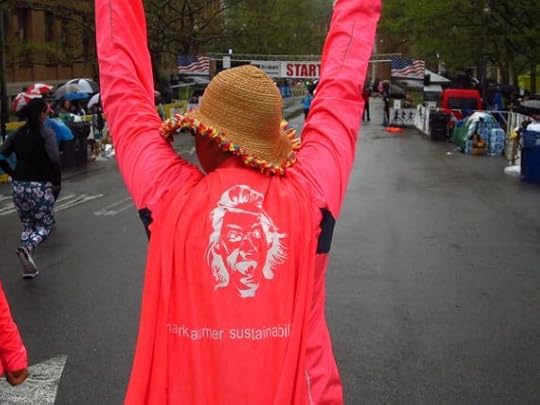
Mary and cape prior to the start of the Providence Rhode Race 5K.
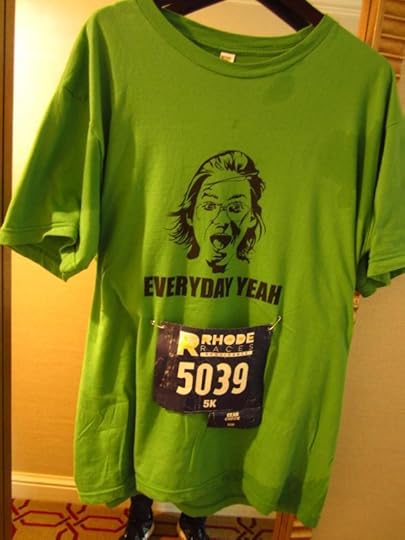
Green shirt drying out from the rain
Family drove down from Maine. Friends from the earliest days of Mary’s life rode buses and trains to Providence. Ironmen from Minnesota who had let Mark into their world of localized competition came from Boston, New York City, Washington, DC, and San Antonio to run in Mark’s memory and support our efforts to hold an event that also connected with the foundation we began: The Mark Baumer Sustainability Fund.
As I was walking a sort of rear guard action during the 5K walk that our small family contingent made together, I was flooded with memories of Mark and me in the place he’d adopted as his home. Not only did he find his niche in the city, Providence welcomed him and adopted him, too. One thing the two of us never got to do was walk down the middle of Memorial Boulevard, sans traffic.
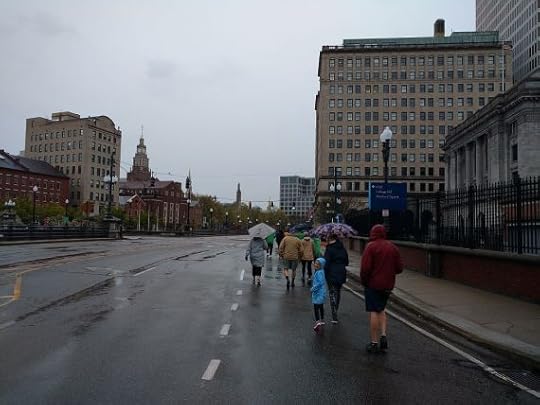
These streets were made for walking.
Mary and I spent Saturday with a special group of people who joined us first at Mark’s garden in front of the John D. Rockefeller Jr. Library at Brown. That’s where the Eastern Redbud was planted in Mark’s memory during the fall of 2017. There’s also a plaque commemorating his life. The group then walked, drove, or Ubered to Federal Hill and dinner at Trattoria Zooma. Somehow, they managed to accommodate our crowd just like they told Mary that they would.
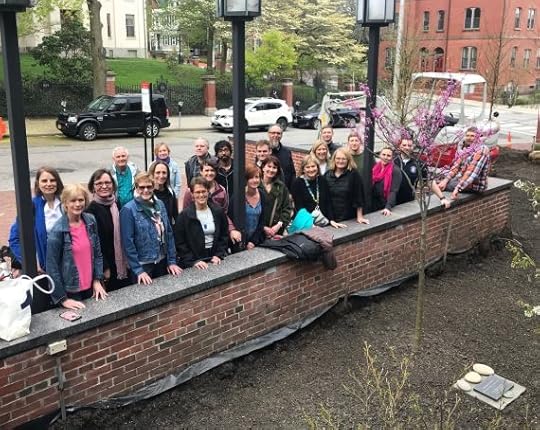
Most of Team Every Mile Yeah (Mark’s Garden-Brown University)
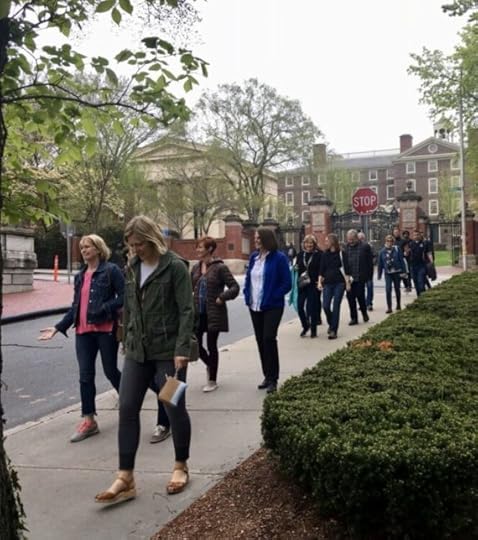
Marching for Mark (heading to Trattoria Zooma)
Afterwards, Mary and I walked back to the Omni where we were staying. Saturday night in Providence, the place filled with memories of Mark.
Sunday was gray, wet, and cold—just like the weather people said it would be. Thousands of runners were there for purposes other than Mark’s memory. Providence is actually a popular qualifying race for anyone hoping to run Boston’s storied Patriot’s Day marathon. The course is a flat one and there were some world-class competitors making their way through the soaked streets and boulevards of Providence and beyond.
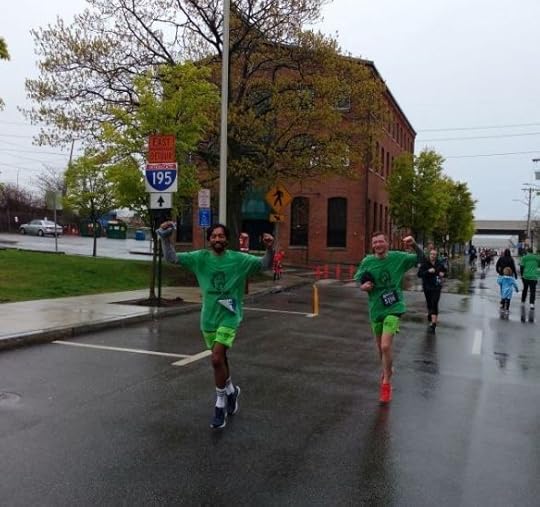
The Ironmen, Samson and Alex, running for Mark.
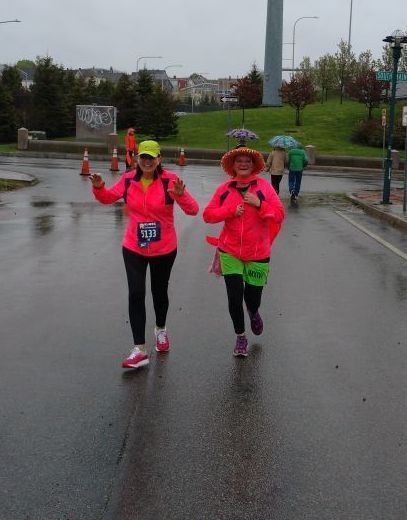
Two SheJAMs’ friends
Memories haunt and even afflict us when a loved one is gone. But memories are what we’re left with.
Mary’s mom would often say at family gatherings, “remember the happy times.” I would often dismiss this as another one of her overly-optimistic sayings. It holds import these days, as I do remember those times.
Thanks to everyone who came out this weekend for Mark and the Mark Baumer Sustainability Fund. Mary and I were honored and also, humbled by your presence.
I’d be remiss if I didn’t acknowledge Mary, Mark’s mom. She organized all the logistics. All I had to do is show up. She’s like that and has been for as long as I’ve known her.
The weekend is now gone. File it under memories and happy times.
May 2, 2019
Great American Novels
I finally read The Great Gatsby. It was shorter than I expected it to be and I read it in less than a day.
A former friend (I have lots of these) who reads very little, was fond of referencing F. Scott Fitzgerald’s “Great American Novel,” like a talisman of sorts. It made her appear urbane and well-read—neither of these were actual qualities that she possesses.
I have been tutoring at a school where most of the students don’t care at all about academics. I wage futile battles with my charges to get them to put their phones down and do schoolwork, nightly.
I’ll refrain from being overly critical: the school is close and the pay is great for part-time work. It’s at night, too, so I have my days free to write and be creative. Oh, and there is the additional perk of having an old-fashioned library full of books like The Great Gatsby. None of the students ever take them down off the shelves and look them over, either. They’re too busy Snapchatting or playing with their phones.
Last Friday night, Turner Classic Movies ran the 1974 Robert Redford version of the movie adapted from Fitzgerald’s classic. Here’s some “inside Hollywood” for you about the film: the script for this 1974 big screen adaptation was actually re-written by Francis Ford Coppola, after the original script by Truman Capote was rejected by director Jack Clayton.
Coppola remembers that he spent weeks locking in a Paris hotel room, an ocean away from the hype attending his own breakout Hollywood tour-de-force, The Godfather. He told an interviewer that the “key to cracking the script” for him was simply reading Fitzgerald.
The movie turned out to be enjoyable. I vowed I’d finally get the book and read it.
Monday night, I found six copies of The Great Gatsby waiting for me at the end of the night. I planned to take it home and return it. I didn’t expect to read into the wee hours and then finish it the following day.
The novel still seems very relevant in terms of class and privilege. Despite technology taking over our lives, most humans are still basically the same shitty creatures they’ve been from time immemorial.
I’ll save the synopsis. They abound across the interwebs.
I’ll briefly share this, though. Jay Gatsby was a man of means. He’d once been dirt poor. We never know for sure where his obscene wealth came from. The educated assessment from the narrative is that some of it was derived from gambling and bootlegging. Also, Daisy Buchanan is simply insufferable—what did Gatsby ever see in her?
People are always happy to ride on the coattails of others, especially if food, entertainment, and other perks are provided by someone else. Gatsby’s parties had become the stuff of legend on Long Island. Anyone who was someone wanted to be seen there, as did many people that could be best described as “poseurs.”
[Spoiler Alert!!]
When Gatsby is shot and killed at the end of the novel (and movie), the task of arranging his funeral falls to his only friend, Nick Carraway. It could be argued that even Carraway was ambivalent about his relationship with his wealthy neighbor. He at least cared enough about Gatsby to mourn his death and handle the logistics of seeing his friend’s crossing from the land of the living to whatever constitutes “the other side,” which is death.
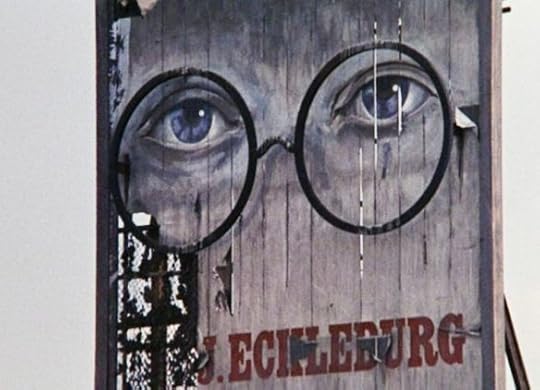
The Eyes-The Great Gatsby (1974)
This passage towards the end of the book, detailing Gatsby’s funeral resonated with me.
About five o’clock our procession of three cars reached the cemetery and stopped in a thick drizzle beside the gate–first a motor hearse, horribly black and wet, then Mr. Gatz and the minister and I in the limousine, and, a little later, four or five servants and the postman from West Egg in Gatsby’s station wagon, all wet to the skin. As we started through the gate into the cemetery I heard a car stop and then the sound of someone splashing after us over the soggy ground. I looked around. It was the man with owl-eyed glasses whom I had found marvelling over Gatsby’s books in the library one night three months before.
I’d never seen him since then. I don’t know how he knew about the funeral or even his name. The rain poured down his thick glasses and he took them off and wiped them to see the protecting canvas unrolled from Gatsby’s grave.
I tried to think about Gatsby then for a moment but he was already too far away and I could only remember, without resentment, that Daisy hadn’t sent a message or a flower. Dimly I heard someone murmur “Blessed are the dead that the rain falls on,” and then the owl-eyed man said “Amen to that,” in a brave voice.
We straggled down quickly through the rain to the cars. Owl-Eyes spoke to me by the gate.
“I couldn’t get to the house,” he remarked.
“Neither could anybody else.”
“Go on!” He started. “Why, my God! they used to go there by the hundreds.”
He took off his glasses and wiped them again outside and in.
“The poor son-of-a-bitch,” he said.
I’m sure people who came out to Gatsby’s palatial manse gossiped about him following his murder. Gossip seems to be the stuff that holds together what remains of our personal interactions. It’s probably always been that way.
They couldn’t be bothered to pay their respects after he was dead, however.
This wasn’t a fictional trope of Fitzgerald’s, either. It’s reality.
April 25, 2019
Democrats Plus One
Yesterday, the crowded field of Democrats grew by one. This morning, the pundits had more energy than I’ve seen in months. Amazingly, they were talking about someone other than Mayor Pete (still having trouble with “Boot-edge-edge”).
American culture is strewn with the iconic. In terms of popular culture—especially music and rock and roll—there are few icons bigger than Bruce Springsteen. Everyone knows what you’re talking about when you say, “The Boss.”
On our Easter Sunday drive into Maine’s western mountains, I had Springsteen on Spotify shuffle. I was holding court with Mary about why his music mattered and how we need to make a point of seeing him before he hangs up his Telecaster.
Yesterday, I had some late afternoon time to fill. Like I’ve done countless times before in my life with unstructured time, I ended up at a library looking for books.
Sitting on the shelf, calling my name was Peter Ames Carlin’s, Bruce. Not the only bio of The Boss, but one of the better ones, I’ve already read nearly 200 pages in less than 24 hours. Students at tutoring wanted to know what book I was toting around with me last night and I got to give them my own Springsteen story, of “Glory Days,” and what that song means in terms of my own smoldering baseball embers.
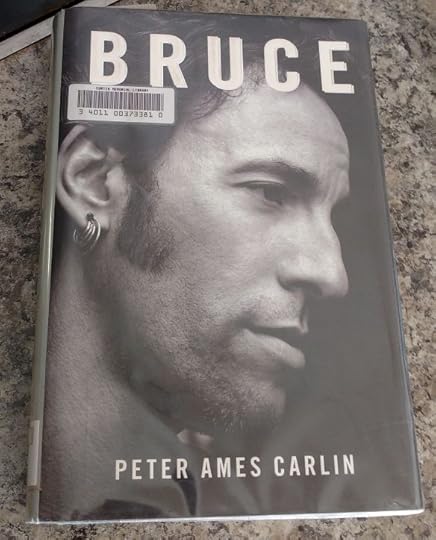
Bruce bio by Peter Ames Carlin (2012)
Joe Biden’s in the race. His launch commercial is a powerful one. He’s got a damn nice logo and graphics, too! Oh, and the president he served under as Veep stopped short of endorsing him, but he didn’t back away from “Ole’ Joe,” either.
If the presidential race in 2020 has a bellwether state, then it might be Pennsylvania. Biden plays as well as any Democrat in the race in the Keystone State. It’s where Trump won in 2016.
Biden was on the sidelines last time. He did endorse The Boss for president, though.
“The middle class would have the best chance with Springsteen,” Biden explained. “He understands issues facing working Americans.”
We all would have been better off with a rock star in office than the current Orange Menace.
Springsteen’s populist bent tilts back to another “man of the people” who lugged a guitar around with him. That would be Woody Guthrie, who also had his own, very clear thoughts on politics and the men (and women) who warbled that tune.
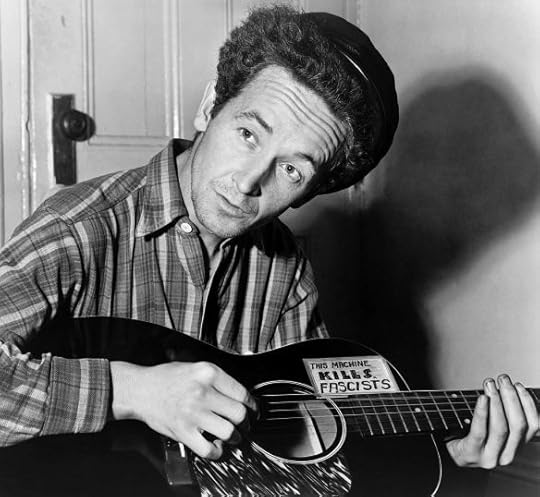
Woody Guthrie, populist troubadour.
Sing it, Bruce!
April 19, 2019
Good Friday Rockin’
For a lapsed Catholic like me, Good Friday will always be imbued with the following memory:
I think I was eight or nine-years-old and attending a Good Friday mass at the old Holy Family Church on Lisbon Street (across from the former location of Morse Brothers). Like most Good Friday marathons, this one involved way too much standing for a young boy.

A re-enactment of Jesus’ crucifixion.
At some point on that April Friday afternoon in what was likely 1970 or 1971, the room began to wobble and my legs felt like they wanted to give way. I didn’t know it at the time, I was close to passing out. Fortunately for me, I sat down in my pew. My mother looked over and under her breath, sternly barked, “stand-up Jimmy!!” No concern for my well-being, only that I maintain our holy facade. I looked at her with what were probably pleading eyes, and struggled back to my feet. Somehow, I managed to make it to the end of whatever torturous section of the “festivities” were in-progress.
If you’ve followed my post-Xian posts, you’ll know this experience wasn’t enough to disavow me of religion’s influence on my life. It would take Indiana and Jack Hyles to come close to finishing the job, and then, the Vineyard and Ralph Grover to finally nail that coffin shut on God and evangelicalism’s false promises (and premise).
They say that when you leave behind something as formative as religion, you should put something in place and begin new traditions. A substitute, of sorts.
Hearing “Good Friday” by Cleveland’s Death of Samantha played on this morning’s “Breakfast of Champions” slot on WMBR made me realize that rock and roll has become a more-than-sufficient stand-in for God in my life.
Here are two selections that fit perfectly from where I sit today on this non-religious holy day for me.
April 16, 2019
The Math of Living
I’m heading down the home stretch of what’s been an intense writing project. It’s rearranged my routines, including writing (like blogging), reading, and my usual Monday through Friday regimen. Then, I’ve also inherited additional assignment deadlines for my class, too. I’m very busy.
Speaking of routines (and rhythms): taking a few minutes every morning to read some poetry is a great way to start the day. I’m grateful to poetry.org for delivering a poem to my email inbox every morning.
As I mentioned, April is National Poetry Month. Because I’m keen to this block of 30 days where I’m a bit more focused on writing I don’t normally read enough of, I’ve tried to be more intentional in taking time to slow down enough each 24-hour sweep of the clock to let a poem or two wash over me.
Today’s spoke to me. Robin Coste Lewis captures life’s randomness, and the injustice inherent in living, especially if you aren’t one of the the “special” people that America seems to bless, while cursing many of the others.
I hope you’ll take a few minutes with this one.
Math
And then (at some point) as you step more vigilantly into the middle of your life, you begin to realize that they are all dead. Or more honestly (it takes even more years), you begin to realize that—perhaps—they are not all supposed to be dead. Or. You still remember. You can still feel yourself there. Standing. Knee-deep. In cement. A particular square on the sidewalk. There were dandelions. That odd, eternal sun. When a dear friend, your sister’s best-best friend—drives by—stops her car in the middle of the street. And then tells you. Screams out of her car window. And says it: your first beloved—that boy for whom you were slowly unfolding yourself from inside outward—that boy, whom you had yet to kiss, but would one day soon kiss certainly—that monumental boy, who smiled at you differently—that boy—had just been shot and killed. By strangers. Just for fun.
You are fourteen. And it is the beginning—it is the very first day—when the World confirms that new gleam of suspicion layered on the surface of the dark violet lake inside, that, Yes, slaughter is normal.
Slowly, over the years, you train yourself not to want this—you—a body in your bed with whom you can have a real conversation—a body with whom you can walk anywhere, talk anywhere, hear anywhere. At some point, you gave up expecting to be understood. English was too many red languages at once. And History was just a very small one—a ledger, and always in the black. You took out your sheerest sword. Your tongue: a sheath of arrows.
Perhaps, not by coincidence—once you began to trip around fifty’s maypole—you and your sister find together the courage to do the math: of all the boys whom you had known as children, at least eighty-percent were all either missing, in jail, or dead. Blood on the streets, bullets in the walls, the police always flying overhead. In your head. You thought it normal. When boys disappeared, were shot, killed, cuffed or thrown onto a black and white hood for simply walking down the sidewalk. Or asking merely: What have I done? Normal. As expected as the orange poppies, your quiet state flower, blossoming on the side of the streets year-round.
And then. Finally. You and I. Our bodies. Together. For a few hours: Time loves me. Every minute a gift so tender, each second announces itself. And then, just as quickly, equally: every second is stolen—erased—washed away—you. I understand, somehow, it will be another four years until I see you again. We walk through the night, arm and arm, across the wet sidewalk, and—besides my son—I am the happiest I have ever been with another person. But it is a silence. A happiness that rare. Unexpected. Quiet. And I wait. And wait. And no one shoots you afterward. Or. Maybe this night was God’s way of saying to me—finally: Yes, I do realize you exist. And this one night—just this one night—is all the complete happiness you can ever expect from Me.
Credit:
Copyright © 2019 by Robin Coste Lewis. Originally published in Poem-a-Day on April 16, 2019, by the Academy of American Poets.
About this Poem:
“I am grieving the collapse of honor, ethics, a generous morality. I am trying to understand my historical place in time. I feel intensely grateful that I was raised within an Old-World cultural practice, which believed deeply that there are no greater human commodities than integrity, respect, humility, and pleasure. I am growing increasingly suspicious that gratuitous violence is what it means primarily to be human. I am disappointed—in myself and in my species. I would like to go on loving forever. Every day that I remain alive is, for me, a true and mysterious gift.”
—Robin Coste Lewis
Author:
Robin Coste Lewis
Addendum:
Because I was so taken by the poem I referenced by Robin Coste Lewis, I went looking for an interview, or something touching on Lewis and her writing and life. I found it.
Here is a link to Commonplace: Conversations with Poets (and Other People), hosted by Rachel Zucker. I went to the trouble of curating content for you. Please honor that by doing your part, which is engaging with it. The episode begins at 2:20.
Lewis speaks about her work of offering a “historical corrective,”
Erasure
What’s “in the frame, and what’s outside the frame”
How do I know what I know and what I don’t know
Zucker (the podcast host) speaks of the power of Lewis’s writing and how it offers the promise of change, if you are willing to do the work necessary for transformation
Back to the notion of “curating content” for readers. I work at it. I don’t post here simply because I have nothing else to do. I offer things that I think matter, and they’re not your usual “paint-by-numbers” material that’s endemic in American culture, especially the mindless posting of links via Facebook or Twitter that requires very little effort and often (for me) feels oppressive.
April 14, 2019
Historical Site Critical Analysis-Maine State Museum
[The following is my Historical Site Critical Analysis for History 122, a class I’m currently enrolled in at the University of Southern Maine. My choice of a site was Augusta’s Maine State Museum. I visited the site on Saturday, March 23, 2019. –jb]
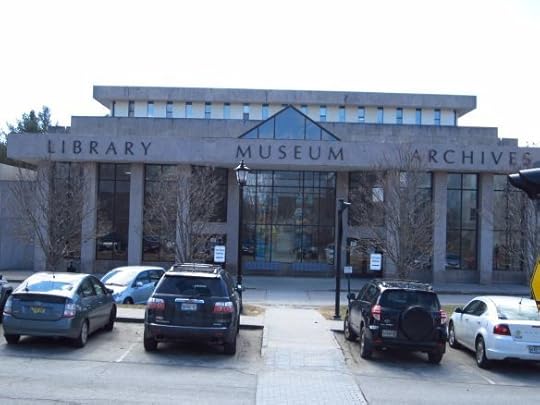
The Cultural Building in Augusta, which houses the Maine State Museum.
The Maine State Museum in Augusta is one of the oldest state-funded museums in the U.S. The state’s allocation to maintain the museum as recently as 2014 was $1.7 million, which covers 80 percent of the museum’s operating budget. However, this amount is miniscule compared to say a state museum like the New York State Museum, which receives more than $20 million in state-directed funds.
Welcome to the Maine State Museum.
From a document I located online prepared for the Maine State Legislature in 2015, the museum’s chief purpose as a museum and center for learning is to be “the state’s chief institution for presenting and sharing the cultural and natural heritage of Maine, especially in relation to the use of authentic objects.”
I chose to visit the museum on Saturday, March 23, because I’d learned that a new exhibit would be opening that day. Women’s Long Road—100 Years to the Vote, commenced the morning I visited. This, along with the Maine + Jewish: Two Centuries, were two of the museum’s rotating exhibits that change during the year. Both represented elements of 19th century American history, so they would be perfect for fulfilling requirements of this critical analysis.
Both of these “new” exhibits were hosted in large “rooms” on the 4th floor of the museum. The museum occupies a portion of a large structure known as the Cultural Building that also houses the Maine State Library (on the basement level), and the Maine State Archives.
The Maine State Museum is a self-directed museum. As someone who hasn’t visited the museum in more than a decade, I found access and direction to be confusing. I considered the signage upon entry to be lacking. For instance, I had to ask where the exhibit on women’s suffrage was before being directed to the fourth floor, where there were posters on the wall. The Jewish exhibit was also on the museum’s 4th floor.
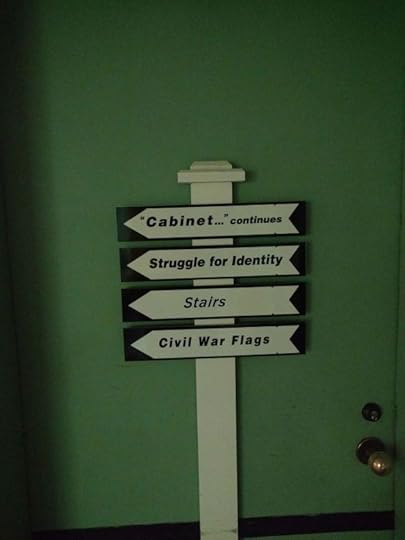
Signs directing visitors around the Maine State Museum.
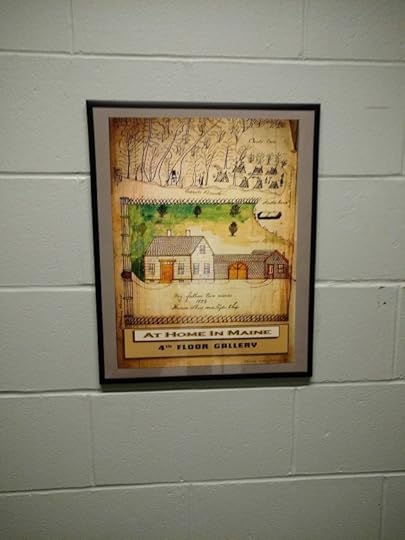
More Maine State Museum signage.
Reading the text placards around the room of the Women’s Long Road exhibit was interesting. The material was well-presented in the form of historically-oriented placards. For instance, I learned that Maine’s first constitution in 1820, answered the question on “who should vote?” It was strictly for men. According to the placard, the U.S. Constitution had left this privilege up to the states. It would be another 100 years before women in Maine has the right to vote.
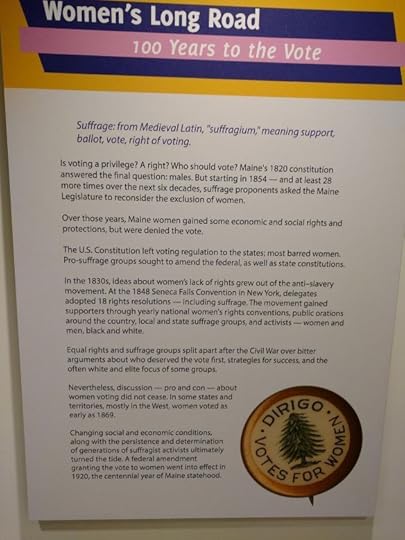
Maine women fought for 100 years for the right to vote.
From our class reading and discussions, my assessment would be that the exhibit did a good job of highlighting elements that we’d talked about: for instance, many of the “movers and shakers” in Maine’s push for women’s right to vote were white women of privilege and means. This was born out from the various photographs, artifacts, and a generous sampling of documents displayed. I liked how Maine’s story was juxtaposed with similar national artifacts showing the parallel track of Maine’s effort with what was taking place across the country.
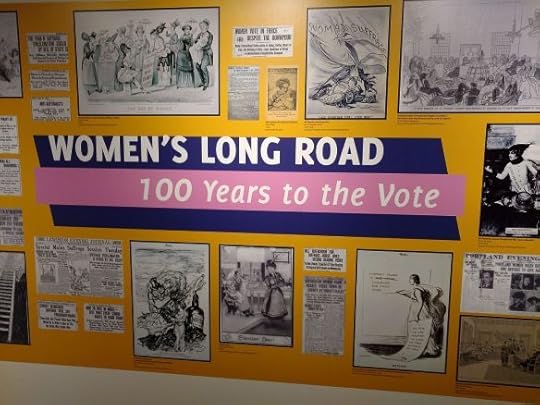
Maine’s battle paralleled that of women across the country.
Not knowing much about Maine’s Jewish community, I learned that Jewish immigrants settled in Portland and Bangor in the early-1800s. I also learned that in Portland and Bath that there were attempts to convert Jews to Christianity in the 1840s.
Like the women’s suffrage exhibit, the Maine + Jewish exhibit utilized a substantial room, with photos, placards, and other artifacts strategically-placed, to take visitors around the space in an organized manner. I think the photos and captions helped pull me towards certain elements. I’m guessing it would be similar for most others who visited the museum.

Maine + Jewish exhibit, Maine State Museum.
One particular exhibit I enjoyed was about a man named Jacob Etcowitz who was called “The Potato King of Maine.” Etcowitz’s father, Louis, settled in Fort Kent, at the northern tip of the state, in 1803. No one knows for sure why the family chose a location a good five hours (today) from Portland. The museum had a short video created by the great-grandson of Etcowitz.
The Potato King of Maine from The Forward on Vimeo.
Josh Nathan-Kazis is a writer for The Forward (formerly, the Jewish Daily Forward) and he’d traveled north to Fort Kent to find out about his relative. His video, which he narrated was fascinating. It was also one of several ways that the museum has incorporated technology and video into telling the story of the past. I think this is a nice touch, given that the museum does cater to school groups and youth, a key demographic among its visitor groups. Videos could be accessed via iPads.
As an adult, Jake Etcowitz built a potato business, a garage, he sold cars, he owned parts of the telephone company and movie theater: he was truly an entrepreneur. Nathan-Kazis highlights how Jake always wore a three-piece suit, like he was conducting business in the midst of a large urban area, like New York City. Nathan-Kazis details the importance of Jake’s Jewish heritage and religious faith. Apparently, Jake had even built a mikvah, a Jewish ritual bath, in his house.
There were a number of ongoing exhibits that I found somewhat troubling.
The At Home in Maine exhibit, which purports to “tell stories of Mainers at home throughout history, formed an odd counter-balance to the women’s suffrage exhibit. I don’t think that was its intent. This was done (from my perspective), by portraying women—especially in photographs—doing “women’s work”: hanging clothes, cleaning the house, and other domestic work. This juxtaposition was very obvious to me and I think it would have been to anyone sensitive to issues of gender and women’s rights.
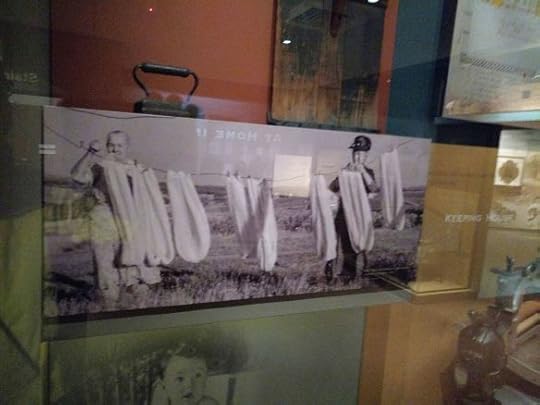
Women’s work: hanging laundry.
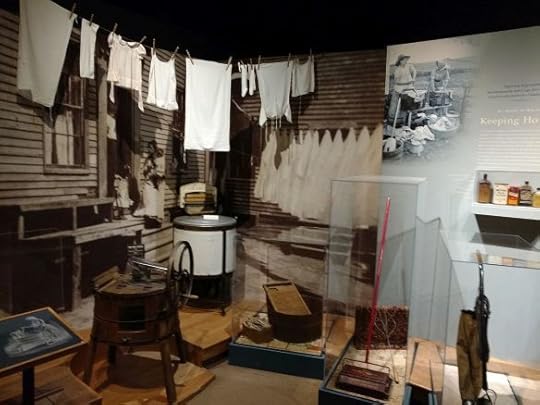
More domestic tasks for women from the Maine At Home exhibit [Maine State Museum]
Interestingly, this exhibit received major funding from the National Endowment for the Humanities, and according to online documents, it is the largest single, private and federally funded exhibit ever opened at the museum, as of 2015. This is one of the museum’s central exhibits, with the women’s exhibit and Jewish exhibit comprising exhibits that rotate throughout the year.Tucked in the basement of the museum, in a way that felt like an afterthought to me, the visitor, was the exhibit on Maine’s indigenous population, referred to as the Paleo-Indians. This was part of an exhibit called, 12,000 Years in Maine.
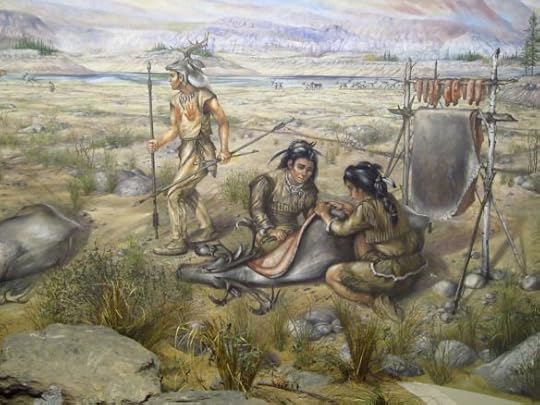
Maine’s Paleo-Indians
The placard text accompanying one of several indigenous dioramas had four short paragraphs about the Paleo-Indians. The visitor would learn that Paleo-Indians lived 9,500 to 11,000 years ago in the Magalloway River Valley (known by that designation in “Paleo-Indian times”), which would be in what we know today as the Western Maine region, probably near Rangeley Lake. I was left wanting to know much more about this population and what happened to them? They’d been “replaced” by a truncated version, masquerading as “history.”
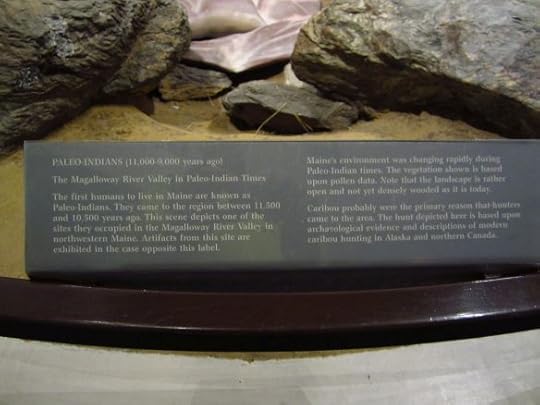
A lack of information about Maine’s indigenous population.
Having read O’Brien’s Firsting and Lasting, I was able to see how this exhibit fit very well into what she described perfectly in this passage from her book:
“Their accounts of the past, present, and future entailed a process of replacing Indians physically and imaginatively on the landscape of New England. That is, they formulated a history that negated previous Indian history as a “dead end” (literally) and substituted Indian history with a glorious New England history of just relations and property transactions rooted in American diplomacy that legitimated their claims to Indian homeland, and to the institution they grounded there.” (p. 189)
Like the Paleo-Indian exhibit, I also found another area that seemed to present countervailing ideas on another topic: labor.
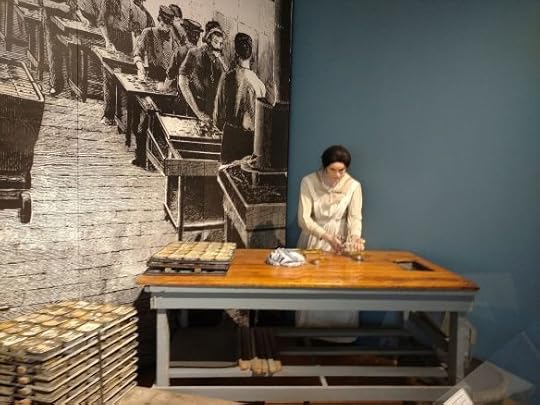
Portrayal of Maine’s sardine industry [Maine State Museum-Made in Maine]
The museum hosts the Maine Labor Mural. This 36-foot-wide, 11-panel mural, landed in the center of a firestorm initiated by Maine’s former governor, Paul LePage. He saw it as a portrayal of Maine’s workers in a light he didn’t like. The entire shitstorm was typical for this governor, a regional version of Trump, and how history can get caught in the middle of an ideological maelstrom.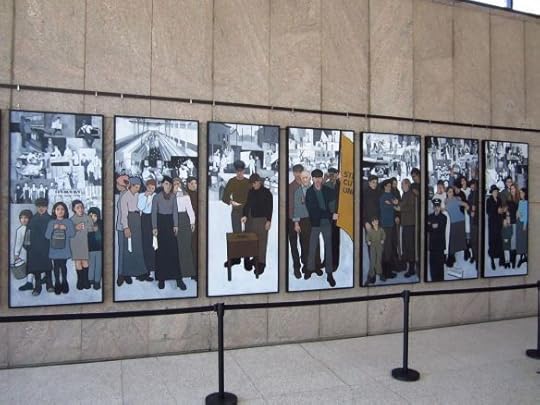
The Maine Labor Mural [Atrium, entering Cultural Building]
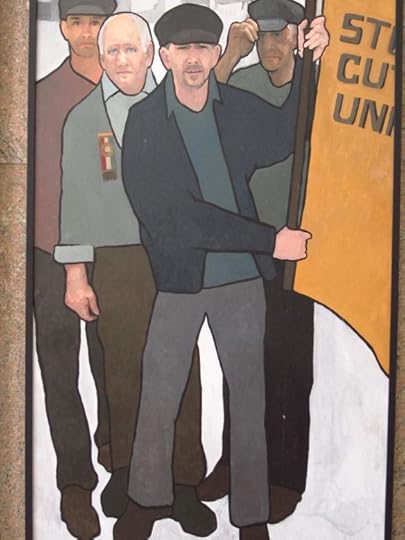
Maine Labor Mural, and one of the slides that caused Governor LePage “heartburn.”
The mural, which had been displayed at Maine’s Department of Labor’s offices, includes scenes of Maine workers, including shoemakers, a “Rosie the Riveter” in a shipyard, as well as elements of the 1986 paper mill strike in Jay, Maine that got national coverage and split a community in two. LePage and his lackeys deemed these scenes as “too one-sided in favor of unions.” History is “tricky,” that way.
The fact that it now resides in the atrium upon entering the Cultural Building that hosts the museum, library, and state archives, is a good thing, in my opinion. I was pleased when it was placed there a couple of years ago, after being put away in storage for more than a year. The artist who was commissioned to do the mural, Judy Taylor, did a wonderful job. I never grow tired of looking at it and I’ve stood in front of it numerous times, especially during the latter part of my time doing workforce development, when I’d pass through Augusta regularly, and was a weekly visitor to the building during trips to the Maine State Library.
Once more, while “rooting around the basement” of the museum, I found the Made in Maine exhibit. Papermaking was represented, mainly via an old film funded by the Maine Seaboard Paper Company of Bucksport.
The film, which was done for marketing purposes in 1940, will be viewed by all but a few people as a “nice” nostalgia piece, and an ode to the “good ole’ days” when papermaking was abundant up and down Maine’s waterways and rivers.
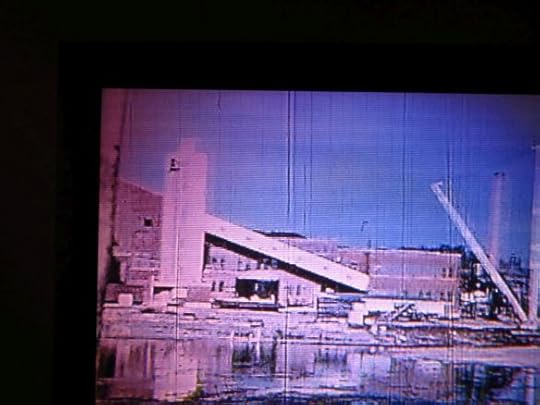
Marketing film made by Maine Seaboard Paper Co., circa 1940 [Maine State Museum]
While the labor mural recognizes the labor strife of Maine’s past, this papermaking sidebar doesn’t show any of it, or the dangers inherent in logging, let alone the physical demands of this work. Instead, it portrays the paper mill as a benevolent “father,” kindly caring for its workers.Perhaps I’m more sensitive to this than most having grown up in a papermaking family, as well as recently researching and writing about the closure of the former Maine Seaboard Paper Company, and how it’s affected the community.
As a museum, representing Maine, the Maine State Museum tells part of the state’s story, but only part of it. This might be due to the challenges inherent with funding cultural elements that are considered social infrastructure. I do consider our state fortunate that there is a place that gets school kids interested in the past.
What I came away with, as someone who has been fascinated by history for a long time, is that my own perspective and orientation has been shifted by your class. I think I’m able to look at things more critically now than ever before, especially relative to the heritage of the American Indian. I know I wouldn’t have “seen” the Paleo-Indian exhibit in the same way prior to being exposed to O’Brien’s book and the other discussions we’ve had.
Protected: Historical Site Critical Analysis-Maine State Museum
This content is password protected. To view it please enter your password below:
Password: