Jim Baumer's Blog, page 9
February 27, 2020
New Experiences and Learning
Over Christmas and afterwards, I read a couple of really interesting books. I’ve found myself coming back to them often to re-read passages.
Both the books, Heather Havrilesky’s What If This Were Enough? and Kurt Andersen’s book, Fantasyland: How America Went Haywire, keep delivering returns on reading time invested in each. What both drive home is that this period of time in America isn’t necessarily unique—at least in Andersen’s narrative—about how America’s need to indulge in fantasy and thinking untethered from science and intellectual rigor dates back to our founding and prior to that. 500 years, really (which is part of the book’s subtitle).
Havrilesky’s book is essay-driven, and while similar in terms of demanding something from readers like Andersen’s does, focuses more on the personal—as in, in a world where excess is the norm—how do we find that place of “happiness” that’s not plugged directly into the capitalist mindset of “things” and “devices.” Both offer more than enough to mull over and I’m sure I will be for months to come.
Then, there’s the constant reminder during my part-time work life of a society that’s been conditioned to constantly bleat the equivalent of “gimme, gimme, gimme,” in the context of healthcare and wellness. It’s all enough to throw one into an existential crisis.
I’m not immune to dissonance. Then there is the path I’ve been given to trod the past three years. Fortunately, music has become a place where I can step away from some of the white noise and static that Havrilesky delves into throughout here essays.
Much like I learned when I worked at Moscow Mutual in the early “Aughts” and fancied being a writer, there’s no easy button when it comes to tackling a craft. While some say the guitar is “easy to learn,” it’s a tough instrument to master. And once you’ve learned a few cowboy chords and can put them together in some progressions, you start wanting to do something more—at least that’s been my experience.
Similar to what I know about mastering writing as a writer, that period from when you take your initial tentative steps to when something positive comes back to you in terms of validation can be lonely. More often than not with new writers and I’m guessing with guitar players finding their way forward, this is when it’s all-too-easy to pack it in. Actually, in the past with my guitar that’s exactly what I did. My guitar went back in the case, stuck in the corner, and the case accumulated a layer of dust.
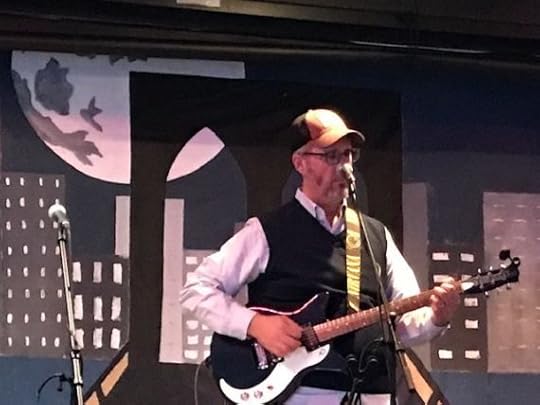
Out at the open mic.
What’s different now? I don’t really know. I think for me, knowing that I was out of options when I got back to playing guitar 18 months ago, there’s some concern (fear?) of what happens if I ever put it away again. I felt something akin to that with writing until I realized that I’d reached a place with writing that I won’t “unlearn” my craft. I’m not there with my guitar-playing and I don’t know if I’ll ever reach that land.
Before Christmas, I drove to Sanford, plugged my Danelectro into my Vox amp and played three songs at an open mic. Things went remarkably well. I thought it would only get easier. Mastering your craft flips that script on its head. Americans want easy: clicking on links, pushing buttons, having others absorb their pain or worse, deadening their pain through things like opioids and other surrogates.
After weeks of wood-shedding in the basement, I knew it was time to climb the stairs and go out into the larger world of music. Off to my local open mic this time, in Old Orchard Beach, at Jimmy the Greek’s Restaurant.
I’ve been weeks scoping out opportunities within driving distance. I’m not sure why I put off an open mic that was four miles from my house. Possibly it has something to do with Wednesday night always being a night that I seem to lack energy.
Last week, rock’s resident contrarian, Neil Young penned a jeremiad masked as a letter to the “short-fingered vulgarian” in the White House. I’m not sure why, but like has happened before, I felt compelled to write another song, this one rooted in Neil’s letter and concerns about our president.
“National Disgrace,” my new song has been on my mind across my waking hours. First it was the case of having three or four verses, but lacking a chorus I was happy with. My guitar teacher helped with that one last Thursday. Once I had the chorus, I began reworking elements of the song and then, on Sunday, I knew I had what I’d set out to do. A song that I liked across all the elements of songsmithing.
I thought I’d play it last night. I came home from work and spent three hours practicing my four or five songs. Then, I got up on stage and realized I wasn’t ready to play the new one and got a bit panicky. Fortunately, my cover of Sparklehorse’s “Sad and Beautiful World” is one song I know very well. The other songs were not sure things and I kind of scrambled a bit up on stage for only the second time. I missed a few chord changes and forgot some lyrics. But I got through my set.
No matter how many times I’ve stood in front of an audience and delivered a talk on Moxie, workforce development, publishing, or local baseball in Maine, those were all very different than being along on stage with a microphone staring at you, and a guitar in your hand.
This is a new experience. One that will continue to be fraught with speed bumps as I make my way along the learning curve. I’m paraphrasing Seth Godin here in describing this as the “succeed, fail, fail, succeed, fail, fail, succeed…” stage of relearning, which is what success could be compared to.
What I do know is that it was all-too-easy to come home and feel sorry for myself last night. Instead, I chalked the experience up as a necessary step forward on my path toward goals I’ve set for myself as a guitar-slinger and musician.
I’m grateful to the welcoming gang at Jimmy the Greeks, especially Paul Conner, the open mic host, along with the cast of mainly regulars who were all really inspiring to watch and learn from. All of them offered something encouraging, which isn’t the norm in all settings involving learning by experience. I’ll definitely be back.
Which takes me back to where I started with this post, mentioning Andersen and Havrilesky. Americans are entitled. We have become lazy and unwilling to accept adversity, pain, and as a result, society has become increasing dysfunctional across all its elements.
I’m not sure, but taking on things that involve struggle, self-assessment, and in my case, literal callouses from playing regularly (a necessity, btw) are how we remain human in the ways that Havrilesky considers various dilemma’s in her writing. In one of her essays, she writes:
“It’s hard to live in the moment, to exist locally and think locally and emote locally. Something in my pocket is always buzzing. People far away except quick answers to every passing question. Why do we live this way?”
One thing playing my guitar allows me: I get to “live in the moment” in a way that technology won’t. I’m also grateful for last night’s lesson that I still have a long way to go in mastering my latest attempt at a new craft.


February 9, 2020
Move Beyond the Usual (Politics)
After last week’s debacle in Iowa, where nearly a week later, we still don’t know if the results are in fact valid, the chattering classes are asking, “why Iowa?” and even, “why New Hampshire?”
The horse race to November’s presidential election has begun in earnest. And as it’s been done now since 1920, presidential wannabes, political insiders, and self-appointed front-runners are forced to trudge through the cold and chill of a New England winter writ large. Running the gauntlet of retail politics is still being done in the age of Twitter—as it should be—in a very white state that doesn’t always mirror the rest of America. But to New Hampshire they all come.
During past campaigns, both my wife and I have traveled to Maine-based events together or on our own. I’ve seen Democrats like the Clintons, John Kerry, John Edwards, and Dennis Kucinich in-person. When I was a Republican, I attended events for George Bush. There’s something about seeing candidates in live settings that surpasses merely seeing them pixelated on a television screen.
On Saturday, we decided to make the 35-minute drive from Southern Maine and cross the border into neighboring New Hampshire to hear a long-shot candidate, Tulsi Gabbard. She was hosting a town hall in Rochester, at the Elks Lodge.
Why Gabbard? Both of us have been intrigued by her commercials running on the Portland station where we consume our morning news and get our weather from. Like other candidates I’ve supported: Kucinich, Ralph Nader, and in 2016, Jill Stein, Gabbard projects something different than the typical business-as-usual politics common during DNC-influenced dog-and-pony shows passed off as debates.
Gabbard was excluded from the Friday CNN town hall, even though her polling numbers were higher than candidates Tom Steyer, Andrew Yang, and Deval Patrick (who didn’t attend). What is it about Gabbard that corporate media hacks at CNN, MSNBC and other outlets fear about Gabbard?
Perhaps it’s her foreign policy prescription to end regime-change wars that are draining America’s coffers in places like Afghanistan and Iraq, with no clear purpose for us being there. While we were waiting to hear her speak on a frigid February Saturday afternoon, news reports began popping up that there had been yet another attack on American troops in a far-off land. Young men and women sent there having taken an oath of loyalty to America and to defend our Constitution. And once more, two would be coming back home in caskets. Their families will never be the same.
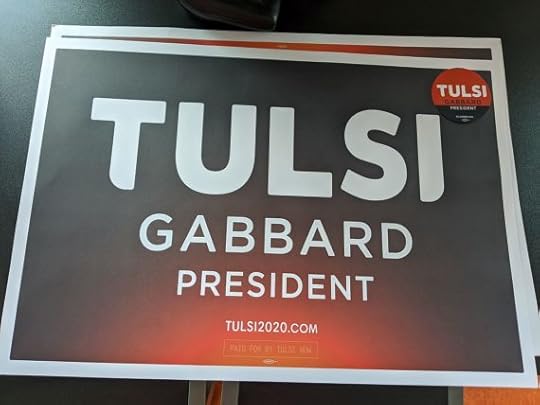
Tulsi 2020 (JBaumer photo)
Of all the candidates, Gabbard is the first female combat veteran to run for president. She’s also the first female combat veteran elected to Congress, along with Tammy Duckworth. Gabbard’s served six years on the Foreign Affairs Committee and the Armed Services Committee. Her background and experience far exceed anything our sitting president brings to the table on matters related to our armed forces (or any other issue, for that matter).
Like Kucinich (when he ran in 2004 and 2008), Gabbard believes that there is a “peace dividend” that would be better invested domestically and could be spent shoring up Social Security, addressing the opioid crisis, and creating the foundation for Single Payer Universal Healthcare. There are also plenty of infrastructure projects that have been neglected and never given the scale necessary to maintain, since the 1940s: roads, bridges, dams, our power grid—to name three areas of concern mentioned by savvy politicians I’ve supported, like Jerry Brown in 1992, when he ran for president. You can check his track record for making things happen in California. I often wonder what he would have brought to the White House if given the chance 25 years ago.

Presidential candidate Tulsi Gabbard/Town Hall in Rochester, NH (MBaumer photo)
Gabbard is impressive live. In a town hall setting, she’s measured and thoughtful. She speaks with warmth about our veterans. She’s inclusive of other viewpoints not often discussed at town halls hosted by Democrats.
I found myself tucked between my wife and a visiting French academic who is a foreign policy fellow at the Brookings Institute. She told me she’d been in New Hampshire for the week and had decided to come and hear Gabbard because her views on foreign policy are so different than “all the other candidates.” My thoughts throughout her opening monologue and introduction went here: “this woman is so much more than any of the candidates I just watched last night on CNN.” That included Bernie Sanders, who I like. Unlike Bernie, Gabbard is a woman of color, who also holds an equally impressive progressive policy orientation. And differentiating herself from all the other progressive Democrat candidates, Gabbard’s has obvious appeal to voters who might have voted for Trump in 2016, or who lean towards the Libertarian side of the political pendulum.
The crowd of more than 100 that turned out in Rochester was made up of Republicans, Libertarians formerly for Ron Paul, veterans who’d fought in Iraq, Afghanistan and Vietnam, and people like me who are looking for something more than the same old prescription offered by most of the DNC-oriented Democratic field. I’m sorry, but Pete Buttigieg does nothing for me. If you want Buttigieg, Biden, or even Bernie (or Warren), have at it.
For me, it’s too early to settle for the lesser of evils, or even progressives who will be forced to knuckle-under to the corporate overlords in their party. Then, once again, I’ll be faced with stuffing my leftist ideals into my back pocket for another four years, or registering yet another “protest vote.” I can’t vote on Tuesday in New Hampshire, but I’m planning to caucus for Gabbard in Maine in March. Maybe 2020 will be different.
I hope you’ll take a few minutes to read through her stands on the issues. There is also a worthwhile article in The Nation that looks at Gabbard’s campaign and stands, objectively—particularly related to why she appeals to people not normally drawn to Democrats. She also mentioned the “Afghanistan Papers,” obtained by the Washington Post under the Freedom of Information Act. I’d urge you to read and ask yourself, “will my candidate offer anything that will change” the wasteful spending on regime-change foreign policy that we’re pissing away $4 billion a month at waging?
February 5, 2020
When It All Unravels
We live in a nation that’s divided. It’s as if there are parallel realities between two different, disparate camps of Americans. For simplification purposes, I’ll make the line of demarcation binary to a fault: in one camp, the followers of this president think (know?) he is an amazing leader. A man who does what he says, and damnation to anyone who opposes him.
In the other camp, many of these people feel a visceral dislike and even hatred toward Trump. I would be in that group. My late son, Mark, also resided there.
Mark’s final video on his final walk drew a line in the sand in terms of what he thought about a man who would be inaugurated the next day, Mark’s last day on planet earth. Here are descriptors provided by Mark of our 45th president.
Racist
Xenophobic
Ableist
Transphobic
Climate-denier
Gun nut
Hates women
He physically abuses women
He hates minorities
All he wants to do is profit
In some of Mark’s final words, he states,
“If you support this man, you do not support human life on this planet…plain and simple: you do not support the future of Earth as a planet.”
He then utters this as his final video fades out:
“Your ignorance is killing people!”
The president’s state of the union speech was filled with his usual lies and half-truths. Trump as a man claims credit for anything he can, while his followers never bother to fact-check his delusional rants.
Patterson Hood grew up in Alabama in the days of George Wallace’s reign. Wallace, the aggrieved governor of a state in the heart of Dixie, became famous for his racist ways and his stands against the federal government. He was racist long before it became chic among Republicans to hate people of color.
Hood’s band, the Drive-by Truckers, have spent the past 25 years making music filled with stories about the South. It’s not the South that I learned about as someone who grew up in the North. The band’s song, the “Three Great Alabama Icons,” from the band’s epic Southern Rock Opera, is one of the best eight-minute history lessons you’ll ever come across. For me, Hood made me curious to learn more of what the South is really about. I dug into other works by historians like Dan Carter and C. Vann Woodard, to name but two. From this, I learned about the “duality of the southern thing.”
The band just released a brand new record. It’s not intended to be pretty, or uplifting. It’s stark and honest about the state of the nation we’re living in. Not dressed-up to be a commercial for re-election (which is basically what Trump rambling mess of a speech was, last night), The Unraveling tells a tale about a country that’s been unwinding from the spool for awhile now. Only the most foolish of deniers would see our nation as a great place. But Americans are as adept at turning from the truth as any people on the planet.
Elizabeth Nelson is a talented writer who is also a musician and member of The Paranoid Style, a DC-based rock outfit that churns out honest music in a similar vein (in terms of thematic content) as the DBT does. It’s fitting that she chose to write this review and it’s well worth the effort required to read it.
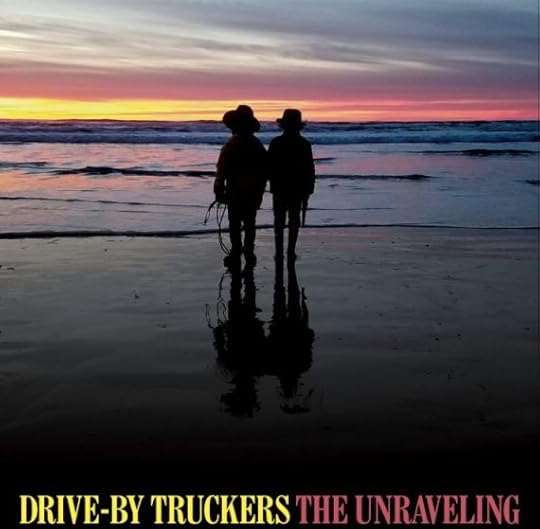
The new record by the Drive-by Truckers, “The Unraveling”
I don’t know what the next nine months will deliver relative to the run-up to the 2020 election. I have no choice but to align with the Democrats, where I’ve hitched my own leftist wagon because I refuse to associate with the party of hate, which is what the Republican Party has become among many other things. Unfortunately, they seem incapable of mustering anything that makes me overly optimistic about countering another four years of hate and division courtesy of the Orange Trumpster.
But, I’ve somehow survived losing my son, abandonment by my family of origin, and coming really close to leaving this planet. Four more fucking years of Trump pales in comparison to that.
January 23, 2020
Complicated, but Simple
Mark was killed two days prior to the day that serves as my birth day. In 2017, feeling celebratory 48 hours after receiving the gut punch of knowing your only son was gone was impossible.
The following year, I realized I didn’t give two shits about anyone knowing it was my birthday. My better half talked about celebrating halfway through the year. Being born in January means that the day signified with cake and ice cream (or your own special guilty pleasure) is usually cold and foreboding. But any day with cake can become a great day.
I haven’t had much cake over the last three years. The summer party never appeared—the idea was a good one, it just lacked a trigger for execution—namely me giving it the green light. Again, losing Mark made celebrating another year of life seem like an exercise in futility and the kind of self-indulgence that grief and loss robs you of.
Mark loved bell hooks’ writing. I was also a fan. Shortly after Mark’s death, I bought her book All About Love: New Visions, at Gulf of Maine Books in Brunswick.
Yesterday, after a friend of Mark’s had reached out on the anniversary of his death with a quote from hooks, I took the book down off the shelf and re-read the following passage:
Just as we are often unable to speak about our need to love and be loved because we fear our words would be interpreted as signs of weakness or failure, so are we rarely able to share our thoughts about death and dying. No wonder then that we are collectively unable to confront the significance of grief. Just as the dying are often carted off so that the process of dying will be witnessed by only a select few, grieving individuals are encouraged to let themselves go only in private, in appropriate settings away from the rest of us. Sustained grief is particularly disturbing in culture that offers a quick fix for any pain. Sometimes it amazes me to know intuitively that the grieving are all around us yet we do not see any overt signs about grief that lingers. Like a stain on our clothes, it marks us as flawed, imperfect. To cling to grief, to desire its expression, is to be out of sync with modern life, where the hip do not get bogged down in mourning.(–bell hooks, All About Love: New Visions)
I shut off the thing on Facebook that alerts people to my birthday (at least I think I did—one never knows about FB anymore). I’ve decided that only the people who really pay attention know it’s my birthday: the love of my life (Mary), some close family members, a friend or two (if I still have friends), and weirdly, some new co-workers.
Today, I will “celebrate” as well as a dad without a son can celebrate during the dark days of remembrance that come every December and January with the roll of the calendar. Mary bought me a few things that celebrate my new passion—the guitar. She also found a photo of me with the very first guitar I owned back in Indiana, so the guitar isn’t some new “flavor of the month” for me. In this photo taken in Indiana (Mark was probably three at the time), I was obviously younger, slimmer, and had more hair. I really liked the “photo shopped” postcard Mary “created” of me jamming on the stage at Buck Owens’ Crystal Palace in Bakersfield. We stopped there on our way from the beach to the desert back in 2017 on our sad vacation in California. Mary also found two ornaments: one for “Yammy” my Yamaha acoustic and another for “Danny” my Danelectro electric. Mary doesn’t share my passion for music or performing. However, she knows it means something to me and she found a way to “touch” me with her act of kindness and remembrance. She personifies love and had a big hand in teaching our son about what love really means. She also managed to do what so many mothers fail at doing—not fucking-up their sons with their own fucked-up-ness. I know the latter all too well.
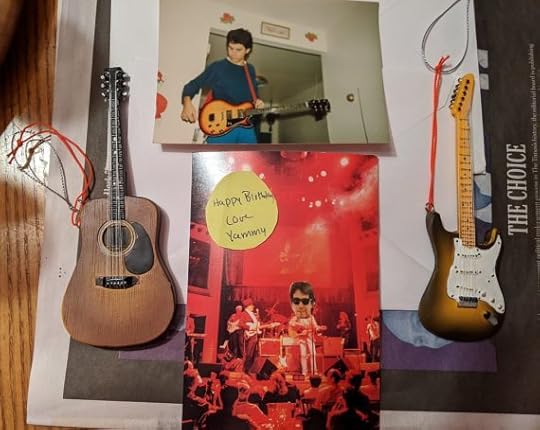
Anyone can play guitar, even the JBE.
I’ve shared with a few friends about life these days. Recently, another friend of Mark’s was checking-in, asking about us. In responding to Mark’s friend and former Brown MFA colleague, think I captured the frame of life for me in 2020:
I feel like three years out from Mark’s death, my life is simple. I get up, go to work four days a week, and on most of these days (save for Friday, which is my “long” day), I’ll come home and play guitar before making dinner for Mary during the week. Most weekends, I try to play a couple of hours on Saturday and Sunday.
Being in Biddeford these days, I realize I may as well be in Bangalore. I say this because while people who know me are within an hour’s drive of a place that’s on the move, rarely if ever does anyone bother to shoot me a note to say, “hey, I’d like to stop by.” We have two (three?) great breweries, fine restaurants, a downtown worth spending time in and we’re damn close to the best stretch of beach in New England. What’s your reason for not paying a visit? Sometimes I think I must give off a vibe that repels people. I’ve basically lost everyone but fewer than a handful of people from my former life. One of them reminds me often that it’s not me. That’s appreciated but hard to believe when my life is full of abandonment.
That’s fine. I’m filling my loneliness with guitar time. That’s probably why my playing has grown exponentially over the past year.
January 12, 2020
Days of Death
I’m taking an anthropology course at USM over Winter Session. These are “compressed” between semester course options. Basically, 15 weeks of work gets forced into an intense four-week offering. Lots of reading, writing, and reflection tacked onto an already busier stretch than I’ve had in probably three years. For a part-time student like me, it’s a way to make progress. “It’s all good,” as they say.
One of our assignments required watching an excellent documentary produced by the BBC on the Mexican Day of the Dead. In a nutshell, this is a day that combines indigenous Aztec traditions about death with the Catholic Holy Day, All Saints Day. Because Americans are rarely curious about anybody else but their own dysfunctional culture, most know little or nothing about this Mexican tradition that actually honors the dead in a way that Americans fall far short in their avoidance of the topic, or their superficial “thoughts and prayers” Facebook contributions.
Once a week since Christmas, I’ve had to respond to one of three assigned student questions we’ve all had to generate from our reading for the class. This week, I tackled this question because death and how we as Americans process it is something I’ve been living for the past three years.
Question:
Why do Americans make the death of a loved one such a heart-tearing occurrence for decades, when the Mexican culture is much faster to move on and celebrate?
I know my fellow student didn’t mean to conflate the differences in how our two cultures process and in the latter sense, bring “celebration” to the experience of the death of a loved one, but that’s how I read his question. So this is how I answered it.
Josiah (not his real name),
I’m not sure I’d agree that Americans make death a heart-tearing occurrence. Like Stefan’s own experience being British, I think Americans tend to be uncomfortable with death and would prefer to acknowledge it as briefly as possible and then, move on.
Why do I say that? Because I’ve just spent the past three years trying to come to terms with the death of my son Mark Baumer. He was a gifted poet and a committed activist who was hit and killed while walking across America (barefoot) to raise awareness about climate change.
While both my wife and I have had to find a way to move through the process of grief and loss, much of that experience was done alone, or supporting one another. Friends and family—while some being supportive initially—can’t be bothered to “stay with” two people who have had their lives turned upside-down. Sometimes, total strangers have been more supportive than those closest to us, or Mark’s own friends.
In terms of the Mexican experience, especially the Oaxacan one chronicled by Stefan Gates, a BBC food writer in the documentary (Day of the Dead-BBC Culture, 2011), I don’t think they are “much faster to move on” at all. Celebratory—yes, for sure! But in celebrating, they carry the memories forward of loved ones lost in a much more meaningful manner (in my opinion) than we do in the U.S.
With the Day of the Dead, the combining of indigenous Aztec traditions with a Catholic Holy Day, All Saints Day, seems like an odd pairing. But it works.
At the start of part 2 of the film, I think it’s Catalina (sp??) who says that Aztecs believe that “life is just a dream.” Perhaps then, death is actually reality.
Stefan is skeptical initially. He wonders if the celebrants really believe that the “dead are coming back,” or if it’s merely and “excuse for a celebration.”
I liked when Catalina explained the Day of the Dead as like “a birthday” for the dead person.
As Stefan talked about Brits equating death with misery, I was reminded of that very same thing. Often, I might think of talking about Mark, my son, but they I remember how often people give the usual hackneyed responses when they learn of the death, more often than not saying, “I’m sorry.” I get it—what else is there to say? Perhaps asking me about him, or asking me how it feels, even three years out (we’re coming up on the third anniversary of his death on Jan. 21).
When Stefan meets Jorge, the festival organizer, Jorge tells him that the celebration is “more about life than death.
Stefan talks about his experience, being part of the Day of the Dead festivities, as a “normalizing” of death.
The Mexican state of Oaxaca is in a poor region of Mexico. Yet, the film shows their willingness and almost, a compulsion, to honor those who have died, by the offerings of food and flowers. Regardless of anyone’s thoughts about flowers for dead people, I found this truly touching that they want to honor their loved ones.
Nora (a local resident) says,
“You are always going to find money for the dead.”
Nora’s story about her grandmother and preparing mole (a favorite food of her grandmother’s) captures the essence of how Mexicans allow their sense of grief and loss to be infused with happiness and the memories from the lives of the people they loved.
Nora tears up, remembering her grandmother, as she eats the mole.
Stefan, a “proper” Englishman, is deeply touched by being part of this celebration. Perhaps, he’s actually allowing himself to feel the emotions and complexities associated with death in his own life.
Catalina talks about her grandfather. She’s emotional because thinking about him makes her miss him again. Yet, there’s a sense that he’ll be returning and this allows her to also feel happiness thinking that in some sense, he’ll be returning in spirit form.
The welcoming of the dead children was especially moving. Not only the locals and their reaction, but Stefan, with his scientific detachment, was able to recognize that remembering those children who had died was honoring to their memories.
Stefan comments how exhilarated he feels after spending the night in the cemetery, celebrating, drinking mescal, etc.
The day after his experience in the cemetery, Stefan’s mentions that memories of your dead loved ones don’t need to be mournful. There can be joy and happiness.
Stefan is visibly moved when he places the photos of his own family members on the altar. Watching this, it’s obvious that these emotions are totally unexpected. There’s a sense of catharsis taking place for him, which is another positive element in the Mexican Day of the Dead.
As Stefan reflects on the events, as they prepare food and offer incense while fireworks are going off, he notes the fundamental difference in this Mexican approach. The dead aren’t acknowledges just once, but every single year. The tragic and celebratory are conjoined.
I think the contrast between the usual way we minimize and avoid death, is clearly contrasted by the Mexican celebration represented by the Day of the Dead. Maybe when you celebrate death, death is slightly easier to bear. Or better, it’s no longer something to fear and avoid but, celebrate.
I appreciate you posing this question. It was helpful for me to view the BBC film again to answer this, and reflect on death (and life).
Works cited:
Gates, Stefan. BBC World News, “Feasts: Mexico: The Day of the Dead, 2011. https://www.youtube.com/watch?v=JFt8-WdstQA
December 29, 2019
Like a Robot
Millennials like to text. If you want to stay connected with them, then you’ll need to text them back. Not only do they love to text, they have their own language around texting.
But texting isn’t natural for many of us who didn’t grow up with a smartphone attached to our palms. If you came up during the time when you still received letters and notes in the mail, then texting often seems impersonal at best, maybe even jarring.
I have hundreds of emails between Mark and me. Every birthday, I’d send him a long note with stories about his birth. We bantered about basketball and baseball. We discussed politics. And on his first walk and the final one, I sent him a note every day via email.
Email shares similarities to letter-writing. I say that because it allows me to think in a conversational way, and my emails usually tend toward that kind of flow. I can ruminate while I write, much like people do when they speak in-person.
While this is anecdotal at best, I find many millennials and younger people struggling to communicate face-to-face. It’s hard to have a conversation with them sometimes. There’s a vulnerability about human-flavored communication that’s very different than the digital kind.

Gold star for robot boy.
We’re being channeled to ask Alexa all of our questions. Anytime I interact with a digital assistant like her, it feels like I’m dealing with a robot, or something less than human.
Often, when I talk to people who grew up with technology as their first language, conversation with them simulates some of those same Alexa-like elements.

Alexa, send me a million dollars.
December 12, 2019
The Holidays are Here
I’m no longer sure who visits this space. Since almost everyone uses social media for communication and I’d prefer not to, it’s been months since all but a tiny contingent of people have remained connected.
It’s December. For some of us, it’s not a time of holiday cheer, or happy memories from Christmases past. For families who’ve lost a child, or currently going through their first holiday season without a loved one, it’s a painful time, one infused with memories that more often than not elicit sadness.
For Mary and me, this is the first year we’ve decorated a tree since Mark was killed. He was a Christmas baby, born on December 19. This will be the third birthday of his we have to endure without our son.
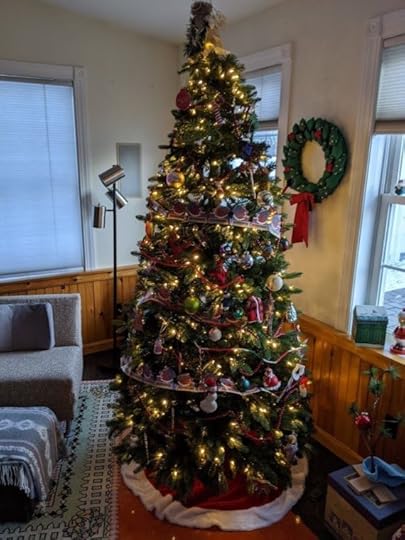
Christmas in the saloon.
I don’t know if I’ll ever be filled with joy and happiness (I probably never have been), but at least this year, the dial on the sadness meter has dropped a few notches: still sad, just not “wrecked with grief.” I guess that’s an improvement when you’ve set the bar very low.
Today, I concluded a difficult class at USM. This was the first one of my history classes I’ve taken that I didn’t enjoy. In fact, I really didn’t care for the professor or anything about the class. First, it was an online class. Being that in 2019, universities are moving away from bricks and mortar and face-to-face meetings, I guess I need to adjust.
What I’m proud of is that I slogged my way through it. This, despite getting off to a rotten start, I still managed a hard-earned B. While my goal is always to land an A, my failure to properly engage with the timeline at the start caused me to basically get a zero for my first module. Fortunately, I can read, write, and think critically. The 96 I got on my book review (20 percent of the semester’s grade) helped me salvage this class. Oh, and the book was one I read on the plane to and from Indiana, on our way to the Heartland International Film Festival. Talk about making the best of one’s situation.
Last weekend, Mary and I dropped by Elements in Biddeford. If you don’t know Elements, you should: they have great coffee, food, beer, and books, too!! I found this one and bought it. The author, Philip Toshio Sudo finds a way to weave ideas of mindfulness and Zen into a very readable (and motivating) work on playing guitar. Sadly, he died of cancer in 2002. He was only 42.
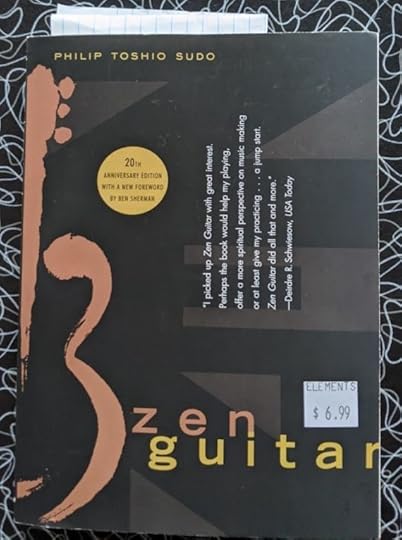
Zen and the art of guitar (playing)
If there are any former friends, co-workers, WorkReady graduated or anyone else who remotely cares to know about my continued evolution on my instrument and growth as a songwriter, drop me a note via email and I’ll let you know which open mic I’m planning to show up at. It looks like I can start hitting the road each week and finding a new place to perform my ever-growing set list of tunes.
Who knows: maybe my new tribe is located at music venues somewhere out there?
November 26, 2019
The Worst
Falsely (this is born out to me, daily), I’ve held onto some delusional notion that for a few days and perhaps—even weeks—humans in America can dig deeper and find their better natures. And after all their efforts at excavation—actually extend their humanity beyond the end of their noses. It’s probably a case of too many times viewing “It’s a Wonderful Life,” or Hallmark’s endless parade of holiday happy-ever-after schlock.
I know I’m living on another planet. Just days before Thanksgiving—that most American of holidays in terms of myth and nostalgia—I was reminded yet again in a very in-your-face sort of way of how shitty nearly every human I manage to rub elbows with, or come close enough to, and having their noxious aura leak into my own personal space. Did I tell you that I hate most humans (or many of the ones I am forced to endure, daily)?
At work, there is a tree. Someone thought we could all write what we’re thankful for on a blank leaf. Then, hang it on the tree. I don’t hold it against them. They meant well.
For more than a week now, I’ve been trying to think of something I could write that wouldn’t sound snarky, or be considered mean, or end up simply being sad. It occurred to me today that I won’t be adding a leaf to the tree.
Before Mark was killed, I had a dream. In the dream, I was asked to front a band and play guitar. This from the guy who was years out from beginning his year-long journey into simply surviving, picking up a guitar and playing it nearly every day. In the dream, somehow, I faked my way through songs and they sounded really good. I woke from the dream and thought, “I wish I could play like that.”
Yesterday, after the shittiest of shitty Mondays at work, listening to angry, entitled people rail and malign their healthcare (in America, if you have it, you are fucking lucky!), I came home to a cacophony of hammers, yelling, and a generator whirring across the street. My neighbors were having a roof repair done. I’m sorry their roof was leaking—they are perfectly nice people and the best anyone could ask for in terms of living near, but of all days, I simply wanted something other than this home repair racket.
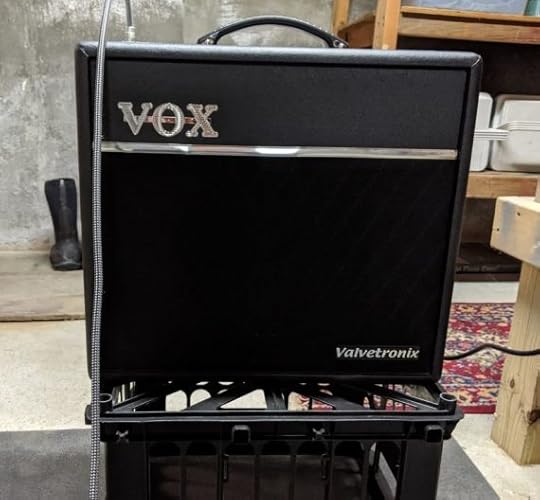
Voxing it up with Voxie.
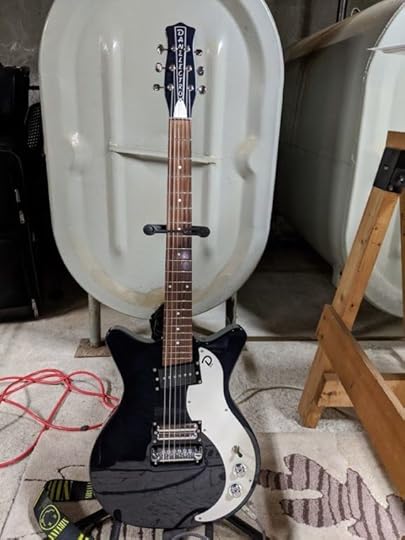
My boy, Danny.
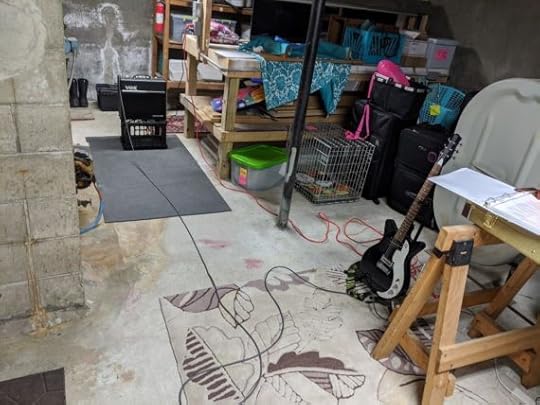
My musical “wood shed.”
I spent a few minutes playing with Lucy and then, down into the basement I went. I flicked on the power switch on Voxie and picked up Danny off the guitar stand. I ran through “Cinnamon Girl” by Neil Young. I then spent time working on adding a bridge to “Spaceship Blues,” the new song I wrote last week. I played “Rachel, Rachel,” another song I wrote. It dawned on me that my dream was coming true.
I could turn this into a listicle of things people should do for Thanksgiving. I’ll spare you and not waste my time engaging in futility.
Instead, I’ll turn my attention to music and another song that has meaning for two reasons this season: one, Christmas will always be the worst of seasons for me and Mary for obvious reasons if you know us and the abridged version of our story at all. Two, I’m learning this one by Sufjan Stevens as my own “Christmas Song” this year.
People might suck, at least most of the ones I’ve wasted my time attempted to remain tethered too: but playing guitar and getting a little better every day doesn’t.
November 14, 2019
Barre Chords are Hard
It’s a rare day when I don’t spend at least 30 minutes with one of my guitars: whether it’s strapping on my electric or cradling my acoustic. Often, I’ll spend time with both. This has yielded improvement I never expected. Still, I have a way to go to play as well as I’d like to.
The internet is chock full of videos on all aspects of guitaring. But like all things interwebs, this plethora of information doesn’t always guarantee that you’ll learn things in a systematic manner. Also, you can spend more time searching for or simply watching videos rather time in the “wood shed” actually practicing your chops.
There’s a local musician I’ve been following. He’s had some measure of success and a few Saturdays ago, he was playing at a local watering hole. I decided to drive down to the beach and catch a set of his. I also had an ulterior motive—I was going to ask if he’d be game for giving me lessons.
We talked and he said to reach out to him via Facebook. I waited a week and sent him a note.
I’m an impatient person. When I didn’t hear back, I began looking for another teacher.
The problem once again with the internet is that it’s great for revealing information—it really sucks in terms of accessing what that information means.
On Monday I put Danny in the back seat in the midst of a snow squall and drove to South Portland. I pulled up outside a nondescript real estate office. I had no idea what door I was supposed to enter for my lesson. I texted the teacher: he came downstairs. We had our lesson.
He wasn’t prepared for the lesson. I drove back home. I felt shitty. Not everyone who plays guitar should be a teacher.
I’d just spent an hour and $50 to be made to feel once again that trying to play guitar was a mistake. If you had any sense about how that Danelectro housed in a hardshell case lying on my back seat was the one tenuous hold I had on staying in the world, then you would have a much better sense at how wrecked I felt driving back to Biddo.
I never told Mary how crappy my lesson was.
That night, I went into the basement and plugged Danny (that’s the name I’ve given to my electric) into my Vox (I’ve dubbed him, “Voxie”) and recommitted myself to playing better barre chords. That was one takeaway from my guitar lesson from hell—my barre chording sucks.
The internet is a crap shoot. But, it’s where I found Marty Schwartz. Marty is an online guitar guru who I imagine would be a true joy to take lessons from in the real world. But he lives in San Diego and I live in Maine. Marty has a video where he and another guitarist, Griff Hamlin, dispense the kind of constructive instruction I’m seeking on how to get better at barre chording and riffing in general.
I’ve been following Marty’s (and Griff’s) prescriptions all week. Monday night, I felt like giving up the guitar. A few days of working at getting better (and pushing through soreness in my left hand), I’ve figured out what my problem was with getting all my strings to ring out when forming barre chords.
I also got a note back from my local working musician. He’s off to Florida for a bunch of gigs with his cover band. When he gets back in early December, we’ll be meeting-up for my inaugural lesson. I’m guessing that things will go better with him.
My wife thinks I have a man crush on him. That made me think of this crazy episode from Seinfeld with George and his male-crush on a guy named Tony.
November 7, 2019
Healthcare is Expensive
Four days a week, I take calls for a Maine-based healthcare provider. The calls run the gamut: people are sick, they want to fill their prescriptions (and there are lots of pills being pushed), or they make some variation on a common theme—demanding some kind of service (often that day), demonstrating how little they know about how broken our healthcare system really is.
Back in the late 1990s, I worked for another healthcare provider. We were an HMO, back when HMOs were supposed to save the day and reinvent medicine in America. More important in this discussion was that HMOs were expected to be the cost-containment deemed necessary at that juncture. HMOs did not save healthcare.
I really liked my gig back then. The organization was locally-managed and really had a humane, quality-focused approach to healthcare. Where I’m at now often reminds me of that time 20 years ago. However, the organization with skilled local management got swallowed like Jonah getting inhaled by the whale. A corporate giant vacuumed up the business based in Freeport and almost overnight, everything went downhill. Profit became the primary motif and most of our group who were hired together to service a block of Midwestern business, scattered to the four corners of the work world. Some of us ended up at a disability insurer I’ve often referred to as Moscow Mutual. That’s another story I’ve written about, including in a book of essays that mainly ended up being relegated to the publishing dustbin.
Elizabeth Warren, one of the bloated field of Democrats, released details recently about her Medicare for All plan, her solution for overhauling American healthcare. As soon as Warren dotted the I’s and crossed the T’s of her plan, the critics crawled out from their corners, detailing why moving from a broken system to one covering everyone, lowering costs, and improving care outcomes won’t work.
Others are talking about how we can reform an unsustainable model.
Marty Makary is a surgeon. He has a new book, The Price We Pay: What Broke American Healthcare and How To Fix It. At least he get the brokenness of the system right. But so do most politicians. It’s just that they don’t seem to know how to fix it.
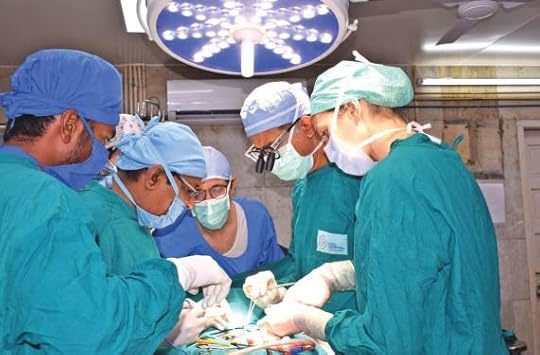
Unnecessary procedures keep pushing up the cost of U.S. healthcare.
Makary makes a number of prescriptions for fixing healthcare. One of the more interesting ones is the unnecessary elements of healthcare. These are the procedures: tests, surgeries, prescriptions that have bloated healthcare’s costs, pushing it north of the $3 trillion dollar mark.
Makary makes note of the Johns Hopkins survey of medical providers in the book that indicates that 21 percent of procedures performed were unnecessary. That’s one-in-five medical procedures.
Older Americans are often the worst offenders. Unlike the generation going out into the world who are under-insured, many of them have had health coverage across their work lives. Some of them have had the entire cost of their coverage picked up by employers, too. And they are the most entitled.
I sold Medicare advantage plans for two years. These Medicare enhancement plans push annual wellness visits. There are a host of other care options that promote the use of healthcare. And in using healthcare, waste is regularly built into that usage. Makary illustrates this when he highlights how he visited a church health fair. He was tipped-off about this from a cardiologist who told Makary that doctors recruited patients at these fairs.
According to Makary, these were in all-black areas and doctors would check seniors’ circulation for free. As Makary noted, this inevitably led to scheduled appointments and eventually, lead to unnecessary procedures.
Makary’s book is worth reading. I agree with him on a number of points. However, like so many other failed proposals to “fix” healthcare, Makary ultimately believes that the market is the solution. He’s opposed to solutions like Medicare for All. For Makary, it’s all about creating “healthy markets” that “eliminate the middleman.” Yeah, right. That hasn’t happened over the past 25 years. Only a slavish devotion to a belief in capitalism would elicit that kind of response to the crisis. But that’s what is offered by someone from the inside.
I’ve always liked Elizabeth Warren’s advocacy for the lower and middle classes. I knew about her work long before she contemplated running for president. I think she’s bringing forth important solutions. She also finds a way to move beyond relying on “the market” to fix what it’s never had any intention of fixing.