Jim Baumer's Blog, page 6
November 22, 2020
Factoring in Fear
Blogging for me began back in 2002. I occupied a cubicle in a soul-sucking job for a major disability insurer. Every minute I spent there was a minute I’d never recover. Fortunately, I didn’t invest much energy into furthering Whitey’s corporate agenda and instead began planning my plan of exit.
A co-worker with topnotch design skills built a functional website at my behest. He never charged me a penny, either. The most important element of the site was that it including a blogging platform. As a writer looking to up my game and work on my craft, I was off to the races with a space to publish my own writing.
Since 2003, I’ve had several blogs including this one. My writing has been bylined in a host of print publications and online. I’ve hit the markers I set out for nearly 20 years ago.
Occasionally, I look back at something I wrote. The blog I maintained from 2004 until I launched this one in 2012, Words Matter, is still out there. Since I just completed rereading George Orwell’s dystopian classic, 1984, I was curious about what I might have picked up previously and perhaps noted somewhere.
Interestingly, these prior blog posts serve as a “trail of breadcrumbs” back to what I was thinking at the time. Just like in the present, I was concerned about the use of fear and hysteria (back in 2006) and also, the limbing of what is considered “proper” in what we are allowed to think and say. These are both central tenets to Orwell’s book that I’m amazed was written in 1949 and is still eerily relevant—just as if he’d written it last week.
In my blog post from 2006 at the Words Matter blog, I wrote this about fear:
Yesterday, while driving home from some appointments in Dover-Foxcroft, I was scanning the radio dial for something tolerable, or at least wouldn’t put me to sleep. For a five minute period, my better judgment took leave and I found myself listening to the demagoguery of Sean Hannity, during his afternoon exercise in right wing ideological indoctrination. This man is certifiably insane. His propaganda-laced tirades are lapped up eagerly by his brain-addled listeners, who subscribe to this kind of bigotry-infused and racist rhetoric. He was prattling on about the need for the U.S. to support their friends (in this case, Israel) in the battle against “Islamofascism,” a term invented by the haters on the right.
Fourteen years later, I could rewrite this, change a few names and terms and it would read this way to detail something that happened to me back in April. I haven’t looked back:
Last night, I watched Rachel Maddow like I’ve done for the past few years. I was looking for some television that might be tolerable in a wasteland of bad programming.
For a five-minute period, my better judgment took leave and I was listening to Maddow demagogue once again about Donald Trump and blaming him for his role in accelerating the spread of the coronavirus. This woman, fear-fogging and engaging in panic porn, seems to have taken leave of her senses. To be honest, she seems certifiably insane.
Her propaganda-laced tirade against the Orange Man (a soapbox she’s been on for weeks) is a nightly exercise in left-wing ideological indoctrination. This nightly drumbeat provided for acolytes on the left is clearly one reason for the ideological chasm between those on the left who worship at her feet and those on the right who can’t stand her nightly exercises, the equivalent of the daily hate directed against the enemies of Big Brother in Orwell’s 1984.
Tonight, I turned off MSNBC. I don’t think I’ll be watching Maddow and the network again.
The legacy media is now censoring what we’re allowed to read. So are social media sites like Facebook and Twitter. What are they afraid of? Why do they think we need them to be the arbiters of truth for us? What is the agenda behind sending information down the “memory hole”?
I honestly can’t answer those questions. I’ve been thinking about them quite a bit over the past few months. What I’ve done while pondering them is to seek out other sources of truth. Nothing is entirely unbiased: not MSNBC, Fox, or NPR. And yet, good liberals (some of them my friends) have told me time and time again that they listen to NPR because it’s “unbiased.” Bullshit on you!
Back to my theme of following my own writing trail to see how my thinking about things has evolved (or not), I wrote this post 9 years later about Orwell and the actual destruction of words, which is what occurs re: Newspeak in the novel.
I’m commenting (in my post from 2015) about Orwell and I note the specific section in the book where it’s found:
On page 45 (of my Signet Modern Classic version), Winston Smith, the book’s protagonist, is taking a lunch break during his work day at the Ministry of Truth. He runs into a colleague named Syme and they sit down at a table together in the canteen. Syme was the lexicographer who developed the language and dictionary of Newspeak. His job also involved destroying works. Syme would eventually be vaporized because he got on the wrong side of Big Brother. While orthodox politically, he was too smart for his own good—or too smart for the politically-correct Party types.
“How is the dictionary getting on?” said Winston, raising his voice to overcome the noise.
“Slowly,” said Syme. “I’m on the adjectives. It’s fascinating.”
The two exchange other pleasantries, while eating their bread and drinking the gin available. Syme speaks.
“It’s a beautiful thing, the destruction of words. Of course the great wastage is in the verbs and adjectives, but there are hundreds of nouns that can be got rid of as well. It isn’t only the synonyms; there are also the antonyms. After all, what justification is there for a word which is the opposite of some other words?”
Syme continues,
“Don’t you see that the whole aim of Newspeak is to narrow the range of thought? In the end, we shall make thoughtcrime literally impossible, because there will be no words in which to express it.”
I am careful what I share these days. That’s very different from when I first started blogging. I was fearless in what I wrote about because I didn’t give a damn who I offended or pissed off. I still don’t give two shits about that.
Here I sit, however, in the waning days of 2020. We now must contend with doxing and cancel culture. Everyone has an ideological axe to grind. And rather than simply agreeing to disagree with some semblance of civility, you must destroy anyone who doesn’t hold to your version of the truth. This “erasing” of contrary thought is very much what Orwell wrote about 70 years ago.
For that reason, I’m not going to share names or sites where I am now seeking alternatives to the biased legacy press. I’m also not going to share my theories about much of anything else. It’s one reason why I haven’t been my usual blogging machine and have limited the content I’ve posted. Then, there’s the desire to play guitar and write songs and prepare for some future opportunity to possibly perform again when we’re let out of our COVID cubbies.
I will simply say this to Facebook “friends” and others—I see you. I watch how you’ve gone off the rails and that your screeds and “expert” opinions are not rooted in science or fact. The people you mock and shame for alternative views are no less rational than you are. You tend to place a great deal of value on signaling your virtue. Your hate isn’t really becoming since you tend to like to talk about “love” and “kindness” but exhibit little of either. Do you feel me?
Often, I just look at you and think, “I don’t care if I ever see that person again.” And the beauty of COVID societal distancing is that I probably won’t have to rub elbows with you, unless we accidentally run into each other in the store or some other awkward place of meeting.
I played this song, “Flying Pizza” last Saturday night. The song is about just that kind of meeting when you wish that other person didn’t see you but they do, and you are forced to make that awkward small talk like “how’s your mom,” and “are you working the same place,” and on and on it goes. I like the band, the song, and like most of what I play, it’s rooted in personal experience or some element that’s meaningful.


November 21, 2020
Dignity to the End
Last Saturday, we hosted a live streaming show by yours truly from the saloon in our house. It’s called the Double Deuce and I call these streamers, “Live From the Double Deuce.” Yeah. Real original. Don’t like it—name your own shows. Oh that’s right, you don’t have any. Okay, enough of being mean. Let’s all make America kind again. Oh, never mind. [lyrical reference]
My sister mentioned one of my songs I played, “Bobcaygeon,” by The Tragically Hip.
I’ve been a fan of the Hip since I drove up to Montreal with Mary and Mark to visit Canadian members of her extended family. Mark was probably eight or nine. We ended up going to an Expos game at the Olympic Stadium. Probably the Braves were in town. We went down to St. Catherine’s Street, part of the city’s shopping district. There was one of those classic department stores, Eaton’s. Eaton’s was a multi-story emporium that every large city had in the late 19th and through much of the 20th centuries. Of course, the big box phenomenon brought about their demise and Jeff Bezos and Amazon ended up finishing them off. Eaton’s officially shut its doors in 1999. Back in 1990, the store still maintained a vibrant buzz with its multiple floors of consumer goods including music. Of course, if all you know is scrolling through items on a small phone screen, you’ll never understand the art of tastefully arrayed items with a purpose, in an actual physical space: think retail Feng shui, or something similar. But that was the lure and wonder of places like Eaton’s.
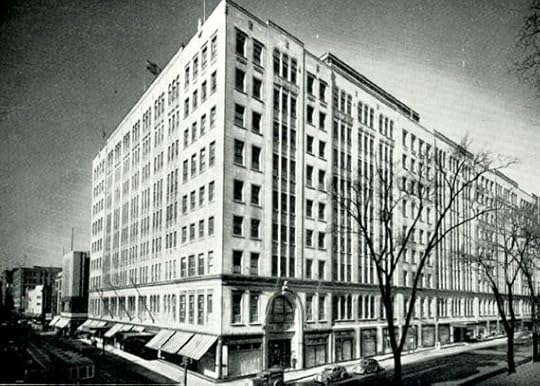
The T. Eaton Co. Ltd. store in downtown Montreal
That visit is where I scored my initial piece of plastic ware from the hip. This being the 1990s, it came in cassette form and the title was Road Apples. I knew the band due to their song “New Orleans is Sinking” on Maine’s last freeform FM station, WTOS. I probably bought the tape on the strength of that one song (which isn’t on this recording, btw). Glad I did. I became a huge fan. Have been to this day.
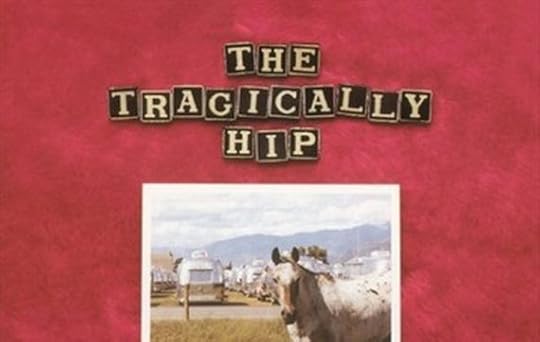
Road Apples (1991) by The Tragically Hip
Phantom Power, the record that “Bobcaygeon” is on, is one of my favorite Hip records. I always liked that song and I learned it as one of my first five songs on my quest to master 10 songs so I’d have an actual setlist. I’ve blown past that self-imposed barrier.
When Gord Downie was diagnosed w/ terminal brain cancer in 2016, his band had just released a record, what would be their final offering, Man Machine Poem. Initially, this bandmates must have been devastated by Gord’s news. Then, there would have been the parallel disappointment of thinking that they’d not be able to tour behind a new record like they’d done since the release of their first one in 1989.
Downie, of course, had other intentions. He knew something that todays bugmen have never learned. That life means at some point that we’ll all “pass through the door” and die. Like all great men, he planned to die with grace and dignity. Oh, and rocking to the finish line, too.
He told his bandmates they were going to tour. I mean, he’s getting cancer treatment, he’s sick, and he’s having trouble remembering lyrics. The documentary, Long Time Running, tells how Paul Langlois his longtime rhythm guitar player was thinking, “how do we tell Gord we can’t do this?” Well, you don’t. Watch the documentary if you get a chance. Maybe it might serve as a buffer to all the fear-fogging coming your way and the constant message of “Be afraid: be very afraid (of COVID).”
Downie managed to ready himself and the band ran from west to east across the magnificent Canadian continent playing Hip shows they were known for: long, loud, and filled with Gord’s charismatic personality. By the time they’d reached Toronto for the final run of shows, fans had been able to pour their heart out and extend their love for Gord and the band one last time. The band’s final song, streamed all over Canada. I mean, who in America would have been able to gather this kind of collective sense of national unity like Gord did? No one, not even Springsteen. Granted, Canada has a tenth of our population, but still. This is amazing and emotional and speaks to the better side of human nature.
I’ve been thinking a lot about what makes for a good life. Men like Gord Downie showed us a manner of how it’s to be done right up until he “walked through the door.” Not perfect, but a man who knew at the end, how to lay his life down with grace and dignity.
We could all learn something from his example.
October 25, 2020
A Guitar Saved My Life
The governor has shut me down. Just when I was starting to slide into a groove of sorts with my guitar-playing and getting out to various open mics, the governor in what seems like simply a random dictate—has snatched away these weekly chances for me to take my music from the basement bunker onto a stage. It’s become a way to push myself to become better, which only comes when you perform. Song lyrics and chords that you nail flawlessly when it’s just you alone in a practice space suddenly disappear when nerves hit prior to going on before strangers.
Mark was killed in January 21, 2017. During the second year of living through grief and loss, things seemed to get worse, if that was even possible. The summer of 2018, I became deeply depressed. I contemplated ways to kill myself. The loss of Mark and the isolation of being alone all day in a large house with no one calling or even emailing me made life seem untenable. As much as I loved Mary and didn’t want to inflict even more pain on her than she was already carrying around, I just couldn’t see any options.
On the darkest day of my life other than the night we learned Mark was killed, I was moving towards a final decision. But, for some reason, I walked towards the corner office I had in our house we were renting in Brunswick. To this day, I still don’t know why. Maybe to buy some time before making an irreversible choice.
Sitting in the corner was my guitar case holding the Yamaha acoustic I bought back in 1989 at Buckdancer’s Choice in Portland. Just recently, Mary found the original sales slip. I paid $140 for an instrument that has brought me joy, along with frustration for 30 years. I say “frustration” because at that point in my life, I’d never managed to push through that “wall” that all guitar players have to pass through on the journey towards being proficient on their instrument. I read a book earlier this year and the author said something to the effect that “the guitar is an easy instrument to learn: it’s a difficult instrument to master.”
Until 2018, I never committed to mastering the guitar. Oh, I’d have periods that would last a few months to a year when I’d play enough so that I built callouses on my fretting hand. I’d learn Christmas songs for the holidays, or in 2001, while attending a Vineyard Church in Lewiston, I became the small group worship leader, the guy who played simple songs on my guitar and led us in worship songs each week. That’s how I learned about Michael Pritzl and The Violet Burning, a band I now cover.
Over the last 10 years or so, I rarely took my Yamaha out of the case. I had committed to being a writer and my craft. As a writer, I managed to get four books to the finish line and I wrote articles for newspapers like the Boston Globe and other local dailies, as well as auto trade magazines from 2012 to 2018. Yet, whenever I’d hear a song I liked and a guitar piece that caught my attention, I’d think, “I need to get back to playing guitar.” But, I never did.
When Mark was killed, his friend and housemate William remained in the house that Mark owned in Providence. As parents, we began the sad and exhausting task of clearing out Mark’s things and managing the house with three other tenants. It wasn’t fun at all.
William was there for six months following Mark’s death. I mentioned the guitar and William said he played. I brought the Yamaha down and left it in the house. Lucky for me he didn’t take it with him when he moved to Vermont. I’m not sure he ever played it. I toted it back to Maine on one of our many 3 ½ trips between our home and Mark’s.
Once I picked up the guitar on that fateful day and played a few songs I remembered and sang, I felt something I hadn’t in months. I’m not sure exactly how to represent what I felt but it was something akin to lightness—not quite joy, but approximating the other end of the spectrum of emotions than what I was sinking under at the time.
After a week of taking the guitar out of the case each day and playing a little bit, I started leaving it out on the guitar stand in our living area, instead of my back office. During the day, if I had 10 minutes, I’d play. Ten minutes became 20 and before long, I was playing an hour or more each day.
For a long time as a inconstant guitar player, I struggled remembering chord patterns and notes on the fretboard. Hell, I couldn’t remember the names of each string. Constantly having to think about every chord change made playing smoothly, difficult.
Interestingly, while it was in August that I chose the guitar over another option, earlier in June, I’d signed-up for an adult ed course in intermediate guitar. I expected to be one of the worst students in the class of eight or more guitar wannabes. But I wasn’t. When Randy, the longtime musician and instructor asked us to pick up the guitar and play a few chords and notes, only two of us could consistently follow his instructions for the basic chords he called out. I guess I wasn’t the worst guitar player in the world, even back then.
Unfortunately, the next week I’d be gone on a road trip for my second Father’s Day without Mark. Two days before leaving, I did something to what I thought was my lower back. I actually aggravated my SI joint and sitting and moving became painful. I never got to complete my guitar class.
The guitar sat from June until August waiting for me to pick it up again.
Since August of 2018, I’ve played the guitar almost every day. After learning new songs and progressing enough that I was starting to crave my time each day on my instrument, I said to Mary, “I think I need an electric.” I know she wasn’t thrilled about me asking for money that we really didn’t have in our budget to splurge on a new guitar and amp. But, Mary being Mary, we sat down and she asked me, “how much realistically do you think it would cost to buy a decent guitar and amp.” I gave her a figure. I knew I wouldn’t be buying a vintage axe and amp, but I also knew I wanted a guitar that would be playable and functional enough for whatever my lie ahead for me as a player.
How I ended up with my Danelectro six-string and my Vox combo amp is another story that I’ve touched on here on this blog. Stopping by Dube’s Music in Freeport with a guitar and amp apparently waiting for me in the price range I’d set with Mary, also now seems like a fortuitous event.
Simply having an electric guitar and an amp doesn’t a guitarist make. In fact, I struggled on the electric for months. I’d work on a song and I just couldn’t manage to put all the parts together. Plus, I had no concept of how scales and chord changed went to together. I never knew what key I was playing in. The theory piece of guitar-playing still eluded me.
I kept playing, though. At least an hour a day, if not more.
Once we moved to Biddeford and into our new house, I set up a practice space in the basement. I’d initially thought another part of the house might work, but what the basement allowed was a space where I could play at volumes that are necessary when playing amplified music. I continued to alternate between my Danelectro and my acoustic.
A year ago, I wrote my first song. “Walking Down the Road” is a song coming from the perspective of Mark telling his own story about his final walk. I’m not sure where that came from. But I was on my way. I wrote a handful of other songs during the fall. A few were throw-aways, but more often than not, the songs were ones I wanted to play.
In December, I went up the stage at the Wolves Club in Sanford for the first time. Their open mic was my first time on a stage before an audience. I played three songs solo on the electric. I didn’t fall on my face. I kept planning to go back in January and then it became February. In March I drove down the coast and jammed with an old friend who was a drummer. I’d been to an open mic in OOB twice that was geared more to the acoustic side. It was okay, but not necessarily what I was looking for. I was planning to head back to Sanford when we were forced into lockdown from COVID.
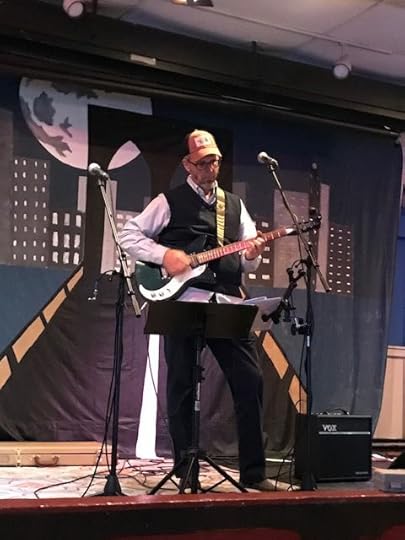
Open mic night at Jimmy the Greek’s back in February.
March, April, and May, I tried to play guitar every night after work. On my day off on Thursdays, I often spent four or five hours working on songs. We did a couple of streaming shows from the saloon in our house. I found a talented local guitar player with a track record of musical success to provide some lessons. I was starting to piece things together.
Finally, summer came and I ended up heading down to Bentley’s to play at their high-powered open mic. Then, I was hitting another one in Gray and then, up to Mechanic Falls. Before the governor shut us back down again, I played three open mics my final week.
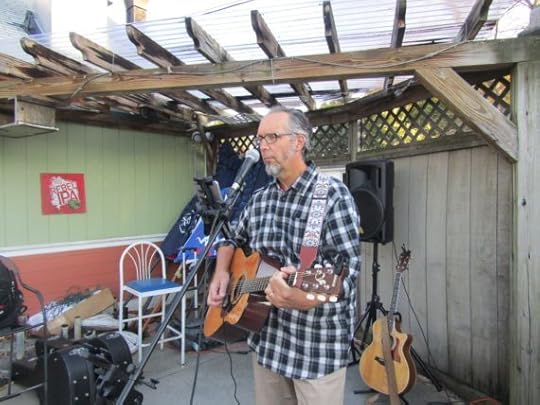
Jamming outdoors (Jimmy the Greek’s)
I have no idea when I’ll get the opportunity to jump back on the stage. I want to keep this positive energy and performance momentum moving forward.
Yesterday, I decided to play a set of songs from our saloon. Mary was gone in the afternoon, so I knew I wouldn’t disturb her. I also wanted to see if I could produce a clearer video stream and experiment with some ideas I’d been thinking about for streaming music. I played for nearly an hour.
I’ll likely stream a show in November and see what happens come December. Stay tuned for more music from JimBaumerME.
October 8, 2020
Working Out More Songs
Another attempt to find a drummer today. These inquiries launched into the digital void haven’t delivered a timekeeper, yet.
All-too-often, some guy wants you to “hit him up,” which seems to be code for “when you do all the work of writing the songs, scoring the gigs, call me and maybe I’ll show up for the payday.” Or something like that.
A week ago Tuesday, I followed a three-piece in Mechanic Falls that were amazing. The band were two brothers (I think) slightly younger than me. They’d been playing for awhile. The drummer who was co-hosting with Chris Floyd was a young man from Jay named Bobby. He has a band of his own, The Only Hope. I appreciated Bobby (and Chris) backing me on “Creep” by Radiohead, and my own song, “Walking Down the Road.”
For the past week, I’ve been thinking how my experiences at open mics might become remarkably different if I could show up with a bunch of songs that I’d been working on with a drummer, instead of hoping the band that I just met minutes before playing will be able to follow me in my own original songs. Then, in some settings, I have to have what I want to play vetted, ensuring the house band knows the song. Maybe I don’t want to learn a bunch of songs that everyone else plays.
Yesterday on my drive back and forth to Brunswick to see my chiropractor with a side jog to my old hometown to see my sister, I listened to Teenage Fanclub. The Fannies are one of a host of bands I could probably listen to daily and not grow tired of. I’m so glad I made the trek to Boston a year ago in March to catch them. It was another one of my solitary adventures.
Prior to my trip to the Hub, I tried banging out some of my faves by the Fannies. For whatever reason, I didn’t have much success. I’m a better player now than I was back then. Maybe that’s why I was able to work this one out, even transposing it in a different key so I wouldn’t be forced to play it dropped down a step and could keep my one electric in standard tuning. That will be good when I roll this one out, live.
What an amazing fucking scene from 1992. It’s Reading, in the rain, and the crowd is being transported to some other place by a bunch of 20-somethings who’ve managed to continue making meaningful music nearly 30 years later.
“Everything Flows” is not the type of song a 25-or-so-old kid writes: a plaintive ode to the passing of time with lines like “see you get older every year/but you don’t change, I don’t notice you changing.”
Looking forward to playing this one live in the near future.
Oh, and the biz card makes it official: I’m now calling myself a musician along with writer.
The business of music.
And since one can never have too much of the Fannies in their lives, here’s a show they did in NYC back in ’93 for some Japanese television station.
September 28, 2020
My Own Terms
We are in that transitional time between late summer, segueing into early fall. I have felt a sense of being adrift. Six months into Covid, with little abatement in sight, the looming darkness and colder days don’t bode well for anyone preferring light and summer breezes. Simply, summer has offered some respite from Covid lockdown. What’s coming, I’m afraid, is a dank, Dickensian dystopia to be endured over the course of the winter.
Last week, a well-known local musician touched down on Facebook about his bookings drying up as the summer places began shutting down for the season. A drive along East and West Grand in Maine’s premier tourist Mecca, OOB, on Sunday revealed summer’s dying embers. Many of the places that had outside entertainment like the Sunset Deck and Myst have closed until next May. Others are open for another three weeks at best. Who knows if The Brunswick will have indoor entertainment come late October.
For the past 44 months I’ve been journeying through the loneliness that apparently is endemic in those relegated to living with the loss and associated grief that accompanies the death of someone deeply loved. During my sojourn, former associates have disappeared. Not sure why. I’m guessing that surface relationships can’t come to terms with darkness of death, subsequent depression it delivers, and all the associated fall-out from an event inflicted on someone.
On days like today, my first inclination used to be to sit down and write a blog post. Given that Mondays don’t require me to check-in at Whitey’s Farm until later in the morning, I went down the stairs to my bunker and picked up my acoustic. As I’ve intimated before, I’m not certain I’d still be here if on that dark day in August of 2018, I hadn’t opened the dust-covered guitar case housing my Yamaha guitar, rather than seeking the alternative hidden in the closet upstairs.
Over the course of the past 2+ years, I’ve learned song after song, while also writing 15 of my own. Anyone connected with music will tell you, playing it has the capacity to deliver healing, while diverting someone from the trauma that comes with sudden and unexpected loss.
As my playing has evolved, I’ve been thinking about possibilities: is it even reasonable to think about playing gigs at some point? I mean, I guess I can sit in my basement/bunker until the end of my days, playing to the cement walls that encase my home-based performance space.
A month ago, I resumed the practice of heading out to open mics. I’d been told that open mics are the requisite initial step towards getting someone to book you to play at their coffee shop or pizza parlor, or even a dive bar.
Weirdly, just like I did with writing, I set out on a path of my own. Granted, with the former, I consulted the experts: writers like Stephen King and a host of other “how to” treatises on writing. It worked. I’ve been at it for 20 years now with some success, although I’m not a household name by any means. Having said that, I’ve hit targets I set for myself long before I ever had my first piece of writing published.
For some reason, my initial thoughts related to playing guitar for someone other than my cat seem to have gotten derailed. I’m not sure why. In part, I think I’ve allowed myself to be pushed towards things I didn’t think were in my best interest six months ago. Some of that is due to limited places to play, even at open mics.
Last week, I came home from an open mic and realized I’d totally lost my way. I ended up playing stuff I wasn’t well-suited for, rather than focusing on my stronger material. I’m not going to do that anymore. I’m going to fail or succeed on my own terms.
Waiting for work today, I mapped a plan for tomorrow night and a new open mic stage. I might end up falling short yet again. But I’m going to play three songs that work for me.
September 13, 2020
Words Don’t Matter Anymore
When I launched this blog in 2012, I was passionate about blogging. At that time, I still believed in the power of words—that words truly mattered. I no longer hold that as a truth.
Back in 1995, after coming to the end of another job and place of employment, I took the summer off. I read, I ruminated, and I planted a garden. There was a particular richness to that brief respite from work and busyness.
In many ways, that summer changed my life at the time. I made a transition in my thinking and outlook. I also read Neil Postman for the first time. What Postman taught me about the world is something I’ve carried with me ever since, especially in terms of how I view technology.
In 1995, there was no Facebook. News and presidents didn’t take to Twitter to make proclamations. I would not learn of the internet for another year. It was the perfect time to come to Postman’s ideas and live amidst the wreckage across the following 25 years, watching a world altered by technology.
Unlike 2012 when I’d spend copious amounts of time researching and organizing my thoughts in order to write a lengthy post that would ultimately be read by very few, these days, I simply present some truncation of a greater truth, or the more detailed ideal that I am working from. I am reading less these days than I did in 1995, but I still read. I’m probably reading and writing less because I’m playing guitar more. Since words matter no more that’s a worthwhile trade.
I don’t believe science and technology will save us, greatly improve our lives, or bring about anything particularly special to how we currently live. That thinking comes from internalizing Postman 25 years ago.
Here is Postman on technology, in five points:
One, we always pay a price for technology; the greater the technology, the greater the price.
Two, there are always winners and losers—the winners always try to persuade the losers that they are really winners
Three, embedded in every great technology an epistemological, political or social prejudice. Sometimes the bias is greatly to our advantage. Sometimes it is not. The printing press annihilated oral tradition; telegraphy annihilated space; television has humiliated the word; the computer, perhaps, will degrade community life. And so on.
Four, technological change is not additive; it is ecological, which means, it changes everything and is, therefore, too important to be left entirely in the hands of Bill Gates (or Jeff Bezos).
Five, technology tends to become mythic; i.e. perceived as part of the natural order of things, and therefore tends to control more of our lives than is good for us. …. When a technology become mythic, it is always dangerous because it is then accepted as it is, and is therefore not easily susceptible to modification or control.
There you have it. A cogent consensus on Postman and technology.
I’ve read nothing in the past 25 years that alters how I feel about these five points and my acceptance of them. But, I don’t hold hard and fast to any belief in never-ending progress, either.
Apparently, neither does John Gray, the author of Straw Dogs: Thoughts on Humans and Other Animals.
As Gray posits in his 2002 book, humans have a limitless capacity for self-delusion. That applies to me and the most rational among us. Gray tells us that humans didn’t evolve to find truth, but rather to mate.
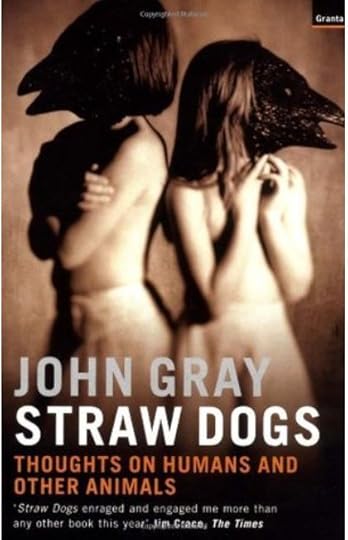
Straw Dogs: Thoughts On Humans and Other Animals by John Gray (2002)
Our current pandemic finds us falling back to technology as a means or remaining connected. Is there anyone who doesn’t know what Zoom is these days?
But Gray notes that while technology and science will progress, humans and our natures won’t. We use technology for both good and evil purposes. As a result, lots of destruction is inevitable.
These days, Gray writes regularly for The New Statesmen. In his essays for that publication, he regular takes down liberals. Not familiar with him until I picked up Straw Dogs, I agree with his assessment about liberals. They set themselves up as the arbiters of free speech and openness—until it doesn’t fit their political agenda. And then, they block it when it doesn’t conform to their particular ideals. See Black Lives Matter and the visceral hatred that most liberals have for Donald Trump. Their solution to Trump? Elect a man who obviously is compromised cognitively. At best, he’s an equally flawed candidate.
And of course, liberals—proud of their rationalism—are now given to conspiracy theories, too.
Gray noted that if liberals are ever at fault (they’ll rarely admit it), it’s for not being liberal enough.
How could the most rational ruling elite in history – as liberals perceive themselves to be – fail to comprehend the world around them? Like the nativists they attack, liberals find a strange comfort in the belief that their societies are being subverted by external forces.
Gray cites Wyndham Lewis, the English artist, writer, and critic touching on “progress.” Lewis who in his time founded the Vorticist movement, calls the idea of progress as “time worship”: the belief that things are valuable not for what they are, but for what they may someday become.
In the 20th century, work became ascendant and that belief has now infected our 21st century world, too. People have to be “busy, busy, busy,” even if that busyness is posting garbage and photos on social media. As Gray observed, “for nearly all of history and all prehistory, work was an indignity.” Even in the Christian world, it was only Protestants that equated work with salvation. If work is salvation, please send me to hell! Actually, for most of its mindless toil and the few shekels given in return, work is torturous most of the time.
Read Gray or not. It’s your choice
July 20, 2020
Give the Drummer Some
On Sunday, I ran through 8 songs in my basement and posted the video(s) on YouTube at my music page. I figured these 8 songs were a good representation of where I’m at in terms of songs and music I’m playing, at least electrically. My hope is at some point to find a drummer, hence the name of the video (parts 1 and 2). I split the set due to a glitch right about midway through.
The title is a reference to both a Big Star song, when drummer Jody Stephens sings “Way Out West,” and Alex Chilton says, “let’s give the drummer some.” Of course, if you know your popular musical trivia, then you know that James Brown says “I wanna give the drummer some of this funky soul, here…” in his song, “Funky Drummer.”
I actually just finished A Man Called Destruction: The Life and Music of Alex Chilton by Holly George-Warren Here’s a review of the book, here. Actually, I like this summation of the book, better.The book was kind of depressing (at least in parts) due to how Chilton pissed away his considerable musical talents through the trifecta of rock and roll, “drugs, booze, and sex,” or at least that was my perception. I’ve written a song about this and will be rolling that out in an upcoming video or recording.
I received positive feedback about the videos from those who watched them. A couple of people asked about lyrics.
Here’s lyrics to my songs and links to the covers (below):
Walking Down the Road
Verse 1
Walking down the road alone, I saw a country lost at home
A mission of hope carried me forth, I lived each day for all it was worth
A president came while I was away, I planned to counter him every day
Hate and division won’t carry us forth, come together and be a force
Chorus:
I wish I had just one more day, I know I had so much more to say.
I love my dad, I love my mom. I’ll miss my friends forever yon
Verse 2
My family back home sent me their love, I wished I got back to give them a hug
We all know what we think we know, but can we strive for a greater hope
Friends I lost along the way, but still I walked another day
Saving earth was what it’s about, some of the haters would jump and shout
Chorus:
I wish I had just one more day, I know I had so much more to say.
I love my dad, I love my mom. I’ll miss my friends forever yon
Verse 3
One hundred days of joy and pain, my feet moved ‘cross the fruited plain
A dirty hippy or something more, why can’t they see my higher road
My face and words live on today, I often wonder what people say
I gave it all held nothing back, but in the end was it done in vain
Chorus:
I wish I had just one more day, I know I had so much more to say.
I love my dad, I love my mom. I’ll miss my friends forever yon
[Instrumental break]
Verse 4
Walking down the road alone, I saw a country lost at home
A mission of hope carried me forth, I lived each day for all it was worth
My family back home sent me their love, I wish I got back to give them a hug
We all know what we know, but can we strive for a greater scope
Chorus:
If I had just one more day, I often wonder what I’d say
It hurts my dad, it hurts my mom. Please remember them from where you roam
[Fade]
© EverysongYeah 2019
——————————–
National Disgrace
Verse I
You’re a national disgrace
A fucking public shame
Trashing all your rivals
Can’t ever shoulder blame
Verse II
Talk about corruption
Should be your middle name
Bait and switch the shell game
It’s how you set your frame
Chorus
Deny global warming
Call it just a hoax
You’re a pox on the planet
Tides are rising at the coasts
Greatness offered suckers
No lightning in that jar
History will show us
Exactly who you are
Verse III
Tiny hands and fingers
Grabbing all you can
All your daddy’s money
Won’t float another sham
Verse IV
Some see through illusion
Your divisive world of hate
Fake news is your mantra
You deserved a Watergate
© EverysongYeah 2019
———————————
Spaceship Blues
Verse I
Life it sucks and then you die
Storm clouds in a darkened sky
Fucking morons are all around
All I wanna’ do is leave this town and roam
Verse II
Idiots tell you just to smile
Don’t have a clue, ain’t walked one mile
In land that’s filled with shit
Jump in a spaceship and be done with it and fly
Verse III
Coronavirus its shut us down
Like sheep we’re led to town
Trust the experts they’re rarely right
Load up that spacecraft with supplies and leave today
Verse IV
Facebook friends are posting crap
Take the bait you’re in their trap
Ideology will dead-end
Fly to outer space never to return again
© EverysongYeah 2019
Covers/lyrics
Berlin Kitty (The Violet Burning)
July 5, 2020
Wisdom Out the Window
Back in 1985, I’d recently walked away from fundamentalist religion. I’d been a student at a school run by a Baptist megalomaniac named, Jack Hyles. I’ve written many posts about Hyles across the footprint of my blogging that dates back to 1993. Of course, in 2020, blogging is as anachronism, just as outdated as a rotary dial phone. Doesn’t mean it’s bad—it’s just not the way the ignorant masses roll these days, especially the impressionable kids.
I was just an impressionable kid myself back in the mid-1980s when Ray-Bans were all the rage. But, I had determined to dry the wetness behind my own two ears. I figured broadening my understanding was the way to go. Moving beyond mere Bible verses and jeremiads offered in daily chapel services at Hyles-Anderson College seemed like a step in a new direction.
Mark was two-years-old and Mary was working the breakfast shift at the local Wendy’s. I was working the afternoon shift keeping the prisoners at Westville Correctional Center healthy and medicated (I was a medical assistant employed by the Indiana Department of Corrections).
With my morning free save for childcare, I decided to take my three semesters of credit at the University of Maine and see if I could ramp up my hopes of success in higher ed. Purdue University had a satellite campus about 20 miles away from where we were living and just up the road from the prison where I was working in Westville. Not sure why at the time, but I enrolled in Philosophy 101. It was probably a morning time slot thing.
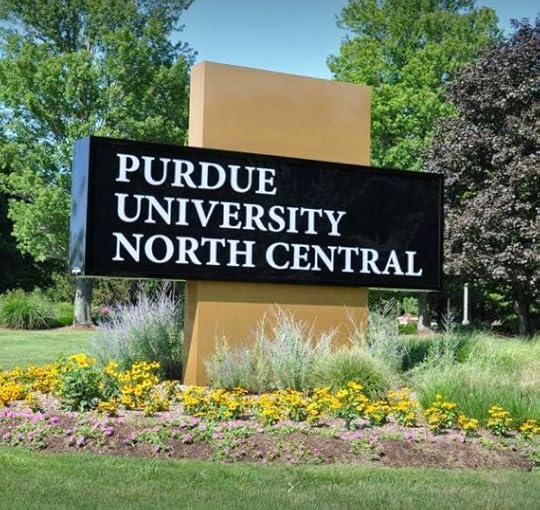
Thinking college was the way to go (Purdue satellite)
Being a commuter school, Purdue North Central’s (now known as Purdue University Northwest) enrollment was a mix of impressionable youngsters seasoned with older students who’d experienced more than I had at 23.
It’s been more than 30 years since I sat in the back of the class wondering “how the hell do these older students know that?” when discussing what we were assigned to read. I rarely offered much by way of discussion. Why? Because I had little to add to what these better-read and thoughtful fellow students had to say. That’s not to say that everyone that spoke up was erudite. I’m sure there were “gasbags” in the class pontificating for show. However, I don’t remember them. I recall thinking how little I knew and was determined to be one of those students some day.
For more than 30 years, I’ve invested my time in a diligent fashion. This has been done to acquire knowledge and wisdom. Knowledge can be garnered by reading, study, and rumination. Wisdom comes from living and processing information across the experiential aspects of time spent on Earth.
I am now those students I once admired and aspired to be. But, I am now living through a time when being 23 and ignorant is no longer a scourge. Instead, due to social media, one’s ignorance is displayed as a badge of honor and a means of virtue signaling.
Don’t know shit about history? Just call someone a racist for standing up for historical facts. Know nothing about the time before you were born? No worries. Just lob ad hominem attacks and chant “black lives matter” or assign all of society’s ills to the catch-all of “white privilege.”
This isn’t a recent phenomenon, either. When Portland still had a alt-weekly worthy of pitching stories to, I had to deal with a young dope of an editor after the more experienced editor I’d hoped to write a series of articles for, left. This 20-something know-it-all made getting a well-sourced and meticulously-researched story on Portland’s gentrification to the finish line a torturous process for the $500 I ended up being paid for writing it. It ended up on the front page and also was one of the last pieces I wrote for the Portland Phoenix.
At the time (2014), I noticed a shift in the Portland’s media culture. These 20 and 30-something types were taking to social media and leaving print behind. They also were more apt to attack my style of journalism, relying instead on 40-character tweets as a powerful tool designed to censor anybody and anything they didn’t want to deal with. It’s 1,000 times worse in 2020. Now, it’s not just these young dolts doing it—it’s people my age who ought to know better, but apparently don’t.
Facebook and Instagram now garner everyone’s attention. While I never had a huge audience as a blogger—I did have readers numbering in the hundreds. Now, one of my blog posts is lucky to have 25 people actually reading it, if the number is that high. Why the hell invest any energy in the blogging space if no one bothers with what you write?
If truth no longer matters (and it now seems not to), then what kind of foundation do we have to build anything meaningful upon? It appears to me that we have nothing but shifting sands.
Perhaps that’s why I find myself hearkening back to a time when thoughtful discussions mattered. Better, I wish I could go back there, even though those times were tough for me and my young family.
June 7, 2020
Trekking Back (to the Past)
Someone I met during the time I used to be a regular at morning business breakfasts told me the best decade of her life was between the ages of 50 and 60. The context of that revelation was my mention (at the time) that I wasn’t looking forward to turning 50. But, given her positive orientation—she was telling me that I had things in place to have a rousing decade of my own.
Back in January 2012, the future did seem bright enough to don shades. However, the subsequent years have disavowed me of that optimism. I think that decade for me has been a nightmare, really.
I’m not one given to nostalgia for the sake of being nostalgic. I do enjoy reading about the past, though. I’m a historian at heart and learning more about “the good ole’ days” is something I still enjoy in a life where joy has been diminished by time and tragedy.
I wrote a blog post about the past (back in the past) and I quoted a Danish author, Martin Lindstrom who wrote that consumers “in the face of insecurity or uncertainty about the future want nothing more than to revert back to a more stable time.” That would seem to be the time we’re living in. No?
When we were first told to shelter-in-place by our all-knowing governor, I was taking a class at USM centered on the Civil War and then, the Reconstruction period following a war that cleaved our country in two. Spending time immersed in reading and study focused on the middle part of the 19th century was strangely comforting—especially when all certainty in the present had been suspended.
While I’ve attempted to stay current on the latest arbitrary decisions made by our political overlords, I admit that my stomach for the propaganda served up by mainstream news sources has soured. If ever there was a time to call out “fake news” when consuming what passes for journalism today, now would be that juncture.
Withdrawing to my basement and picking up the guitar each day has helped maintain some equilibrium of normalcy. So has the occasional foray back into the past.
Last week, my sister-in-law visited my better half one day while I was at work. She dropped off some items that had been the property of my wife’s parents (my in-laws). One of the items was a small 3.25” X 6.25” booklet with the simple title of The Book of Presidents.
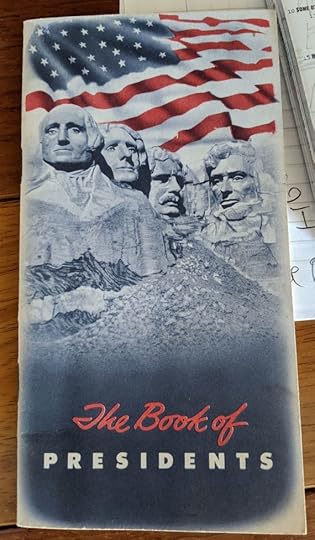
The Book of Presidents (1956) by Barclay Chemical Co.
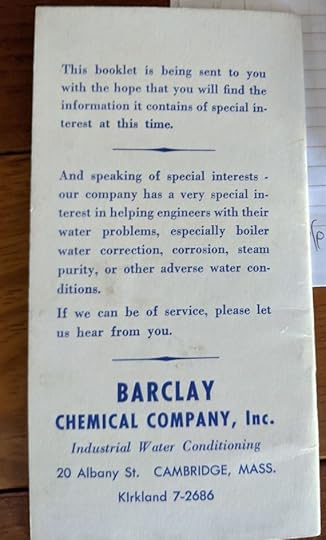
On the back page of the booklet, I learned that the Barclay Chemical Company of Cambridge, Mass. had underwritten its production. They noted that “This booklet is being sent to you with the hope that you will find the information it contains of special interest at this time.”
Presidents (back page)
The time when the book had been produced was just after the 1956 re-election of Dwight D. Eisenhower, our 34th president. For the young skulls full of mush out in the streets, Mr. Trump is our 45th president. Not sure if they still teach these things in school, but George Washington was our 1st president, and for the sake of some context, Thomas Jefferson was #3, Abraham Lincoln was #16. But none of these things probably matter any longer. But I digress.
The booklet was interesting to me because it delineates aspects of the presidency: one of the three elements of our tri-partite system of governance. One of these is the president’s oath he takes upon being sworn into office.
“I do solemnly swear (or affirm) that I will faithfully execute the Office of President of the United States, and will, to the best of my ability, preserve, protect and defend the Constitution of the United States.”
Granted, this oath probably means nothing in light of the events of the past two weeks. No one seem to give two shits about things like the Constitution anymore. The main focus seems to be settling scores and grievances, first and foremost.
But for me, a student of history, I moved from the presidential oath to the Powers of the President that the booklet listed. From there, I became fixated on the booklets pages that showed voting for the president by party, from 1916 to the prior election in 1952 when Eisenhower, the decorated military general, won his first term. I found it fascinating that the listing (by state) shows how party voting by state has shifted over the past 60 years. From 1916 through 1952, it was a given that Southern states would vote Democrat. Nixon, utilizing his “Southern strategy” changed all that and now, the South is staunchly Republican (and conservative, too).
One interesting “blip” I noted on this voting theme was the 1948 election, when Strom Thurmond ran as a Dixiecrat and campaigned on a state’s rights platform. This was during an era when segregation and Jim Crow was the law of the land in the southern half of the country. That’s all changed for the better and it appears that racial progress has been made, at least using history as my lens. I’m sure, however, someone who doesn’t consider anything other than Twitter for their fact-checking is apt to tell me to “check my white privilege” on anything I write, using thought and history as my basis. That’s so 1956. Yes, 2020 is truly a glorious time for sure, when up is down, out is in, good is bad, etc. (See George Orwell)
My sister was the one who pointed out to me that companies like Barclay serviced the pulp and paper industry providing industrial water conditioning, especially for the massive boilers that mills utilized in papermaking. My dad was a unionized paper maker and a boiler engineer at Pejepscot Paper. The mills provided a good living for men like my dad, who were willing to work southern swing shifts and tolerate the industrial environment common in the mills that lined Maine’s waterways at one time. Those jobs and the times that made them possible are a thing of the past.
I’m not sure my father is nostalgic or not about those days. I’ll have to ask him the next time I see him.
May 28, 2020
Locked up for now (but not, then)
Do you remember the early days of coronavirus? It was only two months ago, but it seems like years. Maybe our perceptions of time change when we’re under house arrest.
If you are like me (and you’re probably not), you’ve been searching high and low for some variation on what’s been the equivalent of fear-mongering and propaganda by the mainstream media. I’ve used the term “fear-fogging” on this blog to connote the idea of fear being spread like the way fog rolls in off the ocean and envelopes everything in its path, reducing visibility to zero. The media’s kind of like that these days.
Unfortunately, despite my best intentions, I’ve internalized some of this propaganda and groupthink, too. As hard as I fight it, sometimes when I go out in public, I’m scared that the ‘krona might get me, too.
Speaking of internalization; how about the idea that the last time there was a major pandemic in the U.S. (and across the globe) was the great pandemic of 1918. That’s actually wrong. The U.S. had pandemics in 1949 to 1952 (polio) and 1957. I got this from the website for the Centers for Disease Control (for you scientists lurking out there, fact-checking any alternative storytelling) re: the 1957-58 global pandemic::
In February 1957, a new influenza A (H2N2) virus emerged in East Asia, triggering a pandemic (“Asian Flu”). This H2N2 virus was comprised of three different genes from an H2N2 virus that originated from an avian influenza A virus, including the H2 hemagglutinin and the N2 neuraminidase genes. It was first reported in Singapore in February 1957, Hong Kong in April 1957, and in coastal cities in the United States in summer 1957. The estimated number of deaths was 1.1 million worldwide and 116,000 in the United States.
The current death toll in the U.S. stands at just slightly over 100,000.
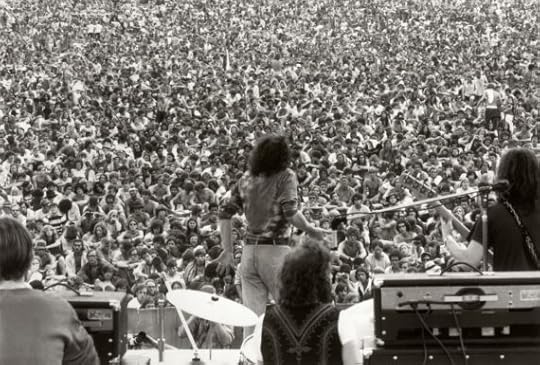
For Boomers (the group that seems most obsessed by Coronavirus), their lodestar event was Woodstock. I’m sure they (and all but a few of you) didn’t know that when Woodstock was happening in 1969, the U.S. was in the throes of another pandemic.
Spreading memes about Woodstock and pandemics.
The Hong Kong Influeza (H3N2) pandemic killed 100K in the U.S. and more than 1 million worldwide. Until this week, I was clueless about this information. Why? Maybe because since March, the New York Times, Washington Post, Atlantic Monthly, Mother Jones, and a host of other left-leaning sites supposedly practicing journalism didn’t think it was important to stem their flow of hysteria and propaganda to actually advance some actual investigative stories that tracked beyond the most narrow of ditches for news about Covid-19. TPTB have done a great job of shutting dialogue down, other than what’s “official.” FB and Twitter have been especially virulent with their supposed “fact-checking.” Okay. Let’s be fair, here. The New York Times did publish this story. But these types of pieces about the pandemic have been few and far between.
Speaking of said checking of facts: some guy who went to Hofstra and has been rooting around the bottom of the media’s barrel with Vice and now, Buzzfeed, tells us all that the stories I’ve linked to (like the Woodstock one) are dubious. He calls them “memes,” which is just another technique for calling something that does’t align with his own bias, a “lie.” Because of course this arbiter of truth (have you ever spent any time on the Vice site with its myriad of clickbait?) tells us so. Thanks but no thanks, Mr. Broderick. I can think for myself and I plan to. But I realize that others require their “truth” fed to them in convenient thimble-sized (and approved) bitefuls. Because thinking is hard and it’s much easier to stand on your soapbox and repeat a bunch of things someone else told you to say.
But back to my main point, here. If none of these previous pandemics resulted in lockdowns and social distancing, then why now? That’s a question I’d think someone in the media might be interested in writing about. I’ve been waiting for 2+ months. Instead, we keep getting the same useless narrative from all the mainstream sources, foisting their never-ending fogging of fear upon the masses. “Bueller,Bueller, Bueller.” [crickets].
What’s different in 2020 that made shutting down everything necessary? It’s been 50 years since Woodstock. We haven’t had improvements in public health that might allow for selective quarantining of high-risk groups, but allowing life to continue, like it did in 1968 and 1969? Honestly—I’m curious if anyone out there can answer that question without an ideologically-oriented response, or with the usual incessant virtue signaling passing as concern for others. I’m calling “bullshit” on that tack, if that’s where your thinking of going with me.
I have my own theories, but I’ll keep them to myself for now. I’m sure you mask-shamers and moral superiors will think, “Jim’s a covid-denier” or some other term used to marginalize (and shutdown) thought. That’s fine. I have come to care less about most of you. You’ve all disappeared over the past three years following my son’s death and I’ve stopped missing you. But honestly, when I see one of your updates on Facebook, pissing and whining about wearing a mask (or those not wearing one), I think, “what a fucking tool.”
But seriously—rather than spending all my time on this shit, I’ll go back to playing the guitar and living my life, in whatever version General Mills tells me I’m permitted to. And btw, I do wear a mask when necessary and when required. But I’m not sold that it makes any difference.