
Jennifer Bohnhoff's Blog, page 41
August 8, 2016
Dehumanizing the Enemy
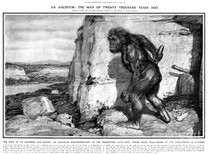 In my novel Swan Song, Helen and her exchange-student friend Dervinder go for a run. As they run, they talk about their assignment: writing a research paper based on the Old English Epic Poem Beowulf.
Helen becomes convinced that Beowulf is far older than people think it is. She believes that it is a story retold through multiple generations: a story about a conflict early in man’s existence:
I say that if this story is old as the cavemen, like I think it is, Grendel’s no tyrannosaurus because they were all dead already. Mr. Reed said that. I don’t think he was a saber tooth tiger either. The Beowulf writer’s idea that the evil creatures of this world are not really monsters, but corrupted sons of Cain, the evil son of Adam and Eve who murdered his own brother. But what lived back then that might have been considered monstrous, a fallen man? Were there orcs back in the Stone Age?
And that’s when Gurvinder says that maybe Grendel was a Neanderthal.
I stop in my tracks. “What?” I gasp.
“A Neanderthal,” Gurvinder says. He stops too, but leans forward, hinting that we’re supposed to keep going. I start running, but slowly. My mind’s racing.
“What makes a Neanderthal like a fallen man?” I ask.
“T’ink about it,” he says. “We depict Neanderthals as brutes. Half monkeys with stooping shoulders who drag their clubs on the ground. We make them look stupid. But they weren’t.”
“How do you know that?” I wheeze. This talking and running at the same time isn’t easy.
“I’ve read about them. National Geographic. Discovery. They were smart, like us.”
“So why do we make them look like morons?”
Gurvinder shrugs. “Maybe they’re too much like us. We need to make them look like they weren’t smart so we can explain why we survived and they didn’t. Make ourselves feel better.”
I wish that the Weders’ dehumanizing of the Berigizon was the only time one group of people have used this tactic to make themselves feel superior. Unfortunately, it's not.
I just finished watching Schindler’s List, a movie about how one German industrialist managed to save thousands of Jews from the Holocaust. Nazi propagandists had insinuated that Jews were less than human, and that they were dangerous because they seemed so much like people. While talking with his Jewish housemaid, Helen Hirsch,
 Amon Goeth, the superintendent of Plaszow work camp, says “I realize that you're not a person in the strictest sense of the word. . . I mean, when they compare you to vermin, to rodents, and to lice,” reiterating the Party line than Jews were subhuman. In other propaganda, such as this poster, Jews looked like monsters with long claws and fangs, much like Grendle the monster is depicted in Beowulf.
We continue to dehumanize our enemies. We call them uncivilized monsters so that we have justification to fight them. And they return the favor, calling us and our way of life monstrous as well.
Perhaps this is the human condition, but perhaps one day we will stop using this ploy and recognize everyone as fully human, regardless of skin color, religion, or place of origin. Only then will humans be truly humane.
Jennifer Bohnhoff is a middle school social studies teacher and the author of several books for middle grade readers. Swan Song is her first young adult novel.


July 31, 2016
The use of kennings in Beowulf: Wealtheow the Peaceweaver
 One of the literary features of Old English poetry is the use of kennings, or compound words that evoke vivid pictures. Beowulf, an epic written sometime before 750 a.d. and arguably the greatest literary work of Anglo-Saxon culture, is liberally sprinkled with kennings.
For instance, Anglo-Saxon scops, or storytellers, compared the bubbles and foam that form around the prow of a ship as it cuts through the water to a necklace on a woman's throat. They knew that the course which a ship took through the water could also be traversed by swans or whales. Therefore, when the hero takes a boat from the land of the Geats to Denmark, the poet uses kennings and says that Beowulf's foamy-throated ship goes over the swan- road to reach the tide-beaten land.
This Anglo-Saxon love of kennings has persisted in the Germanic propensity to form compound words.
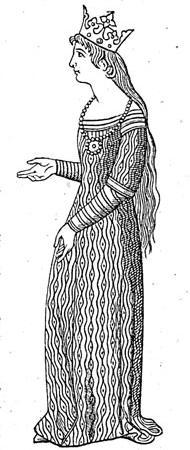
The kenning freodwebbe, or peace-weaver is used to describe Wealtheow, the Queen of the Danes, wife of Hrothgar, and mistress of the great hall Heorot. This term refers to a woman married from one tribe into another in order to secure peace between the two groups. While it is obvious that the Danes are one of the groups Wealtheow's marriage was to unite, we know very little of her original family or clan. In line 620, the poet calls Wealtheow "the Helming woman," but the Helmings are not a tribe that can be historically identified. They show up in no other work of Anglo-Saxon literature. I wonder if they even existed by the the time the Beowulf poem was being written down, or had they succumbed to warfare or disease.
Wealtheow's name further confuses those who want to understand her background. Wealtheow is a compound, a combination of wealh, which means Celt, foreigner or slave, and theow, which means in bondage, service, or not free. Although she moves freely through Heorot, Wealtheow's name suggests that she is not there of her own accord. Several researchers explain that there is not a clear distinction in Anglo-Saxon law between a woman being offered by her tribe as a pledge of good faith between tribes and a woman being taken from her tribe as a hostage. Other precious items such as jewelry and battle gear were exchanged as seals of good faith between tribes, demonstrating that women were treated as commodities in the Anglo-Saxon world.
Although she is a queen, Wealtheow is in a difficult position. She is isolated within a society that may not accept her as one of their own. Stripped of the protection of her own family, she lives among people she may not like or trust because they have, in essence, kidnapped her. Her goal, to weave peace among two peoples, is ultimately in the hands of the men who surround her, and who have already proven themselves warlike in the very act of taking her.
The Wealtheow who appears in my novel Swan Song is a quiet and dignified woman who carefully works to keep peace within her household, appease her guests and please her husband. She is resigned to her fate, but if one looks, one can see the shadow of distant and violent events long past in her eyes.
July 24, 2016
Who - what - was Grendel?
In the Anglo-Saxon epic poem Beowulf, Grendel is a frightening creature who sneaks into Heorot, the mead hall of the Danish king Hrothgar, and kills and eats the warriors. But what kind of creature is he?
The original Beowulf poet did not provide an exact description of Grendle, but he does provide some clues. In his 1977 translation, Amherst professor Howell D. Chickering calls Grendle, among other things, an unholy spirit (line 120), a dark death shadow (line 160), an evil monster (433), a dark walker (703), and a demon (706).
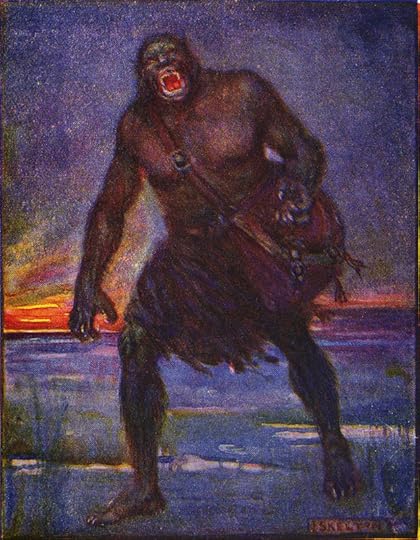 By J. R. Skelton - Marshall, Henrietta Elizabeth (1908) Stories of Beowulf, T.C. & E.C. Jack, Public Domain, https://commons.wikimedia.org/w/index... Perhaps one of the reasons why there is not a lot of physical description rests in the fact that the poet calls Grendle a sceadugenga, a shadow walker, or as Chickering translates the phrase, a dark walker. Grendle only goes about at night, and is therefore shrouded in darkness, both physically and metaphorically.
Grendel is usually depicted as a monster, and while the poet does not give the reader a lot of physical details, those he does give are monstrous, indeed.
Grendle has”gigantic fingers,” each topped with a “terrible hand spike” that “glistened like steel.” (Chickering translation, lines 983-985).
In his 2000 translation of Beowulf, the Irish poet Seamus Heaney says that Grendel is vaguely human in shape, though much larger:
... the other, warped
in the shape of a man, moves beyond the pale
bigger than any man, an unnatural birth
called Grendel (lines 1351–1354)
While we are not given a full description of Grendle’s appearance, we are given his background. Grendle is a descendant of Cain, the son of Adam, who, according to the Bible, was the first man, created by God. Cain was the first man to commit murder, killing his brother Abel. The Beowulf poet says that God then drove Cain “out, far from mankind,” and Cain’s children became “every misbegotten thing, monsters and else and the walking dead, and also those giants who fought against God time and again.” (lines 110-114) Fans of Tolkein’s Lord of the Rings will be interested to know that the original word for walking dead is not zombie, but orc.)
So then, regardless of what Grendle looks like, he is a fallen man, corrupted by the sins of his forebear Cain. He may be monstrous, but he is fundamentally human in nature.
I’d been toying with the idea that Beowulf was not a 6th Century story (even though many of the characters are historical persons from that period) or a 9th Century story (one of the suggested dates for the one existing manuscript) but a much older story. What if Beowulf was a story from the dawn of humankind? A story that had been handed down through countless generations, changing with the times, adapting as new technologies were born and old ways were forgotten?
What creature would have existed at the dawn of humankind that was fundamentally human in nature, yet different enough to frighten and disconcert us enough for us to call it monstrous?
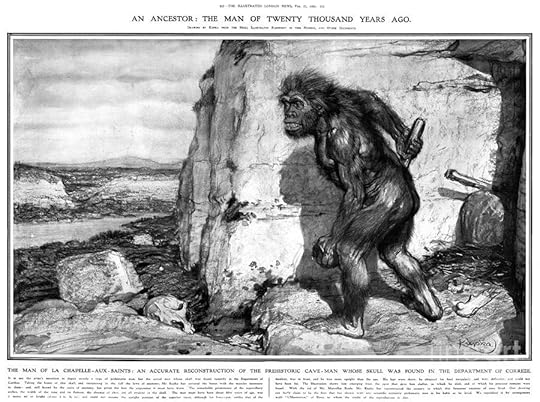 Could Grendle have been a Neanderthal?
The original Beowulf poet did not provide an exact description of Grendle, but he does provide some clues. In his 1977 translation, Amherst professor Howell D. Chickering calls Grendle, among other things, an unholy spirit (line 120), a dark death shadow (line 160), an evil monster (433), a dark walker (703), and a demon (706).
By J. R. Skelton - Marshall, Henrietta Elizabeth (1908) Stories of Beowulf, T.C. & E.C. Jack, Public Domain, https://commons.wikimedia.org/w/index... Perhaps one of the reasons why there is not a lot of physical description rests in the fact that the poet calls Grendle a sceadugenga, a shadow walker, or as Chickering translates the phrase, a dark walker. Grendle only goes about at night, and is therefore shrouded in darkness, both physically and metaphorically.Grendel is usually depicted as a monster, and while the poet does not give the reader a lot of physical details, those he does give are monstrous, indeed.
Grendle has”gigantic fingers,” each topped with a “terrible hand spike” that “glistened like steel.” (Chickering translation, lines 983-985).
In his 2000 translation of Beowulf, the Irish poet Seamus Heaney says that Grendel is vaguely human in shape, though much larger:
... the other, warped
in the shape of a man, moves beyond the pale
bigger than any man, an unnatural birth
called Grendel (lines 1351–1354)
While we are not given a full description of Grendle’s appearance, we are given his background. Grendle is a descendant of Cain, the son of Adam, who, according to the Bible, was the first man, created by God. Cain was the first man to commit murder, killing his brother Abel. The Beowulf poet says that God then drove Cain “out, far from mankind,” and Cain’s children became “every misbegotten thing, monsters and else and the walking dead, and also those giants who fought against God time and again.” (lines 110-114) Fans of Tolkein’s Lord of the Rings will be interested to know that the original word for walking dead is not zombie, but orc.)
So then, regardless of what Grendle looks like, he is a fallen man, corrupted by the sins of his forebear Cain. He may be monstrous, but he is fundamentally human in nature.
I’d been toying with the idea that Beowulf was not a 6th Century story (even though many of the characters are historical persons from that period) or a 9th Century story (one of the suggested dates for the one existing manuscript) but a much older story. What if Beowulf was a story from the dawn of humankind? A story that had been handed down through countless generations, changing with the times, adapting as new technologies were born and old ways were forgotten?
What creature would have existed at the dawn of humankind that was fundamentally human in nature, yet different enough to frighten and disconcert us enough for us to call it monstrous?
Could Grendle have been a Neanderthal?July 22, 2016
Can Run
 I can count on one hand the times I've gone for a run since my running buddy moved last November. Yesterday was one of them.
I got up before dawn, when the full moon still hung in the sky and the shadow of the earth lay low and purple on the western horizon. The air was cool and still. It felt good to be out. And I'm proud to announce that I beat my husband. Not in speed, nor in distance, but in the number of cans brought home. Can runs have been a family tradition for at least twenty years now. It began when I was just beginning to run, and my husband would go with me. He was faster, and grew impatient with me, but I learned a little trick that helped me keep up; I'd point out cans lying on the side of the road, and he's run to them, crush them, then race to catch up with me.
Art follows life in Swan Song, my newest novel. In it, Helen befriends a foreign student whose dark skin and hair have made the other students wrongly label him a terrorist. Gurvinder then helps Helen become a runner. After one particularly difficult day at school, the two of them go on a run:
 That evening, when Gurvinder shows up at my front door for our run I hand him a plastic grocery bag.
“What’s this?” he asks, holding it up.
“It’s a grocery bag.”
He lets out an exasperated sigh. “I know that. Why are you giving it to me?”
“You know all those cans we always pass? We’re going to pick them up, then throw them in the recycling bin when we run by the grocery store. We’re going to save America, one can at a time.”
Cans against cruelty. I know it sounds lame, but it is all my brain could come up with. At least I am doing something.
We head for the dirt road on the north edge of town. It’s where the bonfire was held back during Homecoming Week and I know there are lots of cans there. I see one in the ditch and point it out.
“Stomp it flat and throw it in the sack,” I say. Gurvinder stops and I take the lead. I see three more cans, so I swerve to pick them up, then drop them on the road and run on. I hear Gurvinder smash each one, then race to catch up with me. This idea is pure genius; not only are we being good citizens, but I love being ahead of Gurvinder instead of huffing and puffing to keep up.
By the time he finally closes the gap, his bag is clattering loud enough to wake the dead.
“We’ve got twenty-t’ree, Atalanta,.” He shakes the sack, proving his point quite noisily.
“Ata who?”
Gurvinder laughs. “Atalanta. You know, the girl who threw golden apples?”
“I’m not throwing anything.”
Gurvinder laughs again. “It’s a Greek myth. Atalanta promised to marry the man who could beat her in a foot race. Hippomenes challenged her, and she really liked him, so she threw golden apples. Then she won and . . . . wait, that’s not right.”
Now it’s my turn to laugh. “I’m not going to marry you, even if I do beat you.”
“Why not?” Gurvinder asks. He asks it playfully, but I feel my face go even redder than the run has made it. I’m glad he doesn’t expect an answer, because what would I say? I would never marry Gurvinder. He’s a good friend; he’s just too different from me. It’s not the color of his skin. It’s a cultural thing. Despite what I said to my mother after having dinner at his house, I could never fit into Gurvinder’s family.
 Picking up a few cans may not change the world, but every little bit helps. My run ended well, with four cans and no one hurt. Helen and Gurvinder's did not end so well. Other students made sure of that.
July 20, 2016
How authentic is too authentic?
 I'm working on a contemporary/historical dual narrative novel right now. That means it has two different stories: one set today and one from a long time ago.
The historical story line is based on the Old English epic Beowulf, a poem believed to have been written about 750 AD.
Beowulf is written in 6,359 verses. Each verse has two accented trochee syllables, a pause, and then the second hemistitch of two accented syllables. There is no rhyme, and instead the Beowulf scop (bard) used allliteration, repeating consonant sounds.
If none of that last paragraph meant anything to you, relax. You're normal. Not many people except English professors care about trochees or hemistitches. Here's a brief example, which might help you understand. It is Old English, which is barely recognizable to us, so I've included a translation as well.
God mid Geatum Grendles daeda
(God amidst the Geats Grendle's deeds)
wlanc Weders leod word aefter spraec
(The proud Weder lord Words after spoke) Most of my novel is written in contemporary English prose. However, I felt I needed to give the flavor of the original work, and so whenever Maenan, the scop (bard) in my story tells a tale around the campfire, I wrote it in alliterating troachaic half-lines: When the world was new whelped from the blue mother’s womb
Beautiful to behold it was, full of fulsome wonder
Heavy the herds on the plains Bounteous the berries beneath the forest
My critique buddies hated Maenan's tales. I argued long and loud how important it was to include at least a bit of the original form, but they argued that it was difficult to read and hard to understand. They were tempted to just jump over the sections written this way. That finally got my attention. I rewrote Maenan's stories this way: When the blue mother gave birth to the earth
It was beautiful to behold, and full of wonder
Huge herds roamed the plains, berries filled the forest My rewritten stories were easier to understand, and that led to my critique buddies understanding why they were included and how Maenan's stories related to the larger story. Success!
Sometimes it's good to sacrifice some authenticity for the sake of meaning.
July 11, 2016
From conjecture to memory
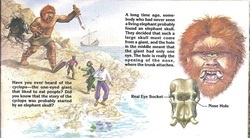 A children's book once made me consider that perhaps the idea of the cyclops came from conjecture about an elephant's skull found by someone who had never seen an elephant.
The person who found the skull thought that the nasal cavity in the center must be an eye socket, and the legend of a one-eyed giant was born.
Scientists have found mammoth fossils in Greece. Rather than an elephant's skull, it could have been a fossilized mammoth skull that inspired the cyclop's story.
 By Patrick Gruban from Munich, Germany (Algerien_5_0039) [CC BY-SA 2.0 (http://creativecommons.org/licenses/b...)], via Wikimedia Commons But what if the story of the cyclops came into being another way? What if the story came into being at a time when mammoths still trudged the rocky coast and islands of the Aegean? Perhaps the original story was not about a one-eyed giant, but about a tribe of ancient Greeks using their spears to kill a frighteningly large and clever woolly mammoth.
 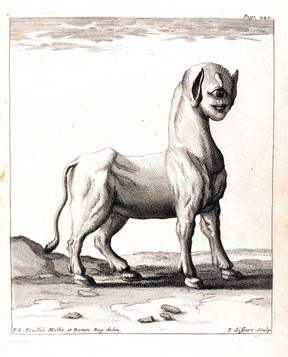 "A Monster Born of a Ewe". In: "Journal des Observations Physiques, Mathematiques et Botaniques ...." by Louis Feuillee, 1660-1732.
 The tale was handed down generation to generation along with the skull. Details changed over the millennia as each generation forgot some of the original story and added some parts relevant to themselves. In time, the people forgot that the mighty beast had a trunk, They improvised an eye to explain the cavity in the center of the skull.
 public domain In time, the Greek storytellers anthropomorphized the mammoth. They made him to stand on two legs. They gave him a voice and allowed him to argue with Odysseus.
 Because really, isn't man the most monstrous of all creatures?
We may be afraid of saber-toothed tigers, but it is man who truly terrifies us.
Jennifer Bohnhoff is the author of three middle grade historical novels. Swan Song, her first YA novel, a retelling of the Beowulf story, is due out August 20th. You can preorder the Kindle version here and the paperback here.
July 7, 2016
Who Wrote Beowulf?
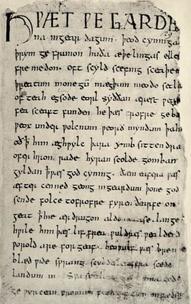 Many people complain that Shakespeare and the King James Bible are hard to read because they are in Old English. They are wrong. Old English, the language spoken in Anglo-Saxon England before the Norman Conquest, is much more difficult to read.
Just looking at the first page of Beowulf, the longest epic poem in Old English, should convince most readers that reading Shakespeare is a piece of cake in comparison.
Were it not for a single medieval manuscript housed in London's British Library, we would not even know the story of Beowulf. The manuscript is undated, but based on an analysis of the handwriting is guessed to have been made somewhere between the end of the 10th century and the death of England's Danish King Canute in 1035.
But the story told in Beowulf is much older than this thousand year old manuscript. Scholars believe the poem must have been passed down orally over many generations. There could have been as many version of the story as there were Anglo-Saxon poets (scops, prounounced 'shop') to tell it, each storyteller modifying it to suit the court in which he sang. In a period of time when few people could read, scops maintained history and upheld or enhanced the ancestry of their patrons.
In my novel Swan Song, I take the position that the original story is much, much older. You can read more about my theory of how old Beowulf is here.
Many of Beowulf's characters, including the Geat king Hygelac, and Hrothgar, the Lord of Heorot Hall, are mentioned in other manuscripts and accounts from the period, which means they are most likely historical personages from 6th century Denmark and Sweden. Some scholars assert that the poem must have been written soon after its historical figures lived, else the scop would have forgotten them. I wonder if the story predates these people, who were added in later by a scop eager to use the age-old story to flatter his patrons.
The story is about the hero Beowulf, who hears that a monster named Grendel is terrorizing a community in Denmark and sails his warriors there to stop Grendel's rampage. Beowulf kills the monster by ripping off its arm, but then must deal with Grendel’s revengeful mother, whom he follows to an underwater lair and finally defeats. The story is clearly pagan in origin. However the scribe who wrote the one remaining copy was likely a monk and clearly a Christian, and his remarks lay a veneer of the new religion atop the old myth.
Beowulf continues to be changed and reshaped by every performance, translation and adaptation. The poem has inspired films, plays, operas, graphic novels, TV miniseries, and computer games. The film The 13th Warrior (1999), was adapted from the novel Eaters of the Dead by Michael Crichton, who, like me, made the monster Grendle into a Neanderthal, but set his story in a much later period than I did.
Swan Song will be coming out on August 20, 2016, but you can preorder it for Kindle here, and as a paperback here.
July 1, 2016
How Pennsylvania Cherries Tried to Win the War
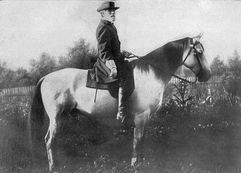 Robert E. Lee on Traveler By Michael Miley (1841-1918) [Public domain] In June, 1863, Confederate General Robert E. Lee decided to invade Pennsylvania, a decision that led to the Battle of Gettysburg. Preparatory to the march, Lee sent Richard Stoddart Ewell's Corps ahead on a foraging expedition.
 According to Philip S. Klein and Ari Hoogenboom's A History of Pennsylvania,
(2010: Penn State Press, pg 283), Ewell tookChambersburg, Carlisle, York and Gettysburg, sending Lee 5,000 barrels of flour, 3,000 head of cattle, and a trainload of ordnance and medical supplies. That was enough to convince Lee that his army could live off the land if they headed north.
Ewell's soldiers were such successful foragers because the farmland of Pennsylvania had not yet been ravaged by two years of war. The rolling hills of Pennsylvania was filled with fresh fruit,something the Confederates had not been able to get for some time. The foragers also found barnyards filled with chickens, pigs and cows that they happily liberated from their owners.
Ewell's men and the Confederate army that followed found the cherry trees that lined the roads irresistible. Many soldiers grabbed handfuls of the luscious fruit to eat as they marched. Some diaries tell us that many suffered stomachache. Some suffered worse. Those who recovered in time went on to fight at Gettysburg.
It wasn't only enlisted men who suffered from eating too much fresh fruit. On page 49 of his book High Tide at Gettysburg, Glen Tucker suggests that General Robert E. Lee's partial indisposition on the second day of the battle of Gettysburg might have been caused by an overindulgence of cherries and raspberries.
Enjoy this pie in moderation. You don't want to overindulge and suffer the same consequences as the Confederate Army.
Cherry-Raspberry Pie
1 10 oz. pkg. frozen red raspberries, thawed
1 1lb. 4 oz. can tart red cherries or 2 cups fresh cherries, pitted.
3/4 cup sugar
3 TBS cornstarch
1/4 tsp salt
Drain raspberries and cherries, reserving 1 cup syrup. Blend sugar, cornstarch and salt in saucepan and add syrup, stirring until smooth. Cook until smooth, then add fruit.
Pour into a prepared 9" pie crust, add top crust and seal. Cut slits for steam.
Bake at 425 for 30-35 minutes until golden.
June 23, 2016
Grand Old Flag
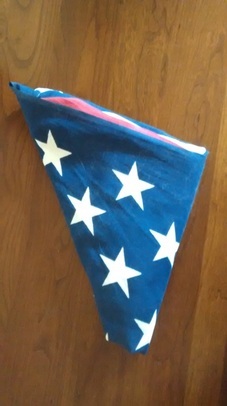 My husband sold this flag to his parents as part of a Cub Scout fundraiser. Seeing as he's now 59, it's likely that this flag has seen half a century of service.
It's not a fancy flag. Its stars and stripes are printed on fabric that is wearing a little thin. Over the years it has become stained from dust and rain-marked when I didn't haul it in fast enough. Some of its edges are fraying.
When I was running with Team RWB some years ago, the flag would come along with me. I started leaving it behind when some of the Veterans hinted that it had seen better days, and perhaps it should be retired.
Last year I bought a replacement flag. It is better in many ways. Its stars and stripes are sewn on, not printed. The fabric is stronger, the colors brighter. I laid it out on the counter, expecting my husband to take the old flag off the pole and put the new one on. He didn't.
Finally, this year for Flag Day I swapped the two flag myself. I folded the old one up and placed it on my husband's dresser. I suggested to him that we should hand it off to the Boy Scouts, so they could retire it.
If you've ever been to a Flag Retirement Ceremony, it is an awesome and dignified event in which old flags are burned. The thought of burning this flag, which my husband had flown for so many Independence Days and Veteran's Days, was too much for him. My husband may be strong, but he is also sentimental.
And so this flag will go into the hope chest. It will rest beside the baptismal gowns and homemade quilts, and someday one of my grandchildren may pull it out and wonder why we were so attached to what has become, after fifty years of service, a grand old rag.
June 11, 2016
A Wild Ride
 James, his wife Sarah and daughter Mabel. My son James recently graduated from University of Pittsburgh Medical School.
He graduated on a Monday. The last day of school was two days later, on Wednesday. What a perfect excuse to miss the last three days of teaching.
Just before my husband and I left for Pittsburgh, my youngest son, John called. John is in the Army, and will enter Ranger School this month. He needed someone to take care of his cat. Good Army Mom that I am, I said that I would do it.
I called Southwest airlines and explained that I needed to add a stopover in Atlanta into my return flight from Pittsburgh to Albuquerque, for the purpose of picking up my son's cat. I told the customer service agent that my son was in the Army, and his duty was going to change, and that taking care of his cat was the patriotic thing for a mother to do. I was hoping that might inspire some kind of discount or special consideration on the part of the airlines. No such luck.
And so my flight - originally from Pittsburgh to Baltimore to Albuquerque - (don't ask me why I had to go to Baltimore first. Airline routing has never made sense to me.) - became a flight from Pittsburgh to Baltimore to Atlanta to Chicago to Albuquerque. When I logged onto my computer 24 hours in advance to get my boarding passes, only the first two had boarding numbers. The passes for the final two legs of the journey said I needed to go to the customer service station at the gate to get numbers.
My husband, who was going to fly the original Pitts-Balt-Alb route, dropped me off curbside, where I intended to check in one bag, leaving my arms free to slog a cat carrier. The curbside attendant looked at my itinerary, scratched his head, and asked why in the world I had four transfers to get to Albuquerque. I explained once again what a patriotic, supportive, cat-and-son-loving mother I was, but to no avail. The attendant took me in to talk with a manager.
The manager asked the same question and received the same answer. Finally he checked my bag, but only through Atlanta, where I would have to walk out to baggage claim, find my bag, and then check it through for the remainder of the flight. Then he told me not to go through the regular TSA line, but to go up a flight of stairs to a special TSA security check though. As I walked towards the checkpoint, a uniformed man stepped out and asked if I was the woman with four stops. When I confirmed that I was, he took me aside and asked me to explain to him exactly why I was traveling in a big circle around the country. I pulled out my cell phone and showed him pictures: of my son the new doctor, of my son the new lieutenant, and of my son's soon-to-be-vacationing-with-me cat. After 45 minutes I convinced the man that I was not a terrorist and he let me run to catch my flight. I was the last person on the plane, so the one boarding pass I actually had proved to be pretty worthless.
My switch in Baltimore turned out to be pretty routine. Whew. Every story needs at least one boring part.
My son met me, cat in hand, at the baggage claim carousel in Atlanta, and we retrieved my bag. When we went to check it in, the man behind the counter greeted me with "Oh, you're the lady with four flights." They knew me. The man gave my son a pass so that he could go through TSA with me, which was good since we had to take the cat out of the carrier and hold it out to be "wanded." I got on the flight dead last (since I wasn't issued a boarding number), and I thought to myself that the worst was over. I would land in Chicago at 7pm, board a 7:40 flight to Albuquerque, and meet my husband for the car ride home.
I was wrong. TSA may have decided not to torment me anymore, but the weather had other plans.
The plane seemed to be leaning to the right for a very long time before the pilot came on the intercom and explained that there was bad weather in Chicago, so we had been circling Louisville for twenty minutes. He assured us that we'd land as soon as there was a gate, and then we'd all be able to reschedule our connecting flights. We circled for another 20 minutes, and then straightened out and continued to fly. Apparently, there were still no gates and we were getting low on fuel, so we were to continue on to St. Louis, disembark there, and reschedule our flights.
We landed in St. Louis, but there was no gate open there for us, either. A tanker truck came out and filled the plane, and we sat on the tarmac for an hour before lifting off again. Apparently, the weather had cleared in Chicago.
What else had cleared were all our connecting flights. By the time we landed at 10:30, all the shops had closed and there were no flights out.
So here I was, stranded for the night with a cat who'd been locked in a tiny box for five hours. Surely she would need to relieve herself. What was I to do?
I stood in line and listened to people shout at the poor, harried woman behind the desk. They wanted hotel rooms. They wanted flights the next day. We were told we wouldn't get either. When it was finally my turn, the lady took pity on me and my poor cat-in-a-box. She issued me a boarding pass for an 11:15 flight the next morning, gave me a sheet of paper listing nearby hotels that I could call, and told me that there was a pet relief station near baggage claim. But she wouldn't give me my checked bag, which had my phone's charging cord in it. With the little juice I had left in my phone I called my husband and told him not to wait for me at the Albuquerque airport. I then called every hotel on the sheet. None of them accepted cats.
I took the cat in the box out through security only to discover that the alleged pet relief station was nothing more than a square of dirt by the side of the road. While this might be some relief to a dog, I wasn't willing to free the cat long enough to try it. Of course, I had some difficulty explaining to the TSA agent why I had walked through security and why I now wanted back in.
A sudden inspiration came to me: this cat was owned by a soldier! Surely the USO would help me! I am sure they would have, had they not closed at 10.
But right next to the USO was a little sign that said "Nursing Mother's Station." I opened the door and found a small room. It had a counter (which I assume was meant as a changing table), a sink, and an upholstered chair. Most importantly, it had a lock on the door and no way for a cat to escape the room.
I let the cat out of the box, filled the bottom of the sink with water for her to drink, and put a handful of cat treats on a paper napkin. I also tried to make an impromptu litter box by ripping up some paper towels and putting them in the darkest corner of the room. She appreciated the food, water, and chance to stretch. The litter box stymied her.
I spent the night worrying what would
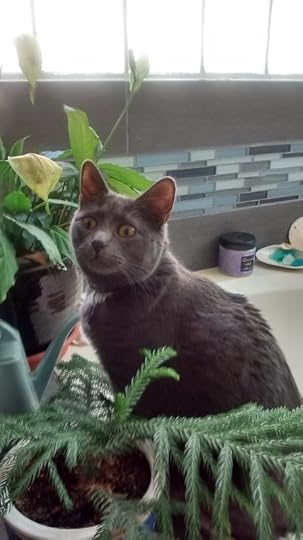 Smoke, the cat who accompanied me on my wild ride. happen if TSA discovered that I had commandeered the mother's nursing station. Surely there's something illegal about taking control of a room at an airport.
At 5am I left my safe hidey-hole and went in search of an open Southwest Airlines Counter. There was an 8 am flight, and I hoped for a chance to fly stand-by on it. What I discovered was that, although I had a boarding pass for the 11:15 flight, I had never been entered into the computer. The attendant said I would be in Chicago another 24 hours.
At that point I dissolved into tears, which set the cat in the box to yowling piteously enough that the attendant got me on a 9 o'clock flight. It wasn't to Albuquerque; it went to Kansas City. I'm sure she just wanted me far away from her, and I was willing to go anyplace. In Kansas City I pulled the same weeping woman stunt and finagled myself onto a flight to Dallas, where I again wept myself onto a flight to Albuquerque. Each time I was the last person on the plane, and each time I took the last seat.
On one of that day's flights, the woman who would have sat next to me announced that she was allergic to cats, and I absolutely could not sit next to her. I think the stewardess had been in this situation before. She looked around, picked the largest person on the plane, a rather unwashed, scary-looking man, and announced that he needed to sit next to Ms. allergic-to-cats, who then backpedaled and announced that she wasn't THAT allergic. I sat down quickly, before she could change her mind.
And that is how I managed to have a 22 hour, nine city (if you count Louisville) plane ride. It was a wild ride I hope to never repeat.


