P.J. Fox's Blog, page 5
April 1, 2016
He’s HOW Old?
In Book of Shadows, Sepha is 17 and Alex is 196. That doesn’t bother people at all. What does bother (some of) them is the fact that he appears to be 37. Which gives me new insight, as both a reader and a writer, into why no one cared that Edward of Twilight fame wasn’t actually a teenager but was, in fact, a hundred year old virgin. Looks are everything.
Alex was–spoilers if you haven’t read the book–an officer in British-occupied India who died, or rather, who should have died during the Great Rebellion of 1857. That he’s an actual adult, with an adult’s experiences, is relevant to the story. His life didn’t begin when he was turned. And, as he (rightly) points out to Sepha, at one point, in his time men his age married girls her age. There was nothing strange about it. And because he didn’t repeat high school a zillion times–with apologies to Stephenie Meyer, we all know Twilight is one of my favorite books–he has a little more to offer in terms of adult insight. He’s also, I think, much more keenly aware of what he’s lost. Although in my world, vampires face a great many more limitations than they often modernly do.
Alex’s perceptions are shaped by his time, to a great extent, even though so much time has passed. And by his experiences in the army as well. Interestingly, though, his sometimes hidebound Victorian opinions don’t seem bothersome. That he wants to take care of Sepha is, indeed, romantic! It’s only when he waxes poetic on such subjects as corsets that anyone raises an eyebrow. Mostly because they’re thinking of him as a modern man–or at least expecting him to have evolved. Which, I think, shows our complicated relationship to the past: we want to romanticize it, which we do by tossing out the bad bits.
Richard, Alex’s human servant, somewhat serves as a foil for this idea. Through the lens of his descriptions we see an entirely different world: one where he faced near insurmountable prejudice for being Irish, and where otherwise healthy young women died in childbirth. Richard’s Boston was a place of disease, cruelty, and systemic economic and social disparity. And his family’s history was shaped, not by inheritance like Alex’s but by the Great Famine and the Civil War.
Which is in part what makes it easier for him to modernize: he met Alex after he lost everything.
The fact remains, though, that while there are varying arguments to be made about how well either of them fits into modern society, those arguments are only to be made because neither of them is below fifty. Neither of them is below one hundred. Yes, Richard is a comparatively sprightly 154 to Alex’s 196, but both of them are–great grandfather doesn’t even cut it.
What I’ve discovered, though, is that people ignore what you want them to ignore. In The Demon of Darkling Reach, everyone’s sins are laid bare. Here, especially because I’m writing YA and because, too, too much gore simply wouldn’t fit the story regardless, I let readers mostly use their imagination on the subject of Alex’s feeding habits and instead focus on his character. His humanity. And so they do. Likewise, present people with someone who looks like a high school student, even if he’s a thousand years old instead of a hundred, and ninety-nine percent of them will see a high school student.
Thoughts?



March 29, 2016
Ros Barber Waxes Blithe on Self-Publishing in The Guardian
I think a lot of traditionally published authors, or would-be traditionally published authors, want Barber’s points to be true in order to justify their own fear of change. But the fact is, none of what she says is true–as this post points out. Rather, she offers a fanciful justification of why no author should have to consider any changes to the publishing industry occurring later than 1925.

 Novelist Ros Barber wrote a piece for The Guardian’s Books blog last week that tacitly pans self-publishing in favor of traditional publication.* Entitled “For me, traditional publishing means poverty. But self-publish? No way,” the article is a list of points explaining why Ms. Barber won’t self-publish, and why you shouldn’t either. Here’s my point by point rebuttal.
“You have to forget writing for a living.”
“If you self-publish your book, you are not going to be writing for a living. You are going to be marketing for a living. Self-published authors should expect to spend only 10% of their time writing and 90% of their time marketing.”
Barber’s first assertion, like all those that follow, is anecdotal at best and a blind assertion without any evidentiary support at worst. The only explanation for the 90/10 percent ratio she cites is that a single self-published author who commented on her…
View original post 2,129 more words


March 21, 2016
A (Very) Short Update
I’m quite behind on writing, let alone posting, all the (naturally) brilliant thoughts I have. Including the last post in what is now a…rather protracted three day challenge. And also I have book updates and other things to share with you. BUT the problem has been that I have pneumonia. Just doing what I have to do, in terms of writing and arting and other things, has taken up so much of my time and energy that I haven’t been able to blog. Or really bathe, so there’s that. Still, onward and upward! I’m on the mend now so you should be (sadly) getting more of my blatherings soon.


March 1, 2016
Making Ultra Realistic Egg Carton Bricks
This is my hobby. What’s yours?

This is a kitchen I finished two years ago, using these same techniques:
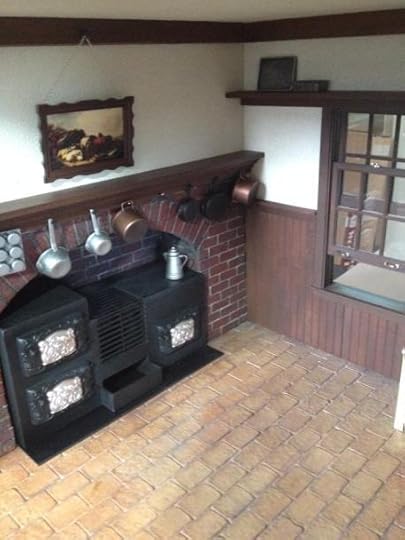
Today, with my current project, I’m going to show you how to start with cardboard and end up with something fabulous. Egg carton bricks have a lot of advantages over their “real” counterparts. Yes, of course, cost. But, more than that, egg carton bricks are versatile. They can easily be cut, and shaped, in a variety of different ways. It was a lot easier to make the fireplace above, with its arch, out of cardboard than it would have been to use a different medium. I also find, personally, that in terms of staying true to scale often the cheaper products actually work better. Brick, in particular, is simply–apart from all its other faults–too porous to really, truly “work.” Now, that being said, what egg cartons lack in cost they arguably make up for in labor! And…
View original post 814 more words


February 24, 2016
Priorities
After failing so spectacularly at the whole “three posts in three days” thing, I realized I had the perfect intro for my second post: take ownership of your priorities. Last week was my son’s vacation, and we spent a lot of time doing (hopefully) fun family-type activities. Now, could I have squeezed in a blog post, between them? Of course. But instead, I chose to squeeze in writing, art making and–yes–sleep. Because why? Because, in the final analysis, the only person you have to answer to, the only person you should feel that you have to answer to, when it comes to your choices, is you.
No one else has to live your life and, at the same time, no one else can be responsible for your success–or lack thereof. I had someone end a friendship with me–and then take to the airwaves, as it were, to tell the world what a horrible person I was–because I didn’t respond to a text on time. And I know the temptation is very strong to always be available. But when you prioritize making yourself available to everyone else…the one person you’re not available to is yourself. Now this friend, or “friend,” if you will, if she’d truly ever been my friend she would have understood that parenting duties come first. And that, additionally, my books don’t write themselves. Just like my art doesn’t make itself and my marriage, and other family relationships don’t take care of themselves. Sometimes, the people who want the most from us are also the ones who want the least for us. Those who truly care about you, when you can’t be available, will understand.
Whereas, conversely, someone who excoriates you publicly for going to work instead of talking to them or, indeed, taking time for self-care isn’t someone you need in your life. Others don’t have to share your priorities but they do, to earn a place in your life, have to respect them. You have a right to assert boundaries. Not only that, but you’re the only one who can. It’s up to you to say, “I need to do this now.” It’s up to everyone else to sort themselves into, or out of your life by how they respond.
If it can be distilled down into a single reason, the reason I’ve written so many books, and made so much art, and done so many other interesting things over the past few years is that I’ve made doing those things a priority. I choose to write instead of responding to every message, or text, the minute it comes in. I save socializing time for later–for after work. Hours, and even days go by when I’m basically not online. Not because I’m unfriendly (that, I suppose, is a different discussion) but because I’m simply too busy. When not at work, with my family. Looking back on this time, years from now, I want to remember my son’s suspicion about green beans, his joy at finally completing potty training, his every little joy and sorrow–not what some random person said on Twitter.
Thoughts?


February 18, 2016
Updates and Challenges
I was tagged by alhenaalana to participate in a three day quote challenge. I’m breaking the rules by not nominating three new bloggers every day, to participate, because quite frankly I don’t know any who’d care to be nominated. But today, and tomorrow and the next, I’ll happily bless you with some of my own (dubious) wisdom. The first piece of which is the rule I developed for myself, as a child: never take advice from anyone you don’t want to be more like.
In my case, I grew up without any sort of de facto authority figures. My own parents weren’t exactly great role models and, honestly, some of the biggest mistakes I made as a child came from trying to follow their advice–and their example. It was wrenching for me to realize that they were toxic and, indeed, the degree to which they were toxic. Their lives revolved around rage, and disillusionment, and more rage, and doing whatever they had to–no matter how illegal or immoral or just plain disgusting–to feed their respective habits. And, like most people who’ve never accomplished anything meaningful with their lives, they thought they were the world’s greatest experts. On everything. And spent a lot of time lecturing me on “what people do,” and what other people were doing wrong, and all the things (mainly cleaning up after them and not being so forthcoming with the outside world about what went on at home) I should be doing.
To…turn out like them? I started thinking, long before I probably should have, about what advice really is and who gives it and why. You can tell a lot about a person’s motivations by how their own life is going. Not all advice is kindly meant; some is meant to sabotage, and is given out of jealousy or even simply out of that person’s narcissistic desire to look in the mirror and feel successful. Even though they aren’t. Their advice comes from a place of competition. And other people, even if their advice comes from the best place, they simply may not know what’s best for you.
People take their own advice, I realized. People who sit around their houses all day feeling resentful that the world isn’t being handed to them on a platter, people who rise with the dawn and milk cows…they’re all living according to their own worldview. If you can’t trust people because they’re family, or if–as was the case with me–you keep being sent to live in new places, where you meet new people, you don’t have the luxury of context. But you do have tools at your disposal.
Yes, it takes time to get to know people. And to feel comfortable with new people, places and things. And nothing, of course, teaches like time. But, at the same time, you have to start somewhere. Every explorer needs a compass. And this was–and is–mine. And now it’s your turn: in lieu of tagging you, I’m asking you, readers, here, to share your own compasses. What quotes, aphorisms, ideas, or teachings have been the most meaningful, in helping to guide your journey?


February 12, 2016
Genitals-Free Friendship
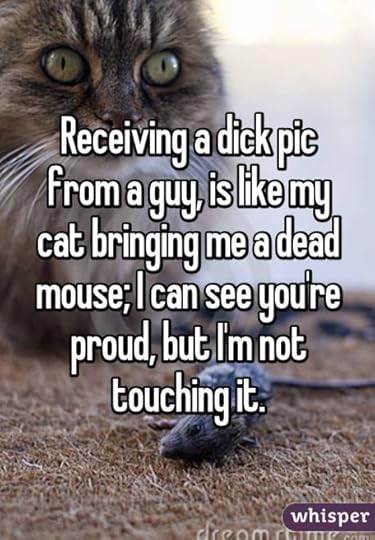
It’s no secret to those who follow me on Facebook that I’ve had a problem lately with some, ahem, overly enthusiastic fans. But it’s happened in my private life, too; most recently with a couple of guys from a group I–was–in. Removing the name, I’m going to use one message as an example of how privilege, specifically male privilege, can be so destructive to relationships. What do I mean by male privilege? The underlying assumption, permeating all aspects of life, that the fact of a woman (or female-bodied person) existing MUST mean she wants to have sex with you. And that, therefore, her willingness to appear in public–or to exist at all–is a clear signal of interest.
The person in question, who sent me this message, I’d ended the conversation yesterday evening after he told me–apropos of nothing–that women who dressed provocatively “deserved” to be raped. So how about no and that was that. This morning, he greeted me by asking me to sit on his face.
I told him that if he sent me any more messages, I’d screen shot them so I could share them with his wife.
His final response, before I blocked him:
Again, I apologize, you liked a post that i posted, [because that absolutely indicates my interest in sexual activity, especially with you] so i played off of that [as you do, because clearly someone being active on Facebook indicates their interest in being propositioned by complete strangers] (in an attempt to be funny) [because propositioning complete strangers, especially when you, yourself, are married is just hilarious] just to open a conversation and say good morning [yes, I ALWAYS wish complete strangers good morning by describing the various sex acts they could engage in with me]. I truly meant no offense [because why on earth would anyone be offended by this?], and after our discussion yesterday [yes, I spoke with you briefly, so clearly that meant I wanted to be propositioned], I mistakenly thought we could be friends [“friends” being code here for people who take their pants off together] who I thought both enjoyed adult humor [because a sense of humor is operated with one’s genitals]. Again i am truly sorry to have offended you [because I’m sure you talk to your mother and your sister this way all the time, so how could anyone predict that I’d ever be offended]. And you won’t hear from me again [no, really?]. I wish you and your family the best [I bet you do; I bet you’d especially like to share a little adult humor with my husb–what, no, really?].
Pro tip: if you want to be friends with me, try getting to know my brain instead of my genitals.


February 3, 2016
Book of Shadows: Series Update
As of tonight, I’m over one third of the way through Prince of Darkness; and writing as performance art continues to be a strange thing. I’m loving it, though, and loving everyone’s feedback. I doubt that I’ll have the entire book posted before I’m featured but, then again, this is only the second book in the series! It’s going to be an ongoing project for some time. I’m planning on it being a trilogy but…we all know how well that worked last time.
In the meantime, I’ve also been investing a good amount of time in my other passions. Jewelry making, yes, but also other art. Pictures of that are coming soon! I may even sell some of my other art; we shall see. It can be exhausting, switching gears between projects, in and of itself. And with the hours I’ve been putting in…let’s just say I’ve been sleeping very well at night! For those of you who are reading the Book of Shadows series, I’d love your feedback. Positive and negative. Yes, I know what my vision is, but it’s my readers who really tell me whether I’m achieving it.


January 31, 2016
How To Succeed On Wattpad
I’ve collected all of my dubious pearls of wisdom on this subject and put them all in one place. Which is, naturally, on Wattpad. The really great thing, though, about Wattpad is that it’s interactive so I’m hoping I get to hear from all of you on this. Feedback helps projects grow! The same goes for How To Write A Novel. A guide on how to write, or any guide, is a something that–I think–ideally evolves over time. The more I know about what issues you guys are having, with Wattpad or with your writing or with anything else, the better I can address them in either guide and thus the better both will be.
What else is up on Wattpad right now? Everything! Sample chapters from The Demon of Darkling Reach, The Price of Desire, and The Prince’s Slave, as well as Paranoia (which I wrote in high school), and Indie Success. Which I’m still in the process of uploading. And, of course, Book of Shadows and (the still ongoing) Prince of Darkness! I’ll be working on Prince of Darkness today, and hope to be uploading another chapter tonight. But we shall see! Weekends have a way of getting away from me. My son is home from school, after all!
So how’s everyone else doing? What’s everyone else doing? How are you coming along with your reading, or writing?



January 28, 2016
Why Sequels Suck
What should happen in the first book is pretty obvious. You start from zero, build a world that people care about. Characters they care about. And if they care about those characters enough, guess what: you get to write a sequel. I have this fantasy wherein I write a stand alone book but it’s never really happened that way; even The Prince’s Slave was originally released as a serial. Right now, I’m working on Prince of Darkness, the sequel to Book of Shadows, and it’s hard. Because I’m letting everyone read it as I write it but, moreover, because it is a sequel. Now, in my case, I know what’s going to happen throughout the series but…strangely enough, that doesn’t make things easier.
The first and most obvious problem is that the energy has got to be very different in a second book. If, you know, you’re doing it right. Because, well, the good news and the bad news are the same news: it’s a continuation of the story. Which means there’s a fine line between regurgitating the first book and writing a book that doesn’t feel like it belongs in the same storyline at all. If the energy is too different, it’s going to alienate your core readership. They don’t want, say, a romance that suddenly turns into a horror novel. Even if you’re going to introduce new elements–of plot and character–you’re going to have to do so in a way that honors what you’ve already created.
Then there’s the issue of pacing. A slow build, in a first book, creates tension. But unless you’re slowly building toward a completely new plot arc, and even if you are, in the second book “slow” tends to equal “boring.” Moreover, just like you can’t have the characters roaming around in circles, never developing, you can’t simply recycle the same plot arc over and over. Because guess what: what created tension the first time…it’s like watching an M. Night Shyamalan movie. That device is only going to work once.
There’s a lot of discussion out there about the evils of so-called “fan service,” but ideally a well-crafted book does give its fans what they want (while also staying true to its creator’s vision). That is, after all, the core purpose of entertainment. If your story isn’t appealing…then really, what’s the point? As much as you might like to (and, trust me, I’d like to) sit your readers down and explain why they’re wrong, you can’t. Because, really, they’re not. Liking something is something you can’t fake. The joy is either spontaneous, real, and there or it isn’t. Trying to force it in someone else is like commanding them to fake an orgasm.
Do people like Prince of Darkness as much as they liked Book of Shadows? I have no idea. It can be hard to tell, anyway, since not everyone shares their thoughts and the book is only a little over a quarter posted. So maybe it’s too early to tell–for me and for them. I certainly hope they do, of course. That they like it but, moreover, that one of the reasons they like it is that they, as a group, feel like I’m being true to the characters they’ve grown to love. That this is still Alex, and still Sepha, and still Lucie, maybe not doing exactly what they’d imagined–hopefully not, or things wouldn’t be very suspenseful–but being exactly themselves.
What about you? What makes a sequel bad or good for you? Let me know in the comments.