P.J. Fox's Blog, page 3
November 15, 2016
PITM: Publication Date?
As of this writing, I’m about 1/5 of the way through writing Predators in the Mist. Meaning that I’m about 27,000 words in and have another 108,000 or so to go. How long will it take to produce those words? Realistically, somewhere in the ballpark of–if everything goes according to plan–about three months. Which means, in turn, that there’s a very good chance you’ll be holding this book in your hands by Valentine’s Day. I will, of course, update you again on this issue as we go along!
I know some of you feel like you’ve been waiting a very long time for me to continue this series, and I thank you for your patience. Instead of making a crack about how at least I don’t write as slowly as George R.R. Martin, I’ll tell you instead that the past couple of years have been difficult ones for me and my family. I needed to, due to the highly personal nature of some aspects of this series, put it aside for awhile. I hope you can understand.


Predators in the Mist Cover and Blurb Reveal
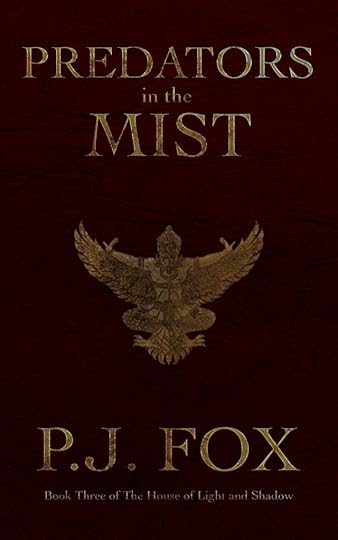
Reeling from the shock of the past few months, Aria is struggling to collect the pieces of her broken life and reclaim from them some kind of whole. Meanwhile, even as the rubble left in the wake of the Brotherhood’s defeat still smolders, a new set of troubles are brewing. Only this time, they’re doing so beneath the surface. Aria discovers, slowly and to her horror, that the world around her isn’t quite what it seems. Friendly faces hide murderous intents; knives wait in the shadows. No one is who they seem. And into this world, this life, comes a shadow from Aria’s past. A shadow she’d thought she’d escaped, forever—one that forces her confront the pain of her past. And then, after, to answer one very important question.
So Wait, Why a Coloring Book?
Those more eagle eyed among you might have noticed that I’ve published a coloring book. Yes, it’s my own original artwork (which you can see more of on my art’s Facebook page, and on my Tumblr). I’ve been drawing, and painting, and sculpting, and making weird things out of mixed media now for years. Since I was about six, more or less. I’d been on somewhat of a hiatus, though, only returning full force this year. As usual, I have my husband to thank for giving me the courage.
So why a coloring book? It’s certainly not my sole art-related endeavor; I’m also working on a series of paintings, ahead of preparing to launch a Patreon. But I do a lot of pen and ink and something kind of magical started to happen. Friends of mine, and in some cases almost total strangers, asked if they could color them. That anyone would want to color them amazed, and thrilled me! And then a friend said: you should really do a coloring book. This particular coloring book, Princess Reimagined, is my own original take on some favorite (and not so favorite) fairy tale characters.
October 25, 2016
I JUST STARTED WRITING PITM!
House of Light and Shadow Fans: good news!
I just, today, started writing Predators in the Mist. Yes! Really! As for a release date, I can’t even hope to answer that question right now. Sometime in 2017, I’d imagine–although hopefully not too far into it! This is a planned five book series, and I think, depending on how the next few months of writing go, that I may finish up the series before I move on to (or return to) any other projects. I’ll keep you updated, of course, here and on my Facebook page, as to my progress.
October 22, 2016
Rules for Adding Description
You need it. But how much of it do you need? It’s a common misconception among rookie authors that intricately cataloguing the color, style, and etc of a character’s jerkin is what helps the reader to become immersed in their world. When, in fact, the opposite is true: too much description is distracting. It breaks up the flow of the story and, in some cases, can actually prevent the reader from identifying with the character. Which is a serious problem, because identifying with the character is what creates that longed for reader to story bond. As a reader, you keep turning the pages, not to learn who’s wearing what but to learn what’s happening. And it’s not who’s wearing what that makes you care what’s happening but, rather, the fact that you already care about the character.
So why do so many writers, even with so much experience as readers, forget this?
Because, I think, when writing, they get so wrapped up in sharing their every little thought that they forget what they’re trying to do. Which is, ideally, tell a story. That lovingly realized jerkin? It matters to them; so they forget, I think, that it might not matter to the reader. Are offended by that idea! This is their world; how could the reader not care? And description…description is important!
Well…yes it is. To a point. But only a certain kind of description: description, not that pleases the writer, or that seems particularly important to the writer, for whatever emotionally based reason, but description that serves a purpose. So how do you know if the kind you’ve got is the right kind? Follow these simple rules:
Only describe things that are relevant to the story, when they’re relevant to the story. I’ve been asked, over the years, to look over a number of manuscripts and one issue the less successful ones all have in common is that they spend a lot of time describing people, places and things that turn out not to be relevant. Three paragraphs on a building that no one is visiting, three more paragraphs on this dress or those robes. If I don’t need to know, at precisely this moment, why this building is made out of limestone or covered with bas relief eagles or whatever, don’t tell me. Save this information for when it’s part of the story–and if it’s never part of the story, I never need to know.
Describe people, places, and things from the character’s perspective. Description can be a great opportunity to shed light on a particular character’s background, ideals, etc. Maybe they’re a country mouse, awed by their surroundings; maybe they’re more of a city mouse, and look down on everything. Don’t waste an opportunity to show your world through a distinct set of eyes; the same town square isn’t going to look the same to everyone.
Description should advance the plot. It is, however, not the plot. You might be thrilled with the pages upon pages of world building-type trivia you’ve created, but one of the hardest things to recognize as a writer is that 95%–or more–of your world building will never make it into your actual manuscript. Should never make it into your actual manuscript. If you open the story with “this is the planet, and this is its ecosystem,” or “this is what everyone was wearing,” you’re going to accomplish precisely one thing: boring your readers to tears, and then losing them. Unless you’re writing an encyclopedia, this is not your plot. Your goal, with description, is to give just enough that readers can connect with what’s actually going on–and no more.
Description should evoke emotion. Again, in terms of what’s actually going on, what’s going to drive your story–no matter what kind of story it is–is emotion. Emotion, and the action it produces. Is your character angry? Sad? Why? Tell me. Help me to feel what they’re feeling.
Don’t info dump. It’s so tempting to lump all your great ideas–about this fortress, or this whatever–together in one place. To tell the reader, the first time they see this thing or meet this person or etc, etc, etc, everything there is to know about them. Except…do not do this! What, to you, is absolutely incredible and fascinating in every way is going to seem, to your reader, like paragraphs of useless information. Going back to the first rule, only share information when it’s relevant. And by relevant, I mean, when it’s absolutely necessary to give context to, and create atmosphere for, the actual plot of your actual story.
I know it’s hard. It’s hard to be a ruthless editor, especially with your own work. But believe me, it’s easier to face your own criticisms than to face other peoples’. Few things suck as much–and trust me, I know, I’ve been there–as entrusting your literary baby to someone and having them yawn. Even with my published work, that’s achieved modest bestseller status, I’ve gotten absolutely terrible reviews. There’s a paragraph about cheesemongering in The Demon of Darkling Reach that, from the excoriation it received, you’d think was six chapters long.
In other words: if you don’t rake your work over the coals, someone else will.
A good exercise, when you’re struggling to craft a story, is to think back to books you’ve enjoyed and to what, specifically, about them worked for you–as a reader. Not, of course, to copy anyone’s work (don’t do that!) but to help yourself connect, as a writer, to which tactics are successful and which aren’t. You might be surprised to discover, if you go back to a certain chapter of a certain book, that that masterful description you remember so well, the one that plunged you directly into a scene, was only a sentence or two long. Because the best writing, ultimately, isn’t about quantity but about quality; your goal, as a writer, should always be to say the most in the least amount of space. And that’s true whether your story is 150 words long or 150,000.
October 13, 2016
Mr. Trump, Fifty Shades, and Consent
Some of you might find it ironic that I’m taking this stand; after all, what can charitably be deemed reluctant sex is a major theme in some of my books. And Mr. Trump, our most orange candidate for president, seems to think that consent is irrelevant. But that’s just it: consent is everything in my books, because it’s everything in real life. Whether there is consent, and what consent even is, these are vital topics to discuss; they’re what move relationships along, of all kinds, on and off the page. To say that you can “do anything”, regardless of what the other person wants, because of who you are is to–in every way that matters–live alone in the world. So yes: Mr. Trump’s conduct is abhorrent.
And, incidentally, has nothing to do with Fifty Shades. Fifty Shades, whatever you consider its literary merits, is about consensual sex. The–female–protagonist’s satisfaction, physical and emotional, was the center around which the plot pivoted. Her amour, however emotionally crippled, wanted to please her. She wasn’t just some interchangeable collection of parts; that was the whole point.
Moreover, this whole “women liked Fifty Shades so they’ve given up their right to dislike Mr. Trump”, as a theory, is just more of the same woman-shaming drivel we’ve been dealing with for centuries. It’s the same woman-shaming drivel that promotes rape culture; “she said yes before” is, in many minds, a valid argument. Whereas I’d like to see someone mount an offense to carjacking, in court, that started and ended with “you let me borrow your car last year, ergo it’s now mine whenever I want it and if you got injured well, that was simply a misunderstanding.” What a woman, any woman, likes is up to her; some man’s judgment on how “acceptable” her various points of view are is simply not relevant. Women, in this day in age, no longer need to seek permission.
Nor, indeed, do they need to seek permission for having a sex drive. What the whole Fifty Shades argument really boils down to is, I know you masturbated. And since the eighty million (mostly) women who bought and read Fifty Shades have revealed themselves to be sexual creatures, they must now be equally sexual with all men! Except no! This isn’t Gor and women do, in fact, have the right to decide for themselves what turns them on–and doesn’t.
When are we going to ditch this “nun versus whore” mentality and accept that a woman’s admission of her sex drive doesn’t somehow reduce her humanity? I’m sorry, but are only women who’ve never had an orgasm, or never sought one, entitled to vote? And, if so, why?
No one wants to answer that question, of course, because when we venture too much beyond meme territory the justifications for these kinds of one liners become apparent–and ugly. No one wants to admit that they’re anti-woman; they’re just “worried about the future of the country.” Well, so am I: I’d like to continue to live in a country where I have rights. And since Mr. Trump and his supporters are now claiming that women’s suffrage was a horrible mistake….
So back to consent. Imagining the rage (amongst the non-orange, at least) to be about the use of a dirty word is setting up a straw man. No, everyone isn’t losing their minds because someone said “pussy.” They’re upset, rather, because–couched in any terms–Mr. Trump was bragging about doing something to women, to multiple women, without their consent. He was, indeed, going so far to completely dehumanize these women. They were and are, to him, clearly, just something you can grab. Oh, they have feelings? Oh, who cares. He talks about his romantic conquests in terms of him.
Is this romance? Is this the same heart-pounding thrill of Fifty Shades? For those who think so, I’m truly sorry for the state of your sex life. Maybe you’ve never had an orgasm, and that’s the problem. Or maybe, even more upsettingly, you’ve never experienced the deep and abiding joy that is true communion–physical, mental, and spiritual–with another person. Which is something I have in my own life, with my husband, and something that all of my characters, however flawed, seek. Because, you see, I’m not glorifying non-consent; I tell stories for a living, and the best stories are about flawed people. But there’s a big difference between seeking something you haven’t found yet, including self-improvement, and glorifying your disgusting treatment of others as some sort of victory.
September 26, 2016
How Do I Do It? And Other Secrets Revealed…
The following interview will appear in the back of my newest upcoming release, Dark Obsession.
An Interview with the Author
James Cormier is the author of the critically acclaimed young adult novel Exile: The Book of Ever, which is available for purchase worldwide online and in stores. He’s also my husband, and we thought that, in celebration of my publishing my eleventh novel, we’d do an interview wherein we sat down together and he asked me all the questions that you, my readers, have sent in. And to my readers, I can’t begin to describe how grateful I am for all of those questions, and for your continued love and loyalty. I couldn’t spend every day doing what I love most without your support. It means the world! I hope I do your questions justice. Thank you all, again, so much. And of course…happy reading!
What were you like at school?
Terrible. I got good grades, because I absolutely slaved away at my work and not because of any natural talent on my part. One thing I did learn from that, though, is that talent without hard work is meaningless—and that hard work, in turn, can make up for a lack of talent. And even create talent, where there previously was none, on a long enough timeline. Socially, though, I always felt like a failure. I was an outcast, with very few friends. My background, too—poor, with very little in the way of clothes or anything like that—singled me out for teasing. I used to wear hand me downs that the school’s gym gave out, because I didn’t have any clothes of my own. I wasn’t always the friendliest person, either, because there was so much pressure from my mother not to talk about my home life. The drugs, the beatings, etc. I didn’t handle it well.
Were you good at English?
It wasn’t until I got to university that I discovered I was good at English. My teachers had mostly made fun of my “outrageous” stories, or criticized my essays and things for being too long and too detailed. And of course, my own family told me my stories were too boring to read and that I was “selfish” to expect anyone to take an interest—selfish and rude. So I kept that part of myself bottled up, for the most part. But then, my alma mater, Boston University, required—and I hope still does require—a year long writing course. Which I loved. That was the first time I had people tell me, you know, you’re really good at this. Your voice matters. It was a sentiment echoed by my husband, when I met him. Without his support, and that of my English professors at BU, I would never have started really writing. I would never have had the courage to.
What are your ambitions for your writing career?
To write, and to be able to keep writing. As many of my readers know, I’m active on Wattpad as well as published more traditionally. Wattpad is a website for writers and readers that’s diverse, dynamic, and entirely free. And one of the things that’s most incredible about it, apart from the amazing community it fosters, is its initiative to help independent writers—of all ages and stages and backgrounds—support themselves. This is why my, and some other peoples’, stories have ads there. When you click on them, we get paid. Which is great because my ultimate, ultimate ambition is to be able to write, and to be able to keep writing, offering my books for publication as well as for free. There simply isn’t, to me, a better place to hang out as a writer.
Which writers inspire you?
Literarily, I owe my biggest debts to Richard Laymon, Stephen King, and James Joyce.
So, what have you written?
I’m the author of eleven novels and two nonfiction works, as well as numerous short stories. None of them have won an award yet, but I’m hoping!
Where can we buy or see them?
You can buy all of my books on Amazon, as well as in numerous bookstores worldwide. One chain that carries me is Barnes & Noble. Another is Tower Books. If you don’t see the title you’re looking for at your particular store, whether chain or independent, please visit the customer service desk and ask them to order it! That way, my books will come to the shelves! Hopefully, in time, for other people to find as well. And don’t forget to leave a review, too, on Amazon or elsewhere, if you do like a book—mine or anyone else’s. Building a following is challenging for an author; most of all, we rely on word of mouth from satisfied readers.
Give us an insight into Charlotte. What does she do, in Dark Obsession, that’s so special?
I think Charlotte’s superpower is being herself. Which is everyone’s superpower, ultimately. A lot of book critics joke, I think unfairly, about romantic heroines being “Mary Jane” types. In other words, dull, uninteresting nobodies with whom the dashing hero is inexplicably fascinated. Which completely ignores the issue of the unreliable narrator: in our hearts, and in our minds, we’re all a Mary Jane. No one, except the most confirmed narcissist, looks in the mirror and thinks “I’m awesome.” It takes love, it takes someone else seeing in us what we don’t see in ourselves, to show us what we truly are. For good and for ill. Love, not self-regard, is what makes us beautiful. Which is, of course, why one man’s “Mary Jane” is another man’s princess.
What about Thorn?
Thorn and Charlotte, despite having grown up very differently, face many of the same challenges. Where Charlotte’s approached them one way, Thorn’s approached them another. He’s a good and decent man, on the inside, but he doesn’t know that about himself. Charlotte might see herself as nothing special, but Thorn is convinced that he’s—not good but evil. In Charlotte, he sees what he’s been lacking, what he’s denied himself. She inspires him to be more.
What are you working on at the moment?
Now that I’ve finished with Dark Obsession, I’m starting to take notes for my next novel. And, of course, I’m painting! You can see my art on my art-specific Facebook page (please follow me!), as well as support me, and get cool exclusive content, on Patreon. Painting, like writing, is something I’ve been passionate about my entire life. Sometimes I combine the two, and paint my characters.
Facebook: https://www.facebook.com/pjfoxart/
Patreon: https://www.patreon.com/pjfox
What genre are your books?
They span different genres, I suppose. The Demon of Darkling Reach has strong fantasy elements, and The Prince’s Slave is a straight up erotic thriller and, of course, modern day retelling of Beauty and the Beast. A great many people found both books disturbing, too disturbing to finish. If I’d classify myself as anything, though, I’d classify myself as a horror writer: because horror, to some extent, is the one element that spans all of my books. Whether they’re romantic, or straight up gore fests. They all look at a difficult, and dark, part of human nature. I try to tell a good story, in all my books, and I think to some extent that different books will appeal to different people, but I can’t keep out that subversive—and scary—element. I’m not a person who likes, or even accepts, easy answers.
What draws you to this genre?
It’s tough to say. Sometimes, when I sit down to write, even I’m surprised by what comes out. My stories, like I think all stories, at some point take on a life of their own. This is a common problem that authors have. Or, at least, the authors I know. I think horror, in a way, is the “realest” of the genres because it doesn’t sugarcoat things. And because it’s so, so much about the internal dialogue of the characters. Which, I don’t think people always think of horror as cerebral, but it is.
Which actor, or actress would you like to see playing Thorn and Charlotte?
Honestly, this is the first time with a book that I can honestly say I have no idea. But I’d love to hear everyone’s thoughts! And should Dark Obsession be optioned as a film, I’m sure whatever studio ends up with it will do a fantastic job. There are so many incredibly talented actors and actresses working today.
How much research do you do?
A lot. A lot. For The Demon of Darkling Reach, I got a degree in medieval history. Well, not for the book. But because I loved, and still do love, the subject. The idea of writing a series set in a fantasy reimagining of the (mostly historically accurate) middle ages was born out of that same love. For my other books, I haven’t gotten any additional degrees but…I usually at least read a few books. For Book of Shadows, for example, I spent about six months reading and researching the British Raj, a subject I was already somewhat familiar with. Details matter; they’re what make the story real. Conversely, one false note can take the reader out of the story completely and then it becomes one of those—to quote the song—paper moons.
You set a lot of books near where you live; why?
Which brings up another question: are Dark Obsession and Book of Shadows set in the same world? To which my answer is, that one’s up to your imagination! There’s no real reason they couldn’t be. But to answer your question, I’m a firm believer in write what you know. I couldn’t convincingly describe, say, Texas, because I’ve never lived there. But everything in Dark Obsession, about what it’s really like to live on the ocean…I really do live on the ocean. The stories, the sailing terminology, everything, that all comes straight from my own personal experience.
So Magnolia is a real place?
Yes. Magnolia is a real place. As is Hamilton. As, of course, is Gloucester; which is home, as some of my readers might know, to another famous seafood seller. To whom I draw absolutely no comparison. Dark Obsession is entirely a work of fiction. Likewise, my characters are fictional and I’ve tweaked certain places—and added certain places—to accommodate that. There are a number of fine estates along the coast; but is there a Wrest Park? No. Wrest Park is gathered from a number of inspirations but, ultimately, exists only in my imagination. If you want to shop for mermaids at bookstores, though…there are several different places to visit, all up and down the coast!
Have you written any other novels in collaboration with other writers?
Not yet, but I’m open to the idea.
When did you decide to become a writer?
I’d dreamed of being a writer since I was old enough to dream of being anything. I didn’t decide, actively decide, to pursue that goal though until after I finished school. It was my husband who encouraged me to start; and after completing my first novel, which was The Price of Desire, I never looked back. That novel was critically panned and sold abysmally, but I loved then and I love it now. I’ve written one sequel, out of a planned total of five books total. I hope to finish the series one day. In the meantime, I just have so many other ideas I need to get down.
Why do you write?
Because I can’t stop.
What made you decide to sit down and actually start something?
That feeling of absolutely having to; like, if I didn’t, I’d explode. Literally. I get depressed if I go too long without writing. I’m not the most talkative person, in person; most of what I have to say, on pretty much every topic, winds up being expressed in some way in my writing. It’s not a one to one comparison; I don’t wait for things to happen and then literally go home and write about them. But as the years pass, and I gain new perspective on old experience, that perspective works its way in.
Do you write full-time or part-time?
Full time.
Do you have a special time to write or how is your day structured?
I write while my son’s at school.
Do you write every day, 5 days a week or as and when?
I write 7 days a week. I also paint, and I also do graphic design. Writing is something that, I find, like anything else you have to commit to fully to really get a result. You can treat it like a hobby, and that’s fine, but it if you do it won’t ever be more than a hobby. I started treating this as my full time job long before I made a single nickel doing it. And these days…well, sometimes I have two nickels and I rub them together. But the dream has to come before the reality. I might never see everything I want come to pass, but I definitely won’t if I give up now.
Do you aim for a set amount of words, or pages per day?
My goal is a minimum of 2,000 words per day. Although I often write more. It depends on what else is going on, usually, with my family and with other projects. Like if I’m really excited about finishing a painting or if I have a graphic design project to finish up for a client. I will say that if it weren’t for my husband, I wouldn’t be able to accomplish anything. He’s my biggest support system, most enthusiastic cheerleader, and best friend. Each successful writing session, each one of my books, is as much his achievement as mine. Which, yes, I take pride in my own accomplishments but at the same time I think it’s very important to acknowledge that success is ultimately a group effort.
Do you write on a typewriter, computer, dictate or longhand?
I use a MacBook Pro 15”.
Where do your ideas come from?
I honestly have no idea. They just come. But one thing I’ve learned, writing, is not to treat any idea, however silly it might seem to you, as silly. All ideas are legitimate. Some of my silliest (to me) sounding ideas have led, in the end, to my best work. Have the courage of your convictions, and just start writing! Your ideas will develop over time, as you do—and often surprise you.
Do you work to an outline or plot or do you prefer just see where an idea takes you?
Some people are convinced that authors fall into two distinct categories: outliners and free writers. But most of the authors I know, including myself, are a mixture of both. I don’t outline per se, but I do take down notes. Often, those notes evolve as my story does—or simply become irrelevant. I like to have some structure, but too much structure is limiting as it doesn’t allow for the inspiration that comes while writing. Which, I learned, when I was first starting to write, is the most important kind. Don’t ever toss out an idea you’re having now, that feels right, right now, for an idea you had a month ago. Trust your imagination, trust what it’s trying to tell you, and go with now.
I’d like to know more about how you develop your characters. Do you just come up with them as you go, or do you have a rough outline or idea of what your characters will be like? You’ve said that plot-wise, you prefer to let the story evolve, but does that go for your characters too?
Yes. Some of my most major characters—and no, I’m not revealing which ones!—were surprises when they appeared. They’d been nowhere, literally nowhere, in my original notes. But then, boom! They were suddenly part of the story. And pretty much fully formed, like Athena from the head of Zeus.
How do you think you’ve evolved creatively?
I think my writing’s getting more readable. A big criticism of my earlier work was that they moved too slowly; the plot got bogged down in description. Which…you have to be a very specific type of reader to like that. And, thank God, I’ve found those readers. But most of them have hung around, from my early days, and most of them like my newer projects as well or better. Which says to me that I’m getting better, at least I hope I’m getting better, at balancing description and dialogue. I’m also censoring myself much less, when it comes to adding dialogue; I used to worry that I was adding too much! I hadn’t realized, back then, how vital dialogue is to advancing the plot.
What is the hardest thing about writing?
Dealing with rejection. It comes in lots of forms: book sales, reviews. From both critics and the reading public. You pour your heart and soul into something and it’s like…this person, who doesn’t even know you, has just come along and stomped on it. I had to, for that reason, stop reading reviews. They were just too depressing! Focusing on the writing itself, though, helps me to remember why I’m writing and who I’m writing for: myself, yes, but also the people who do like what I have to say. When someone messages me, or emails me, or comments on Wattpad to tell me that one of my stories meant something to them, it’s just about the best feeling in the world.
Did anything in your own life inspire this particular story?
No. I was driving up the coast one day, and looking at the ocean, and it just came to me.
Is anything in it based, in any way, on one or more of your own real life experiences?
No. Other than, Charlotte’s an orphan and I’m an orphan and I tend to end up giving my protagonists backstories I can relate to. Not really even intentionally. It just sort of always ends up that way. Probably because I am such a big proponent of write what you know. Certain things would be off limits, because they wouldn’t feel real to me. I’m not sure it would even occur to me to write about them. A perfect childhood? That I can’t relate to. But feeling like you don’t fit in? That I can. And maybe, you know, someone else is going to read this and think, “wow, I’m not alone.”
What was the hardest thing about writing Dark Obsession?
Translating my vision, in my mind, to the page. I wanted my readers to see what I was seeing, in my head; to feel what I was feeling. And that’s what editing is, to me: refining that process, of conforming word to imagination. My characters, their struggles, they’re completely real to me. I know, pretty much instantaneously, as I’m writing, whether I’m getting it “right.”
What is the easiest thing about writing?
I’m not sure there’s anything easy about it. I don’t really think about it in terms of easy or hard, though. I’m not conscious of all the hard work I’m doing, because I love writing so much.
How long on average does it take you to write a book?
Richard Laymon was asked, once, how long it took to write a book. I loved his answer. He said, “twenty-five years and six months. Six months to write the book, and twenty-five years to learn how to write.”
Do you ever get writer’s block?
No. I don’t really believe in it. If everyone only went to work on the days when they felt like it, well…nothing would ever get done. When I hit an obstacle, in terms of creativity, I just bust through it. Now granted, some days are more productive than others…but you don’t learn by dwelling. And certainly not by ignoring the problem. You learn by doing.
Any tips on how to get through the dreaded writer’s block, for those who do get it?
Ignore it.
Will Dark Obsession be part of a series?
No. Dark Obsession is a stand alone novel.
What are your thoughts on writing a series?
Both of the series I’ve completed have turned into series because my ideas for each simply didn’t fit into one book. I don’t think you can really set about to artificially create a series; there’s a certain amount of story, or there isn’t. And, particularly when you’re first writing, it can be tough to tell, really until you’ve finished writing, how much of a story you have. I thought The Demon of Darkling Reach, originally, would be a stand alone book—and then I ended up having to split the final volume into two parts, or risk asking shoppers at Barnes & Noble to tote around a thousand-page doorstop.
Do you read much and if so who are your favorite authors?
I read all the time. In addition to the writers I mentioned earlier, I love several nonfiction authors. Particularly Tim Butcher, who’s written extensively about the troubles in central Africa. Much of the reading I tend to do, particularly in the middle of the night as I’m something of an insomniac, is research for my own books. I have an entire bookcase, now, full of books on various aspects of the history of India and I’m pretty proud of that achievement. But, really, there are very few things I don’t enjoy reading—and learning—about.
For your own reading, do you prefer e-books or traditional books?
E-books, because they’re better for the environment. We need more books and more trees. I don’t, I have to confess, really understand the purists on this issue. Aesthetically, a traditional book might be more appealing, but is the reading experience different? What makes a reading experience good or bad isn’t the looks of the book but the story it contains. A good book should completely transport you, to the point where you forget that you’re reading entirely. You’re simply there.
Do you proofread and edit all your own books or do you get someone to do that for you?
I definitely get someone to do all that for me. Which would be my husband! He’s an incredible writer, himself, so I trust his judgment. And while he’s not always as brutal of an editor as I’d like, he’s a good one. No one, though, is as hard on me when it comes to my writing as I am!
Do you let the book stew—leave it for a month and then come back to it to edit?
Maybe not for a month, but at least for a few weeks. I find that it helps me come back to the story with fresh eyes. And also catch typos! Because while it is important to have someone else edit and proofread, as an author you can never pass the buck. You, at the end of the day, are responsible for your book’s success and you have to own that. However many helpers you have, at the end of the day, it’s your book. Which is another reason I don’t really understand some authors’ objection to indie publishing on the grounds that it’s “too much work.” If you’re not that invested in your book, then why are you trying to publish it? I’m not perfect, and I’ve certainly made some mistakes, in writing and otherwise, but each book represents—for the time it was published—my best effort.
Who designs your book covers?
I do, along with my husband.
Do you think that the cover plays an important part in the buying process?
Only if the cover is really bad. I’ve had a few cover missteps, with my own books, where what the cover promised, or what readers felt like it was promising, didn’t match the actual content of the book and that was bad. It’s a fine art, book covers; you can’t wrap your book in a brown paper bag, although sometimes you wish you could. You have to, to some extent, anticipate your readers’ thoughts. I worry all the time that my covers aren’t sending the right message. I do wish, for that reason, that this was something writers got more feedback on. Very rarely do reviewers, whether they be professionals or simply Amazon customers, tell you “this cover really matched with my expectations.” Or, indeed, the reverse.
What would you say are the main advantages and disadvantages of self-publishing against being published or the other way around?
I’m absolutely 1,000% in favor of self-publishing. For anyone who wants to know why, I strongly recommend reading my book Indie Success. Which is available both for purchase and on Wattpad. The Wattpad version is also the updated third edition; the edition available on Amazon and at Barnes & Noble right now is the second edition. Which, while still good, is…less updated! But for those who don’t want to read an extra book, here’s the short answer: it’s your intellectual property, don’t give it away.
How do you market your books?
I don’t, really. I kind of hope I connect with my fans, and that it all works out.
Why did you choose this route?
Because, quite honestly, I couldn’t sell air conditioners to Hell. They’d hear my sales pitch and decide to buy radiators. I’m just…some people have the gift of salesmanship and I am not one of those people.
Would you or do you use a PR agency?
I don’t. And I don’t think I would. Mostly, they seem to involve paying people to do something you can do yourself: which is get out there on Facebook, and Twitter, and tell the world about yourself. Most of them, too, seem to mainly make a business of preaching to the converted: other indie authors. I’ve met a number of authors who’ve used PR agencies, but not a single reader—just reader—who’s ever even heard of one of them. Which tells me, at least, something about their effectiveness.
Do you have any advice for other authors on how to market their books?
That, honestly, the best marketing is a good book. And when people approach you, be friendly. I find that Wattpad, for example, has been great marketing for me as it’s allowed me to really connect with people—authors and readers—in a very immediate way. You’re never going to get anywhere pleading, or demanding, that people read your book or anything like that; but a good book is going to find its way, as will a decent and hardworking human who’s humble and likeable.
What part of your writing time do you devote to marketing your book?
I think 100% of any person’s writing time should be devoted to writing.
What do you do to get book reviews?
I hope and pray. That’s all you can do. At least, that’s honest.
How successful has your quest for reviews been so far?
I’d love to have hundreds, or even thousands, of five star reviews! Who wouldn’t? But unless you’re willing to violate Amazon’s review policy by engaging in questionably ethical practices like review swapping, this just isn’t something anyone can control. People are either motivated to leave reviews, or they’re not. When I publish a book, and it doesn’t get a lot of reviews, I think, well, clearly I need to go back to the drawing board. And, next time, write something so compelling that people just have to review it.
Do you have a strategy for finding reviewers?
I (politely) offer to send the critics I like a free book, and hope for the best.
What are your thoughts on good and bad reviews?
That they happen, and the best thing you can do is ignore them.
What’s your view on social media for marketing?
I’m a millennial; I don’t know how to communicate with people off social media!
Which social network has worked best for you?
Facebook. It’s the most genuine.
Any tips on what to do and what not to do?
Be yourself. And do not, do not, spam people with pleas to buy your book. They will or they won’t. But no one in the history of book buying ever thought, “wow, this person’s repetitive pleas, demands, etc. etc. etc. are so compelling, I just have to see what they’re like in print.” Rather, the interactions that work are the real ones. The ones where your own writing style shines. Posts, or tweets, that make a person laugh out loud? They’ll sell books. So I guess…the bottom line is this: think about what works for you, as a book buyer, not just as a book seller. And do that.
How do you relax?
I paint.
What’s your favorite motivational phrase?
An old Japanese proverb: fall down seven times, stand up eight.
What’s your favorite piece of advice?
That you should never take advice from anyone you don’t want to be more like.
What is your favorite book and why?
The Shining, because it’s a profoundly at both cutting and sensitive portrait of mental illness.
What is your favorite film and why?
Fight Club, because it’s about what it means to really be alive. Which is a question that more of us should be asking ourselves. The acquisition of things doesn’t make life meaningful; it’s just another form of competing with your neighbor. When who we should be competing with is ourselves.
Where can you see yourself in 5 years’ time?
I hope, doing exactly what I’m doing today.
What advice would you give to your younger self?
To hang in there, because it gets better.
What advice would you give to aspiring writers?
To never, ever, ever give up. Ever. When someone tells you not to write, write more. Your voice matters. And the more unusual that voice is, the more it matters. There is only one you and there is only ever going to be one you. Not everyone, though, is going to appreciate that and you know what? That’s fine. Someone else’s opinion doesn’t affect your worth as a human being, or the importance of what you have to say. Even if they want you to think it does. And whatever’s going on in your life right now…whatever’s gone on in the past, embrace it. Take your pain, and translate it into words. Trust me, I speak from personal experience when I say that this is the ultimate form of empowerment. Because what you own, what you really own, on your own terms, no one can take from you.
Find P.J. Online:
Website: https://pjfoxwrites.com
Facebook (writing): https://www.facebook.com/pjfoxwrites/
Facebook (art): https://www.facebook.com/pjfoxart/
Instagram: @pjfoxart
Twitter: @pjfoxwrites
September 23, 2016
How To Ace an Apple Job Interview
This has been traveling the internet: Time’s list of 33 questions that were asked at Apple job interviews.
I decided to answer them.
And since I answered them seriously, I guess we know why I’m a recluse writer and artist instead of an executive at Apple.
So without further ado…
“Explain to an 8-year-old what a modem/router is and its functions.” — At-Home Advisor candidate
It brings you the internet. More important would be to explain why they can’t leave it outside in the sandbox or drop it in the toilet.
“Who is your best friend?” — Family Room Specialist candidate
My husband.
“If you have 2 eggs, and you want to figure out what’s the highest floor from which you can drop the egg without breaking it, how would you do it? What’s the optimal solution?” — Software Engineer candidate
I wouldn’t waste the company’s time and resources performing such a pointless experiment. We know the egg is going to break; whoever had assigned me the task in the first place should have been fired. My solution would be to ask what it is they hope to learn from the experiment, and then design a better (and less wasteful) experiment that would provide more useful data.
“Describe an interesting problem and how you solved it.” — Software Engineer candidate
I gave birth to my son via c-section without anesthesia. The anesthesia failed. I used willpower.
“How many children are born every day?” — Global Supply Manager candidate
Too many.
“You have a 100 coins laying flat on a table, each with a head side and a tail side. 10 of them are heads up, 90 are tails up. You can’t feel, see or in any other way find out which side is up. Split the coins into two piles such that there are the same number of heads in each pile.” — Software Engineer candidate
Why?
Describe yourself, what excites you?” — Software Engineer candidate
My own ideas.
“If we hired you, what do you want to work on?” — Senior Software Engineer candidate
My own ideas.
“There are three boxes, one contains only apples, one contains only oranges, and one contains both apples and oranges. The boxes have been incorrectly labeled such that no label identifies the actual contents of the box it labels. Opening just one box, and without looking in the box, you take out one piece of fruit. By looking at the fruit, how can you immediately label all of the boxes correctly?” — Software QA Engineer candidate
By labeling them “fruit.”
“Scenario: You’re dealing with an angry customer who was waiting for help for the past 20 minutes and is causing a commotion. She claims that she’ll just walk over to Best Buy or the Microsoft Store to get the computer she wants. Resolve this issue.” — Specialist candidate
I’d encourage her to purchase the computer she wants, and offer to discuss the pro’s and con’s of each with her. Tricking someone into buying a product they don’t want is a bogus long term sales strategy as you’ll only end up with a dissatisfied customer. A customer waiting to happen is far preferable to a customer who’ll never be a customer again, and who’ll Yelp about it until they day they die. Moreover, the hard sell is for snake oil salesmen; not people with integrity who are, hopefully, in their conduct, aiming to represent Apple as a brand that has integrity.
“How would you breakdown the cost of this pen?” — Global Supply Manager candidate
How much are people willing to pay for it?
“A man calls in and has an older computer that is essentially a brick. What do you do?” — Apple Care At-Home Consultant candidate
It depends on what he’s calling for help with.
“Are you smart?” — Build Engineer candidate
Compared to what?
“What are your failures, and how have you learned from them?” — Software Manager candidate
I’ve learned that failure is a frame of mind.
“Have you ever disagreed with a manager’s decision, and how did you approach the disagreement? Give a specific example and explain how you rectified this disagreement, what the final outcome was, and how that individual would describe you today.” — Software Engineer candidate
I’m looking for a new job, aren’t I?
“You put a glass of water on a record turntable and begin slowly increasing the speed. What happens first — does the glass slide off, tip over, or does the water splash out?” — Mechanical Engineer candidate
Depends on how much water is in the glass.
“Tell me something that you have done in your life which you are particularly proud of.” — Software Engineering Manager candidate
Marrying my husband.
“Why should we hire you?” — Senior Software Engineer candidate
Because you want to.
“Are you creative? What’s something creative that you can think of?” — Software Engineer candidate
Define “creative.”
“Describe a humbling experience.” — Apple Retail Specialist candidate
Being interviewed for a job.
“What’s more important, fixing the customer’s problem or creating a good customer experience?” — Apple At Home Advisor candidate
If you’re not doing both at the same time, then you’re a dumbass.
“Why did Apple change its name from Apple Computers Incorporated to Apple Inc.?” — Specialist candidate
Who cares?
“You seem pretty positive, what types of things bring you down?” — Family Room Specialist candidate
Mean people, dishonest people, and warm beer.
“Show me (role play) how you would show a customer you’re willing to help them by only using your voice.” — College At-Home Advisor candidate
Why would I be helping them with anything but my voice? What kind of job interview is this?
“What brings you here today?” — Software Engineer candidate
My desire to be gainfully employed.
“Given an iTunes type of app that pulls down lots of images that get stale over time, what strategy would you use to flush disused images over time?” — Software Engineer candidate
Qualify “disused.” What are we hoping that customers will be doing with the image in the first place?
“If you’re given a jar with a mix of fair and unfair coins, and you pull one out and flip it 3 times, and get the specific sequence heads heads tails, what are the chances that you pulled out a fair or an unfair coin?” — Lead Analyst candidate
Define the, in all cases highly subjective terms, fair and unfair.
“What was your best day in the last 4 years? What was your worst?” — Engineering Project Manager candidate
Sometimes the best days and the worst days are the same days. Every new day that I’m alive is the best day, and the day I’m not alive will be the worst day. Since I’m not dead yet, at least to the best of my knowledge, I haven’t had a worst day.
“When you walk in the Apple Store as a customer, what do you notice about the store/how do you feel when you first walk in?” — Specialist candidate
Like I want to buy something.
“Why do you want to join Apple and what will you miss at your current work if Apple hired you?” — Software Engineer candidate
If I loved my current job, I wouldn’t be looking for a new one.
“How would you test your favorite app?” — Software QA Engineer candidate
By using it.
“What would you want to do 5 years from now?” — Software Engineer candidate
Be alive.
“How would you test a toaster?” — Software QA Engineer candidate
Depends on the kind of toaster.
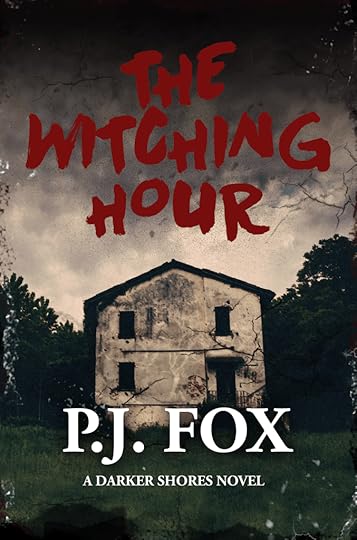
The Witching Hour: Blurb and Cover Reveal
The Witching Hour will be the first in a loose series of stand alone horror novels, all based somewhere along Massachusetts’ North Shore. Picturesque towns, one after another, trail the rocky coastline; lobstermen pull traps and tourists go antiquing and no one notices as certain things…grow ugly. Change. But eventually, at least someone will have to ask: what lies beneath?
The blurb and cover are below:
Gloucester, Massachusetts is a sleepy seaside town.
A town with a past.
A past that’s rarely acknowledged, except in whispers. And in the fact that not all the flowers left at the Fisherman’s Memorial are left for those who’ve died at sea. Some are left for the women, who leave work and are never seen again. Some are left for the men, found dead beneath their boats. Not all of obvious causes. And some are left for a family that was brutally mutilated and slaughtered. In what some still claim was a sacrifice to the Dark One. Behind closed doors, of course.
Their house has remained vacant all these years, a testament to everything that’s wrong in this place.
But now, someone is throwing a party there.
And who can resist a party?
Where Is Predators in the Mist!?!
Predators in the Mist, the third volume in The House of Light and Shadow series, is missing.
Yes. I know this. And I am eternally grateful for the core of loyal readers who keep looking for it. It means the world that you care about this series. Unfortunately, though, The Price of Desire is my worst selling book to date. Which means that, because publishing is a business and sometimes a sucky one, I can’t prioritize its sequels. However. I do still plan to write them!
The question…is when.
And I honestly don’t know. I’d really, really, really like 2017 to be the year. Whether it ultimately is or not…is going to depend on a lot of factors, many of them outside of my control. However, either way, I will keep you updated. So please, stay tuned to this space. And, in the meantime…consider reading one of my other books? Kisten and his adventures aren’t over yet, but…at least I don’t make you wait a decade between books, like George R.R. Martin.