Heather Weidner's Blog, page 104
February 4, 2016
How Much of Your Mysteries are Based on Truth?
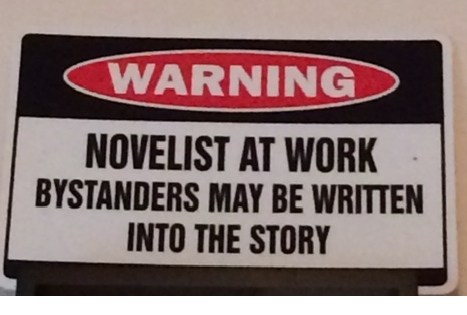
Recently, I was asked, "How much of your mysteries are based on real events or places?"
I do a mix of real and fiction in my short stories and novels. All of my city settings are real places. I tend to set my works in Virginia cities and counties because I write what I know. If a crime occurs, I make up that location's name. I wouldn't put a horrific or violent event at a real restaurant or store. But if you've been to the real cities, you'll recognize landmarks and street names.
I get ideas for crimes and capers from real cases, but I usually take liberties with the details. In my short story, "Washed up," a beat up suitcase washes up on Chick's Beach, and it's filled with some mysterious contents. Back in the 80s, there was a real case where suitcases filled with body parts did wash up on beaches on the East Coast. In my story, I thought it would be interesting for beachgoers to find something old and sinister in an unexpected place.
I carry a notebook with me wherever I go, and I am always jotting down names and interesting tidbits that might one day make their way to a story.
I base some of my characters on combinations of real people. I blend characteristics of several real people to make an interesting fictional person. And phrases that family and friends say frequently appear in my stories. I have two co-workers who keep asking me to make them villains. I haven't done that yet, but I do hint from time to time that unruly team members will end up in a dumpster in a future story.
I use friends and family member's names for minor characters. In Secret Lives and Private Eyes (out May 2016), my sleuth, Delanie Fitzgerald, gives herself all kinds of aliases in her investigations. These are usually names of friends and family. And every once in a while, you'll find police, EMTs, or FBI agents named after my favorite authors, rock stars, or actors.
One of my oddest writing moments happened when a woman with the same name as one of my main characters followed me on Twitter. What a fun surprise!
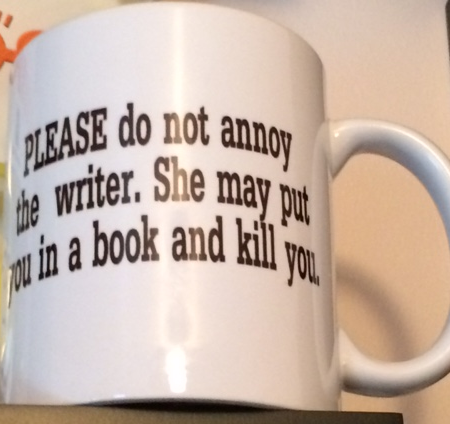
One of my favorite mugs...


January 30, 2016
10 Twitter Tips for Writers

You've created a Twitter account and are tweeting. Now what? Here are ten tips to help you build followers and maintain your account.
1. If you want to gain followers, you need to be social. Make sure that you like and retweet others' tweets. Share information that will help others. It can't be all about you.
2. Find people who are like you or have similar interests. Follow their followers. For example, if you write cozy mysteries about dogs, look for groups of dog lovers, mystery readers, and cozy readers. Also follow who they are following.
3. Always include at least one hashtag in your tweet. This tags your tweet and makes it easier for those with similar interests to find you.
4. You need to periodically review your list of followers. Some people follow you and then unfollow you just to get their numbers up. And some people never follow you back. I manage four Twitter accounts, so I finally broke down and invested in Tweepi's paid version. It helps me unfollow those who are not following me. It also has a variety of other cleanup tools for abandoned accounts.
5. I schedule tweets while I am busy during the day or during the overnight hours. I've picked up a lot of followers who are active in the wee hours. Right now, I use the free version of TweetDeck. There are a variety of tools that will allow you to schedule your tweets in advance. You should schedule at least one tweet a day with a link to your latest blog post.
6. If you are going to tweet links, you need to use a tool to shorten them (or the URL will take up all your tweet). I use Bitly. It's free, and it lets me track clicks. This feature allows me see quickly what catches peoples' interest.
7. Use your analytics to spot trends. Twitter lets you see your top tweets and when they are most active. This gives you an idea of when your audience responds. Schedule an extra tweet or two during those timeframes.
8. Mix up your tweet content. People pay more attention to pictures and videos than they do text and links.
9. Make sure that you have a photo on your account. If you're an author, it should be your recent headshot. You want folks to be able to recognize that it's you.
10. Look at your biography or description. Make sure it's interesting and grabs peoples' attention. Include a link to your website and your information about your latest work. Your banner graphic should be similar to your blog, webpage, and other social media sites.
January 25, 2016
What I Learned from Dan Roam's Blah, Blah, Blah...
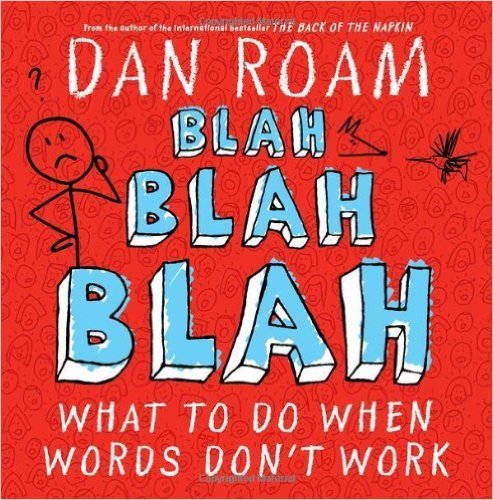
Dan Roam's Blah, Blah, Blah: What to Do When Words Don't Work is a great book on communication. He has wonderful suggestions for how to get your message across in communication, work sessions, and brainstorming events.
This is my favorite quote from Roam, "Words are magnificent. When used well, words help us think, make us feel, let us remember, tell us the truth, show us the way, help us understand, unravel the complex, gather us together, and give our lives meaning" (p. 27). All writers need to remember that. What you put on paper can be powerful.
Here's what else I learned...
We either share too much information or not enough. Don't cause "Death by Detail." This is key for writers. Don't overdo the details.We are often surrounded by words, especially in business communications, that contain no real meaning.If pictures matter so much in children's stories, why do we stop including them when kids start reading. Pictures are important for communication and brainstorming.Using words and using words well are two different things. Great advice!Check out Roam's book. It's worth it.
January 22, 2016
Obsessed with Your Numbers?

Metrics are important. They give you a way to track how well your marketing efforts are doing. But your number of likes, followers, and comments shouldn't rule you or ruin your day. Don't obsess about them. I know; it's easier said than done. We all want to be liked and recognized. Rejection hurts. It doesn't feel good when you get "unliked" or a crummy review.
Look at your numbers. See if you can find clues to figure out what happened. If your site visits on your blog drop, and you haven't been posting, then that's a good sign you need to blog on a regular schedule.
But remember that people are fickle. There is a lot out there to capture their attention, and they often unlike things willy nilly. Don't fixate on the negative. When you lose followers or get negative comments, see if there is anything you can learn from it. If not, let it go. You can't control other people. Go exercise, shout, or jump up and down. Get it out of your system, and then get yourself back in your chair and write. Your primary job is to finish your next work.
Social media has two parts, and the first word is key. People like when you have conversations and build relationships. I always thank people for great comments, reviews, or shout outs. But I don't comment on snarky or negative comments. You don't want to get into a war of words that will last for ever on the Internet. It's hard not to respond or defend, but don't post anything you'll regret later.
Best wishes for your writing! It's hard work, but keep at it. You're not going to please everyone. Celebrate the successes and learn from the less than sterling ones.
January 17, 2016
What I Learned about Crime on Campus
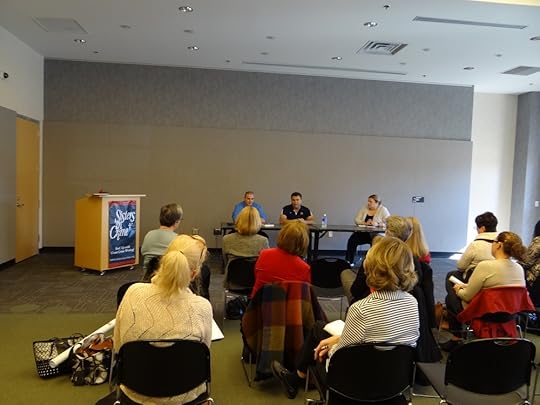
Campus Chiefs of Police Paul Ronka and Dave McCoy spoke at our Sisters in Crime - Central Virginia meeting this week about crime on campus. And yes, someone did ask, "where's the best place to hide a body" on a college campus.
Here's what I learned from both of them. One serves a commuter campus with three locations in Central Virginia, while the other serves a larger private college, where most of the students live on campus.
If you're writing a mystery about college life, most incidents happen in the wee hours.While most of what they deal with are parking, stolen items, underage drinking, narcotics, and sexual assaults, their officers are now trained to deal with active shooter or hostage scenarios. They conduct regular training with students and faculty. Life has changed for law enforcement after Columbine. The strategy used to be to set up a perimeter, wait for the SWAT team, and try to engage the shooter in negotiations. Now, the focus is for the first officers on scene to do a tactical entry and locate the shooter.When events occur on campus, their officers are involved with the investigation, but they also involve the local police, state police, FBI, and Homeland Security, as needed.Chief McCoy's campus requires study abroad for many of its students, so he is often called upon to worth with the state department and law enforcement agencies in other countries when incidents or crimes occur involving students from his campus.Both are also responsible for emergency training and drills for earthquakes, hurricanes, and other catastrophic events. They have a variety of tools and alert systems for emergency notifications.After the horrific college campus shootings, colleges in Virginia now have Threat Assessment Teams to evaluate and investigate safety concerns and incidents. These teams determine the best plan of action for the safety of the campus and the students involved.If you're a writer, you need to check out Yik Yak. It's an anonymous site where people (usually college) students in about a mile-radius of your location post comments about all kinds of topics.Neither officer gave us the "best place to hide a body," but they did talk about maintenance tunnels, steam tunnels, and rooftops. I'm sure there are lots of interesting locations on a college campus...
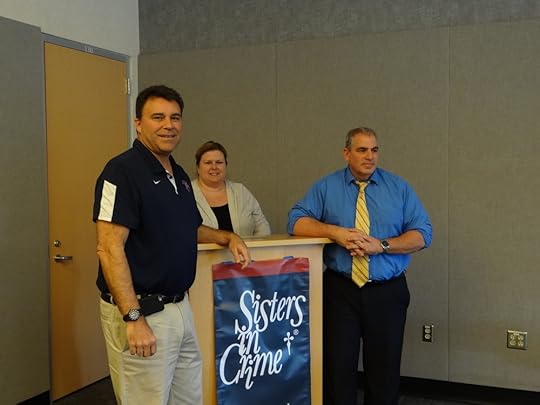
l - r: Dave McCoy, Cynthia Price, and Paul Ronka
January 10, 2016
A Writer's Checklist
I always have this notion that when I'm done writing a story or manuscript that I'm finished. But in reality, the fun is just starting. There are rounds of reviews and edits to be done. (More than I would like to admit.)
Here's a checklist that I put together of things to look for as I go through the draft reviews.
1. I look at my character names. Make sure that you don't have two or three that start with the same letter or sound. (e.g. Kate, Katie, and Caitlyn or Jones, Johnson, and Jacobs) It can be hard for your readers to keep them straight.
2. Look for repeats in your storytelling and dialogue throughout the entire work. If you're not giving new facts, make sure to remove the duplications.
3. Root our passive sentences. (e.g. The ball was thrown by Jake.) Rewrite these to active voice.
4. Look for overused words. Use your search feature to find and eradicate them. My overused words are just, that, only, and in a few minutes.
5. If you're writing a series, make sure you don't repeat too much from previous books. But you do need to provide some background on characters or big events. We talked about this in critique group this week. We were reading the third book in a series, and a new person asked if the two characters were in a relationship. The rest of the group knew from reading the other works that they were dating, but it wasn't clear to the person who started in the middle of the series.
6. Look at your transitions between paragraphs. Are they smooth? The reader should not get whiplash from any abrupt shifts.
7. Look at the last paragraph of each chapter and make sure readers are compelled to keep reading. Don't give them a reason to drop in their bookmarks.
8. Look through your sentences for "be" verbs. See if you can rewrite these without "was" and "were."
What else would you add to the checklist?

January 2, 2016
8 Twitter Resources for Writers

Twitter is a powerful tool for driving traffic to your blog or website. There are tons of Twitter resources out there to help you market your site or your book. Here are some sites you need to check out...
Vertical Response Blog - This link offers 12 tips for running a social media contest.
Buffer Social - This describes how to use Twitter's search to return the information you are looking for. There are some neat hacks for customizing your searches to gain analytical insights.
JeffBullas.com - Jeff Bullas' blog has great information for anyone who is using social media for marketing. This post teaches people how to motivate their followers to get them to spread your posts. In this post, he has a great infographic about social media platforms, their users, and the etiquette on each site. And finally, in this post, he shows readers how to improve their graphics or visuals to improve the chances of being shared.
VAGeek.com - This post from Heather Santos offers users ways to get more interactions from their Twitter followers.
RebekahRadice.com - In this post, Rebekah Radice teaches readers how to create the "perfect social media mix."
Inbound Marketing Blog - This post provides "50 Un-boring Ideas" for you to use to improve your content.
Happy New Year, and Happy Writing!
"Spring Cleaning" and The Secret of Mill Mountain
I'm blogging today over at VIRGINIA IS FOR MYSTERIES. Stop in and see why I chose Mill Mountain in Roanoke as my story's location.

December 27, 2015
New Year's Resolutions for Writers
It's resolution-making time again. Are you ready for the new year? Here is my list of resolutions for writers...
1. I will make time to write. I will never finish my manuscript if I don't work on it.
2. If I want to be a published author, I need to work on my craft. I will look for ways to improve my writing this year (e.g. classes, critique group, writing partner, etc.).
3. I will invest in my writing business this year. I will create or update my website. I will make sure my social media sites have the same professional look.
4. I will update my headshot. It is noticeable when you're using a ten-year old photo.
5. If I am prepublished, I will send out queries or look for ways to have my work published.
6. I will look at my marketing plan, or I will create one. Where should I spend my time publicizing my blog or my work? How often do I advertise? What platforms work for my type of writing?
7. I will commit to a blog schedule, and I will post regularly.
8. I will strive to be more social on social media platforms. I will share others' information and look for groups with similar interests. I will build relationships and resources.
9. I will strive to balance my writing with all the other things that life throws my way.
10. I will exercise more.
What else would you add? Happy New Year!

December 25, 2015
Merry Christmas!
I hope you have a wonderful Christmas holiday!
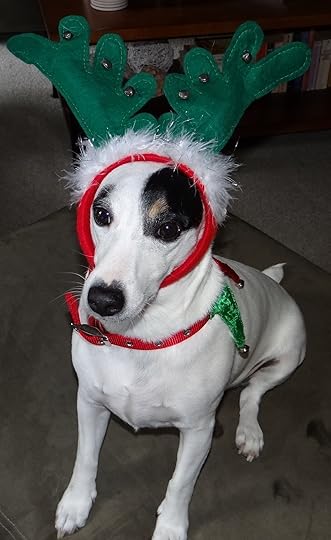
Riley the Reindeer
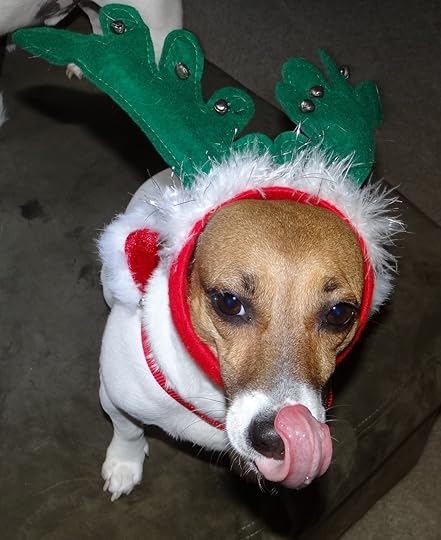
Disney Dog