Heather Weidner's Blog, page 103
April 9, 2016
The Best Advice I've Received about Writing

I am so fortunate to be a part of several writing groups, anthologies, and a critique group. The other writers are so supportive and willing to share what does and doesn't work for them. Here are the best pieces of advice that I've received over the years.
1. Keep writing. If you're marketing or querying a book, make sure that you're also working on your next book.
2. Don't give up. You're going to get a lot of feedback and negative comments. Make sure you learn what you can from the feedback. Then keep going. Don't let bad reviews paralyze you.
3. You can't expect to sell one hundred books at every signing. If you get to meet readers, booksellers, and librarians, then it was a good signing. Relationships and contacts are important too.
4. When you do appearances or signings, make sure you're well stocked with pens, bookmarks, giveaways, and candy. Always bring good candy. Chocolate is a hands-down favorite.
5. Know what your budget is for marketing your book and stick to it.
6. Use your new book to create interest in your earlier works.
7. Know what your budget is for conferences, memberships, and writing workshops. Work on your craft, but remember your primary job is to write your next book.
8. Social media and other marketing are key for authors. It's expected these days that the author has a key role in this. Just make sure that you balance this with your writing time.
9. Invest in your headshot/author photo. And make sure to update it as years pass.
10. If you're not able to create and maintain your website, invest in someone who can. You are your brand, and your graphics, website, business card, and marketing materials should look professional and branded.


April 1, 2016
A Playlist for SECRET LIVES AND PRIVATE EYES
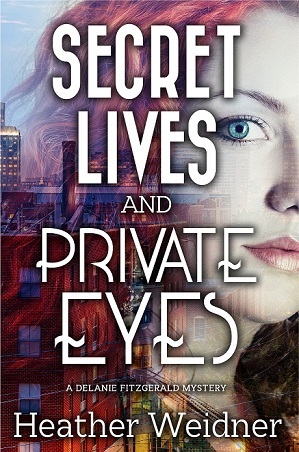
I love music. I have playlists for reading, writing, and revising. Music is always on at home or work. Listening to my 80s Favs this morning made me think about the characters in my debut novel, Secret Lives and Private Eyes (June 20, 2016).
Business has been slow for Private Investigator, Delanie Fitzgerald, but her luck seems to change when a tell-all author hires her to find rock star, Johnny Velvet. Could the singer whose career purportedly ended in a fiery crash almost 30 years ago still be alive?
And as though sifting through dead ends in a cold case isn't bad enough, Chaz Wellington Smith, III, a loud-mouthed strip club owner, also hires her to uncover information about the mayor's secret life. When the mayor is murdered, Chaz is the key suspect. Now Delanie must clear his name and figure out why landscaper, Tripp Payne, keeps popping up in her other investigation. Can the PI find the connection between her two cases before another murder - possibly her own - takes place?
So here's my playlist for Secret Lives and Private Eyes.
Adam Ant's "Goody Two Shoes"A-Ha's "Take on Me"Cyndi Lauper's "Girls Just Wanna Have Fun"Robbin Thompson's "Sweet Virginia Breeze"Wilson Pickett's "Mustang Sally"Modern English's "I Melt with You"Icicle Works' "Birds Fly" (Whisper to a Scream)Van Halen's "Why Can't This Be Love"The Beach Boys' "Fun, Fun, Fun"Bruce Springsteen's "Dancing in the Dark"Bon Jovi's "Wanted Dead or Alive"Rachel Platten's "Fight Song"Mark Wills' "Nineteen Something"And of Course, Hall and Oates' "Private Eyes"
March 25, 2016
What's in Your TBR Pile?
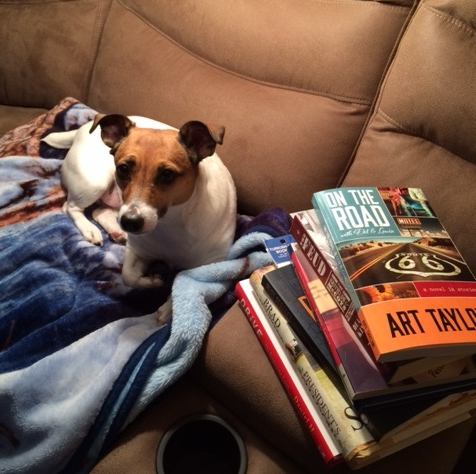
Disney Dog and One of My TBR Piles
My "To Be Read" (TBR) pile is huge. Actually, I have two - one in the den, and one on my nightstand. When I die, there will probably still be a stack of unread books. When we moved to this house, we didn't have a lot of furniture, but we had boxes and boxes of books. Just about every room as at least one bookshelf.
My grandparents and parents started my love for books and reading a long time ago. Someone asked me recently if I read differently as a writer. I'm not sure if it's because I'm a writer or whether it's because of a busy schedule. But I do notice differences in my reading habits lately.
I used to feel obligated to finish every book I started. Now I give myself permission to quit if the book doesn't grab me. If novels are riddled with typographical or grammatical errors, I usually put them down. Since I do a lot of writing and revising, typos and stylistic errors jump out at me and scream. I like plots that move. I get annoyed with mysteries that I can figure out in the first half of the book.
My free time is limited. I work full-time, do volunteer work, and write. I tend to be more selective in what I read. I read what I like, and I don't follow best-seller or popular book lists like I used to. My favorite genres are mysteries, histories, and biographies.
I read ebooks on my iPad. I love the convenience of downloading anywhere and taking a library with me. But I still like the feel of paper.
What's in your TBR pile? Have your reading habits changed?
March 19, 2016
How to Conquer Writer's Doubt
Self-doubt - It rears up and can take over. It's those thoughts that creep in and make you question what you're doing. Am I wasting my time on my writing? Will I ever get published? Will my books sell? What if I get bad reviews?
It's good to review and assess what you're doing periodically. That's how you improve. But those thoughts shouldn't consume you or stop you in your tracks.
You have to be persistent. If you give up, you will never be published. If something isn't working for you, switch it up and try something else.
You need to acknowledge that writing is work. It is very rare that someone has a perfect first (or fourth) draft. Going to critique group, polishing the manuscript, revising, editing, and proofreading take time. To do it right, you have to put in the time.
Asa writer, you will be required to market yourself and your book. It takes money, time, and energy. To keep fans interested in your social media sites, you need to post good content regularly and interact with people. But you need to balance this with your writing time.
You are going to get rejections and negative comments. Deal with them in your own way and then move on. Exercise is always a good way to work out the anger. Don't get obsessed about your number of followers, your sales numbers, or the reviews. Check on them occasionally, but don't let them take over.
Your job is to write your next book. Don't be paralyzed by the worries and doubts. There are always going to be challenges. If writing is worth it to you, you've got to commit to it and learn how to control that little doubting voice in your head. Work to improve your craft and write your next piece.
March 13, 2016
Subtle Ways Writers Can Increase Their Social Media Followers

Using social media to promote your books is key in today's book marketing world. Here are some underutilized ways to increase your following:
Facebook - When other authors or acquaintances friend my personal Facebook page, I invite them to like my author page. You'd be surprised at the number of followers you gain.
Post frequently to your author page. And make sure that most of your posts arenot "buy my book."
Link your author page to your Twitter account. I picked up some tweeters when I did that.
Instagram - Use hashtags (lots of them) with your posts. Thanks, Meagan Cain for the tip. My likes and follows increased as soon as I started the practice.
Post pictures and videos frequently. When I posted once a week, I didn't get much love or attention. The more I post; the more my activity increases.
Twitter - When people comment on my tweets or retweet, I usually follow them.
If you're looking to increase your followers, find people who have similar interests. Look at who they follow and who follows them. Follow their followers.
Use hashtags (usually no more than two or three). People with similar interests can better find your posts.
Other Ideas - Put your Facebook, Twitter, Instagram, blog, website, etc. in your email signature as links. Make it easy for people to find you.
Make sure to put all of your social media links on your website, Amazon AuthorCentral, and Goodreads sites.
And don't forget the social part. Make sure that you're interacting with others' content on these sites. Happy posting.
March 4, 2016
Fighting the Chaos - Organizational Tips for Writers

When my desk gets too cluttered, I have to stop and straighten it. For some reason, chaos creeps in when I'm writing. And I have to be able to find things. Here are some tips to help organize your writing life.
Calendars - Pick a calendar and use it regularly. I maintain the blog rotation for a couple of writing blogs. It's like herding cats sometimes when lots of folks are involved. My friend Tina Glasneck suggested Google Calendar, and it's been a lifesaver. I loaded up our blogging schedule and gave everyone access to it. It's a great way to keep us organized.
Keeping Your Plot in Order - I plot my novels chapter by chapter on paper. I use a Word table, but you can use index cards, paper/pen, Excel, or any number of mind-mapping or drawing tools. I color code the parts that have romance, comedy, clues, and action. This helps me see where they're located throughout the story and allows me to spread them out. It also is incredibly useful later when you're editing.
Keeping up with the Details - I write a short biography of each main character and important location in my novels. I use a Word table. Then I add to it as I revise the work. I use this to keep up with hair color, eye color, favorite foods, cars, pets, and any other little detail that I could forget. I have a separate column for each book in the series, and I can track which characters appear in which book. It definitely helps with the details when you're revising.
Idea File - I keep a notebook with me to jot down ideas (e.g. ideas, names, funny phrases, and interesting stories). I used to keep a manila folder with pictures and ideas. I keep these on my computer now. I also use Pinterest to save ideas, recipes, and photos of great locations.
Contacts - I put all of my contacts in Outlook. I add a note to help me remember where I met the person. Also, when people give me a business card, I write the location on the back to help me remember later.
One Location - Have one location where you keep all of one thing (e.g. keys, papers, ideas, photos, etc.). It sounds simple, but with every-day life, things get misplaced too easily. And you waste a lot of time hunting for them.
By keeping the minutia under control, you have more time for writing. Best wishes for your writing projects!
February 26, 2016
Book Signings: The Weird, The Wacky, and The Wonderful
I love book signings and panel presentations. I enjoy meeting and talking to readers and other writers. Though my writer friends warmed me when I started that I'd be asked numerous times where the bathroom was. Their other sage advice was for me to bring candy - lots of chocolate candy.
I am part of an anthology series, and we did over fifty-four events in a year and a half to promote Virginia is for Mysteries. I learned early in my writing career that book signings are always more fun with other authors. It's a party with the anthology authors get together. But we did have some wonderful and unusual experiences...
At my very first book signing, I pocketed my pen and phone and left my purse in my car. I signed one book, and the pen died. Thankfully, mom was there to rescue me with a spare. I now pack a bag with all kinds of supplies and giveaways.
I had the great pleasure to sign a book for Dr. Hal Poe (descendant of the Father of the Mystery) at the Poe Museum in Richmond, VA. I also had the opportunity to meet Dashiell Hammett's granddaughter at an event in Raleigh, NC. Two fan girl moments for me!
At one of our signings in North Carolina, a man asked the authors at my end of the table if the book had any stories about aliens in it. When we told him no, he proceeded to tell us about how he had been abducted from a farmhouse and the time he spent on a spaceship. He went into great detail about bright lights and probes.
We did a mystery panel in Charlottesville one year, and we were seated on a small stage in a large lecture hall. Afterwards during the signing, a woman told me that I needed more lipstick. I wasn't quite sure how to respond. I thought she was selling cosmetics or drumming up clients for a makeup business. After a long pause, she said, "Your lips disappear in the back of the room." I guess, she just wanted me to wear darker lipstick.
And on more than one occasion, people have asked me to read and critique their manuscript (which they happened to have in their car). My answer is always to talk about my critique group and my writing group. And how they are wonderful resources for constructive feedback.
We are in the process of scheduling events for our second anthology, and my debut novel, Secret Lives and Private Eyes comes out on June 20. I look forward to all the fun and the great stories. Do you have any wacky or wonderful signing experiences?
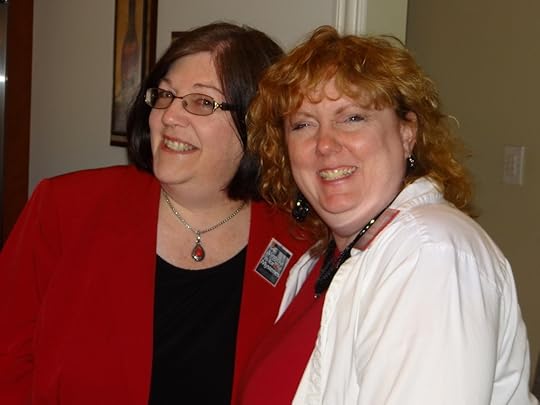
Yvonne Saxon and Me in Virginia Beach, VA
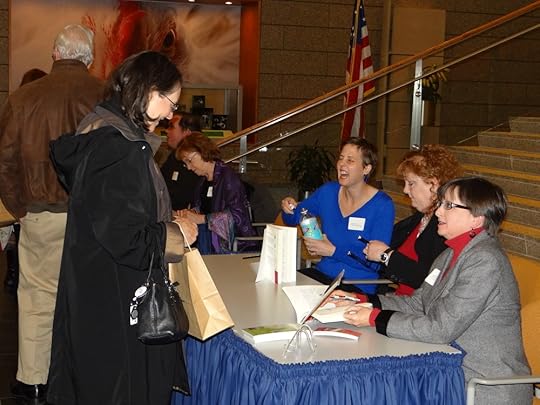
Meredith Cole, Me, and Jayne Ormerod at the Library of Virginia in Richmond, VA
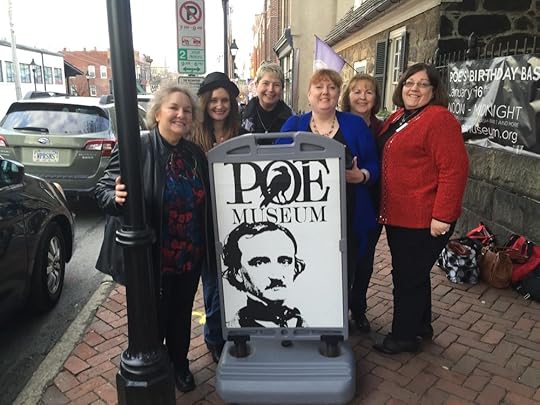
Rosie Shomaker, Teresa Inge, Vivian Lawry, Me, Maggie King, and Yvonne Saxon at the Poe Museum in Richmond, VA
February 21, 2016
Cover Designs - Which do you like better?

My publisher has posted two cover designs for Secret Lives and Private Eyes. Please stop in and vote for your favorite. The book is slated to be released on June 20. Many thanks!
Click here to vote.
February 19, 2016
A Writer's Checklist for Editing

I completed the first round of edits for Secret Lives and Private Eyes this week. Whoo hooo! I made myself a checklist for ensuring that I verified some key areas. Sometimes, when editors or proofreaders use the track changes feature, the formatting and spacing isn't quite right after the changes are accepted.
Here are the items on my checklist...
1. Make sure that all quoted text has an opening and closing quotation mark. Sometimes with editing, the end quotation mark disappears.
2. Check to see that there is one space after all marks of punctuation. I also check to make sure that all sentences have the correct end punctuation.
3. Run the spellchecker to make sure words weren't run together by accident.
4. Make sure all paragraphs are in the correct place and are indented. Sometimes, during editing they merge or lose their indent.
5. Check to make sure that all usages of a word or phrase are consistent (e.g. T-shirt or t-shirt; a.m. or AM). I make a style sheet while I am self-editing to keep me on track.
6. For mysteries and plot twists, make sure that if key clues or plot points are removed that all other references to them are also removed.
7. If dialog or chapters are removed, make sure that clues and foreshadowing are still correct.
8. Check all of your em dashes (to ensure that they are not two hyphens). Also, check your ellipses to make sure that the spacing is correct between the periods.
9. Check all of your chapter numbers to make sure that they are still in the correct order.
Writing, editing, revising, and proofreading are hard work. I probably spend more time revising than I do writing. Best wishes with your writing project!
February 13, 2016
Plotter or Pantser?
How do I write? Writers usually fall into one of two camps, plotters (those who plan, plot, and outline before writing), and pantsers (those who write by the seat of their pants). Plotters know the path and the plan to get to the end. Pantsers go where the characters and story take them.
I am probably a hybrid of the two, though I lean heavily on the plotter side. I plot everywhere. I jot ideas on sticky notes and on scraps of paper. I carry a notebook in my purse for plotting emergencies. I have outlines, character biographies, and color-coded storylines. I keep a chart of all the places and characters. I describe them to the nth degree. This is also helpful if you decide to write a series. That way, my character's eye color or the color of her kitchen doesn't change in a later work. I also use this to take care of my urge to write backstory. I put all the details in this document. Some of the information will never see the light of day, but it keeps me from overloading the story with too much history. Backstory or historical details are better sprinkled in throughout the work.
After my major plotting which usually takes about a month, I'm ready to start writing. And that's when the pantser raises its head. I always decide I like a minor character better than another, and sometimes the story takes a tangent. In my first novel, Secret Lives and Private Eyes (May 2016), I planned to keep one character around for the series to create some tension. But as it turned out, I liked another character much better, and his role took on a life of its own. So, without spoiling the surprise, character two is around for book two.
After the plotting and the first draft, which my friend Mary Burton calls the "sloppy copy," I am ready to revise. This phase takes me the longest. I can write pretty quickly, but it takes me forever to reorder and change. My critique group is very helpful during this phase. They help with storylines that don't make sense. They also point out where things are missing or weird. I had my character eat lunch twice in the same chapter once. Whoops!
After more revisions, then it's ready for professional copy editing and hopefully, publication.
Decide which process works for you or combine them for your style. Best wishes with your writing. It's not an easy process.