Heather Weidner's Blog, page 108
June 21, 2015
"It's a Great Time to be a Geek!" - Ideas for Writers
I returned this week from the Gartner IT Operations Strategies and Solutions Summit in Orlando, Florida. It's a "Great Time to be a Geek!" Technology is always changing, and there will be exponentially more devices and applications in the next five years that will access the Internet. It's mind-boggling.
Good writers are always looking for ideas - no matter where they are. I came up with a great plot line for my PI series. Here's some of what I learned:
There are already smart elevators that use scans to get to your floor, rather than buttons.There are mining operations with computer-driven equipment, including trucks. The biggest problem they had was with the ruts in the road. All of the trucks took the same path back and forth, and a lot of damage. The operators had to program a variety of algorithms to save the mining roads.Ethical reviews are important with technology. For example, should medical devices be blue-tooth-enabled for monitoring? It's a great way for your physician to monitor you, but what happens if it's hacked? Think about the possibilities for legal and medial thrillers.Everything is possible, and nothing is certain. Sounds like a lot of change in the future. As a writer, you do need to be careful when mentioning specific technology unless your work is set in a specific time period. Fax machines and flip phones are out of date.By 2020, over 25 BILLION things will be connected to the Internet. In addition to phones, tablets, and laptops, things like printers, copiers, cars, hospital beds, and refrigerators will be reporting data or communicating to other devices and services.Work is now an activity and not a place. People can work anywhere, anytime.


What I Learned about Funeral Services from Rhonda Pleasants
Rhonda Pleasants, Funeral Director and Professor, spoke recently to our Sisters in Crime - Central Virginia writers' group.
Ms. Pleasants was a wealth of information about embalming, funeral services, religious and historic traditions, and burial services. She answered questions to help the writers get it right. For more information, she recommended The History of American Funeral Directors.
Here's a sample of what I learned:
There are "green" burials and "green" cemeteries. The chemicals and burial devices are biodegradable and less chemical.All disinternments in Virginia have to have a permit.The cremation process is more than just an oven. If they have multiple cremations in a day, they usually start with the largest person.Funeral directors need to be familiar with a variety of religions and traditions.Mortuary makeup is like thick, theatrical make up. Makeup is often airbrushed on.They use wax to fill in holes (stab or gunshot wounds) for viewings.Caskets often come with memory drawers and time capsules.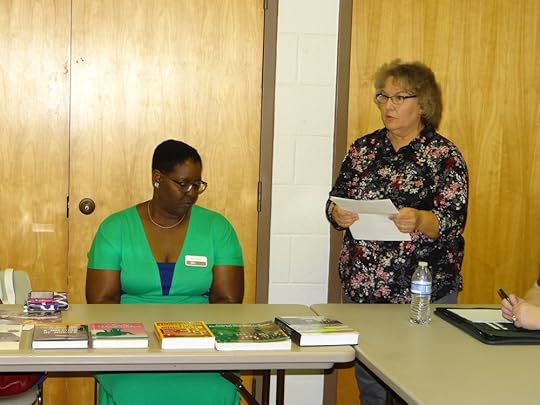
(l-r) Rhonda Pleasants and Rosemary Shomaker
June 12, 2015
11 Things Writers Need to Know
I was asked recently what advice I would give to someone who wants to writer. Here are my Top 11...
1. Read. Read. Read. Read everything you can get your hands on. Learn about the genre. Learn about techniques and style. See what works and what doesn't.
2. Seek out writers like you. Find a writers' group. I write mysteries, so Sisters in Crime was a perfect fit. I am also in the online community, Guppies. They have tons of resources and advice. And they are so supportive and helpful. If you are a student, check into student rates.
3. There are a lot of books out there on the craft of writing. My favorite is Stephen King's On Writing. Invest in books that help you. Use your library. FREE is good.
4. If you are serious about writing, find a critique group. It's an investment in your time to read the submissions. Make sure that the feedback is helpful. Critiques need to be constructive and not personal. My critique group specializes in mysteries and crime fiction. And that works for me. I don't want to have to provide feedback on other genres that I don't read or enjoy.
5. Your first draft is never your final manuscript. Very few people get a polished work in the first few drafts.
6. Start thinking about your social media platform. When you work with a publisher, he/she wants to know where you have a presence. I started with Twitter and my blog. Since then, I've added a Facebook author page, website, Pinterest, Goodreads, LinkedIn, Amazon Author page, and Instagram.
7. Make sure that you carve out time for writing. Work, life, and everything else vies for your time. You need to write regularly.
8. There are tons of creative writing courses, workshops, and conferences, and the costs vary. I learn more from writing and working with other writers in my critique group than I do from most workshops.
9. Google and your library are your friends. You would be amazed at the FREE resources available.
10. Learn to use the basics of your word processor. Many agents and publishers reject manuscripts that don't fit their submission requirements. Each agent, publisher, and contest have different preferences. Make sure that you always review the submission requirements and follow them.
11. Don't give up. Rejections are hard, and they hurt. Learn from the criticism, but don't dwell on the rejections or negative reviews. Keep writing.
June 10, 2015
It's National Iced Tea Day
It's National Iced Tea Day. What brand do you prefer? We drink Luzianne at our house.

June 7, 2015
"Spring Cleaning"
My short story, "Spring Cleaning" is going to be a part of Virginia is for More Mysteries, and our publication date is February 2016.
In the story, medical records manager, Douglas Weimer, gets more than he bargained for when he’s moved onto a new team and receives a project with a drop-dead delivery date. His assignment in Roanoke, Virginia gives new meaning to work deadlines.
My short story, "Washed up" is in the first Virginia is for Mysteries.
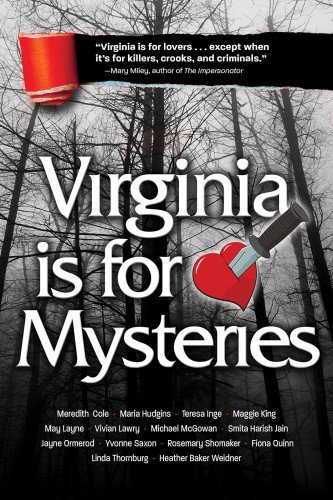
Virginia is for Mysteries
7 Things I Learned from My Dogs...A Dog Blog
Disney and Riley are Jack Russell Terriers, and life at my house is always an adventure. They have two settings, warp speed or sleep.
Here's what I've learned from them...
1. Live in the now. Today is what's important. The past and future don't matter as much.
2. Play hard. Life can't be all work. Everything is a game to a Jack.
3. Nap when you need to. You need to recharge every once in a while.
4. Don't waste a beautiful day inside. Go outside and have fun.
5. Know when it's time to cuddle on the couch with a good book.
6. Bark if you need to, but not too much.
7. Wag and make friends. Relationships are important.
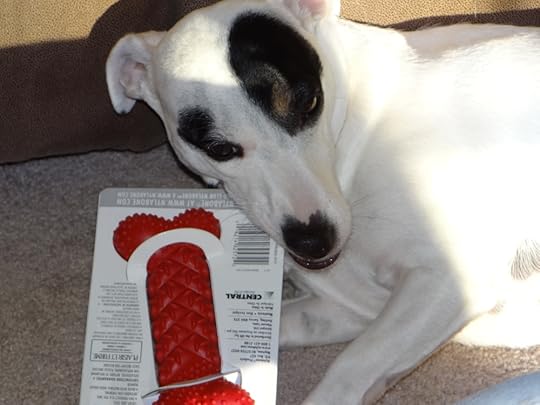
Riley's new bone...
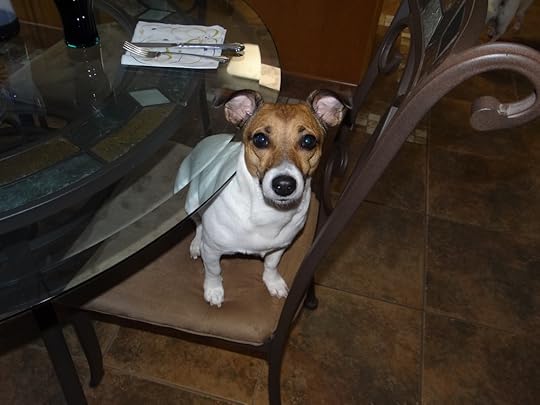
Disney likes to sit at the kitchen table...
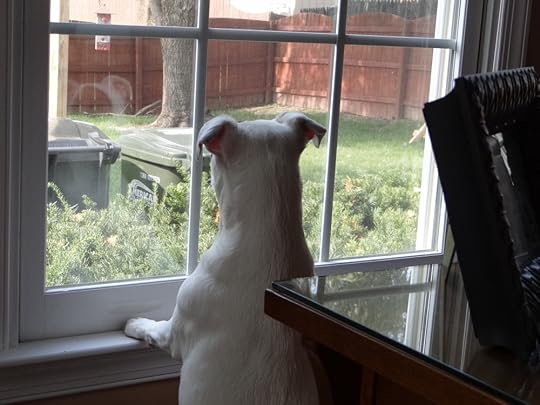
Squirrel!
May 30, 2015
When Life Cuts into Your Writing Time
Life is busy most days. I had dental surgery last week, and the recovery knocked me out of my normal routine. I work full-time and have family and other obligations. Sometimes, it's hard to stay motivated and find time for writing. (Then I feel guilty for not writing.)
These are my eight ideas for squeezing in more writing time.
1. I joined a monthly critique group. Find one that fits your needs and schedule. Don't over extend yourself with multiples. This gives me a monthly deadline and keeps my writing projects on track. Plus, it's an incredible motivator. I always leave my writing events recharged.
2. I use my lunch hour at work to write, outline, edit, or blog. I get five hours of writing a week this way.
3. Take a good, honest look at the time you're watching TV/movies or cruising the internet. If you give up an hour a day, that's seven extra hours of writing time a week.
4. I do like some TV, but I record the shows, so I can speed through the commercials. I also combine my TV time with my pursuing the internet time. I can multitask.
5. I set a blog schedule. I randomly posted and noticed that my site numbers looked like a rollercoaster. I committed to one new blog post a week, and I now have a routine for reposting links. Again, it gives me a deadline each week, and my statistics are vastly improved (and consistent).
6. I get up early even on my days off. You'll be surprised at how much you can get accomplished. I use the quiet time to write. If the evening or wee hours are better, do what works for you.
7. My company offers an alternative work schedule. I added an extra hour to my work day, but I get every other Friday off. I reserve those for my writing days.
8. I love projects, crafts, traveling, and causes. I loved being involved in events and on the go constantly. I had to look closely at my schedule and where I was spending my time, and I had to jettison a few things to commit to my writing projects.
Life is hectic, and there are days where I wrote only a couple of paragraphs. Don't get discouraged. (That's easier said than done.) Keep writing. Just keep writing.
Find the support and encouragement you need and get rid of the distractions.
May 23, 2015
8 Things I Learned from Stephen King's ON WRITING
Stephen King's On Writing: A Memoir of the Craft is the best book about writing that I've read. Several writer friends who I served on panels with recommended it to the audiences when they were asked what books have helped them. I hadn't read it, so I ordered a copy.
The book is frank, creative, and packed with real writing experiences and examples. It doesn't matter what genre you write.
These are my major take-aways:
1. "Good writing is often about letting go of fear and affectation."
2. "The best form of dialogue attribution is 'said.'" (Don't be creative with the attributions.)
3. "The road to Hell is paved with adverbs."
4. "I'm convinced that fear is the root of most bad writing."
5. "If you want to be a writer, you must do two things above all others. Read a lot and write a lot."
6. Turn off the TV. Get rid of the distractions.
7. Write everyday.
8. Research is "a specialized kind of back story." It belongs in the background.
If you're going to invest in books to help you improve your craft, this one needs to be in your library. And if I could only have one book about writing, this would be it.
May 15, 2015
The Nine Favorite Book Challenge
I was challenged recently to list my nine favorite books, and it was harder than I thought. I have a list of hundreds. I also have had favorites at different points in my life. Here they are by decade/age.
The Monster at the End of This Book by Jon StoneThis was my favorite book as a toddler. I am first generation Sesame Street, and Grover was always my hero. Now that I think about it, this one was a mystery too.
Green Eggs and Ham by Dr. SeussI checked this book out of the Woodstock Elementary library every two weeks for months in the second grade.
The Crooked Bannister by Carolyn KeeneIn the 5th grade, this was my favorite of all the Nancy Drew books. It had a pun and a plot twist that I loved. My friends and I raced through the collection at the public library. Then we read all of the Hardy Boys and Alfred Hitchcock books.
The Ransom of Red Chief and Other Stories by O. HenryI was introduced to O. Henry in the sixth grade by Mrs. Todd. I have always loved stories with twists at the end. O. Henry is still one of my favorites.
To Kill a Mockingbird by Harper LeeI read this the first of many times in the eighth grade in Mrs. Buffington’s class. I fell in love with Scout, Atticus, Boo, and all the rest.
The Great Gatsby by F. Scott FitzgeraldI read this the first time in the eleventh grade in Mrs. Bates’ class. Then we watched Robert Redford in that pink suit. I can’t tell you how many times I’ve read this over the years. (Leonardo DiCaprio is good too, but the Robert Redford version is a classic.) Plus, Billy Idol's "Eyes without a Face" came out that year, and I've always linked that song with the eyes of Dr. T. J. Eckleburg.
The Scarlet Letter by Nathaniel HawthorneWe read a lot of good books in high school. I loved the mystery in this classic and the symbolism.
The Bell Jar by Sylvia PathI read this in several undergraduate courses, and it resonated with me in my college years. Plath’s tragic ending made it more poignant.
All I Really Need to Know I Learned in Kindergarten by Robert FulghumI read this early in my work career, and many of his points were dead on.
I was very fortunate to have parents, grandparents, teachers, and librarians who encouraged reading and suggested great books. What are your favorites?
May 9, 2015
Hashtags for Writers
Here are some great hastags for writers. (The hashtag is also known as the octothorp, pound sign, number sign, or tic-tac-toe board for those from other generations.)
For additional exposure and conversations, make sure to include one or two with your tweets. But don't overdo it.
If you don't see your genre, use Twitter's search feature to find thousands more.
#AmEditing#AmRevising#AmWriting#Author#Author RT (Author Retweet)#Blog#Books#Editing#GetPublished#GreatReads#IndieAuthors#IndiePub#Mystery#Promocave#Reading#ShortStory#WIP (Work in Progress)#WordCount#WritingPrompt#WritingTipThese hashtags are tied to specific days.
#Caturday (For Cat Lovers on Saturdays)#FlashbackFriday#FF (Follow Friday)#FollowFriday#FridayReads#IndieTuesday#IndieThursday#MondayBlogs#StoryFriday#SundayBlogShare#TeaserTuesday#TBT (Throwback Thursday)#ThrowbackThursday#TipTuesday#WW (Writer Wednesday)#WriterWednesday