Michael Patrick Hicks's Blog, page 12
August 9, 2018
Review: The Mouth of the Dark by Tim Waggoner
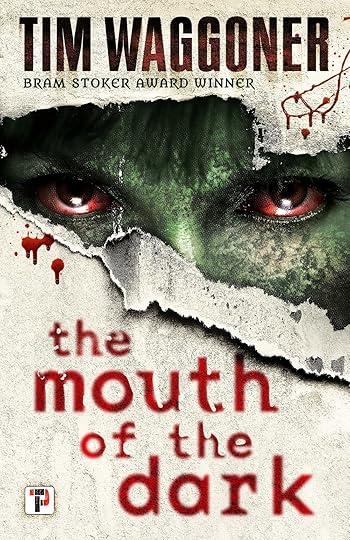
The Mouth of the Dark (Fiction Without Frontiers)
By Tim Waggoner
My rating: 3 of 5 stars
Let's cut right to the quick - The Mouth of the Dark is weird. Seriously weird. Like bug-fuck, batshit crazy weird. Tim Waggoner revels in weirdness here, revealing new layers of oddities and arcane horrors on nearly every page. Yes, it keeps the book moving, which is exactly what you want in a narrative whose timespan is so firmly compressed (the events of The Mouth of the Dark take place within about 24-48 hours or so), but hot damn is it ever weird.
Weird isn't a bad thing, though, and it's one of the central selling points behind The Mouth of the Dark. On its surface, it's about a man searching for his missing daughter. As these types of stories often require, the father takes a trip down a wickedly dark rabbit hole and uncovers a secret world, in this case Shadow. Existing alongside our own daily rigamarole, only a certain special few can see Shadow and the peculiar life lurking within. There's green-gloved men who eat paper covered in hot sauce, couples who eat dogs, and a horrifying entity called The Harvest Man. The Harvest Man has breath that can kill - breathe out, and a black cloud envelops his victim. Breathe back in, and the victim turns to ash. He's like a wickedly fucked up Lamaze teacher with a case of halitosis cranked to 11. Oh, and there's also killer sex toys that sprout tentacles to help users rub one out while asphyxiating them.
Jayce discovers all these things in pretty short order, and Waggoner continually assaults him and us readers with new information and odd-ball scenarios on the regular. Discovery is the name of the game here, and in searching for the absent Emory, Jayce keeps finding more and more dark corners to peek into and only barely survive. Some of these corners involve the secrets of Shadow, while others pertain to his own buried and forgotten past, and nearly every single one of them posits some intriguing bit of fantastical horror. Others are a bit more personal, and frankly Jayce is kind of a creeper when all is said and done, what with his strangely frequent musings on his daughter's sex life and what potential kinks she may get off on. This struck an odd, disquieting note with me. Although Jayce isn't incestuous, he simply seems to let his mind wander down some off-beat tracks and Waggoner is content to let it flow, eschewing any darker aspects between father and daughter, thank goodness.
The Mouth of the Dark largely succeeds on the merits of its strangeness. I will admit I'm not a fan of fantasy lit, and by extension a lot of urban fantasy, which runs wild here in more horrifying and perverse forms. Waggoner throws readers directly into the deep-end, right alongside Jayce, and it takes some time to get oriented to the parallel Shadow reality running alongside our own. Frankly, I struggled quite a bit to suspend my disbelief early on, but as I wised up to Waggoner's game I was better able to appreciate the story. It didn't quite satisfy me, particularly the resolution, which felt like a rush to the exit, but it didn't disappoint either. Waggoner has one hell of an imagination, and at times The Mouth of the Dark feels like an episode of Fringe if Clive Barker had gotten his hands on the screenplay. I definitely can't complain about that, and any story that features homicidal sex toys will always be worth a read as far as I'm concerned.
[Note: I received an advance reading copy of The Mouth of the Dark from the publisher, Flame Tree Press.]
View all my reviews


August 3, 2018
Review: Creature by Hunter Shea
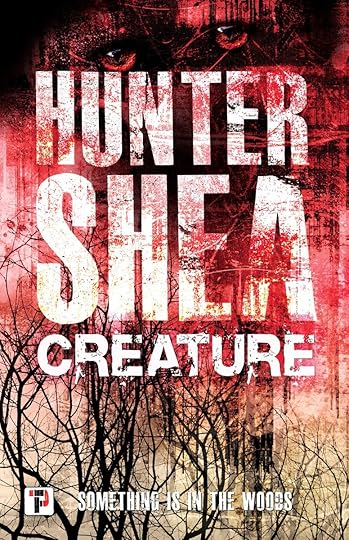
Creature (Fiction Without Frontiers)
By Hunter Shea
My rating: 5 of 5 stars
Hunter Shea knows all about horror. An author with a score of books to his name, podcaster for Monster Men and The Final Guy, and writer of Video Vision posts for Cemetery Dance, all point toward a man who has lived and breathed the horror genre since he was a boy. He knows and writes about cryptids, ghosts, crazed killer animals, and plenty more in-between. But he also knows about real horror, true horror, like when your body begins to fail and suffer from a handful of maladies, any of which on their own could be fatal, the person slowly degenerating into a life that is more misery and pain than anything else.
Kate suffers from a host of autoimmune disorders and lives in a state of chronic pain. Her joints slip out of their sockets with painful regularity and a mason jar filled to the brim with her daily regiment of pills sits on the nightstand beside the bed she only rarely leaves. Her husband, Andrew, is her caretaker, reliant on his dayjob to provide them with the medical benefits that help keep her alive, although the specter of chemotherapy is an ever-present threat, as are worries of emergency surgeries and cardiac arrest.
Kate doesn't get to enjoy her life very much. Mostly, her only company consists of her small dog, Buttons, and classic black-and-white movies on television or her computer tablet. Frustrated by his lack of time with her, and a growing dissatisfaction with work, Andrew takes a leave of absence and rents a lakeside cottage in Maine for the two of them to enjoy and while away their summer. He hopes the change of scenery will help, and that, just maybe, Kate can enjoy some sun and sand.
Their arrival, unfortunately, doesn't exactly go as planned. There's something in the woods surrounding their summer retreat. Strange, violently loud animal cries awaken them in the middle of the night, along with the noise of rocks pelting the house as whatever is out there attempts to lure them outside. What began as a hope for escape soon grows into a dire struggle for survival as the creature in the woods, and the monsters within Kate's own body, threaten to kill them.
Right from the very beginning of Creature it's clear that Shea has plenty of first-hand experience dealing with severe, chronic medical disorders. As it happens, his own wife suffers from afflictions similar to Kate's, and Creature oftentimes feels like a highly autobiographical work. It's honest and unflinching in its depictions of struggle from the perspective of both the afflicted and the partner cum caretaker. When they were dating, neither Kate nor Andrew expected their marriage to take the direction it has, and there's an ever-present sense of loss over the things that could, and should, have been. But there's also an overriding sense of love and compassion for one another, a love that has borne them through the worst of things and will carry them along no matter how grim things get. They manage to carve out moments of happiness, but still bicker and fight when emotional currents run high.
Kate and Andrew aren't a perfect couple, but they work well with what they've been given, and Shea does an excellent job portraying the reality of their relationship, warts and all. He bleeds onto each and every page, imbuing this couple and their shared life with a perfect sense of well-lived in realism. When drawing so heavily on personal experience, once might be inclined to glamorize the characters involved or tack on overly saccharine sentimentalities, but I never got that sense here. Kate and Andrew never struck me as being drawn in any way other than completely and utterly honest, and oftentimes to heartbreaking effect. Kate's disorders are awfully severe and it's impossible to not sympathize with her constant ordeals, and Andrew's by extension.
By now, you're probably wondering about the titular creature. I've spent an awful lot of time here discussing the people, but not the monster. Monsters, of course, are Shea's bread and butter! I can only say, have no worry, because Creature's creature is absolutely present, but oftentimes in omnipresent ways. We hear the creature and see the aftermath of its visits for a good long while before we're presented with it in a fully in-your-face appearance on the page. Creature is a slow-burn, one that constantly builds its way toward a grand climax, and Shea meticulously places the various pieces of his frightfest with careful deliberation.
Shea is more widely known for his fun, gloriously violent, B-movie inspired creature feature romps. Creature is a bit of a departure from stories like Megalodon in Paradise or Jurassic, Florida, but readers who came to Shea by way of We Are Always Watching will have a grand idea of what to expect here. This isn't a mile a minute gorefest, but it packs in a number of scares that are absolute powerhouses thanks to their authenticity and realism. Creature is a slower, characters-first work of horror, but make no mistake, Shea certainly delivers on the horror and in a number of particularly gut-churning, all too-human ways.
[Note: I received an advance reading copy of this title from the publisher, Flame Tree Press.]
View all my reviews
July 30, 2018
Review: Dog Days O' Summer by James Newman & Mark Allan Gunnells
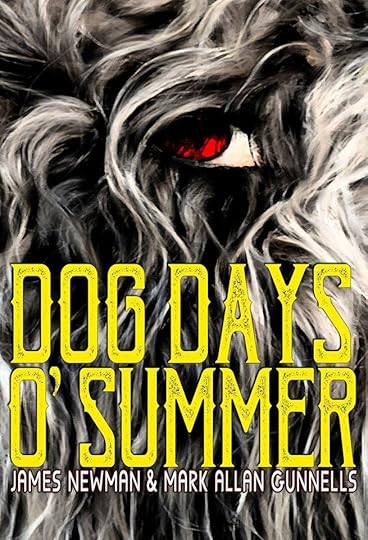
Dog Days O' Summer
By James Newman, Mark Allan Gunnells
My rating: 3 of 5 stars
I flat-out loved James Newman's Odd Man Out and enjoyed Mark Allan Gunnells' #MakeHalloweenScaryAgain, a novella printed in 2017's anthology Halloween Carnival Volume 1, enough that immediately after finishing each of these respective works, I went and bought a bunch of both men's other titles. When I learned they were co-writing a novella together, and a werewolf story at that!, I was overjoyed.
But, before I go any further I'm going to preface the rest of this review with a big, ol SPOILER WARNING. I have some contentions with the story, particularly its resolution, that require discussing in ways that I can't quite get around or be as oblique as I would like. It may be information you'd rather not know, in which case I'd say skip out on reading any further until after you've read this novella. Feel free to come back later, though!
OK? Let's proceed.
Dog Days O' Summer is certainly well-written, but ultimately a serviceable mid-90s coming of age story about a group of teens facing the inexplicable. It's a classic, well-mined set-up, but it lacks any real suspense or surprises. We know right from the get-go this is a werewolf book, and anybody who has read or watched at least one of these types of story previously will be screaming at these young boys to just figure it out already. When Jason, our 14-year-old first-person narrator, finally gloms onto what's really happening here, we breath a sigh of relief that, finally, at least one of these kids has caught up with us. Granted, Jason is relaying to us a story of past events from some point in his future, with all the build-up and foreshadowing that entails, and it's occasionally clunky given we already know more than Jason presumes of us. This is the type of book where it's more about the journey towards discovery for these boys, until their finally forced to accept the ultimate truth and contend with it.
Although Dog Days O' Summer doesn't offer up anything new, it mostly gets by on the easy likability of its characters (except for Jason's Bible-thumping parents; they're the sort of gospel music 24/7, Ten Commandments throw rug, holier-than-thou Christians that wander through the story looking to me like a werewolf buffet on feet), the smooth, easy reading prose, and the occasional bit of titillation from some particularly gnarly and graphically described murders. After the boys discover the killer's journal, Newman and Gunnells offer up a healthy number of diary entries charting one man's descent into madness, initially trying to deny what is happening to him before finally embracing his newfound powers with bloodcurdling effect.
I did greatly appreciate the authors challenging typical werewolf conventions though - there's no full moon and no silver bullets, for instance (although we get a few too many knowing winks and cutesy nods at werewolves in pop culture along the way). Instead, Newman and Gunnells explore some deeper, older mythological roots of werewolf lore related to star system Sirius, or Dog Star as it's more colloquially known. Although they get points for creativity here, I was rather disappointed by the appearance of a last-page trope that has quickly become overdone in horror circles - the "make of it what you will" ending.
While it doesn't exactly come out of nowhere given Jason's well-established interests and his narration recalling the deeds of decades past, I'm growing rather tired of endings that call into question the validity of all that came before in lieu of aiming for a satisfactory finale. Dog Days O' Summer came pretty close to ending on a highly interesting note, but the authors undermined it with a few extra paragraphs that attempt to spin Jason's story into metafictional realms. I'm sure there's a segment of readers out there that will appreciate it, but frankly I'm bored, and more than a little irked, with these type of bait-and-switch gotcha! twists that attempt to upend the entire narrative at the last minute.
Dog Days O' Summer is a short, unchallenging read that hits a few more high notes than it does low. It's more of a slim comfort read than an essential addition to werewolf legend - not that there's anything wrong with that - but I was hoping for something a bit more substantial from the pairing of Newman and Gunnells given the all-too brief sampling I've had of their individual works. It's not as great and ambitious as I had hoped for, but despite it not meeting my perhaps much too high expectations, Dog Days O' Summer isn't so bad I need a hair of the dog to recover.
[Note: I received an advance copy of this title from the publisher, Unnerving.]
View all my reviews
July 27, 2018
Review: Welcome to the Show, curated by Matt Hayward and Doug Murano
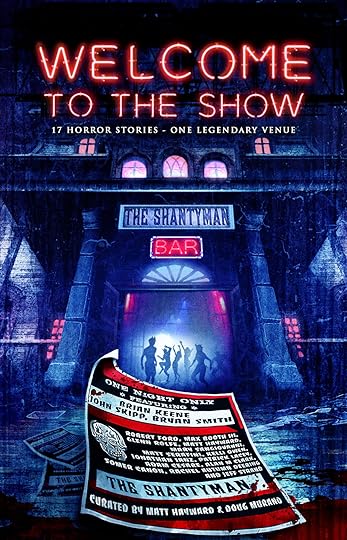
Welcome to the Show: 17 Horror Stories – One Legendary Venue
By Brian Keene, John Skipp, Mary SanGiovanni, Jonathan Janz, Glenn Rolfe, Matt Hayward, Kelli Owen, Jeff Strand, Rachel Autumn Deering, Patrick Lacey, Robert Ford, Max III Booth, Bryan Smith, Matt Serafini, Adam Cesare, Alan M Clark, Somer Canon
My rating: 4 of 5 stars
Although themed anthologies are common in today's publishing, they are, more often than not, focused on a concept or ephemeral idea, like the recent Lost Highways anthology, also from Crystal Lake Publishing, where each story played on the concept of life on the road. Rarer are those anthologies, at least outside of media tie-in properties, where the stories are united by a shared world concept, with the focus aimed toward a singular location. Matt Hayward's Welcome to the Show could have very easily been a basic themed anthology built around the premise of music, and likely that alone would have been a very successful and creative endeavor. Thankfully, Hayward had grander ambitions here, creating his own shared-world property for some of horror's best authors to come in and play.
Welcome to the Show isn't just about the music or the soundtrack of these characters lives. It's about the Shantyman, a dive-bar with a seriously warped history. Over the course of its existence, the Shantyman has been the starting point to some of music's most popular performers. It has also been the site of massacres, suicides, hauntings, and, quite possibly, the apocalypse, depending on which particular reality that world's Shantyman resides in. The Shantyman is, in short, a place of legend.
In this reality, at least, the Shantyman is also a hell of an excuse to show off the horror genre's elasticity and showcase some of the best writers in the business. The table of contents alone is a billet of who's who in horror, presenting veteran authors and younger up-and-comers who have already made impressive names for themselves. Brian Keene, Mary SanGiovanni, John Skipp, Bob Ford, Adam Cesare, Patrick Lacey, Matt Serafini, Glenn Rolfe, Kelli Owen, Jonathan Janz, Somer Canon, Rachel Autumn Deering, Jeff Strand, and more. It's a sheer smorgasbord, an anthology curator's wet dream, of horror writers all sandwiched together between two covers.
Between seventeen authors we get demons, ghosts, vampires, killers, psychopaths, and inter-dimensional Eldritch forces. There's romances and lost loves, time travel, kidnappings, cults, science experiments gone awry, and even a few laughs. Max Booth III opens up the Shantyman's doors for a live podcast show and a discussion about pegging (if you're unfamiliar with pegging, I'd advise you to not Google that at work). Jeff Strand, an author who routinely pens horror stories with a comedic bent, presents one of the most seriously uncomfortable stories about a man who thinks he's funny but isn't. His story, "Parody," is a painful read, akin to watching a highway pile-up in slow motion, as Zany Chester tries to take over the Shantyman's stage and out-do "Weird Al" Yankovic with disastrous, decidedly not zany, results.
Disaster and the Shantyman, unfortunately, go hand in hand. Throughout, characters suffer disasters big and small, personal and otherworldly. Rolfe gives us an encounter with evil in "Master of Beyond," as a few employees use their time off to play with Ouija board, which is, of course, always the best idea ever. Skipp's "In the Winter of No Love" is a fantastically written tale of love, drugs, and rock and roll in the waning days of the 1960's sexual revolution. "Open Mic Night" by Kelli Owen touches on my favorite music topics in her exploration of the 27 Club. The Shantyman is home to curses and cures, oftentimes more one than the other, and sometimes those forces are inextricably entwined as Matt Hayward demonstrates in his "Dark Stage," as the Shantyman's sound engineer is forced to retire from his crippling arthritis.
Over the course of Welcome to the Show, these authors explore the past, present, and future of the Shantyman. Some do their own thing, others build on the works they share space with, but throughout there exists a clear continuity that gives the Shantyman a sense of realness, a sense of history, a depth of existence. Brian Keene encapsulates this beautifully in the final moments of his short story, "Running Free," about a mobster who finds out he has cancer and takes up running, hoping he'll die of a heart attack instead. Even after mankind's experiments with sound and vibrations have accidentally ripped open holes to other dimensions and music has been outlawed, the Shantyman still stands and draws in - or perhaps lures is more apt - those seeking the soulful connection and magic of music. Mary SanGiovanni takes us into the dive bar's near future in "We Sang in Darkness," a story that showcases her strong talents as a Lovecraftian writer.
The Shantyman is real. It exists, because it has been given life by the authors here. Each have conspired to erect this portal through space and time, and they've opened its doors for all to enter, particularly - especially - the unwary and the uncertain. Visiting the Shantyman, you'll find that this establishment's acts are at their best when they quietly sneak up on you and surprise, as Adam Cesare does in "The Southern Thing." As an idea, the Shantyman is certainly one that feels fresh, unique, and wholly welcome, the kind of idea that has so much potential you can't help but want more. I certainly hope the Shantyman's doors haven't been closed quite yet. I'd like to enjoy a few more shows still, and there are a few particular performers I'd love to see showcased in a return engagement. Maybe one day, if the cosmos align just so. For those visiting the Shantyman for the first time, welcome, and enjoy the show.
[Note: I received an advanced copy of this title from the publisher, Crystal Lake Publishing.]
View all my reviews
Review: White Death by Christine Morgan [audiobook]
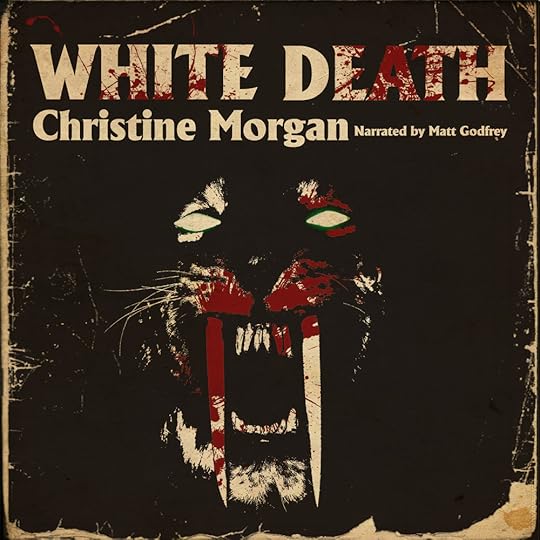
White Death
By Christine Morgan
My rating: 3 of 5 stars
My original WHITE DEATH audiobook review and many others can be found at Audiobook Reviewer.
Few things attract me to a book faster than cover art by the estimable Matthew Revert, the promise of a snowy, frozen terrain, and a wicked creature hellbent on mankind’s destruction. All three of these elements are present and accounted for in Christine Morgan’s White Death, narrated by Matt Godfrey. While there are elements of horror and the supernatural, White Death is primarily a work of historical fiction. What segments of savagery it possesses are primarily due to all-too-human factors, as well as the inhospitable climes of a killer blizzard and a long, cold winter in the Montana Territory, circa 1888.
After Pierre LeCharles’s wife falls sick, the hunter and trapper must seek out the mythical wanageeska in order to cure her. Their violent encounter early on only prompts further revenge as the unnatural wanageeska unleashes a brutal storm upon the men invading its territory, and the settlement of Far Enough soon becomes enshrouded in a blinding blizzard.
The story of LeCharles, his wife Two-Bird, and her father Runninghorse serve as a narrative framing device for the violence inflicted upon the settlers of Far Enough. Morgan gives us plenty of detail on how the men and women settlers fare this Storm of the Century in a story that strikes a powerful chord, and at its heart, this is more than merely a story of man versus the elements. This is a story of American exploration, and even exploitation, as the borders of the US expanded westward and further encroached upon Native land and settlements. The wanageeska may be a monster of myth, but its encounter with LaCharles and the Far Enough settlers serves as a powerful parable of mankind overreaching in its attempts to conquer nature. Nature is violent and toothsome, and more often then not, it can have the last say on who is really at the top of the food-chain. Spoiler alert: it ain’t us!
Morgan’s cast of characters is expansive, and oftentimes unwieldy so. Listening to White Death, I found myself repeatedly questioning who these characters were, if they were being newly introduced or had already been presented, and I simply couldn’t keep track of who was who as Morgan regularly switched up perspectives. I suspect it might be easier to follow such a large group in print, where you can flip back a few pages to refresh your memory. It didn’t help any that the characters are fairly thin in terms of development. They lack any distinguishing features or wow-moments to separate them from the pack, and most of them pretty well blurred together. The main exception was William Thorpe, the founder of Far Enough, who aims to establish the territory as a real town fueled by miners and prospectors rushing for gold and silver in the nearby mountains. Although mighty in his own mind and rich in wealth, Thorpe, too, is no match for the blizzard and the harsh winter alters him ingloriously, frighteningly violent fashion as the weather wears on.
It’s in the details of Far Enough’s settlers braving the grueling arctic snap where White Death is at its strongest. None in Far Enough are free of the wanageeska’s wrath and Morgan skillfully depicts the horrors of being caught in a blizzard, of the human body succumbing to freezing temperatures, frostbite, and fatal cases of hypothermia. While the nature of the wanageeska is mythical, the impact of the arctic horror is utterly real. Several sequences are downright brutal as Morgan describes in unflinching detail the ways in which extreme weather conditions can break down a man, woman, or child, both physically and psychically.
Equally unflinching is Matt Godfrey’s eight-hour narration. Over the course of this past year, Godfrey has become one of my favorite narrators and I trust him to deliver a crisp reading with solid production values. White Death is certainly no exception, and he exhibits a wide range of tones and character voices, hindered only by the large number of characters presented on the page. The overwhelming number of speaking parts eventually blurred together for me, until the majority of characters separated from one another only by gender.
Despite the abundance of characters, the constant rotation through which hindered my attention and made following the various threads of this story difficult in audio form, I did find plenty else to like in White Death. Fueled by Native America myth, Morgan presents a number of sequences of arctic survival horror, giving readers compelling looks at the determination of the human spirit, as well as the fragility of one’s psyche in obscenely pressing trials brought on by extreme weather. White Death may not be a consistently captivating listen, but it is most certainly a fascinating one.
View all my reviews
July 25, 2018
Review: The Smile Factory by Todd Keisling
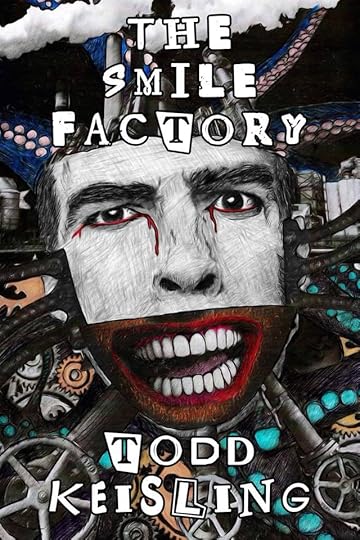
THE SMILE FACTORY (Precipice Chapbook Series 1)
By Todd Keisling
My rating: 4 of 5 stars
Here's a newsflash for you: office jobs are fucking mundane. Day in, day out, almost always the same. Sitting at the same desk, answering phone calls, going to meetings, typing e-mails, dealing with customers with various mental instabilities, psychotic tendencies, and degrees of entitlement, co-workers who drone on and on and on about their vapid, insignificant little lives. Stuck in a dead-end position, toiling away simply to make those stuck in higher positions than yours look good, so they can get raises, a new car, a bigger house, better vacations. And you do it all with a goddamn smile on your face because you have a mortgage, a car note, a family, bills to pay, food to buy. It's all such an endless cycle of monotony, every single day, same as the last, same as the next. Punch in, punch out. Rinse and repeat.
This is, in short, the perfect environment for hell to unfold. Shit, office life is practically a horror story already - trust me, I know. I've worked one kind of dead-end office job or another for almost exactly half my life now. Such dreary day-to-day mundanity is absolutely, positively ripe fodder for the scary books, but not one I see all that often. I know of J.F. Gonzalez's The Corporation (sadly unread at the time of this writing), and I'd be surprised if Bentley Little didn't have at least one book set in this playscape (The Store is the closest I can think of off-hand, with its retail hell setting). There's a few movies, too, like The Belko Experiment and Mayhem. Largely, though, the environs of any given office are far less exciting than zombies or vampiric sexy-times, and office romance or erotica books are a dime a dozen, but the potential for straight-up office horror stories is most certainly there. You could say it's an untapped market.
As a new hire of [REDACTED], you are greeted by the front desk security man who is giving you the inside scoop on legendary office worker, Marty Godot. We don't talk about Marty Godot. His name has been stricken from employee records, and everyone who worked with him, his associates and bosses, have all been promoted and never heard from again. We. Do. Not. Talk. About Marty Godot. You must wear your smiling mask and you must live only to serve [REDACTED]. [REDACTED] is your life now.
Todd Keisling, a writer I would suspect is an office drone simpatico or at least woefully familiar of such a life, recognizes just how much existential terror lives at the core of every office building in America. The Smile Factory, a slim novelette published in chapbook form (and ebook), is easily one of the most scarily honest depictions of office life I've encountered, all wrapped up in a writhing, worm-infested, tentacled snare of cosmic horror.
The Smile Factory is wonderfully satirical, but also deeply honest. A lot of office drones will read this and shrug it off with a chuckle to make themselves feel better, to feel separated from the truths Keisling lays down. Me? This sucker feels awfully fucking familiar on way too many uncomfortable fronts. I've seen too many similar cultish depictions and fetishizations of corporatism to dismiss The Smile Factory as anything other than an accurate and faithful depiction of modern American work-life in all its savagely hostile and soul-sucking underpinnings. Keisling obviously exaggerates things with his Eldritch depictions here, but only just barely.
The Smile Factory is a super quick read, only about thirty pages, so short enough to read over a lunch break presuming you are allowed to detach yourself from your terminal and find that your eyes aren't bleeding too profusely from a day of idly staring at a computer screen. Depending on how much you love your office life, though, reading this on your break will either help you crumble into despair or remind you to keep smiling and let your misery feed the world. Either way, it's a damn enjoyable read. Just remember two things.
Keep smiling.
Don't ask about Marty Godot.
View all my reviews
July 24, 2018
Review: The Siren and The Specter by Jonathan Janz
The Siren and The Specter (Fiction without Frontiers)
By Jonathan Janz
My rating: 5 of 5 stars
I've been anticipating the launch of Flame Tree Press for a good while now, not least of which because it meant brand new books from Jonathan Janz and Hunter Shea. Both authors launched their careers at the now-ancient history Samhain Publishing, and while both have found publishers elsewhere since that publisher's collapse in 2016, it feels good to have them reunited beneath a common imprint and the guiding hand of editor Don D'Auria. I've been waiting for a new Janz novel ever since finishing Exorcist Falls early last year, so turning toward The Siren and The Specter as my inaugural read of Flame Tree Press was a no-brainer.
As expected, Janz delivers a fun, gruesome, and highly compelling read that happily kept me up past my bed-time on a few occasions because I absolutely had to know what would happen next. This is a good and true "just one more chapter!" kind of read.
Noted skeptic and supernatural debunker David Caine is invited by an old college buddy to stay for a time in the Alexander House, the most haunted house in all of Virginia. Built in the 1700s, its owner, Judson Alexander, was the worst sort of man, one who held the village around the Rappahannock River in an iron fist, raping and killing at a whim. His house was a source of bloodshed and torture for a number of those villagers, the land tainted forever. David rightfully expects the urban legends surrounding the Alexander House to be rubbish, but even he can't deny the quiet ache of his own personal losses that being back by the Rappahannock causes. As events unfold, David's skepticism is put to the test and soon enough the Rappahannock will run red with blood.
The Siren and The Specter has a lot going for it. As the title indicates, you get not one, but two - two! - supernatural entities to torment our lead protagonist. You also get a fair amount of carnage, a host of depraved sex acts, and a number of ghostly encounters that will make the hair on the back of your neck stand on end. One of the best parts, though, was the sense of history Janz imbues the Alexander House and its surrounding region with, a history that is deeply personal to David and the peninsula where this book is set. The country is young, but the land is old, and the pre-colonial mythology surrounding the titular siren was a welcome counterpoint to the horrors inflicted by Alexander upon his neighbors. What struck me most, though, was the historical interplay between the siren and the specter themselves. Although these are two distinct entities in the mythology of the Rappahannock, both are fueled at opposite ends of the spectrum in terms of both their gender and their bloodlust, one a victim and the other a victimizer. Janz slowly reveals the stories of each in highly compelling ways, using the dual spirits to illustrate mankind's proclivity toward wrath, cruelty, and the possession of others.
I'll confess that on first blush, I wasn't entirely sold on the siren's involvement in terms of this book's plot. Initially, it felt like a bit of unnecessary overreach, even a minor element that could have been cut without any detriment to the work. After some consideration, though, I find myself appreciating the thematic importance of the siren more and more, and the things she represents for David as he is forced to reconsider his skepticism toward the supernatural. There's a strong sense of duality at play in this book, and as a figure herself the siren is emblematic of several things in terms of both plot and character. The Siren and the Specter is very firmly rooted in the Gothic tradition, which demands readers to use their imagination, suspend their disbelief, and accept that there are more mysteries in this world than we can possibly understand. Judson Alexander is the most in-your-face mystery that both David and the reader must confront, but Janz asks us to accept just a little bit more than that as we carry along, challenging us to confront our own skepticism alongside David and accept some additional horrors and wonders beyond Alexander. Both are integral to David and his personal evolution during his stay on the peninsula. And after all, if we can accept the specter, why not the siren?
While there are plenty of Gothic traditions on display here - the fallen hero, death and romance, loss and terror, an emphasis on sexuality, dashes of political violence, an atmosphere of dread, a focus on the architecture of the Alexander House - in the end, it's this broadening of imagination that proves most fascinating and compelling. In fact, there's a lot about The Siren and The Specter that fascinates, from the character dynamics and their relationships to Alexander, the perversions of the Shelby family, David's struggles to be a better man and the appreciable easiness of those around him to call him out on his foolishness, and, of course, Janz's flair for violence. Janz is not the type of author who gets squeamish writing about blood and guts, and he clearly enjoys splashing around in gore with all the delight of a mad sadist. This is a big win for horror fans, and even when you know certain macabre acts are just a page away, he still manages to pull off a few surprises in each of the big reveals.
It's clear why Flame Tree Press chose The Siren and The Specter as one of their launch titles, and it's a delicious springboard into this new imprint. I suspect this book will also (rightfully) earn Janz a legion of new and devoted readers, readers who will enjoy sinking their teeth into the author's considerable back-list, which will be republished by Flame Tree Press over the remainder of 2018 and well into 2019. Introducing an imprint, and even to a certain degree reintroducing an already established author, with a work of Gothic horror like The Siren and The Specter is a smart move, and one that instills a lot of confidence in this new brand. Get ready to expand your imagination.
[Note: I received an advance reader copy of The Siren and The Specter from Flame Tree Press.]
View all my reviews
July 20, 2018
Review: Lost Highways: Dark Fictions From the Road, edited by D. Alexander Ward
Lost Highways: Dark Fictions From the Road
By Rio Youers, Joe R. Lansdale, Josh Malerman, Damien Angelica Walters, Jonathan Janz, Rachel Autumn Deering, Matt Hayward, Kristi DeMeester, Bracken MacLeod, Jess Landry, Michael Bailey, Richard Thomas, Doungjai Gam, Ed Kurtz, Robert Ford, Lisa Kröger, Orrin Grey, Kelli Owen, Nick Kolakowski, Cullen Bunn, Christopher Buehlman
My rating: 4 of 5 stars
Traveling long stretches of a dark highway it's easy to imagine the horrors lurking in the dark, some of them all too real. Drunk drivers, car crashes, vehicles flipping and sliding along the asphalt, glass breaking and sparks flying as metal meets road and the smell of gasoline perfumes the air. The black hidden world beyond the lane markers and past the guardrails is more ephemeral, the secrets hiding just past the road darker and wilder.
In Lost Highways: Dark Fictions From the Road, D. Alexander Ward has compiled fresh writings from more than twenty authors (only two are reprints, Joe R. Lansdale's "Not From Detroit" and Rio Youers' "The Widow") who have reached into the darkness of the highway, a darkness that travels upon the road beside you, or maybe follows behind you just a bit too close for comfort, or hides just off the exit or in the woods beyond the stretch of road, hoping for some unsuspecting soon-to-be victim to come their way.
Two writers, doungjai gam (writing with Ed Kurtz) and Jess Landry, managing editor of JournalStone, make their fiction debuts with "Crossroads of Opportunity" and "The Heart Stops at the End of Laurel Lane," respectively. Both deal with elements of personal loss, tragedy, death, madness, and the ghosts we carry with us in wildly different ways. These themes occur time and time again throughout Lost Highways, with veteran writers like Joe R. Lansdale and Christopher Buehlman tackling similar concepts of death and the carriage he rides in that could not have been handled in ways more different than here.
Throughout Lost Highways there exists certain plays on a theme, particular notes that are reinforced thanks to Ward's organization of these stories, and elements that are echoed in various and striking ways across the book. Yes, there are stories of cannibals and killers, of urban legends and people grappling with madness, but it's the overwhelming amount of heart that resonates and overlaps the stories here, creating miniature story arcs of emotion that are strengthened or that chafe against one another.
Kristi DeMeester's "A Life That is Not Mine" is an excellent story of madness, but it's all the things that aren't on the page that ring the most true and provide a powerful examination of depression and self-destruction. Schoolteacher Hannah has forgotten what morning looks like, all the light in her life having left. She lives a solitary existence in the dark, one with no happiness, no joy, only drudgery and an escalating insanity. "The Widow" by Rio Youers takes a similar tack, but one that is strikingly different as his protagonist, Faye, grapples with the roadside death of her husband and stumbles upon a centuries old supernatural mystery while those around her constantly worry about the state of her mental health.
Michael Bailey's "The Long White Line" is an exquisite paradox of a story, albeit one with a very simple premise. Still, it's difficult to discuss without veering sharply into spoiler territory and revealing the catch. This one is all about the concept, and it's the stuff of urban legend. Kelli Owen sharpens her blade with her own bit of urban legend involving a small, sleepy town past a Northern Michigan highway exit in "Jim's Meats." Owen hit a lot of sweet spots for me with her story of a wrong turn gone seriously awry, and one character's early mention of the film Deliverance provides a glimpse of where things are headed. I love these types of B-movie pulps, and Owen delivered one of my favorite stories in Lost Highways. Speaking of movies, it feels safe to say that Matt Hayward found some inspiration from John Carpenter and Stephen King with his story of a roving fog that demands the worst memories of those that drive through it. "Where the Wild Winds Blow" ends on a satisfying note that makes one's imagination run wild at the prospect of what comes next, and I certainly wouldn't mind it if Hayward opted to explore this story further somewhere down the road.
Lost Highways is also notable, at least for me, in presenting a return to prose fiction from Rachel Autumn Deering, who depicts one of the most honest stories of heartbreak I can recall, in "Dew Upon the Wing." I was a fan of Deering's 2016 debut novella, Husk, so it was terrific to find her traveling the dark passages of Lost Highways. Of particular note, too, is Cullen Bunn, a scribe best known for his work in comic books, particularly his Bram Stoker Award-nominated Harrow County, whose "Outrunning the End" makes a nicely apocalyptic short story involving a man on the run, chased by demons both personal and otherwise.
At its best, Lost Highways presents some truly engaging, mysterious, and unique stories to captivate. At its worst...well, frankly, there isn't really a worst to be had here. Lost Highways is the rare anthology that even when it's not running hot with its pedal to the metal, it's still pretty damn good. With a line-up that includes a number of outstanding authors, like Jonathan Janz, Bracken McLeod, and Damian Angelica Walters, and a number of strong works from its lesser-known and debut contributors, it's truly hard to go wrong.
Lost Highways offers a number of trips, and more than a few satisfying detours, across the nation's highways and byways that you'd be remiss not to take. Just make sure you've got enough fuel in the tank - you don't want to have stop at some small Podunk gas station late at night in a place you've never heard of, or stall out alongside the road, your cell phone's signal mysteriously lost, with no help in sight. You don't know what's out there...lurking...waiting...and thirsting for blood.
[Note: I received an advance copy of Lost Highways: Dark Fictions From the Road from Crystal Lake Publishing.]
View all my reviews
July 15, 2018
Review: Practitioners by Matt Hayward and Patrick Lacey
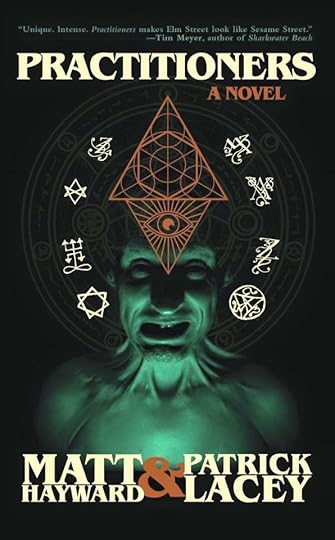
Practitioners
By Matt Hayward, Patrick Lacey
My rating: 5 of 5 stars
Authors Matt Hayward and Patrick Lacey inject fresh life and more than a few sparks of originality into some familiar and well-worn tropes in Practitioners from Bloodshot Books, genre-hopping with apparent ease to flesh out a novel that feels like a dream come true.
On the trope side of things, we have police officer, Henry Stapleton, who is reeling from the death of his wife and is fueled by revenge. Thankfully, Hayward and Lacey upend our familiarity with such a heavily trod character almost immediately. Stapleton, it turns out, is completely off his rocker and his vivid recollections of finding and torturing his wife's killer are psychotic breaks with reality. What's more, he's having waking dreams that lead him to a spate of fresh corpses. His attempts to control his lucid dreaming send him even deeper down the rabbit hole, straight into a paranoid nightmare that could reshape and destroy reality.
Practitioners is a novel all about escalation. The more things Stapleton tries to fix, the worse things get. While Hayward and Lacey embrace the initial noir aspects of their pseudo-cop drama, their story stretches beyond any one genre, preferring to take an everything but the kitchen sink approach. Equal parts cop shop, horror, and fantasy, Practitioners is a hefty blend of cross-genre scares that admirably chugs along without losing sight of its cataclysmic destination.
Stapleton's journey from police officer to dream warrior comes off far more plausible than it should, which is a credit to how well the author's have constructed this story. It helps that Stapleton is initially presented as a bit of a suspect character and we're never quite sure how crazy grief has made him. Hayward and Lacey slowly weave in the supernatural elements, giving us small doses that are just enough to jilt expectations, while embellishing Stapleton's waking-world life with enough paranoia, New Age mysticism, and investigative do-right to prepare us for the headlong dive into madness. This is a book that starts off small and personal and blows up in a wildly cataclysmic and bloody climax that presents a war on two different fronts of consciousness.
It's heady stuff to be sure, but the authors make it all look disconcertingly easy. Practitioners is a highly successful collaboration and the styles of Dublin-based Hayward and Massachusetts-native Lacey mesh seamlessly. I didn't notice any peculiarities in syntax, cultural oddities, or awkward turns of phrase that occasionally occur between authors writing together from opposite sides of the pond.
If I must voice one complaint, though, it's that the various dreams and dream worlds Stapleton journeys through never quite felt strange enough for me. Through it all, there's a certain linearity and even almost-normalcy to it, despite even the occasional appearance of strange creatures. While there's a healthy dose of oddity to the surrounding events that prompt Stapleton to travel between his neighbor's dreams, I wish some of the dream states he found himself in were even more unusual. More often than not, the authors rely on presenting dreams that are either alternate realities where the dreamer engages in particular sexual fetishes or the book's setting of Bellville is depicted as an apocalyptic wasteland. While this latter depiction of Bellville is well-rendered, I could have done with a bit more variety in the various dreamy landscapes. It is also possible I'm simply too inured to stories of my wife's crazy dreams.
While I loved Practitioners and its pulp-noir and chaotic creature-feature sensibilities, few things within Stapleton's lucid dreams are as weird as my darling wife's dreams after she's had Chinese food. This is perhaps too high a bar to set, though, as even the most wildly inventive and creative writer would have a tough time competing with some of my wife's doozies in dreamland. Personally, it's rare that I even remember any of my own dreams, so it's entirely possible my wife is just weird and Practitioners depictions of dream-life are more common and realistic than my spouse's anecdotes would lead me to believe. So, as far as complaints go, this one is certainly nothing to lose sleep over.
Hayward and Lacey pack in enough freshness and a few honestly earned surprises to make Practitioners a book I can easily recommend. It really did hit all the right buttons for me between its awesomely designed cover by Rachel Autumn Deering, and a highly cool concept and well articulated vision from the authors, one that exists on multiple planes of reality and features some neat-o fantasyland magic and killer monsters. I mean, who doesn't love killer monsters?
[Note: I received an advanced review copy of this title from the author.]
View all my reviews
July 12, 2018
Review: The Switch House by Tim Meyer
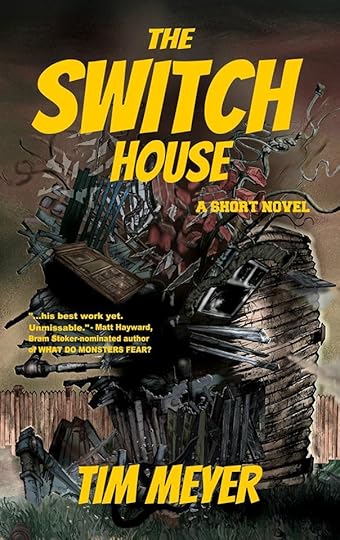
My rating: 5 of 5 stars
I try to approach each book I read with an open mind, but with the hopeful expectation that it will, at the very least, be a decent read. I want to let the author do their thing and then judge for myself how well their story worked for me. Overall, I think I'm pretty good about selecting titles that should work for me based on their synopsis. Sometimes I'm disappointed, sometimes I'm pleased. The best, though, is to discover a work, particularly from a new-to-me author, that proves itself to be positively exceptional.
The Switch House is a slim novel that absolutely rocks right from the get-go, firing on all cylinders the whole way through, catapulting readers from one crazy violent encounter to the next. Tim Meyer takes a no-holds-barred approached to the scenes of bloody mayhem, and there were a few impactful moments that made me wince. He also proves strikingly adept at crafting psychological horror, and one big reveal in the book's climax wrung me dry, my heart lurching as I mentally screamed "HOW COULD YOU?" at one character.
Meyer uses tragedy as the framework here, building his house of horrors around it, revealing additional levels of complexity with each chapter. Bereft over the loss of their child, Angela and Terry sought an escape from their normal lives by auditioning for, and winning a spot in, the reality show, Let's Switch Houses! Returning to their normal lives isn't easy for Angela, especially after she spots a hole in the bathroom wall that peers into...well, elsewhere. She begins having vivid nightmares, realizing that whoever lived in their home during the swap did some very dark things there.
There's so much I want to say about this book, but I fear that so much of it would dive headlong into spoiler territory. I will say that The Switch House is twisty as all get-out, and is the kind of read that will have you questioning the reality of the events and the characters depicted here. I found myself flip-flopping a few times on whether or not Meyer intended this to be a straightforward narrative and on the reliability of Angela's viewpoints. I think I have my answer, but I suspect yours may be quite different.
Despite its short page count, there's an awful lot to digest here. The Switch House is slim in pages, but filled to the brim with concepts and ideas. Meyer pulls in cosmic horror, psychological horror, chaotic and frightening depictions of hell, plenty of paranoia, and bucketfuls of bloody mayhem. It's a rare thing indeed when I finish a book's prologue and already find myself questioning whatever life choices I've made that I'm only just now discovering Tim fucking Meyer. How the hell have I not read this guy before? That's gonna change real fast, I can tell you that right now.
[Note: I received an advance reader's copy of this title for review.]
View all my reviews