Michael Patrick Hicks's Blog, page 11
September 1, 2018
Review: Patient Zero (Joe Ledger, Book 1) by Jonathan Maberry
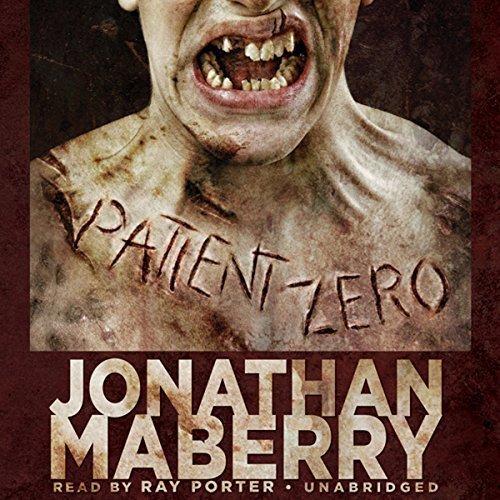
Patient Zero: A Joe Ledger Novel
By Jonathan Maberry
My rating: 5 of 5 stars
I've been meaning to read Jonathan Maberry's Joe Ledger series for a number of years now. Having finally dived into Patient Zero, the first Ledger book, I'm immediately left kicking myself 1) for having waited so long, and 2) because now I have a dozen audiobooks between the core Ledger series, short story collections, and an anthology book involving Maberry's creation that I must proceed to binge posthaste.
Imagine 24 with zombies and you have a very basic understanding of Patient Zero's framework. Joe Ledger is an action hero in the Jack Bauer mold, or maybe John McClane is a more apt comparison given Ledger's tendency to crack wise and spurn authority, up against a ticking clock and a seemingly endless supply of terrorists to confront and kill. What could have been your by-the-book post-9/11 military thriller, though, is elevated to a whole other higher level of bad-assery by a wonderful mixing and intermingling of various other genres.
Maberry introduces us to the Department of Military Sciences (DMS) in a book that leans heavily on its genre tropes but succeeds in making them feel if not entirely original than at least fresh, comfortably familiar, and welcome. Riding high on the success of 9/11, a band of Middle Eastern terror cells within the US are preparing to launch a biological weapons attack that will introduce an unstoppable plague and destroy America. If not for the welcome injection of plenty of high-tech wizardry and terrific horror-based set pieces, Patient Zero could have been just another Vince Flynn clone. Instead, Maberry takes the military technothriller and turns it sideways by forcing a team of special ops point-men (and -women) to confront a horror genre staple. The bioweapon isn't just your run of the mill plague virus, like Ebola, but a genetically engineered plague that can spark a zombie outbreak.
To put it simply, Patient Zero is freaking awesome, and the premise behind it is brilliant. Maberry's taken two of my favorite genres - military technothrillers and horror - and smashed them together into a wonderful, perfectly formed hybrid. This sucker is practically non-stop action; a mid-point set-piece at a warehouse is deliriously violent and intensely claustrophobic, and the story is routinely punctuated with gunplay and fisticuffs galore. In addition to all the brawn and bravura there's a whole lot of brains - and not just the zombie food stuff! Maberry takes the zombie genre and explores it from an honest-to-goodness real world basis. What are the military tactics that would be used to confront such an outbreak? The forensics? The actual science? We spend a lot of time in the field with Ledger and his crew of Echo Team, but Maberry doesn't shy away from all the lab work and biochemistry that goes into giving Patient Zero a grounded, realistic edge to make it all scarily plausible.
It's clear a helluva lot of thought and research went into making Patient Zero a credible thriller, one that's as high in science and combat acumen as it is in horror. Making it even better, though, is Ray Porter's narration. This is my first Porter audiobook, and his reading here is impactful enough to have sold me on the rest of the Ledger series in audio format. This dude is an outstanding narrator and Patient Zero showcases his versatility marvelously. He can really sell the rapid-fire action but it’s in the deeply emotional moments of combat and the resultant fallout from the darker corners of zombie violence Maberry writes where Porter truly shines. He’s incredible to listen to! Porter draws you in with subtlety, gets your blood pumping at the intense highs of a grueling action sequence, and then emotionally devastates you with a perfectly delivered line. He's a seriously phenomenal talent, and in Joe Ledger Maberry writes a multidimensional hero that allows Porter to give a nuanced and multi-layered performance.
Ledger is a smart-ass tough guy, but one who also possesses a highly welcome degree of self-awareness. He understands his propensity for violence and the consequences of his anger. The dude is blessedly in touch with his feelings, something more of our masculine action heroes could do with, and not only regularly meets with his therapist, Rudy Sanchez, but is freaking best friends with the guy! He even encourages the testosterone-laden boys of Echo Team to consult with Rudy and emotionally unload after some particularly nasty encounters. It's absolutely wonderful to see such a positive portrayal of mental health and from an alpha male hero no less. Fantastic work, Mr. Maberry (and thank you).
Patient Zero hit all the right notes for me the whole way through (although I do have some questions about Ledger's military history, which I suspect runs a bit deeper and blacker than is alleged here, but only time will tell), and I positively love the horrifying spin Maberry has given the military thriller. I mean, Jack Ryan and Mitch Rapp are great and all, but they ain't fighting zombies, so Ledger is already at least one step up from those guys. Maberry very well may have just ruined Tom Clancy and Vince Flynn for me in one fell swoop, in fact (but again, only time will tell there, too).
View all my reviews


August 26, 2018
The Horror Book Review Digest: A New Compilation
I've been reading reviews ever since I was kid, primarily film reviews, and writing my own reviews for nearly a decade now, initially as a freelance writer and, later, for my own entertainment. Back in 2010, I began writing reviews of comic book trade collections and graphic novels for Graphic Novel Reporter, before I decided to switch over to writing primarily for own blog and the occasional audiobook review for the Audiobook Reviewer website.
I've always been a fan of reviews and there are a few reviewers I follow religiously, like horror film critic Scott Weinberg, book reviewer Char at Char's Horror Corner, and Sadie Hartmann, aka Mother Horror, who writes for Scream Magazine and Cemetery Dance, to name but a few. Growing up, I was always sure to watch Siskel and Ebert At the Movies, and every Friday morning I was the first one in our house to tear the newspaper apart to get to the Entertainment column for the new movie review columns. I've always loved reading, writing, and movies, and if I could distill all three into one single job I'd have my dream career. Unfortunately, making a living as a critic isn't so easy nowadays, and I've had to forego a professional platform in favor of my own.
However, after reading a bit of Weinberg's independently published compilation of his horror film reviews in MODERN HORRORS: An A to Z of Horror Movie Reviews, I decided to try my own hand at it, but with the focus being exclusively on horror books.
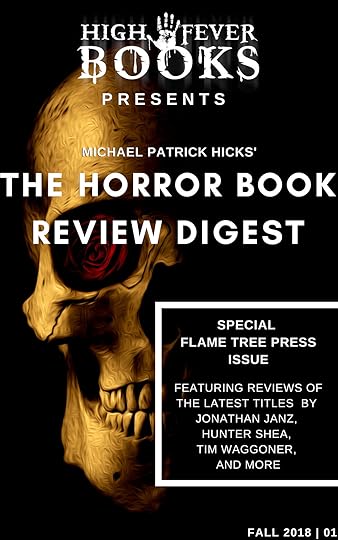
The Horror Book Review Digest is intended to be a quarterly compilation collecting the book reviews I've published here and elsewhere. The bulk of the reviews are centered on recently released and upcoming titles from Big 5 publishers, small presses, and independent authors and publishers, as well as the occasional older title or classic work in the horror genre. Much of this first volume of The Horror Book Review Digest is devoted to 2018 releases, including upcoming titles from Flame Tree Press and Fangoria Presents, two new imprints launching in September.
At only $2.99, purchasing The Horror Book Review Digest is a cheap way for you to show your support for the work I do at this site and for my publishing efforts in general. It's a handy, easily-accessible guide for the latest horror reads, with reviews organized in alphabetical order by author. And yes, each of these reviews are readily available on this site and external sites for free.
Is this a good idea? Frankly, I don't know. I don't know if there's a market for this type of material to begin with, or if people feel my reviews are sufficiently well-written enough to pay me for my time and effort. The Horror Book Review Digest is, first and foremost, an experiment. Maybe it'll succeed, maybe it'll fail. I don't know.
Back in July I ran a Twitter poll that netted some very limited responses, but the results indicated there was a measure of support for this initiative. I also posted a question asking if there was any interest on Facebook, and also as an Instagram story, and again the feedback to both was largely positive. Positive enough, anyway, to convince me it was worth a shot. Now it's time to put those minor bits of market research to the test.
I'm hoping and planning to release a few more volumes like this over the course of 2019 but it all depends on how well this initial book sells, if there's any enthusiasm for this kind of release, and what kind of response I get now that The Horror Book Review Digest is out in the wild. You can buy it right now at the following retailers (iBooks link coming soon!).
Amazon | iBooks | Nook | KoboGoogle Play | SmashwordsAugust 25, 2018
Review: The Devil's Fingers by Hunter Shea
The Devil's Fingers (Hunter Shea: One Size Eats All)
By Hunter Shea
My rating: 5 of 5 stars
Rounding out Hunter Shea's trilogy of One Size Eats All novellas is The Devil's Fingers, a story of fungus getting freaky in wonderfully grotesque ways. The primary theme of this trilogy has been mankind struggling to survive against some particularly vicious assaults from Mother Nature, and Shea goes all out in this third entry with some wild and gory set pieces.
Native to Australia, Clathrus archeri, aka the devil's fingers, is a highly exotic fungus that looks like something out of H.P. Lovecraft's wet dreams. Upon reaching maturation, bright red tentacles burst out of an egg, covered in dark green slime. They smell like a rotting corpse, the perfect odor to lure in flies to carry off fungal spores so that the devil's fingers can reach ever and ever farther.
When a group of hikers stumbles across a mutant strain of Clathrus archeri deep in the woods of Washington, the plan to spread the ashes of one of their companion's recently deceased father becomes an insane battle for survival.
Shea wastes no time getting straight to the creepy point as the hikers become infected and rapidly fall victim to the devil's fingers, pushing each of them to the brink of both mental and physical collapse, straining their bonds, and driving them ever deeper into a hellacious nightmare scenario.
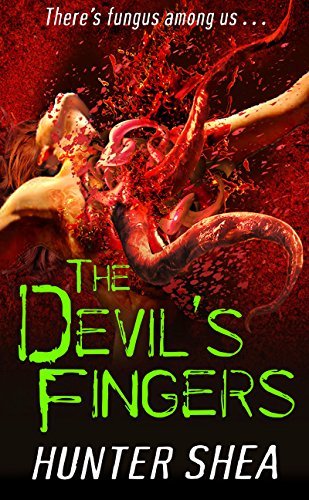
The Devil's Fingers gorgeous cover immediately sets one's expectations for the story within, and Shea delivers an almost pitch-perfect round of craziness, and the strongest entry in the One Size Eats All series. The plot and characters are a bit flimsy, and there are maybe one or two more names bandied about than there needs to be given their thin development and the short page count, but it's an minor complaint since most of these people exist solely to become fungus fodder. And sweet, stinky, glorious fodder they are!
Take another look at this book's cover because what you see is what you get. If you like that image of ornery tentacles bursting out of some rando's torso, then you're gonna love this one. Me, I'm a sucker for this type of story. A group stuck in the woods, cut off from civilization, stumbling upon their own brutal, insane deaths? Count me in! Make their means of destruction something natural, like a plant or fungus, and you've got me by my wallet for sure. Hunter Shea is one of the most consistently reliable writers of fun creature-feature horror, and he delivered exactly what I wanted in The Devil's Fingers - ruthless natural horror, a high body count that never skimps on the gore, and an overriding sense of hopelessness balanced against man's indomitable fight for survival no matter the odds. Lean and mean, The Devil's Fingers held me tight in its grip the whole way through.
[Note: I received an advanced reading copy of this title from the publisher, Kensington, via NetGalley.]
View all my reviews
August 23, 2018
Review: Our Lady of the Inferno by Preston Fassel
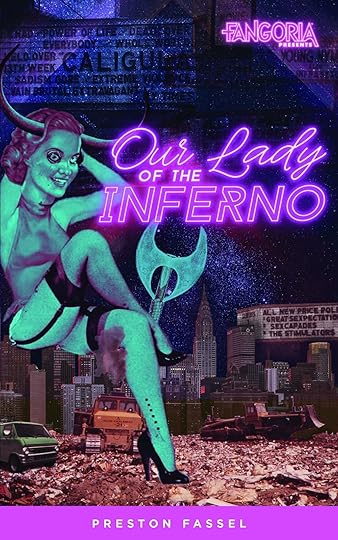
Our Lady of the Inferno
By Preston Fassel
My rating: 5 of 5 stars
Following the death and subsequent resurrection of horror film magazine Fangoria by the Dallas-based entertainment firm Cinestate, it was announced that not only was the magazine returning to print as a quarterly publication, but that Fangoria was to become a media franchise all its own. Under new ownership, the brand is to branch out into podcasts, film production (it's first film in this new role, Puppet Master: The Littlest Reich premiered recently on VOD and with a limited theatrical run), and book publishing. The first book to see print under the Fangoria Presents banner is Preston Fassel's Our Lady of the Inferno, a 1983 New York serial killer thriller.
A Houston-based author, Fassel has written for Scream Magazine, Rue Morgue, and will be a staff writer for Fangoria when the magazine relaunches in October. Although he is a Texas native, Fassel convincingly brings to life the grime and squalor of early-80s Manhattan and the red light district of 42nd Street, an area known as The Deuce. Our Lady of the Inferno captures the seediness of Time Square prior to the area's revitalization and rehabilitation as a tourist-friendly destination, giving readers front-row seats in run-down theaters playing second-rate horror flicks where prostitutes trade blowjobs for quick cash, to the graffiti tagged hallways of the Motel Misanthrope where heroine junkies shoot up in the stairwells and the daytime streetwalkers of 42nd live, breathe, and work.
Damn never every single page of Our Lady of the Inferno radiates a seedy grittiness of the era, so much so one might be inclined to check for an STD on the off-chance you've caught something simply from reading this book. This sucker bleeds atmosphere, but it also has a surprising bit of heart at its dark core.
In a book involving prostitutes and a psychotic, religiously-motivated serial killer, it would have been all too easy to write a story that was all sex and violence, with various bodily fluids soaking these pages from one deviant act after another. And while there's a fair amount of dirtiness herein, much of that comes from how realistically Fassel has written this by-gone period of New York history. Rather than focusing primarily on the titillating, Fassel instead leans hard into the characters, sparing readers the violence and carnage for the vast majority of this title's page count (but make no mistake, when the story does take a turn for the violent, it does so with remarkable brutality).
Our Lady of the Inferno is a slow-burn, ultra-methodical study of its lead women. Ginny Kurva is a prostitute, yes, but that's hardly the be-all, end-all to her existence. Nicolette Aster is a vicious and insane killer, but the degrees of her mental instability are striking. Fassel presents each of these women and then slowly, piece by piece, deconstructs them to show us what makes them tick, revealing all their various facets, their virtues and their flaws, and most certainly their sins.
Ginny trades her body for money, but she's far from the stereotypical portrayal of a New York whore. She's got smarts from both the streets and her years in college. She loves movies and books, and prizes education in both herself and others. She's hardly the Hollywood-standard hooker with a heart of gold, though; she's manipulative, and when angry her rage burns with a red-hot intensity. Prepared for any potential violence that may flare up without warning, she is both victim and victimizer, but through it all there runs a strong undercurrent of empowerment for both herself and for the other women in her life.
A similar vein of empowerment is at the core of Nicolette, as well, and it's striking the ways in which she acts as a mirror image to Ginny. If Ginny owns the day, then the night belongs to Nicolette. And while Ginny attempts to improve the lives of her fellow prostitutes, Nicolette is hellbent on destroying them, hunting them down and carving them apart, limb from limb, joint by joint. That these two women are on a collision course is a no-brainer, but Fassel spends so much time studying each of them, building them up, that by the time they meet head-on you fully understand how much is at stake and what each of them has to live, or die, for.
I will admit, I was fairly surprised by Our Lady of the Inferno; Fassel delivered a story that was a great deal different than I had expected, particularly given the Fangoria branding. I was expecting something much more rapid-fire, chock full of gore and violence and sex, and while each of those do appear in fair doses throughout, I was initially caught a bit off-guard by the focus and commitment to characters. Our Lady of the Inferno is not a piece of disposable slasher horror, or a check-your-brain-at-the-door riff on B-movie pulps. Possessing an intriguing amount of literary depth, it's far smarter than that, and far more astute in its capturing and subsequent rendering of a specific time and place and the characters that inhabit it. Fassel presents several moments of fascinating horror, but its the long and extended moments of quietude, the moments of heart and fellowship and the struggles of daily living, and the amount of research that clearly went into giving this labor of love its necessary and invaluable credibility, that truly make it something special and unique. Our Lady of the Inferno is not simply about the horrors of a meeting a deranged killer in a dark alley, but about the horrors of life itself, the horrors of personal inner-demons, the horrors of the day to day that each of us burn alive in.
[Note: I received an advance reading copy of this title from the publisher, Fangoria.]
View all my reviews
August 20, 2018
Movie Review: Puppet Master: The Littlest Reich
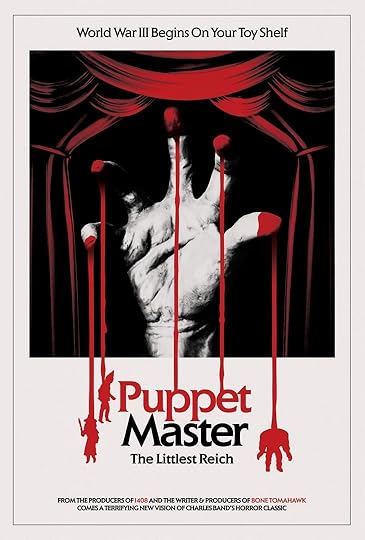
Puppet Master: The Littlest Reich (4K UHD) [Blu-ray]
Starring Michael Pare;Udo Kier;Barbara Crampton;Thomas Lennon;Jenny Pellicer;Nelson Franklin;Charlyne Yi
This past Friday, horror film magazine Fangoria made its cinematic debut, ahead of its return to print in October, as one of the producers of Puppet Master: The Littlest Reich. Launching with a limited theatrical release and wider distribution for rent or purchase on VOD platforms, the release encountered one significant SNAFU as etailer giant Amazon released the title for purchase for only 99 cents through its streaming video service.
Written by S. Craigh Zahler, The Littlest Reich takes the concept and characters originated by Charles Band over the course of the franchise's prior twelve installments and reboots the story, making this entry the perfect starting point for newcomers. Although I'd been aware of the Puppet Master movies for a good, long while now, I'd never actually seen one. Having Zahler on screenwriting duties was enough to pique my interest though. I loved his horror-western flick Bone Tomahawk, which he wrote and directed, and tapping him to write a movie about maniacal killer puppets was a guaranteed way to get my butt in a seat to watch this. Amazon's screw-up only helped to ensure I was absolutely going to watch it.
Puppet Master: The Littlest Reich is a thinly plotted, low budget gorefest that eschews deep and meaningful characterizations in favor of brutal kills and a few doses of T&A. It's also one of the most entertaining diversions I've ever spent 99 cents on, and I can happily say I got my money's worth. This is a fun, silly, utterly ridiculous bit of pulpy midnight theater.
After crossing paths with Andre Toulon, a Nazi who escaped to America, a lesbian couple is savagely murdered by possessed dolls. The responding officers track the killers to Toulon's mansion (exactly how they deduced that puppet maker Toulon was behind the murder is something the script skirts by in order to get to the action) and kill him. Thirty years later, in the present-day, Toulon's mansion has become a museum exhibit and an auction of his belongings are slated for that weekend. Edgar (Thomas Lennon), a comic book writer and artist, lost his brother to mysterious circumstances as a child, and hopes to sell his Toulon puppet for some quick cash. Tagging along for the weekend getaway are his new girlfriend, Ashley (Jenny Pellicer), and pal Markowitz (Nelson Franklin). The gang checks into a hotel stocked with a number of guests, many of whom are also looking to auction their puppets.
It's a simple set-up, and the hotel setting gives us plenty of potential victims, many of whom were unwittingly thoughtful enough to bring their own reanimating object of demise. Once the guests are all checked in and we're given enough background on Toulon's hard-core Nazism and occult tendencies (we're also given Toulon's backstory during the movie's opening credit sequence, told in colorfully comic book-like fashion that's totally aces) by the mansion's tour guide, played by Scream Queen Barbara Crampton, we're off to the races.
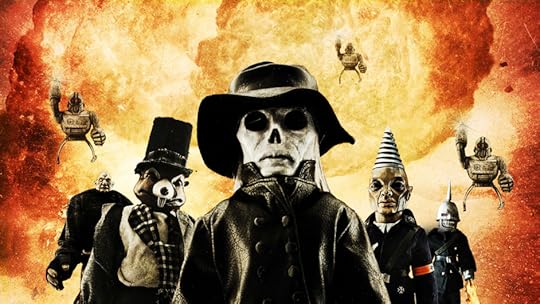
Source: IMDB
The Littlest Reich is cheaply made, but whatever money went into the production is readily apparent in the buckets of blood decorating the hotel sets and just about every single cast member along the way. The practical effects are lovingly done, sparing not an ounce of squirm-inducing gore to bring the creative kills to life. While it's easy to spot the mannequin stand-ins on occasion, odds are you'll be too entertained to care about some of the movie's chintzier moments, which the film more than makes up for with sheer outrageousness. The killer Nazi puppets are brought to life through stop-motion, and are wholly unsympathetic antagonists in possession of a singular goal: kill everyone.
It's a sad fact of life that in modern America, Nazis are seemingly everywhere - they're in the White House, they're running for Congress and local government seats, they're marching outside WorldCon 76, they're holding rallies all over the place. The Littlest Reich is, if nothing else, certainly timely (there's even an amphibian puppet that seems a clear nod to the alt-right's hate symbol of Pepe the Frog) and none are safe. Zahler, and directors Sonny Laguna and Tommy Wiklund, check all the potential victim boxes - gays, blacks, Jews, Asians, a gypsy, men, women, and children all serve as fodder for Toulon's puppets, who drill their way through walls and ceilings, fly through windows, and race down hallways to bludgeon, beat, stab, and set aflame their victims. None are safe, few are spared, and it's fun to see these little Nazi bastards get their comeuppance in a few welcome scenes of just desserts during the flick's finale.
It's clear Cinestate, Fangoria's new owners, intend to rejuvenate the Puppet Master franchise, and they're off to a solidly fun start with this reboot. It's not high-art in the classical sense, nor, really, is it a good movie in any sense, but in terms of animated Nazi puppets going on a vicious kill spree it certainly delivers on its schlocky premise. This sucker is all kinds of hammy, splattery, low-brow, B-movie fun and Zahler pens a few scenes that are delightfully inventive, and at least one moment that is startlingly, wickedly obscene in its execution. Puppet Master: The Littlest Reich is a gloriously cheesy, delightfully profane, and welcomingly sick. It's easily the most rewarding and funnest 99c movie I've ever watched.



Final rating (out of 5):
August 17, 2018
Review: Thirteen Days by Sunset Beach by Ramsey Campbell
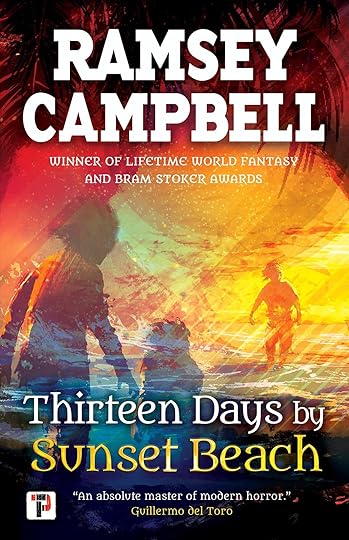
Thirteen Days by Sunset Beach (Fiction without Frontiers)
By Ramsey Campbell
My rating: 2 of 5 stars
Family vacations weren't something I looked forward to as a kid. My parents had this weird idea that going out of state to visit malls was somehow a vacation, and so many summers as a youth were spent in various cities, sitting in various chairs inside various Nordstrom's, Sax Fifth Avenue's, and Ann Taylor's, bored out of my mind and either staring off into space trying not to drool on myself, or whiling away too many hours reading while my mother leisurely scoured the clothing racks for the same discounted articles she could have bought at home.
Spending Thirteen Days by Sunset Beach felt rather similar to the family vacations of my childhood. A whole lot of time was spent doing a whole lot of nothing, trying not to drool on myself as my mind wandered, wishing I was somewhere else, doing something else.
Ramsey Campbell is a fine writer; he's won the Lifetime World Fantasy and Bram Stoker Awards, the Grand Master Award of the World Horror Convention, and the Lifetime Achievement Award of the Horror Writers Association. He has an impressive bibliography, make no mistake, and I would be sorely mistaken to besmirch his talents as a professional author. I must admit, however, that Thirteen Days by Sunset Beach is simply not for me.
I'm a bit of an introvert (ha, "a bit." Yeah, right.) and family drama is just one of the many various reasons I have for avoiding as many family get-togethers as I can. Thirteen Days is all about the family drama, although it has some minor, barely-there paranormal aspects that Campbell plays around with, giving us hints of and peeks at. I'm also not one for slow-burn horror stories. Yes, I dig good, three dimensional characters, but I also like my gore and unrelenting terror. I like it fast and dirty, and Campbell plays it slow and clean, far too much so for my tastes.
I found too much of this book to be plodding and excruciating, hoping that each of its next too-long chapters might finally posit an actual event or occurrence. Every time Campbell peels back the curtain, such as during the family's visit to the ruins of a monastery, and I think, "Aha! Finally, we're getting somewhere! Some action, some monsters, something!" the curtain limply and unceremoniously falls back into place. There's no energy here, no tension, no suspense, and worst of all, absolutely no surprises. The horror element, if one can call it that, is about as old and recycled as they come, and the secret reason for this family vacation to Greece will be suspected instantaneously by readers despite how many chapters Campbell drags it out for. Sadly, Thirteen Days never rises above being simply mundane.
While there are interesting thoughts on aging and dying, and the local legends of the island of Vasilema, and the various possibilities of extending one's life in exchange for certain sacrifices, none of it has any real weight and certainly no payoff, particularly in light of how prolonged it all is. We're treated to two or three scenes that demonstrate some real potential for chills and the promise of a better story, and no sooner than that are we whisked away to a trip to another beach, another bus ride, a supermarket, or a taverna to eavesdrop on this family and their arguments over tips, parenting styles, and more than a few dashes of ethnocentrism from the arrogant and insufferable Julian. Dear lord, how many pages and hours I spent waiting and hoping for Julian to meet his grisly end in savagely satisfying ways...
For me, thirteen days is simply too long to spend with this family, and now that our trip together is finally over I'm grateful to be going our separate ways.
[Note: I received an advanced reading copy of this title from the publisher, Flame Tree Press.]
View all my reviews
August 15, 2018
Review: Gate Crashers by Patrick S. Tomlinson [audiobook]

Gate Crashers
By Patrick S. Tomlinson
My rating: 4 of 5 stars
My original GATE CRASHERS audiobook review and many others can be found at Audiobook Reviewer.
First contact scenarios are a common enough trope in science fiction, but Patrick S. Tomlinson manages to inject a bit of freshness and fun, and more than a few dashes of silliness, into mankind’s discovery of intelligent life out amongst the stars.
Gate Crashers feels at times like an ode to Star Trek (Tomlinson’s Captain Ridgeway of the Magellan being only a hairsbreadth away from Voyager’s Janeway, while Bucephalus‘s Captain Tiberius, a dashing man of action in and out of the bedroom, draws an obvious parallel to one James Tiberius Kirk), replete with a few away missions for our band of cosmonauts that see them tangling with strange new worlds, new life, and new civilizations, boldly going where plenty of aliens have already been before.
Despite there being a certain degree of familiarity baked in, Tomlinson still manages to do his own thing and brings in shiploads of fun along the way, playing a lot of Earth’s first expedition into deep space for laughs. The discovery of an alien artifact by the Magellan’s crew kicks off a wave of scientific advancement, as well as the emergence of an artifact worshiping cult, back on Earth. This latter development is particularly preposterous given the fairly mundane nature of the alien device, and this sense of grandiose discovery for mankind, of things that are commonplace for the galaxy’s alien races, becomes a significant theme that recurs throughout the book. There’s a fun bit of interplay between expectations of discovery and the reality of their situation, but Tomlinson injects plenty of high-stakes action, political machinations, tabloid sensationalism, and world-destroying perils along the way. The threats to mankind are deadly serious, and despite some scenes overloaded with attention-killing technobabble, the story floats along with a good degree of jubilation. Not every joke landed just right for me, but I found myself laughing along with Tomlinson’s wit more often than not. One pun about being a “seasoned veteran” still tickles me, in fact, well after having finished my listen of Gate Crashers.
While the writing is bent toward the comedic, Alyssa Bresnahan’s narration is, unfortunately, largely straight-forward. While she does an admirable job bringing the various characters to life, injecting each member of the Magellan and Bucephalus with their own distinct quirks and voices, her reading is oftentimes much too serious given the tone of the material. Quite a few times, I found myself wondering how Gate Crashers would have sounded with a narrator like Wil Wheaton at the helm, who could capture the irreverence of this particular story and Tomlinson’s writing, much as he had for several of John Scalzi’s audiobooks. Bresnahan’s narration is perfectly adept during this book’s more serious moments, and I’d like to listen to her reading a work that isn’t so reliant on humor, but she too often misses the author’s comedic beats and plays too much of a straight man to Tomlinson’s silliness. On the production end of thing, Bresnahan’s reading comes through crystal clear and Gate Crashers is another finely recorded audiobook from Recorded Books.
Gate Crashers is a fun, witty, feel-good listen, one in which its author has carefully balanced freshness and familiarity while giving us some much-welcomed insight into humanity’s perseverance and ingenuity, and more than a few well-timed fist-pumping heroics as Earth’s most evolved apes outwit far more advanced alien races by the skin of their teeth. If there are more voyages in Megellan’s future, well, beam me up! Or freeze-dry, vaporize, shift, and reconstitute me. Or whatever the hell it is they do around here…
[Note: audiobook provided for review by the audiobookreviewer.com]
View all my reviews
August 14, 2018
Review: Behind the Door by Mary SanGiovanni
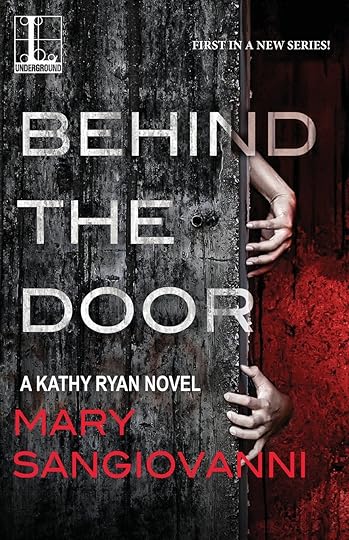
Behind the Door (A Kathy Ryan Novel)
By Mary SanGiovanni
My rating: 4 of 5 stars
The Biblical meaning of the name Zarephath is "ambush of the mouth." Appropriate, given that much of the horror in Mary SanGiovanni's Behind the Door is rooted in unspoken secrets.
Deep in the woods of Zarephath, PA stands a mysterious structure, the Door, framed in stone, its wood banded in metal. It opens to an alien landscape of a gray ocean and a enormous tower, a land populated by strange and evil creatures. Opening the Door is verboten - it is the one thing every man, woman, and child in Zarephath knows. You do not open the Door.
The Door, however, can grant wishes to those who dare to visit it. Properly worded, a letter detailing an individual's wants can be slipped through the thin crack at the bottom edge of the Door and their desires fulfilled within three days. But the urge to open the Door is strong, and after a single soul seeking a change in their life succumbs to pleas of "them beyond" the Door and briefly opens it, Zarephath is plunged into a nightmare. The wishes the Door has granted are being reversed, and after being haunted by the dead of his past, ex-Sheriff Bill Grainger calls on occultist Kathy Ryan to seal the Door forever.
Right off the bat, I was sucked into Behind the Door. SanGiovanni details the history and folklore of the Door, introducing us to the central figures of her small fictional town. We get an immediate sense of her characters, their afflictions, their flaws, as well as their relationships and their growing awareness of the Door and the evils that have crept through. This intimate overview of Zarephath and our protagonists reminded me, in some ways, of John Connolly and Stephen King, and SanGiovanni lulled me deeply into her narrative with deceptive, masterful ease. Her prose is crisp and tight, and the details are shared with such keen interest that it's impossible not to be absorbed.
Although it takes a while for series lead Kathy Ryan (first seen in 2016's Chills and very briefly mentioned in last year's Savage Woods) to appear, SanGiovanni at least gives us plenty of meat in other areas to chew on. Once Ryan finally sets foot in Zarephath, it's a headlong collision with Lovecraftian cosmic horrors and a race to the finish. SanGiovanni is flat-out an excellent Lovecraftian horror author, and she brings all the tentacled goods to the yard here. There's a particularly strong scene involving the discovery of a pair of corpses in a garage that, when Ryan prompts one of officers to turn over one of the prone bodies, had me softly muttering to my Kindle, "No, no, no, no, no." It's a wonderful bit of gross-out material, and the toll the Door begins to take on the townsfolk is a nicely horrifying discovery.
Ryan is a flat-out excellent series character, and I've been rooting for her return ever since I finished Chills a couple years back. She's a strong and capable master of the occult, and it's refreshing to see SanGiovanni's largely male cast treat her with the respect she's due. Perhaps it's wishful thinking to believe that a group of alpha male police officers and butch townies can treat a woman, even one with such specialized talents as Ryan's, as an equal whose abilities go unquestioned with nary a trace of mansplaining. But given that our Cheeto-In-Chief was, on the morning of this writing, taking to Twitter to call one of his former female staffers a dog, I'll gladly take it. Such an idealized portrayal of men easily and respectfully accepting the abilities and knowledge of women as equal, if not superior, to their own is not only welcome, but certainly necessary in these times. Maybe such a fair and balanced representation of the sexes is SanGiovanni's attempt to write her wishes into existence in the hopes that the Door can fulfill them. Or maybe it's just nice to read more into the text than was intended. If I can wish for something from this particular Door, however, it's for the return of Kathy Ryan, and soon. She's a character with plenty of staying power, and I hope to be reading many more volumes of her adventures in the years to come.
[Note: I received an advanced reading copy of this title from the publisher, Kensington, via NetGalley.]
View all my reviews
August 10, 2018
Review: Rattus New Yorkus by Hunter Shea
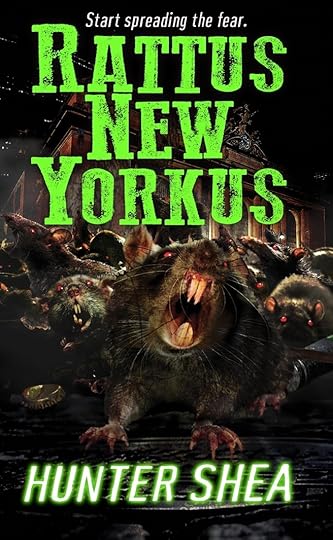
Rattus New Yorkus (Hunter Shea: One Size Eats All)
By Hunter Shea
My rating: 4 of 5 stars
Although humans are at the top of the food chain, we believe we're the dominant species on Earth largely only through our own hubris, and often to our own peril. In the genre of natural horror, this is often the predominant theme, and being too smart for our own good more often than not meets with disaster. Urban legend has it that there are five times as many rats as people populating the boroughs of New York City, while scientific estimates place the rat census at approximately 24% of the human population. Even at this much lower end, it's safe to say that's a lot of rats.
Rats are prime fodder for scary stories. They carried the plague, after all, and are host to a number of diseases, like rabies, salmonella, leptospirosis, and some even carry hantavirus. They've been the subject of horror books and movies - James Herbert wrote a series of novels about these suckers beginning with The Rats, and their celluloid exploits have scared audiences aplenty in Willard, Of Unknown Origin, and The Food of the Gods - but if you really want your blood to curdle, check out Morgan Spurlock's real-life horror documentary, Rats. Hell, just the trailer alone should make you shiver! These rapidly scurrying, long-tailed critters with those sharp incisors built just for gnawing can be frightening critters in the right hands...or even worse in the wrong hands.
Hunter Shea introduces us to New York exterminators Chris and Benny (or Benita if one must be formal), former spouses and now somewhat uncomfortable co-workers, as they take to the streets to test a brand-new rodenticide, Degenesis, which promises to control Manhattan's rat problem with maximum efficiency and efficacy. I probably don't need to tell you that it doesn't work, or that it ends up doing exactly the opposite of what its developer, Dr. Finch, promised. Oversexed and hyper-aggressive, the city's rats are ready to challenge mankind for ownership of the Big Apple.
When he's not delivering emotionally loaded whoppers like Creature, Shea writes fun, highly entertaining, playful creature features. Rattus New Yorkus falls firmly into the latter camp with Shea delivering a tight, perfectly sized, single-serving novella-length story. Chris, our first-person narrator, is New York through and through, delivering sarcastic responses and one-liners no matter the situation, while pining over his lost love. Since the story is confined to Chris's headspace, we don't get to know Benny except through him, but Shea gives us some nice flashes of insight into her personality and their lives together on the job, as well as a decent idea what their marriage had been like. The first person narration serves the story well, though, limiting the viewpoints on any given scene solely to Chris's observations and keeps things moving along pretty rapidly.
The human protagonists are a nice touch, but it's the rats that are the main attraction. After Degenesis fails spectacularly, Chris and Benny have more than their fair share of close calls and near misses as New York's rat population explodes exponentially all across town, turning into an uncontrollable calamity. I had a hunch Rattus New Yorkus was going to be right up my alley, and this suspicion was nicely solidified during an underground encounter roughly halfway through that made the hairs on my arms stand on end. From that point on, Shea charges firmly ahead toward a battle for the ages that will prove once and for all who's in charge - man or beast?
If that's not enough to sweeten the deal, there's a bevy of flamethrower action during the book's climax that rat haters are sure love. For the rat lovers out there, there's plenty of squirm inducing chompy-chomps on unsuspecting victims and tidal waves of rodents scouring the streets (waitaminute, tidal waves of rodents? I better jot that down. Could be the next Sharknado!).
[Note: I received an advanced reading copy of this title from the publisher, Kensington/Lyrical Underground, via NetGalley.]
View all my reviews
Fan Art!
I don't often receive fan art from readers, but when I do it's always deeply rewarding. It's a great feeling to know that a reader has appreciated one of my stories so much that they, in turn, are moved and inspired to create their own art in tribute. The following book cover animations were created by one of my Twitter followers, @JoeStalksBeck - check out this bit of awesomeness!
@JoeStalksBeck has a whole series of videos animating various book covers of some of her favorite reads over on YouTube. It's definitely worth a look!
Thank you so much @JoeStalksBeck!