Michael Patrick Hicks's Blog
November 18, 2025
DC’s Absolute Comics… In Brief
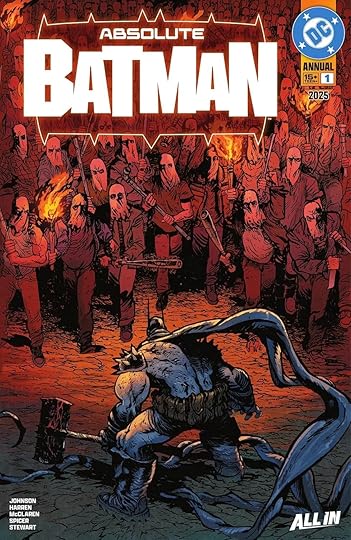
Absolute Batman Annual #1
In early October, a few weeks prior to the release of Absolute Batman Annual #1, writer and artist Daniel Warren Johnson pissed off all the right people by sketching an art print for New York Comic Con of the titular hero giving an ICE agent, as Bleeding Cool’s Rich Johnston wrote, “a very special hug.” Johnson posted the pic to his Twitter and Instagram accounts and, needless to say, a whole bunch of smooth-brained numpties lost their collective mind, to the extent that former Batman writer and present-day right-winger Chuck Dixon commissioned his own piece of art from a Brazilian immigrant showcasing Batman as an agent of ICE. Comicdom grew ensnared in arguments about how Batman would never do such a thing, but that Absolute Batman most certainly would. All in all, it was amusing to witness, particularly from the “I don’t like my comic books to be political” crowd who have apparently never read a comic book before.
Johnson’s sketch not only showcased his political viewpoint and his talent, it confirmed that the very first Absolute Batman Annual would be pretty goddamned special as the hulking AbsBat took his war on crime to the white supremacist forefront. I don’t know that it would be possible for this book to be any more relevant to today’s political climate in the US. There’s two other stories in the annual, but Johnson’s is not only the biggest, it’s the centerpiece of the issue, the beating heart of it all. While it delivers some much-needed catharsis, and few things are more enjoyable than seeing this absolute monster of a Batman smashing corrupt cops allied with neo-Nazis into the ground, or breaking the arm of some racist trash bag mid-heil, Johnson also injects plenty of emotional resonance while questioning if Bruce’s violence is really the answer, as juxtaposed against a pacifistic priest who doesn’t know how to make things better, only how to not make them worse. That all of this is set against flashbacks to Bruce’s childhood and what his murdered father might think of what Bruce has become in the present-day as a violent, wrecking ball of a vigilante makes it all the more impactful. Johnson’s story is tremendous, wonderfully cartoonish in its violence, and a real gem amidst a series already chockfull of memorable moments.
This is also exactly what comic books should be, particularly in this era of escalating fascism in America. We need our heroes out there tackling the big issues and giving us hope, punching all this country’s Nazis right in the face and suplexing the ever-loving shit out of them against the concrete. Johnson’s story is absolutely perfect and it's a real high-water mark for Absolute Batman as a whole. It’s also incredibly surprising, perhaps even puzzling, that this comes from DC Comics so soon after their firing of trans author Gretchen Felker-Martin and the cancellation of her Red Hood series in the wake of her comments regarding the murder of right-wing agitator Charlie Kirk by another right-wing nutjob. Kinda make you wonder who’s allowed to say what over there. I’m hopeful we’ll see more works like Johnson’s, though, rather than further capitulation to incendiary reactionaries stirring the pot and trying to cause a clickbait ruckus.
The other two short stories that follow Johnson’s masterpiece are good and fair, in that order, with the last one earning an excellent laugh with an Instagram-like panel of a poster taking a selfie in front of a police station. The caption reads “Why Does Batman Hate Me??” and is followed by the response, “I don’t know, ‘cause you keep being shady?” Yeah, that one got me chuckling pretty good.
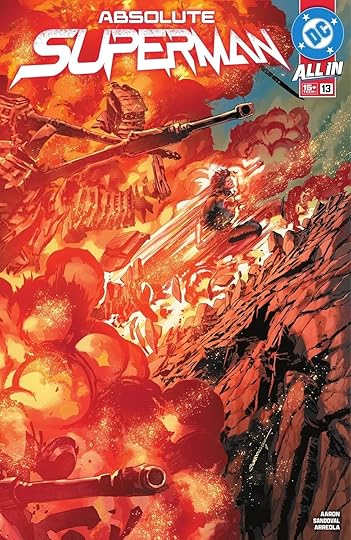
Absolute Superman #13
Jason Aaron continues to knock it out the park each and every issue. Since its launch, Absolute Superman has been one of the most topical and politically relevant comics in the Absolute line and almost immediately became my favorite book of the bunch. Maybe it’s because I’m not a fan of the traditional Superman, so Aaron’s tweaking of the character’s mythology and rebooting him in a scarily familiar America circa 2025 has really helped redefine the character and make me appreciate him. I think having Kal-El come to Earth later in his youth, after having been raised by working class parents on Krypton, has further solidified his immigrant story and made it all the more appreciable.
As issue 13 opens, tanks and assault drones are invading Kansas. Rafa Sandoval’s artwork looks eerily like something out of recent headlines under Trump’s militarized assaults on American cities. You can easily imagine Smallville as another target, like Los Angeles or Chicago, a sneak-preview of Trump’s plans for the country. Jason Aaron’s scripts have been scarily timely since issue one, with its concerns about artificial intelligence, a government that doesn’t give a single damn about its people, and uber-rich businessmen run amok. Now, it’s all-out war, as the chief architect behind Superman’s Earthly challenges seizes Kansas in an effort to force Kal-El to bend the knee.
The real fun, though, is in seeing Lois Lane and Jimmy Olsen working for the resistance and adopting more familiar attitudes, or at least seizing particular job opportunities on the frontlines, more akin to what we’re already familiar with for them. Lane gets to become an embedded citizen journalist, while Olsen is a wartime photographer. It’s fun stuff, and Lane’s commentary on Superman, set against his own internal struggles and self-doubt, makes for an intriguing back and forth. Maybe that’s what I like most about Aaron’s Absolute spin — this is a Superman that struggles, that has doubts, that doesn’t fully believe in himself, and questions if he’s making any kind of a difference at all in a world so stacked against him and fearful of him as an outsider. He’s an ostracized immigrant, an “Other,” and Aaron’s scripts lean heavily on the importance of this. I love it.
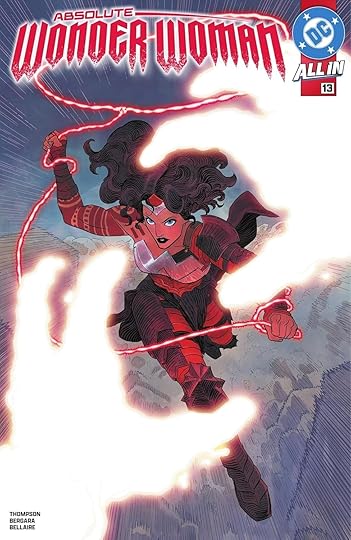
Absolute Wonder Woman #13
I haven’t been as impressed with Absolute Wonder Woman as much with the other two members of DC’s Trinity, but I do like the concept of Diana having been cut off at birth from her fellow Amazon’s and raised in Hades, where she grew up to become a muscular, tattooed, witchy bad-ass. Kelly Thompson’s stories have been OK, but haven’t yet truly impressed me, nor has she taken swings as big as what Snyder and Aaron have been doing in Absolute Batman and Absolute Superman, respectively. I’ve found Absolute Wonder Woman to just be a little too simplistic and unsurprising.
This issue sees Diana confronting an electrically charged elemental that’s been wreaking havoc across the globe. And that’s really about it, until the last page, which is pretty impactful and sets up the climax for this two-parter in the next issue.
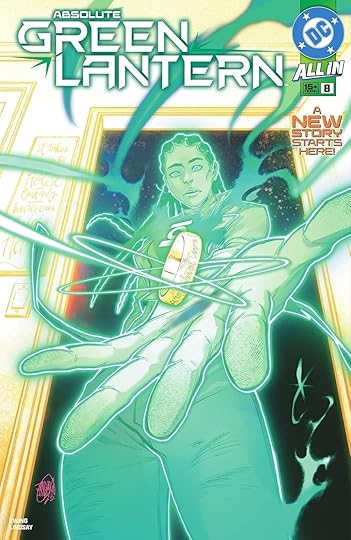
Absolute Green Lantern #8
While I’ve mostly liked Absolute Green Lantern on a month to month basis, I was growing also increasingly stymied by the intensely decompressed storyline of Al Ewing’s opening arc. By the time it finished, I felt pretty hard pressed to tell you what it was all about, so lost was I in a whole bunch of lore about the various lantern’s colors and what they mean, and I just didn’t have any kind of grip on it at all. What had begun as sci-fi horror quickly grew into something more esoteric and much less interesting.
Enter issue eight. This one’s all character based, giving us some much-needed background on our lead character and titular Green Lantern, Sojourner Mullein. Ewing gives his star the central focus here and it’s all wonderfully rendered in both scripting and artwork, which is both beautifully and at times spicy when it needs to be. We get the full history of Sojourner, from her childhood as her and her father move to Evergreen, to her joining a corrupt police force and truly discovering herself. There’s no real action to speak of, just a completely personal and ultimately human story against which the rest of this series is grounded against. This is the best, and cleanest, bit of storytelling this series has seen, and just as I was about to cancel my monthly subscription Ewing convinced me to hang around for at least another arc. I hope we get more stories in this vein, and a little bit less in style of what’s come before.
Now, just for fun, here’s the big, scary image DWJ created that caused conservatives to lose their collective mind. Ain’t it a beaut?!
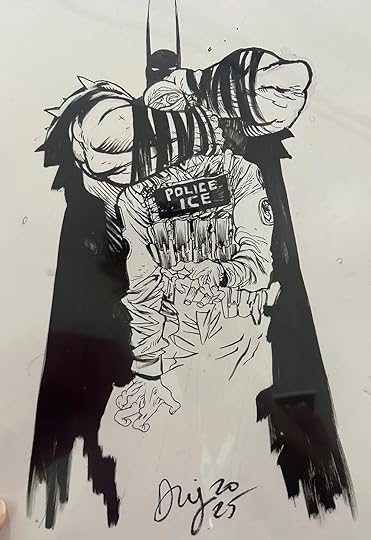
Art by Daniel Warren Johnson


November 14, 2025
God’s Junk Drawer by Peter Clines
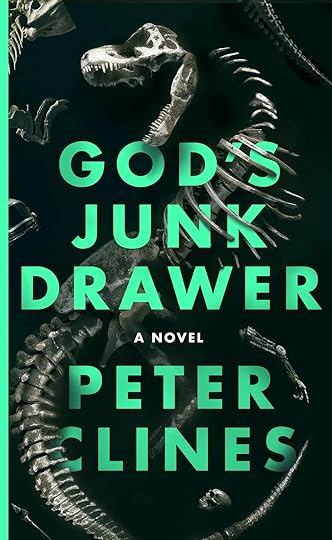
Peter Clines clearly remembers the joy of emptying out the toy box as a child to play with a mashed-up variety of various, disparate action figures. Remember having G.I. Joes squaring off against Darth Vader, while Batman single-handedly fought off a horde of Xenomorphs Imperial forces had corralled into duty for the Dark Side? I can’t but help think such childhood wonders provided at least a smidgen of inspiration for God’s Junk Drawer, even if it falls a bit short of wild, youthful imaginings.
Still, the conceit is similar. In the book’s opening, Billy Gather and his family are sucked back in time to a wild period that couldn’t ever possibly match-up with the historic record. It’s a land where dinosaurs and caveman live side-by-side, a la the nonsensical, science-defying creationist goofiness on display at Ken Ham’s Ark Encounter. But wait, there’s more! In addition to dinosaurs and neanderthals, there’s also an ancient Egyptian, a robot butler, an alien from a higher dimensional plane of existence, some futuristic cyborg warriors, and medieval woodworkers. People, places, and things from all eras of Earth’s history and future collide in one ahistorical valley that really shouldn’t be.
Billy somehow found his way back home and became the subject of tabloids and mental health counseling, until he disappeared again, but this time in more terrestrial fashion. He’s changed his name and thirty years later has become an astrophysicist named Noah Barnes. All his work has secretly centered around a singular pursuit – to rediscover the wormhole that launched him into god’s junk drawer and save the sister he left behind. He knows when and where the wormhole will reopen and has organized a camping trip for his students to observe the stars while he sneaks away to disappear once more. Worried for him, his curious grad students track him down and ignore his warnings to leave, and soon they’re all headed back to the… whenever, I guess?
Clines does a terrific job piling on mysteries, surprise revelations, and some shocking demises. Right from the get-go, it’s clear these kids and Noah aren’t in Kansas anymore.
But then things slow nearly to a crawl, and the rough and tumble excitement of the book’s opening segments settle into a strange sort of placidness. We’ve gotten a good sense of the unexpected dangers that lurk in this land out of time, and Noah and his misfit crew are repeatedly warned by other survivors that death strikes without warning. Yet, despite the body count, nobody ever really seems to be in danger and the crew just kinda hangs out, marveling at unexpected sights and trying to unravel the various riddles they encounter. Clines layers in plenty of logic puzzles and scientific mystery, but for such a dangerous land it all feels oddly safe and our central characters spend too much time in shelter for this book’s too-many pages. There isn’t even a central antagonist to confound their efforts to get back home until close to the book’s end.
God’s Junk Drawer’s feels like a Michael Crichton book at times, a sort-of Jurassic Park by way of Timeline, crossed with Land of the Lost, but without the constant, edge of your seat thrills. It’s sort of like wandering through an amusement park without ever getting on the roller coasters, ignoring all the other attractions, and skipping the elephant ears. Clines loads the front- and back-ends with plenty of action, but the middle is bloated and saggy. People stand around talking, get warned about danger, talk some more, solve a mystery, get warned about danger again, and then talk some more.
The mysteries of the valley are certainly interesting, the scientific gobbledygook is digestible enough, and the rare action scenes are fun, but the narrative never finds a real balance between the two. For all the bemoaning about how savage and violent the valley is, it still seems like a far more peaceful alternative than present-day America and its rising fascism. No Trump, No MAGA cultists, no tariffs, no ICE, no more student debt, which I’m sure these kids have a boatload of, no skyrocketing grocery costs and healthcare premiums and rent jumping through the roof, no more social media, and all they have to deal with are the occasional caveman and a population of ancient dinosaurs that would love to kill them at the drop of a hat? OK, so the last two certainly make decent analogues for our current state of affairs in the good, ol’ US of A, but lacking the rest? Kinda seems like a fair trade to me, if not an outright improvement.
November 12, 2025
Warhammer, Hell Divers, and Dark Descent… In Brief
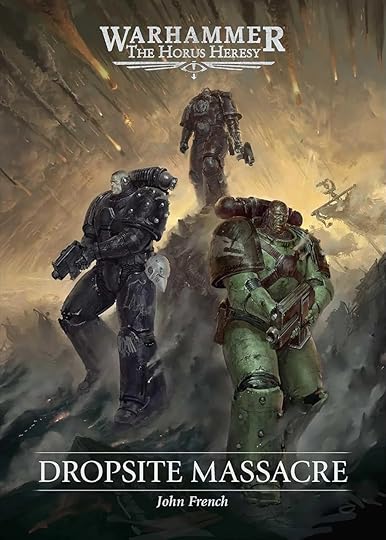
Dropsite Massacre (Warhammer: The Horus Heresy)
If you’ve already read the first five books in The Horus Heresy or have properly steeped yourself in the grand and ever-growing mythology of the Warhammer universe, you’ll likely have no problem diving right into Dropsite Massacre. If you have no background at all regarding Horus, the traitor legions, the holocaust unleashed upon Isstvan III, and followed up with the staggering amount of damage done to the Empire on Isstvan V - as detailed here - then you’re probably going to be lost, confounded, and perhaps annoyed.
I’ve only recently gotten into the Warhammer books and video games, following Henry Cavill’s announcement that he was bringing this corner of geekdom to Amazon Prime video in the coming years. My introduction to it all was with the first installment in the incredibly expansive series of The Horus Heresy books (and no, I will not be reading all fifty million books on this subject) a couple years ago, and I’ve read through the first six or seven books. The Dropsite Massacre was given pretty short shrift in Fulgrim, so it’s nice to see John French expanding on that battlefront and letting such a consequential moment in Horus’s treachery get the breathing room it deserves. But, again, it’s not a terribly good starting place and given the large number of characters and shifting perspectives, it can be a tough read for the uninitiated. For those who have made it through Fulgrim, at the very least, it’s a pretty worthy sci-fi actioneer with some shades of horror, and French does a terrific job capturing the grittiness and hellacious aspects of war. I had a good time with it and am looking forward to making more progress with the Heresy as a whole soon… even if it will take me about 20 years to get through the list of books I’ve drafted based on research and the suggestions of more knowledgeable Warhammer fan(atic)s.
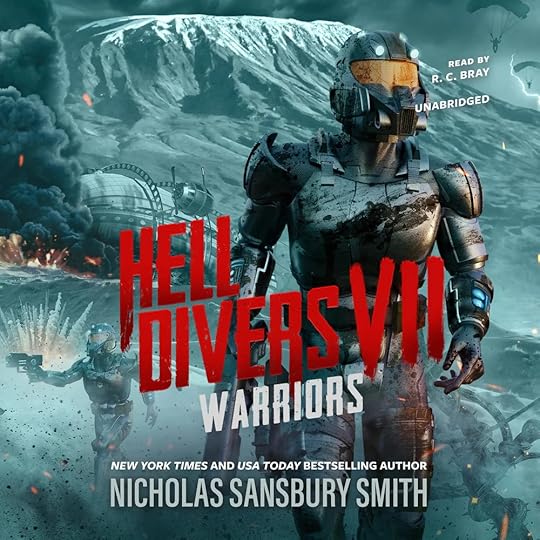
Hell Divers VII: Warriors by Nicholas Sansbury Smith (Narrated by R.C. Bray)
Get yourself somebody who loves you as much as Nicholas Sansbury Smith loves giving his characters battle-field amputations. Or at least as much as R.C. Bray loves to deliberately mispronounce real-world locations for no particular reason.
Warriors is the seventh — out of 12?! — books in the much-too-long Hell Divers series and is basically the same as previous entries. I love Nick, but I cannot fathom why this series needs another five books to wrap things up. By now, everything just feels same-old, same-old and Nick is basically just rewriting the same book over and over. The series has lost whatever freshness it had brought to the table with book one (a freshness which has thankfully been rediscovered with the excellent prequel novel Into the Storms) and feels like it should have concluded up here, rather than set things up for even more not-so-new adventures to come. Apparently these sold incredibly well for him and Blackstone Publishing that this particular horse had to be not just beaten to death but mashed into pulp.
That’s not to say Warriors is bad, just that it doesn’t feel particularly necessary in the grand scheme of things. It’s a serviceable time waster to be sure. There’s just nothing new or innovative here, and it follows the same patterns and tropes the previous books in this series established to a fault. There came a point late in the story where King Xavier’s life is in jeopardy, as usual, and I found myself wishing Smith would just kill him off in order to inject a certain measure of the unexpectedness.
Listening to it in audiobook is a mixed blessing, too. R.C. Bray, by and large, does a terrific job reading overall, but his decision to mispronounce so many geographical sites is certainly a choice. One that I don’t think is a particularly good one. I was jarred right out of the narrative every time he mangled the pronunciation of Florida, Aruba or Mount Kilimanjaro, and wished somebody on the production end would have smacked him upside the head and told him to read it properly. Alas, we get 16 hours of essentially the same Hell Divers stories we’ve gotten for the duration of the series thus far, and more of Bray’s forced-upon-us silliness.
Event Horizon: Dark Descent #3
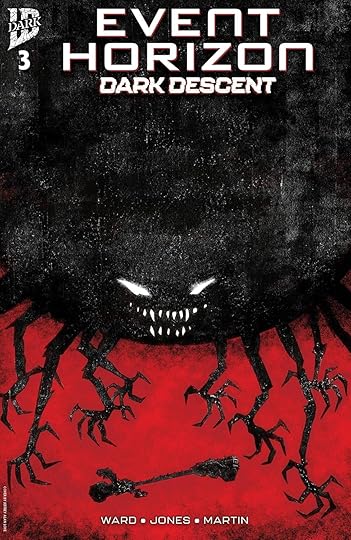
One might think that there is absolutely no reason for a tie-in comic book prequel to a movie that was a critically lambasted box office failure to be this good. Granted, Event Horizon has become a cult classic in horror circles since its release 28 years ago, and it's pretty damn clear that writer Christian Ward and artist Tristan Jones are among its fans, myself included. Three issues in and this series keeps getting better and better. To be clear, the book started off pretty damn good. Now, I find myself lusting for an eventual deluxe, oversized hardcover edition with a slew of extras and an extensive cover art gallery.
Being a prequel book, we have a pretty clear idea where things are headed for this crew. It's kind of like Titanic in that way. We already know how it ends, so the point of the story lies in building toward that with an interesting cast to keep us entertained us while we wait for tragedy to strike. We certainly don't have to wait long for that tragedy, as the massive Event Horizon starship finds itself stuck in a literal interdimensional hell and a demonic king stalking its hallways, playing mind games amongst the scientists and engineers behind this experiment gone awry.
Issue 3 focuses on the ship's doctor, Peter, who was diagnosed with cancer two years earlier. He wants to die somewhere with a view "worthy of a thousand lifetimes." We know from the outset he's doomed, so it's just a matter of how he gets there. I won't spoil the particulars, but Jones's artwork is certainly worth the view, with some truly marvelous and horrifying splash pages and one particularly disturbing panel involving a conjoining of two crewmen that's spectacularly horrendous.
The opening splash page of the Event Horizon lost in the chaos realm is pin-up worthy, and the monstrosities of the chaos realm that have come to lay claim to the ship and crew are suitably gnarly. Looking at Jones's work, it's hard to not to feel as assaulted as the Horizon's passengers. There's so much atmosphere in these pages, with Ward's script and Jones's pencils working perfectly in synch with one another, that it's hard not to get lost inside the story. You certainly don't want to be there, but it's impossible to look away from. You have to turn those pages to see what awfulness comes next.
Ward's writing is endearing, too, immediately putting us on Paul's side and giving us somebody to root for. He also mixes in a certain bit of wry humor, like when one conjuration of a murdered colleague, who has a head riddled with glass shrapnel in a slight homage to Hellraiser, ensures their murderer to trust them because they still have "a very sharp mind." It's funny and grotesque in equal measure. But given that this is an Event Horizon book, it's the grotesque that ultimately wins out, and rightly so.
November 5, 2025
Alien: Paradiso… In Brief
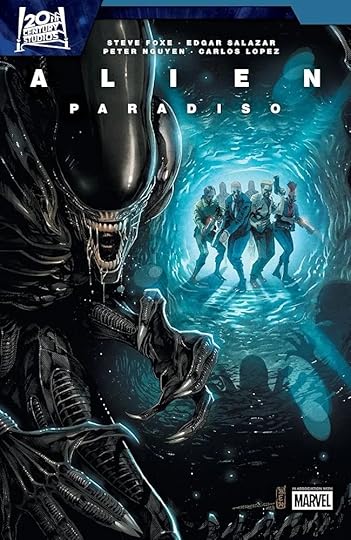
Xenomorphs on vacation!
Alien: Paradiso, a five-issue miniseries from Marvel Comics, written by Steve Foxe and with artwork by Peter Nguyen, is kinda fun in a pure fluff sort of way. Foxe nicely blends together his undercover cops vs gangsters vs aliens story, which is certainly preferable to the done-to-death colonial marines hoo-rah rah rahing, and even casts a sunshiny pall over it all thanks to its luxe tropical island setting. Beyond that, it's all strictly paint by numbers Alien stuff. Paradiso does little to disprove the conceit that if you’ve read one Alien comic book, you’ve read them all. Weyland-Yutani wants the alien eggs, people get infected, chestbursters lead to fully-grown killer aliens, and the body count rises and rises and rises. Nothing spectacular, and certainly nothing that hasn't been seen dozens upon dozens of times elsewhere already.
Nguyen’s art is pretty good overall, and he’s got a deft hand when going over the top with a bit of the old ultra-violence. It’s gory and spectacular, and certainly earns the Explicit Content warning. Paradiso’s graphic mayhem exists alongside that particularly American strain of puritanism where violence can be shown, indeed celebrated, in the most spectacular terms possible, with people's domes being lopped in half and intestines spilling all over the floor, all shown in the most grisly and vivid ways, while words like “fuck” have to be written in grawlix lest some softhearted soul be offended by such scary, naughty, not for kids words.
Paradiso makes for a nice change of scenery in the ALIEN landscape, forgoing the dreary, spartan, industrial look for the bright shinyness of a resort for the rich, and the xenomorph POV is pretty neatly represented as a form of sonar or echolocation. Beyond that, though, it's just your regular, plain old, standard, check all the boxes ALIEN story. I wish it’s characters were meatier and that Foxe mined deeper thematic depths given the nature of Wey-Yu’s profit at all costs concerns intersecting with an island full of rich people but, alas, it’s strictly a lightweight affair that doesn’t fully maximize on its eat the rich potential.
October 31, 2025
October Haunts
Hey, hey, hey! HAPPY HALLOWEEN!
That rustling noise you hear is not only the sound of falling leaves scraping against the driveway and the swishing noises of costume-clad children, but the sound of October having rushed past us as November rudely shoves its way in. And what a month it was!
Back in September, over on BlueSky, I asked followers if they had any questions, comments, or concerns they wanted to me address. One person did, but through alternate means, so let’s unwrap that here.
October really got into full swing with author Brendan Deneen going full Karen on me and emailing FanFiAddict site founder and Boss Man, David W over my “particularly (and unnecessarily) nasty review” of his book, Tracer. I didn’t like his novel, and although it got strong blurbs from a few authors I do enjoy, like Jonathan Maberry and Nicholas Sansbury Smith (authors who are also published by Blackstone Publishing, which not only released Tracer but for which Deneen is their Director of Media, TV, and Film), and a starred review from Booklist. Deneen wanted to make sure I saw that starred review, and I did. My opinion of Tracer remains unchanged. I’m not sure why my opinion of Tracer is so important to him given the enjoyment it’s apparently brought other readers. At the time of this writing, Tracer is currently sitting at a 3.58 at Goodreads. My guess is he’s irked my 1-star review is dragging his overall rating down and I’m supposed to be more generous and gracious toward a book I did not enjoy simply because Booklist liked it and, I guess, because he thinks he deserves, or is simply entitled, to favorable reviews only. Why else email David and try to rub my face in his good review?
Frankly, I don’t really give a fuck what Booklist likes or doesn’t. The opinion of that reviewer is not mine. My opinion is beginning to evolve, though, as I suspect that Deneen’s writing career peaked when he was penning Groot picture books for children. But that’s just my opinion, and one that did not make it into my review of Tracer. I do have a Kindle copy of Deneen’s Alien: Uncivil War in my digital TBR pile that I purchased when it came out last year, but I probably won’t bother reading it now, or anything else he writes, in light of his shenanigans. Deneen has given me enough Author Behaving Badly vibes, particularly after discovering issues surrounding Scout Comics (as reported in Comics Beat, PopVerse, and a massive thread at League of Comics Geeks), which he is CEO of, that arose in 2024. Hopefully this won’t all escalate to Kathleen Hale levels of nuttery. In the meantime, I’ll need to win a Pulitzer before we reach a potential Roger Ebert vs. Rob Schneider level of takedowns, but sadly I don’t think that’s too likely.
Here’s the thing about reviews, gang — they are but one person’s opinion. They are not gospel, nor should they be treated as such. While it’s true I didn’t like Tracer, you all might. I’ve hated books that have proved popular amongst other readers, and have fallen in love with novels hated and disparaged by others. I’m not a fan of Paul Tremblay’s work at all, which makes me an outlier in horror circles. I loved Nat Cassidy’s Mary, but DNF’d his most recent work, When the Wolf Comes Home, despite it also getting a starred review in Booklist and Publisher’s Weekly, and being hailed as one of this year’s biggest horror releases. I found it too silly and laden with too many tropes I don’t particularly like, but it’s got over a 4-star rating on Goodreads amongst 17,000+ ratings. A lot of readers and reviewers that I respect and admire have 5-starred it, but I couldn’t even make it a full third of the way through. I still have Nestlings and Rest Stop in my queue to check out one day, and intend to do so. You know why? Because if Nat saw my DNF review, he didn’t comment on it. He didn’t block me on BlueSky and then email David W to brag about how much other people liked it, inferring that I should to. As far as I can tell, he’s been extremely chill and normal. Odds are, though, he didn’t see it, and if he did he’s got enough other accolades and experience to know that one bad review isn’t the end of the world.
I’m guessing that Nat also did not make a fake Goodreads account under the name of Tomas Hayden for the sole purpose of one-starring several of my books shortly after my review of Tracer dropped. Did Brendan Deneen? Honestly, I have no idea. Based on the allegations posted at League of Comics Geeks, it wouldn’t be the first time Deneen has pulled such a stunt as he was alleged to have left numerous negative reviews for the books from former Scout Comics creatives. Those reviews have since been deleted, but have been archived nonetheless. Maybe the timing of the creation of that Goodreads account and the two minutes that were spent trashing my books on Sept. 30 is entirely coincidental. It’s genuinely possible I pissed off somebody else who then proceeded to create an account targeting me in retaliation. I have no evidence one way or the other. I do, however, find the timing to be pretty suspect. I’m not the least bit bothered by this behavior, whoever did it. Honestly, I think it’s kinda funny and ultimately trivial. It’s childish, petty-ass bullshit, and not much else. This is all pretty small potatoes considering everything else going on in the world right now. It is entirely possible, too, that this a legit reader who honestly hated one of my books, then proceeded to read three more of them, and found those equally inadequate enough that he was compelled to create a Goodreads account simply to tell the world he didn’t like four of my titles. Who knows?! Who cares?! Given the state of America, it’s all pretty trivial right now. Speaking as an author and a reviewer, I think we should just be thankful anybody is reading our shit at all.
At the end of the day, the bottom line is this: Reviews are not for the author. They’re for the reader. Once a book is out on the market, it’s fair game, and literally anybody can put their thoughts down and share it with the world. The key is for those thoughts to be honest and true, and they’re not always going to jibe with what others are saying. Back in October 2015, I published a 5-star review for an advance copy of Joe Hill’s The Fireman. Not long after its publication in May 2016, I got an email from an irate reader who hated the book and accused me of being a shill who must have been paid millions of dollars by Hill and his publisher to have propped it up with such praise. To that, all I could say was, Man, I wish!
Yes, it feels great to get starred reviews from valued, institutional sources. Yes, it sucks to get a poor review from anybody, especially nasty ones. But that’s the business. That’s the job. Your book is out in the world and it’s fair game for anybody with a keyboard. Reviewers aren’t here to hold author’s hands or to prop up their egos. We’re also not here to sell the book on an author’s behalf. We’re not their fucking customer support agents. It’s the job of the author and their publisher to sell the book. It’s my job to tell you if I think it’s worth your hard-earned cash and why. If I like a book, I’ll tell you so. If I don’t like it, I’ll tell you that too. As a reviewer, all I have are my honest opinions, and I’ll share those, fully and unvarnished, in ways meant to entertain myself first and foremost, and hopefully you as well. Having pissed off both authors, readers, and other reviewers aplenty with my opinions, and having been praised by just as many in turn, all I can surmise is that I must be doing something right.
Thanks for the email, Brendan!
And, hey, if any of you have read any of my stuff, and liked it or loathed it, I ask that you put up a review of your own and let other readers know your thoughts. Every review helps, good, bad, or indifferent.
And for all you fucking naysayers out there, at least Laurel Hightower thinks I’m a treasure, so at least I’ve got that going for me. Thank you, Laurel!

Last month, I had a newsletter-exclusive review for The End of the World As We Know It: New Tales of Stephen King’s The Stand. Here’s another, this time for the Dungeon Crawler Carl series by Matt Dinniman.
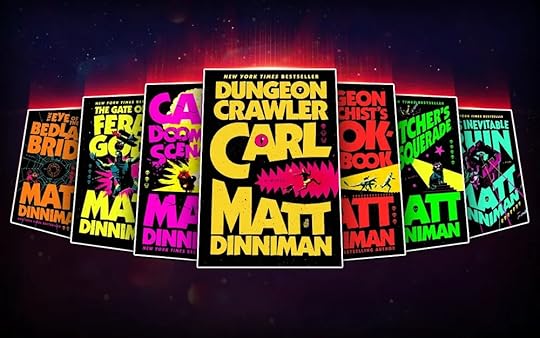
With the release of Book 7 in Dinniman’s series, my Goodreads and BlueSky feeds have been flooded with updates from people getting a kick out This Inevitable Ruin. I’m not generally a fan of the “dude sucked into a real-life video game” conceit, and worried that Dungeon Crawler Carl was just another Ready Player One rip-off: a steady string of pop culture references and nostalgia masturbation to make up for a threadbare plot (and, fuck me, I enjoyed Ready Player One at the time, too, so don’t at me). But then Rich, who I previously co-hosted the Staring Into the Abyss podcast with way back in the day, texted me in July to let me know it’s actually pretty good and I should check it out. He was on book six and listening via Audible. I had a credit to spare and grabbed the first audiobook, narrated by Jeff Hays. I figured, if nothing else, it could at least be some mindless stupid fun, and at worst it would just be a waste of an Audible credit. Live and learn.
Turns out, Dungeon Crawler Carl was indeed some stupid fun. It has pop culture references, but doesn’t use them wholly as a substitute for an actual plot or an endless string of “hey, you remember that movie from 45 years ago?!” contrivances. Jeff Hays brings a lot of heart, not to mention an impressive array of voices, to his narration, which is half the fun. Dinniman’s virtual exploits via meatheaded Carl bring up the other half, along with a welcome thread of omnipresent darkness.
While it’s told in a fun and hugely endearing way, Dinniman makes sure we don’t forget the overarching threat at the core of this series. Yes, it’s an RPG brought to life, but it’s also post-apocalyptic and maybe a smidge of space opera if you squint hard enough. Aliens have absolutely, positively destroyed humanity. Anybody lucky enough to survive find themselves trapped in a dungeon and thrust into a living, evolving video game that’s part of an intergalactic reality show. Think Baldur’s Gate meets Survivor by way of The Running Man. These unwitting and unwilling contestants are encouraged by the game’s AI to “Kill, kill kill!” because if they don’t, they’re gonna die, die, die in the most garish and disgusting ways possible to help ensure it’s all a ratings hit. And it’s also hilarious. In audiobook form, I can’t help but think it has a bit of a John Scalzi feel to it. The premise is straight up sci-fi with occasional smidgens of horror peppered in for added flavor, but it’s told in a way that is positively endearing and humorous. It’s some much needed fun.
Dungeon Crawler Carl might also just be the necessary bit of resistance fiction that we all need here in 2025. I’m only two books in, but as I was nearing the end of book two, I couldn’t help but imagine all the places subsequent books could take us. Dinniman gives Carl the opportunity to temporarily escape the dungeon for brief periods by appearing on talk shows and entering guild halls where he can briefed on not only the game but the larger socio-political context of the universe surrounding the game. Turns out all that “behind the curtain” shit hidden from the players is an intergalactic profiteering racket by a numerous corporations, one of which is going through bankruptcy and fending off competitors, who have made various shady business deals with various shady alien empires. One such king is an ugly, wretched pig-man with stupid children chomping at the bit to become the heirs apparent, and they’re all vicious bullies who loathe the people they rule over. It all sounds terribly familiar! I couldn’t help but cheer when, on one scheduled talk show appearance, Carl rightfully calls the king a pussy and encourages the people to overthrow him. That I was coincidentally listening to this segment on Oct. 18’s nationwide No Kings protest, hours before President* Rapey McPedophile, aka Diarrhea Don, aka Danger Yam, aka Mango Mussolini, posted an AI-made video in response depicting himself wearing a crown and flying a fighter jet (I guess those bone spurs healed up, huh?) to dump shit all over America (and only a couple days prior to literally demolishing the White House to begin construction on the Epstein Ballroom, because these metaphors have to be impossibly on-the-nose nowadays, and all that just prior to him, openly and candidly before a gaggle of reporters, on camera, planning to steal $230 Million in taxpayer dollars from the Department of Justice because they had the temerity to investigate this now-convicted felon for his crimes the last time he was in office.), made for an incredibly timely listen. What happens after Carl’s protestations calls into question the nature of the universe’s politics and the fragility of various interstellar alliances that have been hinted at. Now, I can’t help but wonder how Dinniman is going to handle all this through the filter of the many-floored dungeon Carl and his magically-endowed, talking cat, Princess Donut, inhabit. How are these rising stakes outside the dungeon going to impact what’s happening inside it, and what happens once Carl reaches the end? And yeah, that Princess Donut stuff… I know, I know, I know. I rolled my eyes at the idea too, back when Rich told me about it, but it’s honestly one of my favorite parts of these books. So much so that my poor, suffering, dear wife has had to listen to me recap the story and moments of hilarity to her for the better part of a month now.
There’s subtle shades of Star Wars and Flash Gordon in all this. Dungeon Crawler Carl seems to be existing in conversation with these pieces as much as it does Ready Player One, all the while showing the latter how it’s all really done. Book 1 was dumb fun. Book 2 was also dumb fun, but with some much-needed elaboration on the bigger picture that’s really helped to open up the possibilities for what this series could become. That I went straight into Carl’s Doomsday Scenario immediately after finishing Dungeon Crawler Carl, and am now eagerly awaiting my next Audible credit so I can grab book 3, The Dungeon Anarchist’s Cookbook, kinda says it all, I think. That’s really the highest compliment I can pay it. I just wish these were available via Hoopla so I didn’t have to stay dependent on Amazon’s ecosystem to enjoy them, but alas, it is what it is, and I suppose even adds an extra bit of Evil Empire meta-narrative to the whole endeavor.
October Reviews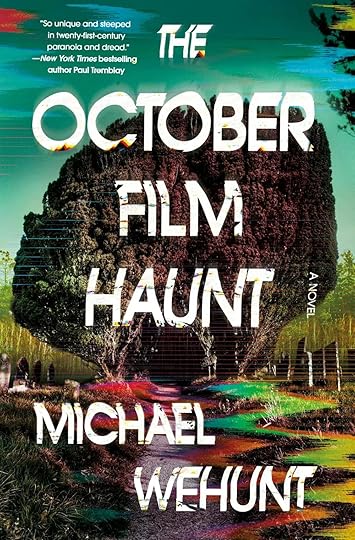
October was pretty damn light in terms of reviews, with only three published pieces for FanFiAddict. I typically cross-post my reviews to Goodreads, and certainly with more consistency than I do on my own website, so I figured I’d better start throwing in that link, too. To my credit, though, I did spend a few days this month getting the site up to date with past reviews previously published over at FanFiAddict and am finally, temporarily at least, caught up on that end! Phew! So, for as long as I can keep up with these things, you’ll get links to my reviews on my website, FanFiAddict, and Goodreads.
Of the three new October reviews, two are favorable, the other is not. Not too bad, overall! As I said up top, my opinions don’t always jibe with what’s popular or tilt the same way the general consensus appears to be leaning. The October Film Haunt is a great example of this. At the time of this writing, Wehunt’s latest is just barely scraping by with a 3.28 overall across 717 ratings. It has far less reviews on Amazon, but is faring a little bit better at this moment with a 3.6.
Honestly, this confounds me, particularly the response this book has been receiving over on Goodreads. Now, to be fair, a 3-star rating is not at all bad, and the bulk of the reviews for this thing are trending toward the positive. But scrolling through, I see a number of 2-star reviews from a few people with similar tastes and I just don’t get it. For me, this is one of the year’s best books, right behind Joe Hill’s King Sorrow. I think that if Hill hadn’t dropped that chonky bastard on us after ten years away, The October Film Haunt would most certainly be my book of the year. Right now, they’re virtually neck and neck for top spot and I could go either way depending on my mood for which is the better of the two. The October Film Haunt is certainly proving divisive amongst horror fans, though, which I ultimately think is a good sign. As always, my advice is to check it out and decide for yourself.
As for some of the other best books of the year, I’ve definitely got a few titles in mind, but you’ll have to wait a little while longer for the full list. It’s currently hiding behind a veil unless, I dunno, some crazy-ass night birds start playing weird games in yellow or something. Besides that, by my reckoning, there’s still two more whole months of potentially awesome reads that could still make the cut.
The October Film Haunt by Michael Wehunt [Website] [FanFiAddict] [Goodreads]
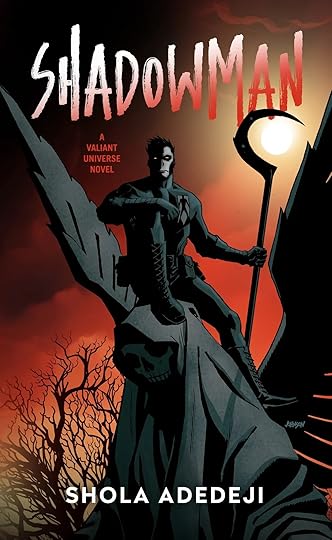
Shadowman [Website] [FanFiAddict] [Goodreads]
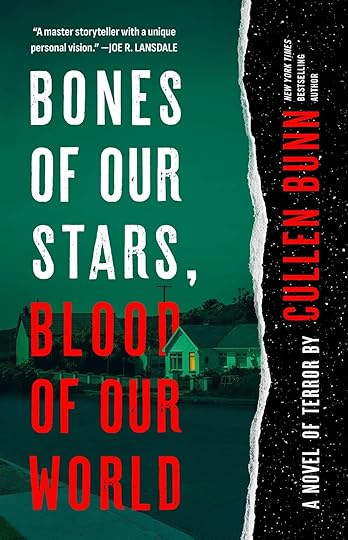
Bones of Our Stars, Blood of Our World [Website] [FanFiAddict] [Goodreads]
THE BOOK OF SPORES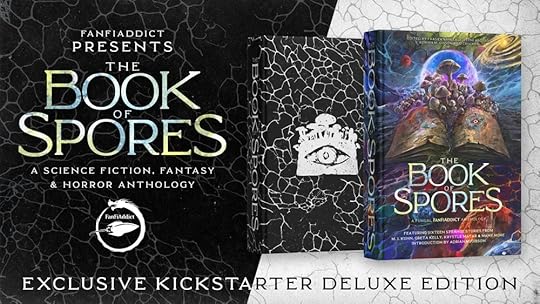
Before I started reviewing for FanFiAddict, the gang over there was busy putting together their own anthology of fungal fiction across the fantasy, science fiction, and horror genres.
The Book of Spores is a Kickstarter exclusive, and you can preorder your copy beginning Nov. 13. The Kickstarter campaign is not live just yet, but you can visit the pre-launch page and follow the project to receive a notification when it launches. Once it goes live, you can put in your order for an exclusive deluxe edition hardcover (which, based on the preview images I’ve seen, looks freaking phenomenal), paperback, and/or ebook.
As Adrian Gibson wrote in his announcement email:
The Book of Spores Kickstarter Exclusive Prelaunch Page
The Book of Spores is a mind-altering fantasy, science fiction, and horror anthology, featuring stories by authors from the FanFiAddict book blog and SFF Addicts Podcast . It brings together an incredible array of writers whose words will spread across the multiverse like spores. Here’s the official blurb:
“Across dimensions, it creeps and consumes.
Hidden in the vaults of a world-spanning library lie the records of a mysterious book, one made of mold and magic. Varied accounts of its existence remain scattered throughout the multiverse, but when an archivist attempts to bring its pages together, she will learn how dangerous a book—and her own ambitions—can be . . .
Collecting fungal tales from across countless universes, this anthology spotlights the best of fantasy, science fiction, and horror. Delve into sixteen strange stories that are seeped in spores, and prepare for your imagination to be colonized.”
One other Kickstarter campaign that I have absolutely nothing to do with, but which has definitely caught my attention, is the First In Fright: The Fangoria Compendium from, well, Fangoria!
This looks like one hell of a hardcover release, and the campaign’s stretch goals aim to make it even better. As the Fango team describes it on Kickstarter:
First in Fright: The FANGORIA Compendium takes readers through the biggest events that helped shape today’s horror landscape. This monumental collectible book is packed with over 300 pages of blood-soaked genre history, recounting iconic films and franchises, offering interviews with directors, stars, and special effects wizards, and going deep with features that track the evolution of horror filmmaking and explore the ways it has intersected with FANGORIA’s own history.
…
And this project doesn’t end with the book! An important part of First in Fright: The FANGORIA Compendium is a new initiative to develop the pinnacle in horror preservation: the complete Digital Archive of FANGORIA Volume 1, chronicling the entire print run of classic FANGORIA magazine issues (all 344 of them)! With every single page, picture and gory cover, we’re building the definitive academic resource for all serious fans of the genre.
Given that this project was fully funded in an hour, I suspect plenty of you on this mailing list have already backed the campaign. If you haven’t, I encourage you to go check it out and order a print or digital copy for yourself. As a backer myself, I’m really hoping this one keeps collecting funds so we can all get those extra stretch goal goodies.
First in Fright: The Fangoria Compendium Kickstarter
Currently reading: Dropsite Massacre (Warhammer: The Horus Heresy) by John French
Currently playing: Baldur’s Gate 3 (PS5). Still an absolutely perfect RPG. No notes.
Currently watching: IT: Welcome to Derry Season 1 (HBO Max)
Man, oh man, oh man, what an opener! Frankly, I was a bit worried about this series given Andy Muschietti’s continued involvement after shitting the bed so badly with IT: Chapter Two and The Flash, but with “The Pilot” episode of Welcome to Derry we might be seeing a director looking to redeem himself. Unlike in Chapter Two, Muschietti seems to be reining in his worst instincts (so far, at least) by letting the horror be horrifying and letting it linger for viewers to marinate in the discomfort of it all, rather than undercutting every single instance of terror with a lame, jokey gag and pulling all his punches to deliver punchlines instead. He only allows it to happen once in “The Pilot” and I’m feeling gracious enough to let that slide provided Andy doesn’t make a habit of it here for the remainder of his time behind the camera.
I’ll admit, I was also a bit leery about young Teddy being a member of the Uris family and started to get worried that this 1960s iteration of the Losers Club was going to just be a remix of the ‘80s kids’ past family members. I know Mike Hanlon’s family has a colorful history in Derry, but didn’t think the rest of the Club did to any similar extent. Having another Uris pop up and be at the center of these shenanigans felt a bit too Skywalkery for me. Like, out of all the people in the universe, it’s only these particular family members that can sort out all the troubles happening here and now? I got over it by episode’s end, though. Nice shoutout to the turtle, too, I thought.
And that ending. Oh wow, did that ever fucking deliver in spades. I really hope the rest of this season’s episodes have the balls to deliver more shit like this and keeps us on our toes. Absolutely fantastic. I am fully on board and can’t wait to see what happens next! Thankfully, I don’t have too long to wait. Episode 2 is getting a special early release for Halloween and you can bet your ass I’m watching that tonight.
Currently listening: Hell Divers VII: Warriors by Nicholas Sansbury Smith
That’s it for now, gang. I hope you all have a safe and fun Halloween! Go watch some scary movies and load up on the candy.
October 30, 2025
Bones of Our Stars, Blood of Our World by Cullen Bunn
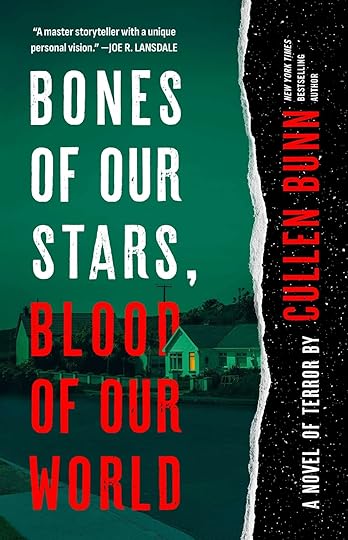
Stephen King’s epic tome, IT, was my gateway into horror as a teenager (or almost-teen) way back in the 1990s. Like many lifelong horror fans, I probably read King at an age younger than I should have, bypassing entirely the works of RL Stine other kids my age were devouring. I wanted to dive straight into the deep-end and, as the Mythbusters would later say, if it’s worth doing, it’s worth overdoing. I bring this up not because Bones of Our Stars, Blood of Our World reminds me of King’s IT beyond some scant superficialities (although Bunn most certainly shares King as a foundational text as a horror creator and it shines through in his creative DNA here), but because it reminded me of those handful of days spent devouring IT. Bunn’s adult horror debut transported me back to what I felt like then as a kid sitting beachside at my parent’s summer home on Grand Traverse Bay, or lounging in a leather recliner with the door wall open and the wind carrying in the smells of the sand and lake. I was there, physically, but I was really existing somewhere else. I was in Traverse City then, but I was also in Derry, Maine with the Losers Club. For a few days in late October 2025, I was in my home or in my office, but I was really on Wilson Island with Willa and Sarah, with Sheriff Buck, and, disturbingly, with the masked No-Face killer.
I haven’t been taken back to the start of my love for horror in a long time. I’ve been reminded of it a few times, sure, but only a few of the books I’ve read in the 30 or 35 years since have really put me back in the shoes of what I felt like as a kid discovering horror for the first time and not entirely quite sure of what to expect next. A lot of it, I think, comes down to Bunn’s visions of terror here, as he tackles the breadth and depth of what horror can be. Bones of Our Stars, Blood of Our World is a smorgasbord of horrors and surprises. It’s a slasher, it’s cosmic, it’s an “animal attacks” horror, it’s a creature feature, it’s a floor wax and a dessert topping. Bunn has taken all of what I love in the horror genre and put it in a blender to create a thick, chunky, coppery slurry of blood and gore and monsters, human and otherwise.
What starts off as a shockingly brutal double-murder turns into something far more expansive as the nature of the No-Face killer, as the psycho slasher refers to himself, is slowly peeled back and the residents and tourists flocking to Wilson Island for summer break come under assault. Of course, as in Jaws, those beaches will remain open! Pregnant teenager Willa is the heart and soul of Bunn’s story, although he has a pretty expansive cast of characters that all work together to make Bones of Our Stars memorable. This one’s a people-first horror. No matter how squicky it gets – and, boy, does it ever get squicky with eviscerations galore – Bunn knows that the horrors don’t mean a thing if we don’t care about the inhabitants of Wilson Island first and foremost. Who cares who the killer is disemboweling if we don’t have somebody to root for? Where’s the sense of loss in Bunn’s nobody is safe attitude if we don’t give a damn about any of them to begin with? Bunn puts in a ton of effort making this crew three-dimensional and alive before reducing them to dead meat sacks. I didn’t like Sheriff Buck upon meeting him, but I couldn’t help wondering how things might shake out between him and that waitress he’s got a crush on. I was invested in Willa and her relationships and how her parents would react upon learning of her pregnancy. We get a few interludes from the townsfolk and tourists, who exist beyond the circle of our core cast and are there to remind us that Wilson Island is a living, breathing, functioning locale with plenty of color thanks to the reporter, its police, its citizens, the homeless, and their relationships to one another, plus the odd old misfit who sometimes forgets to wear clothes before going for his morning run. Wilson Island feels authentic and lived-in, and I know Bunn’s Derry-esque habitat is just one small part of why Bones of Our Stars took me back to my days as a burgeoning teenage horror fan on the lake.
What really took me back — what surprised me most, and happily so — was Bunn’s everything but the kitchen sink approach to horror. Like the Mythbusters, Bunn clearly believes that if it’s worth doing, it’s worth overdoing, gods bless him. He reminded me that a horror story doesn’t have to be any one type. Horror is an elastic genre, and while marketing buzzwords can reduce it to one particular thing (a slasher book, a vampire story, a zombie novel), it can also be damn near all of those genres in one batshit crazy, over the top small-town horror story when it needs to be. It can — and should! — go well beyond what’s merely expected and surprise us with its irregularities and shock us with its author’s twistedness and willingness to go there and beyond. This book is a crystal-clear distillation of Bunn’s love for the horror genre and a reminder of how fun and rewarding horror can be when it’s busy doing way more than we ask of it.
A long-time comics scribe and creator of works like Harrow County, The Sixth Gun, and The Empty Man, you can tell Bunn loves it all, from the ’80s and ’90s paperbacks from Zebra, Dorchester, Dell Abyss, and the like, all the way up to modern big-screen scares and as far back as the old 1950s nuclear creature features. I think it’s Bunn’s nearly-two decades in comics that give Bones such a cinematic feel while reading. Each page unfurls like film in the mind’s eye, gnarly and grainy, with the horrors presented in the highest of definitions. There’s no unseeing some of these kills or the devastation wrought by attacking mutant menaces. One segment wouldn’t be at all amiss in Gregory A. Douglas’s pulpy, mutant cockroach horror, The Nest. Other times it feels like Jaws by way of Se7en, or Scream meets J.F. Gonzalez’s Clickers. Bones of Our Stars is messy and gory as hell, a throwback to the classic pulp horror books and supremely wet practical effects movies of yesteryear – so much so that it feels surprising a major mainstream publisher is releasing this instead of a ballsy, small-press indie label like Grindhouse Press. After so long working in the trenches (or, some might say, the gutters) of comics, I feel like we’ve been long overdue an adult prose horror novel from Bunn and now he’s spoiled us with all these riches in one singular story. After reading Bones of Our Stars, my only concerns now are, when’s the next book releasing, and where the hell does he go from here?
October 23, 2025
Shadowman by Shola Adedeji
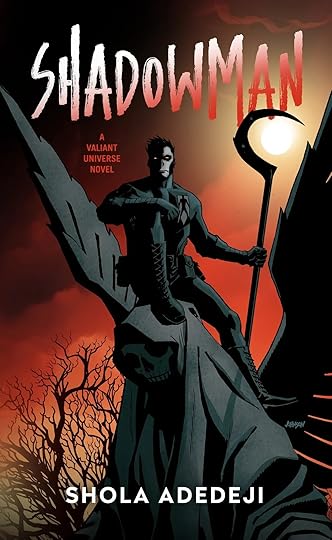
Shola Adedeji makes his debut with Shadowman, a supernatural horror book based on the Valiant Universe comics. Created by writers Jim Shooter and Steve Englehart, and drawn by David Lapham, Shadowman made his debut back in 1992 and has developed a healthy legacy since, appearing regularly in print as a cornerstone of the Valiant Universe, and in a few video games, too.
So, here’s a confession: Shadowman, and Valiant Comics as a whole, had largely flew under my radar for all these years. I was aware of the comic book’s existence, but never read an issue until Cullen Bunn appeared on the “Hell Creek” episode of Staring Into The Abyss podcast, which I co-hosted at the time. Bunn was a guest and joined us to discuss his then-forthcoming relaunch of Shadowman. I dug his series opener quite a bit, but never did read past it, despite picking up the trades and a few compendiums from prior Shadowman teams.
My intent to learn more about Jack Boniface and the voodoo origins of this New Orleans superhero was genuine, and so when I was offered an advance copy of Adedeji’s Shadowman novel and his fresh take on the character, it seemed like a good entry point. Unfortunately, there are too many weak spots and narrative missteps to recommend it, and even with only one issue of the source material under my belt I know this character can be written better.
Shadowman is Adedeji’s first book, and it shows damn near right from the outset in the author’s weak and repetitive sentence constructions, and authorial crutches he leans too heavily on. I was only a few pages into reading when I began to wonder if Adedeji could write a sentence that didn’t involve “it was,” the preponderance of which was so overwhelming I couldn’t help getting annoyed, particularly when used to start a sentence, which was done ad nauseum. Dialogue is weak and often unnatural, stuffed with “Ha-ha”s and “Hm. Hm. Hm.”s over and over and over, again. Conversations between Boniface and his father, Josiah, sound more like psychological clinicians or dueling philosophy professors than father and son. At one point, Boniface marvels over the answers he’s drafted to that night’s homework, “Having ensured his written answers contained as many big words as possible…[he] sat impressed by the quality of his work.” I couldn’t help but wonder how much Boniface was an authorial stand-in, given Adedeji’s similar approach to writing Shadowman. His prose is flowery, loaded with adverbs and five-dollar words that exist more to show readers Adedeji’s capabilities of thumbing through a thesaurus than to tell a good story.
As for the story, well. Shadowman is a messy origin piece, taking us to Boniface’s college days wherein he learns that his father has passed away and he has just become endowed with supernatural powers. His father was the previous Shadowman, and it’s a legacy handed down from one generation to the next. Jack Boniface is the latest, and naturally, the greatest. Being introduced to Boniface prior to his inheritance is to meet your average, smug, self-important know-it-all college kid. Boniface considers himself the smartest man in the room, and looks down upon his elders and fellow students with derision. They’re all backwards and dullards. He’s the only one that knows anything. If he had a personality, money, charm, and sarcasm, he’d be in the Tony Stark model. Instead, he’s a humorless, arrogant whiz kid, the kind of guy everybody avoids at parties, if he ever gets invited to parties.
But then he gets superpowers, which makes him reconsider a few of the things he thought he knew while still remaining largely insufferable, not only to readers but to the ancient entity imprisoned within the shadowy void that empowers Shadowman. If that’s confusing, just think of the recent Tom Hardy-led Venom movies and the multiple-personality aspect that exists between Eddie Brock and his alien symbiote, which Adedeji has mostly ripped off to retool here. Those movies weren’t any good to begin with, and their schtick is even less appealing this time around. Boniface can step into the void and use it to travel or store stuff in, like his magical scythe or discarded street clothes. He also has a shiny new psychic limb that Adedeji and Boniface simply cannot get enough of. The amount of chapters and passages devoted to this psychic appendage grow absolutely tiresome as Boniface palpates his way through various environments with it, whipping his new member out and swinging it around all over the place like an eager, hormonal 13-year-old.
The biggest problem with Adedeji’s take on Shadowman is simply that it’s not the least bit interesting. Once Boniface inherits his father’s powers, he automatically knows how to fight and can defeat any opponent. Apparently, taking on the powers of Shadowman is like Neo downloading kung-fu prowess in The Matrix, except Boniface is able to bypass the training and a much-needed ass-whooping from Morpheus. Boniface is miraculously adept and capable right from the outset, overpowered to the point of near-invulnerability, and that’s makes for a boring hero origin. Where’s the challenge? Where’s the danger? Where are the threats and tension? Each fight scene is overdrawn, repetitious, and lead only to the forgone conclusion that Boniface is the ultimate Shadowman. When it all culminates in the usual citywide threat and ensuing mayhem, there’s no reason to care. We’ve already been told a thousand times that Boniface is the best there ever was and all he knows how to do is win. There’s no rite of passage, no sense of escalation, and pompous Boniface is never humbled enough to be the scrappy underdog. Adedeji never gives us a reason to care, acting like a helicopter parent keeping his precious Jack Boniface safe from the big, bad, scary world around him, and it all makes for a tremendously dull superhero story. That it all ends with a rimshot zinger that would feel more at home in the freeze-frame ending of an 80s buddy comedy than a supernatural horror makes it all the worse.
So far, between this and Sarah Raughley’s Livewire, Valiant Comics is 0-2 in their attempts to break into YA prose. Putting a youthful slant on their adult comic book protagonists has resulted in vapid, self-important, and self-involved characters that are simply uninteresting and impossible to root for. Shadowman, in particular, is both overwritten and overwrought, yet somehow wholly underdeveloped. Adedeji never feels fully confident as to how the various aspects of his story link together, and largely avoids the disparate plot points connecting a kidnapped god, corruption, technology, and the living and dead sides of New Orleans until very late in the book, focusing instead on trying to convince us that Jack Boniface is every bit the special boy he, Jack, and his mother insists he is. Shadowman may get his powers from the Deadside, but that’s no excuse for Adedeji to churn out a story this lifeless.
The October Film Haunt by Michael Wehunt
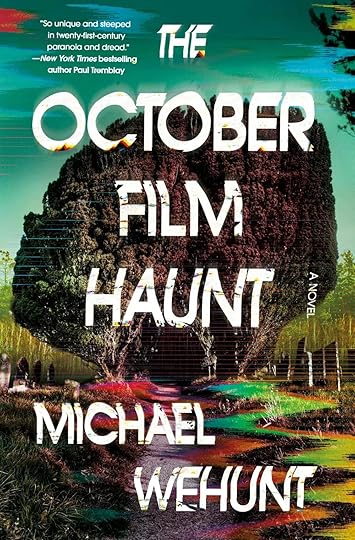
Michael Wehunt’s The October Film Haunt is a love letter to horror films and creatives. Yes, it’s a slasher book by way of cosmic horror and cursed media, but it’s an ode, first and foremost. Wehunt has a clear affection for the horror genre and film medium, born from watching The Exorcist when he was seven. I think most horror fans are created at an age most would consider too young to be socially appropriate, which is only fitting for a genre often viewed as an outcast and a bastard. We horror hounds confront those scary things in the dark and greet them on our own terms, driven by curiosity as much as defiance, throwing caution to the wind because we want to be scared. We need to stare into the abyss just to see if anything really does stare back. Horror frightens as much as it entertains. Wehunt gets it.
His characters get it, too. Jorie Stroud was a dyed in the wool horror fanatic and, ten years ago, an Internet celebrity thanks to her October Film Haunt website. She would trek to the real-life locations of found-footage horror films with her friends and try to recapture the feelings those movies brought about. One such film, Proof of Demons, and its director, Hélène Enriquez, developed a cult following and Internet urban legend status thanks to Jorie’s writings and video essays, which culminated in a tragedy compounded by a drug-assisted suicide by one of her pals. Forced to confront real-life trauma, Jorie’s love of horror died and she put all that behind her. She’s left her abusive husband to raise her son in Vermont and work as a freelance editor, making ends meet clerking at a grocery store. She’s spent the better part of a decade in isolation, far removed from the online horror community, building a new life where nobody knows or remembers her. Or so she thinks, until a VHS tape arrives in her mail and a string of disappearances across the country are linked to Proof of Demons. The fans of that film are attempting to create an all-too real sequel to bring the Pine Arch Creature into our world, and they’ve found Jorie, their final girl and film star.
The October Film Haunt is one of those books that almost feels like it was written just for me. Wehunt has taken a few of my favorite horror subgenres – slashers and cosmic horror – and melded them together into something smart and literate that, dare I say it, elevates them both. He understands and utilizes the customary tropes expected of such material, but there’s a certain freshness to them thanks to his strong character work. The book is a bit of a slow burn at first, with Wehunt taking the time to let us really get to know Jorie and her son, Oli, and the traumas that have upended her life. There’s an unsettling eeriness to her falling victim to stalkers hiding in the woods and recording her every movement, and the increasingly viral nature of the social media hashtags breaking into reality to promulgate the summoning rites to bring forth the Pine Arch Creature.
By the time physical violence strikes close to Jorie and the cult of Enriquez claims its first victim, it’s visceral, tense, and scary, even as it echoes Wes Craven’s Scream films or a Benson and Moorhead production. Wehunt does this knowingly, of course, with The October Film Haunt functioning as a meta horror novel, with the story echoing previous genre efforts in ways that mimic the call-and-response used to summon the Pine Arch Creature. Jorie Stroud knows all the tropes and knows that she’s in a horror movie come true. It may be an accident on her parents’ part, but certainly not Wehunt’s, that her name is so damn similar to final girl supreme, Laurie Strode. She’s the kind of final girl Jade Daniels would love.
Even with its callbacks to slasher classics and focus on a demonic entity and summoning rituals, The October Film Haunt feels wonderfully grounded. Despite being targeted by nutjobs, Jorie still has to go to work, still has to deal with her boss, still has to get forced into making small talk with the neighbor, and make sure her son is fed and clothed. She wryly notes at one point that she has to live through all the movie’s deleted scenes. Her life is upended, but the day-to-day dealings of living go on. And then there’s the cult she has to contend with, too. The masked psycho gimmick in these types of stories are, of course, rooted in real-life terrors. Masked, knife-wielding assailants stalking and breaking in – these things can and do happen. It’s a common fear, and one that reminds us that there is no safety in this world, least of all in our own homes. Clad in bedsheets and wearing pointed crowns made of sticks, the imagery of these cult members coming out of the woods to attack, one can’t help but think of their real-life analogs in the KKK or red hat-wearing MAGA acolytes or tiki torch wielding racists marching down the streets. They’re scary because they’re real. We maybe even know some of them.
What’s scarier, though, is the nature of the Pine Arch Creature. Not the creature itself, but the essence of the creature, the things it embodies, the way it welcomes you with its reassuring callback to the summoning’s opening gambit of “I belong with you” with “You belong.” The creature offers transcendence, but it promises acceptance. The horror genre has long been counterculture, and the horror community has proven itself, over and over, to be an ally, much to the chagrin of the anti-woke crowd. For far too many in a self-proclaimed Christian nation (many of whom have shown they truly only worship a pedophile, rapist grifter and helped propel him to the highest office of the land, because what’s more Christian-American than that?), we horror fans are outcasts, degenerates, and devil worshippers. Our books are easy targets for school and library bans, our movies too often dismissed and derided by mainstream critics. But within this circle of horror, we recognize one another, we see each other. Gay, straight, trans, it doesn’t matter. You’re a horror fan? You’re in. You belong. Troubled by trauma and suicidal ideation? You belong. To see that policy of open arms twisted by psychotics and eldritch terrors turning it all inside out for its own devious purposes, the horror – writ large – becoming an abusive lover – that’s scary. We see it happening on a national level now, under our current administration so rife with fascism. It’s terrifying to imagine our final refuge, this safe space built on terrors otherworldly and human, turned similarly and weaponized against us in violent idolatry.
The October Film Haunt is easily one of this year’s scariest books, not just because of what Wehunt puts readers and characters through, but because of all the subtext that haunts its passages and prose. There’s what the book is about, and then there’s what the book is really about. It’s meta and metaphor. Beyond being a damn good story that hits several of my own personal sweet spots, it’s chillingly invasive thanks to Wehunt’s literary-cinematic style and mixed media elements in the form of blog posts, Reddit threads, investigative reports, and the like. I don’t often feel that sense of creeping dread or the need to look over my shoulder when reading a horror book, but I certainly did here. I couldn’t help but feel watched as Wehunt blurred the lines between fiction and reality, slowly but surely ratcheting up the tension and eeriness in absorbing fashion. This book isn’t just a crowning achievement, it’s damnably haunting and wicked as hell.
Into the Storms: A Hell Divers Prequel by Nicholas Sansbury Smith
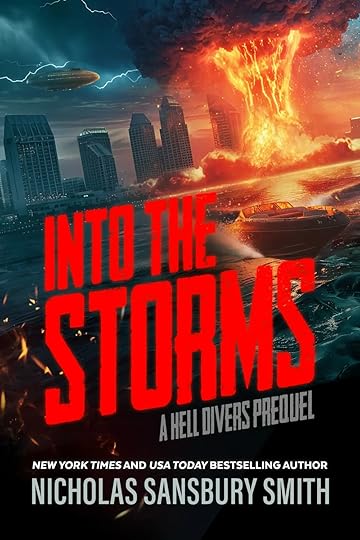
As a teenager back in the 90s, Tom Clancy was a cornerstone of my reading life (alongside Stephen King, naturally, and Michael Crichton). I became a fan largely because of Harrison Ford’s turn as Jack Ryan in the film adaptation of Patriot Games, and reading that book afterward hooked me in for a good long while. I couldn’t help but wonder on occasion what it would look like if Clancy had turned his eye toward military sci-fi and gave us a globe-hopping series of future assaults that helped pave the way for a nuclear apocalypse. I think it probably would have looked something like Nicholas Sansbury Smith’s Hell Divers prequel, Into the Storms, the first in a projected two-book series taking readers back 300 years before Xavier Rodriguez stormed the skies and irradiated wastelands below to ensure humanity’s survival.
Into the Storms is certainly a timely novel, and Smith’s central messages are especially important now more than ever: don’t trust the government, and don’t trust billionaires. Back in 1961, Dwight D. Eisenhower warned Americans about the military-industrial complex and we’ve spent all of the nearly-65 years since ignoring him, just like we do with doctors, teachers, and scientists, in order to elect intellectually stupefying and/or old fart politicians to prop up massive death-loving corporations, wealthy war-wanting elites, and funding terrorists and various bombing campaigns the world over to the tune of almost $900 billion instead of, I don’t know, feeding school children or solving homelessness. Trump’s executive order earlier this month, and god only knows how many constitutional crises ago, to rebrand the Department of Defense as the Department of War might be the only honest acknowledgement of reality he’s ever made.
At the heart of Into the Storms is Santiago Rodriguez, a distant relation to Xavier, who we are introduced to in a war-torn Seol battling Korea’s machine warriors. Victory doesn’t come easy, but the resulting peace leads to mankind’s banishment of all but the most basic service droids. AI is blessedly illegal and war is left to humanity to wage. Five years after the Machine War, a series of events convinces the military’s higher-ups that the robot threat is coming back, and Rodriguez soon finds himself back on the frontlines.
CEO Tyron Red is another central figure in Smith’s latest, a sort-of Elon Musk/Mark Zuckerberg stand-in. As with both of those real-life psychopaths, Tyron is presented as a decent enough chap to begin with. You can tell right off the bat that he’s a fictional billionaire because he’s concerned with stuff like doing good for humanity with projects focused on ending hunger. When we first meet him, he’s with his best bud on a life-threatening expedition through the Amazon to find a plant that can wipe out cancer. Of course, one cannot help but remember that there is simply no such thing as an ethical billionaire and that these insane wage thieves represent an existential threat to all mankind. Eventually Red is forced to show his true vainglorious colors in sparkling high definition. Although Red finds himself largely in opposition to the military’s efforts to bring back their AI-powered war machines, it’s not long before we realize these powerful elites all have one thing in common. Each are hungry for power, and they’ll kill every single one of us with nary a second thought, simply because destroying the world is good for business.
When I said earlier that Into the Storms is Clancy-like, I should perhaps clarify that further here. It has the scope, action, and military drama of a Clancy book. In fact, there’s even a character introduced late in the book named Clancy, so I don’t think I’m too far off in figuring that author must have been influential on Smith and his ever-growing body of work. Unlike Clancy’s work, Into the Storms avoids the American jingoism and hawkish, right-wing politicking of Clancy’s works. I worry that if Reaganite Clancy had lived long enough, he’d have become a full-throated Trump supporter, like so many other Fox News-brainwashed, geriatric cultists in his demographic. The fan in me is thankful he died before he could smear shit all over his legacy and leave behind only a wretched, stinky mess for us to contend with. Smith has his heart and mind in the right place.
I hesitate to call Into the Storms scarily prescient, though, as I’m not sure the ouroboros-like funding of artificial intelligence and large language models can survive another forty years before crashing hard and causing economic ruin. I certainly don’t believe the wealthy elites insisting on cramming this crap into every corner of our lives have any of our best interests in mind. I do wish Smith had introduced more present-date arguments into his narrative to help educate readers on the real-world dangers of AI, like how the technology is built entirely off Reddit shitposters, copyrighted work stolen from creatives and anywhere else these pale, pimple-faced, sexless, weirdo goblins coding this crap can illicitly swipe it from, gen AI driving users to suicide in the worst case scenarios and leading to weaker mental capacities at best, its perpetuation of racism and sexism and the central role it plays in shoring up fascism, rising utility costs, and the climate catastrophe that’s sure to result from the energy- and water-hogging data centers that maintain its utter, vapid uselessness. That the confluence between the rich, the military, our government, and AI – all thirsty for death and war – can lead only to the apocalypse is a sure thing and, boy, does Smith ever nail the hell out of that aspect.
In the first Hell Divers book, Smith introduced us to an apocalyptic Earth whose continents had been reduced to little more than radioactive wastelands resting below the pulsating electrical storms plaguing the skies, and with humanity reduced to roughly only a thousand souls surviving. Into the Storms winds the clock back to show us how it all began and the rich and dangerous bastards who caused it all. After twelve core books and a few other side stories into this hellscape future the techbros and slop makers want for us, going back in time 300 years to the start of it all makes for a welcome change of pace for long-time Hell Divers readers, and an excellent entry point for those who haven’t yet worked up the gumption to dive into the main series. Fans of The Terminator’s future war sequences of man vs machine will find plenty to enjoy here, particularly the scary Def-9 assault units. Thanks to a number of well-choreographed action sequences, some smart shocks, and a tightly-wound narrative that moves at a rapid-fire clip and illustrates just how quickly TEOTWAWKI could happen, Smith is at the top of his world-destroying game.
Tracer by Brendan Deneen
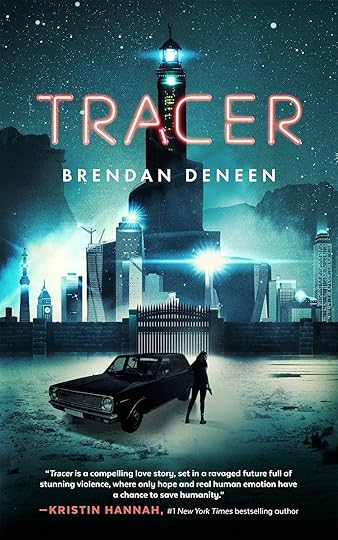
Set in an indeterminate future where humanity has been decimated by a killer flu strain and fossil fuels have gone extinct, Brendan Deneen’s Tracer is a rote post-apocalyptic sci-fier more content to tread the usual, well-worn genre trails rather than carve its own path forward.
Only a handful of cities have survived – urban areas built quite literally off the garbage of the old world, and plastic reigns supreme as the currency of this new world. A technology has been developed to turn plastic back into the oil it came from in order to keep these cities running, but it’s really little more than a MacGuffin to get these characters moving from Point A to Point B. Puente Hills City, built atop the landfills of what used to be Los Angeles, is run by President Bell, but she’s more violent mob boss caricature than politician. Her lead enforcer is her adopted daughter, the titular Tracer, who is tasked with killing anybody who gets on Bell’s bad side, which isn’t exactly a difficult thing to do. When Apex City’s converter goes kaput, Tracer is tasked with delivering them a repair man. What she doesn’t expect is that she’ll be bringing back another passenger, one of Apex’s best roguish thieves, Ezra, as part of a secret trade deal nutso Ma Bell negotiated. Even less expected is the quickly brewing romance she develops with Ezra and all the ways love can change a person.
Tracer’s never known real, honest to god, unconditional love before. She never knew her parents, and the adoptive couple that took her in didn’t have any qualms about selling her to Bell for some cheap plastic. Bell isn’t exactly the lovey-dovey type, either, and her affection for others is measured by whatever they’ve done for her lately. Tracer was trained in combat, and whatever feelings her gangster mom has for her is based only on her abilities and her ruthlessness as the president’s enforcer.
Tracer is built in the typical Sci-Fi Tough Gal™ mold – hard drinking, full of scorn for herself and others, scarily proficient at killing, and nigh unstoppable. Getting shot, choked, stabbed, beaten, etc. does nothing to slow her down, although she occasionally pauses long enough to pour whiskey on her wounds and get stitched up before going right back to getting shot, choked, stabbed, beaten, etc. She’s a comic book character, and taking a gunshot to the shoulder doesn’t stop her from scaling city walls in the pouring rain, or brawling with a barroom full of men twice her size. None of the characters in Tracer feel or act like real people. Instead, they act and feel exactly like characters in a not especially good book. They’re here to check off roles and tropes and to do the expected things their characters have been defined by through a long line of other books in this fashion.
Deneen’s story is phony and superficial, and Tracer plays out in the expected checkmark fashion. Bell is capital-E Evil and Tracer will eventually grow wise to it and do what’s right, all in the name of love! Check. Tracer and her adopted brother hate each other, but rather than come to blows he’ll eventually help her to make up for past sins! Check. Tracer will return to Apex City to rescue the man left behind and show the ruthless masterminds behind it what justice really is! Check.
The only real surprise, storywise, to be found in Tracer is why Bell wants Ezra, and I won’t spoil that because it is kind of a neat reveal. The rest is all pro forma been there, done that. Each story beat and their resolution aren’t just familiar, they’re foregone conclusions long before you ever reach them. The romance between Tracer and Ezra, the supposed beating heart at the core of this story, is a half-baked instalove riff that fails to deliver any authentic emotions between either the characters or the reader. A romance for the ages theirs is not. The biggest shocker in Tracer, though, comes in the author’s afterword, where Deneen confesses it took him over ten years, in between writing for various other intellectual properties, to write a novel this generic.
There’s no heart, no soul, no spice behind any of it, and Tracer’s romance never rises beyond an unconvincing one-dimensional, plot-mandated artifice. Her being forced to contend with the mortal and moral consequences of her life’s work after getting some D in the dessert doesn’t arise as a natural consequence of the story and these characters or the depth of their relationships (there isn’t any), but because it’s what’s expected from these types of stories. Tracer has the strict feel of a book that has been outlined to death and Deneen doesn’t allow any room at all for improv, let alone originality. The characters don’t dictate the story so much as the plot and genre conventions dictate them. The problem is, it’s a plot we’ve seen a thousand times before and done better plenty of times elsewhere, and with more compelling, three-dimensional characters to boot. Maybe if Deneen had taken another ten years to write this thing, he might have been able to come up with something worthwhile.