Michael Patrick Hicks's Blog, page 5
February 1, 2025
January in Review

Whew. January 2025. That was a long year, huh? The last couple weeks, especially. And hey, how about that coup currently in progress, the pardoning of all the January 6 terrorists, Trump and Musk’s attacks on the FAA and the resultant plane crashes, Musk demanding access to the Treasury’s payment systems even though he’s not an elected official and Trump’s made-up appointments for him haven’t even been confirmed by the Senate and, as far as I know, don’t even really exist, the Los Angeles wildfires, the spread of bird flu and the destruction of public health agencies websites by the new administration, and and and and….
It’s safe to say January 2025 will certainly be one for the history books. You know, if they still make those things in another four years and, of course, presuming they’re even allowed to contain anything close to factual information lest they violate Trump’s demands for a bunch of made-up “patriotic” history.
But I digress. I really did not intend for this email to be a political screed, or more anti-Trump ranting. I do enough of that on social media. And besides, that’s what I wrote Friday Night Massacre for. And my novelette, Revolver, which is also collected in In the End, Nothing, with a whole bunch of other stories.
My main goal for 2025 was to try and keep my head down and lose myself in fiction as much as possible. Books, video games, movies — that’s how I want to spend this year, and the next four years at the very least. We all know what this prolonged second season of The Trump Show is going to look like, having already lived through a four-year-long sneak preview of it all once before. We know this sequel is going to longer, louder, brasher, meaner, crazier, and even more fascist, unhinged, insensitive, racist, sexist, and batshit insane than the previous nightmare, which was pretty goddamn awful in its own right. The safety rails have all been removed. There’s no seat belts and the brake lines have been cut, and everything is on fire (literally and figuratively). But, hey, that’s what so many of my fellow Americans wanted, I guess, so, yay, congrats, and good for them! Eggs are more expensive, Social Security and health care are in jeopardy, and a white supremacist Christofascist is leading the Department of Defense, but at least brown people are scared and being rounded up and on their way to a concentration camp at Gitmo. Enjoy! Way to go America! It’s like Germany, 1933 all over again.
Anyway. Yeah. Books. That’s my escape hatch, along with various other bits and pieces of non-reality based media to try and help keep me sane in an utterly insane country. Or at least from going any further insane as things rapidly spiral out of control. And maybe some writing, too. Hopefully I’ll have some news on a forthcoming and long-awaited book for you all soon. We’ll see.
In the meantime, how about some reviews?
My Avoid Reality 2025 project kicked off in high-gear, with January seeing seven (!) reviews for new and forthcoming releases hitting the blog. Here’s what you may have missed:
Needless to say, February will see more reviews coming your way. I intend to do these kind of mailers recapping review posts once a month. But by all means, be sure to check out the website regularly for updates. I might even start blogging if the mood strikes, but no promises there.
January 2025 also saw the release of the third, and I do believe final, entry in The Horror Book Review Digest series. If you’re unfamiliar with this series, each volume compiles a few years worth of my horror reviews into some pretty hefty volumes (thus defeating the purpose of a digest, but whatever… I liked the way it sounded).
Volumes I and II are currently available on Amazon. Volume III, however, is available exclusively on my website as a direct order EPUB-formatted ebook, mostly because Amazon refused to sell this entry and claim they are unable to confirm I’m the copyright holder of the reviews I have written. On the bright side, ordering direct from me means I get the full income and don’t have to split 30% of each sale with a billionaire.
If you’d like to support my work and this site, by all means, grab a copy at the link below!
Selling HBRDV3 direct means I have also reopened my webstore. Unfortunately, stock is pretty slim at the moment and is limited to this one digital ebook. But that’s gonna change soon! I do have some inventory to sort through and count, and once that’s done I’ll get the Store stock updated and will be able to sell signed physical copies of my work direct to you dear readers. Stay tuned!
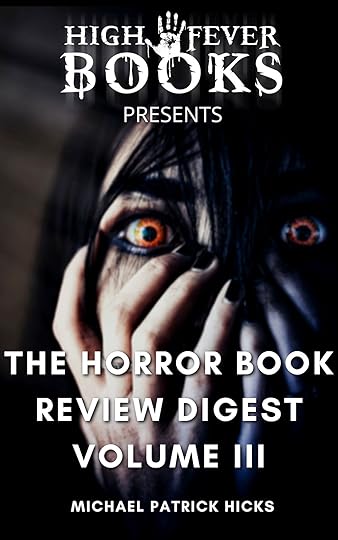 The Horror Book Review Digest Volume III $4.99
 “For the last few years, Michael Patrick Hicks has been my go-to for horror novel reviews.”
Tim Meyer, author of Kill Hill Carnage and The Switch House
In addition to crafting his own works of horror, Michael Patrick Hicks has been reviewing books for more than two decades and has written for such outlets as Audiobook Reviewer and Graphic Novel Reporter.
Now, he returns with The Horror Book Review Digest Volume III, his third collection of reviews covering some of the horror genre’s biggest releases and hidden gems from 2021-2024 from authors like Chuck Wendig, Nat Cassidy, V. Castro, Christopher Golden, Tananarive Due, TC Parker, Adam Cesare, Brian Keene, Stephen King, and many, many more.
This third volume of The Horror Book Review Digest features reviews of over 100 books that promise to give you chills and nightmares! Settle in, keep a light on, and find your next great read.
Readers will receive a secure link to the EPUB file lasting 24 hours after the first download. Add to cartI’ve seen a few other authors post some vital information in the following format and always find it kind of fun. So, I figured I’d rip-off borrow shit my betters have done ahead of me.
Currently reading: The Divine Flesh by Drew Huff
Currently watching: Crime Scene Kitchen, Season 3
Currently playing: Dragon Age: The Veilguard (PS5)
Currently listening: Nine Inch Nails on shuffle while working out


January 31, 2025
Spores by Michael McBride
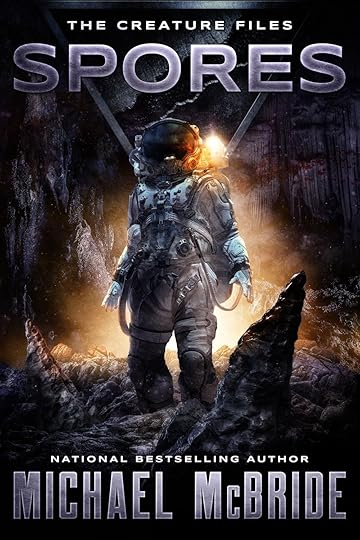
Publication Date: January 28, 2025 | Preternatural Press | 280 pages
Michael McBride is an author I’ve found to be consistently reliable in producing hard science-based horror fiction. His work dovetails rather nicely with that of authors like Michael Crichton, James Rollins, and the writing duo of Douglas Preston and Lincoln Child (although both also have a hefty library of solo books, too), not to mention television series like The X-Files and Fringe. I suspect that if you’re a fan of any of these then you’re perfectly primed to dig into just about any one of McBride’s adventures. In fact, if you’re new to McBride, Spores is a terrific jumping-on point as it’s billed as the first in his new The Creature Files series.
McBride wastes no time getting down to business, opening the book with a widescreen cinematic-styled epic disaster that sees an earthquake rip open the tarmac of Denver International Airport. Seismologist Dayna Raines is called to duty by the USGS, along with a small group of chemical, structural, and biomedical engineers. What Raines, her team, and millions of others whose lives are unknowingly jeopardized don’t know is that beneath the airport is a decommissioned deep injection well the U.S. Army had used to dispose of biological and chemical weapons created during World War II. Over the intervening years, these hazardous chemicals have been eating away at the earth beneath Denver and it’s only a matter of time before a massive earthquake is triggered and wipes out the entire city.
Of course, that’s only just the start of it. Soon, their mission to launch a controlled demolition to backfill the subterranean cavity and prevent any further earthquakes is jeopardized by General Jack Randall, an ornery old man with hideous scars that betray a deadly secret from his past. Randall and his team essentially draft Raines and her team, merging their dual purposes of destroying the cavern… and whatever it is that lurks below. Something Randall has encountered before and tried — and failed — top stop once before.
McBride hits that wonderful sweet spot for me, building tension and unfolding the scope of his science-based horrors in slow-burn fashion, while also making the threats scarily plausible. Not to mention frighteningly timely. Hot on the heels of Spores release, Phys.org reported on a work published in the journal Fungal Systematics and Evolution about a newly discovered novel species of fungus found on spiders in multiple cave systems in Ireland that operates similarly to the infamous ‘zombie-ant’ fungus, Ophiocordyceps. I won’t proclaim McBride to be prognosticator just yet, although the origins of Spores goes back roughly twenty years according to his afterword. The man certainly knows his cutting-edge science, though, and has illustrated as much across a large spread of novels.
And Spores is positively brimming with science. McBride spends a lot of time exploring seismology, ground scanning, the use of drones, and, of course, fungus. Spores also acts as a warning reminder of the perils of mankind’s abuse of Mother Nature and the dangers of deep injection wells, drilling, and fracking, not to mention the perils of chemical weapons and biohazards. These latter topics are worrisome enough on their own, but once McBride starts looking at how nature continually responds and adapts to our worst inclinations, well, that’s when things get downright hair-raising. Once the scientists and their military escorts are dropped into the chemical and fungal soup waiting for them at the bottom of the earth, Spores becomes an energetic thrill-ride of freaky subterranean horror.
The best part is, McBride is only just getting started with these Creature Files, and his final chapters tease us with all kind of deadly possibilities of what’s to come. I’m scared of what weird biohorrors he’s cooking up in the lab for us, but also eager to read all about it, and hopefully soon!
January 28, 2025
Noro by William F. Gray
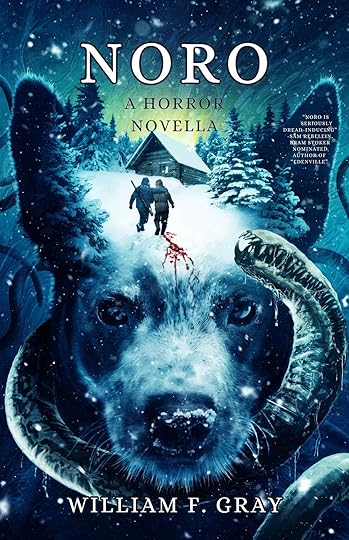
Publication Date: Feb. 21, 2025 | Cemetery Dance | 132 pages
Mark Twain wrote in his autobiography that “There is no such thing as a new idea. … We simply take a lot of old ideas and put them into a sort of mental kaleidoscope.” Meanwhile, film critic Gene Siskel once advised filmmakers not to take time out of their picture to remind audiences of other, better flicks they could be watching instead, such as when characters are shown watching a well-known scene from a piece of highly regarded cinema, or the camera knowingly lingers on a movie theater’s marquee. We shouldn’t be reminded that we could be watching The Shining when we’re stuck sitting through Drop Dead Fred.
These two axioms were at the forefront of my mind when reading William F. Gray’s Noro. Noro involves a meteor carrying an alien parasite crashing into the Wyoming woods in the middle of a savagely violent snowstorm. A young man named Con goes to investigate, but his German Shepard, Doc, gets away from him and ends up infected. Mayhem ensues, and Con’s neighbor Jonah, and his dog Noro, are caught up in the mix and struggling to survive. Noro — the book, not the dog — is a mishmash of familiar ideas and concepts, a kaleidoscope of influences that are ultimately better on their own than stitched together as they are here. Gray borrows from works like John Carpenter’s The Thing and the Alien flicks, along with Stephen King’s Cujo and Dreamcatcher, and tries to take various components from each of these to create a slick horror novella that never feels as fresh as any of its inspirations. Not even Dreamcatcher.
Somewhere along the way, Noro reminded me of a third axiom: familiarity breeds contempt. I’ve read so many similar scenes and set-pieces as Gray’s elsewhere plenty of times before, or seen them played out in movies and television, that having them all appear here in mandatory checklist fashion left me bored. It’s all so rote and dull. We have the requisite bit involving one human survivor getting infected and hiding it. The creature that was thought dead turns out to not be so dead after all and springs back to life. And, of course, as these types of horror stories often do, it ends with a cliffhanger indicating that not only has nothing been truly resolved, but the worst is just getting started.
To his credit, Gray spares little expense in doling out the violence, and Noro is consistently at its best when it’s at its bloodiest. Given that good doggo Doc is infected early on, it probably comes as little surprise that there is a plethora of both human and animal violence. Doc’s infection is gruesomely detailed as the alien parasite sets up residence inside the dog’s body and makes itself at home, and then proceeds to attack Con and Jonah both, chasing them through the woods intent on chomping the hell out of them both.
Readers sensitive to harm brought against animals may want to avoid Noro given the merciless violence inflicted upon Con’s canine companion, but for me that wasn’t even the worst of it. No, the true horror, and what ultimately drew my contempt into outright anger, was Noro’s editing, or rather the complete lack of it. When reviewing advance reader copies, reviewers aren’t supposed to get hung up on typos and textual errors. Most ARCs are even labeled as an “Uncorrected Proof” to warn potential reviewers that the book hasn’t yet gone through the rigorous process of editing and proofreading. However, most publishers do their best to present their advance readers with a book that is mostly polished and largely representative of what will soon be hitting bookstores. I can count on one hand the number of ARCs I’ve had to quit simply because they were so riddled with typos. That Noro comes out in less than a month and this recently-supplied ARC is so positively riddled with errors is absolutely mind-boggling to me. At only 132 pages, it’s beyond absurd that every few pages there are enough typos, and missing or repetitious words or phrases to make reading Noro a downright painful experience. It upset me, and I spent much of my time reading Noro in an active state of hostility toward the text. Even the table of contents on my electronic galley has a mistake, for fuck’s sake! Some examples: In one instance, we’re told that Doc’s one remaining eye remained locked on Con. In another, after Doc has tackled Con to the ground and is face to face with the man, Gray writes that “The snapping of Doc’s jaws sounded impossibly close…” This isn’t impossibly close, dear readers — IT IS CLOSE! Later, Jonah chides himself over a 20-year-old first aid kit and not having the foresight to buy a new one sooner, if not a long a time ago. If the issue is the kit being old to begin with, why would he want to have bought one an even longer time ago? Another time, Gray finds Doc’s wet, bloody, snow-covered fur to be of such importance that he proceeds to tell us about it for two sentences in a row in nearly the exact same way. In addition to a number of other goofs, like odd sentence constructs, inserting words that shouldn’t be there or forgetting to include words that would make a sentence sensible, and occasionally not knowing when to use “an” before a word beginning with a vowel, I found myself having to spend far too much of my time trying to make actual sense of what I was reading and trying to decipher what the author was attempting to say. I was often and repeatedly yanked out of the story by one glaring mistake after another. If I had received a printed copy of Noro in this condition, I would have thrown that damn thing across the room in a fit of anger a dozen times or more.
I can only hope that the version of Noro Cemetery Dance releases for sale has been significantly cleaned up and corrected, otherwise they should be embarrassed to sell this in its current condition. I would also advise potential readers looking to add this to their collection to verify that Noro has, indeed, been properly edited before purchasing. Reading this uncorrected ARC of Noro is like watching a new big-budget blockbuster, only one in which the director and editor forgot to remove all the bloopers and ruined takes before the premiere. I will admit that this sloppy mess severely clouded my opinion of Noro well before I even hit the half-way mark (I debated DNFing this book numerous times due to the total lack of editorial oversight, but stuck with it simply to kill time until the Tuesday release of another title I was highly anticipating), but given Gray’s slavish devotion to presenting familiar tropes in ways that have already been done to death it wouldn’t have been by much. This is a B-movie type of book given a D- presentation. On the bright side, I don’t expect I’ll ever have to read about glittens quite so frequently ever again.
January 26, 2025
Daughter of Daring: The Trick-Riding, Train-Leaping, Road-Racing Life of Helen Gibson, Hollywood’s First Stuntwoman by Mallory O’Meara
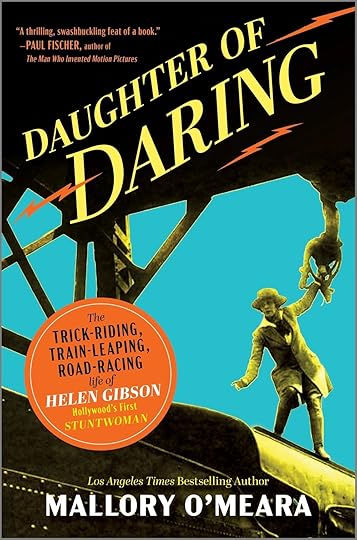
Publication Date: Feb. 18, 2025 | Hanover Square Press | 384 pages
Imagine a film industry dominated by women. Directors, producers, screenwriters, and headlining stars — all women. This wasn’t just some Hollywood Barbie-like flight of fancy, but the reality of motion picture making as it was back in the silent film era of the 1910s and ‘20s. Back them, women were not just common place, but larger than life and in charge of damn near all of it. They were the heroes of the silver screen, leaping off horses and onto hijacked trains to punch out or shoot down the dastardly men robbing people blind, or celebrating bodily autonomy in dramas about abortion, sex, and women’s rights. These women were in front of and behind the camera, crafting stories for the predominately women audiences all across America to live vicariously through, in a time when women didn’t even have the right to vote and were mostly stuck in a life of housewifery.
The biggest star of the time was Helen Gibson, a former rodeo star who worked her way up from background actor to certified star — and Hollywood’s first stuntwoman. Ginger Rogers may have had to do everything Fred Astaire did backwards and in heels in the 1930s, but before that, Gibson was on film doing everything her male counterparts were doing onscreen without padding, wires, or safety harnesses. When she leapt off the back of a car — or out of an airplane — and onto a speeding train, or did a jump trick on a motorcycle over a flatbed car, she actually one hundred percent went for it, and oftentimes in a long dress that could get snagged on something and potentially kill her. She didn’t have the luxury of green screen and CGI, or even crash landing pads. There was only one shot at a stunt, because to mistime a leap wouldn’t just mean a ruined shot, but the loss of limb or life. Gibson was a bona fide action hero, a female Tom Cruise many decades before there was a Tom Cruise, performing one hair-raising stunt after another and constantly looking to raise the stakes with each outing as cars and airplanes were introduced and made staples of American life.
Gibson, and other women like her, ruled the box office for nearly two decades, and helped build Hollywood into the titan of industry it would become in The Golden Age…which was also the period in which control over film was wrestled away from women and turned into a massive boy’s only club. Mallory O’Meara explores these decades that paint the backdrop of Gibson’s life and career throughout Daughter of Daring, a wonderfully feminist exploration of Hollywood in its infancy and development of the studio system in the years following the First World War. O’Meara delivers a thoroughly researched accounting of women’s agency and it’s “women-made women” powerhouses in front of the camera and behind the scenes, as well as a terribly sobering examination of how the legacy of women in Hollywood was stolen out from under them by various cabals of jealous men and right-wing, white, Christian censorship boards looking to profit off everything these women built and completely strip them of their power and influence until they were mostly forgotten entirely.
O’Meara’s exploration of the growth and development of Hollywood as it became what we know it today is an intriguing, not to mention sobering, look at how things used to be, how far certain groups — namely women and minorities — have fallen, and how far we as a society have yet to go (and will likely have even that much further to go after a second ruinous term of the Trump administration and whatever his plans are for his recently announced three-man band of washed-up, racist, sexist misogynistic actors cum Hollywood Ambassadors confessing to Sean Hannity their longing to be spanked by daddy). Only a few days ago, the nominees for the 97th Academy Awards were announced with plenty of fanfare around Coralie Fargeat’s Best Director nod for the 2024 horror film, The Substance. That a horror film was able to garner five nominations from the notoriously stodgy and historically horror-averse Academy was something of a feat in and of itself, let alone a horror film helmed by a woman and centered around women. Demi Moore also earned a nomination for Best Actress, hot off the heels of her recent Golden Globes win. But Fargeat’s nomination is itself a pretty big deal, making her only the tenth woman in Oscar history to be recognized. To date, only three have actually won. Ten nominations and three wins. In 97 years. Ninety-seven years. Ninety-fucking-seven years!
The typical argument is that there’s so few women directors in Hollywood, and while true now, it’s also important to recognize that it wasn’t always like that! O’Meara does a fabulous job driving this point home throughout the course of Daughter of Daring, exploring and explaining how this atrocious inequity arose and became reinforced in the years following the suffrage movement. It’s absolutely heartbreaking to have gone from hundreds of silent films crafted by women to modern-day studios committing to, maybe, maybe, one women-lensed picture a year — maybe, you know, if they’re good, as a treat; to have gone from a period of such prestigious influence for women in the 1910s and ‘20s to the era of #MeToo a century later. One can’t help but look at the work of Helen Gibson, as recounted by O’Meara, and the women that helped make her career and shape Hollywood in its opening act, and think, sadly and wistfully, they really don’t make films like that anymore.
January 21, 2025
The Labyrinth House Murders by Yukito Ayatsuji
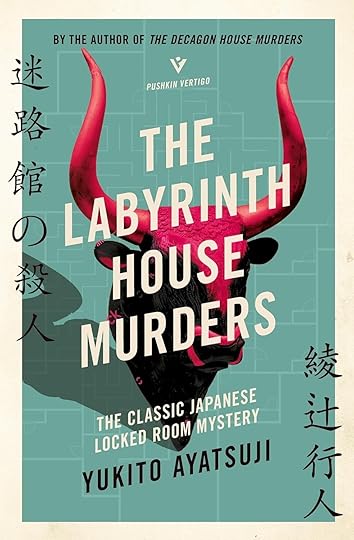
Publication Date: May 13, 2025 | Pushkin Vertigo | 272 pages
A good mystery — a well constructed, carefully crafted whodunnit — should leave readers guessing about the identity of the culprit right on up until the grand (and, occasionally, grandiose) finale, when that very last domino tips over and all stands smartly and logically revealed.
By this criteria, then, The Labyrinth House Murders by Japanese author Yukito Ayatsuji is a successful mystery. That does not, however, make it a satisfying mystery. Although it is smartly constructed, with plenty of reveals and cunning wordplay, and Ayatsuji is careful not to overplay his hand or leave behind too many obvious clues, the work never manages to bridge that gap between logic and emotion to truly connect with it or make it memorable. There’s a certain cold calculatedness to the work as a whole, befitting the work’s place a logic puzzle, but Ayatsuji fails to give readers much of a reason to care for the book’s happenings beyond simply being a puzzler. The Labyrinth House Murders is a nice mental exercise, but it makes for a fairly shallow story.
I’d be lying if I said The Labyrinth House Murders didn’t have my full attention, though. I found myself curious to see how the victims lured into this underground, labyrinthine puzzle-house would be dispatched and whether or not my guesses about the murderer and the clues left behind, formed quite early on in the proceedings, were accurate. Ayatsuji’s novel revolves around a dying mystery writer, Miyagaki Yōtarō, hosting four of the genre’s greatest up-and-comers for his 60th birthday, along with a book critic, the editor Utayama and his pregnant wife, and the “everyman” reader, Shimada. Of course, Yōtarō dies and leaves behind a will challenging the writers to craft the perfect 50-page mystery by April 6, with the winner awarded Yōtarō’s sizable wealth. With several billion yen at stake, it’s the kind of writing prize worth killing for.
The murders are uniquely staged scenes, with each fresh victim dispatched according to the Greek myth of the room they are assigned. The Labyrinth House has rooms named after Icarus, Minos, Theseus, and the like, and the discovery of the bodies left behind and the methods in which they have been murdered are easily the best parts of the book. The characters themselves, unfortunately, are one-dimensional cardboard cut-outs, lacking any depth or personality to distinguish one from another beyond the absolute broadest of strokes. We have the joker, the worrier, the woman, and… some other guy that, even now, I’m struggling to recall, their dynamism so ill-defined and incorporeal that one can’t help but wonder why Ayatsuji even bothered to name them aside from such conventions being standard practice in a book. Utayama and Shimada are our central leads and guides through the Labyrinth. Shimada gets the most character development in the form of various ticks and routinely shouting “Aha!” as if he were a caricature of a mystery detective rather than an actual detective, with Utayama proving to be the more mentally sluggish of the two. I never cared a whit about anybody in The Labyrinth House Murders.
Originally published in Japan in 1988, there’s also Ayatsuji’s casual sexism, or perhaps Japan’s well-noted misogyny, to compound matters further. When introduced, the male authors are all given sterling bona fides to justify their inclusion in this writing contest. Of course, in a fit of Men Writing Women, Ayatsuji forgoes detailing any of Madoka’s achievements and awards as a mystery author, opting instead to describe her bustline and sexy physique. The only other woman present is Yōtarō’s maid who, aside from one particular scene late in the book, exists only to serve the men tea or dinner, and to curl up in a distraught ball and either worry or mutter prayers or do both simultaneously until the next tea time.
While it does have its few moments of intrigue, I can’t help but think that The Labyrinth House Murders read better when it was originally published nearly 40 years ago, and perhaps even more-so in its original Japanese, as I also can’t help but suspect certain aspects have unfortunately been lost in translation. As it stands in 2025, it feels more like an artifact with occasional charm (I can’t help but laugh at the scene in which a group of prolific writers must have the concept of typing explained to them), or at least better suited to those who have read fewer than, say, five locked room mysteries. The Labyrinth House Murders is a smart puzzler, but one that lacks heart and soul.
January 17, 2025
Like-Minded Individuals by Beau Johnson
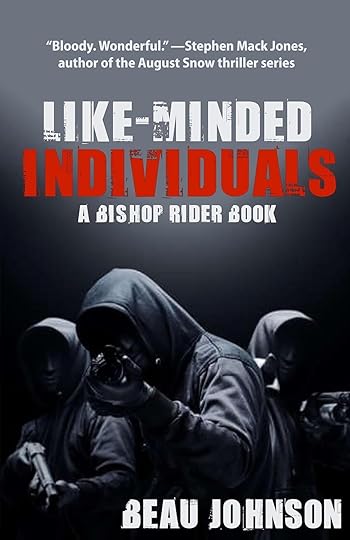
Publication Date: Feb. 2, 2025 | Down and Out Books
In 2017, Beau Johnson introduced an immediately iconic folk antihero with his violent vigilante, ex-cop Bishop Rider, in his short story collection, A Better Kind of Hate. Although Rider’s stories were but a small part of that collection, he loomed larger than life across that whole spread, so much so that Rider then became the primary focus of Johnson’s subsequent work. Inspired and influenced by similar characters, Rider was a riff on the familiar — part The Punisher, part Charles Bronson’s Paul Kersey from Death Wish — but what immediately set him apart was Johnson’s play on the chronology of the character’s exploits and his commitment to the life of this character, from his bloody initiation to the rule of lawlessness to his eventual demise. Rider was a wholly complete character study, and his story was told entirely out of order, through a series of short stories across multiple books, but with certain benchmarks to delineate the order of occurrence. Some stories took place before Rider was violently maimed, others took place well after, as an older man. Some occurred before the death of a central figure, while others followed. Allies came and went, either by choice or through gruesome ends. Rider and his small circle of cohorts wreaked bloody vengeance across the fictional New York-like setting of Culver City, a hellhole grimy and gritty enough to fit in Frank Miller’s Sin City, ruled as it is by various networks of organized crime, crooked politicians, pedophile priests, and street gang thugs. Johnson’s take on neo-noir is the very definition of pitch black. Forget various shades of grey, think various shades of darkness with no light at the end at all. And the acts of violence carried out by Rider and his companions, which were oftentimes as varied and spectacular as they were wholly uncompromising, rarely ever came without lasting personal effects. Johnson was playing a long con, as he made clear from the beginning, and finally capitalized on when he laid out all his cards in Old Man Rider and killed off his series character.
Bishop Rider was dead and buried.
But his memory, and more importantly his mission, lived on in Jeremiah Abrum, the son of a former crime boss looking to make good on his family name by adopting Rider’s tactics and aiming bigger. It didn’t take long for Abrum to step well out of Rider’s long shadow in 2023’s The Abrum Files, which passed the torch from one violent killer to another and gave us another riff on the familiar but with a fresh coat of paint and a whole new bad-ass attitude.
Like-Minded Individuals continues Abrum’s story, as told through Johnson’s typical non-sequential narrative spread across 20-plus brand-new short stories. As is Johnson’s style, some stories are set in the past, with one taking place late in the life of Bishop Rider, whose legacy continues to inform and occasionally downright haunt the events taking place throughout this collection, while others are set further down a roughly sketched and slowly revealed chronological timeline, teasing events yet to transpire for reader’s gruesome pleasures. There’s certain benchmarks to measure these happenings against, like the presence of Rory, a ruthless red-headed redresser who helps give Abrum a larger canvas upon which to operate, and the development of a training camp on land bequeathed to Jeremiah.
Perhaps the most striking aspect of this book, and the Bishop Rider series as a whole, is Johnson’s unflinching portrayal of violence. Although Johnson spares no expense in conjuring up all kinds of viciously violent ends for the scum of the earth, he’s also careful not to get too wrapped up in the muck. It’s bloody and grotesque, but never exploitatively so. Johnson plays a rather deft hand, carefully balancing the descriptions he commits to the page against all that he leaves up to the imagination — and I assure you, he leaves plenty up to the imagination, relying on the reader’s own ability to deploy the worst of it.
All of this is levied against sparse moments of black humor that is, fittingly, as dark as the rest of these proceedings. I don’t recall finding many moments of levity in Bishop Rider’s grim crusade, but Abrums? Abrums has got some jokes, son, and moments of cutting self-depreciation, like when he describes himself as “a middle-aged white dude working out his daddy issues one decapitation at a time.” After rounding up a group of upper-crust pedophiles and dumping them into an emptied out pool about to be flooded with acid, he notes of their condition, “many of them weren’t so much backed against the pool’s wall now as they were attempting to phase through it. Ah, Tuesdays.” Abrums’s work isn’t all fun and games, but one certainly cannot deny that he’s able to find a measure of sociopathic joy in it all at the end of the day.
The end result is uncompromisingly brutal catharsis. Johnson’s body of work arrives at an interesting juncture within our society’s late-stage capitalism, where the murder of a healthcare CEO is met with a collective shrug of the shoulders from a populace tired of the sadism of rich fuckers who profit off the deaths of their clientele, yet opt to elect a rich rapist to the highest office in the land over far more experienced and personable woman of color. Jeremiah Abrums, and Bishop Rider before him, exist as brash, vocal counterweights to real-life injustices, punishing the Brock Turners, Donald Trumps, Proud Boys, and Jeffrey Epsteins of the world through fictional fill-ins, just as Dirty Harry, The Punisher, and Kersey arose in response to American lawlessness and the proliferation of drugs and gang violence of the ‘70s. They aren’t good guys. But they may be the necessary guys, the right guys, the ones needed to fix — or at least send a message to — our neutered justice system, the bastard cops, and an immoral country that caters wholly to the white, wealthy, and powerful. We get why they’re here. We understand why they do what they do and what drives them. And, maybe, we even cheer them on as they take apart a child predator, quite literally, one pound of flesh at a time. It’s not about saving people, as these characters often say, and which has become a motto for this series across its run, but maybe that’s OK. Maybe all this bloody, violent, torturous savagery is enough. Maybe it’s all we really deserve, in the end.
January 12, 2025
The Black Orb by Ewhan Kim
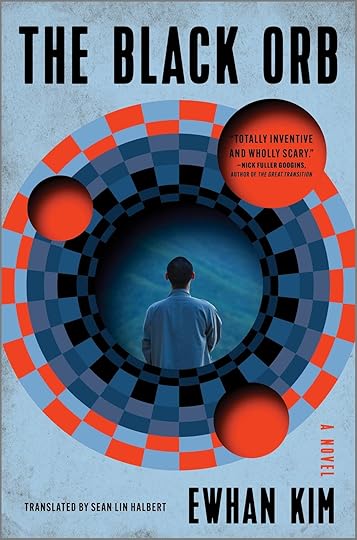
Ewhan Kim’s South Korean horror, The Black Orb, starts off in grand fashion, hitting the ground running with the feel of a classic monster movie with a nifty sci-fi twist. Jeong-su is taking a smoke break in the alley outside his home when he first notices the titular black orb approaching, watching in horror as it violently absorbs the people it comes into contact with. As Jeong-su flees, his attempts at warning others falling on deaf ears because people think he’s crazy, much to their detriment. Kim channels a slasher horror vibe almost immediately, with Jeong-su being stalked through the streets of his Seol neighborhood, as if he’s being pursued by Jason by way of a kaiju. It’s a brilliant, engaging, and intense opening.
And then it’s all pretty much downhill from there.
As the orb consumes more and more Koreans, it eventually begins to undergo mitosis, multiplying to such a rapid degree that there is no hope for humanity the world over. Kim’s monster mash quickly dovetails into the post-apocalyptic, with Jeong-su among the small handful of survivors. There’s plenty of interesting scenarios to contend with, as he tries to adapt to life on the run from the orbs, gets taken in by one group only to be exiled again, and running into gangs pillaging whatever has been left by those who were absorbed.
The longer it goes on, though, the less engaging it becomes. The orbs grow into such a monumental existential threat that we eventually become inured to their danger, and one can’t help but wonder what metaphor Kim is striving towards here. The black orbs eventually are labeled The Orbs of Despair, giving us at least one on the nose interpretation, in which society is threatened by a general malaise. The Black Orb could certainly, and perhaps most easily, be viewed as a work written in response to the COVID-19 pandemic, or even the rise of far-right politics that threaten to destroy us all the world over, especially in the book’s latter chapters which see the survivors seeking revenge and trying to place blame on somebody, anybody, for the horrors that befell them. One might even view it as a response to our lack of proper actions being taken globally against the climate crisis. Even now, with the Palisades wildfires rampaging across California, one can’t help but think of MAGA’s attempt to blame wokeness, diversity initiatives, and women as the primarily culprit behind this climate disaster rather than face scientific facts. The Black Orb is rife with this kind of broadly sweeping, one size fits all social commentary.
However, readers looking for singular answers will likely find plenty to be disappointed in. Kim offers nothing in the way of explanation regarding the orbs appearance, where they came from, or why they do what they do, letting them operate purely as a metaphor du jour. There’s a sense of timelessness to be found in this approach, of course; read The Black Orb in another twenty years and you’ll likely find plenty of socio-political concerns to relate it to as you can today, presuming we’re still around, of course.
I wasn’t particularly bothered by the lack of answers regarding the orbs, and found myself largely pleased by Kim’s commentary on society in general. But as the book went on, I couldn’t help but wonder how Kim was going to resolve the multifaceted issues raised throughout The Black Orb. Jeong-su is a selfish and self-serving protagonist that progressively grows harder to root for the more we learn about him, eventually twisting toward the downright vile as his homophobia toward another survivor he becomes mutually dependent upon grows violent and abusive. What fate would be in store for a man such as him, in a post-apocalyptic Seol ruled by violence and its demands for bloodlust to be satiated?
The simple answer is, there is no answer. Kim simply ends the novel. There’s no definitive statement, no judgements, no emotional or moral resolution. It’s the kind of weak, open-ended anticlimax that made me wish I hadn’t slogged through so much tepid, shallow character work, repetitious ideas, and vulgar sexual abuses. After getting my hopes up with such a strong opening, Kim’s lack of definitive closure, particularly as it relates to Jeong-su, feels cowardly and trite.
A part of me can’t help but wonder if something got lost in translation, or if perhaps my total lack of cultural awareness of Korean society disserved me here. It’s certainly possible I’m too much the “ugly American” to fully appreciate Kim’s commentary, and that whatever he was striving for has fallen on the deaf and ignorant in this US reader. It’s also possible that this is exactly what Kim was striving for, if we’re to view The Black Orb on a metatextual level, with his final chapters attempting to capture those feeling of despair with its oblique finale and to leave readers in a fit of discomfort. In that case, it only half-worked. I wasn’t left feeling despair, only disappointment.
January 9, 2025
Blocked by Amazon

Welcome, officially, to 2025, wherein my first release for the year has officially been banned by Amazon.
It had been my intention to release the third volume of The Horror Book Review Digest, collecting the past several years’ worth of, as the title suggests, horror book reviews I’ve written. Despite my arguments otherwise, the algorithms and AI overlords running the show over Amazon’s Kindle Direct Publishing have decided to be awfully draconian once more. They have claimed to be unable to confirm that I am proper copyright holder of these works that I have written, and that all information I have provided thus far “is insufficient because of the following concerns:
• Documentation or information explaining the edition previously published on
Amazon has not been provided.
• Documentation has not been provided to confirm you are the original author of
the content.
• Documentation has not been provided to confirm that the author granted you
rights to publish the content.
• Documentation has not been provided to confirm that rights were reverted to
the author from the previous publisher.”
I have, in fact, provided them with documentation that I am the original author of the reviews contained within The Horror Book Review Digest Volume III, and that as author and publisher I have granted myself the right to publish the content. It’s all fallen on deaf, and most likely entirely artificial, ears. And there’s the fact that, you know, I published two entire previous volumes containing reviews without any issues. The third time is, evidently, not the charm after all, and we’ll just have to add Amazon’s inability to confirm my rights as the sole copyright holder to the growing list of other things they’re unable to do, like guaranteeing pre-orders, release-date delivery, and two-day shipping for Prime members.
While you cannot find The Horror Book Review Digest Volume III on Amazon, the good news is you can buy it from me directly! I’ve uploaded The Horror Book Review Digest Volume III to the store right here on this webpage and it’s available now in EPUB format. If you’ve dug my review style or any of my previously published books, this is a great way to show some support for the work I’ve done and, hopefully, find some new favorite books to add to your collections.
(As for the other books I’ve written and that are listed in my webstore here, stay tuned for updated inventories. If you’re interested in purchasing signed copies, I need to go through some clutter and see how many paperbacks I actually have on hand before I can fulfill any orders for physical products. At the moment, the EPUB edition of The Horror Book Review Digest Volume III is the only book I am selling direct.)
Here’s the cover art and synopsis:
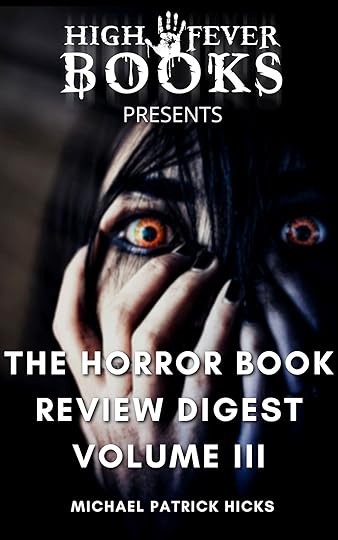
“For the last few years, Michael Patrick Hicks has been my go-to for horror novel reviews.”
Tim Meyer, author of Kill Hill Carnage and The Switch House
In addition to crafting his own works of horror, Michael Patrick Hicks has been reviewing books for more than two decades and has written for such outlets as Audiobook Reviewer and Graphic Novel Reporter.
Now, he returns with The Horror Book Review Digest Volume III, his third collection of reviews covering some of the horror genre’s biggest releases and hidden gems from 2021-2024 from authors like Chuck Wendig, Nat Cassidy, V. Castro, Christopher Golden, Tananarive Due, TC Parker, Adam Cesare, Brian Keene, Stephen King, and many, many more.
This third volume of The Horror Book Review Digest features reviews of over 100 books that promise to give you chills and nightmares! Settle in, keep a light on, and find your next great read.
BUY THE HORROR BOOK REVIEW DIGEST VOLUME IIIJanuary 4, 2025
Reap, Sow by S.H. Cooper
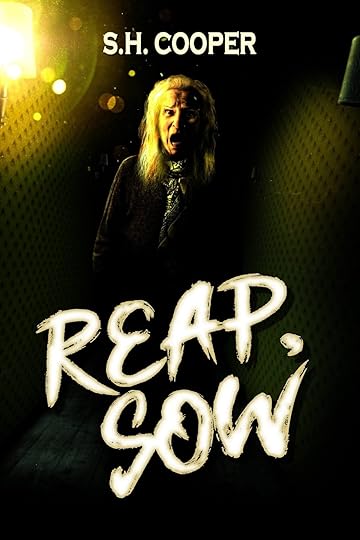
2025 appears to be having a minor liminal spaces renaissance between the releases of S.H. Cooper’s novelette, Reap, Sow, in March and Chuck Wendig’s The Staircase in the Woods in April. Interestingly, Wendig’s book became a flashpoint of controversy over the last 24 hours, as the perpetually online youth crowd who haven’t even had the opportunity to read his forthcoming release discovered, likely to their chagrin, that books can and do often share similar elements or concepts, especially when involving real-life occurrences such as the existence of staircases in the woods, and that such conceits are not plagiarism, especially when executed in such starkly different manners. Nobody tell them about the superficial similarities in synopses between Stephen King’s IT and Dean Koontz’s Phantoms that caused such a dust-up in the 80s and occasionally reoccur online as new readers discover these works. Let them discover that particular joy for themselves. Nobody tell them, either, of the initial and quite modest similarities between Cooper’s short work of grief horror and Wendig’s much longer novel, lest they stir up yet another tired hornet’s nest of attack against Wendig simply because they don’t like the man. Eventually, one of them is bound to accidentally trip over the concept of simultaneous invention and eat crow.
But I digress.
Reap, Sow opens with the familiar conceit of liminal space horrors — a young woman, Lucy, aka Lucky, finds herself in a foreign but familiar hallway, which she has inexplicably appeared in. She has no idea how she got there, and things only get stranger as she proceeds along the corridor and through the doors it offers. The architecture makes no sense and the doors lead only to the inexplicable and illogical, opening into rooms that shouldn’t be there or that exists in entirely different settings, like the inside of a barn or an apple orchard. Yet, all have some deep, personal connection to her, and as she goes from room to room both Lucky and readers become privy to her forgotten past and the secrets she has so deeply buried.
To say much more, though, would ruin the surprises Cooper has crafted. What she has built here is a memory palace that’s like Russian nesting dolls by way of Pandora’s box. The surprises hit like deft, well-placed punches to the kidney and ribs, and the reveals all make sense in the grand scheme of things. What has been crafted here is a humane and empathetic construct about mistakes and their consequences. Reap, Sow is a smartly built and deeply personal puzzle, and that Cooper does all this with such economy is a testament to her skill as a storyteller. I’ve read longer works with similar story beats that don’t land even half as well, nor as memorably, as they do in Cooper’s 60-some pages.
December 21, 2024
2024 STATS
Being a big ol’ nerd, one of my favorite year-end traditions is receiving stats from the various platforms I use, particularly Goodreads and PlayStation. Of course, both companies send out these annual wrap-ups several weeks before the year is actually over with, so within about 24 hours of having these Year In Review mock-ups land in my email inbox they’re already out of the date. I mean, it’s still nice and all, but it’s also not terribly accurate by the time the year is actually over with and leaves a little bit of stuff unaccounted. As an example, when Goodreads sent me the below batch of images, I had read 130 books, which is outstanding! But by the time 2024 ends, I expect that number will have increased to 133 or 134, along with the respective number of pages read. Granted, it’s not exactly life-changing information, but come 11:59 PM, Dec. 31, these stats end up being off just enough to get under my skin a little bit.
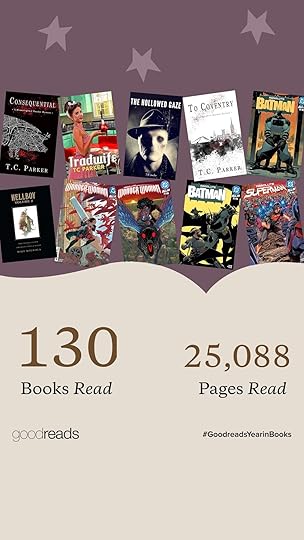
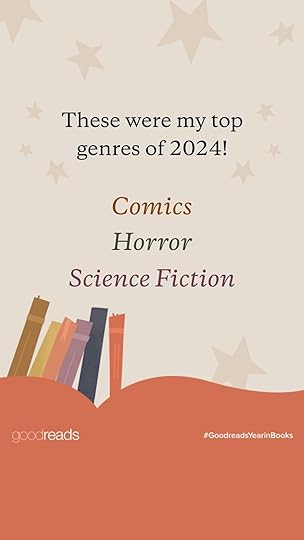
So, obviously, I spent a lot of time reading over the course of 2024, and a big chunk of these 130 books were in the vein of comics and graphics novels. I spent a lot of time working on catching up with the recent Krakoan Era of Marvel’s Merry Mutants and their various X-books and still have quite a few left. I just renewed my Marvel Unlimited subscription, so I expect to finally be able to read through the Fall of X and its aftermath in 2025, and play a little bit of catch-up with the line-wide relaunch that followed. Another batch of comics that caught my attention these last couple months was the launch of DC’s alternate-universe Absolute line, giving all new origins and brand-new stories to familiar but very, very different iterations of Batman, Superman, and Wonder Woman. All three books have been fantastic, and I’ve found myself completely surprised by just how much I’m loving Jason Aaron’s Absolute Superman. Scott Snyder’s Absolute Batman, of course, is also very good, as I had expected it to be having loved his New 52 run with the character and Black Mirror prior to that. Somehow, though, Superman has actually turned out to be my favorite of the three and I am usually very much not a Superman guy. Like, at all. I really dig how Aaron’s reinventing the character and his world(s), and really shining a spotlight on Superman’s role as a true social justice warrior that is no doubt twisting many a soiled knickers in the alt-right corner of comic book fandom.
I expect to do a whole hell of a lot more reading in 2025, particularly given the state of US politics and my likely-to-fail attempts to ignore as much of the upcoming shitshow as possible by escaping into many various fantasy worlds as a coping mechanism. Seriously, how the fucking are we doing this again? Anyway. 2025. Books and comics. That’s high on my agenda, and I’m already thinking a lot about what I want to explore or dive back into in the realm of those funny pages. Marvel’s Ultimate relaunch is a definite must-read for me, and I have a couple trades of Saga I need to catch up with, not mention a slew of omnibus and hardcover collections I’ve been squirreling away over the last few years. And, of course, that’s not even getting into my physical and digital TBR of books I’ve purchased or received review copies of. I’m sure I’ll have plenty to keep me occupied while the republican burns to cinders around me, and that’s certainly a good thing!
For these last few days of 2024, I intend on working through some Christmas horror novellas. I’ve got Brian McAuley’s two Candy Cain Kills novellas loaded up on my Kindle, along with a few of Gemma Amor’s holiday horrors, like her recently released Santa’s Grotto, which promises a murderous donkey, and how the fuck can I not read the hell out of that right away? I also snagged her Christmas at Wheeldale Inn and It Sees You When You’re Sleeping. I know I won’t be getting to all of these before Christmas strikes, but I’m aiming to get through a couple at any rate.
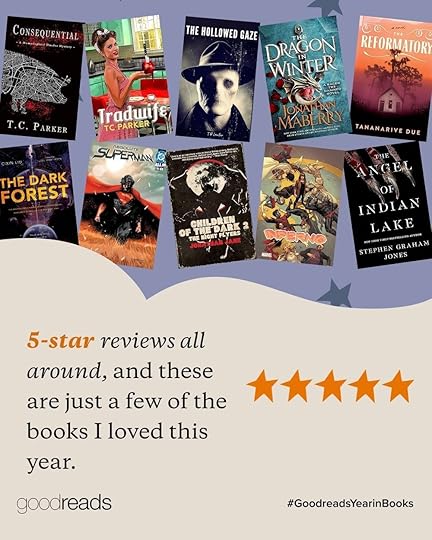
As for what I read this year, I’m not going to do a Best Of 2024 wrap-up. But since Goodreads thought to include the below image highlighting a few of the title I 5-starred over there, I’d be remiss not to include it here, as well. I’m kind of surprised at some of the titles it chose to highlight, but it’s a fair reflection of where my tastes were at this year. I do wish it had also included Laurel Hightower’s The Day of the Door and Ronald Malfi’s Small Town Horror, both of which I found to be exceptional and would have included in the below image instead of the Inferno X-book. Regardless, I’ve linked to my reviews for both, so please do check those out and be sure to grab a copy of the books, too.
2024 was also the year I got back into gaming, since I was able to purchase a Sony PlayStation 5 at the tail-end of 2023. I’ve been a lifelong gamer going back to the original Nintendo days and can still remember saving up my allowance money and making my parents drive me to Toys ‘R Us to purchase the Super Nintendo and Super Mario World when it launched back in 1991 and $200 felt like an astronomical price tag for a gaming system. I would have turned 12 just a few months prior. Good lord. Of course, now, we’re facing down new consoles with $700 price tags attached to them and fucking yikes on that. I suspect the video game arena will be pricing me out of this hobby sooner rather than later.
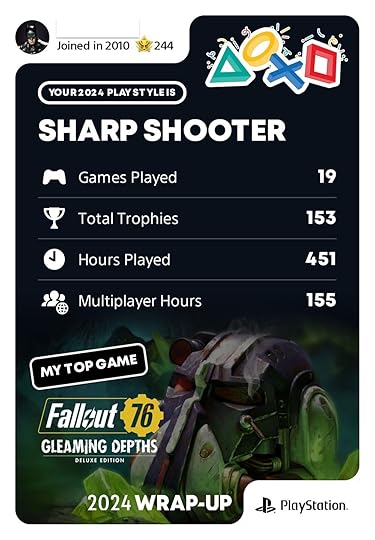
OK, a quick confession! I can’t actually take credit for sitting in front of the TV for all of those 450+ hours. My kids played Minecraft under my account on the PS4 for 45 hours over the course of 2024. Don’t worry though, they managed to rack up plenty of hours on the new system on their own accounts created just for them and their Minecraft addiction. Naturally, they eventually fell down the rabbit hole and discovered other games, as well, like a new Ghostbusters games and some Sonic the Hedgehog titles, which they were delighted to learn about after seeing the movies. Still, 400-some hours for me is… a lot. And I kind of suspect that number will only increase next year because of, well… [gestures vaguely at the current state of America.]

As for me, well, Fallout 76 was a pretty clear winner, with Warhammer 40K: Rogue Trader nipping at its heels. For as much time as I spent in those worlds, though, I don’t think either managed to provide the visceral thrills and flat-out stress of Aliens: Dark Descent, which good and truly surprised the hell out of me in the best ways possible. I’m a big fan of tactical turn-based games, and Dark Descent mostly nails what I love about that play style. Like Rogue Trader, as well, It’s very reminiscent of X-COM. I’d actually hoped to get back into playing X-COM 2 this year, but never quite managed it, and then Dark Descent ended up scratching that itch really, really well. Currently, I’m working through Warhammer 40K: Space Marine 2 and enjoying that quite a bit. It’s a pretty linear, straight-forward shoot ‘em up, and since I started that game after Sony calculated these stats, those hours and trophies aren’t reflected here. But, again, whatever.
I guess the titles I played and the way I played them earned me the title of Sharpshooter. I have no idea what other titles are out there, but have seen other gamers awarded Adventurer and Role Player titles. Based on the games I’ve bought during the latest PlayStation digital sale, though, I’m kind of expecting to get that Role Player card in 2025. We shall see!

And then, of course, there’s Letterboxd! Honestly, I didn’t get to watch nearly as many movies as I would have liked to over the course of the year. I somehow managed to not even watch any movies at all in September and, so far, December, which is kind of crazy, in my opinion. Hopefully I’ll be able to squeeze in yet another viewing of Die Hard for Christmas, and if the kids continue behaving themselves we’re planning on taking them to go see Sonic 3 sometime this afternoon. I also really, really, really want to see Robert Eggers’ Nosferatu if we can find a babysitter.
All right gang, your turn. What kind of stats did you rack up in 2024 that you’re most proud of?