Michael Patrick Hicks's Blog, page 2
October 23, 2025
The Extra by Annie Neugebauer [audiobook]
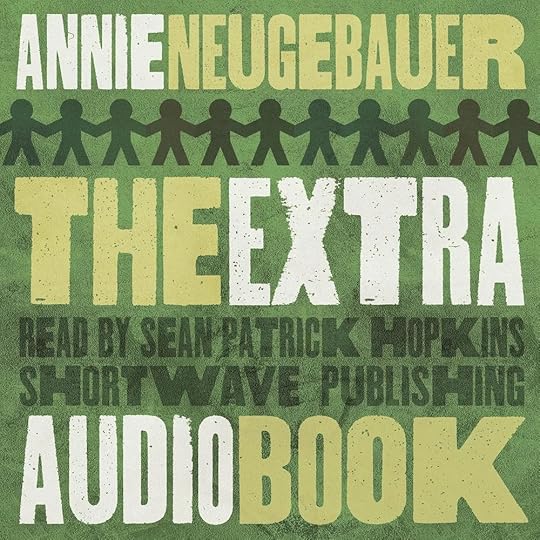
When I chaperoned my kid’s field trip to a nature reserve last year that were multiple checkpoints to take attendance before departing both the school and the park to make sure everyone was accounted for. I mention this because it was the predominant thought that sprung to mind while listening to Annie Neugebauer’s The Extra, narrated by Sean Patrick Hopkins.
Matt is our lead POV through the supernatural crisis that arises and is responsible for taking a small group of college students on a class hiking and camping trip through the woods several states away from their native Texas. Matt is a stickler for the rules and has written an entire guidebook for his two student-employees to follow. The van they take seats ten, and by god, there will be only ten people seated, even if room could be made for an extra two or three bodies, but it can’t, it won’t, not under Matt’s watch, by god.
Upon arriving at the site of their trip, the group is almost immediately set upon when a strange electrical surge knocks out their headlamps. Not long after, Matt notices something odd – their party of ten has increased by one. Somehow, there’s an extra person among them, but he can’t figure out who it is because he has memories of each of them, which could only have been planted in his mind by whoever – or whatever – this mysterious anomaly is.
And here is where I began wondering why the hell this strict rule-follower who is taking a group of college kids into the woods doesn’t have an attendance sheet. He doesn’t do roll-call, or have people sign in, or sign liability waivers for this excursion into the woods so far from home? We know these students had to register and pay for all this, so where’s the paperwork, Matt? Matt, with all his rules, doesn’t, in this age of school shootings and government-sponsored abductions and human trafficking, do the most basic bare minimum task expected of a school excursion across state lines and make sure everyone is accounted for before taking them all off in a van for an hours long road-trip to the middle of nowhere?
I get why Neugebauer doesn’t. It’s the same reason cell phones never work in these types of stories (they don’t work here, either, of course, thanks to no cell signal in the forest). To have Matt take attendance upon being confronted by this extra person would be to make this already short novella even shorter.
I couldn’t get over this omission, nor the fact that it’s not even brought up as a suggestion by Matt’s student guides who help shepherd their 7, plus one, hikers along the trail. It festered and gnawed away at my enjoyment the whole way through. I’m not sure if the lack of an attendance sheet is a glaring omission, an inconvenience merely swept under the rug, or just laziness, but it really did irk me. Maybe if this story had been set in the 1970s or ‘80s, I could have given it a pass, but in this era of helicopter parenting and cellphone check-ins, it struck me as galling. Even if I were able to overlook the lack of roll call, I cannot overlook Matt’s collection of photographs of his student group pre-hike and why he didn’t just compare that against who is present around him now. Since the anomaly apparently can’t affect digital photos the way it can the human mind, or maybe doesn’t know about digital cameras, one might reasonably conclude it doesn’t know about attendance records either. But why doesn’t Matt? We know he’s a rule lover, a fact so baked into the narrative that each chapter is titled Rule #1, Rule #2, Rule #3, etc., etc., etc.
The Extra isn’t about logic, though, so much as it is about conveying a certain mood, an emotional response, and a paranoid vibe. The parable here is an exploration of just how easy it is to Other another, and then exile and dismiss them altogether for nebulous, if not imaginary, reasons. It calls into question who the real villain is and whether or not it’s the right thing to do given perceived threats in a given context. I couldn’t help but wonder what a story reframing the point of view would like here, if we saw things through the eyes of this stranger wondering why their hiking guide is acting so weird and worrying about being found out when all it wants to do is just blend in. Maybe that would be too straightforward of an analogy, though, for certain groups already so thoroughly victimized, vilified, and excluded.
While the premise is intriguing, the execution is too soft, too clean, too cozy. We never get a real sense of what this anomalous person is capable of beyond blending in and implanting false memories, but it doesn’t appear to pose any threat beyond just being an unexpected and unwanted person our narrator has to deal with, and god, who hasn’t been there before? There’s no violence, no bloodshed, no tension, no real sense of danger, no stakes at all beyond whatever the reader’s imagination might conjure on the author’s behalf. It’s horror for people who think mayonnaise is too spicy.
Neugebauer resists any easy answers to the predicament she sets forth, approaching the subject matter with abstruseness. I never could suss out exactly why we were supposed to feel so afraid of this extra or to consider them a potential danger and wondered exactly what the harm would be in letting this person on the bus home, beyond Matt’s apparent seating issues. Would allowing this extra a ride into civilization truly be the end of the world? If so, what’s the evidence of this? Is a false memory, even a good one, enough to condemn another being? For the amount of agonizing our narrator does over this extra, it all amounts to very little in the end. It’s a shame, because there is a neat concept at the core of this book and some cool ideas. They’re all just underbaked and never materialize into anything substantial, engaging, or even remotely horrifying. At least The Extra is short, and Hopkins’ narration is powerful and attention-holding, so it has that going for it, if nothing else.


Spread Me by Sarah Gailey
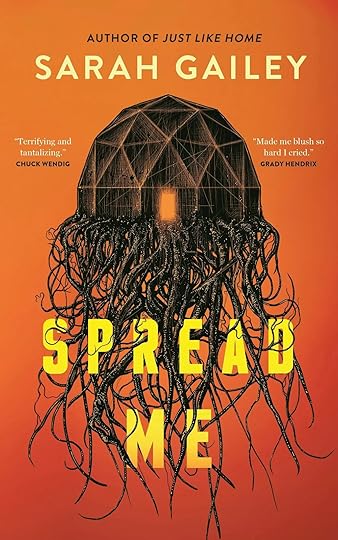
If you’re the kind of sex-positive horror reader who sees a title like Spread Me and automatically thinks of double-entendres, you’re Sarah Gailey’s target audience.
Spread Me is Gailey’s riff on The Thing, with a few important distinctions. Instead of being set in the Antarctic, Spread Me’s research station is desert-based, and the shape-shifting alien creature that can be anyone is, here, an Earth-based virus living a few feet below the shifting sands in the desert’s cryptobiotic soil. The researchers themselves are diverse, as are their sexual partnerships with one another. Gailey’s is a slow-burn modern-day update to the classic John Carpenter flick (and John W. Campbell’s 1938 novella, Who Goes There, which inspired it and Carpenter’s filmic predecessor, The Thing from Another World), with one other key difference – Spread Me is horny as fuck.
If there’s one genetic imperative driving all life on Earth, it is to reproduce. From the mitosis of single-celled organisms to us sex-having mammals, we all gotta do it like they do on the Discovery Channel. Gailey’s ancient (or perhaps newly evolved?) cryptobiotic virus seizes control of the humans it infects, causing rampant, unquenchable desire with occasional sides of body horror. It’s a nice touch that our lead heroine is named Kinsey, no doubt after famed sex researcher Alfred Kinsey. Sadly, there are no Dr. Ruth’s at this desert research lab.
Although it’s set in a desert, there are certainly no dry spells happening inside this scientific habitat, even before these researchers are introduced to this sexed-up virus. While Gailey stops well short of Spread Me being a straight-up monster porn spoof, the eroticism is likely not of one’s usual expectations. In one instance, Kinsey masturbates imagining the penetration of cellular walls by a virus and keeps a poster of cellular organisms close at hand the way a teenager hides copies of Playboy. In another, while taking a biopsy, the act of puncturing skin with a needle is described the way one might write of sexual penetration. In order to gain her patient’s consent, Kinsey must assure assure the patient that this procedure really turns her on, transforming a rote medical exam into a pseudo-sexual ritual. Readers are forced to question consent and issues of control — and who, exactly, is manipulating whom — in this twisted dynamic.
Gailey knows that, despite the focus on the sexual predilections of her scientists and the virus they are forced to contend with, comparisons to The Thing are inevitable and she establishes early on that the movie is a favorite of these researchers, as it is for all good taste-having movie lovers. Even the characters are not immune to drawing parallels between their ordeal and the seminal, iconic 1982 film. “It’s impossible not to make John Carpenter references when you work at a research station in the middle of fucking nowhere,” one character intones at the start. Instead of a swear jar, they have a John Carpenter jar and every time somebody references the movie they have to pony up some cash. Another researcher wears a Baby Slut shirt in a deep cut reference to a Kurt Russell meme.
One might find it easy to view Spread Me in the context of covid. While it’s not directly a book about covid – Spread Me is set in a near-future where pandemics have become routine staples in daily life – it’s hard not to draw those parallels. The single-celled kinks at the heart of Gailey’s book recall the loud pro-COVID-19 forces that reared their ugly heads, demanding an end to masking protocols and for everyone to put themselves in danger for their own anti-masking comfort, delirious with a desire not only to be infected but to freely infect others even as they gussied it up under the guise of civil rights and freedom. These mask scofflaws were intent on doing the virus’s work for it, as if they were themselves some kind of Ur-virus wrapped up in the cellular walls of their flag and loud-mouthed ignorance. The mounting paranoia of who is infected parallels that of Carpenter’s The Thing, only instead of Cold War concerns, Spread Me has more recent worries that echo our period of isolation and sickness during the pandemic — who is infected, who is hiding it or lying about it, and who can be trusted when the masks, not to mention the clothes, come off?
Spread Me plays around a lot with sexual identity, too. Wanting to love, and to be loved, on one’s own terms as their own unique individual, warts or mutant limbs and all, are predominate themes. Kinsey and her staff of researchers defy heteronormativity, with Kinsey going a step further with her infatuation for single-celled organisms and their methods of replication. Isolated with only each other, the researchers pair off with fluid abandon for both same- and opposite-sex pairings and hints of threesomes behind closed doors, in their need for connection. Replication drives our genes, but it’s our need for understanding and camaraderie that unites us. All we need is love, be it platonic or romantic, but finding that love can be an ordeal, fraught with peril and complications, and maybe a little bit of murder here and there. As Johnny Cash once sang, love is a burning thing, but in Spread Me, nothing’s hotter than the desert…or what lies beneath.
King Sorrow by Joe Hill
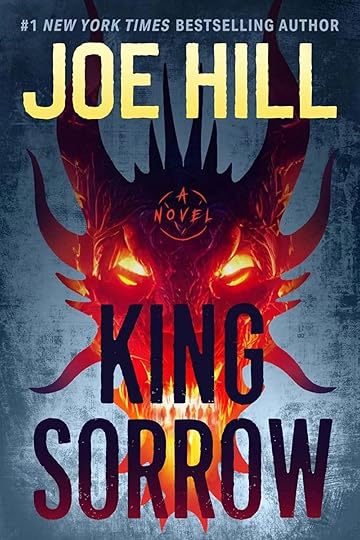
When Joseph Hillström King began writing under the penname of Joe Hill it was to prove himself as a writer on his own merits rather than as the son of Stephen King. His cover was blown early on, but not before he had secured his first book deal for 20th Century Ghosts. Twenty years later, it’s safe to say that Hill has proven himself with work across prose and comics, and with a number of his stories having been adapted for film and television. Hill is his own man, but he’s also very much his father’s son, and it’s impossible not to see King’s stamp on Hill’s creative DNA as both a parent and mentor. Rather than escaping his father’s long shadow, Hill has most certainly learned from and embraced it, co-writing with the elder King on a few occasions and populating his own works with Easter eggs from various King titles across the beam. King Sorrow, Hill’s newest, has a few fun ones, including a cheeky riff on one of King’s most famous opening lines. The rest is pure Hill, though.
King Sorrow borrows a central figure from fantasy – the high dragon, a vicious, flying, fire-breathing monstrosity – but is a straight-up horror epic through and through. The titular King Sorrow acts much like your typical deal-making devil, and when he’s summoned by college lit student Arthur Oakes and his well-to-do friends they discover too late that they have sold their souls in a Faustian bargain that can only end in death. When you make a deal with the devil there’s no winning, and all it can cost them is everything.
Arthur is in a jam, having made the mistake of being kind to the wrong people while visiting his imprisoned mother. They learn he has access to rare and valuable books thanks to his work at the university library’s special collections wing, books he can steal for them to profit off if he doesn’t want dear old mom to get shanked in the prison showers. The most valuable of these is the journal of Enoch Crane, bound in human skin, which holds the key to summoning forth a dragon. If Arthur and his Scooby-gang can call on King Sorrow, they can save his mother’s life and get Arthur out from under the thumb of these drug-addled thugs.
Of course, every action has a reaction, some intended, others unforeseen. Hill takes the long road around (King Sorrow clocks in at around 900 pages), developing a decades-long exploration of this group stuck in the thrall of a devil and a study of multiple characters as they grow and change and fracture under the weight of all they have wrought.
Perhaps it’s unavoidable that King Sorrow will garner comparisons to King’s IT given Hill and King’s relationship, its doorstopper size, and the focus on these characters across time as they engage with a dark and deadly entity across the decades, although Hill plays it straight and linearly rather than hopping back and forth between time periods. King Sorrow certainly exists in conversation with IT and even, at times, echoes it in certain plot beats, but is very much its own thing aside from some superficial similarities. Maybe it’s because of their age when we meet them, and my age as a reader, but I didn’t find myself connecting with Hill’s troupe of entitled, well-off twenty-somethings quite as closely as I did King’s Losers Club. I met the kids in IT when I was roughly their age and dealing with a lot of the same issues that come with being a kid. IT was also the first adult book I read and proved to be a foundational text for me. It’s a personal all-time favorite and means a hell of a lot to me. None of this is to say, however, that I didn’t care about the core cast at the heart of King Sorrow. In fact, I found it impossible not to when all is said and done. I loved and rooted hard for some, perhaps too much, and came to not just hate but despise others. There were times, though, when I couldn’t help but wonder as the book crossed and then dashed past the halfway mark if Hill wasn’t playing it much too safe. I couldn’t help but wonder what this book would have been like if, at some particular junctures, Hill had been meaner, bloodthirstier, more willing to drag both his characters and his readers into hell and make us all hurt.
And then he did, and I wanted to take it all back. I got what I had asked for and still found myself saying, “No, Joe, not like that!” It hurt, having my wishes granted while Hill proved the dragon wasn’t the only one with teeth here, wasn’t the only sorrow king giving us what we demanded in the worst, most tragic ways possible. Moral of the story: be careful what you ask for.
King Sorrow exists in conversation with Hill’s past works as well, particularly Locke & Key, which feels tonally similar with this work, and, at least for one extended segment, the short story “You Are Released,” collected in Full Throttle, which revolves around a disaster occurring during a flight. I can’t help but wonder how many readers who came of age post-9/11 might read the British Airways plane-set segment and find an airliner’s positive treatment of its customers and care for their comfort to be the most fantastical, borderline outlandish piece of writing here.
Some of Hill’s set pieces run a bit longer than feel necessary and start to sag under their own weight toward the middle, but the book recovers nicely and regains its fleet footing as it dashes all the way to the end. Like the dragon it’s named after, King Sorrow moves fast. It’s a pacey son of a bitch that never feels like a 900-page tome, and by book’s end I found myself wanting to spend more time still with these characters, to make sure those that remained were safe and free from future harm, which is a bit of magic all its own.
If anything, Sorrow’s length is more of a rich indulgence than a chore thanks to its well-defined characters, structuring, and hard-fought payoffs. The way Hill sets up the cause-and-effect nature of his no good deed goes unpunished premise oftentimes feels somewhat akin to the Final Destination franchise, with Death in the form of a dragon, or maybe just Fate itself, occasionally taking years to set up its own Rube Goldberg contraptions to trap and snare its victims. Although I worried Hill was playing it too safe with some of these characters in the first half, he really does put them – and readers – through the wringer by book’s end, challenging them mentally, emotionally, physically, and spiritually in ways that hurt so good.
Girl in the Creek by Wendy N. Wagner
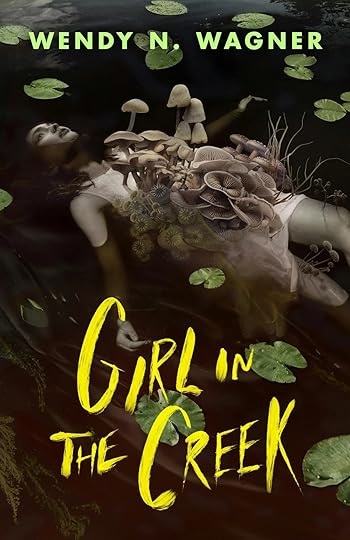
At the heart of most fungal horror works is the theme of connectedness. That, and gore. Lots and lots of gore, if we’re lucky. Hugo award-winner and editor of Nightmare Magazine, Wendy N. Wagner doesn’t skimp on either in her sporror book, Girl in the Creek.
Travel writer and podcaster Erin Harper has travelled to Faraday, OR with her showrunner and co-host, Hari, and their small crew. They’ve arrived on a newspaper’s dime so she can write about how the poor, blue-collar river and mining town is being revitalized as the next hot vacation spot. What she’s really there for is to learn about her brother’s disappearance in Faraday years earlier. Faraday has become a hotspot not just for a lowkey vacay, but for missing people. Flyers of the lost decorate the town, and soon enough Erin stumbles upon the body of a girl who had disappeared prior to her arrival – our titular girl in the creek, Elena Lopez. She’s been dead for a while, but that doesn’t stop her from disappearing from the morgue, or from her fingerprints to turn up at a crime scene after.
Of course, at the heart of it all, is an alien network of spores, molds, and fungus. Girl in the Creek lies somewhere between the classic Creepshow segment “The Lonesome Death of Jordy Verrill” and The Thing, with a small dash of pseudo-zombie mayhem and a smidge of Twin Peaks’s small-town-with-big-secrets for good measure. Wagner gets her ick on as the book moves quickly toward its conclusion, amping up the body horror to terrific effect with plenty of dried out, decaying, sloughing body parts (one particularly squelchy scene late in the book involves an infected dog). It’s hard not to picture Faraday in hindsight as some mold covered town with all manner of mushrooms fruiting from the sides of its buildings and its inhabitants. Everything just feels moist and rotten.
While the gore certainly helped hold my attention, it was ultimately Erin herself that truly kept me invested. Her burgeoning relationship with Madison, sister to one their guides through Faraday, was adorable and I couldn’t help but root for them to make it through, especially given Wagner’s propensity for upping the body count so routinely and regularly it might make George R.R. Martin blush.
Faraday itself feels properly lived in. Wagner brings in some local color with an ex-cop turned mushroom forager and the elderly B&B runner who has had her fingers in much of Faraday’s economic history. Wagner does a terrific job painting the scene for us, with Faraday surrounded by forest. One segment in the book’s opening chapter presents such a vivid picture of Oregon greenery that I couldn’t help but feel like I was there. That Wagner uses this moment to double as some rich character development to illustrate Erin’s connection with her lost brother, and his love of nature, is a stunner that really clues you into Wagner’s capabilities as a storyteller.
Then, of course, there’s the 1907 meteor strike, the biggest thing to ever happen to Faraday, or so we’re told. I’d be inclined to believe it, too, if it weren’t for the people and wildlife possessed by mushrooms. Known to itself as The Strangeness (I guess if you’re an alien fungus with enough sapience to name yourself, it’s better to call yourself The Strangeness instead of Bob or Jimmy. That, or The Strangeness is emo. Either way, it’s pretty accurate – it is pretty damn strange.), this highly connected alien network has infected the forests surrounding Faraday and incorporated various animals into its being. It watches over Faraday through the eyes of birds and deer, always seeking ways to expand and grow and consume. When its spores begin to take root in the body of the girl in the creek… well, let’s just say that’s when shit gets real. The network itself, binding the fungus to the Earth and the creatures and people it inhabits, is another highpoint in the narrative. When Wagner takes us inside it, we’re given such an intense picture of sensory overload and appalling chaos, but also a limitless vista of wonder and promise. It’s beautiful and horrific. One can’t help but wonder amidst this madness if the disconnectedness of individuality is better or worse given the promises and consequences of it all.
Of course, for The Strangeness, that sense of individuality, of differentiation, is itself a threat. When it infects Elena’s corpse, something funkier than usual happens and Elena becomes a rogue agent that must be stopped. The how and why of it all was a little too hand-wavy for my liking, even as Wagner ties it into some larger story threads involving trauma, abduction, and sexual assault. I didn’t quite buy into The Strangeness and Elena serving cross-purposes and wish there had been a bit more meat on this conflict.
Girl in the Creek has just a few too many parallel threats enjoining Erin’s attempt to find her brother, but none feel as fully fleshed out as they could be. On the whole, though, Wagner’s latest cli-fi offering ticks enough boxes to satisfy, and certainly has its share of memorable and disquieting moments. Wagner herself is one hell of a writer, and she can do a heck of a lot in only a few words. Perhaps the highest compliment I can pay Girl in the Creek is that it made me want to check out the rest of her works, which given my backlog of books to read is no small feat indeed.
October 22, 2025
Kill Your Darling by Clay McLeod Chapman [audiobook]
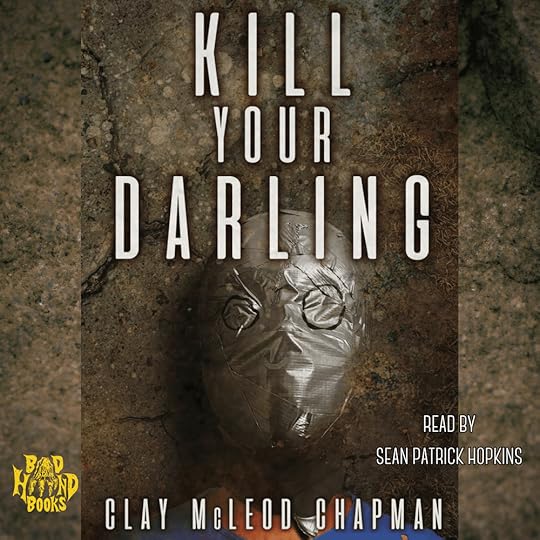
Fresh off his work as an ethereal voice on the other end of a disconnected phone in Stay on the Line, Sean Patrick Hopkins returns to narrate the hell out of another grief-laden horror novella from Clay McLeod Chapman in Kill Your Darling.
Glenn Partridge and wife lost their 15-year-old son to a brutal murderer 40 years ago. It’s a wound that won’t heal, can never heal. Glenn’s wife signs him up for a community writing workshop in the hopes that it’ll help get him a hobby, and get him out of her hair for a little while. Rather than distract him from the obsession of his son’s death, Glenn finds it an opportunity to tell their story, or, perhaps more importantly, to tell Billy’s story. Billy’s murder has been a cold case long enough for a long line of detectives to have retired and die, none of them ever getting any closer to solving the mystery. In telling Billy’s story and unraveling the past, Glenn hopes to find answers, but does he really want the truth?
Chapman is a hell of a writer. His words come from the gut as much as they do the heart, and he’s content to use them as knives to stab at readers with an assassin’s precision. Glenn’s in his 80s. His son has been dead longer than he ever had a chance to live, but his murder took away Glenn’s life, too. The man has gotten old, but it’s been a long, slow death since losing Billy. Whatever is left of him exists only in the hopes that there might be some resolution, some bit of closure. He calls the police daily asking if there’s been any new leads while studying the last shirt his son ever wore in the hopes of scrying a blood stain the forensics team missed all those years ago. He maintains a photo album documenting every inch Billy’s too-short 15 years. He’s given over his existence to become an eternal flame in tribute to Billy. He’s married, but it’s his dead boy that defines him.
Hopkins captures this all perfectly in his reading of Chapman’s material. There’s a rough hollowness to the words spoken that echo Glenn’s loss. We feel the grief, the emptiness, the anger, leeching into Hopkins performance throughout, and the ways hope compete against hopelessness. It’s an emphatic and, more importantly, empathetic reading.
Kill Your Darling forgoes the supernatural in favor of those all-too-personal real-life horrors. The horror of loss, of the brutal murder of a child whose head was encased in a mask of duct tape and suffocated, the horror of never knowing why it happened or who did it. There are no made-up monsters, no vampires or zombies to explain it all away for us. It’s all human, the kind of horrors Chad Lutzke or Jack Ketchum largely wrote about in their too-recognizable monsters that live next door. It’s the kind of horror Clint Eastwood might have adapted to film, starring and directing in between talking to an empty chair at conventions for fascists, back when he was riding high on Gran Torino or Mystic River, if only this book had come out 20 years ago. It’s the kind of horror that’s scary because of how realistic it is, rooted so firmly as it is in the possibility of loss and tragedy and the ease with which one can lose themselves to grief.
Mushroom Blues (The Hoffman Report #1) by Adrian Gibson [audiobook]
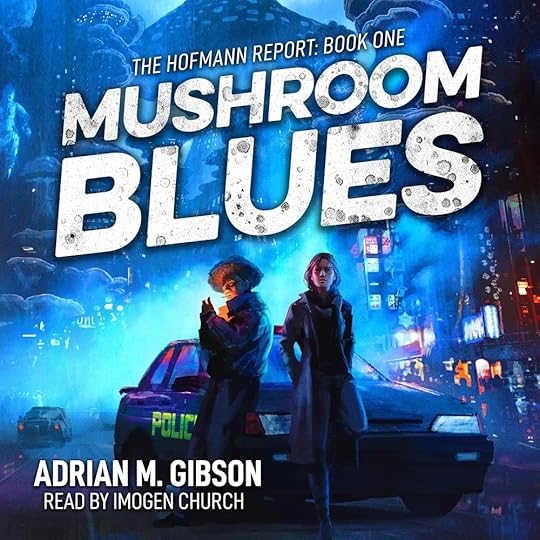
Exiled to the island nation of Hōppon, homicide detective Henrietta Hoffman is assigned the thankless case of investigating the murder of a dismembered mushroom child. Tensions are high between humans the fungal Hōpponese two years after the end of the decade-long Spore War and humanity’s invasion and subsequent military occupation of the island. Hoffman’s crime scene quickly devolves into a riot between Neo Kinoko police and the growing crowd of angry Hōppons, and that’s just for starters.
Canadian author Adrian Gibson’s debut cements the dark and gritty tone of Mushroom Blues’s hardboiled detective noir right from the outset. He doesn’t pull any punches along the way either. What follows is an exploration of colonialism and racism, with Hoffman continually finding her preconceptions about the Hōppon people and their culture challenged. She’s not particularly thrilled when her captain forces her to work alongside the only fungal in the NKPD, Koji Nameko, who is viewed by his people as a traitor to their race. Their partnership is a bumpy one, and Gibson puts a smart spin on the usual buddy cop formula with their vastly different personalities, morals, and ethics oftentimes putting them at odds with one another as much as the criminal forces they find themselves up against.
Hoffman herself doesn’t ingratiate herself with readers right off the bat, either. She’s offensive, rude, belligerent, and supremely racist against the Hōpponese. She’s bought into the propaganda of humanity’s party line that theirs is a superior species and that the fungals are beneath them, and she routinely hurls half a dozen racial slurs their way. For her, these mushroom people aren’t people at all – they’re sporesacks, molders, gillies, and hopheads. She’s also deeply traumatized thanks to her own mistakes as a recovering alcholic with too many years under her belt of investigating humanity at its most inhumane. She’s angry at everything, herself most of all, and she lets everyone know it.
Gibson draws a number of parallels between post-WWII Japan, British colonialism and American racism, the latter feeling particularly topical now amidst unhinged ICE raids across the country and the recent military occupation of Los Angeles, with the US’s Dear Leader promising to deploy armed forces to more Democrat-led cities soon. The island nation of Hōppon and its people are transparently Japanese analogs, but with a few twists and mushroom-centric embellishments to better define their beliefs and culture, providing a degree of separation that prevents them from being simple Asian-inspired stand-ins. Gibson does a swell job of bringing in actual mushroom science, like the Hōppon’s mycelial network, and expounding it into something evolved and extraterrestrial. It’s a natural part of their world, but also serves to separate them from humanity and point toward something potentially darker and, at times, threatening.
Gibson’s world building is on point, with Neo Kinoko coming alive in vivid detail. It feels real, from the city’s bustling streets and military checkpoints to its people still reeling from the Spore War and the devastation it’s wrought and the foods they find comfort in and which bind them as a culture, but also alien with its towering fungal constructs and mushroom-based technologies. There’s much to be said about the well-earned resentments on both sides, but it’s clear from the outset who our sympathies are meant to lie with. Although our central viewpoint through this war-torn, militarily occupied world is Hoffman, Gibson plays it smart and isn’t content to give us just another ethnocentric work of copaganda, choosing instead to build upon the complexities of post-war policing in a world that Hoffman’s people are responsible for decimating. Nameko helps to open her eyes to the realities of the world around her and erode her misconceptions about the Hōpponese, but even by book’s end it’s clear she still has plenty of work to do. For many of the Hōpponese she’ll always be nothing more than just another human invader, a colonizer and genocider, and it’s certainly not difficult to understand their point of view.
Bringing Hoffman to life even beyond Gibson’s crisp writing is narrator Imogen Church. Church acquits herself fairly well here, but with a few minor issues. I couldn’t help but find some of her work, particularly when voicing male side characters, to be much too exaggerated and tonally inconsistent, not to mention downright shrill at times. She’s at her best when she keeps things subdued, but occasionally launches into scenery-chewing overacting that feels out of place. The production value is top-notch, though, thanks to Chelo Suarez, who introduces some neat audio effects, such as when police give orders through a bullhorn. Each chapter is fronted by original pieces of music by Sporer, most lasting only a few seconds, but which give the book a nice bit of funk.
Mushrooms and spores have long been a staple of weird fiction and horror stories, but I wasn’t aware of the SFF subgenre of fungalpunk until Mushroom Blues caught my attention earlier this year. Now that I know about it, I want more, from this genre and this author particularly. I’ll be getting my wish soon, thankfully, with Gibson having recently announced his follow-up, A Murder Most Fungal, a stand-alone novella set within Blues’s fungalverse. As for what this fungalverse is – think part Blade Runner, part Alien Nation, all ‘shrooms. Combined, it makes for a rich, lucious, and highly addictive duxelles.
Breathe In, Bleed Out by Brian McAuley
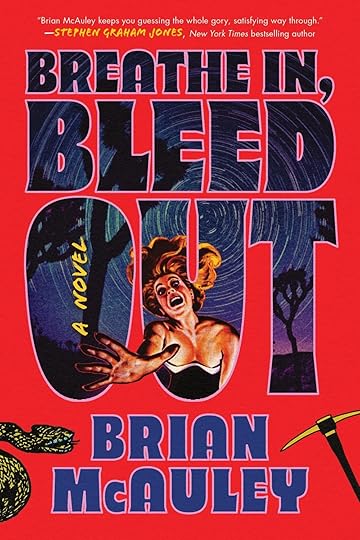
Brian McAuley is clearly a fan of the slasher genre, a corner of horrordom he has paid much homage to with his growing body of work, as evidenced by Curse of the Reaper, two Candy Cain Kills books, and his latest, the wonderfully titled wellness retreat chiller Breathe In, Bleed Out. However, one of the more challenging aspects of crafting an homage story is that it can remind readers how much better the subject being paid homage to was originally. Tread too closely and the homage simply becomes derivative, sacrificing its own uniqueness and surprises while adding little to the growing canon those works inhabit.
Rather than carving out his own identity within the slasher genre, McAuley is more comfortable aping what’s come before, producing fair to middling books that earnestly wear their inspirations on their freshly laundered Fright-Rags sleeves, while contributing little that’s truly new or memorable, save for their flights of logic. Take, for instance, the overly sappy and saccharine unearned ending of Candy Cain Kills Again, which offered one of the most forced, craven, and disingenuous happy endings in recent memory by demanding that both its characters and its readers forget literally everything that occurred prior.
In Breathe In, Bleed Out McAuley turns his eye toward the wellness industry and influencer culture, with a few jabs at cultural appropriation, but does little to really explore these topics with any kind of depth beyond “It’s bad, m’kay?” He saves much of the messaging for what he intends his work to say for the book’s long, explanatory afterword rather than illustrating these ideas throughout the body of the story, playing it safe lest he offends those seeking spiritual enlightenment at secluded hippie cult communes or the sycophants who run them.
Our Final Girl this time around is Hannah, a medical intern forced into taking a leave of absence after getting high on the job and nearly killing a patient. She’s turned to therapy to get drugs to help her cope with the death of her fiancé. In an effort to help her heal, her best friend Tess has booked them and their friends for a weekend retreat at a secluded and highly secretive wellness resort. They’ll live in yurts, do yoga, meditate, commune with nature, and get high spiritually instead. Of course, the site of this secret desert commune just so happens to be a stone’s throw from where an old, gold-digging outlaw died centuries ago and has become the subject of a local urban legend and tourist trap for the nearest outlying town. It’s not long after arriving at camp that this merry band of yogateers come under assault by a lone figure clad in mining gear, a pickaxe wielding slasher icon to be in the vein of My Blood Valentine by way of The Texas Chain Saw Massacre by way of Scream with a dash of Josh Winning’s Heads Will Roll and a dozen other been there, done that derivations.
Hannah is a complete wreck of a character, and I mean this positively. She’s a mess. Psychologically scarred by intense trauma, she pops pills like they’re Tic Tacs and regularly hallucinates being stalked by her dead lover. She’s a complicated and complex character, with enough self-awareness that one can’t help rallying behind her when the chips are down and everyone seems intent on turning against her. She’s easily the best, brightest, and strongest aspect of Breathe In, Bleed Out.
Unfortunately, Hannah is stuck in a slight, lightweight narrative that does little to stand out in such a crowded genre as the horror slasher and spends so much of its page count reminding you of all those other slashers McAuley gleefully cribs from. While it’s not inherently a bad thing, Breathe In, Bleed Out, and much of McAuley’s growing bibliography, feels more like fanfiction than something original. There’s no freshness to his ideas, and even less in his messaging. Although the desert wellness retreat setting provides the opportunity for some neat kill scenes, like death by sauna and a violent yoga mat murder, McAuley never risks rising above or beyond those moments. He nods passingly at the dangers of our capitalism-driven, Instagram influencer-sponsored wellness industry, but doesn’t have anything deep, meaningful, or even new to say about it. He can point a weak finger at the subject, but he never mines deeply enough to really interrogate it in a meaningful way. Ditto mental health treatment, although here McAuley paints with too wide a brush, treating legitimate forms, like counseling, with too much cynicism and false equivocations.
Like so much of the influencer dominated fitness trends, Breathe In, Bleed Out deals in superficiality. It might appear sexy at first blush, flexing hard under the right lighting to show off toned curves and sleek definition, but it’s never truly provocative despite being so scantily clad. It’s a book built by and for online buzzwords, hashtags, and marketing trends, and the last thing McAuley wants is for his readers to be challenged or forced into thinking about something that might make them uncomfortable or squeamish outside the gory bits.
Secret Lives of the Dead by Tim Lebbon
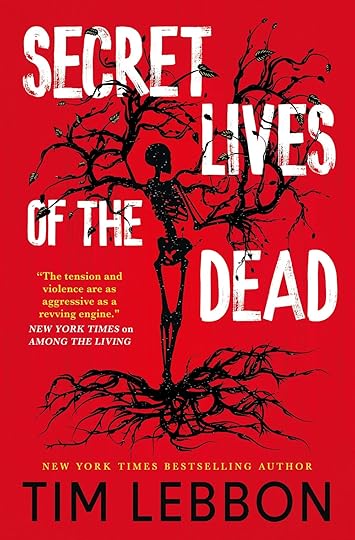
Some authors are content to spend their entire careers essentially rewriting the same book over and over. Much to his credit, Tim Lebbon is not and of the handful books of his I’ve read each has felt wholly distinct from one another. He’s an author equally at home with media tie-in properties, like his Alien or Firefly novels, as he is with his own original ideas. He’s an assured storyteller unafraid to push himself into new arenas and genres with works spanning the breadth of the speculative fiction domain.
His latest, Secret Lives of the Dead, veers sharply toward the crime thriller end of things, with only a small nod toward his horror roots. In the book’s opening pages we’re introduced to Jodi, BB, and Matt, close-knit friends who have been sold on a minor adventure by Jodi to break into the long-abandoned manor that has become the subject of local gossip and urban legend revolving around a familial curse and a long-dead witch. It’s not just the derelict home that’s keeping secrets, as Jodi has her own reasons for starting their day off with some light B&E. It’s not long before the situation spirals out of control with the introduction of the heavily tattooed and psychopathic killer Lem, who arrives at the estate looking for the very same artifact Jodi is covertly seeking.
One of the hallmark characteristics of the thriller genre is its rapid-fire pacing. Secret Lives of the Dead has this in spades and speeds forward like Usain Bolt. Spread across only a single morning, Lebbon keeps the action tight and frenetic, with the plot unravelling across what is essentially a very long chase scene across the fictional setting of Mariton in the UK. Mariton’s a fitting place for all this, sounding a bit like marathon, and with the author being a triathlete with a love for endurance sports. Secret Lives of the Dead is itself a marathon run, and these characters’ endurance is pushed well beyond any of their limits.
Lebbon slows down sparingly to shade in his character’s motivations, answer reader’s questions about them, and link them together via a series of flashbacks. Even then, he still manages to maintain a sense of violent dread, particularly with Lem, who has no tells or other outward signs to indicate what his reflexively violent reptile brain might do next. Lem’s encounters as he searches the country far and wide for the artifacts to break his family’s curse offer those he comes across one thing, but could quickly derail into something else entirely. A small, insignificant conversation with Lem could lead to a quick, brutal, and unexpected violent clash in a heartbeat. He’s emotionless, remorseless, unflappable, and horrifying in the vein of Cormac McCarthy’s Anton Chigurh. Unlike Chigurh, Lem doesn’t leave the fate of his potential victims up to a coin flip as much as he does his own whimsy, which often leans toward murder because that’s just Lem’s natural instinct. We also understand Lem more than we do Chigurh, even as he repulses us. He has his own motivations for doing what he does, even if he comes across as a more thuggish Terminator.
Jodi, too, has her own motivations and reasons for keeping secrets from her lover, BB, and his best friend, Matt. She’s a survivor of Lem’s traumatic actions and Lebbon fills in the blanks well enough to make us understand her viewpoint even if it is disagreeable and leads to numerous unintended consequences that stack one atop another in an out of control death spiral.
As for the horror elements, well, Secret Lives of the Dead is, first and foremost a kinetic crime thriller. For all its talk about witches and curses, the artifacts driving and pushing Lem and Jodi into conflict are a straight-up MacGuffin. Swap those out with drugs, money, or a briefcase with a glowing gold interior, and you’ve got a straight-up crime story. Make them the bones of a witch, throw in a couple gnarly moments of extraordinary violence, mutilation, and/or dismemberment and, presto-change-o, now it’s a horror thriller. With a few adjustments, Lem and Jodi could have been motivated by literally anything else. Lebbon keeps the line separating bad luck from a curse paper thin, allowing readers to draw their own conclusions on the validity of these characters claims. Wondering how much of the narrative is supernatural versus a series of poor, rash decisions made on the run is like wondering why only Christians get possessed by the devil.
The real horror, though, comes through the characters themselves. Lem is, inarguably, a human monster. Jodi less so, although her propensity for keeping secrets results in monstrous repercussions. Who needs witches when you have characters like this?
King of Ashes by S.A. Cosby
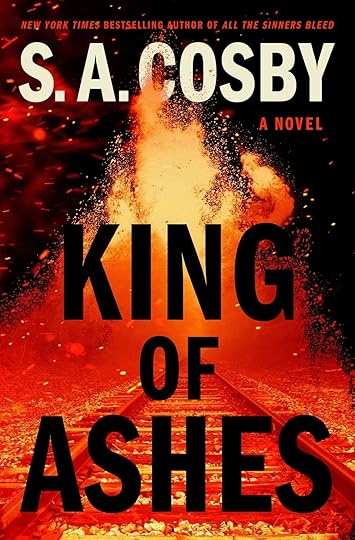
After his father is attacked and left comatose, Roman Carruthers returns home to discover his brother is deep in debt to local gangsters and his sister on the brink, obsessed with finding out the truth about their mother’s disappearance when they were teens and carrying on with a crooked cop, all while trying to keep their family business up and running. Roman tries to square Dante’s debt with the BBB gang, but it soon becomes clear that no matter how much they paid they’ll never be free, and soon he finds himself embroiled with the vicious and sociopathic Tranquil and Torrent, and hellbent on destroying the gang from the inside.
S.A. Cosby flew into the crime scene like a bat out of hell with his Big Publishing debut, Blacktop Wasteland, back in the summer of 2020 and he hasn’t slowed down a bit. Five books and five years later, he’s quickly earned his place as one of the crime genre’s absolute best, not to mention becoming a favorite author of mine in short order, thanks to consistently turning out gritty, character-rich Southern crime epics. His latest, King of Ashes, is his best one yet, and that’s saying an awful lot considering just how damn good his previous books are. This one is an absolute powder keg.
Sprawling and dark, King of Ashes is also the kind of book that only gets better and more rewarding with each turn of the page. Much of this is down to Roman himself. He’s a financial advisor to Atlanta’s biggest hip-hop stars and has made his bread getting them rich. He’s smart and savvy with money, and when he first meets Tranquil and Torrent he mistakes their street gangster ethos for the fake, recording studio-ready gangstas he’s been working with. It’s a lesson that costs dearly, and a mistake he won’t soon repeat. As his plans for dealing with these two psychotics evolve, he finds himself sinking deeper into the muck, while readers are left to wonder just how far Roman is willing to go to protect his family and exact his vengeance.
Cosby takes his time building up, while simultaneously degrading, Roman over the course of numerous bloody and fire-fueled events. We’re given a front-row seat to witness the ways in which money and power can corrupt a man’s soul. Raised by his father and educated by way of bon mots like “Everything burns,” and “To be a king, you have to think like one. You have to do king shit,” Roman’s fall from grace is stunningly potent, and what makes it all the more fascinating is Roman’s own disconnect from himself and the way he blames Dante for everything. While true to a certain extent, there comes a point where Roman can’t blame anybody but himself but is pathologically incapable of it. Cosby’s turned out a brilliant and compelling character study here, bringing with it shades of Breaking Bad‘s Walter White and The Godfather‘s Michael Corleone. In some ways, I couldn’t help but imagine Roman bemoaning, “Just when I thought I was out, they pull me back in,” as he throws yet another body into the crematorium.
For as rich as the character work is, Cosby goes the extra mile to ensure that the setting is equally vivid. Jefferson Run may be a fictional Virginia town, but it feels real. It’s seedy and run-down, with Carruthers Crematorium, a bar and seafood joint, and a weed dispensary among the few viable businesses left in an area run down by urban flight, economic despair, political corruption, the proliferation of drugs, murder, and gang violence. Jefferson Run is a character in its own right, and a stark reflection of Roman and what he can become. Cosby encapsulates the nature of Jefferson Run in a single sentence when he writes, “A light rain moved across the city like it was crying over the blood on its streets.” We come to know this city as intimately as we do Roman himself, and in doing so we know the rain won’t ever wash it clean, certainly not for long.
King of Ashes is among the few books that, upon reading through its very last page and absorbing its implications, I couldn’t help but breath out one single word: “Wow.” The tour through Jefferson Run, and through the mind and deeds of Roman, was messy, violent, complicated, and oh so satisfying. Story-wise, it was like sitting down for a five-course meal, and by book’s end I was positively stuffed. I ate good with this one, even if certain moments and character’s decisions were stomach-turning. Now… when’s the next book come out?
A Game In Yellow by Hailey Piper
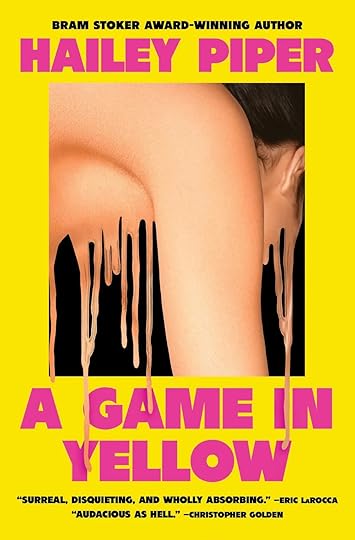
There’s been an odder-than-usual streak of puritanism running amok these last few years when it comes to sex in media. Some argue that sex scenes are unnecessary or, at the more extreme ends, spout spurious claims of mental harm because they, as the consumer, did not consent to read or witness sex scenes. And that’s not even getting into the weirdo spinster Moms for Liberty whackadoos storming libraries and local school board meetings who can find porn in even the most sterile texts outside their Holy Bible. Or the big, tough manly men in state and local legislatures who cower in terror at the mere mention of gay love and launch a proliferation of book banning laws targeting schools, libraries, and bookstores. The more obsequious among us proclaim that sex scenes don’t serve the plot, as if every line of dialogue, every interaction and character beat, every scene of unrelenting wholesale slaughter must serve that unerringly, grimly strict taskmaster. God forbid that both characters and consumers find joy in sex!
Thankfully, Hailey Piper is not one of these odd prudes, and with A Game in Yellow, she even manages to get ahead of these critics arguing that sex scenes don’t serve the plot by making sex integral to the plot. Kink and the submissive and dominant roles that Carmen and her lover, Blanca, inhabit fully inform these characters and their relationship. They have wants and desires, and their sexual intimacy is a cornerstone of their relationship. Their passions, as detailed to us in various roleplay scenarios and breathing and rope play, and later the addition of a third partner, reveal the level of trust that exists between them beyond the physical and the ways that trust and emotional connectivity can be upended and weaponized by outside forces. These moments don’t exist solely to titillate readers — although if that were their only purpose, that would OK too! — but to give life and definition to these women, to present them as fully-formed, three-dimensional human beings, warts and all.
And oh boy, are there ever warts a plenty. Carmen and Blanca are messy, messy lesbians. Carmen, particularly, is about two steps shy of being an actual walking disaster when we meet her. Their relationship has hit a plateau after two years and Carmen is struggling to maintain an interest in sex with her lover. Blanca is willing to do anything for her partner, as Piper lays out in the first chapter, which sees the couple engage in bondage and asphyxiation play with submissive Carmen tied to a chair and smothered with a plastic bag. For Carmen, ecstasy can only be found in that narrow line between life and death.
But even increasingly dangerous kinks can only hold Carmen’s attention for so long before her disinterest returns. Blanca takes her to The Underground to meet a friend and eventual hookup partner, Smoke. Smoke holds the key to sparking Carmen’s interest and introduces her to a dangerous text, the infamous play The King in Yellow. Those who read the play are driven to madness… or worse. Smoke’s copy is incomplete, but what she possesses is enough to drive Carmen wild. But as one reads the play, so does the play read them, and Carmen is forced to weave between this world and another, plagued by nightmares and waking terrors, performing actions that are out of her control. Or are they? Is, perhaps, the submissive the one who is ultimately in control, or is the living city of dead Carcosa, which exists beyond the veil, the one in charge?
Piper’s writing is positively hypnotic, both cutting and cunning in equal measures, and I found my own reading experience with A Game In Yellow dovetailing Carmen’s obsession with the ancient French play. Much like Carmen, I quickly grew obsessed with these pages, desiring to sink ever deeper into the lush world present in this text, to the point of addiction. I was fully enamored with A Game In Yellow, made drunk on it by the time it was finished. It’s the kind of book I’m torn between hyping up loud enough to see it become a best-seller while also wanting it to become an underground cult classic that inspires obsessive devotees. The kind of book that should be talked about in hushed tones at concerts and convention circuits, with worn, coffee- and nicotine-stained, dog-eared copies passed around by hand to help initiate the curious. One of those reads that’s just our little secret, and if you know, you know, like a modern day “Do you read Sutter Cane?” passphrase that helps one find their tribe.
Pulling plenty of inspiration from Robert W. Chambers The King In Yellow, Piper’s work serves as a modern-day sequel and a welcome addition to the canon of cosmic horror. Chamber’s titular King has enjoyed a bit of a resurgence of late, playing a key role in Jonathan Maberry’s Kagen the Damned horror-fantasy series and Todd Keisling’s The Final Reconciliation, and influencing the first season of HBO’s True Detective. It’s nice to see a forebear to and influence on H.P. Lovecraft enjoying their time under the (twin) sun(s).
Some might claim, and a few might even try to argue, no doubt unsuccessfully, that this story could have been told without such a heavy focus on sex and kink play. To eliminate these elements would wholly undermine Piper’s intent, ambitions, and narrative prowess. The sex, and how Carmen, Blanca, and eventually Smoke, connect with each other via sex, is every bit as important an element as Chambers’s foundational text and provides vital insights in these characters relationships and Carmen’s psychology. Sex is the instigating action from which all else here is derived. To remove these elements from A Game In Yellow would be to destroy it.
If this were the ’90s, A Game In Yellow would sit proudly alongside the works of Kathe Koja or Clive Barker, possibly as a Dell Abyss title, resplendent in its griminess and eroticism. There would still be controversy, to be sure, but I suspect it would feel less like a flashpoint than today. In 2025, with Americans having voted for fascism, where race, gender, sexual identities and preferences are the new Satanic Panic with scores of anti-LGBT and anti-trans legislation, oftentimes coded as anti-pornography bills, sweeping through too many state governments, A Game In Yellow is a timely piece of resistance fiction thanks to its mere existence and the human beings it represents. Focusing on gay relations and sexuality, and authored by a trans woman, it’s the type of work mouth-breathing right-wingers would decry as pornographic (it isn’t), shrieking as they do about the safety of the children while simultaneously clamoring for the elimination and undermining of school lunch programs, child labor laws, environmental protections, sensible gun laws, and vaccination requirements. Piper and her stories are welcome — and, particularly now, vital — works of OwnVoices horror fiction, offering seedy, hallucinatory scares, frightening worlds, and plenty of much-needed representation during a time when it is sorely needed to help push back against Christofascist propaganda.
Even beyond the politics of its existence, A Game In Yellow is just a frighteningly damn good book. It’s easy to get lost in these pages, to lose yourself to the story, to the point that you can very nearly see the twin suns setting across the lake of Hali and the shimmer of lost Carcosa. Just try not to lose yourself, dear reader. I can assure you it’s all to easy to do so.