
Leo X. Robertson's Blog, page 24
September 25, 2014
Giveaway for my new book: SINKHOLE
Goodreads Book Giveaway

Sinkhole
by Leo X. Robertson
Giveaway ends October 31, 2014.
See the giveaway details at Goodreads.
Enter to win


September 14, 2014
Reminder of the crucial relationship between characterisation and plot in the form of a random rant about 12 Years a Slave and other crap films
I’m really happy with the examples I’ve managed to use in this, because I think it shows that good storytelling has nothing to do with the perceived quality or importance of the story, and that really you can analyse pretty much any story if you want to learn how to do it. Story is king. You don’t get away with not having a story, no matter how low or highbrow your thing is. There’s no excuse for bad storytelling and no one should be forced to accept the importance of your work if the story is bad (I’m still reading Gertrude Steins Making of Americans by the way so apologies for the infectious repetition.)
Emotional relativity is super important in fiction: it’s pretty much the whole point. Achieving emotional relativity requires characterisation. Without characterisation, no event in a story has any meaning. No event in a story has a priori an assigned weight of positivity or negativity: in other words, no event matters unless we know what the characters think of it, how they react to it, etc.
Say in your story someone is murdered- it’s not yet an event on its own merit. I don’t know how much weight this thing holds: I have no idea if this is good, bad, if it makes people happy or sad, if in your created world it’s necessarily better or worse than just getting injured. You could kill a thousand unimportant characters in one sentence or you could show a character that your audience is invested in being slowly killed against his best efforts to avoid this, and as it happens you’re forced to consider the impact of this event on the people who knew him, or who didn’t, what this says about the world that this is happening, what he must be thinking as it happens etc, but these layers don’t form automatically.
Some real examples:
- Patrick Bateman is presented with a business card that’s nicer than his and this makes him want to murder the guy who showed it to him. Me and you don’t typically wanna do that, so this then evokes curiosity, humour, horror, etc.
- Carrie Bradshaw is home alone on a Saturday night and no man is ringing her. This is worse than the holocaust: I have to assume this, as this incident is about as emotionally engaging a thing that happens within the story world of SATC, so the benchmark is thus set. This allows us to laugh at her childishness and emotional infantilism (right? That’s why we all love SATC?? I love SATC. I am woman, hear me roar! Genius.)
- The main guy in 12 Years a Slave is enslaved. I guess I should assume that he’s not happy about it, but I don’t actually know how he feels about it, because I don’t know anything about the character and he has the same expression on his face the whole film. He has money and a nice family- we guess he loves his family and likes having money more than being enslaved, but look at the above examples: there’s no reason for us to assume this. We shouldn’t have to assume anything: we should be shown everything necessary. Yeah okay some basic elements are there, but what’s at stake? Why is he unhappy? What kind of guy is he, how does he handle problems and what is he gonna do about it? You’re left with a kind of emptiness after the film finishes because the character is not fully developed. It’s not a story so much as a Sadistic exhibition.
This principle I’m perhaps only reminding you of seems pretty obvious, but it bears repeating because clearly a lot of storytellers have not considered it, or forgotten about it, or whatever. 12 Years a Slave won the oscar for best adapted screenplay but the screenplay is terrible. How could you accept that oscar with a straight face?? Guy spends 12 years enslaved. Gets out. Is not responsible for getting in or out of slavery. Does not react during. I mean, I guess he wasn’t chuffed?? Check out Kenny Hotz’s play from “Kenny vs. Spenny S6E12 - Who Can Put on The Best Play” for an example of how you could conceivably make a story about someone who likes being enslaved. No one’s saying that’s a good idea, but if you’re writing a story about someone who’s enslaved, nobody should have to assume without any characterisation that a character doesn’t like it. I’m hammering this point home because I’m trying not to seem insensitive- 12YAS struck me as the best example of poor characterisation, is all.
The whole point of fiction is empathy, right? And we empathise when we have to think about what it’s like to be a person who thinks differently, reacts differently, experiences life differently, watch how they handle different situations and think about the implications of being a person like that who acts like that and how it impacts them, the people around them and the world as a whole. We can’t do this unless we learn how other people react to different situations, what their values are, what they love and hate.
12 Years a Slave is not a good film because the main character doesn’t do anything. He’s barely responsible for being enslaved, and barely responsible for getting back out of it. Like a story by a nervous new writer, it relies on the inherently shocking nature of what happens, and forgets to show us how anyone feels about being enslaved because it’s assumed that none of them would like it. This I guess is what melodrama means: a strong disconnect between events and character reactions, like in Ugly Betty when one poor lass is supposed to conceivably take on the weight of all the stuff that happens to her- UB is aware of this though and does it with some irony, but irony is exhausting for extended periods of time, like when you watch an episode of South Park and you feel like the writers rubbed sandpaper on your eyeballs.
On a sub-rant that just occurred to me, making use of cliche, like in Ugly Betty, South Park, is still using that cliche. It’s still lazier than thinking of something original, wrapped up with a quickly tiring Barthian postmodern eye-roll.
I’m not at all questioning the subject matter of 12YAS but the film relies so much on the inherent importance of the subject matter that it feels it is above basic storytelling mechanics, which instead means that the subject matter is not fully utilised.
While we’re ranting, utilised means “made use of”. It is not a fancy word for “use”: “utilised” utilised like in this sentence actually means “use suck.”
What about Her! Her was a brilliant film! In the very opening we hear the main character delivering a monologue, with warmth in his voice, that turns out to be for an incredibly cynical application, and in this we know how he feels about what he does for a living: he’s happy about it, he enjoys it and doesn’t appear to mind the kind of disconnection he’s creating, is perhaps not as aware of it as we, the audience are. Knowing this about him, we have an insight into how he feels and how he might react when he develops a relationship with an operating system. Imagine instead the film had opened with him waking up and going to buy a new phone (Steve McQueen’s 12 Months a Contract?)
Also wtf was Gravity?! How many years were they making that film? I guess they got locked in before Cuaron got onto draft 2. It is guilty of the same bad storytelling: the assumption that the events that occur in the film are so bad that it should go without showing that the characters aren’t enjoying it. Oh and Sandra Bullock’s character had a miscarriage or something, so she’s lacking confidence in the finger department. Or something.
Lazy, patronising, infuriating.
August 29, 2014
August 19, 2014
Awards that all readers and writers get to receive at some point in their lifetimes (if they’ll allow themselves the pleasure of doing so)
READERS:
The “Just because I don’t get The Beatles” Award for Realising You Don’t Have to Like Every Piece of Literature Ever: Proust got you searching for your lost time? Bukowski making you desperate for a drink? Heller got you stuck in a double-bind on pg 150 (“If he wanted to read another book he had to finish Catch-22. But Catch-22 was too tedious for him to finish. He could cure the tedium with another book but he first had to endure the tedium of Catch-22, which was unendurable. OH MY F**KING GOD HELLER I’M LAUGHING OUT MY) Then you reach that glorious moment where you’ve read the same sentence 10 times and extracted no new meaning when you think ‘Who cares if I don’t like this? It doesn’t make me stupid or uncultured or impatient or anything, it’s just that to me? At this point in my life? This book sucks.’ For flinging what to you is a useless piece of crap out the window? (And maybe reconsidering when you’re in a different mood, natch?)
Congratulations! You have earned a large glass of wine and an evening of watching Candidly Nicole (it’s stagey, but it does a great job of switching you off!)
The Going in Blind Award for Not Reading Any Criticism of the Book Beforehand: some hated it, some loved it, you’ve got no idea who they are: you’re going in blind! You know you, and you’re not afraid of the highbrow or the low, the literary or the pulp: you’re jonesing for some sentences- you’ll cast your own eye over them, you’ll decide their merit, and you won’t care who thinks what. When you’re on page 500 you think ‘Wow! I silenced that voice that said 3/5, 3/5, haha he made me laugh I’ll give him 4/5, I’ve read better than this bit, worse than that bit.’ Oh, wait, did you? Seriously? Can you tell me how?
Congratulations! You have earned a Jack and Coke, and two Chelsea Handler memoirs (no judgement? They’re all pretty good- I’d give each about a “pretty good” out of good).
The “Compiling my thoughts” Award for Writing a Review No One Reads: You’re tapping away on the keys and all your thoughts about a book just spill right out of you. When you look back, you think ‘Yes! That’s exactly what I wanted to say about that book!’ and something clicks: that was the whole motivation behind you even writing the review! You don’t care how clever it sounds or how many likes it gets: it has already served its purpose. Congratulations! Now it may sit there and please others who may or may not find it while you enjoy your well-earned Kir Royale and a big bowl of chips.
READER’S CONCLUSION:
Did you really need that white American gentleman to spell out to you in such flowery prose for 800 pages the simple message that life sucks and we all die and the entire catalogue of evil that men have done to each other when compressed and absorbed at once evokes an inhuman terror? Ehhhh nah. 200 pages was more than enough for this lifetime, thanks, and you’re certainly not doing anything to alleviate all those messages by lying in bed and propping a hardback tome on your belly. Maybe give it a miss and do something gentle?
And was it really worth letting someone else define your opinion on a book? Yes it was! In the hands of a select few trustees, this is often a great shorthand for books you won’t read. But for the ones you do read, it’s often killer. There’s a big brain up in that head of yours, and it works its way around things all by its big self, reaches its own conclusions, irrespective of previous ones. And that’s just great.
WRITERS:
Award for Being a Writer: That’s right, you get an award just for being a writer!
Maybe you were always a natural storyteller, that you gathered any audience around that would listen to you, and when you were a toddler you told stories to neighbours and cats and ugh it’s doubtful and totally unnecessary (and it was shit and not at all endearing anyway!) More likely, you woke up this morning and said ‘World? I’m a… world are you even listening to me? No? It’s a cold empty and uncaring universe and life is inherently meaningless? Oh okay. Anyway, I’m a writer!’ and what obstacle did you overcome, hoops did you jump, how many sweats did you break, words did you write, stories did you tell for the privilege of calling yourself a writer? None none nothing none none none of them. You just uttered those four simple words: “I’m a writer. Burrito”. Congratulations! You have earned said burrito, and a pink lemonade highball with floating gin-engorged gummy bears.
Award for Writing Not the Worst Thing Ever: You’re not yet chilling with Rushdie and Amis, the lit mags are still telling you no (if anything), but something big has just happened: you have something vital in your hands, something you created! Something beautiful and filled with hope! It’s: not the worst thing ever! And you know that for a fact, because you’ve read the worst thing ever. Euuuuugh.
Congratulations! You may now make a pitcher of margaritas and pre-order tickets for the Fifty Shades film premier (It’ll be watchable, they’ll have a good team behind it. “I mean… look at me.” “I am.” “Huh?” “I said ‘I am look at you.’” “Oh. Christian that’s terrible grammar. And in the trailer as well…”)
The “Did I really write that?|” Award for Carpe-ing the Jugulum: The words make you wince when you look at them. It’s so bloody open! It’s like you downloaded a vicious little axiom of hard truth directly from your brain to the page. Did you really write that? Yes you did. You wrote those words, you believe them, and to the best of your knowledge, no one else ever put it like that (technically Sappho herself did on that island in 400 BC or whatever, but, well… let’s just say you’ve increased the odds of anyone ever coming across that thought).
You believe it, and you would never say it aloud to someone’s face, and these are big criteria for a piece of writing. Who knows? You may even be brave enough to let someone read it.
Congratulations! You have earned a six pack of beers, and the right never to read those words again (but please don’t use it).
The Overly Zealous “If I can do it so can you” Award for Not Being a Genius: How did you do it? The mind boggles. The effort, the insight, the beautiful nods to the literary greats and the cocky appropriation of their techniques, all the while creating new ones (in this cynical literary landscape? No way!) That’s it! You’re a genius! Oh no wait you’re not, but that’s cool because you’re the only one who cared if you were or not, but… now you don’t!
You realise that most people in the past who were proclaimed geniuses denied it, and the ones that were desperate for that level of praise, for whom being called a genius was the goal rather than the simple perfume of genius deeds, were miserable with their high standards and misplaced self-worth, and missed out on the fun of all their myriad successes along the way.
You think of not just all the writing you’ve ever enjoyed but all the art at that, and that there’s a very minimal correlation between what it meant to you and how much of a genius the artist was/is considered to be. Not only that, but examining a handful of examples, you see that plotting the quality of work an artist produces versus their happiness provides no correlation whatsoever. So you can basically pick any point on those two axes and sit there. Any point you like!
Worry about who’s gonna read you in 100 years and you’ll miss out on engaging with the lovely folk who are reading you now.
Maybe nobody cares whether or not an artist is a genius. And as we just clarified, you most certainly are not. But no one cares. Probably.
Congratulations! You have earned a vodka (poured with a shaky hand) tonic, and three films with James Franco in them. After all, even geniuses dicked about!
The “S’not what it’s about, mom!” Award for Making No Money (but Writing Anyway): whoahhhh just look at that bank balance! The money has absolutely not been rolling in. Oh dear: the “Kindle Direct Publishing Success Story” dress will have to stay on the hanger, your time to pay back the mortgage is still 15 years and not 1 month like you’d hoped.
But… is that really what it was all about? Is that what you were trying to do all along? ‘No!’ you say to yourself, and you write your next story.
And damned if you aren’t on the way to being recognised as a certified clever with positive bank.
Congratulations: you have earned the likely future of making money from something you now realise you would do anyway, and the less likely future of graciously batting off claims that you are a genius, all the while secretly believing them. (But definitely: something alcoholic!)
WRITER’S CONCLUSION:
The benefits of slowing down, resting and digesting, bite-sized celebrations in the hope of new ones tomorrow, setting reasonable goals and taking your eyes off the outliers and once-in-a-lifetimes, are so so so so so so so many :-) So if you wish to award yourself any of the above, go for it! You will enter the company of many other happy and fulfilled people.
August 14, 2014
Young writers
DO:
Read at least, like, 400 books to get going: if my own Goodreads is anything to go by, that’s a decent figure to get your feet under the desk. Plus it nicely clears up those non-S.M.A.R.T. goals set by the powerhouse novelists of reading “a lot” and “a lot of the time”, etc. Re-reads count, but be reasonable of course- don’t only read Twilight 400x in a row: …someone might have capitalised on that, but she’s the exception to that rule.
Get drunk! I for one love to get drunk anyway. I’ve written some of my best and worst stuff while drunk, but the point is I really made full use of the spectrum. I choose alcohol to get drunk, but you may want to go for power, love, or your own inflated sense of self-worth as inspiration juice (for example). This will give you a wonderfully raw and passionate first draft. People love to quote Hemingway’s writing advice all the time, and so do I: “Write drunk. Edit sober.”
Play videogames, browse the internet, eat too much, generally arse around: this is a keystone of being a writer. Depending on your own innate rhythm, over which you have minimal control, around a third of your time spent writing will be spent on these crucial activities. Cut them out at your peril.
Use your life experience, people you know and things that have happened to you- liberally: please please please PLEASE DO NOT write a piece of genre fiction that relies exclusively on age-old themes. Know why? Because anyone could do it. And you won’t be very proud of having written something that anyone could have written. Use your experience, opinions, make your characters you and the people you know- this is somewhat unavoidable anyhow, and I reckon this is how you find your voice. If you are in the young-to-painfully-young category, don’t worry that you are an unremarkable person and that nothing interesting has yet happened to you. That’s entirely subjective.
Have a point: you don’t have to start with one, but when you’re done, have a look and find what your point is/ was.
Write what you’d actually say, but, like, a really polished version of it (ultimately): isn’t that why they call it a voice? Because it sounds like you speaking? Well…?
Encourage other writers: celebrate other writers, be proud of them, and if you’re in the wonderful position of being able to help them out, do so! If they’re following these rules, what they end up writing is just as important as what you’ve written (and, luckily, so different from your story that they do not bear comparison!) and so there’s more of those glorious thoughts and ideas that you injected into the world in the world!
The one thing I can say that I’m proud of with my stories is not that they have some achingly clever mathematical shape in their narratives, that my psychological insight is supreme, that my wordplay is Shakespearean in its quality (even although all that is true) yadda yadda, it’s that only I could have written them. I couldn’t have written your stories, you have to do that. And somebody out there needs to read them!
My time for one is nowhere near as precious as I’d have you believe, so don’t worry (tooooo much) about wasting it, as I do that enough myself anyway. I reckon this is true of a lot of people. Reading a story, even a crappy one, is way way far away from the things we’ve done that proper wasted our time, so you’re already in the zone of acceptability.
DON’T:
A. Look at the time or the word count until you’re done/ taking a break
B. Worry about the final word count
A. This induces early celebration/ damnation.
B. Words and time are the means to the story’s end, not the end itself. That’s to say it takes time to write a story and stories are made of words, but the story is the end, the goal, the purpose, not the number of words or the length of time taken to write it. So don’t worry about it! A story is as long as a piece of string and it’s done when it’s done.
Start a writing blog and set it up for weekly writing updates which are lazily paraphrased segments of Stephen King’s On Writing: who never did that before?!
Listen only to me: who am I? Just some young-to-painfully-young guy who lives in Stavanger- where’s that? Exactly. It’s not like I live in one of those unanimously proclaimed important places like Vegas, Dubai, or like… Vegas or something, so you know I’m not successful. Play the field! Shop around! Make your own rules.
And thanks for your time!
July 30, 2014
The Daily Routines of Famous Creative People
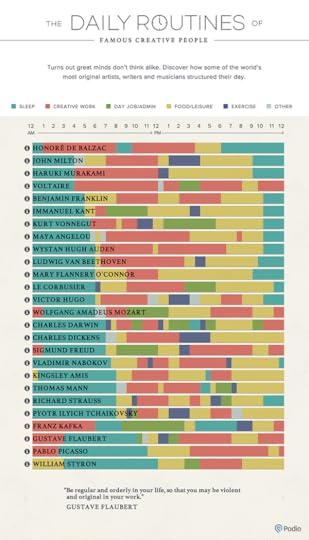
Want to develop a better work routine? Discover how some of the world’s greatest minds organized their days.
Click image to see the interactive version (via Podio).
July 27, 2014
Breaking the Rules
A lot of contemporary writers encourage the next generation to break the rules of writing, but what might those be? Can it be true that none of them are hard and fast? I thought I’d compile a list of the writing rules that I’m aware of that I’m prepared to break, and the ones that I’m not.
Rules for breaking:
Adverbs: I love a good adverb. At some point you have to consider why the adverb exists. I agree when Jonathan Franzen says that ‘Interesting verbs are seldom very interesting’, so what do you have left to make a passage not dull? After a “he said” “she said” never to further convey the emotion of the words, but in a passage of action, go for it! But of course, use them spar- in a sparing manner (see? What a pointless work-around…)
Long, run-on sentences: I loooooove long run-on sentences. I’m not gonna let some asshole full stop break my flow! Let the reader read the sentence a few times if they get lost. They’ll have to trust me on this, and I’ll have to hope they appreciate my confidence.
Avoid dialect: not entirely, though. Do it here and there, but best reserved for minor characters who leave pronto.
Lists: I get the feeling that lists are frowned upon, but I love a good list as well. I think in lists, so if you wanna hear my voice, it has lists in it. I’m not so great at conversation obvs but that’s not what this is about.
Pictures or diagrams: I have a feeling these go against the ethos of making the reader imagine something. Again, I’ve been trained to think in graphs, diagrams, simple visual aids. And I think they’re a lot of fun, too.
No internet: How good a writer are you and what the hell are you writing about that you don’t need the internet while you’re writing? I sit on the internet all the time. I’ll interrupt a sentence for a fact check if necessary. I could do it later, but why bother? You want me to describe a chair with my imagination? I’m gonna, but let me look at the closest existing one first. Don’t be one of these people who thinks themselves powerless against the internet’s seductive charms, because it’s only true if you believe it.
Plot: I used to care, but not so much any more. If it gets in the way of fun, forget it! If you’re having a great time describing a room for two pages, well, you describe the shit out of that room, and I’ll enjoy it if you did. Or not, but you’ll work that out down the line I’m sure.
Chronological order: not necessarily, but think why you’re doing it, because you can undercut the strength of your story by needlessly revealing a conclusion here and there.
Show, don’t tell: Eh. If you stick to this too rigidly, you’ll end up going through some exhausting work arounds to do exposition on everything. Move it along, we’re all getting more impatient.
Alliteration: the funny thing here would be to write something alliterative. Anyways, go for it! Use it. Sometimes. Never force it.
Mixed metaphors: you can totally do this if you’re aware of it and being funny. Extended metaphors for the same reason.
The final draft is the first draft - 10%: a Stephen King rule this one. I tried this and my “final draft” was so bloody skeletal. My first draft is done when I’ve reached the end of the story, but there’s frequently a lot of “blah blah someone needs to do a thing” notes in it. Plus when I write dialogue, I write the dialogue only, sans speech tags or hair strokes or coffee sips or whatever, so that always needs fleshed out. Sometimes I’m inspired to jump off into a little paragraph of backstory on a re-draft. It really depends how you write.
Infodumping: sometimes you’ve done a lot of research and you can’t find a logical place for the facts. This and inner monologue are why people always say the book is better: a film for example is much more limited, and if you ever delve into the research done for a film, you see how much they had to cut because it didn’t make any sense for any of the characters to say it. You don’t have to do this in writing! Please pass on those interesting facts. This isn’t school anymore: loosen up and take a massive dump whenever you need to.
What rules can I see no reason for breaking?
Characters giving each other speeches in place of properly constructed dialogue: this is funny like once, then its just infuriating and silly.
No intertextuality: Ew! It’s so unnatural! Hahaha. Readers care about the strength of your writing, not how it sits on the strength of someone else’s, and nobody anywhere gives a shit how well/obscurely read you are. It’s as Dostoyevsky once said: put all your Nietzsche in the trash, please.
Adverbs or adverbial phrases following a speech tag: never! You sap the snap from your dialogue.
Characters are described in full when they are first encountered: fuck you! Those characters are mine, the reader thinks. I’ll tell you what they look like.
No long passages of italics: unless you feel like cocking your head and squinting your eyes. Go the whole thing with no italics if you can, I hate stupid italics.
No backstory in dialogue: a strange one, but makes sense.
Active voice, not passive: yes. Use this even when personification of inanimate things is required, it gives extra punch to everything.
No “suddenly”s: they quickly reveal where the writer was scared that the passage was disconnected- the writer is a poor judge of that.
No writing gimmicks just for the sake of it: but you’ll always be able to argue your case if you feel in a flourishy mood :-)
I hope this helped and feel free to share some of your rules and rule breaks too!
July 13, 2014
Writing tip for the day!
Don’t read anything by authors/ writers complaining about their job or saying that they sit in front of their computers feeling like failures. Leave that to them! Losers and idiots each and every one of them. They’ve stolen so much of my time with that crap!
It’s just one of those self-fulfilling prophecy sort of things. It’s only true if you believe it. If a writer sees fit to moan about their job like that, they’re probably not that good at it. So when you hear them prattling on like that and you actually listen to it, it’s like getting stuck at a party with the most depressing person there and they suck all the party out of you.
DISREGARD.
POWER THROUGH.
From Kerouac: “YOU’RE A GENIUS ALL THE TIME.”
TUCK IN AND ENJOY!! :D
July 9, 2014
"It is disingenuous to compare all self-published works to the mere two percent of works that manage to get traditionally published."
Great article by Hugh Howey on the state of self-publishing.
To be honest, even having self-published a novel, I had been less than convinced by the self-publishing route. I used to think it was a masquerade of insecurity, like if you ask someone ‘What do you do?’ and they say ‘I’m a model but I’m not stupid, you know’, like whoahhh! You know??
But it is far from an argument dominated by post-agent-rejection angst, the evidence is far too compelling: self-/indie publishing is the way to go!
June 26, 2014
1 day left for FIndesferas Giveaway!
"During an oil crisis-induced war in South America, Findesferas tells the story of Juan and his twin brother Matias as they fight to stay alive in the hopes of returning to their home, and normality. Juan is a poet, but since the death of his wife, he can’t seem to recapture the same creativity he used to pour into his work. Carrying a dark secret that threatens to destroy his life, can he forgive himself and make it out alive, or will his inability to escape the past destroy him? Matías’ wife Octavia is in a civilian holding in Paraguay’s capital, Asunción, trying to forge a new life with her son. When the Pombero, a malevolent spirit, comes to visit them, her brief period of calm is brought abruptly to an end, and she must make a difficult decision: offer the Pombero a live sacrifice, or let him take the twins instead. Findesferas considers the lengths we will go to in order to protect our loved ones, find new energy sources or change the past."


