Leo X. Robertson's Blog, page 23
May 27, 2015
Advice for indie authors
You’ll see on my Goodreads page that my advice for aspiring
writers is to Google “advice for aspiring writers”, because why not? That’s what I did, and all the info you need to know is there :)
But I have read a bit of indie/self-published material and
written a bunch of it myself so dammit I am vaguely qualified to pass on something or at least make existing advice I think is good more readily available. In order to spite my Goodreads answer’s intent, I will repeat some advice I have read elsewhere in addition to my own. Here is that.
1. Read Story by Robert McKee. I would like you to do this because I want this book to scare the shit out of you. This is the nature of story stripped down to its bones, the discipline to master. Having read this book I was too scared to write a sentence knowing that there were about 12 things that sentence was supposed to achieve and it wasn’t doing anything! “Story” brings you back to zero. But hey, McKee scares you with love. He is rooting for you, and so am I. In fact, everyone wants you to be the best storyteller you can be, and storytelling skill is not a function of money made, of popularity accrued- it’s not even necessarily a function of time spent reading or writing if you don’t fully understand what you’re doing. Yes, to a certain extent, storytelling is a mystical process where you channel stories through yourself, but you can put your head back in the clouds later: it is needed in the study for a while. This book is mostly for screenwriters, but what better way to learn how to write [1] than to examine how storytelling is done in a stripped-bare form? As McKee points out: with a film, you can’t push a camera into your character’s heads to see what they’re thinking. I guess you could do an inner monologue voiceover, but, don’t. (You could do that in a novel, but, minimise.) With screenplays, there’s no space to fool anyone with your flowery language, to cloud over inaction/ empty dialogue etc. Learn the bare bones. And do this because it should be apparent after reading “Story” that the story is the communication device. It is not the backbone of a rambling manifesto; it is the entirety of the product, a product which is easily tarnished by scraps of manifesto on its surface. You must trust in the storytelling process that your opinion, your story’s argument, will come through of its own accord. As far as I can see, it always does.
2. Read On Writing by Stephen King. After reading this, you’ll see that McKee’s writing methodologies are not indisputable. Maybe you don’t need to be as structurally hardcore as McKee is. And the truth is, you probably don’t. But there’s no harm in knowing what a rigorously disciplined storytelling methodology would look like. On Writing is a champion of what might be the exact opposite to McKee’s method. While McKee exalts “writing from the outside in”, with the full thing story-boarded first, King is an advocate for “writing from the inside out”, as if opening up an empty book and filling in each page for yourself as you go.
3. Read Bird by Bird by Anne Lamott. Wee Anne <3
4. Watch this video of Robert Rodriguez explaining how to make a film. If you’re following this list in this order- see? It’s not so bad! #Liberating
5. Read Self-Editing for Fiction Writers. Because, as it points out, even published authors violate these rules. If there were any book on this list that I thought was most important, it’s this.
6. Come off the rails. When you start writing, you get this nervous feeling of “Did I just story? Is that a story? What the hell is this? What am I doing?!” and one way to reassure yourself that you are indeed telling a story is to emulate the styles of authors that you know and love. Sure, some people never stop doing this, and influence is inevitably going to creep in, but there’s one thing that has to go, and that’s re-phrasing/ re-delivering messages from stories by authors you respect. If you found some cool learning from a novel and you want your characters to act/talk in such a manner that reflects this learning, it’s kinda noticeably inauthentic. And I say this because I’ve deleted whole short stories where I did this. And also because my first drafts of pretty much everything contain a quote or two from an author that I like, but I tend to remove all of them. That’s my choice, though. Zadie Smith says the same thing, that she likes to use some structure in order to tell her story on the first draft and advises removing it once the story is told. If you want to do some sort of literary resonance a la Ulysses, please have a point and also make it as subtle as possible, because as I’ve written above: the story is the product, not the layers or the digressions. By definition these should not be required to get the reader from A to B on at least the first reading. And if you agree that reading and writing a lot are not necessarily conducive to getting better at telling stories, then you must also agree that the only way you can convince someone that you’re a good writer is by having written something good, not by packing your story with a whole bunch of allusions to other material or by claiming that you’ve been telling stories since you were five. Write a good story. Only!
7. Make your own rules. As Rodriguez pointed out, you don’t wanna write like everyone else. So, you decide how you’re gonna go about achieving your vision. I mean, you don’t have to listen to any of the advice you got from me or any of the above materials if you decide you have reason not to, but if you went through the above, I imagine you are reasonably equipped to break the rules/principles of good writing now you know what they are.
I was really tempted to have number 8 be “Just have fun with it, girlfriend!”
Fuck it.
8. Just have fun with it, girlfriend!
[1] Writing short stories then a novel is strongly advised. Don’t make the same mistake as me and other writers. You might think that your endearing impatience will allow you to skip straight into the long form, but you are likely delaying your progress by going about it in the wrong order. LFMF, MF!


May 26, 2015
I hate writing!!
Todd Solondz calls it “not a particularly fun thing to do”, Philip
Roth said “Writing is frustration — it’s daily frustration, not to mention
humiliation… I can’t face any more days when I write five pages and throw them
away. I can’t do that anymore.” Salman Rushdie says the moments of inspiration
are too infrequent. Anne Lamott, Marc Maron, George Saunders, Zadie Smith, William
Gass, William Goldman, and on and on and on.
Sometimes writers don’t hate writing, though. Will Self, Ray
Bradbury… other people. But not without a complaint here and there. (Have a look at
the linked article and see the plethora of different and contradictory opinions
on writing- important for what I’m about to say.)
I’ve been writing for a while and learning how to write in
tandem with producing books. This is acceptable: no one goes to a (fulfilling)
job everyday knowing exactly what will happen and how to deal with it. No one
enters a relationship with someone knowing exactly what they’re doing, and like
relationships, each story is a puzzle unto itself, and you learn something
different from each one, and in so leaving it behind, become surer of what you
don’t want next time (and yet are not completely bound never to repeat old
mistakes!)
I remember writing Findesferas patchily over a whole year
during my Masters, and always enjoying finding new connections in the story to
technical concepts, digging into research and summarising what I found out,
walking along the leafy street by the National Gallery in London and pulling
out a notepad, scribbling notes for some scene or other. Writing seemed more
like a joyous process of discovery than a chore. Although I was happy then as I
am now not to do it as a living, because some days it feels like you only have
one page left in you (most days, that page out of you is all that’s needed though!)
Findesferas is starting to get more reviews now, for which I’m very thankful,
and people seem to be enjoying it, so I had a glance over it again: I still think
it’s great fun and original, and I suspect the reason for this is that I had
fun writing it and finding out new things and sharing them.
But then when you hear all the time that writers don’t like their
job- writers that you love and respect- you start to think you should hate it
or you’re not doing it properly, that you’ll never produce work of their quality
unless you hate it. And hating to write is an infectious thing.
But then, what was it about writing fiction that had to be
such an unknowable feeling, or one for which I needed to take cues from other people, when I’d
spent years writing theses and reading technical papers and studying for exams
and pushing myself and finding new knowledge? And wasn’t it true that everyone other
than the three or four students I talked to spoke about what a chore it was and
how much they hated it when it was completely their choice to be there studying
for exams, and I distanced myself from them because to do such a thing made absolutely
no sense to me and brought me down? That I spent weeks in the library, loving
the silence, in awe at the cleverness and ingenuity of what I was reading, daring
myself to stay longer and take fewer breaks and look at the clock fewer times,
until my head ached with use, and I felt completely spent on snowy wintry walks
back to my flat again? What exactly was the difference between “I like having
written, not writing” and “I like having studied, not studying”, and why was I
so desperate to agree with the former when I didn’t with the latter?
There’s this great TED talk called “Depression: the secret
we share”, and in it, the speaker, Andrew Solomon, says the following:
“If you have brain cancer, and you say that standing on your
head for 20 minutes every morning makes you feel better, it may make you feel
better, but you still have brain cancer, and you’ll still probably die from it.
But if you say that you have depression, and standing on your head for 20
minutes every day makes you feel better, then it’s worked, because depression
is an illness of how you feel, and if you feel better, then you are effectively
not depressed anymore.”
What I surmise from this is that nonsensical trickery has
application when it comes to influencing our moods; that self-delusion can be
used for good; that attitude, irrespective of circumstance, is a choice, a
hugely arbitrary but necessary choice.
The truth I will convince myself of, and hopefully you as
well, is this: if you think you hate writing, you will hate writing. If you
think you love writing, you will love writing. (Although, also of note is that
if you pretend to love writing and you don’t, people can tell, and they don’t
like it.) Of course this principle has further application than just writing. I’ve
known friends to think their relationships to failure, to think themselves into
a state of inactive paralysis, or to think themselves into unexpected success,
unexpected happiness, unexpected achievement.
There are movements of “listen to your body”, and “acknowledge
your emotions”, but we’re aware of the placebo effect, and in this case it can
be used to your advantage. If ever anyone asks me about writing, I say ‘Writing
is a joyous process of discovery’, and that’s what it becomes. If I knew what I was going to write before I
wrote it, it wouldn’t be a process of discovery. If I sat down to write
thinking “I better bloody discover something!” it wouldn’t be a joy. If I said
it wasn’t a particularly fun thing to do, that’s what it would be.
But then I should address why I think writers might hate
writing.
I mention all this joy I had from studying. The only reason
it was joyful was because no one told me to do it. No one was checking up on
me, no one told me how much to study or what to study or when: I had complete
control over it. I am and remain a stubborn bastart (the “t” at the end makes
it Scottish and friendly.) Were that not the case, were the consequences of
studying or lack thereof on anyone but myself, were there anyone or anything
else relying on me studying, would it have been enjoyable? Those who write for
a living have paycheques pending their output, have fans waiting. For some people,
this is motivating. If you’re a relatively unknown writer, you can embrace the
freedom to pace yourself, to control completely what you write, the ease and
confidence of sending it out into the world and even the solitary, paradoxical pleasure
of considering that maybe no one will read it, of knowing that writing it was
enough of an achievement for you anyway.
Continuing my studying analogy: no one can know what you
know. No one else has to care. You may never use what you learned ever again. Does
that mean you shouldn’t have enjoyed it? Does that mean that what you did was
completely meaningless? Not at all. You can be proud of what you have
demonstrated you can achieve; you can love knowing what you know just for how
cool what you think you know is, you can know that there forever exists the possibility
to use what you have learned, unknown tests of your ability in the future; and
you can know that not only do few people think like this, no one has to if they
don’t want to. It only really matters to you if you’re happy with yourself, if
you appreciate yourself, because you can still be a perfectly functional person
without these things being the case.
Even if you spend days writing total horseshit, it begets
the inevitable good writing in the same way that if every 1 in 20 job
applications in your field are successful, having 19 rejections makes you
really close to your goal of getting a job. If you choose to think about it
that way. Which you don’t have to if you don’t want to.
A desire to hate writing stuck with me for a while, but it
won’t anymore. It doesn’t make sense. However, as an engineer I’ve always said
you aren’t engineering hard enough unless you have an annual freakout where you
want to give it all up and own a baked potato shop in Fife, or [insert pipe
dream.] This is par for ANY course of life, perceivably enjoyable or not.
If you’re going to write, love writing: it could be as
simple as telling yourself you do.
55)<�[��<�G
May 25, 2015
Storytelling + expertise
Me and Juan were having a conversation yesterday about Interstellar, because as is usual for the moment I segwayed it hamfistedly into our conversation so I could make fun of it again MURRRPH!! MUURRPRHHH!! DOn’t let me LEAVE Murph!!
The thing is, in terms of the main storytelling formats- writing, films, theatre, stand-up comedy (Bill Burr’s latest special!! Maria Bamford!), I guess Youtube videos (have you guys seen Jake and Amir yet?? So jealous if you haven’t. Keep an eye out for the pilot of their hopefully upcoming TV series too!)- these are media for geniuses to deliver their product to laymen for their appreciation. You or I can be blown away by a Kubrick, Bergman, Jodorowsky film etc. without exactly knowing why. Maybe we can learn more about the technical details, and this can sure enrich our appreciation, but it isn’t always necessary. I suspect this is the case in few other places/careers/industries. For example, I can only glance off of whyever Roger Penrose is a genius. I tried with The Road to Reality, which, if you ever want a road to a reality check, is a great way to feel stupid (trademark Carrie Bradshaw- fellow storytelling genius.) I wish I could tell people why I’m so great a chemical engineer, but it’s a non-relatable skill base. Maybe I like patronising people anyways tbh ;)
So imagine this, then: Christopher Nolan is a guy supposedly at the top of his game, is given all this time money resources, actors at the top of their game, some guy called Kip Thorne, and what Nolan makes is a total piece of shit. Super lazy. Silly. Visually arresting, or 70s wallpaper? Anne Hathaway’s hair! (Remember, everything a director chooses to show is on purpose. What was that decision about??) I couldn’t contain a rant about about it in under the length of time it takes to watch the film, so if you want my argument, just watch the damn thing. It’s out of this MURPH!
What’s my point, then? Firstly, the best case scenario is always that everyone does their job to the best of their ability, works “as if living in the early days of a better nation.” Even with as much as I love literature, I’m not totally convinced by the “we need stories” argument, but in theory I guess the person responsible for making a film like Interstellar is in charge of enthusing, well, humanity about space travel [1]. So I’m kinda mad he didn’t do his job properly. And yet, it is inspiring to know that some people supposedly at the top of their game just aren’t very good. Here’s my point about laymen appreciating the experts in their field: surely if it’s true that some geniuses are just bad, there must be bad geniuses and bad experts in every profession? That being the case, we’re reminded yet again that confidence versus ability really doesn’t add up. Confidence is totally arbitrary, so why not choose to be super confident? Because confidence makes you a go-getter, and has been shown to be more readily convincing than a demonstration of ability.
You can see some indie films, and budget aside, the storytelling quality is like-for-like comparable to these brand-like directors. Better in many cases! And many recent examples have shown that barriers for entry in creative industries are basically non-existent! How exciting!
I guess my point is: when did being bad at anything stop anyone from making loads of money at it, if that’s your interest? And how often does something being popular relate to how useful/interesting/actually good it is?
Thank you for reading this weird digression on improving your confidence… I think :)
[1] As an aside, the film made me feel kinda sad. Firstly, we have only a human lifetime to get as far as we can- that’s extending, but even so, visible universe etc… and the idea that there are dimensions of space that we can’t access, and that we can only travel time in one direction… The scope of mankind is inherently limited. We humans already know more than we require to fulfil our basic life responsibilities. For example, we can think ourselves to death no matter our life circumstances: what’s the point in that? Lesser beings aren’t able to do that. I mean, imagine how meaningless is the existence of a termite! If they ever cottoned on, they’d be fucked, but the environment would be better because termites release so much methane. What a conundrum.
February 5, 2015
Some thoughts on recontextualisation + symbols in art
I watched all of Harmony Korine’s films over one sunny weekend last year (spring break forever bitches) and it’s hit me only now why he is so great. It’s moments like in Julien Donkey-Boy where a guy progressively fills his mouth with lit cigarettes, then “eats” them (I can’t tell if he actually does: sure looks like it! You can watch the act here anyways, but I wouldn’t recommend it): it’s not like in the film this guy is given directions, or lines, or anything really- his performance, put in the context of the film, adds a whole layer of interpretation to its meaning, even although nothing about it has really been created by the director. Not to mention a handful of scenes in the film which are improvised with unknowing people in shops and on the street, which “steal” real commentary and reactions to the actor’s performances and incorporate them into the film. It’s like graffiti or parkour the way that this bare substance is used to create something artistic.
Anyway, in terms of cultural commentary, there’s things like the Britney Spears song scene from Spring Breakers, or the characters in Mister Lonely who act and dress like celebrities.
The raw material of culture is recontexualised to apply new meaning to it. It’s pretty tough to feel that there’s anything poignant about a guy’s cigarette-eating performance (or that Britney Spears song!) without the context that Korine gives these things.
He’s not the only one doing it of course: 2 Everything 2 Terrible 2 Tokyo Drift is a disturbing film created entirely from American TV footage, curated by theme (money, sex, religion). Somehow, while made from pre-recorded clips, the film has a loose plot of sorts with a hero and a villain (a tongue-twister-reciting child who dresses up as Hitler -_-)
Or there’s Tarantino, or any music that uses samples, if you’re into that :D
Then in literature there’s villain in Murakami’s Kafka on the Shore, who takes on the form of recognisable brand mascots, or in a more diffuse form, all the mythical layering performed by the postmodern greats.
A cultural unit: a TV clip, a Britney Spears song, the appearance of a corporate mascot, is made to comment upon itself as the artist sees it. This is a pretty powerful thing!
In Korine’s case, it’s always nice to see artists start young when likely they do these things to represent their times without being conscious of it: his work very much represents the idea that you never know as an artist what’s going to be useful to you and what isn’t- the symbols, props, people and situations that enter his films appear to be based on his daily observations + autobiographical material (these two things, by the way, are the easiest artistic raw material to collect, and generally the most useful!) Without his context, they might be otherwise dismissed. As he says himself, ’ I feel I need to leave some things undefined in my explanation. You don’t want to spell it out, but also it’s the movie and something I can’t express it in words. If I could talk it away, I wouldn’t film it. I don’t want to say something that would somehow contradict or refute what you got from the movie. It’s more exciting for me to put it out there and let you guys figure it out. If someone doesn’t get anything out of it, that’s fine too. I just want to get it out there.’
Considering symbols in art generally, when I watch these films or read these works of literature or see whatever the hell the Chapman Brothers have made, I don’t necessarily know exactly what is being said about these (non-cat) memes. When you’re fifteen, symbolism is more “Neo’s Jesus! Okay everyone pack up their shit.’ But later you can enjoy art which is so symbolic that it evokes curiosity, the joy of revisiting, and a highly personalised experience based on what the art means to you/ your culture. If you were to see or read the same thing later in life, it might mean something totally different, so that you can become conscious of the changes in your thinking and maturity over time. In order give art this ability, it takes courage on the artist’s part because it appears that the truest symbols come from an unknown place, and for the artist to present a work that has these powerful symbols they must be so trusting in the artistic process to guide them that they release art into the world that even they don’t understand, like Salvador Dali said of his paintings, like von Trier said of his symbols in Antichrist, like Korine and the things he can’t put into words, like Murakami and his cat-snatching guy dressed as Johnny Walker. But then, I don’t think any of the best experiences can be forced.
January 28, 2015
The Case For/ Against Living in a Library
In Norwegian class, after bumbling my way through Norwegian and Scottish politics, the black death and Hanseatic settlers in Bergen (I cheated on the entrance test to make sure I got a difficult class) we finally discussed Norwegian literature, and books in general. I was like great! I tried to narrow it down because I could surely go on all day, so I said I liked science fiction. I was asked to name some science fiction books I liked, and without Goodreads or any science fiction books in my flat, and the pressure of it, I couldn’t name a single novel for like a full minute!
Is it because I read on my Nook most of the time?
I’m a travelling about guy, so I can’t afford the luxury of many books, and reading as often and as widely as I try to do, I read a lot of things I’m not that keen on, and I don’t want physical copies of those books hanging about. Most of the time, not even buying a new physical book from an author I like is a safe enough bet. For the last 3 or so years, most books I buy will either not be available as ebooks or will be big books I want to re-read and spend some time with. Particularly postmoderne litteratur (cheers Berlitz) tomes are worth investing in paper copies, so you can flick about, cross reference, look cool in public, and so they can stare at you from coffee tables and shelves, goading you into finishing them. I want more!
Work is about to move me to a city- I don’t know which- where I’ll be for about 2 years, which is long enough to fill a place with books if I feel like staying longer.
My dad’s goal is to live in a library. It seems like a no-brainer if you like books, and you’re looking for a Minecraft-esque lifegoal, why not?
The Case For Living in a Library
Research has shown that if people know how to find an answer by Googling it, they won’t typically bother to remember the answer. Clearly the brain treats the internet as an extension of itself.
Also, the reason you forget why you entered a room, is because the brain compartmentalizes thought based on location, treating doorways as boundaries, and the memory for an object or task is sometimes not assigned to the room that contains the stuff you need.
Doorways as “event boundaries” is an example of how the brain assigns information to a physical location. There’s something about printing off a document that makes it easier to read, easier to remember. While each page of a book is a separate physical location, every page of an ebook is read in exactly the same place: it has no discretised physical location.
Books create memories.
And there’s just something about being in a massive bookshop that lets you draw power from all the books there.
The Case Against Living in a Library
Too many books can tie you down.
Books are objects and a life in pursuit of objects is a life in pursuit of materialism.
It’s been long theorised that watching objects decay will remind you of the passage of time and where we’re all gonna end up.
Plus, Henry Miller says“A book lying idle on a shelf is wasted ammunition. Like money, books must be kept in constant circulation… A book is not only a friend, it makes friends for you. When you have possessed a book with mind and spirit, you are enriched. But when you pass it on you are enriched threefold.”
The Ideal Scenario
A slim, living library, with books in constant flux between the living libraries of family and friends, and their family and friends, and their family and friends, with books taken care of but not obsessed over, with their ideas spreading and enriching and filling you and everyone with joy.
January 24, 2015
Goals for 2015
The Robertson “I’ve Started So I’ll Finish” Award for completing reading Helene Uri’s “Bitches” and starting Karl Ove’s novels in Norsk. I’m currently at page 14/400 of Bitches, and that took me 3 months of spare time that I could be bothered dedicating to Norsklæring, so I’ll try and speed it up.
The “From My Hard Drive to Your Heart” Award for getting at least 3 more books out this year. 2 manuscripts done, 1 working on (probably not out for a long time tho), 1 idea. 2 done + 1 idea = 3 published.
There’s only 2 but they’re quite ambitious, so unfortunately I’ll have to postpone goals of exercise or drinking less to some other year.
January 12, 2015
One whole month since last book!! What's the deal?!?!
The deal is this: I have 2 ¾ manuscripts chilling on my laptop at various stages of editing. Once that reaches 3 manuscripts, I’ll go to the earliest of them, do a re-write, send to a friend for beta.reading and she should be in your hands some time in March!!
The subject of my upcoming novel shall remain a mystery, but given what I’ve spent last year thinking about, it’s clear that my next book forms part of a loose Asshole Cycle (where Sinkhole = book#1 and Rude Vile Pigs = book #2)- so get excited!!
If we’re GR friends and you’re seeing this for the first time, I’d recommend Rude Vile Pigs as an entry point into my rapidly expanding and masterfully crafted ouvre.
Contact me when I’m in a good mood and I’ll surely send you a copy if you promise with all your heart to review it or pap it a few stars.
Cheers!
NEW RUDE VILE PIGS GIVEAWAY!
Goodreads Book Giveaway
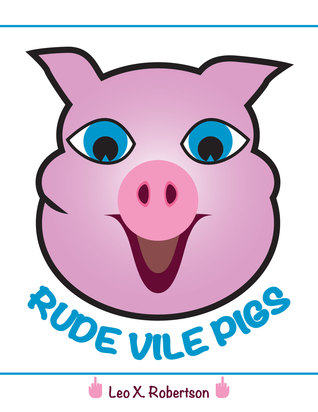
Rude Vile Pigs
by Leo X. Robertson
Giveaway ends January 31, 2015.
See the giveaway details at Goodreads.
Enter to win
RUDE VILE PIGS: a satirical black comedy set in the city of Sadwhitepeopledrinking, which follows the antics of Jim Joy, a middle-aged alcoholic who accidentally creates a religion dedicated to selfishness.
Recently divorced, depressed and living in a squalid flat, Jim realises that his newfound mobility and complete lack of shame can lead him to new exciting depths, doing whatever he wants and encouraging the same of others. Through his alcohol-fuelled misadventures, Jim is about to discover what happens when a society gives in to its basest impulses.
November 4, 2014
RUDE VULE PIGS Giveaway!!
Rude Vile Pigs
by Leo X. Robertson
Giveaway ends November 28, 2014.
See the giveaway details at Goodreads.
Enter to win
October 30, 2014
NEW NOVEL: Rude Vile Pigs!
(Free ebook for Goodreads friends at...
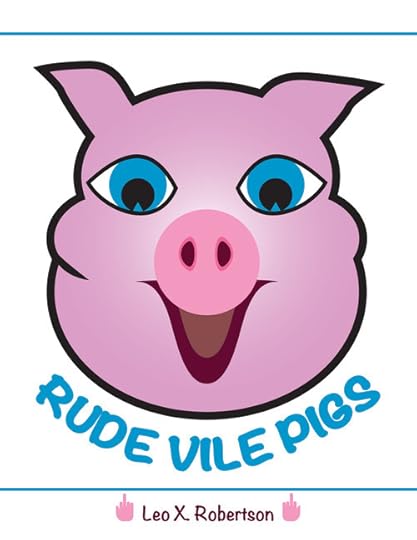
NEW NOVEL: Rude Vile Pigs!
(Free ebook for Goodreads friends at time of posting! Just message me your email and preferred format from EPUB, MOBI or PDF!)
Rude Vile Pigs is a satirical black comedy set in the city of Sadwhitepeopledrinking, and follows the antics of Jim Joy, a middle-aged alcoholic who accidentally creates a religion dedicated to selfishness. Recently divorced, depressed and living in a squalid flat, Jim realises that his newfound mobility and complete lack of shame can lead him to new exciting depths, doing whatever he wants and encouraging the same of others. Through his alcohol-fuelled misadventures, Jim is about to discover what happens when a society gives in to its basest impulses.