
Leo X. Robertson's Blog, page 19
September 20, 2016
The British Screenwriters’ AwardsI was at the British...
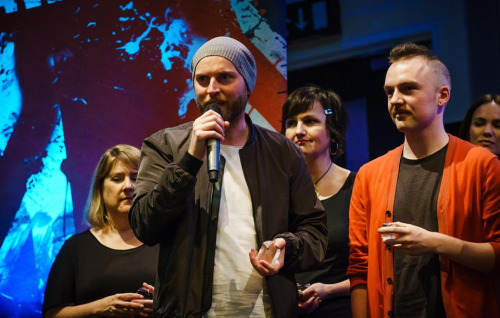
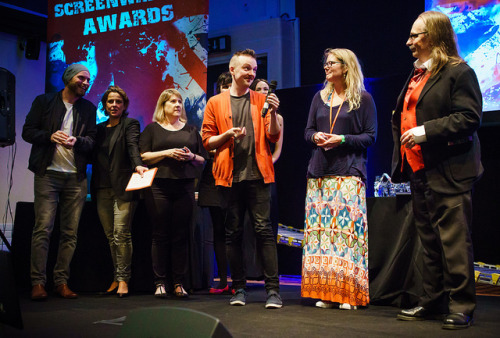
Here I am passing the mic after having said ‘Thanks to the Twisted50 community and to Create50, I think this is a great initiative and I’m thankful to be a part of it.’ All true!
The British Screenwriters’ Awards
I was at the British Screenwriters’ Awards
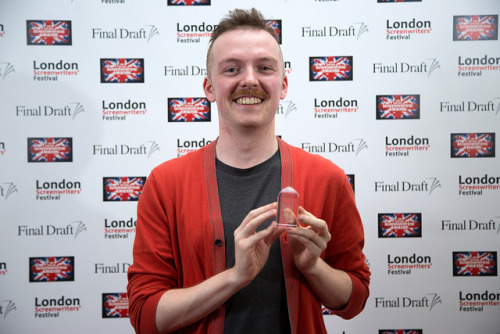
on 3rd September, where I won a Twisted50 Award for one of my short
stories. You can read it here now, but will be available in Twisted50 vol 1
later this year.
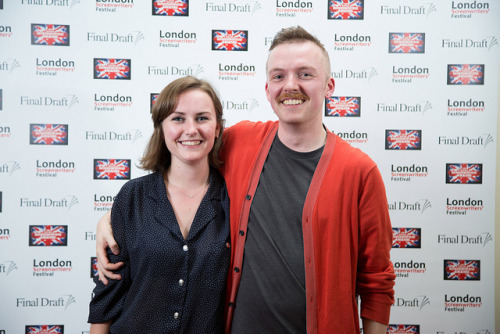
Rebecca and I (both of us pictured together above!) eventually filled her purse with cider cans, which we drank on the underground while singing along
to 90s dance. Totally the evening’s highlight. I later passed out on her couch in front
of Netflix, and for the privilege of this, it was nice to offer her some event
to attend. We had too much fun, and I submitted a story to Twisted50 vol 2, so
I hope I get to have some of that awesome garlic bread with cheese from the
place near her flat again.
[Not pictured: me doing lunges on the red
carpet. When the photographer said ‘All right, will we do at least one serious
one?’ I didn’t realise that meant ‘I’m not using any of this shit’, ahaha!!]


September 12, 2016
Great Short Stories!
No matter what you think of the short story format, you can’t deny that they represent an excellent way to enter the often-intimidating oeuvres of brilliant writers. Here are a whole bunch that are wonderful pieces of writing in their own right and launching pads into the bodies of work of some of my favourite mostly-dead-white-American-males of all time. Get ready to have your mind BLOWN—for free this time!
The Conventional Wisdom by Stanley Elkin.
I’m very excited to read Elkin’s re-issued essay collection, once I can buy it, as soon as my flat stops filling with bees and my teeth stop attacking each other and have to be pulled out. I guess Elkin participates in the same tradition as Vonnegut, Barthelme and them, but I only discovered him recently. I cannot wait to binge on all of his writing when I get the chance. Respected by William Gass but infinitely more accessible, this short story demonstrates the depths of thematic darkness, the coolness of his wordplay and the limitlessness of his imagination.
Good Old Neon by David Foster Wallace
Sometimes referred to as his “suicide note”, that may very well be the case, but his biography reveals that it was written during a happy time in his life. I see it as a cautionary tale about taking life too seriously or giving into dread’s bleak narrative. Putting aside its offputting lack of balance when it comes to its central argument, it’s otherwise a damn good and damn haunting piece of writing.
Written throughout in a believably colloquial style, just like its title, this story pretends to be about one thing while really being about something else, though what that “something else” is is approached in such an oblique and underplayed manner by the narrator’s minimisations that it becomes Streisand-effect magnified. Fighting through the irony, you will find a message of hope.
The Semplica-Girl Diaries by George Saunders
Give a man who is perhaps the best short story writer alive 14 years and he will break your heart with words. An unforgettable story about the crap capitalism produces and makes us yearn for, and the hideous prices attached to said crap.
Chekhov’s one of those writers so lauded that you never want to read him. That would be a mistake, and if you haven’t, Gooseberries is the best place to start. Again, be careful though: Mona Simpson referred to him as “an almost unbearable realist.” This story in particular reveals what Chekhov must have felt was his purpose in society: “Every happy man should have some one with a little hammer at his door to knock and remind him that there are unhappy people, and that, however happy he may be, life will sooner or later show its claws, and some misfortune will befall him – illness, poverty, loss, and then no one will see or hear him, just as he now neither sees nor hears others.”
How to Become a Writer by Lorrie Moore
Failing to find links to any story but “And You’re Ugly, Too”, from her collection “Like Life”, I figured this was a good introduction to Lorrie Moore. Filled with her self-deprecating humour—and if I remember correctly, one or two of the silly puns and word games she’s so fond of—Moore’s captivating voice, should you read further than this story, will carry you to often darker territory.
The Babysitter by Robert Coover
Fascinating and bamboozling experiment that pays off.
Gripping and more-than-a-litte-smarmy yarn about the randomness and indifference of fate.
Town of Cats by Haruki Murakami
Interesting experiment in itself, this story has been cut out of several segments of “1q84” to create a short story in its own right.
The Great Hug by Donald Barthelme
One-of-a-kind Barthelmian WTF-ery
The Ones Who Walk Away from Omelas by Ursula K. LeGuin
‘…is a 1973 plotless, short, descriptive work of philosophical fiction, popularly classified as a short story, by Ursula K. Le Guin.’ EUGH. Despite that description, it’s actually worth reading :)
Orientation by Daniel Orozco
a Helleresque piece on the absurdity of the office. Not all that profound, but a nice amusing departure from the rest of this list!
Two that are not online anywhere I can find but are worth reading anyways:
Silent Towns by Ray Bradbury, from The Martian Chronicles. I’d read Fahrenheit 451, but didn’t get the Bradbury hype until I read TMC, and in particular this story, which blends his poetic and
playful writing style with a narrative that’s as bleak as it is hilarious. Bradbury advises writers to make their readers “jealous of their joy”, which is very much demonstrated here.
We Witnessed the Advent of a New Apocalypse During an Episode of Friends by Blake Butler, from The Best Bizarro Fiction of the Decade: bizarro is far from just “Blank Blank Shark Blank Blank Bullshit”—this collection, and this story in particular, proves it.
Hope you have fun with these, and if you have any suggestions yourself, you know where to find me- just don’t be a dick about them, lol!!
September 6, 2016
We’re all just trying to relate.
Active in the community
I have more favourite authors than favourite books. I’ll read the book of a favourite author just because they wrote it, not because I’m necessarily interested in the book’s subject.
I saw the following question in an author interview: ‘You could’ve dealt with these themes in a piece of realism: why did you choose sci-fi?’ I’m thankful for the author’s honest response: ‘I like sci-fi.’ When people proclaim that ‘We need intelligent horror/fantasy/sci-fi/weird stories’, when you remove the genre, they’re right.
Fiction writers—people who make shit up as a profession—are often “forbidden” from writing in genres they aren’t known for. You might get better material from non-savants who don’t know how to conform.
How is speculative fiction a clearer label of anything? All fiction speculates: none of it happened. I’m not being facetious. Genre-labelling may well stem from the desire to feel part of a community, to create an identity to defend wherever possible. This is YouTube comment-level anathema.
My audience is not a fan of a genre but of me as a writer. This is a tougher way to go. I’ve sent loads of stories loads of places and can confidently tell you that the main issue I face is that of genre.
I hope one day my writing gets widely recognised for what about it is unique. For now I receive a lot of messages dismaying my failure to fit, but I crack through sometimes, and if I do this enough, the dismay will become celebration.
I went to this wine-tasting once: a guy came round the tables with various bottles and talked about the vintage and the year etc. One woman asked if the red wine she was drinking would be considered science fiction. While waiting for his answer, I asked myself this same question. I said, ‘This wine is science fiction’, ‘This wine is horror’, ‘This wine is fantasy.’ I couldn’t change the taste. I forget the expert’s answer, only that he ended his response with ‘It’s just like anything, really: you can get as geeky about this stuff as you like.’
Passive in the community
I recently sent a story to a publisher looking exclusively for stories from “Women, queer, trans and POC writers.” I probably shouldn’t have. After fifteen I thought I was done getting called queer and now here I am doing the work myself. The term to me implies I would have anything illuminating to say about LGBT people, because what else about me as an author would have me at a disadvantage if not that something about my minority had percolated into my stories?
I don’t want to be granted entry to a community I know nothing about and therefore cannot represent. I guarantee the community has no interest in me. “Community” has started to read “animosity” for me. We rarely mean anything offline by it.
I was once advised to tell an NHS psychologist I was gay so I could get “bumped up the waiting list”, which is British slang for shagging your psychologist (not quite as good as “badgering the witness”, which is having a wank while on jury duty.) I was so repulsed by the idea that I didn’t even end up going.
The outer appearance of a dude gets me invited to guys’ nights out; the inner lack of attraction to the opposite sex allows me more intimate friendships with women. I tune out countless references, implied or otherwise, to heterosexual sex, on a daily basis. But it suits me better to live in a world that does not as frequently compete for my attention. If anything the gay experience has suited me quite well, but I don’t have a non-gay one to compare it with.
Most people aren’t as tall as this guy, so it doesn’t make sense to design environments for his size. He clearly accepts that with good grace and humour.
Gay relationships in fiction give me the same intuitive heart swell of connection that straight people receive from the default relationship type depicted. Do we only engage with art to see ourselves in it? Don’t we enjoy considering how other people live? I don’t have to have an unwanted pregnancy to understand how that might impact someone’s life.
Art exists only if the following is true: we don’t need to be it to gain understanding from it.
June 30, 2016
Troll Nation
It shouldn’t surprise you that I and a bunch of my contemporaries are subject to trolling: we’re trying to succeed at something. A childhood in Glasgow prepared me for what a pet peeve this is for a lot of people!
Here is a disappointingly dispassionate strategy to go about staying sane and limiting the influence of weird outsiders, online and in life:
1. Accept that trolls are inevitable, like computer viruses.
2. No contact is the best, easiest and incidentally most vengeful tool at hand.
3. Know that there is no need to meet a troll’s attack on you with panic, offence, introspection or with
your emotions at stake at all.
If it makes sense to you, you can stop reading there. And please note that my troll strategy does not limit itself to the online variety. Life is tough, and sends a lot of people down the wrong paths if they’re not alert. This makes it tougher for the ones who are paying attention, because they become the target of a lot of insecure, angry, confused and intensely sad others, who may or may not be their responsibility— but from my experience, generally aren’t.
1. I don’t imagine you have any viruses, because some software keeps them at bay. And sure, many websites have guidelines which, if broken, will result in people being kicked off them— but not always. Just like viruses, trolls only work on the naive or otherwise unprepared. It’s very important for you to realise, then, that that’s about as deep a description for a candidate that trolls ever develop: they really have nothing to do with you. You have to act like your own dispassionate anti-troll software, blocking and cataloguing any account that seeks to make you suffer somehow.
2. On the topic of suffering: I imagine your experience of life is that you generally don’t suffer until you take a troll’s comments to heart. A troll is the opposite: they suffer all the time until they can get your attention. This is why “no contact” is the best, easiest and most vengeful strategy at hand. If you’re not a vengeful person, don’t feel bad: there’s only so much of the world’s pain that you’re expected to take on— a troll’s is the bottom of your list.
No contact is the strategy advised for use by victims of abusive relationships. Isn’t there an analogy here when it comes to trolls? I doubt they’re all sociopathic, psychopathic, narcissistic etc— but the important thing to note is that their behaviour is manipulative, and that’s where this strategy applies. The School of Life confirms it— I hope you subscribe to their newsletter :)
A friend recently got in
touch with me because she knew I was researching sociopaths for a writing project, and she described an intensely creepy encounter with a guy— likely sociopathic, but not my place to diagnose— at her work. He told her some completely made up story in which he was a victim, because he’d worked out that she had a big heart, and he was looking to monopolise it. She did all the right things: made sure they only talked when other people were present to listen in, and reported the incident to her superiors, who were on her side. She did say to
him that while others might not know what he was up to, she understood it perfectly well. There was nothing terribly wrong about this, though it could have been interpreted by him as a challenge. And sociopaths love a challenge! They intentionally seek out the most
put-together self-motivated people, because it’s more fun to tear them down. (Go ahead and grimace while patting yourself on the back, then!) I told her that to him, she was just anybody, and he would go on and repeat his behaviour with someone new regardless, likely not giving her a second thought. This is a disturbing thing to admit when we see the lengths to which people who don’t give a shit about us will go to in order to have us under their thumb— but accepting it and keeping the person out your life as far as possible is the
only way to go about it. There is no changing certain people, and attempting to do so is a huge waste of your time, and it’s worth remembering that one of the shit-grenades in their armoury of dickery is their ability to convince you that you could be the one to change them. You can’t. I’ve read online of cases of trolls being taught the error of their ways and being coached by strangers into a better life. But consider the types of messages these strangers are sending you,
and the types of personality disorders that are surely heightened in the troll populace: it’s a dangerous and mostly lost cause, and I think the “internet good samaritan raises spirits of lost little man” narrative is a harmful one. Where is this person’s real-life support network? If it is or isn’t there, why is that your problem?
3. I recently went on a course in Trondheim. There was an engineer I used to work with who was also on the course. It took me a while to realise how absolutely livid my presence on the course had made him. See, last time we were in touch, he was the
experienced engineer instructing me, the newbie, on how to do the job. That we were on the same course obviously meant that he had exactly as much to offer by way of experience as I had— of course I don’t believe this, but I have to imagine this is how he thought of it.
I was still nonchalant little bunny most of the first day, trying to sit beside him and chat with him
at every break because I likely wouldn’t see him for a long time afterwards— but by the evening I was starting to pick up on some uncomfortable patterns.
Karl Ove, we’ll call this
guy: he hated the fact that I had managed to get a tenant in my flat (I didn’t bring it up b/c who the fuck cares), and he interrupted me and said ‘Oh, so the rental agency must send you texts like this all the time,’ and held up his phone so I could see the exact quantity of money that was being deposited into his bank account every month as a result of having a tenant in his flat. At this point I realised I wasn’t sitting with my buddy. I’d been warned that other people saw him as competitive around me. If I hadn’t picked up on it, I was thankful, because I was having fun. Not anymore. (I have weird heart
tension typing this, by the way.)
During the following day’s lectures (after an extended breakfast comparison), at every break he’d turn around and continue talking to me about whatever the lecture was about, to demonstrate the breadth of his knowledge and experience on the topic— everything one wants in a buddy and a BREAK, right? It was so tedious and transparent, and eventually I took out my laptop to pretend I had something
pressing to deal with, at which point he laughed and said ‘I see you are done with this technical stuff as you have taken out your personal laptop.’ ????
After the day’s lectures
were over, he invited me out for dinner, and I thought, ‘Fuck it: if I don’t have company, I know fine well I’m not going to go eat in some nice restaurant and drink a beer in the sun,’ so I accepted. While we ate, he took out his phone, his best friend for the evening, and said, ‘Man, I feel so guilty. I used to go to university here, and there must be so many of my friends here that I’m not hanging out with.’ See, I wasn’t to be under the false illusion that he couldn’t do better than me for company that evening; he was simply too lazy to get in touch with anyone else, and what a gift that was for me!
Here’s the thing— admittedly this is where my optimism had begun to fail me regarding his attitude, and I should’ve just stayed away, but it was so difficult to get away from him otherwise, and that relentless comparison exercise would get to anyone if it was the only thing in their environment. My point here is not to beat yourself up if people like this get to you sometimes: ALL they do is try to get to you, so they’re pretty much experts at it! Then you enter the ring, all filled with hope for the future and pacifist-like, and you get trodden upon so easily. This is a weird test of your good qualities, and not something you would want to celebrate, exactly, but what else are you gonna do if/WHEN it happens? These
people are everywhere. Adult life gives you no objectives, no signposts of progress. People get scared and start to turn on each other. I get it. I don’t like it or approve of it, but I get it.
I said I had to go Skype with my dad, at which point he made it clear that when I left him, he would becatching up on work emails (not that I asked— but you see the intent of this by now, right? Perhaps you think I’m paranoid, but there are too many little
examples like this that accumulated into a definite strategy on his part, for me.) Guess what: after I Skyped with my dad, I texted him and went back out for more beers! Here is a lesson that’s a total aside for me: “drinking a lot in company” is not always better than sitting in a hotel room alone. You should never have to drink to bear someone’s company; only drink to enhance the company you’re with. Anyways.
Finally we get the bus to the airport at the same time. I run on, sit beside someone else and pretend to
be asleep, because at this point I can’t take it. There was a quiz that afternoon, and I won a chocolate bar and came in first, so while we were waiting for the bus, Karl Ove was telling me all about the stupid delays in the technology we were using to conduct the quiz, and I’m of course agreeing that my victory was as a result of this, because I’m tired and it’s easier. Not only that, but there was a quiz after each day of the course, and he consistently came in second, so it was clearly an overall victory for him, while I had only
won once. (Unless it was the non-existent delays in the technology that was working against me those other days— but what’s the point of pointing out this contradiction in his self-comforting narrative?)
At the airport I ran, RAN away from him, and hid in the corner of a cafe once I was through security. So he started texting me! Telling me since we’d arrived early, he’d managed to
change the time of his flight, and would be going home in about half an hour. He must have known, or hoped, that I didn’t actually know how to do that, so I was stuck in the airport for another two hours or so. And he wanted me to know he wasn’t.
I got home eventually and cried a whole bunch. It was so exhausting. I escaped without being humiliated, without letting him get to me, but my defences were up the whole time. The intensity of the onslaught was such that I was so worn out by the end of the course.
I hadn’t known he was on that course, and I had plans to see him that weekend when he was back in Oslo with his girlfriend. Prior to going on the course, here were my reasons for wanting to see them, that I had not properly articulated yet:
- His girlfriend could probably use a break from him for an evening. Last time we were all out in the pub, he’d gone to the bathroom and she’d said, ‘We had a really good week this week. He was okay the whole time.’
- His girlfriend thinks I’m funny.
- I like to show my husband that I have friends, I just don’t choose to see them/ they just don’t happen to be in the same city as me.
Notice I haven’t listed: ‘It’ll be fun,’ or, ‘I want to.’ (This is another digression about how I should probably make better choices. Anyways.)
I used my annual lie on him, and it was a good one. I waited until it was likely inconvenient for him and his weekend plans (although he’d made it clear he had SO many people to see and he would be SO busy that weekend, so me getting to hang out with him would be a total privilege) and I texted him that my husband had made surprise plans for our anniversary and
people were even flying in to see us, that I didn’t know what we’d be doing but I had to assume I was unavailable the whole weekend.
1. Demonstrates strength of my relationship, which I know is a sore point for Karl, since his girlfriend cornered me once, in tears, to tell me that she’d discovered he was cheating on her. That was years ago: I never followed that up, but I have to imagine he knows I know by now.
2. “People flying in”- I also have an army of people who like me, and mine are ready to drop what they’re doing and use significant expense to come see me.
3. “Surprise”- in not pinpointing specific activities for the weekend, I allow his imagination to spin it into something ridiculous and lavish.
I want to say, perhaps controversially, that it’s through my female friends that I learned tactics like this, because they were corresponding to their friends like this each and every time. Maybe by now you don’t think a lot of those with whom I choose to associate, but I always thought these ladies who were texting each other were lovely and deserved better for themselves and from each other.
So I’m not proud of myself. A text like the one I sent does not fall under the category of “no contact”- but, as you’re probably wondering by now, this is one of the points of my story: we slip up sometimes. Consider yourself an addict, and this type of behaviour a relapse. And I should point out that while Karl, hopefully letting me off the hook and switching gears to use his poor girlfriend to validate his existence for the entirety of their time together instead, no one flew to come see me, and I did nothing with Juan either, because he was working. Instead, I lay on the couch, sobbing and binge-watching Silicon Valley, occasionally muttering, ‘It’s such a tough industry!! UHHHHhhhhh’— that was me crying again.
I’ve spoken with Juan about the course, which should have been an interesting break from work’s routine and an opportunity to network, but instead became… whatever you’d call
the above. And Juan’s convinced that I do actually care how people like Karl Ove see me. I explained it to him in the following way: in the moment I could feel him nonverbally judging my laptop, I felt an impulse in me to buy a better one and manufacture an opportunity to display to him that I had a good laptop. Not because I needed one; just so I could show him I could afford one. If I had done this— chosen to play his game, gone out of time, pocket and energy trying
to prove something to him— who has won, in the end? Him, of course. The ONLY way to win someone else’s petty game is not even to play it. This is your healthiest option, and the most demeaning to your rival, because you are signalling that what means everything to them is so beneath you that you won’t even participate in it. And you see how many industries serve to exploit your insecurities if you’re not careful? I know it’s not fun to acknowledge this and put your guard up, but what other option do we have?
A friend recently told me that they’d been the same shop twice. The first time, he bought a t-shirt and the cashier said ‘That’s really nice— I bought that one myself recently.’ The second time, the cashier said the exact same thing, and it became clear to both of them that it was a line. My friend told me this story while laughing: what the fuck is funny about it?
One final thing: in supporting unhealthy attitudes, this is codependence, is it not? We help propagate this type of behaviour if we tolerate it in the slightest. Because people like this, like emails with viruses in them, only need every tenth, maybe hundredth person to participate in order to survive. You can’t say who’ll do what down the line— just don’t be the one who tolerates bad behaviour.
Anyways, I told Juan that all I felt about Karl was intensely sad. He was obviously quite lost, and as I alluded to, his lostness had nothing to do with me: I was just there. And again, I get that it’s unpleasant to realise that there are people out there in the world to whom you are just a puppet, a means to their own end— but their manipulations rely on you feeling special. And you ARE special. You’re putting yourself out there, doing your best, trying to help, keeping your chin up and looking to the future with excitement, and this is how you signalled to a troll— either in life or online— that you could serve a purpose to them. (Time for another weary pat on the back :D)
But the moment you start comparing yourself to others, you are totally fucked.
For each skill or trait (hopefully not object) your pride yourself on, there exists someone out there who does it better/ has a better one. Individually, other people may not be better than you overall, of course. Someone might flip a mean pancake but not understand how to do their taxes— but in the moment of comparison, you’ll forget to see it that way. The only person worth comparing yourself to is your former self, and I hope you’re doing better than that guy. (And don’t beat him/her up too much either, because that person got you to where you are, and
if you like anything about your situation now, you have them to thank.)
Karl Ove’s going to stay in my life, but I have to do some work changing the capacity of that. My story did not benefit from including that he is a great instructor at work, and when it comes to practical matters like taxes and rental agencies and so on. I have enough info at hand to know that whatever was going on with him that week was a temporary heightening of him at his worst, which is how I’d describe my own behaviour more often than I’m comfortable with. But perhaps he got too used to enjoying being the instructor, and is not pleased now to see me thrive. I think we both have some complicated adjustments to make. For the moment, I’m glad
we’re not in the same city.
Thank you for joining me on this odyssey of insecurity. I hope you enjoyed my case studies and they were of use to you. If not, thanks for getting this far anyway. Just remember not to feed the troll. Maybe you think you can handle it, maybe you think interacting with them is fun— I can’t say I relate. But in your feeding, you give them enough energy to seek out someone who might not share your point of view, in which case I think you owe it to others to keep the troll starved.
June 11, 2016
New Story! “Covered in Bugs”
Hello good people,
Here is my latest publication, in Schlock! magazine from the UK this time- a wee piece of weird fiction (who knew) called Covered in Bugs. I hope you enjoy :)
Just like most things I’ve written this year, if not all of them, it started off as a dream I had and it used to be a lot longer mostly because I had to cut the entire dream back out- but whatever gets my typing at first I guess :P Good friend/ fellow writer/ all time recipient of my appreciations, Rebecca Gransden, read earlier versions and advised me that what was most interesting about this one was the action. So anything but that got cut, and now it’s a quarter of its original size!
That’s two new stories in two weeks. Doing my best to maintain this pace or something similar :)
Oh! And I got nominated for best short story in the Twisted50 anthology for The Audition Altar.
That’s everything about me for now I think. Anyway how are you :)
June 5, 2016
New Story!
“The Hundred-Year Storm”, my first other-than-self-published thing I wrote, is today’s story on Fiction on the Web! Please check it out here. The site thrives on comments, so please leave yours if you read my story!
Today you join me in celebrating what’s possible when we stay open, keep learning and working and persist persist persist PERSIST. If I can do it, so can you. Yes, I do mean you. You’ll find your people and get what you need. Hooray for Sunday :)
Below is some background about this story and some info for writers wondering how to go about getting things published in this way.
The first draft of this was just over a thousand words and I wrote it over two years ago. The title comes from a technical document on separator design from my work . “The hundred-year storm” is what some types of separators have to be designed for. Such a storm doesn’t exist, but we hope that a separator will maintain its integrity for the entirety of its life before ever encountering more wear and tear than it can cope with.
I cringed over the story and forgot about it, but something like November last year, for some reason I sent it to my good friend and fellow writer Rebecca Gransden— I think we were discussing the drafts we both had kicking around— and she was polite and encouraging about it, as always!
I remembered reading some blog post about writing exercises, and one of them was to re-write an old story to demonstrate to yourself how your skills had improved. I thought THYS was unsalvageable: it had minimal description, none of the characters had names, and it reached some bleak point I’d predetermined it would reach before I started the damn thing, so it was hardly an “exploration”, as many stories are described. Also, a lot of the text of the first draft comprised real dreams I’d had, which, as dreams tend to be, were not at all compelling for an audience.
Anyways, I opened up a new Word file and typed the story out again, fleshing out sentences and descriptions as I went, and adding in questions the story was raising that I would later have to answer. The characters started to express themselves in certain ways and develop their reasons for doing so. Eventually, I cut out just about all the dream material when I realised a dream couldn’t make a story, for the reasons the narrator explains. I’d also since learned that stories weren’t about expressing your opinion; they were about developing as many sides of your argument as possible to stimulate the reader’s ability to form, enhance or develop their own opinion about some concept— at least, mine have to do that for me to feel that they’re done.
I was happy with how the story turned out, and pleased to see that I had developed writing skills in the years that intervened the first and other drafts. Exercise complete! But then I thought, ‘The story’s here: can I do something with it?’ So I began to send it out to some sci-fi lit mags, in Shunn’s short story manuscript form unless otherwise requested: http://www.shunn.net/format/story.html The first mag I sent the story to was Clarkesworld, and when I checked the tracking number I was given for it, unlike the other stories I’d sent them, I saw that it had been held onto for a second round of reading! They held onto it for three whole weeks compared to the standard 2-3 days followed by form rejection my other stories have received, and I eventually got a new type of rejection letter from them indicating that I was close to having had THYS accepted! Note that reasons for getting a rejection sometimes include: too many better stories that month of course, but also other stories with a similar concept, too many other first-person narratives, too long to fit in the magazine with the other stories, and essentially many other factors writers have no control over, and therefore no reason to stress about. And I never even expected to get that far! But that was it: I was determined to get this story published somewhere!
I then sent the story to a number of other sci-fi magazines who don’t allow simultaneous submissions— that is, the story can’t be sent to more than one magazine at once while the magazine reading it has yet to make a decision. These magazines tend to be the toughest to get an acceptance from, so it’s best to start here and work downwards in difficulty as you collect rejections, and you WILL collect them. It also helps to start out by sending your story to magazines who respond quickly.
I got a string of form rejections, which was disheartening given the story’s almost-acceptance. However, Fantasy and Science Fiction Magazine, up there with Clarkesworld in difficulty (we’re talking “I have a successful writing career but never had a story accepted by…” difficulty) kindly responded that the pacing didn’t work for them. When you do get notes like this, you are super lucky and they are given to you in order to help you improve your work. Why else would a pressed-for-time editor who has rejected your story tell you anything other than “pass”? It’s a sign of respect for your work and shows an interest in helping you get it into its best shape. Also, you shouldn’t panic. You haven’t (necessarily) embarrassed yourself by sending incomplete work: all work is incomplete! I’d already rewritten my two-year-old draft, in its entirety, possibly five or six times, then cut perhaps 2000 words, until it reached a quality I was happy with. Then I’d sent the new version of the story to three friends and polished it based on their comments before sending it out to the mags, and apparently I still had further to go. I had another look at the story with this comment in mind and found an additional 500 words to cut. Proofreading is an endless task, and there’s always ways of improving— in fact, if you see any regarding this story, let me know: I can keep working on it.
You’re looking for the convergence point where the amount of effort it would take to improve your story exceeds the improvements it would benefit from, i.e., the point at which it makes more sense to move onto writing your next story. Working by yourself, you are likely to get this point wrong more often than not, erring on “underdeveloped.” I don’t consider it unprofessional to use rejections in order to improve a story. I’m a self-taught writer who doesn’t move in literary circles: comments from editors are gold dust, and I’m thankful when improvements are found beyond my standard— and I’d say already pretty airtight— vetting procedures.
Finally, I decided to do a quick-fire round and sent the magazine out to ten magazines/ sites that allowed simultaneous submission, i.e., didn’t ask for an exclusive read. Mr Charlie Fish of Fiction on the Web was the first to send me his congratulations, and he told me that THYS would appear on his site on the 5th of June. I immediately sent withdrawal emails to the magazines/sites who had not yet responded.
This is more or less how you’re supposed to go about getting your stories published, adding each new publication credit to your query letter, just in case it matters ;)
I say all the above because I did panic and did feel a bit huffy in this process, which began in February, and the above only describes the experience of just one story, not the ten (I think?) others I have circulating around which aren’t yet available in any form.
Honestly, if Clarkesworld hadn’t held onto the story, I might have given up after the string of form rejections, thinking that they meant that no professional could find any value in this story— and, yeah, perhaps me as a writer— whatsoever. If Fantasy and Science Fiction hadn’t told me there were pacing issues in the version I was sending out, I might never have gotten it accepted at all. Who knows what else I wasn’t told by other editors?
Thanks to you, reading this, I got this far, and as time goes on, I become more and more assured that there isn’t something inherently wrong with me as a person that prevents me from telling compelling stories. This isn’t an issue with anyone, of course, since humans naturally dispense wisdom, experience, insights, discoveries etc. in the form of stories and all this quality-checking and culture-forming blah is accessory to this central thing we all intuitively do.
I mean, it was fine thinking that patience, persistence, humility and professionalism pays off, but I had no evidence that it paid off for ME! And it always pays off later than you expect, of course: that’s what it means to have patience!
All writers should bear in mind that the point of writing is to get your stories read, connecting with, you would hope, as wide an audience as possible. Anything else is simply the means, not the end. What I mean is, I’d sent the story to friends who liked it before I started sending it to magazines, in which case, anything else that might have happened was simply quite nice, but not necessarily the objective of having written the story: that objective had already been met.
To be a writer is always to be a student of writing. It matters that the work is good, not that you’re good. But it’s okay to forget this: there must be some reason other than “good work” that we write stories— I don’t see reams of accountants privately dismaying over having quarterly reports rejected. This is competitive for egotistical reasons— partly, we hope, but inextricably.
Younger Me’s less developed skills, his greater impatience and ego are the reason he was unsuccessful in he applications before— but as you might know, I recently rewrote all his self-published short stories and novels, so do check them out, because everything has been quality maximised :)
April 18, 2016
IM GETTING PUBLISHED!!... AGAIN!!
Dear readers!
Having only (like last week?) announced my first publication, Bonespin Slipspace (expected July 26th 2016), I bring you more news: I’m a winner of Create50′s Twisted50 short story competition/publication thang!
Check it! My names on the list below:
http://singularity50.create50.com/blogs/twisted50-volume-1-and-the-winners-are
So I guess I’m a horror writer now XD
April 5, 2016
I’M GETTING PUBLISHED!
I got the news last night that I can officially tell everyone: I’m getting a novella published!!
Psychedelic Horror Press are aiming for a July 26th release date for ‘Bonespin Slipspace.’
First of all, thanks to everyone who has supported me thus far. I never would’ve gotten this far without you: I mean it. While first I thought I would skyrocket to fame within a week, lately I’d begun to think agents/publishers only said no. Thanks for keeping me writing: it has to be one of the best gifts you can give a stranger.
I am also a bit terrified. But what would really help me go ahead with this with confidence is if you could let me know if you’d be interested in reading it. There will be an advanced review copy (ARC) available in the coming months, and reviews always, ALWAYS help me secure
new readers, so please get in touch with me or spread the word in any way you can, and I’ll do the same!
Two more things, just for me, below:
1. I really think all my books are of equal quality, so I can now provide you, reader, with the confidence to read anything of mine knowing that it kinda
sorta has a stamp of approval by proxy (I’m stretching it, yes: I’m excited.)
2. Now (finally, finally!) when I get asked daily how my Norwegian is, I can say I was too busy working towards becoming a published author. Tbh I shoulda had the confidence to talk about how important writing was to me before, but, well, I didn’t! #AdulthoodEqualsBeOkayAtTwoSkills
Thanks again!! Chat soon!
March 17, 2016
The Three FREE Ebooks
Hey! Here are three
FREE ebooks for you. Epub, mobi and PDF all available through the below links
:)
Out Black Spot: a
200pg magical realist historical science fiction epic about an oil crisis-induced
war in South America. Closest to what I write now, but it’s the earliest one I
initially published.
Sinkhole: short
stories about contemporary failures in communication.
Rude Vile Pigs: a
sprawling asshole-driven novel to the theme of “This is not my beautiful house /
This is not my beautiful wife/ How did I get here?” I guess this is what I’ll
be known for, for now! That’s fine. Let the internal war of asshole vs good guy
stay in flux forever. Google “Elton John hates Taiwan.”
If you downloaded the
above, you can stop reading this and read the books instead, and please do
review on Goodreads/ Amazon/ your preferred book-buying site!
If you’ve already read/
reviewed them, you can read the below thoughts on writing life in general :)
(If you’re reading on
GR, pre-emptive apology for weird formatting- it’s not me :D)
(Also, you can’t write
FREE without capitalizing it.)
Marketing scheme
By giving these books
away for FREE, I haven’t given up on
them; I’m relaunching them. I’m not in competition with other
indies nor trying to edge them out. They
won’t be FREE forever, a la Ricky Gervais podcast- he did the same thing.
Worked out great.
I’m like a one-man YouTube
channel for books. You don’t pay for videos on YouTube before watching them—
though you’re often invited to donate, as you are if you want to buy these
books through Lulu or other channels- but I get the most money from Lulu :P I’m
getting the new paperbacks prepped at the moment, so if you want those, hold on
and I’ll announce that when they’re ready. The proofs look great, though!
My writing
trajectory
Not a single book
above is something I would choose to write now, and I guess that’s the point of having
published them when I did. I’ve revised all of them only to make their narratives
clearer.
Being an indie
author
The spelling mistake
used to seem to me to be a hallmark of unprofessionalism. Full disclosure: I
found two in this new version of Sinkhole. I’ll get round to removing them
(promise) but my God do they blend in! Forgive an indie author her spelling
mistakes: she’s just human.
Anyway, being an
indie: it’s a lot more fun than anything else— I think the point of life is fun.
I’m not a skilled enough writer to address the establishment/ literary
magazines/ rejection (I received two while writing this blog post) without
sounding ungrateful, bitter or both. So I’ll just say this: if you’re reading this
blog post, I’d like you to read my fiction (not “take a chance” on it— it’s all
awesome.) If
you want some indie recommendations, hit me up :)
February 25, 2016
Generating Positive Signals
I’m in the process of starting a podcast.
What I mean by that is I sit and talk for half an hour on Friday or Saturday,
hate it, delete it and try to do better next time. Those of you who’ve read my
early fiction should be delighted to see that I’m learning how to start new
skills more effectively!
Anyway, this was a topic I’ve been trying
to express in my recordings, and I think what I’ll do to “soft start” this new
project of mine is to get feedback on some blog posts that I later chat about
on the podcast, and this can be the first, so you reading this and sharing your
feelings will directly influence the scope/ voice of things to come! As it
always does of course :)
I’m always thinking about social
responsibility, and I have a recent concrete example of how I think our bare-bones
responsibility to each other manifests itself.
A few weeks ago now, I had the first
meeting with my new department. I was one English-speaking guy in a room of
twenty new Norwegians, and we were all going around presenting ourselves.
(They’re all laughing at jokes I don’t understand, and I’m following suit
because I don’t want my new manager to know how
limited my Norwegian actually is.) When it was my turn to introduce
myself, I said ‘Hi, I’m Leo, I’m a process engineer. I’m from Glasgow in
Scotland but I’m working in Oslo now, and I live with my husband Juan who came
here from Spain. I’m seriously considering getting a cat but it may be too much
responsibility’ (A-haw-haw-haw…)
Who cares, right? Exactly But I’d just come
out to a room full of twenty people I didn’t know. I was tired and feeling a
bit shy and didn’t want to say anything at all. I still said something because
I knew it would impress my new manager, but also, I’d watched this Big Think
interview with Andrew Sullivan (can’t find the exact video, but it’s still
online somewhere), and he said ‘If everyone just came out, there would be no
more homophobia’, the theory being that everyone would see, maybe even be
surprised by, who around them was gay, and they would experience firsthand the
fact that there’s nothing significantly different or special about gay people at
all, and have no reason to hate or fear them.
When you’re gay, you have to come out in
every new environment you find yourself in, for the simple reason that by
default, most people assume you’re straight, which is a reasonable assumption
given maybe 95% of the population is? So I don’t mind, and from age 20 onwards,
I haven’t experienced explicit homophobia at all, which leads me to believe,
hopefully correctly, that I never will—if it was only going to be half my time
out the closet, better the latter half! Still, there’s no guarantee what will
happen in the next situation.
There are protests, there are pride
parades, there are online petitions, there’s all of that. But the most powerful
thing I can do to ensure what I believe is the best direction for society, or
to ensure that I am a representative for the social justice movements I feel a
part of (already sounding too lofty), is just being myself and being honest in
every situation that arises and expressing my opinion when it’s asked for. As
far as I’m concerned, this is our most basic and most powerful responsibility,
and anything else is a bonus.
Am I then saying you never need to join a
protest, run a marathon, write to your local representative? You don’t, necessarily.
I think it’s great if you do these things but you should recognise that when it
comes to what you stand for, if you participate in these ways and more, you’re
doing overtime. Which is great: go you! By all means do! But recognise that
your most powerful tool is your own life, your own behaviour, your own signal.
Similarly, if you’re quiet about how you feel in everyday life but go home and
sign e-petitions or wait until a fun run to form an opinion about something,
you’re probably operating in a way less effective manner.
I had this lecture in first year Medicine
about neurons. Neurons are nerve cells in your brain and spine matter, and they
send signals via action potentials, which release chemicals at a synapse, which
generate some action at a muscle or another nerve cell. An action potential can
be triggered either by a single neuron sending a big signal or many neurons
sending smaller signals. To demonstrate this, the lecturer included a slide
that had nothing to do with the rest of his lecture, and everyone in the room
all turned and murmured to each other in confusion, which would have been
enough for him to check, if it was an error, if a slide was out of place.
Similarly, he said, one person could have stood up and shouted ‘Hey! That’s the
wrong slide!’ or something to that effect. Either one shouter or a room full of
murmurers would have fixed the problem.
People are an organic system, and the
parallel of action potentials and the course of political decisions/ justice
movements are but one example of where we have a system-based equivalence from
what we know about physiology—that is, both neurons and societies function the
same, in the lecturer’s analogy.
I think what it means to feel empowered to
exact change in your society is again: to live by example, to express your
opinion in organic situations when they are called for, and to tell people disagree
when you do. Interesting, this point: I don’t know how valid this feeling is,
but whenever I’m at a bar or having friends over, I habitually avoid any topic
that would require an opinion, because I get the impression—through outraged
ridiculing scoffs and other snubs—that anything “debate-adjacent” would be rude
to bring up. This makes a lot of social interaction pretty bland. I also know
many people who declare that they hate a film they’ve been enjoying up until
the 90% mark or so because it has a sad ending. Or think of all those blogs and
videos and so on, after Inception came out, where everyone was using every rule
of physics or philosophy at hand to decrypt the film’s true ending. I don’t
personally care for endings of anything much at all, because any true piece of
art is asking, “Well: what do you
think about this?” And many really great pieces of art are really promoting
confusion, because often there isn’t a single answer to how to act or behave or
what to believe, but that doesn’t mean you get to cop out entirely from
choosing a side. Some people have become so accustomed to not having to form
opinions that they become outraged and dismiss anything in their vicinity that
does, or that makes them think. Are these the same people who are more than
willing to bring up Hitler in Youtube comments sections? Probably. But this
invisible inversion of local action in favour of weaker anonymous action is
because it takes so much fucking courage and persistence just to be who you are
everyday. Typically a few days after you think everyone around you has
collectively broken your spirit, you’ll discover that they’ve been forced to
accept you for who you are. My poor sis is still in the thicket: at the primary
school where she teaches in Glasgow, the teachers that pass her say ‘You’re too
cheery to do this job.’ What the fuck does that even mean? Fuck Glasgow, man.
It’s nice to feel a part of something
bigger, but it’s more important, I would argue, to remember the power of your
individuality. Whenever anyone tells you about the paths in life that don’t
effectively satisfy—money, fame, promiscuity etc—it’s because all these things
are so emotionally distant from your everyday life, really. The most emotional satisfaction
you’re ever going to reap is from those around you. It’s not going to be
Twitter followers or prostitutes at your deathbed (you do what you want, but,
generally speaking.) The internet is an excellent way to signal things on a
large scale, but it’s an accessory aspect of communication for humans. We
weren’t really designed to use the internet. We’re still way more affected by
the things around us than the things far away from us, and with good reason:
there’s only so much one person can do, or should be expected to do, but we’re
so used to the daily assault of bad news that the kind of background paralysis
it creates is considered part of life.
Just by living I think we are generating
implicit messages about what we want to change. However, there are a number of
negative consequences of just kicking about on the planet that, extrapolated in
the wrong direction, could make you question your very existence, down to the
carbon emissions of your own breath.
Am I saying we should reduce the scope of
our actions to only that which we directly encounter day-to-day? No, but I
think the many calls to action I receive daily don’t make me feel empowered at
all. Instead, they generate guilt that I’m not doing enough. If I reframe these
accessory methods of generating positive signals (protests, petitions etc.) as
bonus time, I actually feel more incentivised to participate on a greater
scale. I feel less guilty, less helpless and more compassionate, and whatever
the situation, that should always be
the goal.
Whatever system you find yourself in, you
can do more from the inside of it. No longer feel this guilt or lack of power
in the face of massive issues by re-evaluating exactly what is a reasonable way
for you to contribute while you carry on living a happy life, as is your right
and responsibility.


