
Leo X. Robertson's Blog, page 17
January 15, 2017


Episode One of the Losing the Plot podcast!
https://soundcloud.com/user-491775038/episode-one-welcome-to-the-losing-the-plot-podcast
January 13, 2017
The Tragic Conclusion
Wasn’t I talking about LitMags?
Oh yeah! So something about these LitMags: once a writer gets into the ones at the very top, they are golden for life. They become near untouchable. Many readers writers and editors are afraid to criticise them because they fear the writer has something they, with their lesser taste and poorer reading skills, are unable to understand. Now, I have to imagine, given the expertise and experience of the editors of the top mags that indeed, for the most part, these are the best living writers, but some of them I’m like, ‘Dude: I know he got published by … but you’re allowed to say that paragraph was shit, you know?’
I previously joked that Don DeLillo was the dad of all literary writers, and what I mean by that is when you see them write essays and quoting him, it’s given that this is the closest the highly (but not wholly) subjective world of fiction has to facts. You’re still allowed to disagree with anything the guy says—but again, it’s a good idea to accept, after scrutiny of course, most of his ideas, because we cannot discount that the guy has a lot of experience. Experience counts for something but not everything. Not knowing the rules can be useful, but less so than knowing them. A balance of arbitrarily assigned qualities, like a culture, a personality and so on.
So what to say about who is publishing and reading what? Well, I would like the approval of established institutions and I would like them to understand what I’m doing. And I would also like to see in their feedback some indication that I have something salvageable, because FundamentalBads make me think they don’t think I have anything interesting to say, or that I am somehow underprepared for the task of writing short stories. My frustrations don’t stem from taking rejection personally—that is, I don’t believe at all that rejections tell me ‘You don’t have permission to report on the human heart’—rather, I’m annoyed at a one-sided misunderstanding I have no power to remedy, like hearing half a stranger’s conversation over the phone in a café and them up and leaving without you ever knowing what the hell the full chat was.
To my point, though: I would like the approval, but I don’t need it to know that I wrote some killer stories, which I loved, loved writing, and they are, to the best of my ability right now, the purest synthesis of what I consider my most important thoughts. Which is the whole point! And I’m able to extract them from my head!
Some people don’t even have a creative outlet: how do they do it? Live, I mean? If saving a life is the most important thing we do, I’m so sure that of the many struts beneath my existence, writing, and reading, have swollen to unknowable strength. Less so than loved ones and reality, I should add. But they’re pretty damn important. Words aren’t all that, mate, though.
A lot of people like to encourage writers, but I feel it’s half-hearted a lot of the time because it’s something you’re supposed to do so you look good. Or something you do because you do it in the hopes that it will make you feel better about not wanting to do it. But have I made myself look good? I hope not! Anyways my advice to writers and to everyone is: don’t be so embarrassed. It’s only life. But also, it’s LIFE, you get me? It’s unbecoming of you to be so self-conscious. Trust me: less people are watching than you think and the ones that are looking are too wrapped up in themselves anyways. Why is a large audience thought of as such a benefit anyways? Who needs all that responsibility, necessarily? Go for it man! It’s yours! Have at it!
So you know what? Because I appreciate recognition, I am happy to be part of your indie agenda, but not if you’re rallying people around you because your father was distant or your parrot is sick. You should be writing about that shit, not dragging people into your sad sack net. You know how many children I have? Fuck all. I have fuck all kids. But some days I feel like the dad to 20 people, because 20 people had bad dads that life-day. That sure sucks, but I didn’t do it!
I was thinking randomly recently that the one thing businesses are all lacking is emotional health, or people with happy childhoods. Jesus, I mean my heart bleeds for you Karen, but I was just asking if you had any fucking staples, right?! To my knowledge I never set fire to your grandmother’s favourite piano in the abandoned car park by your flat. I seriously just thought you had staples.
I think Leo’s lost the plot.
(The name of my new book podcast is “Losing the Plot” btw: get in touch using losingtheplotpodcast [at] gmail [dot] com! Interested in talking to writers, editors, readers, about books and life at large.)
On authenticity again: if you’re you, you can hear anything about yourself and it doesn’t really hurt so long as you have a sense of humour about yourself, which, if I’m burnt out, is the very last thing to go, and the most painful thing to leave me, which it does about twice a year, but it’s the very last because it’s the most important.
You know how hypothermic people, in the very last stage of shutting down, they do a thing called “paradoxical undressing”, where the constricting vessels that were keeping the blood to their core give up, and the blood floods to their skin all of a sudden, and they feel suddenly very hot, despite being so cool they’re about to die (like, uh… I wish I knew someone cool to put in here, but I don’t know any cool people because I am not cool. Glasgow people stay under the tyranny of cool for a long time, I’ve noticed. They try to collect “body stories”, stories where they put themselves at risk of physical harm somehow in order to collect some funny story—dodgy one-night stands, drugs and drinking, weird holidays and so on. The “body story” lifestyle is highly attractive to those aged about 16-25, but hopefully it wears off as fast as possible, because if anyone finds these stories funny, they don’t care about you, and this should be realised ideally early on. That’s really the purpose of the stories: I did this—do you care? The answer is often ‘No.’ So the question begs, ‘If I don’t care about myself, who does care about me?’ And the answer to that is, ‘Honestly, you shouldn’t go testing that, primarily because if you don’t care about yourself, anyone else caring has significantly less meaning, and once again, Karen, I am not your dad! I just wanted the damn staples!’ And suddenly you reach an age where all these body stories you wasted so much time collecting now embarrass you to recount, and the time has gone, and you have no network, because the club and pub and lane and holiday crew had so little self-esteem between them, and kept each other pathologically afloat for so long, that you might have just stayed at home browsing pro-ana chat rooms. This is the slippery slope argument of cool. I freed myself from the tyranny of cool when I was seventeen and realised I would never be cool. This prompted one of my friends to ask another, when they were in a club and out of earshot, ‘Why does Leo dance like that?’ I’ll tell you the answer: THIS IS WHAT I LOOK LIKE WHEN I’M EXPRESSING MY JOY YOU COOL PIECE OF SHIT!!) So anyway: when I’m burnt out I turn increasingly serious, which only binds me further, much like someone close to hypothermic death might convince themselves they’re too hot, and start to take off their clothes. Luckily, Oslo winters are mild.
But when it comes to rejection letters: it doesn’t beg to dwell of course, but it’s the frustration of miscommunication, not the ad hominem attack, that hurts. The mismatch of interpretation versus intent, and so on, and we should do as much as possible to minimise mismatches and miscommunications. To do this, I would acknowledge the following:
- You are an authority, but only on yourself, and barely even then.
- Don’t fake it: you have made it. Yes, look around you. This is what “it” looks like. “It” is your life, and it is right now.
- Don’t have something to look forward to, because again, your life is happening today.
I wrote this in my journal—a new Word file I open every day—I typed out: this is really happening. This is your life. It is right now, not later, and it looks exactly as you are perceiving it. And suddenly I was free and overjoyed at everything around me and filled with gratitude for all the things I had in my life, because in that second I stopped expecting more. And now when I’m reading, I appreciate these windows into other worlds, other writing styles, because they are not my worlds, my skills, my styles—they could not be further from a commentary on me at all in these respects. They are not representative of skills or lives I have been denied. Because now I know that for a significant enough chunk of time that I am stuck here, in this brain, in this head, in this mortal body, this country, this job, with these tools, this marriage and family (no complaints on the last two, listing only for the sake of completion), this one, singular, somewhat unique and somehow completely the same, life? I can escape.
THE END!!
January 12, 2017
Charles Rambles IV
Worries at any stage of the career.
I’m still trying to navigate Twitter. Being a published author of indie presses gets you 240 new followers, then it stabilises there for some reason, so I have between 530-540. I tend to lose followers if I tweet asking them to buy my book, and I should lose them if they don’t like me doing that, because it’s but one of the key reasons I have a Twitter account, duh. But in trying to network (just get in touch with authors you like, start liking and sharing their stuff: they notice you faster than you think) there’s a weird trend I’ve noticed in almost all writers but the king writer (Stephen King) and many literary agents: they do the young author sighing thing!
“Does anyone REALLY NEED another story about X?
“Can everyone please stop saying they were the first to Y?”
“’Something earnest and sincere you thought earlier today, which you thought was original and interesting, but this is a parody account, so I’m laughing at anyone who thinks this because it’s trite and overdone.’ – Parody account for Leo Robertson’s thoughts.”
You get my point: almost everything exists on Twitter. These parody accounts must make the writers of them especially cynical, because I’m sure they start with a good wealth of funny and astute observations, but given the internet’s hunger for content, in order to have the accounts maintained, their owners need to sneer at everything under the sun. Sad!
Black Mirror is a big fear-producer. I haven’t watched any of the latest season yet because I know it’ll be so good I’ll think every story about contemporary tension has been told. I know Twitter thinks that, because it’s either praised by those encouraging, self-accepting writers like Stephen King (and others I’ll maybe shout out later, but the encouraging crowd don’t need a shout out, because the encouragement is returned their way by the bucketload) or torn asunder by those horrified, neurotic ones, who have ventured too far into the Lovecraftian existential sea and stare at the Nietzschean abyss. By the way, it doesn’t matter how many things and concepts I namedrop: by the laws of the universe, I seriously can’t be that great. Here’s what I mean: to rebel against these Twitter sneerers I tweeted something like “In 50 years, I must have read 0.000001% of the literature ever written, so, uh, I think I know what I’m talking about.”
And anyway, if you’re just being yourself, any time anyone calls out something trite or overdone or cliché, you need not worry :)
Rebellion, by the way, is a good place for creative energy, because originality or story or whatever—I haven’t fully fleshed out this analogy yet—exists in the place between the status quo and what you want to see in the world. I think I flesh this out later when I talk about a Bunsen burner, so watch out for it then. When I wrote Rude Vile Pigs (available in all good blah blah, basket of dreams) I was trying to rebel against the notion that I should love all my characters: who could love these people? I did end up loving some of them. Please don’t think that a result of my surprise at my own skills, rather than a consequence of my arrogance. Also, here’s a rule about rebelling, by the way: somebody has to give a shit. Someone has to want you to do another thing, or something other than a straw man needs to demonstrate an opposing opinion for it to be interesting. If no one gives a shit, it’s not rebellion: you’re just being a dick to yourself, eg, if angry at the world, so you don’t want to provide them with beautiful, heartwarming, evocative, pretty stories about the power of human endeavour and connection, and instead want to write… some other bullshit, well, the world doesn’t really give a shit—because it doesn’t know what it’s missing, I agree, but, still. I’m not saying that’s what I or anyone I know did—it’s just an interesting principle!
Anyways, sneering is no fun: I have no use for it. Why are they sneering? Why isn’t Stephen King? Duotrope boasts that it has about 6000 markets for fiction. So, no matter what level of writer you are, you cannot find the time to read all those. You cannot rid yourself of the nagging suspicion that in the one magazine you didn’t read is a story so monumentally good it would nullify your life’s efforts. Not even that, right? It could be on TV, a film, or even something in the works that you don’t even know about. It could have already been written: you can’t have read everything either. By promoting your own book, you may be stealing time from readers whose energy is best expended otherwise. In so many possible ways! How do you know what a reader likes? You don’t even know this person! Her mother is ill, she’s cycling to the hospital with, I don’t know, a stuffed penguin and a basket of ice chips or whatever ill mothers need—I can’t remember—and then the wheels come off her finds your book? Ugh. What a waste of her time! Okay here’s an example I can be bothered providing: a friend (when you see me write “a friend”, be very suspicious, because I don’t have many: I’m probably just talking about myself or something I overheard that I’m trying to give more credibility to), she was knocked off her bike by a van and hurt her leg. She can claim compensation but is reluctant to because she doesn’t want to take money from someone else who might really need it. First of all: that’s not the reason, is it? It’s probably just a method of self-punishing. I think that’s why New Year’s resolutions fail: because it’s about making better choices, not removing beloved treats. Anyways: unfortunately you don’t know who the next person is or what book they wrote; you only know what you wrote, and you should do your best to know the market, but you can only know so much. Here’s a good rule for life, then: if you’ve done your best, you can chill. But sneerers get scared and self-flagellate and deprive themselves and lash out, and that’s why they sneer. Why shouldn’t you sneer? Because if you’re being authentic, your last bastion in the crashing seas of STORY and CONTENT and INTERNET, there will miraculously be a way you go about things that is undiscovered elsewhere.
Not to say it’s easy to be authentic: you have to constantly find yourself. As you grow, you’ll be overjoyed and horrified by who you become at the same time, but in that tension of losing yourself and rediscovering yourself, you will produce a story to inform you and those like you of what you need to know at that time, written with the ability you have at that time too. One way story exists is in the gap between what you are and what you think you are. It fills the interstices of what you say and what you wanted to say, between cultures, between schools of thought—you’ll quickly find your own examples if you accept this way of thinking.
Frequently in fiction I’ve wanted to add further dimensions, third arguments, but I keep falling back upon binary warring forces. Likely this, isn’t useful when it comes to reading my fiction, it’s just something I’ve noticed. You can pick it up by reading Chekhov: everything he writes seems to be about the arbitrarily assigned traits and opinions and personality types we have, and that’s why his stories are timeless and essential reading for most people, because this tension will never die, but we can rid ourselves of the discomfort we feel around it by acknowledging it either in our own writing or reading or communication or something somehow. Don’t you ever think—in as non-arrogant a way it can be phrased, which may well be but probably isn’t the following way—about how painful the life of a non-reader must be? My God: every new challenge they face, they must feel like the first one facing it. Every embarrassment they feel must be their own. Every mistake they made must only have been made by them, and never made worse by anyone else before. I’ve seen the confusion on people’s faces when they don’t have the tools to express themselves. It happens to the best of us, of course—then after distance and reflection, the confusion may well reveal a story—but it’s one of the most painful situations in life and I’d do as much as possible to minimise it.
The non reader’s reward for not reading is ignorance, an unearned confidence in a poorly gauged sense of originality and self-importance, a way of going about the world that makes it seem like whatever they are doing is far more important than it is. What a lovely life that must be!
Here’s another thing I believe, then: loveliness doesn’t override loneliness. We readers need to face our minuscule, pixelated properties, our shallow influence, our eventual washing away by the seas of time. We map out our tiny, lonely islands of self from which we can cast off hundreds of letters in bottles and sometimes receive, like, two back, for which we have to learn to be thankful. Maybe reading and not reading is just another balance. Hopefully I tend towards the examined life, for which I can see now I’ve paid a high price. But the soulbucks I invested come with high dividends!
One thing I wanted to say related to the above ramble: writing is about the discharge of energy. You ramble highly and cut the story out of what remains. Of course, believe it or not but producing this text took a lot of time, and I have other stuff to do, so my book reviews (to date: podcast view quality needed!) and blog posts tend to be less edited, because editing takes a fucktonne (British) of energy I’d rather use elsewhere, while you, kind reader, basically get the point of my meaning, but must discharge the additional energy of editing and cherrypicking where I have not used mine. Oh well.
Anyways, on the discharge of energy: this is a lot like an experiment I did in chemistry class (You don’t often get through a Robertson ramble without a scientific analogy, although in the interest of avoiding pitfalls, I will never make one using Occam’s Razor, The Theory of Relativity, String Theory, Heisenberg’s Uncertainty Principle and especially not Schrodinger’s Cat. Leave those to dilettante hacks! I even heard in an interview with a comedian: ‘There’s a thing in science where if you measure it there’s an error.’ #LazyHeisenberg!) We put some chemical in the fire of a Bunsen burner and looked at it through a hand-held colour spectrometer, which is a weird steel telescope you can only see out of through a rectangular strip as wide as a fingernail. As it burned, lines of colour appeared in the strip of our vision. This, we were told, was the effect of energised electrons reaching higher energy levels, higher electron shells, and then discharging photons as they returned to their original electron shells. With more accurate measuring devices, this method could be used to identify the pure substance burning. This is how I think about writing: so much energy is discharged, and from it, a thin band of meaning is extracted, an authentic fingerprint of understanding. That’s all you’re entitled to—and yet only you are entitled to it.
It’s hard to hold onto this revelation, and there are many coping strategies so that you don’t have to think about it: one is to be so arrogant and self-assured a writer that you think you’re “doing it better” than everyone else, rather than just doing it differently from everyone else. Now that I think about it, writing being highly and not wholly subjective, perhaps doing it better and doing it differently are valid and sometimes but not always exclusive merits to a piece of writing. Kurt Vonnegut said of Joseph Heller that he was “a first-rate humorist who… insists on dealing with only the most hackneyed themes. After a thousand World War II airplane novels had been published and pulped, he gave us yet another one, which was gradually acknowledged as a sanely crazy masterpiece.” If you’re lucky enough to have the innate (or perhaps nurtured) talent, and the inherent (or perhaps acquired) self-belief that makes your egocentricity authentic, have at it.
If you’re better at acceptance than self-delusion (arbitrary warring forces), you’ll have to thrust yourself towards uncomfortable truths again and again—I think this is me. There’s this wonderful passage in, of all things, Kim Stanley Robinson’s “Red Mars” in which he aligns personality types with the four temperaments theory of personality, and I don’t have the book to hand, but I can screenshot it later, but there will be advantages and disadvantages to whatever personality type you have, which will help you cope with the world and its ways. Self-delusion versus acceptance is one way, introspection versus curiosity about others is another way, losing yourself in higher order problems (considering your drop-in-the-ocean nature, dreaming of what Shanghai will look like in 100 years) versus staying highly present (meditation, mindfulness) is another way. There are so many different solutions and your intuition is telling you yours. This is, I suppose, why there’s always a new book about happiness: there’s always news about happiness, through personal insights, latest developments in science, somewhat useful statistics about how to live your life (although you might always be in the minority and not know it) and yet what you know better than anyone else in the world is what you need to do!
Not to say you don’t listen to everyone but that, where possible, you use data and insight and voices to erect mountains and carve out pitfalls to guide your path of personality on its way. What way is that? Is it a terrifying one, but with fulfilling work? Or a dead-end job but amazing pals? Or both or neither or what? WHAT ARE WE?! It’s okay: I know what I am, most of the time, and that’ll do, I guess. It’ll have to because it’s all I’ve got (acceptance.) New Sherlock is good though (escape!)
Okay, honestly, how can you enjoy life knowing all this is true?
1. There’s what I’ll call The Cure for Glasgow: ‘Saying someone shouldn’t be sad when other people have it worse is like saying they can’t be happy because other people have it better.’
2. There’s acknowledging that if you are truly unique, the success of others has nothing to do with you.
3. Go at your own pace but be diligent in anything you do.
4. Accept that other people all know something you don’t, but it’s also fair to say that a lot of the time, you’d have to put in so much work to find out what it is that it isn’t worth it. But you can still be assured they know something even if you never find out what it is—or want to talk to the person again. And when you recognise that other people are quite poor at knowing what it is about them others might find interesting, you can forgive yourself when you don’t really know what you’re supposed to write about. And the more you forgive yourself for anything, the faster you can get back to doing what you’re supposed to do, which is to everyone’s benefit.
5. Rejoice that it doesn’t take long to overtake 50, 60, 70% of the “competition”, whatever that means, because most people drop out more easily than you’d think. Also, patience means the reward comes later than you expected, so find the reward in the work itself; but also remember that rewards will come eventually, so don’t toil away for nothing.
6. It is a possibility you’ll toil away at any craft and never succeed ever, because of the influence of chance, subjectivity or bias. No one can take that reality away from you. However: it is so unlikely that skill and experience will forever go unnoticed, so unlikely that you should picture something good coming from your hard work, but it isn’t good to be too specific about what that is. I could get hit by a bus tomorrow, but I don’t want to, I avoid buses, and statistically I will live for a long time, and so that’s the option it makes sense to plan for even if it doesn’t come to fruition. Know what I mean? Statistics offer a lot when it comes to dampening the horrible truths of absurdism.
LAST PART TOMORROW!
January 11, 2017
RambLeo the Third
In the last post I was discussing how to place yourself as a
writer when there’s so many of them in the world. Yes, you can build upon the world’s previously produced insights, but you need to know them first. And, yes, your insights will be built upon. You are inescapably but a unit in a larger field of the world—yet once you accept that as your fate, the fun can begin.
I think of everything as in a balance of binary choices or warring forces. Culture, personality, motivation, politics, the battles within ourselves, loving life versus working hard, everything. I live here in Oslo and I just went back to Glasgow for Christmas and it really emphasises how the choices a culture makes are almost arbitrary. For example: when I went to a supermarket in Glasgow, the cashier asked me how my Christmas was and told me about hers. When I went to a supermarket in Oslo yesterday, the cashier didn’t even ask me if I wanted my receipt: she just scrunched it up in front of my face. Scottish people drink an insane amount: coming out my dad’s flat on the first of January to get the taxi to the airport, sick streamed down his street, right outside, and this instant proximity to a midnight emesis gave me reason to believe the kilted zombies we saw on our approach to the motorway spread their bile about the whole city. Norwegians don’t drink so much, but they tend towards a smaller sense of community. To many, friends are just strangers they’ve met. The pathological effects of loneliness are now as well documented as those of drinking and smoking.
In general, Scots drink together and Norwegians take their coffee alone. Why is this? No real reason. It is interesting how these macroscopic trends manifest themselves when everything on an interpersonal level seems so chaotic. I was just talking to a coworker about internal culture, interpersonal culture, city culture, national culture, homogeneous and heterogeneous cultures, being different around different people. This is something I think young couples should discover as fast as possible: we are all multiple people inside and two people cannot survive solely off one another. When I was younger I used to dismay and want to apologise for needing friends outside of a partner—yeah I wouldn’t go back there—but when Juan starts trying to crack outrageous jokes with me, or I try and engage him in a conversation about beral bias in Fantastic Beasts and Where to Find Them, we’re both like, ‘See you in a bit, mate.’
These reflections are a good example of what I want to see in fiction: tensions revealed, characterised and played out. But writing is reflection: stories “wear off” in a way. Once their learning has been achieved, you can move onto the next.
The principles of culture are arbitrary. What’s the lesson here? If the principles of a whole culture can be arbitrary, the reason you are you can definitely have next-to-no grounds either. I’m not encouraging a lack of introspection but I am saying that writers should relax their need to control the way they are seen and admit how little they know about themselves, about the world, and, perhaps paradoxically, in doing this, they become authorities.
A short one today, but I think the next part should stay together :) Until tomorrow!
January 10, 2017
[Ramble, Parte Deux]
Eh, bien, continuouns! (From yesterday’s post)
New author mistakes, mostly by men
I’m going to come back to authenticity, but before you hear me list some caveats, just know that if I’ve described your writing style but this is genuinely how you think about the world, or how you sound to your friends, there’s no problem with it at all. The only real problem with the below is how it rings false, fails to hit the mark, if you get me.
I can tell new male authors by how they sound exasperated with everything. They’re so nervous that they’re not an authority on anything that they feel the need to tear everything around them down, and sneer heavily, which they call voice, but really it smacks of the fear and desperation with which it was written. The writing apes our favourite authors: Bret Easton Ellis, Irvine Welsh, Chuck Palahniuk. The sneering is usually combined with a desire to be seen as some sort of cool waster bohemian type, as per our other favourite authors: Bukowski, Bolaño, McCarthy, Carver.
Or there’s the desire to be seen as some sort of neurotic, misunderstood genius, like our gender’s other group of favourite authors: Jonathan Safran Foer, Jonathan Franzen, David Foster Wallace, Charlie Kaufman, Woody Allen. Or some downtrodden salt-of-the-earth type whose sad life gets super sadder, like the work of George Saunders, Louis CK. If you’re an older guy but new writer, you may feel the need to sound incredibly well read, and say things like ‘One thinks of Homer/Ovid’, or, ‘Leave that to the world’s greatest stand-up comic: Kafka’ so it’s all like ‘Ohhhh he’s pure in touch with contemporary culture but has something of the masters to offer us!’ like Salman Rushdie.
Sometimes you see writers championing a particular genre and claiming it’s the one genre we need the most in these times, often, as I’ve done above, quoting a number of authors, their names like buttresses used to prop up a nervous argument that is framed as follows: ‘I don’t know how to prove this or why you would believe me, but I have read a lot.’
Phew! Okay that sounds like a lot of pitfalls to avoid. Sorry if it was tough to read, and it may even sound like my own nervousness is causing me to pull rank and outsneer sneerers. I promise that’s not what I’m doing: see, there is a clear (but ever changing, ever evolving) path to good writing that neatly dodges these pitfalls, and it’s a path only you know the routing of, because it is your path; it is authenticity. You find it, trial and error-like, by falling into the pits of your favourites. This is why you’ll always be your best editor before anyone else: because more than anyone else, you know what you’d say. So you know what to take out!
There’s no shame, not at all. But it’s something to graduate from. I’m not sure I have. I’m probably not as good as I used to think I was, though I’m definitely better than I’ve ever been. When won’t that stop being true for anyone, about anything in their lives? Because using the path-navigation analogy, you’re forever going forwards. And these favourite writers: maybe sometimes they’re pitfalls and other times they’re mountains. Or ramps or something. You can fall into them or you can spring off them to higher destinations.
On early female writer mistakes? Not being well read enough, or demonstrating a predilection for a rubbish author—while at the same time claiming to be inspired by Dostoyevsky or something. But these are demonstrable flaws of either sex, and I think women generally get better at fiction faster because they tend to have been more naturally curious about others even before they came up with the highly megalomaniacal and egotistical idea of harvesting the LIFE from their surroundings for their own benefit and canonisation.
Hah, of course there’s more to writing than that. Growing up, the great thing about fiction is finding yourself, or your observations better articulated, such that you don’t feel alone and have words for feelings. When you’ve done most of your growing, well, I find it too frustrating wading through fiction for someone else to tell me what I’m feeling: I’d rather take a shot at articulating it myself and assume someone else feels the same, or similar enough for it to resonate. It’s surprising that even now there might be a new way of looking at the world, that what could be considered the millionth version of a story that I tell might be unique enough to be needed. But I’m not in control of that. I mention some other author coping strategies later, but one of them is ‘I was telling my own [often with specified genre] stories to my friends and family since I was knee high to my uncle’s walloper.’ I totes wasn’t, by the way. I wasn’t even reading as much as I thought I was, for most of my life. To be fair, Borges didn’t come up in my Dynamic Behaviours of Process Systems or Particle Engineering classes, for example! But feeling out of sorts, underqualified, like you’re playing catch-up, feeling intimidated—it’s just what it feels like to be human sometimes. Other times you’re able to not give a shit but I think you have to do both unfortunately, to stay focused—or something.
One route to authenticity is self-deprecation. I discovered a quote through an interview with John Barth, and a bit of Googling to reveal the origin of it showed that it’s a maxim handed down through many different professions, so I have reason to believe it’s a decent guiding principle: “The secret of success is sincerity. Fake that and you’re in.” If there’s a character you identify with most, make them do something really stupid and embarrassing, or say something ridiculous, or laugh at themselves, or you can take notes on their past that are embarrassing or something like that.
Well, self-deprecation is just one example of making you see the character as human—then they can no longer be this idolised version of yourself—because this is embarrassing and unattractive. It’s like as a kid when you watch cartoons and you think if you were to design a superhero, you wouldn’t give them a weakness. He’d win every fight, but you wouldn’t tune in!
You don’t want to hit on the self-deprecation too hard either, right, which is what’s so grating about the emptier celeb memoirs. ‘I have caviar delivered to my manse so dorkily, durr!!’ Readers both need their writers to implicitly demonstrate some authority and also to be humble about where that authority or knowledge or understanding fails them. Then I suppose that any story is inherently imperfect—which it absolutely is—is not a shame but a necessary feature of it. It might feel like a shame because sometimes you want the last word on a topic, but we’re all part of an endless conversation, “Yes, and”-ing each other until the end of days.
The typical American strategy is to argue so forcefully for one’s own opinion and draw as little possible attention to opposing viewpoints that the reader simply has to subscribe wholly. I guess that’s one strategy—it worked out for Ayn Rand haha—though I don’t think it’s the best. I suppose that’s how you both create comforting bubbles and hide their existence.
You can balance both opposing views such that a story seems fully fleshed but almost ambivalent (Chekhov.) Or you can be so nervous as to spend most of your time building up straw men and tearing them down sneeringly, like young male authors like to do.
And on that note, get over this idea of artist-as-persona. I used to love the idea of being interviewed and didn’t understand why writers seem so uncomfortable when they’re on some panel or whatever: they’re living their dream, right? Until you watch the whole interview and hear that not only are most of them incoherent but they really don’t have any more clue about what’s going on than you do—or if they do, they aren’t as great at articulating as they would’ve liked. If there’s a guiding question for the interview or panel, you’re not really much closer to answering the question at the end than you were at the beginning. The following stances are irritating until you try explaining things yourself and realise they’re unavoidable in a sense:
- ‘Well what I did in my latest book, available in all good bookstores now, is…’
- ‘I need to phone a friend: I’ll put him on speaker. Okay DeLillo’s not answering, so I guess I’d say, something meandering, then quote a passage of Nabokov I think I’m special for understanding.’
- ‘I’m just some crazy kid from [Nowhere] with a [working class slang for typewriter] and a [working class slang for basket] of dreams seein’ where this wild ride takes me!’
- Others
And who’d want to sound like the above? The writer knows not only that they have to shuffle off the stage having gotten out very little from inside of themselves, but that the world will judge them on these random Tuesday morning events for years to come. Boooo!
Anyway it’s hugely arrogant to think that you know who you are and are in full control of how you present yourself to the world, and the discomfort of trying to do this every day, rather than setting yourself in stone and acting the same—much lesser, I’m sure—part, will provide you with the knowledge that no one is free of this central conflict of life, and once you see this, you will write better, with more empathy. Empathy isn’t everything nor is it nothing.
Writing a story should be a discovery process for the writer: they set up a set of initial conditions and carry them to their logical conclusion. That’s what I think good stories are, by the way: thought experiments. This is what I think is key to the notion of why something has literary or lasting merit and something else satisfies only the needs of the fans of its genre. And it explains how the industry of fiction is similar to, say, the scientific community, which producers paper after paper with insight building upon insight in a neverending fugue of information. This being true, you can expect to train for a long time as a writer without producing results, much in the same way a PhD student can self-direct years of failed experiments, finding out way after way that something doesn’t work and hopefully allowing this to guide them closer to a viable solution, a new way to do something, to think about something, a new discovery, whatever it is. It also explains how a writer may at any stage of his or her career create a failed experiment. The worst thing is that only to a writer does a failed experiment sometimes look successful! But the pain and confusion of the writer’s life is not unique to writers; I’d say the writer’s life is less obviously necessary and hence less respected. Or at least, the writer’s pain has a unique flavour—but the scientist’s can be just as acute, just differently so. And again, anything on the spectrum of self-doubting sigher to joy-filled happy-to-be-here-er to productivity-driven automaton to rebellious slacker is acceptable as a coping strategy for this pain. But I suppose in literature the personality more evidently informs the content.
I can say countless books have at least adjusted my perspective and given me a new way to look at a problem, and at most saved my life. It’s way less likely that they can do this if written by an author who is less diligent.
Side note: saving lives is a thing we all do. Since humans can’t live in absolute solitude, who knows who we’re cumulatively keeping alive or how? There are general principles on how to act that can maximise this in most instances, of course. Saving a life is perhaps the most important thing we can do, but I suspect we all do it at the very least once in our lives in a discrete-occasion manner, but in a diffuse continual manner, life is all about its self-propagation, using all of us in a network in order to do it. What I mean is, if you’ve ever saved a life, you’re special and you’re not and you may have to do it again today. The jury is out on you and all of us. Anyone around you could be on the brink right now: maybe they need a kind hello at the bus stop, which has saved plenty; maybe it’s deadly relapse number seven and there’s no hope. I lost my point, but this is interesting to consider. This is why empathy is important and it isn’t: there may well be no need to ache for everyone, but can’t pull up all the drawbridges on your island either. Binary warring forces, everything in constant flux.
More tomorrow :)
January 9, 2017
A New-Year Ramble Quintych on Reading and Writing and Life
I just wanted to say some stuff about submitting to literary magazines. My heart wanted to say other things though, and so over the last week I prepped this epic continuous blog post in five parts that perhaps I should’ve called Min Ramble—five separate volumes but one stream of thought. I hope it’s of some use to you. It sure was to me! I’m always so wary of whether or not I’ve learned anything over the year, so this was a nice compartmentalisation. Enjoy!
About a year ago I started submitting to submission calls for short stories and novellas and novels and such. 2017 has given me a clean break I can use to reflect on the previous year, and yet at the same time, all the work I put into last year is still paying off.
I can’t effectively say it was “The Year of Submitting to LitMags” because I did it so patchily and sporadically that it was maybe three months’ worth of what this year will be. This is then in many respects the loveliest time of the year, but since I don’t plan to slow down, I can keep up this momentum, that took a year to build, and carry it forth to eternity.
I am so happy to participate in this game of which I am learning more and more of the rules, and I want this for you too so I’m going to share some principles and insights, because while the competition is fierce enough, nothing I can tell you will make you me and vice versa. This will make increasing sense if you read on.
I should say I write this after just having read a personalised rejection that applied what I call a FundamentalBad to a story I thought was pretty good. A FundamentalBad means the story is irreparable, not that it can be simply improved and sent off somewhere else. But I don’t even care. They may even be right. Maybe not. Other mags were more encouraging about it, but now I know what works for the rejecting mag.
I am now accustomed to rejection and the meaning of the honesty of mags that take the time to write more than the classic “first of all thanks” to me. And I want this for if you’re a writer reading this. Most of you are going the self-publishing route, which is great in many respects, but—and I say this constructively—it’s not difficult to find a friend who will award you five stars. This isn’t news to you. But let’s do this properly.
The book “Write. Publish. Repeat.” was an excellent resource for me regarding the self-publishing path. The authors are quite decided about the route they’ve chosen. One of them also wrote “The universe doesn’t give a flying fuck about you”, and I don’t quite adhere to that perspective as I’ll lay out. But anyways: in the book they say ‘Why get published in snooty magazines that need you to have publications in other snooty magazines before they’ll accept you?’ A kinder way of saying this is, a caveat of the literary magazine route is that networking can lead to a small group of writers being overpromoted to a larger audience that doesn’t necessarily share the taste of the editors who first approved of the promoted writers. Just look at the most hyped books of the summer/winter/year/whatever: do the hypers always know the writers they’re hyping, or has some institution simply given those writers the thumbs-up? And if you’re a writer, you’ll hear the same names so much and yet should realise, the chances of you being the one they promote that hard are teeny tiny and cannot serve as a measure of your personal success.
But also, the self-publishing route, if you’re not careful, can lead to Emperor’s New Book Syndrome. And the editors of literary magazines read thousands of short stories a year, right? Have you even read that many, author sending out your stories for consideration? And you don’t think they know anything? Yes they are humans and make the wrong call sometimes, but is that really more likely than that they have spotted something wrong with your story when you had yourself convinced it was finished? No.
Yes it’s true that self-publishers can work hard to find audiences who have been missed by the literary net and learn directly from them what they want to read, but is that what most of them are doing?
I think I’m reasonably respected in the indie community and on Goodreads, but in the literary community, uh… Anyways, it seems like self-publishing versus the lit mag route is a question of developing either marketing-over-writing skill or writing-over-marketing skill respectively—not to say indies are necessarily worse writers and better marketers or literaries are better writers and worse marketers, but there appears to be a trend.
What success I had last year I can attribute to looking for markets on Duotrope and being accepted by those newer ones hungry for content, or those established ones that are accepting of a wide variety of genres and story types. Those established mags with narrower focus and a particular voice take a long time to learn—but they’re all worth reading anyway!
That’s the thing about new mags, new markets, new stories: it’s easy to forget how much fun it is. Writers love to talk about the rejection they face, but not so frequently about the hope and excitement they feel. But they couldn’t brave the former without the latter, I don’t think.
On new markets and mags: new people are going out on a limb to set up new publications in this highly competitive market, so they’re a lot like you in that respect, and more likely to treat your submission with kindness and encouragement. More established markets might reject your story after a day and not tell you why, or apply a somewhat subjective FundamentalBad to it and add ‘… but good luck selling it somewhere else, and please try again.’ What else can they say, though, right? And you have to value the honesty, because they didn’t have to tell you anything. And, no, FundamentalBads are not airtight, because I’ve sold stories that had FundamentalBads applied to them without changing a word—but at what cost? Perhaps I could’ve done better. Done better in whose eyes, though?
An indie author might publish the story themselves and find readers who see nothing wrong with it. Who love it, even. Great, but they might’ve really loved it if you could’ve improved it somehow. You didn’t see a way at the time but if you keep writing, I’m sure you will later. Clearly it’s good to get comfortable with this doubt, because I don’t see it going away. How could it ever stop being true of any piece of writing ever?
For example, I was unbelievably lucky to send Bonespin Slipspace to Psychedelic Horror Press when I did. That wasn’t the story’s name at the time, and after its acceptance, PHP asked me to add parts and remove typos, but they were happy to collaborate and help me improve the piece. Almost anywhere else I could’ve sent it wouldn’t have done that. And I have this false sense that the story is better than other things I’ve written before or after because it got published before it could receive a single rejection. Which is stupid, a very limiting attitude to hold. I love all my children equally. It’s a metaphor, Karen!
That was a call-forward joke, which I believe you’ll get tomorrow in part 2. Maybe later :D
January 2, 2017
A lovely surprise arrived at work today!And served as a nice...
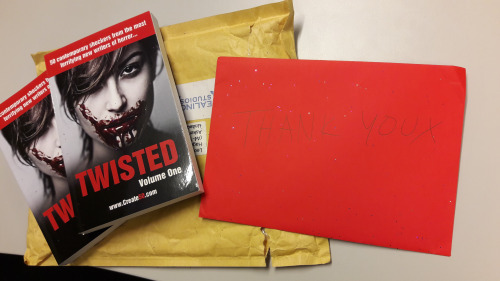
The books! And what's this "Thank you" note??
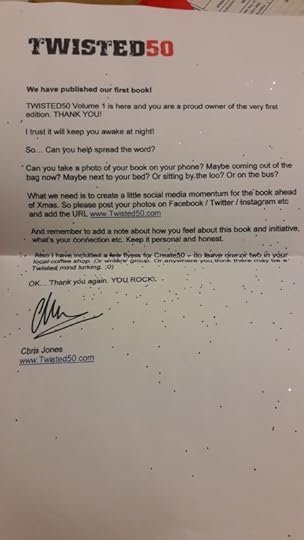
There is indeed glitter all over my work desk. And I love it!
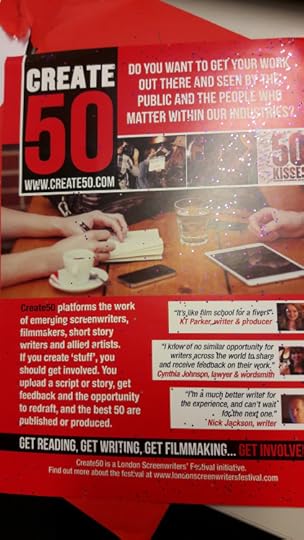
Contribute today and you could be the next one receiving books with your name in them!
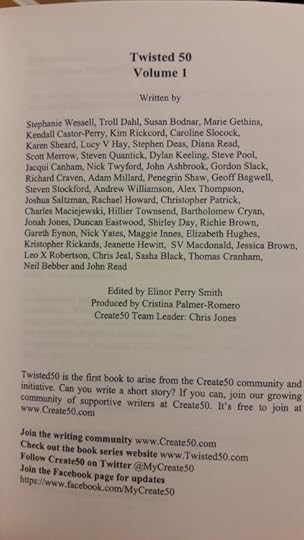
Took me a while to spot myself but I am there yes :)
Yeahhh!!
A lovely surprise arrived at work today!
And served as a nice reminder that yes, it is a new year, but once again, my previous efforts are still paying off.
Twisted50, and Create50 overall, are awesome communities you should sign up and be a part of.
Why do we write? Either no one knows or everyone’s reasons are different—I forget. But as nice as it is to have your name in a book—and it is fucking awesome—most agree that the act of writing in itself is the biggest reward, and that’s what Create50 participants attest. They are part of a writing school outsourced to, well, YOU. And what could be more rewarding than telling stories and helping others tell theirs?
Please do get involved and make sure to get yourself a Twisted Volume one while they’re still available!!
December 19, 2016
Bonespin Giveaway Complete!
Thanks to all who entered the Bonespin Slipspace giveaway. All 1300+ of you! That’s the most yet!!
Those of you who don’t have your copy yet, there’s very few left! Snap them up before there are no more! I’m trying to say you can buy it here :D
And thanks as always for your support :)
December 7, 2016
Bonespin Reviews + Giveaway
Hey everyone!! Just wanted to share the latest Bonespin Slipspace reviews with you :) Here are Paul, Mary and Unnerving Magazine’s* thoughts. So glad people are enjoying this one!
If you don’t have a copy of Bonespin Slipspace yet, you can get one here. All proceeds are going towards getting a Psychedelic Horror Press ISBN for the book, which means it can be sold on Amazon—so have no doubt that your support means something! I may even get royalties from this awesome book!
If you already spent all your spare quids on Xmas presents, or maybe even just stuff for you (because, awesome!) there is a giveaway for the book also.
Cheers! It’s my birthday on the 13th—so I will bug you again about buying a Bonespin then ;)!!
*The first issue of Unnerving Magazine, by the way, came out this week! It’s super creepy and awesome.


