
Jonathan Chait's Blog, page 154
November 16, 2010
Democratic Tax Strategery
Ezra Klein runs through the Democrats' options, and comes up with four possible concessions:
1) Unemployment insurance: In a few weeks, unemployment benefits will expire for 2 million Americans. An extension of the benefits commands majority support among Democrats, Republicans and independents. But most Hill observers think Congress will fail to act. It would be unconscionable, however, to let unemployment benefits expire even as the tax cuts for the rich are continued. If Republicans aren't willing to come to the table on unemployment benefits, Democrats shouldn't move on tax cuts for the wealthy. And if they're not willing to take that case to the public, what are they good for, exactly?
2) The debt ceiling: In February, Congress will have to vote to lift the debt ceiling. Republicans are already looking toward this moment eagerly. Sen. Jim DeMint, for instance, wants to use it as leverage for "returning to 2008 spending levels" and "repealing Obamacare." Of course, part of the reason the debt ceiling will have to rise is that extending the Bush tax cuts will cost about $4 trillion -- all of it on the deficit. If Republicans want the tax cuts, Democrats should force them to accept the consequences of their vote and stand shoulder-to-shoulder on the debt ceiling. For Democrats to vote to extend Bush's tax cuts and then let Republicans hammer them on raising the debt ceiling borders on self-parody.
3) Comprehensive tax reform: Our tax code is long-overdue for an overhaul. We need to clean out the loopholes, lower the rates and get rid of the tricks and traps (like, for instance, the occasional expiration of unaffordable tax cuts). The Bush tax cuts offer a useful forcing mechanism for that process: Sen. Kent Conrad has proposed pairing a short extension with a mandate for comprehensive tax reform. If the reform doesn't pass, then rates snap back to their 1999 levels, or deductions start taking across-the-board cuts.
4) The expiration of the tax cuts for income over $250,000: This was originally the White House's position, though they don't seem to be fighting for it very hard. Now it's the position of the House Progressive Caucus. They want to split the vote on the tax cuts for the rich from the vote on the tax cuts for income under $250,000. It's widely acknowledged that this makes the passage of the tax cuts for the rich less likely, which is why Republicans are ferociously resisting it. it's unclear exactly what leverage they're wielding in that effort, but whatever it is, it seems to be working.
Can anybody doubt they'll go with option 2, self-parody? I mean, "letting Republicans run up the debt and then blame Democrats for it" is the whole centerpiece of the Democrats' fiscal strategy over the last three decades.


Douthat's Unconvincing Defense Of GOP Fiscal Seriousness
Ross Douthat writes that the reaction to the debt commission shows that Republicans take the deficit more seriously than Democrats:
Last week’s media coverage sometimes made it sound as if Bowles and Simpson were taking the same amount of fire from left and right. But the reaction from Republican lawmakers and the conservative intelligentsia was muted, respectful and often favorable; the right-wing griping mostly came from single-issue activists and know-nothing television entertainers. The liberal attacks, on the other hand, came fast and furious, from pundits and leading Democratic politicians alike — starting with the speaker of the House, Nancy Pelosi, who pronounced the recommendations “simply unacceptable” almost immediately after their release.
There are a couple problems here. First, if you follow his links, Douthat is casting National Review as a key organ of the Republican Party and Grover Norquist and Sean Hannity as isolated voices. I think the reverse is much closer to the truth.
Second, I think that, while some liberals disputed the very idea of having to reduce the long-term deficit, most reacted to the specific policy mix offered up by the commission's chairmen. Now, Douthat argues otherwise in his column. Fortunately, we have a handy way to test which one of us is correct. Back in February, Congress held a vote on establishing the commission and requiring and up or down vote on its proposal. This was a good test of the two parties' interest in the concept of deficit reduction. Democrats supported the commission by a 37-23 vote, and Republicans opposed it 23-17.
Because Republicans demonstrated such hostility to the commission, it had to bend over backward to accommodate Republican preferences, produces a mix overwhelmingly tilted toward spending cuts over new revenue, and slashing tax rates. Douthat, in a follow-up item, argues that the plan isn't really so conservative because it would maintain federal spending at 22% of GDP in 2010, which is above the historic average. But in the absence of action, spending is projected to be about 26% of GDP. Obviously, you have to compare any legislative change to doing nothing, and trimming spending by 4% of GDP compared to doing nothing would be a pretty big deal.
Douthat's column also scolds liberals for opposing means-testing of Social Security. Liberals argue that the programs need to eb universal in order to maintain political support -- programs just for the poor quickly become unpopular. That argument, replies Douthat, "ignores the lessons of liberalism’s usual teacher, Western Europe, where governments have successfully reduced spending on their pension and entitlement systems without compromising their commitment to their neediest citizens."
Now, I favor means testing. But Western Europe is a terrible example to rebut the liberal fear of means-tested programs. Western Europeans support means-tested programs precisely because their countries tend to be racially homogeneous:
European countries are much more generous to the poor relative to the US level of generosity. Economic models suggest that redistribution is a function of the variance and skewness of the pre-tax income distribution, the volatility of income (perhaps because of trade shocks), the social costs of taxation and the expected income mobility of the median voter. None of these factors appear to explain the differences between the US and Europe. Instead, the differences appear to be the result of racial heterogeneity in the US and American political institutions. Racial animosity in the US makes redistribution to the poor, who are disproportionately black, unappealing to many voters.
If you go too far in turning Social Security and Medicare into safety-net programs for the poor, then white people will come to see them as transfers from people like themselves to undeserving others. Indeed, in the United States, white ethnocentrism correlates with support for universal entitlement programs like Social Security, and opposition to means-tested programs like welfare.
I think Social Security and Medicare are popular enough to withstand some means-testing. But pointing to Europe as an example that liberals have nothing to fear is terribly unpersuasive. It's precisely the ways in which we're unlike Europe that make universal benefits so much more politically necessary.
Special Ed Teacher Stalked, Harrassed By Right-Wing Creeps
This is one of the most stomach-churning things I've ever seen. Right-wing pseudo-journalist James O'Keefe decided to do an expose on the teachers unions. So he sent one of his flunkies to a bar after a teachers' conference to buy drinks for a special education teacher named Alissa Ploshnick, and prompt her to dish about incompetent colleagues while secretly recording her. One of Ploshnick's stories was that a colleague of hers referred called a student a nigger" and was demoted but not fired. She was clearly outraged.
Guess what happened? O'Keefe released the recorded, and got Ploshnick suspended for using the n-word. Yes -- the teacher who, in what she thought was a private setting, complained about a colleague using a slur is suspended. Here, per Zaid Jilani of Think Progress, is O'Keefe's video ambushing Plotnick outside her home:
Pretty disgusting, right? It gets worse. Plotnick turns out to be a hero who in 1997 was commended by President Clinton for jumping in front of a van to save her students:
Alissa Ploshnick risked her life to save the lives of a dozen Passaic schoolchildren. She threw herself in front of a careening van to protect her students and landed in the hospital with broken ribs, a fractured wrist, a badly bruised pelvis and glass cuts in her eyes. She could have died.
She still suffers pain from the episode. That's the person O'Keefe decided to pretend to hit on at a bar, secretly record, publicize the recording, and then ambush with a camera outside her home.
Have I completely disgusted you yet? Still have an ounce of belief in the possibility of justice? Okay, here's New Jersey governor Chris Christie discussing the episode:
Christie recently praised O’Keefe’s secret taping of Ploshnick and others and said: "If you need an example of what I’ve been talking about for the last nine months — about how the teachers union leadership is out of touch with the people and out of control — go watch this video.’’
Asked whether the stories of Ploshnick’s sacrifice and heroism changed his view, Christie spokesman Michael Drewniak replied: "What do these stories have to do with recent events? What should they have to do with recent events? They are completely separate and have nothing to do with one another."
He thinks the takeaway from this episode is that the teachers unions are out of control.
A Health Reform Opponent Has His Ox Gored
Freshman Republican Congressman Andy Harris, who was elected on a promise to repeal the Affordable Care Act, is outraged that he's going to go a whole month before his government-provided health insurance kicks in:
A conservative Maryland physician elected to Congress on an anti-Obamacare platform surprised fellow freshmen at a Monday orientation session by demanding to know why his government-subsidized health care plan takes a month to kick in.
Republican Andy Harris, an anesthesiologist who defeated freshman Democrat Frank Kratovil on Maryland’s Eastern Shore, reacted incredulously when informed that federal law mandated that his government-subsidized health care policy would take effect on Feb. 1 – 28 days after his Jan. 3rd swearing-in.
“He stood up and asked the two ladies who were answering questions why it had to take so long, what he would do without 28 days of health care,” said a congressional staffer who saw the exchange. The benefits session, held behind closed doors, drew about 250 freshman members, staffers and family members to the Capitol Visitors Center auditorium late Monday morning.”
I think we finally have a working definition of a health insurance crisis--when a member of Congress has to go a whole month without coverage. Of course nothing's stopping him from using his own money and purchasing private health insurance in the individual market. Those onerous Obamacare regulations haven't taken effect yet so he can explore the wonders of a still-functioning private insurance market as God and Adam Smith intended.
Well, That's Comforting
This does not reassure me about the future of political journalism:
USA Today has distributed revised newsroom flow charts, showing the paper's staffing under a recent reorganization to boost readership and revenue. The documents are dated Oct. 21-22; I recently obtained copies from a source. To the best of my knowledge, this is the first time USAT's editorial staffing breakdown has been made public. Some of the key numbers:
5
reporters to cover Congress
27
reporters to cover entertainment
I'd have more to say about this, but I should probably go find out what Lady Gaga is wearing today.
November 15, 2010
&c
Yoo Can't Be Serious

Former Bush administration torture enabler John Yoo mocks Democratic voting blocs of non-high school graduates and people with graduate diplomas:
Postgraduates, by which I believe the AEI analysts mean those with something more than a bachelor’s degree, were 20 percent of the electorate. They went for Democrats by 52 to 46 percent. No surprise there. Obama, after all, is himself a creature of the university ecosystem, and the way he talks reminds me of nothing more than a professor at a faculty meeting talking about changes to the grading curve. All those folks out there with M.A.’s and Ph.D.’s know one of their own when they see one.
Voters without a high-school diploma were only 3 percent of the electorate, and they voted Democratic 60 to 36 percent. Presumably, this group benefits the most from the redistribution of income going on under the Obama administration.
Everyone else (high-school grads, some college, college degrees) voted Republican. Democrats lost the middle class and more.
I’ve been trying to figure out what this means (aside from the amazing educational achievements of the electorate — 97 percent had a high-school degree or more). Does it mean that the over-educated have no more common sense than those with no education? Does it mean that Obama only really appeals to the extremes of the educational distributional curve, because neither end is really responsible for making ends meet and balancing budgets?
Wow. Yoo seems to think that everybody with a post-graduate degree is still in academia, and that none of them went on to the business world. (Somebody should familiarize him with obscure job categories like "doctor" and "lawyer," as well as the concept of "business school.") More amazingly, he seems to believe that people without high school degrees don't have to "make ends meet." Apparently this burden is reserved for the poor, suffering top 1% of the population contemplating the return of Clinton-era tax rates.
The Tiny Cable News Universe
[Guest post by James Downie]
Thanks to the midterms, the Stewart-Colbert rally, and Keith Olbermann's suspension, the opinion pages have been filled with columns decrying the partisanship of today's media, and damning both sides of the aisle for relying on partisan sources. Ted Koppel is the latest to join the handwringing:
“We live now in a cable news universe that celebrates the opinions of Olbermann, Rachel Maddow, Chris Matthews, Glenn Beck, Sean Hannity and Bill O'Reilly - individuals who hold up the twin pillars of political partisanship and who are encouraged to do so by their parent organizations because their brand of analysis and commentary is highly profitable.
The commercial success of both Fox News and MSNBC is a source of nonpartisan sadness for me. While I can appreciate the financial logic of drowning television viewers in a flood of opinions designed to confirm their own biases, the trend is not good for the republic. It is, though, the natural outcome of a growing sense of national entitlement. Daniel Patrick Moynihan's oft-quoted observation that "everyone is entitled to his own opinion, but not his own facts," seems almost quaint in an environment that flaunts opinions as though they were facts.”
Who says we live in a cable news universe? Here are last Thursday’s cable news ratings:
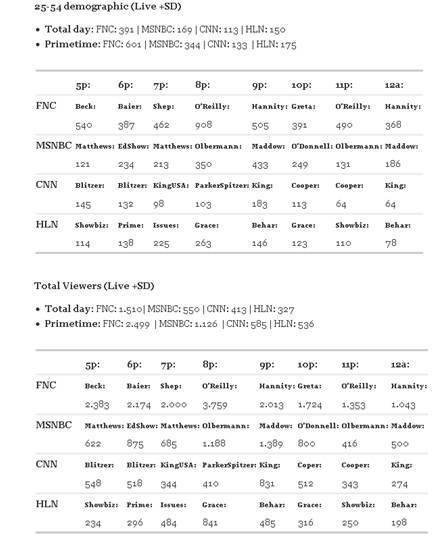
Of all those shows, only O’Reilly gets significantly above two million total viewers. By contrast, NBC's nightly news program doubles O'Reilly's ratings in both total viewers and in the coveted 25-54 bracket. Even CBS, the lowest rated of the three, easily outdraws cable, and both broadcast and cable news face the same aging demographics: the median Fox News viewer is 65, two to three years older than the median broadcast news viewer, and CNN and MSNBC aren't far behind.
But outpacing all of TV news is radio, and that's where Koppel and other media observers should be focusing their attention. At first glance, radio may look like a conservative-dominated field. Rush Limbaugh’s weekly audience of 15 million dwarfs any television news program, and even Sean Hannity and Glenn Beck’s radio audiences are several times their TV audiences.*
In fact, though, NPR provides a counterweight both to conservative talk radio, and to the charge that both sides have equally partisan media. Twenty-seven million people listen to NPR each week, and its morning and evening news programs get fourteen and thirteen million weekly listeners respectively, just behind Limbaugh. The daily audience Unlike TV news or talk radio, NPR's median age is a downright sprightly 50. (The median age of a Limbaugh listener? 67) And as tendentious as the equivalence between MSNBC and Fox already is (MSNBC, for example, wouldn't let its anchors fundraise for an Ohio gubernatorial candidate on air), that equivalency is far more plausible than one between NPR and conservative talk radio. While Limbaugh and others spend their days spouting factually suspect rants, NPR, as James Fallows has written, "is one of the few current inheritors of the tradition of the ambitious, first-rate news organization." It has seventeen foreign bureaus, more than any other American news organization, and its many affiliates continue to provide local news coverage even as local papers struggle. Cable news programs may make for good copy, but perhaps politicos should step back and consider just how influential those shows really are.
*Clarification on comparing ratings: cable news ratings are typically computed for each day of the week, while radio ratings are computed in weekly terms. It is not, however, as simple as dividing the weekly number by number of shows per week: "Morning Edition," for example, gets about 7.6 million listeners daily and about 14 million per week.
If It's Sunday, It's Harold Ford
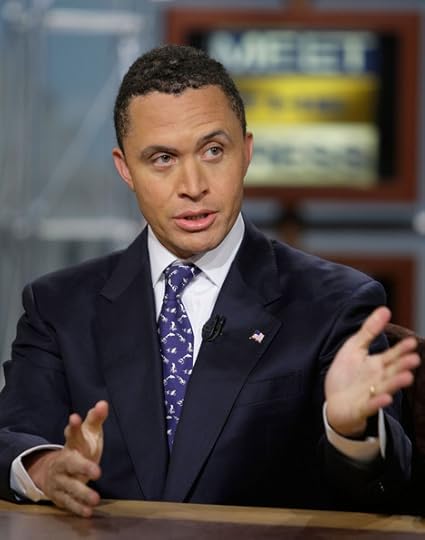
Defying my campaign of mockery, "Meet the Press" had Harold Ford on again, or at least a life-like robot programmed to spout out conventional wisdom in response to every question. Among his nuggets of wisdom:
There may be some areas where we disagree with, but I hope the left in my party and the right in the Republican Party don't scream so loud that they scare the crowded middle.[...]
Speaker Gingrich is a friend. He has been not only a leader in his -- the Republican Party , he's been a leader in a lot of ways for calling for a new American way , a new American majority. I would hope that all of the smart minds in Republican and Democratic Party could come together and say, "Look, this is painful, but we're going to have to do this." [...]
There are smart, sensible people in both parties. As long as you don't allow the far left and the far right, again, to crowd out the, the, the predominant middle, we can get a lot of this done. If that means making tough choices on Social Security -- I'm 40, I'm willing to give mine up, and I think a lot of people my age who may reach a certain income level are willing to do the same. But political leaders have to show some courage and will to make it happen. [...]
Apply to Be a TNR Web Intern!
The New Republic Online is looking for college students and recent graduates for its winter 2010 Web internship program. Internships are unpaid but offer substantial experience in the production of a daily online publication. Interns must be able to work in our Washington, D.C. office. Responsibilities include:
Research projects and assisting TNR's senior writers
Writing articles and blog posts, and helping to create multimedia content
Participating in TNR staff meetings
Preparing and updating TNR's homepage
Helping to maintain TNR's blogs and other aspects of the site
Political journalism experience is preferred, but not imperative; some familiarity with HTML is helpful, but not crucial; and fluency in search techniques like LexisNexis is mandatory. A full-time commitment is preferred.
Applications for our winter internship (December/January through May/June) are currently being accepted on a rolling basis. For the Web internship program, please e-mail a cover letter and résumé to Seyward Darby and Barron YoungSmith.
Jonathan Chait's Blog

- Jonathan Chait's profile
- 35 followers

