
Lucy V. Hay's Blog, page 3
June 21, 2022
5 Best LGBTQ+ Books to Bring to the Beach
 Pride Reading
June is Pride Month, a wonderful time to reflect on how we can all help the LGBTQ community. This Pride, challenge yourself to go beyond the easy platitude of “love is love” and recommit to fighting for LBGTQ people’s tangible equity and safety.
Starting with the narratives you’re reading now and every day is a good place to start. Grab a book from your local LGTBQ-owned bookstore that will broaden your understanding of gender, sexuality, and how we can create a world where everyone is liberated in every way.
1) The One Woman by Laura MayIn Laura May’s debut novel, Julie, a graphic designer, manipulates what the eye cannot perceive. Julie’s life and her relationship with her partner Mark are mundane regardless of how she looks at it. Until she meets Ann, that is.
Ann is a career woman who is also charming and loving. Julie can’t deny that their unexpected meeting resulted in chemistry. As their history and present intersect once more in Barcelona, the spark is uncontrollable. Julie must choose between her love for Ann and her allegiance to Mark when catastrophe strikes. Is pure love able to survive when the time is off?
2) Fruiting Bodies: Stories by Kathryn HarlanFruiting Bodies runs confidently from the fantastical to the gothic to the uncanny in stories that entice and haunt as it follows characters on the verge of change, most of whom are gay and predominantly women. In urgent storylines of discovery, appetite, and coming-of-age in a moment of crisis, echoes of ancient myth and folklore reverberate.
Fruiting Bodies is audacious, startling, and completely unique. It tells stories about knowledge in a world on the verge of collapse; knowledge that empowers or devastates. Kathryn Harlan firmly establishes herself as a startling new voice in literature, drawing brilliantly and boldly from a range of literary traditions.

Rebekah had spent her entire life on the island and had never considered what life might be like outside of her strict religious community until recently. However, when another adolescent girl, Alex, is transported to the community to escape her dark background, the two girls form an instant bond. And there’s nowhere to run when one of the girls’ kisses is caught on camera by another islander.
4) The Sleepless by Victor ManiboA strange virus renders a quarter of the world’s population perpetually sleepless, with no apparent health consequences. The pandemic generates a new class of people who are both feared and shunned, and who spend their extra time working to make more money.
One of the Sleepless is Jamie Vega, a New York journalist with C+P Media. Jamie doesn’t accept his irascible boss’s too-convenient story when he dies in an apparent overdose—especially considering the strange timing in the middle of a business takeover—and begins to investigate.
When Jamie learns that he was the last person to see Simon alive, things soon spiral out of control. When he retraces his steps, he learns he has no recollection of that night.
5) Briefly, A Delicious Life by Nell StevensBlanca, a fourteen-year-old girl from Mallorca, died at a monastery on a mountaintop in 1473. When George Sand, her two children, and her lover Frederic Chopin arrive in the village nearly 400 years later, Blanca is still there: a spirited, funny, righteous ghost, she’s been lurking around the monastery since her untimely death, spying on the monks and the townspeople and keeping track of her descendants.
Blanca is fascinated the instant she sees George, and the enchanting novel unfolds as a story of intensely felt, unrequited longing—a teenage ghost’s unfathomable love for a woman who can’t see her and doesn’t know she exists.
This is a surprisingly touching narrative about romantic fixation as well as a powerful meditation on creation, and it is charming, innovative, and emotionally gripping.
What are your favourite LGBTQ+ books? Please share in the comments below!BIO: Jane Hurst is a book blogger. She reviews latest book releases.


June 10, 2022
BOOK VERSUS FILM: Jurassic Park – Which ROARS best?
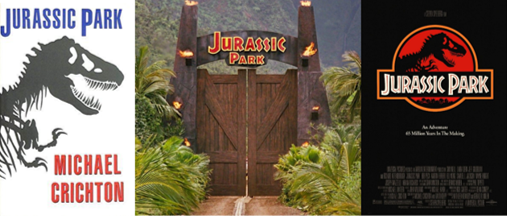 Hands up who loves dinosaurs …
 … Everybody? Correct answer. Grab your brushes and trowels, and try to ignore the running and screaming, as we excavate the biggest dinosaur tale of them all. Welcome to Jurassic Park.
Story & CharactersThree scientists are invited to Isla Nublar, a mysterious island 100 miles off the coast of Costa Rica. It’s actually a huge theme park, due to open in a year. The project’s financial backers are jittery, so to calm their nerves several expert opinions are being sought about the island’s unique inhabitants: living, breathing dinosaurs…
Dr Alan Grant is 40, a palaeontologist famous for theories about dinosaurs displaying maternal, bird-like behaviour. His own paternal instincts come to the fore when he is trapped in the park with Tim (11) and Lex (around 8). It’s fortunate he likes kids, because their lives are in his hands.
Dr Ellie Sattler, Alan’s grad school student, is a 24-year-old palaeobotanist, and the first to realise the park isn’t safe when she spots deadly plants by the pools. She’s a quick thinker, whether that’s identifying what made a stegosaur ill (triceratops in the movie!), or outrunning raptors.
Ian Malcolm (late 30s), a mathematician specialising in chaos theory, has long predicted the park will fail. He’s the main thorn in the side of John Hammond (76), the park’s owner. Hammond, the grandfather of Tim and Lex, created InGen – the biotech firm that discovered how to clone extinct species – and he refuses to listen to dissenting voices.
First Iteration: The Book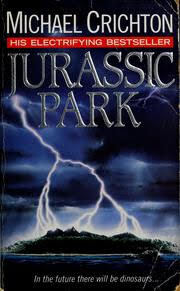 Back in the mid-nineties, a popular game called Theme Park was launched, where players built their own parks. Former Harvard Medical School student Michael Crichton had been creating his own parks since 1973, however, when he wrote and directed Westworld. But his second deadly paradise became possibly the most famous park in the world. And it started with a 1983 script about cloning a pterodactyl.
Though the script didn’t work, Crichton knew the concept was something special. Theorising the technology to recreate a dinosaur would be prohibitively expensive, he decided the only reason for doing so would be as a highly profitable entertainment – thus setting the story in a theme park.
But when he sent the novel to his trusted beta readers, they said it was terrible. Redrafts didn’t fix the issue, until Crichton changed the protagonist. Originally, the book was written from a young boy’s point of view; Crichton reworked it from an adult’s viewpoint, and his readers loved it.
The book opens with an introduction that feels like a non-fiction work, right down to the Roman numeral page numbers. It details the biotechnology rush and its commercialisation, adding to the credibility by referencing real companies alongside the fictitious InGen. We’re then told what follows is an account of two days in August, 1989.
After a terrific prologue where a man is flown to the mainland, allegedly suffering from a ‘construction accident’ but looking like he’s been mauled by an animal and muttering “raptor”, we get the first of several scenes that will eventually crop up in film sequels. A family arrives at a deserted beach and their young daughter is attacked by a tiny dinosaur called a compy.
The resulting investigation suggests the book will be more like a corporate thriller, where a company tries to hide its mistakes. It’s an interesting diversion for anyone familiar with the film, but it leaves the reader knowing far more than the characters. The story’s USP is a dinosaur park, highlighted on the book long before the film existed, so until we arrive on the island (page 79) we’re waiting for our protagonists to catch up.
As the park tour begins (exactly a quarter of the way through), Crichton hits his stride. Whilst many novels and films struggle to maintain momentum through Act Two, this is the book’s best section. The build-up to the storm, and the tyrannosaur’s first appearance, are superb. Interestingly, these scenes are written from Tim’s POV. I don’t know if these came from Crichton’s original drafts, but they are very effective.
At this point, Crichton introduces a countdown element: Lex spies raptors on board the supply ship returning to the mainland. Because there’s no way to contact anyone and warn them to recall the ship, Alan and the kids have a small window of time in which to get back to the visitor lodge.
 Their journey provides more scenes destined for future films: hiding behind a waterfall as a tyrannosaur pokes its head through; being attacked by cearadactyls in the pterodactyl aviary. By now we’re in classic disaster movie territory, where our survivors must make their way through stage after perilous stage to reach safety.
Meanwhile, an injured Ian Malcolm is confined to giving lectures on the dangers of science, from bed. Though convincingly argued, they slow the story down, and wouldn’t be missed if dropped. When Ian dies, the fact we don’t witness it, and furthermore feel nothing, says a lot. The only character who fares worse is poor Lex, constantly complaining of being hungry and getting in everyone’s way. On the flipside, the lawyer Ronald Gennaro is better in the book; not only does he survive but he joins in on the tyrannosaur hunt.
There are some baffling questions. When Ian is bedridden, raptors on the roof directly above try biting through the skylight’s steel bars. At one point they’re almost through, yet nobody moves Ian to another room until after the threat is nullified. Also, Tim gets to witness this via CCTV, but why would anyone install cameras in a bedroom? How do the raptors in the supply ship’s hold know to remain hidden? And most puzzling, why does the raptor that attacks Gennaro in the maintenance shed disappear?
But despite these, there is still plenty to enjoy, including little details such as how the island copes with all the dino-waste (the compys were bred to eat it!) Even if sometimes it feels like we’re reading a manual, Crichton’s research is always thorough.
ReceptionPublished in November 1990, the book was an instant bestseller. Many drew comparisons between it and Mary Shelley’s Frankenstein – a warning about immoral science. There was a studio bidding war even before the book was published. However, Crichton already knew who he wanted as director…
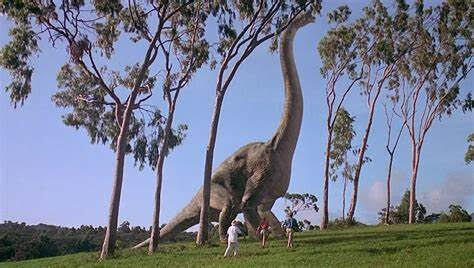
Around 1969, when Crichton sold his novel The Andromeda Strain to Universal, he was given a studio tour by a young TV director, Steven Spielberg. They became friends, and years later, whilst collaborating on another project, Spielberg asked Crichton what else he was working on. Once the magic words ‘dinosaurs’ and ‘DNA’ were spoken, Spielberg committed to directing the adaptation. It wasn’t until May 1990, six months before Jurassic Park was published, that Universal were able to bid for the film rights on behalf of Spielberg. They won, and he set about turning that commitment into a film.
Crichton wrote the screenplay along with David Koepp. The corporate thriller aspects were jettisoned, to get us to the island quickly. We see Isla Nublar at the 16-minute mark, and three minutes later comes our first resident, the brachiosaurus (changed from the book’s brontosaurus, because the brachiosaurus grazed from tree canopies rather than low plants, allowing for that iconic shot when Alan and Ellie first see a dinosaur). Now there’s barely any wait for the cast to catch up with the audience.
And speaking of dinosaurs… 39 years on, the effects are as good as anything made today. This is not a dig at CGI; plenty of the dinosaur action in the original film was computer generated – they were finding how far they could push envelopes, then finding bigger envelopes – and, combined with full-scale animatronics (including a 20 ft tyrannosaur), created a perfect illusion.
Of course, there’s no fun watching dinosaurs if they aren’t chasing little screaming happy meals on legs. So, let’s meet the menu…
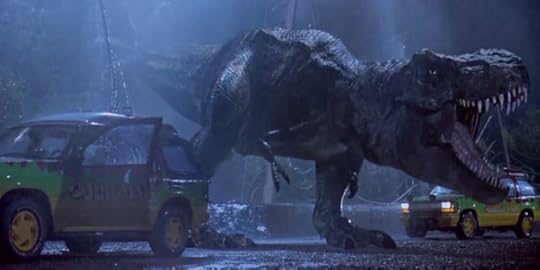
There wasn’t a large group in the book, so the only significant one dropped is the park’s head of PR, Ed Regis. Chief geneticist Dr Henry Wu barely appears, but does now survive (his death in the book is referenced here by Alan when he describes prey being alive when raptors start eating them) and will become the series’ villain.
Gennaro is less fortunate, though he does get to be the film franchise’s first major dino-dinner (following the gatekeeper at the beginning). He gets chomped by the tyrannosaur, in such a way – Gennaro is sat on the loo – that the audience are laughing too much to be frightened.
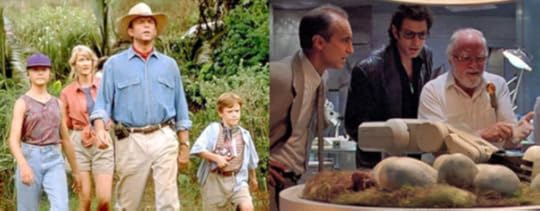
Luckily, Tim and Lex fare much better. Now Lex is the eldest, and it’s her computer hacking skills (not Tim’s) that restore the main systems; and Tim often provides some much-needed comic relief.
With Alan and Ellie there is one significant difference. Ellie is not a student, but they are a couple. The film has reduced their age difference significantly – in the script she is late-twenties and he is mid-thirties – although the gap between the actors’ ages is similar to the book’s characters.
However, Sam Neill and Laura Dern bring a warmth and chemistry to their roles, and provide the film’s primary character arc. This Alan does not like kids, but much to Ellie’s amusement he is thrown together with Lex and Tim, and by the end happily lets both children sleep in his arms.
It also leads to an amusing rivalry with the film’s best character, Ian Malcolm. Ian is attracted to Ellie, much to Alan’s disapproval, which leads to some cracking dialogue (“I’m always on the lookout for a future ex-Mrs Malcolm”). Our chaotician has jettisoned the long speeches, crunching his arguments against genetic manipulation to a few lines, whilst going full-on ‘rock-star mathematician’.
As for John Hammond, played by Sir Richard Attenborough with a mischievous glint and a Scottish lilt, this park owner loves his grandkids and wants his dinosaurs to be accessible to all, whereas the book’s version disliked Tim and Lex, and expected people to pay top dollar to visit. When Hammond dies in the book it’s deserved; when Hammond lives in the film, we’re relieved.
The cast is excellent. But special praise should go to Ariana Richards and Joseph Mazzello for making Lex and Tim so relatable, and the embodiment of chaos theory that is Jeff Goldblum who, as Ian Malcolm, chews more scenery than the dinosaurs.
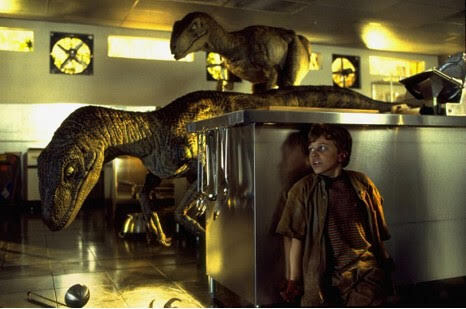
The storyline has been pared down until it’s just about survival. The supply ship countdown is gone, and all that matters is Alan getting the kids back to base, and then everyone getting off the island. It’s a shame the river journey and aviary weren’t kept, but it would have made a much longer film (already 155 minutes without the end credits), rare in 1993. The tension is superb, such as the fence climb, intercut with Ellie turning on breakers that will inadvertently power up those wires. And the tyrannosaur’s first appearance is as perfect as cinema gets: never has a water ripple felt so ominous.
All the science we need – how have dinosaurs been recreated? – is handled in a two-minute segment by an animated character not in the book: Mr. DNA. This not only shows us the mosquito-in-amber theory, but also plants the setup for dinosaurs reproducing. The rest of it, such as chaos theory, or whether dinosaurs are more like birds than lizards, is sprinkled throughout in dialogue and never feels obtrusive.
However, there are issues. In the final showdown we see two raptors (out of three), yet surely there should be only one, because Ellie locked one in the maintenance shed, and the kids locked the other in the freezer… I’d say it’s Ellie’s raptor, and not just because we’re shown they can open doors right when she comments that’s the only way it could get out – it’s also the only way it could get into the shed in the first place – but it’s not made clear.
Finally, the ending feels rushed. There’s a whiff of deus ex machina when that tyrannosaur saves the day (but isn’t, HERE’S WHY). This was a last-minute addition and Spielberg was right when he said the audience will want to see her at the end. It’s not as rushed as the book, however, where they’re off the island and everything is resolved in five pages and lots of explosions. Also, Spielberg understood we won’t want the park’s residents napalmed. They may be dinosaurs but they’re not monsters.
The film opened on 11th June 1993, and earned $912 million on its initial release, becoming the highest-grossing film of all time until Titanic, the first billion-dollar movie (although Jurassic Park re-releases have since taken it over that mark, making it the oldest film to earn a billion). You’d be forgiven for thinking it would to be up for more than the three technical-department Oscars it won, yet John Williams’ sublime music wasn’t even nominated. However, the composer did collect a statuette – along with Spielberg’s two – for the other film they collaborated on that year, Schindler’s List.
ConclusionIn my introduction, I end with the words “Welcome to Jurassic Park.” Did you hear Attenborough’s voice as you read that? Spielberg’s adaptation is a great big dinosaur of a film, but it is the calmer moments that make it powerful. From the first shot of the brachiosaurus to the image of DNA code illuminating a raptor’s face – and yes, Hammond’s welcome – the film wasn’t just entertainment, it was (and still is) an experience.
The book was a phenomenon upon publication and still holds up. If you want more science with your fiction it’s essential, and plays to Crichton’s strength of taking cutting-edge science and making it understandable.
But how do they compare as stories?The film repurposes itself as a survival adventure, whereas the book is a cautionary tale on the mistrust of technology – but the overwhelming research smothers the story. The film realises less is often more, and as a result succeeds better. Therefore, Steven Spielberg’s adaptation of Jurassic Park is the winner.
Which did YOU like best? Share in the comments!BIO: Nick Jackson loves dinosaurs. Every time he looks in a mirror he sees one. He also loves writing about book-to-film adaptations, because it gives him an excuse to watch all those making-of documentaries, and pretend it’s work. He has written numerous short stories for anthologies, including the best-selling “Everyday Kindness” from Dark Skies Publishing. He lives in West Yorkshire, where the Jurassic era hasn’t yet ended.
May 20, 2022
7 Exercises You Can Do While Reading A Book (Yes, really!)
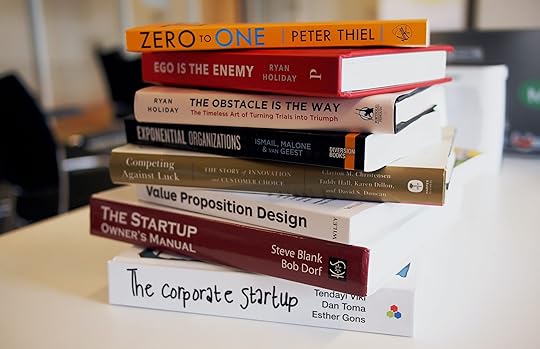 No couch potatoes here!
Mental fitness is just as important as physical fitness. Both provide positive benefits that keep your mind and body fit. So why not combine the two by staying engaged with your book of choice while getting your reps in — here’s how.
1) Literature Leg RaisesGet ready to work your abs and core with leg raises in your favourite workout leggings.
Grab a book and hold it with both hands while lying on your back.
Keep your legs straight up in the air towards the ceiling.
Keep your core engaged while bringing your legs slowly back down.
2) Wordy Wall SitQuads, glutes, and calves? Oh my! This next workout will have you feeling the burn.
Grab your book and stand with your back and legs against the wall.
Slowly slide down the wall, until you are in a proper seated position.
Keep your back flat while holding this position for 1 minute or until you’ve read 1 to 2 pages.
3) Side-Lying Leg LiftsLie down and get lost in your book with these leg lifts.
Begin with lying down on your right side with your arm propped up for head support.
Grab your book of choice so that it is nearby for you to read.
Lift your leg up and down, and repeat this motion 10 times or read 2 pages before alternating sides.
To remain physically and mentally fit, check out the infographic below. Enjoy!

March 28, 2022
The Ultimate Guide To Writing A Book Review
Writing a book review is so much more than simply reading a book and giving your view on it. If you would like to start your own book blog (or even review books professionally!), here is an ultimate guide to writing a book review.
Start Small, Build UpEven before you start writing a book review anew, you should consider your old writing. Re-read your old stuff and make notes. Is there any phrasing you particularly like? If your old writing is online, did you get a lot of comments? What did the readers say? Did they agree/disagree?
This prep work should help you determine your writing style: positive, critical, friendly, optimistic? It is up to you to decide. Establishing your own writer’s voice is worth every hour spent on it.
Read and Interpret the BookThe first thing to do is to read the book carefully and thoroughly. Try to have a critical approach to it and be as interactive as you can. Read the title and ask questions. Read the summary and do the same. Let the book answer your questions during your reading.
When making your interpretation, do not stray into the muddy waters. As interpretation is highly culture-dependent and individual, staying reserved on over-interpreting is a must.
The last thing you need is constructive (not destructive!) criticism. Finding a balance between how you would have said/expressed something and how the author has is a must in this line of work.
Give a Short IntroductionA short introduction is a must. Here, you should name the author of the book and give very brief information about the publication itself. The KISS rule (Keep it Short and Simple) should be applied here. Remember, this is only here to give context to the reader.
Write About the Book, Not the AuthorThe author should be named or introduced with a single sentence. That is all your audience needs to know. Many book review writers get lost in a sea of details about the author and how their voice can be heard in the book itself. Spare time and ink! Go straight to dealing with the book.

A short outline of the plotline and characters is a must. Make sure you stick to the book and that you enter only the most valid information. Try to place the book rightfully where it belongs in the genre.
Try not to be too clever, though! “A girl lands in a surreal landscape, killing the first person she encounters. She then teams up with three strangers to kill again.” – A truthful but hardly reflective intro to the ‘Wizard of Oz.’
Provide Your AnalysisThis part is solely yours. While some decide to have a chronological approach to the book, others strive for a more segmented approach. Whatever works better for you, but make sure to analyse and interpret. Think about how successful the story is at what it’s supposed to do, even if you didn’t personally like it.
Do Not JudgeNever judging a book is as necessary as it gets. Don’t be too critical and lack understanding of the character or story itself. The truth is, the places and characters are described the way they are for a certain reason. They all contribute to the story and have a say. A negative character is just that, a character. Watch them in relation to other characters, not your own sense of morality.
ConclusionWhen writing a conclusion to your book review, it is important not to provide any new ideas. You are summarising everything you’ve just written.
So, in conclusion – you need to start small, find your voice and provide analysis and constructive criticism that is not overly ‘judgey’.
Have fun writing your own book reviews!BIO: Jessica Fender believes that discipline and consistency are what stand behind a good writer. This writer and editor at GrabMyEssay sees writing as a form of communication and insists on clarity and conciseness. Jessica also loves reading and finds inspiration for writing in her favourite novels.
March 11, 2022
Creating A Home Library That’s Just Right For You

In a time where social media is all around, sitting down to read a good book might seem like it’s a thing of the past, but it doesn’t have to be. Creating a home library is a great way to escape and get lost in a book. If you are an avid reader, you most likely already have a growing book collection, and this will allow you to easily keep up and display them.
How to Create a Home LibraryWhile there is no right or wrong way to create your home library, there can be many questions on where to start. While this space is often thought to be solely dedicated to your book collection, it can also be used to work and study. It’s all up to the owner’s preference on how stylish and functional the area will be, so many of the designs will come from your taste.
Here are a few tips to remember when creating a home library that works for you.
Finding the Perfect SpotThe first step to creating your home library is picking the perfect location to put your books on display. Are you looking to dedicate an entire room to this project or just a small nook in your home? Depending on the size of your collection will determine the best area for you.
To picture what area will work best for you, here are a few spots you should put your home library and spots to avoid.
Places to Avoid Putting Your Home LibraryAvoid putting your home library against outside walls. Outside walls are subject to change due to the temperature and will lead to the growth of mildew and mould. The mildew and mould will then spread to your books causing damage. Another area to avoid putting your home library near is food and drinks. Food and drinks can attract small animals and insects that may damage your book. So carving out an area in the kitchen may not be the best spot.
Places to Put Your Home libraryIf dedicating an entire room isn’t the route you are looking to take for your home library, there are alternate spots. Try creating an area under your bed to keep your books. Having them in this underutilized area is a great way to keep your books protected and out of the way. Another area where you can display your books is in a corner nook. Adding shelves to the corner nook will naturally contain your books to a designated area.
Type of Shelving for Your Home LibraryThis is the time to get creative. There are numerous shelving styles available that you can choose from. Here are four types of shelving.
Floating Shelves – These give the allusion that they are floating on your wall. The attachments for the shelf are hidden.Corner Shelves – These shelves would be perfect for a corner nook, as they are specifically made to fit in a corner.Hanging Shelves – These are similar to floating shelves. Each shelf is held up by hanging wall attachments.Adjustable Shelves – These shelves can be moved vertically.How to Organise Your Home LibraryOne of the last steps to creating your home library is figuring out how you would like your books organised. A few ways that you could organize your book is alphabetical order, chronological order, by colour, or by genre.
After putting together a home library that’s just right for you, you will want to be sure your books are covered by your home insurance. This will ensure that your book collection is insured if damaged.
For more tips on how to create a home library, check out the infographic below. Enjoy your planning!

January 21, 2022
INFOGRAPHIC: 2021 Reading Habits Around The World
 Reading Habits in 2021
Despite living in a digital age, most of us still agree that nothing beats a paperback or hardback in our hands.
Global English Editing has just released a new infographic, summing out the world’s reading habits in 2021. And the data is clear: real books are still more popular than digital ones.
66% of us say that printed books offer a more unique and fulfilling reading experience than e-books.
Although the world is increasingly tech-savvy, e-book sales have stalled this year and make up just 9% of the total book industry revenue.
Interestingly, audiobooks continue to boom and are predicted to steadily grow over the years.
These are just some of the findings from Global English Editing’s research into world reading habits in 2021.
Check out the infographic below to discover more fascinating facts. Enjoy!

January 15, 2022
BOOK VERSUS FILM: Zodiac – Which Kills It?
 The Book
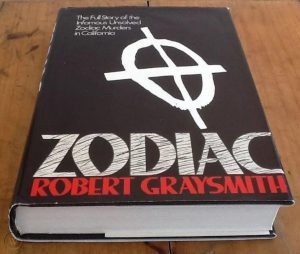 The 1986 book Zodiac by Robert Graysmith tells the story of The Zodiac Killer, the serial killer who terrorised the San Francisco area beginning in the late 1960s. Graysmith was a cartoonist at the San Francisco Chronicle and was there when the Zodiac killer mailed the newspaper letters and ciphers to taunt police.
The book is a portrayal of a watershed moment in American history because the Zodiac killer was the first modern American serial killer that became part of the national culture in an unprecedented way. Graysmith’s book is very much a product of the era, and as a result it feels very different from modern true crime books. But that’s part of what makes the book great!
Written and printed at a time long before true crime was the massive industry it is today, Zodiac is truly a product of research and facts without many literary flourishes. What shines through in sparse, effective prose is the sheer drive to present the facts of the Zodiac.
Those facts are more than enough to tell a captivating and chilling tale. Long before there were entire channels dedicated to court cases and true crime, there was the Zodiac killer and those who were fascinated by the case. The book is written by one of those people. Zodiac doesn’t just tell the story of a serial killer, it tells the story of a different era and a different country.
The Film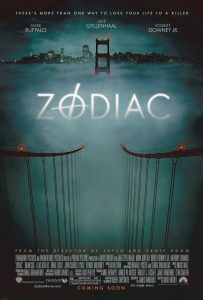 In 2007, Zodiac, a film adaptation of Graysmith’s book by David Fincher, premiered in theatres. From the beginning, it’s clear considerable time and care were given to researching the facts of the case. The result is that Zodiac doesn’t feel like a typical crime movie at all.
In fact, it has the slow, methodical, but quietly unnerving pacing, flow, and style of a good true crime book or even a documentary. There is no huge dramatic showdown in the end with the killer and no climactic ending that can be found in most crime movies.
Instead, Zodiac is a movie about the investigation of one of the most famous serial killers in American history. As opposed to many crime movies, where the serial killer or even the victims is the central focus, the emphasis here is on the investigation itself. That methodical investigation and presentation of the facts are the heart of the movie, as it shows all the ups and downs that the investigators and other people involved experienced while trying to catch the Zodiac. As an audience member, you feel the excitement when a suspect that looks good is revealed, only to have your hopes dashed away by a new piece of information.
The film also does a superb job of creating the mood, atmosphere, and style of the era. Zodiac shows the late 60’s as most of middle America lived it, which is what made the Zodiac killings so unprecedentedly terrifying to people of that era.
This was long before true crime was such a widespread and popular interest, and in a way, Zodiac shows why that genre became such a fascination. The crimes the Zodiac committed were happening to regular people in places regular people lived and worked. And there was no telling where he was and how many people he had truly killed or attacked.
The movie does a great job of showing how the case draws one in. Before you know it, years and decades have passed, and you are still no closer to knowing who did it.
Sadly, Zodiac shows the raw reality of many investigations, especially of that era, as the crime has never been officially solved despite it being one of the most high-profile American crimes ever. Much like the book, the movie Zodiac takes an amazing amount of care in presenting the facts in all their light and tells the story not just of a serial killer, but a different era, a different mindset, and a different culture.
One very important fact the film shows is how this was an era before DNA evidence and instant communication, so sharing information about crimes was much more difficult, complex, and time-consuming. A great scene that subtly shows how the culture changes as the case goes along is where people involved in the Zodiac case go to the movies and the movie playing is Dirty Harry, the iconic Clint Eastwood film where the movie’s villain is a fictionalised version of the Zodiac killer.
Book Versus Film
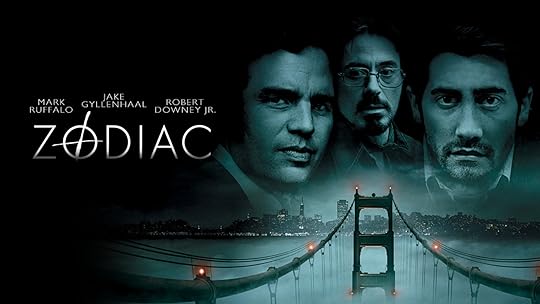
The book and the movie complement each other very well because the movie takes the book and enhances it. Unlike most adaptations of books, Zodiac doesn’t have to work hard to adapt the story to the screen or figure out what to show, which is an advantage of a non-fiction story. The crimes described in the book come across more like re-enactments than typical dramatisations because of how meticulous they are shot and depicted.
But one thing the movie shows in-depth that the book doesn’t is the toll that the case takes on all those involved. This is perhaps the biggest way the movie compliments and enhances the book, because it brings to life the investigators. While in a book there may be one or two notes referring to an experience, the movie Zodiac brings author Graysmith to life as a character just like the cops investigating the killings.
One scene stands out as beyond effective at showing how frightening writing about the case could be, especially in those days. In the scene, Robert Graysmith (played by Jake Gyllenhaal) is meeting a man about a potential lead in the case, and together the two go to his house to look at writing samples for someone who may or may not be involved in the Zodiac killings.
The scene that follows not only captures the real-life thrills that can happen during a case like this, it’s also one of the most subtly suspenseful scenes to happen in a movie in the last few decades. There is no ominous music, no over-the-top jump scare, just a quiet, albeit terrifying implication. And like many things involving a criminal investigation, it may have been nothing, but the possibility is more than enough to be frightening.
The other thing the film captures over a book is the greater effects a crime like this has on a community. The scene where someone claiming to be the Zodiac calls into a local TV station may merit only a brief mention in a book, but the scene showing it re-created is quite unsettling and captures the terror that could’ve been lurking anywhere in the area during the time of the Zodiac killer. Much like the book, the movie never embellishes or exaggerates things because it doesn’t have to.
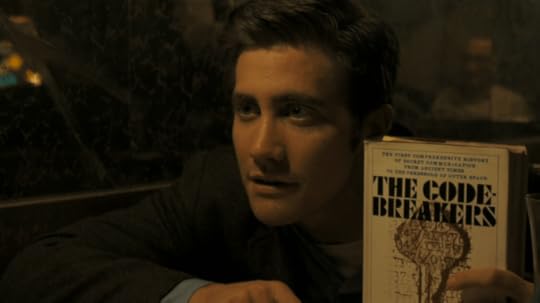
When it comes to deciding which one was the best, it’s a tough call. For those seeking a comprehensive and complete look at the entire Zodiac case, the book is the best bet, but for a brilliantly-made movie that tells an important story and shows the true impact that a crime obsession can have on anyone, the movie is the clear winner. In this case of book versus movie, one doesn’t clearly outshine the other so much as both are excellent examples of their medium. Either way, they are both highly recommended.
Enjoy!BIO: Grant Butler is the author of the novel The Heroin Heiress and his short fiction has been published in Sick Cruising and Mardi Gras Mysteries. Some of his literary influences include Stephen King, Ira Levin, Agatha Christie, and Thomas Harris. Cinema is also a big influence on his storytelling and some of his favourite films are Jaws, The Godfather, Goodfellas, and Psycho. He can be found on Twitter @thegrantbutler.
October 31, 2021
BOOK VERSUS FILM: Hellraiser Halloween Horror Special!
 Hellraising Halloween
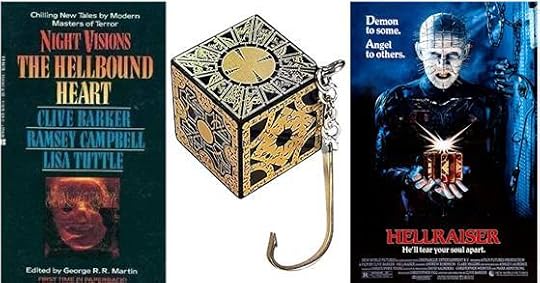
Question: why is Lemarchand’s puzzle box like the foot injury plantar fasciitis? Because it’ll tear your sole apart. No joke: I’m writing this whilst rolling a golf ball under my foot, and it hurts. Someone else who knows about pain is Pinhead. It’s nearly Halloween, it’s Book Versus Film time, so shall we meet him? He has such sights to show us.
The StoryRory and Julia move into Rory’s deceased grandmother’s house. He desperately wants to save their marriage, but doesn’t realise she wants his missing brother Frank, with whom she had an affair shortly before marrying Rory. But neither of them know Frank died in that house the previous year, after solving Lemarchand’s puzzle box and opening a gate to Hell. A gate that opens both ways…
The BookYes, technically it’s a novella, but ‘Novella Versus Film’ sounds as bad as going into a dark cellar alone on the night Michael Myers hits town, so I’m calling it a book.
Back in the 80s, when horror novels were huge, a young Liverpudlian playwright shook up the genre with his short story collections, The Books of Blood. Clive Barker weaved tales of gore, sex, and sadomasochism, and they sold bucketloads. When one of the stories (Rawhead Rex) and another original screenplay (Underworld – not the vampire flick) were turned into substandard films, Barker decided he’d try directing himself.
The problem was, he needed a ‘cheap’ story to get any studio money.
Having linked up with first-time producer Christopher Figg, Barker set about crafting a story that would hopefully get a modest budget of $1 million. Together, they outlined one set in a house, with four main characters. Barker had been fascinated by puzzle boxes since his grandfather, a ship’s cook, brought some back from the Far East, so that went into the mix too. To ensure the story worked he wrote it as a novella, which also completed a prior commitment to American publishers Dark Harvest, for 30,000-words to appear in their Night Visions 3 anthology. And so, into the world came The Hellbound Heart.
The CharactersNice guy Rory knows there are problems in his marriage to Julia, but believes it’s nothing that can’t be fixed. However, he doesn’t know his best friend Kirsty has a crush on him, and as for his wife… Married to a man she does not love, and lusting for a lover who was ambivalent towards her, Julia is even more tortured than the poor fools who open the puzzle box. Since her affair with Frank, she sees how unfulfilling her life has become. Surprisingly, it is Julia rather than Rory who is our protagonist, giving this a much darker tone.
Frank is Rory’s older brother, and as children they were inseparable until the teenage years made one a dutiful son and the other a pariah. A man who takes what he wants, Frank lives only for self-gratification, so when he hears of a puzzle box that promises ultimate pleasures he is hell-bent on finding it. At the opposite end of the confidence scale is Kirsty, who has secretly loved her best friend Rory for years. Despite knowing Julia is bad news, she loyally tries to help him save his marriage. Kirsty is the closest the book has to a heroine, with Frank the antagonist – more so even than the creatures he summons with the box.

The theme – desire – is epitomised by the four main characters, and in all cases it is unfulfilled. Kirsty loves Rory, but he isn’t even aware of it. Rory loves Julia, who does not feel the same about him. Julia loves Frank, but he yearns only for extreme pleasures. Three of the four at various points have what they want – and find it wanting – so eventually pay the ultimate price. By the end, only Kirsty survives. Be careful what you wish for…
Barker clearly loves telling a Faustian tale: his earlier short film The Forbidden, and his first novel The Damnation Game are two further examples. The characters are well fleshed out, despite the short wordcount, and their interweaving relationships – the unrequited love, the secrets, the resentments – are brilliantly realised. Barker describes it as a romance rather than a horror story, with that Hellbound heart of the title belonging to Julia, but Mills & Boon this ain’t. For one thing, people don’t get skinned alive in those books. For another, there aren’t any Cenobites.
Ah, the Cenobites. Inspired by visits to New York S&M clubs, where Barker watched people being pierced for fun, they are introduced here as theologians of the Order of the Gash. Two are recognisable in the film: the Chatterer (third Cenobite here) and Pinhead (second Cenobite), and like their big-screen versions, they barely feature. Of the four we meet in the opening chapter, three are so mutilated their gender is unidentified, and Pinhead is one of them. Some claim the book version is female (a belief once again doing the rounds due to the casting of trans actress Jamie Clayton in a 2022, Barker-produced, reboot) but that’s not strictly accurate. Though described as having “the voice of an excited girl”, our unnamed character (the name ‘Pinhead’ comes later) is referred to as ‘it’ throughout. Only the fourth Cenobite is identified as female, but her startling appearance – not to mention an impressive collection of 20 severed tongues – ensures she never makes it to the screen.
Their summoning has more overt religious connotations here, including such placatory offerings as a jug of urine and a plate of doves’ heads (presumably the food on the return to Hell is worse than British Rail). Frank is twice given the option to back out. Failure to see sense results in all his senses being heightened – in one of the book’s best passages – preparing him for what follows. And judging by the rotting heads that final Cenobite is sat on, what follows will hurt.
The book’s biggest strength is Barker’s writing. At times almost poetic, it’s every bit as emotional, attractive and repulsive as his characters’ desires. There are hints too of other ‘charts’ that lead to the Cenobites (a coded theological work in the Vatican, an origami sculpture once owned by the Marquis de Sade) along with that puzzle box, implying a bigger world beyond this story’s limits. Barker would write a final sequel novel in 2015, The Scarlet Gospels, focusing on Pinhead – now called the Hell Priest – yet there still feels like we have much more to explore.
But of course, all this was just a dry run to what came next …
[image error]
The FilmRoger Corman’s former production company New World gave Barker $900,000 to make his movie. He wrote the screenplay, and after a title change to Hellraiser (suggested by producer Figg), filming began in London, in September 1986.
The CastFor Julia, Barker cast Clare Higgins. Played as a more sympathetic character (we’re actually on her side when she leads the first victim to his death), Julia understands what she’s doing is wrong but cannot stop herself. It’s a great performance – and watching as she becomes more glamorous with each kill is fun too.
Rory, now called Larry, has changed from British to American, to help US sales. The part went to Andrew Robinson, who would become famous a few years later as the wily Cardassian tailor Garak in Star Trek: Deep Space Nine, but was already known for a role that almost ended his film career: the Scorpio killer in Clint Eastwood’s Dirty Harry (he was so convincing, many industry people were afraid to meet him). The contrast between nice Larry and the finale’s evil version was crucial, and Robinson is perfect.
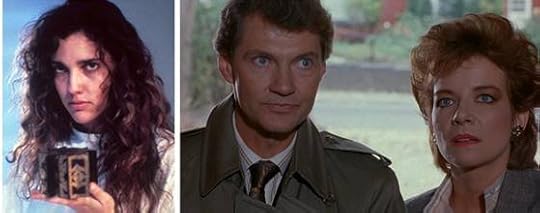 Rounding off the main cast are Sean Chapman as alpha-male Frank (whose British accent would later be dubbed over), and Ashley Lawrence as Kirsty. She is also American, because her character is now Larry’s daughter from a previous marriage. This change works well – allowing Kirsty to be a more proactive heroine – and introducing a fairy-tale element, with the innocent daughter, the gullible father, and the wicked stepmother.
All give great performances, but though franchise plans were to focus on Julia, had Higgins not left after Hellbound: Hellraiser 2, another character, who barely features, was about to become its figurehead. Pinhead: elegant, eloquent, punkish and priestly – and listed in the credits as Lead Cenobite (the Pinhead name officially arrives in the second film’s credits) – he is brilliantly played by Barker’s schoolfriend Doug Bradley. Unfortunately, the studio did not agree.
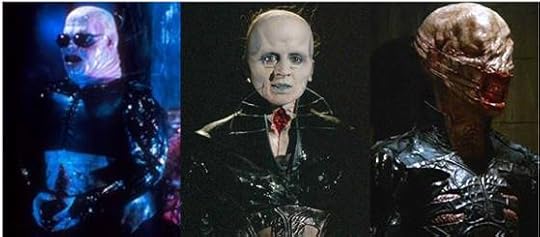
It eschewed the comedic horror of the time – the Nightmare on Elm Street sequels, The Lost Boys, the Evil Dead movies, etc – but that scared New World, so they sent production executive Tony Randel to fix what wasn’t broken, including Pinhead. They wanted him either silent (like Jason Vorhees) or wisecracking (like Freddy Kruger). Barker refused, Randel sided with him, and would eventually become Barker’s choice to direct the sequel.
All the characters are improved, but Kirsty most of all (though she has cinema’s crappest boyfriend, whose talents stretch to swallowing lit cigarettes). In an extended finale that fits so well it’s surprising this wasn’t in the book, Kirsty defeats the Cenobites by reversing the moves that opened the box, thereby closing it. And the coda, with the box returned to the person who first sold it to Frank, bringing the story full circle, also guaranteed sequels.
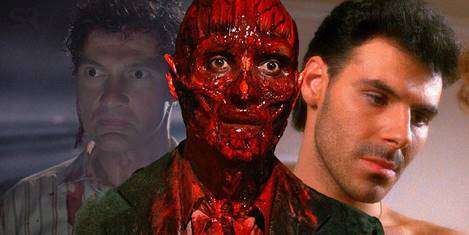 The make-up effects are stunning. Designed by Bob Keen (who helped create Jabba the Hutt), Skinned Frank and the Cenobites are impossible to forget. And Pinhead – a throwback to Christopher Lee’s Dracula rather than snarky 80s bogeymen – is the best horror villain in years.
Though not a horror-comedy, Hellraiser has a vein of humour so black many people miss it entirely: such as Julia reliving her seduction by Frank as Larry gouges his hand open (the incident that precipitates Frank’s rebirth) whilst carrying the marital bed upstairs.
And finally, Christopher Young’s score (which replaced music by experimental band Coil) is so rich and atmospheric it adds a genuine sense of grandeur.
Release and ReceptionIt’s difficult to know how The Hellbound Heart was received when published in November 1986, with it being in an anthology (it finally became a standalone title in 1991), so we’ve only got Hellraiser to go on. Reviews could be divided between those who were disgusted by the S&M overtones and gore, and those who weren’t. And for those who weren’t, the film was a breath of fresh air in a genre going stale. Many praised it for being serious, intelligent, morally complex, and for including deaths that actually advanced the plot rather than being mere titillation.
Stephen King’s famous quote, anointing Clive Barker as the future of horror, was used everywhere, alongside images of Pinhead – frequently without his black contact lenses! Opening in September 1987, Hellraiser grossed $14.5 million, being the most successful ‘foreign’ film in many territories, and a very healthy return for New World’s investment. A sequel was already greenlit, which led to ten films in all (as of 2021), with a Barker-produced reboot due next year.
Demons to Some, Angels to Others: But which Triumphs?
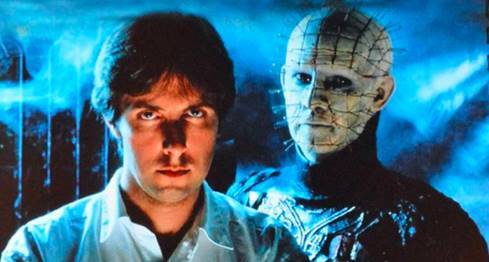
Whichever one comes out on top, the real winner is Clive Barker. He proved he could direct horror as well as write it, and like his books the film remains hugely influential.
The book works better with the world it creates. Barker offers details that linger long after the last page (what are the ‘birds’ Frank sees when opening the gate to Hell?), but it’s the other modes of summoning the Cenobites – the Vatican code and the Marquis’s origami – that really intrigue. Lemarchand’s puzzle box / the Lament Configuration box (to use its film name) is a thing of beauty, but the sequels devalue it by overuse. Those other roads to Hell are worth further exploration, either in print or perhaps an anthology television show.
Also, the book is clearly a British horror story but New World relocated the film to America once filming wrapped, necessitating some poor dubbing for several characters (including Frank and Kirsty’s boyfriend). Many fans thought the transatlantic move happened with Hellbound: Hellraiser 2, but it began here; however, leaving aside the sight of an InterCity train, there’s still no disguising those British price signs in the pet shop scene!
The film benefits from the book road-testing the premise, allowing Barker to smooth over wrinkles and flesh out characters. Because the book explains everything sequentially, we know what the box and Cenobites are in the opening chapter, but the film holds such explanations back, prolonging the mystery. Also, the book’s Frank is given the option to back out by the Cenobites yet Kirsty is not, which is inconsistent.
But what finally separates the two is the final act. The book’s Kirsty is allowed to go free by the Cenobites – anti-climactic as she doesn’t really earn this escape – yet in the film she is forced to fight for her life and freedom. It’s more satisfying, and brings to the story a proper feeling of closure.
So, the puzzle is solved: Hellraiser the film is the winner!
What do you think?BIO: Nick Jackson likes books, films, and puzzles. He does not much like pain, but as he couldn’t even solve two sides of a Rubik’s Cube, there’s little danger he’ll be Hellbound any time soon. He has written numerous Book V Films for Lucy, and several published short stories. His latest story will appear in Everyday Kindness, a charity anthology being published on World Kindness Day, 13th November 2021.
October 30, 2021
BOOK VERSUS FILM: Cape Fear – which EXECUTES the story the best?
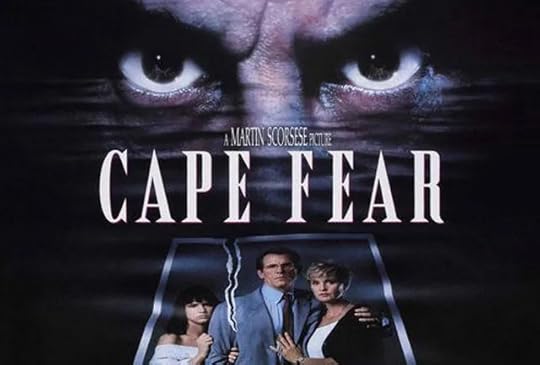 Cape Fear Book Vs. Film
So it’s Halloween week again! We love this holiday here, so below are some previous Book Versus Films on thrillers and horrors. From witches, vampires, ghosts and monsters through to serial killers and psychopaths, these kept us guessing, freaked us out, excited us and/or sent delicious shiiiiivers down our spines …
The Exorcist The Shining Misery Stephen King’s IT The Silence of the Lambs A Discovery of Witches Twilight I Am Legend The Thing Miss Peregrine’s Home For Peculiar Children The Haunting of Hill House Pet Sematary BirdboxThis time, it’s the turn of the classic CAPE FEAR. Adapted not once, but twice, it’s based on the book The Executioners by John D. Macdonald (hence the cheesy pun title for this post! Whaaaaat … you love it).
But which is better, the book or either of its 1991 movie version?? Let’s check it out, but be warned: HERE THERE BE SPOILERS …
About The Book Originally published in 1957, the book’s plot concerns a lawyer being stalked and tormented by a criminal he helped put in prison after seeing him rape a woman.
Just 160 pages long, it’s a novella by today’s standards though it was not unusual for 1950s hardboiled thrillers and psychological suspense to be so short. As the cover suggests, the book in its day was considered pulp fiction but the reality is, this is a lean, mean and scary story that absolutely nails its craft.
The book rockets along in terms of pace, but it doesn’t skimp on character and back story. In fact, you will find a STACK more characters in the book than the film! Whilst Sam Bowden takes centre-stage as we’d expect, his family is much larger. Married to Carol, he has three children instead of just the one (as in both films, incidentally). His daughter teenage Nancy is joined by two brothers, Jamie (12) and Bucky (6).
Cady is every bit as evil as we expect in the book. In contrast to the film version, Sam was a witness to Cady’s crime back in Australia when they were both serving in the navy in WW2. Sam does become a lawyer, but much later.
In the book, the Bowdens are a well-to-do family, but in a different way. Their house is exceptionally remote and intriguingly, the showdown does not take place in the marina like the film. What’s more, Cady’s threat is a nightmare: in addition to poisoning the family dog, he loosens a wheel on the family car and even shoots at twelve year old Jamie when he is at camp.
This leads Sam and Carol to leave the children in safety at a hotel, hatching an elaborate plan to tempt Cady out into the open. They decide to booby trap their home, using Carol as bait for would-be rapist Cady in order to try and execute him. The police obviously do not approve of this plan but allow one of their officers to look in on the Bowdens.
Inevitably Cady is more slippery then they realise and manages to murder the police officer. Cady hits Carol and Bowden is too late, falling and stunning himself. He shoots wildly at Cady as he escapes and is sure he has missed. Even so, he searches the hillside behind his remote home and discovers his dead body. The nightmare over, the family have a low-key celebration on their boat The Sweet Sioux, thankful that their family is still whole.
ThematicsKnown for his wit and wisdom , John D. Macdonald had a busy life. By the age of just thirty he’d gone to college, seen action in WW2, joined the OSS (the original CIA) and got discharged before starting his writing career. During that career he wrote a whopping 60 novels and over 500 short stories.
Though The Executioners was not his best received or most popular during his lifetime, it’s probably had the most longevity thanks to Max Cady and the two Cape Fear movies. There’s some commentary on what ‘makes’ a psychopath in the book. Given psychiatry would have been in its infancy back then, I was particularly impressed with this element.
There’s more diversity than we’d expect in such an old book, too. Bowden’s wife Carol has Indian (Native American today) heritage, signified in her ‘warrior mom’ characterisation and the family boat’s name, The Sweet Sioux. Carol’s background is expertly contrast against Cady’s as he is descended from Hill People. He is the invader, a threat, whereas Carol is always pure of heart, but tough. Her dialogue with Sam reminds us she is capable and will do whatever it takes to protect her family.
The Executioners asks some important questions about culpability that are still relevant nearly sixty five years later. We’re left in no illusions about how The Bowdens are pushed to the brink by Cady, plus their sense of helplessness is expertly drawn as they are forced to take the law into their own hands. Very much recommended!
The 1991 FilmSet UpSo The Executioners was filmed twice under the title Cape Fear, once in 1962 and again in 1991. Most people remember the Martin Scorsese version thanks to Robert De Niro’s iconic and Oscar-nominated powerhouse performance, but many don’t realise it was a remake. The original starred Gregory Peck as Sam Bowden and Robert Mitchum as Max Cady. Both men made cameos in the 1991 version.
Opening on the water, 1991’s Cape Fear places itself not only in the geographical region that means something to the Bowdens, it establishes the tone for the audience. Beginning with a credits sequence by Elaine and Saul Bass and making use of the original movie’s dark and edgy score, Martin Scorsese lets us know this will be a movie that is ‘hyper real’ and uses Hitchock’s notion of the ‘unstable space’. This is further underlined by The Bowdens’ daughter Dani (an Oscar-nominated performance by Juliette Lewis) talking of summers past on the actual headland of Cape Fear, contrasted against the threat of the heavily tattooed Cady working out in his cell.
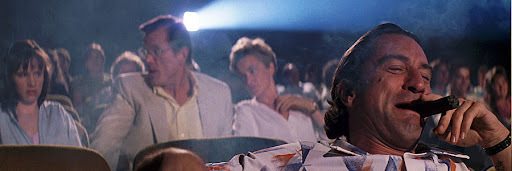
The screenwriter Wesley Strick uses excellent subtext in the Set Up, hinting at what’s to come. First off Max is told ”This is the moment you have been waiting for’ as he’s escorted from jail. Next up Dani and her mother Leigh discuss Leigh’s latest project, with Dani summing it up for her: ‘Movement … Stability … And an arrow’ (is Max the ‘arrow’ moving to threaten the Bowdens’ stability? Certainly seems like it). Later, when the Bowdens watch a movie Max interrupts their evening with obnoxious laughter and cigar-smoking, yet the on-screen ‘Dad’ wrecks the home and yells ‘Bye junior!’ Given the events of the movement are Sam Bowden’s ‘fault’ (both overtly and covertly), this foreshadowing really works.
As mentioned, there are some significant changes to the Bowden family from the book, yet they’re different again from the first movie incarnation. In the book Sam is a righteous man, a good father and husband who puts his family first. What he saw Cady do in Australia appalled him and he worries about Nancy being taken advantage of. Unlike perceived norms of his time, he places wife Carol on an equal footing with him. They are a team.
This is not the case with Nick Nolte’s Sam Bowden in the 1991 movie. Sam is a morally ambiguous character, placing the law at the heart of what he does … yet he won’t stop short of using the law to his own advantage. Swapped from being a key witness against Cady, Sam is now Cady’s public defender who buried evidence rather than see Cady go free. This ambiguity is carried through to Sam at home: he is not a good father or husband, prone to intimidating outbursts with a history of infidelity.
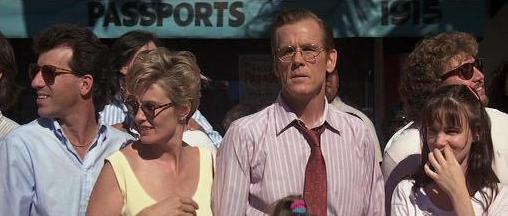
Like Carol in the book, Leigh is tough and no-nonsense, but unlike her she is a wise-cracker: ‘You know how to fight dirty, you do that for a living.‘ Leigh is obviously not a happy woman. Her behaviour after she and Sam have sex suggests she is as bored as he is. Her lack of surprise when she busts him on the phone to Lori is telling. Her outbursts when the dog dies or the affair in Atlanta suggest she is not as ‘together’ as she might appear.
Jessica Lange is not Native American, but instead has a Tippi Hadron-like blonde pixie cut, further underlining Scorsese’s Hitchockian vibe. As the film progresses she lets go of her anger at Sam and starts to think more strategically. It’s her who tries to stop Sam from slipping about in Kersek’s blood and firing randomly into the garden. She also delivers a powerful speech to Cady about sparing Dani from rape and Sam from murder. It’s also her who pushes Dani from the boat before it wrecks.
Dani is child-like and naive, almost babyish in the set up. We hear how she is in summer school for being caught smoking marijuana, but see little evidence of her wild side. This of course changes later in a shocking scene with Cady in the theatre where he ‘grooms’ her to his point of view, kissing her and putting his thumb in her mouth in one of the most overtly sexual and uncomfortable scenes between a grown man and a teenager I’ve ever seen. It’s highly doubtful such a moment would be written in a Hollywood A List movie – let alone filmed – in the post #MeToo era.
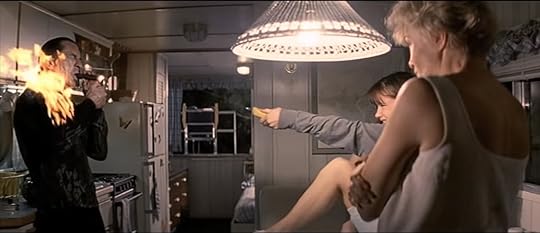
Dani is savvier than we realise when she tells Cady she memorised Sexus for him when he appears on the houseboat. She tries to scald him with water and eventually lights him up via his own cigar after he trapped her in the hold. When teen characters in adult movies are often sidelined as ‘objects’ only needing to be rescued, seventeen year old Lewis’ performance shows us what younger actors can really do. It’s no wonder she has had such a strong career in the past thirty years.
Max CadyRobert De Niro really hams it up as Cady in an unapologetic manner that is both frightening and at times, darkly funny. Even his attempts at affability seem sinister. This approach is on purpose: his garish shirts, leopard print pants, white patent shoes and slicked back hair make him a caricature. The fact he knows what the Bowdens are going to do before they even do might stretch credibility at times, but also give his actions a kind of nightmarish quality. He is every bit the ‘bogeyman’ and this of course makes his performance all the more memorable.
Cady has a powerful motivation for his vendetta against Sam Bowden. He’s absolutely correct when he tells Bowden he should have defended him to the best of his ability according to the law; that Bowden had no right to play judge and jury himself. His points about compensation and how he’s lost contact with his own daughter and had to ‘get in touch with his feminine side‘ in jail reminds us of what he went through. His iconic threat, ‘You’re gonna learn about loss’ seems worse and worse the more we learn about him.

What’s scariest about Cady is not his violence, but his cunning. The way Cady targets the women in Sam’s life – first court clerk Lori, whom Sam had been having an emotional affair with, then Leigh, then Dani – is hideous. He shuts off all potential avenues Bowden can utilise, leaving us feeling: ‘If a lawyer can’t get justice, how can anyone?’ Some of these actions no longer quite work now stalking laws have been passed in both the UK and USA, but in 1991 it was a different world for such cases.
Like the book, the Bowdens hunker down at their home with P.I Kersek to create a trap for Cady. Unlike the book, this does not work and Cady is somehow able to slip into their home again like he did when he poisoned the family dog. The fact Cady dresses up as family maid Graciela is risible, as is the notion the family would have called her into work that day at all. That said, Kersek goes out in a blaze of glory, the expendable hero … But only in America can a family hear a gunshot in their home and not freak the f*** out immediately!
The failed trap prompts The Bowdens to go on the run to their houseboat, little realising Cady is under the car. He makes an appearance that night, pulling Sam off his feet on the deck with one arm and superhuman strength. This sets the tone for the ultimate showdown: Cady is comical, his ability to withstand injury absurd. But most of all his ‘trial’ of Sam is hilarious, as his ‘speaking in tongues’ when the houseboat eventually goes down even more so.
VerdictI expected this one to be a tough one … and it is!!
Cape Fear was one of my favourite thrillers as a teen. When I studied film at both A Level and university I did projects on it both times, so I felt fairly certain the movie would come out on top.
So imagine my surprise when I saw the novel in a local book exchange. I’d always meant to read it, but never got round to it. I took it home and devoured it … and found myself thinking about it days and even weeks later.
Whilst Cape Fear is a classic, the movie has dated considerably. In contrast, The Executioners has stayed relevant the best part of 70 years after its first publication. For this reason, I’m going to call the book the winner.
What do you think?October 26, 2021
How I Wrote LITTLE DEATHS
 A New Name
If you’ve been following me for a good while, you’ll know I am shameless hussy at heart … so given I’ve started writing novels and short stories in the past few years, it was only a matter of time before I started writing EROTICA.
That’s right, I have yet another new pen name: MIA RYDER (super LOL!).
Yes, obviously my new story is an absolute filth-fest, so it seemed only right I should allow one of my BANG2writers to pick my new saucy pseudonym … Veteran Banger (oo er) Mr. Liam Kavanagh, take a bow!
The first in my SEX. DEATH. REPEAT novella series has gone live this SHOCKTOBER. Titled LITTLE DEATHS, it’s published by Spellbound Books.
My stories follow the fates of Nick, a demon in the sack who loves to give women – and a few men – exactly what they want. Check out the awesome cover at the bottom of this post!
What inspired Little DeathsSo I was in the middle of lockdown one and like many people, very bored but also feeling run ragged thanks to various responsibilities and working from home in the midst of the pandemic.
Meeting with several of my friends on Zoom, we all talked about how we wanted to read something that was fun and could distract us, but we all felt uber-serious stuff and full-blown novels were beyond us at that time.
I said, ‘How about an erotica short story?’
Everyone agreed this was a great idea and I was just the person to write it as I am the kind of horndog who never gets embarrassed (they got me). Even better, I’d already written one because I also never stop writing.
So I polished it up and sent them to my friends and a bunch of other contacts because why not. Hilariously, one loved Little Deaths so much she commissioned me to write a bunch more for her at her new venture, Spellbound Books (thanks Sumaira! MWAH).
The Feedback‘This story is a DISGRACE … I love it.’
‘I like how you mix stuff about mental health with crazy-hardcore f***ing. Respect.’
‘This dude is welcome at my house any time.’
But of course, those peeps are my friends, so I had to find some Bang2writers to test it on.
I found some, sent it out and the consensus was YES! YES! YES!
Oh I did get one serious NOPE … another early beta reader freaked out on me, wrote me a hella angsty and outraged email, then blocked me on available platforms.
I can’t say I didn’t warn them … but honestly I don’t think I could get a better compliment than that. Arf!
(Don’t) Buy this Book!Needless to say, I’d love you to read Little Deaths … as long as you realise this is a story NOT for the faint of heart!
But if you are a fan of super-saucy feminist erotica that deals with commentary on consent and mental health, then CLICK HERE or the cover pic below. Can’t wait to share it with you!

Lucy V. Hay's Blog

- Lucy V. Hay's profile
- 174 followers

