
Lucy V. Hay's Blog, page 23
June 29, 2017
INFOGRAPHIC: 50 Powerful Quotes From Literature
This collection of fifty of the most powerful quotes from literature may leave you feeling inspired, shocked, wiser or leave you questioning your own life theories … That’s the power of the work of some of the most famous literary authors to date!
The below infographic, designed by the guys at Essay Writing Service UK, highlights some really powerful quotes from literature, in a fun and bold design.
Which quotes will you recognise? You can expect to read some classic quotes from the likes of Jane Austen, Charles Dickens, John Steinbeck, Emily Bronte and F.Scott Fitzgerald.
There are also some more contemporary quotes from the likes of George R.R. Martin, J.K. Rowling, Gillian Flynn, Nicholas Sparks and Suzanne Collins.
Whether you’re studying in education and need some great references; or work in languages or theatre; or even just an avid reader in your own time, this list of fifty powerful quotes certainly won’t disappoint!

These powerful quotes are inspirational and iconic in their very own way – some for their tragedy, some for their empowerment, some for their literary beauty, and some for their sense of humour. Which one is your favourite?


June 27, 2017
Top 5 Items That Brighten Up My Editing Work
Being a script reader and editor at WRITESOFLUID, I read a lot of scripts and novels, plus I do a lot of annotating and note-taking prior to report-writing.
Being a self-confessed stationery geek this works out great for me, as I have a valid excuse (or at least one I can put on my expenses) to buy things that will help me work efficiently and brighten up my day at the same time.
Here’s my top 5 script reader must-haves:
 1) MY KINDLE WITH ITS ORIGAMI CASE
My Kindle Paperwhite is used every day, for both script and manuscript reading as well as leisure reading. I have the overly-priced but rather marvellous official origami case for it in a striking fuchsia pink. I adore it, plus it makes it easy to hold and acts as a stand, too.
 2) MY FAVOURITE SCRIPT NOTE-TAKING BOOKS
When I came across these A4 lined hardback notebooks in The Works which contain really nice quality paper, I found that they were ideal for writing notes whilst reading scripts and manuscripts. The paper takes all sorts of pens really nicely, so I can change according to my mood. Being spiral-bound, it’s easy to remove the paper when a book is complete so that I can shred the notes. The leftover front and back boards I reuse for my bookmaking hobby.
 3) LENOVO YOGABOOK FOR WRITING UP REPORTS AND ANNOTATING PDFS
I do the majority of my work on my Lenovo Yogabook. It’s ideal for annotating PDFs thanks to the stylus, and I use Word on it to write up reports. As it’s a cross between a laptop and an Android device it helps me keep organised, allows me to digitise handwriting, and I can use apps to update my blog WWW.WRITESOFLUID.COM.
 4) MY FAVOURITE MULTI-PEN, THE UNI JETSTREAM 4 & 1 MULTI PEN
When my husband came home from Japan with this pen, I was jealous. Thankfully, it’s available easily online, and he bought me one as a surprise not long after – it’s so good that he definitely wasn’t going to relinquish his one to me! The black, blue, green and red ball-point refills write really smoothly, and when you push the clip down you get a pencil too – as well as a rubber under the push cap.
 5) MOLESKINE AND SIMILAR BOOKS FOR RESEARCH NOTES
As a script reader and editor it’s important I keep up to date with writing craft and trends, so I read a lot of books and articles. For research note-taking, which I will often refer back to, I like to use any Moleskine or Moleskine-esque notebook; preferably blank. I used to use Moleskine diaries every year, so to start with I craftily refilled my old ones with blank paper using bookbinding methods. However, since then, I have found many great Moleskine-esque notebooks in supermarkets and shops like Tiger.
Which are your favourite items that help you with work? Let us know in the comments!
BIO: Need feedback on your script or novel, or help with proofreading? Check out Michelle’s website HERE. Follow Michelle as @SoFluid on Twitter for script chat, links and articles.
June 24, 2017
CRIMINALLY GOOD: interview with author Sarah Stovell
 1) So, who are you & what have you written?
I’m the new kid on the block of psychological thrillers, but in the past I have written worthy historical fiction that no one wanted to read.
2) Why do you write crime fiction?
Are you looking for an answer less shallow than ‘because it sells’?
3) What informs your crime writing?
Real life dramas are interesting to me, but I am far more concerned with the psychology of the characters and what causes the crime than I am with the details of the crime itself. I am writing my second crime novel at the moment and, like my first, the driving force will be the lives and interactions of the characters, rather than a detective solving a crime. I like to take people – usually damged people – and put them in situations that take them to the extreme edges of their personalities and see how they behave there.
 4) What’s your usual writing routine?
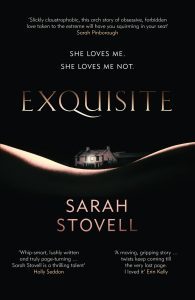
I usually take my children to school, then come home and start writing by about 9.30. When I wrote Exquisite, my son was only three and still at playgroup, so I had less than three hours to bash out as many words as I could. I wrote 1,000 words in the morning, then picked up my son and lived my life, then once both children were in bed at 7.30, I would write another 1,000 words. I did this for six weeks and the novel was finished. I will probably never write anything that quickly again!
This time, I am still in the early stages, so happy with 500 words a day. I will gradually aim to increase this to 1,000 words. Both my children are in school now, so I have a lot more time, but I don’t seem to get any more done than when I only had a couple of hours here and there. I think this is partly because we have just moved and now we own chickens – they are a very amusing distraction from work.
5) Which crime book do you wish YOU’D written, and why?
I love Erin Kelly’s novel He Said/She Said. The writing is beautiful.
BY THE WAY!!!
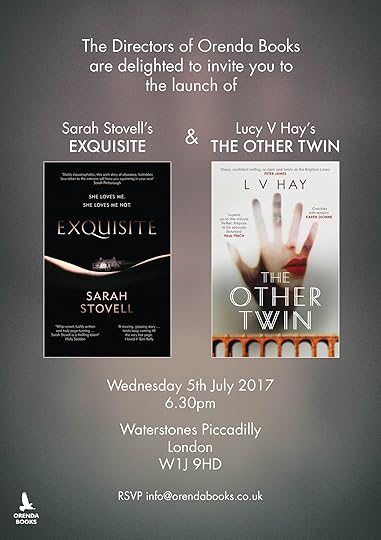
I’m DELIGHTED to be sharing the stage with Sarah on July 5th for our joint launch at Waterstones, Piccadilly, courtesy of Orenda Books!! If you’re reading this, CONSIDER YOURSELF INVITED!!!
I lovedlovedloved Exquisite, so if you click on any of the top pics in this article you’ll find my five star review. BUY IT! And see you on July 5th!!!
June 22, 2017
CRIMINALLY GOOD: interview with author C. Hope Clark
 1) So, who are you & what have you written?
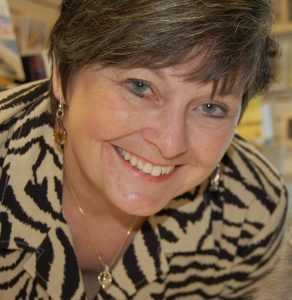
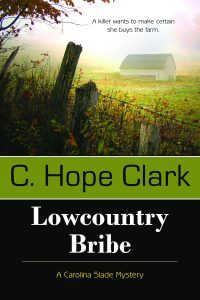
My name is C. Hope Clark, author of The Carolina Slade Mysteries and The Edisto Island Mysteries, both set in my gorgeous state of South Carolina. Both involve flawed yet strong women who are anxious to fight for both justice and their families.
Carolina Slade (“Slade”) works in rural SC, avenging rural crime affiliated with the US Department of Agriculture. Just like nobody knew what NCIS was before Mark Harmon, nobody realizes there are federal agents routing out crime in every United States federal agency, and that includes Agriculture. Death and crime in the country is nothing like the city, and it can be grizzly and unique. Slade has Southern humor and snappy one-liners, but she is deeply invested in her career.
The Edisto Island Mystery involves Callie Jean Morgan who comes home to Edisto Beach after losing her federal agency husband to murder and losing her job as a Boston detective to burn out in avenging his murder. She has a teenage son to finish raising, but once she returned to her Southern roots, in the muggy, bittersweet Lowcountry Coast, she finds that crime follows her, and she’s thrust back into law enforcement. Her flavour is more dramatic and her well might run deeper than Slade’s with all the tragedy she’s had to overcome (and continues to experience). Both series have settings used heavily as characters, places that I adore and feel the public would fall in love with as well.
Carolina Slade Mysteries: Lowcountry Bribe, Tidewater Murder, Palmetto Poison, Newberry Sin (expected winter 2017/2018).
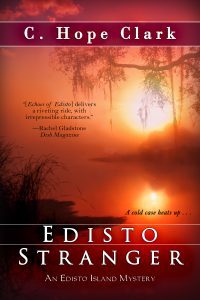
Edisto Island Mysteries: Murder on Edisto, Edisto Jinx, Echoes of Edisto, Edisto Stranger
You can LIKE my Facebook page, check out my website HERE and/or follow me on Twitter as @hopeclark.
 2) Why do you write crime fiction?
Crime fiction challenges me. I don’t want to just roll with a character and their happenstance ways through a lightweight story. I want a character to work for the story, for answers, for truth, for justice. In my former career, I troubleshooted difficult issues in rural South Carolina with the federal government. I already adored reading mystery, so I equally adored solving problems that impacted people’s lives.
Then I met my husband, a federal agency with USDA, when I was offered a bribe by a dangerous farmer. While most folks don’t equate danger with a farmer, there is serious crime in that world as well because lots of money exchanged hands, and farming is one of the most dangerous professions in existence. I married my federal agent, and of course he loves crime stories as well. He serves as my technical adviser, and I write stories that both he and I experienced, only with twists, turns, and changes to avoid the personalities in the real cases. Thus originated the Carolina Slade series!
However, I also adore the Lowcountry of South Carolina, and its dense, dark, ominous setting. Perfect for another crime series. The Edisto Island Mysteries juggle the juxtaposition of a carefree vacation beach and death/crime. It makes for fantastic personalities and opportunity for twists. But in terms of the genre of crime fiction as a whole, I want the author to pit his skills against mine in solving a crime. Anything less and I am bored with the tale.
3) What informs your crime writing?
My crime writing is informed from both my investigative past as a Special Projects Representative and my husband’s past as a Federal Criminal Investigator (Senior Special Agent) with the US Department of Agriculture. We delve into real life cases then adjust them to our suiting, then I take off writing what I hope is a fun tale. As for the beach writing, I grew up in the dark, dank Lowcountry, so I learned to look for danger at every turn.
 4) What’s your usual writing routine?
Daily. I write full time. Sometimes it’s two hours of fiction, and other times it’s ten. I also speak and freelance as well as run a site called FundsforWriters.com where I counsel writers in earning a living. I often present webinars and contribute to books for Writer’s Digest. My newsletter for FundsforWriters reaches 35,000 readers, so it keeps me busy as well.
But I rise when I wake up, no alarm clock, eat breakfast then write. Then a break to garden, go to the gym, run errands. Back to writing. Dinner, then back to writing. I love being able to break up my day as I choose. My study is solely restricted to writing, with a gorgeous view of Lake Murray, deer, ducks, and various wildlife. I adore solitude so writing suits me. My edits take place on the back porch, overlooking the lake, bourbon and the occasional cigar in hand.
5) Which crime book do you wish YOU’D written, and why?
There isn’t just one, just like I don’t have a favourite author.
A Study in Charlotte – Brittany Cavallaro – Written about the teenage descendants of Sherlock Holmes and Doctor Watson. It’s the perfect combo of current day crime solving with the Holmes/Watson dynamics. And the writing is superb. While I love the turns and intensely intelligent twists in this story, I likewise love the poignant wit spoken from college kids but still in the vein of their illustrious ancestors.
The Taste of Ashes – Howard Browne – Written old school, this is classic 50’s crime writing. My favorite genre is noir mystery, and this deceased author is superb at it. I would love for the tone of this writing to creep into some of my work. His books are out of print, but I run them down through Amazon and antique book stores.
The first is contemporary and the second is dated, but I want both aspects of these books to find their way into my toolbox of talents.
June 19, 2017
CRIMINALLY GOOD: interview with author Sanjida Kay
 1) So, who are you and what have you written?
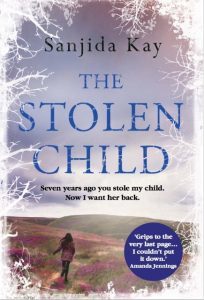
I’m Sanjida Kay and I write psychological thrillers. My first one is called, Bone by Bone, and is about a mother who discovers her daughter is being bullied and tries to deal with the bully herself…with tragic consequences. My second is The Stolen Child, which is about a family who adopt a little girl. When she turns seven, she receives a card from her father, saying she’s been stolen and he’s coming to get her back… They’re published by Corvus Books. Currently I’m editing my next thriller, The Perfect Family, which will be out in May 2018. You can find out more about me on my website, and do please get in touch on Twitter, Instagram or Facebook or join my Book Club (the sign up sheet is on my website)!
2) Why do you write crime fiction?
I’m most concerned with trying to tell a good story, but psychological thrillers is a genre that suits me, because I’m always thinking, ‘What if…’ And the what if bit is usually something dark and chilling, but the setting tends to be ordinary people leading ordinary lives….that are going to get a whole lot more uncomfortable! I’m pretty cheerful in real life though!
 3) What informs your crime writing?
The stories I come up with are normally based on a thought I’ve had or something I’ve heard, and then I add the , ‘What if…’ For example, a friend of a friend wanted to adopt a child and had heard that a woman who was a drug addict was being forced to give up her child from birth. I thought, what if that family were able to adopt the child, and they gave it a stable, loving home…but then, several years later, the father, who was in prison at the time, found out. What lengths would be go to in order to get his child back? And that became The Stolen Child.
4) What is your usual writing routine?
My writing day is book-ended by the school run. I get home just after 9 am, make a strong black coffee and deal with emails, and then I write until 3pm. I have to set an alarm so I don’t get carried away and forget to pick up my daughter! It’s a pretty short day, so I have a fierce word count that I need to get through (my books come out once a year). I spend my evenings on other aspects of being a writer, such as social media, writing events and the boring bits like doing my tax return. I watch a lot of thriller box sets too, which I see as an enormously fun part of being a writer. My favourites are Breaking Bad, Walking Dead and Taboo. I’d like to read more, but in practise, I fit it in by listening to audio books from Audible whilst I exercise.
5) Which crime book do you wish YOU’D written and why?
Rebecca by Daphne du Maurier for its creepy and haunting atmosphere and memorability and Gone Girl by Gillian Flynn for the rollercoast plot twists and razor-sharp and sharply-disturbing heroine/villain, Amy Dunne.
June 15, 2017
Why Coffee Helps Me Through The Day
Today, just a little something fun … When I asked my blogging, writing and publishing friends what their favourite reading and writing products are, I was expecting gadgets, stationery, software … But today we have publishing assistant Emma Mitchell in praise of coffee! Gotta say, I agree with everything Emma says – I’m a serious coffee addict too. Enjoy!
I don’t even snooze my alarm clock before my brain is begging me to feed it coffee.
Seriously.
It’s kinda crazy but I need that caffeine hit in a morning. It did just used to be in a morning. I never drank coffee during the day, always tea and mainly because most places I worked never had the kind I liked and it was easier to stomach cheap tea than it was cheap coffee.
Then I started working for myself. From home. In an office (dining room) next door to my kitchen. Which housed the nice coffee. The lovely, gorgeous, NOT cheap coffee that I love.
Now I have a constant supply of the good stuff, I don’t think I could get through the day without it.
As I said before, I think about coffee in that fuzzy stage of the morning before I’ve fully realised I’m actually awake. I hit snooze and am already half way down stairs to fill the kettle. I very rarely even go to the bathroom before I’ve had my first fix in a morning! And don’t even dream about talking to me until I’ve finished that first cup. Even then, only do so if it’s an emergency, otherwise wait until after cup number two!
Since I started working in the publishing industry, I can spend up to fifteen hours a day at my desk and not even notice it. Having a range of things of things to do certainly helps, I write my blog posts, write books reviews, research and interview authors, organise blog tours and book publicity and then, of course, there’s the editing. I love it! I used to love my sales job too but there was no way on this planet that I would ever have done that for fifteen hours a day without at least a ten-hour nap. I kid you not!
It’s with this in mind that I can only attribute my new superpowers to the coffee. I reward myself for finishing a particular task with a cuppa. I egg myself on internally by promising myself another coffee when I’ve completed this, or finalised that … You get the drift.
I cannot express the value caffeine has added to my productivity. I genuinely think there is a link between the level of creativity I now possess and the copious amounts of coffee I drink on a daily basis. Sales is a ‘fact’-driven industry, once you know the facts, you can’t really go wrong, and as much as editing is fact-based, there is a LOT of creativity required to succeed in the world of publishing, which is something I would NEVER have called myself. Creative – not me! I was the one with the spreadsheets and the lists and the certain ways of doing certain things (think Monica in Friends) now in my coffee fuelled state I am more like Phoebe than I ever thought I would be.
I love coffee.
It makes me warm for a start (I am ALWAYS cold) so warming my hands up around a certain cup first thing in a morning is wonderful, it wakes me up, it brings me round, it stops me flagging when I could potentially nap, it revitalises my juices, and gets the old grey matter whizzing with new ideas and I bloody love it.
I even take a cup to bed with me, and still manage to fall asleep with no problem if I’m tired!
So, to sum up: coffee is great, coffee is wonderful and if I could have it intravenously administered on a daily basis, I would. FACT!
BIO: Emma Mitchell is a freelance publishing assistant and PR person. Check out her blog, HERE and LIKE her Facebook page. Contact her about her services on Twitter as @EmmaMitchellFPR and instagram as @emitch101.
June 13, 2017
CRIMINALLY GOOD: interview with author Paul Harrison
 1) So, who are you & what have you written?
Hi, my name is Paul Harrison, I’m a retired police detective with a career spanning three decades. I’ve also worked at the Royal Courts of Justice with High Court Judges, and with charities working in the support field for survivors of child sex abuse. Check out my website HERE; plus you can follow me on Twitter as @PaulHarrisonAuthor.
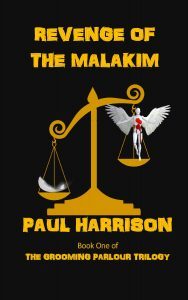
My latest book is Revenge Of The Malakim. It’s high summer and the streets of Bridlington East Yorkshire are awash with tourists. A serial killer is on the loose. DCI Will Scott and his team embark upon a fast paced investigation to catch a killer with a unique agenda. As the body count rises the killer randomly moves location and the police are unwittingly drawn into a dark and sinister world where cover-ups and corruption reigns. A place where no one can truly be trusted and nothing is ever what it seems.
I’ve written 34 non fiction books too. Most of these are listed on my website; the vast majority are true crime. I’ve also written a couple of biographies, such as Leeds United footballers Billy Bremner (Keep Fighting) and Albert Johanneson (The Black Flash).
2) Why do you write crime fiction?
I’ve spent almost 25 years interviewing serial killers and writing true crime. Believe it or not, interviewing those killers became rather banal, boring! With so much knowledge of what makes serial killers tick and why they kill, I decided to create my own monsters: serial killers and murderers with a
difference. They are much more interesting than the real thing, and of course, the fictional police force generally come out on top!
It’s wonderful, creating an alternative world full of characters who you can control. That’s all very good in theory, however, my characters tend to write their own stories. That’s what it seems like, anyway.
3) What informs your crime writing?
I had a police career spanning three decades, so I worked on many high profile cases during that time, including murders. I didn’t realise it at the time, but that experience would later be invaluable to my crime writing. I also worked with the Judiciary at the Royal Courts of Justice, London.
 4) What’s your usual writing routine?
I generally work through the day: early morning seem to be my most creative writing period. I never know how the book will end, until it’s finished. I know that sounds bizarre! However, I insert twists and turns, that changes the direction of then story which often culminates in a very different ending to that I had originally tried to plan.
5) Which crime book do you wish YOU’D written, and why?
Many years ago, I was in the police force, and had written my first true
crime book. It was about the Victorian serial killer of East London, Jack the Ripper. As a result of that book, I received a letter from Reggie Kray (of the infamous Kray Twins).
I struck up a good friendship with him and would often visit him. Reggie asked me if I would consider writing a book about him and his twin Ronnie Kray. He put me in touch with many of the legendary ‘firm’ and I was offered access all areas, and the ‘truth’.
As a then-serving police officer, I had to seek authorisation from my Cheif Constable to write this book. Sadly, he told me I would have to resign to do so. I couldn’t take the chance of losing the security of a job that paid my mortgage and offered a good pension at the end of it. So I contacted Reggie and told him my decision. He was great; he said he understood (although he thought financially, I was wrong, and making a mistake!). He was right. Someone else wrote the book and made an absolute fortune!
I was invited to see Reg on his forced release from prison, due to his failing health. It was there, close to death, that he referred to me as his favourite crime writer and someone unique: a copper he actually respected!
June 12, 2017
BOOK VERSUS FILM: Notes On A Scandal
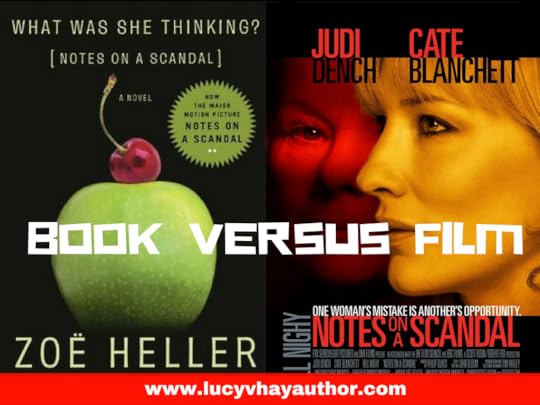
The Book
Notes On A Scandal tells the story from Barbara’s point of view when she becomes entangled with Sheba, a middle class housewife teaching for the first time in Barbara’s inner city school.
Shockingly, Sheba has an affair with a fifteen year old boy which proves her downfall. This is not because she ends up eventually in prison, but because of Barbara: jealous of her friend’s previous family life (Barbara is a spinster), she manages to unpick Sheba from her family and ensure that this fragile and foolish woman totally depends on her. Barbara is essentially a type of emotional vampire, wanting Sheba to herself at the expense of everyone and very chilling she is too.
Interestingly, this diary Barbara keeps starts off innocently enough; though Barbara is clearly somewhat childish from the off and malignantly spiteful, we don’t understand the depth of her distasteful personality or the lengths she will ultimately go to.
In the novel, it is more of a “slow burn”: she is an opportunist, capitalising on events as they unfold – waiting, very deliberately, for her time to come. When it does, Barbara betrays Sheba’s confidence, ensuring she is sacked from the school so the scandal comes pouring out, we get the feeling that this was more of a case of all the ducks lining up as if Barbara is some kind of sniper. She might be a predator, but she would have waited even longer if she had to. Just like people do in life.
It is by no means a perfect book; I was irritated by the constant Americanisms in the copy I read for example, where British middle classes said things like “real estate” and had “baked hams” for sunday dinner, (but perhaps the one I was reading had been destined for over the pond or the copy editor had had a bad day?).
But most of all, I finished Notes on a Scandal super-fast because its characters ENTHRALLED me, particularly its anti heroine, the obsessively jealous Barbara Covett (whose name I thought was pure genius, ironic in a non-obvious way).
The Movie
I was particularly interested to see how Barbara would be represented: surely an opportunist sniper would be unsuitable for the screen? Someone “waiting” would prove dull, unsatisfying drama I thought. Yet the screenplay by Patrick Marber had been nominated for a BAFTA and whilst I do not always like winning or nominated scripts, it’s not usually because they are not crafted well.
Somewhat inevitably, the adaptation is a reconstruction. Heller’s book is so celebrated, I don’t think moviegoers would have found a reimagining of the text so soon after publication palatable. Barbara is played by Judi Dench, an obvious choice I thought whereas the part of Sheba went to Cate Blanchett: I hadn’t seen anyone remotely like her in my head when I had been reading, yet she fit the part really well.
As set ups went, it is very true to the book: it establishes Barbara’s spiteful nature and her disillusionment with the education as a metaphor for her own failings in life. I spotted only one chunk of dialogue lifted from the book – Barbara’s disgust at what someone in her staff room mistakenly believes about Sheba’s father shows us what a petty, precise individual she is.
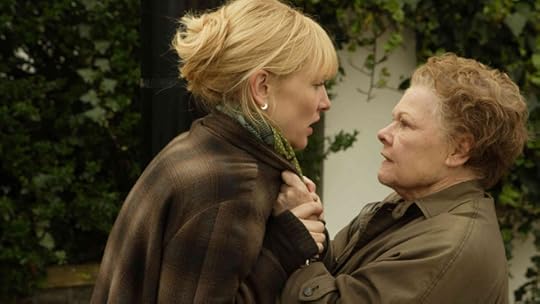
However Marber’s version of Barbara is subtly different to Heller’s. Whilst Heller tells us that Barbara is a kind of sadistic desperado, someone who needs someone no matter age, gender, sexual preference or intelligence as long as they are malleable, Marber paints Barbara as more of a sexual predator, in that Barbara is in love/obsessed with Sheba.
The camera becomes Barbara’s eyes at times: lingering shots of Sheba’s body, especially when she is dancing in the living room with her family, betray Barbara’s lust for her, as does a moment when Barbara touches Sheba’s wrists and forearm, making her feel uncomfortable (which I don’t recall from the book).
The Comparison
So in the film, Barbara is much more active: we get this impression she is “after” Sheba almost from the start once her spite is established. Events too come much more chronologically.
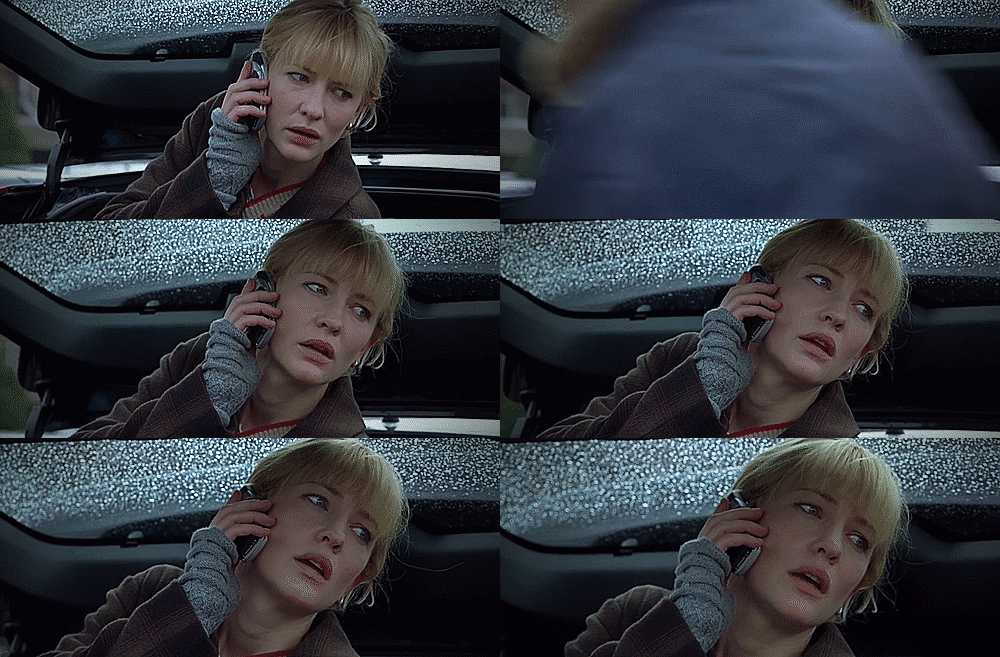
In the book, Sheba tells Barbara of her involvement with the fifteen year old some months after starting the affair, but in the film Barbara accidentally witnesses them having sex in the deserted pottery room at school. She calls Sheba and when Sheba feigns ignorance, Barbara’s “Let’s not, shall we?” proves particularly chilling.
From there Barbara actually orchestrates events, insisting first that Sheba breaks it off with the boy, but when she discovers Sheba has been unable to, Barbara decides to use it to her advantage. Marber does an excellent job of making the film SEEM like the book, when in actual fact it’s rather different!
In the movie, around the end of the second act, as Barbara’s cat lies dying and she wants Sheba to come to the vet with her, Barbara makes Sheba choose between going to her Down Syndrome Child’s school play or with her. Like any mother, Sheba chooses her child’s play, making Barbara actually decide to go to another teacher, Brian, and tell him about her “suspicions” regarding Sheba’s affair. In the book, this only happens because said teacher asks Barbara out on what she thinks is a date; she abandons Sheba momentarily, deciding instead to go for him. When he confesses he wanted to talk to Barbara because he is interested in Sheba, Barbara tells him about Sheba’s affair in a fit of pique.
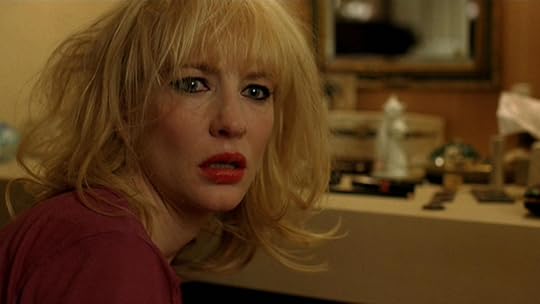
Where the film suffers then is in understanding Sheba’s motivation for having the affair in the first place. In the book, Sheba’s husband is a self satisfied godawful prig; her child who has Downs is a lot of work and Polly, her daughter is a total brat who gets herself expelled from a posh private school. She does not have a good relationship with her own mother and clearly looks to Barbara for guidance when she gets in over her head. There’s a particularly impressive moment when Polly flees to Sheba’s mother’s home and Sheba hits her daughter across the face; Barbara attends the scene and reports it in minute detail.
In the film, there is no room for this level of characterisation: Bill Nighy plays the husband as an affable, much older spouse who has lost touch with Sheba who feels dowdy and unappreciated, making it harder to know why she should choose a fifteen year old kid and not say, another teacher for her affair.
It also lacks that underhand ending – the notion that Barbara wins. We join the book with a foreword that describes the two women’s wait for Sheba’s trial, with Sheba outcast from her family completely. This is bookended by Sheba’s discovery of Barbara’s betrayal via the notes and her acceptance (for want of a better word) that she has been sewn up good and proper; there is nowhere else to run.
But by film logic, this is unacceptable and when Sheba there discovers the notes, she returns to her husband who graciously accepts her back and tries to work through her own betrayal. We see them pictured together on the front of a newspaper with news of Sheba’s sentence. But of course films like to pose the idea a leopard never changes its spots and has Barbara approach another woman, reading that newspaper …
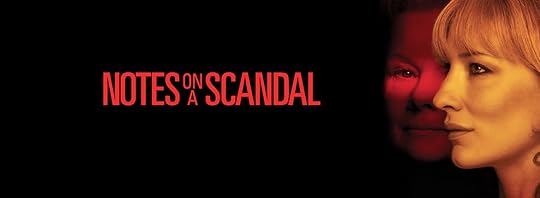
Concluding:
All things considered however, I think this was an excellent adaptation and a great illustration of how a screenwriter needs to change certain elements for novels and films are different media. As an exercise, I learnt a lot and I hope my thoughts prove useful. As always though, it’s all a matter of interpretation.
Have you watched/read Notes On A Scandal? Which version did you like best?
June 8, 2017
CRIMINALLY GOOD: interview with author Sharmishtha Shenoy
 1) So, who are you & what have you written?
I am Sharmishtha Shenoy, an author in the murder mystery genre. I love to read. My favorite authors are Ruskin Bond, Satyajit Ray, Agatha Christie, JK Rowling, PG Wodehouse. I was born and brought up in Kolkata, the city of Joy , India. I studied in University of Reading, UK. I am married with a child. I live in Hyderabad and am very fond of travelling.
I have written two murder mystery books, both having Vikram Rana , an ex-cop and now a private investigator as a protagonist. The first book is Vikram Rana Investigates and the second book is A Season for Dying. My website can be found HERE, plus you can follow me on Twitter as @shenoy_sharmi. You can also LIKE my Facebook page, HERE.
2) Why do you write crime fiction?
I love reading crime fiction. Hence I find it easy to write crime fiction with touches of humour.
3) What informs your crime writing?
I get inspired by real life unsolved cases. I collect crime related news in newspapers and television and if some story touches me, my imagination gets fired, in the sense what might have happened and accordingly I write my story.
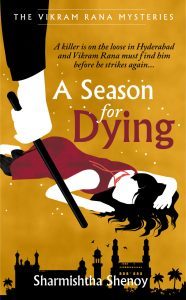 For example in A Season for Dying, I found inspiration of these stories of from two random killers:
The first was Dennis Lynn Rader (born March 9, 1945). He is an American serial killer who murdered ten people in Sedgwick County, Kansas, between 1974 and 1991. He is the infamous BTK random killer in the USA who called himself Bill Thomas Killman (BTK). He was also known as the BTK Strangler. “BTK” stands for “Bind, Torture, Kill”, which was his infamous signature. He sent letters describing the details of the killings to police and local news outlets when the murders happened.
The second one was Charles Cullen (born born February 22, 1960). He is a former nurse who is the most prolific serial killer in New Jersey. He confessed to authorities that he had killed up to 40 patients during his 16-year nursing career. Cullen stated that he gave patients overdoses so that he could end their suffering. However, many of his victims were not terminal and were about to be released from the hospital shortly when they died suddenly while under his care.
Cullen preyed on some of the most helpless, sick and trusting patients whose families believed they were safe and would be nursed with care and compassion. Little did they know that their loved ones were in grave danger at the hands of Nurse Cullen. The unsociable hours and inability for patients to communicate meant that Cullen could murder easily. There was no one to watch him and he had effortless access to his weapon of choice — prescription drugs.
4) What’s your usual writing routine?
I do not have a routine as such. I have to take care of my family, who do not take my writing profession very seriously. So whenever I get time between my household work, I write.
5) Which crime book do you wish YOU’D written, and why?
I wish I had written Gone Girl. The way Gillian Flynn misleads the reader in every step is just amazing. I wish I could be as devious (in the most flattering sense!). Another of my favourite books is The Devotion of Suspect X by Keigo Higashino.
June 6, 2017
INFOGRAPHIC: 12 Books to Read Before You Die
There’s so many classics, so little time … So WHICH examples of great literature should you read??
When I spotted this infographic, I thought this was a pretty good list. Lots of these titles are readily available and often fairly cheap (especially on Kindle). All of them have left have a lasting impression on fiction AND culture, plus 12 titles is an achievable number to get through, particularly if you’ve not read that many classics before. I’d like to have seen more woman and people of colour on the list.
Shockingly, I have only read half the titles on this infographic: Wuthering Heights; To Kill A Mockingbird; The Great Gatsby; 1984; Of Mice & Men and Frankenstein. All of them were a long time ago too, so are due a re-read. In keeping with my 2017 Reading Pledge, I better get cracking!!!
Which ones have YOU read?
More on this blog about classics:
10 Sensational Classics To Read Right Now
BOOK VERSUS FILM: The Great Gatsby
100 Best YA Books Of All Time – Vote!
My Reading Pledge 2017 Update (First Quarter)
12 books to read before you die is a graphic produced by Gumtree.com.
Lucy V. Hay's Blog

- Lucy V. Hay's profile
- 174 followers

