
Lucy V. Hay's Blog, page 10
August 24, 2018
CRIMINALLY GOOD: interview with author David Tallerman
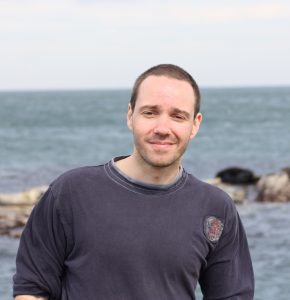 Well, I’ve been writing seriously for about a decade now, across quite a range of genres. That includes fantasy – The Tales of Easie Damask trilogy and my ongoing series The Black River Chronicles; a science-fiction novella from Tor.com, Patchwerk; and horror, with my first short story collection The Sign in the Moonlight and Other Stories.
As well as novels, I’ve dabbled in comics, co-written an award-winning short film, and produced around a hundred short stories, which have appeared in markets such as Clarkesworld, Lightspeed, Beneath Ceaseless Skies and Alfred Hitchcock Mystery Magazine.
Having worked all over the UK for a number of years as an IT contractor, I began writing full time about five years ago, something I’d been dreaming of doing pretty much since my university days, and moved back to Yorkshire, where I grew up. That experience of returning to the north of England and buying a house and trying to settle in was a big ingredient of what would become my imminent crime debut, The Bad Neighbour.
2) Why do you write crime fiction?
Having written just about every type of genre fiction, crime is actually a little bit new to me, though I’d argue that it’s been a thread that runs through a lot of my previous work. After all, my debut novel Giant Thief was about a thief that steals a giant (and also a giant who inadvertently becomes a thief!) But to answer the question, I suppose I write crime because it’s one of my favourite genres, just as I held off from writing it for a long time because it’s the one I’m somewhat in awe of. Good crime fiction is keyed into the texture and reality of our lives in a way that most other genres can’t touch, and the challenge of that was intimidating: could I write a book that felt true to life, and still tell the kind of fun, exciting story I enjoy telling? But it so happened that I came to a point where there was a concept I knew I couldn’t afford to waste, and once the pieces began to slip into place, it finally felt like the time was right to make that leap.
3) What informs your crime writing?
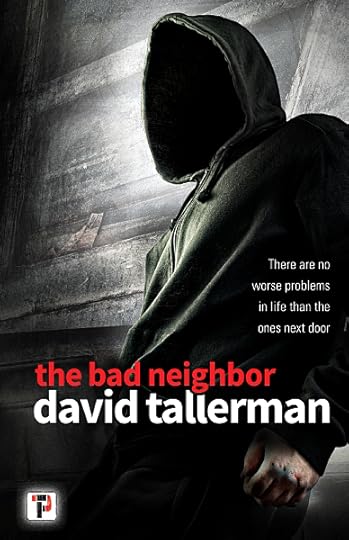 To some extent, writing crime was a logical extension of the other genres I’ve worked in. For The Bad Neighbour, the basic techniques of constructing a plot and creating characters and keeping the action moving scene by scene was pretty much the same as with, say, a fantasy novel. What differences there were came down to the fact that, for the first time, I was drawing significantly on personal experiences and that I was using a real world setting that was close to my own. The starting points for The Bad Neighbour definitely came from my own experiences, in particular the period when I first bought my home in the Leeds area and moved back to the north. Even when I wasn’t lifting directly from things that had happened to me – protagonist Ollie Clay’s house-hunting horror stories are a lot like my house-hunting horror stories! – I found that I was incorporating far more detail from real life than I’m used to. This was the first book I’ve written, for example, where I found myself poring over Google maps at great length, trying to ensure that the details of car journeys made sense.
4) What’s your usual writing routine?
When I made the transition to writing full time, I figured I’d do best to stick with what I knew, so I basically work normal office hours: I get up, have breakfast, and then work through to late afternoon, with a break in the morning and another for lunch. But because there’s no confining all the work of full-time writing to office hours, I tend to pick up again most nights to get through all the little side jobs: blogging, e-mails, submitting short stories and such.
5) Which crime book do you wish YOU’D written, and why?
I don’t know that I wish I’d written it, since then I’d never have had the pleasure of coming to it as a new reader, but Geoffrey Household’s classic Rogue Male is definitely the book that set me on the course of wanting to one day write crime novels and thrillers. It blew my mind when I first read it, over two decades ago, and it’s lost none of its power since. There are no end of aspects to admire, but for now I’ll just mention Household’s genius for hiding his themes and plot developments in plain sight and the way that the action corkscrews down from continent-spanning to the space of a few metres over the course of the book, as though its protagonist is being sucked towards the heart of a maze. Rogue Male was the book that first taught me that thrillers can be utterly exciting and still be smart and complex and tackle meaningful topics, which was very much my goal with The Bad Neighbour.


WEE GIRL REVIEWS: The Beedog
Wee Girl Reviews
We have been sent a LOT of picture books lately, which is great for us as we love them. For those of you who don’t know, my daughter Emmeline, aka ‘Wee Girl (2)’ is 7 years old and a tiny book blogger. We read picture books together at bedtime, so Emmeline can practice her reading and comprehension.
Emme has been swimming with her Dad this week and jumped in the deep end by herself! She is also very excited about going to a sleepover with her friends this weekend.
About The Book
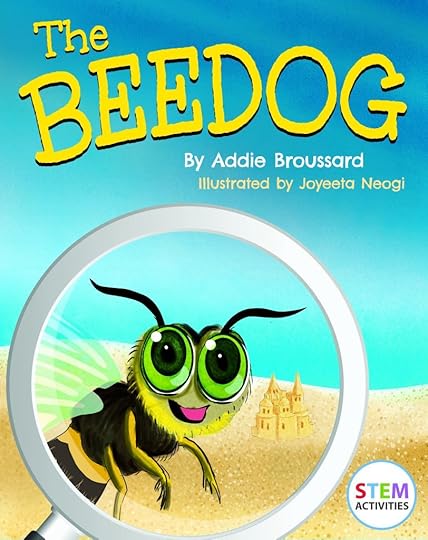
An award-winning picture book that will get little ones excited about science.
While building a unique sandcastle, Cora and Manny spot a rather curious insect.
Soon, the little scientists keep a watchful eye on the insect’s movements, while learning about the natural environment along the way.
A great book for STEM education and home-school projects or just curious little ones who love science. Book extras include fun, printable activities related to science learning and research.
Emmeline’s Review
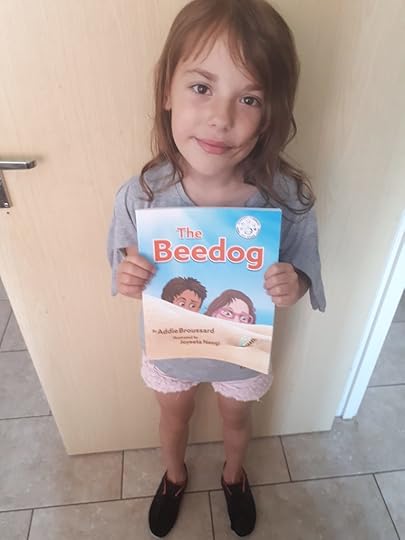
Here’s what Emme said about The Beedog:
‘The Sand Wasp is building a sandcastle to live in.’
‘Manny looks like a Mummy! I love Halloween, it’s my favourite.’
‘Cora uses her detective skills.’
‘I like the pictures a lot.’
‘I like all the facts – especially the scientific names.’
‘1707 was a LONG time ago!’
‘I didn’t know anything about sand wasps before.’
My Review
I normally roll my eyes at picture books that claim they are both ‘fun’ AND ‘educational’, but The Beedog really is! Whilst it takes a little long to get going, once the two characters have seen the ‘beedog’, it really plunges the reader not only into the meat of the story, but the learning objective as well. I thought it was great how the author uses internet searches to help illuminate what the insect was. This is especially relevant to small kids like Emmeline, who are used to searching online and have always seen it as part of their ordinary life.
What’s more, I didn’t know anything about sand wasps either! I actually found out scientific facts along with Emmeline, plus the resources in the back of the book were especially interesting. The inclusion of stuff like the scientific names and ‘your favourite wasp’ were well thought out. |The printable activities are great, too. I feel like I learned something new whilst reading with Emmeline, which hardly ever happens. Excellent stuff.
Verdict
The Beedog is an educational, but nevertheless fun book that both kids AND adults can enjoy together. Very much recommended. BUY IT HERE.
Author Bio
Addie Broussard is an avid traveler, and once went on a solo journey to fifteen countries in one year. When she encounters something unique, she writes about it. Her first published picture book, The Beedog, is about a curious insect that she found in southern Portugal.
Addie began her writing journey when she was just nine years old, with a book called Doggienauts. That book has been updated and is set for publication in 2018. Addie is originally from the United States and is currently a full-time traveler. Home is where her suitcase is.
August 23, 2018
My Writing Journey: Virginia Heath, historical romance author
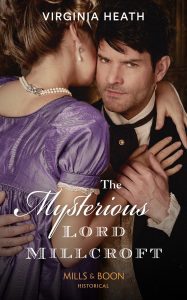
 Something a little different today … I have Virginia Heath, author of the King’s Elite books sharing her writing journey today! I am always fascinated by writers’ journeys through their careers and books. Be sure to check out Virginia’s latest book, The Mysterious Lord Millcroft. Here’s the blurb:
Life as a duchess … Or something much more dangerous…?
Constantly told her beauty and charm is all she has to offer, Lady Clarissa is intent on marrying a duke. And intriguing spy Sebastian Leatham will help her! Only first she’ll assist him with his new assignment—playing the part of confident aristocrat Lord Millcroft. Sebastian awakens a burning desire within Clarissa which leaves her questioning whether becoming a duchess is what she truly longs for … GET YOUR COPY HERE.
Over to you, Virginia …!
My Writing Journey
I’ve always written, and knew I always wanted to write fiction, but only seriously began pursuing my dream four years ago when I quit teaching history to write.
I wrote several attempts at a historical romance – four to be exact – before I thought up a title, That Despicable Rogue. As soon as I had the title, the rest just flowed. I’m not a plotter. I tend to make it all up as I go along and as soon as I finished that book I knew it was different to its predecessors. Fortunately, so did my publishers and it became my first fiction novel to actually grace the bookshelves.
While my debut novel is undoubtedly significant, my second, Her Enemy at the Altar is somehow more so. That’s because the neurotic, self-doubting, creative part of me did fear I might be a one-book wonder even though I had been initially contracted on a two-book deal. Being able to construct a second story on a deadline was a huge relief and extremely cathartic. I discovered that not only could I write a second book, but that I could pour every new thing I had learned into the next one to make it even better than the first.
 My third book was the first of a three-book contract. That new contract made me relax and really begin to enjoy the process of writing a story. The Discerning Gentleman’s Guide came about as a result of too much prosecco and a history documentary on the BBC. There was a segment on Georgian etiquette books and it got my wine-addled mind thinking. What if I based a book around one, using snippets at the start of each chapter? And what if I made the hero write a bestseller, telling eligible men how to select the perfect bride?
Six weeks later, and the book was written. It flew out of my fingers and made me laugh out loud as I typed it. Having it shortlisted for the RoNAs (Romantic Novel of the Year Awards) was the icing on the cake!
After that, I wrote my take on Cinderella and tackled my first series – The Wild Warriners – which really caught on with readers, reviewers and bloggers to become my bestselling books so far and I love each and every one of my handsome Warriner brothers equally.
However, Joe’s book, the third book in the series, stands out because it covers some pretty difficult topics while the hero and heroine fall in love. PTSD, the barbaric treatment of mental health during the Regency, the war between new-fangled science and centuries-old medical practices and a smallpox epidemic. The research was huge and weaving it all in without lecturing the reader was very hard to do.
But I enjoy research … So much so, I went off and did another load on Regency smugglers and spies for my new King’s Elite series! I uncovered a fascinating, subversive world which I’ve hopefully brought to life in the first book of the quartet, The Mysterious Lord Millcroft. A murky world which shifts and deepens as the series progresses and my four spies get ever closer to uncovering the criminal mastermind behind it all. I’m currently writing the last King’s Elite book but I already have a new contract for five more stories. Who knows where those books will take me?
Thanks, Virginia!
August 22, 2018
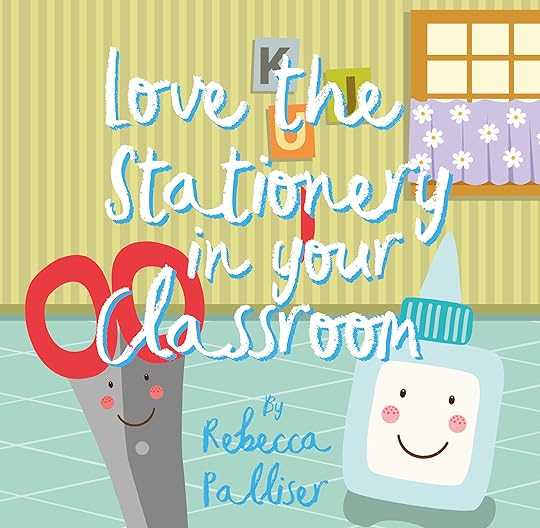
WEE GIRL REVIEWS: Love The Stationery In Your Classroom
Wee Girl Reviews
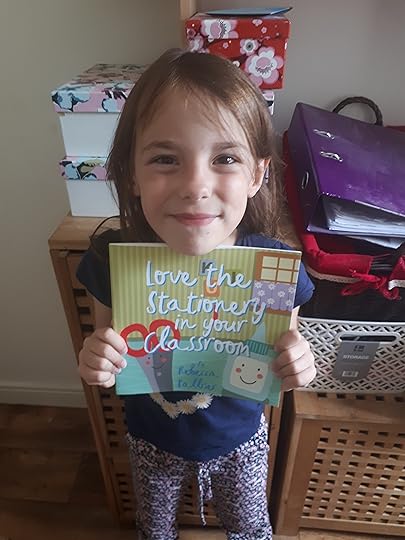
So we’re back with Wee Girl Reviews! Being the summer, we’ve been reading lots here. For those of you who don’t know, my daughter Emmeline, aka ‘Wee Girl (2)’ is 7 years old and a tiny book blogger. Being a reluctant reader, I have been encouraging her to read by signing her up to picture book blog tours.
First though, Emme has been enjoying her time off school this summer. We have visited lots of Natural Trust properties, because they have great activities for children. Emma’s favourite has been making garlic bread over an open fire! We also saw an exhibition at Killerton House, Exeter about the Suffragist movement and Emme saw a picture of her namesake, Emmeline Pankhurst.
About The Book
This delightful little book encourages children to learn about – and have fun with – the stationery they encounter in the classroom. Author Rebecca Palliser wants to help all children to find their feet in the primary school classroom.
Emmeline’s Review
Here’s what Emme said about the book:
‘I like the poems in this book.’
‘The pictures are so detailed, I like the colours.’
‘I love how the pencil is going ‘Oh!’ in the picture.’
‘How could a whiteboard clean up? It has no hands!’
‘The best bit was the crayons, the rubber and the book … At school, the rubbers DO go all grey.’
‘I like how the sharpener wants revenge!’
My Review
There has been lots on this blog before about loving stationery, so I felt sure this would be a fun book. The illustrations are excellent and very cute, just right for grabbing the attention of a child Emmeline’s age. I also like the human faces for the stationery, which will make kids relate to the characters.
The colours are bright and I like the message very much. Children DO have a nasty habit of not taking care of things or putting them away, so this is bound to make them think twice. Unfortunately, the metering in the poems is very off. This did not seem to faze Emmeline at all though.
Verdict
Love The Stationery In Your Classroom is a book children will like, with a message parents and teachers will appreciate. BUY IT HERE.
Author Bio
[image error]Rebecca Palliser is a young primary school teacher whose experiences in the classroom inspired her to write to have an influence on her pupils.
She is about to embark on a Masters programme where she hopes to continue to write alongside her studies.
She takes inspiration for her stories from her travels exploring different cultures and cities, spending time with her little dog Darcy and of course her biggest muse, the delightful pupils she is fortunate to teach.
August 20, 2018
CRIMINALLY GOOD: interview with author Daniella Bernett
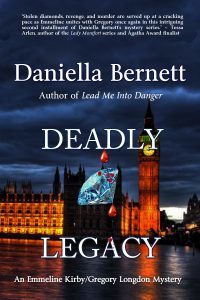
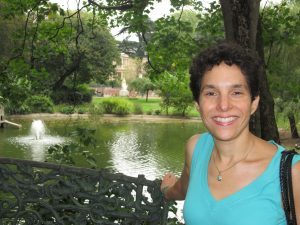 Hi, I’m Daniella Bernett. I am a member of the Mystery Writers of America New York Chapter. I graduated summa cum laude from St. John’s University with a B.S. in Journalism. I am the author of a mystery series featuring journalist Emmeline Kirby and jewel thief Gregory Longdon. They are former lovers. Both are British and my series takes place in the United Kingdom and Europe. The first three books are LEAD ME INTO DANGER, DEADLY LEGACY and FROM BEYOND THE GRAVE. LEAD ME INTO DANGER is set in Venice and London, my two most favorite cities in the world. In this book, Emmeline and Gregory haven’t seen each other in two years, but she literally runs into him in Venice after witnessing two men try to murder her colleague. Then, Emmeline and Gregory become ensnared in a hunt for a Russian spy in the British Foreign Office. DEADLY LEGACY, Book 2, is about $100 million in stolen diamonds, revenge and murder. It takes place in London.
FROM BEYOND THE GRAVE is set in the seaside resort of Torquay along the English Riviera in Devon. It’s about the deep, dark secrets of Gregory’s past, love, betrayal and, of course, murder. In A CHECKERED PAST, the latest installment which will be released on September 29, Emmeline and Gregory are back in London. She’s still reeling from the secrets she discovered about Gregory in Torquay. Meanwhile as Emmeline pursues an investigative series on looted Nazi art, she stumbles upon a disturbing connection between a stolen Constable painting and a sinister IRA collaborator named Doyle. Book 5 will be coming out in fall 2019. I’m currently working on Book 6.
You can LIKE my Facebook page, or follow me on Goodreads, HERE.
2) Why do you write crime fiction?
 Mysteries and romantic suspense are terribly appealing, like a siren call to my soul. I like trying to unravel the puzzle and solve the crime before the sleuth. For me, it has always been about answering the question, “Why?” I love following the clues that the author has strategically dropped. Once the reader understands a criminal’s motivation, everything falls into place. Also, a dash of romance adds another layer to the story, sharpening it some ways and giving it piquancy.
3) What informs your crime writing?
Inspiration is derived from all sorts of places. It could be a newspaper article; a snippet of overheard conversation; a real-life crime; or a dream. I get a lot of ideas from the sights and sounds of a city or an area that has made a strong impression on me. You’re either going to laugh or you’re going to run very quickly in the opposite direction, but oftentimes I come across a place and think, “Wouldn’t this be the perfect setting to find a dead body?”
4) What’s your usual writing routine?
I like to plan out the whole story in my head before I sit down to write the book. I often get new ideas along the journey and make changes, but I like to have that basic skeleton of the plot to follow. I usually take a couple of months off between books to let the next one percolate in my mind. I also need absolute quiet when I’m writing.
5) Which crime book do you wish YOU’D written, and why?
MAGPIE MURDERS by Anthony Horowitz. The book is a brilliantly conceived. There are two mysteries laced together with such finesse to tease the reader’s intellect. It is a delicious pleasure to untangle the tales one delicate strand at a time.
August 16, 2018
BOOK VERSUS FILM – All Aboard! The Girl On The Train
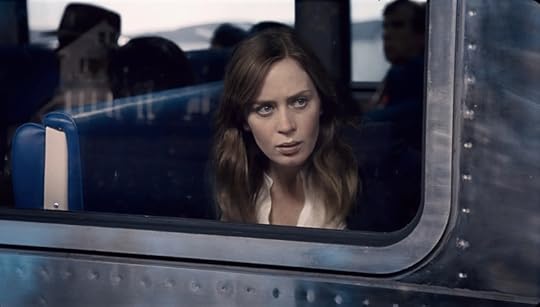
Every so often a book comes along that proves pop culture isn’t confined to Netflix, superheroes, or Kardashians. It’s normally a debut novel, usually a thriller, and naturally a lure for any Hollywood studio keen to board the gravy train. In 2015, that book even had train in the title, and keeping up with this girl was a journey nobody wanted to miss. And then came the film …
All aboard for The Girl on the Train Book Vs Film comparison. Tickets please!
The Book
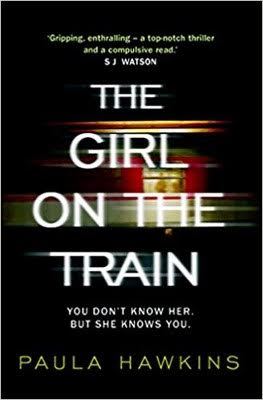 Published in the US and the UK two days apart in January 2015, Paula Hawkins’ debut novel sold over a million copies in under two months. By the time the film came out in October the following year sales had topped 15 million, and it was fastest selling adult hardcover novel in history. But why?
We’ve all been there: staring out of a train window into passing gardens, glimpsing snapshots of lives. If it’s a regular journey, some houses may become landmarks along the way and some strangers may become people we almost know. But what if, one day, you learn a terrible secret about one of them? What would you do?
That’s the book’s terrific premise, and it works so well because it not only appeals to the voyeur in all of us, but also could happen to any one of us. Finally we don’t have to be a space traveller, secret agent or short person with a magic ring for this to be our story – and that’s just one reason we connect with its protagonist, Rachel Watson.
The Characters
Rachel’s journey begins with her daily journey, to London. That she doesn’t do it sober immediately tells us there are issues. The drinking has already cost dear – it ended her marriage to Tom (so she believes), lost her that job she pretends to go to each day, and turned her into a serial liar with the few friends she has left – and whilst she tries to kick the bottle, Rachel’s knack for bad choices means a relapse is never far away. We haven’t seen dire straits this big since Mark Knopfler sang Money for Nothing.
 And yet, in one of the book’s recurring themes, first impressions are rarely correct. Rachel’s misfortunes stem from being unable to get pregnant with Tom, which led to the drinking. Now she clings to her married name as much as the hope her ex-husband will give her another chance, but what Rachel really needs is to give herselfanother chance. Her interactions with other men are the clue. She’ll believe they’ve fallen for her, but this isn’t a runaway ego at work – Rachel left her marriage thinking she was unlovable, and she needs to realise that’s not true. She has to know there’s still a way back for her. Who can’t empathise with that?
Next up is Megan. As the book opens, it’s her seemingly perfect life with Scott that Rachel looks forward to glimpsing each morning from that train – until Megan’s spotted kissing another man, and Rachel’s aghast that she could jeopardise such happiness. Then Megan disappears, and we learn she’s been carrying more baggage than a King’s Cross trolley. A tragedy in her past has defined the woman she becomes, and whilst at times it’s hard to sympathise with her, not once do we dislike her.
The third principal female character is all set up to be disliked though. Anna is Tom’s new wife, and mother to their baby daughter. She openly pursued Tom whilst he was with Rachel and had no qualms about playing marriage wrecker – but as we get to know her better, hidden depths are revealed. By the end Anna is almost as changed as Rachel.
The two male leads – Tom (Rachel’s ex) and Scott (Megan’s husband) – make up the main cast of characters. They’re nicely drawn, but I didn’t find anything that really separated them. Scott’s anguish at Megan’s disappearance is conveyed well, but there were times I struggled to tell them apart; an issue I also had with the film.
Train Reading
Although written in the first person, the book is told by three different characters. Most of it is Rachel’s point of view, starting shortly before Megan vanishes. Megan’s story is set several months earlier, detailing her life up to her disappearance. And Anna’s narrative binds the trio together. It’s superbly written, with each voice distinct from the others, and I suspect the reason the men aren’t as effective is because we never get inside their heads.
One striking factor is the use of an unreliable narrator. Rachel’s drinking means she often doesn’t know what’s happened, making her reliant on others for the truth and leaving us susceptible to their lies. This technique led to some unflattering comparisons with Gillian Flynn’s Gone Girl. However, where Rachel’s confusion was genuine, Amy Dunne’s misdirection was deliberate – so those critics rather missed the point.
That’s not to say the book isn’t flawed. The plot suffers from repetition, (Anna spies Rachel on her street so often, it happens twice in 20 pages at one point), and the final showdown risks being a letdown. There are no unexpected twists, as we already know who did what, but rather than succumb to dramatic contrivance we instead witness that most British of pastimes: a cup of tea and a chat. And it works. By focusing on characters over events, and keeping the story grounded from the first page to the last, Paula Hawkins ensures The Girl on the Train is a journey we’ll remember long after it ends.
All change here for a look at the film. Mind the gap …
The Film
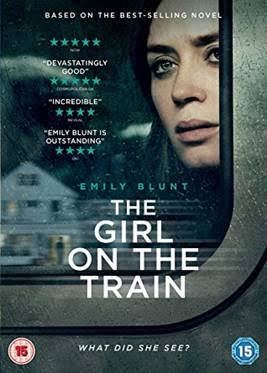 It’s a testament to the novel that the film rights were snapped up ten months before it was published. Dreamworks quickly assembled a team to bring it to the multiplexes whilst the book was still in the public eye. With Tate Taylor (The Help) directing, the film opened in October 2016 – as the paperback sat at number one on The New York Times Best Sellers list. Not a bad bit of free publicity, that.
One thing the film gets right even before the lights go down is the tagline. It’s not a part of the story, but as a foretaste of what to expect it deserves a mention. The book has “You don’t know her. But she knows you”, hinting at a dangerous obsessive similar to Allison Jones (Single White Female) or Alex Forrest (Fatal Attraction), yet Rachel is nothing like either woman. The film uses “What did she see?” in the UK, and “What you know can hurt you” in the US, and both capture the story better.
The Adaptation
Scripted by Erin Cressida Wilson (Independent Spirit Award for Best First Screenplay winner, for Secretary) it’s a faithful retelling. All five main characters are brought over seamlessly, and there aren’t any major diversions for the book’s fans to fret about. That’s not to say there aren’t changes though, including a very significant one. Location, location, location…
The Big Smoke is now the Big Apple. Relocating books to the other side of the Atlantic is nothing new (War of the Worlds, three times – four, if we’re counting a certain radio broadcast), and occasionally it works in the film’s favour (High Fidelity), but this isn’t one of them. The semi-detached suburbia vital to the novel’s relatability has morphed into a cinematographer’s wet dream; ringed by picket-fences, these homes are the type where couples sit around a fire in the garden at night, the type few of us will ever live in, let alone pass by on our way to work.
Due to the restrictions of a two-hour running time it’s expected that Megan and Anna’s storylines will be reduced – and some characters are excised completely – but a crucial change comes with the addition of someone not in the book. Martha (Lisa Kudrow) clues Rachel in to what really ended her marriage, which leads her to remembering so much else. Whilst it’s a quick fix to getting Rachel several steps along her journey, and Martha’s appearance on the train is established earlier, this still feels lazy – and robs our protagonist of finding the truth herself.
The Cast
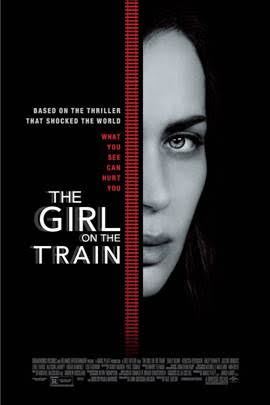 All five leads give good performances, though again it’s not easy to differentiate Tom and Scott, due to Justin Theroux and Luke Evans coming off the dark-haired-and-broody production line (in fairness, scheduling conflicts meant Chris Evans had to pull out; a shame, as casting Captain America would have been a great piece of misdirection). Likewise, Rebecca Ferguson and Haley Bennett work hard with little material as Anna and Megan respectively. But the story is Rachel’s – and this adaptation absolutely belongs to Emily Blunt.
For much of the film she’s playing it drunk, bleary of eye and unsteady of foot, but Blunt still manages to win over the audience. Curiously, considering the switch to America, Blunt retains her English accent, possibly adding to Rachel’s alienation as her life unravels. It’s a tricky performance, but she is totally convincing, and her efforts were justly rewarded with BAFTA and Screen Actors Guild Award nominations.
Train Watching
Rachel makes a few questionable decisions, such as deserting the road for the trees when being followed (a choice that looked dumb in 80s slasher-films) but perhaps we can blame that on the drink. What makes no sense, though, is how we discover Megan’s fate. It’s a flashback, which appearsto be Rachel’s recollection initially, but unless she’s imagining what happened next there’s no way she can know the actual events. As for the person who doesknow, there’s nothing to imply we’re hearing a confession – unlike in the book – so how do the other characters learn this?
The detectives searching for Megan – Gaskill and Riley – also undergo a change. In the book Gaskill (a man) is the lead investigator and Rachel, thinking he’s attracted to her, tries to recruit his support; but the film has Riley (a woman) head up the investigation instead. The director wanted a prominent role for regular collaborator Allison Janney, but in losing the Rachel / Gaskill subplot, along with the book’s deeper relationship between her and Scott, we’re denied a crucial insight into Rachel’s psyche. And Janney’s detective is so indiscrete you wouldn’t trust her to issue parking tickets.
Upon release the film was greeted with mixed reviews, though as is often the case the public disagreed. From a budget of $45 million it grossed a respectable $173 million, and in January 2017 it won the 43rdPeople’s Choice Award for Favourite Thriller Movie. True, it didn’t generate the same fanfare as the book, but if the tension at times is lacking there is still much to enjoy. And it looks beautiful.
Final Destination
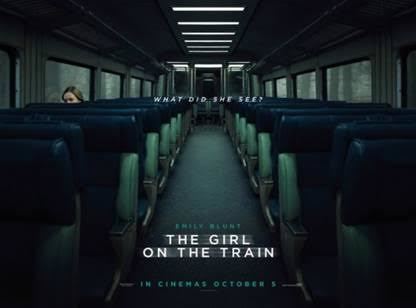 The key to understanding The Girl on the Train is right there in its title. Rachel’s inner journey is our story; so whether that train arrives in London or Manhattan should be irrelevant. Where Rachel’s reallygoing is to a showdown with her personal demons, a reunion with her forgotten past, and a realisation her future will be okay once she chooses a new destination for herself. Megan’s disappearance, and the slow unravelling of her fate, are all just stops along the way.
A lot of care is given to ensuring we like Rachel in both versions, but by jettisoning her need to feel wanted the film loses her most redeeming quality. It’s a cry for help we no longer hear. The book also handles its reveals better (the discovery of a mobile phone’s owner is one example), and whereas the film occasionally feels like it needs a can of Red Bull to give it wings, the book just flies by. Therefore, as we reach the end of the line, the station announcer is happy to reveal the winner of The Girl on the Train Book Vs Film… is the book.
BIO: Nick Jackson is the author of several published short stories, and will next appear in the Momaya Press 2018 short story review. He lives in the North of England, and doesn’t ride trains because folk up there don’t trust owt that’s not pulled by a horse. That, and he can’t afford it.
August 10, 2018
CRIMINALLY GOOD: interview with author KJ McGillick
 1) So, who are you & what have you written?
Hi, I’m author KJ McGillick and my latest novel is The Last Lie She Told. You can LIKE my Facebook page, follow me on twitter as @KJMcKillickAuth or check out my website, HERE.
2) Why do you write crime fiction?
I enjoy putting clues in front of the readers so they have an opportunity to stretch their imagination an reach a satisfactory conclusion. I also like to make it an easy learning experience for my readers and share my legal and medical knowledge with them.
3) What informs your crime writing?
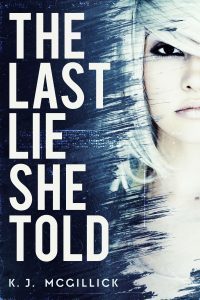 Of course like the rest of the world shows like CSI provided a wealth of information. But being an attorney I also come in contact with the nuts and bolts of crime. Sifting through evidence and how it fits into a case is always a challenge. People are so misinformed about how quickly crimes are solved. It can take months for DNA to come back or blood alcohol levels. In addition to that I have a number of law enforcement people that I can depend upon for the nitty gritty of how things work such as weapons.
4) What’s your usual writing routine?
I research everything before hand. I then do a 7 point plot wheel and next flesh out my characters. Every morning I write until the chapter is complete. Then that evening I run my work through Grammarly and prowritingaid and then self-edit the chapter.
5) Which crime book do you wish YOU’D written, and why?
ANY of Kendra Elliot’s books. Her attention to detail makes the book.
July 26, 2018
Top 10 Authentic YA Reads You Cannot Miss
All About YA …
Sex, assault, cutting, eating disorders, pregnancy, race, murder, death … There are so many issues in the world that it’s confusing for adults, never mind young people! This is why I am SO passionate about contemporary YA Fiction and why I have rounded up some of my favourites below. Enjoy!
1) Just Listen – Sarah Dessen
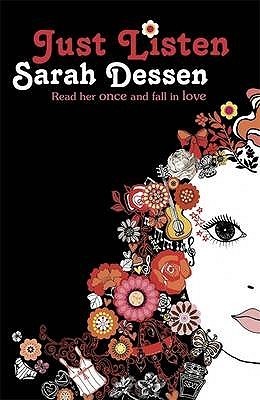 Just Listen the story of Annabel, a teen model who seemingly has everything. She and best friend Sophie are the It Girls at their school – until one fateful party, when Annabel is accused of trying it on with Sophie’s boyfriend. Between being ostracised at school and Annabel’s older sister’s anorexia, Annabel finds herself totally invisible and lost … until she meets Owen, another “outcast” at school.
Just Listen is really strong thematically. Annabel talks a lot about her home, calling it The Glasshouse; the notion that people “who live in glasshouses should not throw stones” is worked into the fabric of the story. Notions of slut-shaming, victim blaming and what it means to be “popular” as well as brave also come into play. What I loved most however about the book was the fact it kept me guessing throughout. Though there is an obvious moral and sting in the tale, Dessen’s tone is never preachy and she offers her readers a look into a world and character’s POV that is both fraught and fragile … No mean feat! What exactly happened at the party comes late in the story, but is all the stronger for it. Dessen handles a difficult subject topic without sensationalism. A brilliant book and heartily recommended!
2) Wintergirls – Laurie Halse Anderson
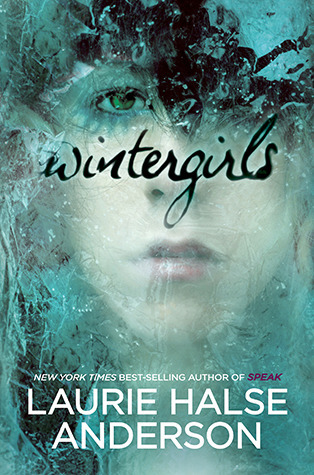 I found Wintergirls very uncomfortable reading, because I felt it to be very real, authentic and honest depiction as someone who has struggled with eating and weight issues myself. Lia’s sense of self being connected to her weight is something I recognised. My own issues, like Lia’s, were less about vanity (as so many assume about anorexia et al) but about control, seeking attention, approval and validation. Anderson paints this superbly with no sentimentality whatsoever and the story is brutal. Lia and Cassie are torn apart from reality, their families and even each other by their hideous shared goal.
Not for the fainthearted. Multiple trigger warnings. But an excellent, insightful read.
3) Genuine Fraud – E. Lockhart
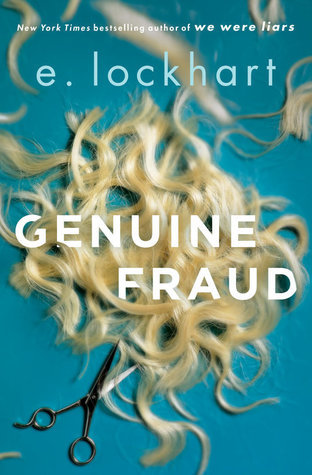 I rocketed through this in just a couple of hours! The lean prose, pacy non linearity and vibrant, three-dimensional characterisation leapt off the page for me. The comparisons to The Talented Mr. Ripley are clear, but there’s an element of Mean Girls and Memento to it as well … It’s modern, up to date and Jule is a fantastic, gender-flipped character; a true Millenial Bad Girl.
I was particularly impressed by the weaving, mobius strip-type structure; I never felt wrong-footed by it and it really drew me in. The power play between the characters on the basis of gender and class is particularly well drawn and the commentary on patriarchy and sexism via superheroes was top notch. I also loved the dramatic irony in that killer twist at the end. Wow! Loved it. If you like your mysteries served ice cold, this is the book for you.
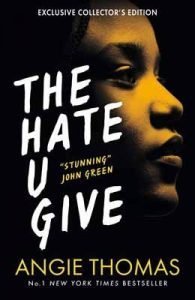 4) The Hate You Give – Angie Thomas
Heartfelt and real, this authentic story is gut-wrenchingly relevant. Packed full of three-dimensional characters, it’s incredibly nuanced, reminding the reader of people’s flaws and foibles go beyond race.
It would have been so easy to draw a line between black and white, rich and poor, educated and ‘thug’, but Thomas paints a storyworld that recognises the complexities and struggles and downright horror of institutional racism. This important book should be required reading for all teens and will take its rightful place as a modern classic, I’m sure. Very much recommended and can’t wait for the movie!
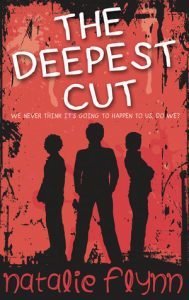 5) The Deepest Cut by Natalie Flynn
Searingly authentic YA read that is so timely given the tragic teen knife crimes in the capital at the moment. When Adam’s best friend Jake is murdered, this sets in motion his descent into a psychiatric unit as he struggles with his survivor’s guilt. Flynn does a fantastic job of painting a picture of trauma here that is so realistic. Thematically powerful, The Deepest Cut talks about culpability and split second decisions that have effects that can last an entire lifetime. Definitely worth a read, especialky if you enjoy sad but impactful teen reads like Laurie Halse Anderson’s WinterGirls. Recommended!
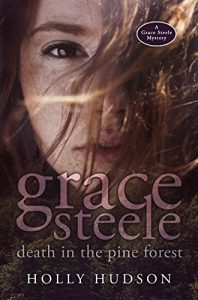 6) Death In The Pine Forest (The Grace Steele Mysteries) by Holly Hudson
This one is a little lighter in tone than the rest on this list, but it’s still authentic and powerful. Reminds me of the 90s show Eerie Indiana mixed with Scooby Doo (in a good way!). Love Grace the narrator; the mix of her confessional tone in the story with her sexy blog is on point. Her two friends Sam and Talia make for a gorgeous little trio, with their relationship contrast really well with grown ups’, such as Grace’s mom Lena and her hot English teacher Mr Siegel! There’s some cool commentary about female teen sexuality here too, which never turns preachy. I love the cover and the narrative doesn’t meander either: it’s short and to the point, making it a fab summer read. Recommended.
7) Beneath The Skin by Kyla Stone
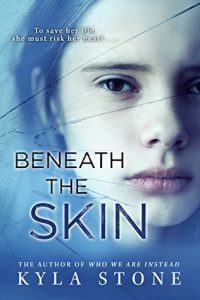 This is a desperately hard-going read, but an important one for young people. The plot is a bit of a misery-fest overall; any one of the issues mentioned here, from cutting, to bullying, to sexual abuse, to terminal illness, to fatal alcohol syndrome, to anorexia, parent-pressure and beyond could have supported an entire narrative in its own right, after all. A lesser writer would have left us depressed and listless at such a litany of terrible things, but Stone does a great job of comparing and contrasting the light and shade here.
However, it’s Sidney who is a revelation: this honest portrayal of a young woman in turmoil is authentic and real and I really related to the anger, shame and despair Sidney goes through. So often YA books focus on quieter female lead characters, but Sidney is a blazing trail of in-your-face attitude. Her sarcasm, suspicion and sometimes outright cruelty is totally understandable and really well drawn. We see her softer side with her brothers and her learning to trust Lucas and Arianna was really quite beautiful.
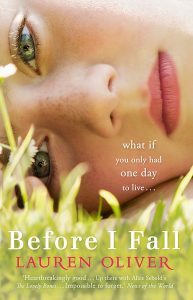 8) Before I Fall – Lauren Oliver
Before I Fall is the tale of Samantha, a girl who is a popular student at her high school. The novel tells the story of her last day before she dies – except she keeps repeating it, GROUNDHOG DAY-style, attempting to ensure someone’s life is saved. At first we assume her own, then as all the storylines get unpicked, we realise that what is going on is far “bigger” than Sam and she is paying for others’ “crimes” as well as her own. This phenomenon is never really explained, but it doesn’t matter. Oliver is such a master storyteller, weaving all the parts of this story together in such a brilliant way, I was enthralled from the prologue through to the epilogue, even though it’s pretty long for a YA book. I don’t mind admitting I cried like a baby when I finished it! Can’t recommend it enough and really should get round to watching the movie ASAP for a ‘Book Versus Film’ on this site!!
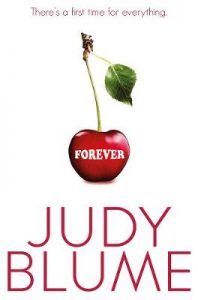 9) Forever – Judy Blume
I’ve read this one so many times! I first read it when I was about thirteen and since I have grown older, what I love about it is how realistic it is. Obviously it feels a little outdated now because forty years have passed; there’s no mobiles or social media or anything like that, but that does not matter. Everything here has stayed the same, regardless of tiny details like that.
So: Kath and Michael are two teenagers in the 1970s. They meet and fall in love with a speed only teens are capable of. Obviously he wants to sleep with her. She is reluctant and first, but eventually they do it, they are both into it. Blume also doesn’t forget about birth control! Yay! Most importantly: nothing tragic happens to them even though they have sex. Nor are they ‘soulmates’ or any that cheesy crap so many YA books about teen sex present. Most importantly, their relationship does not survive the first hurdle (as with so many teen romances!) and no one points fingers and laughs at them. It just normal. Yes!!!!
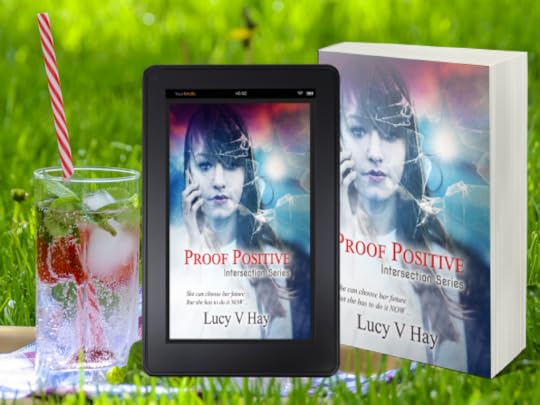
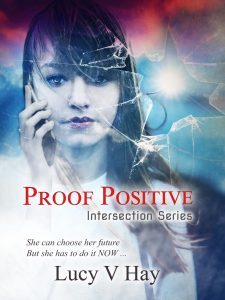 10) Proof Positive by Lucy V Hay
Oooh! How embarrassing, this is one of mine … No really, c’mon: I wrote this book BECAUSE I love contemporary YA and have a story to share about a social issue my teen character, Lizzie, faces. Proof Positive is book 1 in the Intersection Series, where a teenage character is presented with a dilemma and then ALL the potential ways the situation *might* work out. (Book 2 will be out early 2019!).
In Lizzie’s case, on the eve of her eighteenth birthday, she finds herself pregnant: she’s literally days away from her exam results and university beckons around the corner. The bright Lizzie has big plans, but can she have the life she wanted, with a baby in tow? What will her family and friends say? And what will the baby’s father choose to do: stay out of it, or stand by her?
Best of all, Proof Positive is FREE on Kindle right now — so grab it HERE or by clicking the pic below or at the top of the article. Enjoy!
July 25, 2018
CRIMINALLY GOOD: Interview with author Elizabeth S. Moore
 1) So who are you and what have you written?
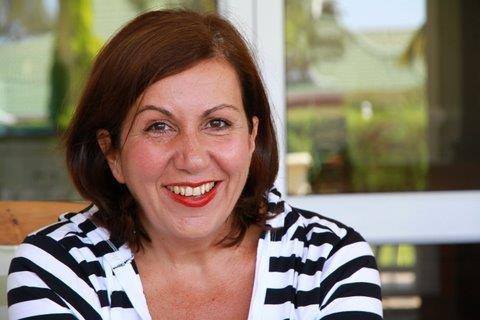
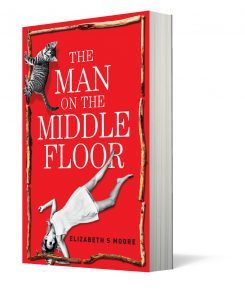
I’m a debut author who has just written a book called The Man on the Middle Floor, published by Red Door. It’s a thriller set in a three floor converted house in London and the three main characters all live in flats within that house but don’t know each other until a murder throws them together. It’s a ‘Why done it?’ as well as a ‘Who done it?’. Up until now I have been a journalist who writes about politics, current affairs, wine and food.
2) Why do you write crime fiction?
I love writing crime fiction as it gives a structure and format that allows you to make almost any comment on society and on humankind less obviously than a non crime piece of fiction. There is cause and effect and as soon as someone loses their moral compass and commits a crime. The questions about motivation, good and evil, the nature of man and so on, follow on naturally in the story.
3) What informs your crime writing?
 My crime fiction writing is largely informed by my childhood. I think that if you grow up in a very emotionally unstable, scary place you learn early on to assess people’s motives for your own self preservation. I became very attuned to moods and my EQ is high, so I find it easy to step into the mind of someone who acts or thinks in a criminal or immoral manner.
4) What’s your usual writing routine?
My writing routine is procrastinate, procrastinate, think of something I have to do at my computer and almost trick myself into starting to write. Once I am writing I am fine, it’s getting going that’s the issue. My daily routine is a couple of articles which limbers up the fingers and the mind or a Q and A about The Man on the Middle Floor, then a few hours of solid writing on my new book usually interrupted by business calls, children, dogs and husbands. I am not one for shutting myself away on a Hebridean Island.
5) Which crime book do you wish YOU’D written, and why?
I wish I had written ‘The Talented Mr.Ripley’ by Patricia Highsmith, I can identify with all the characters in the book, I recognise the mendacious quality of the protagonist and his effect on those around him. It is full of strong, brilliant characters and situations I can identify with. Gripping.
July 18, 2018
BOOK VERSUS FILM: Tinker, Tailor, Soldier, Spy Showdown
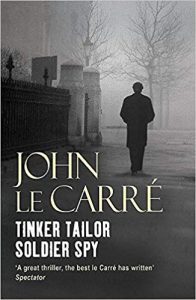 I watched the old BBC version with Sir Alec Guinness in my childhood. Soon after I had my first experience with Eastern Germany, en route to West Berlin. Luckily Le Carré had prepared me for terror and intimidation! Still, it terrified me and intensified my respect for Le Carré (the pen name of Bernard Cornwell).
As a linguist and former intelligence agent whose cover was blown by famous double agent Kim Philby, Le Carré knew his subject matter with an intimacy that spills from the pages. His hero, the outwardly bland George Smiley, is the antithesis to James Bond: his Circus is more populated with ambitious pen-pushers and analysts than dazzling charmers with a licence to kill.
Book: The Plot
The year is 1973, the height of the Cold War. Smiley’s retired … Or rather he’s been forced out from the Circus after a botched mission that cost his dying mentor Control his post. An agent Control sent out to meet a potential defector in Czechoslovakia, a general who was supposed to know the identity of a double-agent in London, was caught and shot by Russians.
As a result, Control is deemed past it. The reins are passed into the hands of wildly ambitious Percy Alleline, as well as his vain sidekick Toby Esterase, the stolid Roy Bland and flamboyant intellectual Bill Haydon. (The latter is the lover of Smiley’s wife Ann at the time of the infamous operation and possibly also the lover of the shot agent, Jim Prideaux).
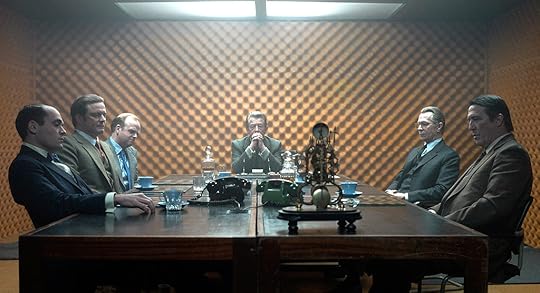
But then another field agent appears with a story about a mole at the heart of British intelligence … It’s Smiley he trusts with his information. When his minister asks him to find the truth Smiley accepts, partly to take his mind of his notoriously unfaithful wife Anne, who this time might have left him for good.
But he’s got to be careful who to rope into his investigation. All the usual avenues are closed to him, and if his suspicions prove correct, there will be hell to pay for the Circus. Control had seen it coming, and he left a little bit of information behind for Smiley. He’d narrowed the suspects down to five, code-named Tinker, Tailor, Soldier, Poorman and Beggarman. The last name stands for Smiley himself. The rest are the four men now in charge.
With most avenues closed Smiley turns to another man who found his role diminished when Control was sidelined: Peter Guillam. Together they unravel the truth about the betrayed operation in Czechoslovakia that led to Prideaux’s capture, discredited Control and left the mole with easy access to all intelligence. It’s a truth that taints everyone.
The Film Plot
The film stays true to the plot, cutting what little flab there is from it. Le Carre knew his stuff – a likely inspiration was Kim Philby, who defected to Moscow in 1963 when he thought exposure was imminent.
It opens with a trap for Prideaux (an always reliable Mark Strong) who is intercepted and shot by Hungarian police, much the dismay of their Russian handler. This differs a lot from the book, which is set in the snowy forests around Brno, but none of the changes interfere with the story.
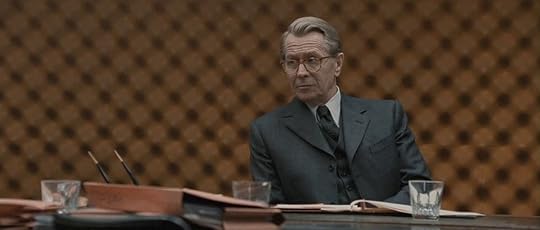
Instead the tenseness is strengthened, ably supported by a muted colour scheme that adds to the bleak atmosphere. Smiley’s world, and that of the whole spy machinery, is a shabby, drab one, and there’s nothing colourful or spectacular about it. The only bright spot belongs to Haydon, whose flapping suede coat and appearance riding a kid’s scooter into the creaking office is the best executed character-reveal.
The Characters: The Book
George Smiley is outwardly bland scholarly gentleman, but his Achilles’ heel is his enduring love for his promiscuous wife. The illusion-less man’s illusion, as Russian spymaster Karla described it, is one of the most enduring creations in spy literature. But because Le Carré uses him before and after, the reader needs to know the other Smiley stories to give him his full due.
What does come out strongly, much stronger than in the film, is the recurring theme of love or the lack of it, romantic or not. It’s what makes Smiley vulnerable. None of the other men have love in their life. They have lovers they don’t care about; families who are side-lined. Their allegiance is their ambitions or their jobs.
Even the formerly missing agent, whose story sets Smiley in motion, is astonished to find himself care for the Russian agent who trusted him – a decision that gets her killed. Most like Smiley is Jim Prideaux, the loyal spy who paid for his love when he is sold by the one person he cares about most.
The Film: Characters
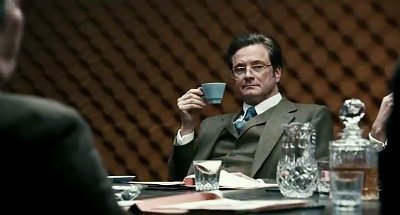
Smiley (Gary Oldman) is a character whose strength is his mind and he is portrayed accordingly. Bill Haydon (Colin Firth) has the distinction of being the only truly colourful man in this circle of shabby, grey men; this makes the hints at his bisexuality as subtle as they are effective.
Percy Alleline, Toby Esterhase and Roy Bland on the other hand have lost most of their individuality. They blend in well with all the grey and brown that suffuses the atmosphere, but a little more personality would have served them better.
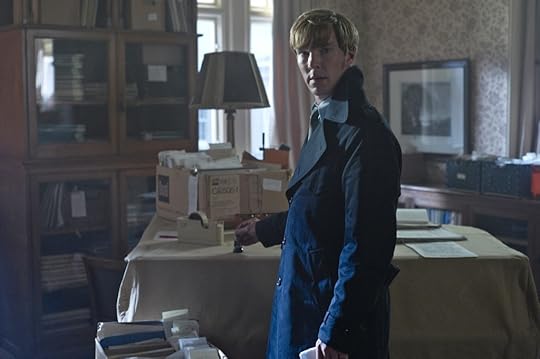
The one person undergoing a small, but interesting change, is Peter Guillam. In the novel he’s having an indifferent affair with a much younger student; in the film an impossibly blonde Benedict Cumberbatch is seen breaking up with a man and being heartbroken about it. That makes him the only one capable of having a loving relationship who does not end up being betrayed (he ends it to protect his partner). It’s a small scene, mostly subtext, but it’s a nice little addition.
Overall, some characters gain in the film others, while others are diminished.
The Ending
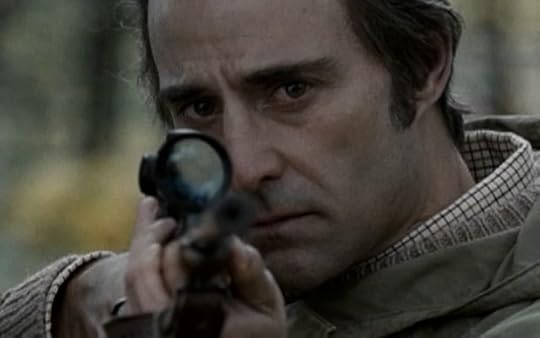
What works perfectly is the ending. In both film and novel, the mole is shot. But where Prideaux’s revenge is implied in the novel, in the film he is shown with his rifle, and the cross-hairs on the silencer. I preferred the film version on this point.
The Verdict
The cinematic version, while streamlined, is still an intellectual feat. The antithesis of special effects and bikini-clad Bond babes, the movie relies on its nuances, as well as well-crafted dialogue and rich subtext to make it thrilling (as long as you can overlook Cumberbatch’s hair!).
The book feels less than 420 pages. Some passages are eerily beautiful. Even so, I still believe there are also lots of places where a cut or two wouldn’t have hurt. With this all in mind then, the author was well-served by this adaptation. Everyone did their jobs properly, from the cinematographer to the wardrobe people who clad Smiley in an old-fogeyish cardigan without turning him into a caricature. Add to that a cast that reads like a ‘Who’s Who’ of British acting and it’s clear the film keeps its slight edge.
BIO: Carmen Radtke is a screenwriter and novelist. Her debut novel The Case of the Missing Bride, a Malice Domestic finalist, is published by Bloodhound Books. She also writes under the pen name Caron Albright. A Matter of Love and Death is out now with Bombshell Books. Follow Carmen on Twitter as @CarmenRadtke1.
Lucy V. Hay's Blog

- Lucy V. Hay's profile
- 174 followers

