Michael May's Blog, page 145
April 14, 2015
Thunderball (1965) | Bond
Actors and Allies
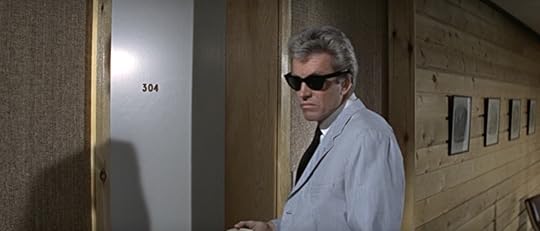
Yesterday, I mentioned that Moneypenny and Bond's relationship was changed slightly from the novel Thunderball. That's because Fleming had weirdly changed it for the novel. The literary Bond and Moneypenny never flirt (that's something he does with his own secretaries, not with his boss'), but in Thunderball Fleming wrote that Moneypenny had a crush on Bond. It never came up again in the books, so maybe he thought better of it, but it was also creeping into the movies with Goldfinger. In Dr. No and From Russia With Love, Bond and Moneypenny flirt, but it's entirely mutual and there's no hint that she wants anything more from him than he wants from her. In Goldfinger though, I got the feeling that she was starting to have romantic thoughts about him. Fortunately, that's all gone in Thunderball and we're back to sheer, mutual playfulness.
Felix Leiter is also back and I like Rik Van Nutter in the part. He's not a very good actor, but he looks like the literary Felix with his lean handsomeness, sandy hair, and relaxed demeanor. Visually, we won't get another Felix this good until the Timothy Dalton era.
One of Bond's most important allies in Thunderball is his assistant, Paula, but I'm going to talk more about her tomorrow.
An overlooked ally is Bond's Nassau contact, Pinder, played by Earl Cameron. It's a small part, but also an important one. Pinder is competent, useful, and surprisingly ubiquitous through the middle part of the movie. I enjoy watching him a lot.
In fact, Pinder is a bigger character in Thunderball than Q, who only appears in one scene. That's not unusual for the series, but Thunderball uses him in a weird way, sending him all the way to Nassau to outfit Bond, but then never mentioning him again. There will be plenty more of that in the later Bond movies, but it's kind of surprising here when we see it for the first time. We do get a chuckle out of the situation though when Bond realizes his mission has been invaded by Q and he says, "Oh no" like he means it. The mutual disdain between the men has been escalating over the last couple of films and Thunderball continues to play that up. Eventually, we'll see that Bond and Q's ribbing each other is actually affectionate, but here it can be read either way.
As for Bond, Connery is completely at ease with his character; possibly more than in any other movie. That's not to say that he looks uncomfortable in the first three films, but he's got this part down by Thunderball and he's never funnier. That's largely due to Connery's delivery, but the script is also the funniest in the series so far. As I was keeping track of quips to figure out the best one, I was surprised by how many great lines Bond has in Thunderball.
Best Quip
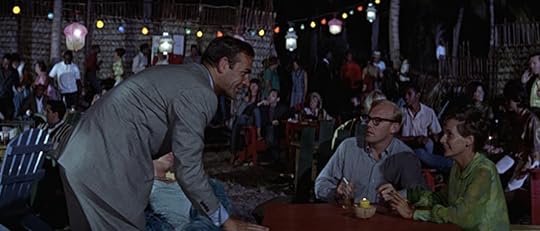
Choosing the best quip turned out to be easy though. As funny as the whole movie is, nothing beats Bond's setting Fiona's corpse in a chair at the Kiss Kiss Club and asking the people at the table if his "friend can sit this one out. She's just dead." And Bond looks simultaneous pained by the pun and completely amused with himself as he turns away from them. Just perfect.
Worst Quip
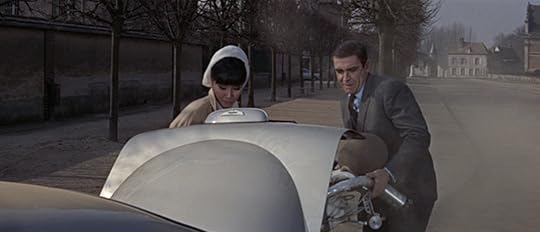
There aren't any full-blown stinkers in the movie, but the one with the worst landing is when Bond takes off his jet pack and declares, "No well-dressed man should be without one." It's not horrible, but it's also not trying very hard.
Gadgets
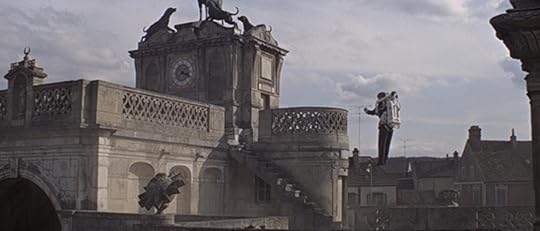
Speaking of the jet pack, it's my favorite gadget in the movie, but there are plenty to choose from. And that's not even counting SPECTRE gadgets like Fiona's missile-firing motorcycle and Largo's tricked out yacht (I've decided only to include Bond's gadgets in my Top Ten). The Aston Martin makes another appearance (this time firing water cannons instead of creating an oil slick), but there's also a tape-recorder disguised as a book, a geiger counter watch, a geiger counter camera, a radioactive pill that acts as a homing beacon when swallowed, a handy rebreather for underwater work, and a propeller-driven SCUBA tank set up with built in spearguns and plenty of underwater grenades. Q really outdoes himself this time.
Top Ten Gadgets
1. Aston Martin DB V (Goldfinger and Thunderball)
2. Jet pack (Thunderball)
3. Attaché case (From Russia With Love)
4. Propeller SCUBA tank with built-in spearguns (Thunderball)
5. Rebreather (Thunderball)
6. Camera-tape recorder; mostly because it reminds me of a camera my dad used to use (From Russia With Love)
7. Seagull SCUBA hat (Goldfinger)
8. Book tape-recorder (Thunderball)
9. Geiger counter watch (Thunderball)
10. Geiger counter camera (Thunderball)
Bond's Best Outfit
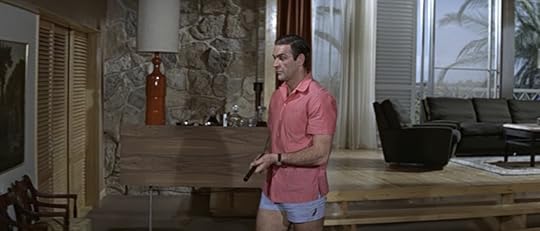
I got tired of looking at Bond's suits and trying to decide which color scheme I liked best, so I picked this poolside outfit he wears with blue swim trunks and a watermelon shirt. It's bold, but he pulls it off.
Bond's Worst Outfit
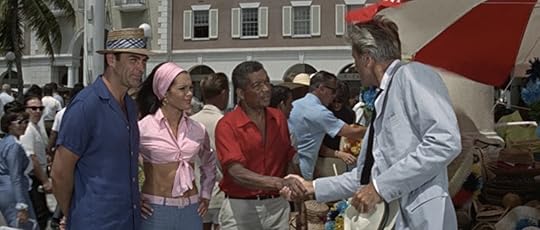
I couldn't find a great screenshot of this entire outfit, but the straw hat is only part of the problem. Bond's pants exactly match the color of his shirt and that's a real issue for me. Looks like he's wearing pajamas.

Yesterday, I mentioned that Moneypenny and Bond's relationship was changed slightly from the novel Thunderball. That's because Fleming had weirdly changed it for the novel. The literary Bond and Moneypenny never flirt (that's something he does with his own secretaries, not with his boss'), but in Thunderball Fleming wrote that Moneypenny had a crush on Bond. It never came up again in the books, so maybe he thought better of it, but it was also creeping into the movies with Goldfinger. In Dr. No and From Russia With Love, Bond and Moneypenny flirt, but it's entirely mutual and there's no hint that she wants anything more from him than he wants from her. In Goldfinger though, I got the feeling that she was starting to have romantic thoughts about him. Fortunately, that's all gone in Thunderball and we're back to sheer, mutual playfulness.
Felix Leiter is also back and I like Rik Van Nutter in the part. He's not a very good actor, but he looks like the literary Felix with his lean handsomeness, sandy hair, and relaxed demeanor. Visually, we won't get another Felix this good until the Timothy Dalton era.
One of Bond's most important allies in Thunderball is his assistant, Paula, but I'm going to talk more about her tomorrow.
An overlooked ally is Bond's Nassau contact, Pinder, played by Earl Cameron. It's a small part, but also an important one. Pinder is competent, useful, and surprisingly ubiquitous through the middle part of the movie. I enjoy watching him a lot.
In fact, Pinder is a bigger character in Thunderball than Q, who only appears in one scene. That's not unusual for the series, but Thunderball uses him in a weird way, sending him all the way to Nassau to outfit Bond, but then never mentioning him again. There will be plenty more of that in the later Bond movies, but it's kind of surprising here when we see it for the first time. We do get a chuckle out of the situation though when Bond realizes his mission has been invaded by Q and he says, "Oh no" like he means it. The mutual disdain between the men has been escalating over the last couple of films and Thunderball continues to play that up. Eventually, we'll see that Bond and Q's ribbing each other is actually affectionate, but here it can be read either way.
As for Bond, Connery is completely at ease with his character; possibly more than in any other movie. That's not to say that he looks uncomfortable in the first three films, but he's got this part down by Thunderball and he's never funnier. That's largely due to Connery's delivery, but the script is also the funniest in the series so far. As I was keeping track of quips to figure out the best one, I was surprised by how many great lines Bond has in Thunderball.
Best Quip

Choosing the best quip turned out to be easy though. As funny as the whole movie is, nothing beats Bond's setting Fiona's corpse in a chair at the Kiss Kiss Club and asking the people at the table if his "friend can sit this one out. She's just dead." And Bond looks simultaneous pained by the pun and completely amused with himself as he turns away from them. Just perfect.
Worst Quip

There aren't any full-blown stinkers in the movie, but the one with the worst landing is when Bond takes off his jet pack and declares, "No well-dressed man should be without one." It's not horrible, but it's also not trying very hard.
Gadgets

Speaking of the jet pack, it's my favorite gadget in the movie, but there are plenty to choose from. And that's not even counting SPECTRE gadgets like Fiona's missile-firing motorcycle and Largo's tricked out yacht (I've decided only to include Bond's gadgets in my Top Ten). The Aston Martin makes another appearance (this time firing water cannons instead of creating an oil slick), but there's also a tape-recorder disguised as a book, a geiger counter watch, a geiger counter camera, a radioactive pill that acts as a homing beacon when swallowed, a handy rebreather for underwater work, and a propeller-driven SCUBA tank set up with built in spearguns and plenty of underwater grenades. Q really outdoes himself this time.
Top Ten Gadgets
1. Aston Martin DB V (Goldfinger and Thunderball)
2. Jet pack (Thunderball)
3. Attaché case (From Russia With Love)
4. Propeller SCUBA tank with built-in spearguns (Thunderball)
5. Rebreather (Thunderball)
6. Camera-tape recorder; mostly because it reminds me of a camera my dad used to use (From Russia With Love)
7. Seagull SCUBA hat (Goldfinger)
8. Book tape-recorder (Thunderball)
9. Geiger counter watch (Thunderball)
10. Geiger counter camera (Thunderball)
Bond's Best Outfit

I got tired of looking at Bond's suits and trying to decide which color scheme I liked best, so I picked this poolside outfit he wears with blue swim trunks and a watermelon shirt. It's bold, but he pulls it off.
Bond's Worst Outfit

I couldn't find a great screenshot of this entire outfit, but the straw hat is only part of the problem. Bond's pants exactly match the color of his shirt and that's a real issue for me. Looks like he's wearing pajamas.


April 13, 2015
Thunderball (1965) | Story

Plot Summary
SPECTRE steals a couple of nuclear bombs and it's up to Bond to get them back.
Influences
It's mostly a faithful adaptation of the novel Thunderball, though that of course was adapted by Ian Fleming from the movie treatment he'd created with writer/director Kevin McClory and others. That's why McClory gets a producer credit on this film.
The court battle over Thunderball had ended during the production of Goldfinger when Fleming - who was very sick by this time - more or less gave up. The novel could remain in print with Fleming's name on the cover, but future editions would have to credit McClory and writer Jack Whittingham as contributors to the film treatment the book was based on. And McClory won the complete TV and movie rights to the story.
McClory was actually working on his own version of a Thunderball movie, but the popularity of Sean Connery as Bond made McClory realize that he'd have a hard time competing. He went to Bond producers Harry Saltzman and Cubby Broccoli with the offer to make the film together. They weren't keen on it at first, but Columbia's Casino Royale spoof was also in the works and Saltzman/Broccoli realized that a third Bond film would be bad for them. And if they were ever going to be able to adapt Thunderball, this was the time. So they scrapped their plans to make On Her Majesty's Secret Service the next movie and accepted McClory's offer.
While not strictly influences, there are a couple of references to other movies in Thunderball. For instance, when Bond tells SPECTRE assassin Fiona, "I've grown accustomed to your face," he's quoting the Audrey Hepburn version of My Fair Lady that had come out the year before. And earlier in the movie, he tells Shrublands employee Patricia Fearing that he'll see her "another time, another place," which was the name of a Sean Connery movie from 1958.
How Is the Book Different?
The plot is very close to the novel, but McClory had continued tweaking the script and there are changes, mostly great ones. For example, the movie drops M's interest in fads as the reason Bond begins the story at the Shrublands health resort. The alternative reason it offers isn't super plausible, but I'm glad that M is less of a joke than he was in the book. Speaking of which, Bond and Moneypenny's relationship is also different from the book, but I'll say more about that tomorrow.
A third, positive change is Bond's reason for going to the Bahamas to search for the missing bombs. The book makes that a hunch on M's part, but in the movie it's Bond who suggests it and he has a good reason for doing so. Which brings me to...
Moment That's Most Like Fleming

Because Bond goes to Nassau on his own hunch instead of M's, he's putting his reputation on the line with the Foreign Secretary who's running the operation. That's a big change from the book, but it gives M the opportunity to stick up for Bond to the Secretary, which is totally something that the literary M would do.
Moment That's Least Like Fleming

As Sean Connery's Bond becomes increasingly solidified as a character, he moves further and further away from the literary Bond. I'll talk more about this tomorrow, but it's not entirely a bad thing. It is partly a bad thing though, because as sadistic and chauvinistic as the literary Bond is, he's not as oppressive and creepy as Sean Connery in his interaction with Patricia Fearing. Bond not only packed a weird, mink glove to take to the resort; he also blackmails Pat into having sex with him. That's in line with the way he treats Pussy Galore in the Goldfinger movie, but I can't imagine Fleming's Bond doing that. In the novel, Pat supplies the mink glove and blackmail never enters the picture.
Cold Open

The cold open for Thunderball doesn't have much to do with the main plot, but I can see what they're going for. Each cold open so far has tried to outdo the one before. From Russia With Love featured a quiet, moody death, Goldfinger had a couple of gadgets and a short fight, and Thunderball offers a prolonged fight sequence and some major gadgets, including the return of Bond's Aston Martin.
And it's not like the opening has nothing to do with the main plot. Not only does Blofeld refer to it in his SPECTRE briefing, but recovering from that fight is at least part of the reason Bond starts the movie proper at Shrublands. It's the best cold open so far, even if the opening shot of the initials JB on a coffin is a sad and poorly executed idea.
Top 10 Cold Opens
1. Thunderball
2. Goldfinger
3. From Russia With Love
4. TBD
5. TBD
6. TBD
7. TBD
8. TBD
9. TBD
10. TBD
Movie Series Continuity

Blofeld and SPECTRE are back of course, after sitting Goldfinger out. As in From Russia With Love, we still don't see his face and he still has the white cat.
Bond's trick of throwing his hat onto Moneypenny's hatrack makes its fourth appearance in as many movies, though with a humorous twist. Bond enters her office and is about to toss his hat when he realizes that the hatrack has been moved right next to the door where he's standing. Disappointed, he just puts it on the rack like a normal person.
And finally, there are apparently a lot more Double-O agents in the movie universe than in Fleming's. The books only talk about three, but when Bond attends the conference room briefing with "every Double-O in Europe" there are nine chairs. Incidentally, the seventh one is Bond's.

April 12, 2015
7 Days in May: Harry Potter and the Furious 7
Doctor Who
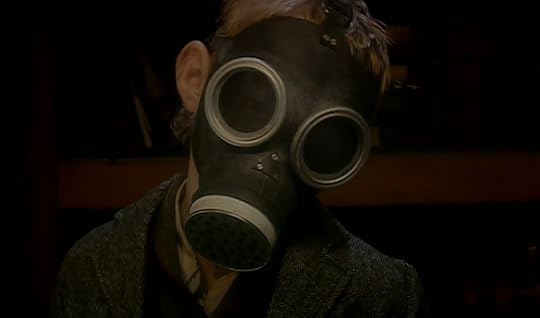
We've been watching classic Doctor Who for a while in our house, but recently David expressed an interest in the new stuff, so we skipped ahead. Diane and I had already seen the Eccleston episodes and David was enjoying them for the most part (he's not a big fan of the Slitheen and who can blame him?), but our New Who marathon ground to a halt with "The Empty Child" and "The Doctor Dances." That's the two-part story where the Doctor and Rose go to London during the Blitz of WWII, meet Jack Harkness, and have to solve the mystery of a gas-masked boy who goes around very creepily asking people, "Are you my mummy?"
Diane was freaked out about these episodes back in 2005 when they first aired. David was about the same age as the gas-masked boy at the time, so the story resonated in an especially disturbing way with her. Ten years later, we hoped it wasn't quite as scary as we remembered, but no, it totally is and David was freaked right out. He has a very active imagination and three days later he's still struggling with some of those images. There's no way he's going to be able to handle the Weeping Angels, so as a family we're going back to the Pertwee era and I'll forge on alone with the New Who catch-up.
My personal opinion about these two episodes though is that they're the best in the Eccleston season up to that point and are a great reminder of why Stephen Moffat (who wrote them) eventually got the gig as show-runner. There are some other very strong episodes in that season ("Dalek" and "Father's Day" being two), but "The Doctor Dances" is my favorite so far.
Eccleston gets a lot of crap from Doctor Who fans and I understand it to an extent. When these episodes first aired, I was just so happy to have the Doctor back that I wasn't the least bit critical of Eccleston's portrayal. Especially since I didn't have Tennant's to compare it to, yet. Watching it again, I can see why it doesn't sit well with some people. Eccleston's Doctor is manic, but in a dark way. He's very angry and sometimes outright mean and cruel. But that makes complete sense to me considering what he's recently been through and I still find him a compelling and likable - if extremely tragic - character.
Star Wars: Clone Wars
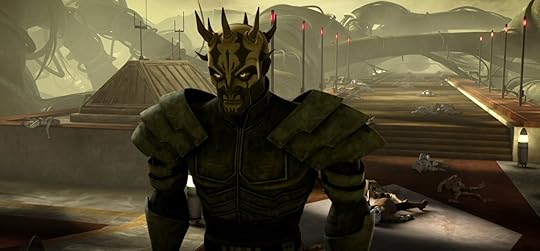
Another marathon we're working through is trying to get through all the Star Wars movies and TV shows, in chronological order, by the time The Force Awakens comes out. We're in Season 3 of Clone Wars right now and it's rough going.
We like the adventures and the way the series jumps between groups of characters. That keeps it exciting and fresh. But the show really dumbs down the Jedi in order to make other threats more dangerous. All the Jedi forget to use the Force at key moments and apparently anyone in the galaxy can pick up a lightsaber and use it with Jedi-like skill against an actual Jedi. Right now, my enjoyment of the show is about equal with my frustration at it. If we weren't doing this as part of a project, I'd consider dropping it to free up time for something else.
The One I Love

Another project I'm working on is catching up on all the 2014 movies that I missed seeing. If you check out that post, I'm banging them out in pretty much the order that I listed them.
The One I Love isn't exactly what I expected. It explores the theme of changes in relationships; just not in the way I thought it would. It starts off as a drama with comedic (and perhaps supernatural) elements, but ends up being sort of a light thriller. It would make an interesting double-feature with Gone Girl since both movies compare their leads' relationships at different stages and ask which stage is preferable. Do we like the beginning stage when everyone's on their best behavior? Or do we prefer the later stages when we're getting real with each other, but everything's so much messier? Gone Girl explores those questions in a heavy, obvious way, while The One I Love is light and subtle. I prefer The One I Love.
The F Word (aka What If)
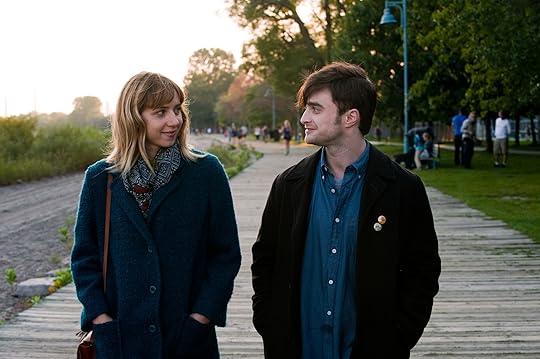
The F Word is an Irish-Canadian movie that was retitled What If for release in the US and UK. The original is the better title, not only because it's way more clever, but also because it actually has something to do with the movie. The F Word of the film is "friend" and the movie explores the relationship between an emotionally damaged man (Daniel Radcliffe) and a woman (Zoe Kazan) who's currently in a serious, long-term relationship.
I love this movie. Its leads are absolutely charming, but what I like most is how complicated the emotions and relationships are. Wallace and Chantry agree to be just friends because she has a boyfriend. Wallace claims to be okay with that because a) he's recently been hurt badly by a cheating ex-girlfriend, and b) he's vowed never to do that to anyone else. He doesn't want to be the guy who breaks up Chantry and Ben. But Wallace obviously has feelings for Chantry and a lot of the movie is about his struggle to keep those in check. He doesn't want fall into Nice Guy Syndrome and it's fascinating to see him navigate the relationship imperfectly, but as honorably as he can.
What is so refreshing about the movie though is that Chantry is an equal player in the relationship. She's not just the object of Wallace's desire, she's a complete character with her own faults and mixed emotions about both Wallace and Ben. She's just as compelling to watch as she tries to figure out what's going on, how she feels about it, and what she should do. Put all that together with funny dialogue, a wonderful supporting cast, and a great soundtrack and you've got the best romantic comedy of last year, if not the last several years.
Furious 7
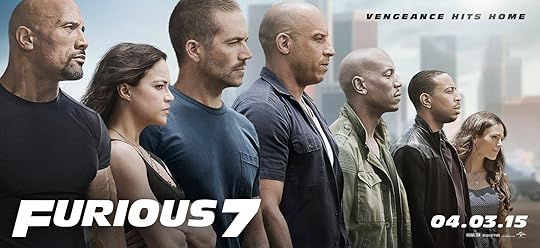
I was nervous going into this. Partly that's because I attributed everything I love about the Fast and Furious series to Justin Lin. James Wan was untested as an action director and that was before all the troubles during production, starting with the death of Paul Walker. I wanted Furious 7 to be as good as the last few movies in the series, but I despaired.
And truthfully, it's not as good as Fast Five or Furious 6. Those are enormously fun movies with huge casts and over-the-top plots that still manage to hold together somehow. Furious 7 is dealing with a smaller cast thanks to the deaths of some characters and its plot doesn't hold together nearly as well. Really, the thing that's supposed to be driving the plot doesn't make sense at all. None of this makes it any less fun than the previous movies though.
The plot is super thin and I expect that will bother people who aren't already all in on the series, but I found plenty to enjoy. The story is only there to get us from one action set piece to the next and it does that adequately. As important as story is to me, this is a movie about huge action and characters I've come to care a lot about. It handles those elements perfectly while also including awesome performances by Jason Statham and Kurt Russell. The Furious series is everything I want The Expendables series to be.

We've been watching classic Doctor Who for a while in our house, but recently David expressed an interest in the new stuff, so we skipped ahead. Diane and I had already seen the Eccleston episodes and David was enjoying them for the most part (he's not a big fan of the Slitheen and who can blame him?), but our New Who marathon ground to a halt with "The Empty Child" and "The Doctor Dances." That's the two-part story where the Doctor and Rose go to London during the Blitz of WWII, meet Jack Harkness, and have to solve the mystery of a gas-masked boy who goes around very creepily asking people, "Are you my mummy?"
Diane was freaked out about these episodes back in 2005 when they first aired. David was about the same age as the gas-masked boy at the time, so the story resonated in an especially disturbing way with her. Ten years later, we hoped it wasn't quite as scary as we remembered, but no, it totally is and David was freaked right out. He has a very active imagination and three days later he's still struggling with some of those images. There's no way he's going to be able to handle the Weeping Angels, so as a family we're going back to the Pertwee era and I'll forge on alone with the New Who catch-up.
My personal opinion about these two episodes though is that they're the best in the Eccleston season up to that point and are a great reminder of why Stephen Moffat (who wrote them) eventually got the gig as show-runner. There are some other very strong episodes in that season ("Dalek" and "Father's Day" being two), but "The Doctor Dances" is my favorite so far.
Eccleston gets a lot of crap from Doctor Who fans and I understand it to an extent. When these episodes first aired, I was just so happy to have the Doctor back that I wasn't the least bit critical of Eccleston's portrayal. Especially since I didn't have Tennant's to compare it to, yet. Watching it again, I can see why it doesn't sit well with some people. Eccleston's Doctor is manic, but in a dark way. He's very angry and sometimes outright mean and cruel. But that makes complete sense to me considering what he's recently been through and I still find him a compelling and likable - if extremely tragic - character.
Star Wars: Clone Wars

Another marathon we're working through is trying to get through all the Star Wars movies and TV shows, in chronological order, by the time The Force Awakens comes out. We're in Season 3 of Clone Wars right now and it's rough going.
We like the adventures and the way the series jumps between groups of characters. That keeps it exciting and fresh. But the show really dumbs down the Jedi in order to make other threats more dangerous. All the Jedi forget to use the Force at key moments and apparently anyone in the galaxy can pick up a lightsaber and use it with Jedi-like skill against an actual Jedi. Right now, my enjoyment of the show is about equal with my frustration at it. If we weren't doing this as part of a project, I'd consider dropping it to free up time for something else.
The One I Love

Another project I'm working on is catching up on all the 2014 movies that I missed seeing. If you check out that post, I'm banging them out in pretty much the order that I listed them.
The One I Love isn't exactly what I expected. It explores the theme of changes in relationships; just not in the way I thought it would. It starts off as a drama with comedic (and perhaps supernatural) elements, but ends up being sort of a light thriller. It would make an interesting double-feature with Gone Girl since both movies compare their leads' relationships at different stages and ask which stage is preferable. Do we like the beginning stage when everyone's on their best behavior? Or do we prefer the later stages when we're getting real with each other, but everything's so much messier? Gone Girl explores those questions in a heavy, obvious way, while The One I Love is light and subtle. I prefer The One I Love.
The F Word (aka What If)

The F Word is an Irish-Canadian movie that was retitled What If for release in the US and UK. The original is the better title, not only because it's way more clever, but also because it actually has something to do with the movie. The F Word of the film is "friend" and the movie explores the relationship between an emotionally damaged man (Daniel Radcliffe) and a woman (Zoe Kazan) who's currently in a serious, long-term relationship.
I love this movie. Its leads are absolutely charming, but what I like most is how complicated the emotions and relationships are. Wallace and Chantry agree to be just friends because she has a boyfriend. Wallace claims to be okay with that because a) he's recently been hurt badly by a cheating ex-girlfriend, and b) he's vowed never to do that to anyone else. He doesn't want to be the guy who breaks up Chantry and Ben. But Wallace obviously has feelings for Chantry and a lot of the movie is about his struggle to keep those in check. He doesn't want fall into Nice Guy Syndrome and it's fascinating to see him navigate the relationship imperfectly, but as honorably as he can.
What is so refreshing about the movie though is that Chantry is an equal player in the relationship. She's not just the object of Wallace's desire, she's a complete character with her own faults and mixed emotions about both Wallace and Ben. She's just as compelling to watch as she tries to figure out what's going on, how she feels about it, and what she should do. Put all that together with funny dialogue, a wonderful supporting cast, and a great soundtrack and you've got the best romantic comedy of last year, if not the last several years.
Furious 7

I was nervous going into this. Partly that's because I attributed everything I love about the Fast and Furious series to Justin Lin. James Wan was untested as an action director and that was before all the troubles during production, starting with the death of Paul Walker. I wanted Furious 7 to be as good as the last few movies in the series, but I despaired.
And truthfully, it's not as good as Fast Five or Furious 6. Those are enormously fun movies with huge casts and over-the-top plots that still manage to hold together somehow. Furious 7 is dealing with a smaller cast thanks to the deaths of some characters and its plot doesn't hold together nearly as well. Really, the thing that's supposed to be driving the plot doesn't make sense at all. None of this makes it any less fun than the previous movies though.
The plot is super thin and I expect that will bother people who aren't already all in on the series, but I found plenty to enjoy. The story is only there to get us from one action set piece to the next and it does that adequately. As important as story is to me, this is a movie about huge action and characters I've come to care a lot about. It handles those elements perfectly while also including awesome performances by Jason Statham and Kurt Russell. The Furious series is everything I want The Expendables series to be.
April 8, 2015
Locked in Time: Time Machine Classics [Guest Post]
 By GW Thomas
The fourteenth episode of the popular sit-com The Big Bang Theory, "The Nerdmabelia Scattering," featured a prop from George Pal's 1960 film The Time Machine. The four main characters go in together to buy the original time machine prop, leading to neurotic Sheldon Cooper's dreaming and crying out, "Not flesh-eating Morlocks!" The disk-backed machine is described by Penny as "something Elton John drives through the Everglades!" But my favorite joke was when the guys simulated the sped-up time effect from the movie, pretending to be moving at advanced speed like the people in the street. Besides being hilarious, this cultural reference to the 1960 film is very telling. The show did not feature any references to the 1978 TV movie or the 2002 film. Why? Because no one, despite big budgets and CGI, has surpassed George Pal's film.
 Of all the films based on HG Wells' four major SF themes, "The Time Machine" has received the least formal adaptations. This is probably due to the expensive nature of creating a future world. The concept of time travel has become widely familiar though, from comedies to super-hero fare. Anyone from the Three Stooges to the Flash can travel in time. The idea became a mainstream trope while actual adaptations of the story have been sparse.
"The Time Machine" (1895) catapulted HG Wells into the top tier of science fiction writers. The story (some call it a short novel) follows an anonymous inventor who goes to the future, seeking a time when Science will have solved all of humankind's problems. What he finds instead is a garden world populated by two separate races: the Eloi, with their pleasant bovine simplicity, and the evil Morlocks, dwelling below with their sinister machines. The tale works on so many levels that I've re-read it more times than any other of Wells' stories. The SF extrapolation is wonderful, following a split in the human species, as well as a look at the eventual death of the solar system. This post-Morlock portion of the tale has been as inspirational as the first part, influencing writers like William Hope Hodgson and John W Campbell. Wells also uses fantasy tropes like the dream journey and return, but the story also works as a horror tale, with the Morlocks slowly exposed and their terrible secret revealed. Perhaps most important to Wells is that the story is also a socialist cautionary tale about the division between proletariat and those who exploit them.
 The very first TV adaptation was made by the BBC and appeared January 25, 1949. No recordings of this show exist. The Time Traveler was played by Russell Napier and Mary Donn was Weena. The script shows a fairly accurate adaptation and the photos look like typical BBC television, shot on a stage but with impressive sets.
Eleven years later, science fiction filmmaker George Pal would bring the story to blazing color with astounding special effects. The classic film starred Rod Taylor as the Time Traveler and Yvette Mimieux as Weena. The film won an Academy Award for its time-lapse photography. It is this film that gave us the chair with the spinning dish that supplied the prop for that episode of Big Bang. Unlike Pal's adaptation of The War of the Worlds (1953), this film did not update the setting but stays in the Victorian age of Wells. Because of this, the time machine does not have a futuristic look, but a quaint Steampunkish one. The only deviation from Wells' vision is the deletion of the scene where he goes beyond the Morlocks to see the end of the Earth.
Pal's film lingered on in TV reruns and re-releases at theaters for decades. It took until 1978 for someone to approach the material again, this time as a television movie, part of Sunn Pictures' Classics Illustrated series. Sadly, the producers updated the background, making the Time Traveler, played by John Beck, a scientist working for the military. The theme of the piece is also updated to being about the military industrial complex and not humanity's overall evolution. The film has numerous strikes against it. First, the almost Western-style music. This, along with jaunts back to a Salem-style witch-burning and the Old West, brand the picture as very American in what was a quintessential British novel. These past episodes take up almost half the movie, leaving only the last 50 minutes for the Eloi. The bad writing is accompanied with much bad acting. Priscilla Barnes, as Weena, is the only convincing performer.
 There is a good laugh for people today when we learn that in 2004, in a world with environmental challenges, a three-day work week and test tube babies, World War III breaks out and annihilates the planet. Humans are driven underground and only the Eloi choose to come up again, leaving the underworld to the Morlocks, who look like Frankenstein monsters with glowing eyes. What was a series of fascinating mysteries and reveals in the novel is baldly and boringly stated in this film. Even the message of peace is twisted when the Time Traveler helps the Eloi to destroy the Morlocks. Wells would never have done this for he knew that the Eloi are too docile and stupid to produce clothing, food and other things necessary to survive. The Time Traveler returns to Weena when he learns the corporation he has blindly worked for, wants to use the time machine as a spying tool to keep their competitive edge on all future technology.
If the 1978 film was a disappointment, the 2002 film by Wells' grandson, Simon Wells, was an intriguing failure. Guy Pierce plays the Time Traveler, appropriately set before the turn-of-the-century, but in America. He is Dr. Alexander Hartdegen, a professor of Engineering at Columbia. The film supplies a romantic back-story in which Hartdegen's fiancée is killed. Using the time machine he tries to change the past, but finds doing so only causes her death in other ways. Disconsolate, he goes into the future to find Earth being ravaged by the destruction of the Moon. In this future time he encounters Vox, the computer library, played wonderfully by Orlando Jones. Later in the film he would encounter him again, in the dilapidated library of the Eloi. Jones is funny, singing an imaginary Andrew Lloyd Weber musical based on Wells' book, but he even manages to make us a little sad for the AI personality that can forget nothing. He also supplies the background info that is usually done at this point in the story. In many ways the film is an homage to the 1960 and even the 1978 films. Hartdegen's design has the same levers and spinning disk (though two) that we all know. The time lapse sequences use the same growing plants and passing suns that the other films did. And like the other two, the sequence after the Morlocks is ignored.
 Now the bad news: once the time traveler goes 800,000 years into the future, the film stumbles. The success of the recent Tim Burton film, The Planet of the Apes, had a dire influence on the producers. The Morlocks are no longer small, apish creatures but several separate types, one large and brutish and the other thin and vampire-like, their king played well by Jeremy Irons. The Eloi are no longer pleasure-seeking cows but barbarians living in huts built on the sides of cliffs. I imagine the producers did not want the second portion to slow in momentum, taking their time to slowly reveal the Morlocks. Instead they dove Planet of the Apes-style into a world of hunter and hunted. The second half tries to be an action film and loses itself for a while. This said, much is the same as the 1960 film, with the main character's discovering the Morlocks' slaughterhouse and the eventual destruction of the underground caves. Before this, Hartdegen and the Morlock King get to argue about evolution and time paradoxes. They fight it out on the time machine instead of the usual bunch of Morlocks and the film ends with the machine destroyed. Hartdegen, with his Weena (named Mara) at his side, is ready to face an uncertain future. Even though the earlier parts of the film played homage to 1960 (like the dresses in the shop window), the second half tries to satisfy action fans and fails.
 One side film I would like to mention is Time After Time (1979). This film featured Malcolm McDowell as HG Wells, who has created an actual time machine, and David Warner as Jack the Ripper. The Ripper's killing spree ends because he steals the time machine and escapes to our time. Wells follows him to the future and has to hunt the madman down. The film was directed and co-written by Nicholas Meyer, who had a bestseller with the Sherlock Holmes pastiche, The Seven Per Cent Solution (1974). The movie also stars Mary Steenbergen as the love interest, Amy, who would appear in another time travel franchise, Back to the Future. Time After Time is a delightful bit of fun for Wells fans, but isn't actually an adaptation. The Ripper's death is similar to that of the Morlock King twenty-three years later and I have to wonder if the film didn't have some influence.
The legacy of Wells' "The Time Machine" is too wide to clearly outline. His idea of traveling in time has been part of so many science fiction novels, TV shows, comic books and films. Without the Time Traveler's adventures there is no Captain Kirk going back to 1968 in "Tomorrow Is Yesterday" or saving whales in Star Trek IV: The Voyage Home. No Red Dwarf. No Doctor Who or Back to the Future. No crappy ending of Superman II. Mainstreamed SF like The Lake House by James Patterson or better yet, Somewhere In Time by Richard Matheson. Classics like The Door Into Summer by Robert A Heinlein, "The Sound of Thunder" by Ray Bradbury, "Behold the Man" by Michael Moorcock, and on and on and on... Time travel is one of the major SF themes and like so many others, the man who gave it to us went by the name of Wells.
GW Thomas has appeared in over 400 different books, magazines and ezines including The Writer, Writer's Digest, Black October Magazine and Contact. His website is gwthomas.org. He is editor of Dark Worlds magazine.

April 6, 2015
7 Days in May: The Week in What I've Been Watching

This year the blog's going to be heavily focused on James Bond, but that's not all I'm watching and it's not all I want to write about. Since I don't have a ton of time for posts that dive deeply into other interests, I thought I'd borrow from guys like Siskoid and William Bruce West and just do weekly capsule posts for some of that stuff.
So, here's what I've been up to the past seven days:
Ken Burns Presents: The West

My family was traveling in Arizona last week and that reignited my interest in the West. In preparing for it, we watched some Zane Grey movies and other films that were either shot in the state or took place there. A lot of these movies reference the Civil War, which David is studying in school, so we've had some discussions around how the war affected the West and when various events in Western history happened in relation to it.
I realized that while I know a lot of tales and legends about Western people, I don't have a great grasp of the timeline and how all of those stories fit together, so I started watching Stephen Ives' The West to help sort that out. I'm only a couple of episodes in - up to the 1840s and the gold rush - but it's as informative and easily digestible as I expect from a project produced by Ken Burns. I have a way better grasp now on the Louisiana Purchase, the roles of Spain and Mexico in the history of North America, and specific tragedies in American relations with native peoples (particularly the Trail of Tears).
Turn: Washington's Spies

Thinking about American history got me interested in finally checking out AMC's Turn: Washington's Spies. It's been showing up as recommended viewing in my Netflix queue for a while, so I pulled the trigger and watched the first couple of episodes. I'm totally hooked.
Jamie Bell and Angus Macfadyen are already favorite actors of mine, so it had that going for it, but the time period is so ripe with drama that I can't believe no one's taken advantage of it before. Turn does though by having Bell play a farmer in English-controlled territory. He's unwillingly recruited into a colonial spy ring, pitting him not only against his government, but also his neighbors and family. In addition to the espionage and family drama, there's also a murder mystery in the first couple of episodes. It's one of those shows where I finish each episode and immediately want to watch the next, but I'm going to hold off and let Diane and David catch up with me before going further. I'm hoping we can get caught up in time to watch the show live as it enters its second season soon.
The Rocketeer (1991)

This was inspired totally by Nerd Lunch's recent episode about it. I hadn't seen it in years and needed to revisit it. The last time I watched it, I'd recently discovered Bettie Page and held a grudge against Jennifer Connelly for not being her. I don't think I'd actually read Dave Stevens' comic by that point though and didn't realize how obnoxious Cliff and Betty are as a couple. As the Nerd Lunchers and Kay point out on the podcast, Cliff and Jenny are still selfish and troubled, but it's way easier to root for them to work out their differences.
The movie does suffer from being an origin story, which means that there's more of Cliff's getting used to the rocket pack than there is of his flying and being awesome with it, but the movie's still full of pulp homages and a lot of fun. Somewhere between it and Sky Captain (which would have benefitted from The Rocketeer's practical effects) is the perfect pulp adventure movie.
Fleming: The Man Who Would Be Bond

Not so much a biopic as a heavily fictionalized version of Fleming's life and how various events from it may have inspired aspects of James Bond's. I wouldn't give a lot of credence to the connections it draws, but they're interesting analogues and fun to wonder about. Beyond that, Fleming mixes WWII spy drama with tragic romance in a compelling way and also nails my impression of the author as an enormous butthole who also happened to be completely charming. I disliked him immensely while simultaneously feeling bad for him and wanting him to get better.
Psych, Season 1

Finally, David and I started watching Psych. David had seen the pilot episode at a friend's house, but what got us into it last week was watching an episode of Castle with the friend we were staying with in Arizona. David wanted to see more Castle, but it's not streaming on Netflix, so I suggested Psych as an even better alternative. The mysteries and detective work are more clever than Castle and the banter is funnier. We'll be adding this to David's regular viewing schedule.

April 3, 2015
My Field Report for Artistic Licence Renewed

The Artistic Licence Renewed blog is a great resource for the literary James Bond and artistic representations of him. In addition to news, reviews, and thought pieces about this side of Bond, the blog also features Field Reports in which readers can answer a few questions about their own experiences with Bond novels and art. I submitted mine and it's up now on the site.

April 1, 2015
David the World-Builder

My son David is working on finding his voice - and his medium - but he's a storyteller. As are most kids, I think, but he's always coming up with ideas that he wants to get out into the world. He makes his own comics to sell at our local convention and he's also interested in filmmaking and creating worlds for games.
He and his friends create their own, elaborate Pokémon cities for no other reason than to share them with each other and have another way to talk about the game. But David is also super into tabletop RPGs and is working on developing one himself. That's the map to his world, above, and it's so full of awesome places that I wanted to share it. Can't wait to see where he ends up taking his talent, because I want to play in the worlds he's building.

March 30, 2015
Out of Office

This week is David's spring break, so we're traveling to Arizona. Never been.
Seeing the Grand Canyon and Monument Valley have always been bucket list items for me and Diane, but we're also going to work in Meteor Crater, the Petrified Forest, and Tombstone. Been watching a lot of Westerns to get ready for it and I'm taking along some Zane Grey to read on the trip.
Don't know if we'll have internet access, so I've got a couple of short posts ready to go for later this week. I'll work on some Thunderball posts when I get back. Have a great week!

March 27, 2015
The Man With the Golden Gun by Ian Fleming
 Fleming began writing The Man With the Golden Gun in the same month that principle filming began on Goldfinger. Exploring just how much the Goldfinger movie inspired the Golden Gun novel would make a fascinating research paper, but I'm not going to do it. I don't need to quantify the influence in order to know that Fleming's writing was affected by the Bond films in general. Putting aside Ursula Andress' appearance in the novel On Her Majesty's Secret Service, as soon as the movies started coming out Fleming immediately started tweaking his Bond. The literary character not only became a Scot like Sean Connery, but a notorious public figure whose life could be read about in the newspaper and speculated upon. Though Fleming died before The Man With the Golden Gun was completely polished, the novel suggests that the book series was going to continue to read more and more like the films.
That's not a good thing. I started writing about the Bond novels with the theory that Bond actually grows as a character over the course of the series. And that's been born out. It's been a great and interesting trip watching the selfish, sullen spy take more and more interest in the people around him. That comes to a head in You Only Live Twice, which would've made a perfect ending to the series if Bond had more say about his fate at the end of that book. Fleming had a wonderful opportunity to wrap up the series with Bond's making a conscious choice to either continue in the Secret Service or stay with Kissy on the island. Either decision would have made a powerful statement about Bond's character and contrasted beautifully with the Bond of Casino Royale. But instead of Kissy's encouraging and supporting Bond in determining what kind of life he wanted, Fleming had her deceive Bond, raising his curiosity and propelling him into another adventure. That's great for the continued potential financial success of the series, but not for its artistic achievement. Fleming gave up a great ending in order to keep the series going.
 Not that The Man With the Golden Gun is a bad book. The first chapters resolve the cliffhanger from You Only Live Twice in a really tense and exciting way. From there, the story goes in a direction that's reminiscent of Bond's early adventures, especially Dr. No. Bond is supposed to stop an assassin named Francisco Scaramanga who's working for Cuba and helping Soviet interests in the Caribbean. Bond finds Scaramanga in Jamaica and that's where the rest of the story takes place. While there, Bond does a lot of recollecting about his previous missions there. We learn that he lost touch with Honey Rider, but that last he'd heard she was married to a doctor from Philadelphia and had a couple of kids.
Unfortunately, Scaramanga isn't a great villain. He's really just a glorified henchman. But he's still plenty dangerous and Fleming does a nice job keeping Bond in danger. Fleming's always made Bond squeamish about killing in cold blood (though Golden Gun makes it clear that that's just something Bond finds extremely distasteful as opposed to something he believes is objectively immoral). Because of that, Bond chooses not to assassinate Scaramanga when he has the chance, but decides to go undercover as Scaramanga's personal assistant. It's rooted in Bond's established character, so it sort of works, but it also smacks loudly of dragging out a very thin plot. Even so, Fleming is able to create tense moments all throughout and Golden Gun is a fun, adventurous read.
 That's faint praise though, especially compared with how epic the rest of Fleming's later novels are. Instead of building on those, he just seems interested in writing a passable adventure for future adaptation into film. Bond finds Scaramanga not through serious investigation, but purely by luck. His relationship with Mary Goodnight - no longer the admin for the Double-O section and recently assigned to Jamaica - is especially flirty and Connery-esque. Bond even pokes fun at Q-Branch like Connery does and a couple of things feel lifted right out of Goldfinger in particular, starting with the title character's gold-covered revolver. Bond also uses a hollow safety razor as a hiding place for spy stuff and there's a scene where the bad guy murders a squeamish ally who wants out of the caper.
I have such mixed feeling about The Man With the Golden Gun. It's simultaneously a solid little entry in the series and a horrible disappointment. As the final book in Fleming's series, it sucks and I'd prefer if it didn't exist. But as the start of something different - a new chapter in Bond's life - I kind of dig it and wish Fleming had been given more time to convince me he was headed in a worthwhile direction.

March 25, 2015
Borderland: A B-Movie in the Making [Guest Post]
 By GW Thomas
"Borderland" by Arthur J Burks is a typical pulp adventure and yet somehow more interesting than many of his other tales in Gangster Stories or Weird Tales. The plot is familiar to anyone who watches old 1950s B-movies. A mad scientist creates giant lizards (though not by nuclear radiation, but with a glandular concoction), intent on extorting millions from the governments of the world. Dr. Frankenstein meets Captain Nemo. Scenes of gigantic iguanas devouring helpless villagers is not far from The Beast From 20,000 Fathoms or It Came From Beneath the Sea. And yet, Burks published this story in Thrilling Adventures, December 1934. Not Thrilling Wonder Stories, but Thrilling Adventures.
Let's back up a bit. The hero of the story is Cleve, a man who captures specimens for Dr. Keller, the Curator of Herpetology at the Museum of Natural History. Cleve plans to dynamite large crocodiles for the Doctor's collection when three enormous iguanas come out of the lake and attack the Haitian villagers nearby. Cleve finds an old dugout canoe and goes to Cabritos Island where he thinks the lizards came from. There he finds his employer, who shows him a secret hideout where the villains are injecting the iguanas with the super glandular mixture. Dr. Keller also reveals he is, in fact, the owner of the secret lab, as well as a giant stockpile of dynamite, enough to destroy the island if the authorities should discover the truth. Cleve must join the doctor or die. Cleve lies and says he will help him in his great plan. Cleve begins capturing more iguanas for Keller. He eventually makes a pretext of going to the other side of the island to get some bigger specimens, but retrieves his dynamite gear from the dugout and strings wires from the dynamite stockpile to the shore. In true non-science fiction adventure style, he wakes from a dream and the ending feels lame. Only after he pushes the plunger, expecting to capture his crocodiles does Capritos Island explode, actually destroying the giant iguanas and Dr. Keller.
 What strikes me about this tale was, of course, that it appeared in Thrilling Adventures and not an SF pulp. (Leo Marguiles, the editor, might have felt it wasn't quite strong enough for Thrilling Wonder, requiring instead the silly, "it was a dream" business at the end for adventure readers.) But there are a few other things I wonder about and make more sense after a little research on Arthur J Burks. First off, I was impressed by his locale color at the beginning of the story. If it had been written by Hugh B Cave I would have naturally expected details about Haiti since Cave made a second career out of writing about this island nation in Colliers Weekly in the 1950s. It turns out that Burks had been a marine in World War I (and would return to active duty in WWII later) and had first hand knowledge of the jungle island which he used in several books.
Secondly, the use of the name "Dr. Keller" makes me wonder if the character was named after Dr. David H Keller, a pulp writer of SF. The two knew each other through Hugo Gernsback's early pulps, plus they also worked on the serial novel Cosmos in 1933-35. Their by-lines are often found together in the same magazines such as Weird Tales. I have no proof of any homage but it is possible Burks was having fun with an in-joke.
 And finally, the title "Borderland" refers to the opening of the tale in which the narrator talks about the thin line between the real and the fantastic. "Where is the thin dividing line between waking and sleeping, knowing and dreaming?" This theme would become part of Burks' life after the pulps (during which he wrote over eight hundred stories, being one of the Fiction Factory's Million-Words-a Year men). Ryerson Johnson told Will Murray in an interview that he saw Burks later working as a psychic medium. His final phase as a writer was in occult studies with titles like En-Don: The Ageless Wisdom (1973).
So "Borderland" was not just your average pulp story. It predated the B-movie monsters, featured solid local color and detail, possibly included a tip of the hat to David H Keller, and lastly, showed Burks' growing interest in the occult. It's a fun ride even if it relies too heavily on mad scientist logic and huge piles of dynamite. It remains one of those odd little pulp gems that can still surprise us eighty years later.
GW Thomas has appeared in over 400 different books, magazines and ezines including The Writer, Writer's Digest, Black October Magazine and Contact. His website is gwthomas.org. He is editor of Dark Worlds magazine.