
Michael May's Blog, page 144
April 22, 2015
You Only Live Twice (1967) | Story

Plot Summary
Someone is stealing US and Soviet rockets from orbit and the superpowers aren't happy! Can James Bond and Britain solve the mystery before those maniacs blow up the earth?!
Influences
Harry Saltzman and Cubby Broccoli's plans to produce On Her Majesty's Secret Service had been postponed by the sudden availability of Thunderball as source material, but they didn't come right back to it afterwards. Instead, wanting to take advantage of the Bond movies' huge popularity in Japan, they decided to adapt You Only Live Twice.
I wasn't able to find out exactly why Terence Young didn't return to direct YOLT after Thunderball, but I did learn that even though the previous movie had been a huge financial success, Young had become frustrated with all the underwater shooting and had pretty much abandoned Peter Hunt to finish editing the film alone. Maybe that had something to do with it. Whatever the reason, he was replaced by director Lewis Gilbert. who originally turned down the job, but was convinced to do it because of the huge built-in audience it would bring him.
Richard Maibaum, the defining voice on the first four screenplays, wasn't available for YOLT either, so the producers hired Roald Dahl, author of Charlie and the Chocolate Factory, James and the Giant Peach, The Fantastic Mr. Fox, etc. He'd been a close friend of Ian Fleming, but he was an untried screenwriter and didn't think the YOLT novel had a filmable plot. He jettisoned most of it, keeping primarily the Japanese setting, a few characters, and some nods to particular story elements.
How Is the Book Different?
Since the US-Soviet space race had captured the world's attention, Dahl made that the center of the movie. Fortunately, it fit well with a change that Cubby Broccoli wanted to make concerning Blofeld's hideout. Broccoli had scouted Japan for a seaside castle like the one in Fleming's novel, but learned that Fleming had made that up. Tsunamis make it foolish to build castles on the coast. Instead, Broccoli discovered a dormant volcano with a lake in its crater. That would be the site of Blofeld's operation.
In addition to Blofeld, Dahl kept Tiger Tanaka and his organization (including the ninja training facility) and diving girl Kissy Suzuki (though she's one of Tanaka's agents and an orphan in the film instead of a former actresss living with her parents as in the book). He also kept Bond's disguising himself as a Japanese fisherman, though that doesn't work at all onscreen. All that remains of Blofeld's garden of death is the piranha pool in his office, but there's also sort of a nod to Bond's obituary from the end of the novel, since the movie opens with Bond's supposed death and a newspaper headline reporting it.
Moment That's Most Like Fleming

Of the various elements from the novel that sneak their way into the movie, the biggest one is when Tanaka takes Bond out for a bath. It's not an exact replay of the scene from the book, but it serves the same purpose in the story.
Moment That's Least Like Fleming

The movie does weird things with a couple of characters. Dikko Henderson isn't a racist Australian bastard in the movie, but a snooty Englishman who's adopted some Japanese culture while refusing to give up all of his own. As much as I dislike the movie Henderson though (more on that tomorrow), the real crime is what they've done to Blofeld. I'll have more to say about that on Friday, but dang that is not the villain Fleming wrote.
Cold Open

Dahl's newness to the Bond series is felt right away with the cold open. Instead of continuing the previous films' trajectory of increasingly more exciting sequences, YOLT opens with a plot-heavy series of three scenes. First is the space walk in which a mysterious rocket opens up and swallows a US capsule (killing an astronaut in the process). There's a good two minutes of boring control room chatter before the second rocket even shows up. I imagine that might have been fascinating to audiences in the mid-'60s, but it's a long, slow, two minutes today.
After that, the movie cuts to some kind of summit meeting where the US and USSR stubbornly threaten each other over the crisis while Britain calmly, but sternly encourages them to focus their attention on finding a third party. Britain's portrayed as a powerful mediator, which is really interesting considering the novel's theme about Britain's declining influence in the post-WWII world.
Finally, the cold open cuts to Japan where Bond is supposedly investigating the rocket's disappearance, since the mysterious rocket supposedly landed somewhere around there. But we don't see any investigating, because Bond is immediately shot and killed in bed. There's no action anywhere in the cold open; just this cliffhanger. Sadly, that lack of excitement will plague the rest of the film.
Top 10 Cold Opens
1. Thunderball
2. Goldfinger
3. From Russia With Love
4. You Only Live Twice
5. TBD
6. TBD
7. TBD
8. TBD
9. TBD
10. TBD
Movie Series Continuity

Bond obviously didn't die before the credits. It's all MI6's trying to fool SPECTRE into thinking they'd got rid of him. Which makes sense because they've known all about him since From Russia With Love. What doesn't make any sense is that MI6 actually goes to the trouble to bury the real Bond at sea. Couldn't they just have dumped a dummy or something? The way Bond gets on board the submarine is convoluted and unnecessary.
Once he's there though, we get another hatrack gag when he tosses his naval cap onto one in Moneypenny's office. And we've now set a precedence for M's taking his entire office and staff into the field. This will happen a few more times in the series and it's never convincing to me.
After his briefing, Moneypenny tries to give Bond a Japanese phrase book, but he tells her that he "took a first in Oriental languages at Cambridge." The obituary in the novel doesn't mention Cambridge, but it comes up again later in the movies.
Following up on Bond's excellent knowledge of alcohol from Goldfinger, Bond knows the correct temperature for serving saké. And speaking of alcohol, there's a strange bit of discontinuity when Bond meets with Henderson, but I think I'll talk about that tomorrow.
Finally, Blofeld makes an odd comment about Bond's being the only agent SPECTRE knows who uses a Walther PPK. I thought it was pretty firmly established in Dr. No that those were standard issue for Double-O agents, of whom we saw in Thunderball that there are nine. I might be adding 2 and 2 and getting 5, but this looks like a ridiculous case of the movie series' getting too big for itself. Audiences associate the Walther PPK with Bond, so the villains apparently do too. The snake is eating its own tail.
If you haven't guessed yet, I really don't much care for You Only Live Twice.


Woe in Westeros: The Game of TV Thrones [Guest Post]

By GW Thomas
SPOILERS BELOW FOR GAME OF THRONES THROUGH LAST SEASON
The battle ax of success is a two-bladed bitch. Take George RR Martin for example. He wrote for decades, publishing award-winning science fiction, novels of fantastic depth of character, and even worked in television for a time. Now with the success of The Game of Thrones, GRRM has everything. The fattest bestsellers, the hottest cable show, the possibility of a feature film. Martin has even won the name "The American Tolkien." How many of us haven't wished for that kind of success?
But that ax has a second side, remember? That sharp edge has shown itself recently as execs at HBO have turned up the pressure on George to write the sixth book of what will be his seven-part masterwork. Martin has told avid readers before that it takes him two years to write one of his Song of Fire and Ice books. And therein lies the rub. TV shows are made every year, not every two. So what does Martin do with this kind of JK Rowling-level pressure?
 He could do two things I hope he'd never do: 1) let other people make up the next season (as HBO has threatened to do), or 2) hand in some quickly written crap. Both of these choices will produce a sad end to what has been an amazing run of television. Hacks (even talented ones) watering down Martin's vision would be the low road to another Legend of the Seeker. Martin quickly throwing together the last two books could lead to storylines that remain unfinished or faltering like the mysteries in Lost. HBO should think carefully on all of this.
I think I have a solution. There has been some discussion around how many seasons the show will go. The producers say seven. HBO says ten. George says, "Let's see." So what will they do after the seven bestsellers? My answer is TALES FROM WESTEROS, an anthology show based on the larger show. Imagine it. Ten episodes about different characters in different parts, different times, of that amazing world. These, of course, would be written by others under GRRM's watchful eye, with Martin providing the last and best episode (probably about the dragons). This would buy HBO and GRRM another year. And whenever they needed more time, do another one. Or after all the regular books are done, fill out the ten years with more. (Martin was producer on the new Twilight Zone and edited a tribute book to Jack Vance set in his world, The Dying Earth, so he has experience at this kind of thing.)
 Some episodes I'd like to see would include:
Another nice part of this idea is we could see some past characters return, like Ygritte played by Rose Leslie, who died in last season's storyline. I'd love a smaller story about Ygritte and Jon Snow before he left the Free Folk. More info on the dangers of the land beyond the wall, please.
Arya and the Hound traveled together for most of Season Four. Lots of opportunities for stories on that journey. The same for Brienne of Tagarth and Jaime Lannister as they made their way south. This would be before Jaime lost his hand, perhaps? Jojen and Meera Reed, Brandon Stark, Hodor's journey to the frozen north has plenty of room for things to happen too.
 Grey Worm and the Unsullied have tons of potential still. I'd like a story without too much Daenerys Targaryen or dragons in it (I'm probably in the minority there.) Jorah Mormont is a favorite so he'd be in it for sure. If Jason Momao would return as Drogo, a Dothraki tale would be as welcome too.
Nothing says you have to stay within the current time frame either. Theon and Asha Greyjoy as children is intriguing. Of course, you could do this for lots of characters, but the bizarre Greyjoy childhood would work well. The Lannisters as children is another way to go but not as interesting to my mind. (The opening scene of Season 5 featured a young Cersei Lannister and a friend visiting a fortune teller. Imagine same but as part of an hour drama.)
 Bronn and Tyrion Lannister are probably the best buddy team since Fafhrd and Grey Mouser. (Though in Season Five, it's Bronn and Jaime Lannister!) You could do an entire show about these two. Petyr Baelish and Varys are naturals for a convoluted story of matched wits. Of course, you'd have to include Pycelle because Julian Glover is Fantasy royalty. There are plenty of other groups of characters matching wits. You could even bring Joffrey back (Don't wait too long. Jack Gleeson is a growing boy, of course. You want a avoid any Harry Potter stubble.)
In a show with a zillion characters (and there will be new ones this season), small episodes around two or three of them would not be hard to do as long as you gave the viewer some way to know when in the chronology they are watching. Smaller stories could allow the show to explore different kinds of narratives: romantic encounters, horror tales, magical and mysterious questions, military and martial matters. The smorgasbord of storytelling could be as wide as Westeros itself. Unlike allowing HBO writers to finish the series, these episodes are contained within Martin's greater vision and would not lead to anything as awful as Lena Headley in a skin-tight leather suit carving up white walkers in slow-mo. (Legend of the Seeker fans, you know what I mean!)
George, HBO, I hope you're listening.
GW Thomas has appeared in over 400 different books, magazines and ezines including The Writer, Writer's Digest, Black October Magazine and Contact. His website is gwthomas.org. He is editor of Dark Worlds magazine.

April 21, 2015
Unused literary Bond scenes that need filming, Part 001

I teamed up again with the Artistic Licence Renewed site to discuss our favorite scenes from the Bond novels that haven't yet shown up in the movies. It's the first of two parts counting down our Top 10. Take a look and see if you agree. And see if you can guess what's in the Top 5!

April 20, 2015
Michael and Jason at C2E2

Jason Copland and I will be at C2E2 this weekend, hanging out at Table L2 in Artist Alley (right next to Eric Freaking Powell!). C2E2 is the one, big show I do every year and there are friends that I don't see any other time. This year I also get to meet the Nerd Lunch guys in person for the first time.
But one of my favorite things about the show - or any convention really - is just sitting at the table and meeting readers. If you're there, I hope you'll come by and say hello.

Kill All Monsters is coming to Dark Horse Comics!

Dark Horse's solicitations for July are out, including the announcement of a Kill All Monsters story in Dark Horse Presents #12. As the first year of the relaunched DHP comes to a close, Jason and I are ecstatic to be part of the legendary anthology series. Having Kill All Monsters published by Dark Horse is seriously a dream come true. I can't even tell you how much without totally embarrassing myself.
This will be a brand new story, serialized over three issues and - for the first time ever - in FULL COLOR thanks to the breathtaking Bill Crabtree. Extraordinary Ed Brisson is still on the KAM team too, lettering the story.
The blurb for the issue also mentions that it's "a tie-in to the Kill All Monsters hardcover," which is certainly true. That the hardcover is "on sale now" isn't accurate though. We're working on that and it's going to be amazing, but it'll be a while longer yet. We'll keep you updated. For now, Dark Horse Presents is puh-lenty to be excited about.
One last thing. There are plans to collect the DHP story at some point, but not in color. If you want to read it that way (and you totally do, because I've seen the finished version and wow), the Dark Horse Presents issues are the way to do it.

April 19, 2015
7 Days in May | While We're Young Guns
The Big Country (1958)
[image error]
As I said last week, we watched a lot of Westerns getting ready for our trip to Arizona, but they all had something to do with the state. They were either filmed there or set there. As we were watching them though, I kept thinking of a couple of others that I really wanted to share with David, so we watched those when we got back.
The first is The Big Country, which is probably my favorite Western. People talk a lot about how Unforgiven deconstructed and commented on the Western genre (and it did), but The Big Country did it 34 years before. Gregory Peck plays a greenhorn from the East who's moved out to an unidentified part of the West (I always assume it's Texas, but most of the movie was shot in California) to marry his girl. I say "greenhorn," because that's how he dresses and that's what everyone takes him for. We learn quickly that he's a sea captain, so that's cool, but then we also learn that his father owns the shipping company he works for, so we don't know right away if he's any good at his job or if Daddy just gave him the job. I mean, it's Gregory Peck, so we can make a really great guess about which of those is true, but the movie lets us learn about James McKay along with the other characters.
There's a plot about a feud between McKay's future father-in-law and another rancher (played by Burl Ives in a way that's more wicked than I'm entirely comfortable with from the guy who sings "Pearly Shells"), but the thrust of the movie is about how everyone in the West judges McKay and finds him wanting, mostly because he refuses to prove himself to them. He has plenty to prove to himself though and that's the stuff that hooks me right through the cheek. He's an amazing, inspirational character and reveals the macho posturing of the cowboys (Charlton Heston in particular as the foreman of the father-in-law's ranch) for the childishness that it really is. The movie's got a great cast (Jean Simmons is also in it as the best friend of McKay's fiancé and Chuck Connors plays Ives' son), powerful themes, and a humorous touch that makes it super engaging.
Young Guns (1988)
[image error]
The other Western I was excited to share was Young Guns. I'm the same age as most of the guys in this cast, so Young Guns made a big impact on me when it came out. It's got some of my favorite actors, great action, and a lot of humor, which are what I thought I was responding to back in the day. Looking back on it though, I realize that subconsciously I was also very into the concept of young men who didn't feel like they had any power, but learned that they could make a difference in their world. Sadly, it wasn't as big a hit with David and Diane, but I enjoyed the heck out of watching it again.
While We're Young (2015)
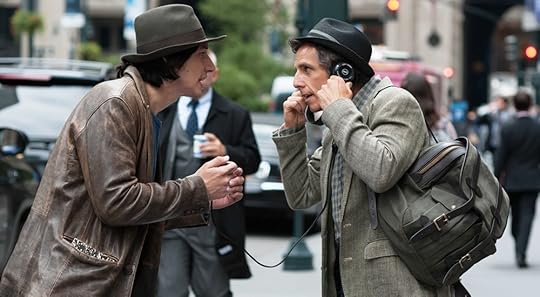
As an old guy who enjoys hanging out with younger people, I was intrigued with the idea of Noah Baumbach's latest film. I like Ben Stiller more often than I don't and I'm becoming a huge Adam Driver fan thanks to his performances in This Is Where I Leave You and What If. Naomi Watts will always be cool to me thanks to King Kong and Amanda Seyfried is endlessly interesting to watch. And then there's Charles Grodin, whom I can never get enough of.
So with all that going for it, I was surprised to not enjoy While We're Young more. It's got some cool ideas and funny moments and it raises good questions about age and art and truth and ambition and success. That's all great. But it hangs all of these things on the relationship between Stiller and Driver's characters. I had a hard time buying them as people who would want to spend a lot of time together. Or maybe I just didn't understand why anyone would want to spend a lot of time with Stiller's character. He has so many quirks and hang-ups that not only is he insufferable, he's also dealing with such specific issues that I wasn't able to relate to his point of view. And that's a problem when his point of view is the filter through which the movie's big questions are looked at and explored.
[image error]
As I said last week, we watched a lot of Westerns getting ready for our trip to Arizona, but they all had something to do with the state. They were either filmed there or set there. As we were watching them though, I kept thinking of a couple of others that I really wanted to share with David, so we watched those when we got back.
The first is The Big Country, which is probably my favorite Western. People talk a lot about how Unforgiven deconstructed and commented on the Western genre (and it did), but The Big Country did it 34 years before. Gregory Peck plays a greenhorn from the East who's moved out to an unidentified part of the West (I always assume it's Texas, but most of the movie was shot in California) to marry his girl. I say "greenhorn," because that's how he dresses and that's what everyone takes him for. We learn quickly that he's a sea captain, so that's cool, but then we also learn that his father owns the shipping company he works for, so we don't know right away if he's any good at his job or if Daddy just gave him the job. I mean, it's Gregory Peck, so we can make a really great guess about which of those is true, but the movie lets us learn about James McKay along with the other characters.
There's a plot about a feud between McKay's future father-in-law and another rancher (played by Burl Ives in a way that's more wicked than I'm entirely comfortable with from the guy who sings "Pearly Shells"), but the thrust of the movie is about how everyone in the West judges McKay and finds him wanting, mostly because he refuses to prove himself to them. He has plenty to prove to himself though and that's the stuff that hooks me right through the cheek. He's an amazing, inspirational character and reveals the macho posturing of the cowboys (Charlton Heston in particular as the foreman of the father-in-law's ranch) for the childishness that it really is. The movie's got a great cast (Jean Simmons is also in it as the best friend of McKay's fiancé and Chuck Connors plays Ives' son), powerful themes, and a humorous touch that makes it super engaging.
Young Guns (1988)
[image error]
The other Western I was excited to share was Young Guns. I'm the same age as most of the guys in this cast, so Young Guns made a big impact on me when it came out. It's got some of my favorite actors, great action, and a lot of humor, which are what I thought I was responding to back in the day. Looking back on it though, I realize that subconsciously I was also very into the concept of young men who didn't feel like they had any power, but learned that they could make a difference in their world. Sadly, it wasn't as big a hit with David and Diane, but I enjoyed the heck out of watching it again.
While We're Young (2015)

As an old guy who enjoys hanging out with younger people, I was intrigued with the idea of Noah Baumbach's latest film. I like Ben Stiller more often than I don't and I'm becoming a huge Adam Driver fan thanks to his performances in This Is Where I Leave You and What If. Naomi Watts will always be cool to me thanks to King Kong and Amanda Seyfried is endlessly interesting to watch. And then there's Charles Grodin, whom I can never get enough of.
So with all that going for it, I was surprised to not enjoy While We're Young more. It's got some cool ideas and funny moments and it raises good questions about age and art and truth and ambition and success. That's all great. But it hangs all of these things on the relationship between Stiller and Driver's characters. I had a hard time buying them as people who would want to spend a lot of time together. Or maybe I just didn't understand why anyone would want to spend a lot of time with Stiller's character. He has so many quirks and hang-ups that not only is he insufferable, he's also dealing with such specific issues that I wasn't able to relate to his point of view. And that's a problem when his point of view is the filter through which the movie's big questions are looked at and explored.
April 17, 2015
Thunderball (1965) | Music
After the worldwide success of Goldfinger, the budget for Thunderball got much much bigger. One of the improvements with the new money was to film the whole thing in Panavision anamorphic widescreen, which meant reshooting the opening gun barrel sequence. In the first three films, the Bond that walks into the gun barrel, turns, and shoots is stuntman Bob Simmons. And he's in black and white. With Thunderball, they replaced Simmons with Sean Connery on color film.
According to title designer Maurice Binder, who had resolved his dispute with Saltzman and Broccoli and was back after sitting out the last two films, he'd seen the pre-title sequence and knew that it ended with the Aston Martin's shooting water at the screen. He decided to merge that into the title sequence and went the opposite direction from the two Robert Brownjohn sequences. Instead of projecting light onto women's bodies against a dark background, Binder filmed swimmers and projected their silhouettes against colorized images of bubbles in the water. The effect was a huge success and became the template for almost every Bond title sequence that followed. It's a good sequence, hinting at the underwater motif that's so important to the film, and I love the way the titles come in looking like light reflecting on water.
Meanwhile, John Barry brought back "Goldfinger" co-writer Leslie Bricusse to help write the new title song and they came up with "Mr. Kiss Kiss Bang Bang" after a nickname for Bond created by the Italian press. Shirley Bassey was also brought back to record it, but Saltzman and Brocolli weren't totally happy with her version.
Part of why they didn't like it was the arrangement, so the second version featured a longer intro that works in the Bond theme and allows the lyrics to start after we've seen the name of the film. But they could have rerecorded that and still used Bassey, so there was apparently something about her performance that they also didn't care for. In the second version, they used Dionne Warwick.
It was United Artists that put the halt on even that version though. They thought the theme song ought to actually mention the name of the movie (and generally speaking, they weren't wrong), so they sent Barry back to start over. This time he teamed up with Don Black, who was the manager and occasional song-writer of From Russia With Love singer Matt Monro. Barry and Black quickly banged out the "Thunderball" theme, brought in Tom Jones to sing it, and the rest is history (though elements of "Mr Kiss Kiss Bang Bang" are still in the soundtrack, particularly in the song the band's playing at the Kiss Kiss Club when Fiona's shot.
Incidentally, Johnny Cash also submitted a song using the film's name. It's a pretty good Johnny Cash song, but - and I say this as a huge fan of Cash - it's not a passable Bond theme. Maybe Barry could have done something with it, but I still think he made the right choice.
I love Tom Jones and I love the music of the final song, but I don't love the lyrics. Maybe it's because I've never been able to decide whom they refer to. Is the song about Bond, like "Mr. Kiss Kiss Bang Bang"? Or is it about the villain - Largo, in this case - like the theme to Goldfinger? The words are ambiguous enough that they could refer to either, which sort of makes them refer to neither. They're generic.
As with Goldfinger, Barry doesn't use the James Bond Theme a lot in Thunderball. It shows up during the pre-credits fight (helpful for getting audiences in the mood) and again to close things out at the very end, but for the most part Barry uses elements of the two theme songs and also the 007 Theme he created for From Russia With Love. I guess another way of looking at it is that Barry's using the Bond Theme more and more sparingly as the series goes on.
Top Ten Theme Songs
1. From Russia With Love (John Barry instrumental version)
2. Dr No
3. Thunderball
4. Goldfinger
5. From Russia With Love (Matt Monro vocal version)
6. TBD
7. TBD
8. TBD
9. TBD
10. TBD
Top Ten Title Sequences
1. Dr No
2. Thunderball
3. Goldfinger
4. From Russia With Love
5. TBD
6. TBD
7. TBD
8. TBD
9. TBD
10. TBD

April 16, 2015
Thunderball (1965) | Villains

Blofeld is back in Thunderball, again played by Anthony Dawson's (Professor Dent from Dr. No) hands and Eric Pohlmann's voice. He's more effective here though than he was in From Russia With Love where he was closer to the planning of the caper. In Thuderball, he's able to remain in the shadows and leave the success or failure of the plot to the movie's real villain, Maximillian Largo.

Italian actor Adolfo Celi plays Largo, but like so many early Bond villains, his voice was dubbed. The voice actor was Robert Rietty, who would go on to voice Blofeld in For Your Eyes Only and also have a bit part in the Thunderball remake, Never Say Never Again. Celi is a memorable villain, thanks in large part to his eyepatch, but he also has some of that calm aloofness that I admired so much in Auric Goldfinger. He's more suave than Goldfinger though, so his emotional detachment feels like an affectation. A very polished affectation, but disingenuous nonetheless.
Some of that also has to do with his big weakness and the reason he fails in his mission. He's too attached to Domino. That was also true in the novel, so it's not like the movie is dumbing Largo down. He's actually a very smart bad guy, but he does occasionally let his passions get the better of him and needs to be reined in. Someone should have told him that keeping Domino around after having her brother murdered was a bad idea. She's the hole in his armor and the whole plan would have succeeded if not for her.

I hate calling Fiona Volpe a henchman, because she's actually smarter than Largo. When Largo wants to have Bond killed, it's Fiona who advises him against it, knowing that Bond's death will let MI6 know for sure that Bond was on the right track. But she takes her orders from Largo and fits the henchman definition in every way, so that's how I'm going to classify her.
She really makes no mistakes though, except for maybe wearing her SPECTRE ring in public, but that doesn't lead to any serious defeat. Bond knows she's a bad guy, but she still captures him and it's only through his own awesome resourcefulness that he gets away and she ends up dead. She makes Bond look better because she's also so good at her job.

There are a couple of other henchmen that need mentioning even though they don't do much and I don't like them. Count Lippe is a fool and turns Bond onto the whole caper by needlessly trying to murder Bond at Shrublands. Yeah, Bond saw his tong tattoo, but that needn't have led Bond to SPECTRE.

Vargas has the ingredients for an interesting villain with his cold ruthlessness and lack of vice, but the movie doesn't do anything with him except let him be killed really easily (though wonderfully and memorably). He's a wasted character and barely qualifies as a henchman. More of a glorified thug.
Top Ten Villains
1. Auric Goldfinger (Goldfinger)
2. Ernst Stavro Blofeld (From Russia With Love and Thunderball)
3. Doctor No (Dr. No)
4. Maximiillan Largo (Thunderball)
5. Rosa Klebb (From Russia With Love)
6. Kronsteen (From Russia With Love)
7. TBD
8. TBD
9. TBD
10. TBD
Top Ten Henchmen
1. Fiona Volpe (Thunderball)
2. Grant (From Russia With Love)
3. Oddjob (Goldfinger)
4. Miss Taro (Dr. No)
5. Professor Dent (Dr. No)
6. Morzeny (From Russia With Love)
7. Vargas (Thunderball)
8. Count Lippe (Thunderball)
9. TBD
10. TBD

April 15, 2015
Thunderball (1965) | Women

For the most part, the women of Thunderball are served much better than those from Goldfinger. There's not much to the first one we meet though. In fact, the movie never reveals her name. According to IMDB, it's Madame LaPorte, a French spy played by French-Japanese actress Mitsouko. We get no sense of who she is or what she's like; she's just there for Bond to explain things to so the audience isn't lost.

Pat Fearing, Bond's physical therapist at Shrublands, gets more to do, though he doesn't treat her very well. When he's injured by a piece of equipment on her watch (though not due to any fault of hers), he blackmails her into having sex with him. It's a creepy move on his part, but besides giving into that she seems more or less like the kind of woman who can take care of herself. She's strong-willed, but only up to a point, which I imagine Bond finds very attractive.

I'm going to talk more about Fiona Volpe tomorrow when we cover villains, but she deserves a couple of thoughts here too. Like Pat, Fiona is also strong-willed, but she takes it much further and that's what I like about her. She's probably the smartest bad guy in the movie and is Bond's biggest rival in most ways.

The literary Domino is one of my favorite women in the novels and the movie version does a nice job of capturing her. Mostly. Claudine Auger has a hard time balancing the confidence and vulnerability of the book's version, so she seems awesomely unaffected by Bond one minute and then the next she's moaning about the way he holds her.
One of the things I'm tracking in these movies is when the female lead turns totally stupid, because it happens a lot in the series. But I'm learning that that's a later development. It doesn't happen with Honey, Tatiana, or even Pussy, and it doesn't happen with Domino either. Once she knows who the good guys and bad guys are, Domino is very brave and agrees to help Bond even though she's in way over her head. A stronger actress would have made her a better character, but I very much like the way she's written.

My favorite woman in Thunderball though is Paula Caplan. She's Bond's assistant in Nassau and I'll get to why I like her in a second. But first, it's worth noting that she's played by Jamaican actress Martine Beswick, who also appeared in two other Bond films. She was one of the Romani women in the death match during From Russia With Love, but she was also one of the silhouette dancers in the opening credits of Dr. No. Terrance Young, who directed all three movies, apparently liked her a lot. She'd go on to appear in various Hammer films like One Million Years BC, Prehistoric Women, and Dr. Jekyll and Sister Hyde.
What makes the character so cool though is that she's a beautiful woman, but there's absolutely no hint of sexual anything between her and Bond. No flirting, no nothing. It's all completely professional and knowing Bond, I'm giving her the credit for that. And as much as I hate to see her go, I also love the way she dies. Not by being roughed up by Largo's men (though she is), but by her own choice via cyanide capsule. It's a tragic death, but it's an heroic one too. Absolutely love her.
My Favorite Bond Women
1. Paula Caplan (Thunderball)
2. Tatiana Romanova (From Russia With Love)
3. Fiona Volpe (Thunderball)
4. Domino Derval (Thunderball)
5. Honey Rider (Dr. No)
6. Sylvia Trench (Dr. No and From Russia With Love)
7. Pussy Galore (Goldfinger)
8. Tilly Masterson (Goldfinger)
9. Jill Masterson (Goldfinger)
10. The Photographer (Dr. No)

Adam Link: The Autobiography of a Mechanical Man [Guest Post]
 By GW Thomas
Sympathetic robot characters were not the norm in the 1930s. Robots were either the tools of mad scientists or out-of-control monsters. Isaac Asimov's fame as an SF writer rests partly on his tales of likeable robots. He created the famous "Three Laws of Robotics," logically deduced rules that robots would have to follow to be used safely in society. Asimov wrote entire novels around possible issues with the Three Laws and how robots would be accepted or not by humans.
But this was in the 1940s. Asimov's first story, "Robbie," was written in 1939 and did not see print until September 1940. Authors who predated Asimov include Neil R Jones with his stories of the Zoromes and John Wyndham (under his real name of John Beynon Harris) with "The Lost Machine," but most influential was Eando Binder (Earl and Otto Binder, a brother team). They created Adam Link, a robot who is judged by humanity, but not found wanting. The stories of Adam Link appeared in Amazing Stories between January 1939 and April 1942. The first of ten stories was entitled "I, Robot," because the narrator of the piece is the robot itself. This was revolutionary. Nobody had ever told the story from the robot's point-of-view before. When the stories were collected in book form the title I, Robot (1965) was selected. This was also the name of Asimov's first robot collection (1950), with the Binders' permission.
 The original Binder stories are more like episodes in a novel. (In fact, when it came time to collect them, the story titles were dropped and only chapter titles were given.) The first story, "I, Robot" ends with Adam Link in prison, waiting for his destruction. The second part, "The Trial of Adam Link," has Adam being represented in court by Dr. Link's nephew, Thomas. This story ends with the case lost and Adam's facing death again. The next story has reporter Jack Hall finding the people Adam saved from a fire (and a small child from a speeding car), who speak out and free him. It is these two stories that will form the television adaptations of the future. "Adam Link in Business" has the robot searching for some form of meaning and employment. Jack Hall is interested in Kay Temple, but she falls for the metal man. Adam is forced to leave so that Kay can fall in love with a human. The story leaves off as Link goes on a new journey. What will happen to him next? These cliffhanger endings worked well to force editors and readers to ask for the next portion of the tale. In consecutive episodes, Adam fell under the control of an evil scientist, created a metal mate named Eve, then became a detective to save her from the Black Fist Gang's frame-up, and he became an athletic champion to win over public opinion and the right to have American citizenship. He even fought for humanity against alien invaders. Not bad for a robot.
Asimov casts a big shadow, but SF fans still have a fondness for Binder's Adam Link. The stories were adapted into comics and television. First in 1955-56 with EC's Weird Science-Fantasy #27-29 (March/April 1955 through May/June 1956). Adapted by Al Feldstein and drawn by Joe Orlando, the last three issues of this title adapted "I, Robot," "The Trial of Adam Link," and "Adam Link in Business." Feldstein's adaptation simplified the stories a little, but otherwise were faithful. Joe Orlando's art was low-key by EC standards, drawing Adam with a pointed conical head.
 "I, Robot," the original story, received two television adaptations, first by the original Outer Limits (November 7, 1964) and again in the new version of Outer Limits (July 23, 1995). The best thing about these two, very similar versions is that Leonard Nimoy was featured in both. In 1964 he played the journalist Jack Hall (renamed Judson Ellis) who acts as a kind of foil to the lawyer, Thurman Cutler (played by Howard Da Silva) who represents Adam Link and loses. In the 1964 episode, the lawyer is not the relative. That is the beautiful Marianna Hall as the professor's niece, Nina Link. In 1995, Nimoy got to play Cutler himself (and wins the case) with his son Adam Nimoy directing the episode. Cynthia Preston is the prof's daughter, Mina Link, now playing foil in place of the reporter.
The first television version may have sparked an interest in another comic version. More likely it was an adaptation of "Adam Link's Vengeance" in a fanzine, Fantasy Illustrated #2, adapted by Otto Binder and drawn by D Bruce Berry and Bill Spicer. This piece won the Alley Award for Best Fan Comic Strip of the Year. Binder was interested in adapting more of the Adam Link stories, but who would publish them? The unusual choice was James Warren's Creepy. Known for down-beat horror, the magazine in its early days was edited by Archie Goodwin and attracted the likes of Frank Frazetta, Gray Morrow, Reed Crandall and Steve Ditko. The new adaptation by Otto Binder would be drawn by Joe Orlando, the original artist of 1955!
 As you'd expect, Binder's adaptation is accurate and he gets to tell five more episodes about Adam Link. Orlando's second time around as artist is interesting because rather than replicate what he did ten years earlier, he uses the black and white medium well with gray shades and a more realistic look. He drew Adam differently too, abandoning the conical head for a more human one. In the end, the Creepy adaptations were well done, but ended too soon when the Warren company fell on hard times. In the end they published "I, Robot" (Creepy #2, April 1965), "Trial of Adam Link" (Creepy #4, August 1965) "Adam Link in Business" (Creepy #6, December 1965) "Adam Link's Mate" (Creepy #8, April 1966) "Adam Link's Vengeance" (Creepy #9, June 1966) "Robot Detective" (Creepy #12, December 1966) "Adam Link, Gangbuster" (Creepy #13, February 1967), and "Adam Link, Champion Athlete" (Creepy #15 August 1967).
Except for the 1995 Outer Limits episode, Adam Link's career ended here. And it's not surprising. He had a lot more competition by 1967. Robots were appearing in all kinds of media from books like Philip K Dick's Do Androids Dream of Electric Sheep? to television with Lost in Space and Astro to films like Forbidden Planet to comics like The Metal Men. Likeable robots are here to stay and Earl and Otto Binder did their share to make them a permanent part of the science fiction fabric.
GW Thomas has appeared in over 400 different books, magazines and ezines including The Writer, Writer's Digest, Black October Magazine and Contact. His website is gwthomas.org. He is editor of Dark Worlds magazine.




![[image error]](http://michaelmay.us/15blog/04/0419-bigcountry.jpg)
![[image error]](http://michaelmay.us/15blog/04/0419-youngguns.jpg)