Michael May's Blog, page 141
May 27, 2015
Fantasy, Oh, Fantasy, Where Art Thou Gone? [Guest Post]
 By GW Thomas
The 1960s saw an explosion in heroic fantasy fiction with Ballantine's The Lord of the Rings and the Lancer Conan paperbacks. Suddenly barbarians and hobbit-like creatures were everywhere. In novels, collections, anthologies and comic books. It was a wonderful decade for fantasy readers. But by 1979, things were changing and soon a desert would be born.
What caused sword-and-sorcery to disappear after the 1980s? I believe it was a combination of things. First, publishers like Belmont were pumping out quick knock-offs to try and grab some of the riches. Books like Quinn Reade's The Quest of the Dark Lady (1969) did nothing to improve what was already seen as a limited sub-genre. Magazines like Heavy Metal (starting in April 1977) did even less, muddying the waters with a weird blend of sword-and-planet and sex. The bestseller, The Sword of Shannara (1977) by Terry Brooks also showed that even really bad Tolkien imitations could make fortunes. Why write short stories of lone barbarians when fat novels about elves and dwarves could sell millions of copies?
Secondly, the role-playing game, Dungeons & Dragons (1974) had narrowed the idea of fantasy, pairing Conan and Middle Earth to create a homogenized version of what should have been a genre without limits. Elves and barbarians fight side by side in Gary Gygax's game world. The younger fantasy fans were ultimately gamers and many became writers as well. These include Raymond E Feist, RA Salvatore, Garth Nix, David Langford, Michael Stackpole, and many others.
 Thirdly and irreparably, was the movie Conan the Barbarian (1982). What should have been a high-water mark that propelled sword-and-sorcery into the mainstream consciousness, the film was the best of a steadily sinking list of films that are so awful they soon became direct to video. Not until Peter Jackson's The Fellowship of the Ring in 2001 would another major fantasy film wave be created.
So things were pretty bad. What's a writer of heroic fantasy to do? Well, one of the few arenas left for sword-and-sorcery fiction was the gaming magazines. Yes, D&D may have caused some of the problems, but gamers still enjoyed heroic fantasy and published it alongside articles on fighting goblins and dungeon scenarios to play with your friends.
The biggest was TSR's The Dragon Magazine, which began in June 1976 and is still running in some form today. The issues of most importance are the paper ones: #1-359 (June 1976-September 2007). These were the ones that featured fiction. The list of authors who appeared is long but looking at the names I see trends:
 The first is old-timers making an appearance. These included Rob Chilson, L Sprague de Camp, Harry O Fischer, Fritz Leiber, and Gordon Linzner. These stories were welcome, but not many. There were also novelists including excerpts to promote a new book: Terry Brooks (Shannara excerpt) and Andre Norton (Quag Keep excerpt). The most interesting of the old timers was Gardner F Fox, comic book veteran and now sword-and-sorcery writer with a long series about "Niall of the Long Journeys" starting in issue #2 and interspersed to #55 (July 1976-November 1981). Ben Bova, science fiction editor extraordinaire, also wrote a series on legendary heroes set in historical Britain between issues #236-311 (December 1996-September 2003).
The second group are names that have since become well-known in other publications like Asimov's, Fantasy and Science Fiction, and paperbacks. These stars of present day publishing include Thieves' World editor Lynn Abbey, Aaron Allston, Neal Barrett Jr, John Gregory Betancourt (future editor at Weird Tales and Wildside Press), Elaine Cunningham, Diane Duane, Esther M Friesner, Nina Kiriki Hoffman, Brian A Hopkins, J Gregory Keyes, Jean Lorrah, George RR Martin (Game of Thrones superstar), Ardath Mayhar, Paul J McAuley, John Morressy, Joel Rosenberg, Kristine Kathryn Rusch (future editor of F&SF), Jessica Amanda Salmonson, Charles R Saunders, Steven Saylor (international bestseller with the Roma Sub Rosa mystery series), Darrell Schweitzer (future editor of Weird Tales), Lisa Smedman, Jeff Swycaffer, Steve Rasnic Tem, Harry Turtledove (sf and fantasy bestseller), Robert E Vardeman, and Lawrence Watts-Evan.
The third group are names we know from later days when the AD&D universe would sprawl out into paperbacks about the Dragonlance saga with its dragons and drow elves. These include Adam-Troy Castro, Troy Denning, Ed Greenwood, Tracy Hickman, Paul Kidd, Roger E Moore, Douglas Niles, Mel Odom, Jean Rabe, RA Salvatore, and Margaret Weis. Many of these books were bestsellers in their own right.
 The second major gaming magazine was UK's White Dwarf, which ran from June/July 1977 to this day, but did not use a lot of fiction. The little it did feature was the humorous fantasy of David Langford (along with non-fiction by future fantasy star Garth Nix and the cartoon Conan parody "Thrud the Barbarian" by Carl Critchlow).
Probably the best magazine in terms of quality was Sorcerer's Apprentice, which ran for 17 issues from the Winter 1978 to a final issue in 1983. SA published the very best of fantasy authors with Robert E Vardeman, Charles de Lint, Tanith Lee, Janet Fox, Manly Wade Wellman, CJ Cherryh, and Fred Saberhagen. Roger Zelazny reprinted several of his Dilvish the Damned stories and even wrote a new one, "Garden of Blood" for issue #3. Karl Edward Wagner did likewise with his eternal swordsman Kane. Michael Stackpole, a future fantasy bestseller, wrote many of the non-fiction articles and acted as editor.
The last of the bunch was Ares, a magazine that focused on games besides AD&D. It ran from March 1980-1984 for 16 issues plus two specials. It featured fantasy fiction by M Lucie Chin, Jayge Carr, Ian McDowell, and Poul Anderson. The best sword-and-sorcery stories were "Inn At World's End" and "The Whispering Mirror" by Richard Lyon and Andrew Offutt, part of their Demon in the Mirror series that Timescape published.
 November 1982 saw the gaming world enter the world of sf publishing when TSR, owners of AD&D bought Amazing Stories, Hugo Gernsback's original SF magazine. They would hold the copyright until 1996. Its new editor was George Scithers, who as a fanzine editor of Amra had been godparent to the term "sword-and-sorcery," born out of discussions between Fritz Leiber and Michael Moorcock. He won two Hugos for his editing at Asimov's before moving onto Amazing. The George Scither years at Amazing (1982-1986) held a nice balance between sf and fantasy with stories from Gene Wolfe's Book of the New Sun, Nancy Springer, Tanith Lee, Pat Murphy, David Langford, Lisa Tuttle, Diana L Paxson, Rosemary Edghill, Jayge Carr, Darrell Schweitzer, John Gregory Betancourt, Harry Turtledove (as Eric G Iverson), and Esther M Friesner. Many of these authors had appeared in The Dragon previously. Scither would leave in 1986 to re-emerge as the editor of another important magazine revival, Weird Tales in 1988, one of the last places to sell sword-and-sorcery in the 1990s.
The '80s saw a few bright flashes but over-all a dwindling in sword-and-sorcery. In paperback, the Thieves' World shared world spawned several books and there were also the Red Sonja novels by Smith and Tierney, Jessica Amanda Salmonson's Tomeo Gozon series, reprints of Elric, and new anthologies such as Sword and Sorceress by Marion Zimmer Bradley. The magazine markets for short sword-and-sorcery were pretty much depleted by 1980, with the folding of Ted White's reign at Fantastic and the last of Lin Carter's Year's Best anthologies. Fantasy was moving away from adventure and derring-do towards a softer, more literary kind. It also re-branded its name, no longer using sword-and-sorcery as a tag. The gamers went one way and the litterateurs another. The 1990s were coming and that desert I mentioned stretched out ahead, with only Conan pastiches and Xena: Warrior Princess left to remind us there had been a sword-and-sorcery boom twenty years before.
GW Thomas has appeared in over 400 different books, magazines and ezines including The Writer, Writer's Digest, Black October Magazine and Contact. His website is gwthomas.org. He is editor of Dark Worlds magazine.


May 25, 2015
7 Days in May | You Wouldn't Like Me When I'm Mad Max
Hulk (2003)
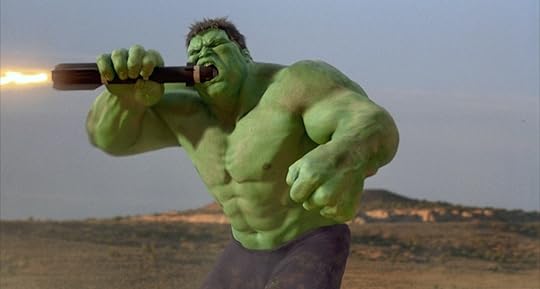
Continuing the Marvel re-watch, I went back to the unofficial first movie in the series. It's unofficial because most people - including Marvel - want to forget it, but I like parts of it too much to dispose of it and it fits with the rest of the series for a couple of reasons. To start, it begins with the military's trying to develop a new version of the super-soldier program. After what happens to the last of Steve Rogers' blood in Agent Carter, the military would have had to go back to the drawing board and David Banner's experiments in Hulk are a logical development of that. So, it fits thematically with First Avenger and Agent Carter.
But I've also always liked that Hulk ends with Bruce Banner in South America and that The Incredible Hulk opens with him there. You can't make the two movies flow seamlessly into each other, but if you squint hard enough you can pretend that Incredible is a sequel and not a total reboot. And like I said, there's enough about Hulk that I love that I want it to still exist in the Marvel Movie Universe. Mostly that's the Hulk's escape from the desert base and the tank and helicopter fights that follow, but I also very much love Eric Bana and Jennifer Connelly's performances as Bruce and Betty. And Sam Elliott was born to play General Ross. Yes, the movie is slow as molasses in winter and the resolution to the David Banner plot is so ridiculous it hurts, but I can suffer through that to get to the good stuff.
Iron Man (2008)
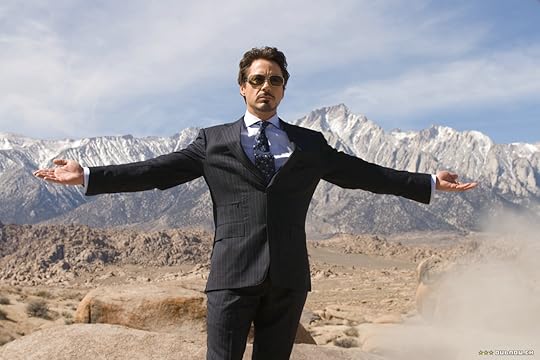
Watching Iron Man right after First Avenger and Agent Carter, I was struck by how easily it also flows from those same themes. Tony Stark and Obadiah Stane are both obsessed with the legacy of Howard Stark. Howard's involvement in Operation Rebirth was one of many projects he participated in or created to improve the US military. And as the military continued its own attempts to perfect a super soldier (resulting in the Hulk), Stark and his partner - and eventually his son - pursued those same goals from other angles.
The problem is that Stane doesn't have the conscience that Howard displays in Agent Carter. And neither does Tony at first of course. That's the beauty of the movie: watching Tony develop that and become a better person. It still totally works after I don't know how many viewings and I still get choked up at the double meaning when Tony thanks Yinsen for saving him.
The Incredible Hulk (2008)
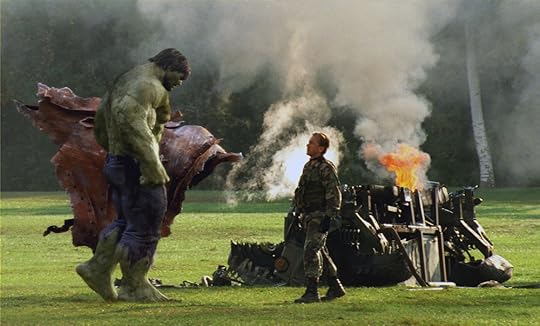
The Incredible Hulk continues these same themes only more overtly than the 2003 movie. Instead of David Banner's working to make soldiers immune to chemical warfare, General Ross is heading up a program that's explicitly trying to replicate the success of Operation Rebirth. I really like how well the Hulk and Iron Man movies pick up and build on different aspects of what was happening in WWII, even though they were made before First Avenger and Agent Carter.
Incredible is a more exciting movie than Hulk and I love how it works in characters, visual references, and musical queues from the '70s TV show. Tim Roth is a cool villain and I buy his motives for going deeper and deeper into the process that eventually turns him into the Abomination. One of my problems with the movie though is the Abomination's look. The comics version is one of my favorite character designs, so it was disappointing to lose the head fins that I've always associated with him.
More than that though, I have a problem with General Ross. Forgetting for a second that Sam Elliot was dream casting for me, Ross is just written really weird in Incredible. In the comics - and in the 2003 movie - Ross is a character I love to hate. I want him to leave Hulk alone, but I understand why he doesn't. He's scared and he's trying to protect the world from what he thinks is a dangerous monster. But in this movie, it's Ross who's clearly the monster. He doesn't want to destroy the Hulk, he wants to weaponize him. That makes Ross an unrelatable, stock villain.
I want to talk about that last scene, too. It seems weird at first that Tony Stark shows up to tell Ross about the Avenger Initiative. What does Ross have to offer SHIELD? He's lost the Hulk and the Abomination was a horrible failure. But the more I think about it, the more it makes sense. We see in The Avengers that Nick Fury isn't afraid to do some questionable things and work with some shady people to accomplish his goals. Maybe with Bruce Banner off the grid, Fury sees Ross as his next best option for getting a Hulk-like creature on the team. Obviously that never paid off and it's kind of embarrassing that The Incredible Hulk doesn't fit more naturally into the rest of the Marvel Movies story, but it works for me that not every avenue Fury explored on his way to The Avengers paid off.
One thing that does pay off from the end of Incredible though is Bruce's learning to control his transformations. That flows into one of my favorite moments from The Avengers.
Iron Man 2 (2010)
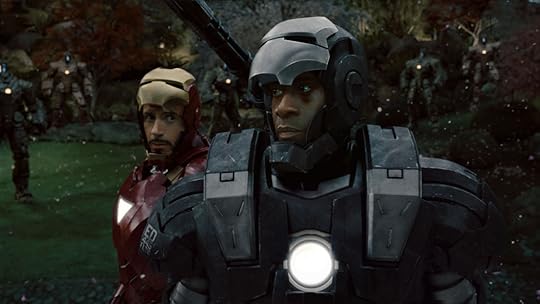
This gets a lot of crap for supposedly forfeiting story in favor of setting up The Avengers. I don't see it. I do think there's too much going on in Iron Man 2, but setting up The Avengers is just part of it and it's one of the more interesting parts. It gives us Black Widow, for crying out loud.
Far less interesting is the plot about Tony Stark's dying. It's a fake emergency; a stake that comes out of nowhere and is easily resolved without any real consequence. All it does is introduce some false and unnecessary tension into everyone's lives. There's plenty of drama already in the idea that the government wants to control the Iron Man armor and that Stark's best friend is under orders to take it from him. That plot also continues the themes of the whole series so far: the conflict between individuals who want to make the world a better place and the organizations that want to do that on a larger scale. With Captain America: Civil War on the horizon, I suspect that we're not done exploring that either.
From a continuity standpoint, Iron Man 2 creates some wrinkles by revealing that Stark actually turned down Nick Fury about the Avenger Initiative. He sort of changes his mind in Iron Man 2, but then Fury decides he doesn't want Stark for more than a consultant. That calls into question the final scene of The Incredible Hulk, but I think I remember an interview or something where someone suggested that Stark's conversation with General Ross happened after Iron Man 2, so Stark's acting in his consulting capacity? I don't know if that marries well with The Avengers, but I'll keep an eye on it.
One thing that Stark and Fury's conversations in Iron Man 2 do really well though is set up Iron Man 3. Fury says that he wants Iron Man, but not Stark. Stark objects, "I am Iron Man," but the certainty of that statement is called into question, especially considering Rhodey's actions. Iron Man 3 explores that question in a cool, powerful way.
Captain America (1944)
I finished the Captain America serial. It's not very good. It's not horrible, but it's certainly not any version of Captain America I recognize. The plot stretches out in dumb ways, too. Most serials have long sections of padding, but some deal with it better than others. In Captain America, whenever the story slows down, a new inventor shows up who's somehow grafted onto the villain's motivations and made a target.
And neither the villain nor Captain America are very smart about hiding their identities. When the villain realizes that Captain America is actually the District Attorney who's also been hounding him the whole time, it's not based on any new information that the villain hasn't already had since Chapter 1. The story just realizes that it's time to wrap things up, so the villain finally figures it out.
It's not much better for the villain's identity. He's so at the center of everything that's been going on that it's ridiculous no one ever suspects or at least questions him. Nor does anyone until the end when the villain has gotten so sloppy that he's just appearing to people and counting on killing the witnesses later.
One cool thing about the serial though is the character of Gail Richards. She's the DA's secretary, but she's also in on his secret and works as Captain America's partner. She's no sidekick, but a valuable ally who drives during chases, flies planes, and figures things out before Captain America does. And it's her who - once she's captured at the end and sees who the villain really is - figures out how to get that information to Captain America to save someone's life and bring the whole case to a close.
I don't recommend Captain America to fans of the character, but if you like serials in general - and especially if you like Lionel Atwill - there's enough to make this one worth watching if not exactly a classic.
Mad Max: Fury Road (2015)
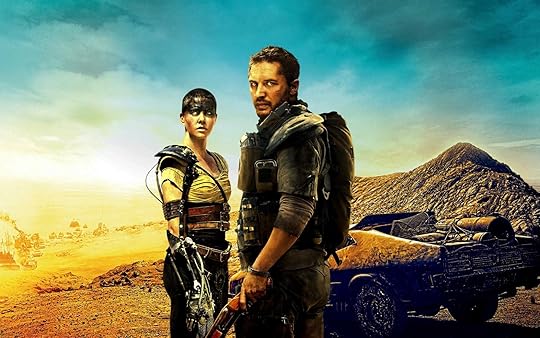
I don't have any special fondness for the first three Mad Max movies. I only ever remember the last five minutes of Mad Max, but I think I enjoyed Road Warrior well enough. All I recall of Beyond Thunderdome is Tina Turner's saying, "He's just a raggedy man!" Which means that I went into Fury Road pretty cold, but - thanks to the reviews - with high expectations for a great action movie. And boy does it deliver.
There was a moment not quite halfway into it where I realized I was watching what would have been the grand finale in most action flicks. That's really what Fury Road is: a two-hour third act. Not that it's light on story. It has plenty of character and emotion; it just gives them to you without a lot of exposition. It's the kind of story I love where the world just exists and no one feels like they have to explain all the details. I get Furiosa (Charlize Theron) and what she's up to. And I even understand what makes Max (Tom Hardy) tick, even though he doesn't say a lot and is actually a secondary character in Furiosa's movie. Theron and Hardy are both doing awesome work and convey more in looks and actions than they do in dialogue. One critic compared Fury Road to a silent movie and that's a valid observation. If only silent movies were all this badass.


Continuing the Marvel re-watch, I went back to the unofficial first movie in the series. It's unofficial because most people - including Marvel - want to forget it, but I like parts of it too much to dispose of it and it fits with the rest of the series for a couple of reasons. To start, it begins with the military's trying to develop a new version of the super-soldier program. After what happens to the last of Steve Rogers' blood in Agent Carter, the military would have had to go back to the drawing board and David Banner's experiments in Hulk are a logical development of that. So, it fits thematically with First Avenger and Agent Carter.
But I've also always liked that Hulk ends with Bruce Banner in South America and that The Incredible Hulk opens with him there. You can't make the two movies flow seamlessly into each other, but if you squint hard enough you can pretend that Incredible is a sequel and not a total reboot. And like I said, there's enough about Hulk that I love that I want it to still exist in the Marvel Movie Universe. Mostly that's the Hulk's escape from the desert base and the tank and helicopter fights that follow, but I also very much love Eric Bana and Jennifer Connelly's performances as Bruce and Betty. And Sam Elliott was born to play General Ross. Yes, the movie is slow as molasses in winter and the resolution to the David Banner plot is so ridiculous it hurts, but I can suffer through that to get to the good stuff.
Iron Man (2008)

Watching Iron Man right after First Avenger and Agent Carter, I was struck by how easily it also flows from those same themes. Tony Stark and Obadiah Stane are both obsessed with the legacy of Howard Stark. Howard's involvement in Operation Rebirth was one of many projects he participated in or created to improve the US military. And as the military continued its own attempts to perfect a super soldier (resulting in the Hulk), Stark and his partner - and eventually his son - pursued those same goals from other angles.
The problem is that Stane doesn't have the conscience that Howard displays in Agent Carter. And neither does Tony at first of course. That's the beauty of the movie: watching Tony develop that and become a better person. It still totally works after I don't know how many viewings and I still get choked up at the double meaning when Tony thanks Yinsen for saving him.
The Incredible Hulk (2008)

The Incredible Hulk continues these same themes only more overtly than the 2003 movie. Instead of David Banner's working to make soldiers immune to chemical warfare, General Ross is heading up a program that's explicitly trying to replicate the success of Operation Rebirth. I really like how well the Hulk and Iron Man movies pick up and build on different aspects of what was happening in WWII, even though they were made before First Avenger and Agent Carter.
Incredible is a more exciting movie than Hulk and I love how it works in characters, visual references, and musical queues from the '70s TV show. Tim Roth is a cool villain and I buy his motives for going deeper and deeper into the process that eventually turns him into the Abomination. One of my problems with the movie though is the Abomination's look. The comics version is one of my favorite character designs, so it was disappointing to lose the head fins that I've always associated with him.
More than that though, I have a problem with General Ross. Forgetting for a second that Sam Elliot was dream casting for me, Ross is just written really weird in Incredible. In the comics - and in the 2003 movie - Ross is a character I love to hate. I want him to leave Hulk alone, but I understand why he doesn't. He's scared and he's trying to protect the world from what he thinks is a dangerous monster. But in this movie, it's Ross who's clearly the monster. He doesn't want to destroy the Hulk, he wants to weaponize him. That makes Ross an unrelatable, stock villain.
I want to talk about that last scene, too. It seems weird at first that Tony Stark shows up to tell Ross about the Avenger Initiative. What does Ross have to offer SHIELD? He's lost the Hulk and the Abomination was a horrible failure. But the more I think about it, the more it makes sense. We see in The Avengers that Nick Fury isn't afraid to do some questionable things and work with some shady people to accomplish his goals. Maybe with Bruce Banner off the grid, Fury sees Ross as his next best option for getting a Hulk-like creature on the team. Obviously that never paid off and it's kind of embarrassing that The Incredible Hulk doesn't fit more naturally into the rest of the Marvel Movies story, but it works for me that not every avenue Fury explored on his way to The Avengers paid off.
One thing that does pay off from the end of Incredible though is Bruce's learning to control his transformations. That flows into one of my favorite moments from The Avengers.
Iron Man 2 (2010)

This gets a lot of crap for supposedly forfeiting story in favor of setting up The Avengers. I don't see it. I do think there's too much going on in Iron Man 2, but setting up The Avengers is just part of it and it's one of the more interesting parts. It gives us Black Widow, for crying out loud.
Far less interesting is the plot about Tony Stark's dying. It's a fake emergency; a stake that comes out of nowhere and is easily resolved without any real consequence. All it does is introduce some false and unnecessary tension into everyone's lives. There's plenty of drama already in the idea that the government wants to control the Iron Man armor and that Stark's best friend is under orders to take it from him. That plot also continues the themes of the whole series so far: the conflict between individuals who want to make the world a better place and the organizations that want to do that on a larger scale. With Captain America: Civil War on the horizon, I suspect that we're not done exploring that either.
From a continuity standpoint, Iron Man 2 creates some wrinkles by revealing that Stark actually turned down Nick Fury about the Avenger Initiative. He sort of changes his mind in Iron Man 2, but then Fury decides he doesn't want Stark for more than a consultant. That calls into question the final scene of The Incredible Hulk, but I think I remember an interview or something where someone suggested that Stark's conversation with General Ross happened after Iron Man 2, so Stark's acting in his consulting capacity? I don't know if that marries well with The Avengers, but I'll keep an eye on it.
One thing that Stark and Fury's conversations in Iron Man 2 do really well though is set up Iron Man 3. Fury says that he wants Iron Man, but not Stark. Stark objects, "I am Iron Man," but the certainty of that statement is called into question, especially considering Rhodey's actions. Iron Man 3 explores that question in a cool, powerful way.
Captain America (1944)
I finished the Captain America serial. It's not very good. It's not horrible, but it's certainly not any version of Captain America I recognize. The plot stretches out in dumb ways, too. Most serials have long sections of padding, but some deal with it better than others. In Captain America, whenever the story slows down, a new inventor shows up who's somehow grafted onto the villain's motivations and made a target.
And neither the villain nor Captain America are very smart about hiding their identities. When the villain realizes that Captain America is actually the District Attorney who's also been hounding him the whole time, it's not based on any new information that the villain hasn't already had since Chapter 1. The story just realizes that it's time to wrap things up, so the villain finally figures it out.
It's not much better for the villain's identity. He's so at the center of everything that's been going on that it's ridiculous no one ever suspects or at least questions him. Nor does anyone until the end when the villain has gotten so sloppy that he's just appearing to people and counting on killing the witnesses later.
One cool thing about the serial though is the character of Gail Richards. She's the DA's secretary, but she's also in on his secret and works as Captain America's partner. She's no sidekick, but a valuable ally who drives during chases, flies planes, and figures things out before Captain America does. And it's her who - once she's captured at the end and sees who the villain really is - figures out how to get that information to Captain America to save someone's life and bring the whole case to a close.
I don't recommend Captain America to fans of the character, but if you like serials in general - and especially if you like Lionel Atwill - there's enough to make this one worth watching if not exactly a classic.
Mad Max: Fury Road (2015)

I don't have any special fondness for the first three Mad Max movies. I only ever remember the last five minutes of Mad Max, but I think I enjoyed Road Warrior well enough. All I recall of Beyond Thunderdome is Tina Turner's saying, "He's just a raggedy man!" Which means that I went into Fury Road pretty cold, but - thanks to the reviews - with high expectations for a great action movie. And boy does it deliver.
There was a moment not quite halfway into it where I realized I was watching what would have been the grand finale in most action flicks. That's really what Fury Road is: a two-hour third act. Not that it's light on story. It has plenty of character and emotion; it just gives them to you without a lot of exposition. It's the kind of story I love where the world just exists and no one feels like they have to explain all the details. I get Furiosa (Charlize Theron) and what she's up to. And I even understand what makes Max (Tom Hardy) tick, even though he doesn't say a lot and is actually a secondary character in Furiosa's movie. Theron and Hardy are both doing awesome work and convey more in looks and actions than they do in dialogue. One critic compared Fury Road to a silent movie and that's a valid observation. If only silent movies were all this badass.
May 22, 2015
Diamonds Are Forever (1971) | Music
I kind of want to rag on the Diamonds Are Forever title sequence like I have most of the rest of the movie, but there are some cool things about it. Maurice Binder's not being innovative - he's found his formula by now and all he has to do is riff on it - but he's still Maurice Binder and he does some fun stuff.
The last shot of the cold open is of Blofeld's angry, apparently orphaned cat, so Binder transforms the animal's eye into a diamond. The rest of the sequence is close-ups of diamond jewelry being worn by women, with some obligatory silhouettes thrown in. In amongst the women and the jewelry though, he also puts the cat, either spoiling or reassuring that Blofeld is still going to be a big part of the show.
For the theme song, John Barry re-teamed with Don Black who'd partnered with him on the Thunderball rush job. They wrote a breakup song that incorporates the movie's title (I always love that formula), but even better is the music itself. He brought back Shirley Bassey to sing it and between her sultrily boisterous voice, some big stingers from the horn section, and a slinky guitar riff, the song is one of my favorites in the whole series.
Barry's back to using the Bond Theme sparingly in Diamonds, but he does it well, always at key moments. It first comes into play when we finally see Sean Connery's face in the cold open, getting us excited about the return of the familiar Bond. The next time it shows up is when Bond is crossing the Channel in the hovercraft, starting his mission. And finally, it appears again when he arrives at Willard Whyte's summer house, his first huge break in the case.
Barry also brings back the 007 Theme he introduced in From Russia With Love. That's what's playing over the movie's finale once Bond gets control of Blofeld's bathosub, the majestic music making it obvious that Bond's now going to be victorious.
Top Ten Theme Songs
1. On Her Majesty's Secret Service
2. Diamonds Are Forever
3. You Only Live Twice
4. From Russia With Love (John Barry instrumental version)
5. Dr No
6. Thunderball
7. Goldfinger
8. From Russia With Love (Matt Monro vocal version)
9. TBD
10. TBD
Top Ten Title Sequences
1. On Her Majesty's Secret Service
2. Dr No
3. Thunderball
4. Goldfinger
5. From Russia With Love
6. Diamonds Are Forever
7. You Only Live Twice
8. TBD
9. TBD
10. TBD

Diamonds Are Forever (1971) | Villains

So they brought back Blofeld one more time and it's once too many. I love the idea of bringing him back for Bond to get his revenge, but not like this. Not with this tone and not played by Charles Gray.
For years I thought I hated Charles Gray, because he kept getting miscast in Bond films. I recently, finally saw a movie that I loved him in though. He plays the leader of a Satanic cult and battles Christopher Lee in 1968's The Devil Rides Out. It's a perfect role for him, because he can be as prissy and cowardly as he wants and I'm supposed to despise him. But those traits make him a lousy Dikko Henderson in You Only Live Twice and a worse Blofeld. He's a stunning disappointment after Telly Savalas' tough guy in On Her Majesty's Secret Service.
When he escapes Bond by dressing as a woman, I don't even blink an eye. That's exactly the kind of thing this Blofeld would do. But just try to imagine Savalas or the Blofeld of Thunderball doing that. Heck, try to imagine Donald Pleasance doing that!
One thing he has in common with Pleasance's Blofeld though is that they're both dumber than their cats. There are a couple of times when Blofeld has the opportunity to destroy Bond in Diamonds and doesn't. Having Wint and Kidd just drop him unconscious in a pipe and leave it out in the open - hoping that it gets buried the next day by random workers - is ludicrous. And later, when Bond shows up at the oil rig, Blofeld again passes up having him shot.
Admittedly, it's too late on both of those occasions for Blofeld's plan to succeed. Thanks to Bond's competent - if not especially impressive - detective work, too many people have all the information they need to shut Blofeld down. But Blofeld at least has the chance to rid himself of Bond once and for all, then escape to plan another caper. He doesn't care though. That's a recurring motif in this movie.

Wint and Kidd are memorable henchmen, because they're so odd and disturbing. Especially jazz musician Putter Smith as Mr. Kidd. Apparently, the producers wanted both killers to be played by musicians and originally went for Paul Williams as Wint, but they couldn't reach an agreement about the money. So they hired Bruce Glover to play Wint instead. They originally told Glover he looked too normal for the role, but the actor makes up for it with the same, innate creepiness he passed on to his son, Crispin Glover.
Wint and Kidd are gay like they are in the novel, but it isn't their attraction to each other that makes them so disconcerting. And interestingly for 1971, no one even comments on it except for Bond's criticizing Wint's cologne. Like everything else about them though, Wint and Kidd's gayness is played really weird. They call each other by their surnames and could not look less natural holding hands. They're completely bizzare as a couple and I'm endlessly fascinated trying to imagine their home life when they're not on an assignment.
And speaking of assignments, just who are they working for when they try to kill Bond at the end of the movie? And why are they trying to use flaming skewers and a bomb? They seem like competent assassins earlier in the movie, but between putting Bond in that pipe and the pointless attack on the ocean liner, they turn out to be not that good.

You know who else are pointless and not that good? Bambi and Thumper are completely lame with their crazy dance moves and sort of taking turns attacking Bond. They don't even really take turns, because one of them will just slither around a little or do some cartwheels before throwing it back to the other. And then Bond defeats them because apparently the fight's gone on long enough and it's time for it to end.
Top Ten Villains
1. Auric Goldfinger (Goldfinger)
2. Ernst Stavro Blofeld (From Russia With Love and Thunderball)
3. Ernst Stavro Blofeld (On Her Majesty's Secret Service)
4. Doctor No (Dr. No)
5. Emilio Largo (Thunderball)
6. Rosa Klebb (From Russia With Love)
7. Kronsteen (From Russia With Love)
8. Ernst Stavro Blofeld (You Only Live Twice)
9. Ernst Stavro Blofeld (Diamonds Are Forever)
10. TBD
Top Ten Henchmen
1. Fiona Volpe (Thunderball)
2. Grant (From Russia With Love)
3. Oddjob (Goldfinger)
4. Irma Bunt (On Her Majesty's Secret Service)
5. Miss Taro (Dr. No)
6. Professor Dent (Dr. No)
7. Morzeny (From Russia With Love)
8. Hans (You Only Live Twice)
9. Helga Brandt (You Only Live Twice)
10. Vargas (Thunderball)

May 21, 2015
Diamonds Are Forever (1971) | Women

Jill St John is really charming as Tiffany Case, but she's a much different character than the one Fleming wrote. In the novel, Case is a tough, but damaged woman who relates to the also tough, also damaged Bond. In the movie, she's still tough and all-business on the surface, but that's a cover for incompetence, not pain. St John's Tiffany is all bravado that fails her when the pressure really gets going.
She's interesting for a while, agreeing to double-cross her bosses and abscond with the diamonds alongside Bond. St John plays it cool and there's no telling at first whose side she's really on. As it turns out, she's playing Bond and stays loyal to her hidden bosses until it becomes apparent that they're trying to kill her.
Once she's on Bond's side though, she doesn't make sense anymore. She has opportunities to take off and escape prison, but she inexplicably sticks around; I guess hoping that Bond will use some influence to drop the charges against her. That works out for her in the end, but it's a super risky play. The impression I get is that she's pretty tough when she has the hierarchy of the smuggling ring backing her up, but she has no idea what to do or how to survive on her own. So she trades in the smugglers for Bond and hopes for the best.
I mentioned in a previous post that Diamonds Are Forever sets the tone for the Roger Moore era and that's evident in Tiffany Case. She's the prototype of the smart/tough woman who suddenly turns dumb partway through the movie, though in her case she was always pretty dumb and just covered it well for a while.

The other major woman in Diamonds is Plenty O'Toole, played by Lana Wood. She's barely even a character and does nothing but bounce between high rollers in the casino. We know nothing more about her than that. Is she a prostitute? Just a gold-digger? Is there some kind of sad backstory that explains why she's ended up here? No idea. The movie doesn't care.
It also doesn't care to explain how she ends up dead in Tiffany's swimming pool, mistaken for Tiffany. Bond says that Plenty went to Tiffany's place to look for the smuggler, but why would Plenty do that? Does she know Tiffany? Who cares? Not this film.
Neither Plenty nor Tiffany crack my Top 10.
My Favorite Bond Women
1. Tracy Bond (On Her Majesty's Secret Service)
2. Paula Caplan (Thunderball)
3. Tatiana Romanova (From Russia With Love)
4. Fiona Volpe (Thunderball)
5. Domino Derval (Thunderball)
6. Honey Rider (Dr. No)
7. Sylvia Trench (Dr. No and From Russia With Love)
8. Aki (You Only Live Twice)
9. Pussy Galore (Goldfinger)
10. Tilly Masterson (Goldfinger)

Diamonds Are Forever (1971) | Bond
Actors and Allies
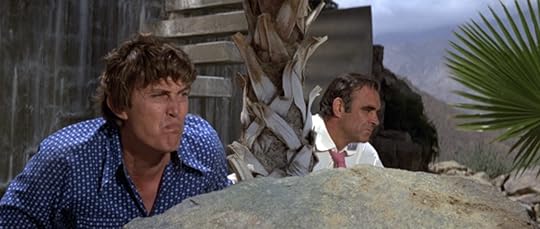
I used to assume that Connery's return in Diamonds meant that George Lazenby was a failed experiment. That Saltzman and Broccoli were displeased with Lazenby and fired him before coming to their senses and begging Connery to come back. Boy, was I wrong. Lazenby turned down a seven-picture contract and left the series of his own free will to become a hippie. (Incidentally, OHMSS director Peter Hunt was also invited back, but had to decline for scheduling reasons, so they brought back Goldfinger director Guy Hamilton instead.)
The producers next approached American actor John Gavin (though they also considered Adam West). Gavin's probably best known for playing Sam Loomis in Psycho. United Artists wasn't having it though. Not wanting to risk another new Bond, they insisted on having Connery back whatever the cost. They bought out Gavin's contract and paid Connery £1.25 million, the equivalent of about £23 million today.
Sadly, Connery was as enthused about playing Bond in Diamonds as he was in You Only Live Twice. But though he looks bored in both, it presents itself in different ways. In YOLT, because of the humorlessness of Roald Dahl's script, Bond comes across as serious and dull. In Diamonds, he takes nothing seriously. He's amused at everything, which removes any possibility of tension from the film.
The one time he becomes serious (not counting the cold open), is when he's talking to Tiffany after Plenty O'Toole is murdered. It's possible that he's upset about Plenty's death, but I get the impression that it's more about convincing Tiffany that she's in danger. He slaps her during that scene, which is where the power balance shifts between the two of them. She realizes then that he's not just some underling who wants to double-cross the smugglers and run away with her. It's a jolting scene and doesn't work for me because it's so out of character for the version of Bond that Connery's playing in the rest of the movie. Unfortunately, it's the only way she's going to take him seriously and get out of the way so that he can be in charge for the last half of the film. That Bond has to resort to smacking a woman to be taken seriously illustrates the big problem with Connery's performance.
Conney doesn't even look like Bond anymore. Maybe it's the gray in his hair, maybe it's his longer sideburns. Maybe it's just a really bad toupee. Whatever the reason, he's no longer a debonair spy, but an aging, slightly creepy old dude (even though he was only 40 when the movie was filmed).
M is irritated with Bond in their scenes, but that's not especially anything new in the series. We've seen it particularly clearly with Q. As Bond becomes a less serious character, that grates on the nerves of the people giving him his orders.
In keeping with the weird tone of the movie, the Moneypenny scene is really awkward. Not only is she in the field wearing a fake uniform to perform an extremely minor task (giving Bond his fake passport), but her banter with him is super inappropriate. He's off to Holland and offers to bring her back something, so she asks for a diamond... in a ring. Whether or not she's serious about wanting an engagement ring from him (and I dearly hope she's not, but you can read it either way), that's just an awful thing to say to someone whose wife was recently murdered. Again, the movie isn't thinking about stuff like that. It's just making sure we get some Moneypenny flirting in and doesn't care if it makes any sense.
Felix Leiter shows up in Diamonds, but he has no personality. He's only there to make Bond's activities official on US soil and to occasionally fix things. It's dumb though that he can't authorize an interview between Bond and reclusive millionaire Willard Whyte. By the time Bond makes that request, he has plenty of evidence proving that Whyte is deeply connected to the smuggling ring, but Felix acts like Bond just wants to see Whyte on a hunch.
And speaking of Willard Whyte, he's the best thing about this movie. Country singer/sausage king Jimmy Dean is awesome, charming, and completely convincing as a guy who's been forced out of his business empire. He's equal parts frustrated by the situation and determined to fix it. Love him a lot.
Best Quip
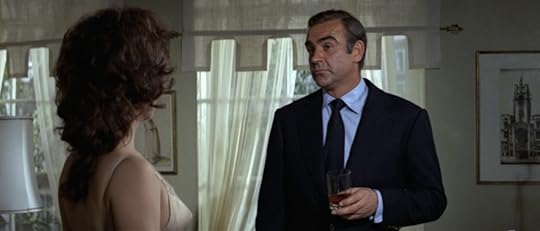
"Well, as long as the collars and cuffs match..." concerning his preference in women's hair color.
Worst Quip
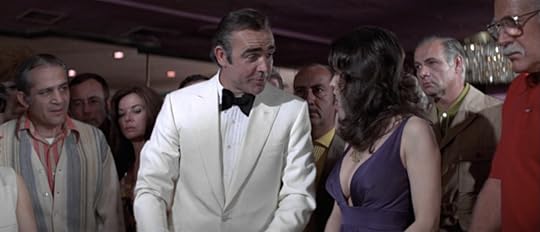
"Named after your father, perhaps?" to Plenty O'Toole when she introduces herself. What does that even mean? Is he implying that she's Peter O'Toole's daughter? Why?
Gadgets
There are a few gadgets in Diamonds, but some of them are relatively mundane, like fake fingerprints and a grappling gun. Blofeld's voice changer is pretty cool and I enjoy Q's nonchalance about the ease with which he duplicates it.
The water ball that Bond uses to reach Blofeld's oil rig is iconic, but that's less a gadget than another reference to new, real-world technology like the hovercraft from earlier in the film.
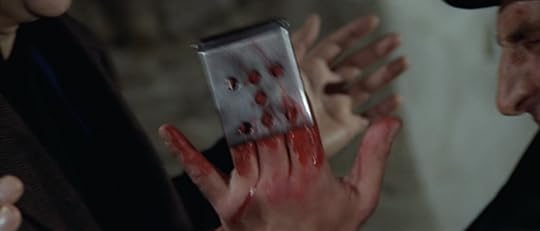
That leaves my favorite of Diamonds' gadgets: the finger trap in Bond's holster that snaps a henchman's fingers when trying to confiscate Bond's gun in the cold open. It's brutal and bloody; a good match for what that cold open is supposed to be.
Top Ten Gadgets
1. Aston Martin DB V (Goldfinger and Thunderball)
2. Jet pack (Thunderball)
3. Little Nellie (You Only Live Twice)
4. Rocket cigarettes (You Only Live Twice)
5. Attaché case (From Russia With Love)
6. Propeller SCUBA tank with built-in spearguns (Thunderball)
7. Rebreather (Thunderball)
8. Camera-tape recorder; mostly because it reminds me of a camera my dad used to use (From Russia With Love)
9. Seagull SCUBA hat (Goldfinger)
10. Holster finger trap (Diamonds Are Forever)
Bond's Best Outfit
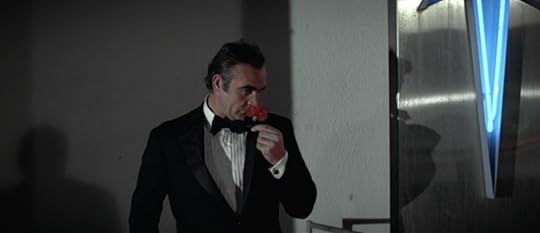
Can't go wrong with a classic, black tux and the red carnation is a nice touch.
Bond's Worst Outfit
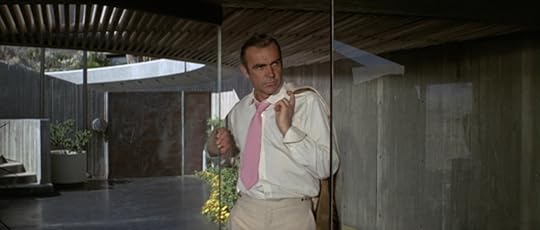
I don't mind the pinkness of the tie; it's the ridiculously short length. The '70s, man.


I used to assume that Connery's return in Diamonds meant that George Lazenby was a failed experiment. That Saltzman and Broccoli were displeased with Lazenby and fired him before coming to their senses and begging Connery to come back. Boy, was I wrong. Lazenby turned down a seven-picture contract and left the series of his own free will to become a hippie. (Incidentally, OHMSS director Peter Hunt was also invited back, but had to decline for scheduling reasons, so they brought back Goldfinger director Guy Hamilton instead.)
The producers next approached American actor John Gavin (though they also considered Adam West). Gavin's probably best known for playing Sam Loomis in Psycho. United Artists wasn't having it though. Not wanting to risk another new Bond, they insisted on having Connery back whatever the cost. They bought out Gavin's contract and paid Connery £1.25 million, the equivalent of about £23 million today.
Sadly, Connery was as enthused about playing Bond in Diamonds as he was in You Only Live Twice. But though he looks bored in both, it presents itself in different ways. In YOLT, because of the humorlessness of Roald Dahl's script, Bond comes across as serious and dull. In Diamonds, he takes nothing seriously. He's amused at everything, which removes any possibility of tension from the film.
The one time he becomes serious (not counting the cold open), is when he's talking to Tiffany after Plenty O'Toole is murdered. It's possible that he's upset about Plenty's death, but I get the impression that it's more about convincing Tiffany that she's in danger. He slaps her during that scene, which is where the power balance shifts between the two of them. She realizes then that he's not just some underling who wants to double-cross the smugglers and run away with her. It's a jolting scene and doesn't work for me because it's so out of character for the version of Bond that Connery's playing in the rest of the movie. Unfortunately, it's the only way she's going to take him seriously and get out of the way so that he can be in charge for the last half of the film. That Bond has to resort to smacking a woman to be taken seriously illustrates the big problem with Connery's performance.
Conney doesn't even look like Bond anymore. Maybe it's the gray in his hair, maybe it's his longer sideburns. Maybe it's just a really bad toupee. Whatever the reason, he's no longer a debonair spy, but an aging, slightly creepy old dude (even though he was only 40 when the movie was filmed).
M is irritated with Bond in their scenes, but that's not especially anything new in the series. We've seen it particularly clearly with Q. As Bond becomes a less serious character, that grates on the nerves of the people giving him his orders.
In keeping with the weird tone of the movie, the Moneypenny scene is really awkward. Not only is she in the field wearing a fake uniform to perform an extremely minor task (giving Bond his fake passport), but her banter with him is super inappropriate. He's off to Holland and offers to bring her back something, so she asks for a diamond... in a ring. Whether or not she's serious about wanting an engagement ring from him (and I dearly hope she's not, but you can read it either way), that's just an awful thing to say to someone whose wife was recently murdered. Again, the movie isn't thinking about stuff like that. It's just making sure we get some Moneypenny flirting in and doesn't care if it makes any sense.
Felix Leiter shows up in Diamonds, but he has no personality. He's only there to make Bond's activities official on US soil and to occasionally fix things. It's dumb though that he can't authorize an interview between Bond and reclusive millionaire Willard Whyte. By the time Bond makes that request, he has plenty of evidence proving that Whyte is deeply connected to the smuggling ring, but Felix acts like Bond just wants to see Whyte on a hunch.
And speaking of Willard Whyte, he's the best thing about this movie. Country singer/sausage king Jimmy Dean is awesome, charming, and completely convincing as a guy who's been forced out of his business empire. He's equal parts frustrated by the situation and determined to fix it. Love him a lot.
Best Quip

"Well, as long as the collars and cuffs match..." concerning his preference in women's hair color.
Worst Quip

"Named after your father, perhaps?" to Plenty O'Toole when she introduces herself. What does that even mean? Is he implying that she's Peter O'Toole's daughter? Why?
Gadgets

There are a few gadgets in Diamonds, but some of them are relatively mundane, like fake fingerprints and a grappling gun. Blofeld's voice changer is pretty cool and I enjoy Q's nonchalance about the ease with which he duplicates it.
The water ball that Bond uses to reach Blofeld's oil rig is iconic, but that's less a gadget than another reference to new, real-world technology like the hovercraft from earlier in the film.
That leaves my favorite of Diamonds' gadgets: the finger trap in Bond's holster that snaps a henchman's fingers when trying to confiscate Bond's gun in the cold open. It's brutal and bloody; a good match for what that cold open is supposed to be.
Top Ten Gadgets
1. Aston Martin DB V (Goldfinger and Thunderball)
2. Jet pack (Thunderball)
3. Little Nellie (You Only Live Twice)
4. Rocket cigarettes (You Only Live Twice)
5. Attaché case (From Russia With Love)
6. Propeller SCUBA tank with built-in spearguns (Thunderball)
7. Rebreather (Thunderball)
8. Camera-tape recorder; mostly because it reminds me of a camera my dad used to use (From Russia With Love)
9. Seagull SCUBA hat (Goldfinger)
10. Holster finger trap (Diamonds Are Forever)
Bond's Best Outfit

Can't go wrong with a classic, black tux and the red carnation is a nice touch.
Bond's Worst Outfit

I don't mind the pinkness of the tie; it's the ridiculously short length. The '70s, man.
May 20, 2015
Diamonds Are Forever (1971) | Story

Plot Summary
After sweeping the last movie's heavy ending under the rug, Bond tries to uncover a diamond smuggling ring before it shuts down. Hilarity ensues.
Influences
On Her Majesty's Secret Service was one of the top money-making movies of 1969, but it still made far less than You Only Live Twice. Saltzman and Broccoli wanted the series back to where it was, so for the next film, they made a conscious effort to duplicate old successes. Goldfinger had done extremely well in the US, thanks in part to a lot of its being set there, so the producers chose another US-based novel, Diamonds Are Forever, as the next film.
Richard Maibaum was brought back to write the script with US writer Tom Mankiewicz coming in to give it an American feel. The basic set up from Fleming's novel was used, but the mastermind behind the smuggling ring was changed from standard gangsters to Ernst Stavro Blofeld.
A minor influence that popped into the movie was the English Channel hovercraft. The hovercraft had been operating for a couple of years by the time Diamonds came out, but it was still a cool, new thing. Referencing new, real-world technology soon became a recurring phenomenon in the Bond movies.
One thing that some think is an influence - but isn't - is the conspiracy theory that the US moon landing was faked. At one point, Bond encounters some men in spacesuits on a moon set, but that's just a reference to the space program in general. The facility that Bond's infiltrated does space research, so those are just astronauts in training. The fake moon landing conspiracy theory didn't get big until a few years after Diamonds.
How Is the Book Different?
I've already mentioned Blofeld. His scheme for the diamonds is completely different from the gangsters' plan in the novel, which is just about making money. We'll talk more about Blofeld's plan in the Villains post, but since Saltzman and Broccoli were trying to recapture the feel of blockbusters like Goldfinger and You Only Live Twice, they needed Blofeld to do something bodacious with those diamonds.
The movie also skips over all the New York stuff from the novel so that it can get to Vegas more quickly and spend more time there. That may have been partially a budget thing (thanks to Sean Connery's enormous salary for the film), but I don't know that New York was ever in the movie script.
Moment That's Most Like Fleming

Though the villains' plans are totally different in the movie, a lot of stuff early in the film is right out of the novel. Wint and Kidd's shutting down the pipeline is from there, and even the death of Blofeld's double in the cold open is inspired by the mud bath scene from the book.
The scene that's closest though is when Bond meets Tiffany in her apartment. It's not a word for word reenactment, but the tone and the characters are exactly right. Bond's pretending to be smuggler Peter Franks and he's bewildered and a little amused that his contact is a tough woman.
Moment That's Least Like Fleming

Again, there's the whole ending, but more than that, Diamonds strikes a weird, goofy tone that's completely foreign to Fleming. That moon scene is one example, with the astronauts moving in slow motion for no reason as they try to stop Bond. The worst though is when Tiffany is walking through the Circus Circus casino and an elephant inexplicably wanders up to a slot machine and plays it.
The Roger Moore era has the reputation for being silly and over-the-top, but that starts right here. As dumb as You Only Live Twice was, I never get the feeling that it's intentionally dumb. But audiences seemed to love that stupidity and Saltman/Broccoli decided to keep serving it up.
Cold Open

The job of Diamonds' cold open is to resolve the end of On Her Majesty's Secret Service as quickly as possible. It opens with a series of beatings as an unseen Bond tries to locate Blofeld and take revenge for Tracy's death. We hear Connery's voice as he questions the underlings, but we don't see him until he arrives at a villa to question a sunbathing woman, choking her with her own bikini top.
She directs him to Blofeld, who's in the middle of surgically creating doubles of himself. Bond and Blofeld fight and Blofeld is apparently killed. Though Blofeld of course turns up later, the cold open wants you to believe that that's it. OHMSS is now wrapped up all tidy and we can get back to the fun Bond that we apparently want.
The cold open is supposed to be the serious, brutal finale to OHMSS, but it doesn't work that way. Forgetting for a second that the rest of Diamonds completely undermines it, the cold open doesn't even work on its own. Connery's performance (which I'll get into more in the next post) is so disinterested that it's impossible to take his quest for vengeance seriously. Even the voiceover work before you see his face lacks any real emotion. In ranking it, I only put it ahead of You Only Live Twice because at least it has a couple of gruesome mud bath deaths.
Top 10 Cold Opens
1. Thunderball
2. On Her Majesty's Secret Service
3. Goldfinger
4. From Russia With Love
5. Diamonds Are Forever
6. You Only Live Twice
7. TBD
8. TBD
9. TBD
10. TBD
Movie Series Continuity

With Blofeld "dead" in the cold open, everything's supposed to go back to normal. M says as much in the very first scene, callously dismissing any feelings that Bond still has about his wife's death. Which sadly is fair, because Bond doesn't seem to have any feelings about Tracy. Hunting down and killing Blofeld was apparently an obligation, not satisfaction. Bond actually seems amused by it. But then he seems amused by pretty much everything in the movie.
Bond's still a know-it-all (about sherry this time) and it still irritates M. And keeping with M and Moneypenny's field activities in You Only Live Twice, Moneypenny and Q both leave MI6 HQ in Diamonds. I can buy that Q might be needed in Las Vegas (though why he has to deliver Bond's equipment personally is never explained), but there's no reason whatsoever for Moneypenny to show up at Customs - in uniform - to deliver Bond his fake passport. It's nothing but a ridiculous way to get her into the movie, because audiences want to see Bond banter with her. The filmmakers are just putting checkmarks in boxes at this point.
Oh, you know what continuity isn't in Diamonds? The hat rack trick. Apparently Bond's throwing his hat to Moneypenny at the wedding was the last time he'd do that, which actually suits me just fine. I'll miss that bit, but I'm glad that it went out with some emotion and meaning attached to it.
One final bit of continuity is that everyone still knows who James Bond is. His notoriety goes beyond SPECTRE now and includes common smugglers like Tiffany Case or crooked casino managers like Bert Saxby. Bond's faked death in You Only Live Twice hasn't even fooled the general public.

Fanciful Tales of Time and Space: Fan Fire [Guest Post]
 By GW Thomas
Reading a scanned copy of the original Fanciful Tales #1 (Fall 1936) fills me with so many conflicting emotions. Most of them good. On the one hand, just looking at the contents pages delights me with names of authors I love. We have HP Lovecraft, Donald A Wolheim, Robert E Howard, David H Keller and August Derleth. All we need is Clark Ashton Smith and it would be perfect. With the exception of some like William S Sykora, Duane W Rimel and Kenneth B Pritchard, these names are weird fiction royalty. More importantly, I can glean the fannish zeal with which the project was done. I know that "fan fire," that desire to place words and images in a new way that will thrill (hopefully thousands of) readers (more likely less than a dozen). Fanciful Tales' single issue is a perfect example of a "fanzine," created in a flash of inspiration (that doesn't necessarily include a lot of proofing). I have created not a few similar works of my own.
Looking at the contents of Fanciful Tales #1, I see DAW (as Don Wolheim was known) had some great connections with published writers and active fans, filling his zine accordingly. All are quite short, little longer than flash fiction. Let's take a look at each one and consider them individually:
"The Nameless City" by HP Lovecraft is a fan reprint from 1921. HPL was a professional, but this story appeared before his rise in Weird Tales, in the amateur press magazine The Wolverine, November 1921. The story was later rejected twice by Farnsworth Wright but appeared in November 1938 after HPL's death. The story is considered the first of the Cthulhu Mythos tales.
 Wolheim"Umbriel" by Donald A Wolheim is a short science fiction tale that DAW never reprinted. It's not surprising why. The story is a supposed report on why space travelers don't go to the moon Umbriel. Short on plot, the idea is good - a moon as worm-riddled corpse - but undeveloped. It's the kind of idea Clark Ashton Smith wrote to 11,000 words for Gernsback's Amazing Stories.
"The Forbidden Room" by Duane W Rimel is a traditional ghost story about a pirate and his treasure that haunt a room in his house after his death. A typical Weird Tales-style filler, it is a little too thin for the pulps. The author also contributed his art to the issue. Rimel was largely forgotten until ST Joshi uncovered his work with HP Lovecraft in this century.
"Solomon Kane's Homecoming" by Robert E Howard is a poem that recaps Kane's career outside of England, his sea battles along with Richard Grenville, his combats against sorcery in Africa. This was the first appearance of the poem that would be included in all Solomon Kane collections in the future, even adapted by Marvel Comics. It is likely Howard sent in the piece before his suicide or it was submitted by his executor, Robert H Barlow.
"The Typewriter" by David H Keller MD is about a writer who mysteriously buys a typewriter and uses it to pen a bestseller. His wife becomes jealous of the imaginary woman in the novel and destroys the machine in an attempt to get her husband back. This tale is similar to many he wrote for Weird Tales, based on the psychosis he saw in his day job as psychiatrist.
 Derleth"The Man From Dark Valley" by August W Derleth is a typical Derleth ghost story. He wrote literally dozens of these for Farnsworth Wright (this one using astral projection), but he would resell this one to Wright's competition, Strange Stories, four year later. The American setting is a little different as many of his ghost stories are set in England.
"The Globe" by William S Sykora is the only story this active fan ever published. It's referred to as a "midgetale," 1936-speak for flash fiction. The brief plot involves a globe that sucks people's souls out and feeds them to the globe's owner. Sykora was one of the charter subscribers to Amazing Stories in 1926, a member of the Greater New York Science Fiction League along with Wolheim and Sam Moskowitz, and was involved with SF in many ways, including publishing and filmmaking.
"The Electric World" by Kenneth B Pritchard is the longest story in the issue and is described as "scientific words as long as your arm plus humor..." Accurate, a tale within a tale, but the electrical version of reality is confusing and really not funny, so I guess we shouldn't be sad it was Pritchard's last. He had published a few pieces in another famous fanzine, The Fantasy Fan in 1934-5. After Fanciful Tales he disappeared into the mists of fandom.
The fact that no Fanciful Tales of Time and Space #2 (featuring "Judgement of Netheris" by J Harvey Haggard, "The Psycho Traveler" by Ralph Milne Farley, and "The Escape" by Robert Bloch) appeared is not a surprise. In the world of fan publishing, a run of six issues is a grand achievement. Published on a shoe-string, with no distribution, little advertising, and a proscriptive price (twenty cents was a lot in 1936), the story is the same to this day. It's hard to compete.
 HowardLooking at this attempt at becoming (I have little doubt) another Weird Tales - a painfully disappointing task many of us have tried to accomplish and failed - I am not filled with smugness or derision. I tip my hat at the attempt. Of course, in 2015 we know that the names of Lovecraft, Howard, and Derleth live on. Back in 1936, there was no reason to assume any of these writers would endure. Howard was dead by suicide, Lovecraft had less than a year left, while Derleth's Arkham House was still seven years in the future. In fact, all that possesses me when I read these old bleary pages is the desire to start another magazine, another (not my first) try to create a meeting place for future Lovecrafts and Howards, Bok and Finlays, a place that is made of well-printed text matched with intriguing artwork, a solid, beautiful gem locked in time.
But I resist. Not because the chances of success are so narrow. They were in 1936. They still are in 2015. But because the days of print are gone. I could do the same in a digital format but... it's not the same. Not for me. I need to see those pages printed and saddle-stapled. I need to smell the photocopy ink, the envelopes, that list of buyers (always too few). The agonizing process of collation, folding, stapling, etc. is life's blood to the editor of a fanzine. It is the wellspring from which Donald A Wolheim began, before he became the editor of the Avon Fantasy Reader, the Ace paperback series, and eventually CEO and head editor of DAW paperbacks, a line that continues to this day run by his children. I can imagine the "fan fire" that burned for DAW as he held each of these projects in their final form. Robert Silverberg has said DAW was the most important individual in 20th Century science fiction publishing. It started with Fanciful Tales #1, Fall 1936, a tiny spark of "fan fire".
GW Thomas has appeared in over 400 different books, magazines and ezines including The Writer, Writer's Digest, Black October Magazine and Contact. His website is gwthomas.org. He is editor of Dark Worlds magazine.

May 19, 2015
MSP ComiCon 2015

The first annual MSP ComiCon (formerly SpringCon) was a big success. The reason they changed the name was in part because WizardWorld came to town last year and - like they do - scheduled their big pop culture/media convention near the date of the small, local, comics convention. Last year, when my friends outside of the comics community asked if I was going to "Comic-Con," they meant WizardWorld. It was a pretty big deal in the Twin Cities; the closest we've ever got to something like San Diego with all the movie and TV stars there. But it was grating to have to explain that no, I wasn't going to that show; I was instead going to the actual comics convention in town. The one that had been around for decades.
SpringCon has always had an excellent reputation among comics fans and creators and has been gaining wider attention locally in the last few years, but it was being held back by its name. As popular as comics are these days, all those fans and interested people didn't know what SpringCon was. So this year it became MSP ComiCon and when I was asked by civilians if I was going to "Comic-Con," that was the one they meant. That's a success, but so is the fact that people turned out in droves.
Here's a picture of the line to get in fifteen minutes after the show opened. I heard that it took another hour for it to finally shorten and that fits what I saw inside the building. The floor was packed all morning on Saturday.

It slowed down Saturday afternoon and Sunday, but overall the attendance was record-breaking. And even more encouraging than that were the kinds of people who were walking around and enjoying themselves. Comics readers have become a steadily more diverse crowd over the last few years and it really struck me at the show how true that is. There were people of all ages and races and I saw a lot more groups of just women and girls than I have in the past. This wan't a surprise; just very very reassuring.
Kill All Monsters did pretty well Saturday morning and I was pleased to donate a copy to a library in Wisconsin. Even though sales dipped Saturday afternoon and Sunday, I got a lot of questions from people who've already read it and wanted to know when the next volume is coming. It was really great to be able to tell them about the Dark Horse Presents story in July and the hardcover omnibus scheduled for next year. Saw some very excited faces about both of those things.
David did well with his new mini-comic, a fantasy story about an heroic goat who recruits a middle-school boy to defeat a powerful evil. I can't wait for the second issue.

And Diane did extremely well with her face-painting. She'd mastered Groot and Rocket Raccoon and those were popular, but she's also able to make up stuff on the fly, especially if she has a reference. She maintains a constant line of both kids and adults and she's thinking about maybe bringing in a partner to help meet the demand.
All in all it was an awesome show. The volunteers of the Midwest Comic Book Association were fantastic as usual; always welcoming and often checking in with creators to bring a drink or a snack or anything else a table-bound person might need. Couldn't ask for a nicer show.

May 17, 2015
7 Days in May | Who’s strong and brave; here to save the American Way?
Hellboy (2004)
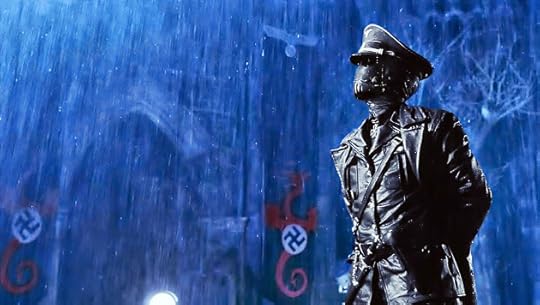
Last week, I got sidetracked from a Marvel re-watch by Red Skull's Raiders of the Lost Ark reference in Captain America: The First Avenger. This week I followed that up with more treasure-hunting Nazis in Hellboy, even though they don't really drive the plot of that movie. Since most of the action takes place in the present, the Nazis are a distant memory with only a few mad villains carrying on their schemes for personal reasons. In First Avenger, Hydra is differentiated from other Nazis too, but their style is similar and they're operating during WWII, so it feels a lot more like Nazis than Hellboy does.
I still like Hellboy, but eleven years later I'm over the initial thrill of having him brought to life on screen, which means I'm less forgiving of some of the changes the movie makes. I don't mind putting Hellboy and Liz Sherman into a romantic relationship, but I do mind Hellboy's pining over her. And while I love Jeffrey Tambor as Tom Manning - and even enjoy that the character is kind of a dick - I think his animosity towards Hellboy is overplayed. These aren't things that ruin the movie for me by any means. In fact, I used to defend them as valid choices to introduce some needed drama to the BPRD team. But a lot has happened with superhero movies in the last decade and I now think it would possible to bring Hellboy to the screen in a way that keeps more of the comics version intact. I want to see that movie.
Captain America: The First Avenger (2011)
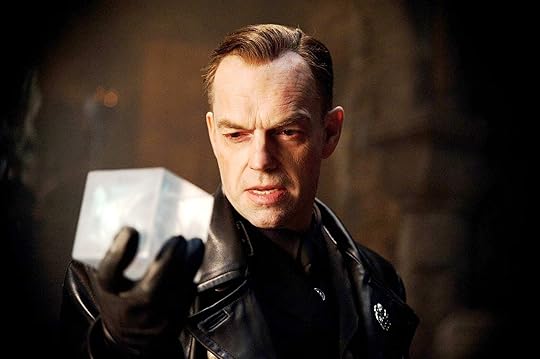
Having finished my detour, I also came back and finished up First Avenger. I don't have a lot to say about it except that it's still awesome with great action, funny dialogue (especially from Tommy Lee Jones), and has a romantic subplot that I get totally invested in every time I watch it. And Chris Evans is still perfectly believable as an altruistic, no-nonsense character who isn't boring. It can be done, Man of Steel.
One of the reasons I want to rewatch the Marvel films is to keep track of the Infinity Stones, but they aren't actually mentioned in First Avenger. We'll find out later that the Tesseract has one in it - and that's foreshadowed when Red Skull touches it and it opens a hole in space at the end, just like it does in The Avengers - but so far all we know about the Tesseract is that it's a power source for Arnim Zola's weapons.
Agent Carter
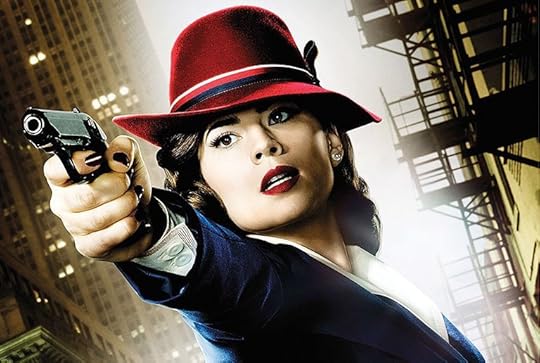
Rewatching The First Avenger also got me excited to go back and finish Agent Carter. We started it as a family for a few weeks when it started, but got distracted, probably by catching up on Parks and Rec. That happens a lot in our house.
Agent Carter is awesome. It picks up right after the events of First Avenger with Peggy Carter's still grieving over Steve Rogers while also trying to prove her worth in the postwar SSR. Howard Stark is back in the private sector and the SSR is no longer a military operation. It's totally G-Man, with the emphasis on "man." Superspy Carter is now serving coffee and taking lunch orders, because that's all that the men in charge trust her to do. So when some of Howard Stark's most horrifying inventions begin turning up on the black market and Stark is investigated for treason, Carter relieves her frustration by launching her own investigation to prove Stark's innocence.
It's a great spy story with lots of connections to the Marvel movies, but it's also much more than that. It comments on the way women were perceived in the mid-20th century and challenges perceptions that may still be holding on from that era. That's a major undercurrent of the story, but the series isn't strident about the way it communicates its ideas. Everything is done through plot and some really excellent characters, including the men. In the first episodes, the men of the SSR appear to be stereotypical and flat. Most of them are chauvinists, except for a handful who seem to respect Carter and her abilities. But as the eight episodes progress, the series reveals more and I came to admire some of the men I hated at the beginning. And some who appeared open-minded and heroic at first are proven to be far more complicated. None of the characters are lazily written; everyone has been carefully considered. Cannot wait for Season Two.
Captain America (1944)
I also got curious about the 1944 serial adventures of Captain America. I'm a little less than halfway through the 15 chapters, but so far I'm disappointed. That's mostly because of how little the serial cares about the character it's based on. Instead of super soldier Steve Rogers, Captain America is a generic vigilante, the alter-ego of District Attorney Grant Gardner, who puts on the costume to fight crime in a way he can't legally in his day job. Cap doesn't even carry a shield.
The villain is generic too if you're familiar with serials or other stories from that time period. He's played by Lionel Atwill, so that's cool, but his motivations and methods are standard. He's irritated about being underappreciated by his peers, so he takes revenge by murdering them and stealing their inventions. One thing is different though. Unlike most serials, the villain's identity is known right from the first chapter. That may be to give Atwill more screen time, which is nice because I like him, but it also robs the story of one of the more fun serial tropes: a mysterious, masked mastermind who is revealed at the end to be one of the supporting characters.
Pitch Perfect 2 (2015)
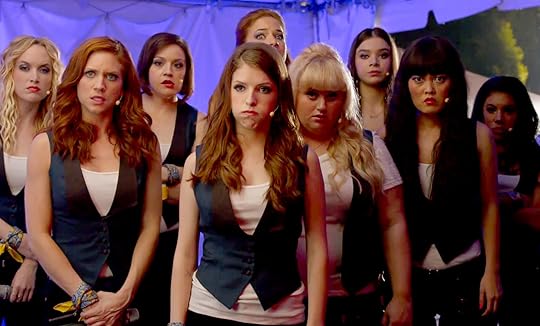
Finally, unrelated to the other stuff I watched this week, I got out to see Pitch Perfect 2. I was pleasantly surprised when the first one turned out to be legitimately, truly good instead of just the amusing diversion I expected. It has some characters that I genuinely care about, the music is awesome, and I laughed out loud a lot.
I wasn't sure the sequel could repeat that. And frankly, I still wasn't sure about twenty minutes into the new one. A lot of the early jokes are lame, one of the new characters is an uncomfortable stereotype, and some of the situations seem trite. The way the team is disgraced at the beginning is a forced, obvious move so that we can watch them climb back up again. And I always like Hailee Steinfeld, but for too long her character is just a way to bring some awkwardness to the otherwise polished and comfortable group.
The movie quickly outgrows this early shakiness though. It gets funnier fast, for one thing, but it also gets more complex and interesting. In the first movie, Anna Kendrick's character wanted a career as a music producer and Pitch Perfect 2 uses that to explore the potential conflict between finding your own artistic voice and just adapting and riffing on other people's stuff. Those sound like mutually exclusive ideas, but the movie argues that they're not. It makes a subtle comparison between a capella covers and a producer's collaboration with an artist. Or any collaboration, really. Having an artistic voice doesn't mean that you have to be the only one heard in an artistic endeavor. It just means that you do need to be heard. You need to have something to say.
And it's wonderful that what could have been an easy, cash-grab sequel does in fact have something to say, too.

Last week, I got sidetracked from a Marvel re-watch by Red Skull's Raiders of the Lost Ark reference in Captain America: The First Avenger. This week I followed that up with more treasure-hunting Nazis in Hellboy, even though they don't really drive the plot of that movie. Since most of the action takes place in the present, the Nazis are a distant memory with only a few mad villains carrying on their schemes for personal reasons. In First Avenger, Hydra is differentiated from other Nazis too, but their style is similar and they're operating during WWII, so it feels a lot more like Nazis than Hellboy does.
I still like Hellboy, but eleven years later I'm over the initial thrill of having him brought to life on screen, which means I'm less forgiving of some of the changes the movie makes. I don't mind putting Hellboy and Liz Sherman into a romantic relationship, but I do mind Hellboy's pining over her. And while I love Jeffrey Tambor as Tom Manning - and even enjoy that the character is kind of a dick - I think his animosity towards Hellboy is overplayed. These aren't things that ruin the movie for me by any means. In fact, I used to defend them as valid choices to introduce some needed drama to the BPRD team. But a lot has happened with superhero movies in the last decade and I now think it would possible to bring Hellboy to the screen in a way that keeps more of the comics version intact. I want to see that movie.
Captain America: The First Avenger (2011)

Having finished my detour, I also came back and finished up First Avenger. I don't have a lot to say about it except that it's still awesome with great action, funny dialogue (especially from Tommy Lee Jones), and has a romantic subplot that I get totally invested in every time I watch it. And Chris Evans is still perfectly believable as an altruistic, no-nonsense character who isn't boring. It can be done, Man of Steel.
One of the reasons I want to rewatch the Marvel films is to keep track of the Infinity Stones, but they aren't actually mentioned in First Avenger. We'll find out later that the Tesseract has one in it - and that's foreshadowed when Red Skull touches it and it opens a hole in space at the end, just like it does in The Avengers - but so far all we know about the Tesseract is that it's a power source for Arnim Zola's weapons.
Agent Carter

Rewatching The First Avenger also got me excited to go back and finish Agent Carter. We started it as a family for a few weeks when it started, but got distracted, probably by catching up on Parks and Rec. That happens a lot in our house.
Agent Carter is awesome. It picks up right after the events of First Avenger with Peggy Carter's still grieving over Steve Rogers while also trying to prove her worth in the postwar SSR. Howard Stark is back in the private sector and the SSR is no longer a military operation. It's totally G-Man, with the emphasis on "man." Superspy Carter is now serving coffee and taking lunch orders, because that's all that the men in charge trust her to do. So when some of Howard Stark's most horrifying inventions begin turning up on the black market and Stark is investigated for treason, Carter relieves her frustration by launching her own investigation to prove Stark's innocence.
It's a great spy story with lots of connections to the Marvel movies, but it's also much more than that. It comments on the way women were perceived in the mid-20th century and challenges perceptions that may still be holding on from that era. That's a major undercurrent of the story, but the series isn't strident about the way it communicates its ideas. Everything is done through plot and some really excellent characters, including the men. In the first episodes, the men of the SSR appear to be stereotypical and flat. Most of them are chauvinists, except for a handful who seem to respect Carter and her abilities. But as the eight episodes progress, the series reveals more and I came to admire some of the men I hated at the beginning. And some who appeared open-minded and heroic at first are proven to be far more complicated. None of the characters are lazily written; everyone has been carefully considered. Cannot wait for Season Two.
Captain America (1944)
I also got curious about the 1944 serial adventures of Captain America. I'm a little less than halfway through the 15 chapters, but so far I'm disappointed. That's mostly because of how little the serial cares about the character it's based on. Instead of super soldier Steve Rogers, Captain America is a generic vigilante, the alter-ego of District Attorney Grant Gardner, who puts on the costume to fight crime in a way he can't legally in his day job. Cap doesn't even carry a shield.
The villain is generic too if you're familiar with serials or other stories from that time period. He's played by Lionel Atwill, so that's cool, but his motivations and methods are standard. He's irritated about being underappreciated by his peers, so he takes revenge by murdering them and stealing their inventions. One thing is different though. Unlike most serials, the villain's identity is known right from the first chapter. That may be to give Atwill more screen time, which is nice because I like him, but it also robs the story of one of the more fun serial tropes: a mysterious, masked mastermind who is revealed at the end to be one of the supporting characters.
Pitch Perfect 2 (2015)

Finally, unrelated to the other stuff I watched this week, I got out to see Pitch Perfect 2. I was pleasantly surprised when the first one turned out to be legitimately, truly good instead of just the amusing diversion I expected. It has some characters that I genuinely care about, the music is awesome, and I laughed out loud a lot.
I wasn't sure the sequel could repeat that. And frankly, I still wasn't sure about twenty minutes into the new one. A lot of the early jokes are lame, one of the new characters is an uncomfortable stereotype, and some of the situations seem trite. The way the team is disgraced at the beginning is a forced, obvious move so that we can watch them climb back up again. And I always like Hailee Steinfeld, but for too long her character is just a way to bring some awkwardness to the otherwise polished and comfortable group.
The movie quickly outgrows this early shakiness though. It gets funnier fast, for one thing, but it also gets more complex and interesting. In the first movie, Anna Kendrick's character wanted a career as a music producer and Pitch Perfect 2 uses that to explore the potential conflict between finding your own artistic voice and just adapting and riffing on other people's stuff. Those sound like mutually exclusive ideas, but the movie argues that they're not. It makes a subtle comparison between a capella covers and a producer's collaboration with an artist. Or any collaboration, really. Having an artistic voice doesn't mean that you have to be the only one heard in an artistic endeavor. It just means that you do need to be heard. You need to have something to say.
And it's wonderful that what could have been an easy, cash-grab sequel does in fact have something to say, too.