
Michael May's Blog, page 143
May 7, 2015
Ranking the First Five Bond Movies

Before we get into On Her Majesty's Secret Service this weekend, I figured I'd touch base and rank the five movies we've looked at so far. I'll probably do this every time we hit a milestone in the series.
Since I'm ranking various, individual aspects of the movies, I came up with a formula to see which films are getting the highest scores. I won't bore you with the details, but I put more weight on the Women and Villains rankings, slightly less weight on the Theme Song, and the least weight on everything else. Based on pure math, my favorite Bond films so far are:
1. Thunderball
2. From Russia With Love
3. Goldfinger
4. Dr. No
5. You Only Live Twice
That of course doesn't take other important factors into account like Connery's performance in each movie or the plots or the action or many other things I'm not ranking, but it's pretty darn accurate. If I were to go purely on my gut, the rankings would look more like this:
1. Thunderball
2. From Russia With Love
3. Dr. No
4. Goldfinger
5. You Only Live Twice
I'm still surprised to see Thunderball at the top of that list, but this project has reminded me of how much it has going for it. Yes, it drags a lot in some of the underwater sequences, but it's also Connery's best performance as Bond (ever), it's got SPECTRE at its most dangerous, the plot makes sense, it's version of Felix Leiter is one of the series' most accurate to the books, and it's got two of my favorite women in the movies: Fiona Volpe and Paula Caplan.
[UPDATE: In the comments, Erik got me to rethink my gut ranking. Thunderball has better individual parts than From Russia With Love, but they don't add up to the better movie. So my revised ranking should look more like this:
1. From Russia With Love
2. Thunderball
3. Dr. No
4. Goldfinger
5. You Only Live Twice]
How would you rank the first five?


May 6, 2015
The End of a Beautiful Friendship: Creators' Rights [Guest Post]
 By GW Thomas
The fight over creators' rights seems like ancient lore these days, but for those of us who remember Destroyer Duck and all the fuss that spawned the Gerber vs Marvel fight, it lingers. The movie Howard the Duck tanked, but his cameo at the end of Guardians of the Galaxy reminded me of those old battlegrounds. But not all the battles were fought with Marvel and DC.
Wally Wood, despite being famous from as early as EC Comics, fought his own battles. He was one of the people who created witzend (issue #1 in 1966), the first pro fanzine in which all material was owned by its creators. Commercially a disaster, it did spark the first discussions around "Who owns this idea, anyway?" Other prozines would follow like Phase 1, Hot Stuf' and Star*Reach. The seeds planted in the 1960s would bloom in the 1970s and 1980s, first as "underground comics," but eventually as creator-owned and published works like The First Kingdom, Cerebus the Aardvark, and Elf Quest.
 Unhappy with the big companies, Wally drew for James Warren's horror magazines Creepy, Eerie, and Vampirella. With more leeway than the superhero books, Wally could create his own stories and retain certain rights he would not at Marvel or DC. His first appearance was supposed to be the very first issue of Creepy, an EC All-Star reunion (January 1965), but mistakenly his story was sent to Gray Morrow instead. He did appear by issue #9 (June 1966) with "Overworked!" written by Archie Goodwin and inked by pal Dan Atkins. This was the first of a dozen appearances at Warren. Wood would draw some of the first sword and sorcery tales for them in "War of the Wizards" (Vampirella #10, March 1971), "To Kill a God" (Vampirella #12, July 1971), and "Prelude to Armageddon" (Creepy #41, July 1971).
So in June of 1978, when Warren began their version of Heavy Metal - first called 1984, then later changed to 1994 - it made sense to include some sword and sorcery from Wally Wood. Who better? Wally had been into heroic fantasy since the 1960s, as well as inking Kull the Conqueror #1 (1971) for Marvel, then the short-lived Stalker for DC in 1975 and Hercules Unbound (1975-76). He also did a wonderful Lord of the Rings parody for DC's Plop #23 (September-October 1976) called "The King of the Ring." These jobs were nothing though compared to his fantasy masterwork, The King of the World, an adult Fantasy he had been working on since the witzend days.
 What he sent to Bill DuBay at 1984 was a 12-pager entitled "The End," set in a world of elves and ogres similar to The King of the World. What DuBay did with this sterling black-and-white piece was turn it into two, unconnected 6-pagers, "Quick Cut" (1984 #1, June 1978) and "One Night Down on the Funny Farm" (1984 #2, August 1978), neither of which make much sense. Since he cut and pasted, then rewrote the story, these two stories have anomalies in their pictures and make very little sense. For the first one he gave Wood full credit, but on the second he took the blame as the writer. Wally was outraged. He had not been consulted. A master of the comic form, a champion of creators' rights, his work had been mangled and trivialized. After thirteen years, he walked away. He never worked for Warren again.
Ironically, in 1983, Bill DuBay would be one of fifty-eight former Warren writers and artists to appear before the judge in the Warren bankruptcy case, protesting that Harris, who bought out the folding Warren empire, did not have the rights to such characters as Vampirella and decades of stories. Creators' rights? What's that?
 So what we are left with since has been a lot of questions as to why Bill DuBay treated Wally Wood's work in this fashion. The answer lies perhaps in a larger question: why was 1984 the worst magazine Warren put out? In trying to out-Heavy Metal the competition, the writing of the magazine was slanted heavily toward sleaze. The work Wally Wood (and others) turned in simply wasn't sleazy enough. DuBay, as editor, was the chief sleaze provider. He knew better than to ask Wood to redo the story in an adolescent way, so he cut and pasted and lost the work of a great artist in the process. DuBay had bigger worries on his hands, including a lawsuit with Harlan Ellison and possibly a copyright haggle with the heirs of George Orwell over the title. Is it any wonder he went by the name Will Richardson for a few years after all this?
GW Thomas has appeared in over 400 different books, magazines and ezines including The Writer, Writer's Digest, Black October Magazine and Contact. His website is gwthomas.org. He is editor of Dark Worlds magazine.

May 4, 2015
7 Days in May | Some Kind of Hughesiful
Pretty in Pink (1986)
This year is the 30th anniversary of The Breakfast Club, so we went to a special screening at a local theater. It got us interested in John Hughes again and talking about later movies that were inspired by his work. Which got me wanting to watch them again.
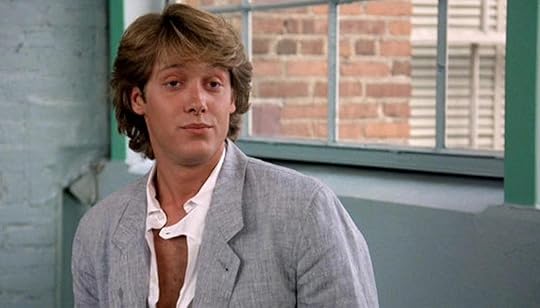
I always forget that Pretty in Pink wasn't directed by Hughes, but it was written by him. For whatever it's worth, he's also an executive producer on it, but it's the writing that makes it a Hughes film. I was shortly out of high school when it came out and totally related to the characters. Not so much the rich/poor caste system they experience, but the obstacles they encounter in their quests for love and the frustrations they have in trying to overcome them. For Andie (Molly Ringwald) and Blane (Andrew McCarthy), it's peer pressure as represented mostly by Steff (James Spader). As much as I like Duckie Dale (John Cryer), Steff is his closest competition for my favorite character in the movie. There is no douchier character in fiction, but the combination of Hughes' writing and Spader's performance elevates Steff above a villainous stereotype and makes him a believable, but tragic character with understandable, if reprehensible motivations.
As for Duckie, his obstacle to love is the simple fact that Andie doesn't feel the same way he does. Sadly, as a teenager I most related to him, but I was also encouraged by the way he's more or less honest with Andie about his feelings. He uses humor to make them seem less intense than they are, but I wasn't even that brave as a kid. There's a reason that OMD's "Secret" was an especially resonant song for me back in the day.
Which leads me to the music. I was very much a New Wave kid, but before Pretty in Pink, my access to that genre was limited by what made it onto our town's Top 40 station. The Pretty in Pink soundtrack introduced me to The Smiths, Echo and the Bunnymen, New Order, and other bands that I'd missed, leading me down numerous musical rabbit holes that I'm forever grateful for.
10 Things I Hate About You (1999)
I wanted to also rewatch Some Kind of Wonderful, which is essentially a gender-swapped remake of Pretty in Pink with the ending "fixed," but I'd loaned out my copy and didn't get it back in time. Instead, we watched a couple of later movies that are very much in the John Hughes wheelhouse. Meaning that they're funny, touching, and insightful looks at what high school is like.
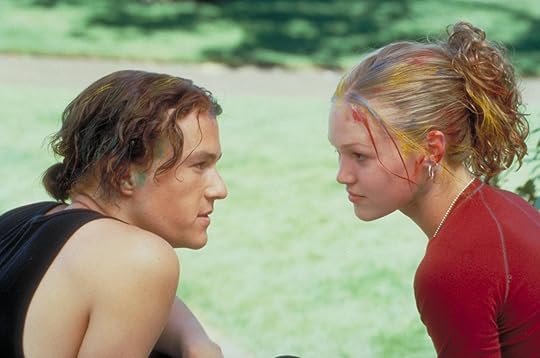
First up was 10 Things I Hate About You, the adaptation of Shakespeare's Taming of the Shrew that launched Heath Ledger's career and should have done the same for Julia Stiles. Why isn't she in more stuff? Anyway, since the movie's following Shakespeare's plot and not conventional romantic comedy tropes, it's wonderfully convoluted (without being confusing) and doesn't follow the typical romcom structure. Yes, there's a point at which an obstacle is thrown in the way of young love, and yes, it has to do with a deception perpetrated by one of the leads early in the relationship, but the obstacle comes up very late in the story and isn't resolved at all in the usual way.
Instead of the deceiver - in this case, Ledger's character - having to make a grand gesture to atone for the mistake, the situation is pretty easily resolved by the fact that Stiles' character is obviously in love with him, which makes her prone to forgiveness. She's also smart enough to understand why he did what he did before he really knew her and how that doesn't necessarily mean he'll keep doing it. After all, she gets the whole idea of behaving badly as a form of self-protection.
That's what I love so much about this movie. Both characters have self-protected themselves right out of society and it's beautiful seeing them slowly lower their defenses with each other. Unlike most romantic comedies where we're asked to root for the couple simply because they're likable and cute, 10 Things I Hate About You builds sympathy for its leads by making them angry, painful messes whom we want to see find acceptance and companionship in each other.
Easy A (2010)
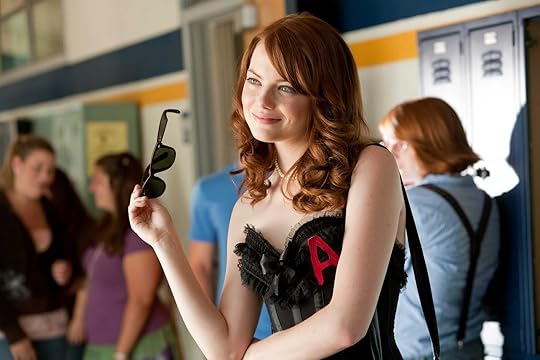
Watching Easy A shortly after 10 Things, I realized what it is that I still like about a great teen comedy all these many years since I graduated. Loneliness and feeling like an outsider isn't something you completely grow out of. I have a ridiculously happy family life, but even then I'm occasionally susceptible to feeling a bit on my own. It's just human nature. And even when I don't personally feel that way, I'm sympathetic to those who do. So stories about loneliness and the experience of being an outsider are powerful. And high school is a perfect setting for those kinds of stories, where those themes can present themselves at almost cartoonish levels without feeling implausible.
10 Things I Hate About You is about a pair of self-imposed outsiders who find acceptance in each other without compromising themselves. Easy A is about a girl who doesn't want to be an outsider, thinks she's found a quick route into the group, but ends up even more ostracized than before. She has to figure out what she's going to do about that and in the end reaches the same conclusion that the 10 Things leads do. She says "screw it" to trying to fight her way into a group of people who don't want her and instead finds acceptance in someone else who's made the same decision. Way easier to do in the movies than in real life, but it's still a powerful and important message.

This year is the 30th anniversary of The Breakfast Club, so we went to a special screening at a local theater. It got us interested in John Hughes again and talking about later movies that were inspired by his work. Which got me wanting to watch them again.
I always forget that Pretty in Pink wasn't directed by Hughes, but it was written by him. For whatever it's worth, he's also an executive producer on it, but it's the writing that makes it a Hughes film. I was shortly out of high school when it came out and totally related to the characters. Not so much the rich/poor caste system they experience, but the obstacles they encounter in their quests for love and the frustrations they have in trying to overcome them. For Andie (Molly Ringwald) and Blane (Andrew McCarthy), it's peer pressure as represented mostly by Steff (James Spader). As much as I like Duckie Dale (John Cryer), Steff is his closest competition for my favorite character in the movie. There is no douchier character in fiction, but the combination of Hughes' writing and Spader's performance elevates Steff above a villainous stereotype and makes him a believable, but tragic character with understandable, if reprehensible motivations.
As for Duckie, his obstacle to love is the simple fact that Andie doesn't feel the same way he does. Sadly, as a teenager I most related to him, but I was also encouraged by the way he's more or less honest with Andie about his feelings. He uses humor to make them seem less intense than they are, but I wasn't even that brave as a kid. There's a reason that OMD's "Secret" was an especially resonant song for me back in the day.
Which leads me to the music. I was very much a New Wave kid, but before Pretty in Pink, my access to that genre was limited by what made it onto our town's Top 40 station. The Pretty in Pink soundtrack introduced me to The Smiths, Echo and the Bunnymen, New Order, and other bands that I'd missed, leading me down numerous musical rabbit holes that I'm forever grateful for.
10 Things I Hate About You (1999)

I wanted to also rewatch Some Kind of Wonderful, which is essentially a gender-swapped remake of Pretty in Pink with the ending "fixed," but I'd loaned out my copy and didn't get it back in time. Instead, we watched a couple of later movies that are very much in the John Hughes wheelhouse. Meaning that they're funny, touching, and insightful looks at what high school is like.
First up was 10 Things I Hate About You, the adaptation of Shakespeare's Taming of the Shrew that launched Heath Ledger's career and should have done the same for Julia Stiles. Why isn't she in more stuff? Anyway, since the movie's following Shakespeare's plot and not conventional romantic comedy tropes, it's wonderfully convoluted (without being confusing) and doesn't follow the typical romcom structure. Yes, there's a point at which an obstacle is thrown in the way of young love, and yes, it has to do with a deception perpetrated by one of the leads early in the relationship, but the obstacle comes up very late in the story and isn't resolved at all in the usual way.
Instead of the deceiver - in this case, Ledger's character - having to make a grand gesture to atone for the mistake, the situation is pretty easily resolved by the fact that Stiles' character is obviously in love with him, which makes her prone to forgiveness. She's also smart enough to understand why he did what he did before he really knew her and how that doesn't necessarily mean he'll keep doing it. After all, she gets the whole idea of behaving badly as a form of self-protection.
That's what I love so much about this movie. Both characters have self-protected themselves right out of society and it's beautiful seeing them slowly lower their defenses with each other. Unlike most romantic comedies where we're asked to root for the couple simply because they're likable and cute, 10 Things I Hate About You builds sympathy for its leads by making them angry, painful messes whom we want to see find acceptance and companionship in each other.
Easy A (2010)

Watching Easy A shortly after 10 Things, I realized what it is that I still like about a great teen comedy all these many years since I graduated. Loneliness and feeling like an outsider isn't something you completely grow out of. I have a ridiculously happy family life, but even then I'm occasionally susceptible to feeling a bit on my own. It's just human nature. And even when I don't personally feel that way, I'm sympathetic to those who do. So stories about loneliness and the experience of being an outsider are powerful. And high school is a perfect setting for those kinds of stories, where those themes can present themselves at almost cartoonish levels without feeling implausible.
10 Things I Hate About You is about a pair of self-imposed outsiders who find acceptance in each other without compromising themselves. Easy A is about a girl who doesn't want to be an outsider, thinks she's found a quick route into the group, but ends up even more ostracized than before. She has to figure out what she's going to do about that and in the end reaches the same conclusion that the 10 Things leads do. She says "screw it" to trying to fight her way into a group of people who don't want her and instead finds acceptance in someone else who's made the same decision. Way easier to do in the movies than in real life, but it's still a powerful and important message.
April 29, 2015
Posthumous Collaboration: Dollars from the Grave [Guest Post]
 By GW Thomas
I was reading an old Tangent Online interview with Leigh Brackett and Edmond Hamilton and I was struck by something. Here's what they were talking about: story planning. Hamilton knew the last line of a story before he started the first. Brackett, like myself, just started writing and the story would go where it pleased. Ed pointed out, because of this lack of planning:
HAMILTON: You had a lot of unfinished stories.So where are they? Where are all the unfinished Leigh Bracketts? In the 1970s, whenever somebody would come across a scrap of Robert E Howard it was immediately turned into a new collaboration. L Sprague de Camp or Lin Carter would come across an old grocery list, perhaps only "Buy milk" and a few months later "The Corsairs of Buymilk" would appear in Fantastic. Oh, those were the days... Some writers have so much mojo that readers want to read everything they wrote, good, bad or indifferent. Howard was one of these. Tolkien was another. Lovecraft, a third. The Eldritch Dark provides all the synopses and fragments by Clark Ashton Smith. What do all these writers have in common? They were all great fantasy writers. Leigh Brackett is worthy to stand amongst them.
BRACKETT: Yes I did.
 So why hasn't this happened to Leigh? Do the Hamilton heirs have a desk drawer (or maybe two or three!) filled with half-finished tales? We know where "Lorelei of the Red Mists" (Planet Stories, Summer 1946) ended up. The story was abandoned when Leigh left to write The Big Sleep for Howard Hawks. Ray Bradbury stepped in and wrote the second half. That turned out pretty well. And then there was the last collaboration she did with her husband, Edmond Hamilton, "Stark and the Star Kings". The story was originally written for Harlan Ellison's third Dangerous Visions anthology, which never appeared, so the story finally saw print in 2005. Both writers chose their most famous creation to meet up but as the interview tells again:
HAMILTON: ...What he wanted was a collaboration between the two of us; you know, a formal collaboration. The story is called “Stark and the Star Kings,” and if I may say what's funny about it: the first half of it I wrote and it's all about Stark. She wrote the part about the Star Kings.
 Ed and Leigh, unlike their famous friends, Henry Kuttner and CL Moore, never collaborated much during their long careers. They did only a few previous to "Stark and the Star Kings." Brackett penned three chapters of Hamilton's The Valley of Creation and one comic strip, "The Lord of Batmanor!" (Detective Comics #198, August 1953). Leigh wrote the plot of how Bruce Wayne becomes a Scottish laird, and Ed wrote the script. I kid you not.
Leigh, Ed, Henry, Catherine, and Ray are gone now but there must be somebody out there who could write the second halves should the firsts exist. Or did Leigh decide she didn't want to be victim to some latter day August Derleth? Perhaps the entire stack was set on fire! All those semi-completed John Eric Stark stories crumbling to ash. Oh, the agony! (In reality, I suspect there is no pile of unfinished stories. If there had been, Baen or Paizo would have been all over them, with Eric Flint doing the honors of figuring out an ending for each one.) We can dream that one day we will be given the "unfinished tales" of Leigh Brackett. Perhaps just in time for Christmas, as the new Eric John Stark film comes out and Brackett is declared the rightful Queen of the Space Pulps, ruling from her throne in Ohio, and... Of course, none of this is going to happen. Instead, I will be happy that the majority of her work is back in print (Is that what we call it now that everything is an ebook?) and a new generation can discover her as more than a writer's credit on a Star Wars movie. Long live the Queen!
GW Thomas has appeared in over 400 different books, magazines and ezines including The Writer, Writer's Digest, Black October Magazine and Contact. His website is gwthomas.org. He is editor of Dark Worlds magazine.

April 28, 2015
Back from C2E2

C2E2 was amazing. Jason and I have shared a table there for three years now and it gets more exciting every time. The photo below of Jason sketching was during a quiet moment, but we had an average year in terms of sales and thanks to the Dark Horse news, an excellent year in terms of buzz about Kill All Monsters. Lots of people were asking when the next installment is coming out and it was great to have something to tell them.

One of the biggest thrills of the show was when Geof Darrow (The Big Guy and Rusty the Boy Robot, Shaolin Cowboy) came to get a copy of the book. Jason and I are both huge fans of his work. He's so friendly and cool and it took us several seconds to recover from our surprise enough to go over to his table afterwards and ask if he wouldn't mind taking a picture with us. What a kind, gracious man.

Which leads me into the best part of any convention: the people you get to meet and visit with. That goes for readers - both of Kill All Monsters and this blog - and other friends. I'm always afraid I'll get into trouble if I start naming names, because I know I'll leave someone out, but one group I have to mention is the Nerd Lunch crew. I've been on their show several times, but this was my first time meeting any of them in person, including Carlin, my co-host on Dragonfly Ripple. We arranged to have a special Nerd Very Late Dinner on Thursday, but it was awesome that we also kept randomly running into each other at the show the rest of the weekend. They're great guys and it was a pleasure hanging out with them as much as I was able to.
It was also a special treat to meet Kay from the FANgirl Blog. We've been on a couple of Nerd Lunch episodes together and are scheduled for a few more, so it felt sort of like a family reunion. I also got to meet Andrew and Christian from the Atomic Geeks podcast, hosts of the network that Nerd Lunch and Dragonfly Ripple belong to. Both guys are super nice (thanks again for the T-shirt, Christian!) and since Andrew and I were on Nerd Lunch's Trial of M Night Shyamalan episode, that was another fun reunion.

All in all, an extraordinarily fun convention. Thanks to everyone who stopped by to say hello! Next up for me is the all new MSP COMICON (formerly SpringCon) in a few weeks. But more on that later.

April 26, 2015
7 Days in May | Before Treasure Island
Flint and Silver by John Drake
[image error]
I actually finished this book a couple of months ago, but I didn't talk about it at the time and it ties in with something I did this week, so I'll talk about it now. I'm not usually big on prequels, but I was looking for a good pirate book to read and decided to give it a chance. And I'm totally glad I did. It does two things I don't typically like, but it does them so well that I didn't mind in the least.
First, like I said, it's a prequel. The problem with prequels is that most of the time you can see the author's methodically checking the boxes and connecting the dots that need to be checked and connected to get to whatever story the prequel leads into. But John Drake has so fleshed out his characters - not just Joe Flint and John Silver, but also Billy Bones, Israel Hands, Selena, and others - that they and their relationships are what I care about. Discovering islands and burying treasure are awesome when they come up, but they're just fun additions to the story; not the point of it.
The second thing that usually turns me off is that the plot meanders and there's not a clear resolution by the end. Flint and Silver is the first in a trilogy, so if you're adamant about getting a complete story in a single volume, you may be disappointed. But again, it's the characters who are most important in this novel and I was emotionally satisfied with the way Drake leaves them at the end, even if there are still major plot points to be resolved.
The book is well-researched both for historical accuracy and consistency with Treasure Island, but Drake is a great writer who knows to let that be background to his world and not just dump it all over the reader. I highly recommend it to fans of Treasure Island or just great pirate stories in general.
Which brings us to...
Black Sails
[image error]
It took me a couple of episodes to get into the first season of Black Sails, because I kept comparing it to Flint and Silver. The Starz series is in part another prequel to Treasure Island and features the characters of Captain Flint, John Silver, and Billy Bones, but the interpretations of those characters are very different from what John Drake is doing. Drake's Flint is a brutal sadist; the Black Sails version is ruthless, but in a sneaky, conniving, sometimes even cowardly way. Drake's Silver is a man of honor who commands respect from his fellow sailors; the Black Sails version is a charming rogue, but - well - in a sneaking, conniving, sometimes even cowardly way. Drake's Billy Bones is an unthinking brute who's slavishly devoted to Flint; the Black Sails version is a good man who begins to see Flint for who he is and has to decide what to do with that information. As I mentioned above, I was completely captivated by Drake's characters, so I didn't want to let go of them and embrace Black Sails, but the more I watched the easier it became to allow both versions to live in my head.
Another thing that helps is that the tone of the show is completely different. Drake adds a lot of historical flavor to Flint and Silver, but his primary purpose is to play in the world of Treasure Island and explain how romantic, non-historical elements like buried treasure might occur in a realistic way. Black Sails on the other hand does away with the romantic stuff altogether, at least so far. Even the pirates themselves are de-romanticized and shown for the cutthroat criminals they really were. And to further support the illusion of historical accuracy, it also includes real life pirates like Anne Bonny, Jack Rackham, and Charles Vane.
It's not just ships attacking each other, either. With so many characters, there's plenty to keep everyone busy, including drama around politics, business, and romance in addition to all the actual pirating. I enjoyed it a lot, especially Zach McGowan as the terrifying, yet somehow vulnerable Charles Vane. McGowan's look and voice is sort of a cross between Liev Schreiber and Michael Wincott. I don't know how the universe produced someone that cool, but we live in a world of miracles.
Doctor Who
[image error]
I finished the Christopher Eccleston season with mixed feelings. On the negative side, the resolution to the season-long Bad Wolf teasing is anticlimactic and the next-to-last episode is dated with its futuristic versions of Weakest Link and Big Brother. But for the most part, the finale featuring the rebooted Doctor's first major confrontation with the Daleks is powerfully touching. I love how the Daleks lose their freaking minds when they realize who they're up against and the Doctor absolutely knows it. But even more than that, I love the dilemma that the Daleks force the Doctor into as he has to decide if he can murder billions of people in order to save infinitely more. It's an impossible choice and what he does with it is perfect.
Rose continues to remind me why she's such a great, unique companion. She's the first I know of who actually had to make a choice between her adventures with the Doctor and the wishes of her loved ones back home. Her constant struggle with that choice - and the decisions she makes about it - make her an inspiring, heroic character. I know some people are annoyed with her, but I don't get it. She's awesome.
Star Wars: Clone Wars
[image error]
We're two-thirds through Season 4 and I can't say that we're enjoying Clone Wars much more than we were last week. It was great to close Season 3 with a couple of storylines featuring original trilogy characters (plus, Wookiees!), but for every story that I'm really into, there are two that I have to make myself get through. And with so many stories being multi-part, it's a slog to spend an hour or more on a plot I'm not enjoying. There's also still the problem with Jedi forgetting to use their powers at key moments, but I think I'm becoming numb to that. Still, it's a fun world to play in and the show is starting to work on showing the darker side of Anakin, so I'm eager to keep going and see where all this leads.
[image error]
I actually finished this book a couple of months ago, but I didn't talk about it at the time and it ties in with something I did this week, so I'll talk about it now. I'm not usually big on prequels, but I was looking for a good pirate book to read and decided to give it a chance. And I'm totally glad I did. It does two things I don't typically like, but it does them so well that I didn't mind in the least.
First, like I said, it's a prequel. The problem with prequels is that most of the time you can see the author's methodically checking the boxes and connecting the dots that need to be checked and connected to get to whatever story the prequel leads into. But John Drake has so fleshed out his characters - not just Joe Flint and John Silver, but also Billy Bones, Israel Hands, Selena, and others - that they and their relationships are what I care about. Discovering islands and burying treasure are awesome when they come up, but they're just fun additions to the story; not the point of it.
The second thing that usually turns me off is that the plot meanders and there's not a clear resolution by the end. Flint and Silver is the first in a trilogy, so if you're adamant about getting a complete story in a single volume, you may be disappointed. But again, it's the characters who are most important in this novel and I was emotionally satisfied with the way Drake leaves them at the end, even if there are still major plot points to be resolved.
The book is well-researched both for historical accuracy and consistency with Treasure Island, but Drake is a great writer who knows to let that be background to his world and not just dump it all over the reader. I highly recommend it to fans of Treasure Island or just great pirate stories in general.
Which brings us to...
Black Sails
[image error]
It took me a couple of episodes to get into the first season of Black Sails, because I kept comparing it to Flint and Silver. The Starz series is in part another prequel to Treasure Island and features the characters of Captain Flint, John Silver, and Billy Bones, but the interpretations of those characters are very different from what John Drake is doing. Drake's Flint is a brutal sadist; the Black Sails version is ruthless, but in a sneaky, conniving, sometimes even cowardly way. Drake's Silver is a man of honor who commands respect from his fellow sailors; the Black Sails version is a charming rogue, but - well - in a sneaking, conniving, sometimes even cowardly way. Drake's Billy Bones is an unthinking brute who's slavishly devoted to Flint; the Black Sails version is a good man who begins to see Flint for who he is and has to decide what to do with that information. As I mentioned above, I was completely captivated by Drake's characters, so I didn't want to let go of them and embrace Black Sails, but the more I watched the easier it became to allow both versions to live in my head.
Another thing that helps is that the tone of the show is completely different. Drake adds a lot of historical flavor to Flint and Silver, but his primary purpose is to play in the world of Treasure Island and explain how romantic, non-historical elements like buried treasure might occur in a realistic way. Black Sails on the other hand does away with the romantic stuff altogether, at least so far. Even the pirates themselves are de-romanticized and shown for the cutthroat criminals they really were. And to further support the illusion of historical accuracy, it also includes real life pirates like Anne Bonny, Jack Rackham, and Charles Vane.
It's not just ships attacking each other, either. With so many characters, there's plenty to keep everyone busy, including drama around politics, business, and romance in addition to all the actual pirating. I enjoyed it a lot, especially Zach McGowan as the terrifying, yet somehow vulnerable Charles Vane. McGowan's look and voice is sort of a cross between Liev Schreiber and Michael Wincott. I don't know how the universe produced someone that cool, but we live in a world of miracles.
Doctor Who
[image error]
I finished the Christopher Eccleston season with mixed feelings. On the negative side, the resolution to the season-long Bad Wolf teasing is anticlimactic and the next-to-last episode is dated with its futuristic versions of Weakest Link and Big Brother. But for the most part, the finale featuring the rebooted Doctor's first major confrontation with the Daleks is powerfully touching. I love how the Daleks lose their freaking minds when they realize who they're up against and the Doctor absolutely knows it. But even more than that, I love the dilemma that the Daleks force the Doctor into as he has to decide if he can murder billions of people in order to save infinitely more. It's an impossible choice and what he does with it is perfect.
Rose continues to remind me why she's such a great, unique companion. She's the first I know of who actually had to make a choice between her adventures with the Doctor and the wishes of her loved ones back home. Her constant struggle with that choice - and the decisions she makes about it - make her an inspiring, heroic character. I know some people are annoyed with her, but I don't get it. She's awesome.
Star Wars: Clone Wars
[image error]
We're two-thirds through Season 4 and I can't say that we're enjoying Clone Wars much more than we were last week. It was great to close Season 3 with a couple of storylines featuring original trilogy characters (plus, Wookiees!), but for every story that I'm really into, there are two that I have to make myself get through. And with so many stories being multi-part, it's a slog to spend an hour or more on a plot I'm not enjoying. There's also still the problem with Jedi forgetting to use their powers at key moments, but I think I'm becoming numb to that. Still, it's a fun world to play in and the show is starting to work on showing the darker side of Anakin, so I'm eager to keep going and see where all this leads.
April 24, 2015
You Only Live Twice (1967) | Music
Maurice Binder is back to create the title sequence for You Only Live Twice, this time using a Japanese umbrella motif over images of volcanoes and the faces of Japanese women. The umbrella design is introduced in a cool way, exploding in red from a patch of blood at the end of the cold open, then turning black and shrinking into a woman's eye. In spite of that strong opening though, I get bored watching faces and lava. I'm much more interested in the song.
John Barry brought back Leslie Bricusse to help with the theme song and this one was less troubled than the song for Thunderball had been. There was one version with mostly different words and sung by Julie Rogers, but Barry ended up going with Nancy Sinatra whose "These Boots Are Made for Walkin'" had just come out the year before. Barry redid the orchestra part of the song to fit Sinatra's range and mellowed out the Japanese strings in the process.
The final version is great. It swells beautifully and Sinatra's voice is lovely. Barry of course uses it in the soundtrack and the musical theme is great over scenes of the Japanese countryside.
The lyrics work well, too. Unlike the songs for Goldfinger and Thunderball, "You Only Live Twice" isn't directly related to characters or events in the movie. It follows the From Russia With Love model in that it repurposes the movie's title into a love song (my favorite kind of Bond theme). In the novel, Bond writes the title as part of a haiku: "You only live twice: Once when you are born and once when you look death in the face." In the film, it's a reference to Bond's second chance after his faked death. But in the song, it's about romance and taking hold of your dreams before they disappear.
Barry's getting even more sparing with the Bond Theme in You Only Live Twice, but he uses it to great effect. The only time it appears is during the dogfight between Little Nellie and the SPECTRE helicopters. It's a highlight of the movie, not only because it's a great fight, but because it uses that music and I go, "Ah! This is Bond."
Top Ten Theme Songs
1. You Only Live Twice
2. From Russia With Love (John Barry instrumental version)
3. Dr No
4. Thunderball
5. Goldfinger
6. From Russia With Love (Matt Monro vocal version)
7. TBD
8. TBD
9. TBD
10. TBD
Top Ten Title Sequences
1. Dr No
2. Thunderball
3. Goldfinger
4. From Russia With Love
5. You Only Live Twice
6. TBD
7. TBD
8. TBD
9. TBD
10. TBD

You Only Live Twice (1967) | Villains

What a letdown Donald Pleasance is after all the buildup the series has been doing towards revealing Blofeld's face. The creepy, mysterious head of SPECTRE with the silky voice is now a tiny, non-blinking madman with a high-pitched screech. When he yells, "Kill Bond! Now!" it's not threatening, it's sad. He sounds hysterical. Blofeld is my least-favorite thing in a movie full of bad decisions.

Like I said yesterday, Helga Brandt is the lite version of Thunderball's Fiona Volpe. She may be pretty and have red hair, but she's an incompetent assassin. Fits right in with the rest of these goons.

Actually, there's nothing really incompetent about Hans, but that's a low bar when he has so little responsibility. All he's really in charge of is feeding Blofeld's fish and holding the destruct key. He does both of those things well though and Bond actually has to expend some energy to beat him. He's the best bad guy in the movie.

I have a hard time figuring out Osato's role in all of this. He gets to hang out with Blofeld who treats Osato like an underling, so I assume he's part of SPECTRE. But that doesn't explain why Osato's corporate logo is proudly displayed on the SPECTRE astronauts' suits as if Osato is some kind of corporate sponsor.
I'm also confused about who's making all the decisions in regards to stopping Bond's investigation. Henderson's killer seems to have been working for Osato and numerous attempts on Bond's life are made on Osato property, so it feels like Osato himself is responsible for that incompetence. In Thunderball, Fiona stops Largo from trying to kill Bond because she knows it would let Bond's allies know he was on the right trail. In You Only Live Twice, every single time Bond gets close to a bad guy, Osato tries to have him killed, even if Bond is literally in the Osato parking lot.
But before we judge Osato too harshly, we need to realize that Blofeld's just as bad. When Bond flies Little Nellie out to recon the area he thinks the bad guys might be operating from, SPECTRE totally confirms his suspicions by sending out attack helicopters. Every step of the way in this plot, all Bond has to do is accidentally get close to the next clue and the villains will let him know he's on the right track. Stupidist bad guys ever.
I'm actually sorry I still have spaces left at the bottom of my Top Ten Villains and Henchmen lists, because none of these guys deserve to be on the lists even temporarily. What I'm going to do though is separate Blofeld out by portrayals. It's not that I consider each version to be a different character, but most of them are different enough that they should be ranked separately. I don't want You Only Live Twice Blofeld dragging down From Russia With Love/Thunderball Blofeld.
Top Ten Villains
1. Auric Goldfinger (Goldfinger)
2. Ernst Stavro Blofeld (From Russia With Love and Thunderball)
3. Doctor No (Dr. No)
4. Emilio Largo (Thunderball)
5. Rosa Klebb (From Russia With Love)
6. Kronsteen (From Russia With Love)
7. Ernst Stavro Blofeld (You Only Live Twice)
8. TBD
9. TBD
10. TBD
Top Ten Henchmen
1. Fiona Volpe (Thunderball)
2. Grant (From Russia With Love)
3. Oddjob (Goldfinger)
4. Miss Taro (Dr. No)
5. Professor Dent (Dr. No)
6. Morzeny (From Russia With Love)
7. Hans (You Only Live Twice)
8. Helga Brandt (You Only Live Twice)
9. Vargas (Thunderball)
10. Count Lippe (Thunderball)

April 23, 2015
You Only Live Twice (1967) Women

The first woman we see Bond with in You Only Live Twice is "Chinese Girl." Her name isn't the only mystery about her; the movie doesn't even care what side she's on. In fact, Bond's whole fake death is hard to figure out. Is Chinese Girl working for SPECTRE to lure Bond into a trap or is she MI6 and in on the charade? What about the guys who shoot Bond? They're apparently not using real bullets, so they have to be good guys, right?
The only thing I can figure is that M must hope that someone witnessing Bond's "death" is going to report that information back to SPECTRE. Otherwise, M could just plant a fake obituary in the paper and be done with it. So if the gunmen aren't SPECTRE agents, CG must be a good guy too. If she were actually working for SPECTRE, why would she contact M's fake assassins to kill Bond? It doesn't make sense that she'd have a real person in SPECTRE to report Bond's death to, but then have to call bogus killers. Even if she thinks she's working for SPECTRE, her actual contact with the organization has to be part of an elaborate sting.
So, who does M hope will provide an eyewitness account of Bond's death? The only thing that makes sense to me is that it's one of the policemen who arrives after Bond is shot. MI6 must know there's a mole in that group. Which may also explain why they go to the trouble to actually bury Bond at sea. Maybe the mole - or another like him - has enough access to have actually seen the burial preparations.
Which is all way more thought than Roald Dahl put into the caper or the character of CG.

Tiger Tanaka's agent Aki is pretty cool. She's apparently a top spy in the organization and she saves Bond's bacon a number of times. But she's too easily dismissed before the ship chase and there's no real chemistry between her and Bond. That is, Bond doesn't really have chemistry with anyone in this movie, but actor Akiko Wakabayashi also delivers a confusing performance. Aki is smart, resourceful, and instigates the romance with Bond, but she kisses him with chaste little pecks that suggest she's not as into him as she pretends to be. Or maybe she's just a bad kisser. Either way, she and Bond don't feel right as a couple and it feels like they're thrown together because that's what's supposed to happen in a Bond movie.

I used to think of Helga Brandt as a sexier substitute for Irma Bunt, Blofeld's wife in the novel, but other than the similar names they don't really have anything in common. There's not a hint of romance between her and Blofeld - quite the contrary, actually - and Bunt doesn't do anything in the book. Brandt is much more active.
That's mostly only true in relation to Bunt though. Brandt is supposed to be an assassin in the spirit of Thunderball's Fiona, but she's nowhere near as cool or efficient. She bungles her easy chance to kill Bond by trading it in for a chance to sleep with him. Like Aki though, there's no motivation for her to do that. She's just doing it because that's what hot villains are apparently supposed to do.

Finally, there's Kissy Suzuki, who isn't that interesting either. The coolest thing about her is that she's all business at first. In fact, "It's business" seems to be her motto and that's really endearing. But after spending a day with Bond she succumbs to his... I don't know, stone-faced staring? Anyway, they make out a couple of times. She serves the plot, but doesn't turn out to be much of a character either.
One nice thing is that none of the women suddenly turns incompetent partway through the movie. That's still not a thing yet in the series. But of all the women of You Only Live Twice, the only one to crack my Top Ten is Aki. Her relationship with Bond is weird, but she's a cool spy and I wish there was a whole separate movie series of her adventures.
My Favorite Bond Women
1. Paula Caplan (Thunderball)
2. Tatiana Romanova (From Russia With Love)
3. Fiona Volpe (Thunderball)
4. Domino Derval (Thunderball)
5. Honey Rider (Dr. No)
6. Sylvia Trench (Dr. No and From Russia With Love)
7. Aki (You Only Live Twice)
8. Pussy Galore (Goldfinger)
9. Tilly Masterson (Goldfinger)
10. Jill Masterson (Goldfinger)

You Only Live Twice (1967) | Bond
Actors and Allies
After such a wonderful, relaxed performance of Bond in Thunderball, Sean Connery is clearly fed up with the part in You Only Live Twice. He was frustrated with Saltzman and Broccoli for not cutting him a larger slice of the enormous financial pie the Bond series was creating, but he was also irritated by the shoot in Japan and the large crowds of fans who continually disrupted the process. Part of the problem with YOLT's Bond is the script - Dahl's isn't nearly as charming as the one for Thunderball - but Connery looks bored with the whole deal. There are moments of levity, but mostly he's phoning it in. It's especially noticeable in the action sequences where he can barely be bothered to aim.
The Moneypenny scene is again mutually playful. Later on, Tanaka will suggest that Moneypenny is interested in more from Bond, but I don't see that in Lois Maxwell's performance. And I like that Bond calls her "Penny," which I'm guessing isn't her first name, but just a nickname. I don't think that ever comes up again though.
Speaking of Tiger, Tetsurō Tamba was a great choice to play him and he's what I imagine now when I read the book. His ninjas are the worst though. The polar opposite of stealthy, especially when they invade the SPECTRE volcano.
Q shows up and he's cranky as usual, but there's no real animosity between him and Bond.
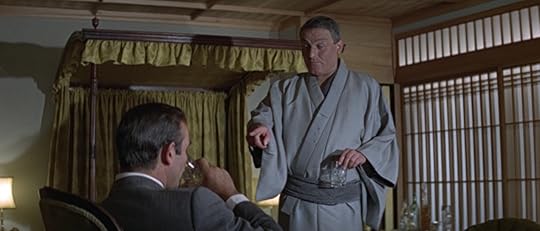
And then there's Henderson. I mentioned yesterday how he's different from the crude bigot in Fleming's novel, but I still don't like him. Charles Gray's performance is a cartoon. He's a spoof of a stuffy Englishman and impossible to take seriously. And of course there's the famous blunder in which Henderson offers Bond a "stirred, not shaken" martini. Bond's too polite to correct him, but geez, Henderon. You had one job. (Well, that and get murdered.)
Best Quip
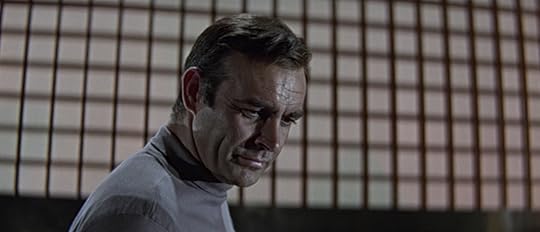
"Bon appétit," as the piranhas are eating Blofeld's henchman, Hans.
Worst Quip
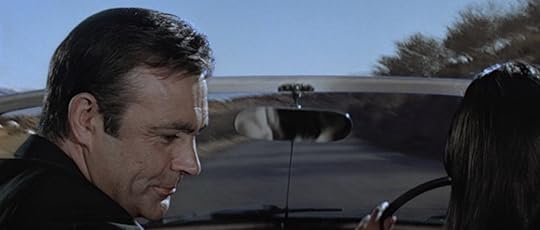
"Just a drop in the ocean," in response to Tanaka's fishing for a compliment after dropping some bad guys from a helicopter into the ocean.
Gadgets
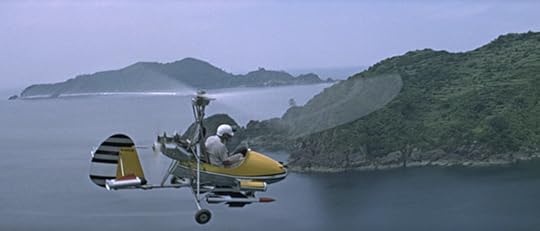
Bond doesn't have many British-issued gadgets in You Only Live Twice. Tanaka and SPECTRE both have a few, most notably the cigarette rockets that Tanaka loans Bond, but the only ones provided by Q-Branch are a safe-cracking device and Little Nellie.
The safe-cracker is lame, because it's never mentioned before Bond conveniently pulls it out of a coat pocket to use. There's no reason for him to be carrying it since he'd gone out that evening just to meet with Henderson.
Little Nellie is cool though. The gyrocopter is outfitted with machine guns, missiles, rocket launchers, flame guns, a smoke machine, and aerial mines; almost all of which get used in the excellent dogfight with SPECTRE helicopters.
Top Ten Gadgets
1. Aston Martin DB V (Goldfinger and Thunderball)
2. Jet pack (Thunderball)
3. Little Nellie (You Only Live Twice)
4. Rocket cigarettes (You Only Live Twice)
5. Attaché case (From Russia With Love)
6. Propeller SCUBA tank with built-in spearguns (Thunderball)
7. Rebreather (Thunderball)
8. Camera-tape recorder; mostly because it reminds me of a camera my dad used to use (From Russia With Love)
9. Seagull SCUBA hat (Goldfinger)
10. Book tape-recorder (Thunderball)
Bond's Best Outfit
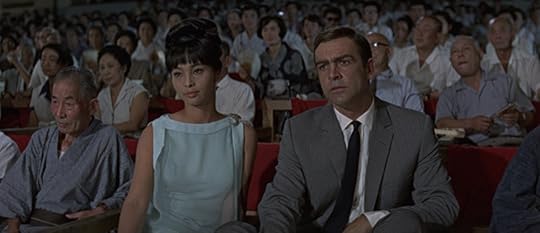
I do dig a light gray suit.
Bond's Worst Outfit
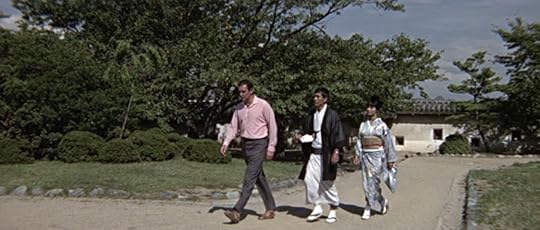
Pink shirt. Gray, high-waisted, sansabelt slacks. Brown sandals.

After such a wonderful, relaxed performance of Bond in Thunderball, Sean Connery is clearly fed up with the part in You Only Live Twice. He was frustrated with Saltzman and Broccoli for not cutting him a larger slice of the enormous financial pie the Bond series was creating, but he was also irritated by the shoot in Japan and the large crowds of fans who continually disrupted the process. Part of the problem with YOLT's Bond is the script - Dahl's isn't nearly as charming as the one for Thunderball - but Connery looks bored with the whole deal. There are moments of levity, but mostly he's phoning it in. It's especially noticeable in the action sequences where he can barely be bothered to aim.
The Moneypenny scene is again mutually playful. Later on, Tanaka will suggest that Moneypenny is interested in more from Bond, but I don't see that in Lois Maxwell's performance. And I like that Bond calls her "Penny," which I'm guessing isn't her first name, but just a nickname. I don't think that ever comes up again though.
Speaking of Tiger, Tetsurō Tamba was a great choice to play him and he's what I imagine now when I read the book. His ninjas are the worst though. The polar opposite of stealthy, especially when they invade the SPECTRE volcano.
Q shows up and he's cranky as usual, but there's no real animosity between him and Bond.
And then there's Henderson. I mentioned yesterday how he's different from the crude bigot in Fleming's novel, but I still don't like him. Charles Gray's performance is a cartoon. He's a spoof of a stuffy Englishman and impossible to take seriously. And of course there's the famous blunder in which Henderson offers Bond a "stirred, not shaken" martini. Bond's too polite to correct him, but geez, Henderon. You had one job. (Well, that and get murdered.)
Best Quip

"Bon appétit," as the piranhas are eating Blofeld's henchman, Hans.
Worst Quip

"Just a drop in the ocean," in response to Tanaka's fishing for a compliment after dropping some bad guys from a helicopter into the ocean.
Gadgets

Bond doesn't have many British-issued gadgets in You Only Live Twice. Tanaka and SPECTRE both have a few, most notably the cigarette rockets that Tanaka loans Bond, but the only ones provided by Q-Branch are a safe-cracking device and Little Nellie.
The safe-cracker is lame, because it's never mentioned before Bond conveniently pulls it out of a coat pocket to use. There's no reason for him to be carrying it since he'd gone out that evening just to meet with Henderson.
Little Nellie is cool though. The gyrocopter is outfitted with machine guns, missiles, rocket launchers, flame guns, a smoke machine, and aerial mines; almost all of which get used in the excellent dogfight with SPECTRE helicopters.
Top Ten Gadgets
1. Aston Martin DB V (Goldfinger and Thunderball)
2. Jet pack (Thunderball)
3. Little Nellie (You Only Live Twice)
4. Rocket cigarettes (You Only Live Twice)
5. Attaché case (From Russia With Love)
6. Propeller SCUBA tank with built-in spearguns (Thunderball)
7. Rebreather (Thunderball)
8. Camera-tape recorder; mostly because it reminds me of a camera my dad used to use (From Russia With Love)
9. Seagull SCUBA hat (Goldfinger)
10. Book tape-recorder (Thunderball)
Bond's Best Outfit

I do dig a light gray suit.
Bond's Worst Outfit

Pink shirt. Gray, high-waisted, sansabelt slacks. Brown sandals.



![[image error]](http://michaelmay.us/15blog/04/0419-flintandsilver.jpg)
![[image error]](http://michaelmay.us/15blog/04/0419-blacksails.jpg)
![[image error]](http://michaelmay.us/15blog/04/0419-doctorwho.jpg)
![[image error]](http://michaelmay.us/15blog/04/0426-clonewars.jpg)