Amy Rae Durreson's Blog, page 8
June 2, 2015
How I failed to write a Regency
I think of it as ‘fizzle,’ mostly because I like the onomatopoeia of the word, the hint of sizzling heat and quick fizzing reactions. I’ve heard it called other things: spark, frisson, attraction, the click. It’s the magic ingredient that makes a romance work, that little extra that draws characters together and keeps their interactions fascinating. I’m sure there are romance writers out there who can write it into every story, but I’m not one of them and I suspect I’m not the only one.
In every story I write, there’s a period of nervous expectation before that moment, usually somewhere in the first few thousand words, where the characters come face to face for the first time. No matter how carefully I outline the plot, design the characters around a common need and conflicting ambitions or desires, or how much pressure I put on them from the outside, I can never be certain what will happen as the scene plays out.
When it goes well, it’s exhilarating, and you know that you have a story worth telling, whether they’re snapping, snarking, or just terribly, terribly flustered (or, in the case of Lord Heliodor’s Retirement, one getting fired by the other for dropping a book on his head). That perfect click happens about 80% of the time, and I love it, to the point that once I have it I go dancing around my flat on the way to the kettle for more tea to fuel me through the night. Even when the rest of the book is hard work, knowing that initial fizz and spark was there is the reassurance that this story will work.
Of course, sometimes it fizzles out instead.
That was what happened to my first attempt to write a Regency. As soon as I saw the call for Dreamspinner’s 2015 June Daily Dose, I wanted to write for it. The theme was older men, and I’d had a wonderful time writing for their earlier anthology on the same topic, Snow on the Roof. I decided to get as far away from my story in that collection as possible and so avoid a contemporary setting. Why not, I thought, write a Regency? I love reading them, have always fancied having a go, and hadn’t tackled a historical since Aunt Adeline’s Bequest.
Within a day, I had my lead: a soldier home after Waterloo, reluctantly retired, seeing his beloved only daughter through a London season. I had an idea for his match: the dancing master hired to teach hopelessly tomboyish Thomasina how to behave at a London ball. I threw myself into research with glee (Regency dances are complicated), and not long after started writing. All was going well, until I finally got Colonel Fleet and the very proper Mr Cody in a room together.
And they nodded politely at one another. Fleet picked up the paper. Cody started his lesson.
And that was that. No fizzle.
I kept trying. I rewrote the scene, forced Fleet out of his chair, inflicted poor Tommy with mishaps to draw her father’s attention, tried and tried and tried.
But nothing worked. These two perfectly good characters simply weren’t interested in one another.
So I gave up and went back to the drawing board. I liked the idea of someone retiring reluctantly, but this time backed away from a historical setting and a military hero. What about a civil servant, I thought, someone who has quietly and competently done his duty for his entire life and now discovers that duty has become his life and he doesn’t know how to live without it? What would push a man like that into retirement? What happened to him?
What happened to Lord Heliodor was the Screaming, a lethal curse which killed several of his friends in front of him, made him risk his own life to save his queen, and left him with what modern readers will hopefully recognise as PTSD. I wanted to explore how a pre-modern society would deal with that, and see how Heliodor healed and found his way again, with a little help from the long-lost lover now working as his librarian (see comment about dropping books above).
This time, the fizzle, well, fizzed. Heliodor had a second chance with Corun, the soldier he’d loved and thought dead years ago, and I had another shot at a story about, ironically enough, second chances.
You can find out more about Lord Heliodor’s Retirement from Dreamspinner here. If you fancy reading the story that never was, I’ve put up what I did write of Colonel Fleet’s Dancing Master Thingy (it never got past a working title) over here.
Lord Heliodor’s Retirement
IT WAS not the Screaming itself that forced Lord Adem Heliodor into early retirement. Indeed everyone in the court was in full agreement that his lordship had acted with extraordinary and unexpected courage during the incident. After all, it was no common occurrence for a mere minister of ports and customs to be called upon to save the life of the queen, let alone in the face of a horror such as the Screaming.
No, Lord Heliodor’s retirement came two months later, in the wake of a council meeting where a passing remark of blinding stupidity drove him to his feet to shout, spittle flying and fists clenching, at the lackwitted, mealymouthed, porridge-brained imbecile who had made it.
And then, when the red mist cleared from his eyes and the rage stopped clutching in his throat, he found himself surrounded by silence, staring into the young, troubled face of the queen he had just insulted. Around the table, the rest of the cabinet were staring at him in wide-eyed shock, his old familiar colleagues and adversaries looking at him as if he was a stranger and the young, newly appointed councilors clearly wondering if the old man was mad.
“Give us the room, friends,” the queen said softly.
Heliodor stood there as they filed out, shaking harder and harder. He could feel a scream rising in his throat, and that in itself made him feel sick with fear. Had it caught up with him at last?
The queen closed the door behind the last of the council, poured a cup of tea, and brought it over to Heliodor. “Sit down, my lord, please. Here.” Her hand was warm and steady on Heliodor’s shoulder, pressing him gently into his seat, and Heliodor did as he was told, taking the cup with a shaking hand and sipping at the tea mechanically.
He had already been at court when the queen was born. He could even remember the royal baby’s naming feast, how he had spent it flirting with a certain golden-haired guardsman with merry eyes and a mouth as sweet as sparkling wine (for Heliodor had been young then, and wild, before he had spent his life in quiet service). Now his laughing guardsman was thirty-five years dead, and that baby was queen and had a husband and young son of her own, and Heliodor was… was just….
Heliodor was crying.
The queen waited patiently until he managed to choke back his tears. Then she said, her voice very kind, “You seem tired, my lord. If anyone in this kingdom has earned a chance to rest awhile, it is you.”
“Perhaps,” Heliodor said, and winced to hear how old and dry his voice sounded, “I could be excused from your council until tomorrow.”
The queen was quiet for a few moments. Then she said, “When did you last spend any significant time at home, Heliodor? In Worldham, I mean.”
Heliodor lifted his face with a mixture of shame and dismay. No. Surely she couldn’t just dismiss him to his country estate, to retirement. He swallowed hard and said, “My ministry?”
“Lord Zircon—”
“Zircon!” Heliodor flared up, anger blazing through him again. “That jumped-up little piece of—” Then he realized that he was bellowing at his sovereign for the second time in minutes and stopped, biting his lip hard enough that he could taste blood (blood on their mouths, running like tears from their eyes, and all the while the screaming, the endless shrill screaming….)
“Heliodor!”
The queen’s voice recalled him, and he bowed his head, hunching his shoulders up. He said, “I’m sorry.”
“You have served your country so well,” the queen told him. “Take your reward, my lord. Go home. Rest, and let us remove the burdens of your office from your shoulders.”
But they are my burdens, Heliodor wanted to say. He refrained, though. He had done enough damage today.
By the end of the week, he was on his way out of the city, being driven back toward the country estate he had not visited in decades.
Worldham was relentlessly green. As his coach slowed down on the fifth morning of his journey, his city-bred driver cursing at the narrow rutted lanes that made even the most well-sprung of modern carriages jolt across the road, Heliodor stared out of the window at hedgerows, orchards, and fields full of grazing livestock. The valley was too low and damp for vineyards, but hops grew here by the row, and the air smelled thick, green, and faintly sour.
It felt like he had stepped back in time as he had passed over the leagues between here and the crown city. Where were the coffeehouses and salons, the theaters and concert halls? Where were the bustling streets full of merchants, sailors, beggars, and fine lords and ladies? How was he supposed to endure the soft twitter of hedgerow birds when he was accustomed to the squall of seagulls?
He had spent much of his childhood dreaming of escaping the tedium of the countryside. How awful to be sent here to end his days.
For this was an ending, no matter how kindly it had been phrased. It was a much gentler one than others had been granted, but it was still an end.




May 27, 2015
North Yorkshire (Ten Castles Tour, Part Two)
After a lovely sunny day in Scarborough, I was surprised to wake to heavy fog the next morning. I was in no rush, as it was still a Bank Holiday and the buses were few and far between, so I made my way into town slowly and settled down at the bus stop with the book. I wasn’t the only one waiting for the bus to Helmsley, and several of my fellow passengers explained to me that this was just a sea fret so they were heading inland to get away from it and have a nice pub lunch somewhere less busy than Scarborough. That was reassuring, although the fog was still thick enough to make me a little sceptical.

Looking out from the steps of the Youth Hostel before I left Scarborough.

I shouldn’t have doubted. By the time I got to Helmsley, thirty miles inland, the skies were completely clear again. Helmsley is a beautiful little market town on the edge of the Yorkshire Moors.

Helmsley also has a castle. This is the most intact section, a Tudor mansion built on the space where the old hall used to be. It backs straight onto the innermost of the castle’s defensive ditches. Inside it now is a small display on the castle’s history.

Although the castle dates to the 1120s, its first, and last, battle was in 1644, when it was besieged in the English Civil War. It was besieged from September to November under the defenders were forced to surrender from lack of food. The Parliamentarian commander then ‘slighted’ the castle to prevent its further use, dismantling the curtain walls and towers and blowing up the east tower, which you can see here. The bank beyond it is still covered in overgrown rubble from where the tower fell.

Inside one of the towers that is still standing, beside the manor house.

By evening, Helmsley, which earlier had been so busy the bus had struggled to find somewhere to stop, was growing quiet again. Here’s the market square at dusk.

I left Helmlsey the next morning, heading back towards the coast. It was another sunny day, and I was heading towards my next castle of the trip, in Pickering.

Pickering is a motte-and-bailey castle, the most well preserved one I’ve ever seen. Here is the central mound with the remains of its defences. It offers views over the vale to the south.

The view from the mound.

The walls enclose a broad space around the motte, which is divided into two wards by a ditch and walls. The Inner Ward held the main buildings of the castle and the Outer Ward was used for more public business and could be cut off from the rest if attacked. The walls are still high around that side, and the whole interior space feels very sheltered and secure.
From the castle I walked down into Pickering and spent a happy hour in the local history museum, the Beck Isle Museum, which is one of those fantastic places which is packed with the memorabilia of everyday life over the last few centuries. After that, I headed across the road to the station and caught a steam train to Whitby, my overnight stop.
I didn’t have much time in Whitby and I needed to do some laundry, so I only went out to buy some fish and chips for my supper and then wander back through the dusk to climb up the steps towards Whitby Abbey (the Youth Hostel is beside the abbey).

Whitby is full of narrow little streets full of quirky shops.

Pausing for breath as I climbed up the Hundred Steps, I looked back to see the lights coming on along the waterfront.

At the top of the Hundred Steps lies the church of St Mary, which features in Dracula. I went for a slow amble around the grounds and glimpsed the abbey ruins rising above the graveyard.

And here’s the church itself. Despite the horror story connection, it was actually a very peaceful place to sit as it got dark.

I left Whitby early the next morning. I was heading north into County Durham, and had decided to take the scenic route up the coast instead of going straight to Middlesborough as I had on my previous visit to Whitby.

I was heading for the little fishing village of Staithes, which is tucked behind a tiny harbour and walled in by cliffs. I visited their local museum, a wonderfully quirky place which was 60% local history, with newspaper clippings and photographs covering every inch of the walls, and the rest is devoted to Captain Cook, who grew up in the village. The joy of Staithes, though, is the narrow streets and sudden views of the village, cliffs, and sea.

Although tourism is a major industry, fishing boats do still go out of Staithes.
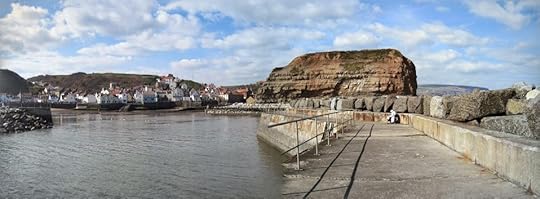 From the end of the breakwater, which I was sharing with several artists. The big cliff here was covered in nesting gulls.
Staithes, for me, was the magical moment which comes on every long trip, where you take a deep breath and suddenly realise that you’re on holiday and you can relax as much as you like.


May 14, 2015
An Upcoming Release and Easter in the North East (Ten Castles Tour, Part 1)
For the last few weeks, I’ve been so busy that I keep forgetting that I was on the road only a month ago. This year’s great adventure took me north, on a route from York to Edinburgh, via visits to ten different castles, two cathedrals, two railway museums, three cities, and a Holy Island, all by public transport. Over the next few weeks, I’ll be sharing a few highlights of my trip.
I’ve also got a new release coming up. Lord Heliodor’s Retirement will be part of the Dreamspinner June Daily Dose. The theme this year was older men. I was lucky enough to feature in their earlier anthology on the same theme, Snow on the Roof, and was very excited to write for this one. The gorgeous cover (created by Catt Ford) and the blurb are below:

Unlikely hero Lord Adem Heliodor saved his queen’s life during the Screaming, a magical attack on his city, but his broken nerves have forced him into an unwanted early retirement to his country estate. Adem thinks his life is over, but retirement holds some surprises. First, there’s his new librarian, who turns out to be not just the first love he thought was dead, but also someone surprisingly knowledgeable about political intrigue. Then there’s the assassin in the orchard and the discovery that the Screaming was just the first attack on the city.
You can buy the whole set now, or wait for individual titles to become available on June 1st.
I arrived in York just after 11am on Easter Saturday. I had been there once before, for a desperately needed day off about ten years ago, but the one major attraction I had run out of time to see then was the National Railway Museum. I love steam trains. It’s in my genes, I think, as my grandfather worked on the railways all his life, and I was brought up to appreciate our railways. Something in my heart lifts at the smell of steam and the distinctive sound of a steam locomotive huffing its way across country. The National Railway Museum in York is home to over a million pieces of railway memorabilia, from great locomotives like Mallard, whose 1938 world speed record for steam locomotives has never been broken, and the stunning Art Deco Duchess of Hamilton, to signals and sign boards and station furniture and all manner of weird and wonderful stuff.

On Easter Saturday, it was absolutely heaving with people, as you can see. This is just a glance down at the corner of the main hall.

Many of the locomotives are positioned around the turntable towards the back of the hall. The red train is the Duchess of Hamilton, who is polished to such a sheen that all this is the only one of the pictures I took of her that is actually in focus.

And this is Mallard, the fastest steam train there has ever been. Built in 1938, she was four months old when she broke the record, travelling at 125.88mph, just south of Grantham. She’s got a plaque on her side to celebrate her achievement and is one of the undisputed queens of the museum’s collection.

The museum also works to restore and preserve locomotives and rolling stock. This is peep down into their engineering bay. Up in the gallery you can also watch a live display of platform and line availability for the trains coming into York station and try to figure out the logistics of keeping them all moving on time.
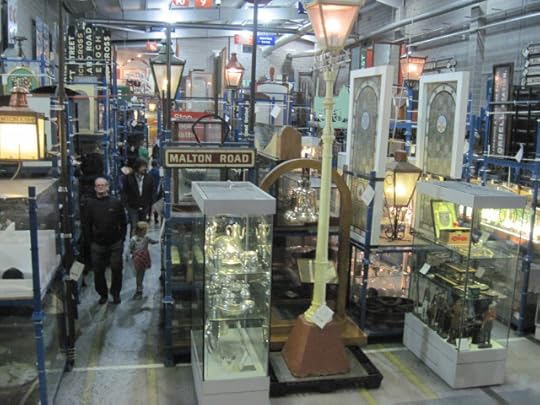
My favourite part of the museum, however, was the warehouse. Here they store all the items they have collected but not yet restored or investigated. They’re piled up in row upon row of signage and signals, seats and station silverware, models and memorials and some things which baffle the imagination. I was delighted to find the signs of many stations I have visited on my travels around the UK and intrigued by a memorial from my home town of Reading, in remembrance of a poor young chap who was killed in a whirlwind in 1840 (in Reading, which was then a very ordinary home counties market town!).

Also, a model horse (nope, I’ve got nothing. No idea).

This chap, however, is a collection dog. They were very popular from Victorian times until the 1950s, and wandered around major stations collecting donations for railway charities. There was a fantastic article about them on the BBC News site last year. Click on the picture to read it.

I eventually tore myself away from the trains to go in search of lunch. I ended up just wandering around York for the rest of the afternoon. The queues to get into the various tourist traps were huge, and it was too nice a day to queue for a hour to go inside or underground. This is the Shambles, one of the little old streets which date back to medieval times. I didn’t try to go along it, not with my full backpack on.

Round the back of the Minster, they were celebrating the Easter weekend with Christian rock and outside baptisms. You may just be able to see Archbishop Sentamu in front of the doors (all in white, of course, just left of the lamp post). It wasn’t a very warm day for it.

The whole city was heaving with people, and eventually I escaped down to the riverbank, sat down for the first time since I’d got off the train (I’d eaten on the move about three hours earlier) and caught my breath. Once I’d rested my feet for half an hour, I toddled up to the Yorkshire Museum to see their Richard III exhibition and goggle at their fossilised ichthyosaur, which is the closest I’ve ever seen to a real dragon.
I ended my day in York after that by making my very weary way back to the station (I later found out that I’d walked almost eleven miles that day without realising) and caught a train to Scarborough, where I was staying in a Youth Hostel a few miles outside town. I’d been here before, on another trip and was quite pleased by how easily I remembered the slightly complicated route from the bus stop.
The next morning, I set out very early to walk the mile or so across the fields to the cliff tops, where I had my breakfast gazing out towards Scarborough Castle on the next headland to the south. It was still very early and very quiet, but that wouldn’t last. To spend a bank holiday weekend at a seaside resort is to become just one tiny part of a very vast crowd.

The view from my breakfast spot.

Scarborough’s North Bay. The town is situated on the headland between two bays. The headland itself has been used since Roman times and houses the ruins of one of Henry II’s castles. North Bay is mostly beach and holiday accomodation, whereas the harbour and the older parts of the resort are on the South Bay. This is the mouth of Scalby Beck. The hostel I was staying in was the old watermill on this river, in a sheltered spot further inland.

This early, with the mist still clinging on, it felt a little eerie.
The morning clouded over after that, and I decided to wait and visit the castle later. Instead, I hopped on a open top bus and went round the whole route, listening to the history of Scarborough. As I did, the town began to fill up, with motorbikes, beachgoers, and day trippers. At the end of the tour, I braved the crowd to buy some chips and then headed up the headland to the castle. As I did, the sun came out.

Looking back over North Bay from the castle. The waves here are amazing.

Here’s the castle itself. Built in the most strategic position, of course. The keep was built in the 12th century by Henry II, but it remained important for centuries afterwards. It was besieged twice in the English civil war and last saw battle when it was shelled by the German Navy in the First World War (hence the missing bits of the keep).

Much of the headland is grassed over, and you can wander along the edge to enjoy the views. Here’s the view to the south, including a ‘pirate ship’ harbour cruise.

The keep from the side.

The south bay and the harbour. Even from here, it was obvious how very busy the town and beach had become.

In a churchyard just below the castle walls lies the grave of Anne Bronte, who died here on 28 May 1849. Her sister Charlotte, who was with her, decided to ‘lay the flower where it had fallen.’ I was pleased to see the fresh flowers. It’s a very lovely spot on a sunny day and you only have to raise your head to see the sea and the castle walls.

Back down on the seafront, things were very busy. I got back onto a bus to go round the headland to the other bay, but we pretty much crawled along at walking speed anyway!

Back where I had started, the eerieness of the morning had long vanished. I bought myself a cold drink and wandered back up the clifftops where I sat and read until it started to get cold.
I’d had a wonderful day in Scarborough and was well and truly in holiday mode. The next day, I would be heading inland again, towards more castles and the edge of the Yorkshire Dales.


February 20, 2015
Up the Downs again (and a peek at my current WIP)
It’s been a busy week, with the release of the Random Acts of Kindness anthology on Monday, and the usual mountain of accumulated chores which fill up any week off. I did manage to head down to East Sussex on Tuesday, though, to continue my walk along the South Downs Way. I’ve been picking odd bright days to continue the walk for a few years now, and am finally nearing the eastern end of the path. This walk was the last inland walking of the trail. All that’s left is the coastal stretch over the Seven Sisters and Beachy Head, which I’ve walked before, albeit ten years ago, so I had decidedly mixed feelings by the end of this walk. It’s been a long, dreamy wander through the sky, and it’s sad to think that it will soon be done.
(Scroll past the pictures to meet Arden, Tarn and Hal’s brother dragon)
This time the walk began at Southease station, close to the River Ouse which runs down to meet the sea at Newhaven. There’s a little branchline that runs from Lewes station, which is itself like a place out of time, and there’s little at Southease beyond a farmhouse and a unmade road which leads off the main road and over the level crossing towards the village a mile away.

Within another fifteen metres, you would barely notice there was a station there at all.

Like many of my walks on the South Downs, this one began with a steady uphill climb before evening off to lead along the top of the ridge for miles. These trees were perched at that point. It’s rare to see more vegetation than this on the South Downs. Unlike my local hills, they are very bare, which makes it feel like you can see forever. The town behind these is Lewes, which I have been circling for the last three walks.

The winter sun was low, and it caught in the fleeces of these sheep. Behind them, you can glimpse the sea and the headlands. What you cannot see from here is that those headlands slice away to reveal bright chalk cliffs.

Looking back towards the port of Newhaven, no longer quite the major channel crossing point it once was, but still busy and grubby (or it was, when we walked that stretch of the coast ten years ago. There’s a ruined village down there somewhere, and a WW2 fort hidden in the cliff. It seemed very far away from up here).

The Downs were surprisingly busy for a Tuesday morning. I guess the sun brings everyone out, including these chaps with their remote control aircraft.

And this man, who was taking to the skies himself. There wasn’t much wind, and I’d been watching him try to get aloft for about a mile. Just after I passed him, I looked back and saw that he was finally away.

Barrows, tumuli, and earthworks mark the entire length of the path. I find they make really good spots to sit and have a biscuit (though, yes, I do always nod hello in case the inhabitants feel slighted) and wonder who built them. It’s obvious why someone would want to spend eternity up here, but I still wonder what their lives must have been like. You can’t live up here, so they must have come up from the Weald or the coast.

The view along the ridge from the same barrow wasn’t bad, either. I’ll miss this kind of walking when I’m done (this end of the path is 3 hours away by train. I may do some of the closer bits again, but not this stretch).

Just one of the Downs dreaming away in the sunshine.

All good things must come to an end, and I eventually followed the path down to river level and the village of Alfriston, which is very pretty but knows it (and survives off tourist money). I’d originally planned to stop here, but it was only one-thirty and a mere three miles to the next good stopping place, so I pushed on.

Here’s Alfriston church, across the River Cuckmere. Aylminster Cathedral in Gaudete isn’t real, but if it was, it would only be a few miles further inland. I liked the shadow cast by the tree here.

Looking back towards Alfriston across the flood meadows. The path was on the bank, but very muddy. The underlying rock here is still chalky and chalk-mud is vile to walk through: it’s simultaneously slimy and sticky. I met a couple walking the other way and we stopped to commiserate and they compared it to toffee, which wasn’t far off (on reflection, it was more like treacle).

This is the next village along the river, Litlington. My easy final three miles were turning out to be tougher than I expected, and now the path went up again. There were three narrow ridges between here and the end of the walk, two of which needed flights of steps to climb, and the mud only let up in a few stretches.

Over the first ridge and I was startled to approach thick woodland. This is the end of Friston Forest and it was a very dark and eerie forest, full of long shadows, twisting muddy paths, and snowdrops gleaming in the shadows.

Afternoon sunlight striking the trees. I hadn’t seen woodland this thick on the South Downs way for several walks, and it was another reminder of how close I was to the end.

Between the final two ridges lies the village of West Dean, which my guidebook had promised me was very pretty. I thought it looked like the set of a horror movie. Even the phone box was green rather than red, and the whole village was hidden in the shadow of the ridge, even on a bright day. This was the only picture I got of it before I got chased off by an angry dog and had to make my escape up a steep flight of steps between low crumbling, moss-coated walls, while the rooks went cawing and wheeling overhead. Even when I finally got to the top, all I could see it front of me was a wall.

But when I looked over the wall, I saw this. This is Cuckmere Haven, where the River Cuckmere meanders down to meet the sea. It’s the only undeveloped river mouth in the south east of England. My path for the day finished at the road which crosses behind this, and it was an easy swing over a stile and walk downhill to the bus stop. The path continues up the side of the Haven, climbing steadily until it turns along the cliff edge. The coastal path itself comes inland around the back of the bay to the first bridge. Finally, I had reached the sea.
The next walk will be wonderful (it’s often cited as one of the best walks in the UK and I wouldn’t argue), but it was strange to be so close to the water. I love coastal walking, and do a tremendous amount of it, but this has been my inland walking project for so long.
I’m pouring my love of walking into my writing at the moment, too. Raif has travelled the entire length of the River Anniel to find and wake Arden, and he’s done most of it on foot. Poor Raif is very eager to meet this new dragon, who he imagines will be gracious and lordly and wise, and eager to fly them back across the north to confer with the Prince of Shara. Well, those of you who have read the glossary may realise that he’s in for a bit of a shock. For a start, Arden doesn’t speak the language. Also, he doesn’t feel like flying….
���Walk?��� Raif said. ���That will take months!��� There was no direct road from here. They would have go south of the moors and then swing through the mountain passes of the Low Amels, which would likely to snowed in by then, or keep south almost as far as the Dragon Gate before taking the main road northwest again. ���Why walk?���
���Fun,��� Arden said and pouted at him a little. ���You not fun, Raif?���
���No,��� Raif said. ���I���m not fun.��� He went to grab the pack, swinging it onto his back hard.
He had forgotten about his bruises until then, and winced when the pack slammed against them.
���Raif,��� Arden said chidingly, and his hands landed on Raif���s shoulders, pulling the pack off him. He had swung it onto his own back before Raif recovered enough to protest.
He was a dragon. He wasn���t supposed to do such lowly things. Raif knew perfectly well the relative importance of gods and men, even the most friendly of gods, and it was not appropriate for him to stroll along unburdened whilst Arden carried their packs. It just wasn���t right.
���My lord,��� he protested, reaching out.
Arden seized his hand, squeezed it gently, and then pointed at the deer track around the lake. ���Go?��� He started that way, tugging Raif after him.
Raif pulled his hand away and opened his mouth to argue.
���No, Raif,��� Arden said, without looking back. ���Walk. Not ow.���
���Hurt,��� Raif corrected automatically. ���I can cope.���
���No,��� Arden repeated and kept walking.
���But������
���Sssssh, Raif. Hurt am not fun.���
���Is not fun.���
���Is. Yes. Raif is mine.���
Raif sighed and muttered, ���Raif is your walking lexicon, clearly.���
���What?���
Raif changed the subject hurriedly. ���Oh, look. Birds.���
Arden shot him a smirk. ���Birds fly.���
���Unlike a certain dragon I know.���
���Dragon fly. Raif and Arden walk.���
Raif was beginning to get the feeling this would feel like a very, very long trip.


February 2, 2015
Andrew Q. Gordon on First Love and the true strength of a queen…
Today I’m very pleased to welcome fellow DSP Publications author Andrew Q. Gordon who is visiting to talk about his free release,��First Love, which is set in the same world as��The Last Grand Master.��I have a weak spot for fantasy prequels, and this one sounds wonderful. Here’s Andrew to talk about Queen Zenora…

Thanks Amy for hosting me today and letting me talk a bit about my new free release.
First Love has its origin in what was basically one sentence in The Last Grand Master. At one point Farrell tells Prince Peter of Belsport in passing about his first love. It was ten years before the opening of The Last Grand Master and Farrell’s mother���Queen Zenora���and teacher���Heminaltose���were still alive.
First Love not only shows what Farrell was like before the war began, it also let’s me show his mother and teacher, through his eyes.
Of all the characters, Farrell is naturally the most fleshed out. The story is through his eyes. But what of the secondary characters? ��I kid you not, the Champion of the Gods series is well over 2 million words long. Much of that is filler and background that I wrote to flesh out the story that will never see the light of a Kindle. Writing it, however, made it easier to write the entire story.
Queen Zenora of Yar-del is one of the more tragic characters in the story. ��Like Heminaltose, she doesn’t survive the open campaign of the war. One of the things I wanted to show in First Love, was the true strength of Zenora.
Zenora is the only surviving child of King Bren. In her own right, she is a very powerful wizard. Her power is often over shadowed by those around her, specifically Heminaltose, her teacher, mentor and ally. ��Meglar’s meteoric rise to influence upon the stolen energy of Yar-del also obscures Zenora’s true power.
But that just speaks to her strength as a wizard. What about her as a person? When King Falon of Zargon proposed that Meglar and Zenora married, King Bren and others had their doubts, but he allowed the prince of Zargon to court his daughter. ��A marriage between the two houses promised an end to thousands of years of conflict.
True to her calling as a princess of Yar-del, Zenora agreed to the courtship. In the end she agreed to marry Prince Meglar, unaware that he has been deceiving her all along. Within a few years, Meglar’s ultimate goal is revealed���to get close enough to Zenora to be able to steal Yar-del’s Source, the foundation of its power.
Zenora had to live with the fact that because she Meglar was able to deceive her, the world at large suffered from his rise to power. Adding to her pain, the gutting of the Source affected the health of her father, King Bren. Yar-del’s Source not only supplied the kingdom with its vast power advantage, it served to bind the monarch to the land. The damage to the Source caused Bren to irreparable physical damage to her father and caused his death centuries sooner than otherwise would have happened.
As if all of that wasn’t enough to heap on Zenora, before Meglar fled with his stolen energy, he tried to take his son with him. Fearful that Meglar might capture the boy and turn him against the world, King Bren, with Heminaltose’s agreement, ordered that Halloran could not be allowed to live. In a staged and very public scene, Heminaltose ripped the screaming child from his mother’s arms and disappeared through a waiting door. King Bren sent out an edict that he’d ordered the child killed and his name stricken from the House of Kel.
In truth, Heminaltose took the child to his school at Haven, changed his name to Farrell and didn’t tell Farrell about his birthright until he was twelve. During those years, Zenora saw her son sporadically and could not acknowledge as anything more than Heminaltose’s student.
The Zenora we see in First Love is preparing for a war she knows she will lose and trying to spend time with her estranged son. Even though logically she knows sending him to Haven was for the best, her heart still grieves for the child she lost.
One of the themes I want to show through out the series, is the love Farrell has for his mother and the ache he feels not only from her death, but from how little time they had together. First Love allowed me a brief opportunity to show how she much she cared for her son as well.
Enjoy!
PUBLISHER: DSP Publication
SERIES: Champion of the Gods
RELEASE DATE: 27th January 2015
LENGTH: 40 Pages
BLURB:
Prequel to The Last Grand Master
A Champion of the Gods Story
On a visit to Yar-del with Grand Master Heminaltose to celebrate his age of majority birthday, Farrell catches the eye of Lieutenant Cameron, a handsome young officer in the Queen���s Guard. But having spent most of his life cooped up at Heminaltose���s school for wizards, Farrell is clueless as to palace intrigue. He is unaware that his access to the queen is something others would greatly prize. When the queen points out that his suitor is the son of a social climbing minor noble, Farrell must decide whether to heed the warning or meet with Cameron anyway.
BUY LINKS:
EXCERPT
Tenth hour would take an eternity to arrive, but they both had to attend to their duties. Although Cameron seemed suitably impressed by his appointment, it didn���t improve Farrell���s mood.
He stopped himself as he started to think of ways to get out of dinner. Not going wasn���t an option. More importantly, Heminaltose only allowed Farrell brief visits to Yar-del City to see his mother. Skipping dinner meant one less chance to spend time with her. And he���d see Cameron at tenth hour.
���Boy.��� The deep voice behind Farrell made him freeze.
He turned slowly but already knew who he���d find. ���Master Heminaltose.���
Dressed in his formal blue-gray robe, he leaned on his white wooden staff and tilted his head to the left. ���What brings you to this out-of-the-way place? And why are you just standing there?���
Farrell had been in trouble often enough to know his master suspected him of something. When he tried to answer, his mouth went dry and his tongue turned to stone.
���Well?��� The older man raised his bushy white eyebrows and peered down his nose at his student. ���I���m waiting for an answer.���
His euphoric mood dashed, Farrell knew better than to lie. ���I came here to meet someone.���
���Someone?���
���Yes, Master, someone.��� This approach never worked, but he���d been too embarrassed to answer directly.
���Don���t treat me like a fool.���
Despite being at least an inch taller than his teacher, Farrell felt like Heminaltose towered over him.
���I���m not, Master. I��� I just���.��� His cheeks flushed and he started to sweat. ���I���d rather not say.���
���Excuse me?���
���It���s private.���
���Private? You mean���?��� Heminaltose jerked his head back and his eyes opened wider. ���By the Six! Now? Your hormones have decided to kick in now?���
AUTHOR BIO: Andrew Q. Gordon wrote his first story back when yellow legal pads, ball point pens were common and a Smith Corona correctable typewriter was considered high tech. Adapting with technology, he now takes his MacBook somewhere quiet when he wants to write.
He currently lives in the Washington, D.C. area with his partner of nineteen years, their daughter and dog. In addition to dodging some very self-important D.C. ‘insiders’, Andrew uses his commute to catch up on his reading. When not working or writing, he enjoys soccer, high fantasy, baseball and seeing how much coffee he can drink in a day.
AUTHOR LINKS:
Website: www.andrewqgordon.com
Facebook: www.facebook.com/andrewqugordon
Twitter: @andrewqgordon
Google+: https://plus.google.com/u/0/+AndrewQGordon
E-mail: andrewqgordon@gmail.com
GIVEAWAY DETAILS:
Andrew Q. Gordon is giving away the following:
$15 DSP Gift Card
An E-copy of ���Third Eye��� by Rick R. Reed
An E-copy of ���Ghost��� by Carole Cummings
An E-copy of a book by J. Tullos Hennig
Contest Begins: 27th January, 2015
Contest Ends: 9th February, 2015
Rafflecopter Code:
Rafflecopter Link:
http://www.rafflecopter.com/rafl/display/0f7bf72014/?


January 28, 2015
To the Temple of the Winds… (also stories about kindness and another dragon snippet)
And here we are, almost a month into 2015, and I actually have a new release to get excited about (what’s that, Amy? Something new? From you? Are you feeling all right?). I have a bittersweet little contemporary story in Dreamspinners’ upcoming anthology��Random Acts of Kindness. I loved the idea of the anthology and was determined to write for it. Neil and Monty’s story is about family, impending bereavement and finding the courage to live a little even after you’ve lost your way. The anthology looks like a lovely little collection and you can read more about it here (or click the picture).

One of my vague non-quite-resolutions this year was to make the effort to get outside more at weekends, to walk or play tourist. In accordance with that, I took myself up to the Temple of the Winds on Sunday. The forecast had suggested it would be bright and very cold, which suited me very well as the trail is a muddy one and I thought a good hard frost would help. I also quite fancied seeing the heather and gorse laced with frost.
It turned out to be mild and cloudy, but it was still a lovely walk. I followed the Serpent’s Trail long distance path, which is one of the sillier ones in the south-east, as it manages to trace a snaky 64 mile route between Haslemere and Petersfield, two towns which are about twelve miles apart. The first eight miles or so takes you up and over Blackdown, the great down that towers over the little market town of Haslemere.

Haslemere is a pretty little town, with an excellent independent bookshop and more quirky little gift shops than parking spaces. These days, its a very expensive place to live, but it still has a sleepy, cozy feel.

From the town, it’s a long, slow climb uphill between patches of woodland and fields, with views back over the downs.

This is Tennyson’s Lane, which is the road access to the top of Blackdown. It’s named after a previous owner of the land, one Alfred Tennyson, who was also known for writing a poem or two ;) Tennyson spent his summers here. He was one of a large group of writers who descended on the villages around Haslemere after the railway came. There were about 65 of them living scattered across these hilltops, including at various points Christina Rossetti, Arthur Conan Doyle, HG Wells, George Bernard Shaw, Flora Thompson, and George Eliot. My own ancestors were also to be found in close proximity to the poet, clearing out the grates and washing the crockery (several of them worked as house servants in Tennyson’s house, Aldworth).

Tennyson was known to love walking across Blackdown. It now belongs to the National Trust, who maintain the common. It is criss-crossed by paths.

The escarpment is very steep. Unfortunately the camera flattens out these angles, but the trees in the foreground were several metres below where I was standing.

Blackdown is the highest hill in Sussex and the third highest in the southeast of England. 280m above sea level (920ft) and 191m (627ft) above the valley below.
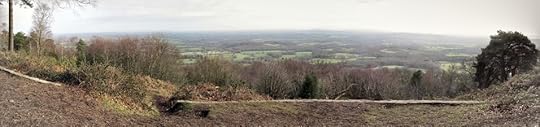
At the end of the down is the Temple of the Winds. Despite the grand name, there’s nothing there save an ornate stone bench and a view south over the Weald. On a clear day you’re supposed to be able to see the sea, 40ish miles away. I’ve never managed to get up there on a clear day, but even the misty winter version makes the climb worthwhile.

Looking east from the Temple of the Winds, there was a brief hint of sunshine.

The path then leads back along the western edge of the down. I rather fancied this old tree looked like an owl.

The gorse is in flower! According to old country wisdom, that means it’s kissing season.

And slowly, slowly, the paths winds it way down the far side of the hill. Looking at this makes me want to come back in early summer, when the beeches will be in new leaf.

Eventually the path comes back out on the road back into Haslemere. In the past, I’ve continued onwards over the next stretch of heath, where moss monsters lurk under every tree, but I decided that in winter discretion was the better part of valour and turned back into town in plenty of time to finish walking before I lost the light.
And finally, have another dragon drabble. Tarn and his kin are now in council following the first disastrous encounter of the Dragon Wars…
���The Shadow sends a message,��� Tarnamell told his gathered council. ���It makes this suggestion: that both sides fight only in the guise of men. Your thoughts, kin and beloved of my kin.���
Markell spoke first, graver than usual. ���At least we cannot bring down mountains when we walk as men.���
���Nor can we win a swift victory,��� Arden countered hotly. ���It commits us, and our hoards, to a slow war. We���ll lose too many.���
A noise by the door made them all swing round. Sharnyn was clinging to the doorframe, human face blanched and eyes shadowed. ���But never so many at a single blow,��� he rasped. ���Never so many simply as a passing strike, by sheer accident. If we are all men, each one of us has a chance to fight back. Death should not come burning from the sky to bring the mountains down, on������
���Nice job sedating him, great physician,��� Isara muttered, but Hal was already moving forward to catch Sharnyn as he slid down the doorframe.
���A thousand cuts can kill a man, just more slowly than a single blow,��� Arden said, but it was clear from his voice that he knew he would not persuade them.


January 4, 2015
A Midwinter Meander Through London
Ten years ago, I worked in an office near Gray’s Inn. I commuted, first from Surrey and then from Cambridge, and every morning and evening I would avoid the ghastliness of the Tube at commuter time by walking to one of the big mainline stations in London. I used to walk past lots of tiny little museums and quirky places, but never stopped to go in. Over Christmas, I was chatting to my mum, who had recently done a walking tour of London which had whetted her curiosity, and I mentioned how much I regretted missing out on all those places. It took us about twenty minutes to find a day when we were both free and so last Friday we headed up to London.
The original plan was to walk from Waterloo Station to King’s Cross via two museums, Sir John Soane’s Museum and the Foundling Museum in Coram Fields, then on past King’s Cross station to the London Canal Museum and St Pancras Old Church. That plan didn’t quite work out, since we acquired a three-year-old along the way, but our route was still a wander through some of the lesser known quirky corners of London.
We started by crossing Waterloo Bridge, which I firmly avow offers the best views of any the great bridges across the Thames, upriver towards Westminster and downriver to St Pauls and the startling architecture of the city. If you access the bridge via the underpass from Waterloo, you will have the chance to read Sue Hubbard’s beautiful poem��Eurydice, which is a stunning evocation of London.


From the end of the bridge, we wound our way up along the Strand and through the London School of Economics towards Lincoln’s Inn Fields. We wanted to visit Sir John Soane’s Museum, which is meant to be one the most eccentric art museums in London, but my sister texted as we were almost there to tell us she was on her way into London with my three-year-old nephew and could we meet up. Since the queue for the museum was already thirty people long, we decided to skip that one in favour of heading north to meet them for lunch. We swung up through Lincoln’s Inn, one of the four Inns of Court. This was true legal London now. The Inns are ancient institutions, dating back to the fourteenth century when they were professional colleges in the heart of London. Even today, all barristers in the UK belong to one of the Inns. To even qualify as a barrister you have to attend a certain number of social events in your Inn. The Inns themselves are home to the chambers of high-profile legal companies, as are the surrounding streets.

This is the Undercroft in Lincoln’s Inn. In the 18th and 19th century, unwanted babies would be left here and adopted by the Inn. They would be brought up as servants of the Inn, and were often given the surname ‘Lincoln.’
From Lincoln’s Inn, we emerged into Chancery Lane, crossed High Holborn, cut across Gray’s Inn and within minutes we had left legal London behind.

Bedford Row, just north of Gray’s Inn. All of these buildings are chambers, with the names of the lawyers posted outside the doors.
Crossing a road in London brings you to a new world. Five minutes north of Gray’s Inn, the law offices are gone, and there are hospitals on each side. Then you reach Coram’s Fields, home for the Coram Foundation, one of the oldest children’s charities in England, founded in 1739 to provide a home for abandoned children in London. These days the Fields are open to children (adults are only allowed if they have a child with them) and the charity continues to help vulnerable children. There’s a little museum there which combines displays on the history of the Coram Foundation with an amazing art collection. Throughout their history, they encouraged artists to display their work at the Foundling Hospital. Wealthy visitors would come for the art and donate to the charity, and the artists benefited from the display space and the publicity. They still work with artists today.
Ten minutes walk brought us to Kings Cross, where we met my sister for lunch. She’d treated my nephew to a trip on the Tube (so exciting if you’re three), and been round Camden Market. We left Mum to look after my nephew and snuck into the Harry Potter shop (ghastly and overpriced) before we all headed to the Canal Museum, which was lovely and very child-friendly (my nephew loved the fullsize model barge so much he declared that he was going to live there from now on). The museum is in an old Ice Warehouse on the Regents Canal, once the base of one of London’s early ice cream entrepreneurs.

My sister left us there, and Mum and I headed off to find our way through the back streets to St Pancras Old Church. We ended up walking along the Regent’s Canal as the day began��to fade.��
We were rather disappointed that this was closed.

St Pancras Old Church is supposedly one of the oldest sites of Christian worship in the UK. Sadly, when we got there, it was closed.
We finished our day by getting a train down to Blackfriars on the banks of the Thames and a riverbus back to Waterloo. By then it was dark, but the Thames is always illuminated by night.

Blackfriars Bridge and the Shard behind it.

The South Bank and the London Eye


December 24, 2014
Merry Christmas, Everyone
All the joy of the season to you all, whether or however you celebrate!
And to mark the day, here’s my favourite Christmas poem. I love the quiet magic of this one.
The Oxen
Christmas Eve, and twelve of the clock.
“Now they are all on their knees,”
An elder said as we sat in a flock
By the embers in hearthside ease.
We pictured the meek mild creatures where
They dwelt in their strawy pen,
Nor did it occur to one of us there
To doubt they were kneeling then.
So fair a fancy few would weave
In these years! Yet, I feel,
If someone said on Christmas Eve,
“Come; see the oxen kneel
“In the lonely barton by yonder coomb
Our childhood used to know,”
I should go with him in the gloom,
Hoping it might be so.
Thomas Hardy (1915)


December 21, 2014
More dragons and a chilly morning in Guildford
I did most of my Christmas shopping on Friday morning. Inevitably, I got bored of the crowds after a while and took half an hour off to sit down somewhere quiet with a late breakfast croissant. I’d made the trip into Guildford, which is our nearest big town, and my first choice for a few quiet minutes in Guildford is pretty inevitable (although it’s rare to have the place completely to myself as I did on Friday). Guildford, you see, has a castle.

Looking up from the south side of the keep. The remains of the castle and its grounds have now been turned into a public garden.

The keep from the other side. Guildford was a royal castle. The original motte and bailey castle was built not long after the Norman Conquest, and the keep was converted to stone in the 1130s.

Looking over the town from the base of the keep, towards the modern cathedral on the other side of the valley.

Looking south from roughly the same location. When the sun isn’t in your eyes, you can see right down the valley from here. Guildford was on the trade route from London to the south coast, and the castle would have offered good views of any threat to the ford over the River Wey.

The gardens in the sides of the defensive ditch are a little dull at this time of year. They’re at their best in late spring, when they’re full of tulips.

For some reason, there is a large commemorative sundial on the back of a shopping centre opposite the castle. I have no idea why Guildford is commemorating Edward I and his wife. He certainly visited the place a few times, but he wasn’t hugely important to the town’s history, as far as I can find out.

Guildford is full of little sidestreets and passages, some narrow enough that you have to turn to let people past and some wide enough to be proper roads. This is quiet Quarry Street, just below the castle. It supposedly owes its width to George IV, who was so infuriated when his carriage got stuck here on the way to Brighton that he ordered that the road be widened by knocking down the protruding chancel of St Mary’s Church.

St Mary’s Church, on Quarry Street. The tower dates from 1050, making it the oldest building in Guildford, and the rest of the church was built in the late 13th century.

And here’s Guildford High Street, complete with the clock on the town hall. For those who have read The Ghost of Mistletoe Lock, this was the road I placed Ryan’s shop in :)
And finally, another dragon wars drabble. This follows on from , and introduces one of Tarn’s sisters.
The market hall they had turned into their council chamber was packed with anxious people. Tarnamell looked out across the throng, wondering who to keep inside.
���Four pages,��� Isara said quietly at his shoulder. ���Us, and one more voice from each hoard. Breadth, but not chaos.���
���Reading my mind again?��� Tarnamell asked.
She raised an eyebrow. ���As if I need to, brother. There���s Hal.���
The crowd parted for Halsarr, Tarnamell noticed, though their brother didn���t seem aware of it. He simply strode through, straight to the dais. ���Sharnyn���s sedated. He���ll sleep for days.���
���How did you manage that?��� Isara asked, with too much interest for Tarnamell���s liking. ���Horse tranquiliser?���
���I���ll hardly tell you,��� Hal said. ���You steal things when we���re sleeping.���
���Out of love,��� she protested. ���I only see the rest of you when you come to retrieve your treasures.���
���To council?��� Tarnamell suggested before they started that fight again.
When the room was clear, it felt easier. He had more kin than this, but these five, and poor Sharnyn, were always the first to answer his call. He trusted them: Arden, Halsarr, Markell, Quarllian, even Isara.
���We must decide,��� he said to them now, ���how to fight this war.���


December 7, 2014
Dragon Wars Drabble (Tarnamell, Sharnyn, Killan)
I’m trying to get back into the habit of posting more regularly, so have another little snippet from the first war against the Shadow. This is from very early in the war, before the dragons and demons have reached the agreement to only fight in their human forms. Again, exactly 200 words.
20 years before the Fall of Eyr
Tarnamell remembered the slow birth of the mountain millennia ago, how the land folded higher every winter. The forests had spread across it, snow melt and rivers had carved its slopes. Now their battle had broken it into pale, jagged rubble.
To the east, terrible things circled on dark, ragged wings, demon lords aloft. Only one dragon still rode the winds above their township: green-winged Sharnyn, keening softly.
���I found you!��� A stern young voice said, as his page tugged at his sleeve. ���Everybody���s looking.���
���I���m right here,��� Tarnamell said and ruffled Killan���s hair.
Killan shook him off with all the dignity of his ten years and demanded, ���Is he crying?���
���Yes.���
���Why?���
How could he explain this grief to someone so new to the world? ���He loved the mountain and the people who lived on it.���
���Oh.��� Killan shivered. ���You should go and get him down now.���
���He needs to be alone. I���m keeping watch.���
Killan gave him a sceptical look, but just crossed his arms and looked up too. Tarnamell couldn���t tell if the boy was imitating his stance on purpose.
He took Killan���s point nonetheless and soared up to coax his grieving brother back to earth.