Amy Rae Durreson's Blog, page 4
June 5, 2016
Ironbridge Gorge: Tiles, China and Tar
A few weeks ago, I wrote about my trip to Ironbridge and its pivotal role in the Industrial Revolution. This is a rather belated follow up post about the later industrial history of the Ironbridge Gorge. Although the initial industry in the Gorge was all related to iron, other industries soon arose to take advantage of the riverside location and a technically capable local workforce. On the second day of my visit to the Gorge, I visited the sites of some of those industries.

This is St Mary the Virgin church in Jackfield, just over a mile downriver of Ironbridge. As you can see, the weather was grim, but I hope you can see a hint of the patterns and colours in the brickwork. Pattern and colour was at the heart of this little village’s contribution to industrial history, because here clay, not iron, ruled the day. Although the village first existed as a river port for the coal mines higher up the slopes, its first pottery opened in 1713.

By the mid-eighteenth century, the pottery was successfully producing Jackfield ware–black-glazed pottery decorated in gold. As more sophisticated techniques were invented, though, they fell behind the times. By the mid-nineteenth century, the original pottery works had been replaced by two vast tile works. The factory buildings remain–one is now a crafts centre and the other is the amazing Jackfield Tile museum.

And here are some of their tiles. From the 1870s to the 1950s, tiles were produced here and shipped to all over the UK and beyond. The museum tells the history of tile production, covering both the processes by which they were made and the changing fashions.

Tiles were increasingly popular in the Victorian era. Used for everything from floors of public buildings to decorative fire surrounds to hospital walls, they were easy to clean, added colour and interest to a room, and could be successfully mass-produced. Tiles made here appear in many great public buildings of the era, from tube stations to banks (there is even a reconstructed underground station in the museum, which was not something I was expecting to find in rural Shropshire).

I was surprised by how much the tiles fascinated me, but this was by far my favourite of the museums. The colour and lustre of them draws the eye, and some of the artwork is stunning. The Gorge had its own art school in Coalbrookdale and artists were employed not just here, but in the China Museum and designing decorative ironwork.

Although the works here originally closed in the 1950s when the company moved to Bridgnorth, but they have since reopened a small workshop in the museum which specialises in producing tiles using Victorian methods for restoration work.

Here’s the tiled walls of a children’s ward which was rescued and restored here. It reminded me of the fairytale tile pictures I fell in love with at St Thomas’ hospital in November.

This is the side of the other tile works in the village, now a craft centre, to give you a sense of the scale of the industry.

This footbridge links Jackfield with the village of Coalport on the other bank of the Severn. This footbridge dates from 1922. You may be able to see the plaque halfway along–the bridge was erected as a war memorial, and the plaque is the roll of honour. A sign at the end reads “This bridge is free / oh tread it reverently / in memory of those who died for thee.”

As you can see, there was a need for a bridge. The Severn is a fast and far from friendly river, and ferry crossings could be very dangerous. On October 23rd 1799, a ferry carrying workers back over the river from the china works sank. 28 people, including 15 women, drowned. There had been a wooden bridge, erected in 1780, but it had been swept away by a flood in 1795. A replacement only lasted a few years, and eventually an iron road bridge followed in 1818.

Some of those who drowned were likely too weakened from their jobs to swim through the dangerous waters. This is the Coalport China Factory. Another success on a national scale, it combines displays of gleaming and delicate china with chilling details about the dangers of the work. Working with plaster of Paris and china clay could be lethal and the workshops are full of signs wanting workers to treat even minor cuts seriously. If you avoided that danger, the specialised work of painting the china was even more deadly–lead based paints meant the life expectancy for a china painter was about thirty-five. Other jobs in the factory might let you live into your forties. To my modern sensibilities, there’s something obscenely ironic about an industry that could set up an art school and then kill the artists it produced.

A strange offshoot of the Shropshire Canal runs through Coalport, along the side of the kilns. It meets the river after only a few hundred metres, but its inland end is a much stranger device. The Shropshire Canal runs across the county at a much higher elevation. To link it to the river, the canal authorities installed an inclined place–a rail based pulley that hoisted tub boats up 63 metres to connect with the main canal at Blists Hill.

Here it is from the top (no pictures from the bottom, I’m afraid, as I was getting rained on at that point). Of course, the inefficient pulley hadn’t been the first attempt to solve the problem of moving boats. Originally, the plan was to dig a tunnel from the riverside to connect with the lower galleries of the mines on the hill above. Unfortunately, they ran into a problem once they started building the tunnel.

This is the Coalport Tar Tunnel. Despite the name, the goo oozing down the walls is actually bitumen. Although this was originally meant for boats, the excavators hit a spring of natural bitumen. They managed to get almost 1000m into the hill before they gave up and turned their proposed canal tunnel into a bitumen mine (gotta love that Victorian entrepreneurship!). You can still borrow a hard hat and walk along the first 100m and see the bitumen oozing out of the cracks in the walls (it looks like Marmite).
The rest of my trip was mostly steam trains and ruined abbeys, so there may be another post yet, but no promises


June 4, 2016
Rainbow Snippets hits rough waters
After spending my week off the day job doing nothing but writing, I have now finished Raif and Arden’s story, Recovery. I started pulling ideas together for this one in April 2013, and until about a week about was secretly convinced I would never finish it, so I’m feeling a bit lost and bewildered right now. Here’s six sentences from the 31k I wrote this week, which was just the final chunk of this 156k third book in a series (why, yes, I am craving a nice little bit of standalone flash fic right now). Enjoy!
But his heart was as broken and torn as the waters of the lagoon.
Arden had lied to him.
And then, out of the wind, the singing began, high and sweet and yearning, calling him to the waters, promising oblivion. Pol stirred beside him in the boat, rolling towards the edge, their hands reaching out, and a nixie came rising on the crest of the wave, pale hair spilling down her back, her mouth open in song, and her hands reaching out to pull Pol close.
Kastrian let out a shout of rage and swung the oar round to hit the nixie in the head, hurling it away as its song splintered in a shriek of fury.
“Cover your ears!” he roared at Raif.
Rainbow Snippets is a wonderful little Facebook group in which writers gather every weekend to post a six-sentence peek at one of their works. All genres are included but the snippets must be from books with a LGBTQIA+ protagonist.
Hoping to be a bit quicker coming round to comment this week, but it probably won’t be tomorrow, because I’m planning to actually go outside and experience this weird sunshine thing.


May 29, 2016
Rainbow Snippets meets the locals
Getting back into the swing of Rainbow Snippets this week, after taking a couple of weeks to hammer away at the current WIP. I’m still going (aaargh) but have finally reached the beginning of the end. Here’s six sentences in which Raif and Arden meet one of the minor spirits living in the city of Aliann…
The baker herself was a plump little woman with round cheeks and eyes as dark as currants.
Her Sharan was broken, but she talked warmly to Arden in a language Raif had never heard before. Arden translated quickly, saying, “She apologises for not speaking to you directly. She is no dragon, she says, to learn new tongues in the blink of an eye, and she has only been awake a few years.”
“Tell her I know quite well how irritating dragons are to the rest of us,” Raif said.
Arden clapped his hand to his heart and the baker laughed at him.
Rainbow Snippets is a wonderful little Facebook group in which writers gather every weekend to post a six-sentence peek at one of their works. All genres are included but the snippets must be from books with a LGBTQIA+ protagonist.


May 7, 2016
Rainbow Snippets climb a mountain
A change of focus for this week’s Rainbow Snippets. This week’s snippet is from a short story, The Dark of the Sun, which is included in DSP Publications’ anthology 7&7. The anthology is coming out on 10th May and can be downloaded for free from the DSP Publications website. It’s a showcase of genre writing, not necessarily with romantic elements, and each story takes on one of the traditional sins and virtues. My story addresses Faith, through the story of a priest who has lost his after the death of his husband. As he leads a party of pilgrims up a very high mountain to witness an eclipse, he is forced to face his own doubts and fears.
Here’s a bit of the climb.
Today’s climb was harder, even with a shirtless Amra encouraging them all along the way. He lost the monkey’s company not long before they climbed past the tree line, which was also when several of the party began to feel dizzy and queasy. For most of them the symptoms passed quickly, but one of the priests continued to vomit beside the path every few steps, and Meru Tanicius struggled to catch his breath even when they stopped. The path rose and fell, scrambling up a succession of ridges, first through the trees and then across scrubby heathland thick with spiky, flower-bright bushes. There were few animals up here except for the striped mice scrabbling through the undergrowth, but birds sang freely in low nests and eagles drifted overhead.
By the time they reached the camping spot, Tomal was worried about most of the party.
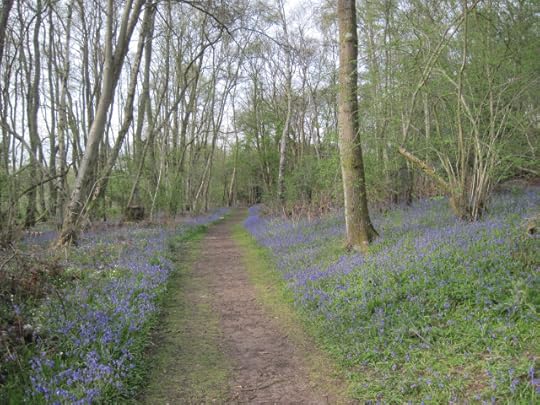
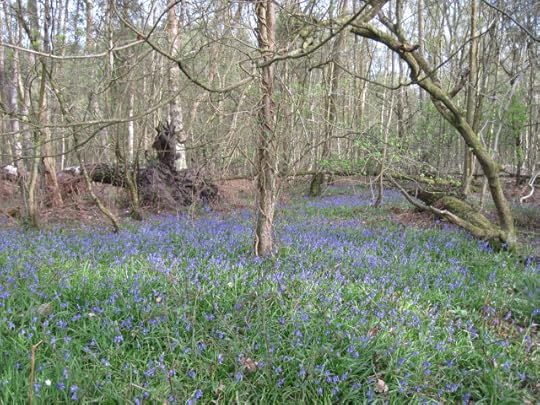
And, since the spring is still blooming madly, here’s some more pretty pictures of the local woods. I work in a small village ten minutes drive from the local town. Usually I catch a bus or get a lift to the station, but in summer I sometimes walk a rambling route back along foothapths and bridleways. It’s a good seven miles and takes a few hours, so I only ever do it on Fridays but I never regret it and this week I was rewarded with even more bluebells.
Rainbow Snippets is a wonderful little Facebook group in which writers gather every weekend to post a six-sentence peek at one of their works. All genres are included but the snippets must be from books with a LGBTQIA+ protagonist.


April 30, 2016
Rainbow Snippets (and bluebells) 30th April
In today’s Rainbow Snippets, you get bonus bluebells (and azaleas and duckling and goslings and blossom and spring foliage and.. and.. and). For those who don’t know, my blog is equal parts writing and walking. I’d usually do a separate post to explore all the history of the landscape, but this one is simple, so just scroll down if you want to find out about the man who decided to ‘paint a picture’ with trees.
In the meantime, here’s my snippet of the week, again from Recovery. There’s more going on in Raif’s life than romance, and here he makes contact with the community of exiled Tiallatai in Aliann (Raif is a very recent immigrant from Tiallat–a country that has just emerged from years under a totalitarian government).
He found the bookshop and his father’s friend, Ulviye, who was a tiny woman in a bright purple headscarf who fell on him with a cry of delight when she heard his name. She seemed more astounded by how tall he was than his presence in Aliann, and he regretted that he couldn’t remember her, especially once she started to tell him stories of his parents. Her shop was a marvel in itself, tiny and crammed with scrolls and books—some hand written but many printed, mostly in Sharan, but also in Latai and six or seven other languages he didn’t recognise. A samovar bubbled in the corner of the counter, its steam directed through a slanting window in the roof of the shop, and little twisting stairways led to further rooms overflowing with more and more words. She tugged him around the shop by his sleeve, introducing him to all her customers as ‘the poet Namik’s son’ and those who were Tiallatai bombarded him with questions about the people and places they had left behind. There were tears, then, and sighs of understanding when he had no news to share, and he was left startled and breathless, because he had never heard so many people speak at once anywhere in Tiallat.
And here, as promised, are a great many bluebells. This is Winkworth Arboretum(and some of the nearby woods and river). It’s a local marvel, founded by one Wilfrid Fox, who bought and landscaped the valley in the early twentieth century, adding a lake. The original larches which grew here were requisitioned and felled by the Ministry of Supplies in WW2 to make pit props. Dr Fox was dismayed by the loss of the larches, until he realised the opportunity it offered him to replant. He selected his trees for their autumn foliage, but did not neglect the colours they would show throughout the year–there are a thousand species here, and at this time of year the whole place is carpeted with bluebells. He gave the estate to the National Trust in 1952 and they still manage it (I shared my table at lunch with one of their volunteers and spent a very pleasant half hour chatting about local walks and taking his advice on the best route to the river). These pictures barely hint at the true colour. Imagine it four or five times as bright, and you’ll get a hint of how stunning it is.
Click to view slideshow.


April 23, 2016
Rainbow Snippets (23rd April)
Rainbow Snippets time again and here is Raif along with his new friend Luljeta and Arden, of course.
With one quick tilt of her wrist, Luljeta downed the whole glass.
“If I wasn’t too distracted by Raif’s pretty mouth,” Arden told her, placing his hand over his heart, “I would be quite madly in love with you.”
“Don’t make promises you cannot keep, my lord,” she said, winking at him, and lifted her chin. “That feels better. Thank you, Lord Denor.”
Clearly Raif needed to start making more sensible friends. Just one or two of them, for days when he needed a quiet life.
Rainbow Snippets is a wonderful little Facebook group in which writers gather every weekend to post a six-sentence peek at one of their works. All genres are included but the snippets must be from books with a LGBTQIA+ protagonist.
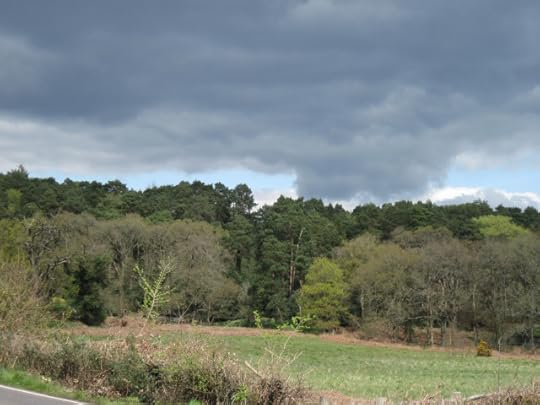
We always appreciate the colours of autumn, but these emerging shades of green caught my eye today.


April 11, 2016
Ironbridge Gorge: Iron and Furnaces
So I spent last week in the little Shropshire village of Ironbridge, where I had rented a cottage for a week of writing and walking (which was actually mostly a week of editing and getting rained on XD). Ironbridge is a deceptive place–at first glance it appears rural and serene, perched on the steep wooded sides of the Severn Gorge with the River Severn running at its foot.
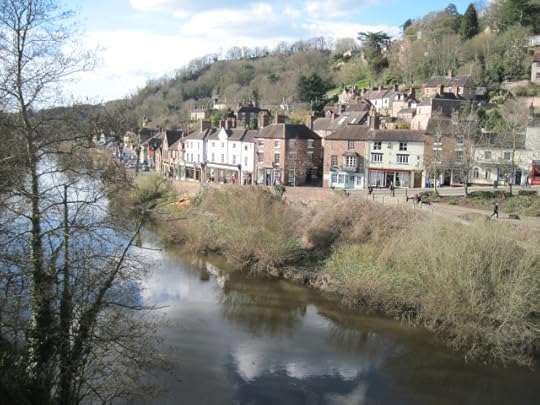
Looking upriver towards Coalbrookdale.
Yet from the early eighteenth to the early twentieth century, this scene would have been very different. Arthur Young, writing in the Edinburgh Review in 1797, described the valley thus:
After having passed over a few hills, that singular valley comes all at once into view, from whence, night and day, there arise clouds of fire and smoke… Nothing would be more dismal than this scene, if it did not exhibit the image of industry, and consequently make one conclude the condition of its inhabitants to be comfortable…. The trees are few in this valley, they are stunted in their growth, and bare of leaves; the ground, at every step, presents fragments of iron and coal, and the dark orifices of the pits dug for the extraction of these useful minerals. The birds, that animate and enliven country scenes, fly from this bleak and barren spot; and the most comfortless silence would reign throughout the whole valley, were it not disturbed by the noise of forges, of fire-engines, and of furnaces.
It was here in the Ironbridge Gorge that one of the most important strands of the Industrial Revolution began and the scars of that extraordinary era linger everywhere. A walk through the woods seems peaceful, until you realise the very straight track you are on was once a railway line, that the overgrown bricks were a furnace, or the supports for a slide bringing coal down from the higher slopes. Peering between the houses, you see brick walls built into the side of the slopes, pitted with the hollows of old furnaces. The whole area is a world heritage site, and its endlessly fascinating.
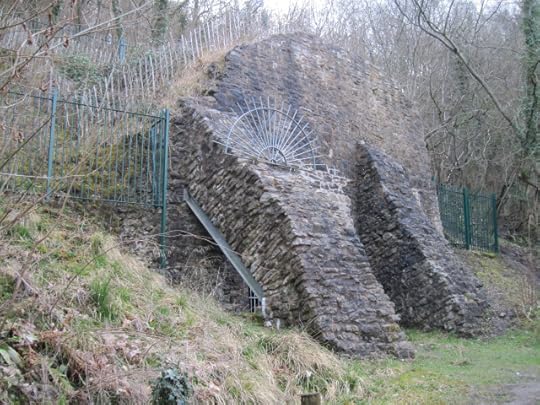
This is one of several lime kilns within a few minutes walk of the village. Although kilns have been used to process limestone since medieval times, lime is used in the iron refining process, so there was increased demand as the iron industry grew.
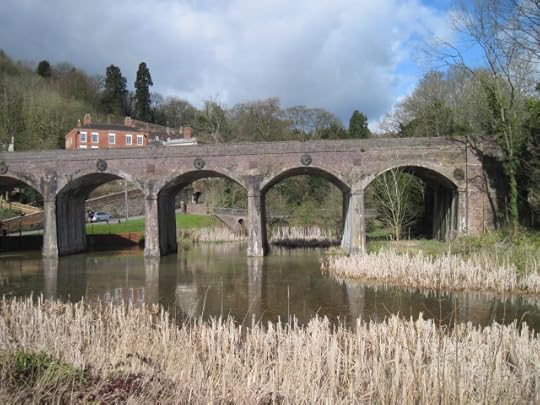
This is where it all began. This is the Upper Furnace Pool in Coalbrookdale. In 1709, a man called Abraham Darby arrived here from Bristol. He was a successful and innovative maker of brass pots, but wanted to develop his business by using a cheaper metal–iron. The greatest challenge he faced was in finding fuel to power the abandoned blast furnace he had bought here. At that time, blast furnaces were powered by burning charcoal–which is impractical for mass production because of the sheer amount of wood needed. Owners of blast furnaces frequently had to stop work to wait for the local woods to regrow.
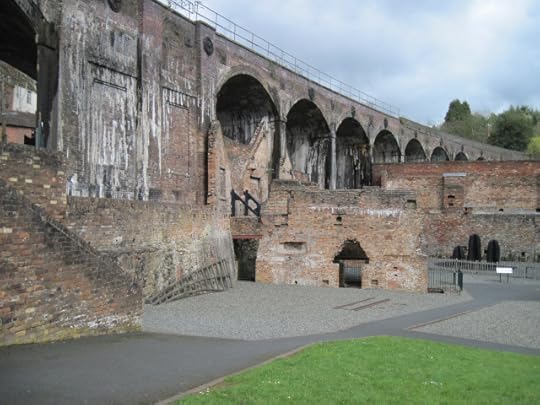
Darby, however, had used coke–coal with the impurities burnt out–in his previous work. Ordinary coal made iron brittle and unusable, but he believed coke would do the job. It was also much cheaper and quicker to produce than charcoal. He hired a few local men and set out to build a coke-fired furnace. His plan was a success, and he celebrated simply, by buying his workers a consignment of beer and setting to work to mass-produce pig iron. Here you can see the dam across the pool from the picture above and the location of the waterwheel which worked the bellows that were essential for his furnace.
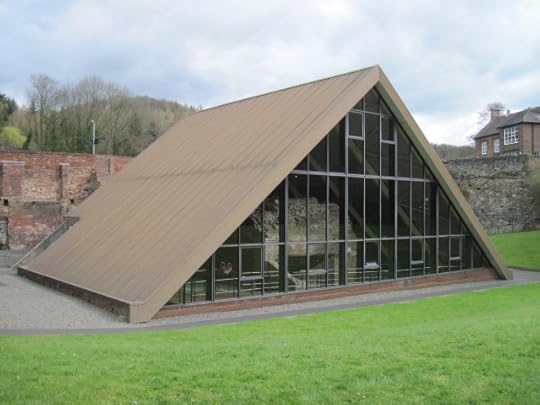
And this is what remains of Abraham Darby’s first blast furnace. It was a while before the rest of the world realised the significance of his invention. By then, he had established his business. He was succeeded by his son, Abraham II, who further refined the process.
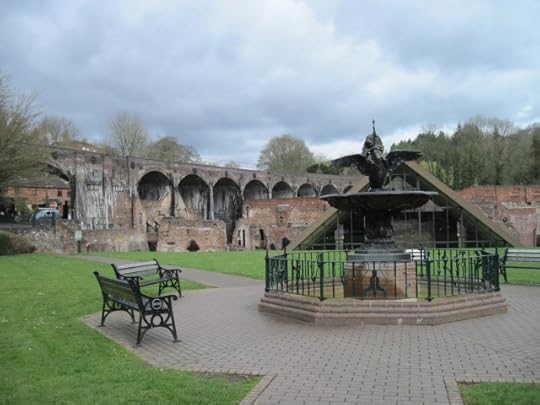
The site Darbys’ factory now houses two museums, and several archives and study centres, including the Museum of Iron. This fountain was created for the Great Exhibition in 1851, along with many other pieces (there was a whole gallery full of them inside). The most recent offshoot of the original company is slightly further down the valley and is still in operation making Aga stoves–the latest iteration of Abraham Darby I’s cooking pots?
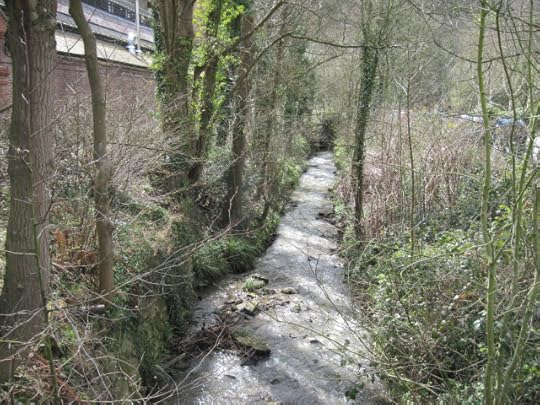
Of course, fuel wasn’t the only problem the Darbys faced. This is the little stream that powered the Industrial Revolution, just before it runs into the River Severn. Water powered the bellows that powered the furnaces and if the stream dried up in a hot summer, the furnaces stopped. To deal with this, the stream was channeled into a sequence of reservoir pools and channels and the later Darbys built a succession of engines which pumped the water back to the top of the valley. By then industry had spread the length of the side valley of Coalbrookdale, now full of furnaces, foundries, rails (the foundry here was one of the main producers of rails and engines for the first steam railways), wagon trains full of coal, iron and stone being pulled by horses, debris heaped high on the riverbanks, and smoke and steam. The industry was also spreading along the banks of the Severn, where great barges carried away cargoes of iron.
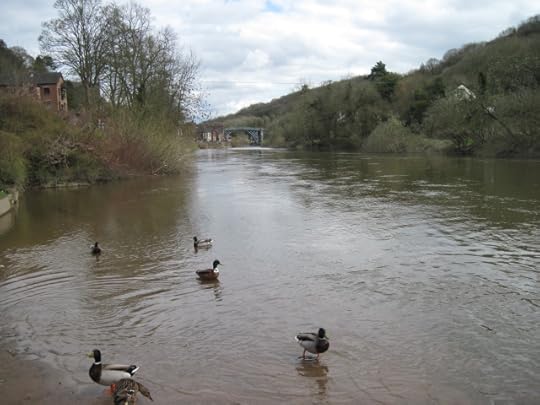
Not far from the mouth of the stream, you can look along the river to the foundry’s most famous product–the Iron Bridge. This is how the Ironbridge Gorge got its name–produced by Abraham Darby III in 1779, it was the ultimate demonstration of the potential of iron. It is 30m long and was the first bridge ever to be created out of cast iron. It opened on New Year’s Day 1781. In 1795 it was the only bridge on the Severn to survive an unusually bad flood undamaged.
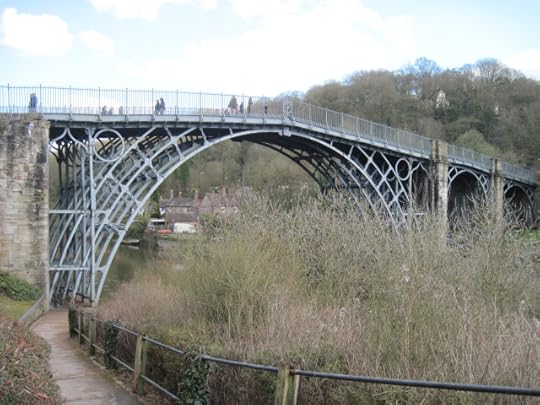
It’s now in the care of English Heritage and is a huge tourist attraction. It’s also quite stunning.
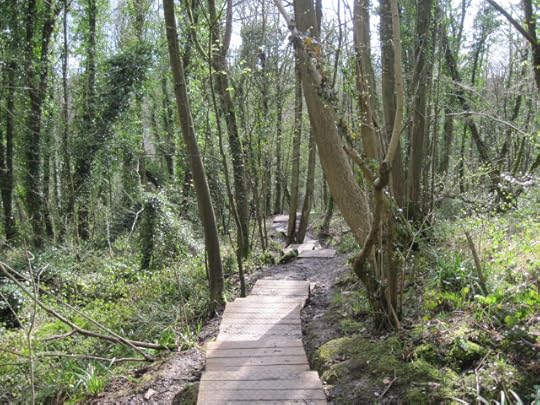
The whole gorge has felt the impact of industry. These steps through the woods a couple of miles downriver of Coalbrookdale looked charming, until I read the information board at the bottom which explained why they were necessary–a landslide. The gorge is prone to landslides anyway, and the end of industry exacerbated this. The village of Jackfield, across the river from here, lost 27 houses in the early 1950s as a result of abandoned mines flooding and causing subsidence (watch the Pathe news clip from the time).
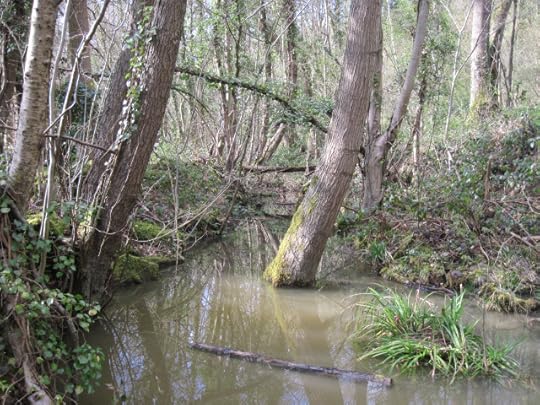
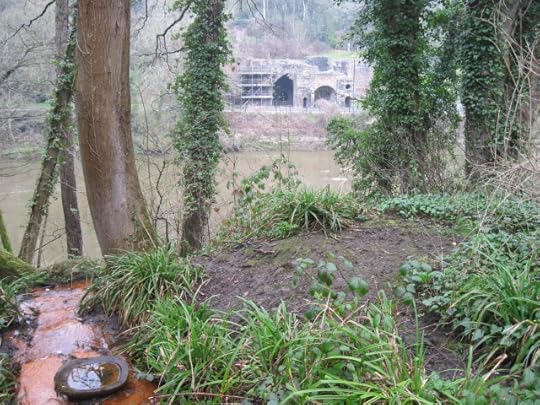
That path came out at another blast furnace, known as the Bedlam Furnaces (here seen from the other side of the river). Note the colour of the stream here, showing the minerals still in the water!
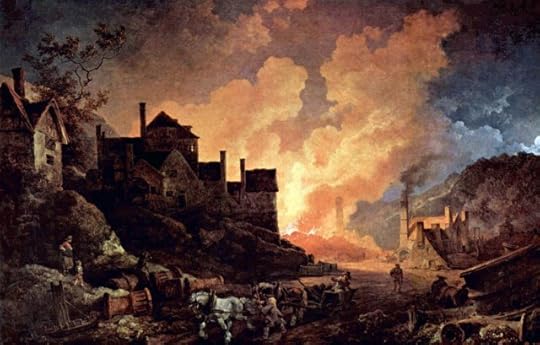
In 1801, Philip James de Loutherbourg painted the Bedlam Furnaces at work.
Of course, iron wasn’t the only industry to be found in the gorge, but that’s story for another post…


April 10, 2016
Rainbow Snippets (10th April)
This week, to fit in with the loose theme, here’s a few sentences from my very first m/m story, “Granddad’s Cup of Tea” which can be found in the Snow on the Roof anthology, a collection of stories about characters over the age of 40. My heroes are both in their 60s. Ewan, the protagonist, is a widower who lives near his daughter and grandchildren. He meets Alex, who has spent his entire life in the closet, pretending that he and his partner were brothers. After his partner’s death, Alex is dealing with bereavement and slowly coming out, and their friendship pushes Ewan into acknowledging his own bisexuality and attraction to Alex.
Here’s Ewan talking to his oldest granddaughter Mia about a schoolfriend of hers who has just come out.
“Everyone’s used to it now, and some people are totally haters, but most people just get on with their own lives and leave us alone. It’s not like it would have been in your day, when it would have been the end of the world if you went out with another boy.”
“Your generation didn’t invent gay people, Mia.”
She rolled her eyes at him. “You know what I mean. Come on, you would never have kissed a boy.”
“Oh, aye?” Ewan said, and the sight of her jaw dropping was compensation for all the grief his girls had given him that evening.
Rainbow Snippets is a wonderful little Facebook group in which writers gather every weekend to post a six-sentence peek at one of their works. All genres are included but the snippets must be from books with a LGBTQIA+ protagonist.


March 27, 2016
Rainbow Snippets (27th March)
Happy Easter everyone. Don’t eat too much chocolate ;)
A little bit more Raif and Arden this week, from my current WIP, Recovery.
His silence must have lasted too long, because Arden said, that hard laughter in his tone again, “Ah, once more I disappoint you, my Raif.”
“No,” Raif said, stung and ashamed. “No.”
“No?” It was still that faintly mocking tone, but there was something else there, something Raif recognised with a sudden twist of his heart as a ancient and fathomless loneliness.
Arden had lost his hoard, and only had Raif to replace them, and Raif had spent much of his time being irritated with him.
Rainbow Snippets is a wonderful little Facebook group in which writers gather every weekend to post a six-sentence peek at one of their works. All genres are included but the snippets must be from books with a LGBTQIA+ protagonist.


March 20, 2016
Rainbow Snippet (20th March)
This week, more Recovery, of course, as Raif and Arden attend a masked ball (I couldn’t write a fantasy novel set in pseudo-Venice without one of those).
“Masks are easier,” Arden said, his hands lingering on Raif’s face. “Everyone can see them for what they are.”
“Even if everyone is wearing them?”
“The danger comes when you think the masks are off,” Arden said, and there was little laughter in his voice. “They never are, Raif. Not entirely.”
Rainbow Snippets is a wonderful little Facebook group in which writers gather every weekend to post a six-sentence peek at one of their works. All genres are included but the snippets must be from books with a LGBTQIA+ protagonist.