August McLaughlin's Blog, page 63
May 23, 2013
Smash the Tomatoes: Dealing with Bad Reviews
Not long after my book released, I ran into an acquaintance in Hollywood. “I saw your book on Amazon,” he said. “Sorry about the reviews. Man, that must suck!” (Geez. Nice seeing you, too!) At the time, I had two critical reviews, and over 20 positive. If there’s one thing we can be certain of about reviews, it’s that the doozies will stand out.
A friend and fellow writer recently asked me how I deal with bad reviews. I’m so glad she did, as I consider myself somewhat of an expert.  I’ve likened my brain to a teflon pan when it comes to rejection and criticism, thanks to my acting and modeling days. I learned early on that my job was simply to do my best, and view gigs and pay as frosting that would eventually come if I kept at it. I still believe that.
I expected some harsh reviews and mixed feelings on my novel. I write about controversial topics in arguably unconventional ways. Writing the stories I’m compelled to write matters more to me than writing a “safe” book, or aiming to please the masses. I seem tough, right? Grrr… I can deal!

Well, usually. I let a couple of reviews bother me early on. One, in particular, seemed snarky and cutting. Like obsessing over a tiny blemish on an otherwise blemish-free face, they seemed to grow and fester. “It’s all anyone will see!” No, but…
Let’s face it. There are some seriously sucky aspects of bad reviews. They affect us and others more than they should, stand out like snowmen on a balmy beach to anyone looking (geez, enough with the analogies!) and have the capacity to hurt longer and more deeply than positive reviews feel good. Blah humbug! So what can we do?
Plenty, in my opinion. I’ve found that a little perspective check can go a long way toward thriving amidst what can feel like a rotten tomato-throwing war.
Reassuring Facts About Bad Reviews
1. We all get them. The more reviews we gather and books we sell, the more likely bad reviews become. It’s generally part of the deal, and shouldn’t make us less like authors, but more.
2. Many of the most celebrated books gain a significant amount of bad reviews. Based on Amazon.com reader reviews:

When readers chuck tomatoes, make ketchup!
I Know Why The Caged Bird Sings, by Maya Angelou 407 reviews, 66 critical (1 or 2-star)
The Bluest Eye, by Toni Morrison
590 reviews, 87 critical
Les Miserables, by Victor Hugo
961 reviews, 108 critical
The Great Gatsby, by F. Scott Fitzgerald
2,243 reviews, 256 critical
Girl with the Dragon Tattoo, by Stieg Larrson
4,107 reviews, 800 critical
Fifty Shades of Grey, by E.L. James
19,468 reviews, 7,136 critical
The list could go on, and on…
3. Many bad reviews are badly written. Nothing against people with lower IQs or limited literature savvy, but I appreciate the fact that many of the best reviews I’ve read (of my own book and others) are well-written critiques, composed by sharp and prestigious reviewers. Snobby? Maybe. But it helps.
4. The “star” system is flawed. Do you know what the 5 star levels specifically represent on Amazon? No one does, because it’s different for everyone. The layperson could simply be having a bad day, see the star system differently than we do (consider ’5′ the best book they’ve ever read, for example), or misuse it entirely.
5. Some bad reviews are better than none, and bad ones may even help. People tend to review books they love or hate, which isn’t necessarily negative. Numerous studies have shown that bad publicity boosts book sales—familiarity and popularity being bigger contributors to consumer decisions.
6. Price-drop promos make bad reviews more likely. When we run a price special, some folks will nab it simply because it’s cheap or free. They may not read romance novels, for example, but download yours for free, dislike it solely because of the genre, then blast away in a review. Frustrating, yes, but it’s nothing personal or worth beating ourselves up over.
(**The promotions are still worth it—trust me. It’s easy to focus on the bad reviews that evolve afterward. Focus instead on the increased downloads and positive reviews that arise.)
7. At the end of the day, they don’t really matter. My agent hasn’t seemed to care about poor reader reviews, nor have publishers who’ve picked up indie authors for mega-contracts, production companies that choose novels to base films on, or loyal readers, lovers, friends, plants or pets. If anything, beloved fans will probably root for us even more—and possibly bake us cookies.
Turning Tomato Wars Into Ketchup
(That’s my Minnesotan/optimist way of saying, turn rotten reviews into something positive, and don’t let them matter more than condiments do within a healthy diet. Even Minnesotans don’t serve ketchup as a main dish. Ew.)
Read reviews in moderation. It’s natural to peek in on occasion, and to read all reviews early on. But I feel that our time and energy are best saved for worthier pursuits. (There’s a reason that many celebs bypass reviews—and their careers carryon, perhaps better so, for it.)
Refrain from lashing out at the reviewer, or pleading friends and family to make up for it with praise. These are great ways to attract more attention to our bad reviews, and get unfriended, unfollowed and dis-liked throughout social media. (Reviews will come. We don’t need to beg.)
Re-read positive reviews. Read them out loud if it helps. Print them out, or paste them on your desktop. Positive feedback should empower us, so let it. By letting bad reviews bother us, we’re empowering the wrong thing.
Remind yourself that YOU ROCK! We all have moments or days of “Oh man, I totally suck!” But you’ve written a book! That’s a huge, admirable, worthy accomplishment. And it’s probably touched more than a few readers. True artists carry on, with or without a few tears along the way.
Laugh at them. Given the proper mindset, bad reviews can be downright hilarious. (If you’d rather, giggle at Ketchup Man. He won’t mind.) Giggling at famous authors’ bad reviews can also be oddly therapeutic—if only because many are insanely off-base and grandiose.
Stay captivated with book-writing—not review-reading. The best medicine for hurtful criticism, I feel, is focusing on writing another book. Get lost in story; that’s what counts. And since your next book is going to be EVEN BETTER than your last, phooey on whoever made you feel bad. (Did I just say phooey?)
Seek support. If self-encouragement isn’t enough, reach out. Most of us want to help one another, and no one understands as well as fellow scribes.
Do you read all of your reviews? How do you deal with the bad ones? Any tips to add? I always dig your thoughts.



May 20, 2013
The Highly Sensitive Clitoris
I adore my clitoris, now that I know what and where it is.

Here, clitoris clitoris… I know you’re in there somewhere!
Professor Olga Rockenstein stood before the Psychology of Female Sexuality, staring at us with bulldog-intense eyes. “Women know too little about their bodies,” she said. “Do you know how many don’t even know where their clitoris is?”
As her gaze caught mine, my expression read: “You’re kidding me!” What I really thought: My what?
The word sounded familiar, but I was 20, and too much time had passed since high school health class. When she called it the “pleasure button,” I assumed it was the area inside the vagina that lights up and explodes, triggering uncontrollable delight and making the entire world disappear, during orgasm. (Sigh…)

I wasn’t even close. When I learned its actual location, between the inner folds of the vulva, at the top of the labia (diagram here), I wondered if mine was broken. When I or my boyfriend touched mine, I felt…ticklish. Really ticklish, as in it nearly hurt.
If you relate to this, I suggest not Googling “sensitive clitoris,” unless you want nightmares and psychosomatic symptoms and of a clitoris-clobbering disease. Chances are, there’s nothing wrong with you. (If you suspect an illness, though, definitely consult your doctor.) Regardless, all clitorises are sensitive, and as lovely as the flowers they’re named after:

Behold, the CLITORIS!
Fab Facts About Clitoral Sensitivity
♥ A highly sensitive clitoris is usually just that—an organ so sensitive that mild touch can cause sensation overload. It’s more common among people with increased overall sensitivity, from what I’ve gathered, and in women prone to G-spot orgasms.
♥ You know how penises get incredibly sensitive post-ejaculation? Well, the clitoris is comparable to the head of the penis, only it’s smaller and has many more nerve endings—about 7,000. (So guys, imagine that sensation, multiplied by about 200.)
♥ If your clitoris has typical sensitivity, touching, kissing, licking and sucking probably feel DAMN good, and make way for climax. Clitoral orgasm is the most common and easiest to achieve, according to sexuality expert, Dr. Laura Berman.
♥ If yours is highly sensitive, you probably prefer gentler touching or pressure, on or around your clitoris. Vaginal (aka, G-spot) orgasms are likely to be your numero uno. In blended orgasms, we come in both places—YEE HA!
**It’s important to note that one type of orgasm is not superior or ideal. Our sexuality is unique, and we should all feel great about our personal style and preferences.
There’s also no “right” way to engage or enjoy our joy buttons. The key is knowing how our own works, and communicating with our partners, as needed.
#ClitParty: A Pleasure Button Clit-ebration!
Earlier this month, Clitoraid, a Las Vegas-based group namely devoted to helping victims of female genital mutilation, hosted the first ever International Clitoris Awareness Week. When a few of my sassy, Girl Boner-loving friends, and I learned of it, we decided to throw a party. And guess what. You’re all invited! Actually, you’re already here.  SURPRISE!
I know—a rather clinical party piece, but I happen to LOVE chatting about clitoral quirks at parties. Consider this segment the #GirlBoner geek in the room, and check out the following blogs later today, some of which will be slightly more steamy:
Kitt Crescendo: Project Cliteracy
Angela Tavares, via Go Deeper Press: Where Were You The First Time You Found Your Clitoris?
Bring Back Desire: Celebrating the Clitoris
Lana Fox, via Go Deeper Press: Freud’s Big Clitoral Snake
Yolanda Shoshana: Cheers to the Clit
You can also join us today on Twitter, using the hashtag #ClitParty. For a chance to WIN an erotic book from Go Deeper Press or a 30-minute clairvoyant reading with Goddess Isis Oracle (via Skype or phone), Tweet us about your clitoris: What you love about it, what you’d say to it, your nickname for it—whatever!—using the hashtag #ClitParty. For even MORE fun, join me on the Girl Boner Facebook page.
Prizes will be awarded for the most retweets and/or favorites, with extra points given for creativity. (Pssst! Guys can enter, too! Talk about a romantic gesture—tweeting about your sweetheart’s clit.;))
Will you be partying with us today? What have you learned about your clitoris? Is yours hypersensitive? I just LOVE your respectful thoughts.


May 16, 2013
A Peek Inside ‘Big 6′ Author Life: Amanda Kyle Williams
Thank goodness for books! Seriously. With all of the buzz circulating about Abercrombie & Fitch and its CEO’s damaging messages, I’ve had youth on the brain. Mysteries and thrillers helped me through countless teenage hardships, and I looked up to their creators long before I imagined becoming one. In a world with too many villains (*clears throat* Jeffries!), I’m particularly grateful to my author heroes.

Today, I’m stoked to bring you one of my favorites, Amanda Kyle Williams. Her Stranger series, starring former FBI profiler, Keye Street, is captivating, witty, spine-tingling and inspiring. Now through Sunday, you can nab its first installment, The Stranger You Seek, for only 99 cents. (Total steal!) I hope you’ll pull up a chair, and a cup of java. This author is one you don’t want to miss.
AM: I first had the pleasure of “meeting” your work, thanks to a serendipitous galley copy of your series premiere. Now, you’re about to release #3. (Time flies!) How different is it, being a further celebrated veteran?
AKW: I can tell you the writing process is very different now. It took me a couple of years to settle into my job. Sometimes just being still is challenging. Learning a new job is challenging. But I’m in the groove now. I have a routine. I’m fairly disciplined and I’m enjoying writing again, remembering why I love it. I lost that for a minute while I was freaking out. I just finished the third book, Don’t Talk To Strangers, and it’s the first time I’ve finished a book without secretly believing I’d never write another one. I hear I’m not unique in this way. Writers, as it turns out, are neurotic as hell.
AM: As a traditionally published, Big 6 (well, 5) author, are you flown around the world with an entourage who wines, dines and does all of your marketing for you?
AKW: [laughing] You’ve been watching “Castle,” haven’t you? Actually, I am treated very well thanks to a great agent, publicist and publishing house. But it’s more like I’m flown to a few cities with mystery bookstores. Great opportunity to develop relationships with booksellers and to meet readers. My books have a few translations now and that means foreign publishing houses so I was very happy to be invited to London last year to meet my UK publisher and attend the Harrogate Crime Writers Fest.
But here’s the truth, or at least my truth and my experience at my level: There’s a big push just before and after a release. Tours and publicity. It’s this crazy blast of activity in the middle of a writer’s solitary life. It’s fun and exciting. And then it’s over. And if you want to keep the buzz going, you pretty much have to do it yourself because publicists and publishers are on the next bazillion new releases. Not that they don’t work hard for me all year. They do. But their attention shifts. They have other authors. Now, if I have a marketing idea or need help, I can reach out and they’re there. The team at Random House has been incredibly available and willing. But it’s up to the author to learn how to promote, attend conferences, meet people, stay involved in the community, keep your name out there, develop social media relationships, visit book clubs, develop a website…
There’s a financial investment associated with conferences, of course. Travel is expensive. But I see it as just that—an investment in my career. A lot of authors blog, as you well know. I don’t. It’s fraught with dangers for a dyslexic writer. I’d have to employ a full-time freelance editor. It’s not something I have any interest in at this point. And honestly, I don’t have that much to say. Some days I can’t even manage a status update or something cute for Twitter so…
(Psst! She’s actually a great Twitter follow. Check her out: @AKyleWilliams.)
AM: What’s your funniest or zaniest fan story? (If your groupies are super normal, feel free to embellish.)
AKW: Oh sure. Everyone knows thriller fans are perfectly normal, right? All I will say is, my inbox gets pretty interesting. Funny story about my first tour: I went to Houston after the release of The Stranger You Seek. Murder By The Book petitioned hard for me to come to Texas and visit their store. My publicist was skeptical. First tour. No one knew who I was. Tours can be brutal anyway. It’s hard to get people out of the house and into a bookstore for a book signing even if they like the author.
So I go to Houston. Nice hotel. Good food. Published book. I’m feeling pretty important. Four people show up, including an older couple, white hair, sitting very quietly through my whole spiel. During the Q&A, I discover they’re only there because they think I’m a long lost relative from Mississippi named Amanda Kyle. [August falls over laughing.] Bless their hearts. More recently, I visited a local book club that chose one of my books as their monthly read and I was asked if I’d ever killed anyone. I took that as a compliment.
AM: Well they were lucky to meet you anyway. What lesson have you learned writing or career-wise, that you wish you’d learned sooner?
AKW: You know, I really wish I’d identified as a writer before I was a professional writer. I was writing on and off for 25 years before it was my full-time job. I think I would have found the confidence to go for it sooner. There’s value in speaking about things before they’ve materialized. It’s like looking like a success before you’re a success. Same principal.
When I began making lists of positive things to say to keep my mind for running negative loops, telling me I wasn’t good enough or talented enough, my life started to change very dramatically. It’s virtually impossible for your brain to get stuck on fear and worry when your mouth is saying something positive like, Everything I Touch Prospers and Succeeds. I’m creative. I’m talented. I have new ideas all the time. I write many books. I have these affirmations posted around my house—on the fridge, inside the medicine cabinet, over my bed on the ceiling with painter’s tape. Turning off that little voice that was holding me back infused my writing with some confidence.
AM: If you weren’t a writer, and could take on any skills/traits, what would your dream alternate career be?
AKW: Seriously, I have no skills except that I can write a little and I’m really good with animals.
AM: If you could have any celebrity endorse your book, who would you choose?
AKW: Um… Oprah. [August cheers too loudly.] I mean, come on. She sells the hell out of books. But seriously for me, for the big rush, I want one of the big boys. Right now Gillian Flynn (Gone Girl) and Lee Child (Jack Reacher series) are my fantasy cover blurbs.
AM: Lee Child would totally blurb you! We shared smoothies once. I’ll put a word in. (Kidding—pretty sure he’s forgotten my name.) What aspect of the author’s life do you find most rewarding?
AKW: Besides typing The End? I guess reading back something you really struggled with, honed and revised, and discovering that you managed by some miracle to say what you wanted to say, or create the emotion or suspense you were going for. Because when I start a scene, it’s not like that. It doesn’t come rushing out of me, perfectly shiny and polished. It’s a painstaking process, word-by-word, building from the foundation up.
The other thing would be getting mail from a reader who really gets the character or was touched by something in a book. I talk a lot about addiction in the series. I hear from a lot of folks in recovery. I get mail from from former cops and private detectives and dedicated crime fiction readers. It’s really great when you’ve gotten it right for them. All the hours pay off in those moments.
AM: Beautiful. Tell us about your 99-cents promotion, and what we can look forward to next.
AKW: My publisher decided to run a nice little promo on the eBook edition of the first book in the series, The Stranger You Seek—$0.99 wherever eBooks are sold in the U.S. The promotion runs through May 19th.The 3rd book in the series, Don’t Talk To Strangers, is scheduled to release February 11th. We thought this would be a great way for new readers to discover the Keye Street Stranger series and jump in at the beginning in advance of the 3rd release.
*****
Great indeed. If you haven’t yet, I hope you’ll all race over to Amazon, B&N, or wherever else you e-book shop, and check out Amanda’s work.
Isn’t Amanda Kyle Williams fabulous? Any thoughts to share with her? Do you relate to her “neuroses” as much as I do??? Sure we’d both love to hear from you.

In the sweltering heat of an Atlanta summer, a killer is pushing the city to its breaking point, preying on the unsuspecting, writing taunting letters to the media, promising more death. Desperate to stop the Wishbone Killer, A.P.D. lieutenant Aaron Rauser turns to the one person he knows can penetrate a deranged mind: Keye Street, an ex–FBI profiler and former addict who now picks up jobs where she can get them. But the last thing Keye wants is to be pulled into the firestorm of Atlanta’s worst nightmare. And then it suddenly becomes clear that the hunter has become the hunted—and the stranger she seeks is far closer than she ever dared imagine.
Available on Amazon, iTunes, B&N and more.


May 13, 2013
Abercrombie & Fitch: Who’s REALLY Uncool?
“In every school there are the cool and popular kids, and then there are the not-so-cool kids. Candidly, we go after the cool kids. We go after the attractive all-American kid with a great attitude and a lot of friends. A lot of people don’t belong, and they can’t belong. Are we exclusionary? Absolutely.” — Mike Jeffries, CEO of Abercrombie & Fitch

All teens should be told that they are beautiful, inside & out.
What teen feels “cool?” I’m fairly sure it’s the rare adult who looks back on their teen years, recalling confidence. I sure as heck wasn’t one of them.
I was 16 when a pair of hip modeling agents saw something in me I didn’t. From my first time before the camera, staring into what I lovingly coined the “beautiful black hole,” I seemed to morph into someone else—someone self-assured, pretty and Don’t mess with me-skilled. Afterward, I held my breath, awaiting dreaded feedback: You’re overweight, not pretty enough, too curvy in all the wrong places. When several meetings and shoots passed by with no mention of my size, I wondered for the first time if the notions I’d long held about my body were false. With the breath of one sentence, everything changed.
Following what had seemed a glorious shoot with a renowned Los Angeles photographer (I’ll call him “Gregor”), I laid on the ground, poised for that beloved black hole. Gregor lowered his camera, looked me in the eyes and said, “You could be working in Paris, if you lost ten or fifteen pounds.” The words felt like bricks to my stomach. Repulsion washed through me like sudden onset malaise. I wasn’t okay! My “fatness” was real.
My disgust rapidly transformed into motivation. Nothing would stop me, I decided. And nothing did, until countless shoots and weight loss tactics later, I lost consciousness while running toward the Seine in Paris, my heart and body too weak to carry on.
When I read of Jeffries’ remarks, his plot to keep the “uncool” (commercially unattractive) kids out of his stores, I couldn’t help but wonder if he’s become other individuals’ Gregor—confirming the belief that body shape, size and appearance determine whether one is embraceable or not, and that anyone larger than lithe is unsightly. I wish I could reach through the internet waves and hug every teen who feels unworthy, ensuring them that that is not the case: YOU’RE BEAUTIFUL, AND OKAY—MORE THAN OKAY—PRECISELY AS YOU ARE. ♥
One of my last modeling castings, post-recovery, was for Abercrombie & Fitch. Upon arrival, I learned that they were seeking “attractive” people to walk around their store—illustrating the consumer type they hoped to attract. I wish I could say that I was so disgusted that I rushed out and alerted the press, but I wasn’t. Presenting an “ideal” image for others to admire and aim for is what models do. I found the notion bothersome, but more so, boring. For both reasons, I turned the job offer down.
Last week, 18-year-old Benjamin O’ Keefe displayed the courage and wherewithal I lacked. In response to Jeffries’ remarks, the teen who overcame an eating disorder and depression, started a petition, beckoning others to boycott the trendy store.
“Instead of inspiring young people to make healthy choices and better themselves, Mike Jeffries and his company has told them they will never be good enough. Well, he is wrong.” — Benjamin O’ Keefe
The National Eating Disorders Association learned of O’Keefe’s efforts, and has joined forces. I had the privilege of discussing the Abercrombie & Fitch ordeal with Lynn Grefe, NEDA’s president and CEO, last week. Here are the highlights of our conversation:
AM: Critics of the outcry against Abercrombie & Fitch claim that there’s nothing wrong with a company targeting a particular group in the name of prestige and profit. How is it different from, say, a plus-size store targeting larger consumers?
LG: I’ve never heard of a store that says, ‘We don’t want ugly or fat people coming in our store.’ And that is basically what he said. There is no problem with targeting consumers, such as plus-sized models, but to actually discriminate and say, ‘We don’t even want those people in our store, who don’t fit in our clothes, and aren’t pretty and attractive?’ It’s terrible.
AM: You’ve described Jeffries’ marketing ploys as bigotry. What do you mean?
LG: I have it right here! Bigotry is ‘the state of a mind of a bigot, someone who treats other people with hatred, contempt and intolerance.’ That’s intolerance, to say that we only want pretty people, small people. They are teaching kids how to discriminate, how to body shame, how to make other people feel bad—hopefully inadvertently, but they are doing it.
AM: I’m glad you brought up the age issue, because it’s such a vulnerable age already.
LG: It is a vulnerable age! Nobody wants to be body shamed. Right now weight bias is significant in this country… To do this with children, and they know that they are appealing to children, is just awful.
AM: What are the repercussions of weight bias?
LG: It absolutely leads to poor self esteem and poor body image, and can lead to eating disorders. When you are body shamed and told that you are no good, it causes many people to engage in unhealthy behaviors.
AM: Tell us about the campaign to boycott Abercrombie & Fitch.
LG: Benjamin O’ Keefe created a petition through Change.org. He was willing to speak out, and we’re on top of it with him. We really support and applaud him. Beyond the petition, we’re pushing out a campaign targeting parents, as much as anything. For an awful lot of these kids, it’s the parents’ credit card. Why would parents want to support this kind of discrimination?

AM: A friend suggested to me that by speaking out against Jeffries, we’re supporting him—giving him free publicity.
LG: I think that people should be called out and shamed if they’re doing something that can hurt young people. People can buy what they want to buy, do what they want to do. I guess if this makes people want to shop there more, we didn’t do our job. But I don’t think we can ignore it. We don’t stand by and say it’s no big deal.
AM: What can we do to make a positive difference?
LG: I keep saying, ‘Be more concerned about the size of our hearts than the size of our hips.’ I really think if we could live that way, let people breathe and not feel like they’re under a microscope, it would make a huge difference.
To support O’ Keefe and NEDA’s efforts to make the world a happier, healthier place, sign the Boycott Abercrombie & Fitch petition. Show your support on Twitter by sharing this post, O’ Keefe’s post and/or the petition, using the hashtag #BoycottAbercrombie. For support regarding disordered eating thoughts or behaviors, call NEDA’s helpline: (800) 931-2237.
How do you feel about Mike Jeffries’ remarks? How about Benjamin O’ Keefe’s activism? Will they alter your shopping habits? I’d love to hear your thoughts!


May 9, 2013
Morning Hair, Colic and Mother’s Day Wishes
“There’s a story behind everything…but behind all your stories is always your mother’s story…because hers is where yours begins.” – Mitch Albom, For One More Day
I had a blast interviewing my mom last year on marriage and lasting love, and thought it was time for a followup. Yesterday we chatted by phone about motherhood. Here’s what my ebulient mama had to say, once again revealing tidbits I wasn’t aware of.

Mom and me on Christmas, 1981
August: When did you first realize that you wanted to be a mom?
Caroline: I can tell you the exact moment. I went to the hospital and my sister, Jackie, had just had her first baby. That was the first time I saw a baby up close, and I thought, “That’s what I want!” I always knew I wanted kids, but that sealed the deal.
August: What’s surprised you the most about parenthood?
Caroline: I’ve enjoyed it more than I thought I would. Children are so full of wonder… Also, your hair can be standing on end, and you can look in the mirror and think, “OH MY!” Well, you know my morning hair.
August: [laughs] Yes, but don’t worry. I won’t post a picture.
Caroline: You can look just awful, and you go to pick up a baby from the crib, and they think you’re just gorgeous! They love you either way.
August: Aw. You’re welcome!
Caroline: [laughs]
August: What’s one of your favorite funny memories?
Caroline: One night when Dad was working nights, I was sleeping on the couch, and you had colic, you know.
August: So I’ve heard.
Caroline: You were a siren at two or three in the morning. So I took you to the living room and hours later, I was sleeping on the couch. I jolted upright and thought, “Oh no! Where is she? What did I do with her?” And there you were, sound asleep on my shoulder.
August: [laughs] So I did sleep every once in a while.
Caroline: Yep! You could get away on such little sleep, yet were just full of joy. And joy is contagious.
August: I’m glad colic isn’t.
Caroline: Colic seems really long when you’re screaming in the middle of the night. But when it’s done, we’d think, that wasn’t so bad! You sort of forget the bad parts.
August: Ah. Post-colic amnesia. Sweet! Speaking of noise, I get my blurting tendencies from you. Do you remember my first one?
Caroline: Do I… It was just before Kelly was born. You were only about 18 months, and nursing just a couple of times a day. So I gave you a tiny glass of milk and explained that you’re still you’re going to get your milk, but you’re getting it from a cup now because Mama is having another baby. You looked at me and said, “So you’re going to be four mommies?” I said, “Yes.” And you said, “Well there’s only one daddy. And he’s ALL MINE.”

Got ‘im!
August: Such a giver, I was. Good thing I learned to share.
Caroline: You were a talker very early. Your first words were ‘Mama’ and ‘Dada.’ And you loved books.
August: I remember. You gave me a lot of quiet time with those books.
Caroline: That’s what YOU remember. You didn’t have much quiet time. You always thought you were in there for hours. I just gave you a chill out moment—time to refocus.
August: If you say so. I still need those.
Caroline: One thing you did that drove Aaron nuts, was you’d sit in your car seat and sing about everything you saw out the window, at the top of your lungs. And you’d look at Aaron and he looked like had smoke coming out of his ears.
August: I don’t blame him! But geez. Sometimes a girl gets bored.
Caroline: One of the funniest things, I remember as clear as a bell. It was your first experience with watermelon, at Grandma’s. Kelly had just started talking, and you were probably four. She held up her watermelon to you and said, “What’s this?” And you said, “I don’t know! But it has little black shiny things in it!” You reminded me of two little old ladies chatting about some newfangled thing. Now you can get watermelon all year long, but then it was only available in the summer.

Kelly and Me
August: Super cute. Was it different raising Aaron, compared to us four girls? Or were we all just really different?
Caroline: What your sex is was irrelevant. You all have blue eyes and blondish hair, but every one of you is unique. When you have four girls, you can really see the differences—very individual.
I never had a little brother, and wasn’t around little boys very much. I thought they loved cars and other stereotypical stuff, so one year I bought Aaron the cutest set of little cars and trucks from the Sears catalogue. But I realized I’d bought it for me. I liked it, and thought that he should like it. He was nice about it, but he never played with them.
August: [laughs] That’s probably why he and I played “used car lot” later on and tried to sell them off.

Mom and Pirate/Viking Aaron
Caroline: Now little Isabelle goes around with cars and goes, “Vroom, vroom, vroom. Truck!” She loves them.
August: You started having kids very early—20, right? Was it a shock?
Caroline: Yes, twenty. I don’t think that I’d even changed a diaper before. Dad taught me how. I think the biggest shock is to realize that they’re always there. They’re not going anywhere, and they’re your responsibility. It’s kind of like, “Here’s a sponge, and you’re going to teach it what it’s going to soak up.” Obviously kids make your own choices, but what things are you going to offer them? That’s a pretty awesome responsibility.
August: I can imagine. What’s your Mother’s Day wish?
Caroline: Well, I told the girls all I want for Mother’s Day is little handmade cards from the granddaughters, and that’s it.
August: Ha. Good luck with that.
Caroline: My Mother’s Day wish is this. You have chosen not to have kids like Carla has. But you’re a super special aunty to your nieces, and you can mother them if you want to. It’s not right or wrong to have a baby. If someone has them and they don’t want them, I would just love for them to find loving homes for them. There are so many loving people who want children but can’t have them.
August: That’s sweet, Mom. And cool that you’re so open minded. I’ve known for a long time that the only way I’d want to get pregnant is if one of my sisters needed to borrow my womb.
Caroline: [laughs hard] Hope you have lots of storage!
August: Well not all at once! Anyway, I’m glad they’re all fertile.
Caroline: I look at teachers who’ve never married, or never had kids. Their pupils are like their children, and they have more kids than any of us. I also wish that if people wish, they can be a mom. I don’t love you anymore or less because you have babies or you don’t have babies. And I was just telling Dad today that Zoe has an aura about her.
August: She does, doesn’t she? I love the way you tie it all into my dog—because you know that she’s my thing.
Caroline: Well she’s a special girl, my grand-dog-ter.

Zoe, the GREAT!
August: Brilliant and true. I have to head out, but if I find that picture of your morning hair from New York—
Caroline: Putsu! [Translation: AUGUST JOHNSON MCLAUGHLIN—Don’t you dare!]
Okay, okay… I’ll share her most recent poem instead:
Mama Brain, by Caroline
I looked forward to being a mom with great expectation,
Never realizing there would be days of great consternation.
Some sleepless nights, schedules to juggle, topped off with a bout of flu
Could leave me wondering, what on Earth would I do?
Motherhood is filled with hugs and fun, that’s a fact.
Motherhood is also a careful, loving balancing act.
Like sunshine following the rain, mothers rely on their mama brain.

The Johnson 5
(6 if you consider my Miami-bleached hair a creature)
What’s your favorite mom memory? What has your mother taught you? Any thoughts or questions for mine?
♥ Have a happy Mother’s Day! ♥


May 6, 2013
Your #GirlBoner Brain, on Orgasm
“Orgasm is one of the most all-encompassing phenomena in the brain. The only other thing that is known to produce such widespread [brain] activity is epilepsy.”
- Barry Komisaruk, researcher at Rutger’s University

Many of us think of sex like this. In reality, it’s more like this.
When I learned that researchers were studying the female orgasm by hooking women up to MRI machines while they climaxed, I was INSANELY slightly envious. Why couldn’t I have participated?!? Not sure I can conjure a cooler gig for a research and Girl Boner obsessed writer. My greenness quickly turned giddy shades of red, thanks to the power of distraction. The findings were fascinating, and affirmed what many sexually empowered women believe: Our brains are funky, sex-tastic beasts!
Some of the highlights:
* When our clitoris, vagina or cervix are touched, a different part of our brain’s genital sensory cortex—a fancy term for the outer layer that promotes sexy feelings—fire up. (Think July 4th fireworks.) All three areas can independently lead to orgasm.
* When the clitoris, vagina and cervix are touched at once, our pleasure sensations are amplified. (Think July 4th fireworks on steroids.)
* As we move toward orgasm, the hippocampus, which is associated with dreamlike memories, is stimulated. (No wonder mid-sex fantasizing rocks.)
* All 80 regions of the female brain studied at Rutgers University were stimulated during orgasm—at maximum capacity. (YES! YES! YES!!!)
* During sex, the amygdala, the brain’s emotional powerhouse, is sparked. Women are generally more emotional than men when it comes to sex and orgasm. (This is one reason that female physical sexual dysfunction is controversial; emotional factors, such as poor body image, low-self esteem and trust issues halt women’s libido. As I keep sayin’! )
* As we approach orgasm, the cerebellum causes tension in our abs, butt and thighs. Meanwhile, the front cortex, which controls abstract thought and planning (Hmm… more FANTASIES), kicks in. Then the pain-inhibiting brain areas, the anterior cingulate cortex and insula, rev up, causing the opposite of pain: PLEASURE.
* As we climax, the hypothalamus releases the feel-good “love hormone,” oxytocin. Our brain’s pleasure center, the nucleus accumbens, fills with dopamine and we sore even higher. ECTASY.
* As the brain and body calm down after orgasm, the hormonal shifts and release of tension stimulate a warm, nearly intoxicated, glow. Ahhh….

Knowing that the brain plays such a major role in our sexuality can help on multiple levels. I hope you’ll join me next week as we discuss lifestyle tips for a healthier, sex-friendly brain.
Would you volunteer to orgasm in the name of research? Do the orgasm study findings surprise you? Matchup with your experiences? I LOVE hearing from you! ♥


May 1, 2013
Pitching to Agents: Why A Little Sweat’s Okay
If you’re a writer, there’s a reasonable chance that you’ve had conferences on the brain. I’m heading to OWFI in Oklahoma this week, while many friends conference it up at DFW Con in Texas. Registration for ThrillerFest, Bouchercon, RWA and other fests are ongoing, all of which provide opportunities to mix, mingle and potentially pitch to literary agents.
As some of you know, I met my agent at AgentFest—the pitch portion of ThrillerFest, which takes place annually in New York City. My pitch was not polished, memorized or anywhere near perfect. I rambled a bit, stumbled over a word or 700 two, and probably spoke faster than ideal. But you know what? I had fun, relayed the gist of my novel, and my now agent saw something worth further considering.
While it’s awesome to prepare for pitches, and conferences in general, what seems most important to me is being ourselves while we’re there–whether we’re anxious, excited, shy, outgoing, blurty, loud or fill-in-the-blank.

An agent/author relationship is a close and valuable one. If we don’t mesh personality-wise, that’s a problem. Enthusiasm is a great thing, even if it makes us bumble around a bit. And no one is expecting the most eloquent speech ever recited. As my agent wisely said, it’s their (agents’) job to pitch stories to publishers; writers’ primary job is to write. Keeping that in mind might help remove some of the pressure. (I suppose I’m sharing what I wish someone had told me pre-pitch.;))
Most of all, I want to wish all of you who’ll be pitching this weekend or later on this year GOOD LUCK and heap loads of fun. If you are, you may find the following links helpful:
ThrillerFest.com: Something Did Happen (How I landed my agent)
Write It Sideways: How to Slam Dunk Your 90-Second Pitch, by Debra Eve
The Other Side of the Story with Janice Hardy: Is the Agent Pitch Session an Effective Tool or Could it use a Tweak?, by Guest Agent Sara Megibow
What writers’ conferences are you looking forward to? Heading to OWFI or DFW Con? Will you be pitching? Any tips or challenges to share?


April 29, 2013
#GirlBoner Quickie: Solo Sex and Body Image
“Good sex is like good bridge. If you don’t have a good partner, you’d better have a good hand.” ― unknown

One thing I’ve learned about body image is that self-nurturing goes out the window along with it. When we perceive ourselves as not attractive or worthy of love, we treat ourselves as though we don’t deserve either. Our healthy eating habits tank. We work out excessively or not at all, sleep too much or struggle for any, and let everything from annual physicals and dental checkups to well-deserved rest time slide. If sex enters our brain, it’s likely to seem like a chore, a waste of time or even something horrifying. (“I can’t let him/her see this!”) Luckily, we can turn all of these factors around. From a Girl Boner standpoint, I believe that doing so starts with masturbation.
There’s SO MUCH I’d like to say on this topic, and probably will (though some is top secret for publishing reasons—shhh!). *secures blurt guard* Since we explored self-perception last week, I couldn’t resist at least dipping in today. (I ♥ GB puns!)
“Women who masturbate are usually more comfortable with their bodies and with sex in general,” says Ian Kerner, PhD, a sex therapist and the author of Sex Detox.
Multiple large-scale studies have shown that women who masturbate routinely also have more positive self-esteem, positive views on sexuality and happier interpersonal relationships. Sadly, many women feel uncomfortable masturbating or discussing self-stimulation. (I certainly was, early on.) The more we learn about our bodies, and the beautiful things we’re capable of sexually and otherwise, the more comfortable and fulfilled we’re likely to be in our bedrooms, relationships and big, wondrous lives. Don’t you think?
5 Fab Facts About Female Masturbation
1. Masturbation boosts our moods, instantly. Our levels of feel-good hormones, epinephrine and dopamine, skyrocket during self-arousal. Orgasm furthers these effects, making way for relaxation and a sense of euphoria.
2. Masturbation is a form of self-nurturing. Taking time for ourselves and prioritizing self-pleasure, in my opinion, is a lot like treating ourselves to healthy, gourmet meals rather than scarfing processed food from packages. All self-care habits lend themselves to others; we essentially tell ourselves we’re worthy, which goes a long way.
3. Masturbation staves off infections and disease. Masturbation stretches the mucous in the cervix, according to Sex: A Natural History, by Joann Ellison Rodgers, which acid levels and stimulates “friendly” bacteria production. This allows more fluid to move from the cervix to the vagina, washing away bacteria that cause urinary tract and yeast infections. Sexy self-play also helps relieve pain when infections set in. Masturbation and orgasm are associated with a reduced risk for type 2 diabetes and improved cardiovascular health.
4. Masturbation promotes restful sleep. Many women masturbate to “wind down after a hectic day or to fall asleep at night,” says Carrie Levine, a certified nurse and midwife. In addition to simply feeling good and distracting us from the day’s stress, the happy-hormones released during arousal and climax provide a “warm afterglow” that can help us sleep with peaceful ease.
5. Masturbation improves sex and intimacy with our partners. We can learn so much about our bodies, what feels great and what doesn’t, through self-exploration. ”[Masturbation] helps build sexual confidence,” explains Kathleen Segraves, PhD, a sex therapist and associate professor of psychiatry at Case Western Reserve University. “It helps you guide the partner when you have a partner.” It also helps women who have difficulty reaching orgasm climax with ease, making sex more satisfying for both partners.
All of these solo sexy play perks are associated with positive body image. Stress, illness, a lack of self-care and sleep deficiencies make us feel worse about ourselves. (If you don’t believe me, try looking in the mirror after after a spree of sleepless nights, or when your whole body is pressed with worry.) Next time you’re feeling challenged in any of these ways, I hope you’ll consider a little naked TLC. When you do, try looking in the mirror afterward. I’m telling you—instant improvements. If you’re new to masturbation, check out Dr. Laura Berman’s article, A Woman’s Guide to Masturbation, for some stellar tips.
Have you noticed a link between your body image and sexuality? Are you comfortable talking to girlfriends or your partner about masturbation? Any related questions or topics you’d like Girl Boner to address? All respectful thoughts are welcome. You can also join me on Twitter and the Girl Boner Facebook page for between-post fun.


April 26, 2013
An Interview with OWFI (And I Have the Grooviest Friends)
I’m having one of those heart-gushy, “I’m so freaking grateful” moments, thanks to my friend and insanely talented author Mike Miller, and Patty Stith, president of the prestigious Oklahoma Writers’ Federation Inc.. A week from today, I’ll be mingling with wonderful wordsmiths, sharing some insight and soaking in even more in Oklahoma. I’d take such a conference over a Bahamas cruise any day of the year.
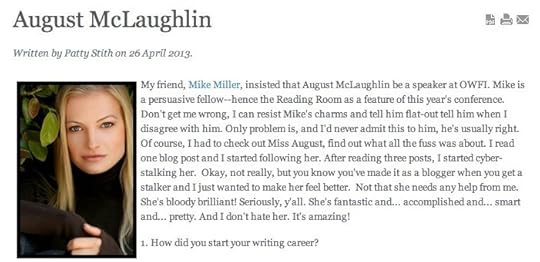
I’m honored to be a guest on Patty’s OWFI blog today, answering questions about writing, my career, gender swapping and more. I hope you’ll check it out. To read the interview, click the above link or this photo:
If you haven’t yet registered for OWFI and would like to, there’s still time! For more details, visit OWFI.org. You can also keep up with the conference via Twitter, using hashtags #OWFI and #OWFI13.


April 25, 2013
The Blurt Diaries #2: A Broken Breakup
If hindsight is 20/20, I’m pretty sure that some of my former boyfriends wish it was more like 20/300. I don’t mean to diss my younger self. I’m just saying—certain experiences could stand a bit of dementia blur. From where I stand now, what happened with “Humphrey” (not his real name) is pretty darn hilarious.

I met Humphrey at a club in Minneapolis, shortly after a burst appendix landed me in the hospital, followed by 30 days of bed rest. So sick of lying around, I took a friend up on her offer to hit the town. I was 22, and hadn’t yet had my first alcoholic drink. (Calories. It’s a long story.) This night called for let-loose-age.
Naive girl’s dating lesson #1: Never judge a date by your drunken brain’s perception.
There I was at the Gay Nineties, watching male performers with legs and dance moves I’ll never hold a candle to, when this cute, muscular blond (think surfer dude, with a preppy haircut and dress pants) sat down beside me. When he offered to buy me a drink, I chose what seemed like the healthiest menu option—Long Island Ice Tea. (Hello. Antioxidants!) The alcoholic hodgepodge gave me a free feeling I’d never before experienced. The world appeared softer, sparklier and lighter. So did I. During an otherwise turbulent time body image-wise, I could look at my reflection in a bathroom mirror and think, “Damn! I look HOT!”
The next day, Humphrey called, thanking me for the wonderful time. Though I couldn’t recall many details of our shared time, I’d retained that sense of wonder. I also mistook it, as Humphrey did, for falling-in-love type chemistry. On our first official date, we sat across the table from each other at a restaurant, me talking, Humphrey listening. The quieter he was, the more gregarious I became, and vice versa; I suppose I felt the need to fill the air, or balance things out. Once the alcohol started flowing, Humphrey spoke up and my boredom dissipated. (Welcome back, wonder!)
Every date with Humphrey played out similarly. And soon, signs of our incompatibility cropped up like a weed-plague overtaking a rose garden. He was an accountant; I was a psych. major/artist not-otherwise-specified. He envisioned marriage and children; I dreamed of backpacking through India and starting non-profits. He loved steak; I preferred legumes. He was a night owl; I preferred dawn. When we had sex, it was as though we were in separate rooms, trying to make love to a person we couldn’t find. Alcohol was our only mutual path to “enjoyment.”
After a Valentine’s date gone wrong, I knew it was time to part ways. So I did the logical thing. I wrote him a breakup song.
The next night I arrived at his place, clutching my guitar, feeling brave yet tender. It was time, I told myself, and though breakups are never fun, we could handle this like responsible adults—move on and chalk our time together up to shared learning experiences. Surely he felt our dissymmetry, too.
With perspiring hands, I plucked the strings on my guitar and chirped my “Dear John” letter-like lyrics, avoiding eye contact. I’d envisioned him holding me afterward, saying “thank you” and that he understood. Perhaps we’d shed a few tears then share one last kiss, knowing we’d closed the book on a story that should’ve ended at the preface.
I strummed my last chord then looked up at Humphrey. He was…smiling, and blushing. And silent. He finally broke the quiet, saying something about being speechless. I was right about the thanking and holding me bit. And our last kiss was probably our best.
Presuming that there was nothing more to say, I left, feeling relieved. The following night I performed with Propinquity, a folk-rock band I was part of during high school and sporadically after. I stood up on stage and introduced my new number, Came and Went (I still can’t believe I failed to recognize that awkward pun…). “I also call it the ‘breakup song,’ because that’s what it is,” I explained. I heard a “huh?” type sound from somewhere in the audience, then watched in horror as Humphrey stood up, his jaw slightly ajar.
Mid-performance I realized what had happened. After the show, it was confirmed. Humphrey had no idea that I’d intended the song as our breakup. He thought we were still together. (Youch, I know.)
When my own hindsight kicked in, I looked back and saw countless additional flaws in our partnership, some of which reduced the guilt I felt over the not-quite-obvious-enough breakup. Of course, those flaws weren’t fully clear to me until I wrote them into a song.
What’s the wackiest breakup you’ve been through? What lesson did your younger dating self teach you? What’s your take on breakup songs? (I may have matured, but I still see the value. ) Share away. I love hearing from y’all. Oh, and in case you missed it, the Blurt Diaries is a series in which I let my blurty mouth and fingers go wild.