
Lynne M. Spreen's Blog, page 15
August 18, 2015
Tuesdays at AST are for Writers
 Most of you know Any Shiny Thing as a blog about positive aging, and that’s 90% true. But there’s more.
I’m also an author, so I occasionally bore non-writers with posts about that. The other day, my friend Bob Hurlbert told me he shares those posts with his writing group, and that gave me an idea.
Every Tuesday, I’ll post something about the writing life. It might be a tip, a bit of wisdom, a reminder, a strategy, a triumph, or an admission of failure. I want to share with you, and I hope you’ll reciprocate.
What works for you, and what doesn’t? What are you learning? How do you keep up with everything? Any tips or tools to share? Spill it, sisters and brothers.
Because the writing life ain’t all it’s cracked up to be. (What the heck does that mean, anyway? Is it from a time when people gathered nuts, maybe? And then they cracked them and found, I don’t know, ants? Mold? But I digress.)
All my life, I dreamed of being a writer. I thought I would spend lovely days writing, and when my books were done, I’d bask in the adoration and awards. Not to mention significant royalties.

Not mine, shockingly.
As time passed, and I got the true picture of what I’d have to do to achieve success, I got so depressed I thought I might give up. But that would have been like giving up breathing, so now I’m stuck.
Here, off the top of my head, are some of the responsibilities of a professional writer.
You make plans, setting goals and objectives.
You budget time and money.
You hire contractors (e.g. web designers, editors, cover designers, formatters, etc.)
You write and deliver speeches, and/or teach workshops and/or classes.
You perform marketing and publicity tasks.
You belong to professional organizations, attend meetings, and perhaps do volunteer work.
You build networks of friends and partners.
You stay up-to-date through constant learning.
Besides the fun stuff above, you must take care of body and mind. To that end, I try to maintain a healthy work/life balance, which means family, love, exercise, and occasionally losing myself in a movie or art gallery.
Ha ha.
But the operative word is try. And right along with that is fail. For example, this will publish Tuesday morning, just as I begin a four-day babysitting gig. (“Family.”) So you might not hear from me until Saturday.
In his famous book, Man’s Search for Meaning, Viktor Frankl said humans are happiest when aiming for some kind of goal or purpose. It might be as simple as not overeating, or as big as world peace. My goal is to create a life in balance, one that supports the writing life. I get frustrated, but I enjoy the struggle.
So for the next few months, until I run out of ideas or you beg me to stop, I’ll post another installment of The Writing Life each Tuesday. Let me hear from you.
And we’ll continue to discuss positive, powerful aging every Friday.
Now if you’ll excuse me, I have to pack tomorrow’s lunch.


August 14, 2015
Why We Use Ms.
 I was shocked that she was shocked. My young friend was riveted as I explained history to her. MY history, which was only from about 40 years ago.
She’s a Millennial, and had no idea why the designation “Ms.” was invented. When I told her, she was surprised and intrigued.
In case you have young people in your life who don’t know, before the invention of the honorific “Ms.,” women were either Miss (maidens; i.e. never married), or Mrs. (married or widowed).
While men have always been called Mister regardless of marital status, women were denied this privacy.
To my warped way of looking at it, it seems this was intended to designate who was or wasn’t virginal/available, regardless of the woman’s preferences.

During marriage, women lose their names completely. Thus, if I, Janetta Dos Flamencos, marry John Smith, I become Mrs. John Smith. Every trace of my brilliant and colorful “maiden name” is erased.
This realization led to the popularity of hyphenated surnames, but if you’re just linking your dad’s name with your husband’s, what’s the point?
Later, if John dies, I get my first name back: the designation “Mrs. Janetta Smith” indicates widowhood.
During the feminist awakening of the 1960s-70s, we resurrected “Ms.” as a counterpart to Mr. It is neutral as to marital status, thus giving women the same privacy as men.

Not everybody fell in love with it. I remember being mocked, as in:
“Will Mmmiiiiiiiizzzzzzzz Lynne Kuswa please come to the office?”
Now it’s accepted, and used as the default, unless, per the Emily Post Institute, a woman specifies her preference for Miss or Mrs.
Remembering this change, which happened just as I reached adulthood, makes me sigh with weariness. Like so much about feminism, the reasons for its necessity are forgotten. The fight is forgotten. So it was gratifying to see the young woman’s eyes widen in disbelief when she found out that this all occurred.

A few years ago, I happened to mention to my 30-something son that there was a time when women couldn’t get hired as firefighters or police officers. He is very bright, but he was shocked. And I was shocked that he hadn’t known.
This isn’t ancient history, folks.
My mother was 5 years old when women got the right to VOTE in this country! And that was after a long fight in which women were jailed, went on hunger strikes, and were force-fed with tubes for the right to vote! In case you’ve never seen it, watch this trailer for the unforgettable, triumphant, Iron-Jawed Angels with Hillary Swank.
We really have come a long way, and sometimes it saddens me that young women take equality for granted. On the other hand, doesn’t that presumption of equality make them stronger?
August 7, 2015
Dressing Crazy When You’re Older

You never wanted to be a “little blue-haired lady,” did you? Yet here we are.

In a recent issue of More Magazine, which I love, editor Lesley Jane Seymour suggests we stop buying classics and branch out with some kind of flair. “That’s how we spotlight our uniqueness (as opposed to what we wanted to do in our twenties, which was to blend in.) Find a killer coat in an unusual print or color and wear it to death.”
When we get older, a new song begins to play in our heads, over and over again. It’s the “I’m not going to live forever” anthem.
It can make us go through our dresser drawers and closets and get mad about how we’ve missed out on all the fun of wearing our favorite things, because of public opinion. But if not now, when? Then we get a murderous light in our eyes. We hold the object up, shake it at the ceiling in a clenched fist, and shout:
I’m going to wear this and I don’t care WHAT they damn think.
You have something like that, don’t you? Something you love, but you’re never quite sure of wearing. Maybe a nice pair of shoes that would really only go well with a very nice pair of slacks, to a very nice event. You look at them, and sigh, and think, some day. Then you hear my voice in your head, saying ever so politely:
SCREW THAT! They’ll look fabulous with jeans!
Maybe you have a flashy jacket, or a sweater with little baubles sewn all over it. What are you waiting for?

Maybe you have a big red hat that feels just a bit pretentious. So you let your granddaughter wear it, for fun. But only around the house, because you don’t want it to get wrecked, or lose it.
Maybe you have a pair of earrings your sweetie bought for you on your late-in-life honeymoon cruise. You wore them on the ship, but then when you got home and realized they’re not really for every day. So you put them away.
And then, years later, you’re going through your stuff and remember that morning in Bora Bora, when the two of you ran through a tropical downpour, laughing at your umbrellas turning inside out, shaking off the drops in the doorway of the magical jewelry store near the boat docks, strategically placed to take advantage of the idiot tourists.
You’re looking at those earrings one day, and the anthem begins. Suddenly, you don’t give a shit that they look like giant black marbles on your ear lobes, you’re wearing them to the grocery store. Maybe with the hat.
Because at this age, we have learned the hard way that there is something way more important than what other people think.
It’s called mortality.

Related articles across the web
 Marketing to Baby Boomers: A Boon for Business
 Year Of The Woman
 Watch Raw Video Portraits of Hollywood Faces
July 31, 2015
Hot Tip for Writers: Easy Way to Add Character Traits
![Pageflex Persona [document: PRS0000046_00068]](https://i.gr-assets.com/images/S/compressed.photo.goodreads.com/hostedimages/1438371075i/15699503.jpg)
I was halfway through writing my new novel, Key Largo Blues, when I realized that Jessie, the 24-year-old granddaughter of Frieda, didn’t have any flaws. I had to find some quick, and that’s how I discovered a fantastic tool for writers.
If you check out the TOC of the Negative Trait Thesaurus, you’ll see there’s a long list of traits your characters might have. I went down the list thinking “Nope. Nope. Yes. Maybe. No,” until I had a half dozen possible traits Jessie might possess. I also noted the page numbers where the individual traits were explained / expanded upon.

Table of Contents for The Negative Trait Thesaurus
Then I went to the chapter that more fully described each trait, reading about them in detail. For example, here are the two pages relative to the trait “Flaky.” (Sorry they aren’t clearer. I couldn’t reproduce the pages very well here, but that’s no reflection on the book, which is very nicely done.)

I thought of Jessie being naive but gifted, so some of the “Possible Causes” fit right in with her personality.

More interesting information about a flaky person.
I decided flaky wasn’t exactly right for Jessie, but did select gullible, know-it-all, and melodramatic (hey, she’s 24). Now Jessie is a more well-rounded, if flawed character, and I didn’t have to spend all day trying to think of different characteristics. Angela Ackerman and Becca Puglisi did it for me.
They also published a couple of sister books, The Positive Trait Thesaurus, and The Emotion Thesaurus. I bought all three, because I’ll welcome any help I can get, and I recommend them to any writer who’s serious about getting something done in this lifetime.
Related articles across the web
 Should You Write For Yourself Or Your Audience?
 Writing from Personal Experience: Janet Fitch on using the deep parts
 Writer’s Quote Wednesday – Nora Roberts
 How to Step Up Your Author Presence on LinkedIn
July 24, 2015
Almost Totally Gray!

Grayer and shorter than ever.
Remember I told you about the decision to go gray? It was about something way more important than hair color.
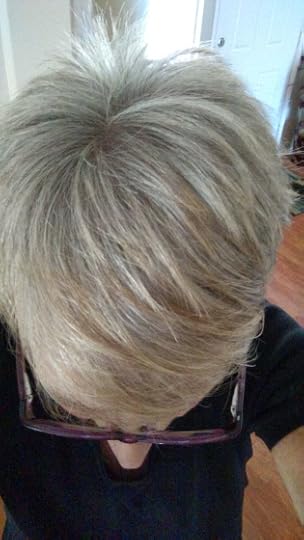
I never knew my nose was this pointy.
I started this journey back in March. Here we are almost five months later, and I’m almost at my goal. The only color is toward the front, where my bangs are longer than the rest of my hair.

Bill took this picture of the back of my head. I’m happy about all the color variations.
Maybe for some people, it’s a simple decision to stop coloring their hair and be whoever they naturally are. Oops. Did I just say that?
Does color change who we are?
Why was I sitting in the salon for two hours every five weeks spending $130 – what was the importance of the color treatment? It should have been as easy as a finger-snap to decide to stop. But it wasn’t. Somehow, the decision to go gray carried freight. It was about the deepest questions of self-acceptance.
I had to examine why it mattered so much–what did those few strands of blond mean?
What did they do for me? I can only answer for myself: they held back time. To go completely natural was a way of saying to the world that I am old. I am sixty one. Quibble if you want, but old it is, or oldish, but definitely no longer young.
If you are going to rush to reassure me that I’m not old, please don’t.
That’s like saying old is bad, but wouldn’t it be fantastic if “old” was just old, and not a negative? Could we even imagine oldishness as something fine? We could if, instead of worrying about what we lose, we got excited about what we gain, like the dazzling power of brain bilateralization, for example. Or the freedom from having to curtsy and ameliorate, placate and nurture. Others, anyway.
Now is the time to nurture ourselves.
This is my declaration of independence.

I’m rocking the porcupine look, right?
Yes, I want to look good, and I want to be slender, strong, and healthy. But I refuse to compete with someone my daughter’s age, or younger, for society’s approval. Because there is richness in the second half, and I intend to cultivate it. Occupy that territory. Own it.
A very influential, smart, well-educated person in my life said, “Well, it’s only hair.”
I jumped for his throat. “It’s way more than that!” I said. “It’s about society telling me I’m not worth anything, now that I’m old, and me telling society to go f*** itself.”
“Whoa,” he said, rearing back. “I understand. Good for you.”
I’m in full-on rebellion. Again. Just like in the 1960s.
You know what was really cool about getting my hair cut that day? The salon was playing songs popular from my first major life-change: puberty and high school, which for me, hit at the same time. As Cassie, my stylist/spirit-guide, prepared the way for this new stage, I traveled through my memories of cutting school, dropping acid, falling in love, winning a speech contest, getting my license, buying my first car (a very used 1961 VW Bug), and getting in all kinds of trouble with my Norte Vista friends Fran Smith, Lisa Forte, and Kathy Richartz. Kathy and I are still friends, forty years later. Actually, we’ve decided we’re now sisters.
God, we humans have a long lifespan, don’t we? When will we stop apologizing for that?
July 17, 2015
25 Midlife Hobby Ideas
 When I was young, I was busy working, churning through marriages, and raising my son. Who had time for hobbies? But now I’m older, and I yearn to have more fun.
Not that I’m bored. I’m busy all day long, most of the time clacking away on my computer: writing, reading, and interacting. Sometimes I get tired of all the words: the thinking, the typing, the electronic glow of the various screens.
My brain starts to feel worn out.
Much of what I do is enjoyable, but it’s brainwork. The other night, I found myself humming that Peggy Lee song. You know the one.
Especially in the fall and winter when Bill watches wall-to-wall football, I wish I had a hobby. Just something fun and simple that I can do in the house, after dinner, even if the TV is on. Something that doesn’t involve a computer screen.
Do you ever feel as if your leisure time is spent checking things off your to-do list?
I thought about organizing my photos or returning to Ancestry.com, but there again, you’re on the computer, using the keyboard and staring at a screen.
I could garden, but that’s a daytime/outdoor activity. Ditto, my sister’s hobby. She buys things at yard sales and repurposes them. Her latest idea is to find an old broken-down dresser she can paint and turn into a planter full of succulents for the patio.
I’m looking for ideas for myself and to share with my readers. What hobbies do you enjoy?
As I checked around, I found that for some of us, it’s not just the hobby–it’s the enjoyment of doing that hobby with others. Mom, 90, makes all kinds of craft items. She and a group of ladies meet on Mondays, creating objects to sell at their church’s fundraising bazaars.
My cousin, Kathleen, is a master quilter. She gets together with a group of girlfriends every summer. They rent a cabin by the beach up north and spend about a week quilting together and catching up.
Did you know that working with your hands can have the same effect as meditation?
For example, coloring is said to be good for your brain, in that it is calming and engaging at the same time. My friend, LaDonna, swears by coloring books. Although this is a relatively new fad, she’s been doing it for six years. Part of her thing is the enjoyment of finding exactly the right gel pens.
Whenever I color with my grandbabies, it’s fun, and I have to stifle myself so as to not take over their pages. So that seemed promising. I tried coloring, and enjoyed it. I’m actually kind of proud of this.

One of my former coworkers, an attorney, builds and furnishes elaborate dollhouses. She makes everything, and is very much into the details. One of her two-story houses boasts a library suitable for a judge. There’s a bookcase full of miniature books, and even a tiny gavel on the tiny desk. Her houses are works of art!
Here are some other ideas from the people in my writing group: jewelry-making, beading, painting, knitting, sewing, crocheting, origami, Solitaire, crossword puzzles, listening to audible books or music, meditating, drawing and/or painting, light housework, making-ahead of meals, catching up on phone calls, journaling, and planning the redecoration or redesign of your house or garden.
I’m curious about card or board games. Bill and I play Backgammon sometimes, but I have to admit, it isn’t very compelling to me. Surely in the last thirty years or so, some new ones have been invented.
Do you have a favorite card or board game?
I bought a 1000-piece jigsaw puzzle and dedicated a card table to its assembly. Wow, that sucker is going to take a while! But it’s a beautiful lakefront scene, which I’ll enjoy looking at as I work.

Last night, I had such a good time on it that when I looked at the clock, it was almost eleven.
Two hours had passed in an instant! I went to bed and slept like a baby. Do you think there’s a connection?
I’m also going to try to learn how to make things out of papier mache. This is going to be my first try:

Design by David Stark. Photo by Susie Montagna.
While researching this topic, I found The World’s Largest List of Hobbies. Although I don’t think I’m going to be herping anytime soon. Also, you can go on Pinterest and search for hobbies. Like I did, here.
You know what’s wonderful about this pursuit? I’m excited. Like right now, I’m thinking about how much I’d like to color, or work on the jigsaw puzzle, but I want to save these activities for evening, when my mind is tired. I’m pacing myself.
I haven’t felt this way in years – the thrill of thinking I might create something with my hands, without much cost, ideally out of something lying around the house waiting to be repurposed (as in the papier mache made from newspapers.) More than that, I feel as if I’m getting back in touch with my inner five-year-old, that nice little kid who hadn’t yet been slapped around or had her heart broken or learned to sublimate her spirit for the realities of adulthood.

What do you think? Are you with me? I’d love to hear about your hobbies. Let’s share in the comments below, and I’ll update you from time to time with new ideas. Let’s have some fun!
Related articles across the web
 Printable sudoku and crossword puzzles for the second week of July 2015
 The Gift of Love {Why I Quilt}
 Show and tell…
 Paper Mache Bowls: One-of-a-Kind Gift for Kids to Make and Give
 Do It Yourself!
July 10, 2015
Hospitals Can “Give You” Dementia

Nobody would want to stay in a 19th-century hospital, where flies and rats proliferated, surgery was done without anesthesia (not yet invented), and the spread of disease wasn’t understood.
Yet a hospital stay today can result in a condition called delirium, characterized by hallucination, confusion, physical debilitation, and life-threatening psychosis.
“…research has linked delirium to a greater risk of falls, an increased probability of developing dementia and an accelerated death rate.”
Now, we’re learning that delirium can be brought on by hospital stays – even short and relatively simple stays, and affecting relatively young and healthy people. It can arise from something as simple as treatment for a urinary tract infection. According to this article, originally published in Kaiser Health News and reprinted in Next Avenue,
“Many cases are triggered by the care patients receive — especially large doses of anti-anxiety drugs and narcotics to which the elderly are sensitive — or the environments of hospitals themselves: busy, noisy, brightly lit places where sleep is constantly disrupted and staff changes frequently.”
My Mother’s Experience
When Mom had to overnight in hospital recently, the cleaning crew came in at 2:30 a.m. to strip the second bed, clean the bathroom, and mop the floor. Mom, 90, is a light sleeper anyway, and couldn’t go back to sleep that night. Couldn’t they have waited until morning? Another time, nurses stood outside her room, jabbering loudly about their personal lives. I realize this is their job, and they are people, too, but if you can’t be more compassionate or professional, go to work at a lumber yard or something.

Mom has had to stay in hospitals three times in the past year (she’s fine, thanks). Each time, she came home exhausted, needing several days to feel normal again.
Historic Breach of Trust
I’m not singling out Kaiser. My own experience with Loma Linda University Medical Center was similar. Unless you’re a one-percenter, this is the environment you get. We already knew hospitals are torture chambers where a healthy limb can be severed, an incurable disease contracted, or one’s financial health ruined. Now there’s a risk you’ll go crazy.
Hospitals are trying, though. Now that they understand how stupid they are, they’re teaching staff thusly:
“…(hospitals) are trying to soften the environment by shutting off lights in patients’ rooms at night, installing large clocks and minimizing noisy alarms…m aking sure patients’ sleep-wake cycles were preserved, that they had their eyeglasses and hearing aids and that were not dehydrated — reduced delirium by 53 percent. These simple fixes had an added benefit: They cut the rate of falls among hospitalized patients by 62 percent.”
For the love of God, how hard was that to figure out? It isn’t brain surgery, folks.
Related articles across the web
 Delirium In The ICU Associated With Longer Hospital Stays And Double The Risk Of Death
 Developing delirium in the ICU linked to fatal outcomes
 Delirium in critical care ‘signals twice the risk of dying’
 ICU Delirium Tied to Higher Death Risk, Study Says
Hospitals Can Give You Dementia
Nobody would want to stay in a 19th-century hospital, where flies and rats proliferated, surgery was done without anesthesia (not yet invented), and the spread of disease wasn’t understood.
Yet a hospital stay today can result in a condition called delirium, characterized by hallucination, confusion, physical debilitation, and life-threatening psychosis.
“…research has linked delirium to a greater risk of falls, an increased probability of developing dementia and an accelerated death rate.”
Now, we’re learning that delirium can be brought on by hospital stays – even short and relatively simple stays, and affecting relatively young and healthy people. It can arise from something as simple as treatment for a urinary tract infection. According to this article, originally published in Kaiser Health News and reprinted in Next Avenue,
“Many cases are triggered by the care patients receive — especially large doses of anti-anxiety drugs and narcotics to which the elderly are sensitive — or the environments of hospitals themselves: busy, noisy, brightly lit places where sleep is constantly disrupted and staff changes frequently.”
My Mother’s Experience
When Mom had to overnight in hospital recently, the cleaning crew came in at 2:30 a.m. to strip the second bed, clean the bathroom, and mop the floor. Mom, 90, is a light sleeper anyway, and couldn’t go back to sleep that night. Couldn’t they have waited until morning? Another time, nurses stood outside her room, jabbering loudly about their personal lives. I realize this is their job, and they are people, too, but if you can’t be more compassionate or professional, go to work at a lumber yard or something.
Mom has had to stay in hospitals three times in the past year (she’s fine, thanks). Each time, she came home exhausted, needing several days to feel normal again.
Historic Breach of Trust
I’m not singling out Kaiser. My own experience with Loma Linda University Medical Center was similar. Unless you’re a one-percenter, this is the environment you get. We already knew hospitals are torture chambers where a healthy limb can be severed, an incurable disease contracted, or one’s financial health ruined. Now there’s a risk you’ll go crazy.
Hospitals are trying, though. Now that they understand how stupid they are, they’re teaching staff thusly:
“…(hospitals) are trying to soften the environment by shutting off lights in patients’ rooms at night, installing large clocks and minimizing noisy alarms…m aking sure patients’ sleep-wake cycles were preserved, that they had their eyeglasses and hearing aids and that were not dehydrated — reduced delirium by 53 percent. These simple fixes had an added benefit: They cut the rate of falls among hospitalized patients by 62 percent.”
For the love of God, how hard was that to figure out? It isn’t brain surgery, folks.
Related articles across the web
Delirium In The ICU Associated With Longer Hospital Stays And Double The Risk Of Death
Developing delirium in the ICU linked to fatal outcomes
Delirium in critical care ‘signals twice the risk of dying’
ICU Delirium Tied to Higher Death Risk, Study Says
June 26, 2015
The Generations Need Each Other
 I’ve read that you can divide up the human lifespan into three distinct age groups. Each one is unique and powerful. But more than that, they need each other.
In the first part of life, as a prepubescent child, it’s said you are most authentic, because hormones and societal norms haven’t changed you yet (I’m paraphrasing Dr. Christiane Northrup.)
In middle-age, most of us sublimate that authenticity as a tool of survival – our own and others’. This usually involves caring for family, earning a paycheck, paying taxes, and (hopefully) building for retirement.

Middle-adulthood is hard work.
Thus in midlife, the world needs you to set aside your individuality in support of the greater good. Families, communities, and civilization depend on your selflessness at this stage. We all appreciate you! But it can feel soul-killing at times.

My friend, Dorys, who I love for her wisdom and wisecrackery.
In the last third of life, you have the potential to become your authentic self again. Hopefully, you are at least partly retired, and have more free time. You can sleep all day or start a revolution.
When I speak to groups about positive aging, there’s a danger that the older people will begin chortling. They’re so excited they sometimes make the middle group feel bad.
So I remind the younger peeps that they still get the good skin, powerful bodies, and the ability to snap back quickly from illness.
I joke that the level of stress that young adults experience, between work and family, would kill me. I don’t actually think I’m joking.
All three age groups have their own strengths, and we can help each other. Recently, I was talking to the American Business Women’s Association about seeing the positive in aging, and a couple of stressed-out 30-somethings began to lament the pressures of their lives. My audience of mostly-50-plussers became nurturing and sympathetic. The older women rallied around, asking questions and remembering how it felt to be in that middle-age tornado. They offered encouragement and support. The meeting ran long. We couldn’t stop talking! All of us walked away that night feeling better. Such bonding! Such fellowship.
The noted researcher, Dr. George Vaillant, says the ability to learn from the younger generations is one of the hallmarks of successful aging, along with the ability to give back.
Don’t cut yourself off from other age groups. We all have something to offer.
You can read more about positive growth and human development at this website.
Related articles across the web
 Sounding the Emotional Depths
June 19, 2015
Why Fathers Matter

Daddy and kids at fishing lake last winter.
Men are often under-appreciated as caregivers because they have their own way of parenting.
It’s a little different from the way women do it, and there must be a reason. After all, Mother Nature decreed that it would require both genders to make a child, and I think it’s more than metaphorically important. And now we’re learning – finally, for Pete’s sake – how important men are in the optimal development of humans.

Daddy at the loving center of it all.
These are some of the amazing things I’ve learned about what men bring to the lives of children:
Research shows kids who have a solid relationship with their dad or an influential male figure get along better with their siblings, have more developed social skills and experience less emotional distress.
Father involvement from birth and through childhood is positively linked with children’s overall life satisfaction and wellbeing.

Formal night on cruise
Fathers have an outsized influence on the kids’ language development.
Fathers emit pheromones that delay the pubertal development of their daughters.

Daddy was right there the whole time.
Fathers can keep kids out of the criminal justice system, as they teach children from a very young age that misbehavior can have serious consequence (or as one police officer told me, if they don’t learn it from Dad, they learn it from the judge.)

Grandpa with angel 2014
I am blessed to have four sons in my life, from biological to steps to inlaws. Additionally, I have Bill, who has turned into the greatest Grandpa a guy could possibly be. To see the men in my family, all strong, manly people, interacting with such tenderness, patience, and humor with their children/grands, makes me teary-eyed with love and gratitude. To Bill, Danny, Sean, Mike, and Carlos, you guys are the absolute greatest, and the little people around you are so blessed to have you in their lives. As am I.


