Russell Atkinson's Blog, page 78
June 3, 2017
Ratagrams revisited
Last fall I proposed a new type of word game I called Ratagrams, a particular type of anagram. The rules are here. Here are some more, ones I hope are more challenging.
Hereafter, out room, whore!
Staffed peg convicts Viennese poets’ theater
Haven seize finer festivity
Two of the three contain proper nouns (names). Good luck.
P.S. Please don’t post answers here or on social media, but do feel free to let me know if you’ve solved them.
The post Ratagrams revisited appeared first on OnWords.


June 2, 2017
F-bomb
I was running at the park today and overheard a young woman use the F-bomb while talking to her friend. This is the first time in years that I’ve heard it in real life, at least as far as I can remember, other than people who repeat offensive language they heard in movies or TV as a complaint about it. I hear or see it all the time on TV, in movies, and books, but not from actual people. I still don’t know why writers do that. The purpose of using offensive language is to offend. That’s tautologically true. So why do writers intend to offend their customer base? I don’t get it. It’s so far removed from reality it’s like having all your characters float six inches off the ground instead of walking. What’s the point? Maybe I live in a relatively insulated slice of society, but I don’t think so. Most decent people just don’t talk like that.
May 29, 2017
Gluten-free post
This post is gluten-free.
Consider the following:
A seven month-old baby in Belgium died from malnutrition after his parents put him on an alternative gluten-free diet despite no actual medical diagnosis or recommendation. The child weighed only 9 pounds, about half the size of an average child his age, and was extremely dehydrated. The story brings to light just how dangerous alternative diets can be for very young children.
The baby, identified only as “Lucas” by The Daily Mail, was raised on a gluten-free diet consisting of quinoa milk, rice milk, oat milk, and other alternative milk products. Upon noticing their child’s diminishing health—the boy was described as extremely thin and “gasping for air”—his parents, named only as Peter S and Sandrina V, took him to visit a homeopathic doctor. The homeopath however immediately sent the family to a hospital.
(full article here: Baby Dies of Malnutrition).
And some people still don’t believe in natural selection. I think that’s proof in itself of natural selection.
The post Gluten-free post appeared first on OnWords.
May 25, 2017
Behind Her Eyes by Sarah Pinborough. Yuck!
 Behind Her Eyes by Sarah Pinborough
My rating: 1 of 5 stars
I can’t believe I stuck with this book to the end. It’s a positive insult to the reader’s intelligence. I saw the ending coming way in advance, although, admittedly, not the very last twist. I couldn’t believe the publishers would ever put such crap in a book, so I kept reading in the hope that I had it wrong. It wasn’t just the ridiculous ending that was bad; the writing was, too. The author used the same sentences with only minor variations dozens, perhaps scores, of times. The same thoughts running through the same heads over and over. I wanted to scream “get on with it!” at least fifty times. Enough said. Don’t waste your time on this one.
The post Behind Her Eyes by Sarah Pinborough. Yuck! appeared first on OnWords.
May 24, 2017
Breakdown by Jonathan Kellerman
 Breakdown by Jonathan Kellerman
My rating: 4 of 5 stars
Child psychologist Alex Delaware is summoned to treat Zelda, a psychotic former actress whose child he once evaluated. She’s on a 5150 hold in a dubious facility and is soon released. Days later she is found dead on a palatial estate in Bel Air, poisoned from ingesting some toxic plant material. With his homicide lieutenant buddy Milo, Delaware goes about tracking down what happened to her and trying to find her missing son. The plot is classic police procedural, my favorite mystery genre, and the author has a knack for description. Put simply, he writes well. I enjoyed the book and recommend it. If you are looking for an idea of a book to read this summer, and you like police procedurals, then you can stop reading here and put this on your list. It’s a good one.
Now, if you’d like my take as an ex-FBI agent, lawyer, and crime novelist as to what wasn’t done quite right, keep reading. For starters, it was realistic, or at least plausible, for Alex to go from person A to person B to person C to gather leads. Pure procedural. But when it got to person Q or R, the serendipity became ludicrous. Everybody he talked to just happened to have one person to suggest who might have information, and all of them were alive, easy to find, and available and willing to talk. He also met every one in person, mostly over a meal. Have they no telephones in L.A.? What that really was was a lot of filler trying to turn a 120-page book into a 350-page book.
Now for the forensic part. The author really slipped here. I think he just got lazy. Take this quote where Alex has just looked up a location on Google Earth:
“In seconds I had full-color, one-year-old, 3-D satellite photos of the property at a variety of angles, the forest-like area … revealed in high definition.”
I use Google Earth constantly for my geocaching and a camera designer for Google involved in Google Earth used to be my next-door neighbor. It does not actually show satellite photos over L.A., although it does over many non-urban or forbidden areas like North Korea. Over L.A. and other U.S. cities they use low-flying airplanes. Okay, I forgive the use of the word satellite. But you can’t look at the area from different angles from that view. The pictures are all taken from directly overhead. Google has given the terrain a sort of 3-D look using clever algorithms and elevation data, but you’re still only going to see the same exact view no matter how you tilt the screen view. Think of it this way: imagine they printed the overhead view on a flat, flexible piece of paper and then pasted that paper over a 3-D model of the surface, complete with hills. That’s what is displayed. Despite the 3-D effect you only see the roofs of the houses. Of course if you use Street View, then you can see various angles at ground level because the Google photo car does have multiple cameras photographing from different angles, but that view wouldn’t show the plants in this scenario.
Next, Alex has a retired cop fly over the property in a helicopter and a plant biologist is able to identify several different species of ground-level shrubs from the infrared photos. This information is used to obtain a search warrant. There are several problems with this. First, IR photography identifies heat, and has very poor resolution. A biologist would not be able to identify various different species from IR signatures no matter how low the helicopter flew. Even if he also used standard photography, he’d have to practically land on the property to be close enough to identify these various species among a very tangled growth area, which would be a 4th Amendment violation and render the search warrant void. I rather doubt it could be done at all without taking a sample back to a lab. A low flight of that nature would also destroy the secrecy of the surveillance, which supposedly went undetected in the story.
There were several other legal hurdles that seem to have been magically vanished in the story, like how does Alex, a civilian, get access to crime scenes and all kinds of evidence only police can get (and even they often can’t), but I’m not going to go into further detail. These quibbles did not destroy the overall enjoyment of the story, although they diminish my rating from 5 stars to 4. This is the first book from any of the prolific Kellerman clan that I’ve read, although the library shelves are full of them. I expect to read more in the future.
The post Breakdown by Jonathan Kellerman appeared first on OnWords.
May 23, 2017
Cached Out free this weekend
My best-selling Cliff Knowles mystery, Cached Out, will have a free promotion (Kindle download) on Amazon this weekend, the first in a year. Spread the word.
Cached Out
The post Cached Out free this weekend appeared first on OnWords.
Comments welcome
I welcome comments on my posts, but they sometimes take a while to appear. Why? I have a spam filter on my site. It does a pretty good job, but it’s not perfect. The majority of comments that get past it are fake, spam posts. For that reason I have set restrictions so that comments do not appear until I approve them. However, WordPress does not “push” notify me that a comment has come. It just adds a little number next to an icon on the dashboard page. I have to remember to look for that as it is not obvious and hides among a lot of clutter on that page. I typically see the dashboard page only when I’m ready to post something new myself. The long and short of it is that it sometimes takes me a few days to notice that a comment has come in and to approve it. I don’t know how that looks on the reader’s end, i.e. whether he or she is notified that the comment has been approved and appears. So if you look for your comment and it is not there, don’t think you’re being snubbed. Just look again in a few days. If you want to reach me immediately, you can use the About the Author/Contact link at the top menu and I will get an email in my inbox.
The post Comments welcome appeared first on OnWords.
May 18, 2017
California Dreamin’
Consider these two maps:

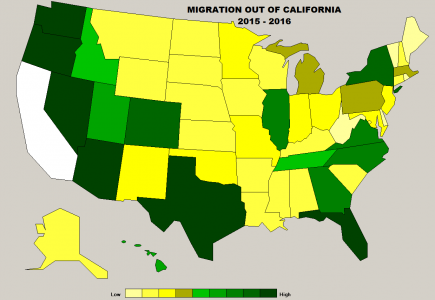
This data is taken from the IRS based on the number of taxpayers (and their children, since it includes exemptions on the returns) who moved into or out of California between 2015 and 2016. California had slightly more people leave than enter. The top map shows the states from which people come to California, the bottom the states to which they go. In both cases, darker green means more people.
In both cases it is unsurprising that the largest number of migrants both in and out come primarily from the states that are the most populous and the ones geographically closest to California. The maps resemble each other to a large extent, but there are subtle differences. For example, the upper Midwest like Minnesota and Michigan are darker in the upper map, indicating that more of those people want to come to California than the other way around. It looks like more Californians prefer to stay in the Pacific or far west states when they do move. Now compare these maps to the next one:
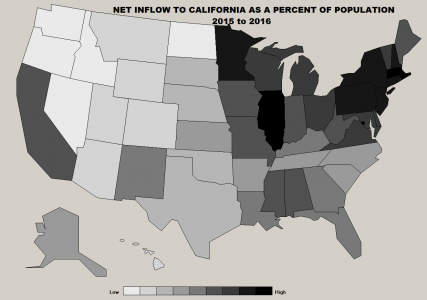
This map shows a net migration into or out of California as a percent of the population of the other state. I set California at zero for comparison purposes even though it had a net outflow. Every state that is darker than California had a net migration into California with the darkest having the highest percent of their population migrating. Everything that is lighter than California shows a net migration from California to that state with the lightest receiving the biggest bump to their population as a percent. The top maps show raw numbers while this bottom map shows the biggest effect on population percentage-wise. It seems there is still a westward migration going on, especially from the Northeast. It also appears that Californians are moving to adjacent states, probably in many cases motivated by the high housing, taxes, and other costs. There was a net flow of about 14,000 to Nevada, 9,000 to Oregon and a net inflow of almost 6,000 from New York to California. Bear in mind that the IRS data does not show movement of those who don’t pay federal income taxes, like the poor, unless they are taken as dependents on someone’s return. It also doesn’t show movement to or from foreign countries. Even so, it seems reasonable to assume that these trends are consistent with population movement as a whole.
The post California Dreamin’ appeared first on OnWords.
May 17, 2017
Idiocy or lack of education?
I have two short anecdotes about the sad state of knowledge in America today. My wife went to the store to buy some fish for tonight’s dinner, a fish soup we both enjoy. She ordered a quarter pound of one particular fish. The new clerk at the meat counter scooped a bunch of it and placed it on butcher paper on the scales. It read .41 pounds. She asked if that was the right amount. My wife told her no, she wanted a quarter pound. The clerk, a young woman, asked if that was more or less than what she had on the scale. My wife had to give her instructions to take some off until it reached .25 pounds.
Now I just learned that a large freeway sign has been erected on Interstate 280 in San Jose near the Saratoga Avenue exit. These signs cost over $10,000 each. The sign reads “Saratogo Ave”. I understand that whoever made the sign may not be from this area, but Saratoga is a common place name and has other uses. The Wikipedia page has 31 entries for it on its disambiguation page, including a fish, several battles, and a Chrysler model. CalTrans blames it on a contractor. Perhaps we can’t expect laborers to be able to spell, but I think we can expect them to paint the same letters on the sign as written on the order from CalTrans and we certainly expect those guys to be able to spell the names on roadway signs. Considering the cost of these signs, we also should expect the CalTrans staff and the contractor’s staff (which may be the Department of Corrections) to have close oversight over the spelling and overall accuracy of the signs before they are committed to metal.
I don’t know whether to wallow in dismay at the stupidity of the world or rejoice in the fact I’m not that stupid. Did I just get a better education? Am I just more careful? Have I made any typos in this post? Better check.
The post Idiocy or lack of education? appeared first on OnWords.
May 14, 2017
Why all the smoking and drinking?
Would someone please send a 2017 calendar to all the publishers and producers out there. Somehow they haven’t gotten the word that people don’t smoke anymore, not most sane, admirable people anyway. I’ve noticed a trend in books and movies recently that feature leading characters, i.e. the “heroes” and “heroines” of the stories, who smoke and get drunk all the time. Supposedly these are sympathetic characters. These behaviors, however, do not make them look very admirable.
The days of Mad Men cocktail parties and chain smoking are long gone. I cannot remember the last time I saw anyone smoking in real life. It has been months, maybe years. I can’t think of anyone I know who smokes. It’s interesting that you can tell the demographic a movie or TV show is going for by who smokes. For the mainstream broadcast channels now like ABC, NBC, CBS, if a character smokes in one of their series, he or she is probably a bad guy. They’ve figured out that it is mostly the low-lifes who do (no offense to the non-low lifes who do as I know you exist). In fact, often the person doesn’t smoke until it is revealed that the person is a bad guy. However, in many movies and on the cable channels or “arty” or counterculture channels, the lead characters smoke. Supposedly they are, or look, cool by doing this. I don’t get it. They just look like idiots, definitely not sympathetic. Maybe the demographic they are targeting is the low-life demographic.
Examples of this trend in books: Behind Her Eyes by Sarah Pinborough, The Girl Before by JP Delaney, The Muse by Jessie Burton. All three of these are written by British women, but Pleasantville by Attica Locke, and American, can be added to the list. On TV, examples of shows where the “cool” leads smoke are Better Call Saul and Sneaky Pete. All of these drink quite a bit, too, although that varies. I’m afraid series and books like these will inspire some impressionable young people to take up smoking. The only good thing I can say about them is that these lead characters are all pretty much losers in life. If these kids pay close attention (good luck with that) maybe they’ll see that smoking is not the way to a good life.
The post Why all the smoking and drinking? appeared first on OnWords.