Russell Atkinson's Blog, page 79
May 8, 2017
Two Chopin pieces on guitar
Two piano pieces arranged for guitar. Very short. The first one is a Waltz in A minor (Op. 34 No.2) and the second is Nocturne (Op. 9 No. 2). I think I play the second one a little better.
The post Two Chopin pieces on guitar appeared first on OnWords.


Two Chopin etudes on guitar
Two piano etudes arranged for guitar. Very short.
The post Two Chopin etudes on guitar appeared first on OnWords.
May 7, 2017
The Girl Before by J. P. Delaney
 The Girl Before by J.P. Delaney
My rating: 1 of 5 stars
One star seems a bit harsh since it wasn’t badly written, but in Goodreads, that merely means I didn’t like it, not that it was terrible. I didn’t get all the way through this one. It just got too creepy and graphic with the sex to be enjoyable. I got the feeling the whole plot was devised just to provide some soft-core porn gussied up as drama so that readers could pretend to themselves they were reading it for its literary value, like men who used to tell their wives they read Playboy for the articles.
The post The Girl Before by J. P. Delaney appeared first on OnWords.
May 5, 2017
Tapas Bar
Since this blog is about language, this recent Facebook thread of mine may be of interest to readers. Click on the image to get a larger version if you can’t read it.

May 1, 2017
The Muse by Jessie Burton
 The Muse by Jessie Burton
My rating: 3 of 5 stars
Odelle is from Trinidad, living in London in the 1960s, trying to make it as a writer as she makes a living as a clerk in a shoe store. She manages to acquire a position as a typist at an art gallery and is taken under the wing of Marjorie Quick, an executive there. The story shifts to prewar Spain where Olive Schloss, a young woman, falls in love with Isaac Robles, an artist and revolutionary. Isaac and his half-sister Teresa are working as servants to the Schloss family. Olive’s father is a renowned Austrian art dealer, her mother a disturbed British woman. Central to the story is a remarkable painting of a young woman carrying her own severed head while a lion looks on. The two stories merge, of course, as the plot reveals itself.
The author writes with erudition bordering on pretentiousness, but succeeds in giving a credible picture of both settings. The story is engaging the whole way. I listened to the audiobook version. The actress who reads the London portions is excellent, with a wonderfully charming Caribbean accent (when portraying Odelle) and upper class English accent (when portraying Quick or other Brits). On the other side, the actress who reads the Spanish portions is terrible. She can’t act and her English so poor she mispronounces words constantly. Orange rhymes with flange. It’s clear she is a native Spanish speaker. This choice may have provided us with an authentic Spanish accent, but at what price? She sounds like she’s reading to three-year-olds, overacting and reading at a pace designed for a slow-witted Braille transcriber. She’s more than a ham; she’s bacon. I don’t understand the choice since there is very little Spanish in the story, just a few words here and there.
For a long time I had a hard time believing the same author wrote the two threads of the story, the Spanish thread seeming so badly written. It just shows how important the reader is. Despite this drawback, I enjoyed the book. I thought the attempt to create a surprise ending by letting us know that Marjorie Quick had a secret failed, as I was able to guess the secret quite quickly (no pun intended), but the ending was still a mostly satisfying one.
The post The Muse by Jessie Burton appeared first on OnWords.
April 30, 2017
Weapons of Math Destruction by Cathy O’Neil
 Weapons of Math Destruction: How Big Data Increases Inequality and Threatens Democracy by Cathy O’Neil
My rating: 5 of 5 stars
This fascinating and well-written non-fiction book explores how the brokers and manipulators of “big data” affect us all, often in harmful ways. The author is a former math professor, Wall Street quant, and now is a full-time “Data Scientist,” a title she gave herself. She definitely has a great deal of inside knowledge about the users of big data and the algorithms they use to churn through the data and direct their activities. She calls them Weapons of Math Destruction or WMDs. Among the users are banks, credit companies, employers, government agencies, universities, advertisers, search engines, police departments, payday lenders, criminal sentencing courts, and insurance agencies.
She gives an example of a teacher in Washington, D.C. who was fired because a WMD identified her as being in the worst 10% of teachers despite having had glowing reviews in the current year and top scores in previous years. It turns out that the teacher who had taught most of her students the previous year had corrected the standardized tests of her students to make it look like they were performing better than they actually were. The result was that their scores on the test dropped during the next year even though they actually made good progress. The cheater kept her job, while the honest teacher lost hers.
Another surprising area to me was how the U.S. News rankings of colleges and universities has driven up tuition, lowered the quality of faculties, and actually made it harder for some top students to get into a “safety” school. You’ll have to read the book to understand how this happens. Many such tidbits are set forth throughout the book.
The book has a definite political slant to it. The author decries unfairness in general, which I consider apolitical, but then tends to harangue on anything she sees as racial inequality or “targeting the poor.” Many WMDs take into account such things as Zip codes or credit scores, things she considers “proxies” for race. From the viewpoint of a civil libertarian, this is a valid approach, but, as she herself admits, from a business standpoint, some of these WMDs are effective at reducing inefficiencies and increasing profits. Corporations, banks, and even many government agencies are not in the business of fairness or eliminating racial inequality; they’re in the business of business, i.e. making money, or in the case of the government agencies, accomplishing an important task like public safety or building infrastructure at a reasonable cost. One could argue that they have a legal and moral duty, a fiduciary responsibility toward stockholders or taxpayers, to increase those profits or efficiencies. As she also admits, using traditional human judgment alone, without the WMDs, has its own history of unfairness and racial prejudice.
A central theme throughout the book that was not explicitly stated is the failure of nearly all the WMDs to take into account the effect they themselves have on human behavior. Take the mortgage crisis of 2007-2008, for example. The math behind the collateralized debt obligations (CDOs) that packaged sub-prime mortgages with other debts was valid. If borrowers had continued to behave as they had statistically in the past, defaulting at the same rate, the CDOs would have been sound investments. What the lenders and brokers did not factor in was that once the market was created for these securities, lenders and borrowers would both change their behavior, increasing the number of mortgages granted to people who obviously had no way to repay them, thus changing the long-standing statistics on which the WMD was based.
If you want to know how to increase your chances of getting hired or how to get a better college education at a lower cost, this book is worth your time studying. I don’t have any skin in the game, but I found it a very interesting read even so.
The post Weapons of Math Destruction by Cathy O’Neil appeared first on OnWords.
April 29, 2017
Inside the FBI: New York – a review
I don’t usually comment on television, but regular readers of this blog know I’m a retired FBI agent and may have some special insight on the new series “Inside the FBI – New York.” I watched the premiere Thursday on USA Network. My overall impression: there’s good news and bad news.
The series is an unscripted documentary-style show made with the full cooperation of the FBI, mandated from Director Comey. There is plenty of footage of real FBI agents inside the office, on the streets, and at home. The good news is that the show is realistic. It rang true to me, reflecting what the FBI is really like. I served in the New York office for a year early in my career. The ridiculous portrayal of FBI agents in drama shows is put to rest here. Instead, it showed men in suits sitting around conference tables discussing threat reports or out on the street looking for a terrorist suspect (only a suspect – don’t mistake that for a terrorist) who may be in New York during a major event like the Thanksgiving Parade or New Year’s Eve in Times Square. Unlike fake FBI TV, this show depicted the confusing information that comes in – an email trail that proved the suspect was trying to acquire a weapon, but nothing that showed he had succeeded in getting one, the lack of information on his current whereabouts. I think the dedication and stress of the FBI agents came through accurately.
The bad news is that it was rather boring. it showed men in suits sitting around conference tables discussing threat reports. Hey, didn’t I just say that? Yes – and that’s the good and bad of it. That doesn’t make riveting TV, although that is often the real life of the FBI. I thought the scenes humanizing the agents by showing their families and personal interactions were rather interesting, especially the anecdote about the suspect who stabbed an agent with a butcher knife during an arrest – and he was someone not expected to be violent. Both the knife and the protective vest worn by the agent that saved his life were shown to the TV audience and they could imagine, almost feel, having that 8-inch blade thrust at their abdomen. It highlighted the danger that even a “routine” case can present to an agent. Unfortunately, that bit was buried well into the episode, after fifteen or twenty minutes of men in suits around tables. That was a major editing/directing flaw in my opinion, especially for a premiere episode.
The producers no doubt thought that the tension would be ratcheted up by featuring the terrorist task force right after the attacks in Paris and San Bernardino, which took place shortly before the holiday season in New York. To some extent, perhaps, it was, but really, viewers already knew that nothing happened. Nothing, that is, in 2013 when this was filmed, but remember Faisal Shahzad, a would-be ISIS sympathizer, parked a large SUV bomb in Times Square in 2010, not to mention the 9-11 attacks. The danger was real, but the suspense for the viewer was not.
I will continue to watch the series, at least for a while, but I predict it will not be a commercial success.
The post Inside the FBI: New York – a review appeared first on OnWords.
April 27, 2017
Electric vehicle adoption
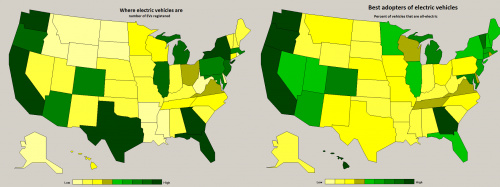
The map on the left has been circulated quite a bit recently, showing that electric vehicles (EVs) have been doing well in certain states like California, Texas, and New York. That map is misleading, however. Of course states with large populations and large numbers of cars registered are going to have more EVs. The one on the right shows which states have the highest rate of EV adoption based on the percentage of the vehicles in the state that are EVs, a better indication of how EVs have caught on. While many similarities exist between the two maps, it becomes evident from the second chart that states like Hawaii, Vermont, and Nevada are actually among leaders in adopting EVs. Georgia, with its strong state incentive program, now leads the nation in current sales of EVs as a percent, although California still leads in overall percentage registered.
Sources: Energy.gov, CleanTechnica.gov, USEIA. Data is from 2014, the most recent I could find.
The post Electric vehicle adoption appeared first on OnWords.
April 26, 2017
Trump vote vs. Average SAT score
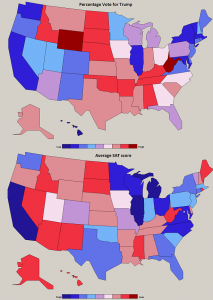
This graphic illustrates the percent of the vote total Donald Trump received from each state (top map) and the average SAT score of entering freshman for each state’s flagship public university. Both were obtained from data published by the responsible state officials (for the vote totals) and by the universities (normalized for the new (2016) SAT scoring system). The darkest red in the top map represents the highest vote percent for Donald Trump and in the lower map, it means the lowest average SAT score.
Note that blue (top) represents all non-Trump votes, not necessarily a vote for Clinton, since in some states (e.g. Utah) third party candidates received significant votes. The universities selected were the premier public university in the state, excluding specialty schools such as engineering or arts. The District of Columbia had no qualifying universities since all the public universities were specialty schools (e.g. military/intelligence).
The post Trump vote vs. Average SAT score appeared first on OnWords.
April 25, 2017
The Poison Artist by Jonathan Moore
 The Poison Artist by Jonathan Moore
My rating: 5 of 5 stars
Caleb is living the life of a Gen X at the pinnacle of success. He owns a house in a tony district of San Francisco and has his own biochemistry research lab where he is a respected expert on poisons and pain-inducing compounds. No Budweiser on the sofa for him. He drinks Jameson and Guinness in high-end bars, until, that is, a mysterious, captivating woman sits next to him and orders a Berthe de Joux, French pour. Caleb has just had a fight, a serious one, with his girlfriend Bridget, and it has sent him on this bender, but this new woman enthralls him. He watches as chilled water is poured over sugar cubes through a slotted silver spoon into the drink. It’s French, the notorious absinthe which was banned for decades because of its mythic poisonous qualities. The woman downs the drink and disappears as quickly as she appeared. He must try the same drink and he must find her again somehow.
When he sobers up and returns to work, he is confronted with the possibility of his grant money not being renewed. For his funding he needs more data on pain, on the chemicals that are produced during extreme pain, in order to help researchers and drug companies develop better anesthetics and manage chronic pain better. While he is straining to obtain this funding, he is also helping his best friend Henry, the chief medical examiner, determine the cause of death of some recent victims who appeared to die of natural causes, but whom Henry suspects were poisoned. Caleb confirms the poisoning. Soon he is obsessed with tracking the serial killer and trying to find the ephemeral woman, a woman we later learn is named Emmeline. While this is going on, we find allusions to a dark and troubling past of Caleb’s, something Henry knows about.
I won’t spoil with any further plot details. This book is all atmospherics and they very dark indeed. It’s so noir, it’s ebony. The style is something of an acquired taste, but I acquired it quickly and became fully absorbed in the depth of the mood. Be warned: it is not for the faint of heart or queasy of stomach. Stephen King fans will soak it up. Others may find it hard to take toward the end, but if you can get yourself around a large dose of creepiness, this is the book for you.
The post The Poison Artist by Jonathan Moore appeared first on OnWords.