Russell Atkinson's Blog, page 81
March 19, 2017
Retiree free time vs. Age
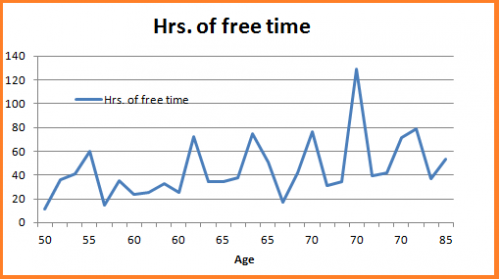
I’m still analyzing the data on retiree free time from my survey. The chart below shows a generally upward trend in the amount of free time as one ages. This is unsurprising, but what may be surprising is the degree of variation. The numbers on the left show the reported number of hours of free time per week of the respondents, or, more precisely, hours that fit into the nine broad categories I listed. I still think there are substantial free time activities not reported in the survey.
The post Retiree free time vs. Age appeared first on OnWords.


Between the World and Me by Ta-Nehisi Coates
 Between the World and Me by Ta-Nehisi Coates
My rating: 1 of 5 stars
My book club chose this book, so I dutifully read it. The author has chosen to always be angry, which seems like an unpleasant way to live. I’d rather be happy, so I choose that approach. Still, everyone has to make a living and Coates has this professional victim shtick working for him. More power to him, but I wouldn’t recommend this to anyone who wasn’t a masochist.
The post Between the World and Me by Ta-Nehisi Coates appeared first on OnWords.
March 18, 2017
Our hilarious newsies – KQED Newsroom edition
I’d never thought of KQED Newsroom as a comedy show but last night there was some unintentional levity. For those of you not familiar with the show, it is a San Francisco-based news interview and analysis show, concentrating on local and California issues. One of the panelists was with the Asian Law Caucus discussing the effect of the new Executive Order on travel. First she said she and her colleagues went to the airport to work “on the ground” (which seemed amusingly counterintuitive). Once there it was “back and forth, back and forth, a real roller coaster.” I paused the recording and tried to envision a roller coaster that went back and forth while I suppressed a smile. The poor girl needs some work on her metaphors. I commented about it to me wife and she had a chuckle, too. Then when I hit the play button again the next thing the woman said was that a man had come up to her and said “I’m a U.S. citizen and my wife is abroad.” My wife, who is definitely not a broad, and I cracked up and couldn’t stop laughing. The panelist seemed totally unaware of what she had just said. As if that weren’t enough, her first name was Elica and she worked for the Asian Law Caucus. I told my wife her real name was probably Erica and she spelled it that way so her clients could pronounce it. (Okay, that last one was a cheap shot, but having done a year in Japan and studied Mandarin for a year, too, I appreciate Asian culture and people as much as anyone. The L and R thing is real, though).
The post Our hilarious newsies – KQED Newsroom edition appeared first on OnWords.
March 15, 2017
Retiree activity analysis
A few days ago I posted a survey asking retirees to answer a few questions about how they spend their free time. If you are retired and haven’t yet taken the survey, you can do so here:
Twenty-eight responses have come in to date. If you want to see the individual question results so far, you can do so here: https://www.surveymonkey.com/results/SM-QZWP9YJG/ . There was a rather wide range of responses on most of the questions.
Here is my own summary chart showing the overall averages for all respondents over the age of 50:
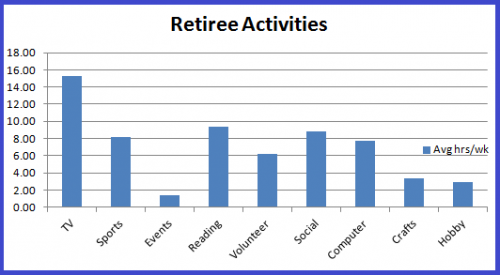
Several things struck me about the results. One number not shown here is the average number of hours of free time per week for respondents. In this survey, the average for everyone over 50 (I excluded two below that age on the assumption they weren’t actually retired) was 44.29 hours. That’s about 6 hours per day. That seems really low to me. I sleep about seven and a half hours a night. I spend perhaps an hour a day eating, another half hour on changing clothes, showering, brushing teeth, etc. Chores like feeding the cat, doing dishes, mowing lawns, paying bills, running errands, etc. take maybe another hour a day on average. Throw in another hour a day to account for things that are for me rare but can take substantial time, like illness, major repair projects, travel, etc. So that’s 11 hours a day taken up with necessary stuff. That’s still 13 hours a day of free time, more than double what other respondents show. It makes me wonder why the discrepancy.
There are several possible explanations. I don’t have any grandchildren (yet- get going, kids!) and I know many retirees babysit grandchildren. I consider that a legitimate activity to put in the socializing category, assuming it’s voluntary and not done solely out of financial necessity or duty toward children, but it can take up large amounts of time and some respondents no doubt omitted that from their responses. Some retirees may still be employed at least part-time or have extensive business matters to handle. Some of that may be at least in part recreational in nature, not entirely out of financial necessity. I count all my novel-writing as hobby activity. As a business it’s a failure but I enjoy it. Some travel a lot – a category I omitted because I am trying to identify things I can do in my free time when I’m home. Please comment on this post if you have a big time commitment not included in the survey. Also, my wife does nearly all the shopping and cooking and shares other chores, so someone living alone might have more stuff to do of that nature. However, I suspect the single largest reason for the disparity is underreporting. I’m guessing that most people don’t realize how much time they on many things. I notice my own responses total 76 hours, less than 11 hours a day, 2 hours less than what I just estimated as my actual free time. Even though that’s one of the highest responses in the survey, it is still probably underreported. I must be guilty of this. I am probably underestimating the time I spend on the computer and TV.
This causes me to wonder about the accuracy of the results. One respondent accounted for 129 hrs/wk of free time. That’s more than 18 hours a day. That sounds like someone who is sleep-deprived. Perhaps some of that is accounted for by double counting. For example, Socializing can be a main reason for volunteer work, and people can watch TV and do crafts at the same time (my wife crochets constantly while we watch), and so forth. The person may have counted those hours in both categories. On the low end, there was someone with only 15 hours a week of free time. Ultimately,something is taking a great deal of most respondents’ time that doesn’t apply to me, and I am hoping to find out what that is. Maybe I’m missing a rewarding activity I just haven’t thought of. Please do leave comments to help me understand what that is.
The post Retiree activity analysis appeared first on OnWords.
March 14, 2017
Sinner Man by Lawrence Block
 Sinner Man by Lawrence Block
My rating: 1 of 5 stars
I only read about a hundred pages of this one, but it was enough to know I didn’t like it. I don’t believe in continuing to do something I don’t enjoy so I stopped reading. I’ve read some of Block’s Bernie Rhodenbarr series (e.g., The Burglar Who Counted the Spoons) and enjoyed the wit and cleverness of plot, so I had high hopes for this one, but I found it to be crude and rather offensive. Block at least avoids the all-too-prevalent four-letter words of other novels with indirect language, but still manages to descend into tackiness. (I pushed her head down below my waist and told her to pretend she’s a French girl). The fact that the main character (“hero?”) beat and then murdered his wife didn’t help. As a former FBI agent I know something about New York organized crime and the whole plot was preposterous. The notion that a new guy could just blow into town and be recognized as a “hotster” (whatever that is) and be given a mob assignment just doesn’t fly with my plausibility meter. From now on I’ll stick to The Burglar Who series with Block.
The post Sinner Man by Lawrence Block appeared first on OnWords.
March 13, 2017
Betting the Farm on a Drought by Seamus McGraw
 Betting the Farm on a Drought: Stories from the Front Lines of Climate Change by Seamus McGraw
My rating: 3 of 5 stars
The author is a journalist who has followed the public debate about climate change, or, if you prefer, the weather. That sums up the main message of the book – how a subject as mundane and apolitical as weather has turned into a political hot potato pitting liberals against conservatives. He argues that extremists on both sides, aided by the media, have politicized an important issue and and in effect stalled any attempts to address it.
The science isn’t in question. It’s getting hotter and the rate of rise is unprecedented not only in human history but in the history of the world. It coincides with the industrialization of the world using fossil fuels in unprecedented numbers. Global warming is real and it is caused by the increase in greenhouse gases. Just don’t call it global warming or even climate change. Those are buzz words pointy-headed liberals use. As one skeptic put it, “I didn’t know anything about the issue except Al Gore believed it so I didn’t believe it.” This theme was echoed a lot in the book, but the author also takes issue with the apocalyptic rhetoric coming from the extremists on the other side and the media, which he says presents only extremist views because those are the ones that draw the ratings. They fool themselves into thinking presenting both extremes is balanced reporting. It’s not, at least according to the author.
He makes a point to interview a lot of skeptics, conservative “climate deniers” if you will, like hunters, commercial fishermen, and farmers. Almost to a man they claim man-made climate change is a hoax or at least not proven. Yet they also agree that it is getting hotter and that it will continue to get even hotter. (Umm, fellas, that is climate change). The elk no long come down from the high mountains to the valleys until after hunting season is over because it stays warm longer. The trees are dying, too, the hunters say. The whiting no longer come close to shore in the Maryland bay where the author grew up because it’s too warm. Fishermen have to go north long distances out to sea now. Cattle ranchers in Texas have moved their herds to Montana and North Dakota. Others who used to plant corn now plant cotton. They just call it drought or weather, not climate change, and they are taking reasonable actions to deal with it. The author’s point is that it is their very actions that are necessary (although not sufficient) to fight the phenomenon everyone agrees is real, even if they can’t agree on what to call it.
The book is a bit pedantic even though it is peppered with personal anecdotes. It probably isn’t going to change anyone’s mind because the issue is so polarizing now, but it has some good information for anyone wanting to educate themselves on the subject.
The post Betting the Farm on a Drought by Seamus McGraw appeared first on OnWords.
March 11, 2017
Milestones
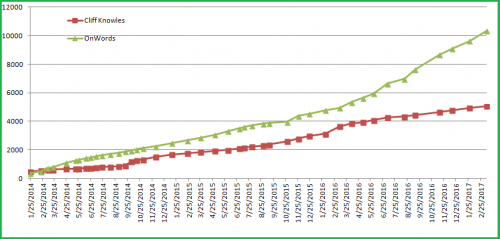
February marked the month this blog topped 10,000 views and the month my Cliff Knowles Mysteries page topped 5,000 views. That’s kind of a nice feeling.
The post Milestones appeared first on OnWords.
March 8, 2017
The Vaccine Race by Meredith Wadman
 The Vaccine Race: Science, Politics, and the Human Costs of Defeating Disease by Meredith Wadman
My rating: 4 of 5 stars
This nonfiction account of the spectacular and life-saving advances in vaccine development over the last fifty or so years is in some ways reminiscent of The Innovators: How a Group of Hackers, Geniuses and Geeks Created the Digital Revolution by Walter Isaacson. Until you see it set out before you, it is difficult to imagine or remember how much important history has passed in this field in just the last few decades.
The book begins and ends with Leonard Hayflick, a cell biologist credited with, among other things, discovery of the Hayflick Limit, an amorphous number that identifies how many times cells, especially human cells, can split and thus reproduce in a laboratory culture. In effect he established that non-cancerous cells cannot live and expand in culture indefinitely, which was in direct contradiction to the established wisdom of the day. He developed a human cell culture known as WI-38 that had the remarkable quality of being able to culture or reproduce in the lab multiple times without becoming cancerous or developing other anomalies. He promoted these cells vigorously for the purpose of researching cell aging, and, perhaps more importantly, for use in producing “clean” vaccines.
Hayflick was a controversial figure for several reasons. He was treated as hired help at the Wistar Institute where he worked culturing cells for the virus researchers, the supposed stars, a fact that he deeply resented. His discovery of cell death was not easily accepted by the scientific community, but more than that, it was his fateful, and questionable, decision to take the WI-38 cells he had developed with a government grant to his new position at Stanford University, and eventually to begin selling them through his own corporation. Some at the National Institutes of Health (NIH) considered him a thief while others saw him as an underappreciated scientist of outstanding ability.
The book is not a biography of Hayflick, however, although he is the central figure. Other virus researchers, doctors, biologists and bureaucrats are featured at length. The process of cell culture and vaccine development is described in considerable detail in language a layman like me can understand. I was awestruck at how complex the process is. Really top-notch science is required – hands-on lab work especially – and some risky experiments and testing that raise ethical questions. Experiments of the day involved inoculating subjects with untested vaccines, including live ones that could give him the disease. Subjects were often orphans, prisoners, soldiers, babies, the mentally deficient, and others who had little or no ability to consent. Many or even most were unaware that they were even test subjects. The diseases involved included polio, rubella (German measles), rabies, and adenovirus. The WI-38 cells were derived from an aborted fetus. It is clear that the field is replete with controversial and ethically troubling issues.
The writing is clear and workmanlike, if not particularly elegant. To my taste there was too much time spent on the upbringing and background of the various figures in the book when it should have focused more on the science. The author also had an irritating tendency to repeat. Virtually every time a vaccine or person was mentioned it was followed by clause informing us for the umpteenth time who or what that was. I’m not an idiot. I can remember the person who was just the subject of a long chapter twenty pages ago and mentioned fifty times earlier in the book. It made the book overlong. It also focused too much on the intellectual property controversy over the ownership of the WI-38 cells and Hayflick’s alleged wrongdoing. He was, by all accounts, a star in the field of cell biology and a decent human being whose work led to the development of new or improved vaccines preventing thousands, perhaps millions, of deaths and other suffering, and to scientific advancements that brought Nobel prizes to others who built on his work. Still, all in all, it was a well-written book on an interesting subject.
The post The Vaccine Race by Meredith Wadman appeared first on OnWords.
March 1, 2017
Winterkill by C. J. Box
 Winterkill by C.J. Box
My rating: 3 of 5 stars
Wyoming game warden Joe Pickett finds the local U.S. Forest Service manager drunk and shooting elk like crazy. Joe arrests him, but the man escapes and by the time Joe catches up with him, he’s been murdered. Joe has to solve the crime since the local sheriff is an incompetent lout and arrests the wrong man. His deputy is even worse. Meanwhile Joe’s adopted daughter is imperiled by the return of her natural mother. As with his first two Pickett novels, Box portrays the stark majesty of Wyoming well and has created a likeable All-American do-goody main character. The plot is full of action and cleverly constructed, only I can only bring myself to give it three stars. In fact, I could barely finish it. Why?
Because of the near-vitriolic anti-government sentiment that only gets worse throughout the book. The Joe-Pickett-against-the-world thing just got to be too much. It seems that Joe is the only government worker in the whole world who is decent and hard-working. The local sheriff is lazy, mean, and incompetent. [My grandfather was a sheriff in Wyoming and was kind and beloved by the citizens. I know; I was living with him in the courthouse as a 5-year-old when he died]. The Forest Service victim is a drunkard and animal slaughterer. His boss, a regional manager, is an insane egomaniacal woman who blithely lets (or causes) her dog to be run over by a piece of heavy machinery and is itching for a shootout with the Sovereign Citizens group camping nearby. She only gets worse throughout the book, too. The Bureau of Land Management (BLM) and USFS types are all lazy, arrogant, and don’t work a second past 5:00. Worst of all, the FBI agents brought on scene are chain-smoking HRT members who were at Ruby Ridge and Waco and take sadistic pleasure in killing people. [Now, as an ex-FBI agent I’m beginning to feel some piling on here]. The local County Attorney seems to have his heart in the right place, but he’s portrayed as ineffectual. The disgustingly obese judge will give a woman whatever court order she wants in exchange for sex. So only the game wardens are the good guys? Oh wait! I forgot – no they’re a bunch of corrupt crooks, too, as portrayed in the first book. Oh yes, anyone with a southern accent is evil and stupid, too.
So who are the good guys, if any? Of course, the swastika-wielding gun-toting white supremacist sovereign citizens. Well, not quite good guys, but portrayed almost sympathetically. I’m perplexed by this anti-government direction in the writing since Joe Pickett is a government employee. Okay, plenty of crime novelists and TV writers like to stick pins in the FBI, making them out as pompous or arrogant, hogging glory. I’m used to that and it doesn’t bother me. I even do a bit of that in my own novels, although it’s confined to the top brass. But there are so many things wrong with the portrayal in this book on all levels it’s beyond literary license. A chain-smoking HRT member? They’re all fitness nuts. The FBI taking orders from a Forest Service manager? It’s laughable. In my 25-year career I saw nothing but cooperation and friendly relations between police and FBI, with the exception of one case (in which the FBI rescued a kidnap victim, arrested both kidnappers, and recovered the ransom much to the annoyance of the local police). Worst of all, a sadistic FBI agent who took pleasure in killing people? Not in my FBI. Okay, so forget my gripes on that account; maybe I’m not objective.
The thing that got to me more than anything else was the way it seemed to be taken for granted that the white supremacist narrative was accurate on things like Ruby Ridge and Waco. What’s next, Timothy McVeigh’s a hero for blowing up the day care center and hundreds of other innocents in Oklahoma City? David Koresh is a true prophet despite burning down his own parishioners? The Unabomber? Jim Jones? ISIS? This kind of story-telling is troubling. Sure, most people will see it as just the fiction that it is, but it only takes a tiny fraction of one percent to buy into it to end up with the self-styled vigilantism that justifies in someone’s mind the mass killing of random innocent people. It’s possible to make Pickett a good guy without making everyone else a scumbag.
The post Winterkill by C. J. Box appeared first on OnWords.