
Matador Network's Blog, page 2116
April 25, 2015
10 steps to germanize yourself
WHAT EXPAT DOES NOT WANT TO BLEND IN? Being mistaken for one of the natives in a country where you are only an expat is one of the highest compliments you can receive.
The people at Babbel put together this inforgraphic to help you acculturate smoothly and easily in Germany; it only takes 10 simple steps! 

Photo: Adam Fletcher via Babbel
Featured image: Aleera.


April 24, 2015
This is the best prom proposal
EVERYONE WANTS AN AWESOME DATE to go to the prom with and both Jacob Lescenski, and is best friend, Anthony Martinez, two Las Vegas, Nevada high school students, will have just that on prom night.
Jacob is straight, Anthony is gay, and none of the two friends had dates for this special night. When Jacob saw that Anthony was lamenting about going to the prom alone on Twitter, he took action and decided to ask his friend to be his date.
Guess who just got asked to prom by @JacobLescenskii pic.twitter.com/eDrTRkX7fp
— AnthonyseXC (@anthonyseXC) 21 Avril 2015
NewNowNext chatted with the two friends about Jacob’s great prom proposal:
“I decided on going to prom alone because my original date idea didn’t work out so well,” explained Jacob. “Then one night I saw Anthony, who is my best friend, Tweeting about wanting a date. I then thought about how amazing of a guy he is and that he deserved a date. So, I came up with the poster idea, asked my friend Mia to make it and asked him that next day. No one knew about it except for me, my friend Jamie, and Mia (who made the poster). Therefore it was a giant surprise to everyone, especially Anthony!”
“I just always wanted a date,” says Anthony, “but I knew being gay, and knowing I’m too busy for guys, no gay guy would ask me to a dance, let alone prom. So like any teen I complained about it on Twitter. On April 21 I was down at lunch selling prom tickets and I went upstairs to go to class and saw this giant poster and assumed it was for another person… until I read ‘You’re hella gay.’”

Not only will the two best friends have a brilliant night, but Jacob demonstrated to the world what it is to an ally. Kudos to him for being a genuine and accepting friend. 
9 foods you must try in Puebla
1. Mole poblano
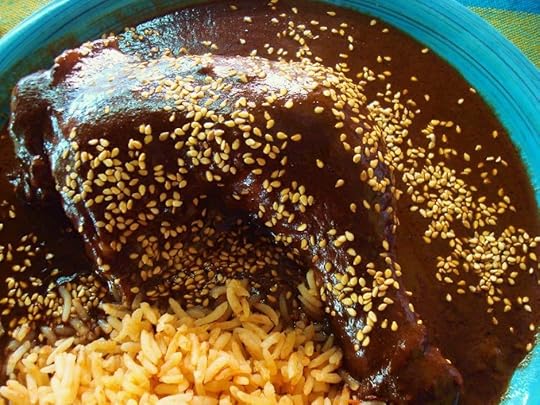
Photo: austin tx
Mole poblano is Mexico’s most famous, and tastiest mole. Don’t let anyone tell you otherwise! The dish is characterized by its inclusion of chocolate, which creates a very distinctive taste due to its combination with different spices and chillies. The dish is of particular importance to Mexico as it is a symbol of its Mestizaje: the fusion of Indigenous and European cultures.
2. Chiles en nogada
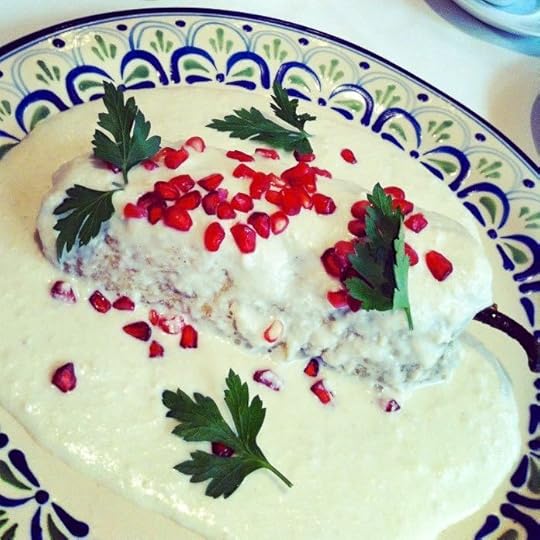
Photo: Soy Poblana
This dish is as poblano as you can get. It consists of a poblano chili pepper, which is filled with ‘picadillo’ and local ingredients such as ‘manzana panochera’ and ‘pera de leche.’ The filled chili is then dunked in egg batter and fried. Finally a delicious creamy walnut sauce is poured over the chili and topped with pomegranate seeds and parsley. The dish’s three elements generate the colours of the Mexican flag: the green parsley, the white walnut sauce, and the red pomegranate seeds. Keep in mind that ‘chiles en nogada’ are only available from July through September.
3. Cemita
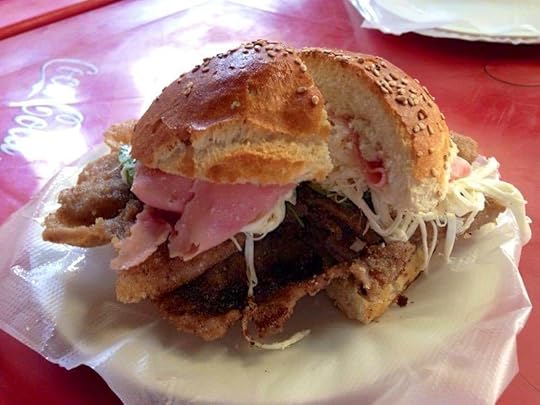
Photo: Soy Poblana
The cemita is deliciously crunchy and Puebla’s champion! After the excess dough is removed from the inside of the roll, the cemita is filled typically with: avocado, quesillo (cheese from Oaxaca), pork milanesa, pápalo, onion, and chipotle can be added for spiciness. Known locally as ‘cemas’ you can always get them filled with al pastor, carne asada or arabe meat. Take your pick!
4. Chalupas
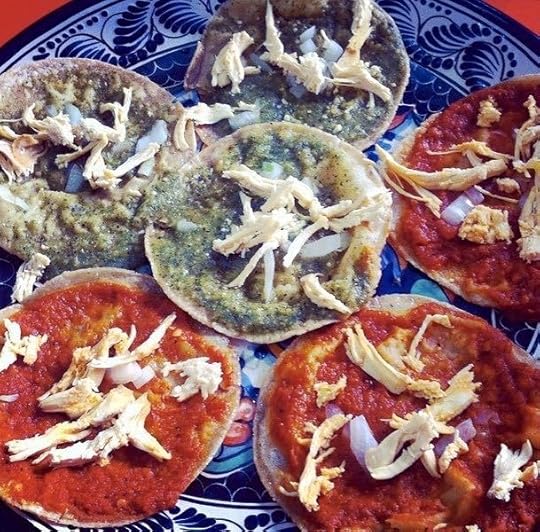
Photo: Soy Poblana
These are lightly fried corn tortillas that are topped with salsa, onion and shredded chicken or beef. You will find them being made on street corners typically in the evening. An order of chalupas usually comes with at least four pieces, so be a good Mexican and share the chalupa love!
5. Rajas poblanas

Photo: FoodMayhem.com
Here’s one for all you vegetarians. This dish is simple but don’t let that fool you. Rajas poblanas are strips of poblano chili peppers grilled to perfection with corn and cream. And if that doesn’t sound good enough then imagine how good they taste when topped with delicious quesillo (oaxacan cheese).
6. Tacos arabes
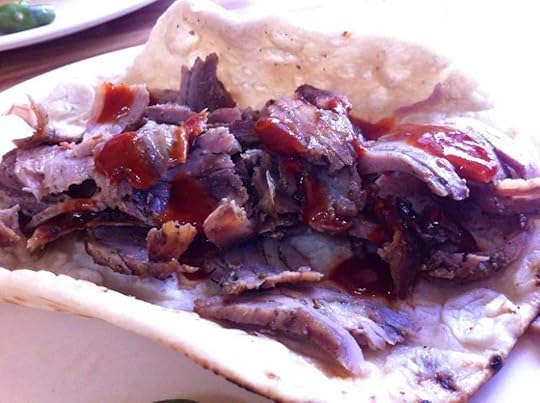
Photo: Soy Poblana
This arab-style taco is a real favourite for meat-lovers in Puebla. The spit-roasted pork is cut and served in a pita-style bread called ‘pan arabe.’ Squeeze a bit of lemon juice, add chipotle salsa, and you are set to go!
7. Pelonas
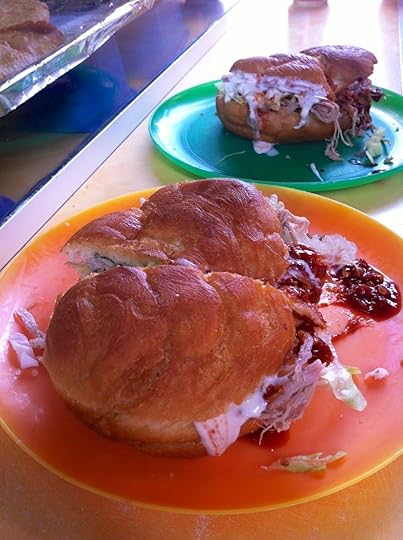
Photo: Soy Poblana
The pelona is a fried bread roll filled with beans, lettuce, cream, shredded beef, and salsa. It is a crunchy, creamy, spicy heaven.
8. Memelas
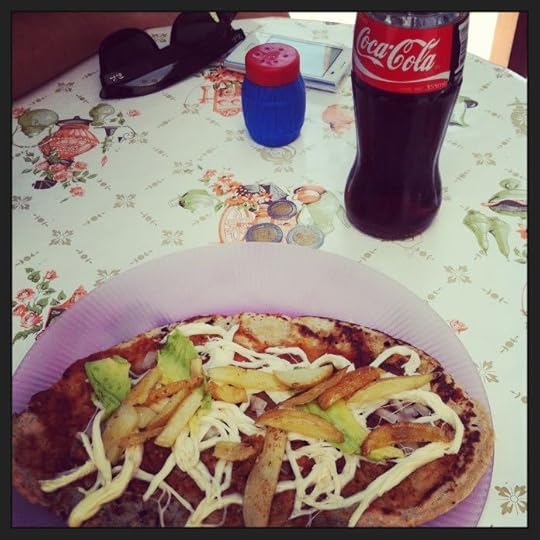
Photo: Soy Poblana
Memelas exist in other states, for example, Oaxaca, but though they share the same name, they are not the same thing. In Puebla, a memela is a hand full of corn masa filled with beans that that is pressed out into an oval shape and cooked on a comal. Salsa and cheese are then added along with anything else you want such as chicharon, or even French fries. It makes for a great breakfast (and hangover cure).
9. Molotes
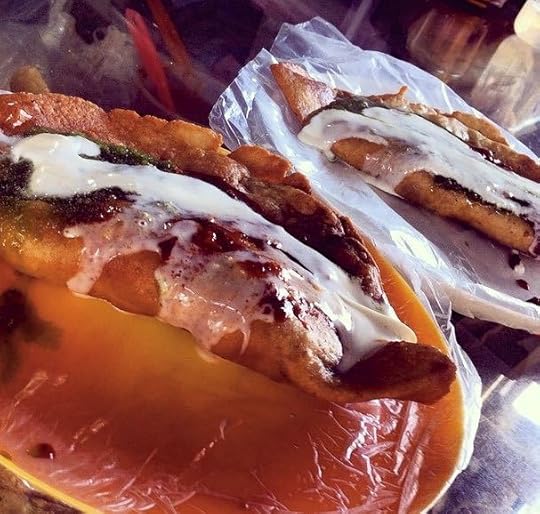
Photo: Soy Poblana
Molotes are made from pressing corn masa filling it with anything from quesillo, potatoes or mushrooms, deep frying it, and then smothering it with salsa and cream. The result: deep-fried deliciousness. 
Survival guide to Japan hot springs
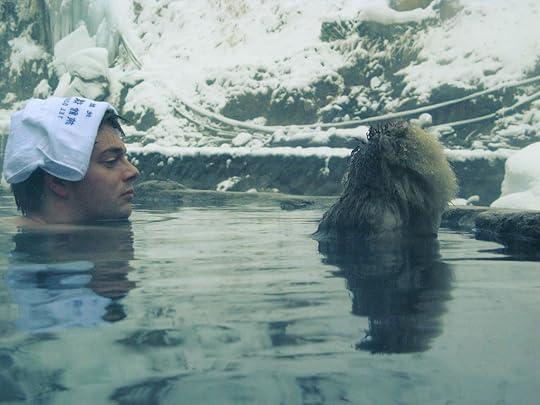
Photo: spDuchamp
FOR THOSE OF YOU WHO AREN’T FAMILIAR, Japanese people like to get naked and take baths together…in public. No biggie.
Most people call it “Onsen.” Onsen has a long and storied past that I do not have enough time to summarize, but most people attribute public bathing in Japan to two factors 1) the popularization of Buddhist purification rituals, combined with a large number of available natural hot spring sources, and 2) post-World War II Japan had a lack of private bathing facilities. I’m going to personally advocate for #2 as a bigger influencer in recent times (at least in urban areas anyway).
Since the ‘70s, private bathing options have become more available, causing public bathing as a necessity to drastically decline, whereas spa-like experience bathing is undergoing a renaissance.
So… first things first: Where to get naked?
There are two legit onsen in Tokyo. By this, I mean that these bros have drilled down 3,000 feet to access the giant volcanic aquifer that rests underneath all of Tokyo.
The first is a giant onsen theme park in Daiba, which is a manmade island in the middle of Tokyo Bay.
The place is called Ooedo-Onsen-Monogatari, and it is much more accessible for the everyman than its more upscale and expensive spa-like alternative called Laqua (across the street from the Tokyo Dome baseball stadium. But hey, there’s a rollercoaster! So that’s a plus).
The onsen theme park in Daiba has many cool features.
They give you kimonos to wear around. There are restaurants and they have beer. You can throw ninja stars while drunk.
But we’re getting sidetracked.
Here is the basic step-by-step etiquette for getting naked at the onsen.
Step 1) Get inside, get registered, pick a kimono.
Step 2) Go to the male / female dressing room.
Step 3) Get naked and put all of your stuff in a locker.
Step 4) Take a modesty towel with you, but try to act cool. If you run around worried about people staring at your junk, more people are going to stare at your junk.
Step 5) Go to the designated shower area and wash your body thoroughly with soap and body wash before entering the bath.
Step 6) Get in the bath and go with the flow. Don’t stare at people and relax.
SPECIAL NOTE — TATTOOS!
If you have tattoos, they are banned in all onsen. But there’s a fix. Use athletic tape to cover your tattoos so no one will bother you. It’s basically a “Don’t ask don’t tell policy.” No one will ask why you have so many bandages, but if you ask if tattoos are okay, you’ll be bounced out of there faster than you can say “Sayonara.”


How to parent like the Chinese
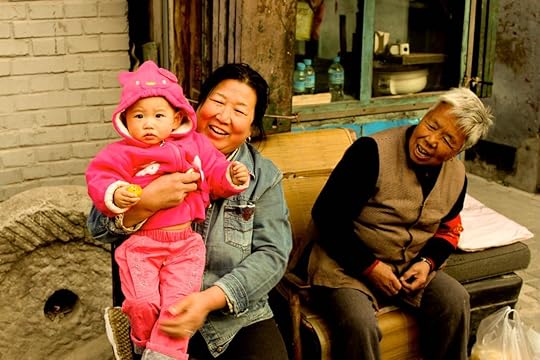
Photo: Matt Barber
Make education the top priority.
At age four, start teaching your kids to count to one hundred, do basic arithmetic, and memorize the multiplication table. Simultaneously, ask them to remember and recite ancient Tang dynasty poetry. And don’t forget to arrange music lessons as soon as possible, but know that the only options are piano and violin.
When they get older, make sure to arrange private tutoring and intensive summer classes. Parents push kids to study hard in a fiercely competitive environment, first to get into “key” junior and senior high schools, and then to earn top scores on the gaokao exams, so they can study Medicine, Law, Engineering, or Business at elite universities.
Be a helicopter parent.
Forget about the Tiger Mom; instead, take it up a notch by “hovering” over your kid like a helicopter. Some Chinese parents spend a fortune and fill their kids’ after-school, weekend, and holiday breaks with music, art, and dance lessons. Other parents forbid computer games, disallow sleepovers, and require kids to be home by dinnertime.
Also, make sure your kid is always warmly dressed whenever they leave the house. Even if they have become an adult, encourage them to live at home until they’re married. And when they finally do move out, begin each phone call with “Have you eaten?” and ask questions about minute details in their day.
Talk about the past, family honor, and Confucius.
To deal with kids who are picky eaters, begin talking about how the older generation grew up during famines, with rice, meat, and oil all carefully rationed. Remind the children about how their relatives used to work fifteen hours day in a factory or on a farm. Chinese parents also teach kids the proper way to address their aunt’s cousin twice-removed, and regularly refer to xiaoshun, filial piety towards parents and elders. And if you ever want to share a nugget of wisdom, there’s always Confucius.
Change your attitudes on dating.
Most Chinese parents forbid their kids from dating until after high school. They view zaolian, “dating early” before graduating high school, as harmful, distracting from schoolwork, and a waste of time. Some would even refuse to discuss dating, and there’s no Chinese equivalent for “the bird and the bees” talk.
This story was produced through the travel journalism programs at MatadorU. Learn More
But once kids become adults, become very concerned: “Why don’t you have a girlfriend/boyfriend yet?”
Give your kids tough love.
It’s rare for Chinese parents to tell their kids “I love you” or “I’m very proud of you”. Instead, show tough love by telling the kids bluntly to work harder, change bad habits, and lose weight; after growing up with the same comments, you know kids can handle criticism and grow from it.
If you’re a Chinese parent, you’ll make your kids’ favorite dishes after a long day at work, use your life’s savings to give the kids the best upbringing, and even immigrate to another country to provide them with a better life. And when your kids succeed at something, you’ll definitely show your pride by humble-bragging to all their friends and relatives. 
6 addictions you'll get in Japan

Photo: OiMax
1. Peeing to the sound of a babbling brook
Some Japanese toilets have so many buttons and gadgets that you almost expect to be launched off into space while sitting on the throne. Even some of the most basic public toilets have an automatic music function that starts playing when you sit down: muzak, gentle summer rain, a rushing river, take your pick. The intention is to mask the sound of your evacuations so that nobody who happens to be hanging around outside is able to discern what is really going on inside the cubicle. The side effect is that if you hadn’t been self-conscious about the thought of others hearing you pee before Japan, you will be afterwards.
2. Nomihodai karaoke (otherwise known as all-you-can-drink-until-5am)
It’s not healthy, and it wouldn’t be legal in many countries. But in Japan, it is common for traditional izakaya (Japanese-style bar-restaurants) and other establishments to have an all-you-can-drink plan for surprisingly little money. Some places offer just one or two hours of all-you-can-drink on particular items. My favorite version of this unhealthy pastime was camping out in a private karaoke room until 5am, with a waiter just a phone call away to bring me umeshu, plum wine, while I belted out an off-key rendition of REM’s “Losing My Religion.”
3. Tofu
Slimy and bland, tofu has a bit of a bad reputation in the West. The ways it’s prepared in Japan, however, could turn even the most ravenous red-meat carnivore into a convert. Skewered, coated in salty miso paste and grilled on an open flame; lightly battered and topped with spring onion; served alongside shrimp and sweet potato as tempura; diced finely and added to noodle soup dishes: the varieties are endless, creative and always delicious.
More like this: 10 Japanese trends we wish would hit the US
4. Onigiri
An onigiri, at its simplest, is just a rice ball. Fast-food versions, however, are usually the size of a fist, wrapped in nori (dried seaweed sheets) and stuffed with tuna salad, grilled salmon, pickles or other tasty morsels. Available at any corner store for small change, onigiri are Japan’s version of a sandwich, are just as satisfying, and usually healthier.
5. Flower viewing
Much of Japan is the proverbial concrete jungle, and the open green spaces are few and far between. Perhaps it is because of this, not despite it, that the Japanese are flower crazy. Each month ushers in a different bloom that everyone — frail old grandmother, suited salaryman, teenage boy—flocks to ooh and aah over. Every year they behave as if they’ve never seen such beautiful flowers before, snapping endless selfies with the flowers (felfies? flowfies?). Most Japanese have a soft-spot for the delicate pink cherry blossoms that are said to embody the national sensibility, which bloom in March and April.
More like this: 11 American habits that saved me in Tokyo
6. Onsen
A bit of a culture shock for the inherently prudish Anglo-American tourist afraid of public nudity, but once you’ve taken the plunge into your first onsen—or public bath sourced with hot spring water—you will wonder how you ever lived without them. The prettiest are to be found in remote mountain villages, where you can sit in an onsen cave, or enjoy one with a view of mountains or rice fields. Just don’t even dream of getting in without thoroughly washing first though: some onsen notoriously displaying ‘no foreigners allowed’ signs because of previous faux pas. (Tip: if camping in Japan, they may be the only way you will get clean, as Japanese campsites are usually not equipped with full facilities). 
An Afghan millennial in exile reflects on his country from the US

Photo: Ben BrodyGroundTruth Project
Qais Akbar Omar says he appreciates his life in the United States, which has given him shelter, an education and a certain amount of fame.
But it’s not Afghanistan, his home country.
“Of course I would love to go home,” Qais says, sitting in his small but comfortable apartment in the Boston suburb of Quincy. “In Kabul, when I wake up in the morning and see the mountains, I know those mountains are mine.”
Qais moved to the US in 2012 to pursue an MBA at Brandeis University, in order to better develop his carpet business back in Kabul. But he has yet to return home.
In 2013, Qais released his autobiography, “A Fort of Nine Towers.” It’s a searing account of his family’s ordeal during the Afghan civil war and the Taliban years, and it attracted negative attention from some of his countrymen.
In a place where disagreements all too often end in violence, many took exception to Qais’ frank indictment of the actors in those conflicts. They felt it cast the country in a negative light.
“People would come to my father’s carpet shop asking for me,” Qais explains. “They slid letters under the door at night, threatening us.”
Things got so bad that last year, when the 32-year-old’s mother died unexpectedly, his father forbade him to come home.
“We were crying on the phone,” recalls Qais. “I said, ‘I will be there by tomorrow,’ but my father suddenly stopped and shouted, ‘No! You cannot come. I will not have a bloodbath at the funeral.’”
After Qais published an article in The Atlantic last September about Afghanistan’s presidential elections, the number of suspicious visitors increased so much, Qais’ father closed his store.
His father now sits at home instead of going to work, and has told Qais to clear any further articles with him.
“My father is now my censor,” Qais says with a laugh.
“People would come to my father’s carpet shop asking for me. They slid letters under the door at night, threatening us.”
Qais comes from long line of carpet sellers, and he finds beauty and solace in the trade. Sitting in his apartment in Quincy, he says he never thought he would want more out of life than a carpet selling business. Destiny, however, had other ideas.
Qais was born in 1982, in a country at war. The Soviet invasion, which began in December 1979, was well underway.
Qais remembers his early childhood — spent in his grandfather’s large compound in Kabul, surrounded by parents, siblings, uncles, aunts and dozens of cousins — as idyllic. There was always someone to tease, fly kites with, and share meals with on the long tablecloth spread on the dining room floor.
Soviet planes may have been decimating villages, killing hundreds of thousands and driving millions into exile, but Kabul was calm and peaceful.
“We thought the Russians were very nice people,” recalls Qais. “They would throw us chocolate from their tanks, and we would yell “spasibo,” even though we did not really know what it meant.” (“Spasibo” is Russian for “thank you.”)
“We did not feel the effects of the war,” he adds. “The media was controlled by the government.”
The government, in turn, was supported and controlled by the Russians, so reports of the carnage were few and far between.
But once the Soviets left in 1989, things took a turn for the worse. In 1992, Afghanistan entered its darkest period, the savage and chaotic civil war, when the mujahideen, or “holy warriors” who had liberated the country from the Soviet invaders, turned their guns and anger on each other.
Qais was just 10 when the war started, but those years would mark him forever.
As he describes in his autobiography, Qais’ family lost everything — their livelihood, their home and the feeling that life made sense. Qais witnessed unspeakable brutality and unbelievable heroism, filing it all away in the deepest recesses of his young mind.
The fighting continued for four years. Qais and his family fled Kabul, setting out on a perilous journey where death seemed to hover around every corner.
When the Taliban finally drove the mujahideen from power, Qais felt only relief. No matter how harsh their rule, the Taliban were, at least initially, a vast improvement over what had come before.
“We welcomed those people,” Qais recalls now. “At least I did not have to worry that my aunt, my mother and my sisters would be raped in the next minute.”
But the Taliban rule became increasingly onerous. Qais himself was imprisoned for 10 days after a scuffle with a Talib who objected to his long hair.
“The movie ‘Titanic’ had just come out and everyone wanted to look like Leonardo DiCaprio,” he said with a laugh. Qais, who trained as a boxer, broke the man’s nose, and soon found himself chained to a wall with a mullah beating him with a whip several times a day. Adding insult to injury, they also shaved his head.
Qais’ father finally decided on the unthinkable: leaving Afghanistan. He paid a smuggler to get the family out through Central Asia, planning to wind up somewhere in Europe.
Before they could depart, on September 11, 2001, hijackers flew two planes into the World Trade Center, and Afghanistan once again found itself at the epicenter of world affairs.
Qais and his family watched the US-led invasion from the rooftop of their new house in Kabul, and his father suddenly announced that they would not be leaving after all. Over the vehement protestations of Qais’ mother, his father explained that a man did not abandon his country to an invader.
“We are not leaving Afghanistan until we find out whether these Americans are our real friends, or enemies in the mask of friends,” said Qais’ father.
Now, more than a decade later, Qais says he is still not entirely sure what the answer is to that vital question.
“The Americans are our friends, but they are not very smart about the choices they make,” he says. “They do not learn from their mistakes. They do not understand Afghanistan, our culture and customs, what makes us.”
The misunderstanding can be mutual, as Qais learned soon after he came to the US.
“I remember my first trip to Walmart,” he recounts with a smile. “I got up to the register and the cashier, a chubby blonde woman, rang up my purchases. ‘That’ll be forty-five dollars,’ she said. ‘Make it twenty-five,’ I answered. She just looked at me.”
Qais was with an American friend who in a panicked whisper tried to explain that this was not how things were done in the US.
Qais waved away his protests, sure that he had the situation well in hand.
“In Afghanistan, only an idiot pays the first price asked,” he explains.
On that occasion, the Afghan carpet trader ultimately had to bow to a new reality.
But he dreamt of bringing his country and culture alive for the rest of the world.
It was this drive to explain that led Qais to start writing. In the first years after the US-led invasion, he made friends with the waves of newcomers who were now living and working in Kabul. He taught himself English, and he regaled his new acquaintances with tales of his family’s ordeal. Slowly he came to realize that the events that had shaped his life were all but unknown outside of Afghanistan.
A friend, journalist and author Stephen Landrigan, encouraged him to write it all down. He started his epic autobiography in 2006.
“Once I started, I could not stop,” he says. “I did not leave my room for two-and-a-half months. Then I gave Steve a manuscript of 750 pages.”
Qais wrote his book in English because “it was too painful to write in my native language, Dari,” he says.
Landrigan helped him shape the book and find an agent. Qais was initially reluctant to make such personal reminiscences public, but once the publishers started calling, he decided to go ahead.
The book changed his life.
Over the past three years he has abandoned his carpet business and devoted himself to his new craft, completing an MFA in creative writing at Boston University. He is now a fellow at Harvard University’s Scholars at Risk program, and he is working on a novel.
He likes his neighborhood in this Boston suburb, and enjoys exploring local shops and restaurants.
“Here it is great,” he says. “You don’t have sewage in front of your house. There are no dead dogs in the streets for months on end.”
He is comfortable here, he says, but he still feels a hollowness at his core.
“There are so many places I cannot easily go in Afghanistan, because it is dangerous, but still I belong there,” he says. “I miss my country, I miss my people, I miss my food.”
With all its faults, Afghanistan is still home.
“The country’s a mess,” he said. “But maybe I should try and clean it up?”
He knows it won’t be easy. As Qais writes in his book:
“I know it will take a long time…I am a carpet weaver. I understand how, slowly, one knot follows another until a pattern appears. Oh God, can you not weave my destiny to keep me close to these people who mean more to me than any others in the world?”
By Jean Mackenzie, GlobalPost
This article is syndicated from GlobalPost.

Spaniards are obsessed with religion

Photo: Juanedc
The number of Spanish people who go to church keeps decreasing, and more and more the population defines itself as agnostic or atheist, but religion is still winning in one important part of life in Spain: language.
1. Llegar y besar el santo | To arrive and kiss the saint
Saints have always been in demand in Spain, so if you want to approach a religious statue and kiss it (because, why not?), you’ll have to queue. That’s how things are, at least with the saint statues you’re actually allowed to kiss (the situation would be different if you were going after clandestine kisses). But what if you arrive to the church, and it is empty? You could go directly to the saint and express your love and thankfulness! To arrive and kiss the saint! What a lucky person you are!
2. Con la Iglesia hemos topado | We’ve come up against the Church
There was a time when the Church was powerful in Spain. It influenced and intervened in people’s lives so much, that even Don Quixote de la Mancha saw his adventures partly cut short by it. Or that’s what we imagine now that we have manipulated Quixote’s original sentence, changing its literal meaning for a figurative one. Because he just came across the village’s church! But we don’t really care, and now we use the sentence to talk about any superior power or institution which cuts our plans short. In the 21st century, it’s usually the tax office and not the Church, though.
3. Ser de la cofradía de la Virgen del Puño | Being part of the religious brotherhood of Our Lady of the Fist
Don’t look for her, Our Lady of the Fist doesn’t exist, at least not in an official way. She has plenty of devotees, though. This imaginary virgin always appears with a closed fist (which never opens, that’s the important part), symbolising her reluctance towards spending, giving, or releasing money. A.K.A. patron saint of the scrooges.
4. Para más inri | For more inri
Inri, inri, there’s something familiar about that, isn’t there? You might have seen those letters on pictorical depictions of Jesus Christ’s crucifixation. On the top of the cross, a small piece of wood says INRI, which stands for Iesus Nazarenvs Rex Ivdaeorvm (Latin for Jesus Nazarene, King of the Jews), showing what he was being punished for. So, on top of everything the Romans did to him, “for more inri”, they placed the sign. A sign the Jews were not really happy with either, since they didn’t consider him their King and saw it as an insult. Oh, what a cross to bear.
5. Ser la Biblia en verso | To be a versified Bible
Why was the Bible written in prose? Wouldn’t it be much better to have a versified version? That’s what José María Carulla, a lawyer who was born in Igualada (Barcelona) in 1839, thought, and he was so convinced that he decided that he should be the one to perform such a solemn task. He got to versify four Bible books, but the result was not really popular. It was apparently hard to read — that’s an euphemism. Poor hard-working Carulla became the center of his literary colleagues’ jokes for a long time. No one remembers his name anymore, but his versified Bible is still synonymous with anything long, boring, and impossible to understand. But hey, no one will take the Pontifical Order of Knighthood you were awarded with away from you, dear Carulla!
6. El hábito no hace al monje | The habit doesn’t make the monk
Of course not! Otherwise, Carnival would mean a roller-coaster for Church statistics. So many new monks! But it would only be a temporary peak, and everything would go back to normal after the celebrations. No matter how many running clothes we buy and even wear, we won’t become athletes if we don’t actually go for a run. The same happens with monks, and anything you try to look like.
7. Ser un viva la Virgen | To be a Hail to the Virgin
Contrary to what you might be thinking, “Hail to the Virgin” types are not pious people who hail to the virgin several times a day. To qualify as a “Hail to the Virgin” person, you need to stop caring and doing things. Stop everything and lie on the couch. Isn’t life great? The origin of the expression is not clear, and there are several theories. One of them goes back to Imperial times, when Spanish conquerors decided the best way to defend the South American coast from the English pirates was to give weapons to the natives and let them work. Having just been baptised, the natives were really religious and used to yell “Hail to the Virgin!” while fighting. Except that in the end there were not so many pirates, so sometimes the hailing part was the only thing they did all day.
The other main theory refers to sailors and how, whenever they were calling the roll, the last one would say “Hail to the Virgin!” He was usually the clumsiest sailor as well.
8. Estar hecho un Cristo | To look like a Christ
Where are you coming from? You look like a Christ! That is, dirty, poorly dressed, disheveled… you look terrible! You can use it for anything, not just people. Rooms, according to our mums, look like a Christ quite often too.
9. Quedarse para vestir santos | To be left to dress saints
Things have changed and many now think it’s better “to be left to dress saints, than to undress [insert insult of your choice],” but some years ago it wasn’t advisable for women to stay unmarried. What would you do without a husband? The only thing left for you would be helping in church (what else, with so much free time?), more often than not, putting clothes on the saints statues.
10. De Pascuas a Ramos | From Easter to Palm
What comes earlier, Easter or Palm Sunday? Yes, first Palm Sunday and, a week later, Easter. And you don’t get any other Palm Sunday until the following year! So if something happens from Easter to Palm, it means it doesn’t happen very often.
11. Hacer la pascua | To make the Passover
Please note that the Spanish word “Pascua” is used both for Easter and the Jewish Passover. Here, we refer to the Jewish Passover ritual of slaughtering a lamb as a sacrifice. The slaughter comes, of course, after weeks of feeding, and taking care of it. You can imagine what making the Passover to someone means, right?
12. A la buena de Dios | To God’s good
To God’s good will, that’s what we mean when we say that. We are good devotees, and, as such, we believe in God’s goodness; therefore the expression is “to God’s good” and not “to God’s bad”. That’s what we hope will happen whenever we find ourselves abandoned, helpless, and unguided, left to God’s (good) will. When we show up to an exam without having studied. When we decide to explore a new city leaving the map (and smartphone!) at the hotel. When we leave our younger siblings alone at home. In God we trust.
13. ¿Quién te ha dado vela en este entierro? | Who has given you a candle for this burial?
No one! So get out of here, this is none of your business! And by candle and burial, we mean right to give your opinion, and matter (but it doesn’t sound so well). The candles are the ones given to a deceased person’s friends by his or her family when they attend the burial. So if you’re not given one, maybe you’re not really welcome. You’re just a nosy, meddling person. 
You know you're in Mexico City when
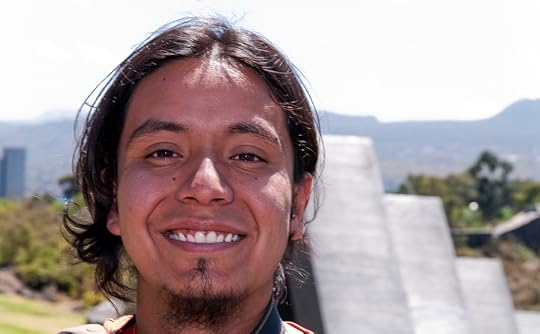
Photo: sari_dennise
Hacé clic para leer este artículo en español. Tambien podés darnos un “me gusta” en Facebook!
1. You’re usually woken up by a tune that goes like “Se compran colchones, tambores, refrigeradores, estufas, lavadoras, microondas o algo de fierro viejo que vendaaaaaa.”
2. You step out of the bus to find a stall of tortas de tamal… and the tamal is deep fried.
3. You find the representatives of the 400 pueblos all naked in some public plaza.
4. You order your taco with or without copy.
5. You find that guy who just got out of jail and now he’s here to ask for a little cooperation, for some coin that doesn’t affect your economy, because he would really hate to be forced to mug you in a dark alley… so please give him a little money.
6. Peddlers in the public transport call you little-lady-gentleman (damita-caballero).
7. You hear a street organ somewhere.
8. There are more San Juditas figures than people on the metro.
9. The same pedestrian has outrun the taxi you’re riding a few times.
10. After a day in the streets, you blow your nose and the tissue turns black.
11. Having change is a civic duty… especially early in the morning.
12. You finish a cascarita with gol de oro and no matter what, you pamper your efforts with a caguama in a bag.
13. There’s a guy selling chito among some other snacks… and you don’t really know what to think about that.
14. A traffic jam turns into a market and the first stall to appear sells gorditas de nata.
15. Every single day, High Quality Products releases a novelty item, a trendy item, that’s also a cute little detail for your girl or your boy.
16. No matter the tone of your skin or the color of your hair, you’ll be referred as güero or güerita by every single vendor.
17. The avenues have more than two white lines indicating each lane… choose wisely.
18. Everything you eat on the street has onion, cilantro, or parsley.
19. Every stranger you cross words with will call you “amigo.”
20. Every city fountain is a water park waiting to happen.
21. You can feel a strong hatred against viene-vienes.
22. Taquerias are ubiquitous and they come in all kinds of presentations, from the gourmet fancy ones to the corner stall that sells cochi tacos.
23. You’re asked if you want cheese with your quesadilla .
24. There’s a street bump that every single local knows and fears.
25. The camote cart scares the shit out of you.
26. In less than 200 meters, you’ve walked past a couple palaces, some museums, a nice park, and at least ten torta stalls.
27. You find someone selling chilaquiles tortas and your heart fills with joy.
28. The sky is sometimes blue and sometimes white, and this has nothing to do with clouds.
29. You see walls painted with vibrant colors announcing the upcoming sonidero event where the main showdown will be between Sonido La Changa and the almighty Patrick Miller.
30. There is a speed bump so evil, that some wise guy opened a tyre shop in front of it. The shop is called El Tope.
31. You see a sign announcing ultramarines… and you know precisely what that means.
32. Your esquites come with chicken legs.
33. You have to stop your conversation briefly because a plane is passing by.
34. There are Iron Man and Hello Kitty themed taxis.
35. The guy driving the car next to yours is reading a novel or catching up on paperwork.
36. You find Michelangelo’s David in a park.
37. You find a street full of cosplayers that want you to get a picture with them.
38. A Day of the Dead altar is erected with the help of cranes and scaffolds.
39. You’re late to work because the metro was flooded.
40. You find a policeman riding a horse dressed as a charro.
41. Every massive event has a high incidence of that canned foam spray shit.
42. Every single bus driver thinks his unit is “Edition Special.”
43. The mountains around you disappear and reappear depending of the day.
44. The floor starts moving and you don’t know if it’s an earthquake or just the garbage truck… and you don’t really care.
45. Somewhere in the distance, you hear the subtle voice of a man calling “Súbale, súbale, lleva lugar, súbale, se va, metro Zapata, Insurgentes, Mixcoac, súbale…”

Matador Network's Blog

- Matador Network's profile
- 6 followers

