
Matador Network's Blog, page 2075
August 9, 2015
12 ways to cure your hangover in Amsterdam like a local
A photo posted by Sophia Koehorst (@sophiakoehorst) on May 16, 2015 at 1:04pm PDT
It’s 9am, and you feel like you’ve been run over by a streetcar. Most bars in the city don’t open until at least noon, but at ’t Smalle, bartenders are busy at 10am seven days a week. As the day of misery wears on, down a cocktail that matches your state of being — The Walking Dead — at Hiding in Plain Sight.
2. Eat an Omelegg omelet.
#omeleggamsterdam literally the best brunch going! No surprise its voted #1 restaurant in #amsterdam


35 things you will never hear someone from Cornwall say

Photo: coolio-claire
1. “I could murder a Ginsters pasty.”
2. “I just love that Rick Stein has taken over Padstow.”
3. “Kernow King is shit.”
4. “I can’t go to the pub in shorts and flip-flops! I’ll go home and get changed.”
5. “I remember the whole of last year’s Mazey Day.”
6. “No, no. You put the cream on before the jam.”
7. “I love seagulls, their screeching is like a lullaby.”
8. “Nah, I’ll have a coke instead of a cider with lunch.”
9. “St. Ives is just so lovely to visit in summer.”
10. “I’m never drinking mead again.”
11. “I’m never drinking cider again.”
12. “I’m never drinking rum again.”
13. “No, I will not dress up as a pirate.”
14. “Land’s End is the best place to visit in Cornwall.”
15. “I don’t want to go to the beach again.”
16. “It’s amazing that so many people think Cornwall is great enough to buy a second home in.”
17. “We’ll definitely be able to find a parking space in:
St. Ives/
Fowey/
Mousehole/
Penzance/
Mevagissey/
Tintagel/
Boscastle/
Perranporth/
Porthtowan/
Carbis Bay/
Falmouth/
Porthlevan.”
18. “I really want to go on a night out in Newquay in August.”
19. “I have never seen the Mousehole Christmas lights.”
20. “Who is Betty Stoggs?”
21. “Flora Day is the worst day of the year.”
22. “Oh, it’s raining? That makes for a nice change.”
23. “I don’t have an opinion on whether Cornwall should be independent or not.”
24. “I don’t have an opinion on the new Asda in Hayle. Or the new Sainsbury’s in Penzance.”
25. “I hate seafood.”
26. “Storms are so boring.”
27. “How great is it that public transport here is always on time?”
28. “Let’s feed the seagulls!”
29. “Nope, I didn’t hear that gossip…”

This story was produced through the travel journalism programs at MatadorU. Learn More
30. “No! I will NOT day drink with you in a beer garden when it’s 30C outside!”
31. “Wait, what? We’re the poorest county in the country? Didn’t even notice.”
32. “Camborne is Cornwall’s cultural centre.”
33. “The Scillonian is the best form of transport. I just love a flat-bottomed boat on a stormy day.”
34. “Oh, you only have Rattler? No Strongbow?”
35. “I’d rather live in Devon.”


August 8, 2015
11 abilities Portlanders have over everyone else

Photo: Jim Fischer
1. Admiring your quirks and celebrating how you personally contribute to the weird fabric of the city.
What “keeps Portland weird” is certainly not the city itself, which on its surface is actually pretty normal, if a little small. It’s the people… the folks who may work as a barista 3 days a week, run an indie web comic in their off time, and be the mandolin-and-harmonica-playing frontman in their costumed super-hero-themed band on the weekends. It’s the folks who borrow the industrial welder from their construction gig to fuse 4 individual children’s bikes into a single creation that’s both bizarre and grand (and which you’ll then see them riding naked down Burnside the first opportunity they get). Each person, no matter where they fit in on the weirdness spectrum, is what makes Portland, Portland — and we reserve the right to celebrate you for your contributions.
2. And with that, unflinchingly accepting that sometimes, “it’s just another day in Portland”
When you bring enough weird people together, really weird things are bound to happen. And as a result, we seasoned Portlanders have grown a bit desensitized to the sheer gravity of the oddness that happens here on the daily. For example, if they made a bingo card for stuff you might see while in town, it would definitely include things like: a flaming-bagpipe-playing Darth Vader on a unicycle, hula-hoops u-locked to bike racks, dogs trained to trot alongside their leash-wearing humans, and a person in a chicken suit serenading other actual chickens with a violin. And as if that wasn’t enough, our newspaper is basically a police blotter featuring such colorful headlines as: “Man tries to strangle wife with his own dreadlocks” and “Naked man hit by car while doing push ups in the middle of the street.” But you know what? That’s just another day in paradise.
3. Seeing past the hair and tattoos to the rich and complex human being beneath them.
Think of it as a sort of X-ray vision we shouldn’t need but have anyway. We recognize that a person is so much more than their appearance, and let people express themselves any-which-way they choose. But then again, just because we choose not to judge people on these attributes, it doesn’t mean we’re completely blind to them — we just *actually* appreciate a finely waxed moustache and the killer color work on your elaborate shoulder piece.
4. Prescribing the perfect beer for you based on your personality and meal.
In Portland, most things are elevated to an art form, and one of the grandest expressions of this is in our beer culture. Yes, you’ve heard it a billion times: we love beer, we drink it while doing everything, and if the apocalypse happened tomorrow we as a community could subsist on it until it was time to repopulate the Earth. But more important than our abundance of beer, is our respect for it — which is why any good Portlander knows exactly when to recommend you dabble in an IPA, and which Hopworks seasonal will pair perfectly with your easy-breezy attitude and those insanely delicious cheesy pretzel sticks.
5. Taking all of your dietary restrictions in stride.
Are you: vegan? Gluten allergic or gluten intolerant? Morally opposed to eating anything that’s not grass-fed, cruelty-free, free-range, cloven-hooved, purple, or grown inside a castle of cheese? It doesn’t matter what your dietary restrictions are, we’ll still find a way to whip you up something that’s delicious… and will do so with a smile.
6. Having the steely resolve needed to endure the long gray season (without letting it permanently harden our hearts).
I would never say that Portland sees more gray sky than Seattle during those 10 sunshine-less months between September and July… but I can say with utter confidence that during that very first sunny break in the cloud cover (sometime in February), Seattle will never have anything on the widespread communal ecstasy experienced in Portland. It’s almost like you can hear Grieg’s Peer Gynt Suite No. 1 playing as the darkness parts and all of us Portlanders emerge from our hidey-holes like thousands of soggy gophers full of playful wonder.
7. And a certain lack of water-solubility.
We’ve accepted wetness as a fact of life, and don’t fear the water here. We won’t shut down any of the major roads just because “it’s not safe to drive in this much rain”, and we certainly don’t need no namby-pamby raincoat-and-galoshes-and-an-umbrella getup to keep us dry during our lengthy wet season. All we need is an extra flannel on our backs, and a good minute to shake it off like a duck when we get wherever we’re headed.
8. Harboring the complete and utter inverse of road rage.
We Portland drivers are a friendly but meek breed. And yes, it’s true that many of us are also objectively pretty bad drivers… the kind that view signaling as optional and merging as something that’ll just “happen if I keep driving straight.” And yet, hearing a car horn (even living literally off a major thruway like Powell, which I do) is an inexplicably rare occurrence usually reserved for just after an accident has actually already occurred. The paralyzing fear of being seen as a Californian behind the wheel often leads to backed up traffic in all directions at a 4-way stop… after each driver has politely relinquished the right of way in what winds up resembling the lamest game of Hungry-Hungry-Hippos ever. And yet, still, not a horn is honked nor a naughty finger raised, and any expletives are muttered silently (and typically come from the mouths of native Californians).
9. Knowing and appreciating objectively “good” food.
If it’s true that “everyone’s a critic,” in Portland everyone would be a food critic. PDX is a massive foodie city, which means that we not only value good food… we expect it. It’s hard not to, when even our everyday cart food has notoriously next-level flavors and will almost always contain exotic ingredients we can barely pronounce and/or didn’t know were legal (foie gras, Romanesco broccoli, and goat cheese marionberry habanero ice cream, anyone?).
10. Having the boundless courage (or madness) to make virtually any length commute by bike.
Portland’s unofficial motto (which I’ve admittedly just made up) is “the City of Sculpted Calves,” which we forge on our 15-25 mile daily commutes to and from work, in all types of weather, and in what always seems like the mad-pedal-uphill in both directions. And then we go on even longer “scenic” rides over the weekends, just because we love our bikes (and being a “biking city”) *that* much.
11. And finally, developing a patience that even saints would envy.
Portland is also a very sleepy city, which honestly has a lot more to do with the weather than it does all the weed people think we’re for smoking. But as a result, Portlanders take their own time doing everything, and opt for a very laid-back, “let it be” attitude toward the pace at which things get done. We “live life, man,” even when living life means waiting half an hour for a cup of coffee. And if we get stuck behind a couple of older folks ambling at a snail’s pace down a sidewalk in Sellwood, we’ll just consider it an opportunity to stop and smell the flowers. 
Gaza Sky Geeks keeps startups afloat
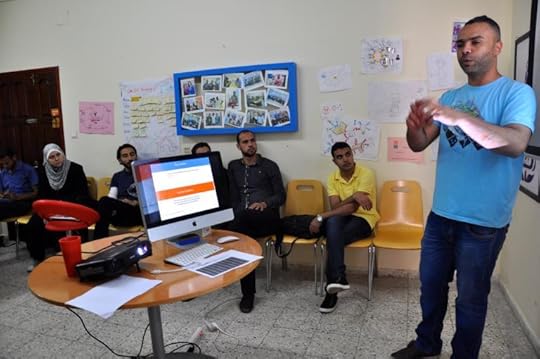
Said Hassan, manager of Gaza Sky Geeks, advises entrepreneurs at the group’s pre-investment “bootcamp.”
Photo: Lauren Bohn/GlobalPost
GAZA CITY — Last summer’s 50-day war, in which 2,000 Palestinians and 70 Israelis were killed, were some of the hardest days of Said Hassan’s life.
“I lost nearly everything that connected me to my roots,” the 30-year-old says.
His home was destroyed, along with nearly all of his family’s belongings. Gone in the rubble were the self-proclaimed computer nerd’s electronics, his wife’s beloved collection of shoes and his daughter’s favorite toys — items reflecting a life of attempted normalcy.
But one thing got him through days of despair and destruction: leading Gaza’s first and only startup accelerator, Gaza Sky Geeks.
“Gaza is a place where few people think they can build something,” says Hassan, the manager of the accelerator. “Some of the smartest people I know are now selling chocolate in the markets. People don’t reach their full potential here. We’re making sure they do.”
But reaching is difficult in a place plagued by a protracted occupation, daily power shortages and the highest unemployment rate in the world. Few can venture outside the Philadelphia-sized territory’s tightly controlled borders and 80 percent of the population depends on aid.
Despite overwhelming barriers, Gaza Sky Geeks — backed by Google and administered by Mercy Corps, an Oregon-based aid agency — has birthed a startup movement, having hosted over 100 competitions and trainings that have reached more than 1,500 youth.
In last year’s first incubation cycle, four startups — ranging from a carpooling and taxi request service to a social network for Arab soccer fans — received outside investment from Arab-focused venture funds.
The team hopes to secure funding for another four startups this year.
On a recent hot summer afternoon, twenty teams chosen from hundreds who applied participated in a startup “bootcamp,” where they were trained on marketing basics and how to sell their big ideas to investors. Those who receive investment will go through Gaza Sky Geeks’ five-month acceleration program later this year.
“We’re trying to encourage people to keep following their dreams,” says Hassan. “To never give up.”
Meet some of the relentless entrepreneurs behind those dreams that extend beyond the 134-mile territory they call home:
Walk and Charge
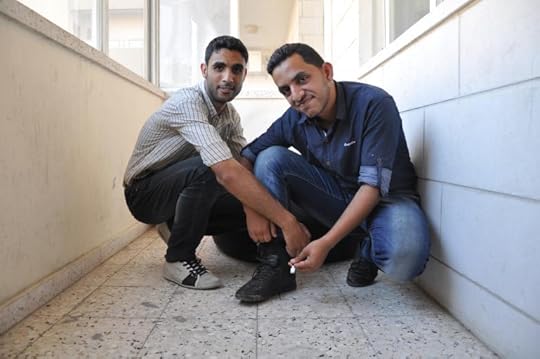
Omar Badawi and Sameer Al NuNu, 22, creators of Walk and Charge.
Photo: Lauren Bohn/GlobalPost
Gaza’s orange-sky mornings are Omar Badawi’s favorite time of day. Almost every morning, he sips tea on his balcony in Beach Camp, one of Gaza’s most crowded refugees camps, and watches the sun rise over the strip’s 25-mile Mediterranean coastline.
“You have to take advantage of the light in Gaza,” he says, showing off a photo album on his mobile phone, full of sunrises and sunsets. “And you have to get everything done then, because by night, you most likely won’t have electricity.”
According to UNICEF, Gaza is currently supplied with only 208 megawatts of electricity for 1.8 million people. The territory gets its power mostly through purchases from Israel (120 MW) and Egypt (28 MW), and less than a third from production by Gaza’s only power plant. But the supply meets only 46 percent of the estimated demand. Rolling power outages currently last up to 12 hours per day. During the summer, most Gazans have electricity for only 6 hours a day.
“I’ve been thinking about it for so long,” says Badawi. “How can we take advantage of technology and generate power in Gaza?”
When he met 22-year-old Sameer Al NuNu, a fellow engineering student at Al Quds Open University, they vowed to figure it out.
With the help of two female developers Ghaida Hussain and Saeda Nassar, they came up with “Walk and Charge,” a piezoelectric (electricity resulting from pressure) device that charges your mobile phone while you walk. So far, they’ve successfully produced an electric charge from a small device that rests in the soles of shoes. Inspired by the success of a West Bank startup which designed a top-up battery pack, they plan to launch a Kickstarter campaign to develop a more sophisticated prototype.
“Need is the mother of invention,” says NuNu. “You need to change the frustration in your mind to make something.”
Still, the optimism only goes so far. Hussain lost her home in last summer’s war. NuNu lost a close friend in an Israeli airstrike.
“It only fuels me to keep going,” he says, vowing to never give up on behalf of his beloved friend. “It only fuels me to do the impossible…to someday get to Silicon Valley and do big things.”
On their down days, the best friends linger on TED.com, watching talks for quick-hits of inspiration. Among their favorites is one by a South African entrepreneur who invented a bath-substitute lotion to combat water deficits — a reminder that they’re not the only ones facing antiquated problems.
“It’s not crazy to dream big. I mean, Steve Jobs grew up with a hard life too,” says Badawi. “If he can do it, I can do it.”
La Belle
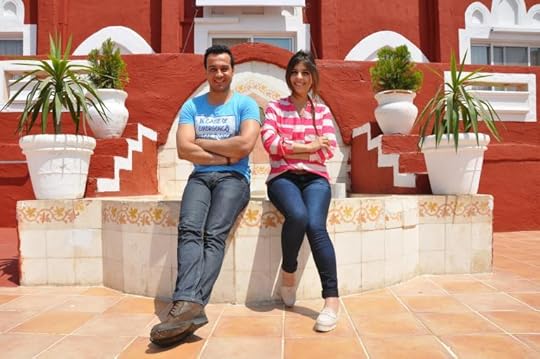
Ahmed Al Wakil, 31, and Engy Rehim, 24, founders of La Belle.
Photo: Lauren Bohn/GlobalPost
When Ahmed Al Wakil grew up watching his sisters toil in front of the mirror, trying to find the perfect blend of eyeshadow and lip gloss, he always wondered why there wasn’t an easily accessible technology that would allow them to test makeup on themselves through photography before applying.
“Even in Gaza, women want to be beautiful, it’s a universal language,” the 31-year-old accountant says. “It’s the biggest business opportunity.” So last year, he teamed up with 24-year-old Engy Rehim, a friend of his wife, to develop La Belle, an aspiring virtual one-stop makeup hub and social media network for the Middle East.
“Nothing like this exists for the Arab world,” Rehim says. “We want people to connect over beauty, to experiment using our technology and to transform themselves.”
Wakil’s own journey of transformation hasn’t been an easy one. He spent two years in Malaysia for graduate school, but returned to Gaza in 2012, unable to obtain scholarship money to continue his studies. The only college graduate in a family of automobile workers, he worked his way up from a menial factory job to retail in a men’s boutique to a relatively well-paying job at a Gazan bank. He says he is the only one in his family with a stable salary.
For Rehim, who recently got engaged but wants to work toward a master’s degree in Turkey, being a woman presents its own unique challenges in a conservative society. “If I leave Gaza for education, people might judge our family,” she says. “For instance, my leaving might make it difficult for my sisters to get engaged.”
They acknowledge the realities are unfair, but they’re determined to work ahead.
“Look, imagine getting up every day to go to work at a bank in a nice suit, but you walk to work in the dusty sand and you arrive dusty to a place where no one cares about their work and everyone is depressed,” he says. “But Gaza teaches you something important: the only thing you can change is yourself, and that’s the most important thing. Entrepreneurship will be the door out of our cage.”
He attributes much of his optimism to the best-selling self-help book “The Secret,” which holds that one can create his own reality through the power of his thoughts.
“If you can imagine it,” he says, his mobile phone ringing to the chorus of the hit song “Happy” by Pharrell Williams, “you can be it.”
Baskalet, “Bicycle”
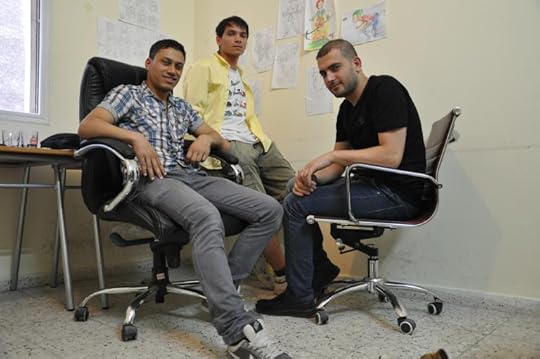
Mohammed Ezzdeen, 27, Baskalet developer.
Photo: Lauren Bohn/GlobalPost
Mohammed Ezzdeen traces his life’s mission back to a decision his father made twenty-some years ago: purchasing an IBM computer. He says his father was one of the first in Gaza to do so and, at the time, everyone thought he was crazy to spend so much money on technology. “It was the best thing,” he recalls. “I became a computer geek and things were never the same.”
Ever since, Ezzdeen says he’s been obsessed with computers, specifically gaming. But as he grew older, he became frustrated that none of the popular games were designed by Arabs, let alone designed for an Arab market.
“I mean, the streets aren’t even Arab in style,” he says. “People here play Western games without even really understanding them.”
So the 27-year-old, along with two self-taught programmer friends and an illustrator, got together to start Baskalet, Bicycle in Arabic, a mobile gaming company.
“When we were younger, having a bicycle was our dream,” he says. “But today’s generation wants technology and mobile games. Gaming is the new bicycle.”
The group recently released its first title, an Arabic-language driving game in which a son steals his father’s keys to go on a joyride — a memory, they laugh, is shared by many of their friends.
“There’s so much potential in the Arab world for games that speak to us,” says Ezzdeen, who recently quit a relatively stable job at an outsourcing company. The Middle East, and the Gulf region specifically, is an active consumer of games. In 2011, the market was estimated to be around $1.4 billion.
“We’re ready to break into the market and make the Arab world the hub for gaming,” he says. “But really, we want to make kids smile.”
MENAship
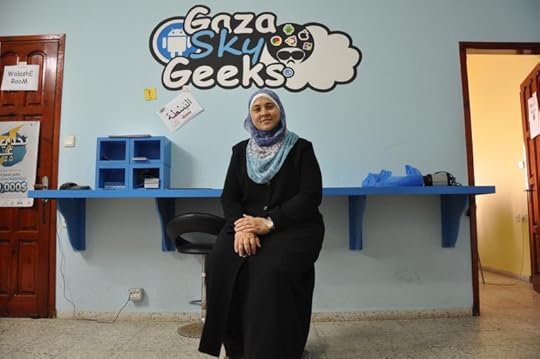
Nawal Abu Sultan, 31, founder of MENAship.
Photo: Lauren Bohn/GlobalPost
Nawal Abu Sultan was always a top student. While she studied engineering at the Islamic University of Gaza — where a quarter of the program is made up of women — she soon gravitated toward the field of education.
“I want to help people expand their minds, to learn,” the 32-year-old teacher says. But when she started teaching 7th grade technology and science, she realized she needed to do more outside the classroom to expand their horizons.
“A lot of Gazan students have so much potential, but don’t know what to do with that potential,” she says. “The keys exist but often educational opportunities are abroad and they don’t know where to look.”
Inspired by her own challenges for scholastic advancement, she and a team of four friends started MENAship, an online database and mentoring site that connects Arab students across the Middle East with scholarships abroad. She plans to partner with universities and education centers around the region.
“Navigating these applications is difficult for everyone, especially those in Gaza who aren’t familiar with the outside world or how things work,” she says. “Education in the Middle East needs a revolution…the system is old and we need to innovate.”
While Abu Sultan says she’s one of the most hopeful people she knows, last summer’s war was a test of her strength. The old dilapidated school where she teaches was overflowing with students who fled from war-torn neighborhoods of Gaza.
“Sometimes it’s hard, because I want to give them hope,” she says. “But I don’t know how.”
Still, while she concedes MENAships might be a drop in the bucket, she believes it will make a meaningful dent.
“I believe a good education is a right, not a gift,” she says, updating the company’s Facebook page. Its avatar features a photograph of Cambridge University’s wide green campus, a galaxy away from Gaza’s concrete obstacle course. “And I won’t stop until my students have that right.”
TebCare
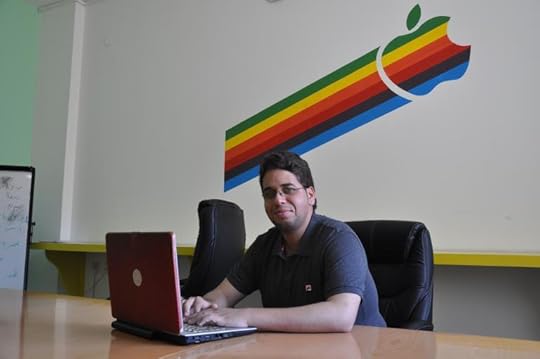
Mohammed AbuHaiba, 24, developer of TebCare.
Photo: Lauren Bohn/GlobalPost
The Israeli invasion of last year was “heartbreak” for 24-year-old Mohammed AbuHaiba. While he’s lived through two other wars, this was the first time he was practicing medicine at Al Shifa Hospital, Gaza’s largest medical center.
“There were dead people everywhere,” he says, recalling instances where he tried to reunite family members with their lost loved ones. He wasn’t always successful. “We were trying to do as much as we could, but we were powerless.”
Even in more peaceful times, being a doctor in Gaza is a challenge. “I suture wounds for patients, but we often we don’t have the proper materials for them,” he says. “So I have to tell them to go down the street to a pharmacy to buy them and then bring the materials back…can you imagine?”
Two years ago, frustrated by deficits in the region’s healthcare system but encouraged by advances in technology, AbuHaiba started TebCare (Teb is medicine in Arabic). It’s an Arabic-language WebMD of sorts, designed to address the parallel needs of a void in medical knowledge online and off while featuring a wealth of talented but unemployed doctors. The website averages 3,000 unique visitors a day, he says.
“Arabs are lazy,” he laughs. “Getting them to the office is sometimes hard…so if we can do as much as we can remotely, we’ll be a success.”
The team currently has a volunteer staff of 43 doctors from around the region who answer questions free of charge within 24 hours. They’re planning to introduce paid consultations with video services and scale the service to the Gulf region. AbuHaiba says they’re currently in talks with the US-based Mayo Clinic to translate content and produce it for the Arab world.
He hopes the website can become a viable employment opportunity for Arabic-speaking doctors, who often make dismal salaries in the Middle East. He says there are around 1,700 doctors in Gaza, half of whom don’t receive a regular salary. Those who do average $600 a month.
Along with developing the region’s go-to source for medical care, AbuHaiba also hopes to crack Gaza’s professional glass ceiling. While he procured an American visa last February, which is no small feat, last month he finally obtained permission from Israeli and Palestinian authorities to travel to Houston, Texas, where he hopes to take the US Medical Licensing Examination.
“America is the best country in the world to be a doctor,” AbuHaiba says. “I want to bring what I learn there to Gaza…to change lives. It’s a big dream, but dreaming is all we do in Gaza.”
A version of this story appeared on The New York Times.
Lauren Bohn is the The GroundTruth Project’s Middle East correspondent. This story is part of an ongoing GroundTruth series called “The Other,” supported by the Ford Foundation.
By Lauren Bohn, GlobalPost
This article is syndicated from GlobalPost.

August 7, 2015
Australians can’t agree whether booing an indigenous athlete is racist
Is booing an indigenous athlete racist?
The question is at the heart of a heated debate that has been raging in Australia for weeks and has polarized the country.
Here’s a bit of background to bring you up to speed.
Adam Goodes is a star player for the Sydney Swans, one of 18 teams in the Australian Football League — the equivalent of the NFL in the US, but for Australia’s rough and tumble version of football, which to outsiders looks like rugby.
The 35-year-old is a two-time Brownlow Medallist, the highest individual honor in AFL that goes to the best player of the season. He was named Australian of the Year in 2014.
He’s also an indigenous leader and is considered a role model for Aboriginal children. He has used his high profile as a platform to speak out about racism and social injustices in the country.
#ICYMI: #Indigenous leaders speak out on #AdamGoodes and Australian racism http://t.co/C9Xb3SNTRj #thedrum pic.twitter.com/ko0hLlLeAD
— ABC News (@abcnews) August 2, 2015
Yet many football fans appear to hate him.
Earlier this year, Goodes performed a war dance after kicking a goal during the AFL’s Indigenous Round, a special event held just before the start of the official season to celebrate the contribution of Aboriginal footballers to the sport.
The fans of the opposing team took umbrage at the impromptu performance they believed was targeted at them. Since then Goodes has endured relentless booing every time he runs onto a football field.
Check out the controversial dance here.
But is the booing racially motivated?
It’s a question that has dominated mainstream media, social media and dinner-table conversations in the sports-mad country, and has prompted some uncomfortable introspection among non-indigenous Australians.
Defenders of the booing claim the taunts are not racist and that it’s the footballer’s own “theatrical” style of play that has irked fans.
#AdamGoodes NOT SEEING RACIAL MOTIVATION IN THE DEFINITION, Unless you are looking for it. pic.twitter.com/JiWfMYzKLa
— hashhag (@vviivviieennnne) July 28, 2015
Anyone stop to think that Adam Goodes is being booed because he's being a wanker? #AdamGoodes #haveacupofconcrete #haveasook
— Jacinta Clarkson (@jayrarf) July 28, 2015
Radio shock jock Alan Jones told his listeners that football fans “just don’t like the fellow.”
The ill-feeling toward Goodes has also been traced back to an incident in 2013 when he had a 13-year-old girl removed from the spectators stand after she called him an “ape.”
The teenager was questioned by police, but Goodes declined to press charges. He later described the incident as “shattering,” but said it wasn’t the first time he had been the target of a racial slur.
Despite being the victim of blatant racial vilification, Goodes was accused of humiliating the girl.
While some football fans may have taken a dislike to Goodes following the highly publicized incident, the persistent booing appears to have only started this season following the controversial war dance.
To many, the heckling of Goodes is flat-out racism and those who suggest it’s anything else are in denial.
@firstdogonmoon sums it up perfectly as usual #AdamGoodes #CheerAdamGoodes pic.twitter.com/Xf1VpdvTg1
— Donna South (@DonziMonster) July 28, 2015
Opinion: Those who boo #AdamGoodes, have the courage to admit you’re racist. http://t.co/6n2LDrmdRi @Smithersss pic.twitter.com/Ww5K3iLHgu
— The Australian (@australian) July 30, 2015
“The problem with racists is that they genuinely don’t believe themselves to be racists,” wrote Robbie Blowers, an American legal practitioner living in Melbourne.
“During round 17 of the AFL fixture, a fan supporting the West Coast Eagles was ejected from Domain Stadium in Perth for yelling at Goodes to ‘go back to the zoo.’ Upon being questioned about the incident, the fan defended his actions as being part and parcel of the game. He genuinely believed that what he said wasn’t racist in any way, but rather, he’d been singled out by the Political Correctness Police. And this is why racism is such a deep-rooted problem.”
Whether you think it’s racist or not, Goodes’ treatment by some AFL supporters appears to have taken its toll on the footballer.
“It’s frustrating just to have all that bad energy targeted towards me,” Goodes said. “It’s disappointing. I’m coming towards the end of my career and if I leave the game this year and that’s the aftermath of my career then I’ll be really disappointed with that.”
Goodes took last week off, fueling rumors that he was considering quitting the game.
But he was back at training this week following an outpouring of support from Swans fans, fellow footballers, company bosses, politicians, church leaders and ordinary people.
Goodes said he felt “very loved.”
Time will tell if he still feels that way this Saturday when he runs onto the football pitch.
By Allison Jackson, GlobalPost
This article syndicated from GlobalPost.

9 steps to Españolize yourself
Learning the language is a good first step, but it takes much more than that to pass for a Spaniard! The process of “Españolization” is is your ticket to be the perfect expat (or more!), so the people at Babbel put together this infographic for you to acculturate seamlessly in 9 simple steps! 
Photo: Cristina Gusano via Babbel
Featured image by dr_zoidberg.

31 things you’ll never hear someone from Mexico say

Photo: Miguel Angel Alvarez Bernardo
1. Flour or corn tortillas? Doesn’t matter, tortillas are tortillas.
2. I don’t give a damn about what my mother thinks!
3. Donald Trump’s chido.
4. I love when people write Mexico with a j instead of an x, it looks so chic and classy.
5. I can’t believe how great the public transportation is in my city!
7. What’s the name of the song again? Cielito what?
8. No, my friends and I have never been into parties that much.
9. Everyone ready? Let’s start singing Happy Birthday!
10. What the hell! My taco has two tortillas!
11. Let’s organize a Mexican Night, I’m seriously craving some good margaritas!
12. Where can I get some tamales oaxaqueños?
13. Mexican music is so boring… those mariachis always sound the same.
14. I have never really liked our national emblem… It’s just too much!
15. Gasoline is so cheap these days! I’m gonna fill the tank to celebrate.
16. I love what tex-mex cuisine has done with our traditional dishes. They added so much flavour to Mexico!
17. Remind me when the Day of the Virgin of Guadalupe is…
18. Oh my! What amazing weather we’ve had this year!
19. I’m so proud I voted for “insert the current president’s name here.”
20. Who’s that Luis Miguel everyone talks about?
21. Have you noticed how charming and considerate the nurses from Social Security are?
22. If Mexican broadcast television continues on its current path, it’ll exceed the BBC in terms of quality anytime now!
23. Why are you putting chili on that mango?
24. Wait! That guy behind you looks suspicious and he might push your face into the cake!
25. Chido or chilo? It’s just the same to me.
27. I’ll always favour Taco Bell over every other taquería, too bad they didn’t open more restaurants in Mexico.
28. Does anyone know if these tortillas are gluten free?
31. To be honest, it was really a penalty…


You were born and raised in Brazil

Photo: Jon Rawlinson
1. You’ll never forget the 7×1.
It’s one of those things you never forget. “Hey, where were you when Brazil lost to Germany?”, we shall always say. Most of us lost part of our hearts that day. I know I did. I shall never enjoy soccer as long as the yellow shirt is maculated with the CBF logo.
2. You started drinking coffee at an early age.
Of course, coffee is not endemic to Brazil, almost every country in the world consumes it. But it is one of the biggest exports of Brazil’s economy and a regular in Brazilian kitchens, botecos, and restaurants. Espresso is widely available in every big city, but the coado is king at home for both adults and kids.
3. You’re not too proud of your history.
There where people here before, but Brazil was born when European ships appeared on the shores to “conquer” — meaning, of course, to kill almost everyone, take whatever’s available, and impose slavery on the poor surviving souls. Our history is one of invasion, genocide, injustice, exploration and poor administration.
4. You’re not really from here.
Still, Brazil grew up to become one of the friendliest countries in the world for whoever may be in need of starting again. From Germans to Nigerians, from Japanese to Turkish, everyone and their moms ended up here. The fact that we’re all mixed may explain our singular (some say legendary!) physical beauty.
5. It’s not that you don’t trust politicians, it’s more that you don’t know their names.
Yeah, politicians suck. Some say we inherited the corruption problem from our South European “conquerors”. Some say it’s because our democracy is too new. Some say it’s because people have to, but don’t know how to vote. But the fact is: we don’t know who we elect. Of course, most people know the President’s, local Governor’s and Mayor’s names, but who controls the country? The Senates and Câmaras, elected trough a shady system. Nowadays, while the country faces deeply serious political crisis, they are quite busy building an shopping mall, praying inside the Senado, and approving their salary raises. But we don’t know who they are, or how they got there, so we just ignore them. Why care, when it’s easier to blame the President for everything, from traffic jams to the price of beer?
6. You learned about Bandeirantes at school.
Yeah, those heroic guys fighting savages, entering jungle to bring progress to the countryside. Or were they? Nowadays the Bandeirante figure is seen more as a bunch of bounty hunters, bringers of disaster, and promoters of genocide. Not exactly the kind of guys you’d want around your family or tribe.
7. Soccer is your first and foremost religion.
Brazilians take soccer very, very seriously, even when the national team faces its darkest period ever. Soccer is by far the chosen sport for everyone, everywhere. A small village may not have a school or a hospital, but will have three things: a church, a boteco, and a soccer field.
8. Novelas are part of your life.
It doesn’t matter where you live. It doesn’t matter if you love or hate then. And doesn’t even matter if you never watch TV. Novelas are a big part of your life. They set trends, influence opinions and promote cultural changes. From time to time comes a novela to unite teh whole country in front of the TV, regardless of age, region, or social status. Like major hit Avenida Brazil in 2012.
9. You strongly believe that everything’s better with farofa!
Like novelas, farofa is one of the few things that you can find all over Brazil. You eat farofa with meat, rice, beans, fish, soup, etc. Even the popular snack tapioca is no more than a farofa pancake with sweet or savoury filling.
10. The idea of crossing the country scares you.
It’s not impossible, but going from one point to the other is not an easy task. Brazil is more of a continent than a country and regions are very different from one another. There’s the Amazon covering almost 60% of the area. There’s the huge coastline. There’s the cerrado, the pampas, the Mata Atlântica and several smaller, local climates. There are colonial towns and one of the biggest cities in the world. And there are, of course, monstrous soy fields and cattle farms. Scary stuff. 
Inflate Canadian's ego
You can’t even really SEE Horseshoe Falls from the US side.
Une photo publiée par Travel With Bender ✈ (@travelwithbender) le 3 Août 2015 à 7h44 PDT
2. Try out some Canadian content.
Whether it’s the world’s first Inuit-made film, “Atanarjuat: the Fast Runner”, or the Montreal-made “Bon Cop, Bad Cop”, you’ll definitely impress us if you’ve not only heard of some Canadian movies, shows, or musicians… but actually have opinions about them. Did you like the latest Arcade Fire album? Have you seen 19-2 or This Hour Has 22 Minutes? We’d love to talk about it.
Une photo publiée par Jamie J. McCormick (@skipscarborough) le 1 Juil. 2015 à 6h45 PDT
3. Point out all the (good) ways we’re different from the United States.
For one thing, we have more political parties… AND we have socialized medical treatment. We also have a cultural mosaic instead of a melting pot, and you can get poutine as a side dish at KFC. We’re so glad you noticed.
4. Impress us with your knowledge of Canadian history.
Even we don’t know that much about it, sometimes! But if you can make a reference to voyageur canoes or Pierre Trudeau’s famous opera capes, we might just swoon.
Drinking tea with the Famous Five. #ottawa #canadianhistory
Une photo publiée par @meridiansour le 2 Août 2015 à 12h16 PDT
5. Tell us red and white is your favorite colour combination.
Ever since the Great Flag Debate of 1964, our distinctive 9-pointed maple leaf flag has proudly flown over hockey arenas and on travelers’ backpacks. We may occasionally feel touchy about our national identity, but the flag is one thing nobody seems to dislike.
Une photo publiée par Ridersown (@ridersown) le 4 Juil. 2015 à 10h28 PDT
6. Offer us a beer from a small brewery.
Everyone knows Molson or Labatt’s, but we’ll appreciate it far more if you offer us a Schooner, or a selection from Driftwood or Dieu du Ciel. 6% of all beer sold in Canada is craft beer (20% of all beers in BC are craft beer, if you’re a beer enthusiast looking for a province to visit), and you can find lots of local brands that haven’t yet been bought out by Anheuser-Busch.
Une photo publiée par Sergio Negro (@sreigo_) le 19 Juil. 2015 à 20h13 PDT
7. Remark that you think our accent is cute (thanks, we like yours too!).
Nobody says “aboot” instead of “about” up here, I can promise you that… although we do say “eh” (unless you’re in British Columbia, and then we say “hey”). With a country as large as Canada, there are obviously a lot of regional variances in accent, with Newfies in the east sounding a lot more Scots-Irish than Manitobans, so you can take your pick as to exactly which accent you think is cutest.
Une photo publiée par Sanya Chen ° 陳盛雅 (@sanya.chen) le 3 Août 2015 à 9h53 PDT
8. Fully appreciate our summer cottage.
For Ontarians, it’s a weekend trip to Muskoka, while Montrealers head to the Eastern Townships… We love our cottages. We don’t have that many nice months to use them in (and some of them become ski or ice fishing cottages, depending on how focused we were on weatherproofing), so we are pretty proud of our home-away-from-home.
Une photo publiée par Bree Wasylenko (@breewas) le 1 Août 2015 à 14h03 PDT
9. Compliment our money.
It’s pretty, it’s practical, and it’s got super cool holograms and windows in it. The only downside is that the hundreds smell like maple syrup, and we honestly don’t see how that’s a down side.
Une photo publiée par Cec' Diaz (@cec.dz) le 2 Août 2015 à 8h41 PDT
10. Go sledding with us.
Who doesn’t love tobogganing? Check out our daredevil moves on the slopes, and see if we can make ourselves go so fast we crash through the haybale barrier at the bottom and end up in the pond.
Une photo publiée par Nathan Benavides (@natesby) le 9 Mars 2015 à 12h14 PDT
11. Compliment our snowboots and winter coats.
With winter taking over most of the country for up to 7 months a year, we spend more time in our heavy coats and fur-lined boots than in trendy spring jackets. It’s hard to find something that looks good and stays warm, so if you see something that keeps us toasty AND stylin’, please let us know.
Une photo publiée par marlene (@malimish_marlene) le 23 Mai 2015 à 9h26 PDT

Matador Network's Blog

- Matador Network's profile
- 6 followers

