
Matador Network's Blog, page 1388
March 7, 2018
Film offers a taste of India
With over a billion residents and covering over a million square miles of diverse landscapes, from the world’s tallest mountains in the north to palm tree-lined beaches in the south, India is a difficult nation to sum up. Perhaps this is why filmmaker Jorgo Kokkinidis offers just a “taste” of the nation in his new film. While plenty of travel logs and documentaries have a tendency to label themselves as the definitive or “official” look at a place, “A Taste of India” does not attempt to summarize the subcontinent. Instead, we are invited to be pleasantly bowled over by a montage of just a handful of India’s infinite sounds and images. 
Follow Matador on
Vimeo
Follow Matador on
YouTube

More like this: India at street level


World's oldest message in a bottle
It’s not every day that you find a message in a bottle, let alone one that contributes to a 132-year-old scientific experiment that began half-a-world away. Yet that is exactly what Tonya Illman discovered while walking along a Western Australia beach in January.
Illman spotted the glass bottle half buried in the sand and thought it would look good as a piece of house decoration. On the drive home Illman’s son’s girlfriend noticed that there was a piece of paper inside the uncorked bottle. Rather than risk damaging the paper, the family rushed home and heated in the oven what they quickly realized was a very old note.
Follow Matador on
Vimeo
Follow Matador on
YouTube
Once dried, the family carefully removed the string wrapping and inspected their message in a bottle. It was in German, but Illman’s husband knew enough of the language to make out that it was not a cry for help, but a form requesting the opener to write down where the bottle was found. The form was dated June 12th, 1886.
Illman reached out to inform the Western Australia Maritime Museum of her interesting find. After some inspection, the museum concluded that the bottle and the paper were indeed from the 19th century, and that they were deliberately chucked off the German ship “Paula” as part of a research experiment on the nature of the Indian Ocean’s currents.
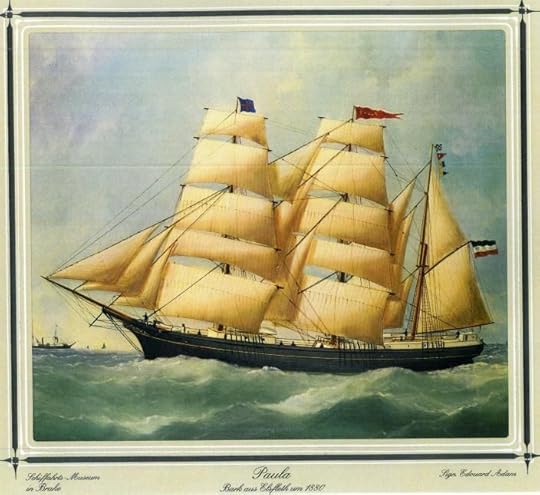
Photo: Deutsches Schiffahrtsmuseum-Unterweser
“Incredibly”, said Ross Anderson, the museum’s assistant curator of Maritime Archeology, “an archival search in Germany found Paula’s original Meteorological Journal and there was an entry for 12 June 1886 made by the captain, recording a drift bottle having been thrown overboard.”
The bottle was one of thousands that the Paula tossed overboard between Cardiff, Wales, and Indonesia. This particular bottle was set adrift around 600 miles off the coast of Western Australia, 131 years and 224 days before Illman unearthed it.
Illman’s discovery set a world record for the oldest message in a bottle ever found. The previous record holder was thrown in the ocean in 1906 and found in 2015.
“This has been the most remarkable event in my life,” said Illman of her extraordinary discovery. “To think that this bottle has not been touched for nearly 132 years and is in perfect condition, despite the elements, beggars belief. I’m still shaking.”
More like this: 20 images that will make you wonder why you have never travelled to Western Australia

Travel with Bronn from GoT
While Ser Bronn of the Blackwater from “Game of Thrones” hasn’t had much luck in the way of finding himself a castle, you may be able to help him location scout for one. The actor who portrays the lovable sellsword, Jerome Flynn, is promising to travel around Iceland with one lucky “Thrones” fan.
In partnership with the Whale and Dolphin Conservation, Flynn is raffling off a trip to the “Game of Thrones” filming locations in Iceland, where Flynn will act as your tour guide, in exchange for a charitable $10 donation towards the conservation’s efforts. Accommodations are also included.
One winner and a friend will fly to Reykjavik, Iceland, where they’ll join Flynn in touring filming locations from Beyond the Wall, such as the Fist of the First Men and the “mountain that looks like an arrowhead” from Season 7. Thankfully, you shouldn’t have any run-ins with White Walkers, zombie polar bears, or ice dragons.
You’ll also join Flynn on a whale watching trip, where you’ll hopefully spot some orcas, humpbacks, dolphins, and sperm whales in their natural habitats. If you happen upon an orca that doesn’t have a registered name, you’ll also get to choose the name that will used by scientists and whale watchers forever. And if you don’t name it after a “Game of Thrones” character, all we have to say is “shame.”
To enter the contest, donate a minimum of $10 to the Prizeo campaign, which will earn you 100 entries. While the contest isn’t an auction and the winner is still drawn at random, the more money you donate, the more entries you’ll receive — as well as some bonus swag. A $150 donation, for example, will give you 1,500 entries and an autographed photo of Flynn.
The drawing will be held “on or about” April 24. For all the unlucky people who won’t get to visit Iceland with Bronn himself, you can still travel to many “Game of Thrones” filming locations on your own in Iceland, Northern Ireland, Croatia, Morocco, and Spain. 
Venice Beach's faded glory
The only thing that still glitters here is the sea. The gloss has long since faded at Venice Beach. And yet the tourists keep coming — to see and be seen.
Elvis is flagging, but he manages a couple more numbers. He chortles slightly as he sings, but it’s the music that counts. It’s Showtime. A small crowd of snap-happy tourists is assembled around him. Mingling among them are a couple of his friends, who have yet to change into their own disguises. The sky above is blue and if you listen carefully, you can just hear the waves of the Pacific breaking in the distance. Elvis casts a brief look around, adjusts his old Marshall amp to full gain, and launches into an adroit hip-swivel from left to right. His quiff jiggles in time to Jailhouse Rock. The sun shimmers from the rhinestones on his once-white, rather tightly-fitting jumpsuit. Elvis isn’t entirely sure of his lines and occasionally his timing is off, but he continues, laughingly. The Venice sidewalk is Elvis’s own stage.
***
High up above the street hangs a row of oversized letters: Venice Beach is spelled out in capitals, dangling from a rusty metal chain attached to two street-lights. The intersection below is very busy. Honking taxicabs send unwitting tourists, their selfie-sticks aloft, scrambling for the sidewalks, while others weave swiftly around them. In Venice, everyone seems to do pretty much whatever they like. But for most tourists, a visit to the area begins right here: at the famous intersection with its colorful murals and the famous name tag dangling up above. This is the entrance to another world.
A pilgrimage to the famous Venice Beach is high on the list for many visitors to California. The area’s name is no coincidence: it was inspired by the many canals leading down to the beach, originally created to make the area habitable. But the relative calm of the canal district is of little interest to most tourists. The majority head straight for the beach, where it glitters. And where it’s all about one thing: seeing and being seen.
***
Venice was once an early stomping ground for Arni, that charming Austrian with the enormous arms. When the American Joe Gold opened his first fitness studio on Venice Beach in 1965, the as-yet-unknown Arnold Schwarzenegger was among his very first members. In time, Joe lived up to the promise of his name and Arnold went on to become more than just Mr. Olympia. Venice Beach, too, has gone on to become something very different.
***
The beach which fronts onto the Pacific coastline is about five kilometers long. Its centerpiece, however, the famous Venice Boardwalk, occupies just a few hundred feet. This stretch feels much longer when one walks along it. It’s a freak show.
On this Sunday morning, the boardwalk seems especially crowded. Elvis’ music is slowly drowned out by the thumping bass from Muscle Beach. Pumped-up muscle-men lift weights and heave themselves up on rusty steel pipes or lift their own weight. At the fringes, an audience is beginning to gather — mostly curious tourists — but the bodybuilders pay little heed to the crowds around them.
The smell of deep-fat fryers hangs in the hair, mingling with the unmistakable scent of marijuana and stale alcohol. Buildings with colorful facades line the boardwalk facing Muscle Beach. Keen young Americans stand in the entrances wearing boldly printed T-shirts. “Medical Marijuana here” reads the slogan on their chests. Since the US State of California legalized marijuana, the herb has become a ubiquitous presence on almost every street corner in greater Los Angeles.
The crowds in Venice are a mixed bunch. There are those, armed with their iPhones, on the look-out for the ultimate, most Instagrammable shot. There are others, who are trying to ride their bikes from Venice to nearby Santa Monica, and then there are those for whom the American Dream has long since shattered. Opposite the colorful facades, they can be seen resting on the floor, dozing on the lawns, propped up behind street stalls or slumped under benches. Some attempt to sell art. Many seem lost, forgotten, and frozen in time.
One wears an enormous pink cloak, another is entirely consumed by his joint. Beside him, an elderly man with a trailing beard is grasping his whiskey bottle tightly to his chest. Selling? They haven’t bothered with that for a long time. Barely any tourists pause for longer than a moment. Whether it’s the lingering stench or the crude banter exchanged between the booths, something discourages the tourists from stopping here. Beyond them, the sea still twinkles in the distance, but it seems to play little more than a sad, walk-on role in this part of the beach.
Suddenly there are cheers. A cluster of onlookers gathers between the promenade and the beach to watch skateboarders as they practice their tricks in the Venice skate park.
Skateboarders are as much a part of Venice Beach as the bodybuilders. Today it’s a tiny girl who steals the show. Fearlessly, she slings herself into the halfpipe, again and again, performing tricks. The crowds applaud, phones at the ready, waiting to capture the perfect shot of the girl in the air, her hand beneath the board and the tall palms beyond. In the meantime, the older skaters just go through their paces. Many are clearly veterans. They seem to know every angle, every curve. The flocks of tourists standing all around are a matter of supreme indifference to them.
Again, there is movement on the Boardwalk. Filming is taking place — as it does almost every day on this famous beach. Away from the market stalls, beyond the bodybuilders and the skate-park, a film crew is busy. Oiled-up, scantily-clad women prepare a well-rehearsed routine on the Beach Volleyball court, while a crowd of extras applauds on cue. A real Hollywood shoot. Barely anyone is interested. It’s just another part of Venice Beach.
***
Slowly, the sun sets. Most of the day’s visitors have now disappeared into the innumerable restaurants which line the side-streets. Now it is just the locals who assume their familiar positions. Alongside all of those who seek their luck every day here with music, dance, or other talents, Venice Beach is at the epicenter of homelessness in Los Angeles. What was once downtown is now on the beach. Emerging from all the nearby laneways, laden with their worldly goods, worn-out sleeping bags, and tattered tents, they shuffle into their places on the beach. Everyone knows everyone else. Everyone knows where they sleep. And everyone understands the fate of the others.
Once this night camp is established, the gym equipment falls silent. The last flips are turned in the skate-park. And Elvis packs away his case and wanders off into the balmy summer’s evening. His tent is waiting for him.
More like this: 12 offbeat experiences you can pretty much only have in Los Angeles
Each country's women's suffrage year
Suffrage happened in 1920 in the United States, three years behind Russia and Canada but 91 years ahead of Saudi Arabia, as noted by this map depicting the year women earned the right to vote in each country. Countries began joining the fray en masse by the mid-twentieth century, but the leader of the pack comes from far down under — women in New Zealand obtained voting rights in 1893. This map was uploaded to Reddit and shows the year women earned the right to vote in each country.
Matador Network is celebrating Women’s History Month throughout March. Join us as we tell incredible stories and highlight vibrant personalities through our content including original video production and in-depth editorial. 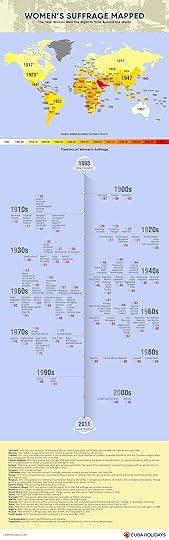
Photo: Cuba Holidays
More like this: 6 libraries around the world completely dedicated to women

Teach ESL in South Korea
I always wanted to buy a one-way ticket to the unknown. When I finally saved my money and did just that five years ago, my life changed forever. The ticket was to Santiago, Chile, and I lived in that vibrant, colorful country for a year. Traveling around Chile and across the border to Peru and Argentina were just perks of my location.
After a year of teaching experience, I took another chance, and applied to teach in South Korea. Getting to actually move to Korea is a process and one must have the patience of a saint to get through it. Somehow, I did it all within one month. Here are the steps and recommendations I have for moving to Korea to teach ESL.
How to get a job as an ESL teacher in South Korea:
1. Where and when to apply
2. Finding a recruiter
3. Requirements and paperwork
4. In the classroom
1. Where and when to apply for an ESL job in South Korea
There are many websites available for researching potential employers and schools to work for. I personally went through EPIK my first year. EPIK is the Korean government-sponsored teaching program. If you apply late, choices for working in bigger cities will disappear. However, applying at an appropriate time (six months in advance), you’ll have a chance to work in Seoul or Busan, which are amazing cities full of expats, restaurants, and the latter has a beach. I applied late and because of that, I was the lone foreigner in a tiny town, but I made the best of it. If you want to go the hagwons (private Korean schools) route try waygook.org or Dave’s ESL Café. Both provide great advice on how to secure a job and offer helpful tips on schools that one may want to avoid.
So, EPIK or hagwon?
With EPIK, you will work with public schools. You can be placed anywhere in the country and teach several classes during the day while still having at least four hours of downtime. Yes, there are vacations, but also “seat-warming”. “Seat-warming” refers to the downtime during the kids’ vacation when teachers still have to go to school. Find a hobby or a good book.
Hagwons (private schools) are busy. Time goes by fast because you have children to teach from morning until evening. The break times may differ, but they aren’t huge.
2. Find a recruiter
The first thing I did after researching what type of school I wanted to teach (public or private?) was find a trusted recruiter to guide me in my project. Having a person who has extensive experience with the teaching world in South Korea was extremely helpful. Not only does a good school recruiter help you with the application process, but they also explain what is expected of you during the Skype interview (which you will inevitably have) and host you for your first days in the new country. There are many recruiters out there. I was guided by Korean Horizons and they were wonderful. I was even picked up at the airport once I landed. The cost was free as they are paid by the government for recruiting English teachers. If you decide to go another route, here’s a list of several more companies who help with the process of applying and teaching in Korea.
3. Requirements and paperwork
This part can suck. I still have my Korean visa and I love it, but the process is intricate. Let’s break down a list of what is needed:
A BA or MA
A TEFL/TESOL certificate
A background check (FBI background check for those from the US)
Your college transcript
Two letters of recommendation
Drug tests
The TEFL/TESOL certificate
First and foremost, to qualify for your TEFL or TESOL diploma, you need to have university BA.
I already had my TEFL Certificate from working in Santiago. When I took the class, it was all online. I had loads of help and a great teacher to guide me when I had questions. I learned to make lesson plans and brushed up on my English skills. It’s a class that zapped my brain into English mode. It motivated me to think about how to teach and speak to non-English speakers, adults and children, and how I could become more assertive in my native language. Remember that it’s easy to speak English but explaining grammar to a six-year-old child with no prior knowledge is intimidating. There are many routes to go through to obtain your TEFL or TESOL certificate. Consult their website (TEFL and TESOL) for more information about courses and check the website of the colleges in your area.
FBI background check
Whether you’re a felon or not, it can take ages for your fingerprints to get analyzed. The test itself takes a minute, but receiving the results you need to send in your application for Korea can take months. Do it as early as possible. If you think you may want to take the plunge into the Korean school system but aren’t sure, just get your background check as soon as soon as possible. It’s never bad to have a document that says you aren’t a criminal.
College diploma and transcript
If you graduated from college, you have a diploma. To get your transcript, contact your university. You may have to pay a simple fee, but it arrives fast. Everything needs to be notarized so go to your closest law firm with all your documents to get everything in order. Note that your college diploma and your transcripts have to be notarized in the state where you graduated.
The Apostille
Getting an Apostille is the worst. Still, I understand why it’s important. It federally authenticates your papers. To get documents apostilled, you must go to your local government place and the government has to advocate that it’s a legitimate document. The office opens early and it can be done in a few days. When I had to do it, there were many people in line and I had to wait a day to get it back with the proper authorization. It can’t be done at a law firm and finding a location to get this done is not easy, so get Googling.
Drug Test
Just don’t do drugs, especially before you move to South Korea. Upon arrival in South Korea, your Korean co-teacher will take you to the hospital for several tests:
A blood test which tests for illegal drugs and liver function
A lung X-ray for TB
A basic eye exam
Hearing tests
Blood pressure
Weight and height
Don’t worry about getting tested for drugs unless you are doing something illicit and unhealthy. If you take Lexapro or anti-anxiety medicine, disclose it to the doctor. It won’t be spread around the school, and you can’t lose your job because of it.
4. In the classroom
Your work in the classroom will differ depending on what kind of school you decide to work.
With EPIK, your role is only English teacher. You won’t have the same class every day; instead, you will most likely move from class to class teaching many different levels of students. Discipline is handled by your Korean co-teacher and everything is followed from the book. Sometimes your job is to be a sidekick to the Korean co-teacher. Other times, your co-teacher will let you take the reins and have control of the class. It’s hard to determine until you start your new job.
At a hagwon, you are the main teacher. You will have full control of the classroom, how to discipline students, and you’ll teach almost every class. The days are busier but fulfilling as you get to bond with your students whom you have in your classroom all year.
In both situations, a majority of students behave well and respond to discipline. In both cases, there’s a lot of book work so it’s important to make sure you can sneak in some fun every once in a while.
More like this: 8 uncomfortable truths about teaching in South Korea
A day in the life of an Indian woman
Filmmaking is always collaborative, but with In Her Shoes, our story has really come full circle. We are the team behind the film, Doree Simon (Director, Producer, and Host) and Caz Tanner (Cinematographer and Editor). We met through this project and have become great friends, collaborators, and co-workers here at Matador.
In Her Shoes is a series that explores women’s empowerment efforts through a day in the life of young women around the world. Episode 1 follows Rani, a 17-year-old from Mumbai’s Red Light Area.
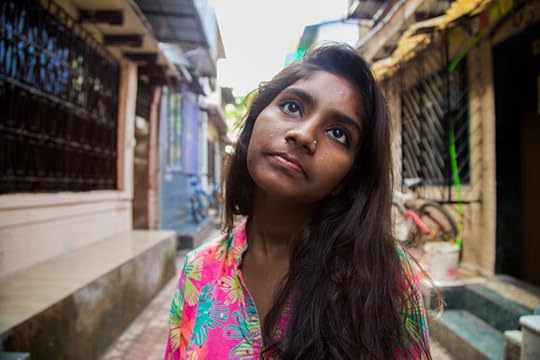
Rani is a teenager from Mumbai. In In Her Shoes we see how she deals with day-to-day life, from her habit of checking likes on Instagram to overcoming the typical destiny that comes with being the daughter of a sex worker.
The inspiration for this series came from Doree’s frustration with pre-existing media coverage that so often portrays women’s stories in a way that generalizes complicated situations and leads to viewers becoming desensitized to seeing yet another story of poverty and oppression.
Our film strives to humanize the women and girls who are so often represented as caricatures and tell their stories in a positive, engaging, and relatable way. Balancing lighthearted moments with stories of struggle was a challenge, but we’re proud of the final result.
Since we’ve now spent many hours talking about, forming, and analyzing this story, we thought it would be fun to ask each other questions to give some background on the piece and get an understanding of each other’s experiences.
Caz to Doree: How did you choose Rani to be the subject of our video?
I first heard the basics of Rani’s story before we traveled to India. Every girl at Kranti has an incredible story of struggle and strength, which made it hard to choose, but something about Rani stuck with me and I knew I would click with her, which was important because she’d be taking me on a day through her life. She’s 17, a really fascinating age for every woman — she’s a full-blown teenager and yet, a woman. In so many ways, she is an absolutely typical teenager (which I knew could make for a relatable story), and yet she’s incredibly driven and grown up. I think that dynamic is fascinating.
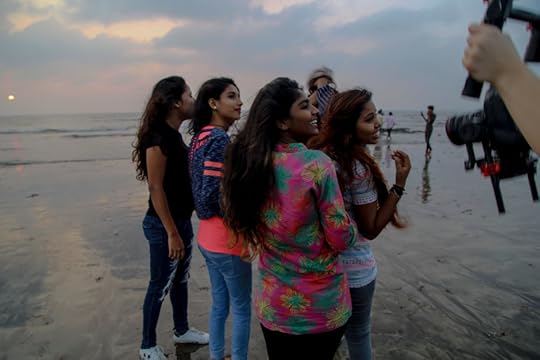
Shooting on location using a DJI Ronin stabilizer.
Doree to Caz: [We lugged a Ronin (a pretty large and heavy stabilizer for the camera) all around Mumbai, including into the Red Light Area.] What was your first thought when I said I wanted to bring a Ronin with us? How much did you hate me?
Haha! I was not a fan of the idea at all and felt like it would be impossible for us to carry the camera gear, audio gear, plus the Ronin! With Doree being on-camera sometimes, I knew it would be especially hard to add a larger piece of equipment to our kit. But we got very lucky in that one of the Kranti volunteers joined us on a shoot-day and helped carry some of our gear. We also had the Kranti girls who were very willing to take turns carrying the Ronin when I needed a break. We used the Ronin on the beach shots and I love the aesthetic the Ronin helped give to these scenes by making it look like the camera was floating over the water.
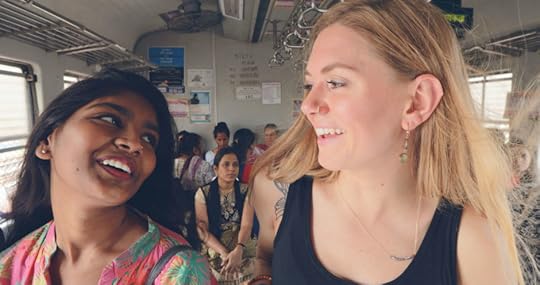
Rani with Filmmaker and Host Doree Simon.
Caz to Doree: What was your biggest takeaway from this experience?
My biggest takeaway is a reinforcement of how important these stories are, and what a responsibility I have to tell them right. When you ask someone to share their past, their present, and what they want for their future, you owe it to them to do tell the world in a way that does that justice. It’s one reason I wanted to call Rani “a revolutionary.” She isn’t defined by where she came from, but she chooses to embrace that and do something bigger with it. That’s a story I want to share with the world.
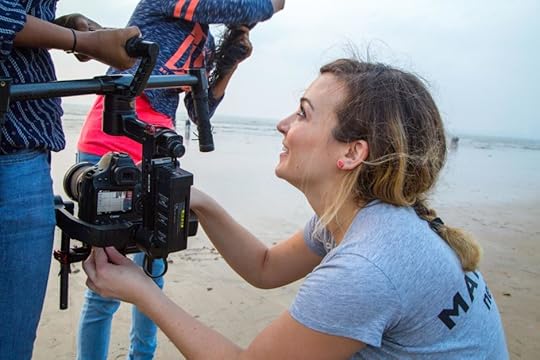
Filmmaker Caz Tanner handling behind the scenes.
Doree to Caz: What was your funniest moment we had in India?
I think the funniest moment was on the very last day when we had only two hours before we had to leave to catch our flights. Doree was trying to do her final stand-up in front of the camera but fate wasn’t cooperating with us that evening. First, someone started hammering really loudly next door so it was too loud to film. Once that quietened down, we started filming again when the lightbulb in the hallway went out and we were plunged into darkness! To make matters worse, we realized that we had locked ourselves out and the only key for the apartment was inside. Luckily we realized there was a small hand-sized hole in the grate of the door so Doree was able to stick her hand in and unlock the door from the inside. Phew! I was rolling the camera this whole time so it was fun to play back this moment later.
Caz to Doree: We edited this remotely (you in the UK, me in the US). What was the most challenging part of the editing process for you?
We’re used to working between time zones, but directing an edit remotely is a different beast. It was hard not to be side-by-side with Caz, so we spent countless hours screen-sharing via Skype, and kept the process moving as smoothly as we could.
And you, Caz?
I think the hardest part about being so far away is not having someone there to share the small wins with. For example, when we received the musical score from Zachary Walter, it really helped glue everything together. I was running around my house in excitement but wishing Doree could have been here to share at that moment.
Doree to Caz: Had you ever filmed someone actually waking up before?
I’ve filmed a few morning scenes before but it’s always been staged and never natural. Watching the sunlight filter in through the windows and being there to capture the morning rays gently wake up our main character was a moment that took my breath away. While filming those shots, I knew we had captured the opening sequence of the video.
Caz to Doree: What do you think makes us so aligned creatively? Where do you feel like we butt heads the most?
I think we align because we both see media as a way to tell stories in a responsible, engaging way. Surprisingly, that’s not as common as you might think. We probably butt heads most because Caz is a master editor who will throw any unnecessary moment to the cutting room floor, and if the edit were left to me, this film would be four-hour long. So, I’m grateful for the ways we’re different because we need balance, and we also need this to be short enough that people actually sit down and watch it!
And you, Caz?
I think we have similar intentions and motivations with our work; we ultimately both want to tell meaningful stories that can have a positive impact. We both value the power of a good story and care most about the quality of what we’re creating over pandering to what will get the most views online. I think the place where we felt tension was in deciding how much Doree should be featured in the film. We had spent hours on the phone talking about how we wanted to ensure this didn’t seem like a “white savior” video and to allow the young women we were featuring to be the main focus of the story. We sometimes felt pressure to make the video more “vlog” style as that could be a more popular structure. We both kept going back and forth on the approach but ultimately it was important for us to talk out the different ways we could have filmed this. I love the resulting balance of Doree as the host and guide for the series with Rani being featured as our independent main character of the story. 
American culture shocks in Russia
I’ve never been to Russia. The traveler in me knows that what a government does and how the people act are often very different, and in my experience with Russians that has certainly been the case. For example, I recently met a Russian girl on a long-haul flight from Doha to Denpasar. She was a musician from Moscow, and as we sat next to each other I ended up chatting with her most of the way when we weren’t napping. We became friends and toured around the island of Bali together that weekend. Facebook keeps us in touch these days, until we meet again — in Russia, perhaps.
Lately, with all the news coverage (the Olympics scandals and the investigation into the 2016 US election), I’ve caught myself wondering what it’s like on the other side. In particular, what culture shocks do Americans face in Russia? On top of that, what do average Russians think about Americans who come for a visit? I took to Quora and some of Matador’s editorial content for some insight.
On first impressions and Russians’ disdain for small talk
Americans are chatty and often quite loud. This is in stark contrast to many Russians, as Thomas Breckinridge explains on Quora: “In American culture, we’re much more free with general information. Our way of doing things is to understand the whole so that the parts can be modified as needed to achieve the overall goal. Russians very much go the other way: no one will ever give you the big picture of what’s going on, only the barest information necessary to complete the next step.”
Do Russians enjoy chatting with Americans? “That totally depends on the American tourist,” notes Boris Ezomo on Quora. A fitting answer, I suppose. This holds true for people of any nationality, traveling to any destination. Thinking back to my friend from Moscow, our conversations, while enjoyable, were often quite brief. Plenty of time passed in silence, and I was reminded of an episode of Invisibilia in which they covered the difficulty of working at McDonald’s in Russia, simply because the employees are expected to smile so much. This could explain why: “Russians don’t like to waste their time on empty words that don’t really mean anything: we are very direct and prefer to get straight to the point of the conversation,” Marina Vinogradova explained in a piece for Matador. “If you meet your neighbor and you don’t really have anything to say to him, you don’t stop for a chat about the weather and the latest football game. You just say hello and carry on with whatever you were doing.”
Matador Network editor, Morgane Croissant, traveled to Russia and has nothing but positive things to say about her interactions with the locals: “Although they may not be chatty, the people I dealt with showed genuine interest in me and my trip and were extremely helpful — my Russian was very approximate, but the people I asked for direction or help always made sure I was given the right information and was not getting lost.” A great example of the locals’ kindness is when Morgane was crossing the border between Belarus and Russia. She explains: “I had to fill in an immigration form that was in entirely in Russian. I was not able to understand 80% of it, so, without asking, the older train employee in charge of my car brought a full teapot and cups into my compartment and spent 30 minutes filling it up with me.”
I did ask my friend about traveling to Russia and she encouraged it, noting that both Moscow and St. Petersburg are quite accustomed to tourists. Just don’t bring up politics. “Politics are a different matter,” noted Laura Hancock via Quora. “But in terms of the people, yeah. Russians seem to like Americans, or, at least, they liked me. And I liked them.”
On lifestyle differences
How do four weeks of paid vacation sound? Pretty darn good to most Americans, of which 23% receive no paid vacation time at all. “People get at least 4 weeks of vacation a year and a couple trips a year are not unheard of,” explains Maria Guzenko on Quora.
Maria also noted the efficient public transit in Moscow and walking culture as big pluses, when compared to the States. “I really enjoyed the ‘walking culture’ in Russia, where young people meet up and go for a walk through the city (гулять). Instead of sitting on your butt in a bar, you get to explore the city and be physically active.”
Russians aren’t big on living up to expectations, it seems. “I like the fact, that nobody pressures you into anything,” Dmitriy Kim said on Quora. “Like there is no accepted common opinion about anything, therefore you can choose your life path without being looked upon with judgement. This cynicism and nihilism make life here somewhat relaxed.”
Members of the LGBTQ community may offer different opinions, however, particularly depending on the location within the country, with many areas being historically difficult for LGBTQ people to live.
On Russia’s flair for the dramatic
“Russians are much more superstitious than Americans,” notes Kirill Valyas on Quora. Marina Vinogradova agreed in her Matador piece: “Our folklore has myriads of superstitions relating to all spheres of life. Even if you don’t really believe in mystiсism, hundreds of weird superstitions constantly pop up into your head: do not shake hands over a doorstep or you will have a quarrel. Do not sit at the corner of the table or you will never get married. Do not return to the house if you forgot something or you will have bad luck during the day.”
The dramatics of social interactions are quite different as well, as Lee The on Quora describes the Russian expressions as such: “An artistic leaning towards the florid, by American standards. If you look at Russian ice dancers at the Olympics etc. vs. American ice dancers, the Russian dancers are doing, like Romeo and Juliet — ending with the double suicide of course, while the American dancers are being either kind of jazzy or cheerfully romantic. Likewise the costumes, with the Russians tending towards fluttery black and white stuff.”
On hospitality
Food and beverage-wise, soup, pancakes, tea, and of course, vodka, are big in Russia. All stand as a common base for social activities, Marina noted for Matador: “Many places in the world are known for their love of tea, but no one drinks as much tea as Russians do. I personally drink about 3 litres of tea every day: when I am cold, when I am bored, when I chat with my family, when I visit my friends, when I have a snack and before I go to bed.” Additionally, “‘Without soup, your stomach will dry up!’ my mom used to tell me.”
With all of these traditions and superstitions, it seems as though Americans have a bit of reading to do before landing in Russia. Maybe a bit of practice on that poker face is in order, as well. Working in our favor, however, is the embracingly friendly welcome Russians are known for when visited. Aleksandr Tikhonov brings up this point: “I’d like to add that Russians actually LIKE foreigners — including Americans, of course. We will ask a lot, tell even more, invite you somewhere, then probably eat, drink, and discuss a lot. We’re fun to hang out with, really.”
“Once someone crosses the threshold of your house, he gets the most comfortable bed, the softest slippers, and the greatest meal in the history of humankind,” Marina Vinagradova noted in her Matador article. “That rule applies to relatives, friends, friends of relatives and pretty much everyone else.”
More like this: 15 awesome expressions to know before you travel to Russia
Travel abroad to donate eggs
I knew I didn’t want kids since age eleven. That was the year my seven blood siblings started popping out their own and our swarming family gatherings exploded into the likes of rush-hour at Grand Central station. I love my nieces and nephews, but I had reached my small-person quota and was okay with it. Children aren’t meant for everyone. Over the years I had witnessed several of my gay friends struggling to start families of their own, often spending their life savings on unsuccessful IVFs. I felt ashamed and wasteful literally flushing my high-commodity eggs down the toilet every month. In December of 2012, I envisioned wrapping up a vial and attaching a card addressed to my barren sweethearts, but the thought of having him, her, or them grow up in my immediate world was a little too close to home. I wanted to help but didn’t know how.
Six weeks later, I bumped into a work colleague, Betty, on her way to the airport. She was gripping a small floral cooler in her freshly manicured hand and wheeling a fuchsia Louis Vuitton carry-on behind her. I teasingly asked what she had packed in her cooler for lunch and she smiled dismissively and said, “Honey, these are the drugs that are getting me to Thailand!”
She went on to introduce me to her new obsession — international egg donation. Selling her “lady bits” had funded her last two trips to Bali and India. All three destinations were on my top-5 list to visit before I turned 35; I was almost 33. I had another two years of car payments, a 6-year-old wiener dog with Intervertebral Disc Disease, and a wedding company in its infancy. I wasn’t close to reaching my two-year cut-off. That evening, I researched that Betty’s donation agency was run by a local gay male couple and specifically catered for gay recipients. I signed up immediately.
A few weeks after, I met my business partner and close friend at a local dive bar to discuss our scheduled weekend wedding gigs. Two beers in, I realized that I wouldn’t make it home in time for my first FSH (follicle-stimulating hormone) injection. I ordered us a round of tequilas and gave Laani a ten-minute run-down of my recent decision to “give the ultimate gift”; the donor website’s catch-tag. I also asked her to inject me with Gonal-f, a medication to stimulate egg production and ovulation.
“Does this make me the father?” Laani chuckled and rubbed her clammy hands together excitedly.
I peeled open the sanitized needle cap, clipped it onto the end of the pen, clicked in the recommended dosage, and passed it over. Leaning up against the cold rim of the bathroom basin, I pulled up my shirt and closed my eyes.
“Here she blows!” Laani exclaimed as she jabbed my pinched belly fat. “Bet this is the most action Roxy’s restroom has had in a while.”
I saved telling my mum for last. The less time she had to stress about my decision before I jetted off the better.
“Let me get this straight… you are flying to India, alone, for two weeks to sell your God-given genes to complete strangers that you will never meet? What if you wake up in a foreign country post-op missing your kidneys or they mess up your insides!?” I could hear Mum fluster as her pitch elevated through my speakerphone.
I trusted the agency was legit or Betty would have let the world know. I’d also not be alone while sharing a room at the 5-star Marriott Lakeside Executive Apartments in Mumbai with the agency’s Donor Liaison, Lucy Palmer, aka my chaperone. I was contracted to fly into Chhatrapati Shivaji International Airport the next week, hugging my very own floral cooler filled with needley goodies. It was too late to obsess over possible doom-and-gloom now.
Lucy was a strange cat. A pale-skinned, gaunt, strawberry-blonde with a skittish yet arrogant disposition that kept you feeling on edge. She was mostly withdrawn and socially awkward when she spoke.
The first time we met at Cape Fertility clinic, she introduced herself, “Hi I’m Lucy, your go-to-person from here on out. After treatment commences, make sure to keep your legs closed, you have one of the highest fertility scores and we can’t afford any ‘accidents’!”
During our stay at the hotel, she spent most of her time in her room or hotel lobby taking heated work calls. We shared one mealtime together within the week we spent there. I suggested a mini celebration for my 33rd birthday and coincidentally the success of my 33 supersized baby-makers due for extraction the following day. We got home from T.G.I. Fridays before midnight, just in time to administer the daunting 3.8 cm needle shot to trigger the release of eggs. She advised me not to finish my glass of Champagne, for the eggs’ sake, and promptly disappeared back into her room.
The next morning, Lucy waited in reception, and I was ushered into the “operating room” (a small converted office at the back of the building). The nurse instructed me to remove my clothes and put the open-front hospital gown on. She closed the door behind her as I spun around to skim the state of the room. A wave of trepidation washed over me as I recalled Mum’s concern for my kidneys. There was a rusted filing cabinet standing in the corner beside a dusty fan and a few tray stands holding an array of antiquated medical tools. In the center of the room was the steel operating table draped in a previously stained disposable sheet. I apprehensively slipped my gown on, checking for any unsanitary marks, and walked over to the window to catch my breath. It was barred-up and covered in bird excrement, but I had a partial view of the road winding up to the nearby “Tower of Silence” on Malabar Hill. The 300-year-old dakhma (funerary tower) is where the bodies of deceased Zoroastrians/Parsi were left for vultures to carry out the sacred defleshing and purification ritual. The imagery of disemboweled corpses intensified my panic. There was a faint knock followed by the abrupt entrance of my tiny, barefoot anesthetist. He wore a semi-toothless grin and a pair of mended circular spectacles balanced on the tip of his nose. He spoke zero English but motioned for me to lay down and stretch out my right arm. Before I could ask any questions, my depth of focus narrowed down to just the twinkle on his gold front tooth before it all went black.
I awoke in a haloed white light surrounding an image of young Buddha raising his right palm outward towards me, which I’d learned was a Buddhist mudra signifying reassurance. I lay there for a few moments in a state of blissful nirvana, until Lucy barged through an inconspicuous door, enquiring how I was feeling.
I reached around to feel both sides of my lower back and replied, “In one piece.”
She told me that I had an important examination to do before I could leave, followed immediately by, “Would you be okay on your own if I fly back home tomorrow morning? Our Cape Town office needs me urgently to resolve some matters.”
Our thin hotel walls gave me privy to what these “matters” were. She had received several complaints from donors regarding her abrasive manner and her job had since been compromised. Assuming she’d wait to get the “all-clear” from my examination before changing her ticket, I agreed to her early departure. The exam did not go well and Dr. Vinesh discovered fluid around my lungs. I was placed on an IV for three hours and then sent back to the hotel for some bed rest. Lucy was gone when I awoke.
Doctor’s orders were to drink three liters of water daily or I’d be forced to go on another IV. I had to text him photos of my urine in a measuring jug as proof I was drinking enough. I felt humiliated. Five days had passed since my extraction and I hadn’t bathed, left my room, or had a meal more sustaining than dry crackers and an energy drink. I was on my fourth course of antibiotics, three different painkillers, antispasmodics, anticoagulants, anti-nausea tablets, and a gonadotropin-releasing hormone (Gn-RH) to suppress ovarian activity. My eyes were sunken hollows and my arms and belly were covered in bruises from countless puncturing hormone injections, IVs, anesthesia, and blood tests. Recurring night terrors began with a fever and ended in the shakes. No diagnosis was given. I was just told to take my medicine, drink more water, and rest. I found some information on The Malpani Infertility Clinic, India website:
“A potentially serious side-effect of HMG (Human Menopausal Gonadotropins, Menotropins) is ovarian hyperstimulation syndrome (OHSS) which is characterized by enlargement of the ovary and an accumulation of fluid in the abdomen. This fluid can also accumulate around the lungs and may cause breathing difficulties.”
If my condition worsened, it could lead to my ovary rupturing and blood accumulating in the abdominal cavity. This could also have caused blood clotting due to the imbalance of fluids and be potentially life-threatening. The website recorded only 1-3% of patients are affected, who can be easily treated by bed rest and careful monitoring of fluid levels (if caught in time). Was I the unlucky 1-3%?
After more research, I discovered opposing results of 30-32% in Wendy Kramer’s (Co-founder and Director, Donor Sibling Registry) OHSS research. “We can see huge discrepancies regarding statistics that the reproductive medicine industry reports for the health of egg donors following donations.” She concluded that there’s little to no follow-up or aftercare offered to donors post egg-retrieval date and this is a major factor contributing to the lack of cases documented. Research on the long-term effects of egg donation was also very pricey for the medical board and therefore neglected for the most part.
The clinic’s DigiCal flickered “May 5th, 2013” in bright neon green and I flashed back to this time last month. I remember excitedly sketching out my itinerary listing all the inspiring ashrams and magical beaches I was going to visit in Karnataka, Tamil Nadu, and Goa. I was meditating every day, doing a full body and mind cleanse and diligently self-administering my own daily hormone injections. I felt mentally and physically prepared for this journey. The front desk phone rang, snapping me out of my memory, and the nurse signaled for me to come through. I could walk upright now, no longer doubling-over in pain. I marched down the familiar passage into his corner office. The meeting was over in ten minutes when he uttered the long-awaited words, “It’s time for you to return to your home.”
The relief washed over me like a Ganges River baptism and I beamed my first smile in a week.
A month later, I was back at home in Cape Town having my check-up at Milnerton Medi-Clinic’s Ultrasound and Gynecology Department. I had been suffering from discomfort and shooting abdominal pains for two weeks. They discovered a non-cancerous uterine fibroid that had grown 2cm since my last ultrasound (increased estrogen levels also contribute to accelerated growths). I told my gynecologist that my follow-up exams weren’t covered by the donor agency and I hadn’t heard from them since my return. She shook her head in disbelief and handed me another bill. As I left the clinic, I saw a missed call on my phone from an unrecognized number. The voicemail was from Lucy.
“Hi Louise, it’s Lucy Palmer. I wanted to give you a quick call to let you know that all your hard work paid off! Your first three eggs were successfully inseminated, and you have made a loving couple very happy. Thank you. I’m also no longer working at the agency, but you’re welcome to contact the office directly for anything you need. I’m sure they’d be happy to have you as a donor again. Take care.”
We both knew I couldn’t run the risk of being a donor again, so I was thrilled about my one-hit winners. All the trauma and medical bills could not diminish the lifetime of happiness it offered. I don’t regret my decision.
*Alcohol consumption is not advised during the stimulation phase of egg donation.*
More like this: I traveled overseas to be an egg donor. Here's what I learned.

March 6, 2018
Get paid to travel Europe
If you’ve always dreamed of seeing Europe but cared more about racking up Instagram likes than saving money for a trip this past year, you could be in luck. Busabout, a company that provides busing services in Europe and Asia for “free-spirited travelers,” is bringing on four talented travelers to document an epic trans-Euro adventure — and get paid for it. The trip, a hop-on-hop-off adventure that sounds much like a cross between the best road trip ever and a spot on your favorite band’s bus for their summer tour, aims to promote Busabout’s services as an affordable way of seeing Europe.
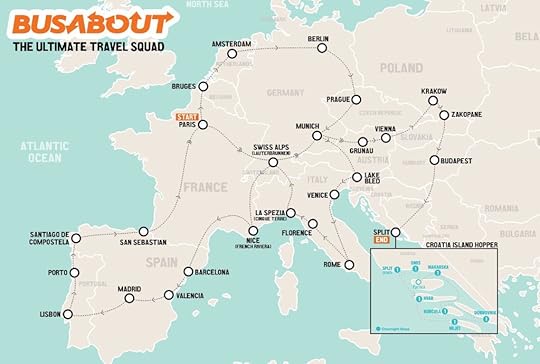
Photo: Busabout
The lucky “hires” will visit 47 cities across 15 countries and see some of the continent’s most iconic spots, including the Swiss Alps, Rome, Barcelona, and many more. Oh, and the party kicks off in a little spot called Paris — maybe you’ve heard of it? The catch is that you’ve got to work. Specifically, you must be a social media whiz. The company is looking for one vlogger, one blogger, one Instagrammer, and one Snapchat/Instagram Stories pro to send on the road.
Sound like you? Get your application in before April 17. Don’t rush your application — since being digital savvy is critical to being selected, take the time to craft a compelling video and polish that resume. The trip, including the selection of winners, will be finalized in May. The lucky four will have just enough time to pull together any necessary travel gear and give their “real job” enough notice to (hopefully) maintain a good relationship before hitting the road for the summer.
Here’s what you need to know before applying:
You’ll have to create and upload a public YouTube video
Posting on social media using #busabout and #ultimatetravelsquad as much as possible certainly isn’t going to hurt your chances.
Follow their instructions specifically! Don’t eliminate yourself from the running simply on a technicality.
More like this: 23 awesome travel jobs and how to get them

Matador Network's Blog

- Matador Network's profile
- 6 followers

