
Matador Network's Blog, page 1374
March 28, 2018
17 reasons to avoid Ventura, CA
Quirky beach towns like Ventura aren’t for everyone. And let’s face it, beaches and piers, uncrowded national parks, constantly warm weather, delicious fish tacos, and vintage, old-school fun — carousels, skating rinks, arcades — are only going to ruin all backyard family reunions and local theme park trips from here on out.
High expectations? Pass. Here’s 17 reasons to knock Ventura off your family travel list.
1. Ventura’s harbor is just too hectic and overwhelming.

Photo: Jeff Turner
Between the commercial fishermen distracting you with their daily catch, the harbor seals out for leisurely swims, the touch tanks at the Channel Islands welcome center, and all the shops and restaurants, there’s just too much to do and see at the harbor. Your kids can barely decide between two pairs of socks.
2. Just across the water at Channel Islands National Park, your kids could spot whales, seals, and dolphins…
How will they document their sightings fast enough for Snapchat? It’ll be impossible to post it all on social media! Think of their poor friends!
3. …and discover up to 145 plants and animals that only live here…
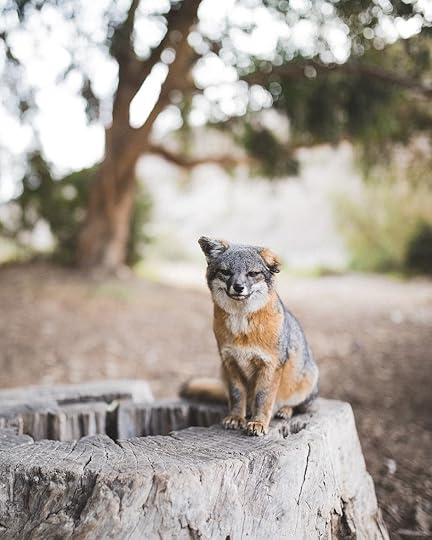
Photo: Sean Dougherty
How do you explain you can’t take an Island Deer Mouse or an Island Fox home as a pet? Your kids will be so disappointed.
4. …and each of the islands, from the smallest (Anacapa) to the largest (Santa Cruz), has plenty of places to hike, snorkel, and explore…
But not one fast food restaurant. What are you going to do, picnic?
5. Watching surfers at Surfers’ Point catch wave after wave is just going to give them ideas.

Photo: Anita Ritenour
Too much exposure and your kids might want to try surfing themselves. Ideas. Aspirations. Ugh.
6. Marina Park has its own pirate-ship playground.
No, thanks, they might get too into character. Imagine them saying “arr” all the way home.
7. What even is gelato?

Photo: Richard
Chocolate or vanilla ice cream was good enough for you when you were their age. And besides, the flavors of gelato at Palermo — in Downtown Ventura — aren’t to be trusted. Crème brûlée? Birthday cake? Honey lavender? Is this pure chaos?
8. Renting a four-wheeled Surrey bike to cruise the pier means only one thing.
Yep, you’re going to have a hard time convincing your family to take it back at the end of the day. Second-degree theft is not what you signed up for.
9. The Downtown Ventura Farmers Market has aisles and aisles of fresh fruit and vegetables (and a kickin’ tamale stand).

Photo: Brenda Davis for the Ventura County Certified Farmers’ Market Association
NO. Saturday mornings are meant for frozen Eggo waffles, not spoiling your kids rotten.
10. The indoor Village Arcade and Carousel at Ventura Harbor Village is a giant time suck.
Nine games of Pac-Man and air hockey, six rides on the dancing horses, and three caramel apples later, you’ll probably miss your flight back home.
11. Harbor Cove Beach offers a protected swimming area for your kids.

Photo: Visit Ventura
But really, you can’t beat a kiddie pool for safety. Just stay home and use the garden hose.
12. The locally owned shops on Main Street will lead to a lot of “Can I have this?” conversations.
Ugh. It’s easier just to say yes (especially to the esoteric wonders at Copperfield’s).
13. Visiting the Museum of Ventura County will teach them about the area’s earliest residents, the Chumash people.

Photo: Jlm06
Watch out, or else your kids might start spouting trivia all the time. Or worse, asking you questions you don’t know the answers to!
14. Between Ventura’s walkability and the free trolley, you won’t have to rent a car to get around.
But…but…but what about all those precious “Are we there yet?” moments?
15. One look at the giant fish tacos at Spencer Makenzie’s Fish Company will ruin everything.

Photo: Spencer Makenzie’s Fish Company
Fish tacos JUST AREN’T SUPPOSED TO BE THIS BIG.
16. The indoor roller rink at Skating Plus and Buena Lanes bowling are right next to each other.
Good luck going to one and not the other.
17. And when you’re on your way home, you’re definitely going to have to explain to your kids why you can’t move to Ventura.

Photo: Visit Ventura
Good luck navigating that one. Better stick to more disappointing vacations from now on. 
The post 17 reasons you should NEVER take your kids to Ventura, CA appeared first on Matador Network.


March 27, 2018
Pokemon Go killing rare beetles
While the obsession with Pokémon Go may have died out worldwide, there are still hundreds of thousands of active players, and they’re wreaking havoc on real-world creatures in their attempt to catch fictional ones. Hordes of video gamers playing Pokémon Go have spent the last two years flocking to the Tottori Prefecture in Japan, a hotspot for the digital pocket monsters. Unfortunately, it’s also the local ecosystem to a native species of beetle, and the gamers are resulting in the species dying off.
The area known as the “Oasis” of the Tottori Sand Dunes — 3,500 square meters of desert surrounding a pond in Tottori, Japan — will be closed to the public in early April in response to the Pokémon Go-inflicted damage. Players have flocked to the Oasis in search of a coveted Pokemon creature in the popular phone-based video game, and the dwindling population of the cylindela elisae beetle is thought to result from increased foot traffic in the area, in addition to hot, dry weather.
The Pokémon fanatics themselves aren’t fully to blame — their attendance is largely the result of encouragement by the local government, which had hoped to capitalize on the game’s popularity and build tourism in the area. The dunes were touted as a prime spot for the gamers.
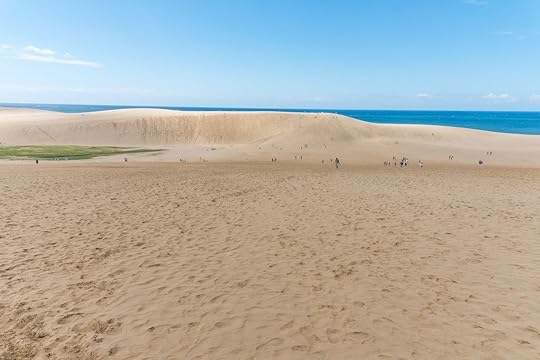
Photo: Jirat Teparaksa/Shutterstock
But the influx of gamers, coupled with minimal rainfall and rising temperatures, proved devastating for the beetle. The population of the species, estimated to be at around 2,300 in 2015, dropped to 153 in 2017. A species with under 500 living creatures meets the criteria for being in danger of extinction. The endangered beetle species typically measures about 9 to 11 millimeters.
The Tottori prefecture attempted to quell the masses prior to an organized Pokémon Go event in November of 2017 by preventing Pokémon Go characters from appearing in the area. 90,000 players still descended upon the Oasis over a three-day period.
The site will close to the general public beginning next month and remain closed for a minimum of one year, according to the Cultural Affairs Agency. The agency plans to continue the restriction for at least a year and a half until the number of the species has sufficiently recovered. 
More like this: Why we need to stop treating other countries like our playgrounds
The post Pokémon Go players nearly eradicated this rare beetle in Japan appeared first on Matador Network.

Money-saving hacks for tough visas
One of the most overlooked aspects of travel that people planning out their bucket list forget to consider is visas, particularly the cost of exorbitant fees for visas that many countries charge. Whether you’re planning to visit as a tourist or as a business traveler, there are a few countries or areas that are notoriously difficult or expensive to get into. Thankfully, there are a few hacks around the system that could get you into these places legally without having to pay an arm and a leg. Here are five of those tricky areas, and how to bypass their pricey and complicated immigration laws.
Note: These tips don’t apply to every passport holder. The rules change based on the country your passport is from. These tips mainly apply to those with a United States passport.
1. Use the 144-hour Transit Visa in China.
If you’re a US citizen, visiting China on any type of visa costs at least $140 — more if you need to expedite your application. Other nationalities are still charged tens of dollars and need to make the effort to drop by an embassy or consulate prior to their visit.
However, there’s now an alternative that will allow you to squeeze in a few days in China during a larger trip. While a 24-hour transit visa has been available for some time, this rarely afforded travelers the opportunity to do more than simply sleep in the airport between flights. As of a few years ago, Shanghai started offering international travelers a 144-hour transit visa, good in the city and the surrounding areas. As long as you have proof of ongoing travel, citizens of 53 countries — including the United States — can have a free week in China.
2. Skip Hanoi — go to Phu Quoc Island, Vietnam instead.
Most nationalities need a tourist visa to Vietnam. The government may have made it easier in the last year with the $25 e-visa, but you can still avoid getting one altogether by visiting the island of Phu Quoc instead of mainland Vietnam. As long as you’re flying into the island from an international port and planning to leave within 30 days, all nationalities are eligible to enter Phu Quoc, Vietnam without a visa.
3. Visit Russia via the ferry from Finland.
Russia is a tough nut to crack when it comes to visa-free travel. Like many countries, it offers international travelers a 24-hour transit visa assuming they are, in fact, transiting, but even this doesn’t allow one to leave the airport. Moreover, a proper tourist visa requires going through an official agency. But if you’re interested in only seeing St. Petersburg — one of the most beautiful, and popular, cities in the country — many nationalities can legally enter the country for up to 72 hours if they arrive via ferry from Finland. The clock starts ticking the moment you’re waved through immigration.
4. Take advantage of Saudi Arabia’s newest tourist visa.
For many years, it wasn’t the easiest process in the world for any nationality not from a Muslim country to enter Saudi Arabia. Those who follow Islam in any country qualify for hajj and umrah visas to the country, but these still entail fees and a lengthy application.
It used to be that an uncertain 72-hour transit visa was the best way for non-Muslims interested in visiting the country. You couldn’t apply for them in advance, but visiting an embassy, presenting your flight itinerary, and asking for an official letter explaining the situation to immigration would certainly ease the tension on arrival. However, as of April 1st this year, Saudi Arabia will start issuing tourist visas to many nationalities, including Americans, in the hopes of bringing tourism to its burgeoning luxury resorts. Take advantage of the fact that this isn’t widely known yet to get in on the deal before masses of tourists start applying to its limited number of visas (how expensive the visas are, and how many there actually are, are not yet known). Keep in mind, however, that due to local customs, there are restrictions against solo female travelers; if you are under 25-years-old, you will need to be accompanied by a family member to obtain a 30-day tourist visa.
5. Spend more than 90 days in Europe by bouncing in and out of the Schengen Area.
The important thing to remember when maximizing your time in Europe is that there are, in fact, different areas with different visa regulations. The Schengen Area (the 26-country section of the EU that has abolished passports between its borders and includes countries like France, Denmark, Portugal, and Sweden) allows tourists to stay up to 90 days, while Bulgaria, Croatia, Cyprus, Ireland, Romania, and the United Kingdom allow anywhere from 60 to 180 days. If one is so inclined, he or she can stay in the Schengen Area for 90 days, visit Ireland for a few months, then just fly right back into Switzerland or another eligible country to obtain a new period of stay without having to fly back to their home country.
More like this: The top countries for US visa refusals
The post 5 money-saving hacks for visiting places with complex visa restrictions appeared first on Matador Network.

Uber is leaving Southeast Asia
In less than two weeks, travelers to Southeast Asia will have to download a new app to hitch a ride in from the airport to their hostel or to get around town. Ride-sharing giant Uber is leaving the eight countries it serves in the region, ceasing all operations in Malaysia, Singapore, Indonesia, Thailand, Myanmar, Vietnam, the Philippines, and Cambodia. The company sold its business rights in those countries to competitor Grab.
Grab is a Malaysian company which built a platform very similar to Uber’s. No cash is involved, rides can be booked quickly via the app, and their GrabFood service picks up food from restaurants and delivers it to customers, very much like UberEATS. But Grab’s services are also more customized for ground transportation in some Asian countries such as Indonesia, where motorbikes are more common on the roads than cars. The GrabBike service allows riders to hail a motorbike — which may prove to be a big time-saver for riders in crowded cities as bikes tend to move through traffic at a faster pace than passenger vehicles. GrabTaxi allows passengers to hail a taxi instead of a private passenger vehicle.
For Uber, the sell-off of their Southeast Asia business marks the third time in recent years the company has pulled out of a major market. They left China in 2016 after failing to top local rival DiDi, and were unable to successfully compete with Yandex in Russia, where they pulled the plug in 2017.
Uber entered Southeast Asia in 2013 but never quite mastered the local markets. Their services were strikingly similar to what the company offered in the United States, where private vehicles and interstate highways are the norm. The company also did not appoint a regional head of operations until August of last year.
That said, the easiest (and cheapest) way to get transportation in these areas may still be the old-school ways of doing so, such as the songthaew red pick-up vans in Thailand that locals use to get around for next to nothing.
More like this: This video will make you want to travel to Southeast Asia right now
The post Uber is leaving Southeast Asia in two weeks appeared first on Matador Network.

How Americans speak
Think back to the last time you said to someone you’d just met, “Let’s grab a coffee sometime.” What were your feelings about that person? If you’re like many Americans, the true meaning of your words lay unspoken, yet perfectly conveyed through your invitation: you liked that person. Like, a lot — enough that you would be willing to adjust your schedule to fit them in on short notice.
Reddit user TheYoungGriffin posted an infographic dissecting the way Americans talk. If you had told that person to simply “Stay in touch,” it may have actually signaled a slight disaffection.

Photo: TheYoungGriffin
The list itself is brief, but in true Reddit fashion, the rest of the internet has chimed into the comments and really brought the post to life. A few of our favorites:
“Wow that’s crazy = I wasn’t paying attention to anything you just said.”
“Maybe is more like No, but I wanna keep my options open just in case at the last min I decide I do wanna do that.”
Sometimes, American lingo tends to go down a rabbit hole of each phrase actually meaning slightly worse than it sounds. This thread sums it up perfectly:
Surprisingly accurate = not far off
Not far off = needs improvements
Needs improvement = failing
Failing = don’t even bother anymore
User Haicra asks, “Are these ones just California? ‘Yeah, no’ = ‘no,’ ‘No, yeah’ = ‘yes,’ ‘Yeah, for sure = yes,’ ‘No, for sure’ = ‘yes’.”
The moral of the story? Next time you’re chumming it up with an America, read between the lines. They may be trying to tell you something that they’re not actually telling you.
More like this: 63 differences between British and American English
The post Someone made the perfect guide for understanding how Americans speak appeared first on Matador Network.

Bus-sized space object from China
In 2016, the China National Space Administration lost control of its first space station, Tiangong-1, launched in 2011. That uncontrollable, bus-sized space object orbiting around our planet was no biggie until — plot twist! — its orbit started decaying.
Tiangong-1 is planned to re-enter the Earth’s atmosphere between March 30th and April 2nd and fall onto our planet. Despite being monitored closely by The Aerospace Corporation’s Center for Orbital and Debris Reentry Studies (CORDS), it is quite difficult to determine where the surviving debris of the space station will land because no one seems to have any control over its trajectory.
But, there’s some good news. First, there is no crew on board. Second, the odds of space junk hitting you are less than one in 1 trillion, but if you are very much out of luck and get injured or have your property damaged by space debris over Easter weekend, know that the launching nation (China) is liable. Third, you may be able to see the whole thing happening.
Depending on many different factors (your location included), you may be able to see the space station’s reentry. Aerospace.org explains that “visibly incandescent objects from this reentry will likely last tens of seconds (up to a minute or more)” and that the re-entry “may appear as multiple bright streaks moving across the sky in the same direction.” Keep your eyes peeled on the Aerospace’s website as they will be updating the information available as they learn more about Tiangong-1’s trajectory and the time frame of its reentry.
Check out this video to see what a re-entry looks like from space and from the Earth:
It’s very likely that Tiangong-1’s remaining parts after re-entry will fall into an ocean, but if they don’t, CORDS advised that you stay away from the debris of the spacecraft as it may contain and/or emit toxic materials. Happy Easter!
More like this: Here’s what the aurora borealis looks like from space
The post A bus-sized space object from China will crash on to Earth this weekend appeared first on Matador Network.

Ireland's first nude beach
Ireland is welcoming this summer by opening a nudist-friendly beach next month. The South Dublin beach, Hawk Cliff in Dalkey, has been earmarked as the first public beach in the country to welcome people who like to get back to nature and avoid tan lines by getting their kit off.
Organized by the Irish Naturist Association (INA) and Dun Laoghaire-Rathdown County Council, the Irish Sun reported the head of INA, Pat Gallagher, deemed the step a “milestone for Ireland.”
In a world where casual nakedness is frowned upon, and in most cases, you can even be prosecuted, marking off public areas for naturism is a landmark change in policy in Ireland. The announcement comes after recent national shifts in the law which legalized public nudity on beaches that have official signage.
The health and social benefits of going nude in a natural setting have been promoted by proponents of naturism. Exposure to sunlight, reduction of stress, anxiety, and depression, increased body positivity and harmony with nature and respect for the environment are among some of the benefits Naturist Associations have listed.
The INA stated that the beach will be open to people who choose to wear clothes — which the naturism community refer to as “textiles” — and the erected signage will act as a warning to the public so as not to cause alarm. Gallagher explained:
“It will more than likely say something like ‘nude bathers may be seen beyond this point’.”
“So for someone reading that, if for any reason they are in fear or distress, at least they will have notification that there may be nude bathers.”
Gallagher argues seeing a warning such as this is quite normal on the coast of Europe and this is a vital step for Ireland and may well boost tourism in the region. The INA is currently in negotiation with a number of local authorities about getting similar signage placed at other beaches. Although nudist holidaymakers will need to brave the low temperatures, this movement could make Ireland a leading destination for those coming to Europe.
More like this: 8 ways people are getting naked in Europe
The post Ireland is opening its first ever nude beach appeared first on Matador Network.

How to surf as a beginner
You’ve seen the swimsuit ads on billboards and the WSL highlights on YouTube, and you’ve thought to yourself — how in the heck can I get started doing that? It’s never too late; every year thousands of people of all ages pick up surfing. Anyone can surf and everyone should — but it can be challenging. This guide can help cut through the noise and show you how to pursue your dreams of becoming a surfer.
How to get started surfing:
General advice
Gear
Getting started
Getting better
General advice
Be realistic.
Before you hit the water, there are a few things you’ve got to understand if you ever want to find success as a surfer. Firstly, you have to be realistic about what you can achieve. I’ll be blunt: surfing is hard, very hard. Thousands of people pick up the sport every summer and thousands give up in frustration every fall. If you choose to surf you’ll be humbled and you’ll be challenged — but if you can stick with it and accept that progress comes slowly, you’ll be rewarded a thousand times over. It’s not for everyone, but if you take to surfing you’ll find it can be more than a sport — it can come to define who you are as a person, at least when there’s swell.
Figure out where you can surf.
With your expectations suitably tempered, the first and most important thing you’ll want to take note of is where you can surf.
I know Kelly Slater is going to bring surfing to Minnesota in the next decade but for now, you’ll have to be on the coast to find decent waves. More specifically, you’re going to want to find a gentler, more docile break to learn on. Though there are certainly people who have started out surfing above sharp reefs, you’ll probably be less frustrated if you can begin surfing on a beach break where the worst falls will push you up against sand instead of thrashing you against sharp rocks or poisonous coral. You should also consider the crowd at the beach you’re planning to frequent.
Great waves are in short supply and those who can really rip aren’t going to take kindly to beginners wasting waves. That’s okay though — you don’t need great waves to learn to surf, you’ll work up to it in time. If you don’t know any locals personally that know the best beginner surf spots in the area, start asking the employees at a surf shop where to head out — they’ll be glad to send you to a gentler beach that they’re not surfing.
Gear
Once you’ve chosen a beach you’re going to need some gear.
I’m an advocate of renting a board for a few days while you determine if you’re going to want to keep pursuing the sport, and most surf schools will provide you boards on your first day. Once you’ve decided to go through with it, however, you’re going to want to pick up a beginner’s board.
Be warned, this is where many beginning surfers go horribly wrong. Do not, under any circumstances, buy a board smaller than 7’. I would recommend going even bigger and getting an 8’ board, preferably one with a soft top. The advantages here are two-fold.
1. A bigger board is going to catch waves more easily which should help make up for your neophyte paddling skills.
2. It’s also going to be more forgiving with your weight distributions.
The professionals riding 6’, super thin, potato chip-esque boards are paddling with the strength of Olympic swimmers and are manipulating their weight with the movement of a single toe. You’re not going to jump into the sport with either of those abilities. If you lie to yourself and buy a 5’9” you’re going to find it incredibly frustrating and you’ll probably be selling that board soon.
Fortunately, there’s a giant market for these beginner boards and, as mentioned before, a thriving secondary market (i.e. Craigslist) where you can get a used beginner board in a beach town for around $50. Considering it’s the singular piece of equipment you’ll need (unless the water’s cold, in which case you’ll want a wetsuit which can also be bought on the cheap secondhand), it’s worth the investment. The brand de jour is Wavestorm, a company which sells 8’ soft tops new at Costco for $100 — these boards do come with a leash, but you might want to upgrade (for around $20 at a local surf shop, again, cheaper online) because the Wavestorm leashes don’t have a swivel and have a tendency to get horrendously tangled.
Getting started
So you’ve picked your beach and you’ve bought your board, time to get in the water, right? Wrong.
Figure out if you’re regular- or goofy-footed before anything else.
Much like being right or left-handed, when it comes to surfing you are either goofy- or regular-footed — referring to which foot naturally goes in front: right (goofy) or left (regular). A good test is to have a friend give you a surprise shove from behind and see which foot you catch yourself with. If your friends are better than mine and don’t jump at the opportunity to shove you, just go by which foot you more naturally climb stairs with.
Take a surfing class.
The very first steps in learning to surf can be quite technical and hard to get right alone. I always recommend that beginning surfers take one class at the very start of their surfing career. Have a professional help you begin to feel comfortable with the admittedly unnatural movements that surfing necessitates. You don’t need to keep taking lessons every time you want to try something new, but a solid foundation is easier to come by with a little help. If that’s not an option, you can go off of YouTube videos and articles like this, but you’ll progress faster with a little push out the gates.
Practice the pop up.
Regardless of your decision to take a class or not, you’ll want to begin by learning how to pop up.
This is the most critical movement a surfer makes when they jump from a paddling position to a standing position. I won’t exhaust you with the mechanics — there are a thousand YouTube videos which will do a better job than I could here in text — but I will tell you to really drill the pop up in. Spend a good 20 to 30 minutes before your first few sessions making careful mental notes of what a good pop up feels like. A quick and balanced pop up is the hallmark of strong, stylish surfing. A word of warning: never go to your knees, even if it feels easier. If you can avoid developing that habit now you’ll be ahead of 90 percent of beginning surfers.
Get wet.
Once you feel comfortable popping up, you’ll want to hit the water and start looking for whitewash.
The good surfers will paddle to the outside — where the unbroken waves can be caught — but for your first few sessions, you’re going to live off their scraps, trying to catch waves that have already broken and are much easier to get in to. Find the spot where the broken waves (whitewash) are rolling in, face the beach, hop onto your board, and start paddling. Hold on as the wave hits you and once you feel stable, hit the pop up you’ve drilled into your mind. You’ll certainly fall the first few times, but eventually, you’ll manage to hold your balance for a few seconds.
Keep at it, enjoying the little tumbles you take after a misplaced foot (those never go away) and work until you can manage to keep the board underfoot. For a lot of surfers, this is the moment you’re bitten by the bug: you’re barely standing, you’re heading straight towards the beach, and the wave has yet to break — but you’re surfing, and by god, it feels good.
Getting better
Now, standing on a board that’s riding foot high whitewash probably isn’t what you had in mind when you set out to start surfing. The first step to getting better, once you’re comfortable and competent in the broken stuff, is to move towards unbroken waves. You’re going to need to paddle out past the whitewash, which is the first test, and begin developing a critical eye that can discern passing bumps from the real swell.
Paddle slightly past where the waves are breaking (being careful to give everyone else a solid buffer — you’re still learning after all) and wait until you see incoming waves. When you spot a promising line on the horizon turn your board towards the beach and start paddling. You’ll have to play around with timing before you can pull it off, but eventually, waves will start to push you before they’ve broken. Pop up quickly and shift your weight slightly towards the direction you’d like to move, now you’re surfing!
Once you’re riding unbroken waves down the line (i.e. not straight towards the beach but across the face of the wave), you can start to dig into what really makes surfing fun.
Simple shifts in weight and little manipulations of your feet, torso, and arms can drastically alter a ride. In time, you’ll find that bringing your weight forward will send you barreling down the wave in a straight line, while stepping back puts your weight over your fins, slowing you down but giving you more control. Finding when and where to shift your weight is what surfing is all about.
It will take thousands of hours to become truly competent and several lifetimes to perfect, but my guess is that after you ride that first wave, you’ll want to put that time in.
More like this: How to get started surfing
The post How to get started surfing appeared first on Matador Network.

Being a woman in Burundi
I am a woman.
I don’t think there’s a determining and decisive moment in my life when I became a woman. I “became a woman” because it wasn’t an overnight transformation but a process. A process of maturing my thoughts, making life-changing decisions, assuming responsibility, making mistakes, learning lessons, building a list of principles and values that guide my choices. I did all this (granted, with great help from my mother!); I refuse to wait and attribute this to marriage and childbirth, required Burundian thresholds to womanhood.
But for the Burundian society, I am still umukobwa, a girl, and only marriage would make me a woman. As a 27-year-old girl, I have no power, no say. If I buy land before marriage, tradition expects me to leave it to my brother or my father as I go to live off my husband’s land. In my culture, samurarwa is the heir who is in charge of the departed parents’ heritage. Samurarwa can never be a woman. In fact, a 12-year-old boy can and will be samurarwa despite the fact that he has three older sisters in their 30s. Widows are also at risk of being pillaged by their late husband’s family, leaving them vulnerable and alone to raise their children.
Heritage is a hot topic in Burundi and, unfortunately, some people are trying to push the idea that this issue is an “educated women” battle in the capital. The President of Burundi once asked during one of his popular countryside visits if any of the women present wanted to have the ability to inherit from their parents or husbands. The large crowd in front of him remained silent, not a single word, no raised hands. Fear? Lack of knowledge? Paralyzing comfort of traditions? Would I have stood up in that setting? I can’t say for sure. But my taking part in this specific battle for social justice is another topic.
Kirundi is a language that uses a lot of verbs. In fact, a majority of nouns are derived from verbs: for instance uburaro, hotel, literally means “where you sleep”; uburiro, “where you eat”, means restaurant. The equivalent in English would be “an eatery” to mean restaurant. This not only makes it easy to define words but also to find their roots… which gives a clear picture of gender issues in Burundi.
Umugabo: a man (“he who gives directives”, in a commanding manner)
Umupfasoni: a woman (“she who dies of shyness/shame”)
Umwigeme: a young woman (“she who stays put together”, an umupfasoni in the making)
Umukobwa: a girl (“the one obtained with a dowry”, the intended for marriage)
It’s hard to become a woman in a culture that made, centuries ago, words that will forever define who you are, how you should behave, and limit the spectrum of your impact. If I give instructions to a contractor or a carpenter, he can “jokingly” ask me if I am umugabo, a man, to give orders. And I guess this is the moment when I should literally die of shame and shyness, like a proper mupfasoni.
How can a Burundian woman, the one supposed to “die of shyness,” decide to lead? (See the twofold effrontery: the audacity to decide and the boldness to lead.)
How can “the intended for marriage” choose to stay single and pursue a career when everyone constantly reminds her that she should be focusing on obtaining a dowry instead?
Decades of trying and yet here’s the cold hard truth: there will be no sustainable development if women are left behind.
CARE International, among a few other NGOs, has figured that out and has implemented amazing programs specifically tailored to focus on the economic and social empowerment of women and girls. CARE is rectifying the gender imbalance by including men in the equation and challenging their perception of society’s pre-installed gender roles and their consequences.
With programs like Ishaka (“Courage”, a girls’ economic and social empowerment program), Nawe Nuze (“Come Along”, a women’s economic and social empowerment model), and Abatangamuco (“those who cast light”, a men engaged program), CARE Burundi is effectively empowering women and girls while equipping men with the proper knowledge to understand and allow (*wince*) that empowerment to happen while welcoming the positive change that comes with it.
In the context of my fellowship with CARE Burundi, I often had to interview women and girls to quantify the impact of our programs on their lives and write their testimonies on how empowered they now are.
But when it comes to girls specifically, my sample was mostly made of “girls” well in their 30s.
In the mission to empower women and girls, I find it rather unfair and counterproductive to decide for them and use the marital status as a threshold between adolescence and womanhood.
During my fellowship, I traveled to Gitega, Burundi’s second largest city after the capital, for the purpose of a blog on girls and leadership. There I met Albertine who, at 32, still had to get her father’s approval prior to investing her own money. Jeanine, 28, had to ask her parents the permission to run for village mayor, her dream, because they still needed her help with chores her brother should not be doing. Chantal, 29 with two children under 5, couldn’t choose to use much-needed contraceptive methods because her partner thought that it would make him infertile.
Looking up to the future
I believe that empowered women raise empowered girls, and I also believe that vulnerable women raise vulnerable girls. Constantly infantilizing women questions their choices and robs them of their decision-making power. Taking ownership of my womanhood should not be a privilege. Deciding for my life and making my own choices should not be bold, rebellious, or give people the right to question my ability to become somebody’s docile spouse.
Extreme poverty stems from social injustice: a child is raised in a family lacking formal education and suffers malnutrition at an early age, which permanently affects his ability to learn. He becomes a least-performing student and gets lower grades which will, at the end of his studies, lock some of the doors giving access to success, making his journey a harder struggle. In rural Burundi, children are brought up by their mothers; it is especially crucial to economically and socially empower these women to give the ones who want it the right to become successful mothers, with all the tools to raise healthy and educated children.
Audre Lorde once said “I am not free while any woman is unfree, even when her shackles are very different from my own.” I have an unconditional love for vulnerable rural women. Women’s empowerment is an amazing thing as is, but with my Global Health Corps fellowship at CARE Burundi, I got to experience first-hand how much this empowerment impacts communities and how fast social progress starts to happen.
This fellowship also gave me the opportunity to meet amazing women who, despite harsh and prejudiced rural taboos, are empowered and successful. These women inspire me and reinforce my feeling that we should all aspire to fully enjoy the same rights, whether we want it or not, need it or not, we deserve to have that option.
As a feminist, it hurts me deeply to know that I can’t say, “I am a woman” in my mothertongue without feeling diminished and devalued. But I can’t change that, we can’t change languages. I believe, however, that we can change how people perceive some words; we can invite them to think differently and defy tradition by creating more balanced and socially just communities with enough space for everyone to grow and use their full potential regardless of gender and culture.
This article originally appeared on Medium.
More like this: 5 amazing South African women challenging stereotypes
The post What it’s like to be a woman in Burundi where “woman” means “she who dies of shame.” appeared first on Matador Network.

Slot canyons of Utah
A perfect trip to Utah will have you seeing a mix of some of the most popular, renowned national parks in the country, and a few paths that are less traveled — but no less spectacular. One of the best places to experience a bit of both is Grand Staircase-Escalante National Monument. The monument is physically mesmerizing, but not overrun with crowds in the same parks like Zion or Arches are. It was the slot canyons in particular that caught my attention for this trip. Never having been in one, I had no idea what to expect from this — as described online — “very skinny canyon.” So, after choosing Peek-a-Boo and Spooky Gulch to explore, my adventure buddy Doug packed up the car and we got ready to scramble, climb, and stare in awe at some of mother nature’s most peculiar handiwork.
1
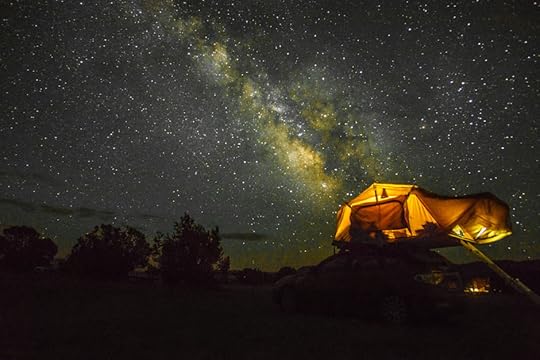
It’s dark when we arrive. Well, dark is actually an understatement. It’s pitch black with no moon, and no nearby cities to emit light. We crawl out of the car, stretch our legs, and set up the rooftop tent under the cover of an infinite amount of stars.
2
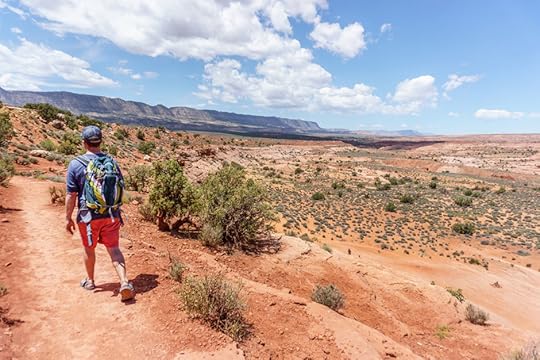
We wake up to oatmeal and a drive down the bumpy road taking us to Peek-a-Boo and Spooky Gulch. Finding a day clear of rain after checking the weather (important when venturing into slot canyons), we pack our bags with food and snacks and make our way into the landscape amongst which the slot canyons are hidden.
3
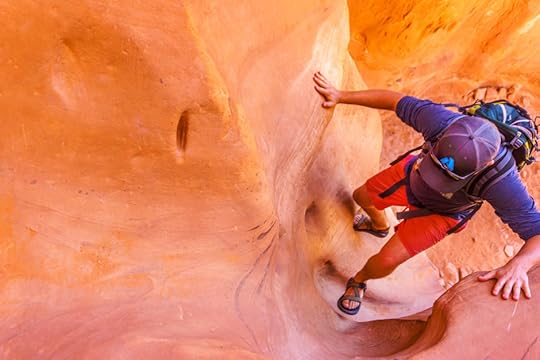
A quick scramble gets us into Peek-a-Boo Gulch. The rock is smooth, and quick slips mixed with good grabs cause laughter from the family behind us as we clamber up the orange sandstone. Peek-a-Boo and Spooky Gulch will get us on a 3.5-mile loop, a perfect length for most visitors.
Intermission
Activism + Politics
The year women became eligible to vote in each country
Tim Wenger
Mar 7, 2018
Parks + Wilderness
22+ spots that prove that our National Parks are the ultimate outdoor playground
Katie Scott Aiton
Apr 21, 2017
Photo Essay
The incredible formations of Bryce Canyon National Park in 11 amazing images
Katie Botwin
Feb 16, 2018
4
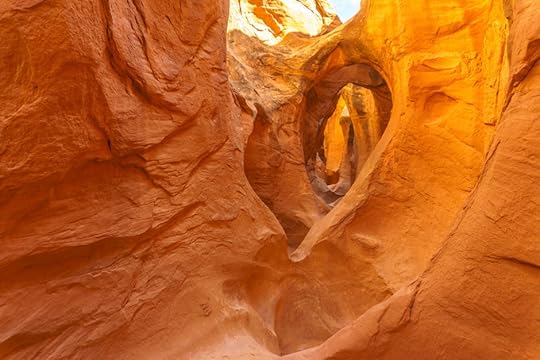
Our first view of the canyon is jaw-dropping. A seemingly endless tunnel quickly pulls us into the depths, moving away from the family that’s now struggling to get up the short scramble.
5
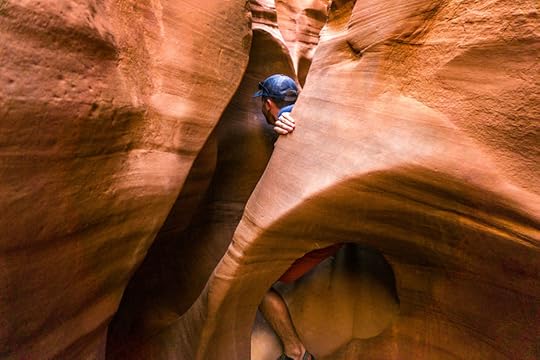
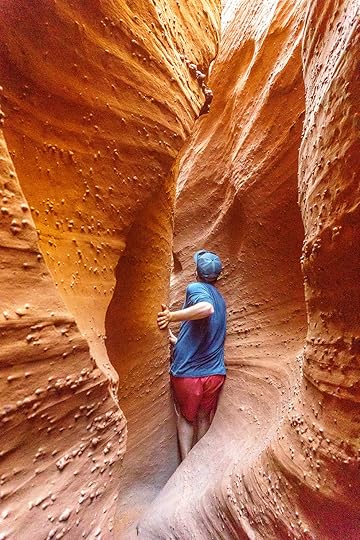
It’s quiet inside the canyon. As we move further along the path, we quickly find why it’s called a slot canyon. Doug crawls through a natural tunnel of rock that feels soft and cool to the touch.

6
Rock formations flow around us, arching overhead and towering to our sides. These natural wonders allow sporadic peeks at the blue sky above, juxtaposing with the endless orange labyrinth of stone.
7
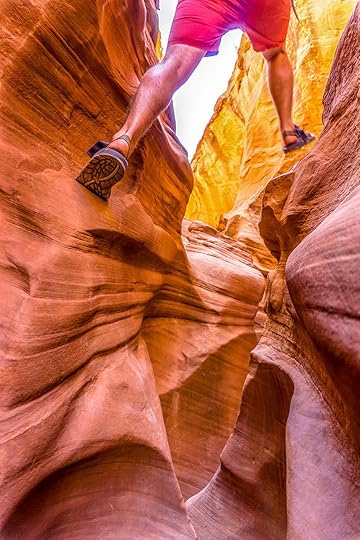
Peek-a-Boo Gulch calls for occasional rock hopping and scrambling. Doug tiptoes along the ledges above as I scramble below, giggling like kids in a jungle gym all the way through.

8
But the canyon can also command a sense of silence. Sometimes all we can do is stop and stare in awe. We’re alone for this stretch, and a gentle orange glow surrounds us with nothing but the sounds of our padding along the soft dirt.
9
Imagine water flowing for millions of years, forcing itself to carve such an incredible place. We move slowly along these old walls, feeling the smooth remnants left by the force of nature.
10
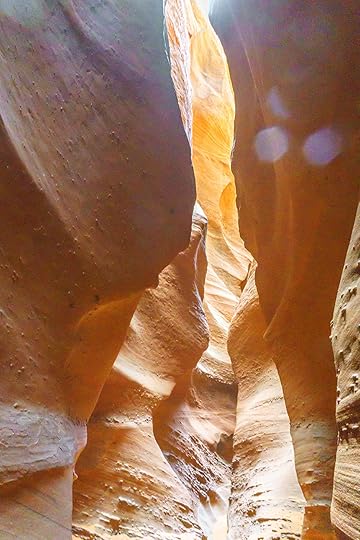
We immediately realize why it is recommended to do Spooky Gulch after Peek-a-Boo. This second canyon is tighter, and its one-person corridors can get a bit saturated. However, we manage to find a moment of quiet as we take in a narrow strip of sun.
11
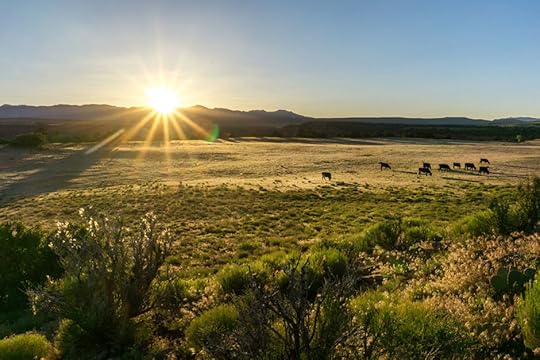
Covered in red dirt after a day of adventure, we set up camp overlooking a seemingly endless field. We have a dinner of pasta and wine as we watch the last light of the day painting the landscape in a warm light, knowing now that there are hidden worlds that gouge the earth before us.
More like this: Beyond Utah’s national parks: Hiking Coyote Gulch
The post Exploring the amazing slot canyons of Grand Staircase-Escalante National Monument appeared first on Matador Network.

Matador Network's Blog

- Matador Network's profile
- 6 followers


