Michael Hyatt's Blog, page 55
October 16, 2017
How to Avoid Our Most Common Thought Traps
A New Guide to Clear Thinking in a Confusing World
During the early days of the Vietnam War, U.S. Secretary of Defense Robert McNamara wanted to know if American military efforts in Vietnam were effective. He charted the numbers of weapons lost, enemies killed, and so on. But there was a hole in his thinking.
A critical colleague told McNamara he’d failed to count “the feelings of the Vietnamese people.” It was a fatal miss. While experts in Saigon and Washington insisted America would win the war in no time, it seems clear from Ken Burns and Lynn Novick’s new documentary that alienating the South Vietnamese spoiled any chance of American victory.
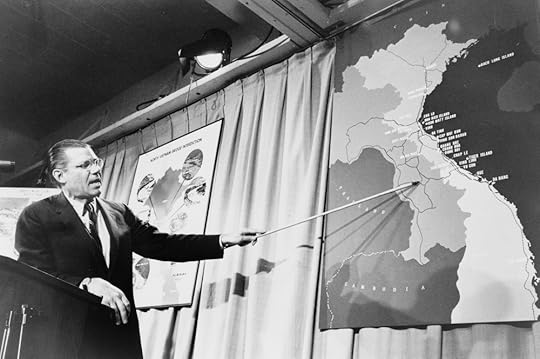
Robert McNamara. Photo courtesy of Library of Congress
It’s easy to spot the failures at this distance, but the truth is we’re all prone to similar miscalculations and flawed thinking—usually just less disastrous.
Smart people think, say, and do stupid things all the time. One explanation is that we’re sometimes more intelligent than critical. Researchers who’ve studied the discrepancy between intelligent people and stupid decisions note that critical thinkers experience fewer negative events in life, even when compared to highly intelligent people. Why? Their critical lens helps them avoid traps others blindly stumble into.
The good news, the researchers say, is that we can all learn how to think more critically. To do so takes more than just thinking. It requires thinking about our thinking. And for that, there are few guides better than Baylor professor Alan Jacobs’ new book, How to Think.
A Process, Not a Product
We often mistake thought for a product. After all, it’s what our brain produces. But thought is really a process. Since we usually focus on what—and not how—we think, we’re liable to stumble into unseen traps. Thankfully, Jacobs illumines our path.
He starts by explaining most of our thinking isn’t really thinking. It’s more like mental shortcutting. If we had to dissect the world at every turn, we’d never get anywhere. We all develop habits of mind that help us compress and even sidestep most of the thinking we might otherwise have to do (which is good news because we’ve got mortgages to pay). The problem is that some of that shortcutting fails us, and we fall for traps set by our own false assumptions or hasty conclusions.
We cook up some of these shortcuts on our own, but many are given to us by others. Jacobs points out that we never think in a vacuum. “Everything you think is a response to what someone else has thought and said,” he says. But it goes beyond that. Our thinking is heavily influenced by our social circles. “To dwell habitually with people is inevitably to adopt their ways of approaching the world.” If we’re not critical enough in our thinking to recognize how the process works, we default to unhelpful attitudes, ideas, and practices.
Dangerous Myths
During Vietnam, Cold War mythology shortcut critical considerations about Vietnamese reunification and independence. It’s a cautionary tale. If we’re self-unaware, mythologies of all sorts can wreak havoc in our business, politics, relationships, and more. Just look at social media, where a single hashtag can substitute for an entire train of thought—or, more accurately, its absence.
Hashtags exemplify what Jacobs calls “keywords,” by which he means the terms any given community takes for granted. If you’re in the group, you know what they mean (more or less) and use them accordingly. Sometimes these keywords stand for bigger metaphors and full-blown myths. But these keywords can replace actual thinking. They’re like an autopilot system steering us toward some truths, while skirting others. Occasionally, they send us into a ditch.
“We come to rely on keywords, and then metaphors, and then myths,” he says, “and at every stage habits become more deeply ingrained in us, habits that inhibit our ability to think.”

Alan Jacobs. Photo by Holly Fish
The more invested we are in our myths, the less likely we are to change our minds or value those who hold differing views. For leaders, the stakes are higher, thanks to the power differential inherent in their positions. Self-unaware leaders are likely to devalue the ideas of their own team members.
Avoiding the Traps
Once we see how and why we fall for various thought traps, we have choices to make. Though he starts the book by saying “diagnosis is the treatment” and summarizes key points in a “Thinking Person’s Checklist,” mere awareness is not enough. Thankfully, Jacobs closes with a much more compelling call. “You have to be a certain kind of person to make this book work for you,” he says. “What is needed for the life of thinking is hope: hope of knowing more, understanding more, being more than we currently are.”
Self-awareness begins by thinking about our thinking. But it only continues with a commitment to self-transformation.






Do You See Yourself Clearly?
How Teams Can Help Leaders Overcome Their Blindspots
When you see a group of friends roar with laughter after taking a selfie, you can bet they used a warp app to capture the moment. Like the funhouse mirrors of yesteryear, the app stretches our bodies and squeezes our faces to hilarious extremes. We have to laugh because the reflection has nothing to do with reality.
I’ll never forget the day a fellow leader poked his finger in my sternum and severely criticized my leadership. I stood speechless, not because his words were true, but because his criticism mirrored the very flaws he manifested in spades. In censuring me, he revealed his own warped selfie—but this one wasn’t so funny.
Every leader carries a selfie stick. We must. After all, effective leadership requires we take a good look at ourselves—not only from our own vantage point, but that of our teammates as well.
Blind Spots in Plain Sight
Our position of authority doesn’t bestow a supernatural ability to see the truth. Our authority can, in some cases, do the exact opposite. If our self-awareness gets warped—and we see ourselves far different than reality—we can begin to lead with directives that merely prop up our fragile ego.
We’ve all known leaders oblivious of—or unwilling to see—their weaknesses. The emperor has no clothes, but no one has the guts to say so. In such an insecure environment, many people prefer to let the king continue the charade rather than to speak up and lose their heads.
Truth be told, we all have blind spots that hinder our self-awareness. Personality tests can offer a great starting point on our journey to self-awareness. After all, no one fails a personality test! These assessments have no wrong answers because their goal is self-discovery. The real test comes after you get the results.
Chicken in My Teeth
But self-awareness means more than knowing the strengths and weaknesses of your personality. It also means understanding how others may react to your temperament. One time, I asked several colleagues to give me some honest feedback.
Along with the affirmations, they opened my eyes to a blind spot in my leadership. Hearing their words felt like staring in the mirror after a social event and—horror of horrors—seeing chicken in my teeth!
I had no awareness of the flaw they saw. Honestly, I struggled to face the truth. I later went to each person and apologized for how I had blown it. And I’ve tried to pay attention to that blind spot since then. It was a tough assignment, but worth the work.
I’m convinced that a wise leader welcomes feedback. Only a foolish leader thinks she has already arrived. And in a way, she has. She’ll make no progress. Why? The problem always lies somewhere else. But it takes tremendous courage to dig the lint out of your navel, examine it, and own it!

Take a Good Look
I urge you to invite those who work over you, beside you, and under you to offer some honest feedback. It isn’t easy, believe me, but it’s essential. Is it disappointing? It sure can be! But like a doctor who discovers a spot on a lung, we know it’s better to acknowledge the issue and deal with it than to waste—and eventually lose—our influence because of our disregard of the disease.
The path to effective leadership begins after seeing our true reflection. Knowing about it only makes it better if we deal with it. Don’t filter or delete your selfies. Instead, take a good look. Authentic self-awareness plays an essential role in leadership because truth wins in the end. Trying to lead by faking it may allow some leaders to sidestep the truth for a while. But reality shows up in the long run.
“
Authentic self-awareness plays an essential role in leadership because truth wins in the end.
—WAYNE STILES

Good leaders pursue more than the bottom line. They see character as their primary means of influence. Our lasting legacy will come more from who we are than from what we have done.


How to Break out of Business as Usual
The Enneagram Solution to Upgrading Our Outmoded Conflict Responses
Whether we know it or not, we all rely on a few basic strategies for moving through the social world. Different people adopt different strategies. Some try to be helpful and friendly; others aim for perfection. Some try to be attractive and productive, while knowledge is the goal for others.
The problem is that most of us have been using the same strategies for too long. They worked at some point, but we forget that we are seeing the world through our own unique lens—and that perspective can sometimes be limited. These adaptive strategies become a kind of “programming” we repeat over and over again, even when it doesn’t fit the situation we are in.
Getting Defensive
We’ve probably all heard someone describe somebody else (often somebody they don’t like) as having a “big ego.” And we all know what this means—this person displays an outsized sense of themselves and their own importance. But the ego—or personality—is not the bad guy in this story.

Being an “unconscious” person or an “unconscious” leader is actually a fairly normal way of functioning. It simply means the default “programming” you developed to survive in the world ends up driving most of what you do. It becomes business as usual: “just the way we are.” When this is the case, we are operating defensively, out of a subconscious desire to protect ourselves from threatened changes to our “programmed” leadership methods.
Complicating this defensive process is the fact that our physical brains also get involved. The design of our brains motivates us to react according to biological, wired-in “programming” we often don’t have conscious control over (unless and until we learn our way out of it).
As neuropsychologist and meditation teacher Rick Hanson states in his book Buddha’s Brain, our brains have a built-in “negativity bias” that primes us to avoid certain experiences but ends up making us suffer in a variety of ways. This bias originally helped us to survive by enabling us to recognize threats—like lions chasing us, or the dangerous possibility of falling off a nearby cliff. But even when we aren’t really in danger, says Hanson, it “generates an unpleasant background of anxiety,” which can “make it harder to bring attention inward for self-awareness.”

Since negative experiences have the most impact on survival, we get locked into response patterns that helped us avoid painful situations early on. This negativity bias also “fosters or intensifies other unpleasant emotions, such as anger, sorrow, depression, guilt, and shame,” he says. “It highlights past losses and failures, it downplays present abilities, and it exaggerates future obstacles.”
So, it’s part of being human to get defensive, respond impulsively from a negative filter designed to detect threats to our well-being and get emotionally triggered by things that make us anxious or fearful. When you feel anxious about paying your mortgage or terrified before the big speech you have to give or you throw a fit when someone cuts you off in traffic, you can relax in the knowledge that you are a normal member of the human race.
“
When you feel anxious…relax in the knowledge that you are a normal member of the human race.
—BEATRICE CHESTNUT
However, while it’s just a natural part of being human to respond in automatic, preprogrammed ways, these automatic defensive responses to perceived threats are often ineffective strategies for addressing situations successfully. Because they were created out of an early event (that may have felt like an emergency) our reactions can be rigid, fixed, and hard to change. So, we can overuse a specific strategy or strength, simply because it worked in the original setting.
In light of the omnipresence of these “pre-programmed” strategies and reactions, the most important thing we must do to more consciously manage our behavior (and rise above our defensiveness) is to develop the ability to notice, observe, and reflect on our automatic, habitual responses in a nonjudgmental and compassionate way.
This is why I like the Enneagram.
Discovering Your Personal Defaults
As a holistic framework for understanding personality, the Enneagram serves as a roadmap you can consult any time you find yourself lost or confused by what is happening between you and the people around you. According to the Enneagram model, there are a finite number of personality styles or “types” corresponding to a finite number of key adaptive strategies. And when I say there are a “finite number” of identifiable coping strategies, there are exactly … nine.

Each of the Enneagram’s nine types of specific focus of attention grows out of a central “coping strategy”—the go-to method for getting around, adapting to the environment, and surviving in the world. At its core, each of these nine personality styles is basically a “defensive” structure—an inner program that operates automatically to protect us from being hurt or feeling uncomfortable. In addition, the patterns that make up the personality also represent our particular strengths, specialties, and superpowers.
The Enneagram map of these nine personality styles provides a clarifying framework for understanding why you (and others) do the things you do because it highlights the specific patterns of reactions associated with the nine styles and what motivates them. And when you can study your habits and patterns with more clarity and objectivity—which the Enneagram personality descriptions provide—you can use your increased self-awareness to decide what behaviors you want to continue to engage in, and what behaviors you may want to change, if any.
You can also come to know yourself better, and share yourself more authentically with others, to build stronger working relationships. Andrew Greenberg, Founder and CEO of Greenberg Strategy, a brand strategy and market research company based in the San Francisco Bay Area, has worked extensively with the Enneagram model to develop his leadership, his team, and his organization: “There can be a dearth of authenticity in an organization,” he says. “It’s like high school; everybody is trying to fit into the guiding culture. The Enneagram offers an opportunity to be real. If you are a Type Two, I know something about you that’s personal. When people can be vulnerable enough to say, ‘I’m a this,’ to share something about themselves, it creates opportunities to like them more, to know them more.”
“The Enneagram is the great organizer, unifier, tenderizer,” he says. “Because there are nine types—and not sixteen or four—you get a nice balance. Each type is deep enough, but not too hard to understand. It’s like a meat tenderizer or a field plower, it takes the hard chunks of earth that are our habitual patterns and unexamined assumptions and makes them something you can plant on. It makes people more mindful and aware and open.”
Changing Your Programming
To be a conscious leader, you need to have a clear sense of your “programming” and be able to recognize when you get stuck on your personal autopilot. The solution to unknowingly operating in this default mode lies in your ability to see and own what you are really doing, thinking, and feeling. This allows you (eventually) to expand the repertoire of strategies you use to cope and function in the world—and to deploy the best strategy in each situation instead of always employing the narrow set you are most accustomed to using.
Having a clear window into your personality (and what motivates you) is key to understanding how (and why) your “programming” operates the way it does. The Enneagram system is a proven way to make sure you wake up from “sleep mode” without relapsing into ineffective or irrelevant coping strategies.
Adapted from The 9 Types of Leadership: Mastering the Art of People in the 21st-Century Workplace by Beatrice Chestnut, published by Post Hill Press.


October 13, 2017
Your Power as a Leader
The 4 Realities of Your Impact on Others
Years ago, I had a very difficult boss. One-on-one he wasn’t a bad guy. He was warm and likable. But in a group—particularly in meetings—he became another person. Dr. Jekyll became Mr. Hyde.

He would suddenly become cold and aloof. If I, or someone on my team, reported good news, he either didn’t acknowledge it or quickly dismissed it.
“Okay, we get it. You had a great month. Can we move on?” he would snap.
If we confessed bad news, he would begin his interrogation. He would bludgeon us with questions, one after another. He often asked the same question more than once, wearing us down and sucking the life out of us. We would leave these meetings depleted and discouraged.
I was very much aware of the impact he had on me. I vowed I would never lead this way when I got promoted.
As leaders, we possess more power than we think. But we can only use it for good if we understand it and embrace it. We need to remind ourselves of these four leadership realities:
People are aware of our role. As much as we may want to be “just one of the troops,” our people often won’t be able to separate us from our role in the organization. They know we can advance, hold back, or derail their careers. This colors their perception and interactions with us.
People notice our behavior. This is easy to forget. When I was just beginning my career, I noticed how my boss treated his assistant, whether or not he was punctual to meetings, and what he did when he was angry. So did my colleagues. We often spoke of it to one another. We noticed the most trivial details.
People amplify our words and actions. This is the scary part. We may think we are just being firm, but our people see us as angry. “He chewed me out,” she reports to her friends. Or we ask a question, and our people interpret this as a lack of trust. Everything gets dialed up a click or two.
People create stories to explain our behavior. This is just human nature. We try to find patterns behind the facts and create meaning. Sometimes we get the story right; often we get it wrong. Regardless, we knit together the facts and create narratives to make sense of our world.
As leaders, we don’t need to resist these truths. Instead, we need to be intentional with our words and actions, aware we are constantly modeling what we believe and expect. It’s not unlike parenting. More is caught than taught.
This is a challenge but also a great opportunity.
“
Leadership is not unlike parenting. More is caught than taught.
—MICHAEL HYATT
As interested as you might be in improving your leadership skills, the path forward isn’t always easy—it requires constant learning and flexibility. As organizations expand and teams grow, leaders must adapt and grow with them.
That applies to me, too. As you know, I’m passionate about helping high achievers become better leaders. My company has made a commitment to your personal and professional development—and that means changes for us as well.
Starting on Tuesday, we’ll be providing high-quality content to you in a brand new way. You won’t see a new blog post here on Monday, but that’s because there’s much, much more on the horizon.
I can’t wait to show you what we’ve been working on… Stay tuned!
Question: What impact do you want to have on others? How do you want them to feel after their interactions with you? You can leave a comment by clicking here.


October 11, 2017
Are You a Responsive Person?
4 Ways to Set Expectations for Collaborative Communication
Unresponsive people drive me crazy. I hate sending an email or Slack message to someone and then waiting days to hear anything back. (Admittedly, I have sometimes been guilty of this myself.) This is particularly maddening when you don’t hear anything at all.
One of the questions I always ask when interviewing executive assistants is this: “Do you consider yourself a responsive person?” For me, this is a must-have attribute. Naturally, everyone says, “yes.” However, you can tell a lot by how they answer the question.
One candidate replied with a very smart question of his own: “What is your definition of responsive?”
Brilliant.
I suddenly realized that I had never really stopped to define this for anyone who worked for me. I assumed there was one standard and everyone knew it.
The truth is that I don’t need to demonstrate the same level of responsiveness to everyone. Furthermore, I don’t need everyone I interact with to demonstrate the same level of responsiveness toward me. What I need to do is clarify my expectations.
Here are four actions to help you calibrate your expectations with the expectations of others.
Define how responsive you are going to be. Segment your contacts. Who is your inner circle? What about the next level out? What about acquaintances? What about complete strangers? I have a different standard for each. I don’t necessarily need to tell them which circle they’re in. I just operate by these standards.
Determine how responsive others need you to be. If you acquire a new client, a boss, or a business partner, ask them to clarify their expectations. How quickly do they need you to respond? Does it need to be immediate? Within a few hours? Within 24 hours? In a couple of days? Ask them to be specific. This is an implicit contract.
Express how responsive you want others to be. Take the initiative to clarify this with your direct reports, business associates, and vendors. It will result in less frustration for both of you. It also provides the necessary accountability to make progress on your various projects.
Be proactive when you can’t respond in a timely manner. If the other person has to follow-up, it’s a good sign your expectations are mismatched or you dropped the ball. Instead of waiting for them to ask again, contact them. For example, “I just wanted to acknowledge that I received your email. I am traveling this week, so it will likely be the end of the week before I can respond.”
Remember: You don’t have to provide the same level of responsiveness to everyone—nor can you. But you would be wise to clarify your expectations and then be intentional about it.


October 9, 2017
5 Reasons You Need to Get Better at Saying No
Finding the Positive in the Negative
I have a hard time saying no. Perhaps you do, too. I think it is more common than we think, especially for those who are empathetic or nurturing. We just hate the thought of hurting someone else’s feelings.

It was a long time before I noticed this problem in myself. For most of my career, I’ve had administrative assistants who said no for me. If someone had a request, they had to get through them first.
This gave me the buffer I needed to consider the request more carefully. I then let my admin decline on my behalf. The fact that I didn’t have to deliver the bad news myself not only kept me focused and productive, it also helped preserve relationships.
But here’s the thing. I didn’t realize what a gift this was. When I left the corporate world, I figured I could make it fine without an admin. That meant the requests all came straight to me. And, left to my own devices, I said yes to far, far too many.
A third of the time I wanted to kick myself as soon as I said yes. Another third of the time I wanted to kick myself shortly afterward. How did I get myself into this mess?
“Saying No has always been important,” says William Ury in his book, The Power of a Positive No, “but perhaps never as essential a skill as it is today.” The reasons he lists are the ones I experienced. All my yeses meant I was overcommitted, shortchanging my relationships, and unable to do my best work.
I bet you can relate.
The Reason We Struggle
Why do we have such a hard time saying no? Ury says it’s because we want to protect our relationships, and that’s definitely a big part of it. But we even say yes to perfect strangers. I think it has to do with keeping up appearances. We want to appear helpful or can-do. But it’s a trap.
When we say yes too often, we tend to hurt our relationships. Not only that, but our performance suffers, so it’s impossible to keep up appearances. We let everyone down, especially ourselves.
After a while of fielding all my own requests, I decided I needed an administrative assistant again. But before I hired an admin, I started turning my no boat around on my own. How?
I resolved to say no to everything unless there was a compelling reason to say yes. I switched my default response from an affirmative to a negative. Things changed with just that determination, but I was able go even further when I wrote down five reasons for saying no.
Say No for a Better Yes
This list is the why behind the what. It turns out there are very good reasons for flexing your no muscle. If you struggle with this, I think these five reasons might help you as well.
Here’s what I wrote.
If I don’t say no,
Other peoples’ priorities will take precedence over ours.
Mere acquaintances—people we barely know!—will crowd out time with family and close friends.
We will not have the time we need for rest and recovery.
We will end up frustrated and stressed.
We won’t be able to say yes to the really important things.
This last one was the clincher for me.
Here’s what Patti Breitman and Connie Hatch say in their book, How to Say No Without Feeling Guilty:
Out of guilt or fear of confrontation, we take on more projects, invest in someone else’s priorities.… In the process, we dissipate our most valuable personal resources—time, energy, and money—on things that aren’t important to us. Each time we agree to something without enthusiasm for interest, we waste a little more of these precious resources.
Now let’s turn that around. Every time we say no to something that is not important, we are saying yes to something that is: our work, our relationships, our resources, our margin.
“
Every time we say NO to something that is not important, we are saying YES to something that is.
—MICHAEL HYATT
Question: How often are you saying no? You can leave a comment by clicking here.


October 6, 2017
3 Ways to Go Further, Faster
The Secret Power of Sherpas, Experts, and Coaches
Years ago, I wrote a list of “100 Things I Want to Do Before I Die.” It’s really an amazing, audacious list. Whenever I review it, I am both inspired and stunned by how many of the items I have already accomplished. And yet, there is so much more. The list keeps growing!

I’ll bet you have a list, too. Maybe you’ve written it down. Maybe not. But either way, you want to accomplish things. Really important things.
w
Unfortunately, life is short. Or at least it feels that way. I have more to accomplish than I could do in seven lifetimes.
So how do you reclaim some of that time? How do you shortcut the process and make significant gains on your goals?
The Most Important Action You Can Take
I’m going to tell you the single most important action you can take to go further, faster and to make your dreams become reality. I have done this over and over again in my life.
To the extent I have achieved any level of success, I believe this is the secret. It’s something I learned from my dad.
Enlist the help of the best coaches and instructors you can afford.
Let’s be honest. Everyone needs a sherpa to get up the mountain. My assumption is that someone, somewhere has already done what you are attempting to do—and done it well. If you can tap into their experience and learn from it, you can get to where you want to go faster and with fewer missteps along the way.
There are basically three ways you can do this. I’ve arranged them from least expensive to most expensive. However, you can often find free alternatives if you look hard enough.
1. Read the Best, Most Relevant Information
My journey into uncharted territory always begins with a search on Google. There is a ton of free information on the web (obviously). This will give you a feel for who the experts are and what they have to say. If I want to go deeper, I then buy the best books I can find on a given topic.
For example, when I first took up digital photography, I bought the three books with the highest Amazon ranking and the best customer reviews. I did the same when I decided to start running. This is a relatively inexpensive way to learn the basics and get a broad working knowledge of the topic at hand.
But this step doesn’t just apply to new interests. I continue to read in areas where I am already proficient. I want to deepen my knowledge and keep my skills sharp. Think of it as continuing education for life.
2. Sign up for Specialized Classes
I have a short attention span, so full-length, longer-term courses don’t work for me. I get bored. I prefer the all-day, three-day, or (occasionally) a one-week course. For example:
When I wanted to learn how to build a great marriage, Gail and I attended several courses on marriage, some taught by Gary Smalley. [A bit of trivia: Gary and his wife, Norma, introduced Gail and me to each other. He actually performed our marriage ceremony.]
When I wanted to up my game on team alignment, I took a one-week course from Gap International called “The Alignment Intensive.” It blew my mind. I use the tools I learned in this course almost every day.
When I wanted to rethink what was possible in my business a few years ago, I attended Tony Robbins’ Business Mastery. I have been to several of Tony’s events, but this conference was a gift to me at that juncture in my career. It wasn’t cheap and the commitment was substantial. But it’s a whole lot less expensive than learning these lessons on my own.
When I wanted to improve my writing skills, I signed up for an intensive one-week course from American Writers & Artists, Inc.called, “The Copywriting Success Bootcamp.” This was one of the best professional investments I ever made. Similarly, I went through the Fast, Effective Copywriting course. It was worth every penny.
These are just a few examples of dozens I could cite. Some of these courses were free. Some cost a few hundred dollars. In a few rare instances, the courses cost several thousand dollars.
Regardless, you can sometimes find very good free or inexpensive courses taught by churches or other nonprofit organizations or even local colleges. Like I said, enlist the help of the best coaches and instructors you can afford.
3. Hire World Class Experts
Finally, I enlisted the help of real people who could hone my skills beyond what I could learn in a book or garner from a course. For example:
When I wanted to create sustainable work-life balance, I hired Daniel Harkavy, the president and founder of Building Champions. He helped me craft my very first life plan. Later on, we cowrote the book Living Forward to explain the life-planning process.
When I wanted to take my business to the next level, I hired Dan Sullivan of Strategic Coach to help me think through obstacles and opportunities in new ways. It’s no exaggeration to say I use what I learn from Dan in my business every day.
When I wanted to take my personal leadership skills to the next level and really see how my own thinking was impacting my corporate results, I hired Ilene Meuthing of Gap International. She’s basically performed a brain transplant on me, helping me change my thinking and produce better outcomes.
When I wanted to figure out why I kept slicing my drives, I hired Nancy Quarcelino, one of the best golf teachers in the country, for a two-hour session. She videotaped me, so I could see the problem in my swing and fix it for good. Her personalized coaching bore immediate results. Though my game is still not all that great, it’s a lot better because of her coaching.
In addition, in the course of my life, I have hired personal trainers, nutritionists, counselors, music teachers, accountants, lawyers, fishing guides, agents, and various kinds of instructors and coaches. Some have been short-term; some have been long-term. My philosophy is to use them as long as they continue to provide value.
Don’t Let Resources Hold You Back
Again, note that I said, “hire the best coaches and instructors you can afford” For years, the most I could afford was to check out a book from the library. Don’t worry about what you can’t afford or do. Focus, instead, on what you can afford and start there.
The most valuable resources you have are determination and creativity. In my experience, the rest shows up as you go.
In the end, you can accomplish more than you ever thought possible. And you can do it faster and with better results if you just enlist the assistance of the right guide and do what they say. I can’t think of anything else that will help you accomplish your goals more than this.
“
The most valuable resources you have are determination and creativity.
—MICHAEL HYATT
Question: What coach can you enlist today to enable you to accomplish your goals? You can leave a comment by clicking here.


October 4, 2017
Why Keeping Commitments is Critical to Your Influence
3 Reasons Integrity Is Key to Your Success
When we think of someone with integrity, we think of someone we can count on to come through on what they promise. Unfortunately, that’s not always a safe bet today.

Over the last several years I’ve noticed a change in the way we use the word integrity. Having integrity requires staying true to your word—even if it’s difficult, inconvenient, or expensive. But today I hear more and more people using the word as if it means being true to themselves—even if that means leaving someone else to clean up the mess.
This might look like a win if we’re trying to save ourselves from difficulty and discomfort, but it will come back to bite us in the end. Nothing destroys our credibility faster than bailing on a commitment.
More to the Story
The phrase “To thine own self be true” comes from Shakespeare’s Hamlet, but it became popular through self-help books and programs. There’s nothing wrong with these words by themselves, but they’re usually taken out of context.
If you’ve ever read or seen the play, you know the full story. The phrase comes after advice about being prudent and preserving friendships. The idea is that we are true to ourselves so that others can count on what we say. It was about having true integrity.
But if you listen to the way people use it today, they usually mean something else. “To thine own self be true” is often used as an excuse to do whatever a person wants instead of what’s expected—or even what they’ve already committed to. This is suicide in business—and the rest of life.
Not only is integrity essential for strong friendships, it’s crucial for all of our relationships. “Honesty,” says Stephen Covey, “is making your words conform to reality. Integrity is making reality conform to your words.” We won’t get far in life without it.
Just think about your work. Without the kind of integrity Covey describes, you cannot be an effective leader. Why?
Trust depends on integrity. If people can’t rely on your word, they won’t trust you. They may extend some grace, but eventually, people will doubt and disbelieve.
Influence depends on trust. People will refuse the influence of leaders they distrust. Just look at how this plays out in politics or the media. We follow people we trust.
Impact depends on influence. You can’t make the impact you want unless you can influence others and shift their behavior.
Now think of other relationships: marriage, parenting, church, whatever. The strength of our relationships is measured by how much people can count on us. If we’re not true to our words, that means our relationships will be as unreliable as we are.
“
The strength of our relationships is measured by how much people can count on us.
—MICHAEL HYATT
Not Without Cost
Yes, keeping our word can sometimes be very costly. I’ve had times in my career when it’s been very expensive to do the right thing. Once I had to pull the plug on a multimillion-dollar project we desperately needed to make our numbers.
Another time I had to uphold an exorbitant commitment of an executive I let go, even though he didn’t have the authority to make the agreement in the first place. The P&L was already hemorrhaging, but the cost of not following through would have been more expensive to the company in the long run.
There’s nothing wrong with asking to be released from a commitment. But if we can’t get free, then we need to make good on it. If we try living true to ourselves at the expense of others, it’ll cost us our relationships, our success, and ultimately everything of real and lasting value.
Question: What examples of true integrity have you witnessed in your own relationships? You can leave a comment by clicking here.


October 2, 2017
What It Takes to Become a Person of Influence
4 Simple Behaviors Any Leader Can Adopt
I was recently talking to a neighbor about an ordinance being considered by our city council. She didn’t like it and felt strongly that it shouldn’t pass. She went on to make the case to me, raising several valid points I had not considered before.

I reminded her that the city was holding a public hearing on the matter before the council voted and asked if she planned to attend. “No,” she immediately replied, “I don’t have any influence.”
Clearly, she misunderstood the nature of influence. Many of us do.
Most people think they can’t have influence without more reach, higher education, longer experience, better skills, or a bigger title. While all those are important and can increase your ability to influence others, none of them is essential.
So what is?
When it comes to influencing others, it really comes down to a solid foundation—something anyone can acquire. All you need are these four simple behaviors.
1. Be Present
In order to influence others, you have to be willing to show up. Before people can like or trust you, they have to know you. They can’t get to know you unless you give them the opportunity.
2. Be Consistent
You won’t be able to influence others if your beliefs and your behavior are not in alignment. The most difficult person to lead—and thus influence—is yourself. You don’t have to get it perfect. We are each a work in progress, but there has to be a fundamental integrity between our words and our actions. (I’ll share more about this on Wednesday.)
3. Be Empathetic
As the old saying goes, “People don’t care what you think until they think you care.” You have to be willing to listen without judgment (at least initially). You have to see the situation from the other person’s point of view.
4. Be Counted
You have to be willing to speak up. Your words won’t mean much if you:
don’t routinely show up
aren’t walking your talk
don’t listen
[These are in the order they are for a specific reason.]
Assuming you are not guilty of those things, you also have to find the courage to speak up. Sometimes it’s to lend support to an idea you believe in. Other times, like the case with my neighbor, it’s to challenge an idea you don’t believe in. Regardless, people can’t read your mind. Unless you speak up, you won’t have influence.
“
Before people can like or trust you, they have to know you.
—MICHAEL HYATT
There’s more to influence than these four behaviors, but they are the foundation. If you’re focusing on volume and views before these, you’re in trouble. But if any leader who adopts and develops these four behaviors will see results.
Question: Have you noticed that these behaviors are present in the people who have influenced you? You can leave a comment by clicking here.


October 1, 2017
LEAD TO WIN Teaser
Short-term wins are easy. Sustained achievement is another story.
On this brand new podcast—Lead to Win—we help you discover how current research combines with timeless wisdom for lasting success. From personal productivity to personal development, self-leadership to team leadership, and intentionality to influence, get the insights and tools you need to win at work and succeed at life.
Subscribe today so you don’t miss the pilot episode next week!
Listen to the teaser: