David Pilling's Blog, page 3
January 30, 2025
The liberty (?) of the people

#OTD in 1649 Charles I, King of England, Scotland and Ireland, was executed outside the Banqueting House at Whitehall, London.Charles had been found guilty of attempting to "uphold in himself an unlimited and tyrannical power to rule according to his will, and to overthrow the rights and liberties of the people" and sentenced to death by beheading.
The following is an excerpt of Charles's final speech, which he apparently made on the scaffold:
"As for the People, truly I desire their liberty and freedom, as much as any whosoever; but I must tell you, that their liberty and freedom consists in having of government by those laws, by which their lives, and their goods may be most their own. It is not for them to have a share in Government, that is nothing Sirs, appertaining unto them. A Subject and a Sovereign are clean different things; and therefore until that be done, I mean, until the people be put into that liberty, which I speak of; certainly they will never enjoy themselves."
So far as I understand this, Charlie appears to have said that the people could only have liberty via good law and government, which they had no part in i.e. they must entrust their freedom to a higher power. Or something like that.


January 29, 2025
1314: the Year of Bannockburn review

My text review of 1314: the Year of Bannockburn by Callum Watson, published by Pen & Sword:
1314: the Year of Bannockburn is an in-depth new study of perhaps the most famous battle in Scottish history. As well as the battle itself, Dr Callum Watson highlights aspects that have been somewhat overlooked in previous studies, including preparations for the campaign and the reaction to the outcome.One of the most impressive features of this book is Watson’s meticulous build-up, drawing upon contemporary sources to explain the policy of Robert de Bruce (King Robert I) and Edward II on the eve of the Bannockburn campaign. Although the records are incomplete, it seems Bruce was unwell in the months leading up to the battle, and it may have been feared that he would not recover. That would explain both his concern with the succession, and absence from events in early 1314. Instead the Scots were led by his brother, Edward, although Bruce returned to take command at Bannockburn. He may have also passed sentence of forfeiture on all those Scots who remained outwith his allegiance, although the timing of this is uncertain.
The position of Edward II is easier to define. There is clear evidence of his growing concern at matters in Scotland, and intentions to lead a military expedition. To demonstrate this, Watson looks beyond the British Isles. For instance, in October 1313 Edward addressed letters to the Roman Emperor, Andronikos II, requesting the release of Sir Giles d’Argentan, who was in prison at Salonika. Giles, one of the most famous knights of his time, would act as Edward’s bodyguard at Bannockburn. The king’s desire to secure his release implies that Edward specifically intended for Giles to serve on a Scottish campaign.
Furthermore, Edward was alarmed by complaints brought by his Scottish allies, led by Sir Adam Gordon and Patrick Dunbar, Earl of March. These throw light on the chaotic situation in Scotland prior to Bannockburn. Edward’s Scottish allies were not only being attacked by the Bruce Scots, but also the English garrisons at Berwick and Roxburgh. One of these ‘English’ officers was in fact a Scot, Thomas Pencaitland, son of a man who had defected to Edward I. Such pleas give an idea of the shifting allegiances in Scotland, in which all sides preyed on each other. It was Edward II’s thankless task to restore order, which he promised to do by advancing ‘against our enemies and rebels in those parts’.
The available evidence suggests that Bruce simply meant to stay out of Edward’s way, wait for the English king to run out of patience and money, and then resume terrorising English garrisons once Edward was forced to withdraw. This strategy had served Bruce well on Edward’s previous Scottish expedition, in 1310, and there was no obvious reason to abandon a winning strategy. To quote one chronicle, the Vita Edwardi Secundi:
“…but always as the English army approached he [Bruce] kept to the trackless boggy mountain places, into which such an army could not easily penetrate…”
Edward II was also driven by domestic concerns. In England he faced a serious challenge from the Ordainers, a group of nobles and prelates who wished to force Edward to reform the abuses of his government. Watson argues that the Bannockburn campaign was really an excuse for Edward to get away from the Ordainers, as well as improve his own political capital by winning a great victory in Scotland.
Watson provides a detailed account of the preparations for the campaign on both sides. Considerably more detail survives for the English side, thanks to the existence of so many administrative records. These include details of victualling, supply and wage accounts and other financial arrangements generated by the Exchequer at Westminster. Less information survives for the Scottish side, and Watson has to (reasonably) speculate as to the size of the army Bruce could field at Bannockburn.
The focus on administration may sound dry, but they make for a fascinating contrast between the two kingdoms. England in the late 13th century was a powerful centralised state, with a sophisticated bureaucracy set up to handle financial and military matters. Scottish governance was far more decentralised, meaning there was no fixed bureaucracy in any one place. This was a major advantage, since it meant there was no one town or region that the English could seize, which would enable them to take control of the Scottish administration.
The military aspect is, of course, the main focus. Watson describes how Bruce operated a scorched-earth policy, and from 1312 launched repeated raids into northern England. These were meant to hammer home the point that Edward II could not defend his kingdom, and to exploit the political turmoil in England surrounding Edward’s hated favourite, Piers Gaveston. The raids were brutal, although Bruce’s men tended to kill only those who resisted them.
This wasting or ‘guerilla’ strategy, typical of medieval warfare, was plied with lethal skill. Previous Scottish raids had been chaotic affairs, but Bruce’s efforts were systematic, organised and highly disciplined. Apart from spreading terror, they were designed to extort payments from the local populace, in the shape of what Watson refers to as ‘the three C’s’; cattle, cash, and corn. Discipline was important for then purpose of blackmail, since the English would not pay over large sums if they thought they were going to be robbed anyway.
Turning to the battle itself, Watson closely examines Bruce’s preparations in the weeks before the event, and his innovative use of the landscape to secure victory for the Scots. He ably examines each famous episode of the battle in turn, beginning with the skirmish at the New Park, where divisions among the English leadership triggered a disastrous cavalry charge into a series of specially dug pits. To quote the text:
“A contrivance full of evils…holes with stakes, so that they may not pass without disasters.”
This unpromising start was followed (allegedly) by the famous duel between Bruce himself and Sir Henry de Bohun. Watson, always even-handed with sources, points out that the earliest version paints Bruce in a distinctly unheroic light, killing Bohun as the Englishman tried to escape a Scottish ambush. It was John Barbour, writing decades later, who wrote the popular tale in which Bohun surprised Bruce while the latter was inspecting his troops. Another version, written by Sir Thomas Grey, states it was one Piers Mountforth whom Bruce killed, rather than Bohun. However, the existence of three independent accounts suggests there may be some truth to the tale.
The fight at the New Park was followed by a second skirmish, in which the English mounted chivalry were once again worsted by Scottish spears. Following these disasters Edward II attempted to move his army onto the Carse of Stirling, beyond the tidal streams (called ‘pows’ by the Scots), and the only firm land where his army might camp. Thus, even before the battle started, Bruce had left his enemy with few viable options.
On Monday 24 June 1314, after hearing mass, the Scots deployed in rectangular blocks of footsoldiers, with their long spears pointed in the direction of the enemy. This was in contrast to the oval-shaped formation used the previous day, and by William Wallace at the disastrous battle Falkirk in 1298; another example of Bruce’s tactical flexibility. To the shock and dismay of the English, the first two Scots divisions moved forward, when they were expected to stay rooted to the spot.
This meant Edward’s army was trapped between two streams, the Bannock Burn and the Pelstream, squeezed into the cramped space where the waters flowed together. Their only way out was to hack through the dense formations of Scottish spears, but English cavalry charges proved ineffective against the tight discipline of the Scottish infantry. The English archers briefly threatened to turn the tide, as they had at Falkirk, but were scattered by Scottish cavalry. The death of the Earl of Gloucester, probably killed during the initial charge, was a further blow to wavering English morale.
The destruction of the archers meant the English had no hope of extricating themselves from Bruce’s trap. At the crucial moment, when Bruce judged the enemy to be at breaking point, he threw in his reserve of hardened troops from Carrick, the Western Highlands, and the Hebrides. According to Barbour, these men were joined by the ‘rabble’ of the Scots camp, spreading panic among the already hard-pressed English.
At this point the English army broke and fled in all directions, reduced to a mob of terrified fugitives. Edward II himself was almost captured, and owed his escape to the courage of Giles d’Argentan, who dragged the king from the field before returning to embrace death. Some of the fleeing English tried to scale the steep sides of Castle Hill, but most followed their king south, abandoning the baggage and royal treasury. Many were trampled and drowned in the mud and water, although most of the nobles got away, accompanied by bedraggled or ‘naked’ Welsh infantry. One of the captured English knights had the interesting name of Sir Marmaduke Thweng; even better, his arms consisted of three green popinjays. He and another prisoner, Sir Ralph Monthermer, were treated courteously by Bruce.
Watson’s nuanced reconstruction of the battle is followed by an equally skilful analysis of the aftermath. The desperation of Edward II’s position is shown by the loss of his privy seal, left behind in the rout. Humiliatingly, he had to borrow the privy seal of his wife, Queen Isabella. Bruce then returned Edward’s own seal, both as a way of emphasising the parity between the two kingdoms, and a stinging reminder of Edward’s recent defeat. Elsewhere Edward was obliged to deal with ransoming prisoners taken by the Scots, including Scots alienated from the Bruce regime.
Watson emphasises that Bannockburn was not decisive. Edward II would recover, and lead an even larger army into Scotland in 1319; as usual, to no great effect. Meanwhile the Scots pressed their military advantage, mounting ever more destructive forays into the northern counties, now completely exposed to Scottish raids. After Bannockburn the extent and ambition of these raids were far greater. Edward II, in stark contrast, was unable to mount any kind of effective response. Eventually northern communities switched to making private deals and truces with the Scots, and even recognising his title as ‘regis Scoiae’ - King of Scots. These endless disasters, coupled with Edward II’s increasingly tyrannical regime in England, eventually led to his deposition and probable murder.
Within Scotland, Bruce’s position was still not secure. In 1320, despite repeated victories over the English, he was faced with the so-called Soules conspiracy, organised by the rump of his domestic enemies, the Balliol and Comyn factions. The executions and forfeitures that followed not only eliminated this threat, but provided Bruce with more lands to distribute to his loyal supporters. Even so, plenty of Scots lords were still unwilling to accept the Bruce regime, and would go on to form a body of men called ‘the Disinherited’. These men would play a key role in triggering the Second War of Scottish Independence, which almost witnessed the collapse of the fledgling Bruce regime, only a few years after Bannockburn.
Overall, this is a highly readable and precise account of a famous battle, written with verve and energy and an obvious passion for the subject. Watson mixes his undoubted scholarship with a clear and precise writing style, managing to convey knowledge and understanding of the sources without bogging down the text in fine detail. Anyone with an interest in this tumultuous era of Scottish history, and the astonishing rise to power of the Bruce dynasty, would do well to start here.
January 28, 2025
A dyke in great haste

Scooting over to the Netherlands...
Floris V, Count of Holland and Zeeland (1254-96) was one of the claimants to the throne of Scotland, eventually assassinated by his own nobles. For much of his career he was focused on conquering West Friesland. Recent studies in the Netherlands, led by Nancy de Jong-Lembregts, have argued that Floris was heavily influenced by Edward I of England's castle-building policy in Wales.His father, William II, was King of Germany as well as Count of Holland and Zeeland. William died on 28 January 1256, when his horse fell through a frozen lake near Hoogwoud, now a small city in the Dutch province of North Holland. Willliam was dragged out and killed by the Frisians, who hid his body. It was not discovered for 26 years, when his son Floris swore revenge.
Floris's first campaign against the Frisians occurred in 1272. West Friesland was an island, essentially, bordered by inlets to the north and interconnecting lakes to the south. The inhabitants of this swampy region had no wish to be vassals of the rulers of Holland, and held off Dutch invasions using guerilla-style tactics, similar to the Welsh and Irish.
As early as 1133 and 1168, the Dutch had made serious military attempts to conquer West Friesland, but never achieved a permanent settlement. Floris, just like his contemporary Edward I, was determined to reverse the failures of his ancestors.
Their strategies were remarkably similar. Edward widened roads and created new waterways in Wales, to provide easier access for his armies. Floris did the same on the borders of West Friesland, where he widened the traditional invasion route near Aaalkmar, north of Amsterdam, to make it easier for his cavalry. One of his clerks, Melis Stoke, wrote that Floris also raised a new dyke:
“He also had a dyke built nearby in great haste,
So that people could move from here in times of emergency,
And could go from the castle to Vronen and Aalkmar.”
Floris also built new fortifications, including a castle at Middelburg. A recent archaeological dig on the site in 2018 achieved results that were – according to the official study – nothing short of spectacular.
Jane Austen's History of England
 On this day, in 1813, Jane Austen's Pride and Prejudice was first published in the United Kingdom.Austen also wrote a very funny History of England. Unashamedly biased and inaccurate, it trashes pretty much everyone except the Stuarts: Austen openly admitted to liking them because she was a Catholic. Here are some quotes:"Lord Cobham was burnt alive, but I forget what for.""One of Edward IV's Mistresses was Jane Shore, who had a play written about her, but it is a tragedy & therefore not worth reading.""His Majesty died & was succeeded by his son Henry VIII whose only merit was his not being quite so bad as his daughter Elizabeth.""As I am myself partial to the roman catholic religion, it is with infinite regret that I am obliged to blame the Behaviour of any Member of it."Etc...
Kingbreaker!

Available from Amazon UK and Amazon US
" 1461 AD. England is at war. The bitter feud between the rival houses of Lancaster and York reaches a bloody climax on the field of Towton. Here, the rising sun of York is triumphant, and the red rose of Lancaster trampled into the mud."
In 1462 John de Vere, the 12th Earl of Oxford, and his eldest son Aubrey were executed at Tower Hill in London. They had been arrested for plotting against the Yorkist king, Edward IV, although the precise nature of the accusations are unclear.
What lay behind this spate of political killings? The twelfth earl has steered a middle course during the early stages of the dynastic conflict we know as the Wars of the Roses. He had played no active role on either side, but instead focused on preserving his power base in East Anglia. This passive role served him well, until he suddenly became involved in the fatal conspiracy of 1462.
The bare outline of this plot is provided by a London chronicle. Quote (rendered in modern English): “And the xii day of February the earl of Oxford and the lord Aubrey Vere, his son, Sir Thomas Tuddenham, William Tyrell and others were brought into the Tower of London. And upon the xx day of the said month the said Lod Aubrey was drawn from Westminster to the Tower Hill and there beheaded.
And the xxiii day of the said month of February Sir Thomas Tuddenham, William Tyrell, and John Montgomery were beheaded at said Tower Hill. And upon the Friday next following, which was the xxvi day of February, the earl of Oxford was led upon foot from Westminster unto the Tower Hill, and there beheaded; and after the corpse was had unto the friar Augustines, and there buried in the Choir.”
This reveals little save names and dates, and the curious detail that the earl’s execution was saved until last. A brief note in another chronicle states that Aubrey was subjected to an especially cruel execution, being hung and disembowelled (‘suspensus et tractus'), rather than beheaded. This would suggest he was regarded as the chief instigator of the failed plot against Edward IV.
The conspiracy may have been driven by the insecurity of the Yorkist king, who had only been on the throne for a year. Rumours were rife of a fresh invasion of England, led by Margaret of Anjou, the exiled queen of Henry VI.
This was, supposedly, meant to coincide with an invasion from Scotland by exiled Lancastrians, supported by troops raised by the duke of Somerset. IN the end this elaborate three-pronged strategy came to nothing, although Edward would face many more serious threats to his rule.
However, one man never forgot the killing of the de Veres and their supporters at Tower Hill. This was the twelfth earl’s younger son, another John, who was allowed to succeed to the earldom. Driven by revenge on the house of York, he would pursue a remarkable career as rebel, outlaw, pirate and political prisoner, until he finally triumphed on Bosworth Field…
June 15, 2023
Fever and dysentery

Summer 1296, Robert of Artois leads a French army to conquer what remains of English-held Gascony (I'll write in the present tense for a bit of immediacy).
Artois has been granted viceregal authority by his sovereign, Philip the Fair, throughout most of southern France. He has lost no time in preparing for the campaign; no expense or detail has been spared, down to ordering special cloths and saddles from Saloman Boinebroke, a merchant of Douai, to be sent with all speed to Gascony.
The French advance quickly through the south. The march takes them through Auvergne into Poitou, Limousin and Angoumois, reaching Angouleme on 28 April. En route Artois collects more troops and summons the local nobility to serve for at least two months in the host. He crosses the frontier into Gascony in mid-May.
Artois must capture the main English strongholds of Bourg and Blaye in the north, and Bayonne in the south. If these fall, the lesser towns and strongholds still in English hands will soon follow. Artois chooses to concentrate on Bourg. The town, on the upper Gironde river, is held by a mix of English and Gascon men-at-arms. Taking it will be no easy task. The French commander hires stone-cutters to make stones for the bombardment, and workmen to construct a siege engine.
Meanwhile the French navy attempts to blockade the Gironde. Despite the large sum of 23, 141 livres tournois spent on this operation, it fails to repel a supply fleet rushed over from England by Edward I. This delivers much-needed supplies of corn, hay, beans, bacon and other victuals to the garrison.
Artois and his men suffer in the extreme heat. On 28 April his physician is ordered to treat members of the count's household, stricken with disease. Camp fever and dysentery run riot in the French army. Throughout May-July, at least a dozen epidemics are reported. Finally, on 2 July, Artois himself falls sick.
June 14, 2023
What you say is true...
 In summer 1296 a French army led by Robert, Count of Artois, marched into the duchy of Gascony in south-west France.
The King of France, Philip the Fair, had appointed Robert lieutenant in Gascony and the duchy of Aquitaine in April. He was given extensive powers to act 'as if the king was personally present', and given a list of instructions. These included issuing pardons, negotiating alliances and truces, inspecting garrisons and fortresses, conferring knighthood, inquiring into the crimes of royal officials, and so on.
His real task was to destroy the last English garrisons in the duchy. Philip's armies had initially invaded and conquered Gascony in 1294, only to lose some key towns and castles to an English counter-attack the following year. While Philip was busy conquering Flanders, far to the north, Robert was tasked with finishing off Edward I's supporters in the south-west.
Although war was offically declared in 1294, the French had been planning it for at least a year before that. Between August and November 1293, Robert of Artois put his castle and garrison of Calais in a state of defence. Apart from the normal wages of the garrison, additional payments were made for provisions, shields, pavais for archers, lances and other weapons, helmets, crossbow strings and bolts, as well as operations to clear the castle ditches. The nobility of Artois were placed on a war footing against Edward I in June 1294, and many would serve in Robert's expedition of 1296.
Philip was also busy. In 1292 he started to purchase galleys from Genoa and Provence, assembled in Normandy, to build a fleet to launch a full-scale invasion of England. This was two years before the declaration of war.
While it is undeniable that Edward I's diplomats bungled the negotiations in 1294, it is difficult to see what they could have done to avoid conflict. When the Pope, Boniface VIII, later challenged Philip's chief minister that the French had deliberately provoked war, the Frenchman blithely answered:
“Certainly, sir, what you say is true.”
There were suspicions of French intentions in Aragon, beyond the Pyrenees. In 1296 a band of Catalan nobles wrote to Edward I, offering their service against the French and expressing disappointment that war had not broken out already.
The English king received at least thirteen such offers from Aragonese nobles between March to April 1294. One declared he would fight the French 'to the death', while others offered to do simultaneous service against France and in the Holy Land.
Steady on, boys. One thing at a time.
May 30, 2023
Plunder like Pirates

On 30 May 1266 a peace was concluded at Winchelsea, one of the Cinque Ports on the southern coast of England.
After the battle of Evesham, the rebel forces in the southeast were concentrated at Winchelsea and Sandwich. The barons of the Ports were motivated by support of Simon de Montfort's widow, Countess Eleanor, and the fruits of piracy. Over the winter months of 1265/66 they sailed out to attack commercial shipping in the Channel, seizing vessels and even plundering the coast of Brittany.
Henry III sent his son, Lord Edward, and Roger Leyburn to reduce the Ports. A string of military operations followed, combined with Edward's campaign against Simon de Montfort junior in Lincolnshire.
Finally, in March 1266, the royalists were able to launch a combined land-sea assault on Winchelsea. On 24 March the town was stormed with great loss of life; many of the defenders were killed as Edward's shock troops forced the gates, others drowned as they attempted to escape by sea. Edward pardoned the surviving townsfolk and forbade his men from plundering the town, 'as if they were pirates'. A town that refused quarter was usually sacked without mercy, but it made little sense to destroy one of England's richest ports.
Via the final agreement, the barons of the Ports were permitted to have their lands, houses and chattels, as well as their traditional rights and liberties. This marked a dramatic change in royalist policy: in the immediate aftermath of Evesham, Henry had ordered the disinheritance of all surviving rebels.
This, inevitably, triggered a backlash and another round of civil war. After months of bitter fighting, the royalists were forced to change their tune. The alternative was endless conflict.
May 23, 2023
Amaury de Montfort, Caliph of Baghdad

Amaury de Montfort was released from custody on 21 April 1282, after six years in prison. In that time he was moved about from Corfe castle, to Sherborne, and finally to Taunton.
The timing of his release is odd. His gaoler, Edward I, was not usually inclined to let his enemies slip away. The king had previously refused to listen to any plea to let Amaury go. Everyone from the Pope to the Queen of France to the Archbishop of Canterbury had begged and pleaded on Amaury's behalf, to no avail.
Furthermore, Amaury was released barely a month after the Palm Sunday revolt in Wales. Edward had always regarded the alliance between the Montforts and Prince Llywelyn of Wales as a clear and present danger. To let Amaury walk, at such a time, was a potential risk. Yet walk he did.
There were conditions attached, of course. Amaury was only liberated after swearing an oath to leave the realm and never return. He immediately went to France and on 22 May wrote to Edward from Arras, sarcastically 'thanking' the king for his grace, promising fidelity, and asking permission to recover his rights and titles in England.
The king refused. Unabashed, in 1284 Amaury tried to sue in the court of Rome against Edward's brother, Edmund, for the restoration of his inheritance. The lawsuit got nowhere, but even in 1289, when he made his will, Amaury was still calling himself 'earl of Leicester by hereditary right, and palatine of Chester, and steward of England'.
Amaury's use of these titles recalls an old Tsar of Bulgaria, Symeon, when he called himself Emperor of Rome. As the actual emperor remarked, Symeon could call himself Caliph of Baghdad if he wished. It made no odds. Power was the only fact.
May 4, 2023
The trials of Angharad (1)
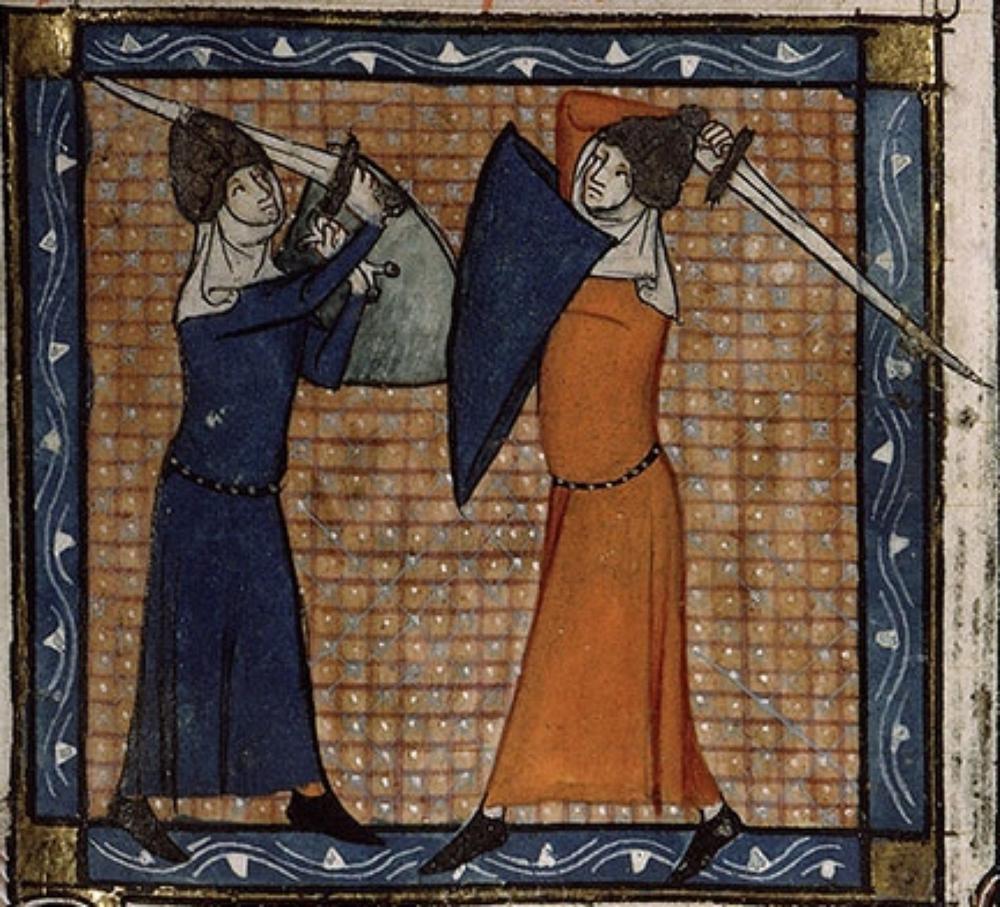
Angharad ferch Owain ap Maredudd of Cydewain was an important Welsh noblewoman of the late 13th century. Along with Margaret of Bromfield, Llywelyn the Last's unjustly neglected sister, her actions had a significant influence on Welsh politics, and the fate of the principality.
Her dynastic connections were important: Angharad was a great-granddaughter of Llywelyn Fawr, and married Owain ap Maredudd (died 1275), a powerful lord of Ceredigion and descendent of the Lord Rhys of Dinefwr. Thus, Angharad linked the rival houses of north and south Wales.She and her first husband, Owain, had one son, Llywelyn. This was an unusual name for the royal house of Deheubarth, and probably in honour of Anghard's kinship with Llywelyn Fawr and Llywelyn the Last.
Her son (died 1309) was the only ruler of Ceredigion to survive the upheavals of the conquest of Wales: he became a minor Marcher lord, holding lands that eventually passed to Owain Glyn Dwr.
Llywelyn owed his survival to his mother, who spent her adult life fighting bitterly for her rights in court, just as the men fought on the battlefield. Her legal career was very similar to that of Margaret of Bromfield. Neither woman had any qualms about challenging powerful Marcher lords, or the Prince of Wales, or even the King of England.