
Horton Deakins's Blog, page 26
October 5, 2011
If only you knew what Ainu
The indigenous peoples of Japan are the Ainu Indians. They were pushed off the main island of Honshu and isolated in the northern island of Hokkaido in their own version of the Trail of Tears (OK, I'm using a little artistic license here–so sue me). They intermarried with the Japanese to the extent that there are no more pure-blood Ainu, but some of the Ainu characteristics, such as greater height, as well as greater body and facial hair, can still be seen today.
One of the things you will find in the tourist-oriented Ainu village that accentuates the mixing of the Japanese and Ainu cultures is the presence of samurai swords (katana). They decorate with these swords and use them in their ceremonial dances. There is still a distinct Ainu language that you can hear in their songs, and which is totally unintelligible to the Japanese, but I'm not sure if they still can use it conversationally.
Here's the first installment of photos of the Ainu village our tour group visited on our way to the Sapporo Snow Festival. The Ainu are animists, and if you visit the village you'll see several carved statues and totem poles of animals.
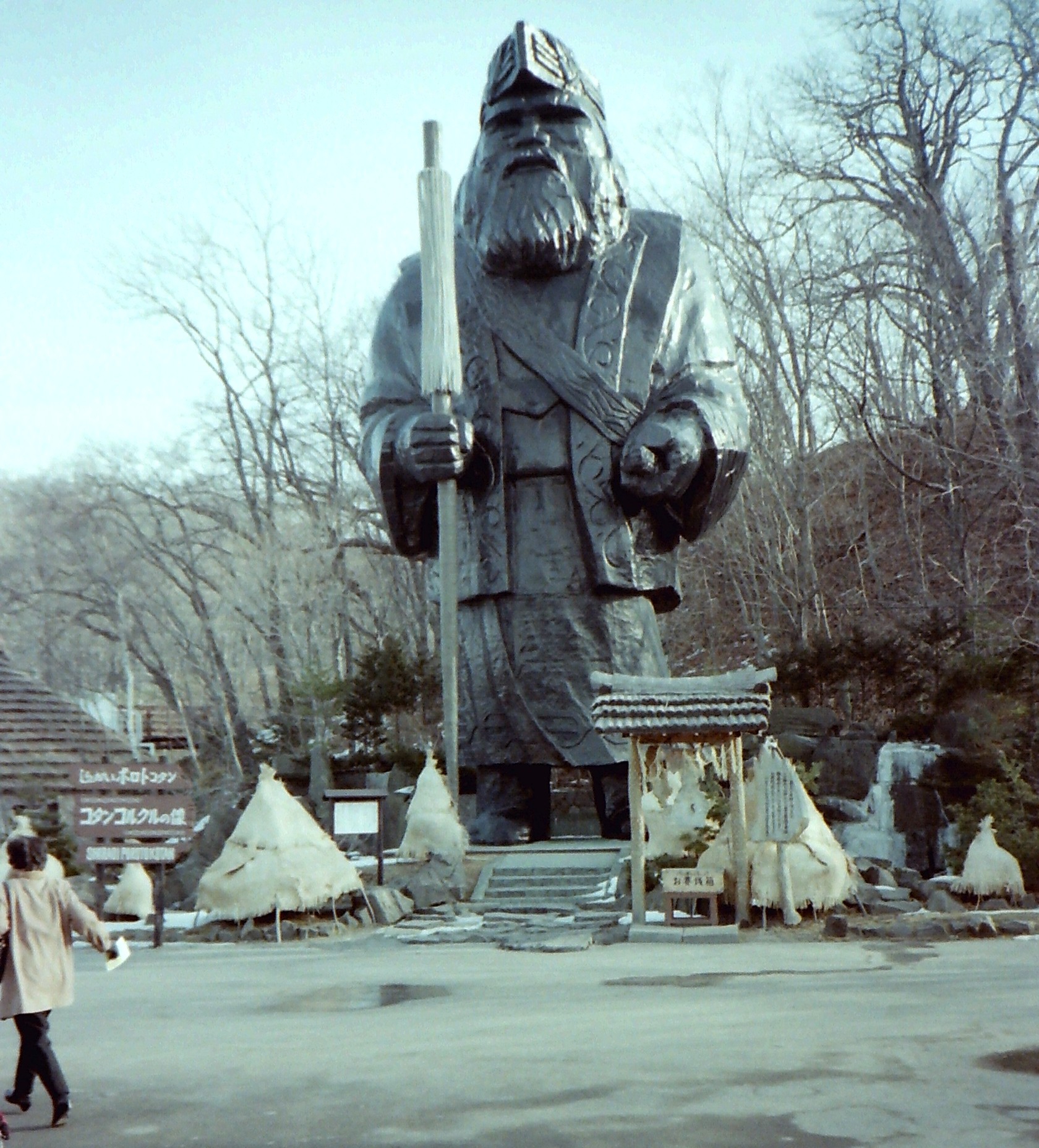
Entrance to Ainu Village
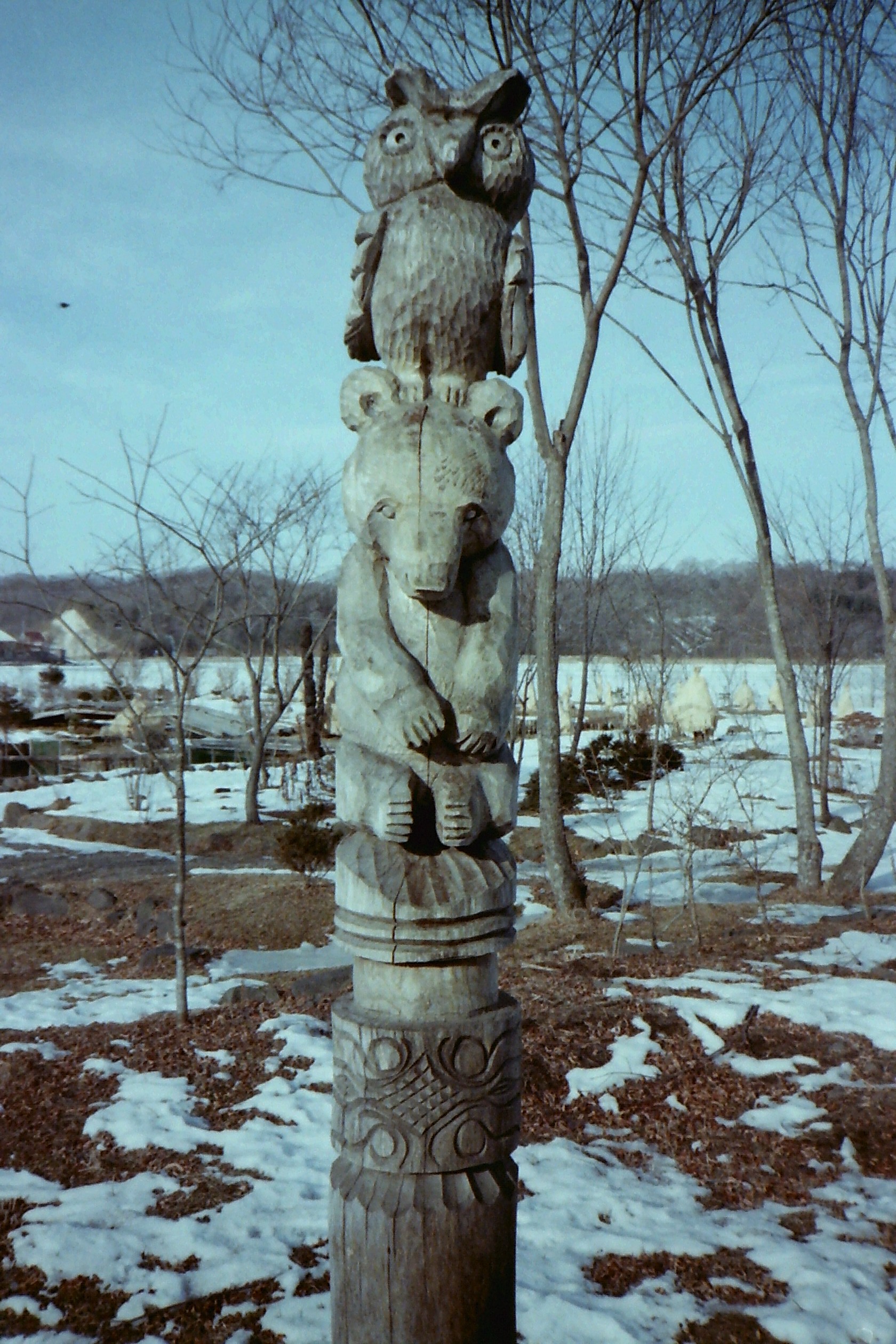
Totem
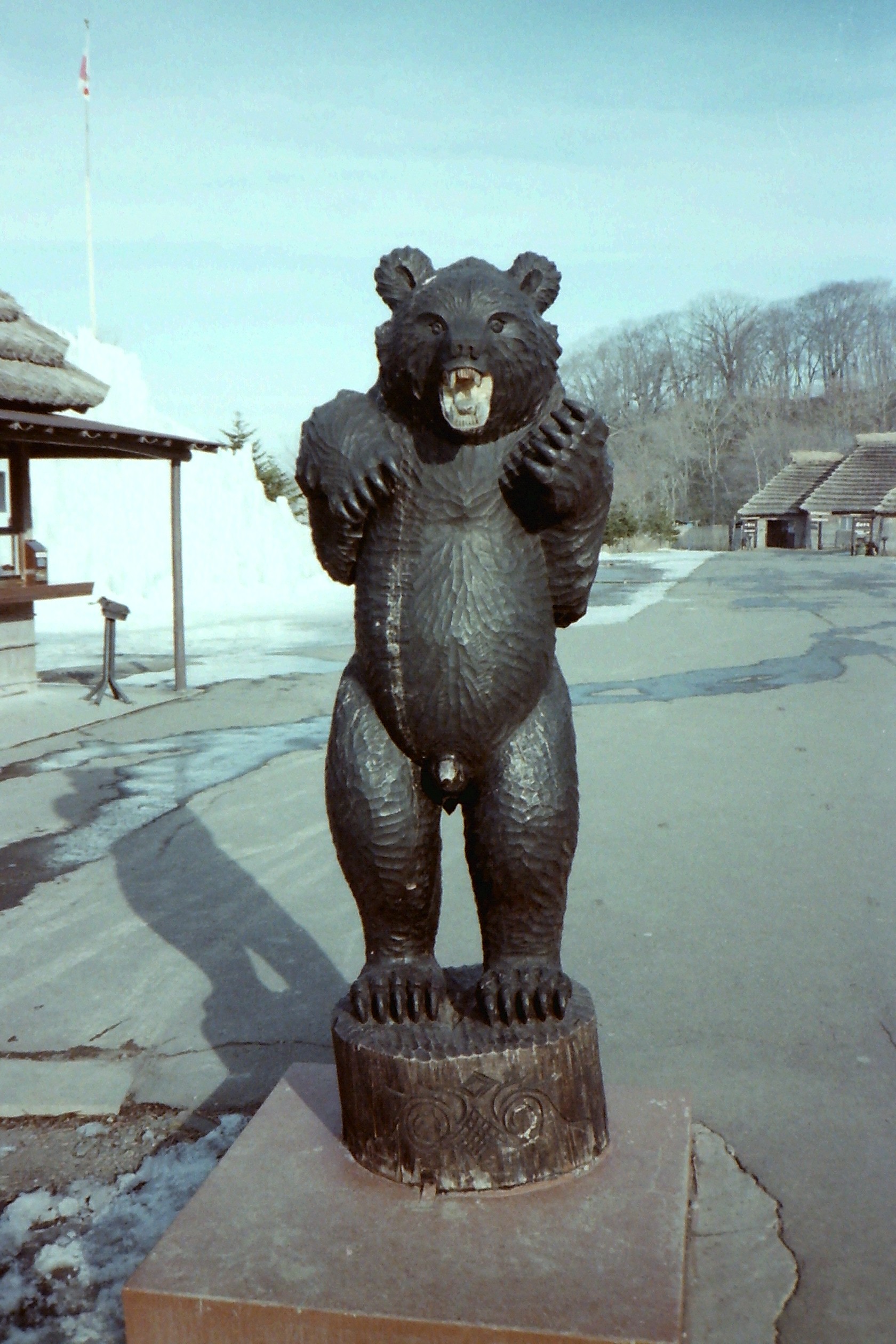
Bad bear! No cookie!
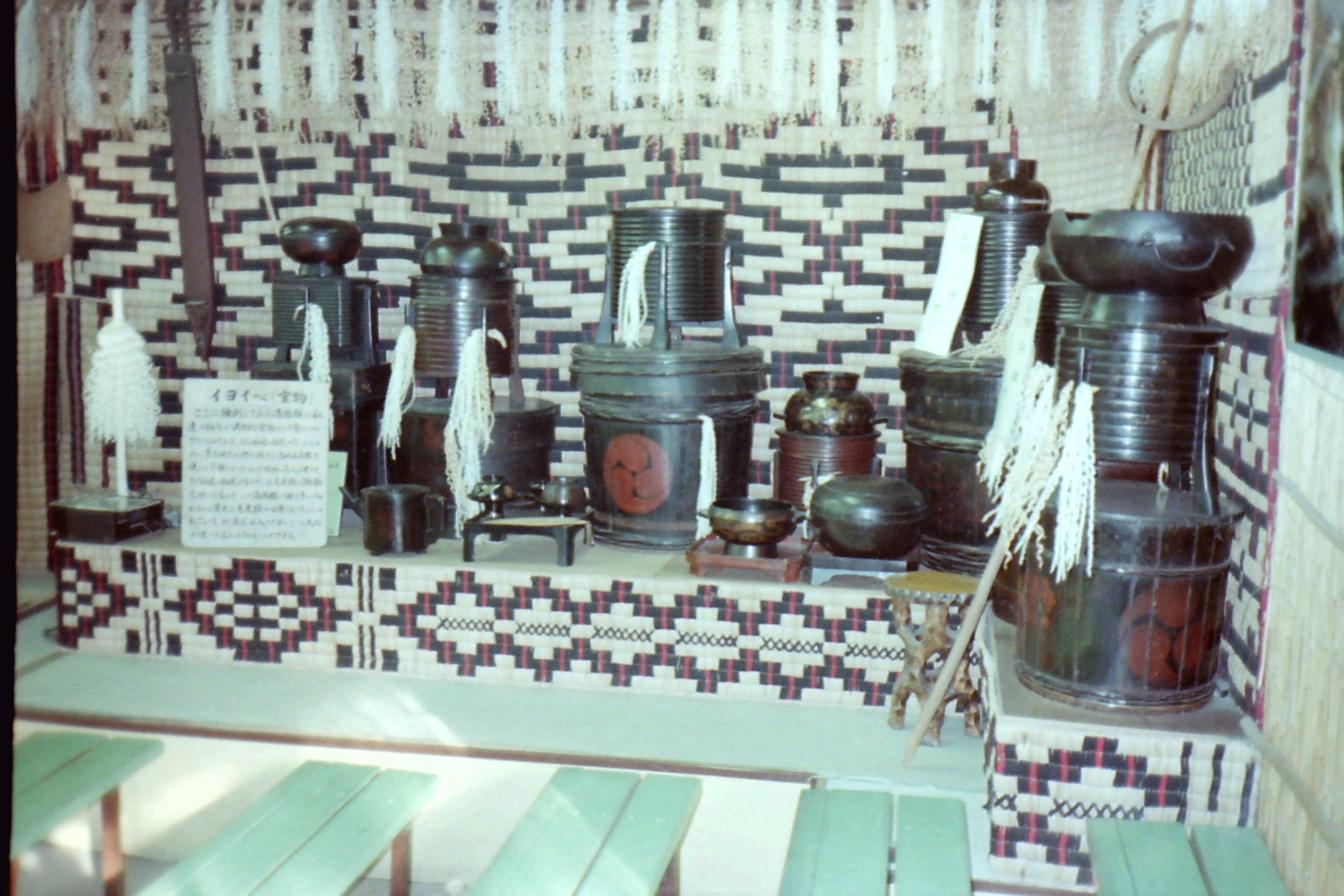
Cooking pots? Funeral urns? Wakaranai.
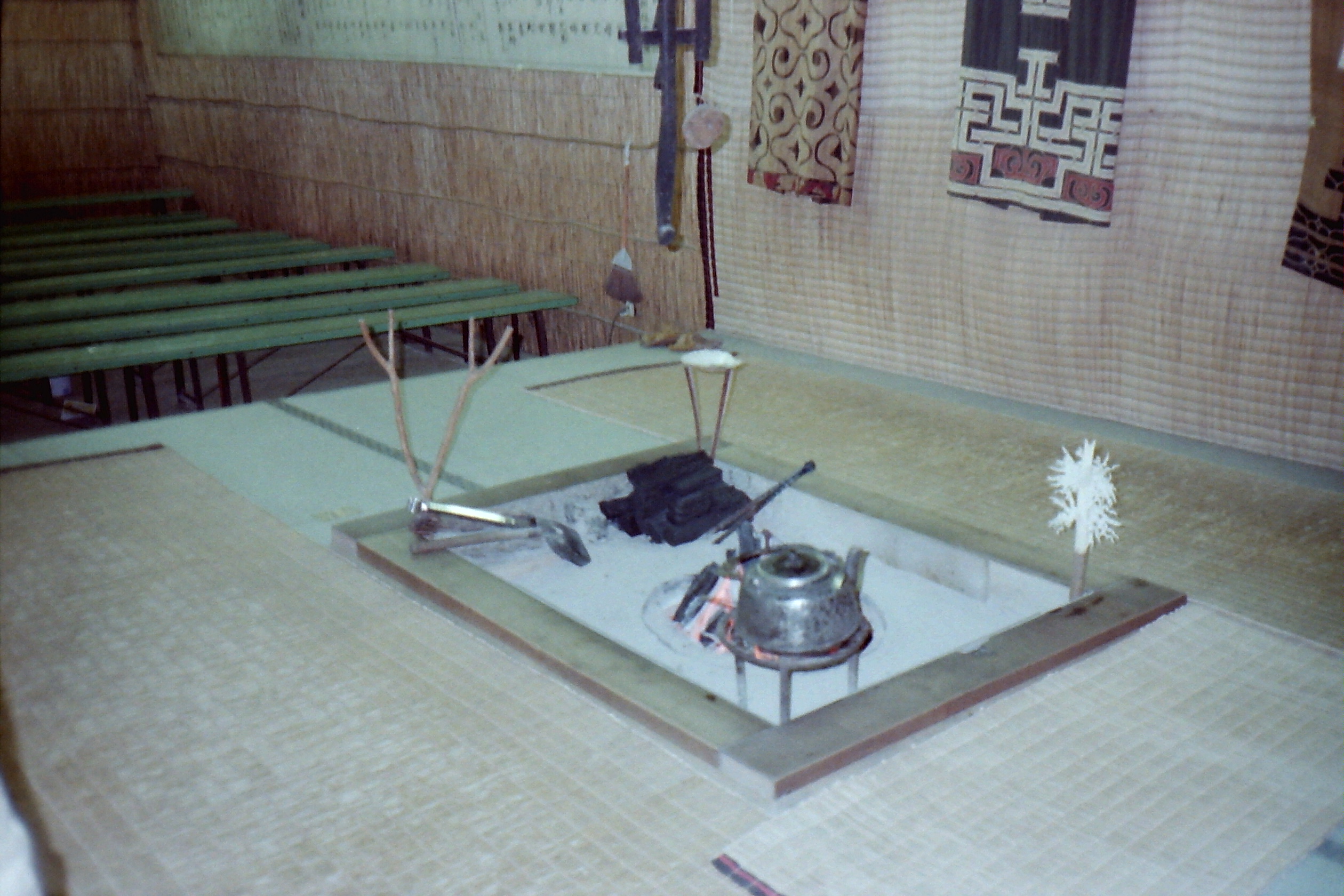
Hibachi firepit
This hibachi and the grass tatami mats look very Japanese.
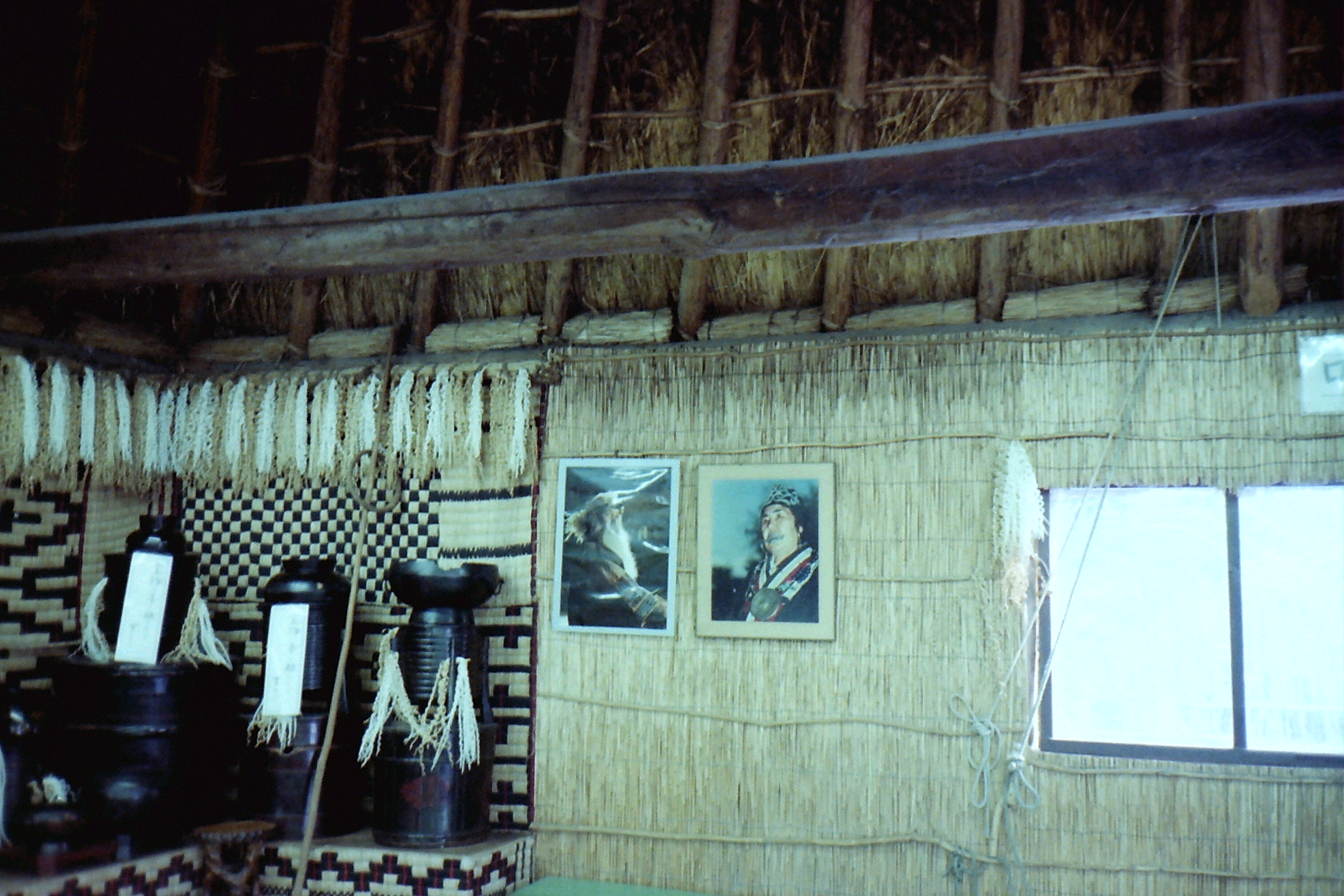
Patriarch and Matriarch
It may be hard to see, but the women used to wear some funky makeup.
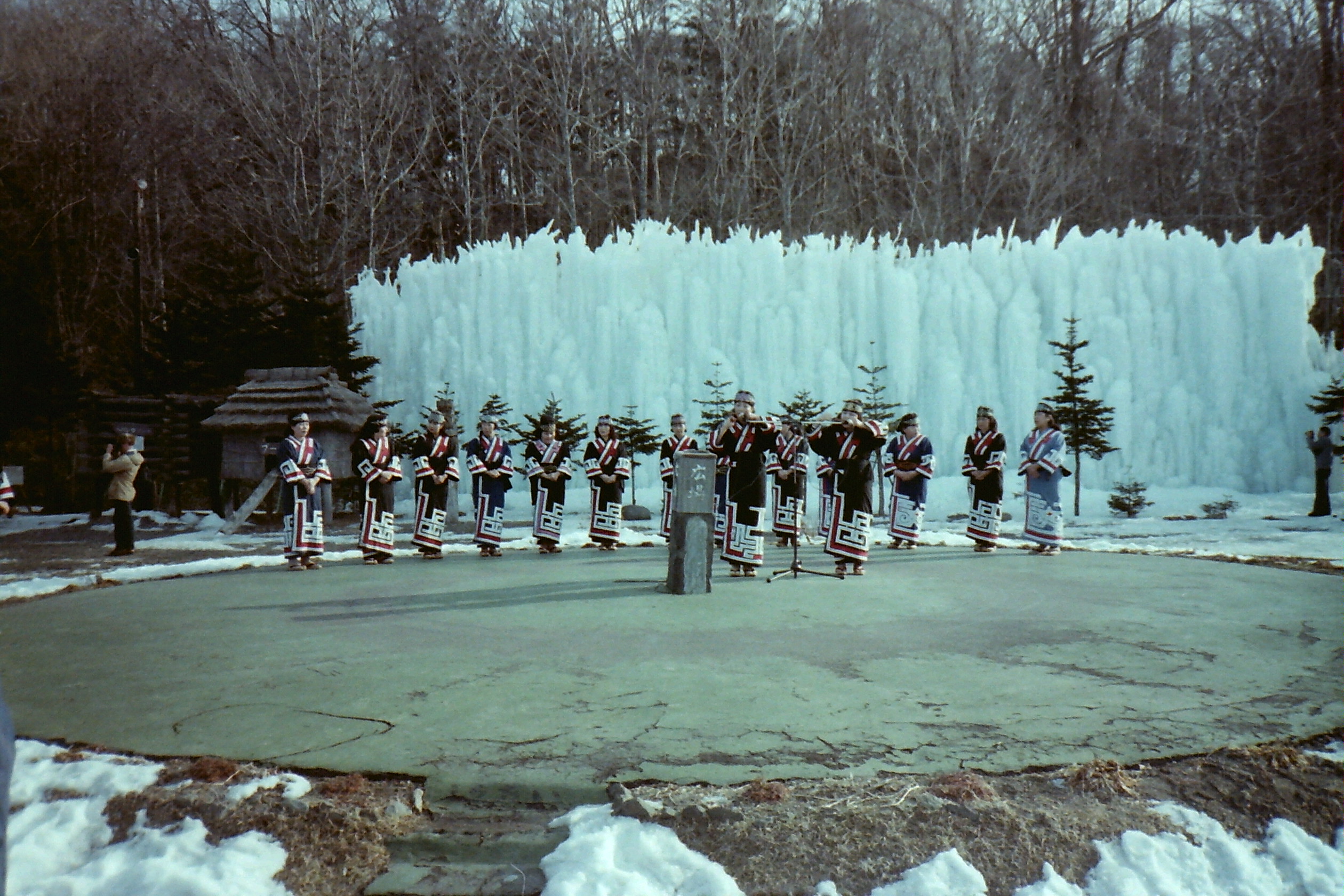
A little mood music
The two Ainu women in front were playing some kind of instrument akin to what we commonly know as a Jew's harp. Yeah, I know, it's not politicallly correct to use that term, but to that I say, "SHA-ALU SHALOM YIRUSHALAYIM." They played for a very long time, so long that it became annoying. I have some of it on videotape, but I don't have any of my Japanese videos in digital form yet. Someday…
Apparently, it's easier to find women who want to keep the Ainu traditions alive that it is to find men, but after this performance, the women formed a circle and a very tall Ainu man joined in for a slow dance around the circle. The man had a katana and waved it in the air for most of the dance. Later, I showed the video to a Japanese girl and asked her what they were singing during the dance, and she told me she didn't have a clue because it wasn't Japanese.
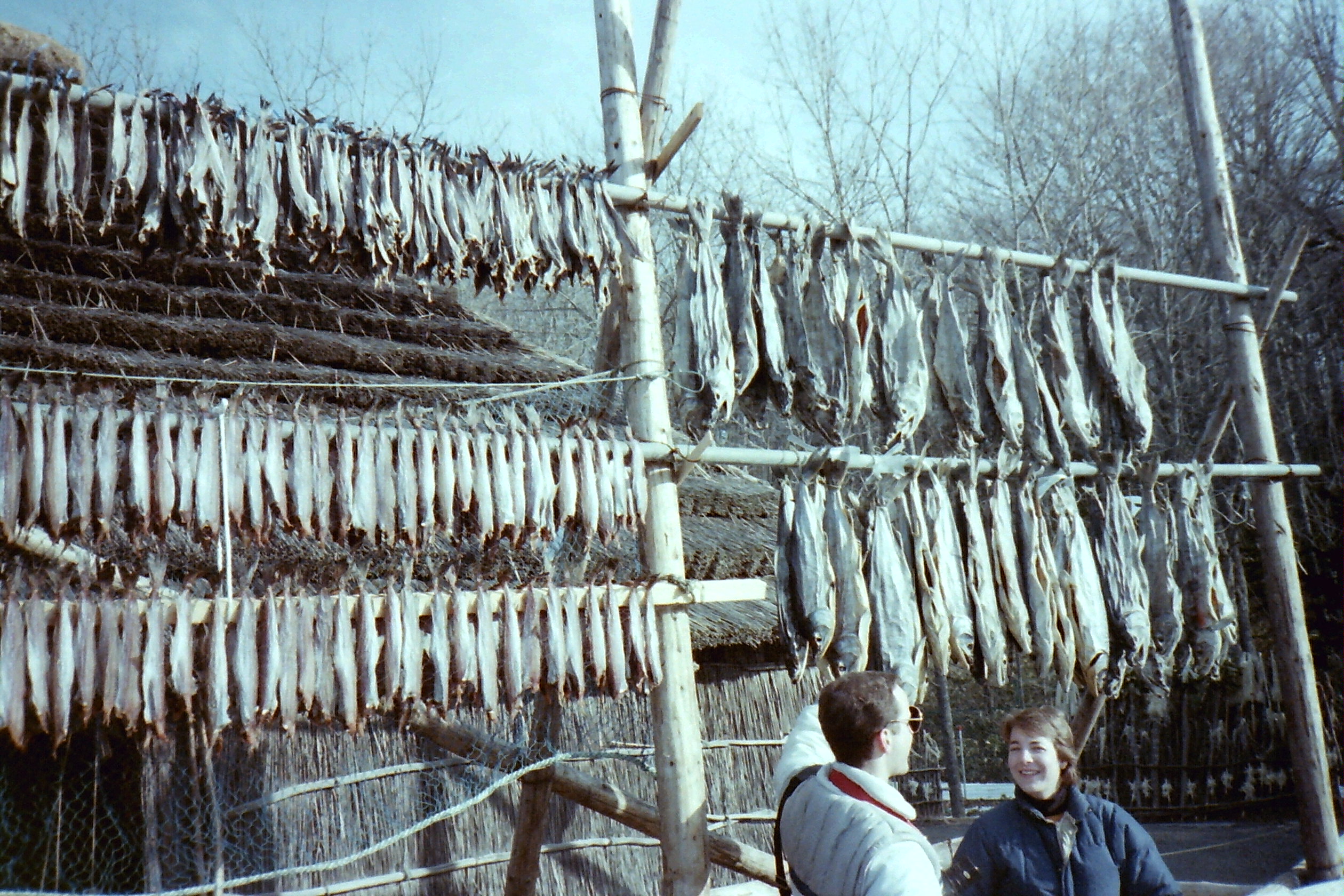
Yum!
This may look archaic, but your average Japanese also enjoys a good chew on dried fish. In the convenience stores, you can even find bags full of what look for all the world like dried minnows.
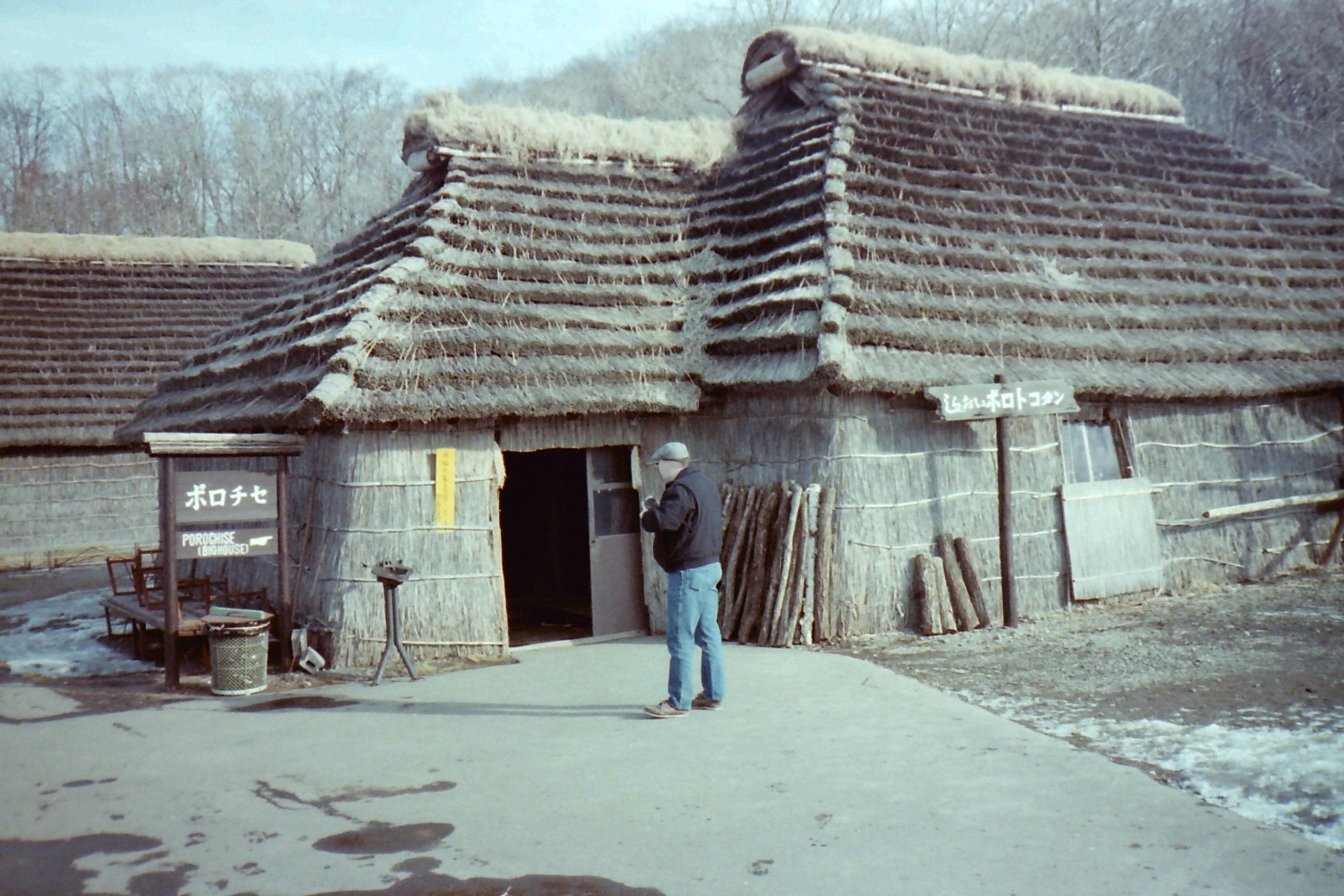
Porochise — big house
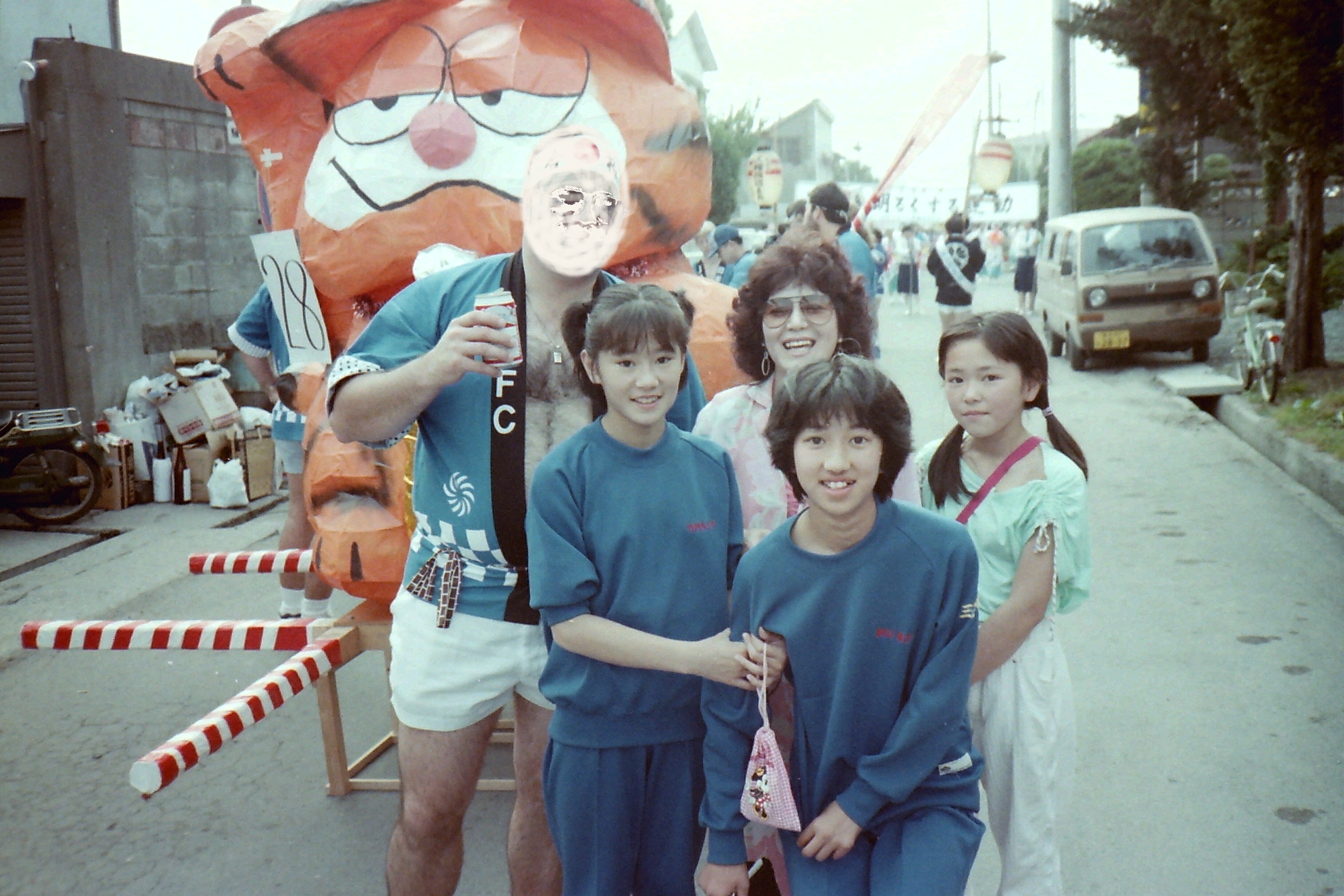
Please excuse the guy in front of the Big House(I think his name was the same as the guy from Austin Powers with the initials, "F.B."), I know he reduces the quality of the photo, but if you think of a whale, he does add some scale. I have smudged up his face so as not to embarrass him. If memory serves, this structure was where I took all the inside photos.
Next time I'll show some photos of displays that depict Ainu in historical settings.


October 3, 2011
Skiing the benjo ditches
In case you're not familiar with the term "benjo ditch," it is a shallow, gently-sloping ditch that funnels water and human waste from the cities in Japan out to the fields for use as fertilizer. These ditches line the roads in town, and if you're lucky, you'll find most of them covered with small concrete slabs. Just be careful when you round a corner, because you don't want a wheel dropping off into a ditch where the covers have been broken.
The winter I spent in Misawa was a relatively light one, but there was enough snow to do a little cross-country skiing. Here are a few shots of where I
"skiied the benjo ditches."
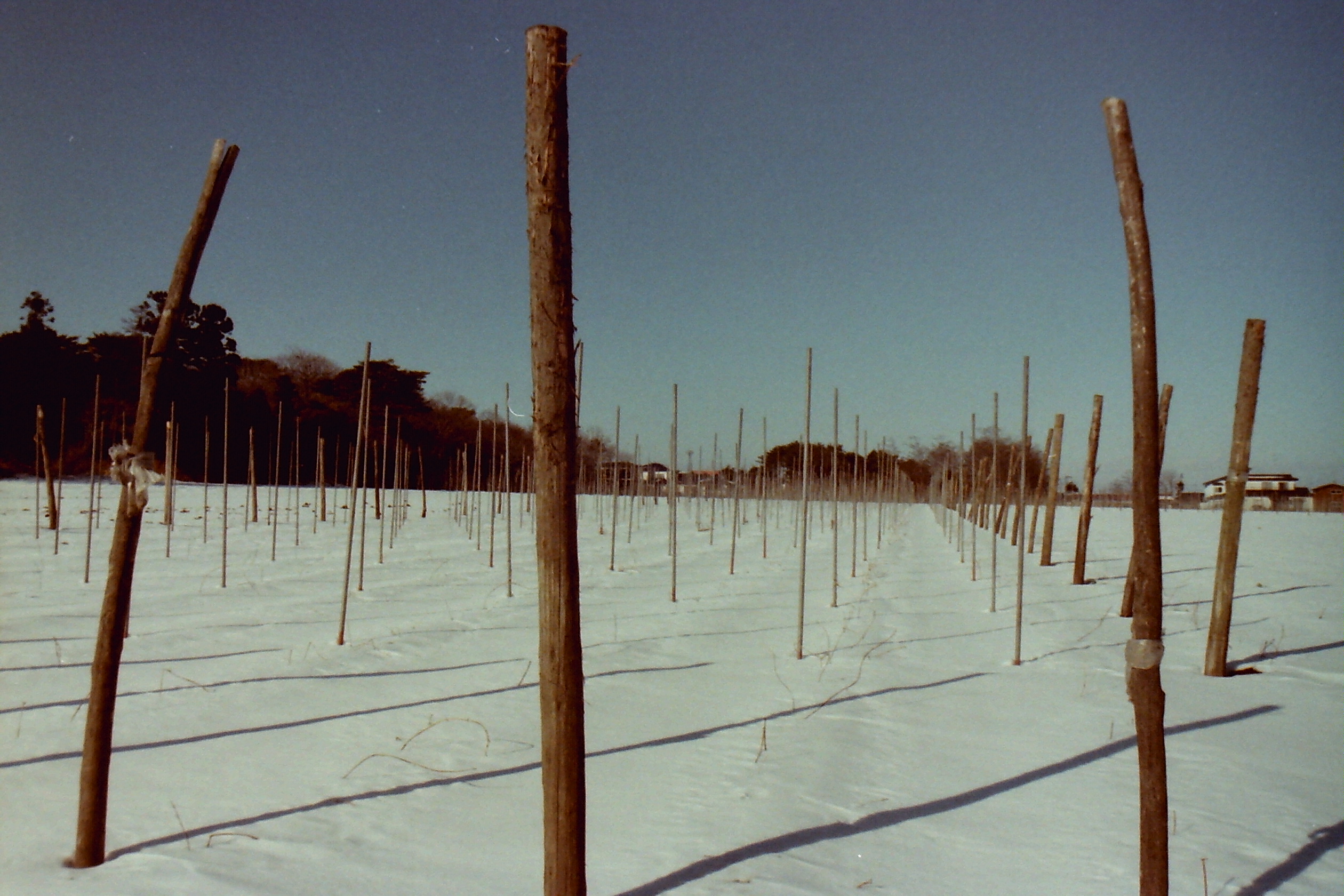
Buncha bean poles
Long shadows from a low sun. Getting very close to finding the benjo ditch.
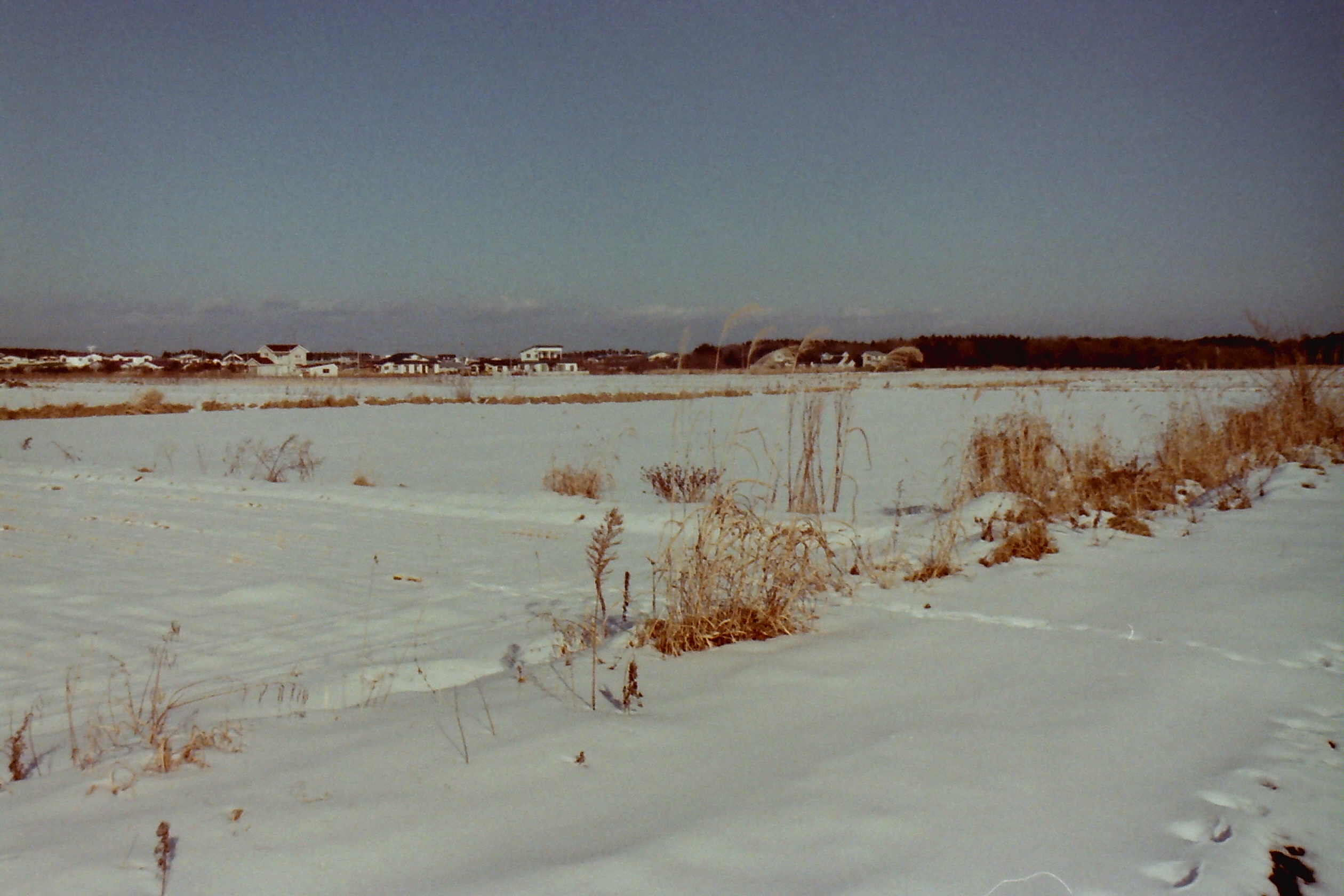
Rice paddies in the snow
This is way up north in Japan, but they still grow rice here.
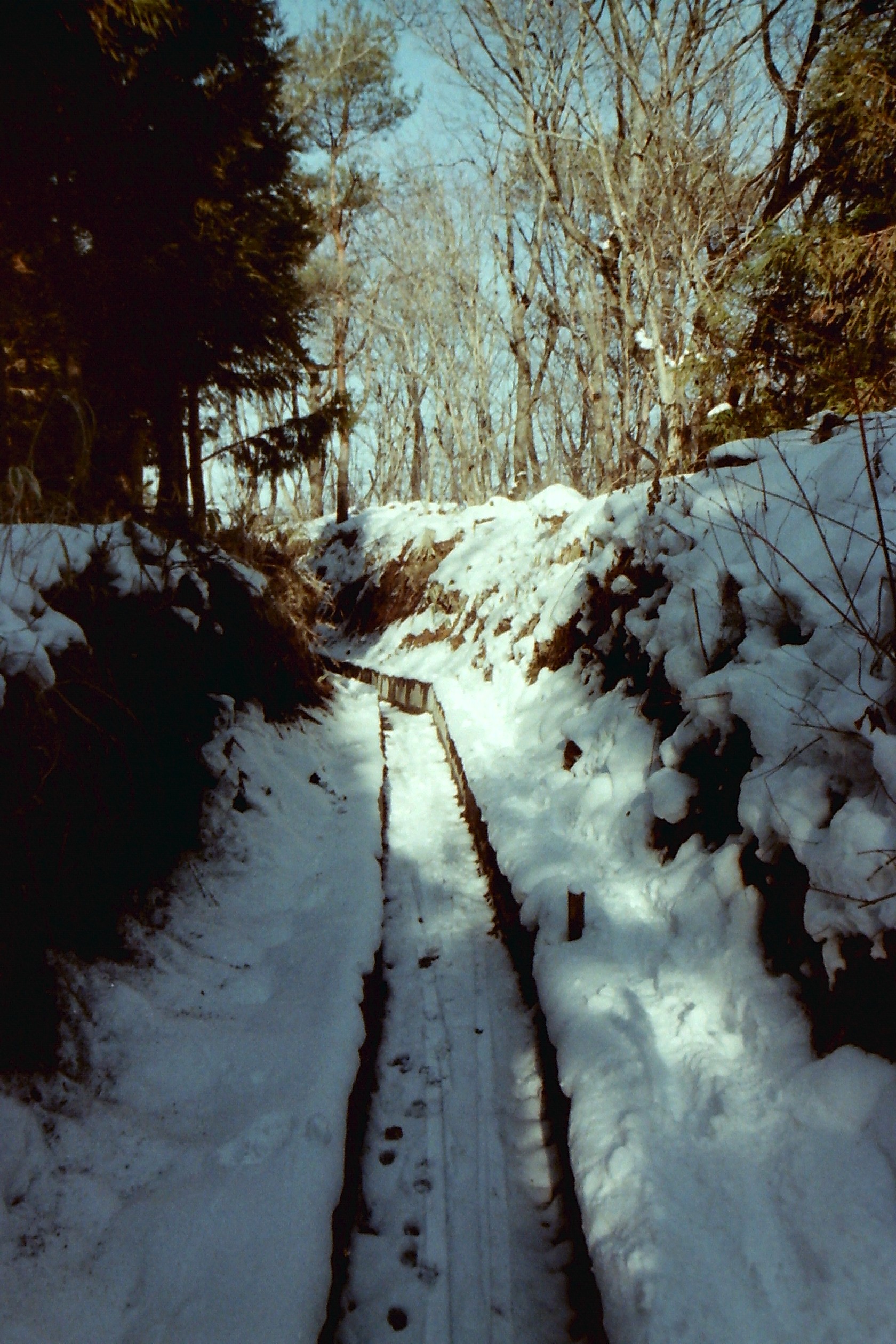
The benjo ditch, at last!
You can see the ruts from my skiis in the benjo ditch. This one is a bit diffferent from those you might see in the city, as it is sunken with high berms on either side. It made for quite an interesting outing!
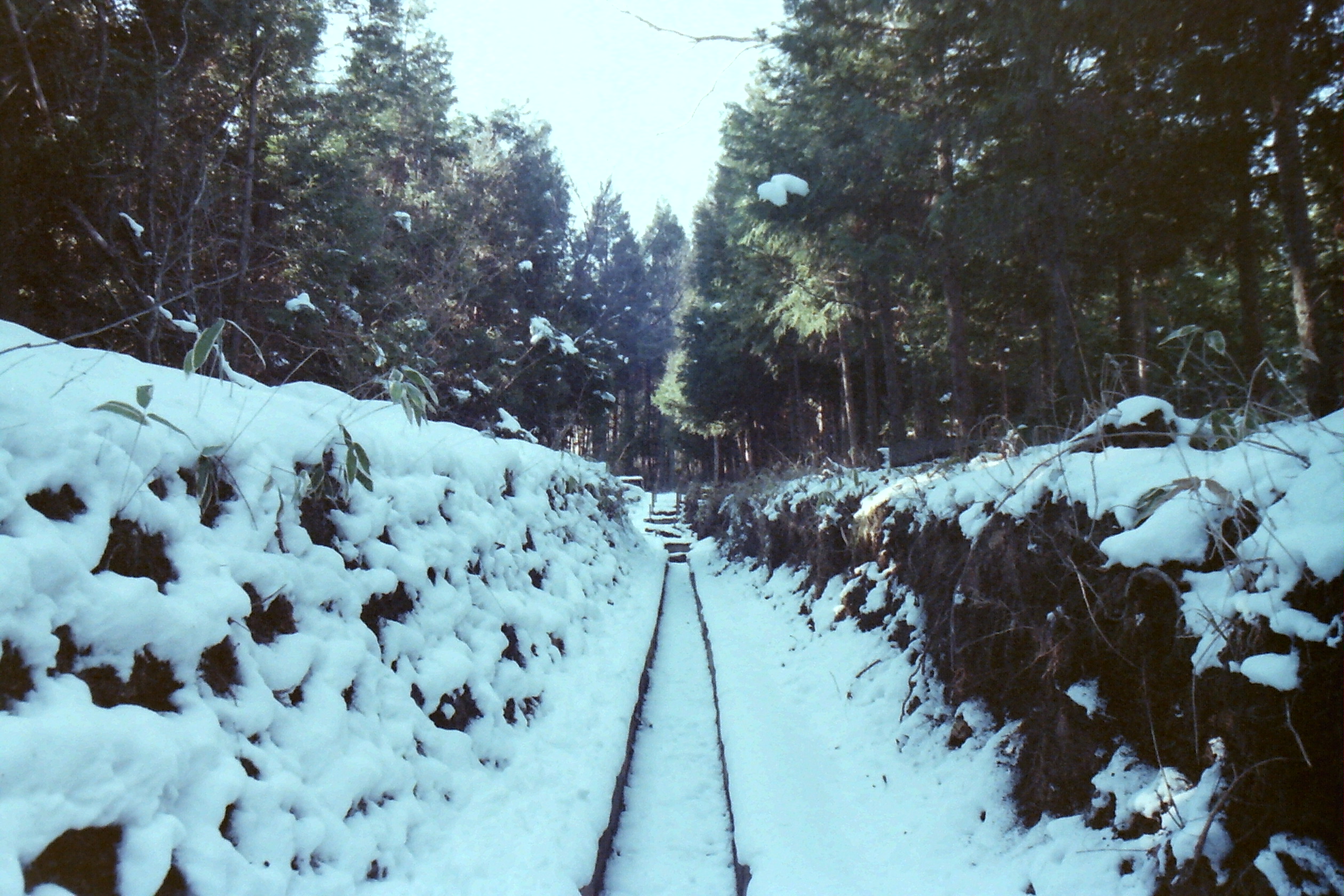
And the ditch goes on
The scenery was quite nice here, quite enjoyable – if you don't think too much about what you're stepping in.
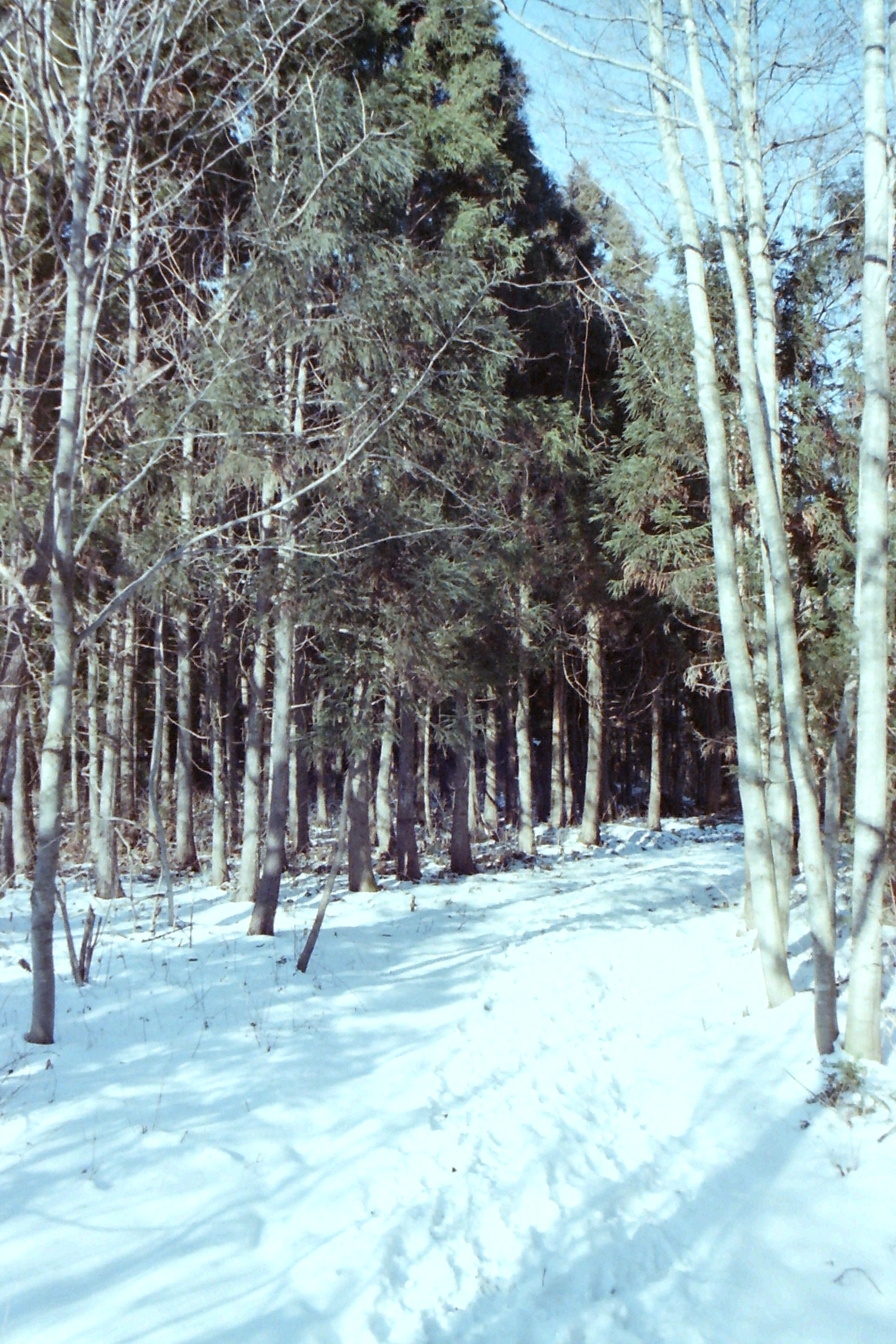
Forest in the snow
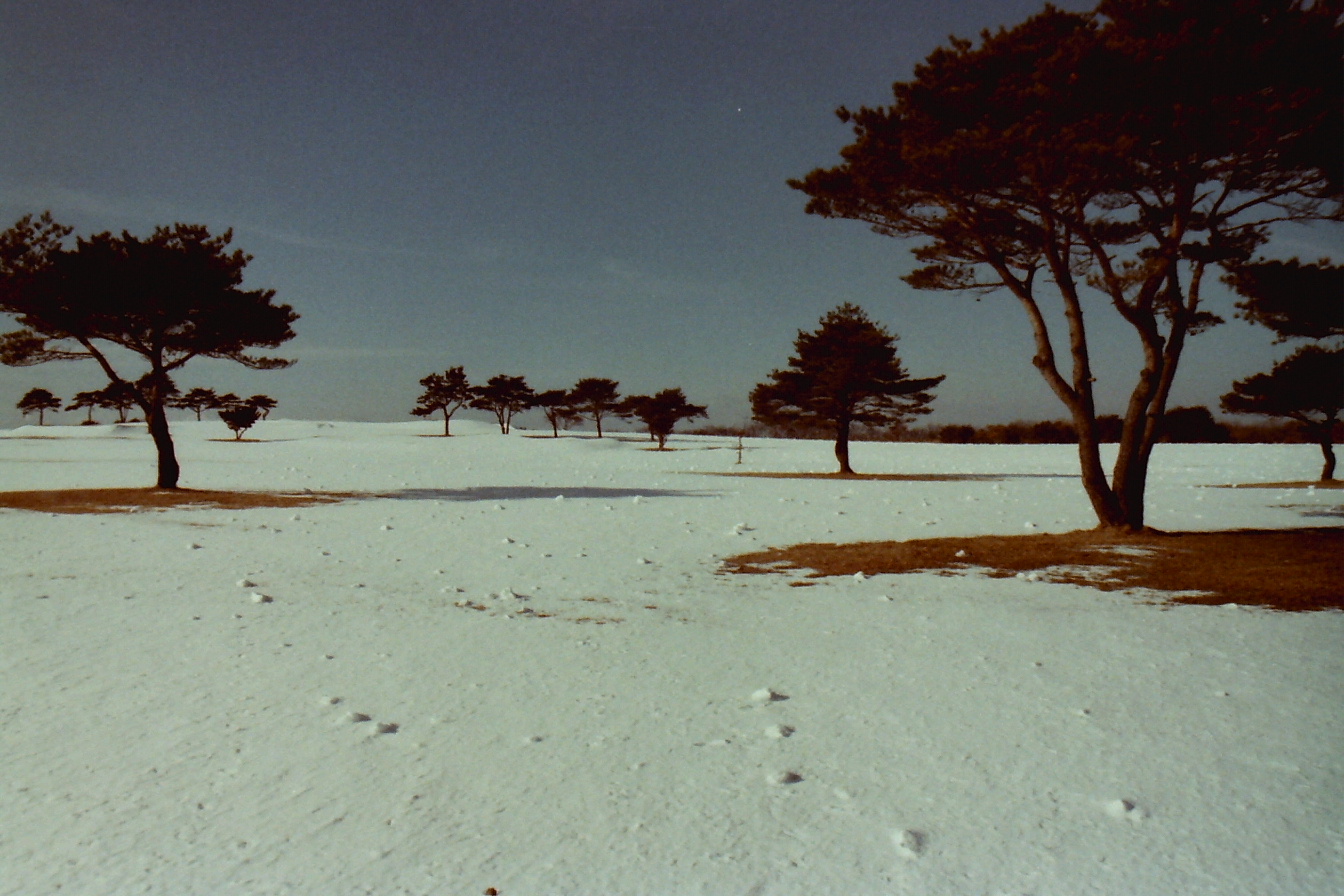
See how light the snow was -- normally measured in meters
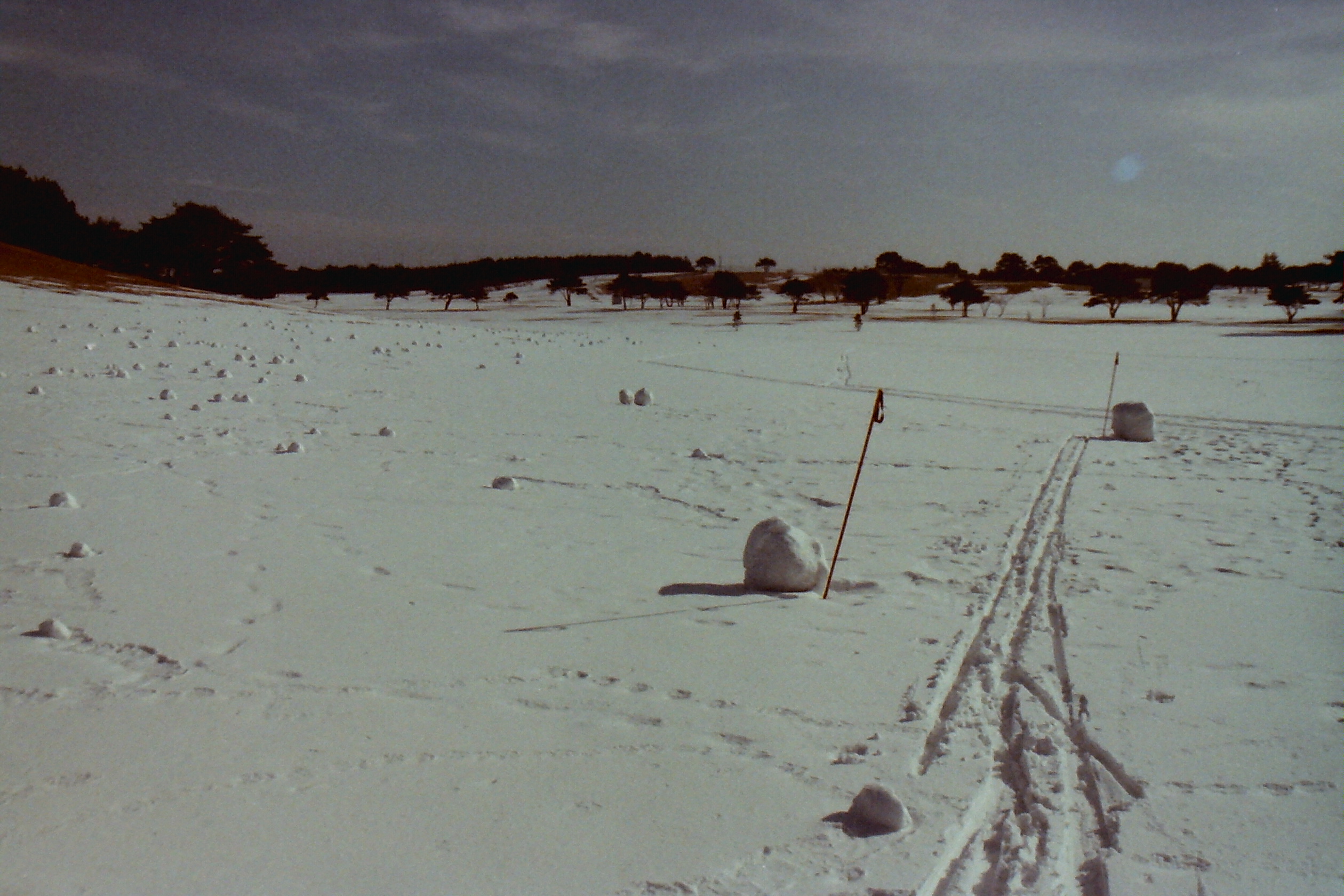
Automatic snowballs
Out of the benjo ditch and onto the golf course (I think). These "automatic" snowballs were driven by the wind into solid shapes, but no ghostly snowmen ("yuki otoko") rose from the Michinoku flatlands. Notice my two ski poles that I planted at strategic intervals to give some scale to the photo. I've seen snoballs like this on some of the more remote meadows of the ski slopes in Colorado, too, but they usually had little trails behind them where they were rolled into very special spheres.
Next time, I'll post a few photos from the Sapporo Snow Festival of 1989.
October 2, 2011
Saving the best for last
Well, these really were the last — they just happen to be some of the best close-ups. I ran between the hauling ropes to get right up in the celebrants' faces.
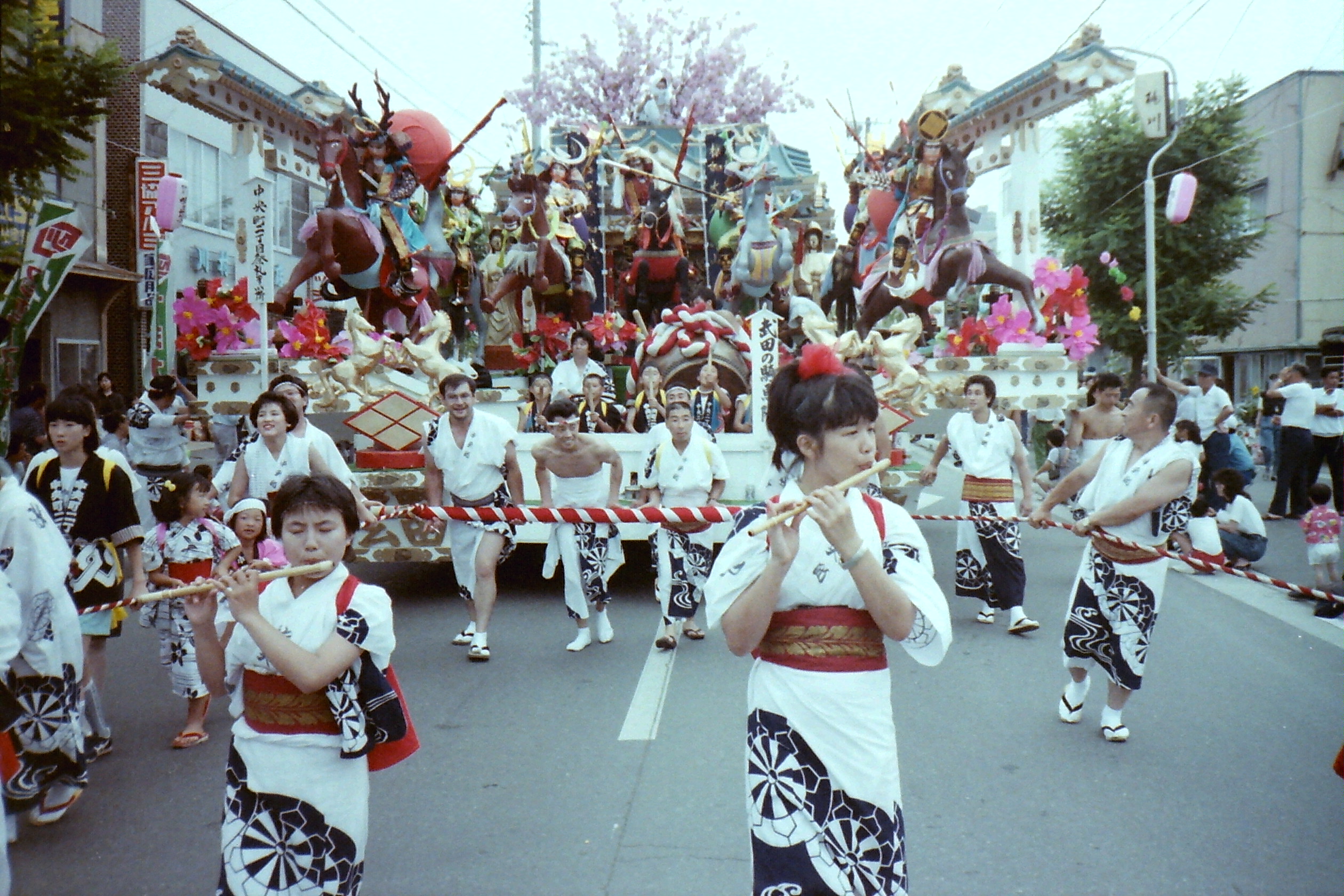
Getting closer to the action
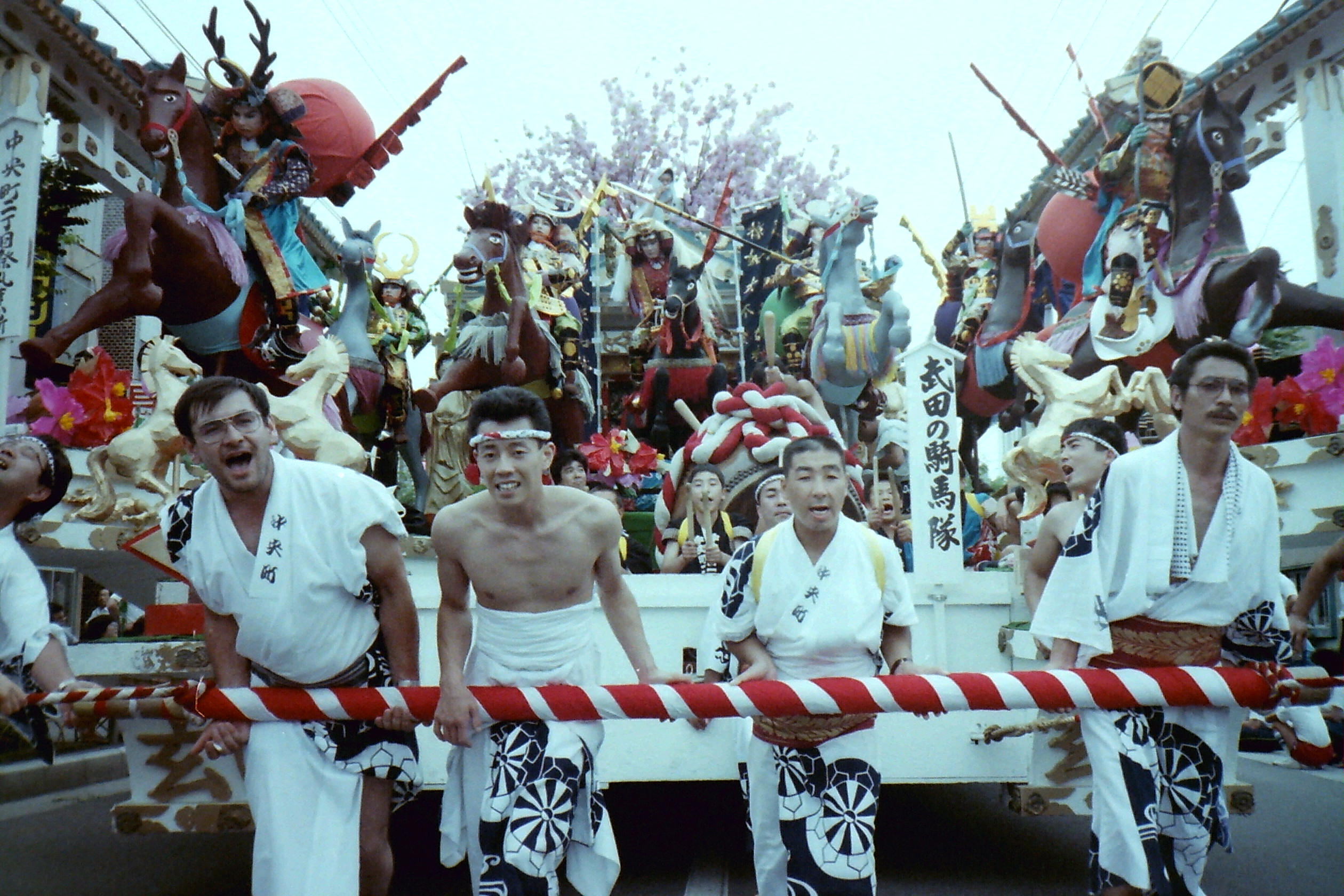
Still enthusiastic after a long haul
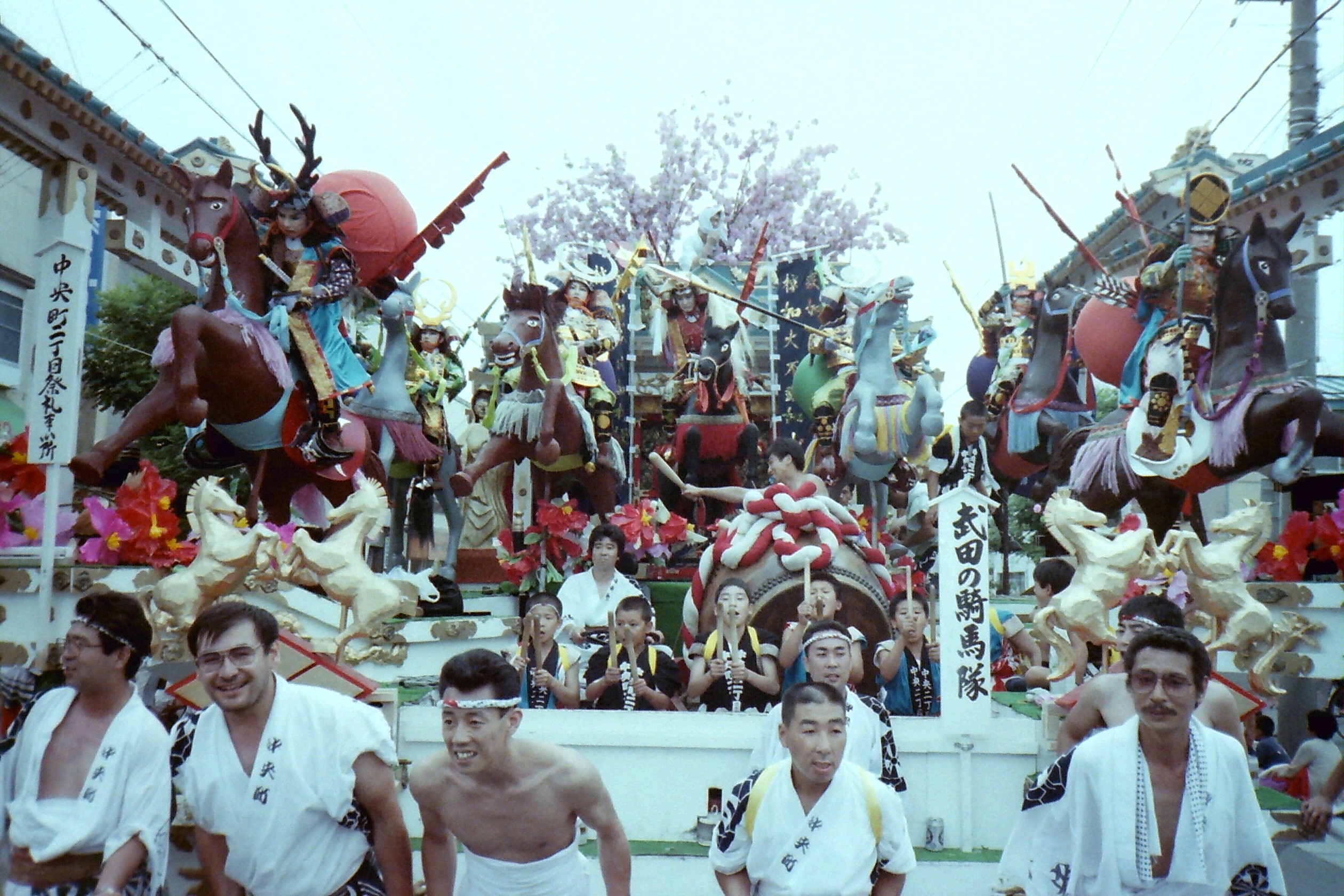
Another angle
This angle shows the on-board musicians a bit better. And it brings to mind a scene from a certain Tom Cruise movie, doesn't it? Check out this movie poster.
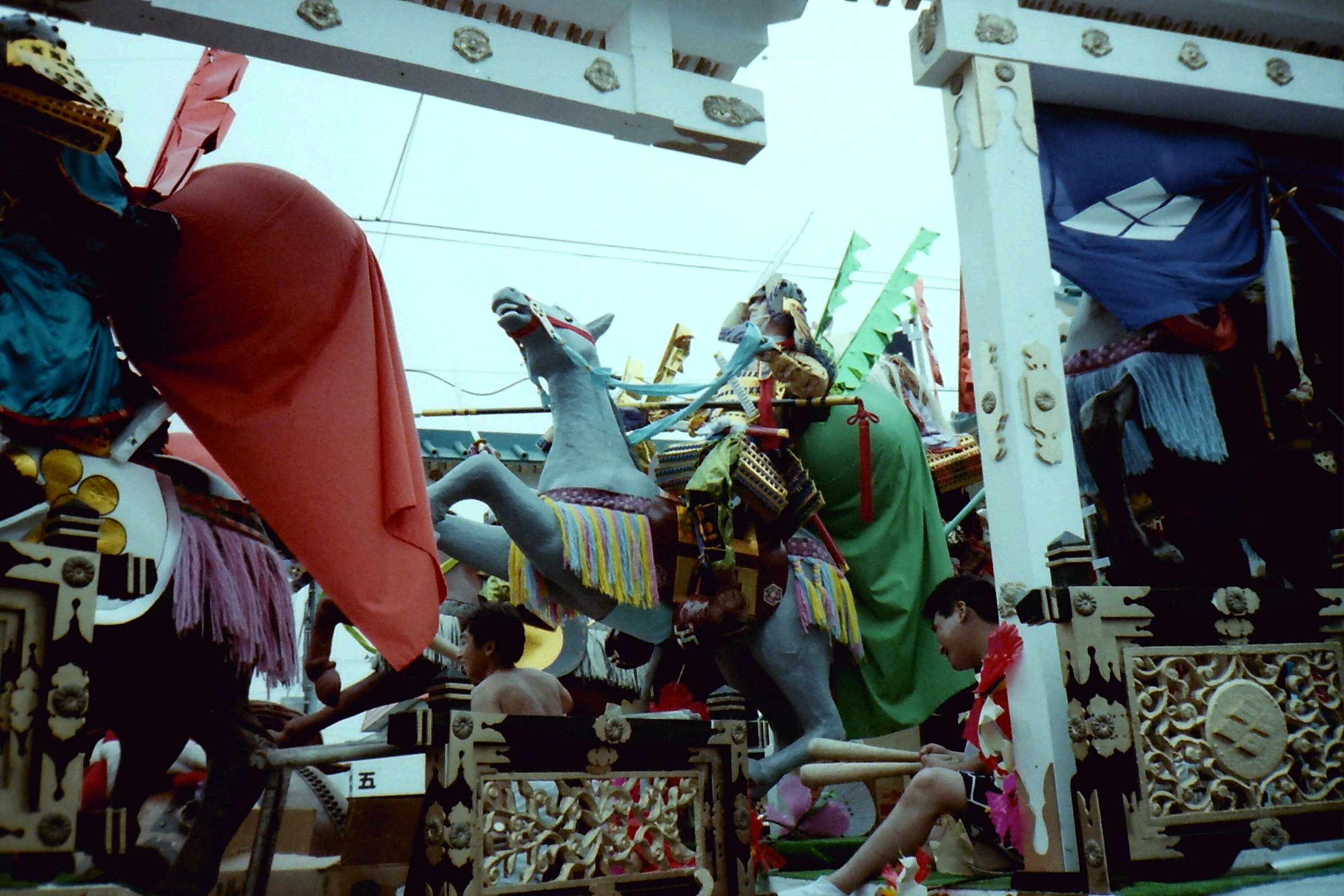
A view as the float passes
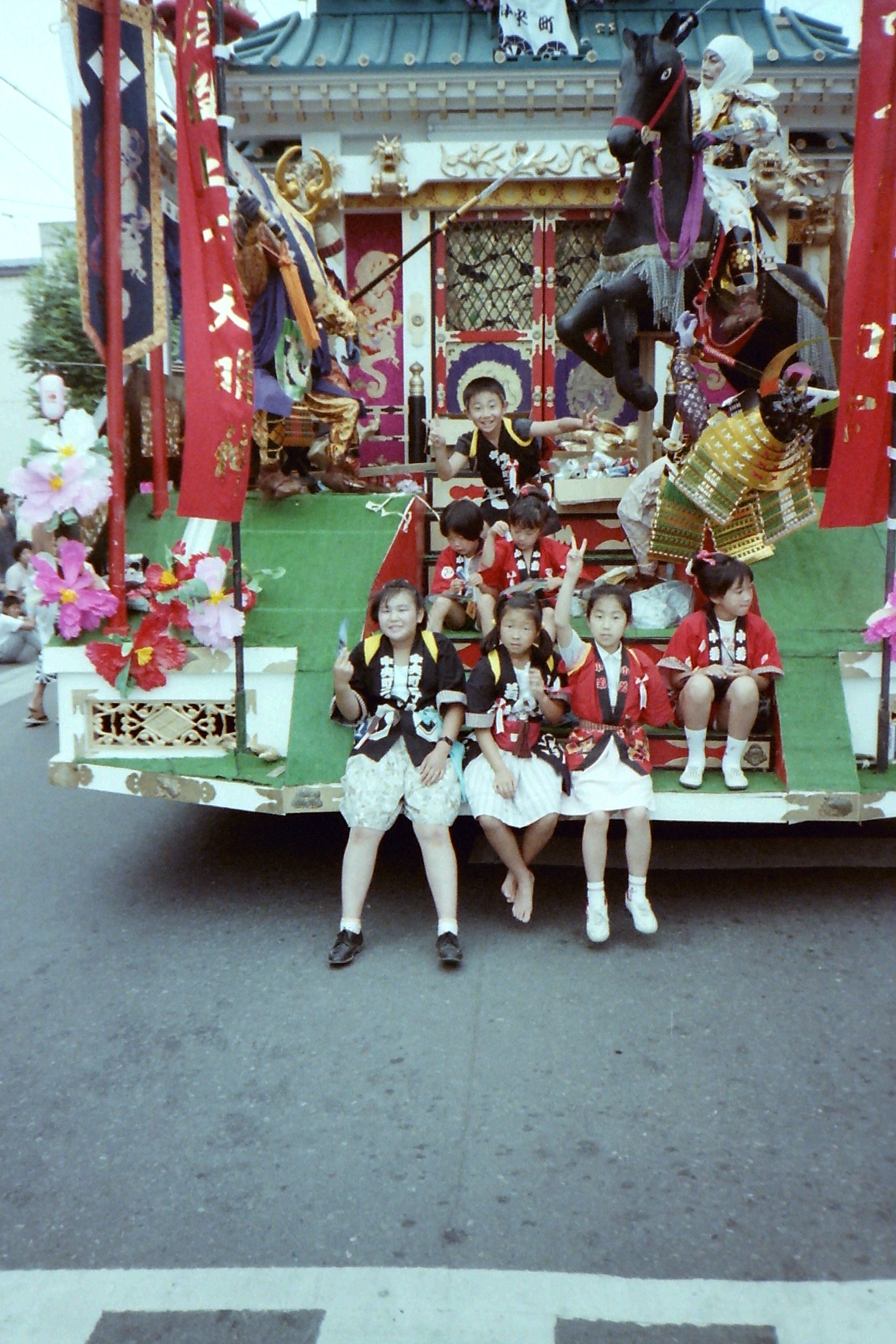
Peace, man
I don't know what the first two girls are holding — sort of looks like knives — but the third girl is giving the peace sign, as is the boy behind them (and with both hands!). One of the things that was so prevalent among the young (almost exclusively) in Japan was a theme of peace. I was once approached by some young girls in a McDonald's who wanted me to write my "peace message" for them. I suppose it was a school assignment. Such an assignment might seem totally innocuous to the average westerner, until one understands where it comes from. You see, the Japanese are not taught the true history of World War II — and I'm not saying that just because I'm an American. No, for a number of reasons, including plain-old shame, the Japanese thought it better not to burden their children with the unnecessary knowledge of their merciless, murdering, plundering, raping, torturing, cannibalistic, heartless history of sweeping conquests through China, Korea, Southeast Asia, and much of the Pacific Rim. No, they just sort of spread the blame around so that everyone appears to have an equal share of the responsibility. One part of that great lie you may have heard before: "Oh, they would never have attacked Pearl Harbor if we hadn't denied them oil." What a crock. Ever heard of The Rape of Nanking? Ever heard about people being used for bayonet practice? Ever hear about a boy being tied up in a tree and, while still alive, his flesh being cut off to feed the Japanese Soldiers' dogs? Can you imagine his screams? Can you imagine how his mother might have felt? If you don't believe that story, read Flyboys, by James Bradley. I haven't told you the worst of it.
"Peace message?" Give me a break. But don't get me wrong — many Japanese are today very nice, kind, generous people. Some were also very nice when I was there — at times very much nicer than most Americans — but I often felt as if I were black and living in the South during the Jim Crow days. The Japanese were the human beings, and all non-Japanese were gaijin — foreign people, i.e., barbarians. The Japanese really defined racism like no one else.
One of my coworkers walked into a Japanese karaoke bar one time (yes, the word IS Japanese, and it means "empty orchestra") where an older man was singing about the glory of Japanese imperialism, while videos of WWII Japanese sailors swabbing the decks of the battleships and such were being displayed on the display screen. When the song was over, the old man was very embarrassed (to be caught by an American), and he apologized profusely. Was he sorry for singing the song? No. He had "lost face" by being found out, but he would do it again in a heartbeat. During that same time period, I was discussing with a middle-aged Japanese woman about how long it might be before everyone would forget about the war. I suggested twenty years, but she said "No." According to her, it would take at least forty years, or when everyone who could remember the war was dead. This conversation took place only 44 years after the end of the war, and if she was correct, we must wait until 2029 for all the bad feelings to disappear. But then, I think of all the people in Georgia who still hate General Sherman.
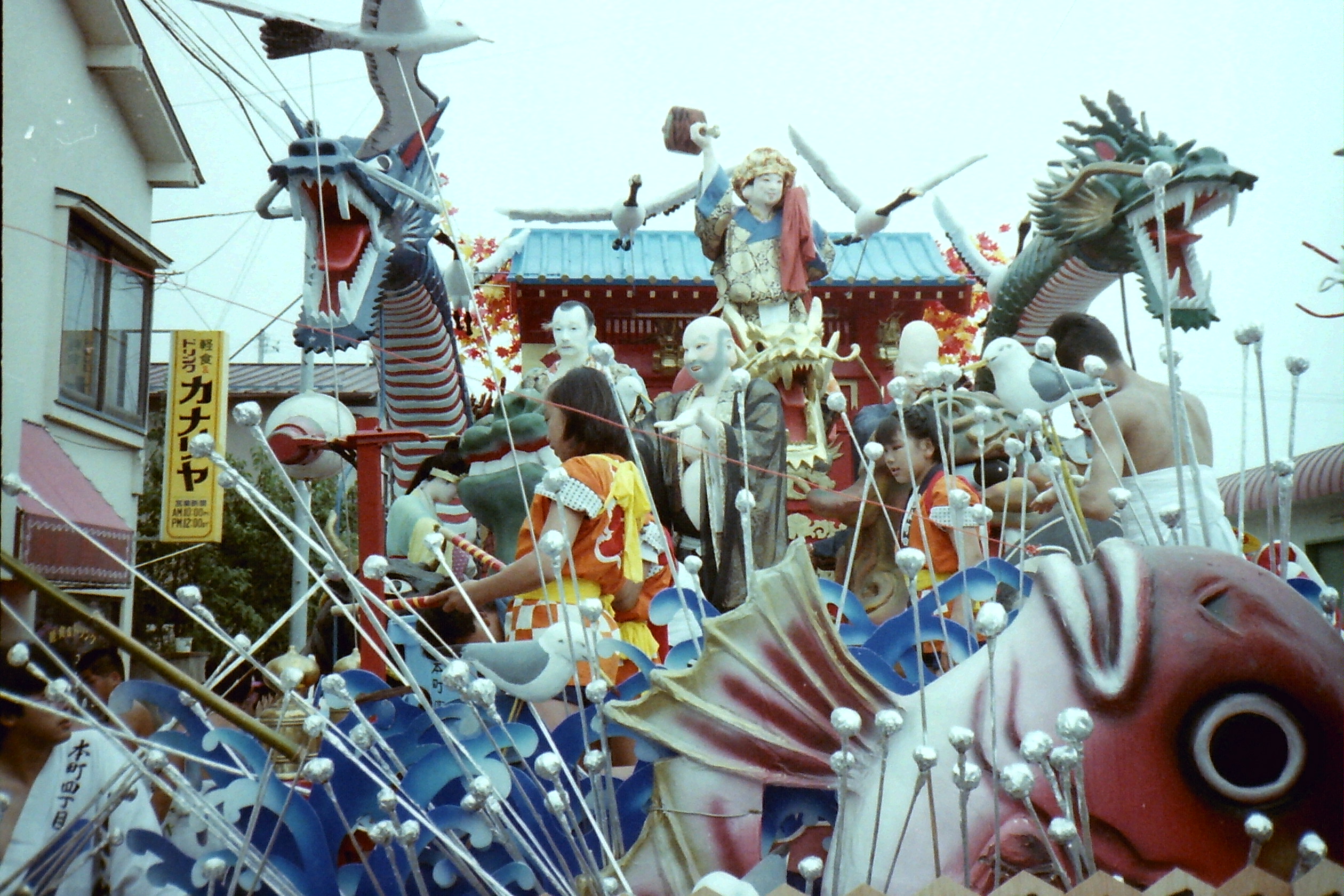
Move along folks
Let's keep it moving, folks. Nothing here but peaceful dragons, birds, and giant fish.
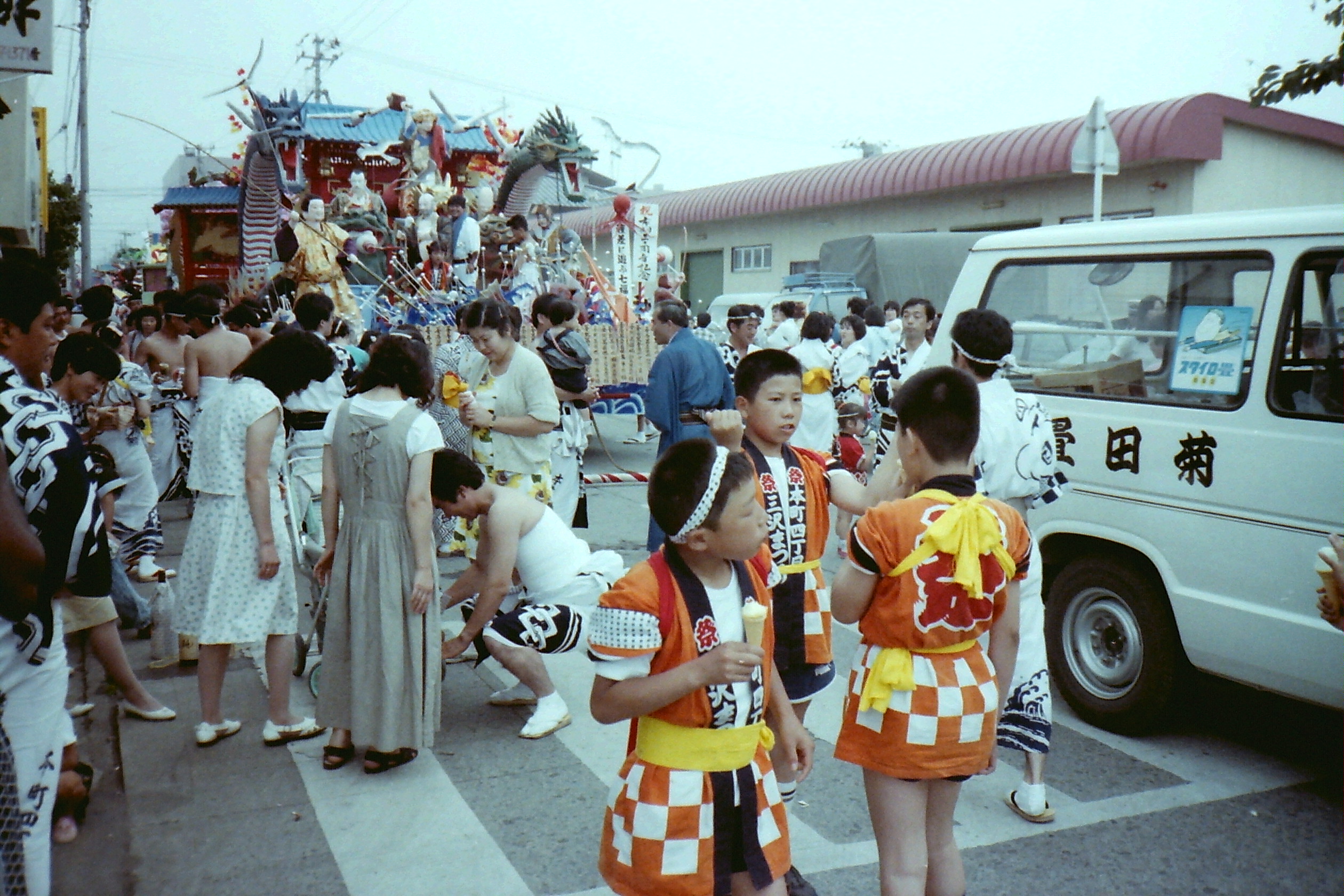
The sweet, sweet end
The end of the parade, and time for a sweet treat. But you could bet your sweet yen that the ice cream is going to contain soymilk.
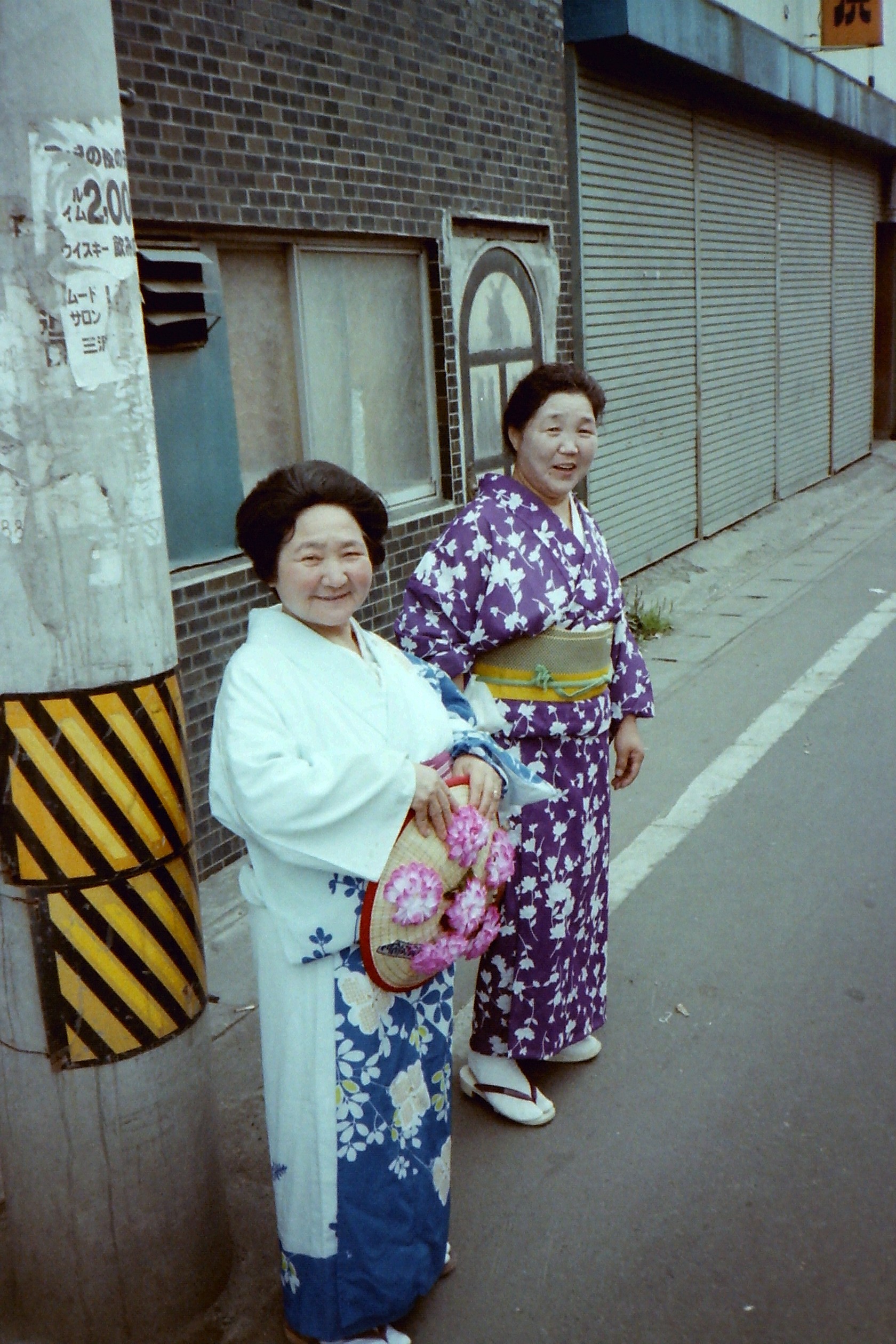
The belles of the matsuri
These happy, classy matrons dressed up in their best festive regalia for the matsuri. Now, if only everyone who was old enough to remember the war, as were these women, could have managed a smile when a gaijin wanted to taked their photo.
I'm not sure when I'll get a chance to scan in more negatives, so, until next time, I thank you for viewing, and I bid you adieu. Sayounara, ki o tsukete, oyasumi nasai. Mata, ne.
October 1, 2011
I love a parade
We are getting close to the end of the Misawa City Festival Parade of 1988; we just have a few more photos to go. After that, we'll be moving on to more skiing pics and some interesting shots of the Sapporo Snow Festival — as soon as I can get those negatives scanned in.
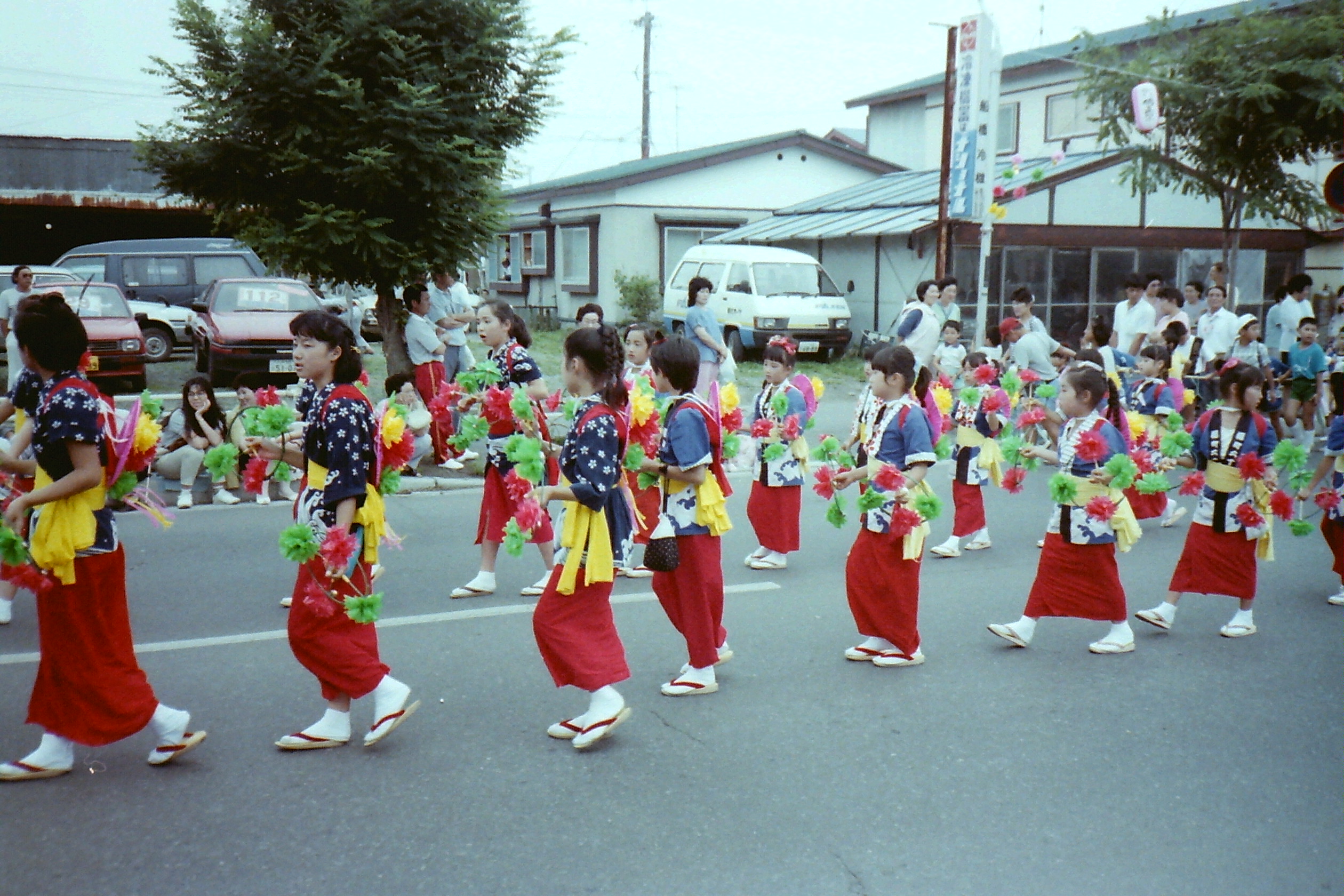 Flower girls
I think those flowers were paper.
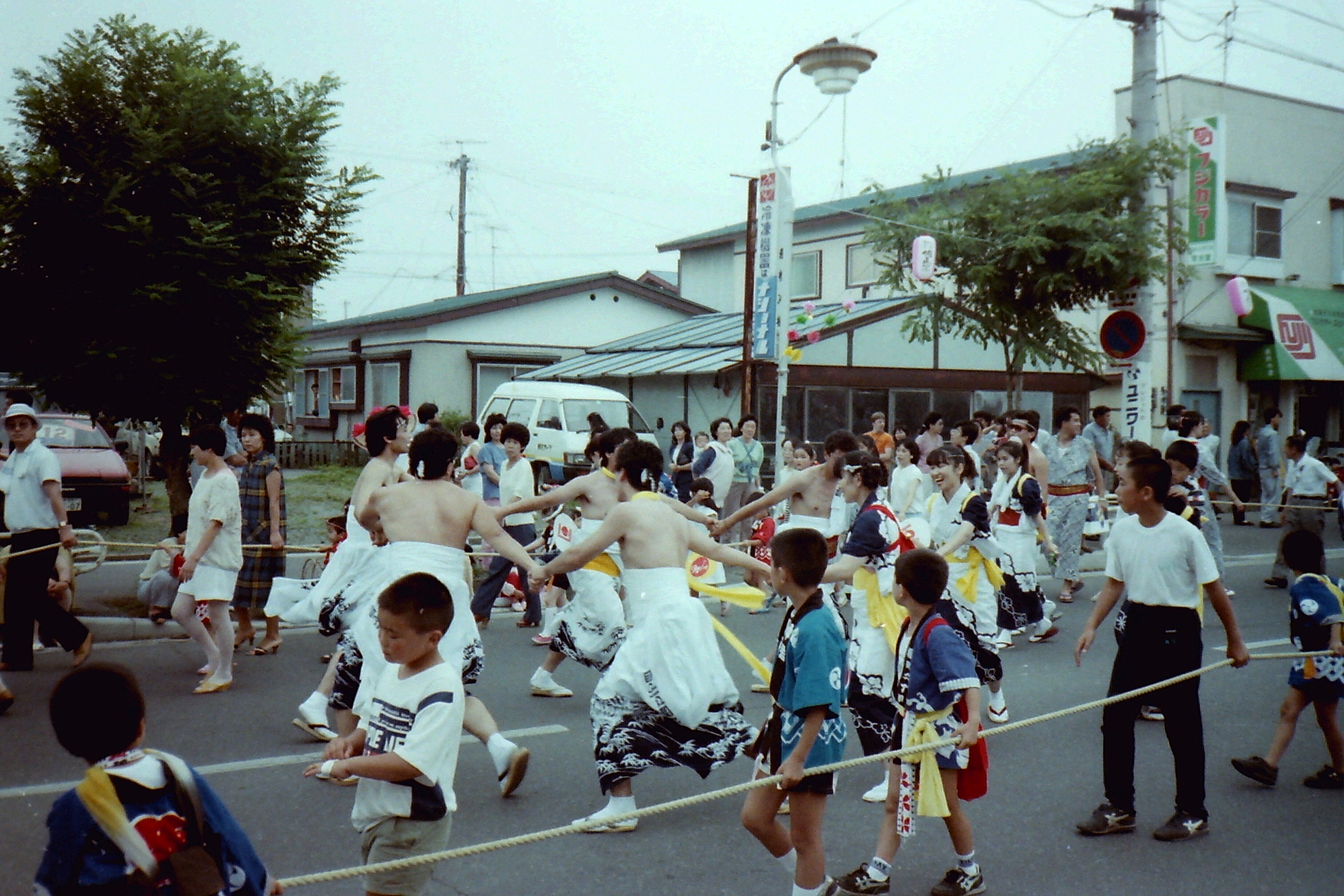
Ring around the rosy
Lots of beer and sake had been downed by this time in the day. Kanpai!
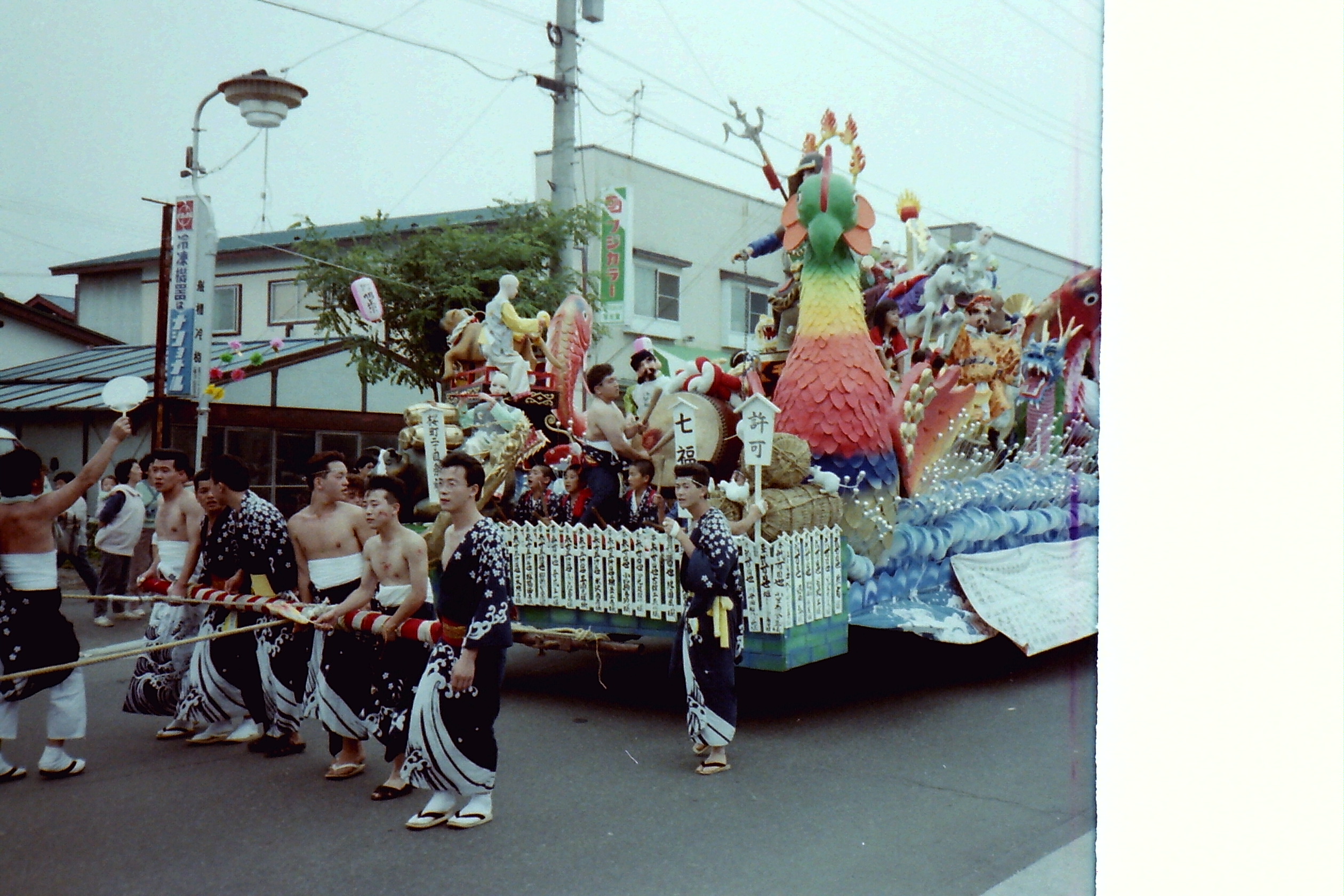
Do I spy a samurai riding a peacock?White Crane
The white crane, or hakutsuru, is a big deal in Japan, and it appears to be also in America, as evidenced by the popularity of Hakutsuru sake.
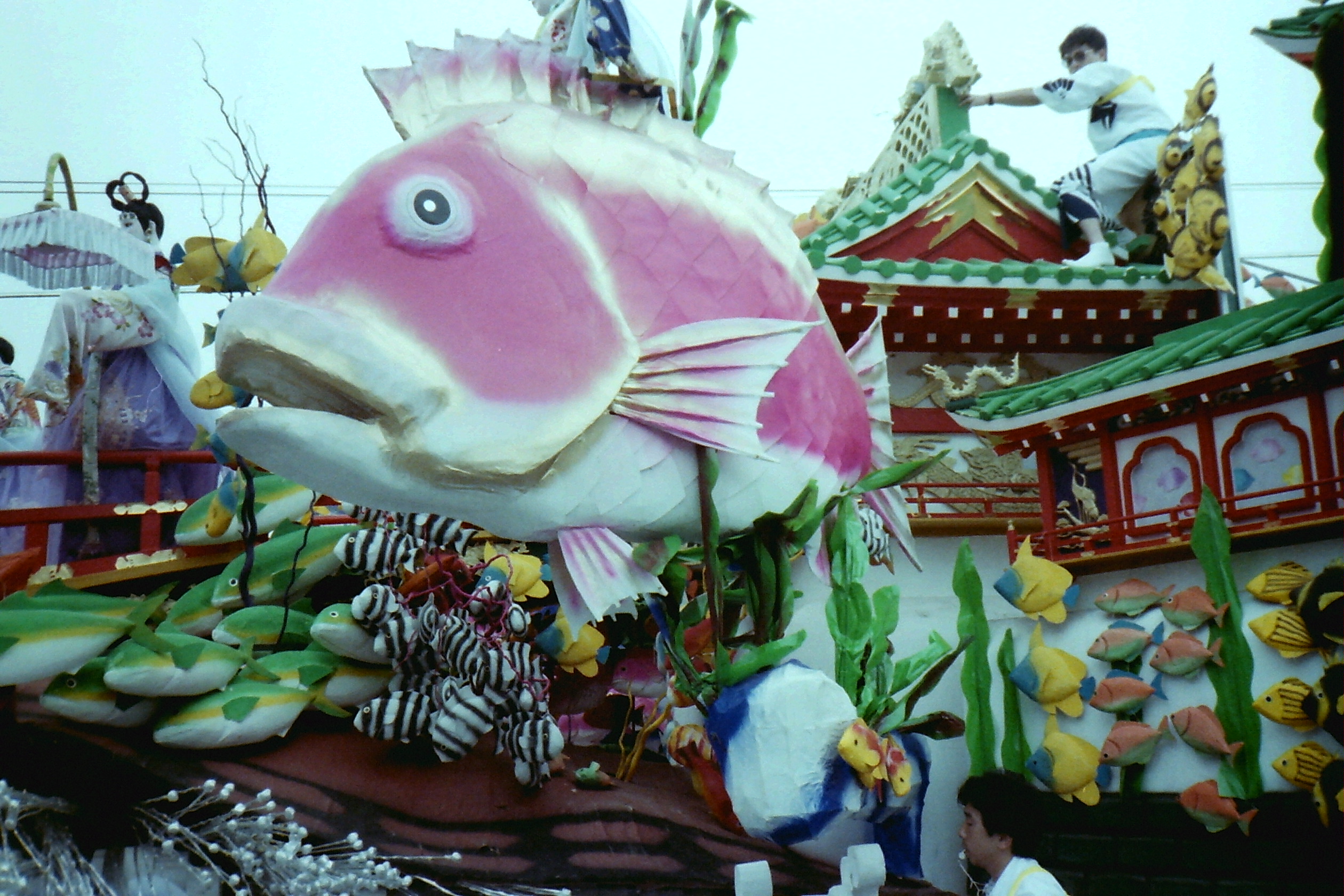
Hungry, anyone?
That looks strangely like something I had on my plate at a ryokan (traditional Japanese hotel).
[image error]
Does the name "Nemo" come to mind?
I think of "Nemo" when I see this guy riding the turtle, and I don't mean "Captain" Nemo.
September 30, 2011
"Mayhem" o, mou sukoshi kudasai.
Sore wa nan da? E–to–ano kichigai ryuu dayo!
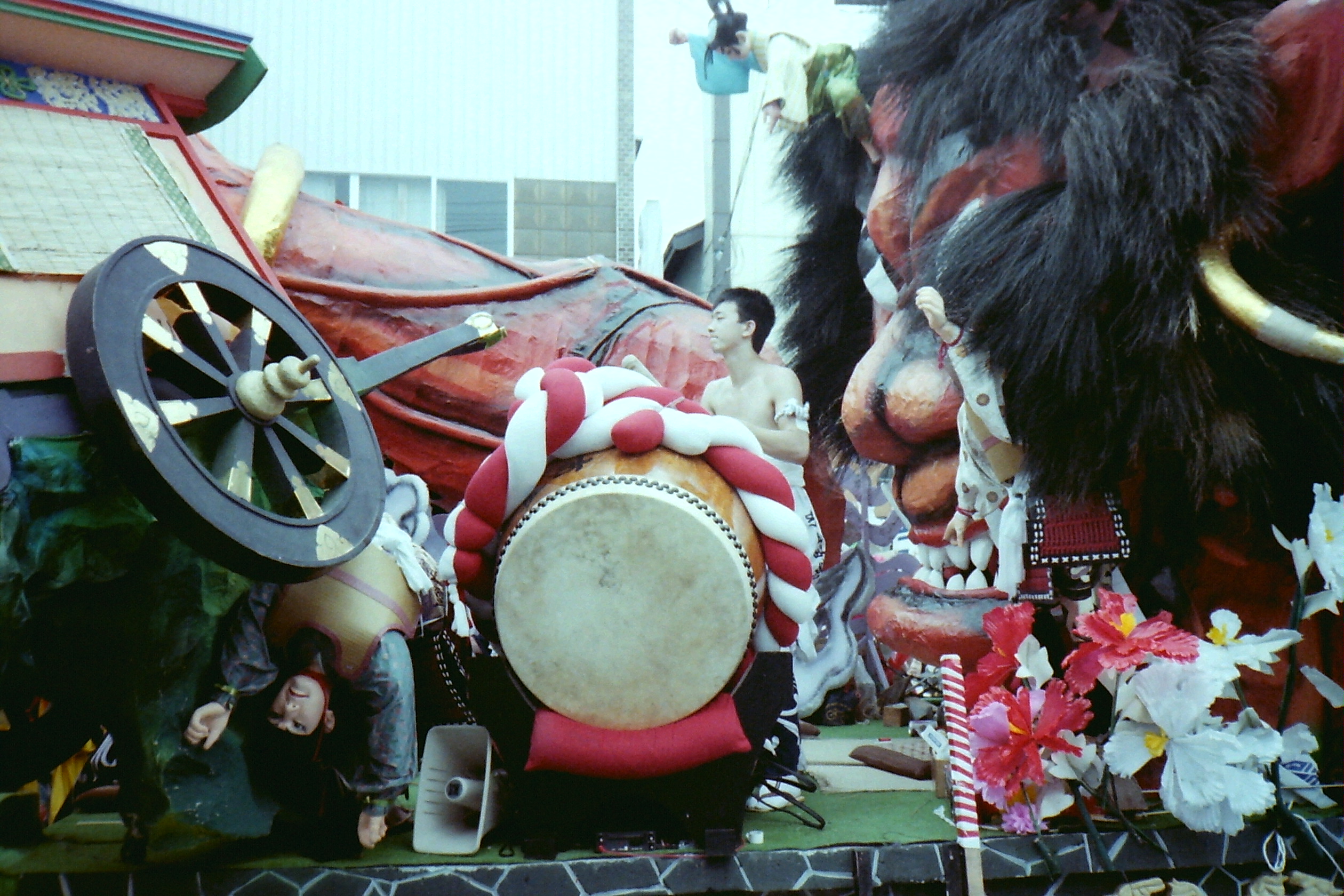
Check out the totally crazy dragon
This float was worth a few more views. That's some dragon, huh?
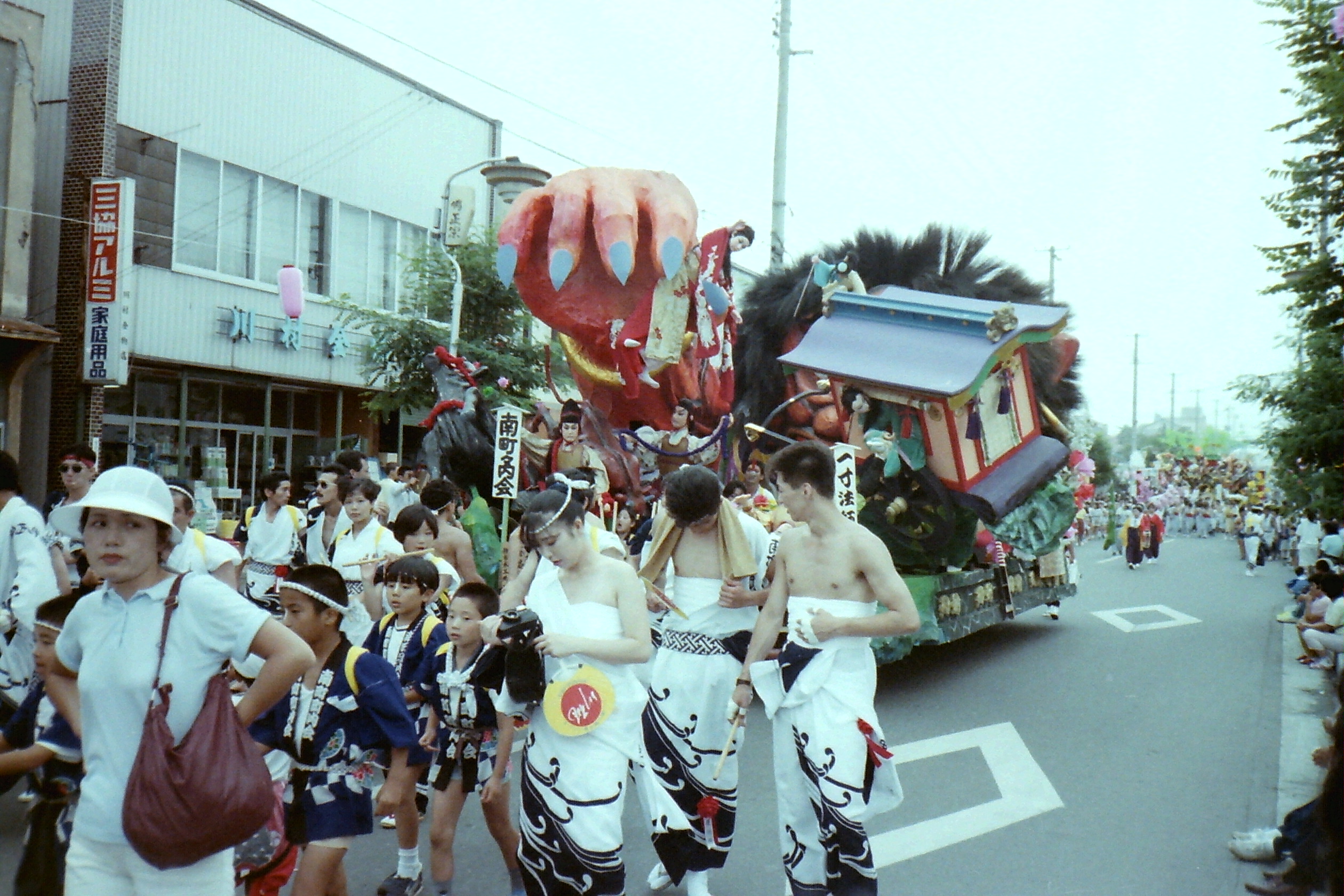
This is just crazy
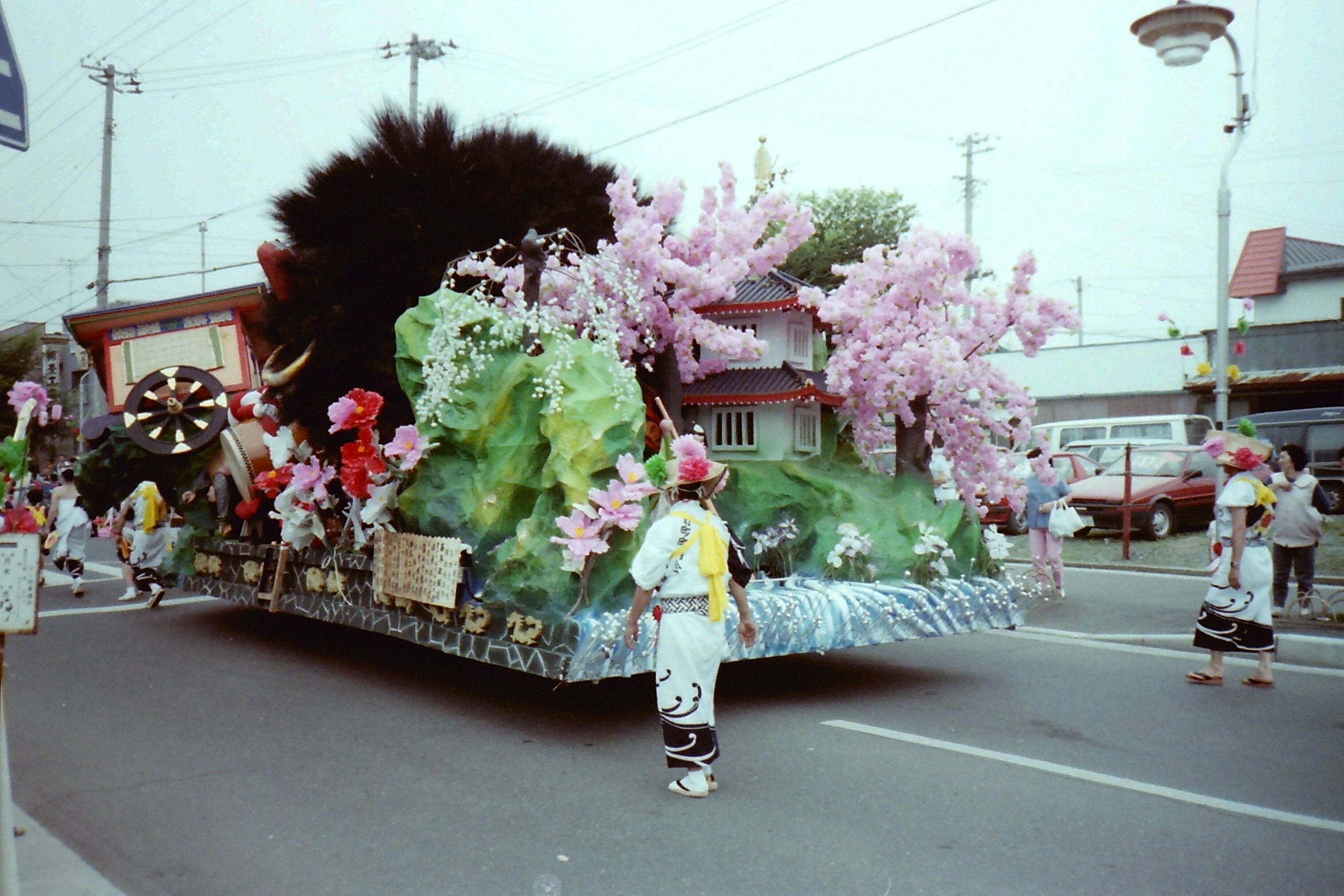
In the end, everything's coming up roses--or sakura
Just in case you're unfamiliar with sakura, it means "cherry blossom."
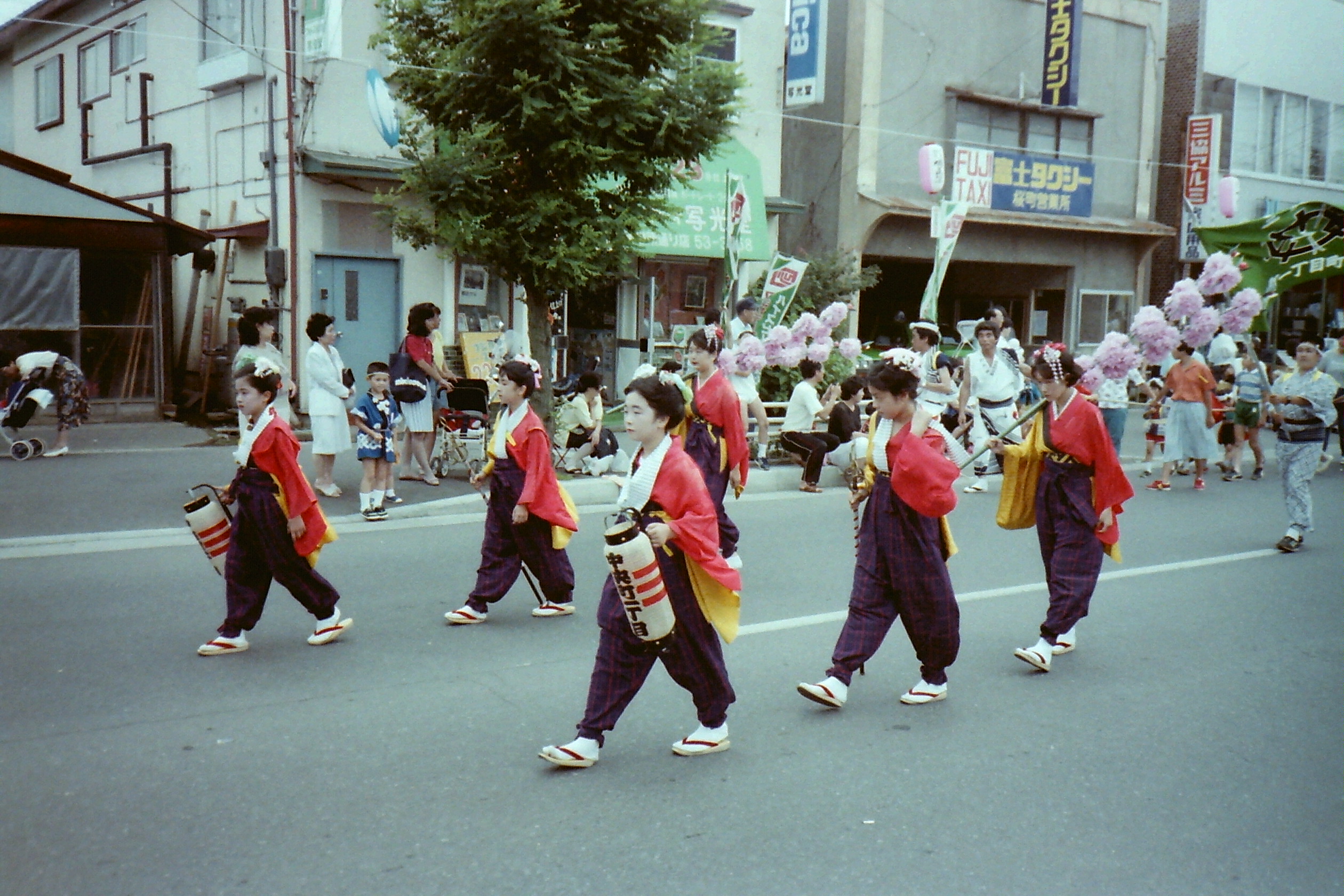
Chochin lead the way
Chochin are Japanese paper lanterns. The girls with the "headlamps" lead the way!
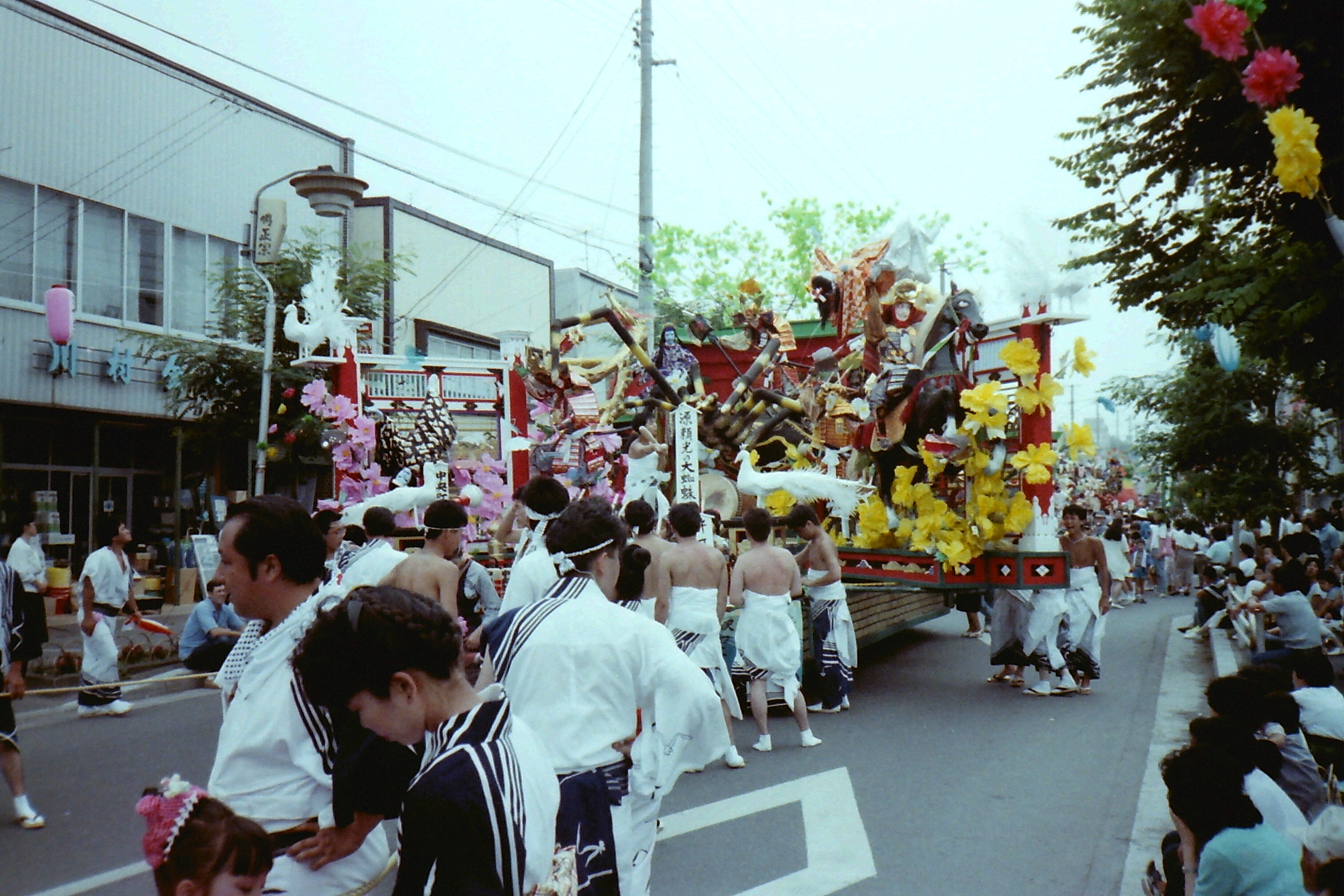
Just another float example
These things just knocked my socks off.
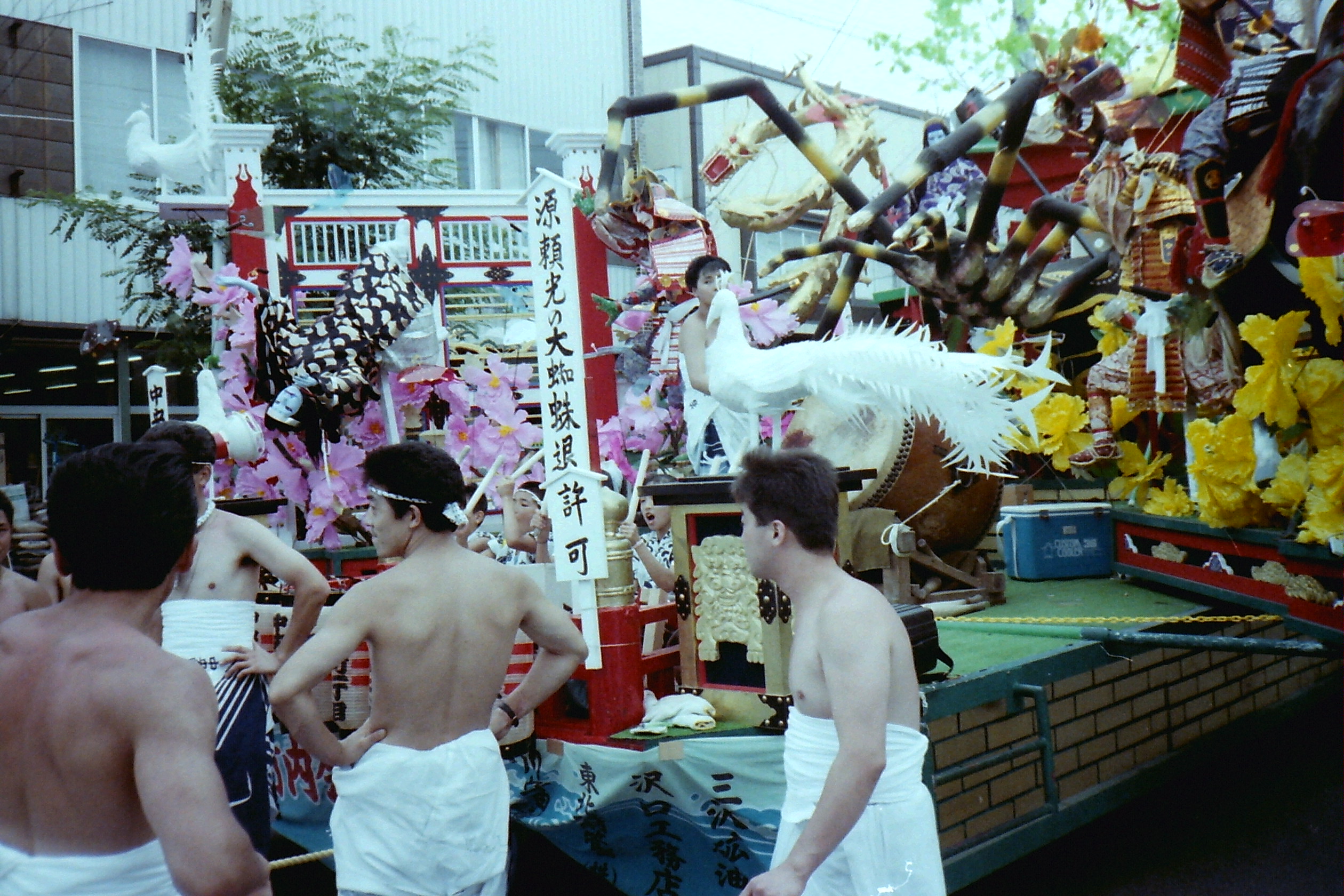
Are these guys showoffs, or what?
Japanese men have virtually no hair on their bodies, unless you count the Ainu Indians up on Hokkaido. Sure, it was a warm day, but these guys seems to be showing off. If you think this is a lot of skin, however, you should check out a local onsen. But, if you're a guy, you won't be so worried about the dudes there–you'll probably have to strip down in front of the mama-san who runs the establishment. Stick your clothes into the basket, and make sure you bring your own soap.
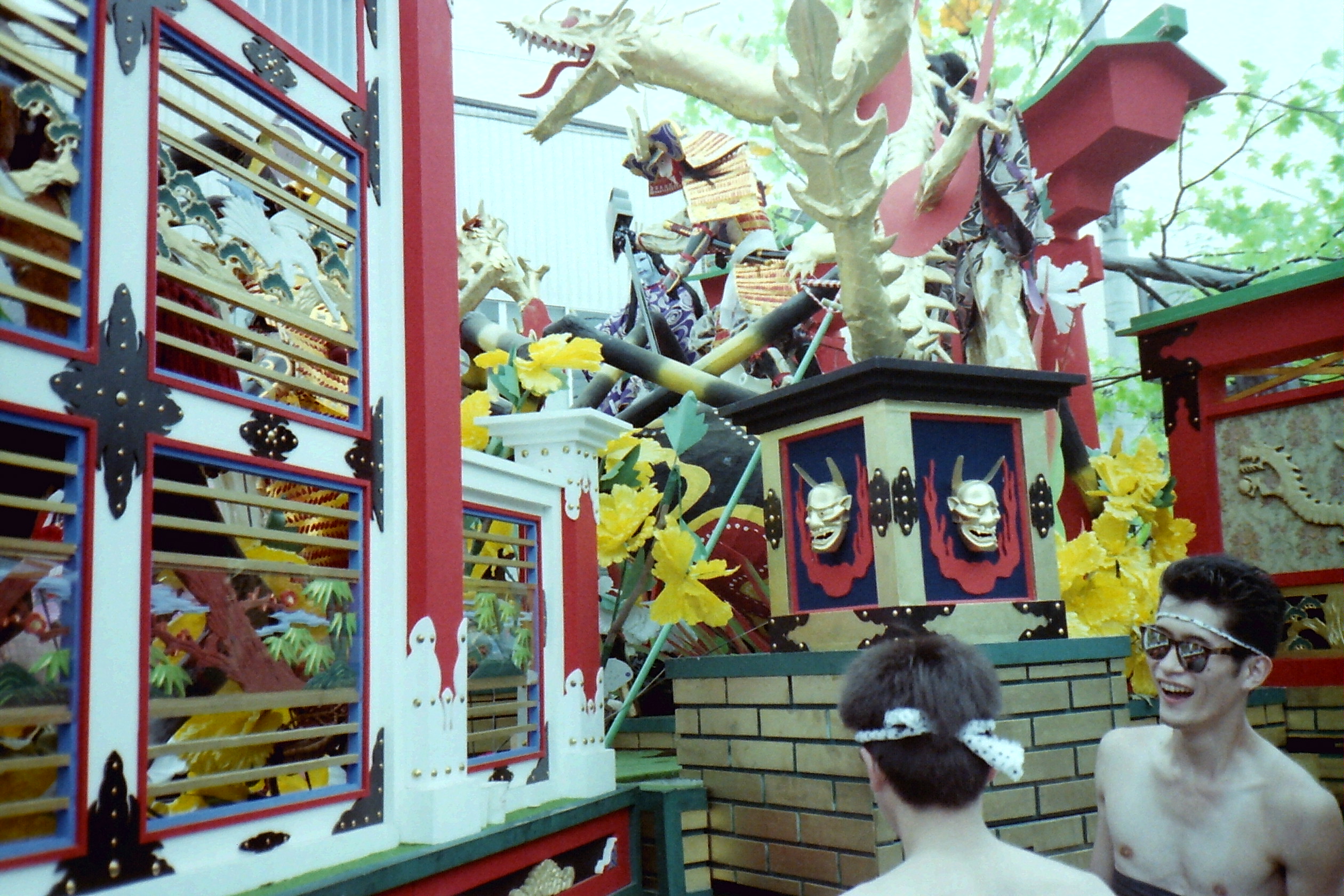
A devilish pair
I didn't really mean the two guys in the foreground. Check out the faces on the box behind them. I have no idea about the significance of the horns, but I suspect some 16th-century Jesuit influence.
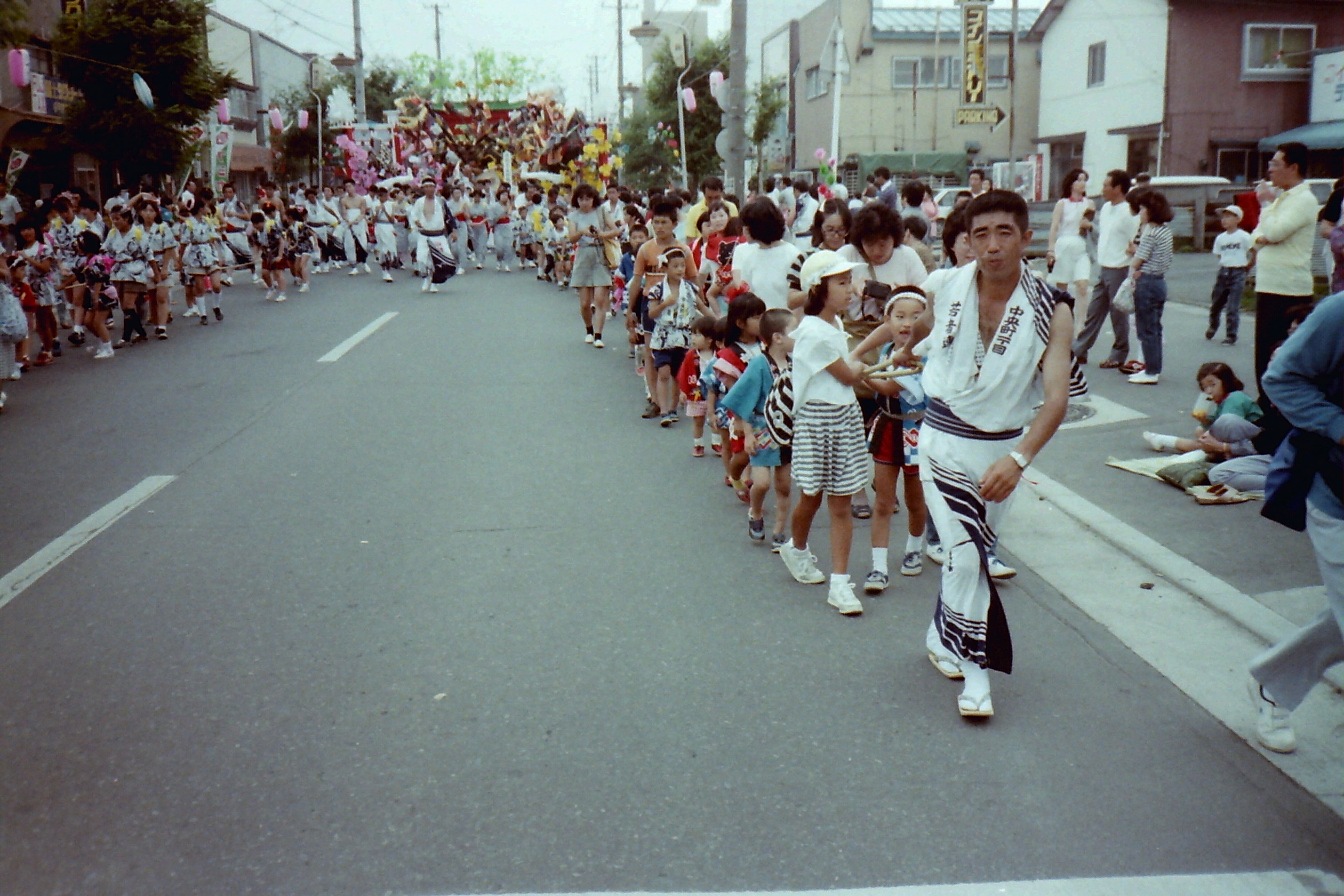
Who is really doing the work?
I think the man in the front is probably doing most of the work.
September 29, 2011
No rain on this parade
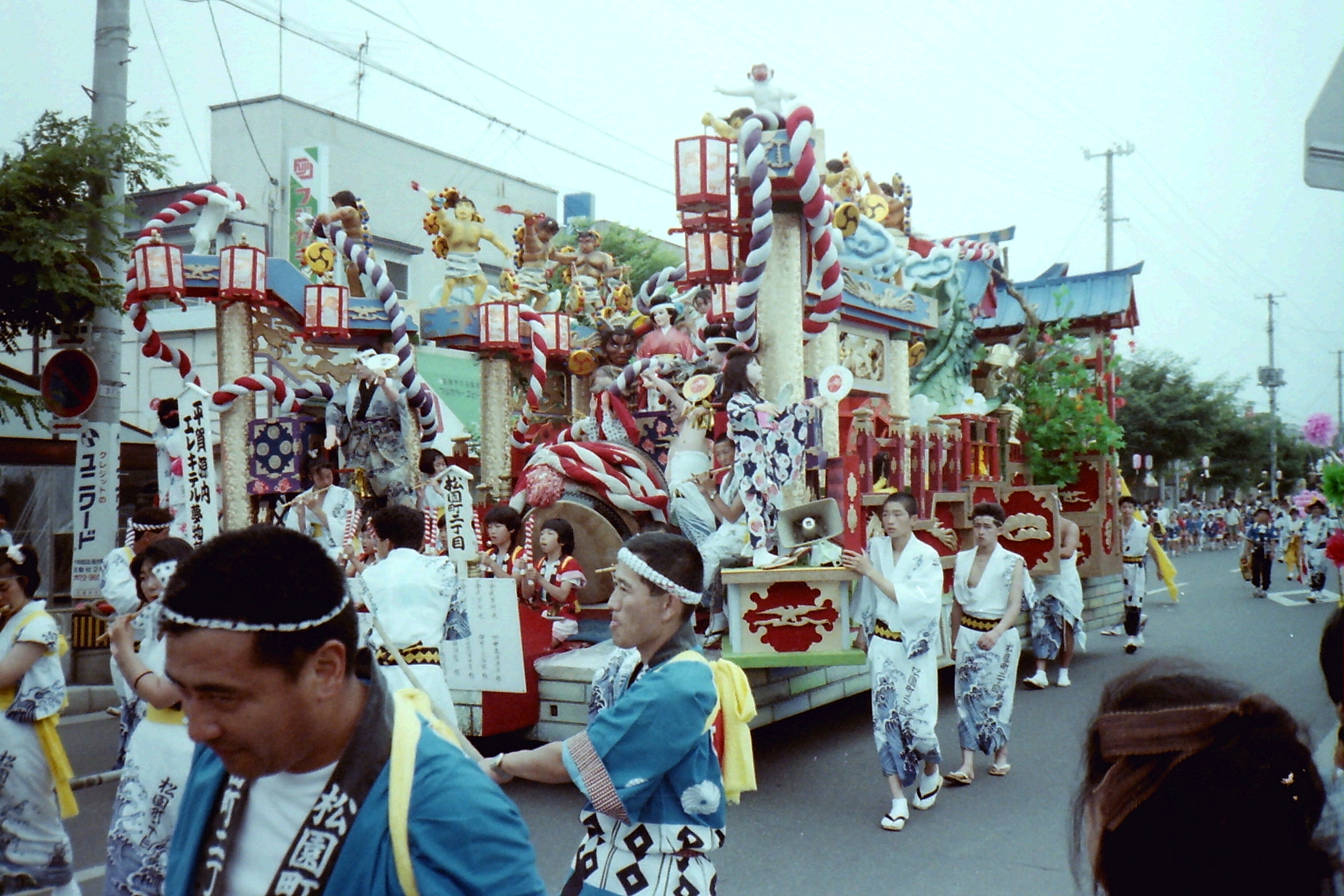
Just keeps getting crazier
At least, no rain this day. Northern Japan, so close to the ocean, gets a considerable amount of precipitation, though, and it is overcast most of the time, with the clouds often hanging very low. Kinda sorta like the Seattle area, but moreso. On Thursdays, if the clouds are very low, you can smell the sickeningly-sweet aroma of the crematorium — virtually everyone in Japan is cremated when they die. Or, perhaps, you're enjoying the odor of the hog slaughterhouse; I'm not certain.
Note the loudspeaker on this float. Sometimes a person would walk along with the float and shout things into a microphone, something akin to "Rah, rah, siss-boom-bah!" or the equivalent in Japanese, I assume.
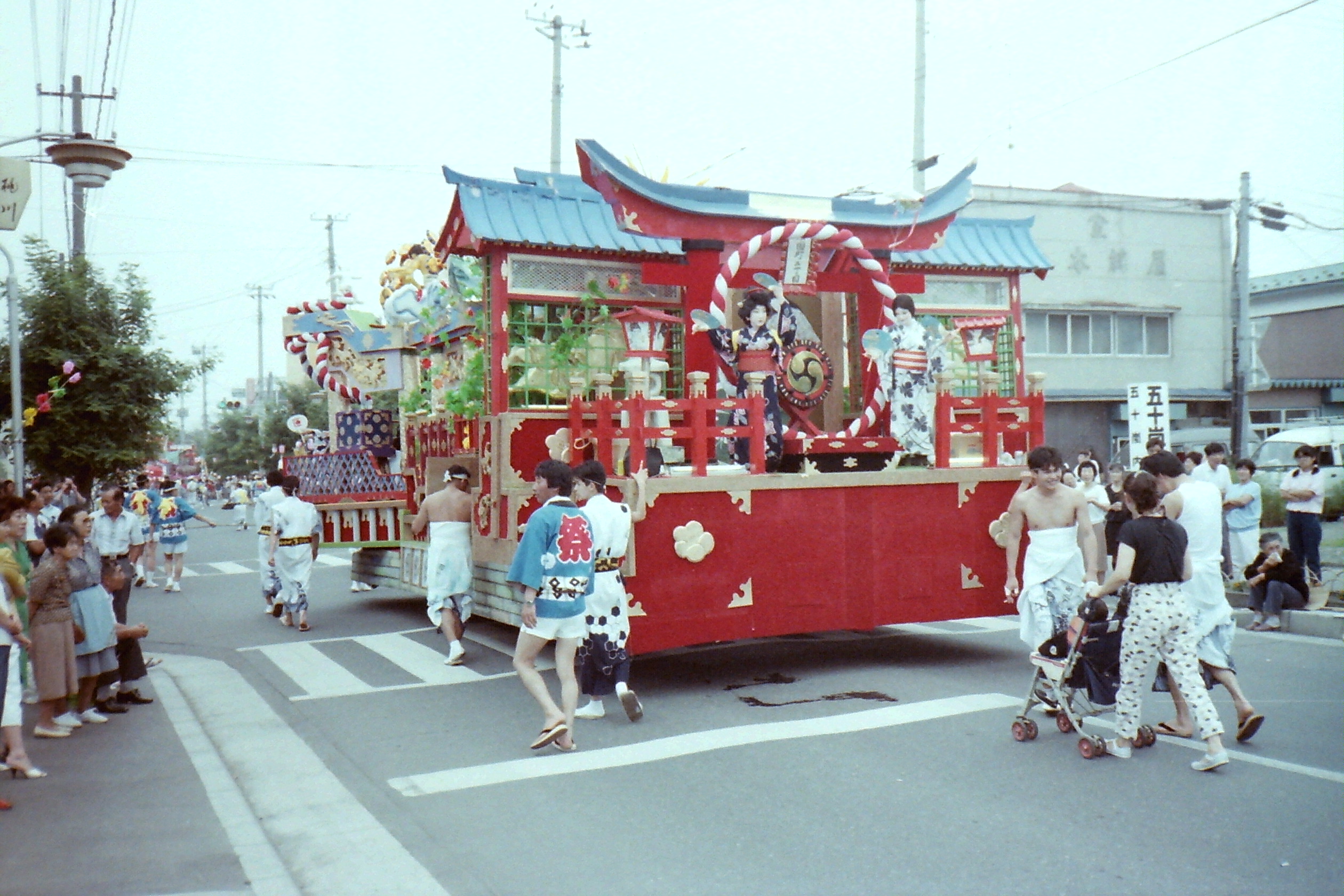
Torii gate on float
This is the same float from the back. Note the torii gate, a sort of Japanese version of a door to an alternate reality.
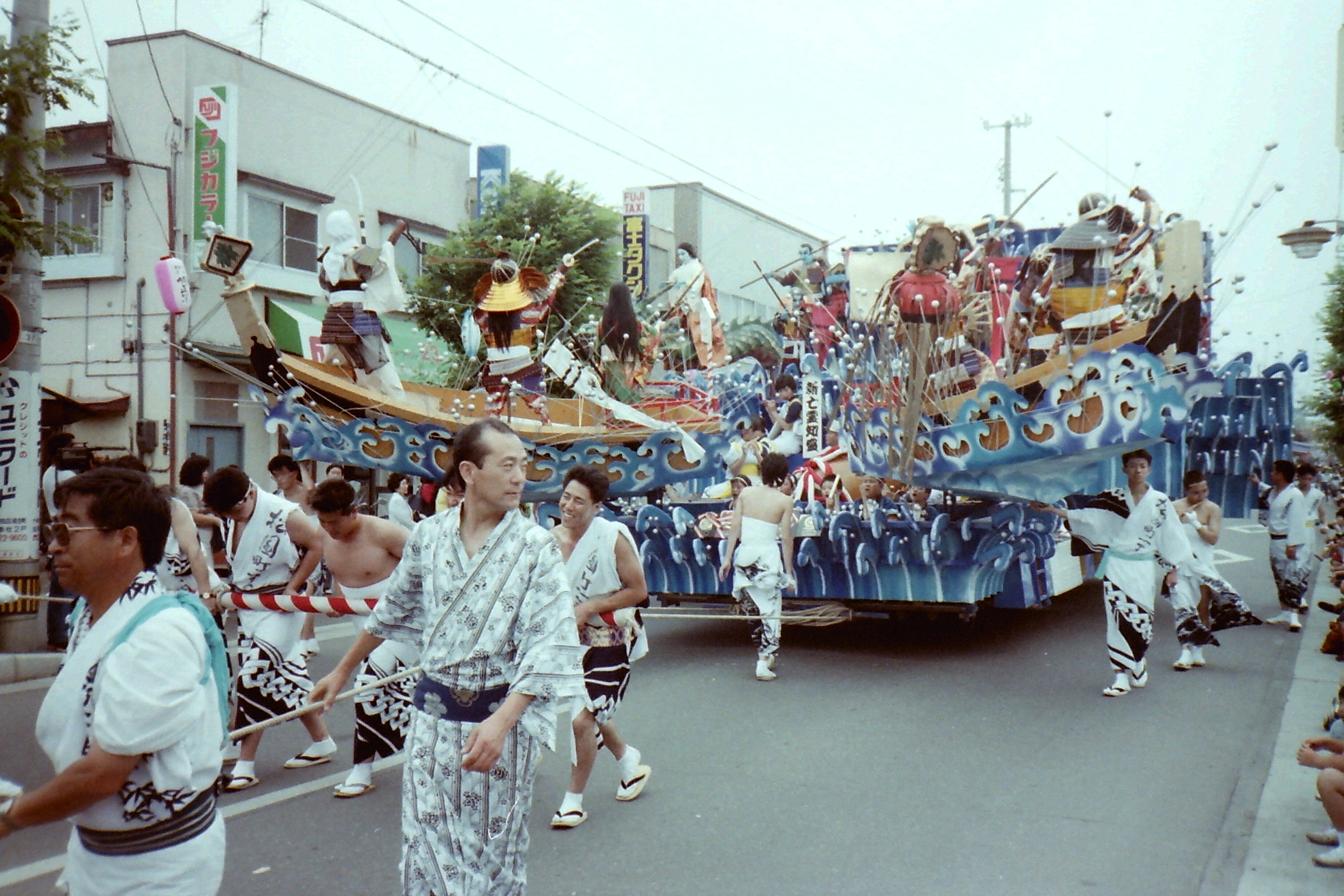
Samurai battle at sea
This is one of the more elaborate floats, at least as far as the Misawa City Festival is concerned. You'll see bigger, more elaborate floats at the Aomori Nebuta Festival, but a lot of work went into this one, too.
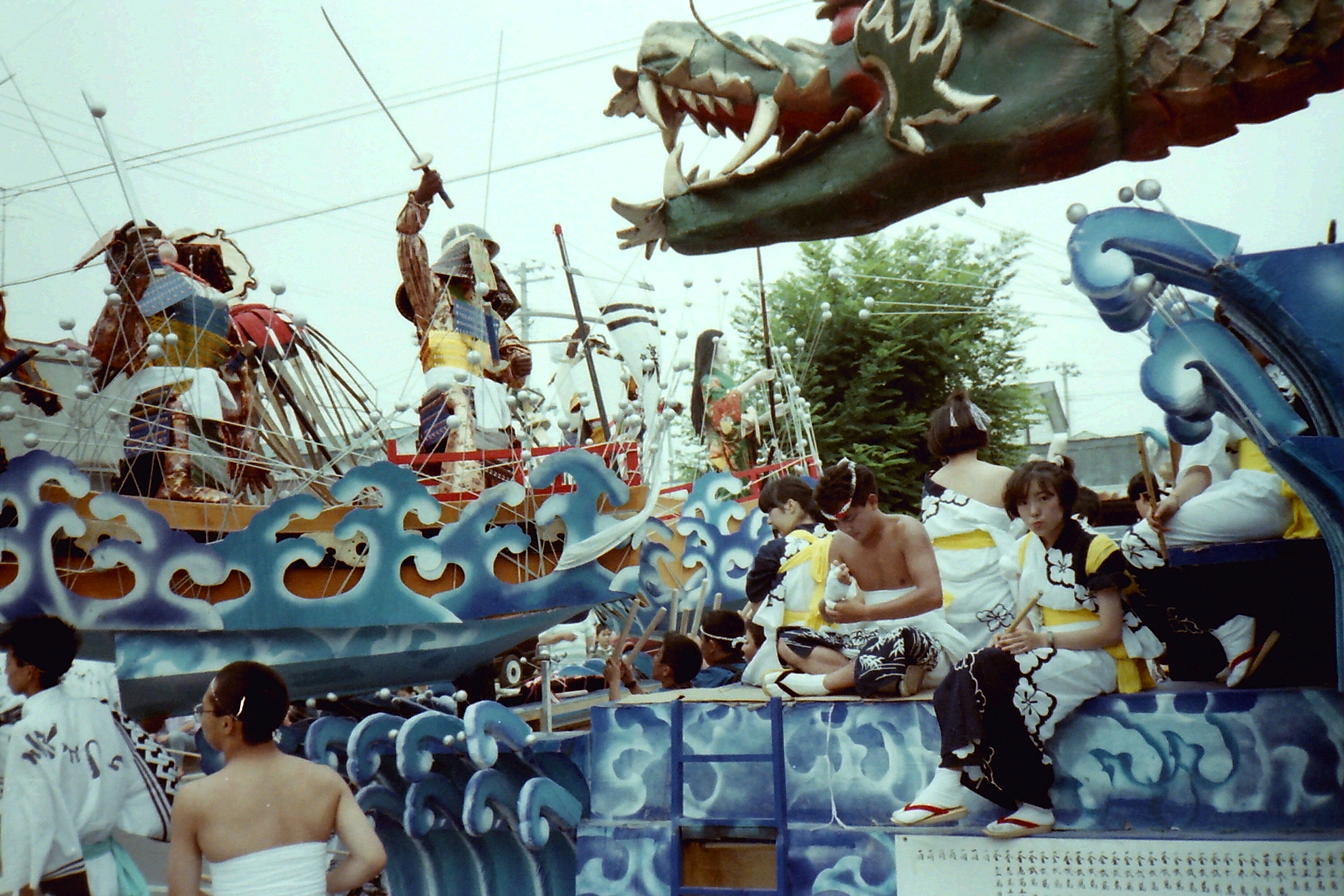
Battle at sea
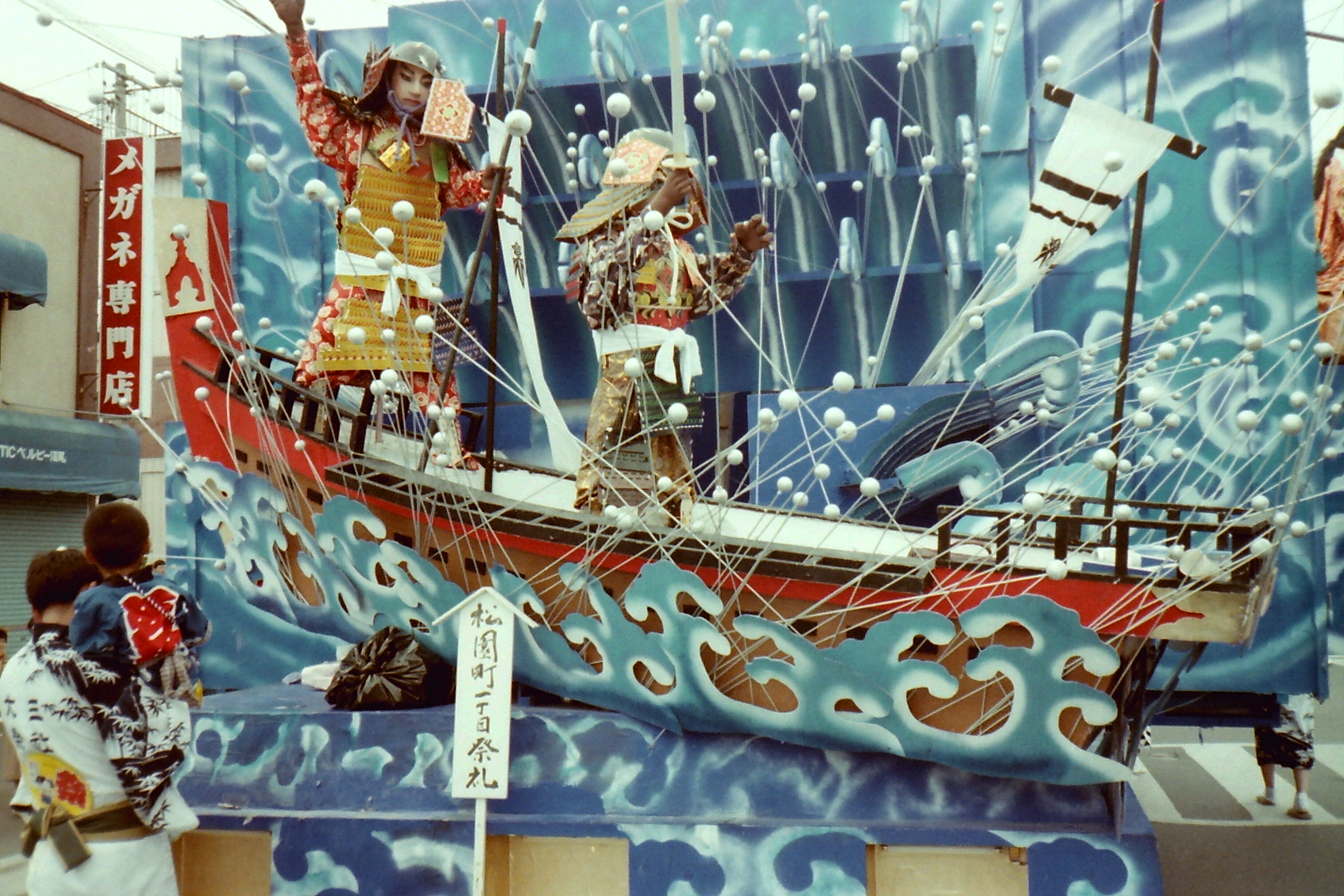
The battle at sea continues
All these boats remind me of the TV miniseries, Shogun, from back in the '80′s.
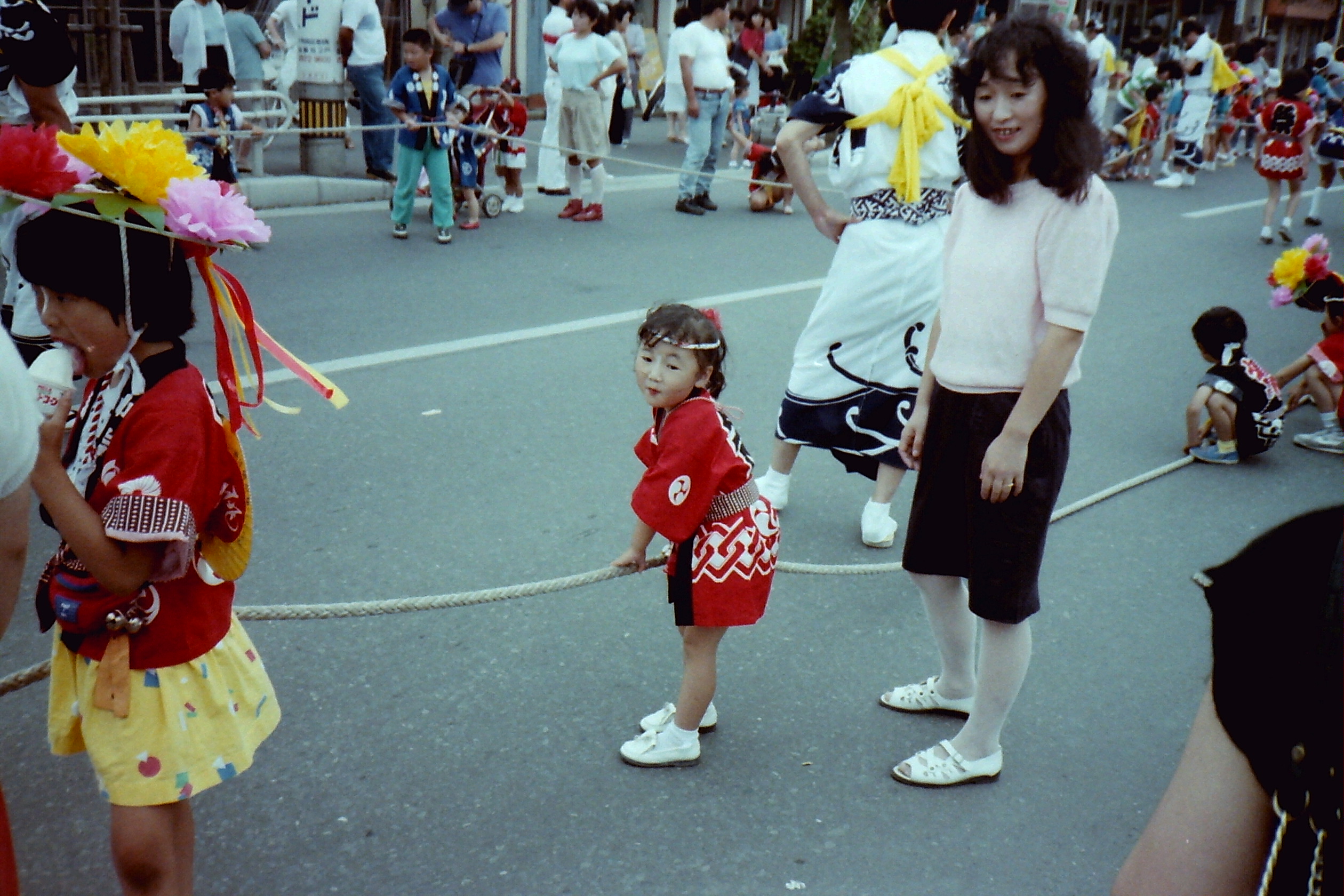
Little helper
This cute little Japanese girl wearing her red hapi coat is doing her part.
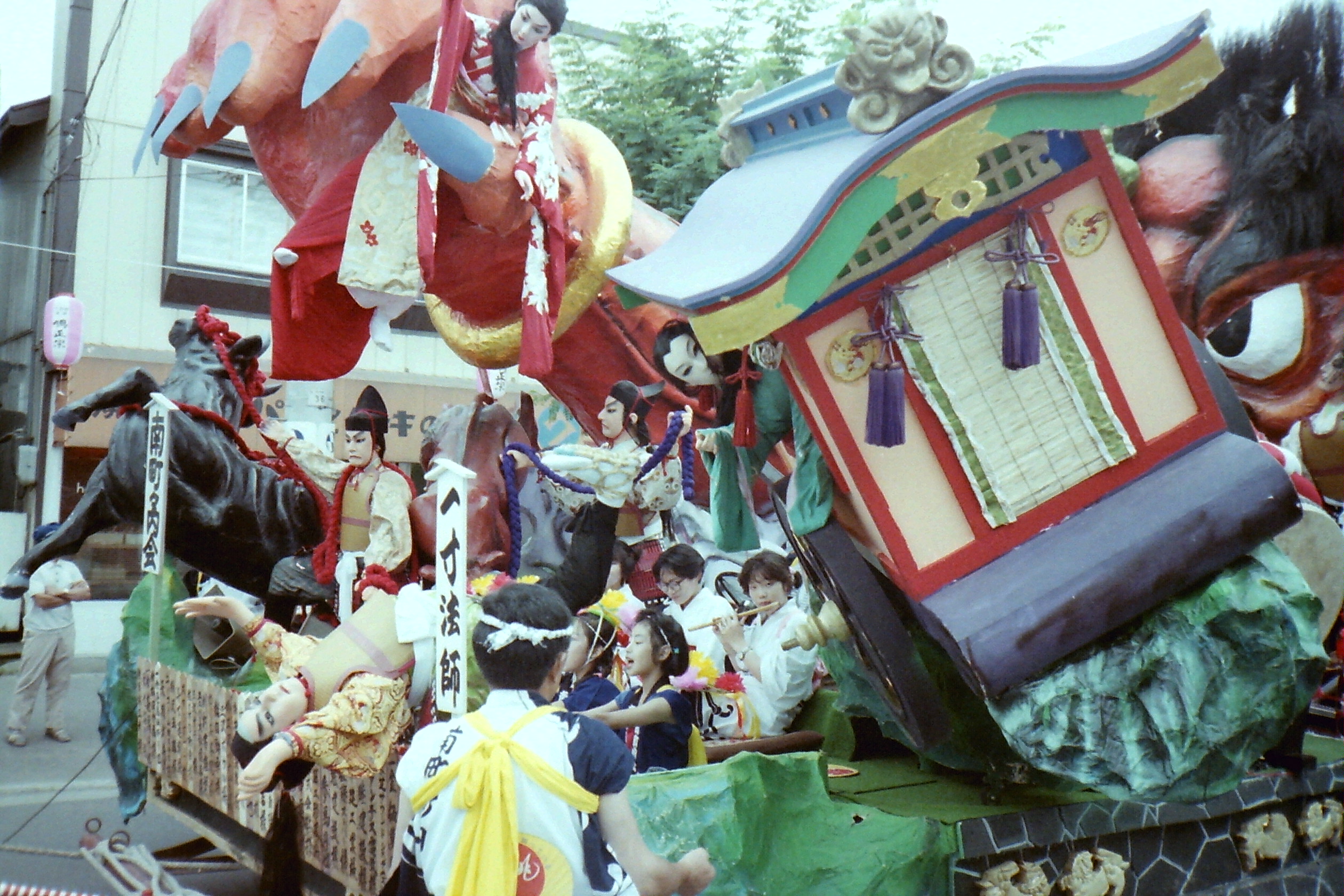
Mayhem at the matsuri
Looks like all heck is breaking loose on this float. That cart looks like it's about to roll over on the flute players.
September 26, 2011
Go west, young man
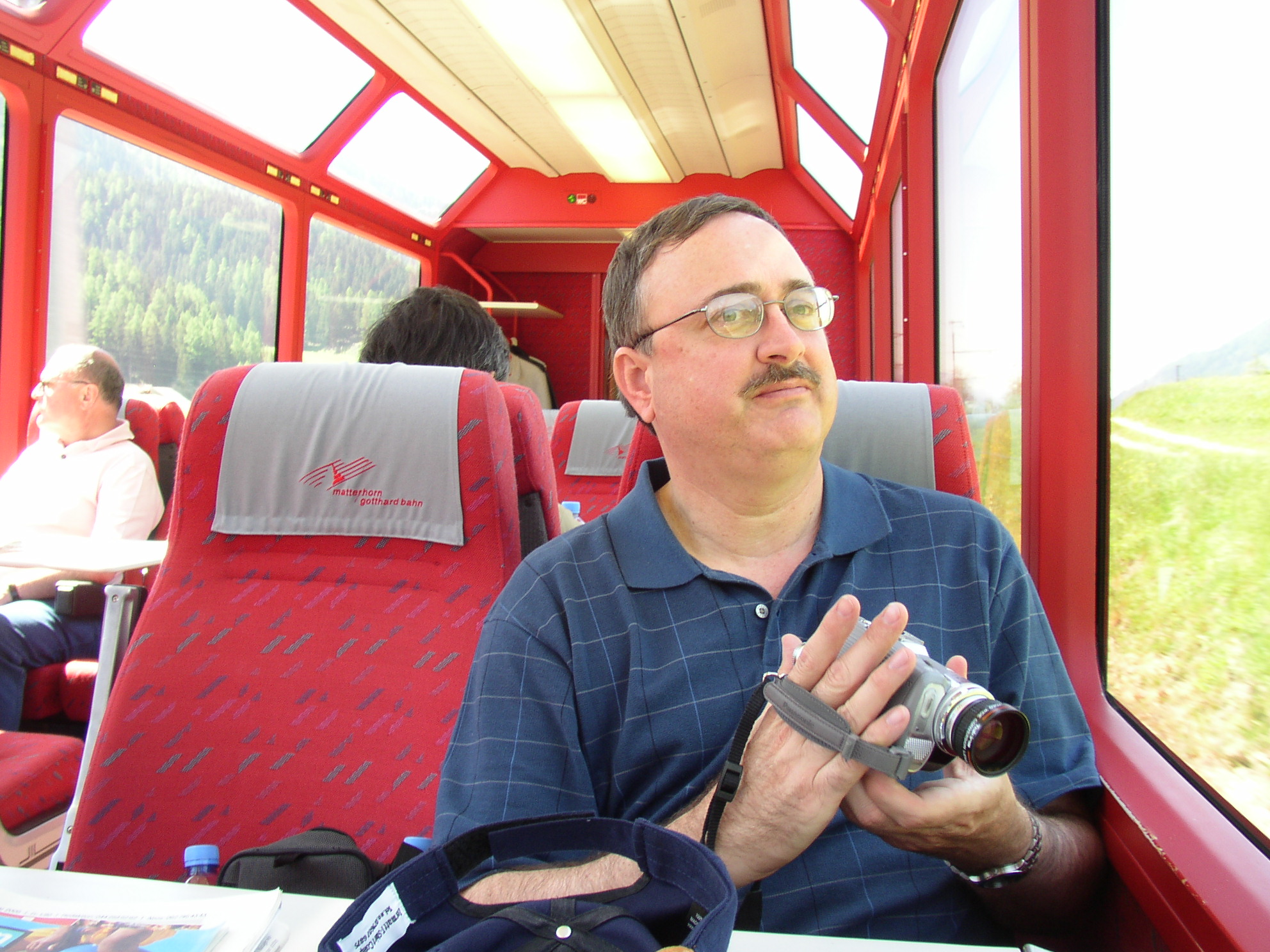
On the Glacier Express
Obviously, the title doesn't refer to me, since even more than a half dozen years ago, at the time of this trip, I was no spring chicken. Nor does it reflect the direction we were headed, since we were spanning the space from Zermatt to St. Moritz, which gave us an easterly bearing.
This is the Glacier Express, Switzerland's famous tourist train. It was some sort of anniversary of the train that year, perhaps the 75th, but I do not recall. In any case, I thought it would be nice to take a break from the Far East and travel both west and seventeen years forward along the continuum for a change of scenery.
Speaking of scenery, you will notice that, despite the great visibility afforded us from our not-so-cheap seats, we still had to shoot our photos through glass and from a moving platform, and the resolution of the still photos I was taking with that video camera I'm holding was, unfortunately, quite limited. So, with that in mind, enjoy your trip. I'll be restricting the narrative to a minimum so as not to distract. Oh, one more thing — if you happen to reserve a ride on this train, ask about dinner reservations, too. We didn't know about the dinner, so we had to settle for a box of Toblerone. At least it wasn't ear-wax- flavoured jelly beans or chocolate frogs.
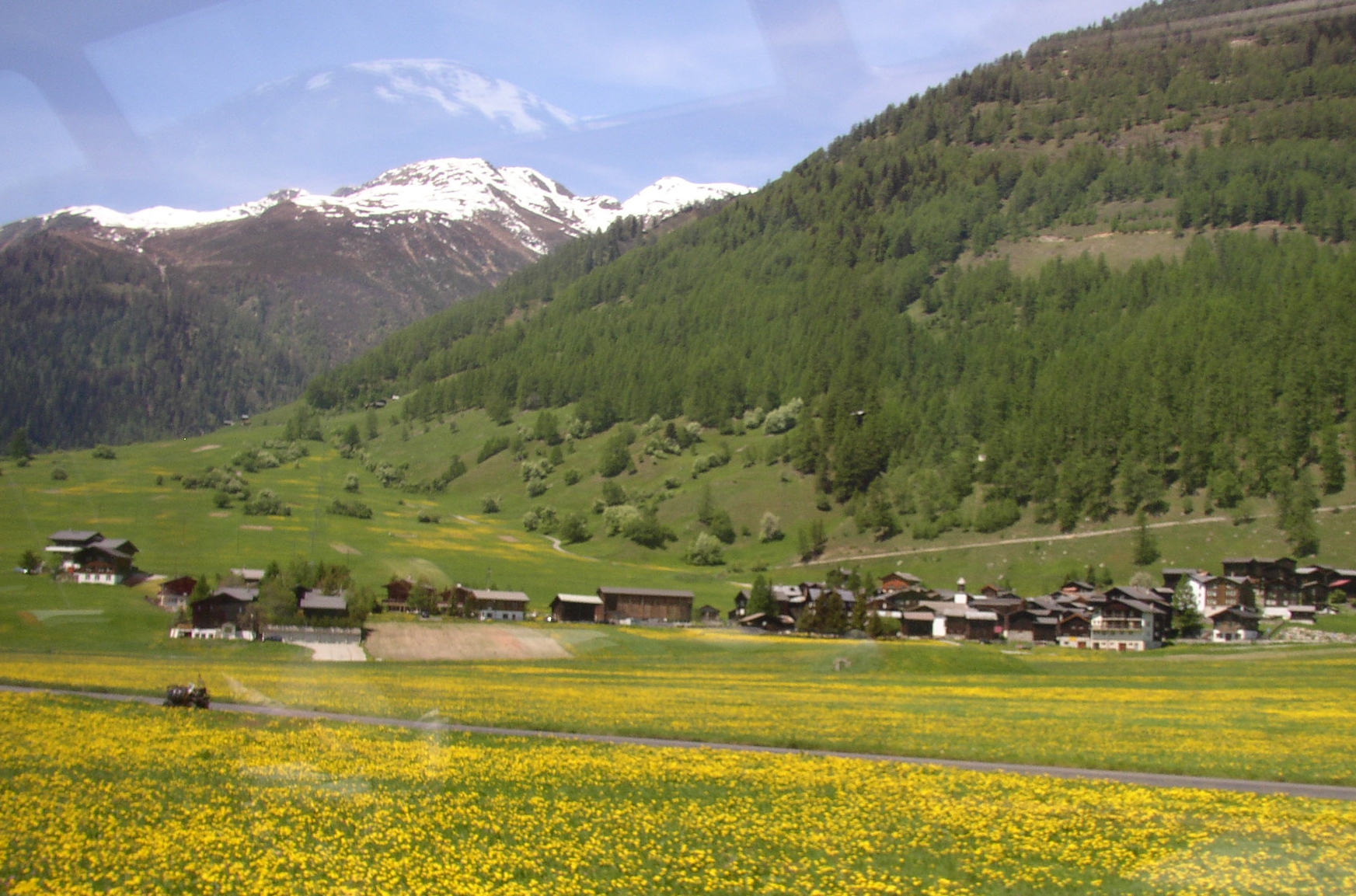
Switzerland in late May
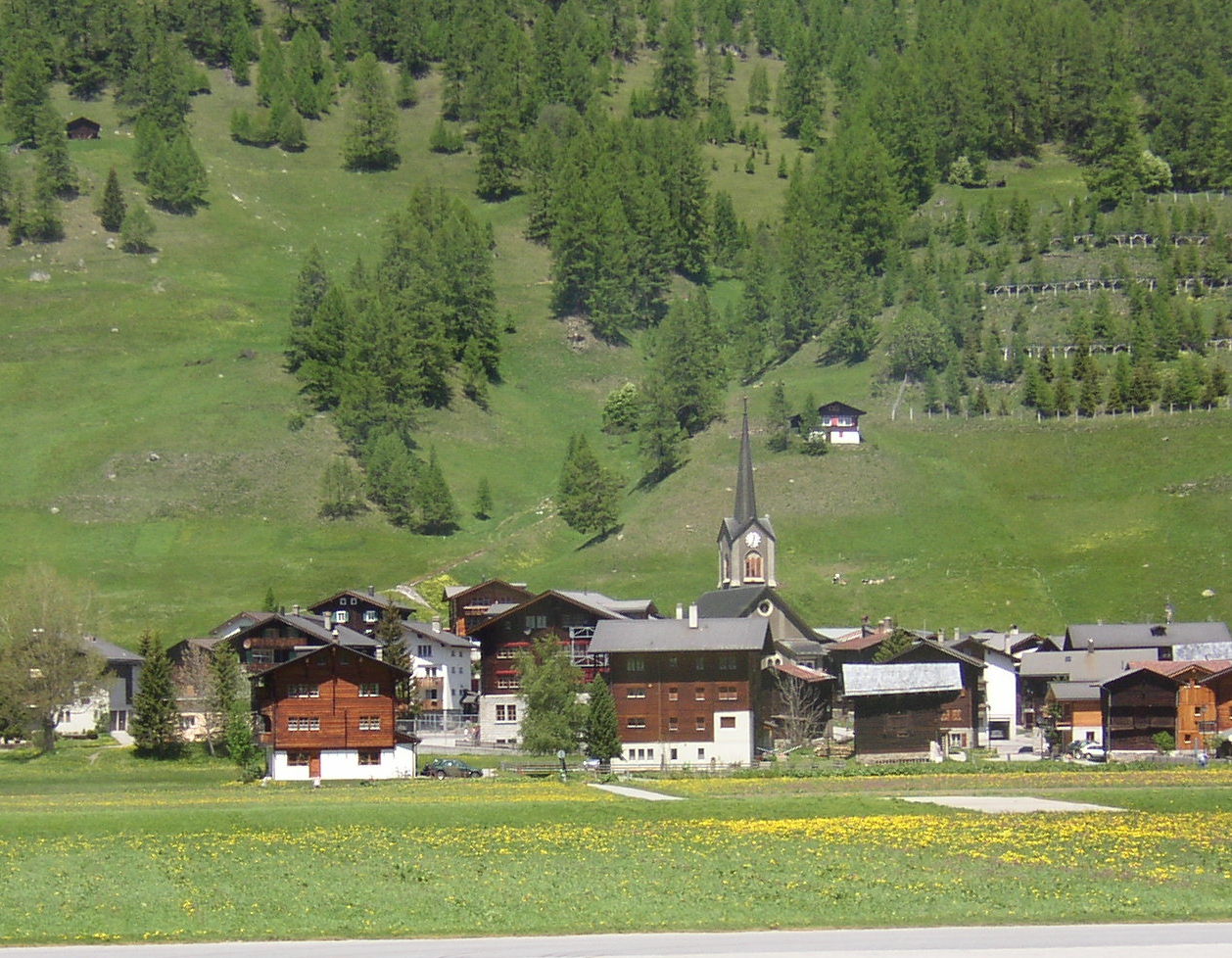
Town along Glacier Express route
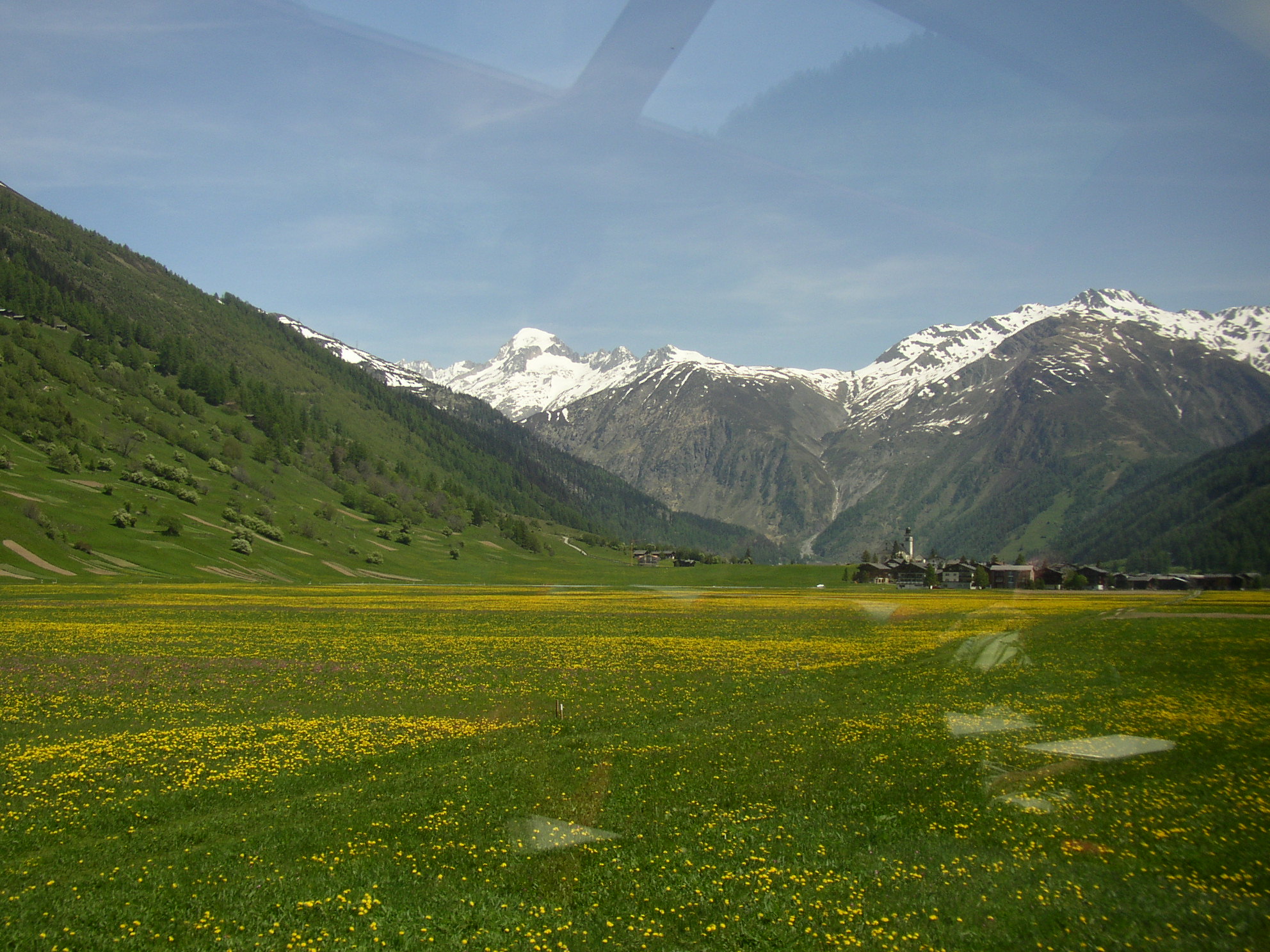
Mountain meadow
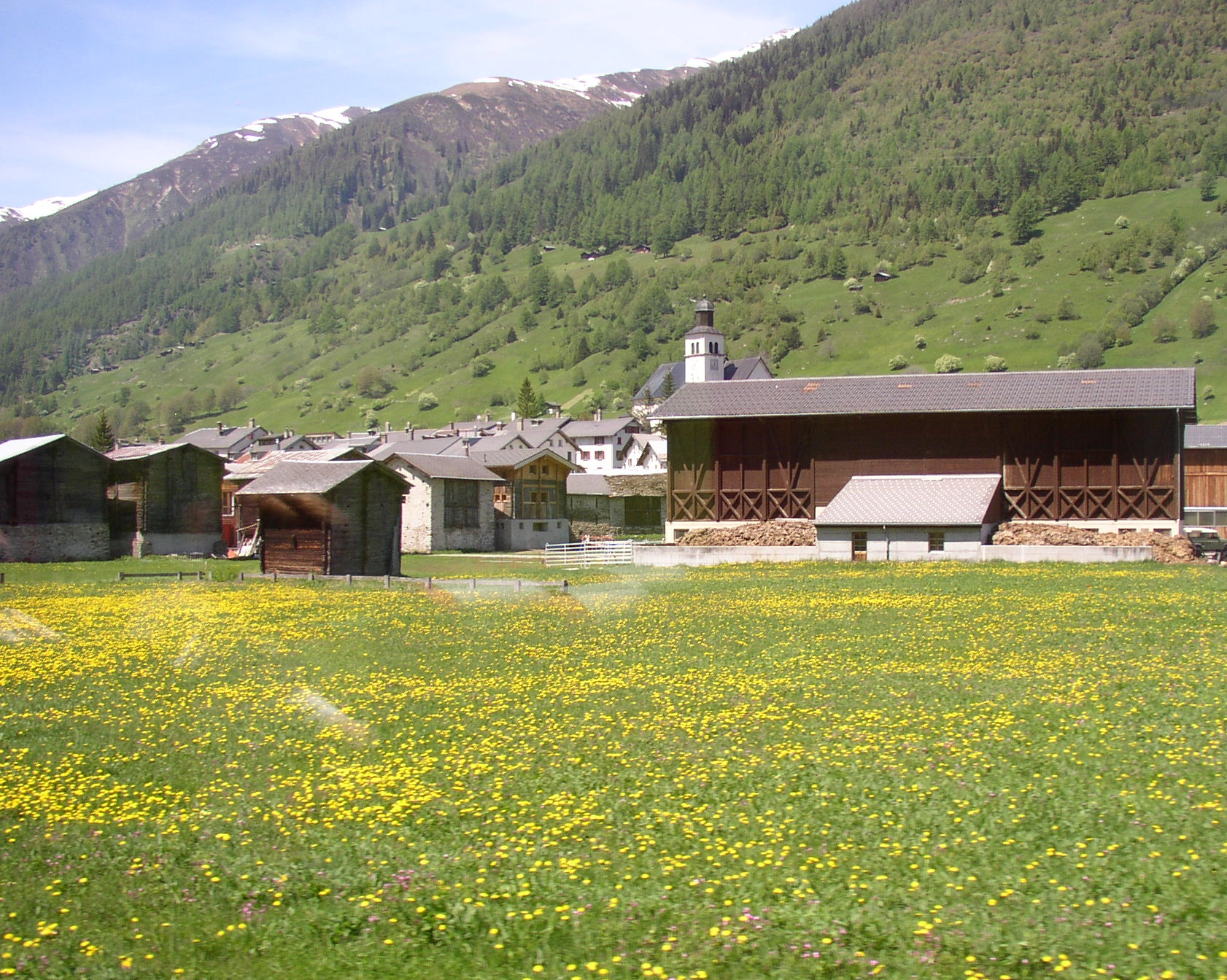
Another town scene
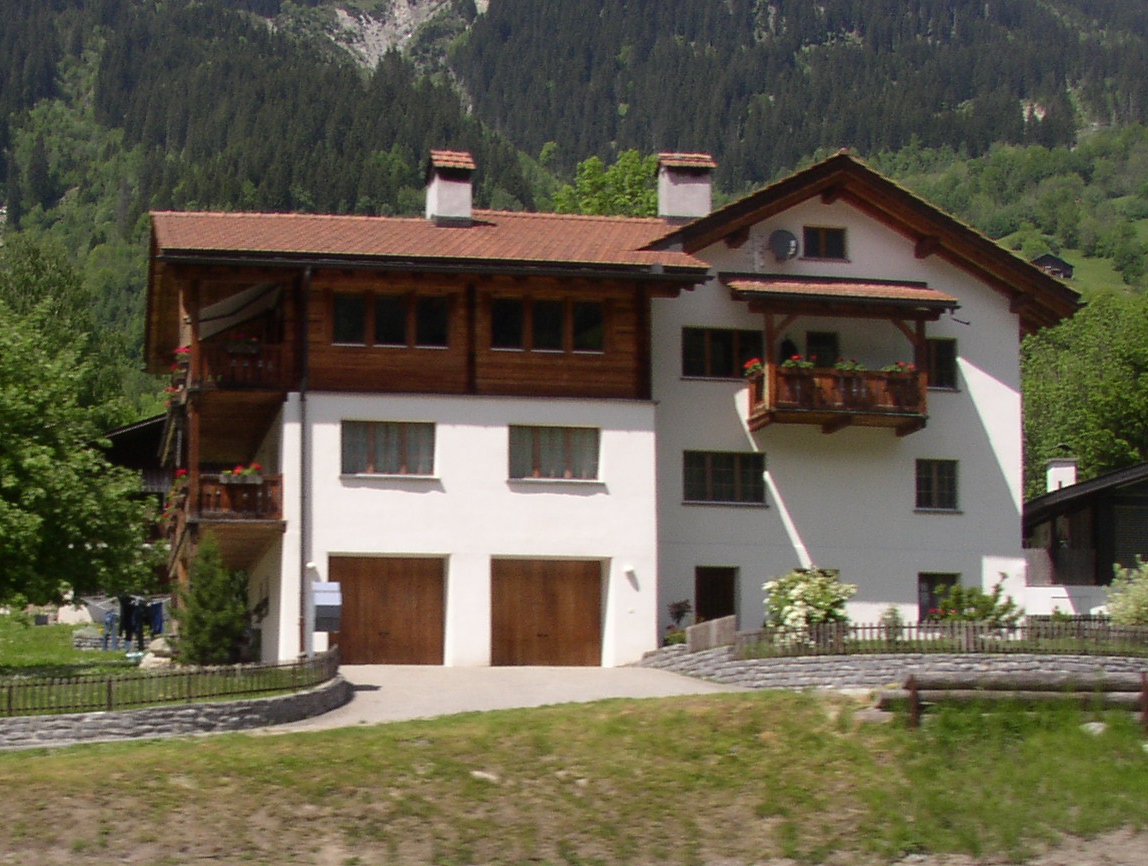
Nice digs
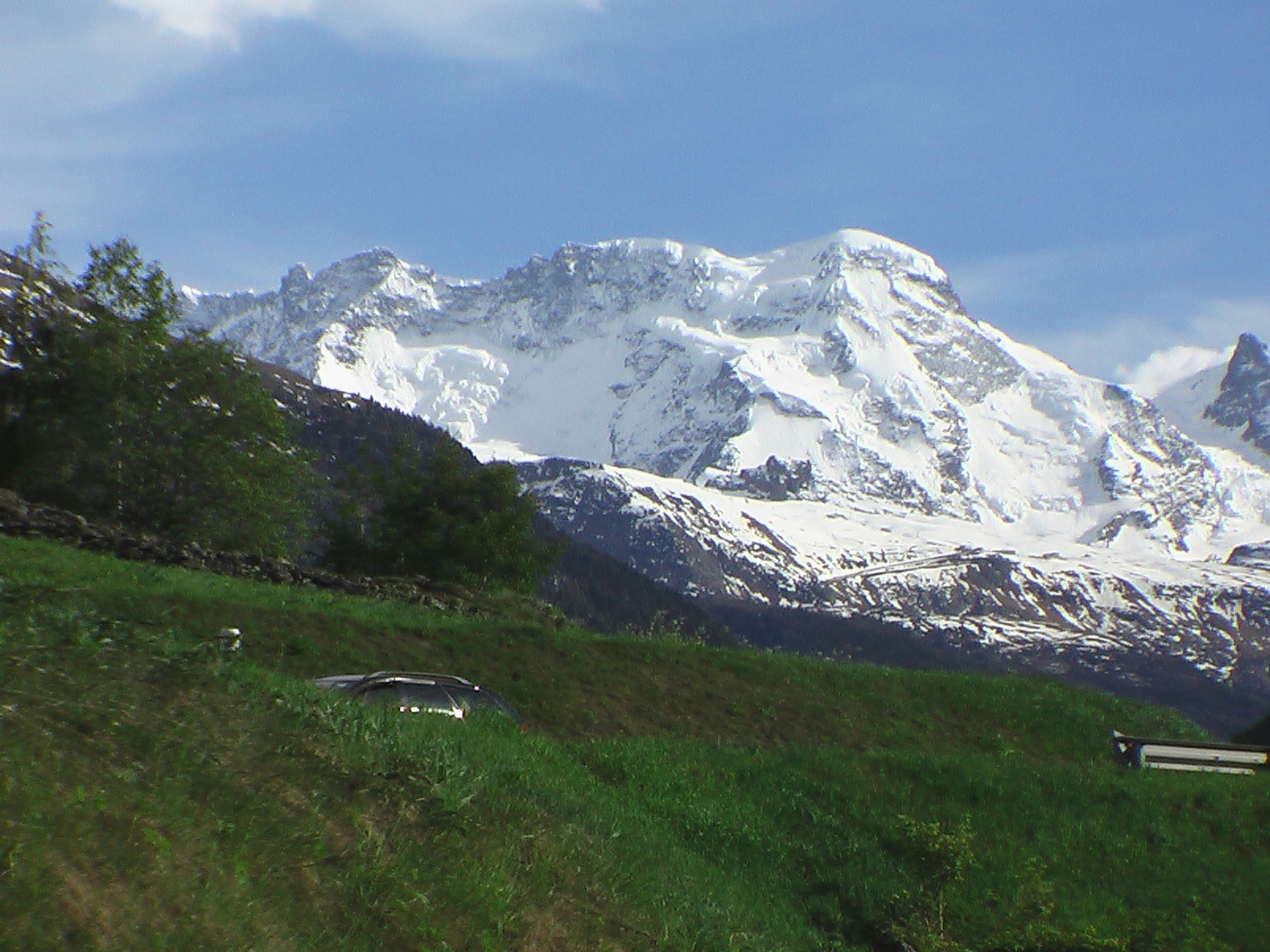
Still plenty of snow
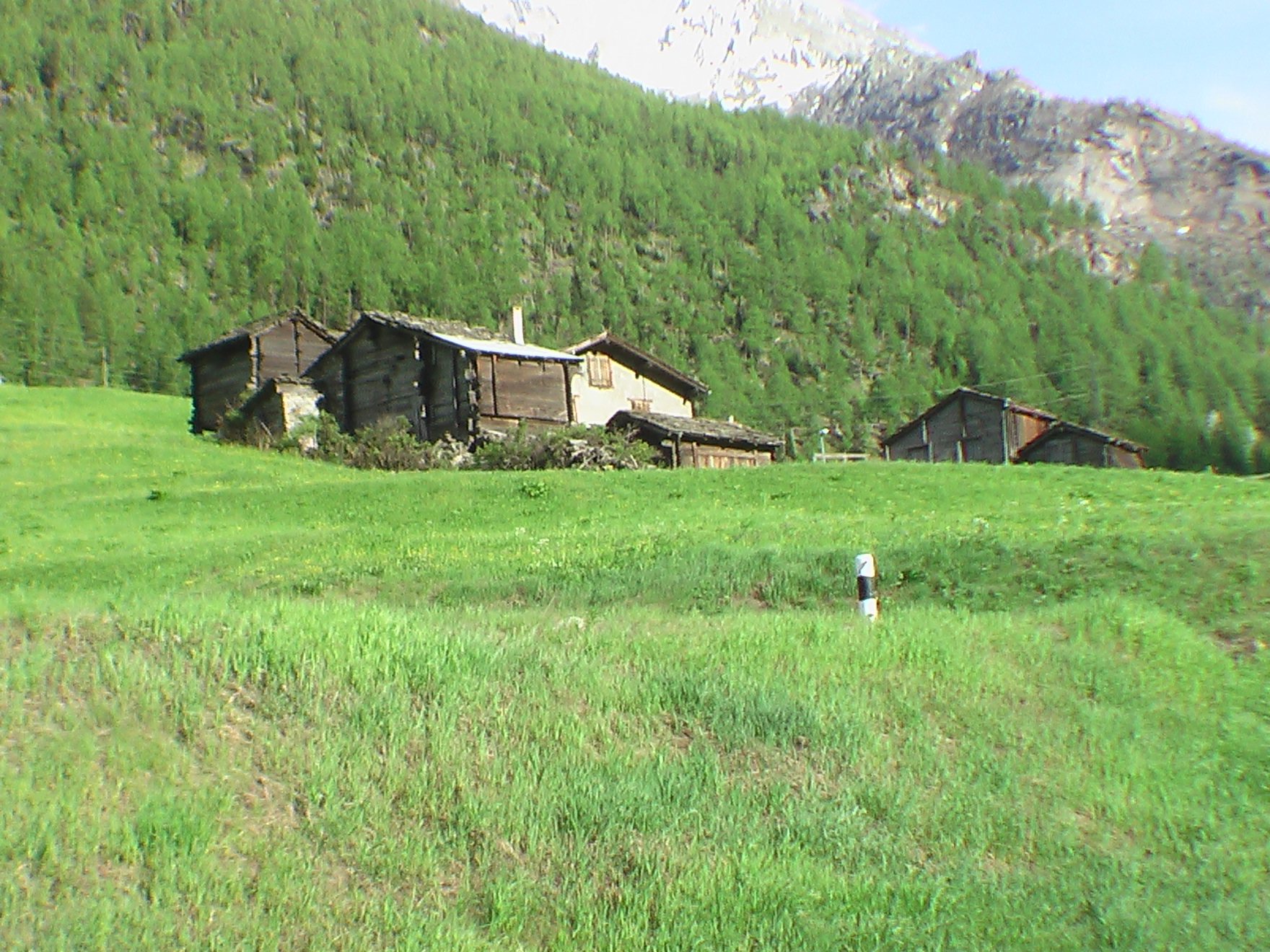
Older house
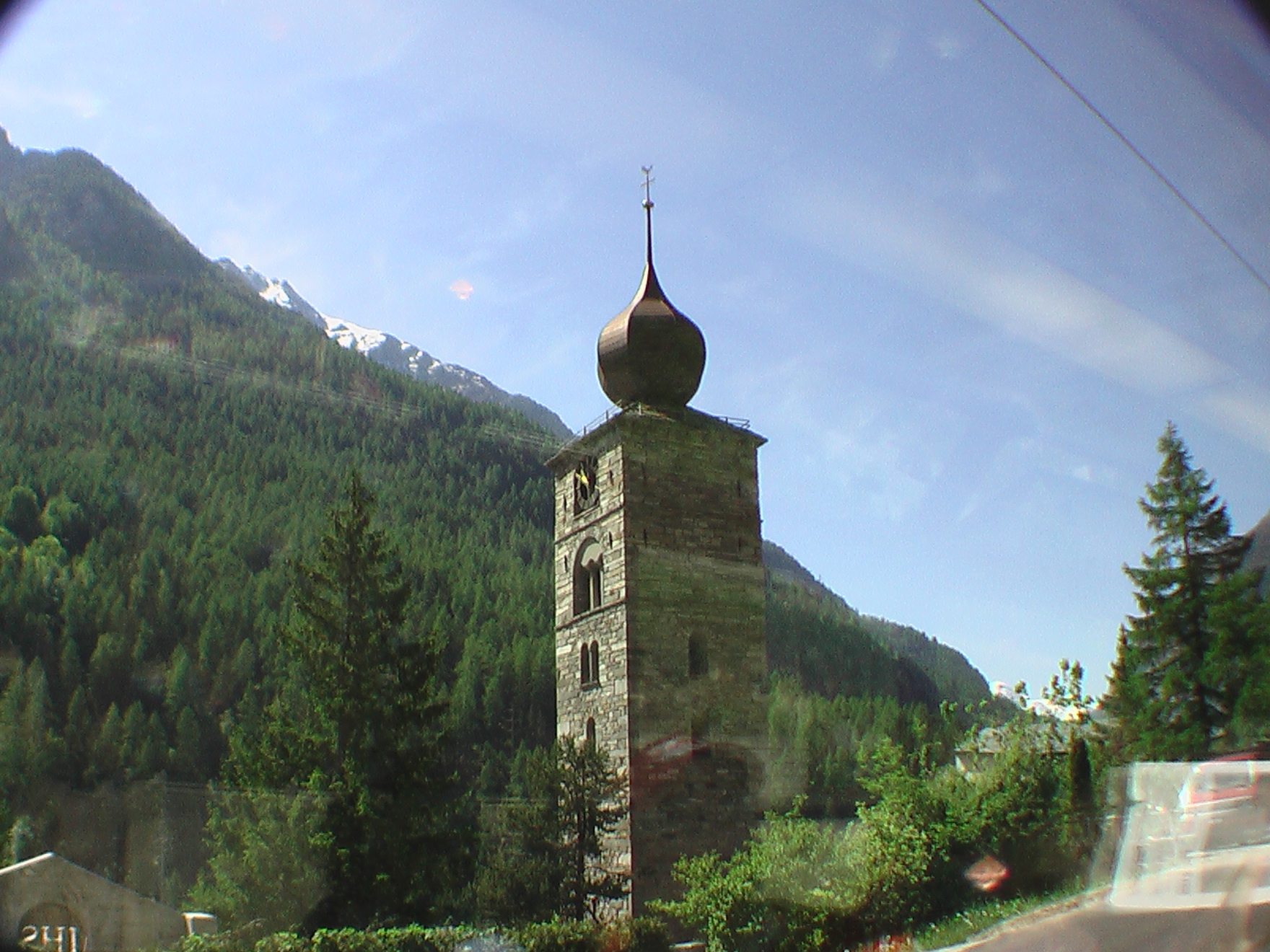
This onion-shaped architecture was quite common
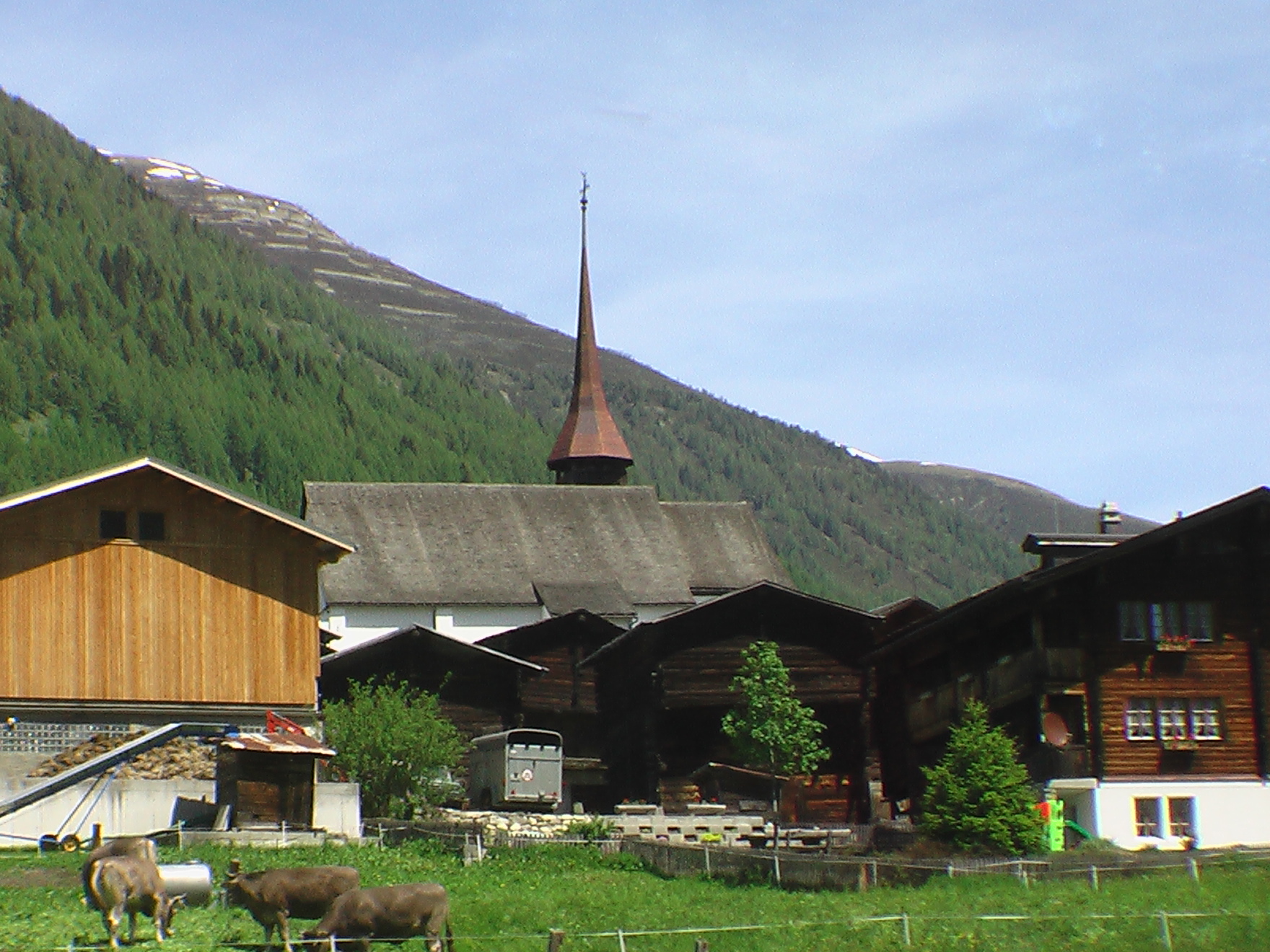
Every community had a church with a steeple
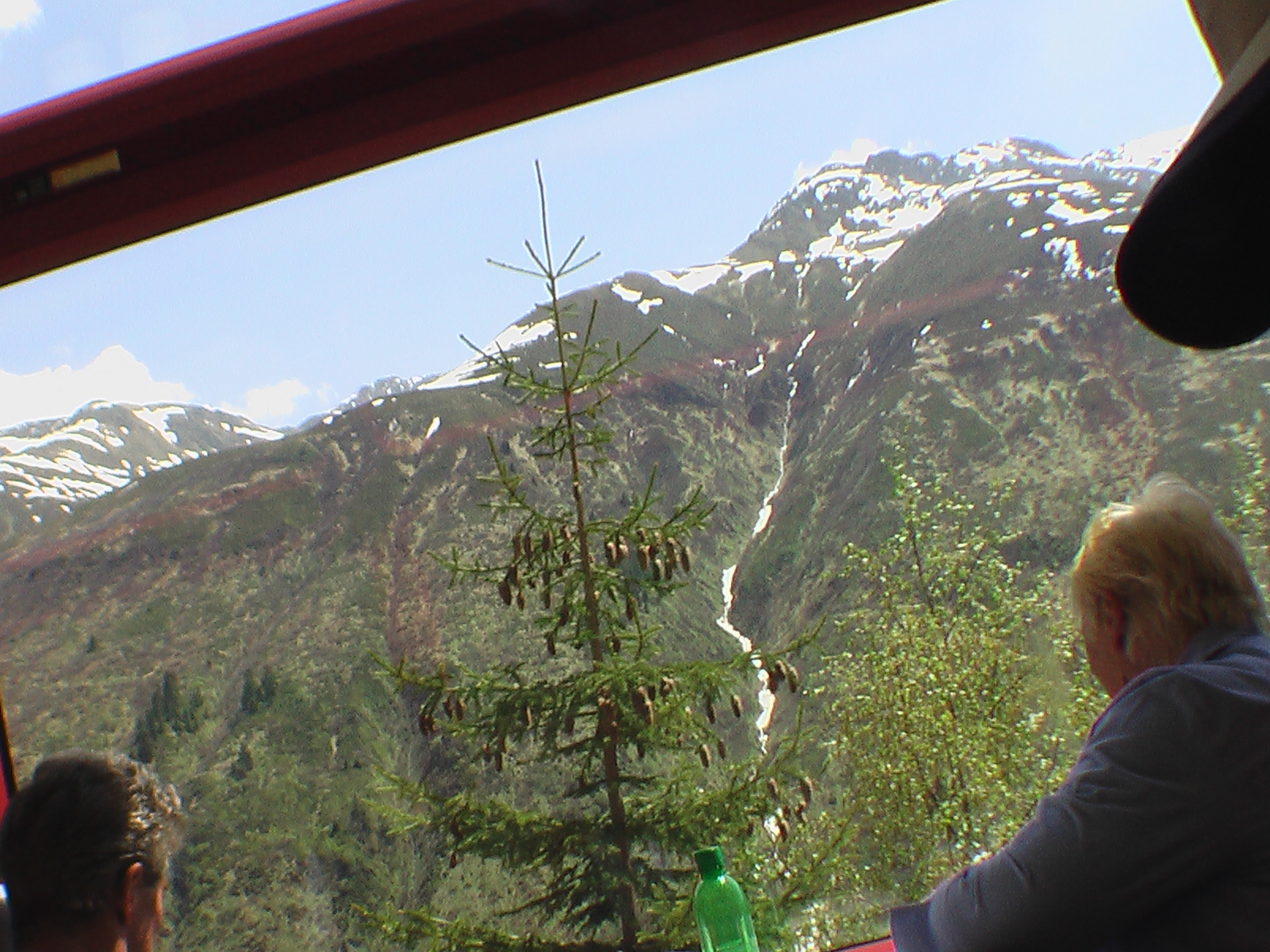
Other passengers enjoying their view
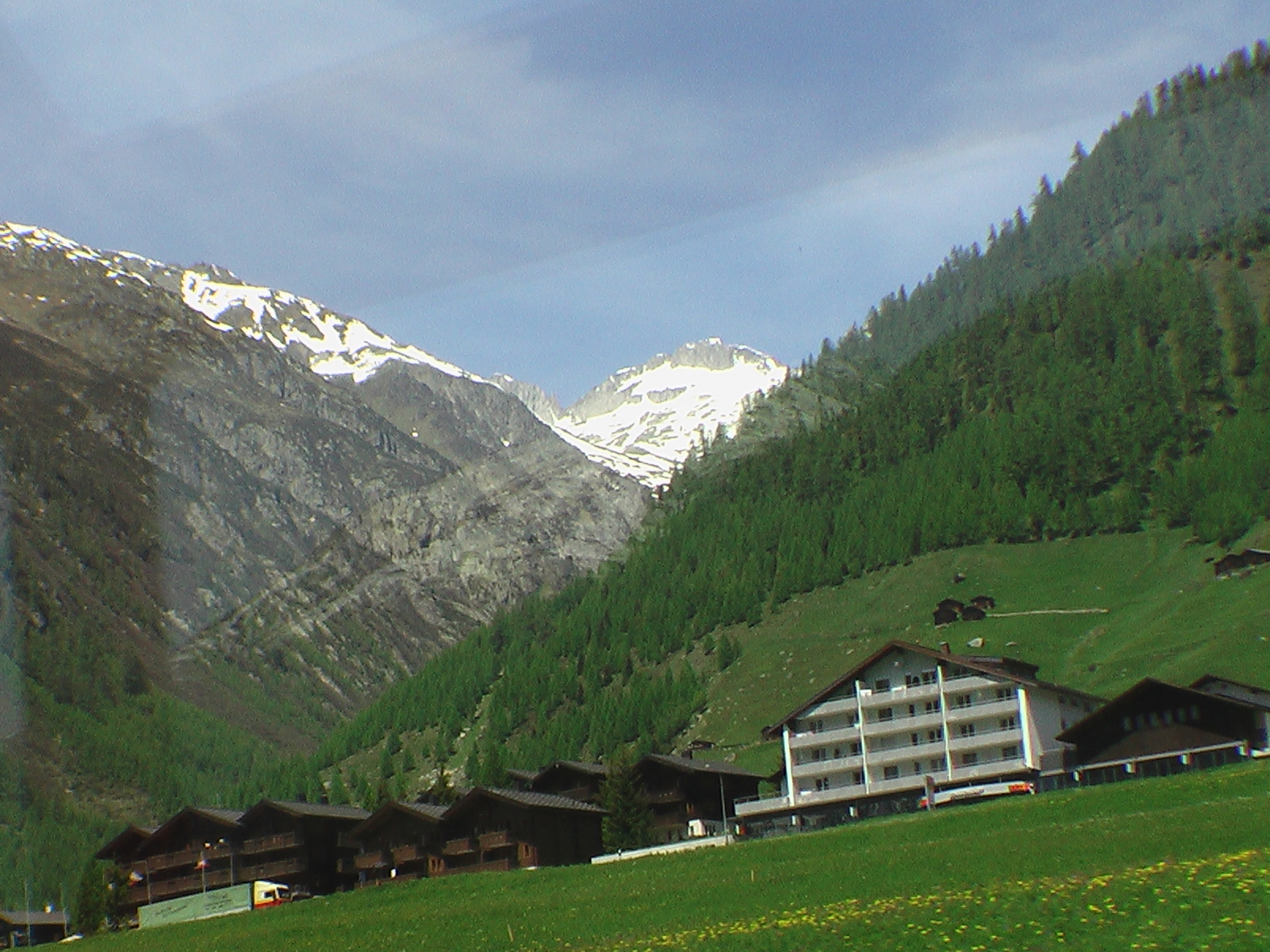 Another gorgeous view
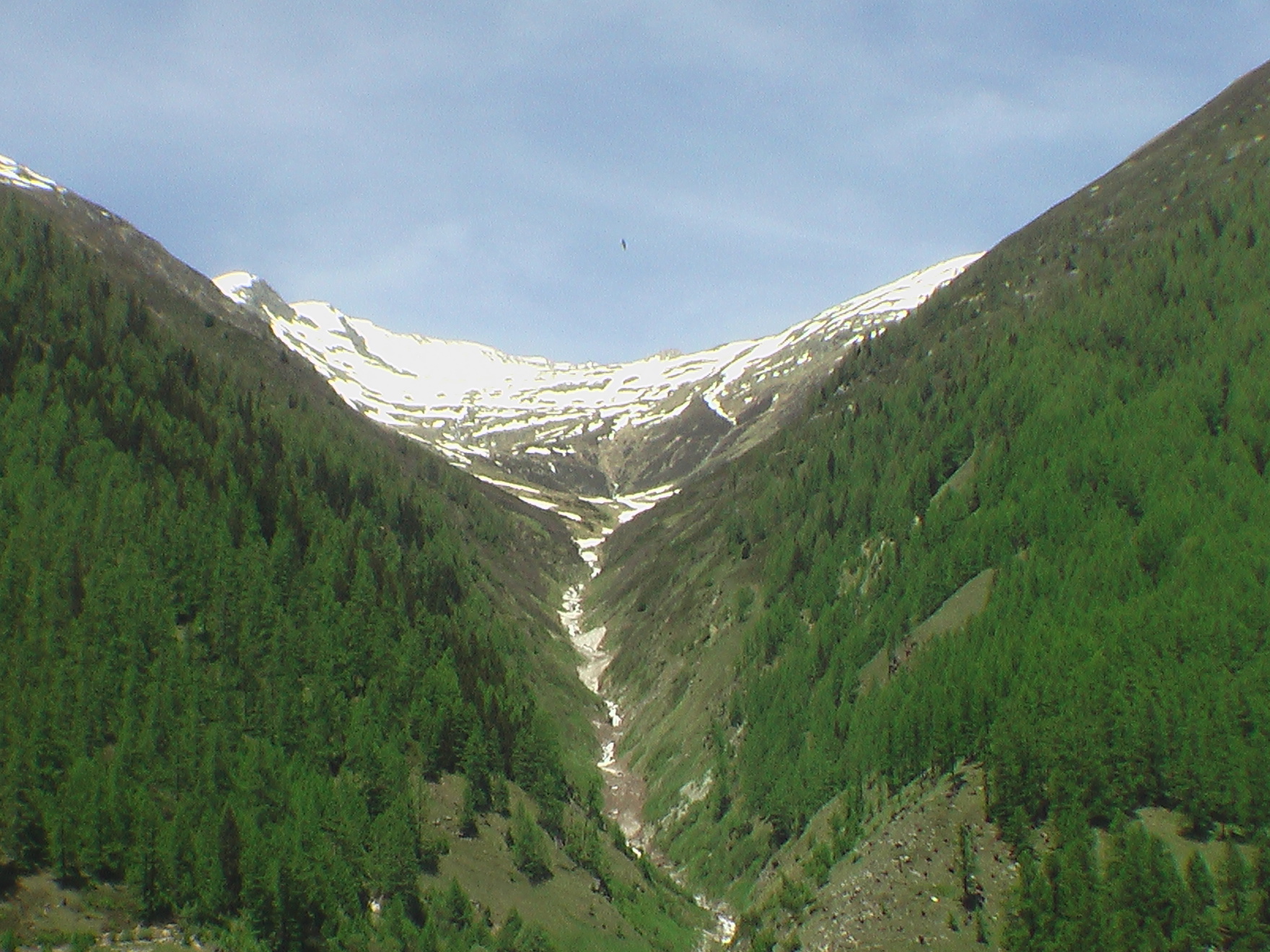
Hanging valley
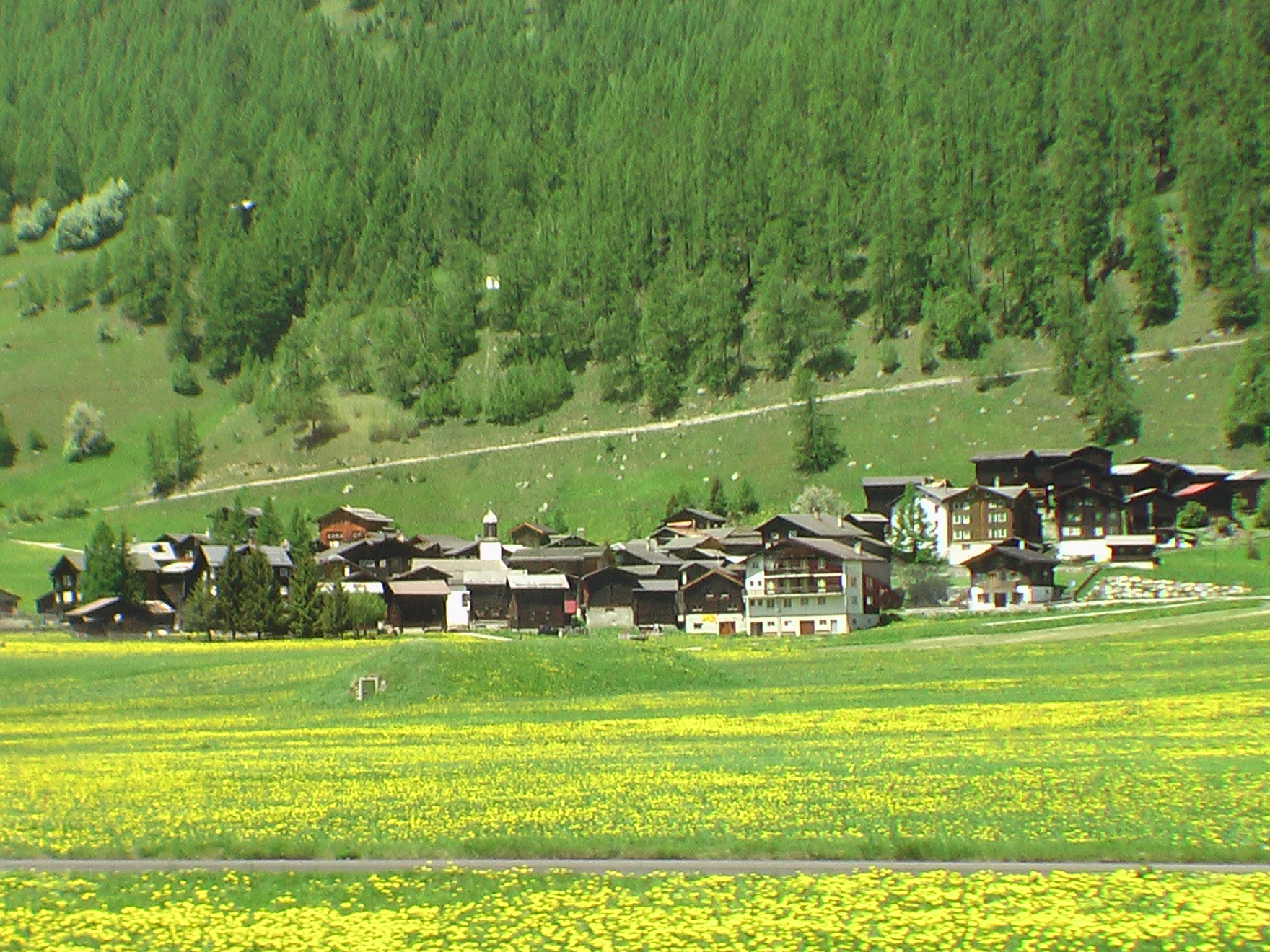
Another picturesque hamlet
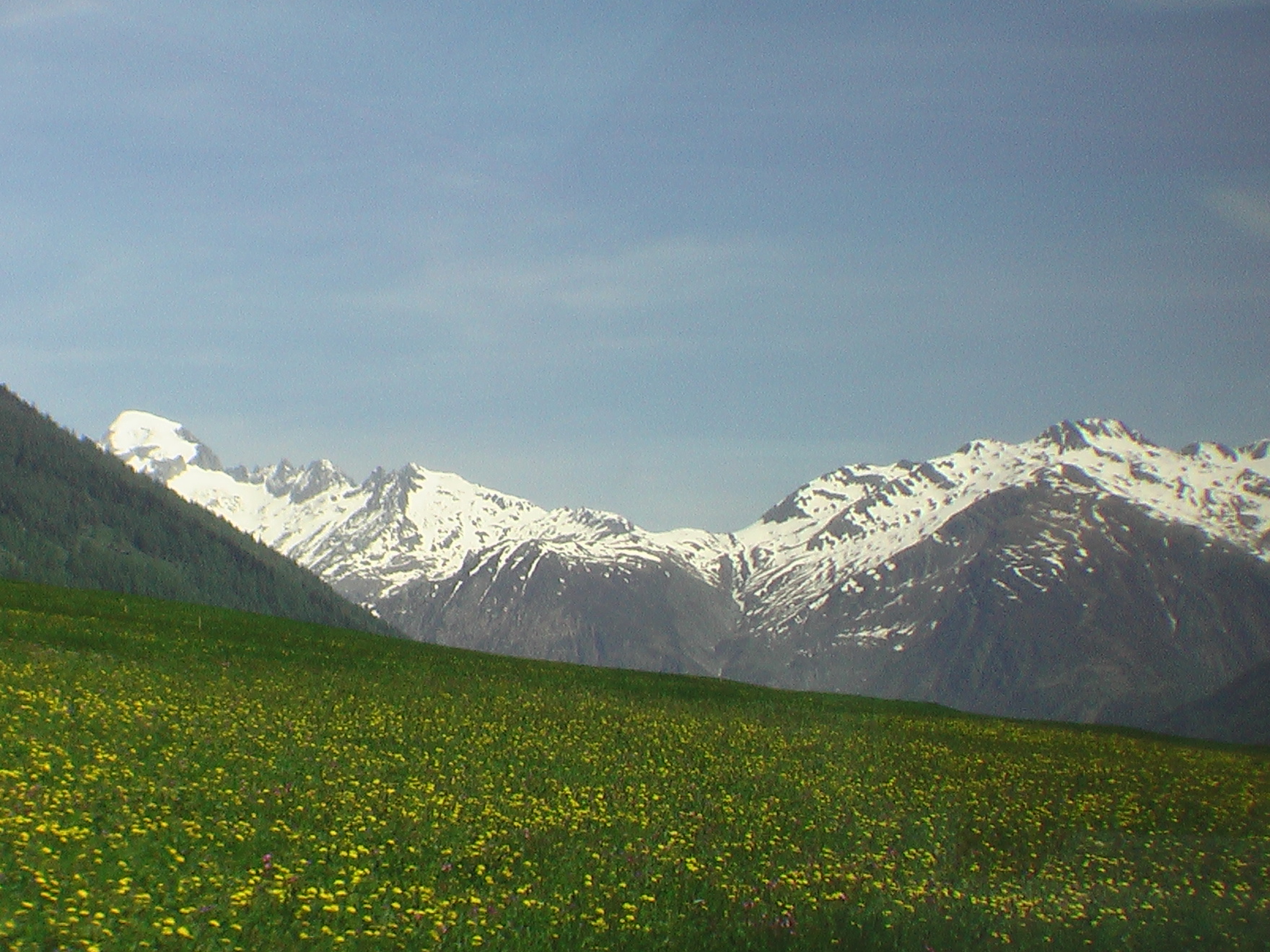
This one just screams, "The hills are alive ..."
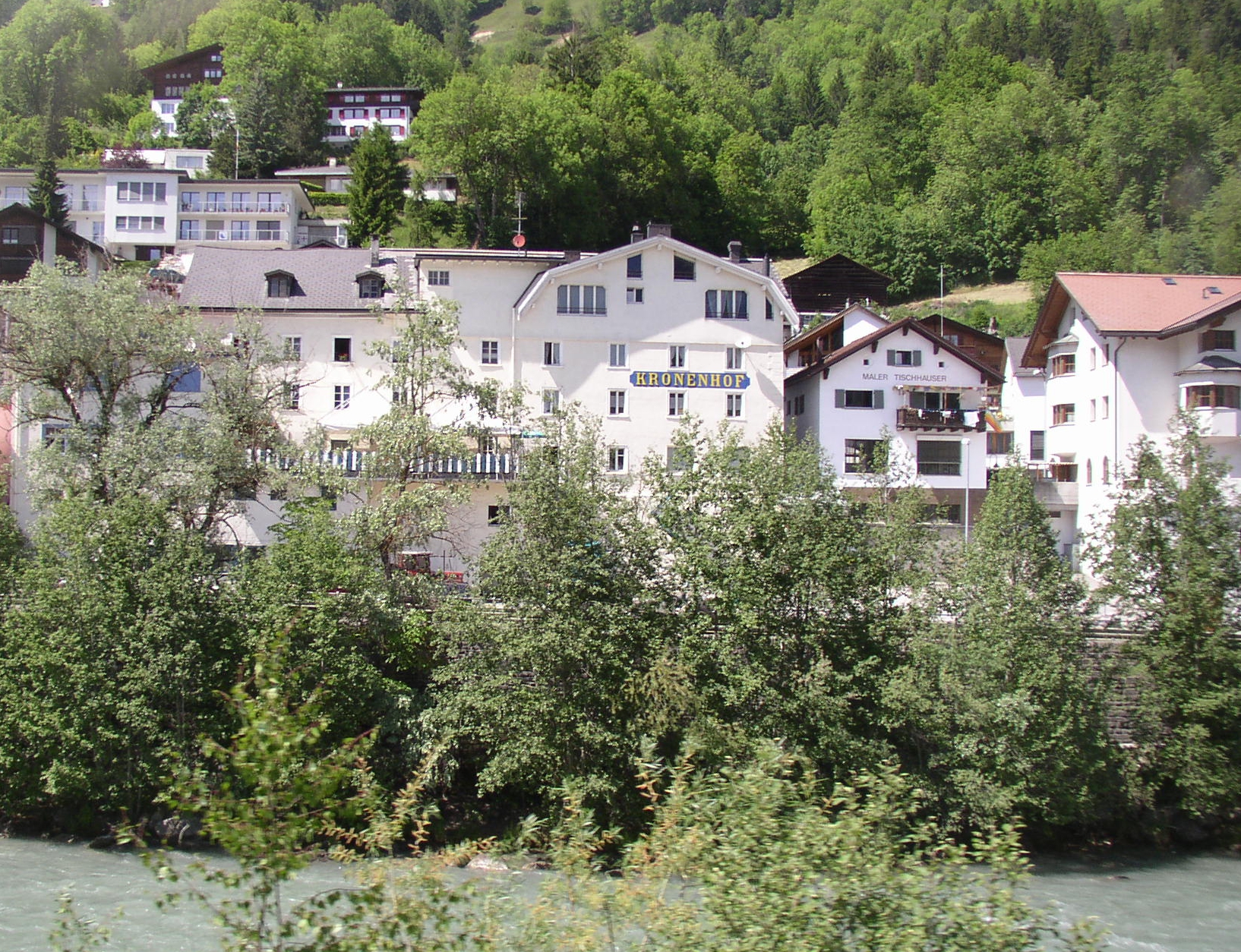
Painter table house(?)
This Kronenhof is obviously not THIS KRONENHOF, but it's probably a hotel, anyway. Next to it is a building entitled Maler Tischhauser, which, if translated literally, means "Painter table house." Probably just a name, I'm guessing.
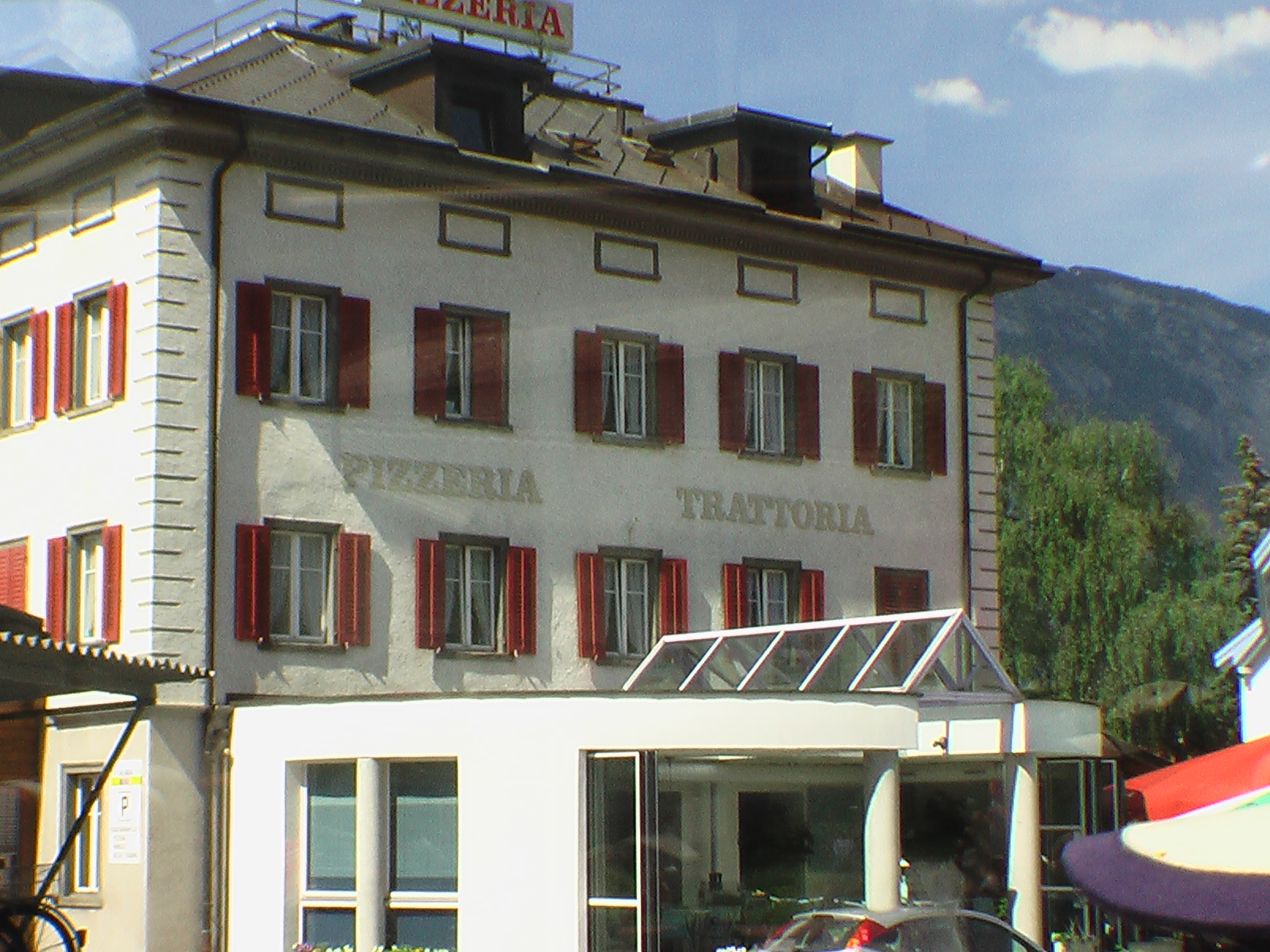
Pizza sounded really good after getting no lunch!
We were drooling after we spied this pizza place — and it was still quite awhile before we were to arrive in St. Moritz.
A wee bit of information about St. Moritz: It's one of the few places left where you can find people who speak Romansch.
Hope you enjoyed it. Next time, it's back to Nippon.
Now, here are tonight's special messages for our friends across the channel:
John has a long moustache. John has a long moustasche. Mary's cat is ill. Mary's cat is ill. Artichokes are three for a dollar. Artichokes are three for a dollar. A table leg is short. A table leg is short. My balloon is missing. My balloon is missing. Our grey goose is dead. Our grey goose is dead. The dairy has no cheese. The dairy has no cheese. Paulo has a large bull. Paulo has a large bull.
September 24, 2011
Here come the floats
At the conclusion of the mikoshi part of the parade, I was free to roam and take photographs. Here are some of the larger floats.
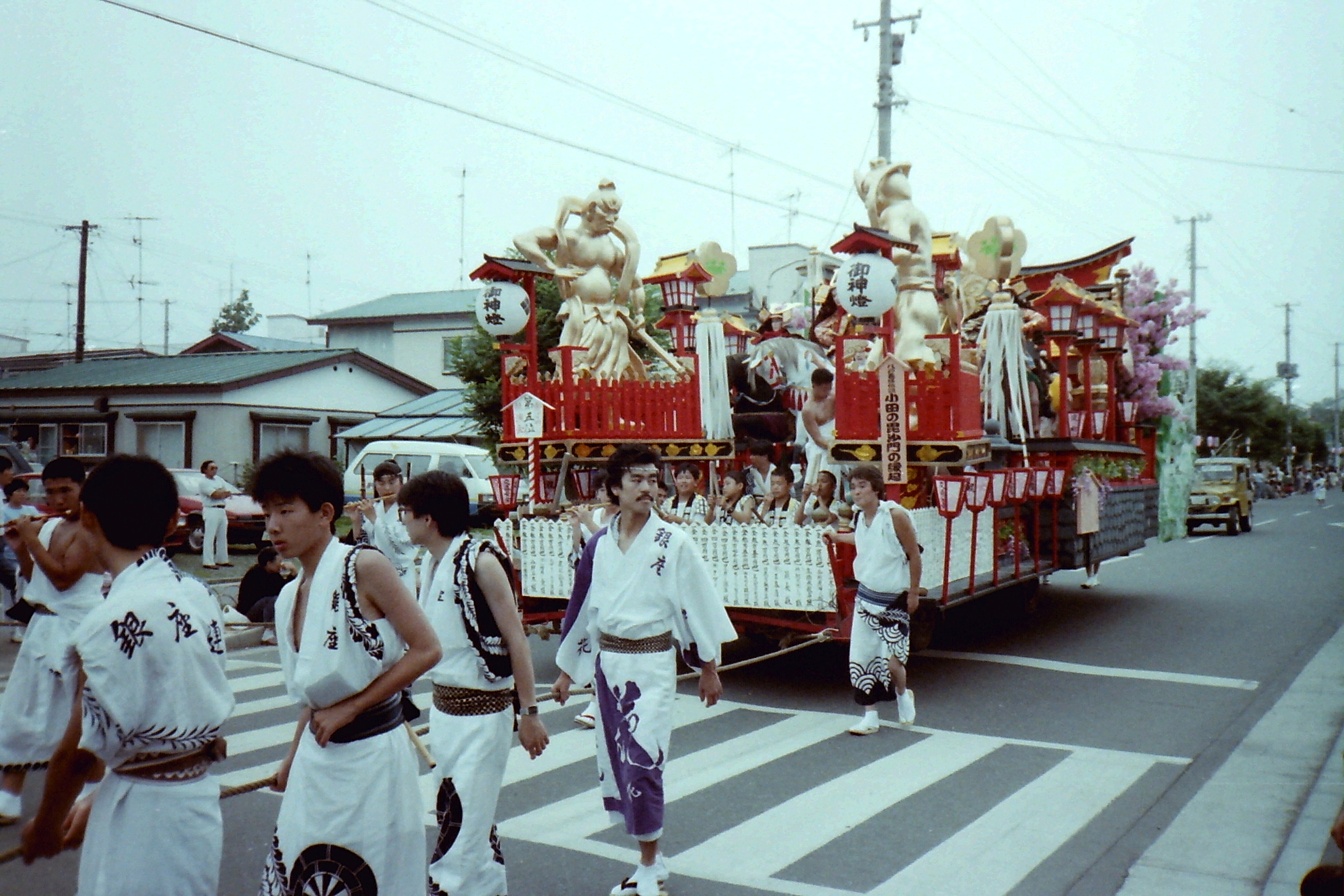
Misawa City Festival wheeled float
Note that none of these floats are powered by internal combustion engines; they are all people-powered. There are a lot more people powering this one than you can see, but I'll show you examples later in this post that give you a better idea of how many people it takes.
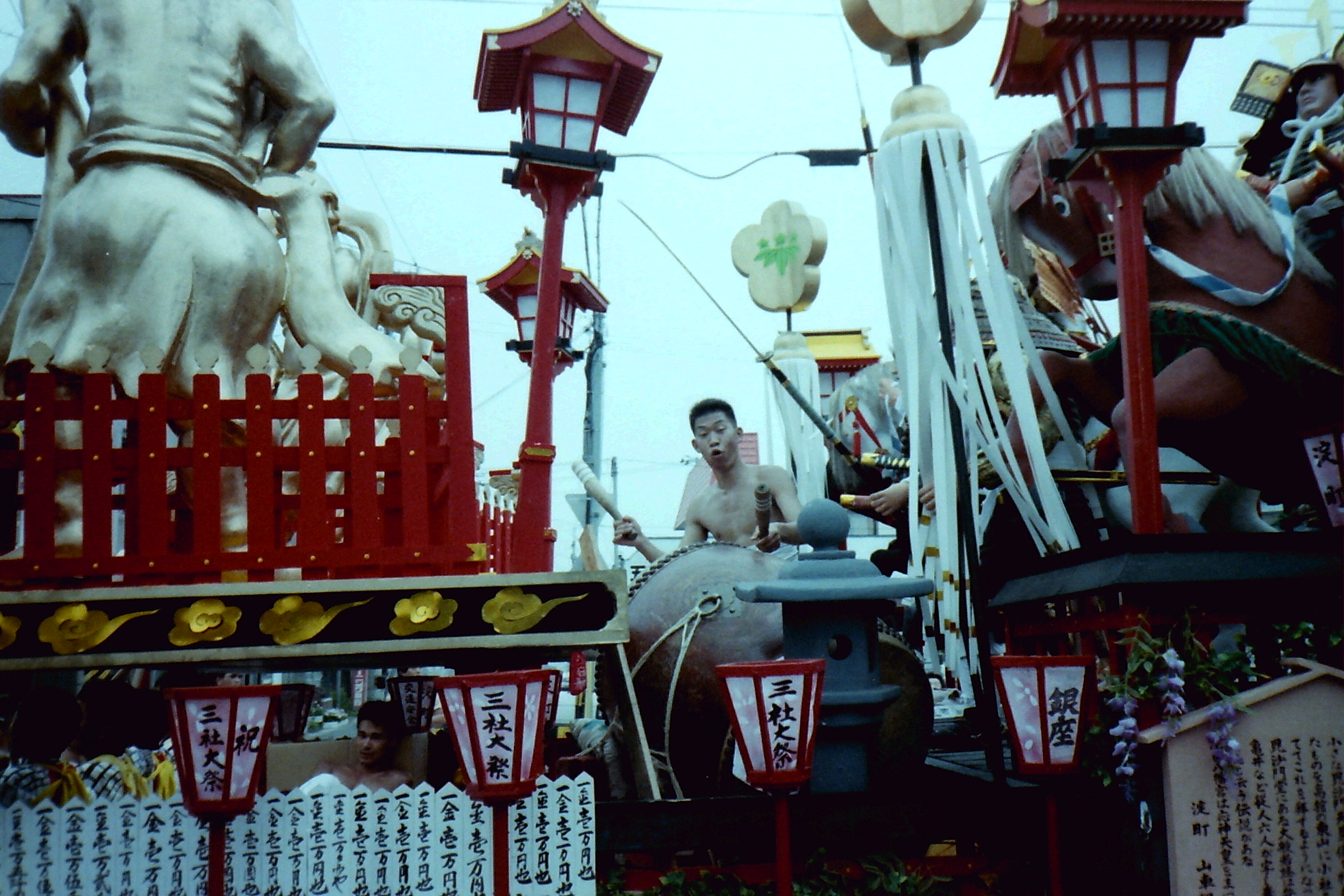
Taiko drummer on float
This taiko drummer's sticks resemble little baseball bats, don't you think? Soo desho!
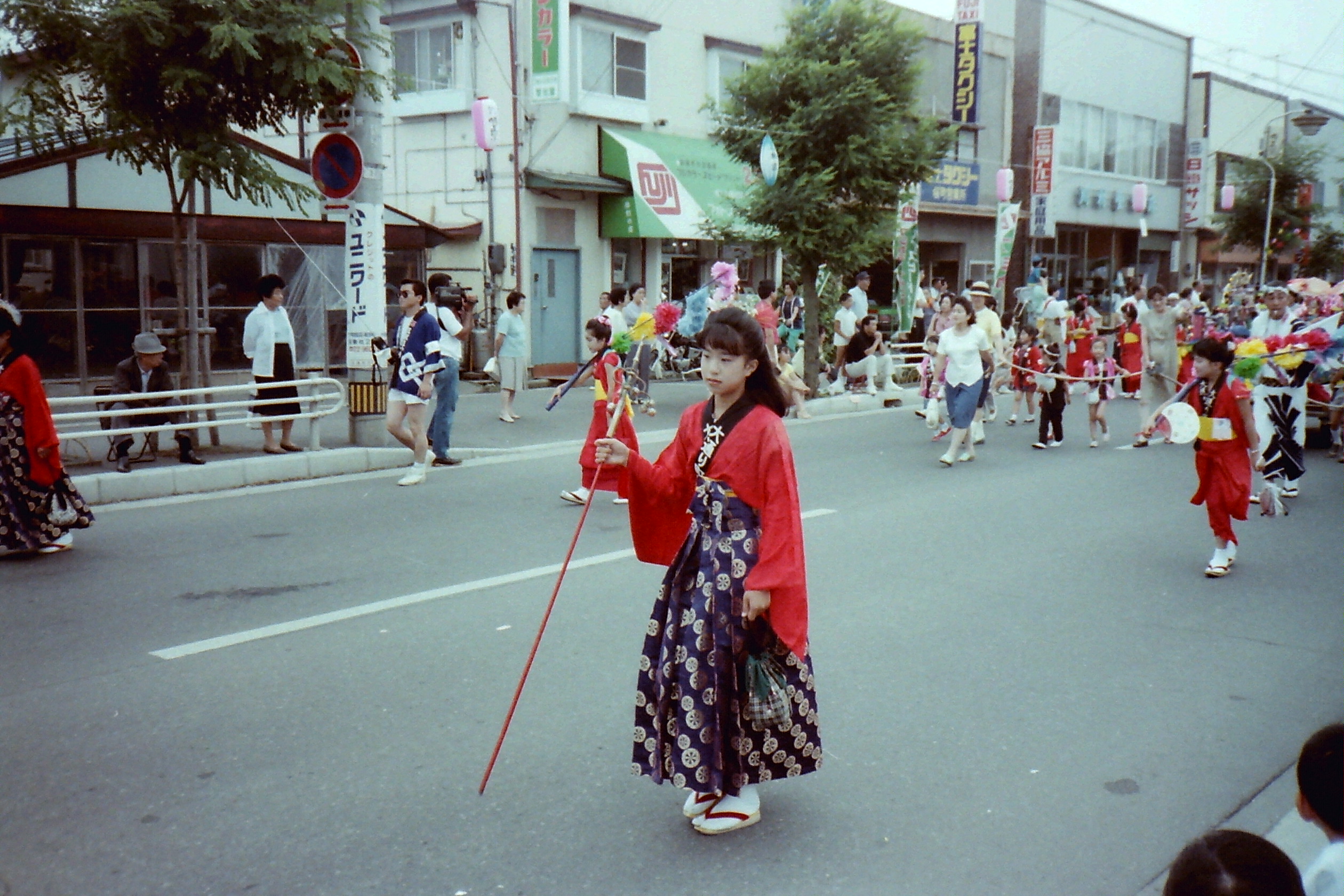
All dressed up and everywhere to go
I'm not sure of the significance of this girl's costume, but it appears to be a fancy hakama (split skirt) with a short kimono or haori.
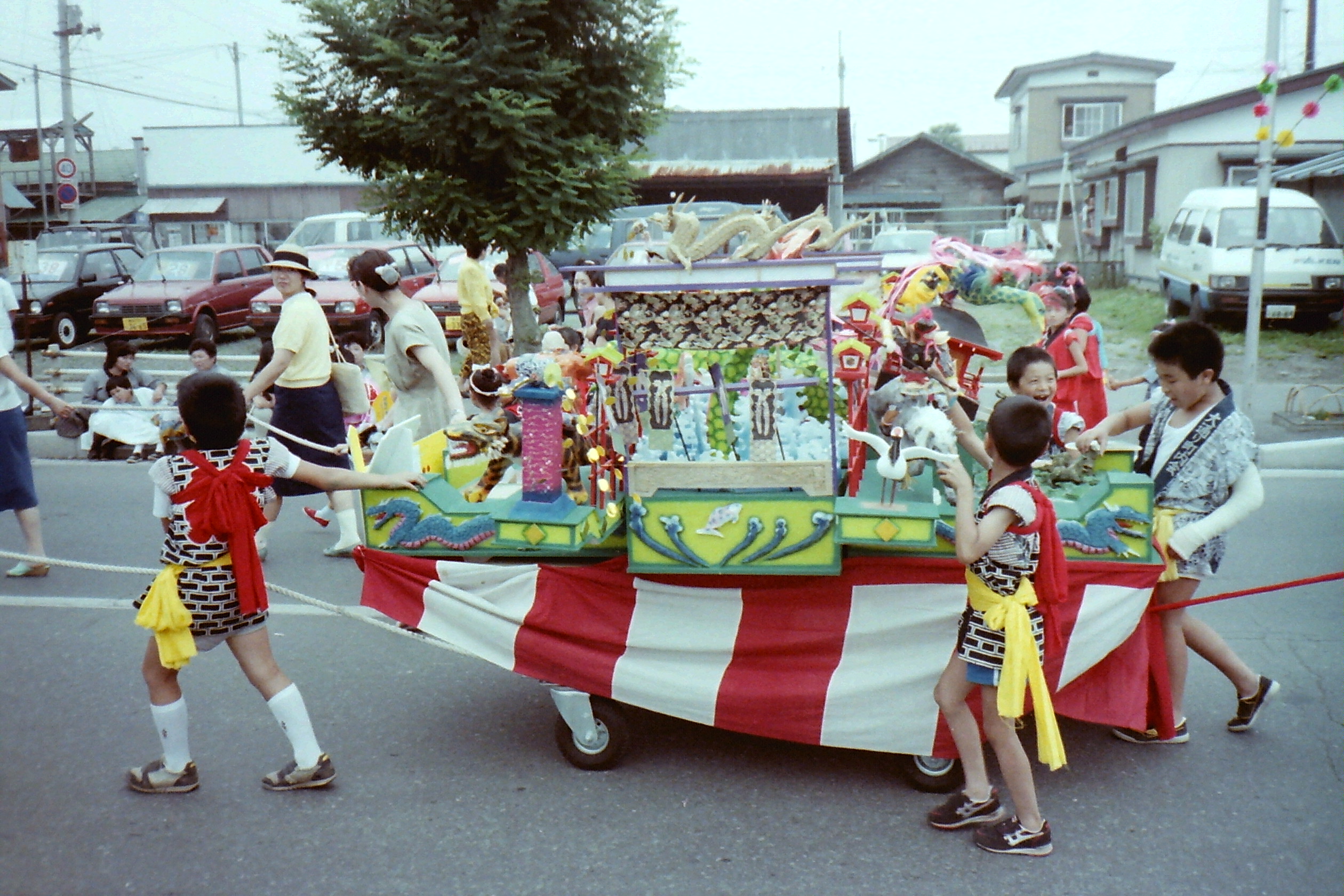
Childrens' float
Even the kids get into the act.
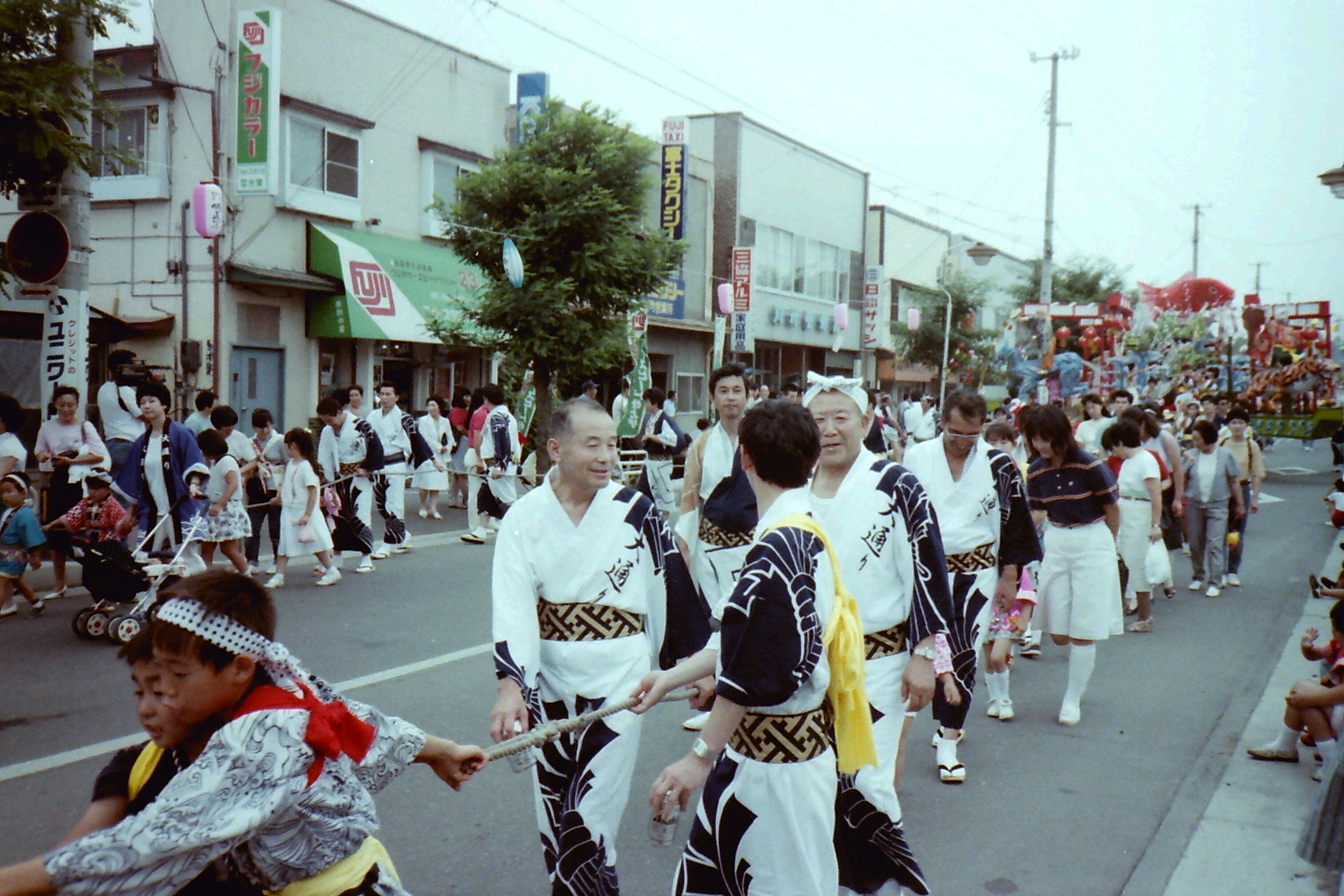
People power
You can't even see the entire line of people (two lines, that is) pulling this float. I often wondered if those rather small-guage ropes ever broke under the strain.
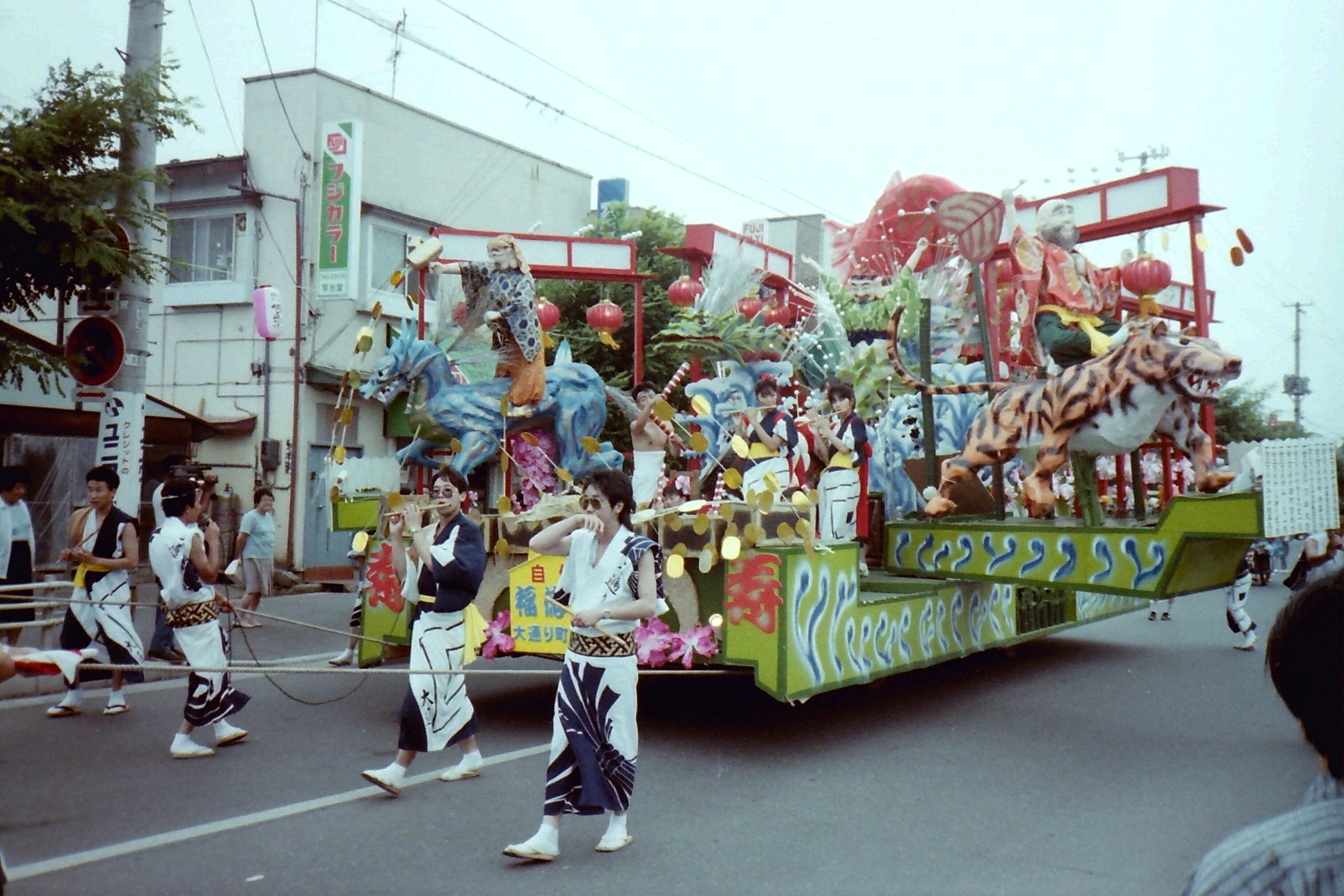
Float with taiko drummer and flutists
Note that this float also has a taiko drummer, as well as flute players. That was pretty common in the parade. The flute music they play isn't exactly what our Western ears are accustomed to, however. Also, note those swing-out wings sporting a tiger and a, uh, I suppose that's a horse and rider — or, at least, a charicature of such.
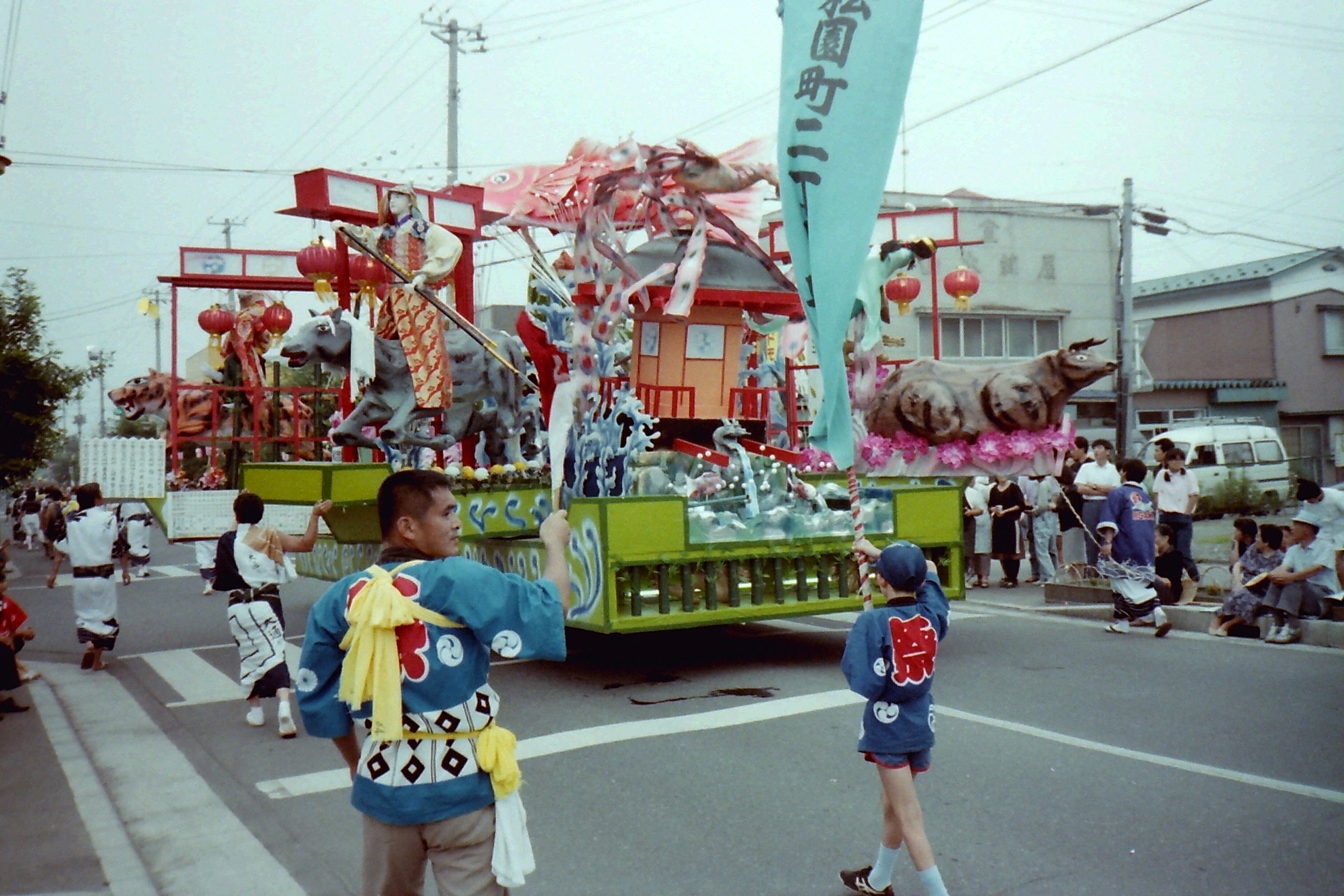
Back side of the float
Easy come, easy go. Easy for me to say, I suppose — I wasn't helping pull.
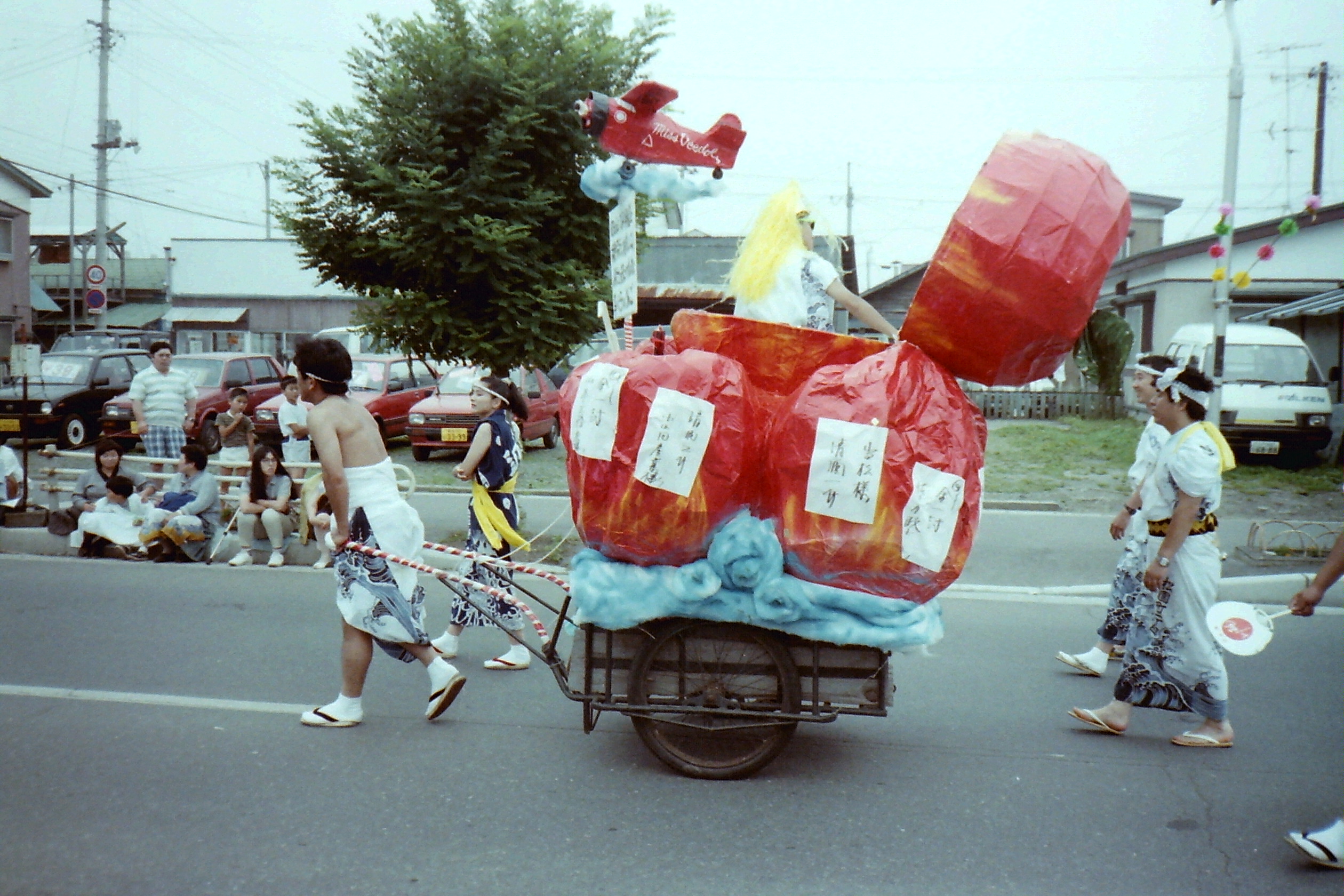
Miss Veedol, and the Apple Connection
Most Americans have heard the names Lindbergh and Earhart, but they have never heard of Clyde Pangborn and Hugh Herndon. Nor are they familiar with the first flight across the Pacific by the plane depicted here, the Miss Veedol, rising high above the pop-top apple carrying the carbon-based unit.
In 1931, Pangborn and Herndon took off from Misawa's Sabishiro Beach and flew nonstop to Wenatchee, Washington. Apparently, it was somewhat of an escape, as well, because they were under suspicion of spying. Misawa celebrates this flight in many ways, including using a plane that rides on rails on Green Pole Street in a contest of strength. The "pilot" pulls on a long rope to try to beat the best time for dragging the plane up the street to the finish line. Unfortunately, we Americans know nothing about this flight, and I suspect that is because it originated in Japan. By the way, both Washington and the area near Misawa are known for their apples. I found the largest apples I've ever seen somewhere between Misawa and Aomori, and if you will notice, Aomori Bay looks like an apple.
September 22, 2011
The Rise and Fall of the Mikoshi
Miyako and her children
This very, very nice lady was my housekeeper in Japan. She also kept house for some of my coworkers, and for only about $30, she scrubbed everything, shined shoes, stacked papers, vacuumed, and sometimes even cooked up a little miso soup with mussels. Her name, if memory serves me, was Miyako. All I can remember for sure is the "Mi" part, since I know her name began with the Hiragana symbol that looks like the number "2." More often than not, Japanese girls' names end with "ko," so I've probably got it right.
Miyako seems really happy in this photo, but sometimes she wore even darker sunglasses on overcast days — to hide the bruises. You see, she was separated from her husband, living in a tiny place with her three kids, trying to scrape out a living, and her husband would still beat her periodically, and he would not grant her a divorce. In Japan, wives are the property of their husbands, and a woman cannot divorce her husband unless the man gives her permission. He could legally beat her to within an inch of her life, and no one could do a thing about it — legally. Miyako's husband provided, on occastion, transportation for her, so he kept tabs on her that way. One time, he found out that some of us foreign devils had given her candy for Christmas or Valentine's day or something, and he beat the sushi out of her. I knew something was wrong when she arrived wearing sunglasses and did not want to take gifts, and her husband was sitting in his car in my driveway. The good news, however, is that the barbarian finally granted Miyako a divorce, and with that went all his rights of ownership. The next time he hit her would land him in jail, but I'm afraid I had to leave Japan before I found out the rest of the story.
If they only knew what was about to happen
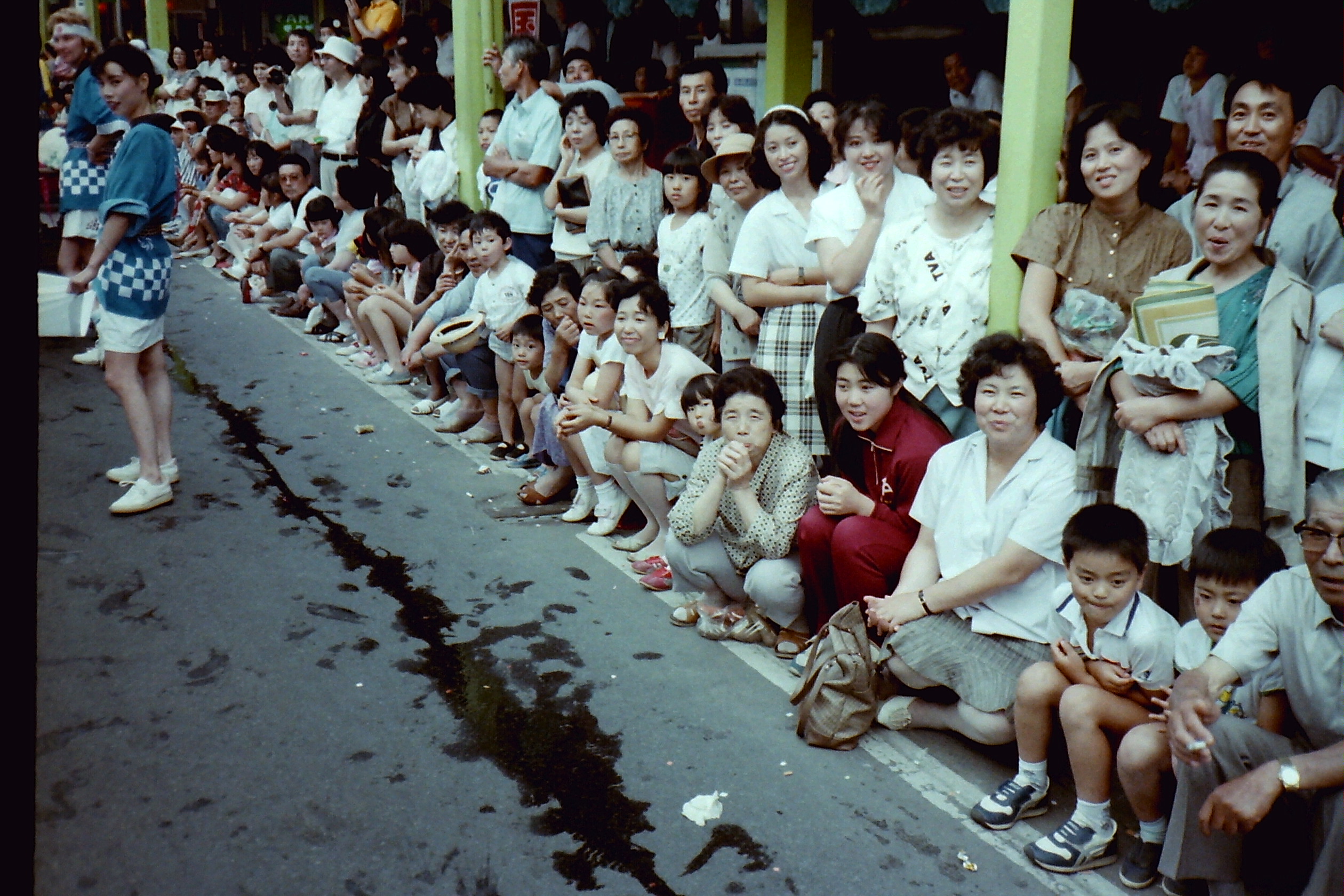
This happy-looking crowd was oblivious to the fate that was about to befall them. This was the resting spot I told you about earlier where, when we raised our Garfield mikoshi on high, my camera swung off my neck and sailed into the crowd, landing, I think, on someone's knee and popping apart the camera body. I was able to continue snapping, but the smiles were gone after that.
Green Pole Street
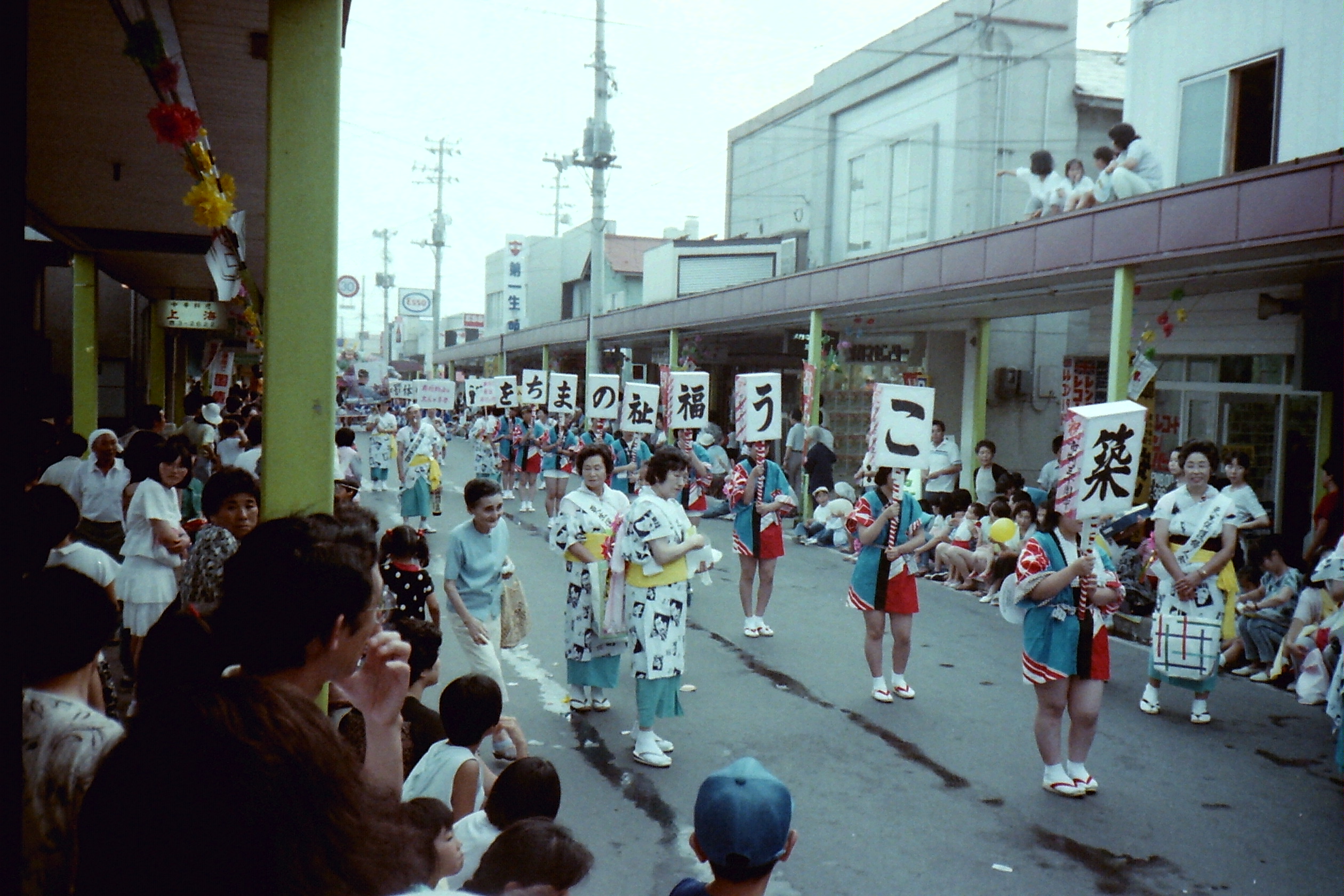
Here's a good view of Green Pole Street, which I mentioned in an earlier post.
Taking a break
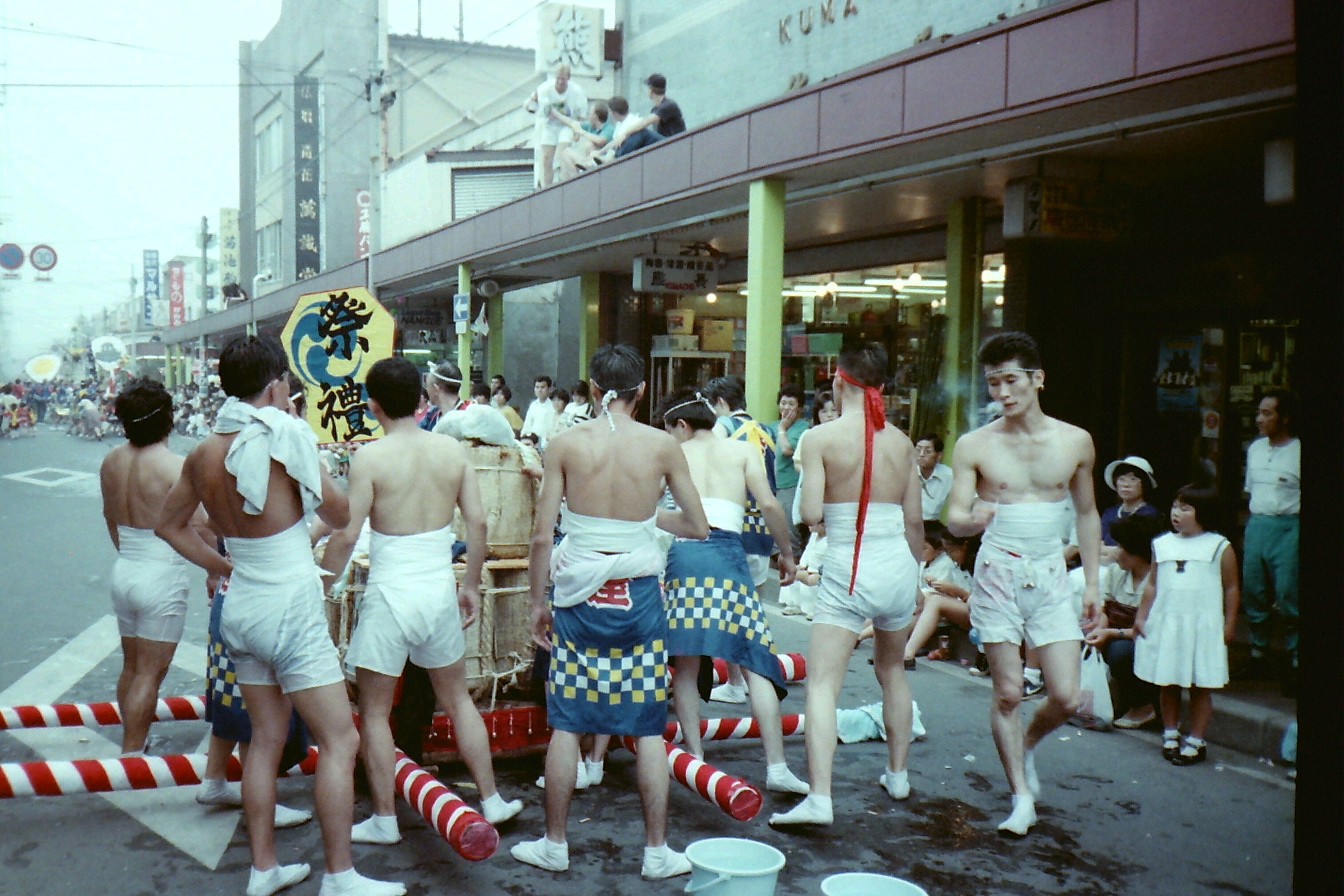
How many little ciggies can you count in this picture? And I wonder how these young, macho men are doing health-wise some twenty-four years later?
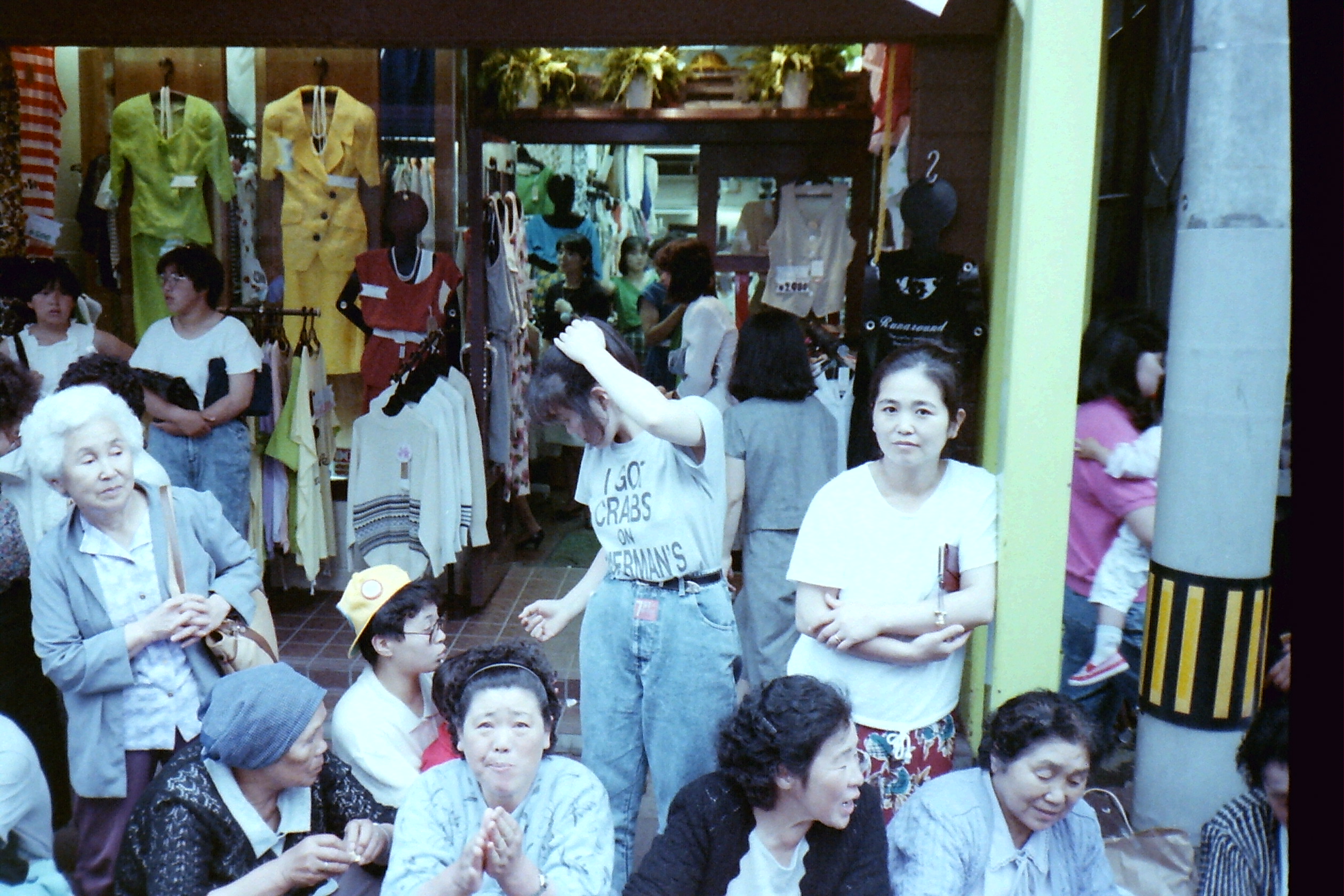
Nowhere near Fisherman's Wharf
It was so common to see misused English in Japan. For example, I knew a young woman who wore a cheeerleader's jacket that said on the back, "Encounter Mutant," and I bought a box of cookies that were labeled, "Homely Cookies." Another of my favorites was the coffee creamer named "Creap," and the isotonic drink I mentioned earlier called, "Pocari Sweat." This girl, for certain, had not a clue about her shirt's double entendre. But, in reality, we were only a few kilometers from the wharves.
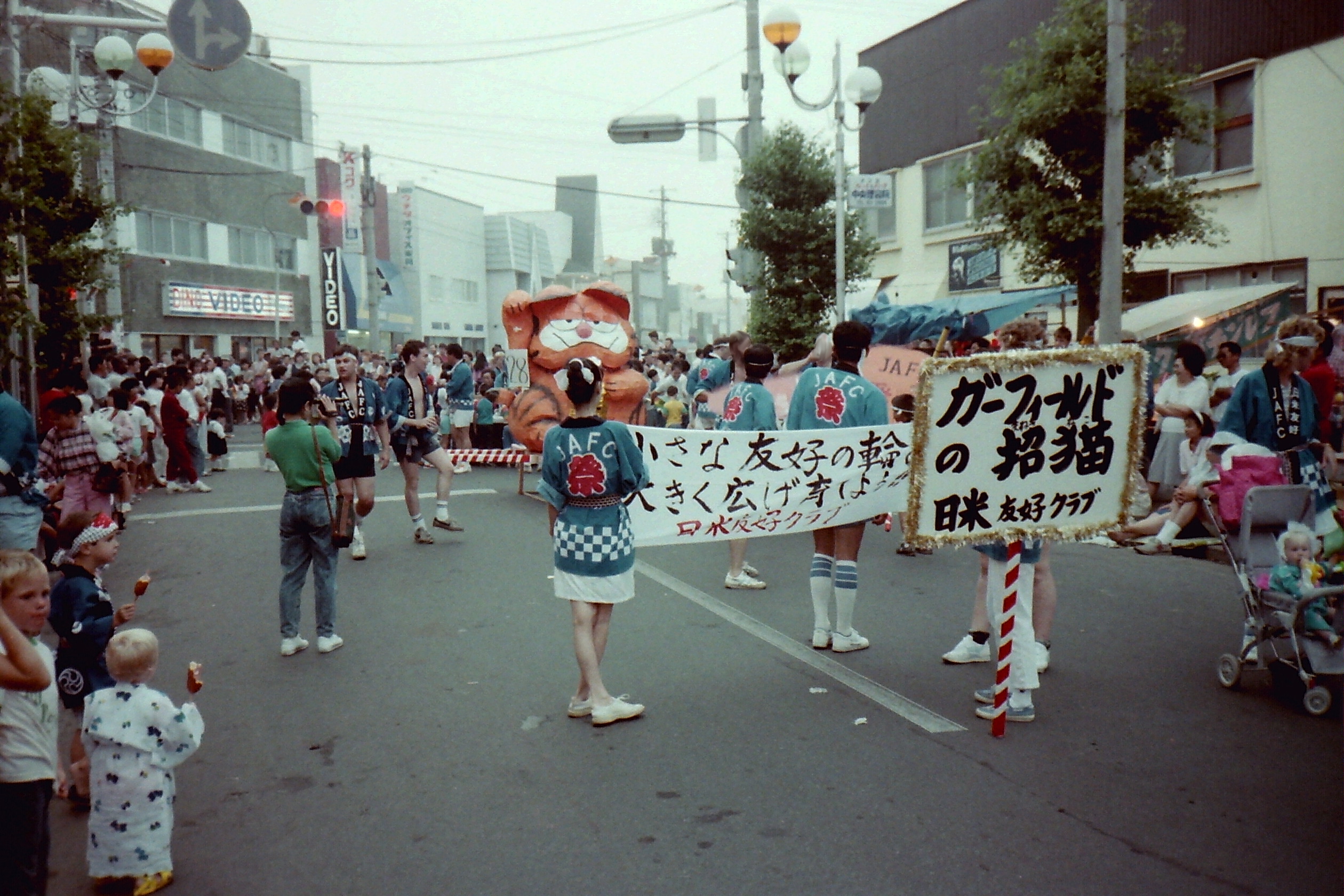
Leaving Green Pole Street and winding down
Our quest is nearing an end, and Garfield, I presume, will be stored away for another day. The cute little girl in the kimono is visible in the stroller on the right, and don't even ask me what the kids on the left are eating — it's not state fair corn dogs; I'll guarantee that.
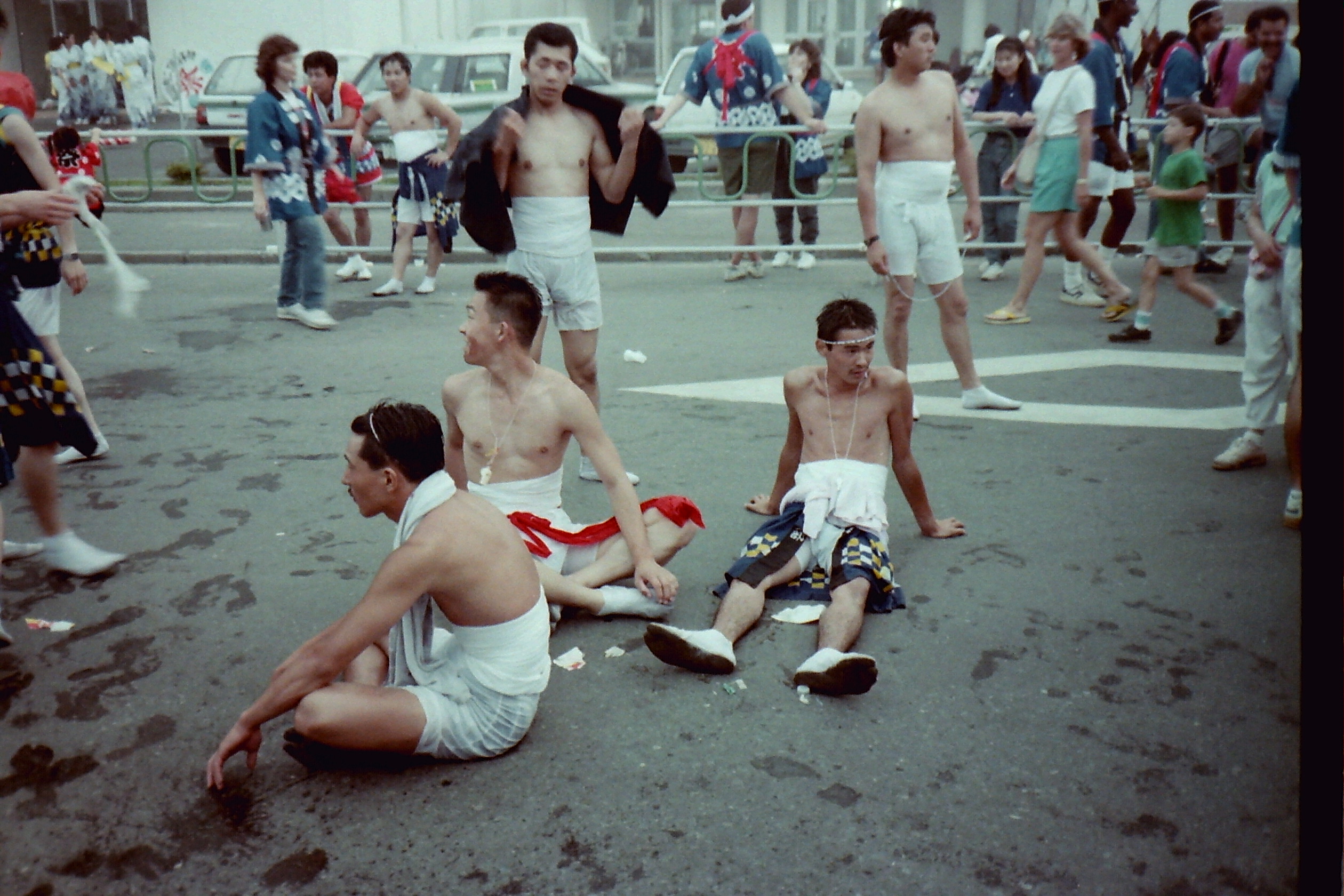
Vaquished Samurai
These guys are, as we say in Oklahoma, flat worn out, they've been rode hard and put up wet. What was curious was, for all the time we were taking part in the parade, and for all the beer that was consumed, no one had to use the benjo (crude word for bathroom, meaning "convenient place," also what we called the covered ditches that lined most of the roads and which conveyed raw sewage). It was so hot and everyone worked so hard that all liquid imbibed turned to sweat (but not Pocari Sweat).
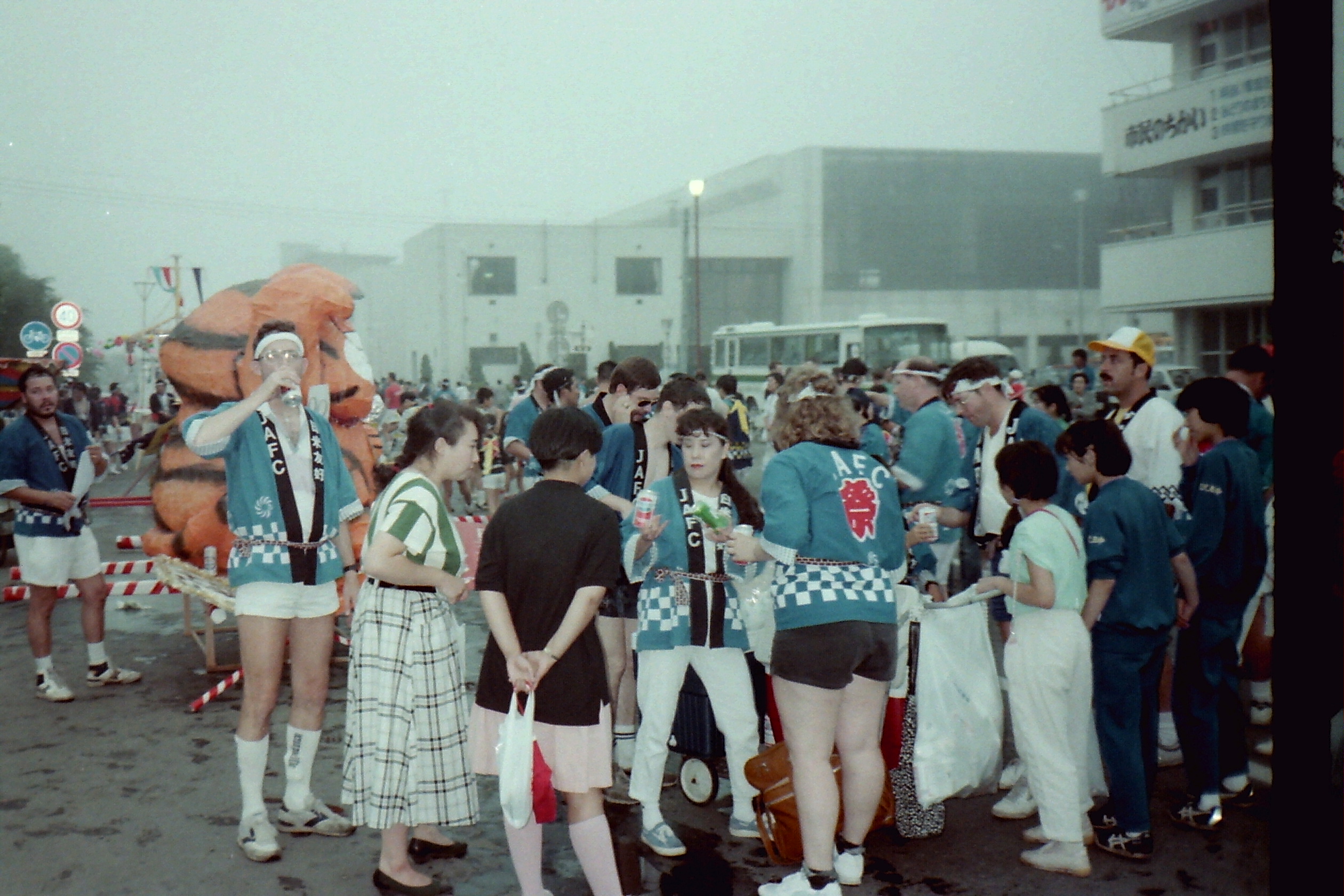
Rest at last
The Mikoshi Parade is over, the the woman in the center is passing out the Pepsi. But the festivities are far from over, as the big, elaborate wheeled floats are coming!
Following are a few photos to give you a preview of bigger and better things to come. Some of the floats I will show you in subsequent posts are quite impressive.
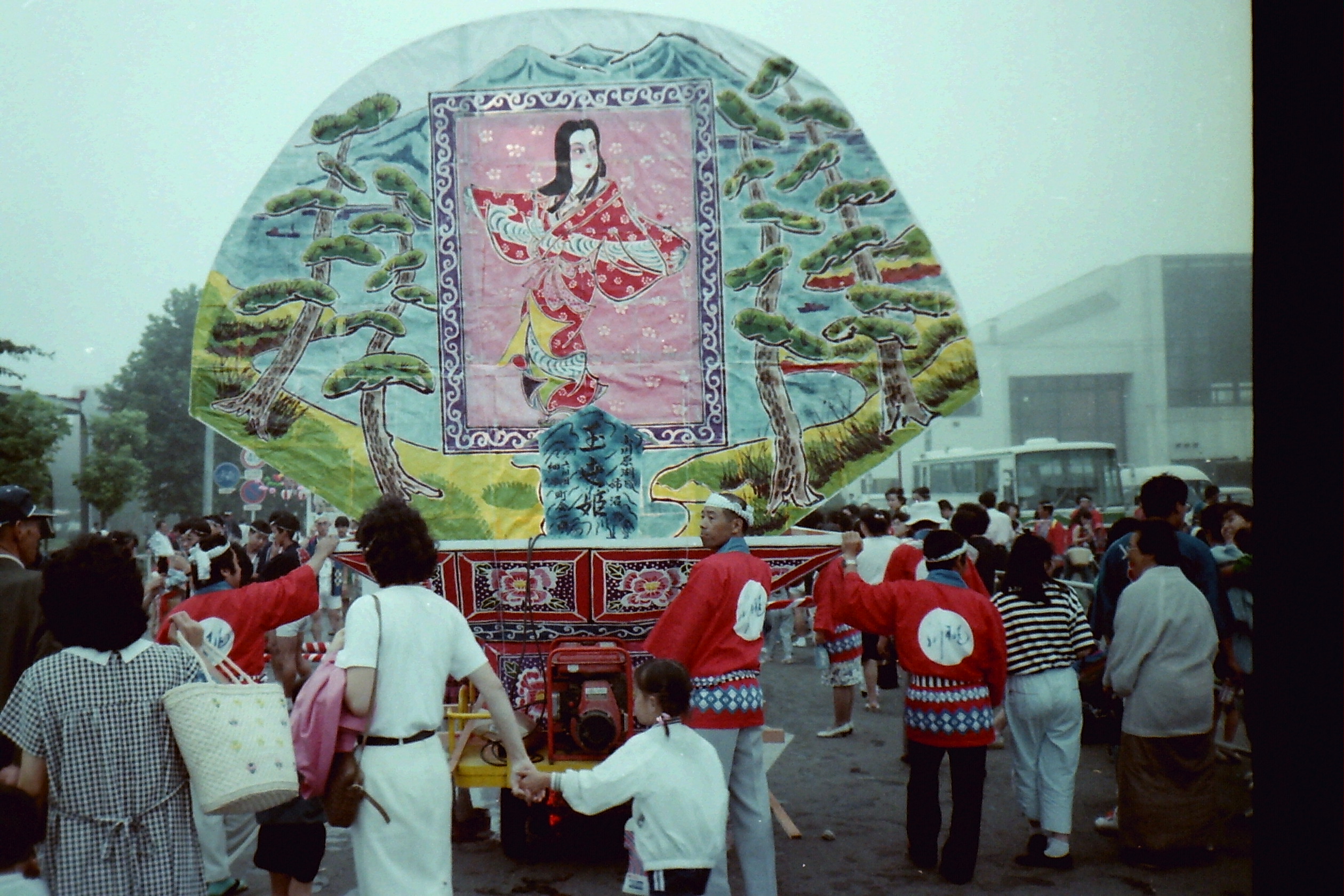
Small float
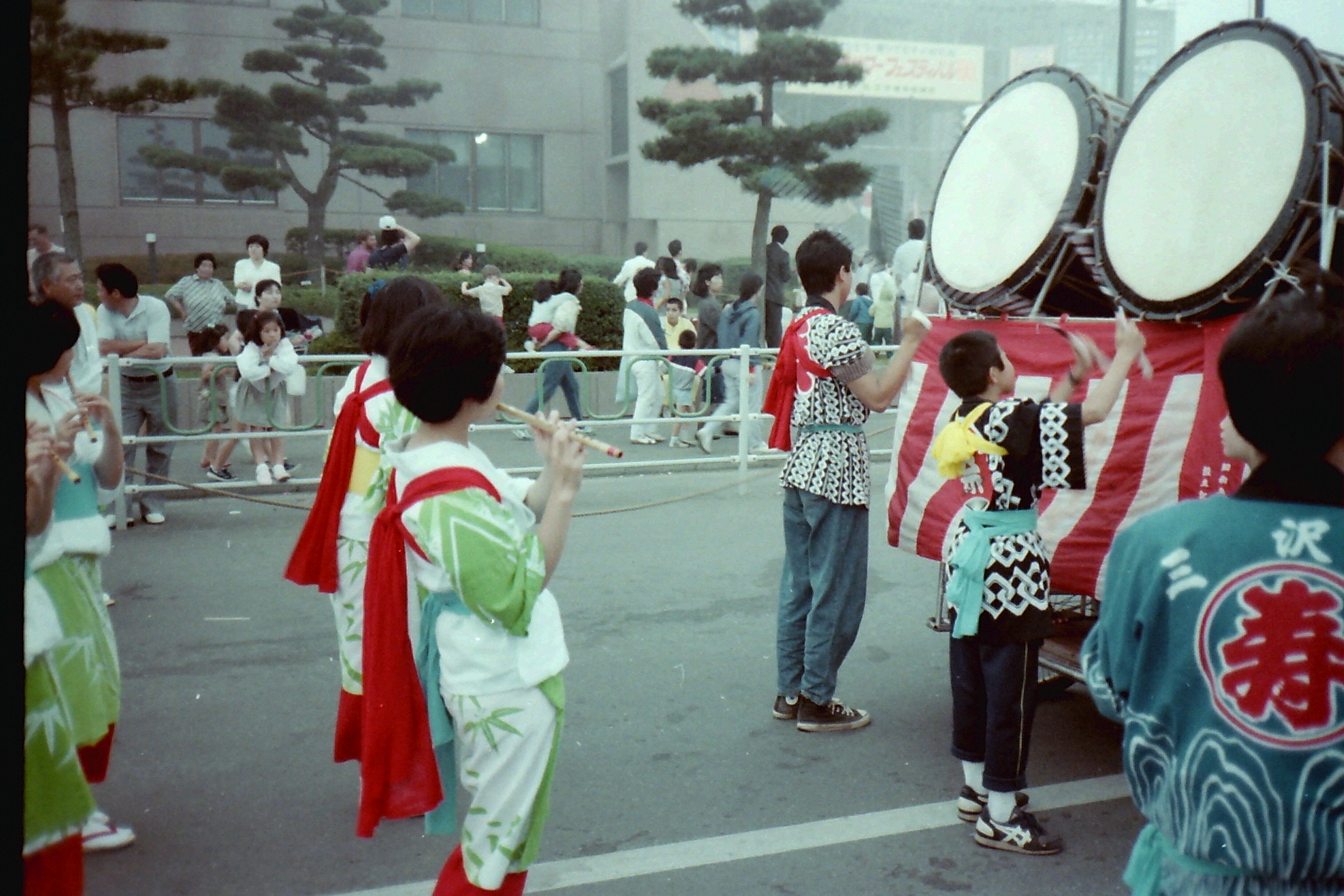
Taiko drummers and Japanese flute players
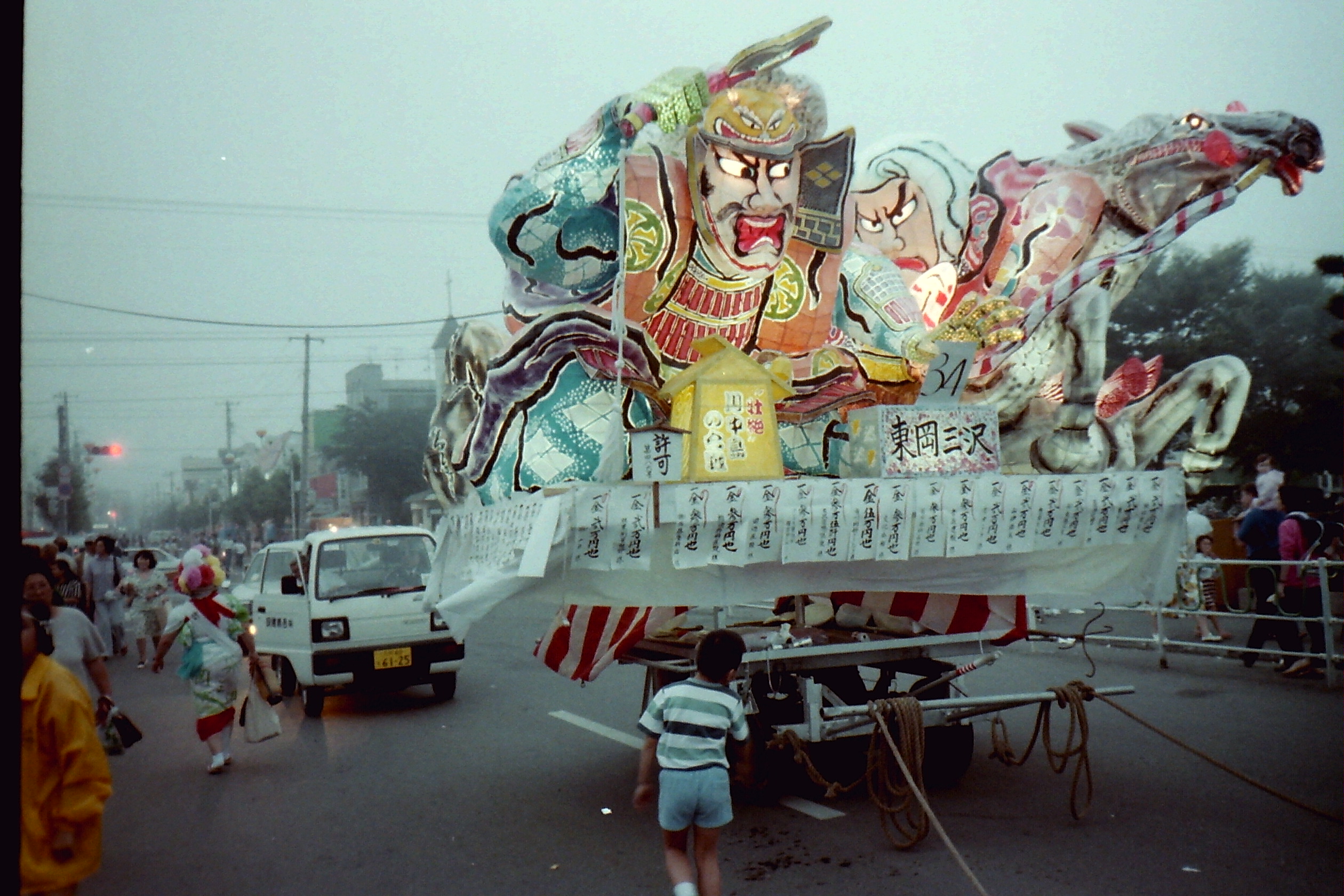
A float illuminated from inside
September 21, 2011
One Mikoshi, Two Mikoshi, Three Mikoshi, Four …
Check out the top of this float. After examining it, you might believe it to be too heavy to be carried on shoulders, right?

Mikoshi, or unfinished residence?
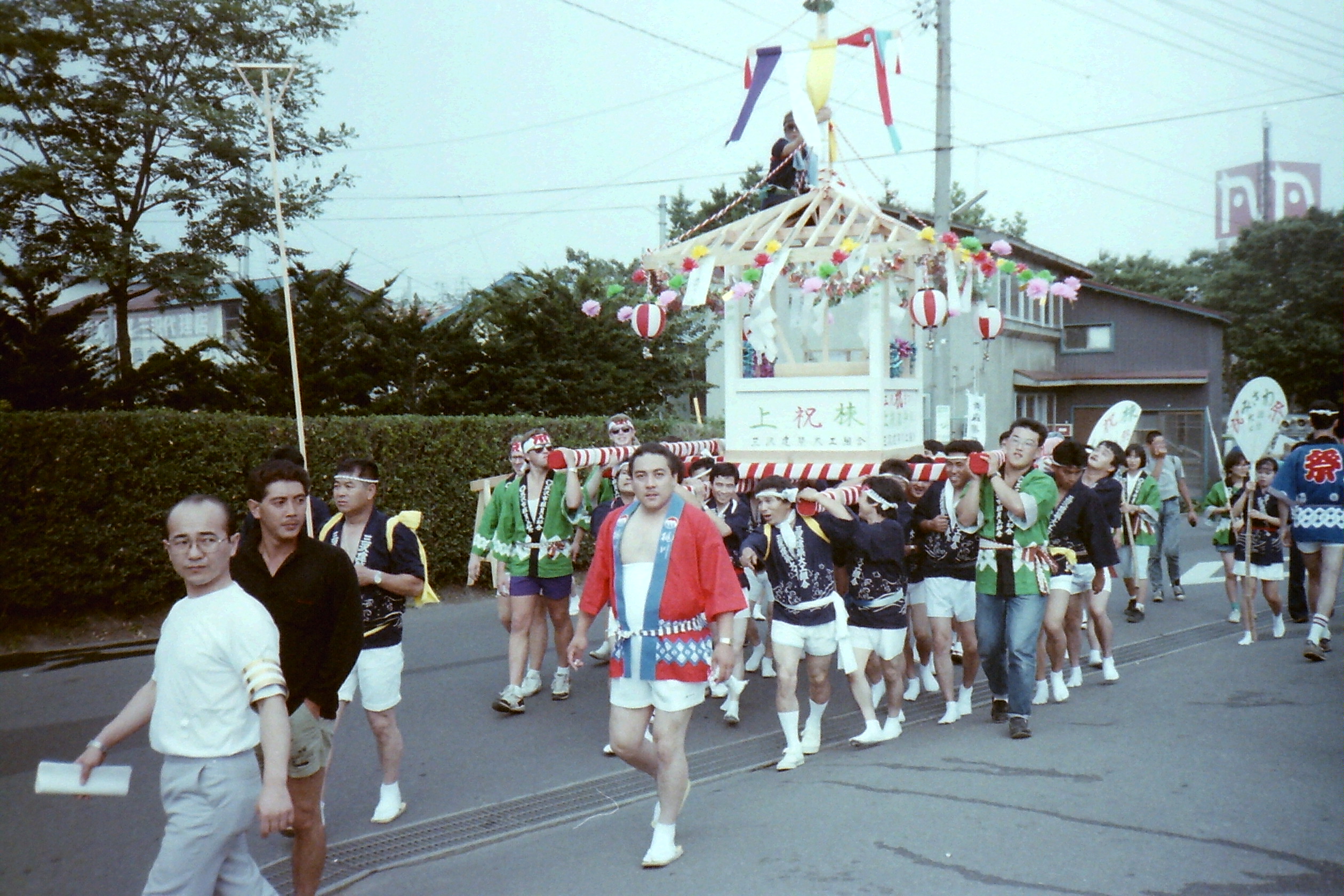
Nope--it's a mikoshi all right!
Making the mikoshi as heavy as possible seemed to be part of the allure.
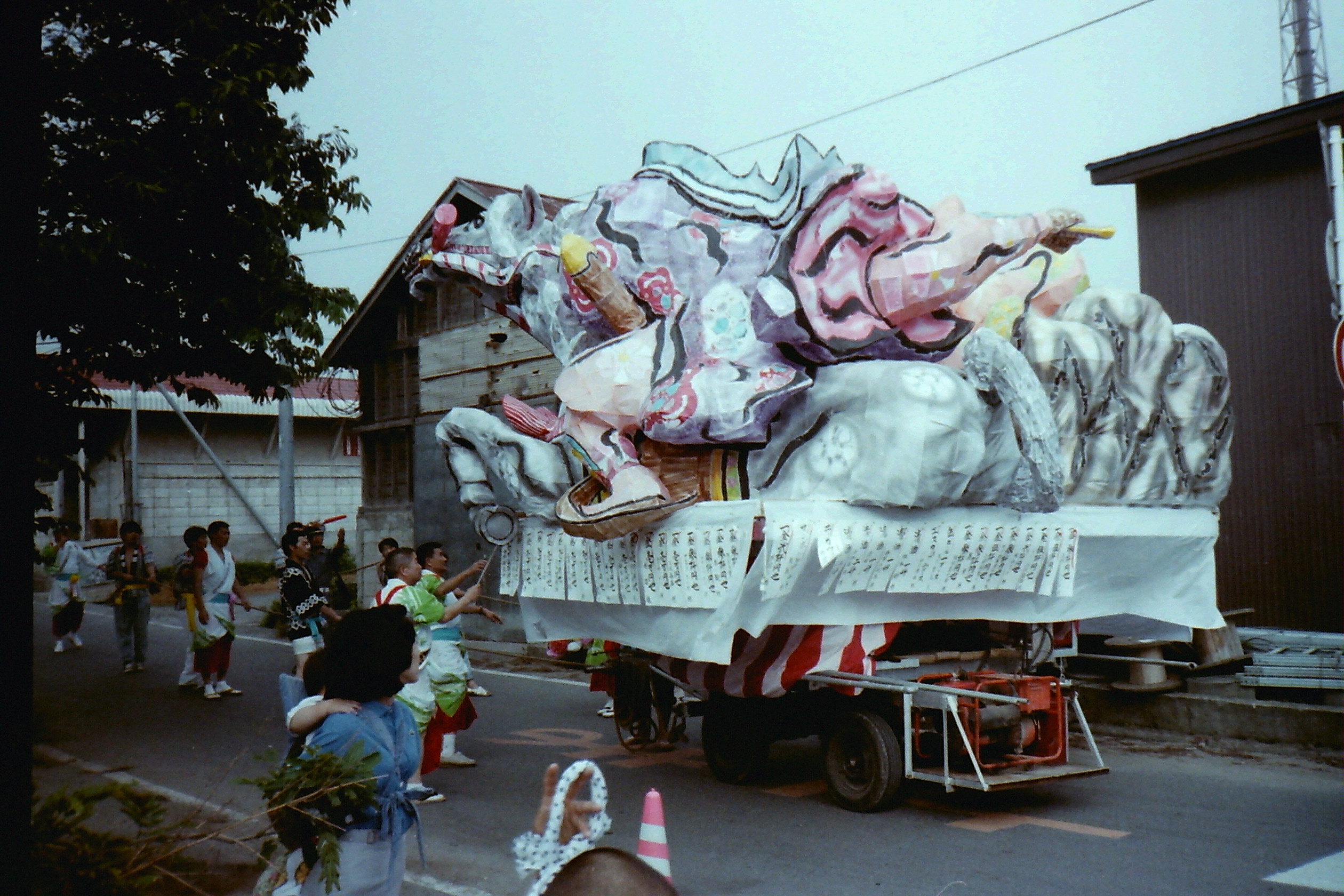
What a story this could tell (or does tell)
This type of float is seen in other parades, such as the one held annually in Aormori. It appears to be a peculiarly-Japanese type of impressionism, and no doubt depicts some mythological or historical event, probably something everyone in Japan learns about in primary school. We have our Washington crossing the Delaware and our legend of Paul Bunyan; they have their Takatsuna and Kagesue.
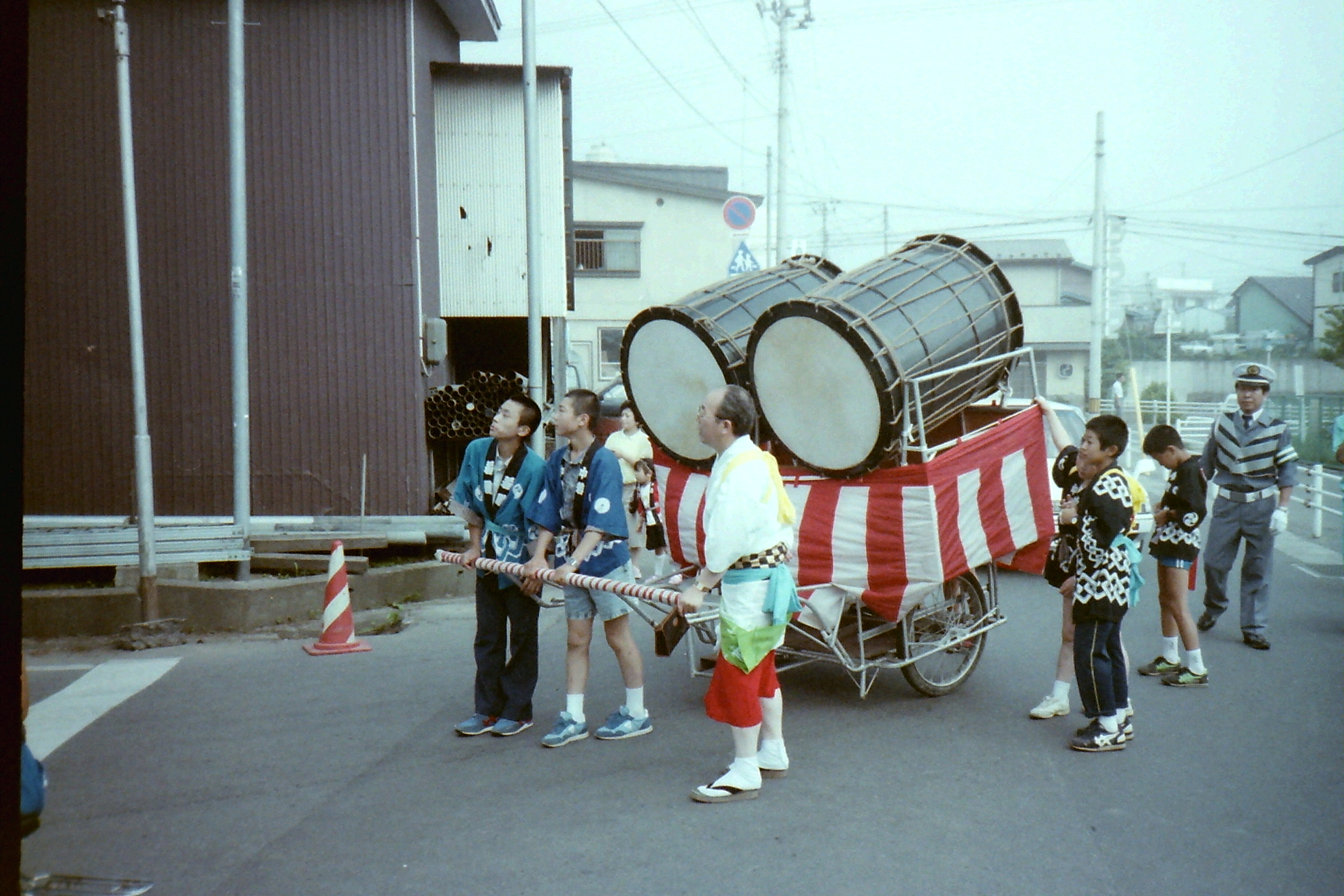
Taiko happens
These boys are having an easier time of it with their wheeled cart. But I suspect it would be difficult to both carry and play the taiko drums at the same time.
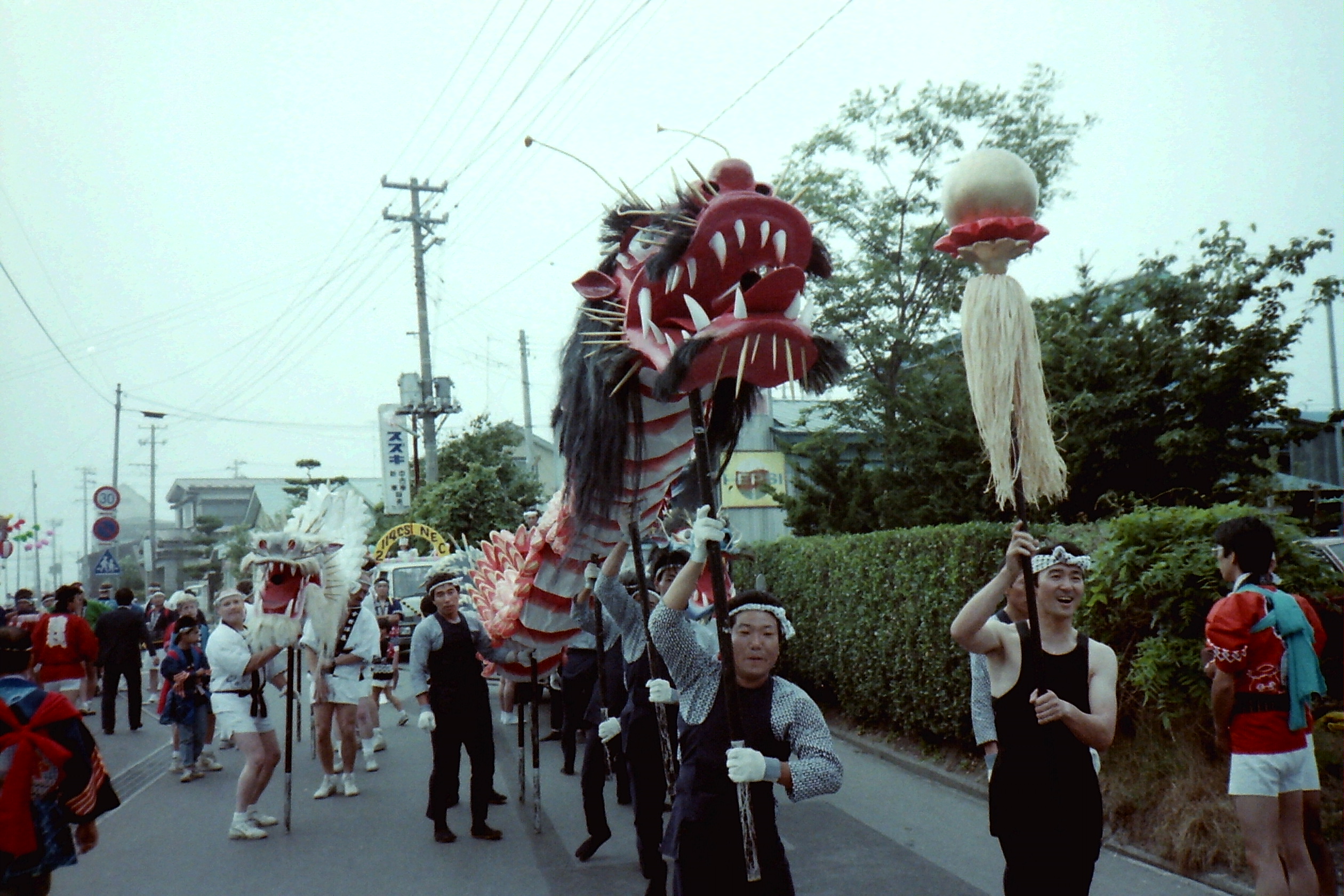
Dragons, long before Harry Potter was dreamed of
See the dragon chasing the dragon's egg on top of the pole? They do this same act at the Kappa Festival at the Komaki onsen (hot baths resort), but they do it in boats. A "kappa" is a mythical Japanese monster, but it's name is a pun, since kappa also means cucumber. I have a stuffed-toy kappa doll holding a cucumber.

The intensity builds
Things are starting to get crazy, but not nearly as crazy as they will get. Here's one more shot of the crowds building, and then I'll close for today.
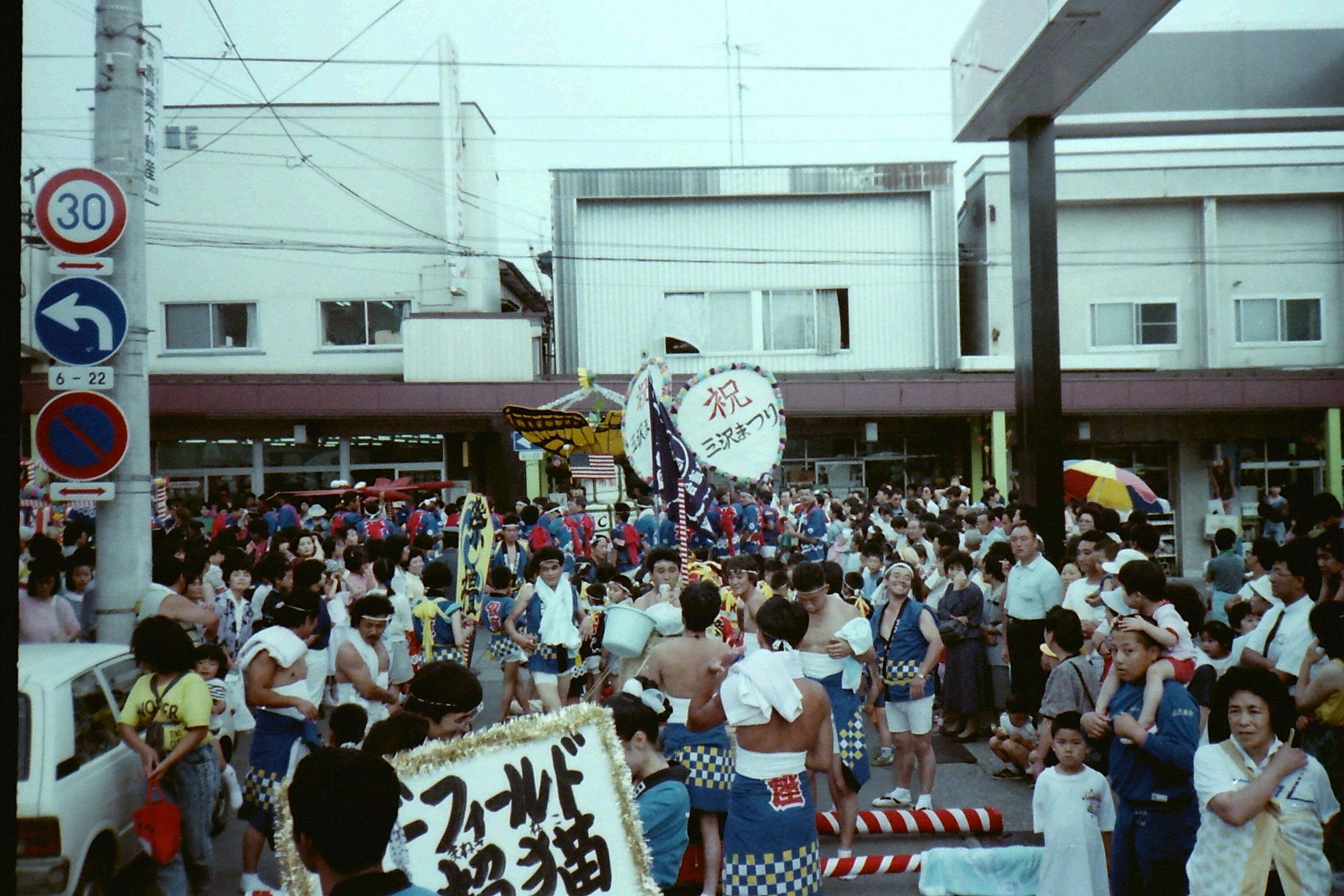
Arriving at "Green-Pole" Street
No one knew the real name for this street, if it indeed had a name, so it was called after the green poles that lined the sidewalks. You can see a few of them n the background. The street was one-way during the day, but at night it was a two-way street. Taxi drivers were pretty much the only people driving at night.



![[image error]](http://hortondeakins.com/survivors/wp-content/uploads/2011/10/PICT0003.jpg)