
Horton Deakins's Blog, page 25
October 21, 2011
Not all change is good
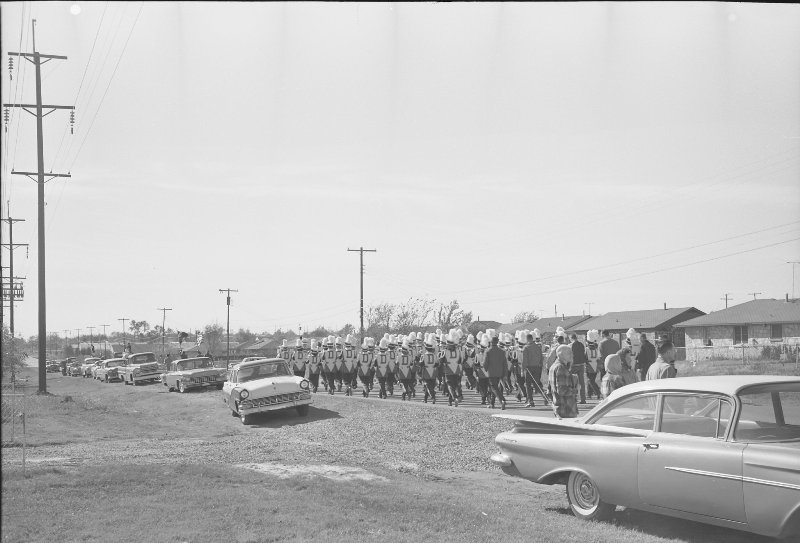
DCHS marching band, circa 1960
At least one of my sisters was in this particular high school band. The avenue on which they are marching is now a four-lane, and cars can no longer park along the shoulders. We know it is at least 1959, since in the lower right there is a 1959 Chevrolet Biscayne coupe, and, judging from the shadows, we know it is near noontime. This photo was taken with 120 black and white film.
But the features I have noted are not what most interested me when I examined this scene. If you can, look closely at the two men on either side of a scarved woman on the other side of the Biscayne. Note what the men are doing–they are holding their hats over their chests. What are they looking at? It certainly isn't the band. The next photo will reveal all.
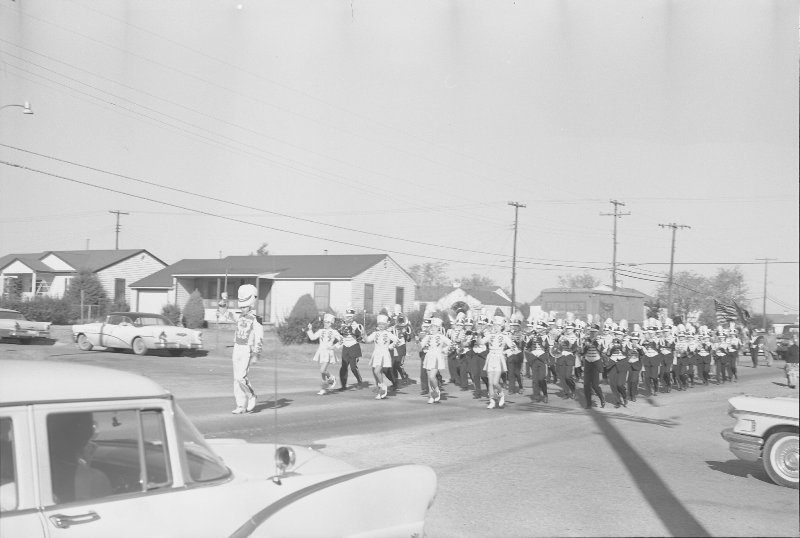
Band, followed by honor guard
In this photo, you can just make out the honor guard to the rear of the band. This day, which could have been Armistice Day (now Veteran's Day) or Memorial Day, was only about fifteen years after the end of WWII, and about half that number of years from the cessation of hostilities in Korea. The two men took off their hats as the flag was passing, and they stood at attention. How often do you see that today? Not so much. Some changes are not so good.


October 20, 2011
My prize watermelon
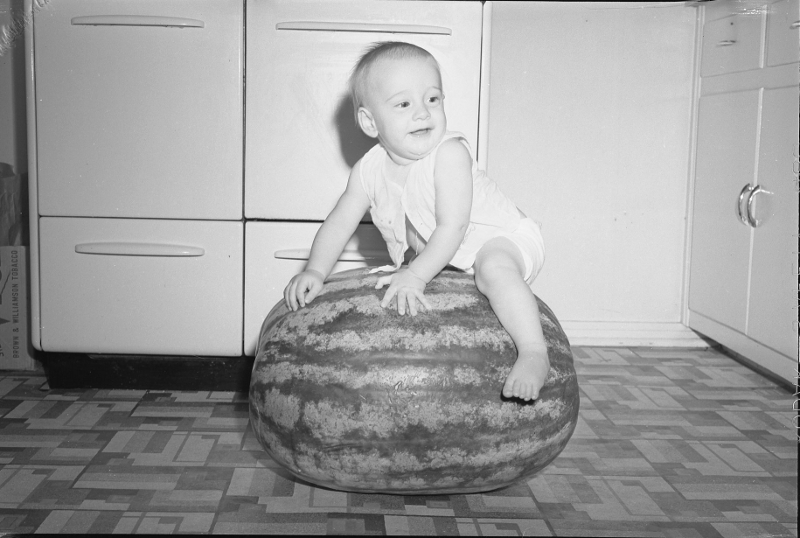
My agricultural roots
Here I am, showing off my prize watermelon. It was the year James Dean died and Elvis signed with RCA. Rock Around the Clock. Bobby socks and poodle skirts. Disneyland opened, and Jonas Salk developed the polio vaccine. And I, in my first year of inhaling earth's nitrogen-oxygen atmosphere, grew the world's largest watermelon … yeah … that's the ticket … the world's LARGEST WATERMELON. Yeah!
October 18, 2011
Three of a kind
First day of school, 1952
OK, I don't know for sure if this photo was taken the first day of school. For that matter, I can't say with 100% certainty that the year of capture was in 1952, but it's a fair guess. It can't be any earlier than 1952, and I'm sure it's no later than 1954. These three girls are my sisters (well, they weren't in this photo, because I hadn't come along yet!), and the family didn't move into this house until 1952. This is probably the only photo of my sisters together that exists on the Web. They still look the same.
Mom and Dad lived in this house until they died; Mom died in the hospital, and Dad died at home in his bedroom, the room behind the door at the left of the photo. The family sold the house in the late '90′s after Dad passed away.
I drove by the old house the other day, and two of my favorite trees, a pine tree and a fruit-bearing pear tree, had both been cut down. I suspect they fell victim to this year's drought. I was glad to see my "tree house" tree was still standing with only light pruning. The house had a new roof and a new front door, and it looked like all the windows had been replaced. I could see clearly into the room where dad died, and I could tell that the sliding doors to the small closet where he hung all his clothes had been removed.
[image error]
Born virtuoso
I was not yet one year old in this photo, and you can see how quickly I took to the piano (*wink*). I don't remember this particular piano, but about fifteen years ago I bought one that looked just like it. Gave it to the guy across the street before we moved, but there is a very interesting tale that goes with it concerning an old, nearly blind man by the name of Jahn Kohlert who came, with his assistant, to work on the piano. Perhaps I'll tell you his story someday, but for now just know that it involves Joe Kennedy, Al Capone, and the Gestapo.
Neither do I remember the window in the photo – at least not with glass in it. I think I remember Dad crawling through what was left of it when he was building an additional bedroom and bathroom for my sisters. Before he finished the room, we were six people living in 640 square feet of space. As long as I lived there, though, I never felt cramped. It was home.
October 17, 2011
Self portrait
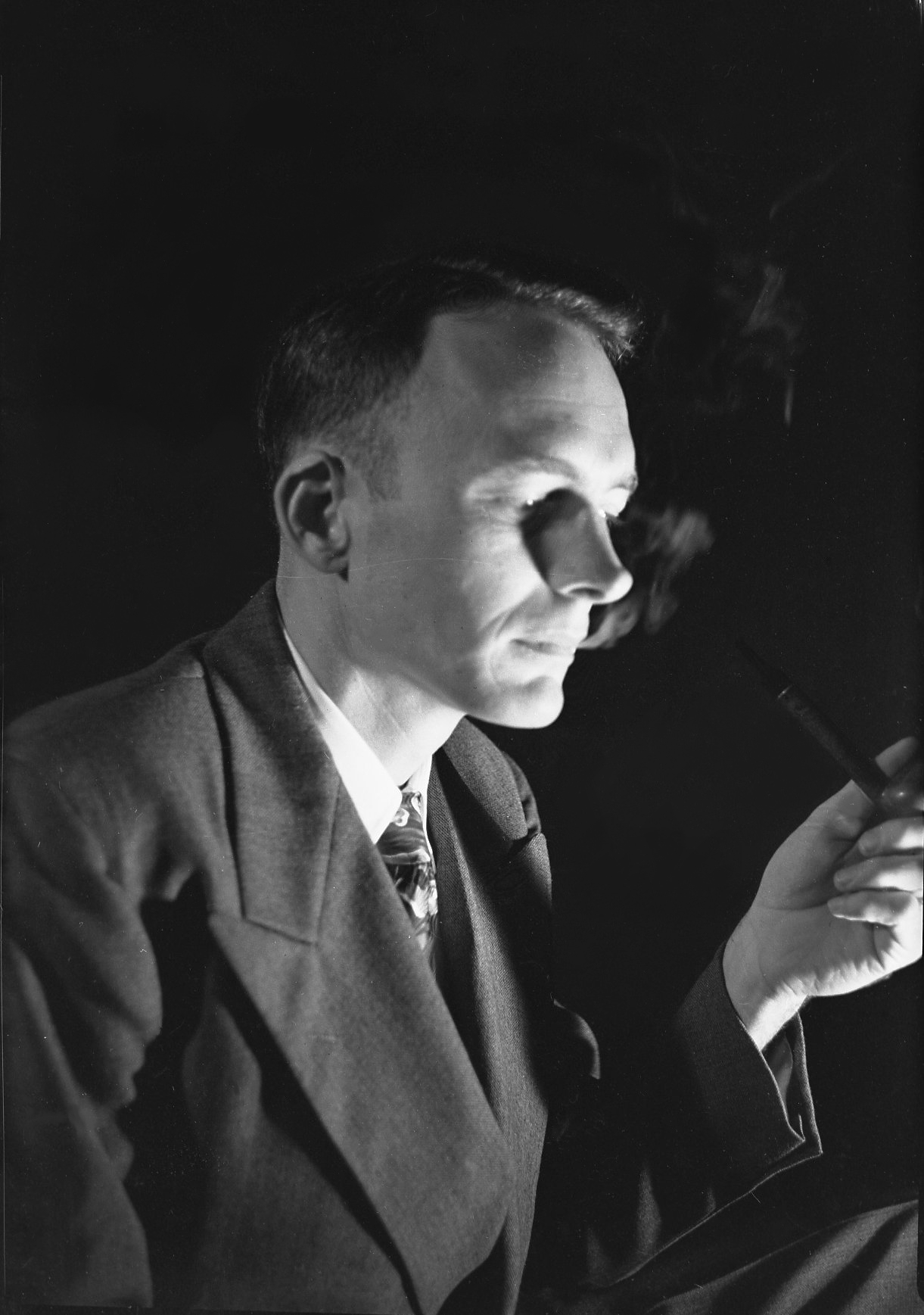
Horton Deakins with pipe, self portrait
No, that's not me. That's not even my dad. It is, however, the man who would eventually become my dad. He was quite the photographer, and he took this self portrait sixty years ago, in 1951. He used what was known as a "press" camera, and this particular shot he did with cut film. I've had to touch it up, though, because it looked like it was covered with lint.
Cut film, if you're not familiar with it, is pretty much what it sounds like. Film is cut into certain sizes; in this case I think it was something like 2.25 by 3.5 inches. A stack of the film is purchased in a small box, and the photographer loads a metal cartridge–in a dark room–with a piece of the film. He inserts the film cartridge into the camera, and this opens the cartridge to the inside of the camera body so that the shutter can expose the film.
First, however, the photographer may, if utilizing a fixed setting with a tripod, focus his subject. He does this by looking at a large piece of ground glass on the back of the camera on which an image of the subject appears, not unlike rear-projection TV. Unfortunately, the camera lens inverts the image, so if it is necessary to re-aim the camera, everything moves in reverse to what you see. When the photographer inserts the film cartridge into the camera, the image disappears, so the subject is asked to sit or stand very still in order to stay in focus and in the frame. Typically, the shutter is triggered with an extention cable to prevent shaking the camera and blurring the image. Dad used a mechanical timer that pressed the plunger on the extension cable when the time ran out.
October 16, 2011
Aloha snoe
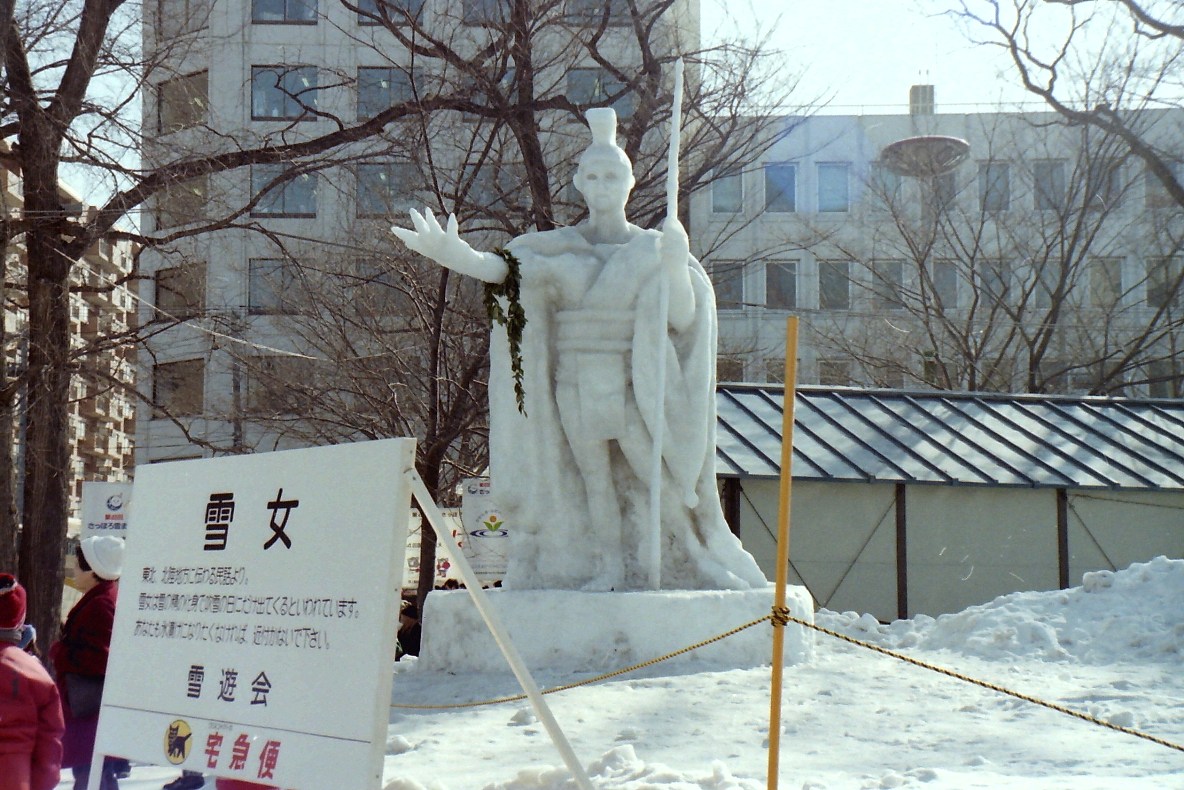
King Kameamea
And don't even think about complaining about the pun in today's title – it's what I do.
[image error]
O beautiful, for spacious skies ...
I think this was an American entry — but what would have been my first clue? While you're here, check out the small figure at the bottom left of the statue. Where have we seen this before? We'll get a better look on another day.
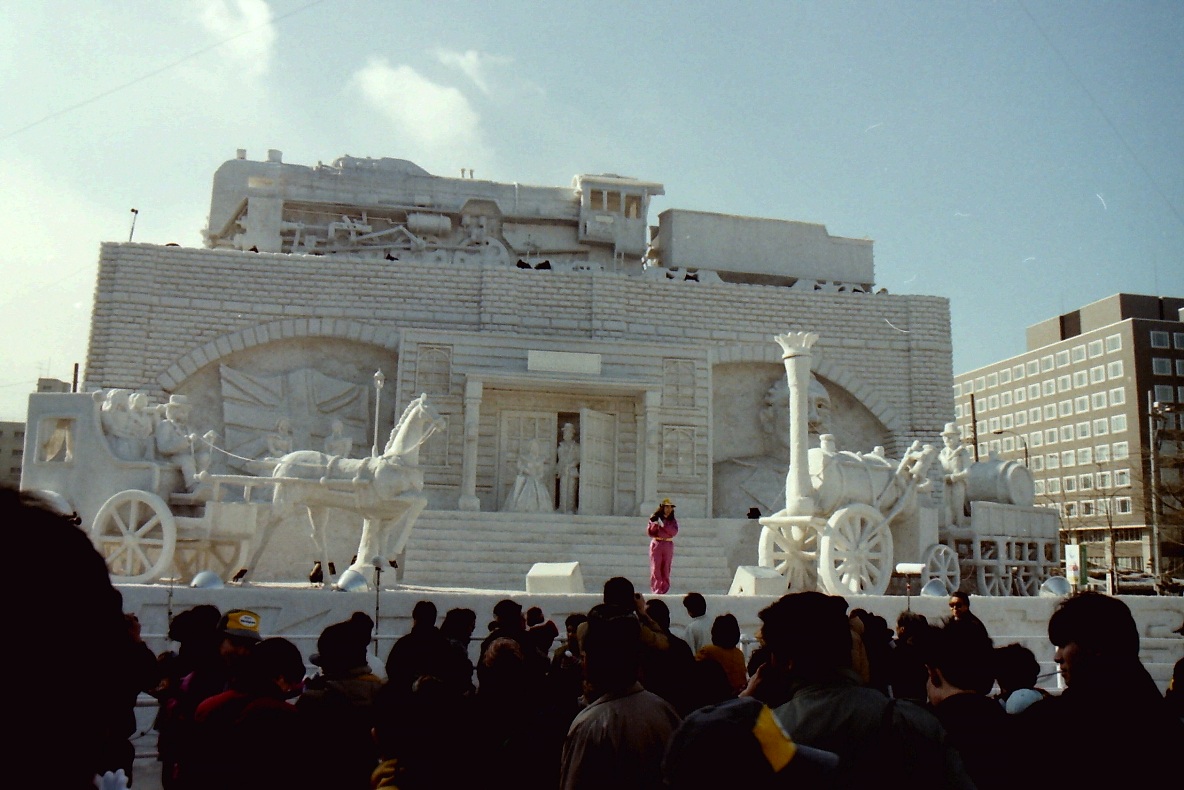
Look at the detail!
This one just absolutely amazed me. I don't know to what extent they were allowed to use frameworks, but what you see is really snow.
[image error]
Big Bird
Sesame street is big in Japan. Check out Big Bird and friends in this display. I remember becoming so tired of hearing nothing but Japanese during a road trip I took in Japan that I longed to hear anything at all in English. So I kept tuning my radio until I found something, and, lo and behold, it was Sesame Street to the rescue! Brought to you by the letter "J."
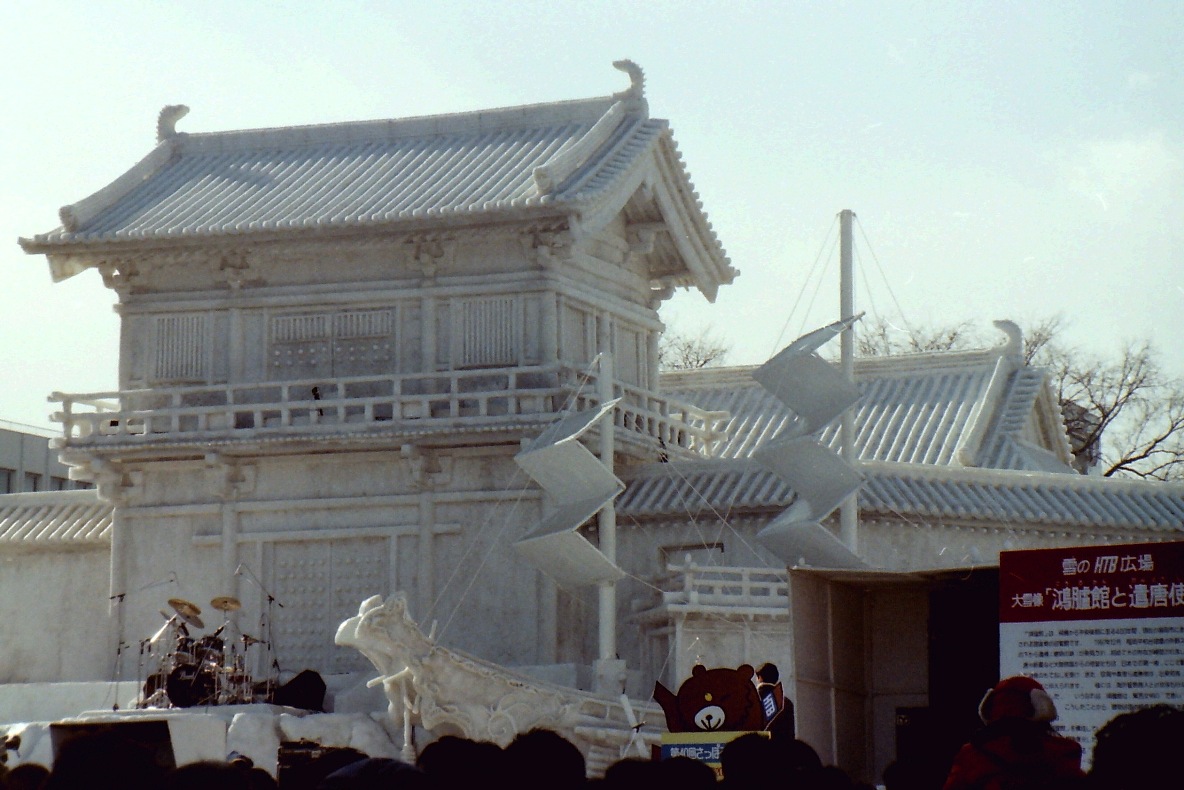
A more traditional scene
Another amazing scene.
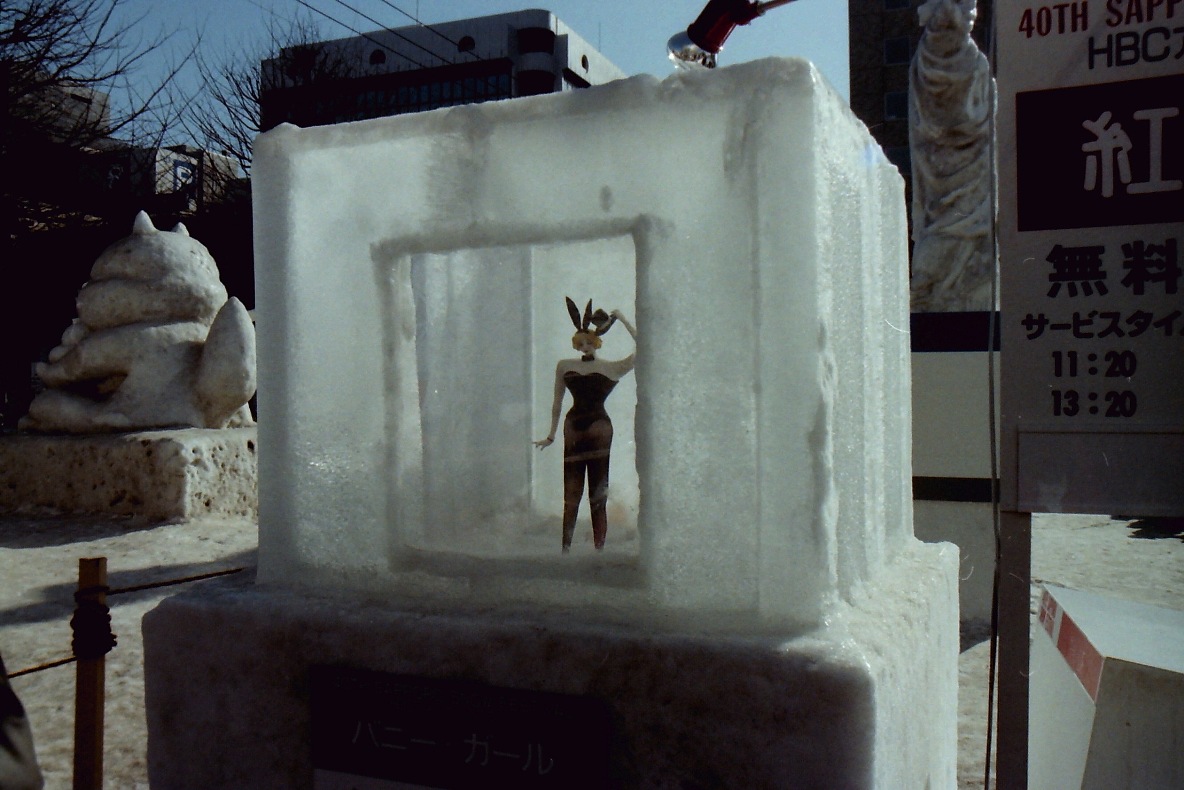
Banii gaaru
This was strange but not unique; there were several of these miniature "frozen rooms." The caption below, which you may not be able to see in this photo, says "banii gaaru," which is Japanese phonetic for the English phrase, "bunny girl."
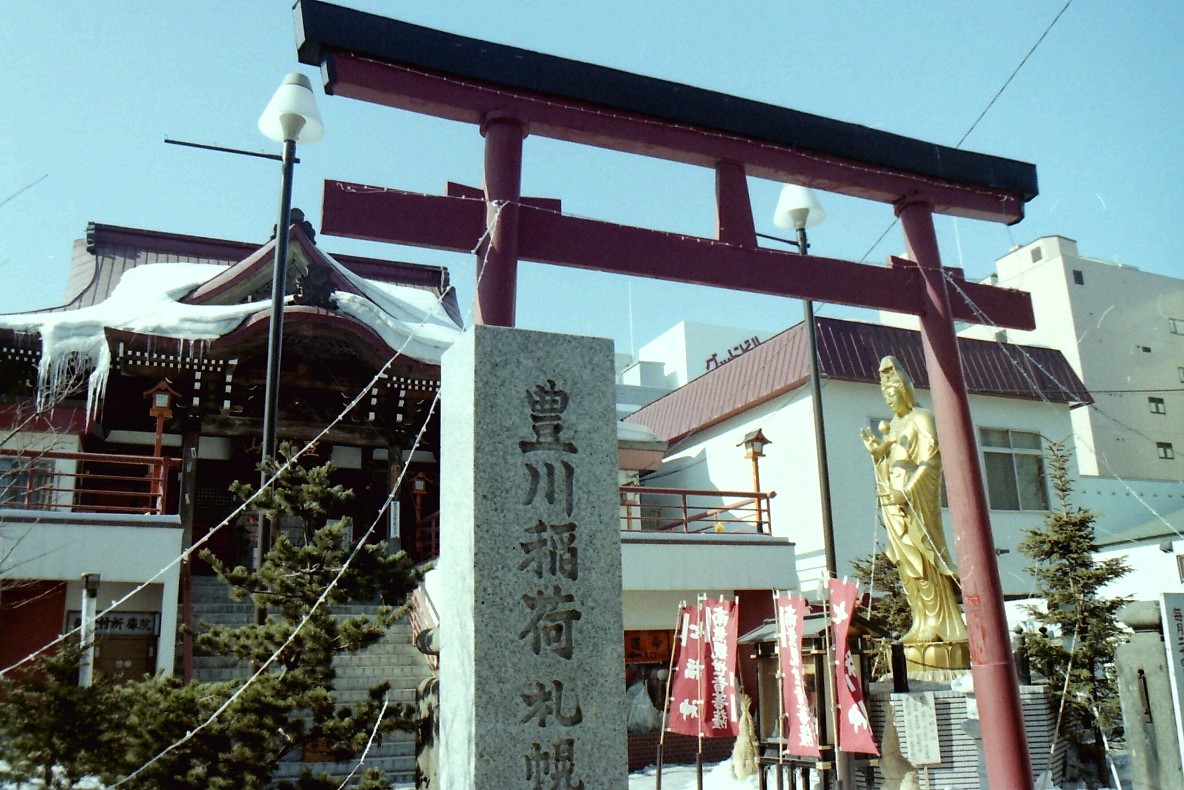
A blending of cultures
Unless I am mistaken, this temple in Sapporo demonstrates the blending of Shintoism with Buddhism. The torii gate is the Shinto gate into the detached world where the Shinto temple is supposed to exist, while the golden figure just inside the gate seems clearly Buddhist to me. Maybe someone can set me straight if I am in error about this — I'm not exactly an expert on Buddhism. But Americans who have seen the familiar sight of a Gideon's Bible in a hotel room may be interested to know that it is not unusual to find a book about the Buddha in Japanese hotel rooms, and you may well find it written in English, as well!
October 15, 2011
Susukino after sunset
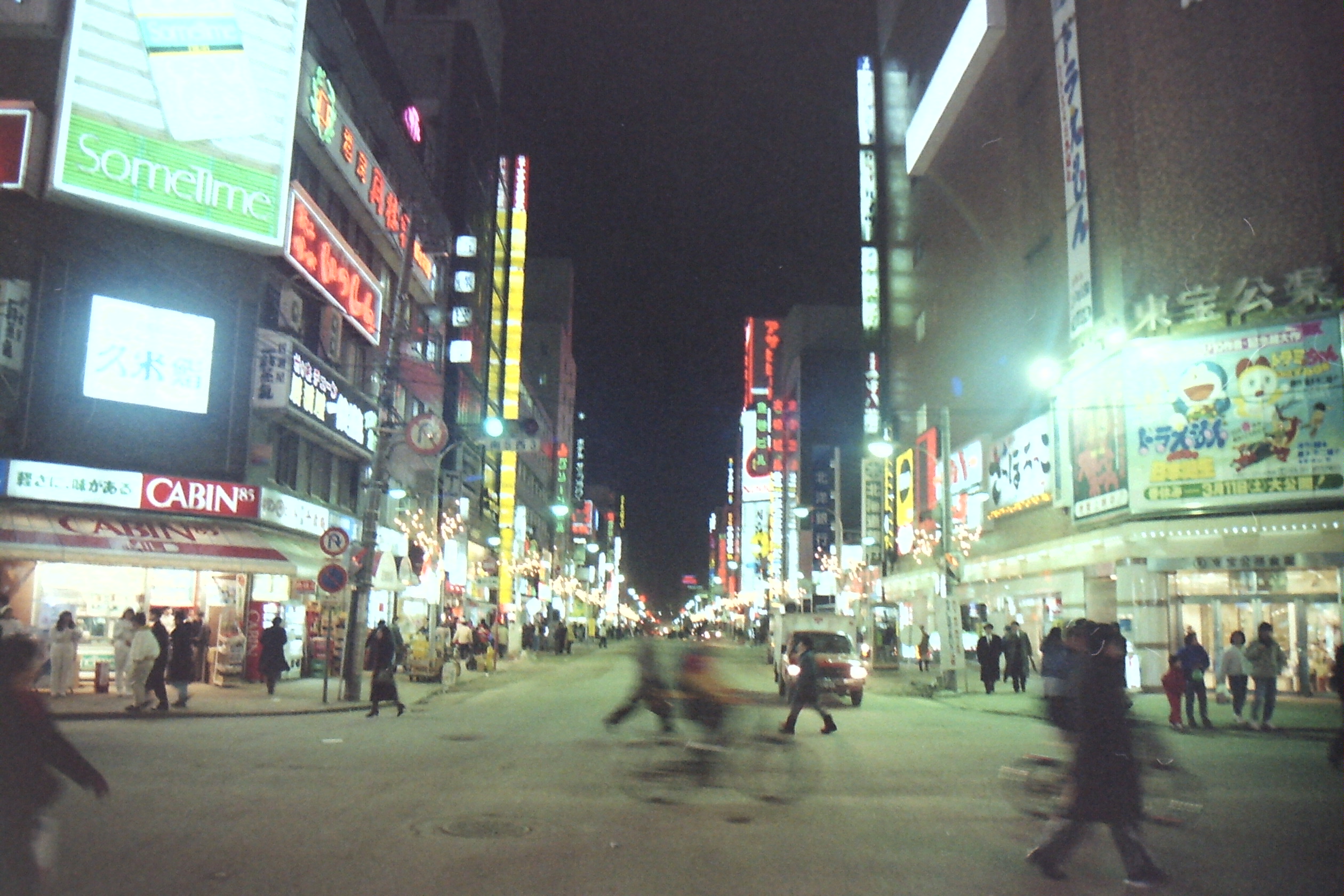
Susukino district in Sapporo at night
No snow here, but plenty of activity. This used to be (?) the red light district.
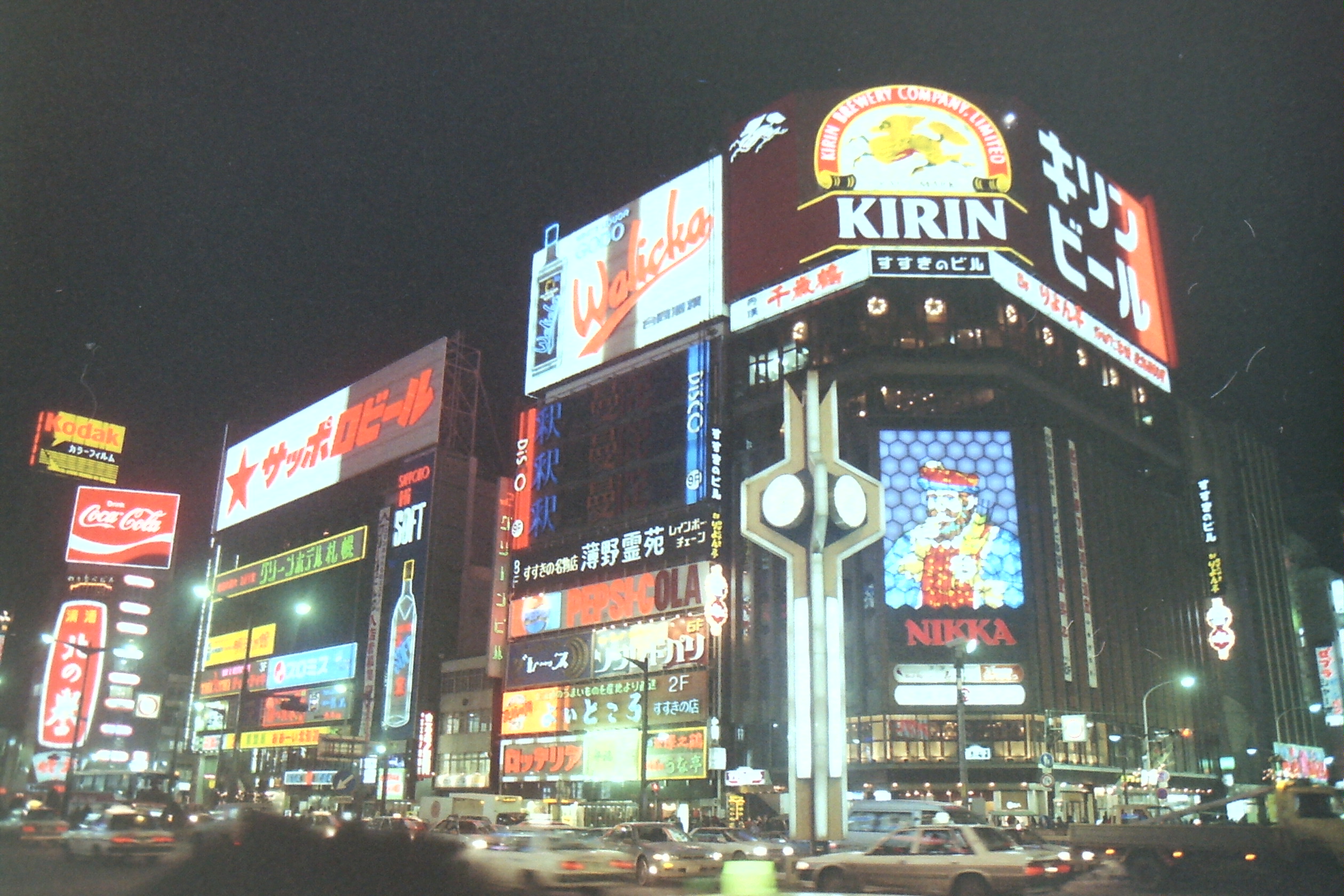
Appealing to your thirst
Almost every display here has to do with something to drink, and CocaCola may be the only one without alcohol. There's Sapporo Beer, Kirin Beer, and Nikka Whiskey.
[image error]
City of lights
[image error]
Sunakku bars, etc.
A sunakku bar, or just sunakku, a strange twist of the English word, "snack," is a bar where light snacks are served. These snacks can be anything from small, wrapped hard candies to bowls of a disgusting substance called natto, all served at the discretion of the host or hostess, and all very expensive. These tidbits always seem to appear when the patron isn't ordering drinks as frequently as the host would like, and if you're lucky, you won't be charged twice for each serving.
In any case, this towering stack of shingles announces all the business in this building, some of which are sunakku.
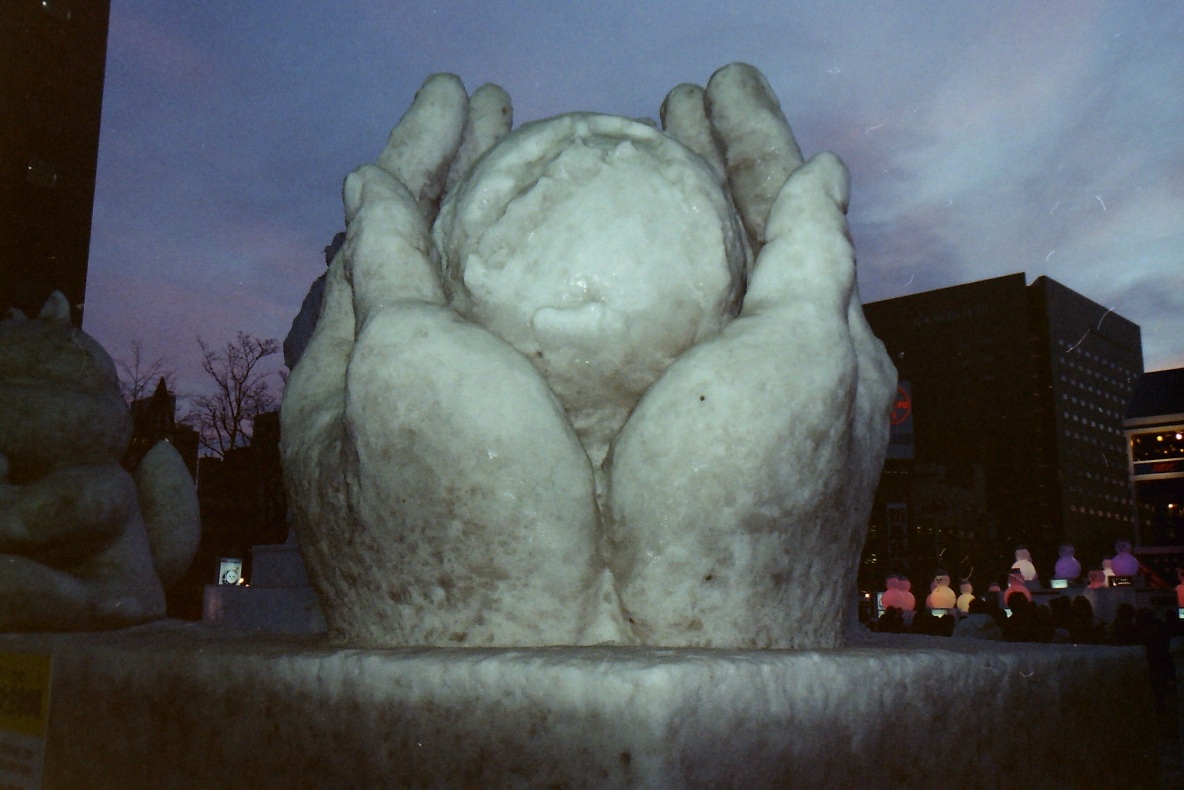
Now, that's one big snowball!
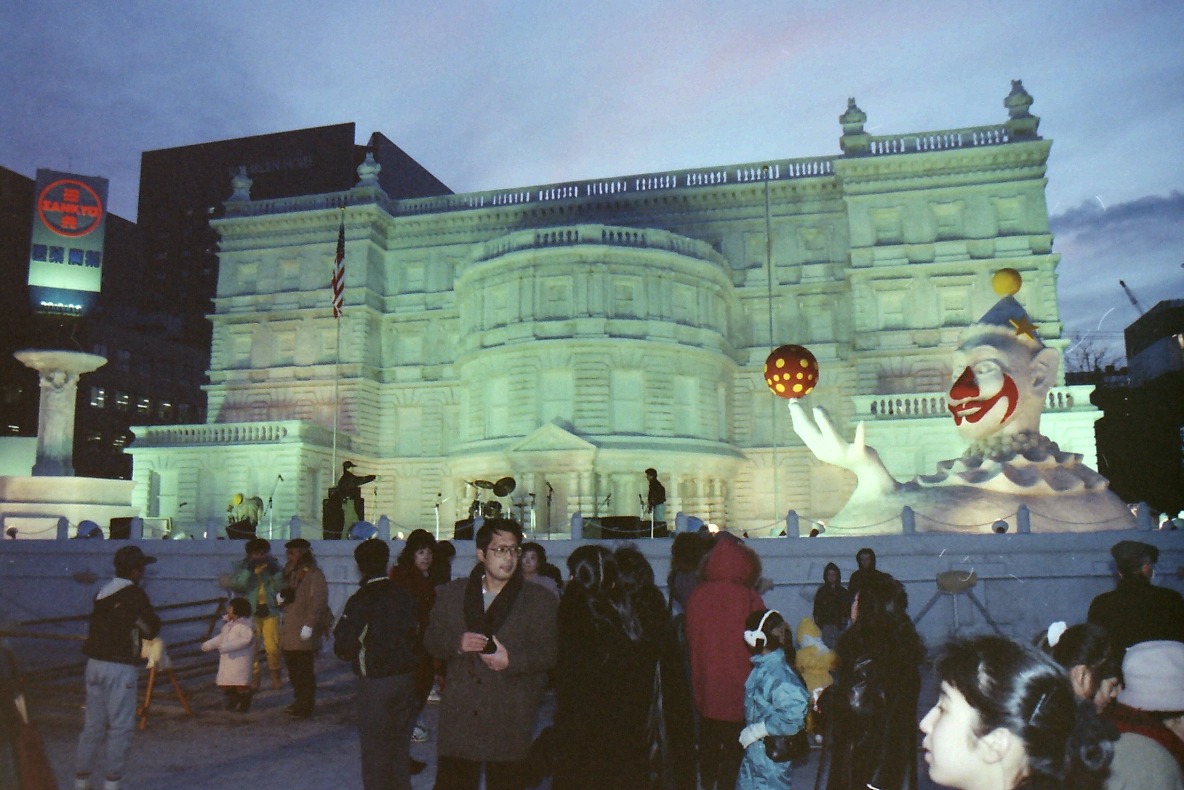
Creepy clown
Let's just get the creepy clown out of the way right now.
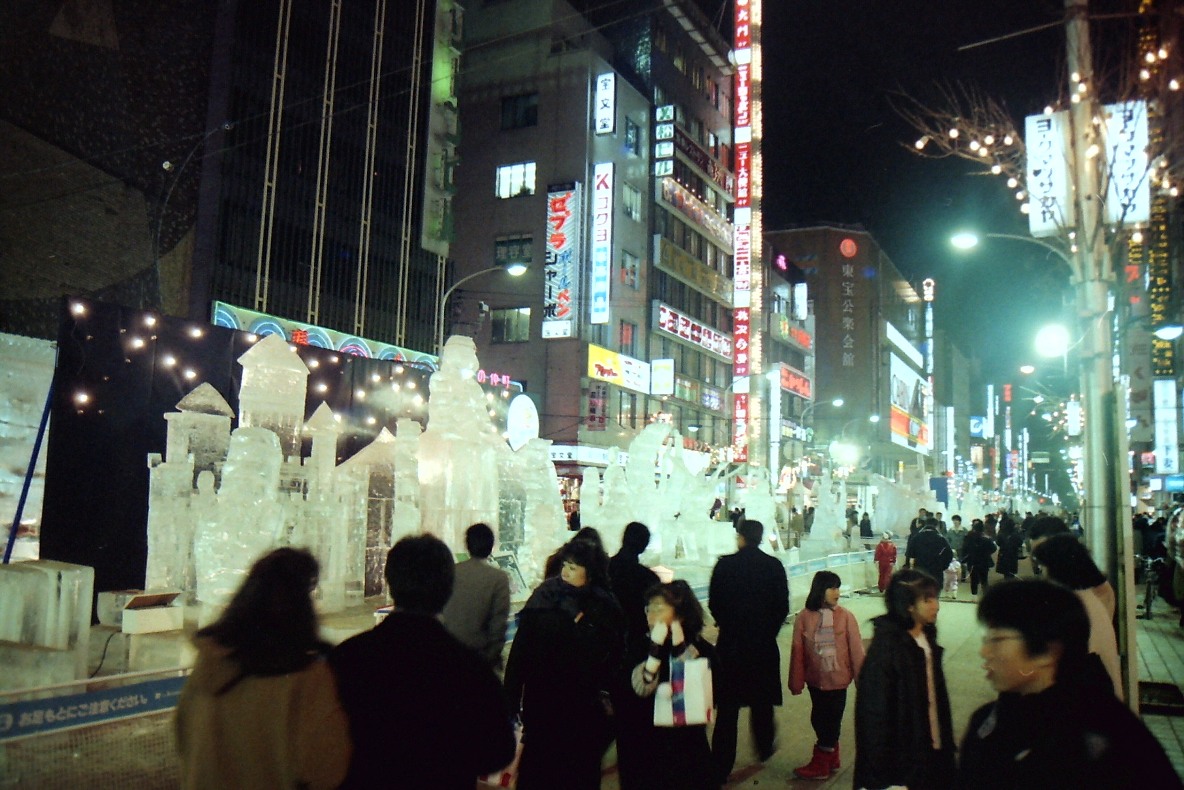
Ice sculptures as far as the eye can see
This street was shut off to vehicle traffic and ice sculptures ran for blocks down the middle — and it wasn't the only street where such sculptures were on display. Many displays were corporate-sponsored, as you will see.
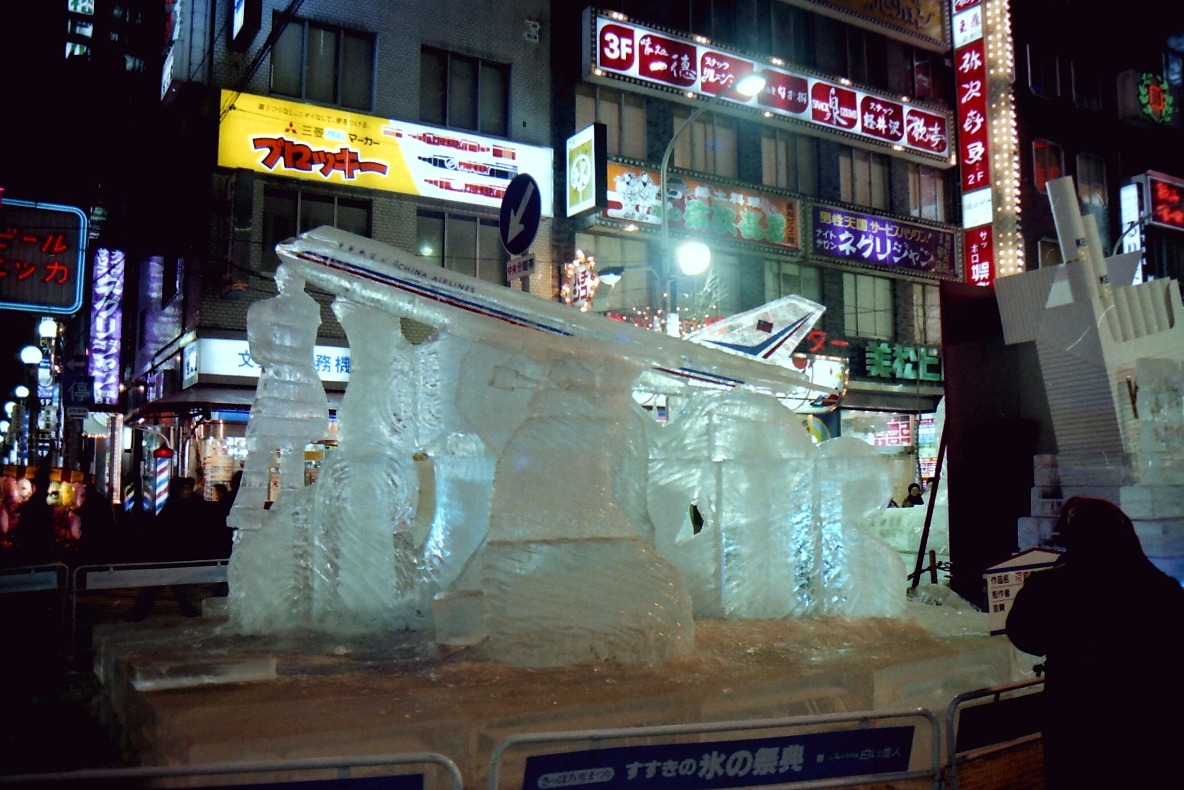
China Airlines
This is the China Airlines display, and to the right appears to be Kent cigarettes.
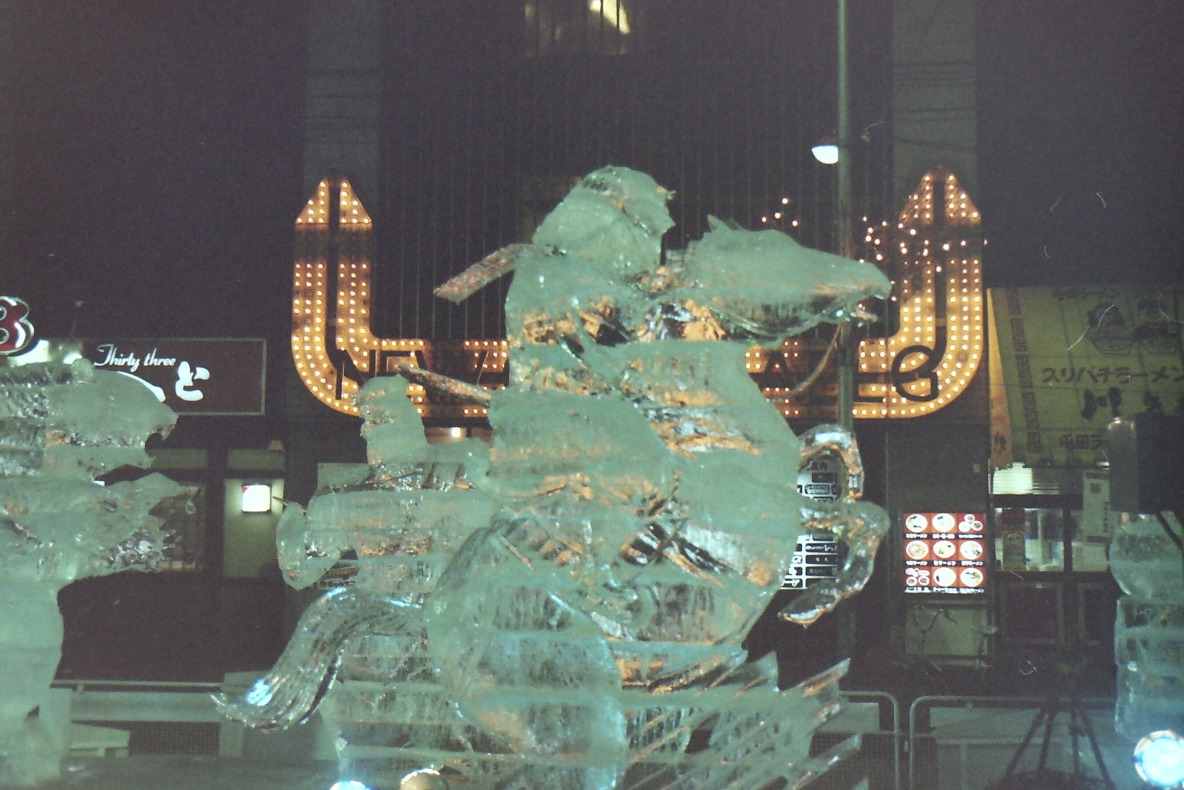
Samurai on horseback
This one looks almost like a ghost horseman, what with the lights showing throught it.
October 12, 2011
The Sapporo Night Life
I haven't had time to scan in more photos, but I found a few that I had missed. I think — but I'm not sure — that these are from my first evening in Sapporo during the snow festival, i.e., the yuki matsuri.
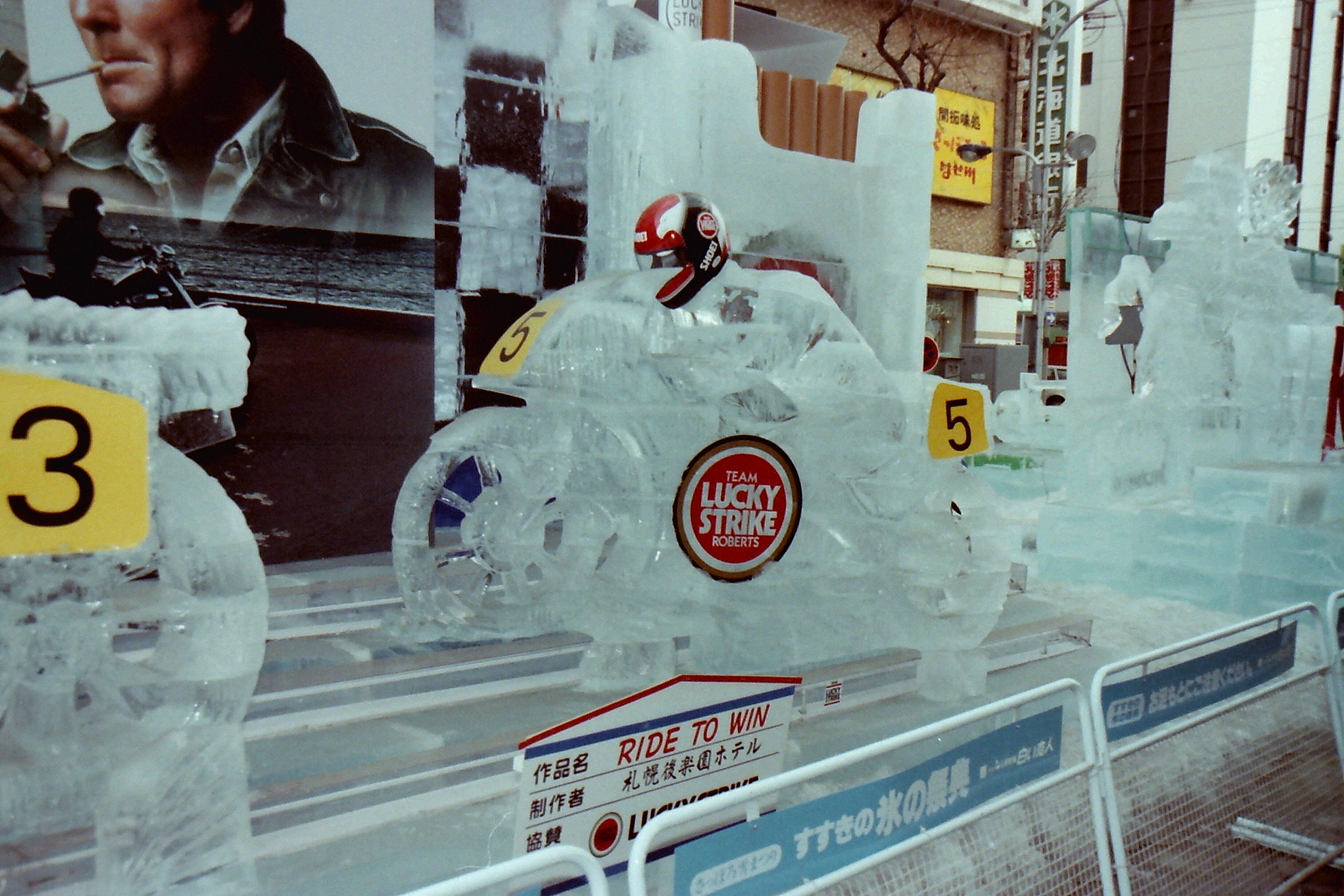
Cigarettes make biking better–right?
Cigarettes are king in Japan, so alcohol must be queen. There were many more ice sculptures in Sapporo, so I'm hopeful I will find more of these when I go through the rest of my negatives.
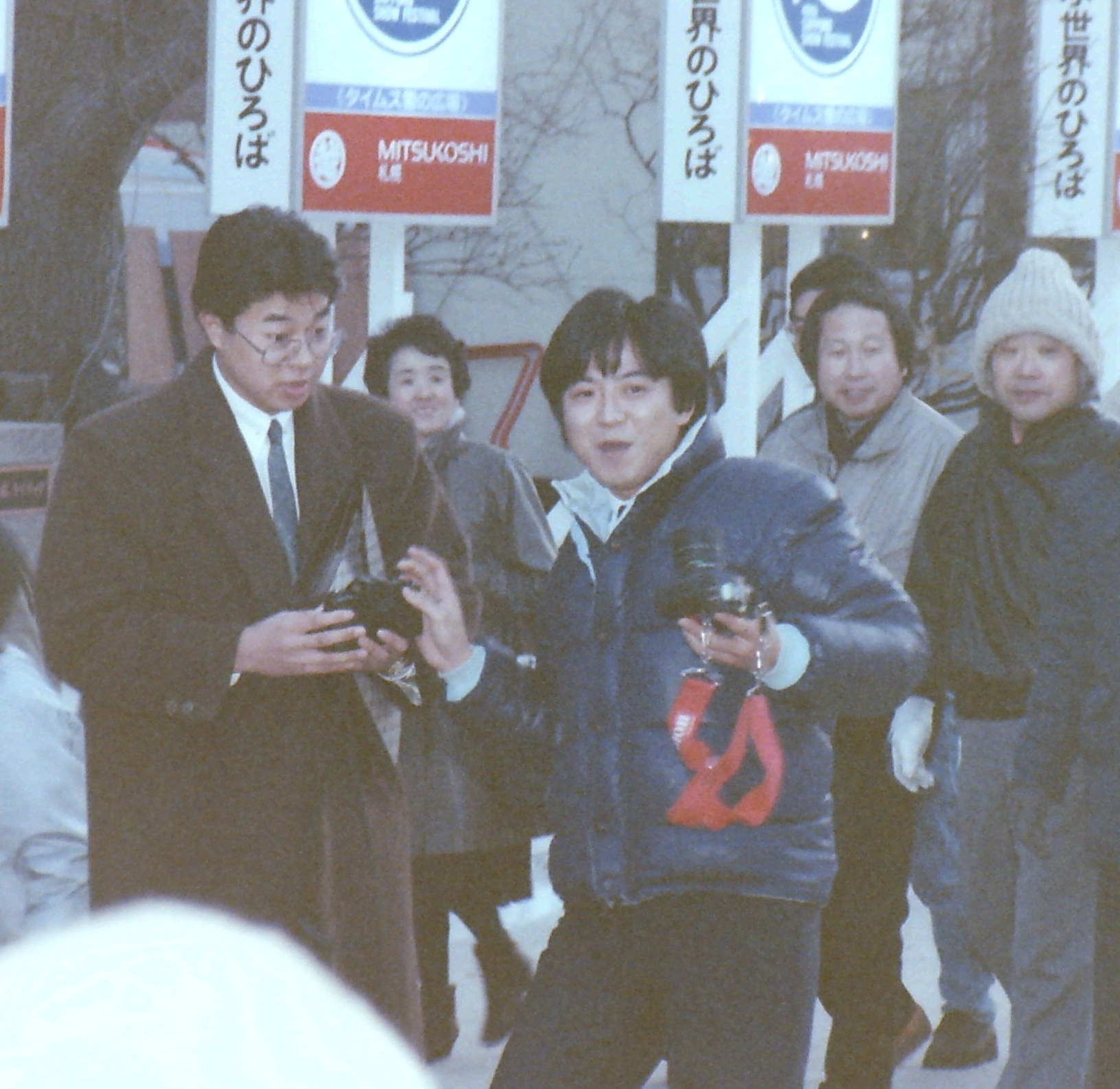
Did you just take my picture?
I think this must have been "somebody." He had an entourage, and seemed to be quite startled by my catching him on camera.
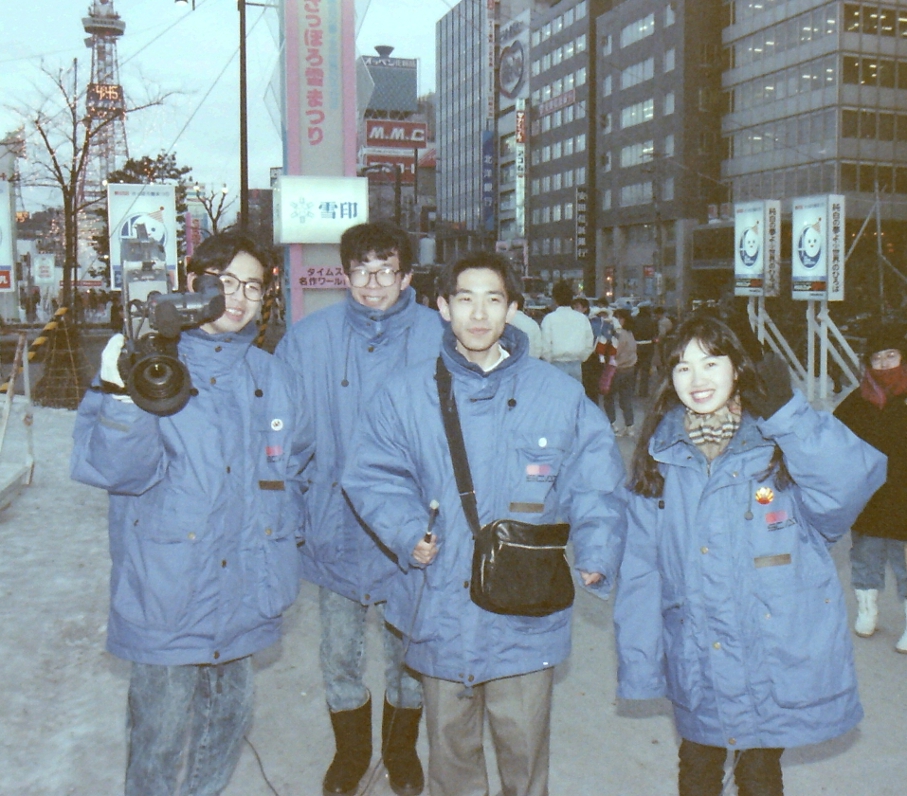
TV film crew
I was probably on the six o'clock news.
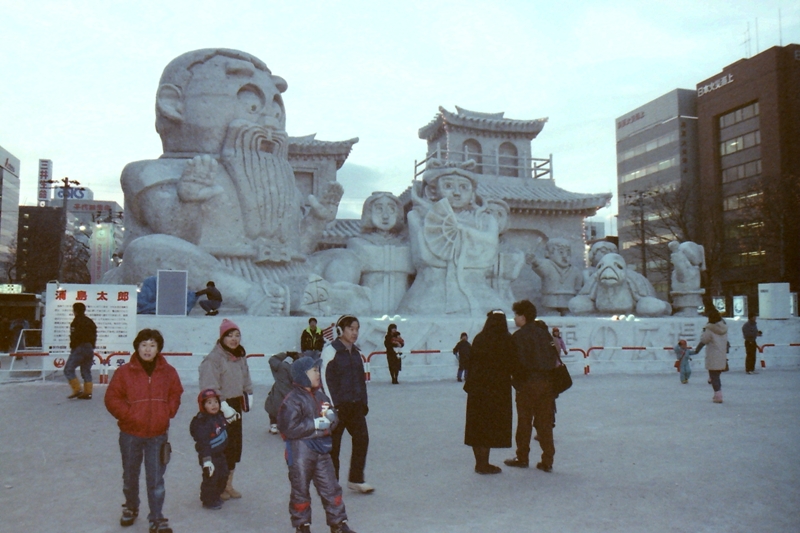
Snow sculptures
Most of these sculptures began to melt in the mid-day sun the next day. It was a warmer-than-normal festival.
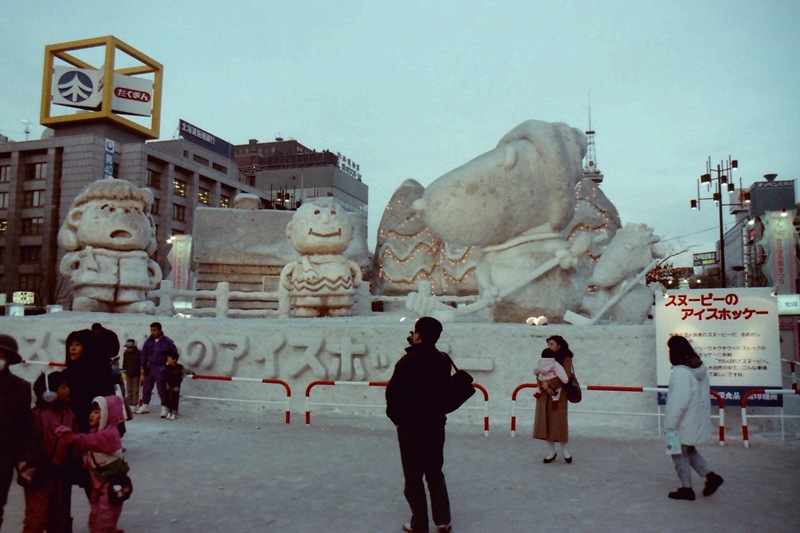
Snoopy's ice hockey
The sign says it's Snoopy's ice hockey. Obviously, they had never heard of Peanuts. Mickey Mouse is also the most prominent Christmas figure in Japan.
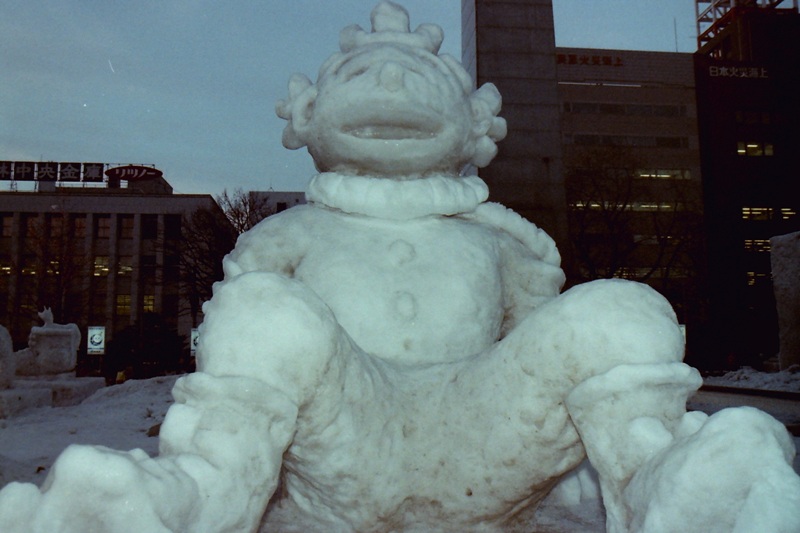
Another creepy clown
Looks like this creepy clown had already started to melt. But what can I say besides
CREEPY CLOWN!
October 11, 2011
A Man of Double Deed
Since I haven't been able to get back to scanning in my Japan negatives, I thought I'd break things up a bit with a poem that constitutes the lyrics of an Irish children's song. Over four decades ago I was given an LP of The Clancy Brothers and Tommy Makem at Carnegie Hall, and it became one of my favorites. In fact, I memorized many of the lyrics and sang along — except for the Gaelic, that is. But I think I did a fair job of imitating the sounds of some of the Gaelic without having a clue what I was saying.
They did a long segment of children's songs, and one of them was called "A Man of Double Deed." The lyrics appear below:
There was a man of double deed,
Who sowed his garden full of seed.
And when that seed began to grow,
'Twas like a garden full of snow.
And when that snow began to fall,
Like birds, it was, upon the wall.
And when those birds began to fly,
'Twas like a shipwreck in the sky.
And when the sky began to crack,
'Twas like a stick upon my back.
And when my back began to smart,
'Twas like a penknife in my heart.
And when my heart began to bleed,
Then I was dead and dead indeed.
October 8, 2011
Sapporo Snow Festival
I think I made a mistake when I decided not to resize the scans from my Japan negatives. The limit for WordPress is about two megabytes per photo, but that's not a practical size. My negative/slide scanner saves files of just over one megabyte, but even that is too big. When this page loads, it can take awhile to download all the images, even with a fast cable connection.
Sooooo, I have started downsizing my Japan photos for blog posting to 47% of their original weight. They still look pretty good at that size, and you will still be able to click them in the blog and see a slightly larger, more detailed image.
Here are a few pics of the Sapporo Snow Festival, in (of all places) Sapporo, Hokkaido, Japan. BTW, in Japan, they give addresses in a more logical way — from large to small, i.e., they give the city/town designation last.
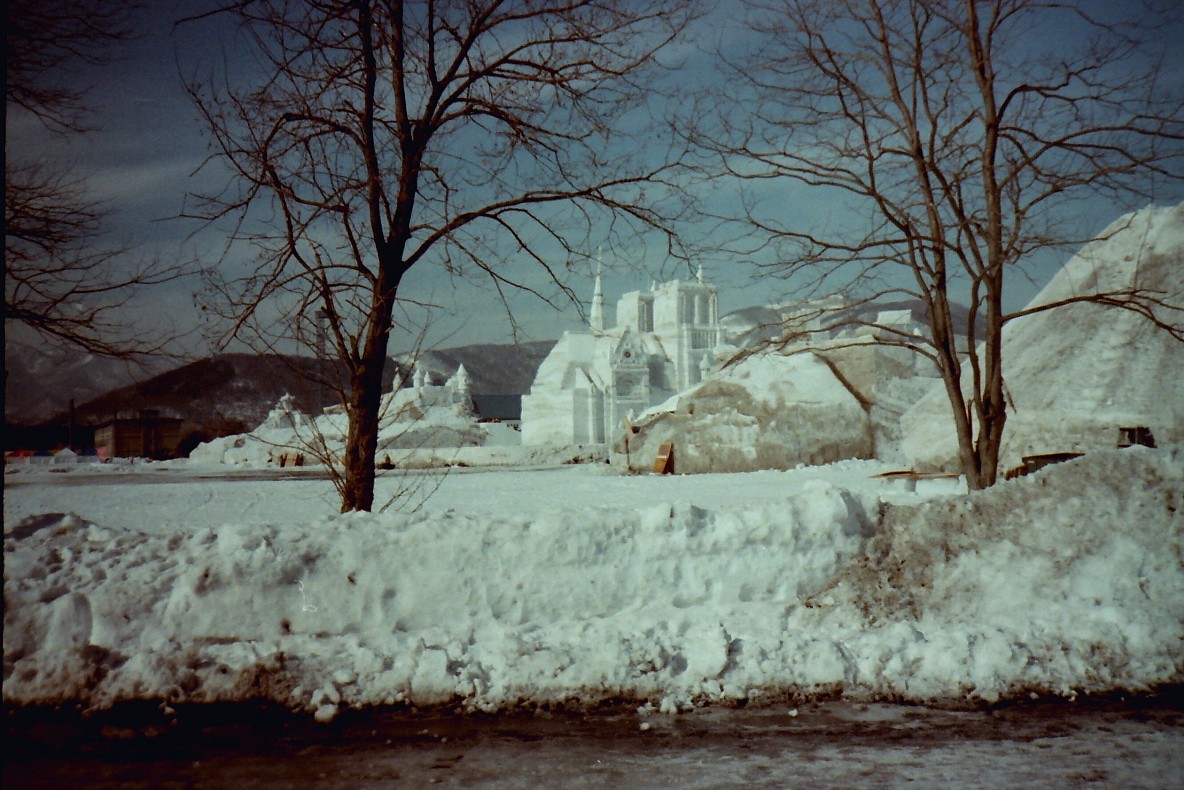
A city in the distance
It's really difficult to discern scale from this shot, but that cathedral is bigger than you may think.
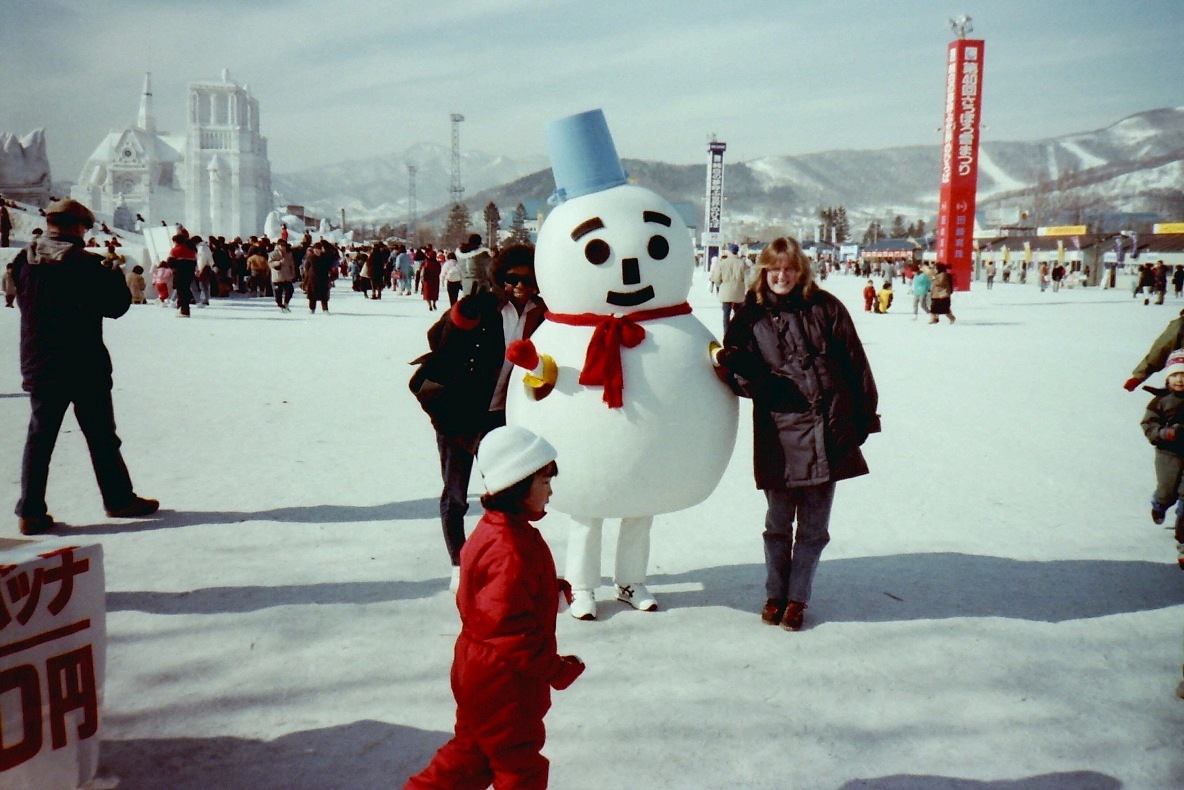
Official festival mascot
We're a little closer to the cathedral — beginning to see what I mean?
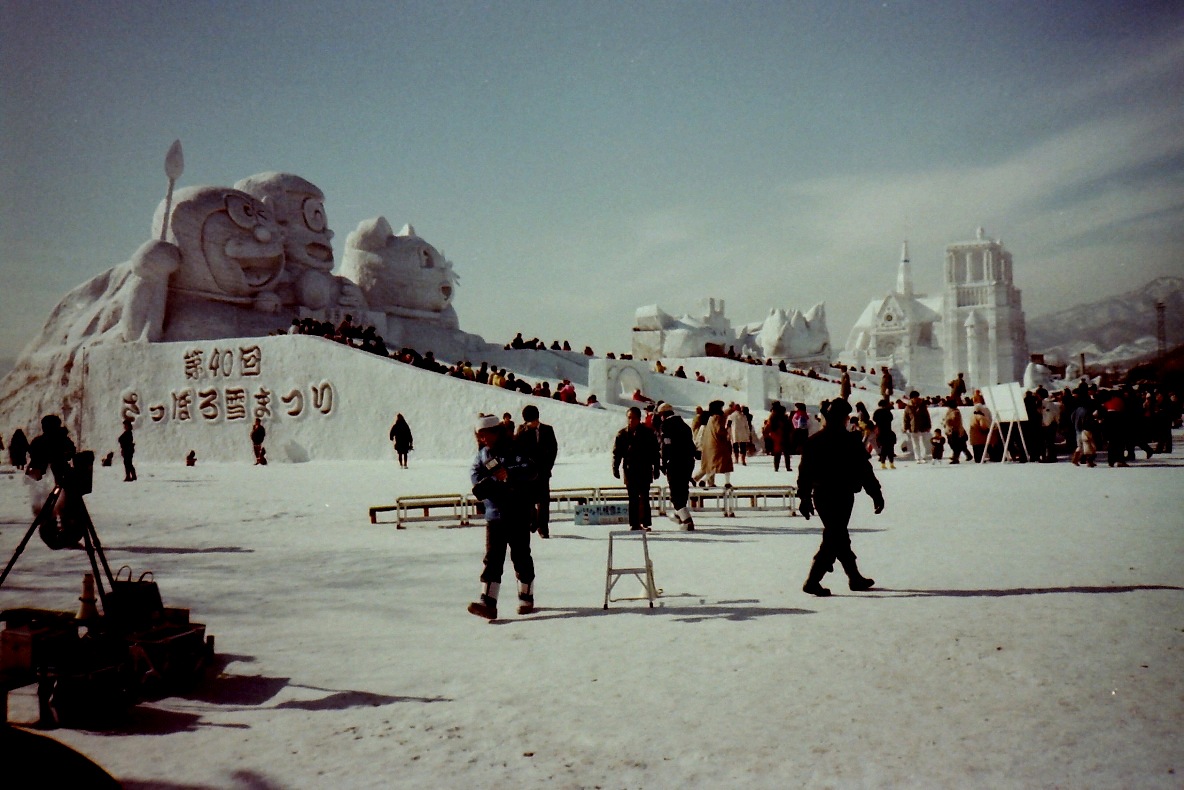
Ice slide
The bottom line of text on the side of the slide says, Sapporo Yuki Matsuri (meaning, "Sapporo Snow Festival," only there are no capital letters in Japanese). I'm not positive of the translation of the top line, but it's most likely something like, "Fortieth Annual." That works out to the first festival taking place in 1950, if you do the math, and if they didn't skip any years, like when there might have been too much snow. We'll get a closer look at the cathedral later.
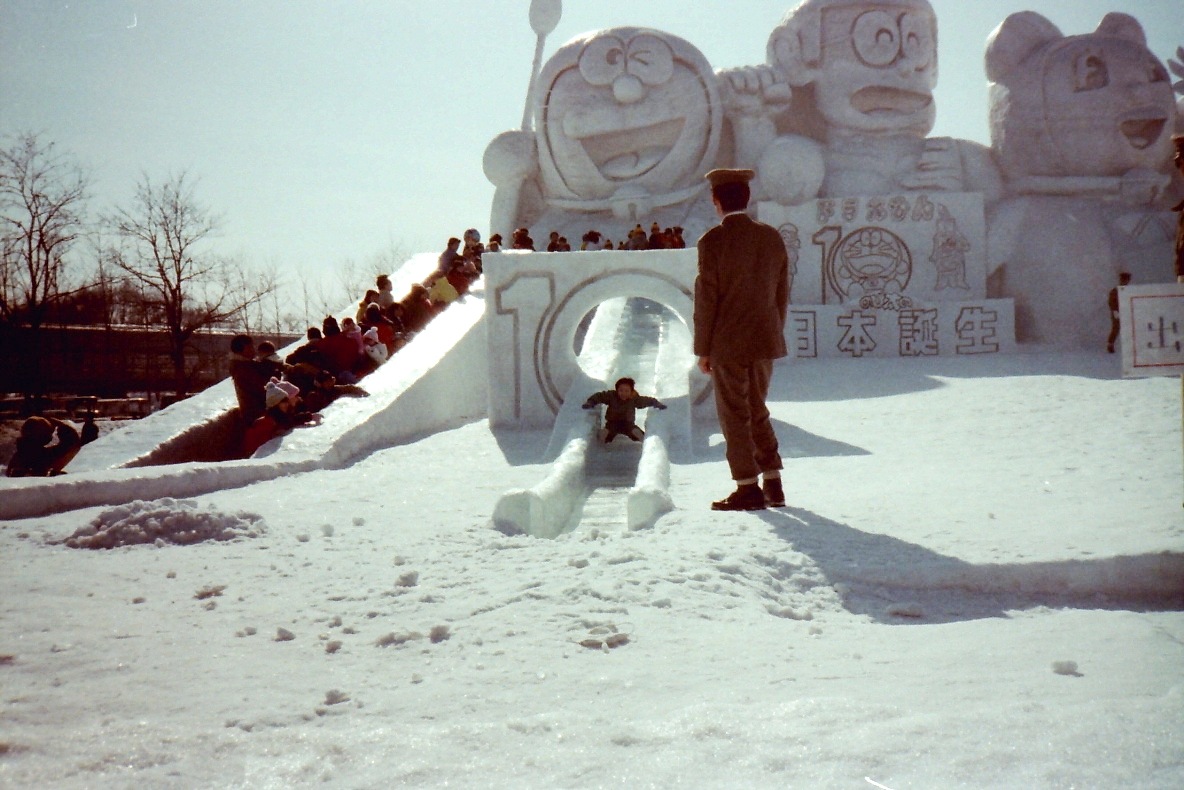
The kids loved it
I probably would have loved it, too — about 25 years earlier. But one of the dudes from my office drove his dumpy derrierre down this delightful damp ramp. He looked like a damp fool — but he needed no help from sculpted snow to prove that.
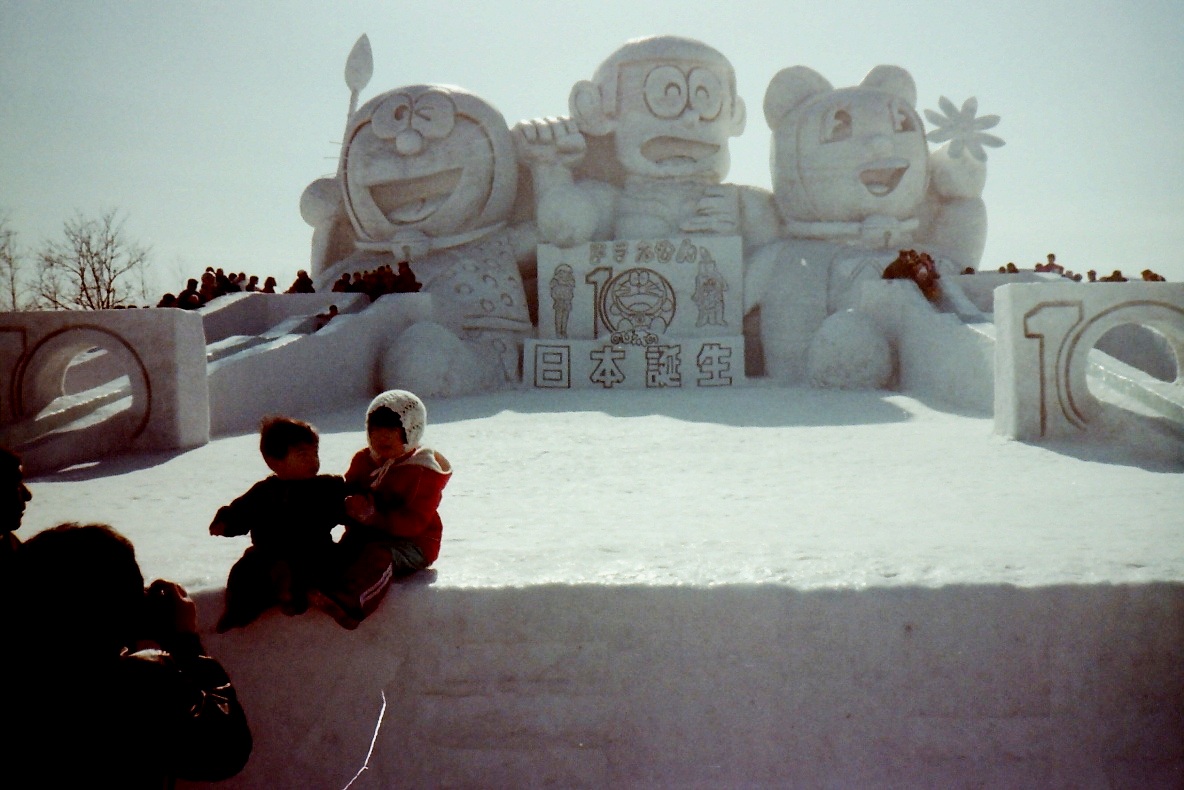
Taking photo with favorite cartoon characters
I think these snow beasts must have been Saturday-morning cartoon heros.
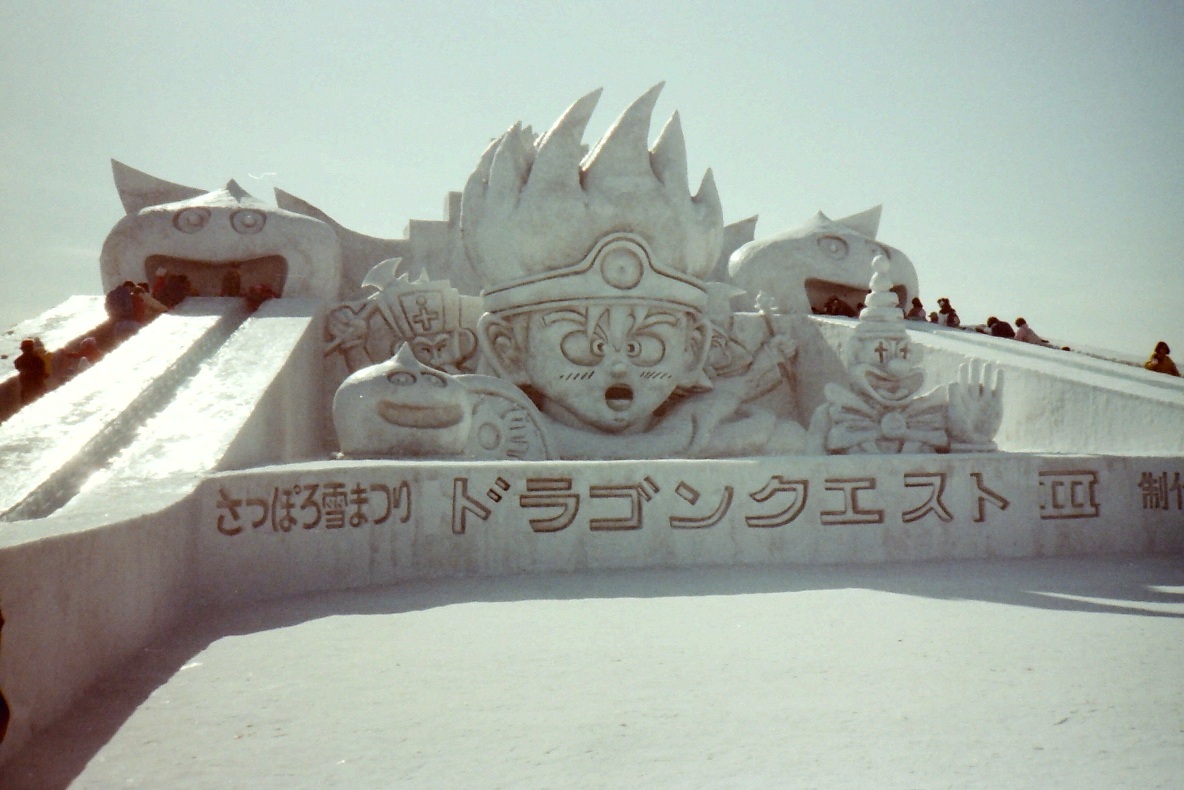
Dragon Quest
This slide has a more serious, perhaps more violent manga theme. Notice the "flaming" hair and the creepy clown. The text says, Sapporo Yuki Matsuri Doragon Kuesto, with "doragon kuesto" being about as close as they're going to get to "Dragon Quest."
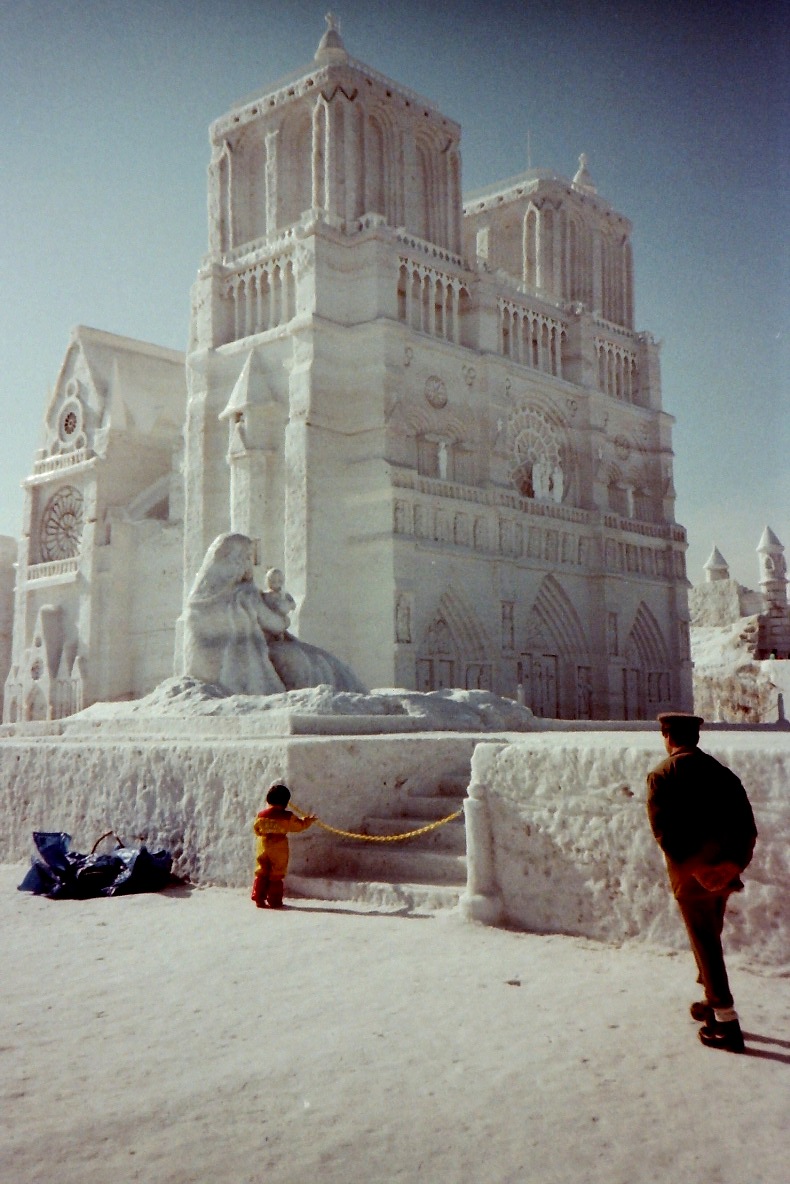
Notre Dame
This cathedral looks hauntingly familiar, n'est ce pas? So-yo!
No, this isn't Paris in a blizzard. We've finally gotten close enough to garner a good gander at the snow cathedral. I think they said it was somewhere from 25% to 35% scale. That's a LOT of snow! I don't know how they get it piled up high enough, but they do use big trucks to move the snow.
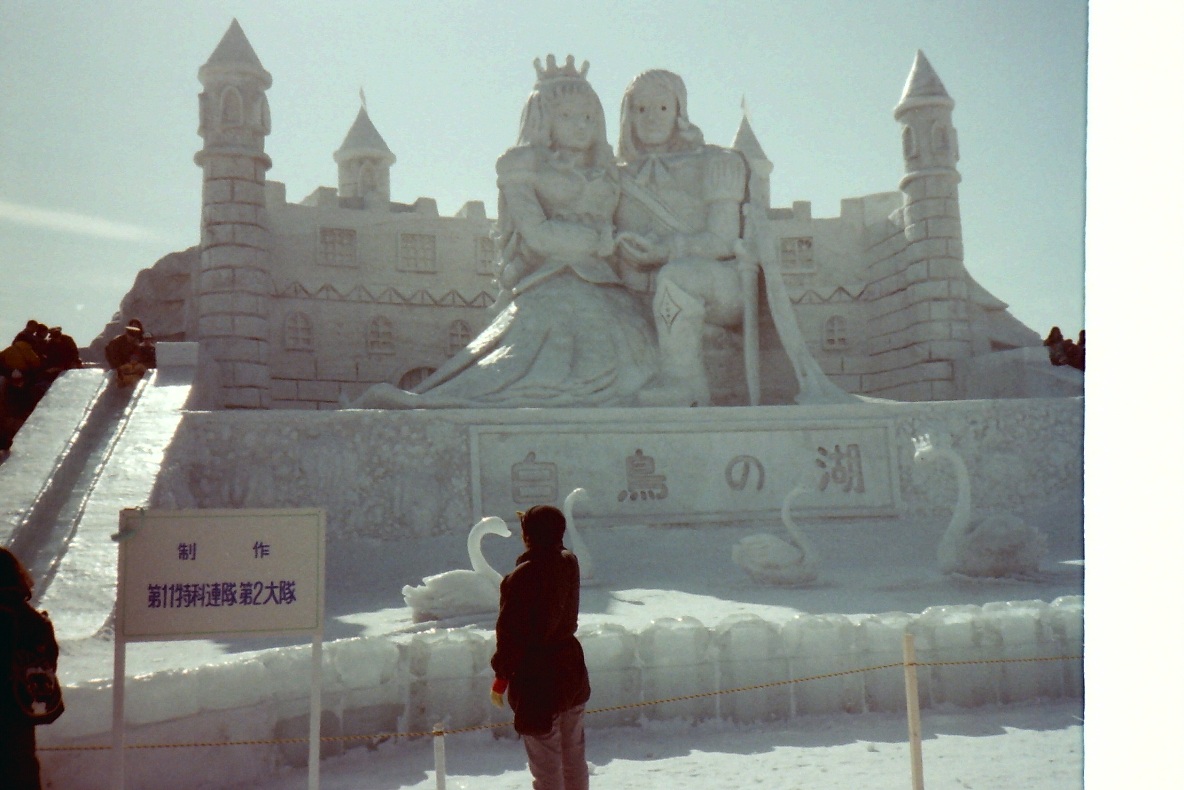
White Swan Lake
I'm not really sure if it says "swan" or just "bird." My Japanese is a bit rusty. I think the final kanji, though, the one for "lake," is probably pronounced "mizuumi." Or, it could be "ko." Language rules, phonetic conventions, and plain-ol' memorization all enter into determining how something is pronounced in Japanese. In fact, some regional pronunciations were changed on purpose, dating back hundreds of years, for the purpose of spotting spies who had slipped into the area. Pretty sneaky, huh?
A lot of people seem to think Japanese (the kanji) is phonetic, i.e., see it and say it, but it ain't so. Sometimes, phonetic kana are added to the kanji to assist in the pronunciation, but oftentimes you just have to memorize it. Occasionally, though, multiple pronunciations may be correct. Even worse is the problem with homonyms. One syllable, such as "ka," may have a couple of dozen different meanings. The hearer must wait for the context to determine the meaning. But sometimes even that is not enough. Japanese people will often "write" the kanji in the palms of their hands or in the dust or wax of a table top during a conversation in order to get their point across. And you thought the gender, cases, and conjugations in German were hard! Nihongo wa totemo muzukashii desu ne!
I have no idea what fairy tale was being represented by "White Swan Lake," but with this photo we come to the end of today's post. I have a number of other snow fest photos, but you'll have to wait for me to find time to scan them in. Sayounara.
October 6, 2011
Meet the Fukawas
[image error]
Say "Cheese!"
I got REEELLLY frustrated with WordPress yesterday. This new version is ten times buggier than the last, and I had to reload at least three photos and re-do a lot of text. It does some really crazy mixing of the HTML, but rather than continue with this diatribe, I'm going to begin posting more photos from the Ainu village. To help prevent my having to repeat effort, however, I'm going to "publish" after every two photos. I hope that doesn't cause undo grief for anyone with an RSS feed.
Here are some dioramas and artifact displays depicting the traditional day-to-day life of the Ainu.
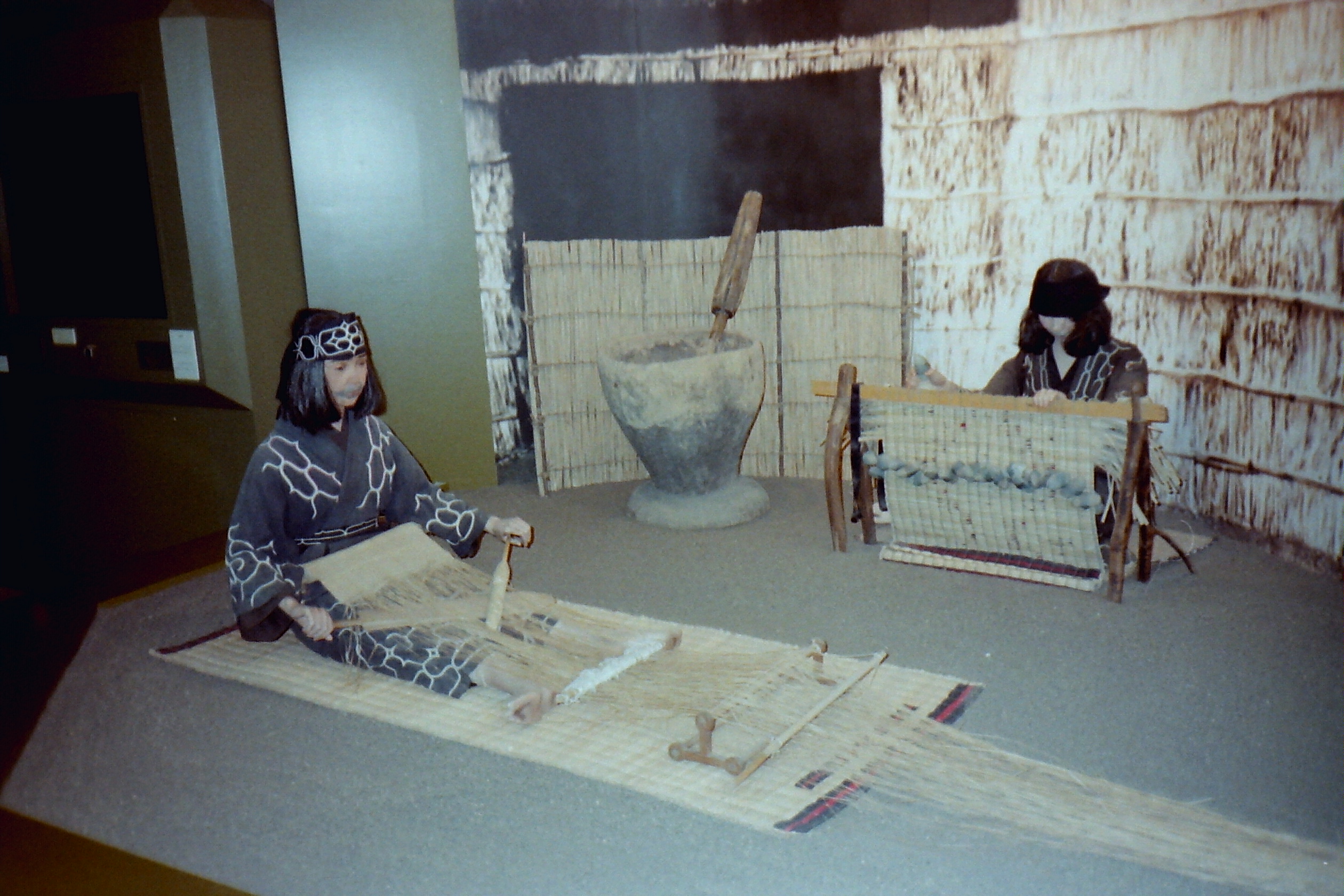
I'll NEVER get this blanket done!
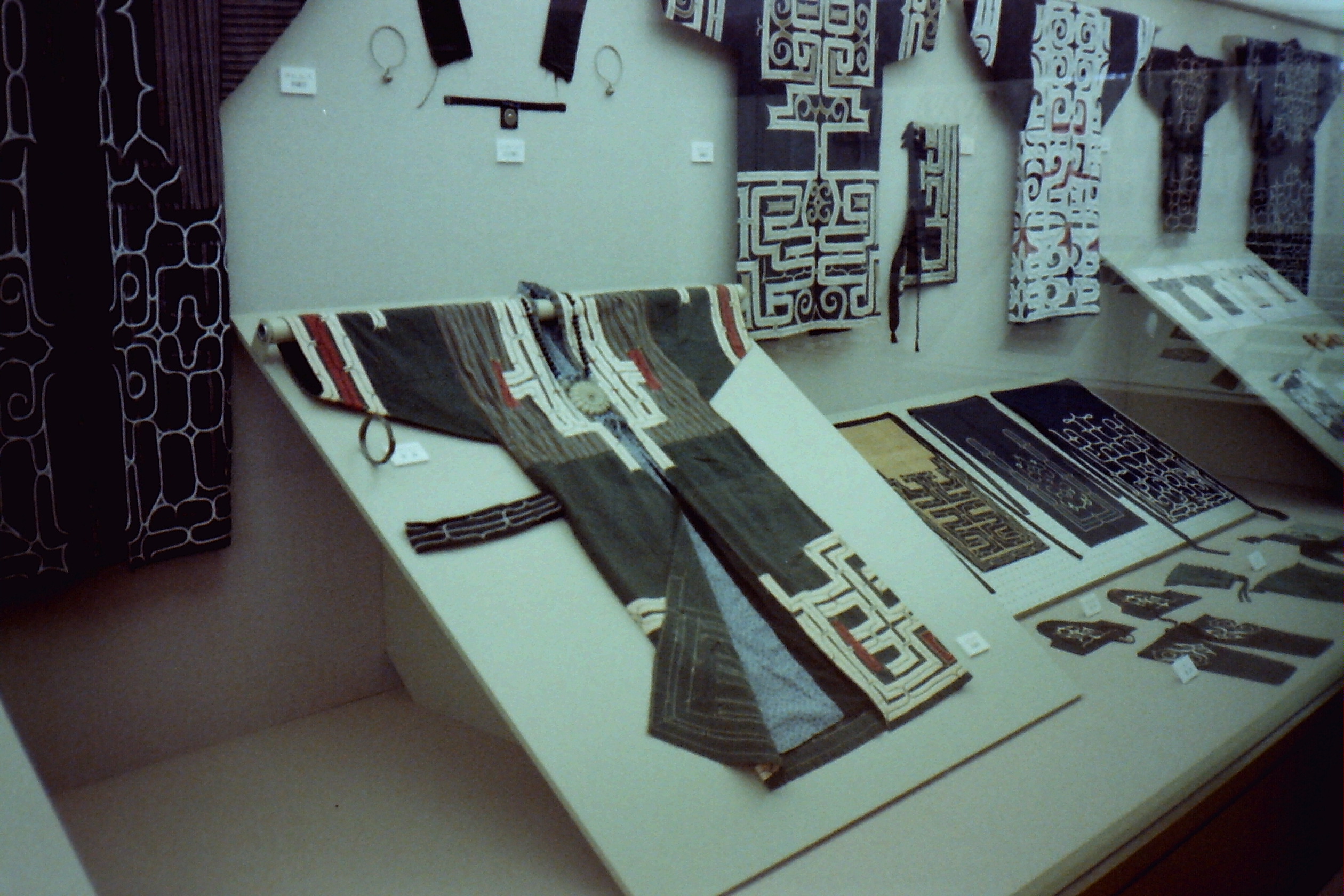
Ainu clothing
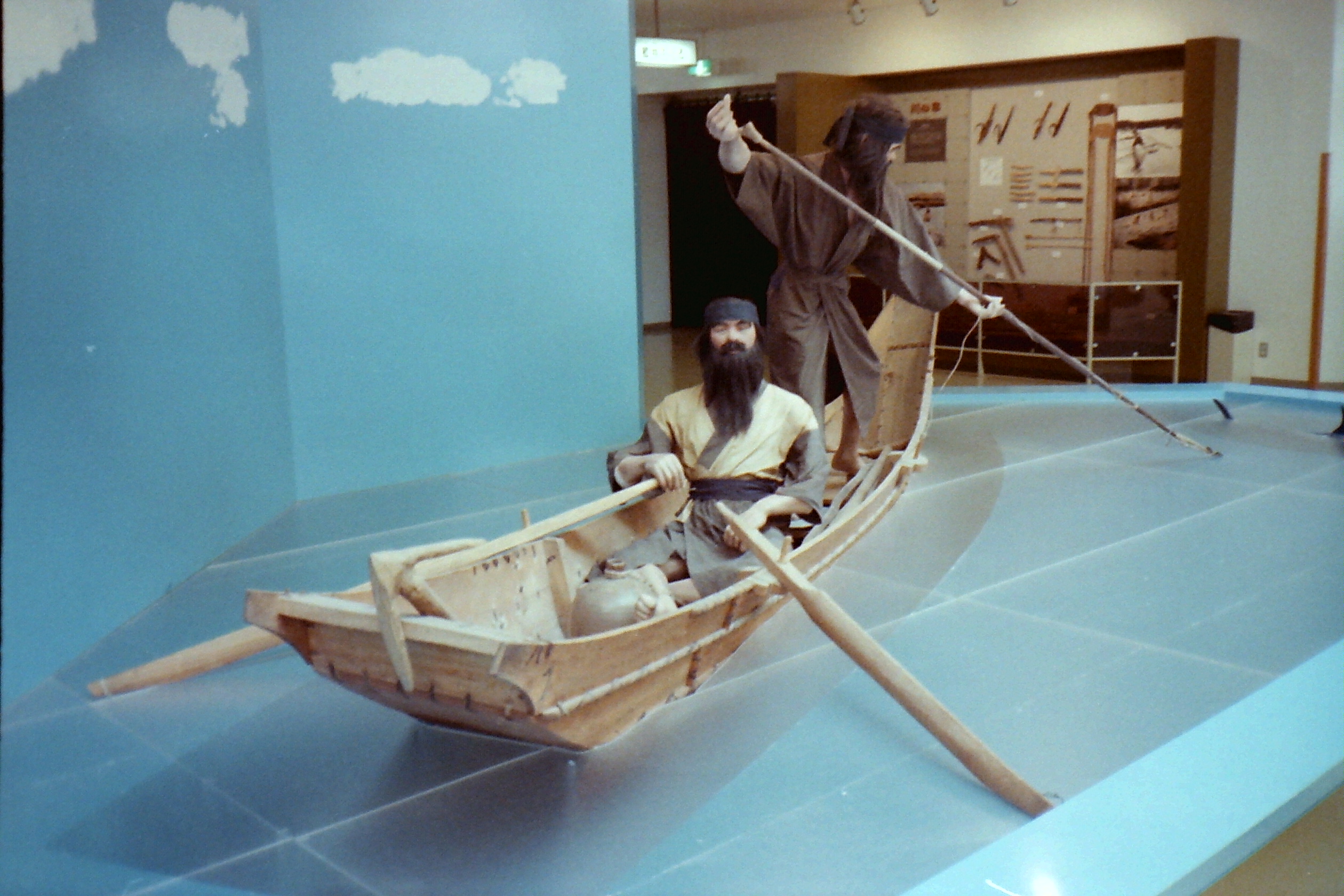
I'm a flyin' fish sailor, just home from Hong Kong
Way, hey, blow the man down. These fishermen may have no mast and rigging, but they have the one qualification common to all men of the sea: Check out the jug at the oarsman's feet. Could that be their alotment of the pusser's rum? Aye, and you may lay to that.
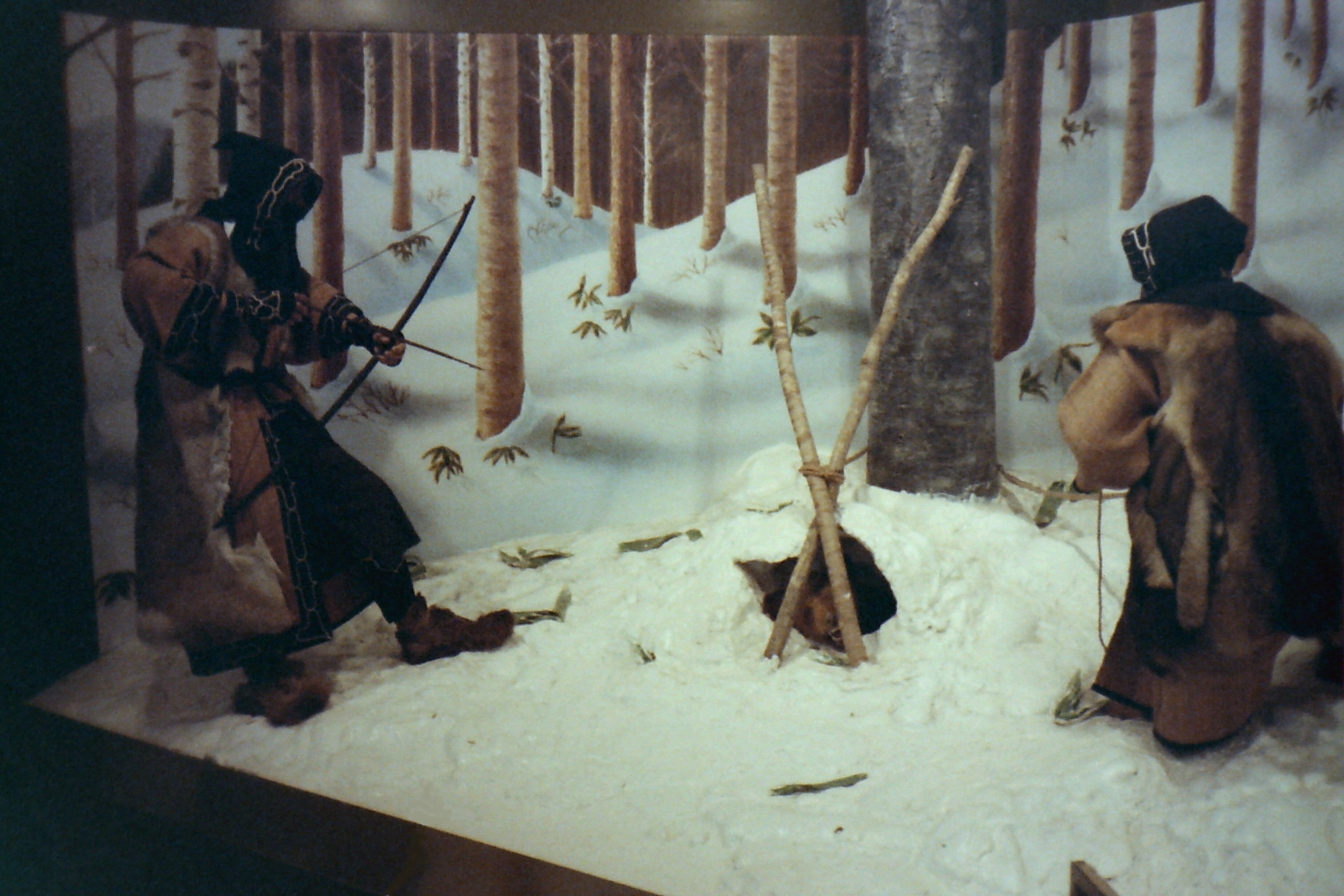
That bear hunter is going to need a bigger bow
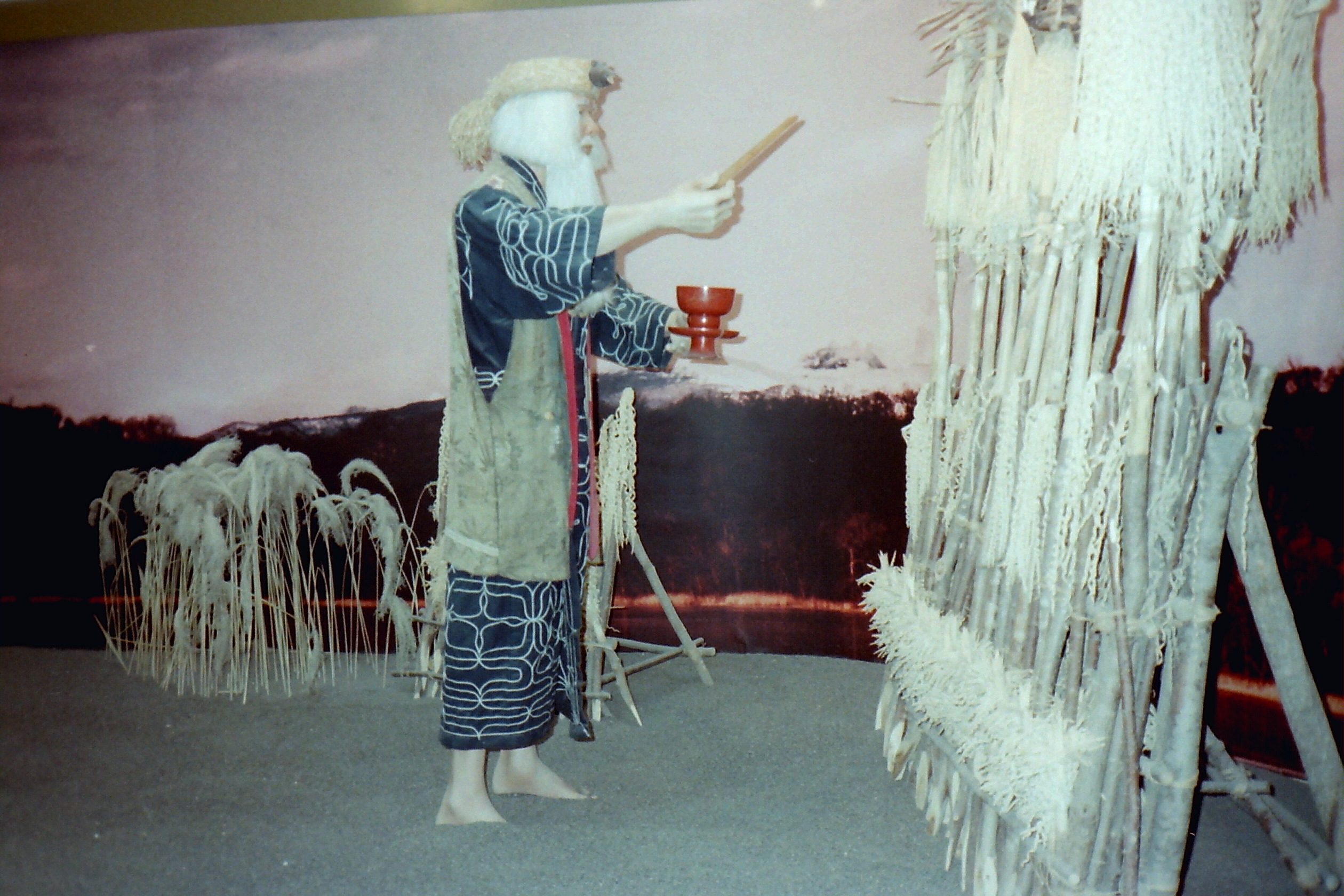
Michelangelo Fukawa
One man's art … well … whatever. Gotta work with what you have.
Next time — the Sapporo Yuki Matsuri (Snow Festival) and the Susukino district.



![[image error]](http://hortondeakins.com/survivors/wp-content/uploads/2011/10/S-A-A-c1952-72dpi.jpg)
![[image error]](http://hortondeakins.com/survivors/wp-content/uploads/2011/10/HortonJrAndPiano-1-600eg.jpg)
![[image error]](http://hortondeakins.com/survivors/wp-content/uploads/2011/10/PICT0027.ed_.jpg)
![[image error]](http://hortondeakins.com/survivors/wp-content/uploads/2011/10/PICT0033.jpg)
![[image error]](http://hortondeakins.com/survivors/wp-content/uploads/2011/10/PICT00064.jpg)
![[image error]](http://hortondeakins.com/survivors/wp-content/uploads/2011/10/PICT00117.jpg)
![[image error]](http://hortondeakins.com/survivors/wp-content/uploads/2011/10/PICT00122.jpg)