Horton Deakins's Blog, page 35
June 4, 2011
Shorei-Kan Proverb Number Ten
Konbanwa. One last time, I, Ichiro Morioka, come to give you another proverb: Practice to the best of your ability, and everyone will benefit.
This proverb holds true in many ways. For one, when you are practicing well, you are helping your sensei to conduct the class without interference. You also do not present a distraction to the other students in the form of a bad example. On the other hand, you do present a good example, an example to be imitated. This can greatly benefit the other students, especially students of lower kyu, or rank. Concerning these students, your influence may be much greater than you realize. Do not make yourself a stumbling block to them—rather, become the pattern they wish to imitate.
In the ninth proverb, we discussed the concept, "perfect practice makes perfect." This is practicing to the best of one's ability, and, above all, it benefits the individual. But this benefit is not merely for the moment, it also assists as you attempt to acquire more advanced techniques, since it provides you with a solid foundation on which to build.
Throughout the years, as you practice well, you reinforce your training foundation and create a wealth of knowledge from which other students may draw. It is this type of practice, this practicing to the best of your ability, that will enable you, perhaps, to someday become the sensei—as it is said: The student becomes the master.
This concludes our discussion of the ten Shorei-Kan proverbs.
Master Miyagi said, "Live a plain and simple life."


May 30, 2011
Welcome to "Fin" Land
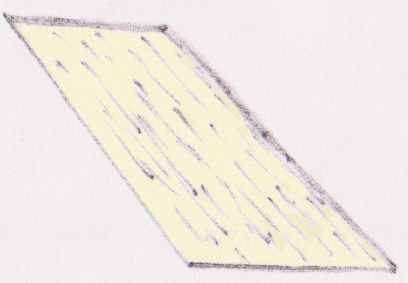
Sample fin
Bonjour, mes amis. I do so hope you are enjoying the Memorial Day holiday, but we must also not forget to pay our respects to those who have given their lives in the defense of freedom — such freedom that allows me to write to you to discuss the theory and construction of model rockets without fear of being censored or even arrested and imprisoned by a less-than-benevolent government.
Now, I ask you to study my very crude drawing of a rocket fin. The direction of motion of this particular fin would be to the right. The slanted edge on the right side is described as the leading edge, and the slanted edge on the left is called the trailing edge. The bottom edge would be attached to the rocket body and is termed the root edge, and the remaining edge may be called any of a number of things, but we will call it the outboard edge.
The colour I have selected for this fin was my attempt at approximating balsa wood, but it may be necessary for you to use your imagination, if only a bit. The somewhat random, mostly parallel streaks are meant to represent the grain of the wood. It is most important that, when marking the balsa for cutting, you lay your straightedge exactly along the grain to mark the leading edge. This will ensure maximum strength for the fin, both in a static, that is, non-flight, mode, and also during flight. Many types of fins are possible — we are limited only by our creativity and basic physics. We must always, however, keep our leading edges parallel to the grain.
Concerning the other edges, there is not much to say. Variations will change both the flight characteristics and the aesthetics. So, their orientations are up to you, but you will quickly find that cutting your fins into parallelograms, that is, with opposite pairs of sides parallel, will minimize wasted balsa and save money on construction, which is most always desirable. If your budget is unlimited, well, then, feel free to experiment.
Now we are ready to attach the fin to the rocket body, yes? No. There is yet much work to be done. Edges must be flattened, the cross-section of the fin must be shaped, and the surfaces of the fin must be made as smooth as possible. Furthermore, it is usually best to cut one fin and then use that fin as a template, or pattern, for marking the others. Once all the fins are cut, typically either three or four, it is best to sand them into their basic size and shape together, that is, all the fins are to be pressed together while sanding.
The first sanding should be done with a medium-grained sandpaper that is laid flat upon your work table, or which may be glued to a flat board — sand-side up, of course. Press together at least two, if not all, of the fins with their root edges on the sandpaper. Slowly and deliberately, and as even-handedly as you can manage, push and pull the fins up and back on the sandpaper, toward and away from the leading and trailing edges. Take special care to keep the root edge flat so that it does not take on a bowed appearance, and do not push or pull in the directions of the surfaces of the fins, as you risk breaking the fins with such an action. Alternatively, you may use a sanding block to flatten the root edges of the fins, but I prefer imparting the motion to the fins over doing so with sanding blocks, as I always obtain a better result by doing so.
If it is needed in order to make all the fins uniform in size, repeat the same type of sanding operation with the other edges. If not, then we are ready to proceed with shaping the fins to reduce aerodynamic drag, that is, to allow the fins to slip through the air more easily at high speeds and improve the rocket's performance. Look at the following drawing:
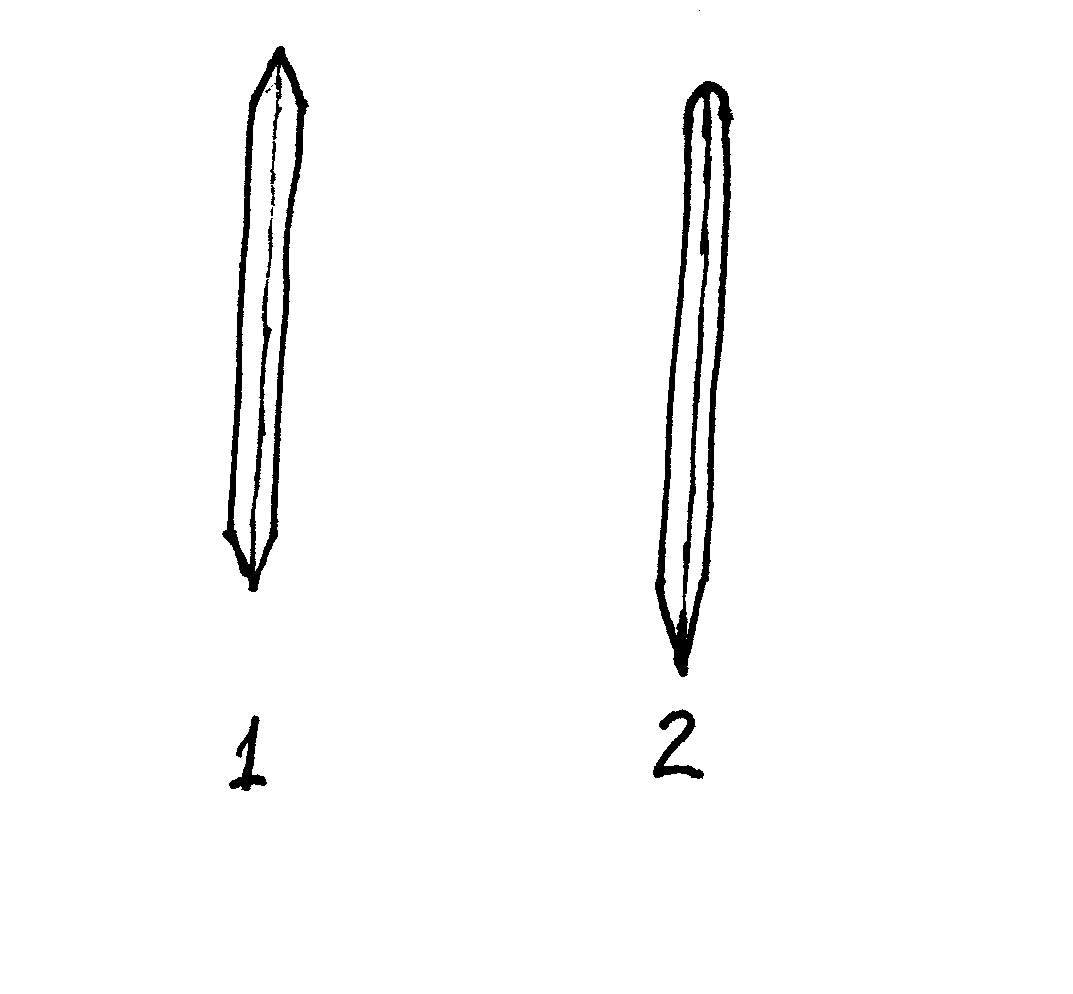
Two fins viewed from outboard edges
We are looking at the cross sections of two types of fin shapes, that is, we are looking at the outboard edges of the fins. Fin number one has sharply-pointed leading and trailing edges, while fin number two has a rounded leading edge and an even more sharply-pointed trailing edge than does fin number one.
Why the difference? It is simply a matter of ease and speed of construction versus performance. Fin number one is much easier to make, and it has acceptable performance. Fin number two is a bit more difficult to construct, but its performance is much better. It is up to you. Do you wish your rocket to take to the skies as quickly as possible, or do you wish to pit your rocket's performance against another? Do you take pride in your models, or do you not? Most of you will answer that you do, so let us use fin number two as our pattern.
Your sanding block or paper laid on a flat surface will be used again for shaping the fin's trailing edge. Lay the fin on the paper at a shallow angle and again move it up and back in the direction of the grain. Do a bit on one side, then the other, and repeat until you have made a knife-like edge. You will, at some point, wish to switch to a finer grit of sandpaper. Now, take your fine-grit sandpaper in hand and gently smooth out the transition between the fin's flat sides and the beginning of your sharpened trailing edge.
Next, wrap your sandpaper around the fin's leading edge, beginning with medium grit, and sand up and back along this edge until it has become rounded. Change to the fine grit and repeat to get a nice, uniform edge.
Your outboard edge may be left flat, if desired, or you may round or sharpen it, as you wish. A tapered edge will, however, further improve the rocket's performance.
Finally, we need to do preliminary smoothing of the surfaces of the fins. Take care not to damage the edges during this process. You may keep either the fin or the sandpaper stationary, or you may wish to skip this step altogether until the fins are mounted on the rocket. More smoothing will be performed at that time anyway, so perhaps that would be the better course to take.
Next time, we will proceed with mounting, smoothing, filling, and painting the fins.
May 24, 2011
A very moving conversation
A not-so-unlikely scenario seventy-five years ago could have been, if you will imagine with me for a moment, mes amis, encountering Albert Einstein on board a car of a passenger locomotive. An aspiring physics student once made such an encounter.
The student had been following closely the career of Dr. Einstein for years—as closely as one could before the existence of the Internet. So it was with much excitement and trepidation he approached the illustrious theoretical physicist. He formulate his one question—and he was very much convinced that one question would be all that he would be permitted—very carefully and said, "Excuse me, Herr Professor. Does New York stop at this train?"
Professor Dubois
May 19, 2011
The reel thing
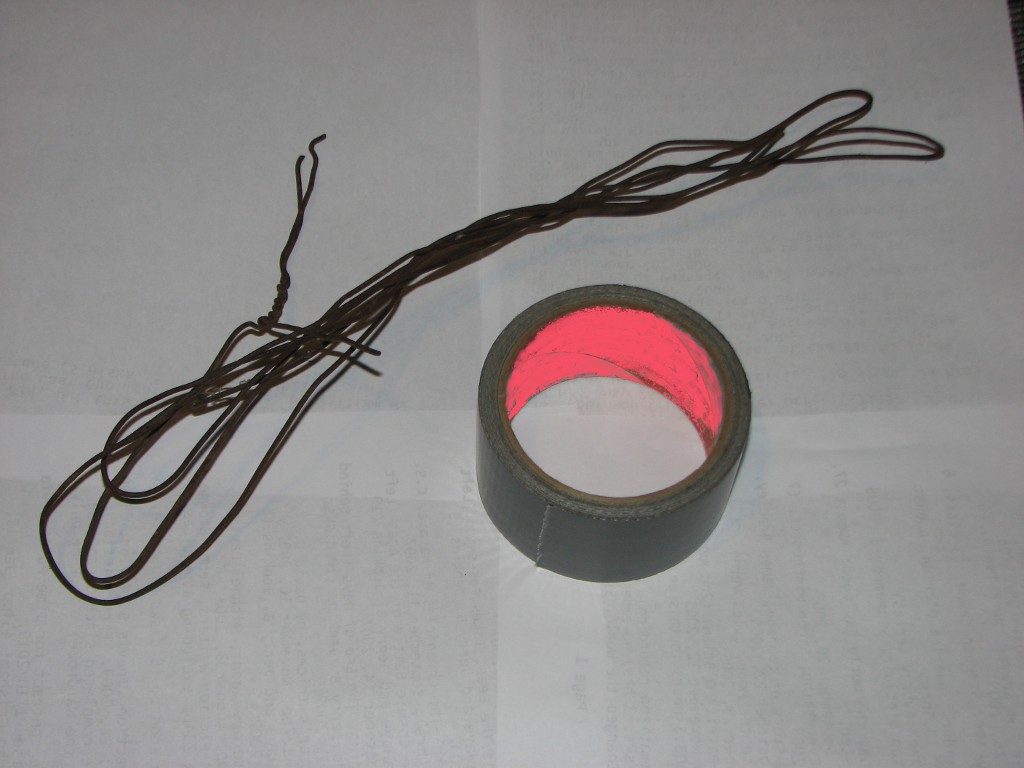
Duct tape and bailing wire
In the above photo, friends is the "reel" thing—bailing wire, right next to the duct tape. No, I didn't get it off a reel. It came out of the old family barn, a barn that is about to be bulldozed down, along with the old family farm house—gone forever.
There's still a big pile of that wire in the barn, but it's not accessible without taking out a wall. Not that you'd really want to, anyway, but that wire is anywhere from forty to ninety years old, and you just don't see it around much anymore.
Yes, we had to sell the old farm. There was no one to live there and keep it up, and it wasn't in a particularly safe area. Oh, it was at one time, back in the days when Dad took his rifle to school with him and stored it in the cloak room until time to go home, and no one ever got shot—not once. He and his brother used it to hunt possum on the way home.
In a month or two, there will be nothing left but a memory. I hate that it has to happen, but life goes on. One thing I really regret, though, is that the old house has window panes that date back about 100 years. That glass is wavy, not flat like modern glass, and it can't be replaced except by windows in another 100-year-old farm house.
There's a lot of history in that old farm and the surrounding area. A spur of the Chisholm Trail even passed nearby. I've recorded some of the history and family stories, and maybe I'll get to publish it some day. I hope I got everything correct, because there's no one left alive to correct me. I'll miss the old farm, but I miss the family the most.
May 16, 2011
Well, tie me up and call me a turkey
Sure, I've been falling down on the job. I haven't contributed to this blog in nearly two months. I could say I've been busy, but burning through 9mm rounds at the range is no excuse. Gotta keep up my marksmanship, though — never know when you're going to need it. Which reminds me, I need to clean the ol' hog leg.
I'll make this short, because it's late. I just wanted to give you a heads-up that next time I'll show you some REAL bailing wire. Yes, the real stuff. And this stuff is somewhere between forty and seventy years old.
I'll post a photo soon, I promise — Craig Brewer.
May 4, 2011
An Anniversary of Historic Import
Mes amis, our friend Mr. Brewer had intended to be the next to address you in this forum, but I asked his indulgence in order to bring to your attention an occasion deserving of our notice and our honor.
Tomorrow, May 5, 2011, has a significance far beyond the celebration of Cinco de Mayo–as important as that may be to you. Tomorrow is the fiftieth anniversary of the first flight of an American into space by way of a rocket launched from the ground. On May the fifth, 1961, Alan Shepard, reclining inside the Mercury capsule christened Freedom 7, was boosted into a suborbital flight by a Redstone rocket launched from Cape Canaveral, Florida.
Mr. Shepard was lifted to an altitude of 187 kilometres, and he was catapulted downrange a distance of 486 kilometres. He was not the first to travel into space, an honor held by the Soviet cosmonaut Yuri Gagarin, nor would he be the first American to orbit the earth, as that record belongs to astronaut John Glenn. There are those who argue that the first person in space was indeed an American, and that the vehicle employed was not a vertically-launched rocket, but I digress. We will not explore that subject during this time of honoring the man and the mission.
Mr. Shepard passed from this life on July 21, 1998, at seventy-four years of age. Take a moment now with me to celebrate his life and such a great accomplishment for both the astronaut and this nation.
April 26, 2011
Newtonian Food for Thought
Good evening, mes amis, it is Professor Dubois once more. This will not be an extended talk, but I had on my mind the concept of frame of reference, or perspective, and I wished to share it with you.
You have heard it said that a body remains at rest or remains in motion unless acted upon by some outside force. Now, imagine two masses, shall we say, two baseballs, sitting on the floor. Neither is moving. They are not moving relative to each other, but they are moving, are they not? Could not this floor be falling from an airplane? Or from a spaceship over an airless planet? In that case, are not the balls accelerating in relation to the planet or moon toward which they are falling?
But the planet or moon where the balls are falling, or perhaps resting, is itself rotating, and it is revolving around a star, and that star is likely revolving around a supermassive black hole at the center of a galaxy, and that galaxy is moving through the universe, and sometimes that motion is a fixed velocity, and sometimes acceleration is involved, and …
What, then, is motion? And what does it mean to be stationary? What is your "point of view?" What is meant by "frame of reference?" Ask yourself, "Is this what is meant by relativity?"
April 25, 2011
Shorei-Kan Proverb Number Nine
Konbanwa, tomodachi. Good evening, friends. It is Ichiro again. We have almost arrived at the end of our journey. This evening I come to you to talk about the ninth proverb: Do not become angry. He who is easily angered often loses courage at important moments. There will be only one more proverb after this.
You may think that, in order to fight well, one must become angry, that one must raise the level of adrenalin in one's body. There is nothing wrong with an elevated level of adrenalin, if it does not distract one from his focus. One only attains focus, however, through protracted practice. You may have heard the saying, "Practice makes perfect." I, on the other hand, have heard it said that perfect practice makes perfect. In any case, focus is a very important component of karate.
Anger breaks one's focus, and it will blind one to his attacker's methods. When this happens, one may receive an unexpected blow which will shake one's resolve and erode one's courage. In a fight, each moment is crucial, and the fight may be won or lost in an instant. Each and every blow from a trained karateka can be deadly, maiming, debilitating, or incapacitating. So, you see, all moments in such an exchange are important, and one must not risk losing courage.
If one allows anger, or, for that matter, any emotion, to control oneself during a fight or where there is the potential for a fight, one has already lost courage and, therefore, the advantage.
Master Chojun Miyagi said, "Be calm in mind and swift in action."
April 24, 2011
Block, or Inline? Your choice.
Hello again. I'm Horton Deakins, the real-life writer of this blog. By that I mean that all the other "writers," Craig Brewer, Professor Dubois, Ichiro Morioka, and Lana Abston, are characters from my new Sci-Fi book, Time Pullers. So, for them, I say "Howdy," "Bonjour," "Konnichiwa," and "How are you?"
I have created a new trailer for Time Pullers. You can find it on YouTube by searching for my name, or you can access it via my Web page, www.hortondeakins.com , or you can click on this link: TIME PULLERS TRAILER . I had a bit of fun creating it, and I hope you enjoy it. The best part was writing the music for it. Of course, I also hope it makes you want to get the book to find out what it's all about!
Last time I promised to talk about the HTML elements span and div. These are container elements that are defined to be, by default, inline, and block, respectively. What does this mean? Let's start with a little history (so apropos for a writer of time-travel stories, don't you think?)
In the early days of HTML, all the tags, e.g.,"
", for paragraph, were written in uppercase. Also, it was quite acceptable to have a paragraph tag and not end the paragraph with a closing tag, i.e., "
". Today, the trend is to make HTML "XHTML" compatible, i.e., HTML written according to the rules of XML, and standards are beginning to tighten, as well. Thus, out go the uppercase tags, in come the lowercase, and everything must either have a beginning and an ending tag, or in the case of a few elements such as "", or horizontal rule, the ending tag is combined with the opening tag by way of the slash.A " " container is used to group HTML elements that will usually be displayed within the flow, i.e., no extra lines or carriage returns are generated by this container in its default mode (more about that later). A " " container, however, begins a new line before displaying the elements it contains, and it creates a new line at its end before any following content is displayed. It is as if a rectangle, or "block," has been created by the in which to render its contents on the screen.
When elements are grouped using a or a , it makes it very handy for the control of the display of these elements as a group using CSS, or Cascading Style Sheets. Unfortunately, CSS is beyond the scope of this lesson, but it can be used to control the margins of the block and how much padding is allowed around the internal elements, the size and color of the text, the font, and many other things.
I mentioned "default mode" before. It is actually possible, using CSS styles, to reverse the inline and block properties of the and containers, thus making the one behave like the other. The reasons for doing this also fall beyond the scope of this lesson, however.
Let me conclude with a quick example of how to apply margins around a and padding around the elements it contains. We won't use a style sheet; we will instead add what is called inline style. Enter the following HTML markup (notice I didn't say "code," since, strictly speaking, the creation of HTML markup is not coding, a word which is generally used as a synonym for programming. HTML is not a programming language) into the body of your HTML document:
This is text at the beginning
This is a paragraph inside a div
This is text at the end
The block containing the paragraph will have at least 100 pixels of space all around it, and the
block inside the will have at least 50 pixels of space (padding) all around that. Note that the blocks expand to the width of the window or the containing block, minus the margin (or padding). This is easy to see with the borders we placed around the blocks. Note that the widths of the blocks change dynamically as you adjust the width of your browser window.
That's it for this time. Check out my book trailer—it's less than two minutes long.
TIME PULLERS TRAILER