David Williams's Blog, page 4
July 3, 2012
Dumbed down by PowerPoint
It’s twenty-five years since Microsoft acquired PowerPoint. In one-third of a lifetime the program has achieved virtual ubiquity, not just for business presentations and sales pitches but in public meetings, schools and colleges across the developed world. It’s a fair bet if you have sat in a classroom or meeting room anytime over the last quarter of a century you will have been PowerPointed; and then some.
I’m sure I’d find common ground with readers, elicit nods of recognition with an article entitled Bored silly by PowerPoint. Which of us has not peered past a turned shoulder in an imposture of attentiveness to a distant screen, our yawns politely stifled while a speaker (more likely male than female) works his way through every one of forty slides by reading aloud each of the myriad bullet points on each slide, breaking off only to say of a particularly crowded specimen, ‘Mmm, you probably won’t be able to read this...’ A too-familiar scene, but my argument is a wider one - that the way this Microsoft presentation tool is conventionally, almost universally deployed acts as a barrier to clear reasoning and expression, and actively inhibits the close, creative engagement that can help to spark, expand and develop our best thinking. In school or at work we are brain-dulled and dumbed down by PowerPoint.
One generic descriptive label for presentation equipment and software is speaker support: a telling phrase, its focus on the messenger rather than the message, much less the audience. Of course there can be genuine benefit for those who only sit and stare - it’s true that a striking illustration, a well-designed graphic, a significant quote may, judiciously selected, enhance enjoyment and understanding - but all too often the speaker’s PowerPoint pack is not there to support the presentation; it is the presentation.
What we generally see is an abridged form of autocue on slide. On slide after slide after slide in relentless sequence. Our speaker would probably prefer to have it all up there word for word, but that’s not the done thing with PowerPoint. It’s de rigueur to employ nouns without verbs, cut out conditionals, avoid pronouns (especially personal pronouns), chop and order everything into a hierarchy of bullet points. The effect is a flat placebo of a presentation, pretending potency but squeezed of content, reason and any trace of passion.
Imagine if Martin Luther King, getting to the crux of his I have a dream speech, turned his back on his audience and addressed them using PowerPoint, thus:

At least as a member of the audience you might have some of the gaps filled in by the speaker on the day (though a 2007 study by the University of New South Wales found that trying to attend to a speaker while simultaneously following a visual summary of the words leads to ‘cognitive overload’ and a consequent failure to do either). What’s worse is trying to make sense of handouts that are merely a print-out of the given presentation. Devoid of oral interpretation, meaning drains from the printed sheet. Yet surveys have shown that an audience is even less likely to focus properly on a presentation when they know they will be provided with a handout of the slides at the end.
Despite these shortcomings PowerPoint continues to be used with mind-boggling frequency – 30 million presentations per day according to Microsoft’s own estimate – and across an extraordinary range of subjects. To test the breadth of use, try typing any random concept you can conceive into a search engine and add the extension ppt. I just tried it with the phrase diabetic monkeys ppt and sure enough a PowerPoint slide show obligingly presented itself at the top of the search results. Why the enduring popularity of this mind-sapping software? I’d like to suggest some reasons as I continue my exploration of its deleterious effects.
First its use in schools, embedding early the notion of PowerPoint as the default mode of presentation. Teachers – often influenced by teaching guides set out in PowerPoint format – tend to be regular users. Pressed for time and conscious of copyright issues, many rely on standard Microsoft templates and reach too readily for the royalty-free images, so inventive opportunities are forsaken for cliché. Pupils are encouraged to present much of their own work in the same style, so what may traditionally have been reports written in full sentences and carefully structured in paragraphs, perhaps with hand-drawn charts or illustrations, are these days prepared and given like client pitches in the inelegant, anti-literate half-language of bullet points. Art is sacrificed for clip art.
For children and adults PowerPoint is the easy option. It obviates the need even to express a complete thought, still less develop an argument or guide a reader through possibly complex or subtle ideas with clarity and skill. Enough to dash down a few headers, fill under with some salient points – an outline sufficient to talk to. Trouble is, in avoiding the hard graft of deep thinking and writing, they avoid the deep learning too. They lose the richest opportunities for analysis, exposition, synthesis and, at best, revelation. As E M Forster wrote, ‘How can I know what I think until I see what I say?’
On a superficial level PowerPoint looks good, looks cool, and of course it’s slick to use. The presenter with the remote control has the room under control (if only because the audience is semi-comatose). The more polished the presentation the more authoritative it appears to be – and certainly the aspiring executive who can carry it off with a measure of pizzazz and conviction is often the one who will attract the notice of senior management and gain both kudos and promotion.
In this very coolness lurks the greatest danger. I use the term ‘danger’ advisedly because, as I’ll exemplify, there are circumstances in which the consequences can be life-threatening. By preferring form over content, sales pitch over objective analysis, by substituting condensed pellets for the meat of the argument, by creating an illusion of control and authority that stifles discussion and relegates the audience to passive recipients of here’s-some-I-made-earlier slices of preorganised information, without elaboration or deconstruction, the PowerPoint presenter can lead us to mistaken conclusions, shallow judgements, bad decisions.
In February 2003 the space shuttle Columbia disintegrated over Texas as it re-entered the Earth’s atmosphere. All seven crew members were lost. A tragic accident, yes, but an avoidable one according to post-disaster analysis by Professor Edward Tufte of Yale University.
A fortnight earlier, while the craft was in orbit, a short video sequence had shown NASA observers that something (it turned out to be a piece of foam debris) had hit the wing. To help senior officials assess the threat, Boeing Corporation executives converted their engineers’ investigations into a rapidly-assembled PowerPoint presentation of 28 slides on screen with summary printouts – a standard form of briefing. The devil (doubts, uncertainties, worries) was in the detail. Specific technical findings about the wing damage were buried in a confusing, multi-layered crowded slide. The highlighted, key bullet-pointed executive summary was generally upbeat about the problem. Top level officials missed the underlying messages. Drawn to the optimistic summary and reassured by the tone of the presenters, they concluded there was nothing really to worry about. A wrong decision not to intervene turned the undetected hole in the wing of the spacecraft into a two-week time bomb that triggered calamity.
 Columbia Space Shuttle February 2003
This was a failure both of the presentation and the organisational framework within which it was delivered. In many corporate cultures – not least typically ‘macho’ environments such as the military, the space industry, engineering – there is a strict reporting hierarchy and an assumption, as information is passed up the line, that senior management is far too busy and important to be bothered with small details. Bosses have their eye on ‘the big picture’; they demand reports presented in hyper-condensed form so that they may review and pass judgement without having their valuable time wasted on minutiae. This is condition perfect for bog-standard PowerPoint – neatly ordered bullets with key words and phrases lined up for inspection (supporting information filtered out), a few charts with coloured bars or arrows interweaving between word bubbles to provide (illusory) one-page snapshots of the technically complex; all smartly presented electronically and with a slim sheaf of hard copy for later perusal (or more likely to be filed unread).
What’s missing from this picture is just about everything that vivifies learning and leads to genuine understanding: motivation, engagement, interaction, examination of evidence and counter-evidence; thinking aloud, questioning, discussing, opining, debating, arguing, reasoning, imagining, postulating; pulling strands together and reaching some sort of realisation, new awareness, consensus or resolution.
If, as seems probable, PowerPoint continues to hold sway as it has done for the last twenty-five years, don’t hold out for improvement. Oh, there will be technological advances no doubt – the PowerPoint of the future is sure to be even more impressive and glitzy, studded with apps and gizmos for the new world – but what they’ll add up to is the modern equivalent of smoke and mirrors, taking us further away from the opportunity to experience insights that can result from the deep thinking that accompanies considered writing, truths that can be revealed by discussion without distraction.
At its worst, a PowerPoint-supported talk is a conspiracy of pretence. The speaker pretends to communicate, and the audience pretends to listen. Nobody learns. The presentation may seem smart, it may look great, rather like a picture in a swish corporate brochure, and equally devoid of life. There may be words, words and more words spoken from the platform, but it’s one dumb show.


June 22, 2012
Comedy sketch: So you want a pay rise?
A couple of weeks ago I posted the series of short Matt and Nev sketches I wrote for the BBC 'Jesting About' radio show. Here's a longer sketch that was recorded but did not make the final edit. Hope you enjoy it.
SO YOU WANT A PAYRISE?
David Williams
FX OFFICE ATMOS
FRANK You busy, boss?
BOSS Frank, come in, you know my door’s always
open. Don’t stand on ceremony – perch
nervously on the edge of the chair.
This is about your pay-rise request, yes?
FRANK Well, I’ve been here nearly three years now,
and I’ve never had...
BOSS Three years. Time flies, eh? How many days
in a year, Frank?
FRANK Eh? Oh, er... 365. (EAGER BEAVER) 366 in
a leap year.
BOSS Good. Very, very good. That’s what I like
about you, Frank, you’re quick. And how
many hours in a day?
FRANK (ENCOURAGED BY PRAISE) That’s easy.
24.
BOSS Of which you work?
FRANK Oh, er, nine to five. (BRIGHTLY) That’s eight
hours, boss.
BOSS Which is precisely one third of a day. So, over
the year. Come on, Rain Man, what’s one
third of 366 days?
FRANK Mmm, that would be 122 days, boss.
BOSS I said you were quick. Remind me, Frank, do
you work weekends at all?
FRANK No, no. I’m staff side. We don’t...
BOSS So, no Saturdays, no Sundays. Let’s see. 52
weeks in the year... By my reckoning that’s
104 days, which we take off your...?
FRANK 122.
BOSS Which leaves...?
FRANK (BEMUSED) Oh, er, 18.
BOSS Very good. Now, Frank, holidays!
FRANK (INTERESTED) Yes, that’s another thing I
was going to ask about...
BOSS Of course, Frank, no subject barred. So
what’s your entitlement at the moment?
FRANK Just 14 days, boss. I think you’ll agree...
BOSS Don’t interrupt while I’m doing the sums. 18
minus 14, that’s...
FRANK (HELPFUL) Four.
BOSS Just got there before you, Frank. Wow, you
young guys keep me on my mettle. That’s
what I love about this business. Now, where
had we got to?
FRANK Er... four?
BOSS Oh, yes, four days. But of course the office is
closed Christmas Day.
FRANK And New Year’s Day.
BOSS Which leaves two days. Do you work Good
Friday, Frank?
FRANK (BELATEDLY REALISING WHERE THIS IS
GOING) Ermmm, no. (BEAT) No.
BOSS Easter Monday?
FRANK (DEFEATED) No, boss.
BOSS Well, Frank. You know me, always ready to be persuaded by the facts. And in this case I have to say your pay claim doesn’t stand up to scrutiny. In the circumstances I think we’ve been more than generous. According to the figures you and I have just kicked around you haven’t worked for this firm one single day. (BEAT) Are you OK, Frank? You’ve suddenly turned a little pale.
FRANK I do feel a bit sick all of a sudden.
BOSS (SYMPATHETIC) Ah Frank, mate, we can’t have you working if you’re not well. Please, with my blessing, take the rest of the day off.
FRANK (WEAKLY) Thank you, boss. That’s very kind of you.
BOSS Not at all – you know my mantra; this company’s greatest asset is its workforce, and it has to be looked after. What time is it now? 2 o’ clock. You get along home to bed, I’ll let Accounts know they’ll need to dock three hours off your salary this month.
END

SO YOU WANT A PAYRISE?
David Williams
FX OFFICE ATMOS
FRANK You busy, boss?
BOSS Frank, come in, you know my door’s always
open. Don’t stand on ceremony – perch
nervously on the edge of the chair.
This is about your pay-rise request, yes?
FRANK Well, I’ve been here nearly three years now,
and I’ve never had...
BOSS Three years. Time flies, eh? How many days
in a year, Frank?
FRANK Eh? Oh, er... 365. (EAGER BEAVER) 366 in
a leap year.
BOSS Good. Very, very good. That’s what I like
about you, Frank, you’re quick. And how
many hours in a day?
FRANK (ENCOURAGED BY PRAISE) That’s easy.
24.
BOSS Of which you work?
FRANK Oh, er, nine to five. (BRIGHTLY) That’s eight
hours, boss.
BOSS Which is precisely one third of a day. So, over
the year. Come on, Rain Man, what’s one
third of 366 days?
FRANK Mmm, that would be 122 days, boss.
BOSS I said you were quick. Remind me, Frank, do
you work weekends at all?
FRANK No, no. I’m staff side. We don’t...
BOSS So, no Saturdays, no Sundays. Let’s see. 52
weeks in the year... By my reckoning that’s
104 days, which we take off your...?
FRANK 122.
BOSS Which leaves...?
FRANK (BEMUSED) Oh, er, 18.
BOSS Very good. Now, Frank, holidays!
FRANK (INTERESTED) Yes, that’s another thing I
was going to ask about...
BOSS Of course, Frank, no subject barred. So
what’s your entitlement at the moment?
FRANK Just 14 days, boss. I think you’ll agree...
BOSS Don’t interrupt while I’m doing the sums. 18
minus 14, that’s...
FRANK (HELPFUL) Four.
BOSS Just got there before you, Frank. Wow, you
young guys keep me on my mettle. That’s
what I love about this business. Now, where
had we got to?
FRANK Er... four?
BOSS Oh, yes, four days. But of course the office is
closed Christmas Day.
FRANK And New Year’s Day.
BOSS Which leaves two days. Do you work Good
Friday, Frank?
FRANK (BELATEDLY REALISING WHERE THIS IS
GOING) Ermmm, no. (BEAT) No.
BOSS Easter Monday?
FRANK (DEFEATED) No, boss.
BOSS Well, Frank. You know me, always ready to be persuaded by the facts. And in this case I have to say your pay claim doesn’t stand up to scrutiny. In the circumstances I think we’ve been more than generous. According to the figures you and I have just kicked around you haven’t worked for this firm one single day. (BEAT) Are you OK, Frank? You’ve suddenly turned a little pale.
FRANK I do feel a bit sick all of a sudden.
BOSS (SYMPATHETIC) Ah Frank, mate, we can’t have you working if you’re not well. Please, with my blessing, take the rest of the day off.
FRANK (WEAKLY) Thank you, boss. That’s very kind of you.
BOSS Not at all – you know my mantra; this company’s greatest asset is its workforce, and it has to be looked after. What time is it now? 2 o’ clock. You get along home to bed, I’ll let Accounts know they’ll need to dock three hours off your salary this month.
END
June 6, 2012
Would-be authors - 25 sentences NOT to include in your query letter
‘Dear Sir and/or Madam’
‘What’s that smell coming off the ms you’re holding? - that’s the smell of serious money.’
‘Friends who I have shown my book to all say things like: ‘the best story I ever read’, ‘definite best seller’, ‘it’ll make a great movie’ etc.’
‘Move over, Harry Potter.’
‘You’re gonna love it.’
‘This book is bound to fly off the shelves.’
‘This book will change the face of publishing forever.’
‘I didn’t see any other fantasy books on your list, so this is a great opportunity for you to publish in a popular genre.’
‘Your listing said no short stories, but you’ll find my short stories are very different.’
‘I have not included a synopsis as that would spoil the surprise at the end of the story.’
‘The story speaks for itself.’
‘I have not included the first three chapters as things don’t really get interesting until Chapter 4 - please find enclosed Chapters 4-10.’
‘I know you asked for only three chapters, but my book is finished and anyway I’m confident you’ll want to read on after the first three chapters so I’ve enclosed the whole thing.’
‘The single spacing and two-sided printing are not exactly according to your guidelines, but I’m sure you’ll appreciate the savings in postage.’
‘Excuse the handwritten ms - my typewriter is on the blink.’
‘You asked for submissions by post, but these days people find that email is quicker, cheaper, and gets right to your computer - please click the attachment above and start reading straightaway.’
‘Don’t take the risk of losing this in the slush pile - read it today.’
‘I’m not sure if it’s any good, but I suppose you’ll be the judge of that.’
‘Please ignore the spelling mistaks - never my strong point at school.’
‘I noticed a few factual errors after I printed it out - but your proofreader will pick these up easily enough.’
‘As you’ll see from my pic enclosed, I have all the attributes your publicity people need for setting up celebrity interviews etc.’
‘Rather than taking up space here with my cv, here are the links to my website and Facebook page.’
‘More than twenty agents and publishers have rejected this already - please do not add your name to the list of the stupid.’
‘Please get back to me not later than the 17th - I have given the same deadline to everyone I’ve sent to so I can assess all offers and make a decision.’
‘Call me, but you’d better make it quick.’

May 31, 2012
Matt and Nev in their usual seats 7
MATT AND NEV IN THEIR USUAL SEATS 7
David Williams
FX PUB ATMOS
MATT Tell ye a thing that would solve the
inviroment. (BEAT) Bikes.
NEV Oh aye?
MATT Like China. It’s all bikes in China now. (BEAT)
And Belgium.
NEV I canna ride a bike.
MATT Why aye ye can. One of them things you
never forget. Like... ridin’ a bike.
NEV Never had a bike. (BEAT) Just a pump.
(BEAT. ANXIOUS) When’s this coming in?
MATT What?
NEV This law aboot ridin’ bikes.
MATT Next Tuesday.
NEV Oh. (BEAT) Will ye learn us, Matt?
MATT On yer bike.
END
That concludes my week of Matt and Nev scripts. Thanks for listening. (Well, reading.)

May 30, 2012
Matt and Nev in their usual seats 6
MATT AND NEV IN THEIR USUAL SEATS 6
David Williams
FX PUB ATMOS
MATT Tell ye a thing they should bring out. (BEAT)
Beer-flavoured crisps.
NEV Ye reckon?
MATT Oh aye. Cos see, suppose you eat a cheese
‘n’ onion crisp, then you have a sup o your
pint, that sup’s spoilt cos it tastes all cheesy.
NEV An oniony.
MATT Exactly. But if you had a beer-flavoured crisp,
you wouldn’t be wastin any o your drink.
NEV Right. (BEAT) But if you think about it, they
don’t need to go to all the bother o making
beer-flavoured crisps.
MATT Why not?
NEV Cos you could just get plain-flavoured crisps,
right... an dunk em in your beer.
MATT Doesn’t work.
NEV How d’ ye know?
MATT Cos I just this minute tried it. What happens
is, your crisps go soggy in your beer, an they
drop off your fingers an make a horrible mush
in the bottom o your glass.
NEV Well, your pint looks clear enough to me.
MATT (COOLLY) That’s cos I used yours.
NEV (REACTS. FADE ON NEV’S DISGUST)
END

May 29, 2012
Matt and Nev in their usual seats 5
MATT AND NEV IN THEIR USUAL SEATS 5
David Williams
FX PUB ATMOS
NEV Fancy a game o darts, Matt?
MATT Nah, I’ve given up on that game. Pointless.
NEV Whey, I divent agree, marrer. I’d say it’s the
supreme test of hand-eye coordination.
MATT Mebbe so, but me darts keep falling out.
(BEAT) Pointless.
END

May 28, 2012
Matt and Nev in their usual seats 4
MATT AND NEV IN THEIR USUAL SEATS 4
David Williams
FX PUB ATMOS
NEV Eh, you like karaoke, Matt?
MATT Me? Nah, never been much struck on
take-aways.
NEV No, karaoke, man. Where the music comes
on and you sing the words off the screen.
MATT Oh, like karaoke nights, you shoulda said.
Oh aye. (BEAT) Elvis is very good at that.
NEV Elvis?
MATT You knaa Elvis. Works down the chip shop.
NEV Oh aye. (BEAT) Bet he does a good karaoke.
MATT Good? You should hear his Lady Ga-Ga. It’s
like she was in the room.
END

May 27, 2012
Matt and Nev in their usual seats 3
MATT AND NEV IN THEIR USUAL SEATS 3
David Williams
FX PUB ATMOS
MATT Nev, ye knaa ‘Fog on the Tyne’.
NEV The Lindisfarne song? Oh, aye.
MATT (SPOKEN NOT SUNG)
Sittin’ in a sleazy snack-bar,
Suckin’ sickly sausage rolls,
Slippin’ down slowly, slippin’ down
sideways,Think I’ll sign off the dole
(BEAT) Do ye think the consonantal switch
in alliterative pattern to introduce the last line
of the quatrain enhances or diminishes the
dramatic effect of the underlying satirical
narrative?
NEV I diven knaa. (BEAT) Canny song, like.
MATT Oh aye.
END

May 26, 2012
Matt and Nev in their usual seats 2
MATT AND NEV IN THEIR USUAL SEATS 2
David Williams
FX PUB ATMOS
MATT Tell ye a thing I never won.
NEV National Lottery?
MATT Not that, no. The thing, man.
NEV Pools?
MATT No.
NEV Bingo? Raffle? What? Domino card?
MATT No. The thing. (BEAT) Nobel Prize in Physics.
NEV Ah.
MATT Passed me by, that one.
END

May 25, 2012
Sketch comedy: Matt and Nev in their usual seats
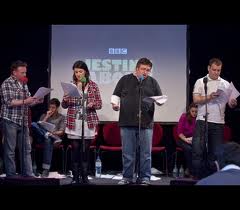
When I was working with a team on the BBC radio sketch show Jesting About I wrote a series of very short sketches featuring two Geordie friends Matt and Nev who could always be found in the same seats in their local. None of the shorter sketches written by any of the writers made it to the recording as they turned out not to fit the format, but I thought I'd spend the next few days on my blog reproducing the Matt and Nev sketches. Here's the first one:
MATT AND NEV IN THEIR USUAL SEATS 1
David Williams
FX PUB ATMOS
NEV Just suppose, Matt...
MATT What?
NEV Suppose your doorbell rings, right. And
there’s a lovely young lass stannin there,
18-19, mebbes. 22.
MATT Oh aye.
NEV She takes one look at you, an she says, ‘Let
me in. I want you to rip all my clothes off, and
I want us to make mad, passionate love.’
What would you do?
MATT Oh. (PAUSE TO CONSIDER) Wouldn’t
happen.
NEV Why not?
MATT I haven’t got a doorbell.
END