Michelle Ule's Blog, page 90
September 20, 2013
Crafting a Novella in Four Easy Steps!
 “For sale: baby shoes; never worn.”
An entire story packed into six heartbreaking words, which calls to mind the infamous quote:
“If I had more time, I would have written a shorter letter.”
In our google-brained attention-span-of-a-gnat era, novellas have become popular because they can be read in an hour or so. People are busy, they don’t have time to invest in a full-length novel full of characters, action and plot. When you’re busy, particularly at Christmas time, and you want the satisfaction of reading a full story in one sitting, a novella can be the perfect solution.
I’m just back from a writer’s conference where someone asked how I managed to write something which is not much more than a long short story. For novelists used to fashioning a full length 75,00-100,00 manuscript, the thought of telling a story in a mere 20,000 words seems daunting.
With only 20,000 words, you have to be careful. You can’t really include much subplot, characterizations need to be simple, and you have to plan the story so it makes sense, has a character arc, and ends in the proper place without cramming in too much at the end.
If you’ve got a lot of story, like I did in The Gold Rush Christmas, it can be a challenge.
Here are my tips for crafting a novella in four easy steps:
1. Chart out your story.
While I had the original pitch accepted by my editor, I had done more research in the meantime and needed to tweak a little.
The story began in the summer of 1897 because I wanted my three musketeers, Miles, Peter and Samantha, to get caught up in the heady rush to gold-country Alaska. Since A Pioneer Christmas Collection’s stories needed to end with a satisfying romance at Christmastime, the story needed to take place over a four to five month time span ending at Christmas.
I gave each major scene its own chapter–or two, December got a little complicated.
Since I was writing a romance and that means the story is told through two points of view (POV), I noted whose head I was supposed to be in during each scene. Several times I had to switch the order of scenes when one needed to be told from, say, Miles’ POV and it was Samantha’s turn. Having the skeleton helped me keep track of that.
I drew up a matrix and spent a delightful afternoon filling in the squares.

2. Figure out your ending.
I needed to know how my story was going to end before I got there, because I had to be “salting” the manuscript with items pointing to the resolution early on. I didn’t have room to write things that wouldn’t fit into the ending.
Christmas 1897, easy. But why would the couple fall in love? How would I pull off the different strands of story I had included in my proposal to the publisher?
And as I researched and found a fantastic TRUE story, how would I fit that in?
Magic.
3. Recognize your main plot points.
The story started in Port Orchard, Washington, that location was chapter one. I knew they would spend time on the boat sailing to Alaska and I needed to figure out what else would happen on board–so I gave them three chapters to sail.
They ended at a Tlingit village at the end of the story–they had to get there, find what they were looking for and then have the romantic moment.
That left me about seven chapters to fill with “everyday” life in Skagway, Alaska.

Peter decided to pack things over White Pass for other Klondikers. That was one chapter, or at least half of one because it was a powerful scene about what life was like that winter.
I had that fantastic true story. It turned out to need two chapters of its own–but it was the turning point of the tale. I plotted it in.
Once those significant events were placed on the chart, I could fill it in.
4. Let the creativity carry you away but then edit, edit, edit.
My first draft was 22,000 words long, or 10% over. I was satisfied with the story, but obviously needed to trim.
I went through excising extraneous words, tightening descriptions, watching word order, anything to cut.
And cut.
And cut again.
Every word had to count–particularly verbs. It’s an excellent exercise!
I turned it in at exactly 20,000 words, even including the lengthy dedication and the historical note at the end.
But when my editor got a look at it, she saw things in the story line that needed changing. We worked together–shaping, cutting, changing, shifting. It was like putting together a puzzle, only we were using words–and counting them zealously.
Final tally: 19,998 words. I felt a little cheated, but too weary to stick in two more descriptive words.
I’ve always enjoyed short stories and I’d be delighted to write one again. Indeed, even as I work on my current project–a full length novel–the techniques I polished in my three novellas (The Dogtrot Christmas, An Inconvenient Gamble and The Gold Rush Christmas), have proven excellent training.
Good, tight writing is essential no matter how many words you’ve got! Click to Tweet
How to craft a novella in four easy steps. Click to Tweet
Do you think word counts are limiting on your creativity? How do you manage when you’ve got shorter, rather than longer, things to write? Hard or easy?

The post Crafting a Novella in Four Easy Steps! appeared first on Michelle Ule, Author.


September 17, 2013
Research Serendipity: McMinnville, Tennessee
 I’m just back from a trip to the Midwest to attend a conference. Since I was headed in that direction anyway, I stopped off for a couple days in Middle Tennessee for two days of research on my Civil War project–the one that keeps getting set aside so I can write other things!
I’ll write more about the exciting things I found related to my particular characters in a future post, but for the time being I have, as usual, another story in research serendipity. This one involves late night prowling on the Internet, among other things . . .
A couple nights before I left, I began to plan what I wanted to see and accomplish in the days I had. Since my characters honeymoon in McMinnville, Tennessee, I thought I’d drive out there and get a feel for the landscape and perhaps see some Civil War-era homes.
Lucy Virginia Smith French was a well-known Civil War diarist of Middle Tennessee, and she entertained my characters during that time. L. Virginia French’s War Journal 1862-1865 details the dinner party she threw and includes a bit of catty gossip as well–all of which are perfect for my backstory at the very least. So I goggled her and discovered she had an historical marker placed in front of the property where she lived.
But it’s tricky to track down those things and I couldn’t figure out where it would be. I had sketchy directions: a few miles outside of McMinnville. I figured I’d just ask when I got there.
As I sped down the lovely road toward town last Tuesday, I hit the brakes hard. There it was! I got out and took the photo, breathed in the clear air and heard the slight singing of insects. It was humid in Tennessee last week and I marveled anyone could live in such heat–particularly when you had to wear seven petticoats to make your dress stand out properly!
But fun though that “chance” meeting was, it wasn’t the only one.
In that late night prowl, I typed in my word choices and found a painting of her house on Google books. Further research determined it had been torn down but a local artist, Monty Wanamaker, had painted it from a photograph. He also painted the house where my couple stayed on their honeymoon. (It was torn down long ago to make way for an addition to the local Church of Christ).

Monty Wanamaker’s drawing of Forest Home
He’s a fine watercolorist. That’s his drawing of Lucy’s house, Forest Home:
So, I had an idea of the house where the dinner took place, I knew the spot, and when I googled Civil War in McMinnville, it advised me to visit a museum downtown, open from 2-4 on Tuesdays and Thursdays. Perfect.
The drive from Murfreesboro was through tree-covered rolling hills and studded with lush farmland. I thought a lot about the drama of early spring 1863 in Middle Tennessee. Horses were foddered for large distances around McMinnville as the Confederate forces struggled to regain strength before the big push they knew was coming. Every tree and fence were cut down and burned as firewood.
When I reached town, I stopped at the library, where the local authority was not in. The librarian suggested I visit the two museums further down the main street.
Two?
They were a block apart, so off I went.
The one I had traveled so far to see was closed. That was disappointing. I continued down the block to The Southern Museum and Galleries of Photography, Culture and History.
A nice man behind the counter greeted me. I explained I’d come from San Francisco and told him what I was doing, what I was looking for, and about finding the marker.
He said the houses I sought all had been torn down long ago. “But I have this calendar that has watercolors of what they looked like. We were fortunate to have pictures I could draw from.”
He turned to September, I smiled and then looked closer. “Yes. I’ve seen this picture.”
He stepped back. “You have? Where?”
“On the Internet the other night.” I paused and looked around a little more. “Wait. Are you Monty Wanamaker?”
He was.
Serendipity? A woman in northern California looks at pictures late one night and three days later steps into a little shop in a small town in Tennessee and meets the artist?
You have to laugh.
I did.
Monty gathered the materials he had on my subjects. We had a spirited conversation. He showed me his pictures. I bought his book (which he autographed): Images of America: McMinnville. He gave me permission to use pictures on this blog post. (In the photo on the right, he’s holding the calendar page featuring the honeymoon cottage.)
It was really fun to talk with him.
You cannot make up these stories of research surprise. You just have to follow where you’re led and laugh with delight.
Thanks, Monty!
Have you had any fun experiences while doing research?
Tweetables:
Research serendipity: You just follow where you’re led and laugh. Click to Tweet

The post Research Serendipity: McMinnville, Tennessee appeared first on Michelle Ule, Author.
September 13, 2013
Genealogy, Inspiration and a Christmas Novella Part II: Reverend Thomas Hanks
 Among some Texas Baptists, the Reverend Thomas Hanks, a circuit-riding preacher from the Primitive Baptist Church, is famous for obtaining “the first conversion” on the west side of the Brazos River. He had begun sneaking into Texas when it was still a Mexican state, baptizing, marrying and preaching to the English-speakers in the neighborhood possibly as early as 1820. He baptized a woman at Moses Shipman’s house and walked into history.
Catholicism was the state religion and no other faiths were tolerated. Most of the Americans, however, who moved to Texas (at the encouragement of Mexico) were not Catholic. They may have kept their heads down with the authorities, but they welcomed a man preaching from the Protestant Bible all the same, particularly if they wanted to get married.
Despite the potential danger of being arrested if caught, Hanks married a number of couples–keeping track of who, when and where.
Once Texas became a Republic, he returned to the isolated farms to remarry them all.
One woman, ten hard years into a challenging marriage heard him out when he stopped by their claim and offered to legally marry them. She frowned and looked into the distance, finally saying, “Well, okay, Daddy Hanks. I’ll do it just because it’s you that’s doing the asking. But if I’d known then what I know now, I’d never have married him.”
Do you see how that gave me insight into my ancestor–from whom the story obviously came? An adventurer, not afraid to share the Gospel in an illegal situation, and probably with a sense of humor.
This story encouraged the fictional plot of “The Dogtrot Christmas.” I imagine old Tom had to stay somewhere, so I gave him a relationship with a Tejano family that provided a perfectly legitimate alibi. It also provided the spiritual meat of the story.

Photograph Ad Meskens of painting by Newbold Trotter
Because “The Dogtrot Christmas” is a romance, I needed to find some hooks to link in the history with my fictional story.
When Texas became a Republic, Thomas Hanks loaded up his family and some neighbors and brought them on a wagon train trip to the new promised land. His youngest daughter, Cynthia “Syntha” Hanks Faires, wife of James Faires, unfortunately died in childbirth along the way.
I invented a character: Molly Faires, a sister for Jamie. In my story, she raises her baby nephew, deals with the Native Americans, and helps put together the dogtrot homestead.
She also enjoys Rev. Thomas Hanks’ preaching at a camp revival meeting and along the way falls in love with a native Tejano–fourth generation Spaniard on a land grant–who just happened to be tutored by the Rev. Hanks during those spying-out-the-land-for-the-Gospel visits.
Because my fictional character Molly was an orphan, I was able to give her a connection to her brother’s in-laws that provides the heart of the story.
How did these people live out their spiritual lives on the frontier?
I took what I knew about circuit-riding and Hanks’ pioneer spirit and tailored it to the circumstances and beliefs of the people during that time. It had to be true to the early 19th century, but the Word of God is eternal and profitable no matter when in history a believer lives. Figuring out how people of faith related to their God was straight forward–and even easier when I found hymns sung at camp meetings!
The Log Cabin Christmas Gift Basket Giveaway continues through Sunday, September 15, 2013. Click here to enter:
If you have any problems, visit Jane Kirkpatrick’s website for more details: here.

The post Genealogy, Inspiration and a Christmas Novella Part II: Reverend Thomas Hanks appeared first on Michelle Ule, Author.
September 10, 2013
Genealogy, Inspiration and a Christmas Novella Part I: Kizzie
 Writers are often asked where their inspiration comes from–what made them write about a specific time and place, or put such an odd twist into a story.
It can come (frequently) while taking a shower and the mind is roaming seemingly nowhere. A photograph can catch your attention, or the turn of a person’s head. People tell you incredible stories and you want stretch them just a little to consider, “what if?’
Sometimes it’s as simple, however, as being given a writing prompt. Click to Tweet
I asked my father once to give me a title and I’d write the story.
He laughed. “How about The Creature That Ate Bakersfield?”
I swallowed. And wrote a story–which no one ever needs to read.
I was given several parameters when I wrote “The Dogtrot Christmas” for The Log Cabin Christmas Collection. Because it’s part of a Christmas collection, something in the story needed to touch on that holiday. In addition, a log cabin needed to play a major role and it needed to include a frontier romance.
Go.
Fortunately for me, I’m a genealogist and I merely had to reach into my family history to find an accessible log cabin story.
Kizzie’s Diary
Keziah (Kizzie) Hanks Colwell (or Caldwell?) wrote a diary as her family traveled from Maury County, Tennessee to eastern Texas in 1835. The wagon train was led by her father and my great-great-great-grandfather, the Reverend Thomas Hanks, a Primitive Baptist Circuit Riding minister.
Gladys Hanks Johnson, a researcher, saw Kizzie’s diary and took notes. Someone allegedly wrote a Master’s thesis on it.
(If anyone knows where I can find that diary, PLEASE contact me. I’ve been seeking it for years!)
Kizzie had quite a task ahead of her. Her sister died in childbirth shortly before they left Tennessee, meaning she had to nurse a newborn along with one of her own four children, manage the wagon, encourage her husband, and follow her Dad. Not to mention write up her diary notes.
Once they got to east Texas, the family threw together a log cabin and they worked the land. Kizzie did the cooking, chinking, teaching, child tending and of course, tried to keep her nephew alive. One day she returned to the cabin to find the baby restless on the straw tick. When she looked a little closer, she saw a Native American‘s hand reaching between the unchinked logs, patting the baby on the back.
That scene made it into my story. 
Another time, she was down at the creek washing clothing. She looked up when the baby cried, to see him being swung by the foot. A Native American chattered at her in his unknown tongue and indicated a nearby tree. Laughing, he swung the baby’s head in the direction of the trunk. Kizzie threw down the clothes, shrieked and grabbed for the baby.
The Native American handed him back and slunk away.
Of course that scene appears in my novella.
But since this was a romance, I needed to find a romantic element and a married couple, just wasn’t going to be sufficient.
So, I invented my heroine.
You can read about the (fictional) Molly Faires, next time.
But in the meantime, celebrate women like Kizzie Hanks Colwell who went above and beyond the life of any “normal” woman of the time to give her children a future in Texas!
What family stories are you itching to write about? Click to Tweet
The Log Cabin Christmas Gift Basket Giveaway continues through Sunday, September 15, 2013. Click here to enter:
If you have any problems, visit Jane Kirkpatrick’s website for more details: here.

September 9, 2013
A Log Cabin Christmas Collection Gift Basket Contest
 What? You don’t feel like Christmas yet?
It’s only 104 days (or less) until that reason for the season occurs: Jesus’ birthday.
To help you get organized, early, this year, my co-writers on A Log Cabin Christmas Collection have put together a gift basket that includes a copy of the New York Times best seller signed by all nine writers, along with a host of other items. Here’s a photo:
In addition to a small log cabin quilt, the prize includes copies of The Night of Las Posadas by Tomie dePaola–a children’s book about the Mexican tradition that is part of my story “The Dogtrot Christmas.” I’m not sure you can make it out, but there’s also a Texas-shaped lollipop (in appropriate red, white and blue) to symbolize where two of the novellas take place!
Join our blog giveaway part celebration designed to get you in the mood for Christmas.

WHEN: September 9-15th.
PRIZE: Each author has contributed a meaningful gift for the prize basket, as well as the copy of
A Log Cabin Christmas Collection,
SIGNED by all the authors!
The more times you enter, the greater your chances are of winning! Authors will post throughout the week and not on a scheduled day. Keep returning here for the links to each of the author’s site to see a new post. Once it is posted, it will be linked below (where the author’s names are listed).
Entering is so easy, but if you get confused, simply comment here on this page with your question and it will be answered ASAP.
Below are the author’s websites/blogs (The authors who are able to post an article will do so throughout the week. Don’t forget to check).
Find their post about A Log Cabin Christmas Collection and let them know what it means to you.
Jane Kirkpatrick
Liz Johnson
Liz Tolsma
Kelly Hake
Michelle Ule
Debra Ullrick
Erica Vetsch
Margaret Brownley
Wanda Brunsetter
HOW to participate: Log in ONE TIME (the entry form will keep your information for subsequent days). Do as many of the entries as possible.
Click here to enter:
If you have any problems, visit Jane Kirkpatrick’s website for more details: here.
That’s it! Have fun!

September 5, 2013
20 Years of Searching to Find a Face
 My grandfather was an enigma and his mother even more so. Nearly 20 years ago, I began a genealogy hunt hoping to learn more about the man and some of the mysteries of our family.
Others have followed the genealogy quest for similar reasons.
I quickly learned that some of the quirks I saw played out in family members may have been owing to a woman about whom I knew very little. They called her Amelia, but I soon discovered that was not her real name.
And thus began a 20-year quest: to learn about Permelia Hanks and to find a photo of her.
I’ve written about her before when I thought I might have stumbled on an old picture my grandmother, the daughter-in-law who never met her, spoke of. It’s of three girls in an oval frame. Permelia had two sisters. Could this have been them?
I still don’t know, but it was exciting to dream and wonder. Is that what Permelia–not Mealey, Melia, Malia, Ellita, nor Amelia–looked like as a girl?
(With all those variations in name, not to mention misspellings of her second’s husband’s last name, is it any wonder I can’t find records about her?)
I know she was born in 1867, the daughter of James S. Hanks and his wife Louezer (Louisa?). My research turned up an 1890 marriage to Ben Alex Dunn, brother to her brother-in-law T. R. Dunn, and she bore a son James. Ben died at some point and in 1897 she married my great-grandfather, another mystery person, had four children and then came down with tuberculosis.
My grandfather had few memories of her because she went into an east Texas sanitarium when he was a little boy, where she died in 1914.
But I think about her from time to time, wondering about the drama that played out through her 47 years. She lost her parents, a husband and a child, then coughed herself to death leaving four young ones behind.
And that hole, that loss of a mother, affected us.
I’ve contacted relatives, scoured the Internet and never found anything except that tantalizing photo above from an obscure website sent to me by a genealogy pal. The other night, not sleeping and filling in time putting together a Pinterest page, I drifted over to that East Texas Genealogical Society website. I needed to add a photo of James Hanks’ original farmhouse.
Carol Hafner had put up a few more photos.
Did you hear me scream?
At 1:30 in the morning, I stumbled on this photo. I stared and stared, numb, exhausted, unbelieving.
It was listed as: “Aunt Mealey with Uncle Aleck Dunn.”
Can there be any doubt?
What if I tell you–and my cousin agrees–those look like my aunt’s eyes? You can see them more clearly in the top photo.
What were they doing in San Antonio, Texas?
How would I know?
It’s enough just to look at her face and be thankful, for the millionth time, for the Internet’s research capabilities, not to mention the hard work of so many genealogists to provide information.
20 years of searching is over.
Now, do me a favor. Look at Permelia’s photo at the top and compare it to those three girls. She was the second of three–does the adult woman look like any of those girls in your opinion?

September 3, 2013
Moving Memories: Or, What to do with Mom’s Yearbooks?
 We moved this summer, in an unexpected way and fashion. We’re not far from our former home, but we still had to pack up everything and haul it over.
Our former home is built on a hillside and I had no idea how much storage space we were using under the house until boxes and boxes of items I didn’t know I had showed up at the new house.
And because we’ve been storing things for 12 years, that included my late in-laws possessions as well as my own late parent’s belongings, I’ve had to go through everything.
Because you never know what you’re going to find.
There amid a box of ancient maps–ancient in that we got them from AAA in 1991–I found the bulletin from our wedding.
Who knows how it got there or why, it just was.
So, I’m paging through everything–just in case.
But how do you avoid the emotional minefields while sorting memories? Click to Tweet
The filing cabinet was stored in a closet far from my everyday life. It’s beside my desk in the new house and I need it. So, I started culling one Sunday afternoon.
Some of it was easy, but then I stumbled on my father’s death certificate. I pulled up photos and newspaper clippings of my grandmother’s aunts and uncles. Here was a letter written in that same grandmother’s pristine handwriting. A Christmas note from my mother, dead since 1997. Wills for six or seven people (three still alive).
I push the door shut with a rolling thud. I was crying too hard to continue.
The other night while my husband used our brand new shredder, I opened a box of photo albums and found my mother’s high school year books, her name embossed on the cover.
I don’t recall ever seeing them before–how could that be?
I knew she loved high school. I’d heard plenty of stories. The first page of the 1945 yearbook opened to her good friend Alice Cannistra’s scrawl giggling about that “private and sergeant we met last summer and couldn’t get rid of.”
My mother was 15 that year. What was Alice talking about?
In the 1946 yearbook Alice wrote about a sailor.
They lived on chicken farms hours from the ocean. Hmmm.
It was fun to look at the photos and see a life so very different from my own. I just wish Mom had been sitting next to me to tell the stories–and to explain a little bit.
You have to go through them. You don’t know what you’re going to find. Click to Tweet
 My father only had two yearbooks. I can hear his explanation: “we were too poor.” I laughed to see him described by a friend as a “young Charles Boyer, a swank dresser and smooth operator.”
That was my dad.
Or at least how he wanted to be seen.
The gold was in the back: four essays scribbled on browned notebook paper, assignments for an English class. My heart quickened when I saw the titles: “My Daily Stroll” (C+); ”A Lover’s Enigma” (B+); “Integrity” (A); and “A Description of Home” (B).
My father could not have left me better gifts–and each one is a reflection of who he was.
“My Daily Stroll” was boring, but what he liked to do–traveling and reflecting on the people he saw with a critical eye. (He visited over 100 countries before he died).
“A Lover’s Enigma,” combined with references to himself as “Baron” and the Charles Boyer reference, reminded me of his boastful tales of trying to make himself suave and elegant–a man about town, even if the town was Burbank, 1947. He came from a poor family and struggled mightily to overcome his mundane background. He succeeded, but that yearning for popularity and reknown never left him.
“Integrity?” That was how my father ran his business. He may have been a “squirrely naval officer,” as a young man but he took to heart being a gentleman and honest.
The best essay only merited a B but it brought me to tears. A simple assignment, “A Description of Home,” had him walking up the porch steps and through the shotgun house, making comments here and there, describing family arguments, and being smug: “My mother sat in the overstuffed chair, reading as usual.”
Of course my grandmother had a book in hand.
He continued:
“On my left stands the symbol of my mother’s personality–a piano with several photographs on it. There was a time when our home was rent by a mighty struggle–to decide on a new car or a piano, to be purchased by the funds acquired by mother’s labor during the war.
“She cannot play it, although she takes weekly lessons at night school, unless you call playing by ear musicianship, but she persisted and this persistence has a reward which now rivals a radio which was purchased under similar circumstances several years ago.”
No, I argued with that essay. It was her organ, she never owned a piano.
No it wasn’t, I realized, she retrieved the organ ten years later.
I’d never heard this story before.
They’re alive again, standing before me, arguing about a car or the piano. I can hear my dad, his father, and my aunt and uncles taunting her, with Grammy remaining steadfast.
My grandmother never learned to drive. But she always had her music.
And I know, now, why she fought so hard for me to get a piano when I was five and to learned to play.
We needed the music.
I needed the memory.
Can I throw away the yearbooks?
Maybe.
But not before going through them all first, thanks to that cocky teenaged boy’s essays nearly 70 years ago.
How do you determine what goes and what stays when you go through old photos, yearbooks, memories?
(Help me!)

August 31, 2013
12 Days of Christmas: What’s Inspirational About These Collections?
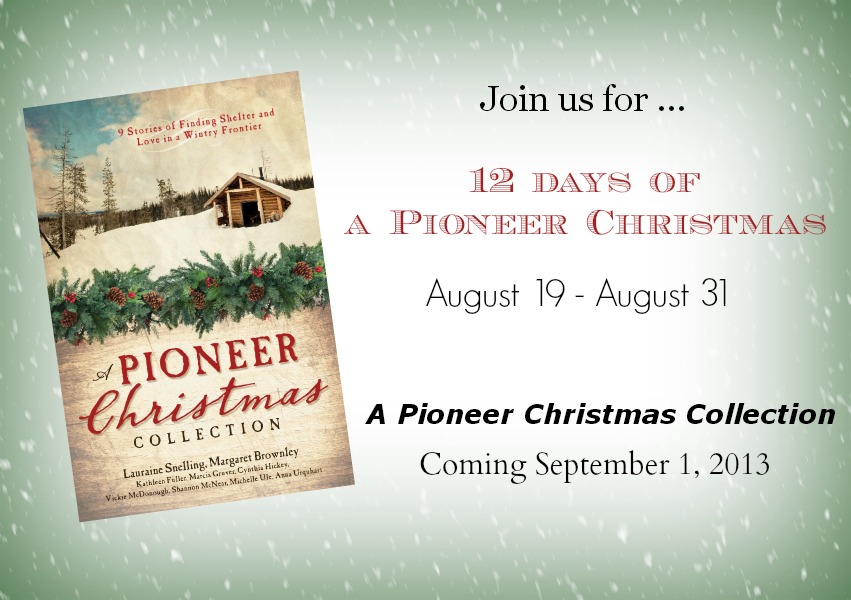 Both my September 1, 2013 releases are Christmas books shelved in the “inspirational fiction” section of your bookstore–if you still have a local bookstore.
But what does “inspirational fiction” mean?
The Charlotte and Mecklenberg County Public Library in North Carolina defines it this way:
“Any good book can be an inspiration, but many of these books highlight people overcoming adversity or reaching new levels of understanding. Whether they pull themselves up by their own bootstraps or have help from a higher power, these books will uplift and entertain you.”
When you add in Christmas, as is the case with both my A Log Cabin Christmas Collection and A Pioneer Christmas Collection, you should have novellas that remind you of the reason for the season, as well as leave you with hope and a warm feeling of contentment.
I’ve found that to be true with the stories in both books. They don’t take more than an hour to read and take you all through American history. They include romance, some more gentle than others, and a happy ending usually at Christmas time.
I was surprised two years ago when A Log Cabin Christmas released, at how many people I met read a Christmas book every year. Click to Tweet
It never occurred to me to do that!
That’s partly why A Log Cabin Christmas ended up on the New York Times best-sellers list, because enough people saw in that beautiful, charming cover, an invitation to cuddle up with stories that would allow them to abandon the whirling snows of their lives and enjoy someone else’s happy ending. With nine stories in each collection, these novellas enabled readers to take a break from hectic Christmas activities and reflect on different elements of the holiday season.
In my Log Cabin story, “The Dogtrot Christmas,” I incorporated the Mexican posada tradition to explain why the romance worked between an Anglo blond woman from Tennessee and a Tejano–third generation Spanish-descendent Texan. Using the metaphor of the dogtrot–a two room cabin with a ten-foot breezeway between the “pens,”–Molly explained how the two traditions could be bridged by their mutual faith in Jesus Christ. (In this case, Jesus was the roof, not the foundation!).
What made the story inspirational, alongside the posada tradition and the dogtrot metaphor, was the faith element. Luis had to come to learn to forgive over the course of the story. He had to be reminded of the truths he had been taught while learning English from a tutor years before. Once he could accept the forgiveness for what he had done–in his case in fighting against the Anglos during the war of Texas independence–he could make peace within his own family. In forgiving the brother-in-law who stole and then sold his land to the Anglos, Luis was freed to accept and love Molly as his own.
The story ends with hope, because a man recognized the value of forgiveness.
My Pioneer Christmas story, “The Gold Rush Christmas,” comes at romance, inspiration and Christmas from a slightly different angle. Set in 1897 Alaska, it features a young woman struggling with her mother’s death and her towering twin brother’s need to control everything–including her. She balks at the assumption she should marry the bumbling boy next door. That bumbling boy, a seminary student, learns important lessons himself when he tags along on the adventure. His form of Christianity doesn’t work so well in the raw frontier of gold seekers.
All three learn lessons about growing up and where a true mission lies. When they stretch out of their comfort zones to help those in need very different from themselves, they gain important insight into who they are and what God has called them to do. By the end . . . well, it’s an inspirational romance. Christmas comes to mean something very different.
I’ve read the stories in both books. Some of them have familiar inspirational themes. Some of them take on romance from a surprising angle. They all are founded on the good news that Jesus was born for God’s purposes and that birth is reason to rejoice.
Everyone lives happily ever after.
What could be better than that?
A Pioneer Christmas Collection releases on September 1. It’s got an embossed cover and deckle-edged pages. It’s beautiful.
A Log Cabin Christmas Collection re-releases on that same September 1 with a smaller, less glamorous cover but bearing a proud silver sticker.
Rejoice with us–that many readers will be able to savor a heart-warming Christmas story this holiday season.
Tweetables
Inspirational fiction: books to uplift and entertain Click to Tweet

August 30, 2013
12 Days of a Pioneer Christmas: Margaret Brownley
Margaret Brownley
I met Margaret Brownley in October, 2011 when we appeared at a retailer’s meeting called Reboot West. We were promoting our other collaborated book, A Log Cabin Christmas Collection (which re-releases on September 1, along with A Pioneer Christmas Collection). She’s a cheerful, hard-working writer who loves to meet her readers and is busy finishing up another novel as I type.
A lover of the western and things related to that time period (Margaret writes monthly for the Petticoats and Pistols website), she wrote “A Pony Express Christmas,” a rollicking tale of a woman who while searching for her long-lost express-riding brother, happens upon outlaws torturing a man. She enlists him in her quest.
“I was surprised to discover how little information is available on the Pony Express,” Margaret said. “It was only in service for 18 months and some station keepers didn’t bother to keep records. As a result little is known about many of the riders. We don’t even know where all the stations were located.”
The express ended when the trans-continental railroad went through and the mail could travel by rails rather than on the back of a horse.

Margaret has a great appreciation for the 1800s and the changes that came. ”The westward migration freed women in ways never before imagined. Women abandoned Victorian traditions, rigid manners and confining clothes and that’s not all they did; they brought churches, schools and newspapers to frontier towns, and helped build communities. The gun might have won the west, but it was the women who tamed it.”
It was women who tamed the west. Click to Tweet
“The Pony Express Christmas” takes place in Nebraska, which Margaret notes now looks nothing like it did then. When she formulated her story idea, the first thing that sprang to mind was why not have them celebrate Christmas with a mule in an abandoned Pony Express Station?
“I wanted their Christmas celebration to be simple and rustic given the times and conditions. If they saw my family Christmas extravaganzas, they would have thought we belonged to the royal family!”

Michelle and Margaret at Reboot West, 2011
Margaret shares determination and stubbornness with her characters, along with an abiding faith. “My story involves the Chimney Rock in Nebraska and the spiritual theme is God is my rock. Family love and loyalty are also themes found in the story.”
She believes she would have made a great pioneer, “providing I had a modern bathroom . . . and a good mattress.” Click to Tweet
The author of more than 20 books, including nonfiction, Margaret has written countless articles and church newsletters. And like all her fellow A Log Cabin Christmas Collection writers, she’s proud to be a New York Times best-selling author!
For more information, visit her webpage or follow Margaret on Twitter.
Two copies of A Pioneer Christmas Collection are currently being offered in contests on two of the other author pages. If you’re interested in entering the contests–which include signatures of ALL nine authors, you must check out
Shannon McNear’s webpage (her contest ends August 31) Click Here
or
Anna Urquhart’s webpage (her contest ends August 31) Click Here
You cannot enter either contest by commenting on this post!
In addition, I will be reviewing Shannon McNear’s wonderful story from A Pioneer Christmas Collection, “Defending Truth,” on the Colonial Quills website today. There’s a book drawing there, too!

12 Days of A Pioneer Christmas
Monday, August 19
12 Days of Christmas Introduction
Tuesday, August 20
Cynthia Hickey on cynthiahickey.blogspot.com
Wednesday, August 21
Kathleen Fuller on www.kathleenfuller.com
Thursday, August 22
Michelle Ule on michelleule.com
Friday, August 23
Marcia Gruver on Yielded Quill
Saturday, August 24
Shannon McNear on www.shannonmcnear.com
Monday, August 26
Lauraine Snelling on michelleule.com
Tuesday, August 27
Kathleen Fuller on www.kathleenfuller.com
Wednesday, August 28
Vickie McDonough on www.shannonmcnear.com
Thursday, August 29
Anna Urquhart on The Silent Isle
Friday, August 30
Michelle Ule on Colonial Quills
Saturday, August 31
Michelle Ule on michelleule.com
Sunday, September 1
A Pioneer Christmas Collection Release!!

August 29, 2013
12 Days of A Pioneer Christmas: Anna Urquhart
Anna Urquhart
Debut novelist Anna Urquhart was traveling to Paris to work on her Masters of Fine Art degree, when the call came suggesting she audition for A Pioneer Christmas Collection.
She thought about a story idea while flying across the Atlantic Ocean. “I’d seldom heard stories of pioneers traveling by water. I examined the opening of the Erie Canal in the 1830s which led to settlements in then-Michigan Territory. That time period sparked my initial interest, combined with the fact my husband lived in Edinburgh, Scotland for many years.”
The result is A Silent Night.
Not a conventional love story, Anna’s tale involves a young couple very much in love who seek out a new life far from Scotland. While building a home and working hard, the husband goes missing and our heroine is forced to make difficult choices. Click to Tweet
The idea came from putting a woman in the kind of situation most women fear: helplessness. “It’s an abstract fear, but on the frontier becomes tangible quite quickly,” Anna said.
“Families were forged on the frontier from more than just blood-ties, and it’s curious to me how that seems to happen in times of struggle. MichiganTerritory was quite wild at the time, with constant threat of weather, Indians, wild animals, and even trivial accidents that could change a person’s life. I tried to capture that wildness throughout the story.”
In terms of character, Anna saw aspects of herself in her heroine. “I have my protagonist’s propensity to second-guess herself. Additionally, I think that as a result, she continues to drive toward self-reliance, posing an unwillingness to surrender to the guidance and strength of the Lord.
I also gave my protagonist a daughter–whom I named after my own daughter–and my character’s struggles, as you can imagine, quickly became personal.”
When a story becomes personal to a writer, things creep in the author may not realize. That happened to Anna in A Silent Night.
“I had no clear spiritual theme as I began the story because I find that often the story itself has it’s own message it wants to forge. As I dug deeper the theme of surrender seemed continually to appear, and it became clear that the direction the story wanted to take was to look at the age old decision faced by every one of us: to hope that our own strength is enough to sustain us or to surrender to the One who loves us, pursues us, and calls us by name.” Click to Tweet
For the reason, perhaps, the ending surprised even Anna. “It turned into a completely different kind of love story than even I had anticipated.”
As for being a pioneer herself, Anna, like many, doesn’t believe she’d be a good candidate, “Though I’d like to imagine I’d put on a good show while I lasted. My husband assures me that I’ve not the makings of a frontierswoman, and I believe he’s right. However, I am quite handy with duct tape.”
“A part of me, though, itches to see what it would be like on the frontier struggling for survival. I think within each of us is a desire to know what it is that we’re made of, to see the exact boundaries of our strength and fortitude.”
In terms of Christmas, Anna’s vision is about families gathering, coming home from wherever they are.
“Most of those traveling west, however, didn’t have that luxury. They had only each other and those they’ve met along the way, who essentially became family. That is what I tried to capture in A Silent Night–the gathering and celebration of new-found family.”
To learn more about Anna Urquart, check out her webpage: http://www.annaurquhart.com
To read Anna’s story of writing A Silent Night for A Pioneer Christmas, see her blog post: http://bit.ly/14c5cAr
12 Days of A Pioneer Christmas
Monday, August 19
12 Days of Christmas Introduction
Tuesday, August 20
Cynthia Hickey on cynthiahickey.blogspot.com
Wednesday, August 21
Kathleen Fuller on www.kathleenfuller.com
Thursday, August 22
Michelle Ule on michelleule.com
Friday, August 23
Marcia Gruver on Yielded Quill
Saturday, August 24
Shannon McNear on www.shannonmcnear.com
Monday, August 26
Lauraine Snelling on michelleule.com
Tuesday, August 27
Kathleen Fuller on www.kathleenfuller.com
Wednesday, August 28
Vickie McDonough on www.shannonmcnear.com
Thursday, August 29
Anna Urquhart on The Silent Isle
Friday, August 30
Michelle Ule on Colonial Quills
Saturday, August 31
Michelle Ule on michelleule.com
Sunday, September 1
A Pioneer Christmas Collection Release!!