Michelle Ule's Blog, page 93
July 19, 2013
Welcome to Mrs. Ule’s Mean and Cruel Summer School
 I took a pile of unread National Geographic Magazines to the hospital with me when I gave birth to my third child. I had a lot of reading to catch up on and I figured the photos would be a good diversion if I just couldn’t take in any information.
It turned out to be a prescient choice. A lengthy article about hiking the Appalachian trail caught my imagination and I saw what this new baby, another boy, and his older brothers could be some day. Hikers. Boy Scouts. Outdoorsmen.
(Girls, obviously, could do this to but at that time females didn’t seem a likely addition to our family. God laughed.)
It all came true, we’ve got three Eagle Scouts in our family. They’re great hikers and campers, can find anything with compass and know how to start fires. Everyone rests easily when you know a contingent of young men are around and prepared.
I like to think I had at least a small hand in that because of training they received from the much vaunted and teeth-gritting summers they spend in Mrs. Ule’s Mean and Cruel Summer School.
The school was devised after one too many afternoons watching perfectly capable boys kill aliens for hours on end. Sure, we lived in military housing and perhaps they thought keeping America safe for democracy was a valuable task, but with the Hawaiian sunshine beckoning and their eyes glazing over, I’d had enough.
Someone needed to do these chores. Somebody, somebody had to, you see, (and for some reason) that somebody turned out to be me. (My apologies to Dr. Seuss).
The curriculum was short that first summer: basic kitchen clean-up, meal preparation, ironing, laundry, and swimming lessons (we used a contractor for that). Reading was required, television was off until dark and the computer could only be used–one child at a time–for an hour a day each.
(They quickly decided one hour of play but two hours of observing. We negotiated).
In later years it was expanded to include checkbook balancing, travel arrangements and clothing purchasing, plus school supplies.
Since we did at least two loads of laundry every day, they caught on quickly and, of course, decided they didn’t care how clean their clothes were but would cooperate.
Ironing made no sense. (Indeed, my own three year-old granddaughter just came in and asked, “What are you doing?” She’d never seen an iron before.)
The boys were supposed to learn all the skills they’d need as adults when their mother wasn’t around. I didn’t get very far with button sewing (why not?) but they did take a few photos from time to time. Yard work had to be supervised, but they liked some elements of it (climbing on the roof to sweep it clear of monkeypods was always exciting).
Because we lived in such a terrific spot, they also could ride their bikes down to a nearby marina and sail in Pearl Harbor (they had sailing lessons the first summer). They’d tape golf clubs onto the same bikes and catch a lift to Ford Island on the ferry. Using old golf balls, they’d duff their way about the admiral’s abandoned golf course for a couple hours.
Once a week I’d be inspired and we’d visit a museum or unusual spot in downtown Honolulu. Once we rode The Bus just for the experience. Who said summer school was all bad?
What summer be without trips to the library. Mrs. Ule did have one rule: you could read as much as you like.
Even Star Wars novels.
We never did make it to the Appalachian trail Trail. Perhaps I should suggest it for later this summer.
Well, what would you do if your mother asked you?
How did you spend childhood summers? What was the best part?
Tweetables
Mean and Cruel Summer School techniques Click to Tweet
Summer Ideas for Bored Kids Click to Tweet


July 16, 2013
Where’s YOUR Place?

A man and a woman performing a modern dance. (Photo credit: Wikipedia)
I walked forward to chat with one of my fellow Zumba dancers last week and when our instructor started the music, I hurried back to my “regular” spot.
Except, there was a cute young thing already in it, bright and smiling in snazzy spandex.
I cleared my throat and looked around for backup. My friend Diane laughed and I realized how silly I’d sound demanding that patch of floor space. So, I took the front spot under the speaker.
But I seethed.
During the first break between songs I stretched up my arms to prove I could nearly hit the speaker while dancing.
No one noticed.
But me.
The next half hour flew by as I grumbled and growled to the music, ducking my head just in case, and flourished my arms.
I got a great work out for my body, but my spirit–that was another story.
It argued and debated until I finally realized how absurd I was behaving. I decided to forget about “my spot,” and was in a terrific mood by the time the hour zumbaed to an end.
It reminded me of college where I always sat in the second row, two seats in, on the right side. I wasn’t in the front row where the prof would trip over my feet. I was in the second row where I could meet their eyes and possibly get a word in edgewise.
Since I was in relatively small English classes, I sat with the same group of guys in class after class.
They obviously had real estate issues, too.
The same thing happens in churches. Our pastor says he can tell who is missing if their spot is empty or contains someone else.
My husband and I like to jumble it up, but sitting on the left side feels odd. We prefer right aisle seats five rows back, but we’re friendly about it.
(Note: my zumba spot is second row on the left near the windows).
Jesus was familiar with angst over seating arrangements. When the sons of Zebedee approached him in Mark 10 about getting the best seats in heaven–on his right and left–Jesus had an answer.
“You do not know what you ask. Are you able to drink the cup that I drink, and be baptized with the baptism that I am baptized with?”
39 They said to Him, “We are able.”
So Jesus said to them, “You will indeed drink the cup that I drink, and with the baptism I am baptized with you will be baptized; 40 but to sit on My right hand and on My left is not Mine to give, but it is for those for whom it is prepared.”
41 And when the ten heard it, they began to be greatly displeased with James and John.
It amuses me the other apostles were irritated with the Zebedee boys, though this was no laughing matter. They wanted to get ahead and be distinguished as the most important. By so doing, they obviously forgot one of Jesus’ other lessons from a few verses further on:
If you want to be great, you must be the servant of all the others. 44 And if you want to be first, you must be everyone’s slave. 45 The Son of Man did not come to be a slave master, but a slave who will give his life to rescue many people.
I don’t know that servanthood is involved in a Zumba class, though certainly I needed to welcome our pert visitor. My pride probably ordered my seat in my English classes because I wanted the professors to recognize me. In church, I’m a little more free–I’m looking for newcomers and I don’t care if the pastor sees me or not.
The point, however, is not where I sit, but the attitude of my heart. Like the Zebedees, I need to examine it before I ask for preferential treatment. I need to make sure I’m right before God wherever I sit. And I need to take advantage of the places where He sends me.
I got my Zumba spot back the next day. I haven’t seen that young woman again. I hope it wasn’t me . . .
Those UCLA English major guys were very different from me. I never would have spoken to them if we hadn’t become friendly based on where we preferred to sit.
I’ve had marvelous encounters no matter which pew I occupied in churches.
I have no idea where the Zebedees are sitting right now.
But I do know my place is in the center of God’s will for my life–wherever it takes me– and to display Jesus’ attitude of servanthood no matter where I end up.
Where’s your place in God’s kingdom? Click to Tweet
Where do you guard your territory? Click to Tweet
And why? 

July 12, 2013
Clearing the Shelves
 We’re looking for a new home and the new residents of our current house have moved in–our grown son and his family.
Our college kids are home for the summer, too, which means we have nine people living in the house.
We’ve got room, sort of, but it’s still a little full. Fortunately, the three adorable grandchildren have been on vacation with their parents the last two weeks.
That’s given me time to start packing–we’re half in and half out right now, with the majority of the boxes full of books.
And that’s where it’s gotten interesting.
I started packing books weeks ago when I came across my grandfather’s teenage math book–the one published in 1907 that has a bullet hole in the middle.
(Why a bullet hole is the question. I don’t know. Perhaps he shot it in rage?)
It’s the only possession of that ne’er-do-well grandfather that I have. It’s the closest thing to an heirloom from him, and so I was shocked to find it flung on the floor, spine up, under a desk.
Since the adorable one year-old likes to empty shelves, I knew the culprit.
I started packing boxes that night. I don’t know how many we have now, but I do know I have culled the shelves yet again. I’ve taken two loads to the public library, two loads to church and have given away several others.
I’m down 150 books from the start of the summer.
That includes 20 cook books I had to blow the dust off it had been so long since they were opened.
Some were gifts I read and don’t need to consult again. Some were hard cover books I hated but couldn’t bring myself to throw away. I finally handed over my Strong’s Concordance.
I donated five Bibles to the public library. Surely, someone will pick one up at the used book sale in October?
If hadn’t opened a book in years, why hang on to it? Click to Tweet
If I can still buy it on Kindle or check it out of the library, do I need to own it anymore?
If it’s out of date, why not throw it away? Click to Tweet
If I’ve always loved it, I kept it.
Some had too many memories to let go.
Oh, and I still have eight hard cover Solzhenitsyns. Just can’t quite bring myself to giving away literature which I’m not sure would be published anymore.
 My OED went to Leah, a recent college graduate with a degree in English Literature–the one person I knew who would love it.
She does.
Which makes me very happy.
How do you decide what books to keep and which to give away? Click to Tweet
Have you ever regretted giving away a book once the shelf was cleared?
July 9, 2013
Dealing with a Fear of Flying

I live an hour north of San Francisco International Airport. We’ve all been following the tragic 777 plane crash last Saturday and are grateful only two lives were lost.
But we’re so sorry those two Chinese teenage girls died. I can’t imagine what their parents are feeling as they fly in today to retrieve the bodies.
My brother flew the day after the crash and he commented, “for the first time in years, I read through the emergency evacuation card.”
It all felt closer to home after Saturday’s tragedy, and I’m sure many people are facing a fear of flying this week.
I understand. The fear of flying is a common phobia. I struggled with it for years.
I wasn’t helped by urban legends about devout folks who suddenly had a premonition the flight they were sitting on would go down. According to the stories, they managed to talk their way off the plane, including their luggage, and were amazed when the flight did, in fact, crash.
Those stories always bothered me and provided me with a particularly bad flight once from Los Angeles to Oakland when I became convinced I was on a doomed flight and didn’t have the nerve to talk my way off.
In my case, I couldn’t decide what I feared most: dying or making a scene.
As the plane roared over the Pacific Ocean on take-off, I fretted and worried and confessed every sin I could imagine–just in case we went down. After I exhausted my list of sins, I realized those on the plane with me were going to crash, too, and I should pray for them as well.
So I did.
All the way to Oakland, where we landed safely and without incident.
I’ve flown countless times since and never had a problem I know about.
Thanks be to God.
Still, my heart raced every time and each flight was an exercise in deep breathing and relaxation techniques, combined with confession, prayer and holding my breath on take off.
What does the Bible say?
But one day as I fretted about an upcoming flight, I remembered the words from Matthew 10:28-32:
“And do not fear those who kill the body but cannot kill the soul. . . Are not two sparrows sold for a copper coin? And not one of them falls to the ground apart from your Father’s will. But the very hairs of your head are all numbered. Do not fear therefore; you are of more value than many sparrows.”
Similarly, Psalm 94 talks about God numbering our days, which I’ve always taken to mean God knows how long my life will be.
So, I reasoned, if God knows the day I’m going to die does it make any difference how I die?
I could just as easily be killed walking down the street as die in an airplane. Whatever day my life ends on will be determined by God. So, why be terrified of an airplane?
Indeed, statistics say I’m more likely to be killed in an auto accident than an airplane crash.
Frankly, the idea cheered me up considerably and while I still pray on take off, I’m not a wreck anymore about flying.

English: Aerial view of San Francisco International Airport. (Photo credit: Wikipedia)
I can trust the one who created to me to bring me home any way, and any day, he chooses. Click to Tweet
I’m just sorry the day was last Saturday for those two Chinese girls.
A 9-11 Flight
Some friends had reservations on the September 11, 2001 9 am Boston to California flight. They arrived in Boston a day early, however, and decided they were tired of traveling, and caught a flight home on September 10.
My eyes went wide when Al told me the story. “How do you live your life after being spared like that?” I asked.
“Very thankful to God,” he said.
No surprise. He’s not afraid of flying at all.
How do you deal with fear? Have you ever been afraid to fly or been in an airplane crash?
Tweetables
Dealing with a Fear of Flying Click to Tweet
Christian fatalism and a fear of flying Click to Tweet


July 5, 2013
Traveler’s Tales: Cruising with the Nuns (Reprise)
 Avid travelers, my parents loved cruise ships. Unfortunately, when my mother died, my father had a series of health issues and couldn’t travel alone. One spring break my husband and I invited him to take a simple cruise to Mexico with us and our two youngest children. We hoped to encourage him that his life hadn’t completely narrowed to just southern California.
We weren’t all that keen ourselves, but he was very excited–he hadn’t been to sea in several years. When our abbreviated family joined him on deck aboard the large Carnival Cruise liner, he rubbed his hands in glee. “I can’t wait to set sail. I’m going to gamble and chase women.”
“Then why am I on this cruise? I’m not interested in gambling or chasing women,” I said.
He shrugged. “I don’t know.”
Our family had never been on a cruise before, though my naval officer husband certainly was familiar with ships and going to sea. We bounced on our narrow bunk beds, inspected the various decks and found our seating assignment. On this cruise line, we ate at the same rectangular table set for eight people the entire five days.
My heart sank as I examined the place cards. In addition to our five spots, three single women would join us. I hoped my father would not be too outrageous.
We wore our nice clothes that first night and arrived at the table early. My optimistic dad took the head seat with the four of us sitting two on either side.
I’ll never forgot the stunned look on his face when our table mates joined us: three nuns dressed in full habit; white wimple, black crepe veil and all.
I confess, I laughed so hard I had to cover my face with my damask napkin.
My father had the good manners to greet them in a tight voice. “Good evening, Sisters.”
They smiled politely. Middle aged and serene, they spoke in pleasant tones.
My eight-year-old daughter hadn’t seen a nun before. I explained they were nice ladies married to Jesus.
She liked the idea.
The nuns were teachers pleased to be on a spring break, just like us. Another nun who had always wanted to take a cruise had planned the trip; this wasn’t their idea. When she broke her leg, she insisted they go without her.
They had never been on a cruise before either.
As we set sail that beautiful evening headed toward Santa Catalina Island 26-miles across the sea, I wondered what the trip would hold and if my father would find some peace with his circumstances.
Unfortunately, Dad had a mini-stroke the next morning and had to be airlifted back to Los Angeles. He recovered within a few days, but the experience proved his cruising days were over. I don’t know which of us was the most crushed. I so much had wanted him to have a fun trip.
He told us to continue without him, but every day I wondered why we were on a cruise filled with drinkers, gamblers, raucous high schoolers, and three kind nuns.
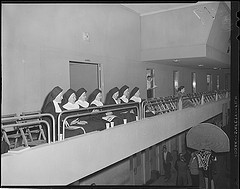 Lovely women and out of their element, the nuns spent a lot of time with us. We took off-ship tours in Mexico with them, dined nightly at their table, sat with them during the shows, and waved when we saw them walking the top deck in shiny tennis shoes wearing black track suits with white trim.
I don’t know how many times they asked about my father and told us they were praying for him.
I’m sorry my dad didn’t get his cruise. I still feel a guilty about how hard I laughed when my father realized the single women at his table were nuns.
But I will always be thankful that in an incongruous place at a difficult time, God sent three of his special agents to minister to my family.
It just goes to show, you never know when you may end up entertaining angels, or even nuns, unawares.
Have you ever entertained an angel–or a nun–unawares? Click to tweet


July 2, 2013
Tattooing your soul (Reprise)
 With the summer weather, more skin is exposed here in California and the tattoos are coming out. Some of them are beautiful, many are intricate and astonishing. I often stop and try to figure out what they are and why folks chose that particular item.
Sometimes it’s obvious.
Sometimes I shake my head.
But body art always reminds me of a desperately ill young woman who loved her God and the tattoo she got to make sure that love could be proclaimed.
Our pastor’s 27-year-old niece, Heather Beyer, died of breast cancer several years ago. She used the last two years as she fought for her life to share the good news that she had a future in heaven. As time went by, however, she became concerned she would not be able to praise her Lord so effectively if she couldn’t speak. She wanted to be able to lift up her hands and continue to voice her love for God.
So, she had her praises tattooed to her wrist.
Heather’s thought was, if all else failed, when she lifted up her hands “hallelujah” still would be announced.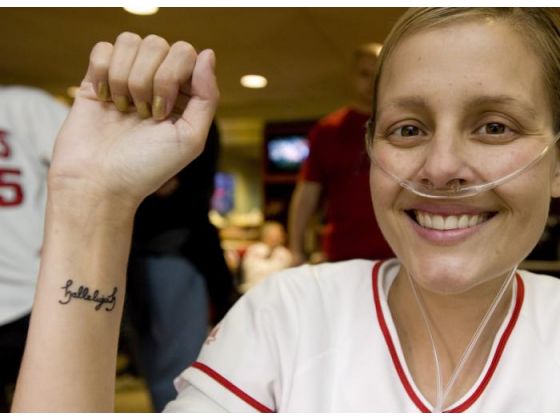
I’m blessed and amazed at such strength.
Which reminds me of another tattoo, inked onto the forearm of a writer I know. Kay Strom has a heart for third-world women and one day while interviewing some Copts in Egypt, she noticed they had a cross tattooed to their forearms. Why?
“We feel certain that severe persecution is coming to Egypt, and we are not sure we will be able to stand up to it. We have chosen to have ourselves indelibly marked as followers of Christ so that we can never renounce Him, not even in our weakest moments,” one woman explained.
Kay was struck by their courage and came home resolved to do the same. Her husband, Dan Kline, was a little nervous about the idea, but agreed to drive her to the tattoo parlor when the day came. At the last minute, he got one, too–though not on his forearm like Kay.
 But you can see the crosses on their arms. They are not particularly large, “I can cover it with a bandage when I visit Muslim countries,” Kay explained.
But it’s there and she knows it.
And it makes me, in only this one instance, itch to consider the same mark.
The Bible reminds us that we, ourselves, are a tattoo in 2 Corinthians 3:2-3 when the apostle Paul remarks:
“You, yourselves are our letter, written on our hearts, known and read by everyone. You show that you are a letter from Christ, the result of our ministry, written not with ink but with the Spirit of the living God, not on tables of stone but on tablets of human hearts.”
I need to remember that. I may not have the courage of Heather or Kay or Dan, but the grace of God flows through me to the world–a tattoo of God’s love and mercy to all I meet. Click to Tweet
Thanks be to God.
What would you tattoo on your forearm? Click to Tweet


June 28, 2013
How Should We Walk with Those Who Suffer?
 The Christianity Today article by Dorothy and Christopher Greco was about the demise of Exodus International, but something else in it caught my heart:
Rarely does any organization, Christian or otherwise, offer another option: that of accompanied suffering. To be transformed into the image of Christ, we must suffer as Christ did, a suffering too great for any individual to bear alone . . .
Such suffering does not necessarily signal our failure or God’s abandonment. Instead, it invites us into God’s presence for the purpose of refining and changing us. Though we may desperately want God to change our circumstances, he may want to use our circumstances to change us.
What is “accompanied suffering” and how do you do it?
First you have to accept that suffering is part of life.
In his book Rumors of Another World: What on Earth are We Missing? author Philip Yancey talks about the way many American Christians tend to deal with suffering as contrasted with believers in third world countries.
In the US, we pray that God will take away our suffering.
In other parts of the world, believers pray they will be able to endure the suffering and continue to glorify God.
In Fearfully and Wonderfully Made, Yancey talked about the affects of leprosy on patients. Leprosy deadens nerve endings and patients don’t realize they’ve hurt themselves because they doesn’t feel anything.
Without pain, they don’t realize they have a problem until something else calls attention to their injury. Suffering, in this case, has a purpose.
What would it mean for the church to walk with those who suffer?
I don’t like to suffer. I’m uncomfortable when people I care about suffer. What do I say? How do I encourage? What can I do that will not insult and will help? Sometimes I pray that God will enable me to be a blessing not a curse to people going through difficult times.
So, like many, I bungle along and try to help those who suffer in the best way I can. Sometimes it’s by praying. Other times, I send a message, or bring a meal, perhaps offer a ride or a listening ear. I can’t take away the suffering, but I can stand by to help someone who is in a daze of never ending pain or shock.
The Christian church is a hospital for those of us with broken souls. Click to Tweet
We take the tattered pieces of hearts, the lost parts of our souls, and we bring them to a place where we can find restoration, hope, encouragement. It takes people to help us hear the good news that Jesus saves all sinners; loves everyone, and has his hands open to receive those who want his forgiveness.
We who believe, however, need to be Jesus’ hands and feet. The body of Christ, the believers, are those who have the feet to walk, the hands to bind up, the ears to hear, the hearts to understand, and the words to pray.
Jesus could have spent his entire life healing people. He did a lot of healing while on earth, but you notice he did not set up a hospital in Capernaum and heal everyone who walked in.
That wasn’t his purpose. He came that we might have life more abundant. He came to set people free from the burden of sin that separated them from God.
Suffering drove people to him. Once in his presence, he healed–most of them.
But the Creator of the Universe demonstrated in Matthew 8:5-13 that he didn’t even need to see or touch a person to heal them. The Roman centurion demurred when Jesus asked if he should visit the servant. “Lord, I do not deserve to have you come under my roof. But just say the word, and my servant will be healed.”
Which is exactly what happened. The servant needed his master to “go to bat” for him, to seek out Jesus for the healing. And Jesus healed–without ever seeing the man.
Why didn’t God just heal all the people with problems in Israel?
Why doesn’t He heal all the people with problems today?
Perhaps God has a purpose in mind we can’t see?
Obviously, not everyone is healed. Countless folks suffer. Many people never have pain-free days.
We used to pray on a prayer chain that God would give the people we were praying for the healing they needed most. The “presenting” problem might be a broken foot or severe migraines, but maybe they needed to resolve a relationship issue and find peace first. Maybe forgiveness issues needed to be addressed. Maybe someone needed to help them?
That didn’t take away their need for physical pain relief, but it might deal with the emotional agony that kept them from Jesus.
Hands and feet. Voices and encouragement. Binding up the broken-hearted. These are hard jobs–only made possible by the power of prayer–but they’re needed, for our sake as well as those who are suffering.
Do we have a role in another person’s suffering? Click to Tweet
What should our reaction be to someone in pain?
Related Posts
Thoughts on Fear and Control in the Book of Job


June 25, 2013
Have You Ever Met a President?
 We used to play a game called “Six Degrees of Separation,” in which we tried to connect ourselves to a famous person within six contacts.
You’ve probably heard of the game, based on the theory that everyone on the planet is only six people-connections (as trivial as your tour guide) away from everyone else.
According to Wikipedia, the theory originally was developed by Hungarian Frigyes Karinthy and popularized by John Guare‘s 1990 play Six Degrees of Separation.
It’s always fun to figure out how you might be loosely “connected” to a famous person, or an obscure one. I used to scoff–”how could I possibly be connected to a person who lives in Siberia?”
But my husband pointed out my parents (1) had a tour guide (2) while in the Soviet Union, who probably went to university where he met someone from Siberia (3), who undoubtedly had lots of friends in the area (4), who probably knew someone in an obscure village (5) and thus I was connected.
How many connection from me to a Nobel Prize winner?
Two.
Can guess which one?
(I hate to admit this. Yassir Arafat through Jane Fonda).
We quit playing the game when we realized we knew CINC-PAC (Commander in Chief Pacific) (1) who knew the CNO (Chief of Naval Operations (2), who briefed then-President Clinton (3) who knew everyone, including President Nixon (4), who had shaken hands with Chairman Mao (5) who met Hitler (6).
It didn’t seem so much fun anymore.
Still, it’s amusing to contemplate whose hand has touches whose (like the story of Beethoven’s kiss given to composer Franz Listz, who passed it on to his student Emil von Sauer who bestowed it on pianist Ander Foldes).
One day a group of my friends discussed who had met a US president. I’ve never met one, so it was fun to hear their stories.
Several friends had shaken hands with Presidents Nixon or Clinton (Shudder. I’m one step closer to Hitler than I thought). One had met the first President Bush.
My elderly friend Jo is a native of Charlottesville, Virginia. Upon reflection, she nodded. “I’ve met Calvin Coolidge.”

“Get out of here,” I laughed. “Nobody’s met Calvin Coolidge!” Click to Tweet.
I was seven or eight years old. I held my father’s hand and we walked up the steps to the White House. I remember his bright red hair!”
She was born in 1918. Coolidge was president 1923-1929. Some one I know well had met a man who was only a silent character from the past.
I didn’t know he had red hair–the only photos I’ve seen of Coolidge were black and white. (But you can see his official portrait does show red hair!)
Jo also met a very young PT boat captain when he came through her office at the Navy building in Washington D. C.
“He was headed to the Pacific,” Jo remembered, “and was thin with a startling smile. He was shorter than I expected, but then, I didn’t realize Lieutenant John Kennedy would become president some day. He was just eager to go overseas.”
That makes me two degrees of separation away from both Calvin Coolidge and JFK!
I love these brushes with history.
Don’t you?
Have you ever met a president? Click to Tweet


June 21, 2013
Personal First Hand Research–in Your Own Family!
 Primary source documentation is a fancy technical description for a question you’ve grown up with: “Tell me a story.”
Out of the past can come amazing tales that not only are true but are pertinent to you. If your family remembers them, they probably reverberate with emotion, too.
(And if someone claims to have no memory of their childhood, I let it go. “Tell me a happy story,” I suggest instead).
For example, my grandmother’s aunt died years before Grammy’s 1905 birth. Lettie was two years old when she climbed up to the mantle piece and ate the rat poison. I can’t imagine my great-great-grandmother’s horror watching her toddler’s writhing death with blood pouring . . . well, from everywhere
Which is why the poisons are locked up at my house and the mere mention of “rat poison” makes me shudder.
First hand stories, particularly those written down at the time, can provide an immediacy about current events “unpolluted” by the historical revisions of later writers trying to tell the story. It’s a particular challenge for modern writers to put themselves into the mental mindset of those who lived long ago, without interjecting some of their own attitudes towards race, religion, feminism, militarism, capitalism, and so forth
(Though, it’s a given you can best see God’s hand in your life looking backwards). Click to Tweet
My father, for example, was ten years old at the start of World War II. He described the start of the war to my son for an oral history project.
”We were at the movies in Fresno, California. We came out and boys were selling papers and shouting about the Japs. We didn’t know what it meant and were scared. Would we be bombed in Fresno just like they were in Honolulu?”
He ran to the newspaper office and got papers of his own to sell. They went quickly.
With some of his first earnings, my father purchased an atlas. Using pencil, he plotted the course of the war in Europe.
My brother still has that beaten up green-cloth-covered atlas with dog-eared pages and place names written in cramped print. The European maps slip out easily because my father spent so much studying them. You can see Dad’s pencil lines for, among other things, the Battle of the Bulge.
I think about my father in 1943, a lanky twelve year-old sprawled on the rag rug listening to the radio news and piercing together what was happening with his limited knowledge. He did not know the Allies would win the war. For all he knew, airplanes with the rising sun on their wings could bomb him some day. So, he participated in war drives and watched over his siblings when my grandmother went to work at an aircraft factory. “We didn’t know until the end if we’d be speaking English or German.”
My maternal grandfather lived to be 103. When he was born in a Sicilian fishing village, Queen Victoria sat on the British throne (and would do so for ten more years) while Thomas Edison still tinkered with electricity applications.
Born in 1890, he had witnessed an astonishing period of history. Grandpa lived long enough to converse intelligently with my husband–an officer on a nuclear submarine who could explain how personal computers worked!
I asked when he saw his first airplane.
“In Chicago. It was the Wright brothers‘ plane on display at the museum.”
I didn’t know the plane was exhibited in museums. I’m not even sure I knew it had survived the 1903 take off!
Living history–in my own family.
And first hand at that!
Have you interviewed people about events they witnessed?
If you’re old enough, do you remember when you first heard President Kennedy had been shot?
Where were you on September 11, 2001?
Has your story changed since the event? 
Related blog posts:
Using Genealogy to Write a Novel
Writing Historical Fiction with a Family Flair


June 18, 2013
First Hand Research and Oswald Chambers
 I recently spent several days at Wheaton College’s Special Collections library. As I read through the papers, housed in archival boxes, the archivist asked me what, specifically, I was looking for.
“I don’t know. Just color details.”
I found plenty of remarks, tossed aside comments, diary scribblings (though not in Biddy’s Bible–she wrote her notes in shorthand!), and newspaper clippings. They will serve me well as I write, but they did not come easily. I have to review plenty of material to find nuggets of golden insight.
Research is like that, particularly primary source research.
Back in the dark ages when I attended school, my eight grade history teacher, Mrs. Klocki, stood on her spike heels and animated her painted face. “I don’t know why you read fantasy,” she trilled, “when history is much more fantastic and true!”
She emphasized the importance of first hand information–what did the people who experienced the event think about it at the time? What did they observe?
How did they see things without the hindsight we have today?
Reading through letters, written in the often hard-to-decipher hand of the person I’m studying, gives poignancy and character to the words. I’ve written before about the voyeuristic feelings I’ve had reviewing the private thoughts of a subject: here. But when you can see the suggestion of tears, note how the handwriting appears–the lines thick and dark, pale and wispy–the letters have a poignancy you can’t pick up from reading the words in a book.
During my genealogy research, I learned to read far afield–to not limit myself only to the person I was studying. I read material collected by relatives. Stories written by friends in diaries about events they participated in, enable me to glean further details. I’ve learned pet names for family members and lip-curling disdain for the hated northerners in a Civil War project.
Such material takes me out of my 21st century point of view. While I knew it was dangerous to move onto land belonging to native Americans, reading an account of one woman’s horror in Harriet Arnow’s Seedtime on the Cumberland brought the danger home to me.
“A woman sent her twelve-year-old out to milk the cow in eastern Tennessee (prior to 1800). The next time she saw him, his head was on a stake being shaken at her as the Indians rode their ponies around the clearing, shrieking.”
See what I mean? I could tell you how frightening it was, but two sentences of a first hand account, shakes you emotionally.
 The United States has many special collections libraries, and even has presidential libraries when you can explore history through first hand accounts. Like Wheaton, some libraries have “ephemera,” odds and ends loosely linked to the subject of the library that are not necessarily papers. At Wheaton, I handled Bibles owned by Biddy and Oswald Chambers, as well as one donated by a friend. I touched the typewriter on which My Utmost for His Highest was written, and I even rifled through Biddy’s old purse.
I’m not interested in fetishes, but items that belonged to the people I’m studying give me a sense of who they were–a leather bag in the hand, a high-keyed typewriter, onion-skin pages. A dress resurrected from a relative’s attic and displayed will soon tell me how tall my heroine is. Her ring, chipped from a rock in prison, shows me how much she was loved. A newspaper clipping detailing her trousseau tells me what’s important to a woman in love during the Civil War.
These are the types of items you can see and sometimes touch, in a special collection, a library or a museum.
What makes a character come alive when you read about them? Click to Tweet
How important are historical details in the writing process? Click to Tweet
What’s the value of special collections in libraries? Click to Tweet
Related articles
Holding Oswald Chambers’ Bible: the (Literal) Book that Changed My Life
Astonishing Research – Madeleine L’Engle