Michelle Ule's Blog, page 39
November 9, 2018
Great War Novel Giveaway!
How about a multi-author giveaway, featuring Christian authors and their books on the subject?
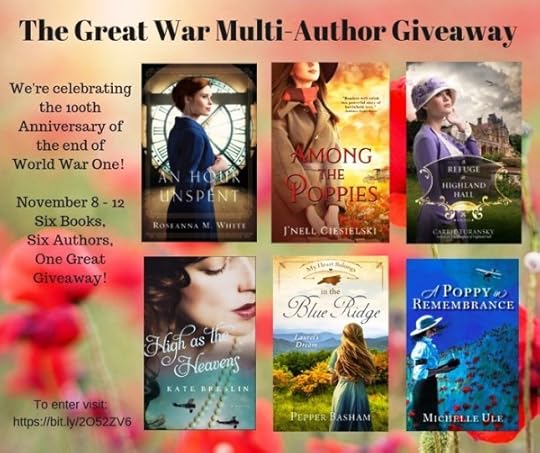
Bestselling novelists Carrie Turansky, Pepper Basham, Kate Breslin, J’Nell Ciesielski, Roseanna White, and Michelle Ule are donating one book each.
You can read about the war from a number of different theaters and venues.
It’s a comprehensive group of books telling the war through fictional women.
But why did these American women write about the Great War?
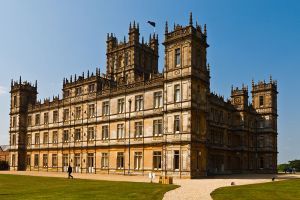
The Downton Abbey home
Downton Abbey inspired several writers.
Kate Breslin
“My interest in WWI and the early 1900s was sparked a few years ago watching the PBS series, Downton Abbey.
I’d already written about WWII in my debut novel, For Such a Time, but there seemed little written about the Great War.
“As I researched my first WWI-related novel, Not By Sight, I found the era’s history fascinating. It also provided an opportunity for fresh new stories.”
Roseanna White‘s agent asked her if she had written anything from the Downton Abbey or Edwardian period for possible publication.
“I had an idea that would work well in that period, and wrote a series set in 1910-1913 for Bethany House.
Of course, then I realized war was on the horizon, and I decided it would be fun to continue my exploration into the next stage of history, as England entered the Great War.”
Carrie Turansky simply followed the timeline for her Edwardian Bride series, which started in 1911.
As her series followed the Ramsey family all the way into WWI, it was natural to include the war in her third and final book, A Refuge at Highland Hall.
“When I took a research trip to England and visited Tyntesfield, the estate that inspired Highland Hall, I found the war-time diary of a woman in the bookstore on the estate. It was so interesting to read how people on the home front in England were impacted by the war. I took many true incidents from that diary and used them in the story.”
A Refuge at Highland Hall is a standalone story with a hero and heroine unique to the series. Readers may enjoy reading all three books to get a better feel for the impact the war had on lives.
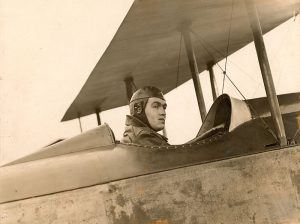
Frank Dixon of the RAF (Public Domain)
Others were drawn to the unique era in publishing or the drama of the times.
Pepper Basham loved “the age of change and discovery in the WWI era,” that she wrote about in My Heart Belongs in the Blue Ridge.
“There’s so much going on. There’s something about the WWI era–where the “gentleman’s war” became much less gentlemanly. It shows the devastation of the human condition and the need for hope more than some other eras.”
J’nell Ciesielski enjoys reading about chivalrous men and feisty women. WWI gave her the perfect opportunity to describe such a romance!
Michelle Ule wrote numerous blog posts about how she went to work one day and ended up five years later an expert on WWI!
All that information played a role in her A Poppy in Remembrance.
“I wrote about a specific story: Oswald Chambers’ revival among the ANZAC troops in Egypt during the war–the one inspirational story out of a horrific slog.
“I enjoyed learning and writing about a young woman’s attempt to become a foreign correspondent in a man’s world.
“In addition, a visit to New Zealand inspired a hero because of the 58% casualty rates that country experienced during the Great War.”
Different angles on the Great War
A variety of heroines find their lives complicated by the Great War.
The stories include a female ambulance driver falling in love with an army captain. (Among the Poppies)
A clockmaker’s daughter tangles with a thief-turned spy. (An Hour Unspent)
The trials of a widowed British nurse falling in love with a flyer. (High as the Heavens)
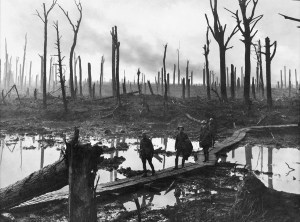
An iconic photo of WWI by Frank Hurley (Public Domain)
A debutante who returns home to assist with orphans and meets a flyer. (A Refuge at Highland Hall)
Journalism captures the attention of a would-be foreign correspondent who can’t decide if she really loves a New Zealand soldier. (A Poppy in Remembrance)
And one story set in the American Appalachians featuring a teacher and a missionary. (My Heart Belongs in the Blue Ridge)
The women are all resourceful in the face of a devastating war.
Why can modern readers learn from World War I?
All the authors found the war fascinating.
Several fashioned their stories around hope and how to see God at work amid the horrors of war.
“In any time period, people need to know there is hope. I think it felt more poignant in this era when the world suddenly expanded and all sorts of people were thrust together.
“When you get a bunch of people together who need Jesus, you’re bound to need a lot of hope,” explained Pepper Basham.
Michelle Ule agreed.
“Since A Poppy in Remembrance is a coming of age story, spiritually, emotionally and professionally, Claire needs to have hope to survive the four miserable years.
“Her spiritual discovery mixes with her life and provides her with a conviction that her journalism needs to provide hope to a broken world following the war.”
The timeless importance of individual character
“The lessons of courage, trusting God, and taking a stand against evil are timeless, and I hope they will be inspiring to readers,” said Carrie Turansky.
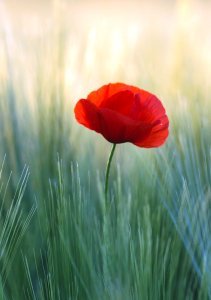
Photo by Thomas Quaritsch on Unsplash
In her writing, Kate Breslin discovered,
“Those who lived a hundred years ago weren’t all that different from us today. They worked hard, had their dreams, and experienced the same joys, fears, hopes, and sorrows.
“They were ordinary people who in times of crisis could rise beyond themselves to accomplish the extraordinary.”
Roseanna White agreed:
“We all know history repeats itself–or “at least rhymes,” as one author said.
“In a lot of ways our modern world is mirroring the way things were before the outbreak of the Great War, which is scary.
“But I tend to focus more on individuals than sweeping history.
“In my stories, I really want to explore how the least of us can have huge, lasting impact upon our world when we do the extraordinary, ordinary things God calls us to.”
Among the Poppies grappled with a woman refusing to let social status or gender prevent her from serving her country.
How did writing the books change the authors’ perspectives on WWI?
“The roots of the war and the end result of the Great War were more complicated than I expected,” Michelle Ule said.
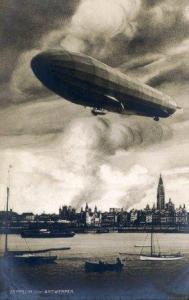
Zeppelin bombing of Antwerp (Wikipedia Commons)
“Many of the catastrophic events of the 20th century, especially WWII and the growth of Communism, were directly linked to the war.
“I really don’t like Woodrow Wilson. I’m shocked American banks ultimately paid the reparations bill.”
The technological advances surprised several people.
Carrie Turansky learned a great deal about aviation.
“It was so interesting to see how developments in aviation moved forward quickly to combat this challenge and protect England.
“I learned about the Zeppelins coming from Germany and bombing England, and this was the first time airships had been used like this.”
Several of us recognized the Great War planted the seeds for World War II.
“Until I really began studying this era, I was much more familiar with World War II,” Roseanna White said.
“Much of the technology, methods, intelligence, and even mindsets that we know from that later war had their start in the first World War.”
Kate Breslin hoped her readers learn about history without feeling like they’ve received a history lesson!
“I love weaving historical facts into my fictional stories.
“It still surprises me how much of the innovation we employed during WWII had its roots in WWI. Our ancestors were extremely inventive and clever!”
Pepper Basham perhaps said it best:
“Spiritually, I loved delving into the aspects of forgiveness from various perspectives.
“Time-wise, I enjoyed researching the indomitable reach of the human spirit to love, sacrifice, and adapt to change.”
Six great stories
The giveaway for winning ALL six books runs November 8- November 12.
To enter the Rafflecopter Giveaway, see the options on the Rafflecopter form below.

Tweetables
Six Great War authors and a giveaway–for six inspirational novels! Click to Tweet
A raffle to win six Great War novels from best selling authors! Click to Tweet
Six different Great War novels in one raffle! Click to Tweet
The post Great War Novel Giveaway! appeared first on Michelle Ule, Author.


November 6, 2018
Biddy’s Biography and A Poppy in Remembrance
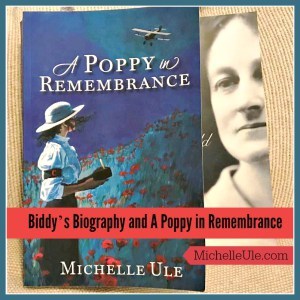 A Poppy in Remembrance.
As I’ve recounted elsewhere, I spent several days researching Biddy and Oswald Chambers’ lives.
Two intense days focused on the World War I period at Wheaton College, brought the two alive.
As I wrote the novel, I knew Oswald would influence the storyline.
What I did not anticipate was how strong a character his wife Biddy became!
How does a novel inspire a biography?
She kept influencing characters to do things I hadn’t expected!
Biddy’s quiet perseverance influenced Claire’s decision-making.
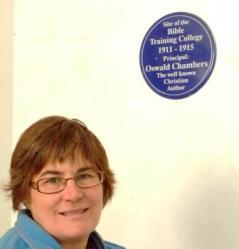
Found it!
But how she affected Claire’s mother turned the story in a completely different direction.
Indeed, it was the making of Anne’s character in the book!
She was hardly in the story to begin with!
When I looked through the novel, the question arose in my mind, “what kind of person was Biddy Chambers?”
An innocent prompt.
Nine months into writing the novel, I met a member of the Oswald Chambers Publications Association, Ltd.
“Have you thought about writing a Biddy biography?” I asked.
“She’s such a strong and interesting character, it would be interesting.”
He laughed and said, “No, but maybe you’re the person to write it.”
“Not me. I’m a novelist.”
Which is true, but it turns out I became the author of Biddy’s biography!
How the novel writing affected Biddy’s biography.
The research went both ways.
Several people asked me if I had visited Egypt. They thought the descriptions of Cairo during WWI were very vivid.
While I have never set foot in Egypt, in writing the novel, I thought about how to how to depict the country in a sensory manner.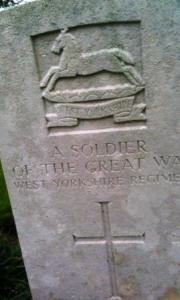
Novel writing is not just straight facts. A novelist tries to paint a picture using all the emotions and senses.
Frankly, the Egyptian scenes were the easiest sections to write in the biography.
Research details made a difference
Physical research done in conjunction with A Poppy in Remembrance overlapped to Mrs. Oswald Chambers.
While on a business trip with my husband, I suggested we spend a day in London hunting for Oswald Chambers-related sites.
We then crossed the English channel and spent two nights in Paris.
We visited the Somme battlefields on the only full day we spent in France.
(My poor husband just laughed, “the life of a writer’s spouse!”)
I stood on the top steps of #45 Clapham Common North and tried to imagine what it looked like 100 years before.
We found the Light of the World painting just north of the altar in St. Paul’s Cathedral.
Everywhere I walked between the two sites, I tried to picture Claire and Biddy at the same places.
I made sure we traveled to the same Underground Station that both fictional and historic women would have known.
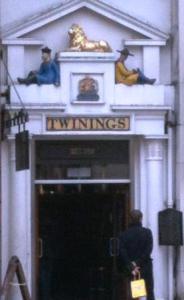 My husband and I walked from St. Paul’s Cathedral down Fleet Street past Twining’s tiny tea shop.
I took mental notes every step of the way.
We paused on the corner near St. Martin in the Field’s Church.
Trafalgar Square opened before us with the London Gallery of Art on the north side.
All those places appeared in A Poppy in Remembrance, and most in Mrs. Oswald Chambers, too.
I visited Oxford on that same trip–where Biddy lived and compiled My Utmost for His Highest.
If only I’d known that day. I would have walked up to her former boarding house and taken a real photo!
You never know.
A writer’s brain constantly files away information.
You never know what will influence a description, or how an experience will play out in another project.
I’m so thankful and proud that A Poppy in Remembrance led me to two years of researching and writing Biddy’s biography.
Led by God on both, I come away with six years of gratitude for the opportunity to write two wonderful and satisfying books.
And all because I just went to work one day, with a heart and mind open to wherever God would lead me.
Thanks be to God.
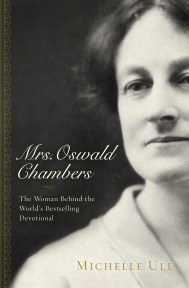
Purchase Biddy here:
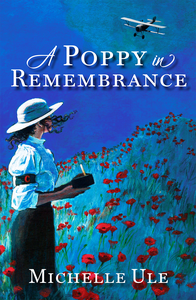
Purchase Poppy here
Tweetables
How a WWI novel inspired the author to write a biography. Click to Tweet
How A Poppy in Remembrance led to Mrs. Oswald Chambers. Click to Tweet
Research is good, whether for fiction or biography, right? Click to Tweet
Interested in Oswald and Biddy Chambers? I recounted stories about the amazing ways God led me through the writing of two books about them in my 2017 newsletters.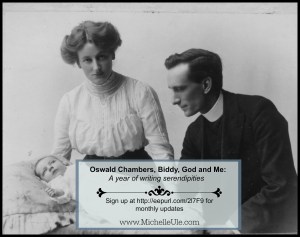
The Ebook, Writing about Biddy and Oswald Chambers, is complete in one volume and available free if you sign up for my newsletter here.
The post Biddy’s Biography and A Poppy in Remembrance appeared first on Michelle Ule, Author.
November 1, 2018
A Poppy in Remembrance Launch Day
The word “launch” truly describes what it means for a book to be published for the first time.
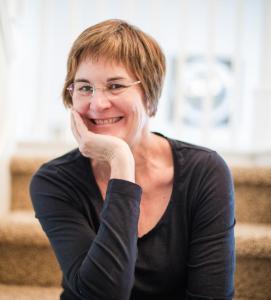
See how happy I look?
Just as with a child, you send your “baby” off into the world to meet it on her own terms.
I spent years writing, studying and traveling to make A Poppy in Remembrance an honest portrayal of a young woman struggling to become a journalist in a man’s world.
She tussles with her journalist father, trying to demonstrate she can do the job. Claire makes mistakes. She learns.
Along the way to her desired profession, Claire’s life changes to the good when she meets Oswald and Biddy Chambers.
From them, she learns what it means to follow God.
As a result, her faith, her writing and her personal relationship with two engaging men changes.
All of this coming-of-age happens during World War I--in three different theaters of the war: London, Cairo, and Paris.
Godspeed, Poppy!
Go out and meet the world and people you’ve been designed to bless.
What’s the launch day about?
Providing opportunities for readers to meet Poppy in the book world.
Traditionally, writers have parties and sign books.
I’ll be doing that later in person, but for now, the party is right here.
Here’s the novel’s one minute trailer:
Here’s a visual explanation about why I wrote a WWI novel, of all things:
A gift to my readers in honor of launch day
You’ve been putting up with World War I posts a long time as I researched and wrote this book.
I’ve come to really appreciate that war and can see so many repercussion reverberating throughout history since.
Maybe I’ll write about that next? 
October 30, 2018
Making Real Characters Come Alive in a Novel
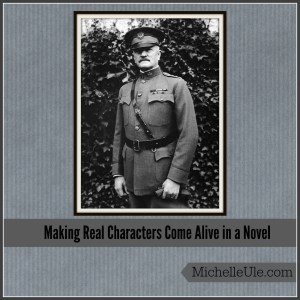 Very carefully.
You do not want to misrepresent an historic figure.
It was an interesting exercise to write intelligently and honestly about several World War I people in A Poppy in Remembrance.
My real characters included Mary Lee, Winston Churchill, T.E. Lawrence, Black Jack Pershing, Oswald and Biddy Chambers, and Eva Spink.
Quotations
A novel is a story in written form.
“Listen to me carefully. Oswald Chambers is too important a person in people’s spiritual life. You cannot make a mistake in any words you put in his mouth.”
My writing teacher at a writer’s conference was adamant.
I followed his advice and traveled to the Wheaton College Special Collections library where I read through correspondence and other papers left by Oswald Chambers.
My novel includes ten quotations from My Utmost for His Highest. I applied to Discovery House Publishers and received written permission to use those specific quotes.
But he’s one of several real characters with dialogue in the novel. How did I invent that?
Very carefully. I examined the writings I had and either adapted things Oswald wrote in his diaries and teaching or made the answers as simple as possible.
I did not want to make mistakes.
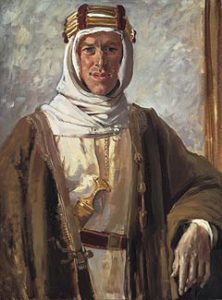
Thomas Edward Lawrence (Tate Museum; Wikipedia Commons)
The same thing was true of T. E. Lawrence. While I did not directly quote from Seven Pillars of Wisdom, I examined Lawrence’s memoir of his time in Arabia to fashion the words I gave him.
For Eva Spink, a young student of Oswald Chambers at the Bible Training College, I read her diary entries and adapted them and a few of her actions to facts I knew about her.
Pershing and Churchill were so voluminous, I either quoted them or wrote non-inflammatory dialogue.
I got so good at imitating Biddy’s voice, I became confused about whether or not I had an actual quotation in a letter she “wrote” in the novel.
I was convinced I’d adapted it, but in reality, I made it up.
But I spent a long time trying to track down the source of that imaginary letter!
Sounds
What did they sound like?
We know Churchill’s growl from the radio speeches he gave during World War II.
Like it or not, I couldn’t help but hear Peter O’Toole’s careful diction from the movie Lawrence of Arabia, when I wrote T. E. Lawrence’s scene.
What do you think of his description in A Poppy in Remembrance:
“Lieutenant T. E. Lawrence shook their hands and gazed at them with pale aquamarine eyes. His fair hair and high tenor gave him an immature air, but his descriptions of the desert and those who lived there, as well as thoughts on the political situation beyond the Suez, mesmerized.”
Mary Lee, General Robert E. Lee’s daughter, naturally spoke with a Southern (American) accent.
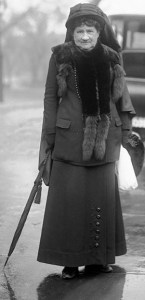
Mary Lee, 1914, Library of Congress
Oswald’s voice carried a lilt of Scotland–where he lived until he was fifteen-years-old.
Photos
I’ve written before about my attempts to accurately describe Oswald Chambers’ burial service.
I spent a long day examining and trying to imagine what that day was like based on the three photos we thought were of the event.
The next day, Peter Wenham wrote from Australia and provided me with more!
Thanks to his help, I could correctly describe what people saw who attended the ceremony.
I knew T. E. Lawrence was careful about his dress and that after a time, he disappeared into Arab “mufti” or clothing that looked like that worn by the locals.
But what about Oswald and Biddy Chambers?
I spent a lot of time at Wheaton looking at their photos from WWI.
Mrs. Oswald Chambers was the result of all that research!
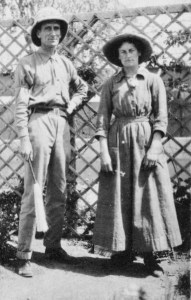
Goal
All this research had a single goal: to write an honest and accurate novel.
You’ll have to read A Poppy in Remembrance to find out if I succeeded.
For more information on the novel, click here.
Tweetables
Making historic characters come alive in a novel. Click to Tweet
A colorized photo of Oswald and Biddy Chambers? What did they look like? Click to Tweet
What did Oswald Chambers look like in real life? Click to Tweet
Find out how well I portrayed marquee characters here!
The post Making Real Characters Come Alive in a Novel appeared first on Michelle Ule, Author.
October 26, 2018
Themes from My Utmost for His Highest in Poppy
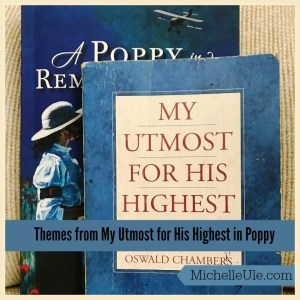 They serve as the “backbone” of the story, and should not be obvious.
But they provided me with a way of enriching the spiritual aspects of the book.
In the novel, twenty-year-old Claire comes to a personal faith at the Bible Training College (BTC).
She takes Chambers’ correspondence course and sits under his actual teaching in both London and Cairo.
After Chambers’ death, Claire examines her own shorthand notes for wisdom and encouragement.
By the end of the story, and the war, she understands what it means to be Chambers’ famous “broken bread and poured out wine.”
Where did the themes come from?
Early in my research, I listened to a lecture by Dr. Ken Boa on “Themes from My Utmost for His Highest,” as part of Breakpoint’s Great Books Series (produced in 2007).
He listed sixteen specific themes taken from the 366-daily readings.
I used a number of them as conflict points in the novel.
How did I use the themes in A Poppy in Remembrance?
Here are several themes from My Utmost for His Highest and quotes from A Poppy in Remembrance demonstrating them.
Surrender of the Will and the Cost of Discipleship
Claire’s head swam. How could Claire’s decision to attend a prayer meeting have resulted in her mother’s worst nightmare?
Identification with Christ:
Anne grabbed Claire’s chin. “I don’t care what OC says. I want to know what you think. Use your brain.”
“Sanctification means I can live a holy life with purpose and when I die, I won’t disappear into oblivion, I’ll go to heaven.” Claire’s hands turned clammy.
Prayer:
Claire shrugged. She avoided the editor as much as possible. “I guess you could say I’ve learned how to manage my reactions to the war news.”
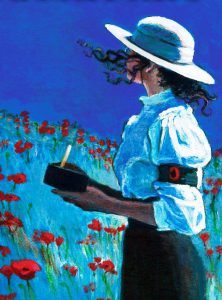
Prayer sometimes involves looking up.
He snorted. “Who can adapt to this nightmare?”
“I pray and leave the war in God’s hands.”
“Don’t be ridiculous.”
Claire stowed away her notepad and pencil. Prayer had become a whispered ritual: “I give my worries to you, Lord, help me, and help them.” On devastating news days, her prayers never ended.
God’s Guidance in Our Lives:
A sailor paced past. “Keep your eyes peeled for a U-boat,” he said. “The Huns sank a ship in the Channel yesterday off Calais.”
Claire’s heart lurched, but Biddy looked unperturbed. “God’s will goes before us.”
The Role of Service and Faithfulness in the Ordinary:
“Are you the Meacham princess here? What is the attitude of your heart toward manual tasks?”
“I’m not a princess, but I don’t do chores like dishes.” She cringed even as she spoke.
“Why not try now?”
A verse from the lecture whispered. Jesus said, “Whosoever of you will be the chiefest, shall be servant of all.”
Claire squirmed. “It’s time for me to be on my way.”
“Half an hour, Claire. Can you not wash dishes for half an hour?”
She thrust gloves, pencil, and the remainder of her note pad into her bag. “Fine. I’ll dry dishes, but you’ll need to escort me home. It’s getting late.”
He gestured downstairs to the kitchen.
Intercession, Trust, and Obedience:
A verse threaded through Claire’s mind, in one ear and out the other, gentle, quiet, comforting: “Why art thou cast down, O my soul? Why art thou disquieted within me? Hope in God, for I shall yet praise him.”
How often had Jim asked if she trusted God? How had Biddy found the courage to never doubt God or his word with OC’s death?
“Do I believe my life is yours, Lord, to your glory?”
Claire nodded. She did.
And if her loved ones died? Would she still worship such a God?
Claire didn’t want to consider the horror, but she needed to. Did she have any other choice than to submit her life to the God who already owned it?
Perspectives on Adversity, the Past, and the Future:
Graphic by Elizabeth Hoagland
“The poppy flourishes after the seeds lie dormant for years,” Claire said.
“It’s when events churn the soil around them they germinate. What does the poppy teach? A glimpse of the future, life goes on, beauty can survive ugliness, and hope exists in the world.”
Other thoughts on themes
The My Utmost for His Highest themes are a backbone, but other themes run through A Poppy in Remembrance.
I hold a degree in English Literature from the University of California, Los Angeles. I’ve been trained to recognize themes in literature and watch for what they mean.
Until I read A Poppy in Remembrance aloud, I didn’t realize a key theme had slipped in.
Rather than point it out, I’ll just say watch for how the author uses flowers throughout the book.
You may be as surprised as I was!
Thanks, Dr. Ken Boa, for a wonderfully insightful lecture on My Utmost for His Highest!
Tweetables
How a writer used themes from My Utmost for His Highest in her novel. Click to Tweet
My Utmost for His Highest prompts a WWI novel. Click to Tweet
Using My Utmost for His Highest themes as a backbone to a WWI novel. Click to Tweet
On sale now, in time for the 100th anniversary of WWI’s Armistice.
The post Themes from My Utmost for His Highest in Poppy appeared first on Michelle Ule, Author.
October 23, 2018
Sam Staniford: BTC Regular
His life as a missionary afterwards was extremely difficult.
But what would you expect of a man who went to Africa with the famous missionary C.T. Studd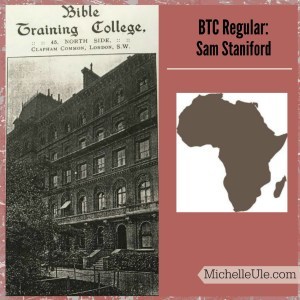 ?
?
The son of a florist in Buckinghamshire, Sam was born in 1893.
At the Bible Training College (BTC)
Sam Staniford never forgot the effect of Oswald Chambers’ teaching.
“What a privilege, yet what a responsibility, too, we had in having such a man as Oswald Chambers for our teacher. In every class he took we felt that he came to us straight from the presence of Almighty God.”
He was forever grateful for the lessons he learned there.
[image error]
Sam was a member of the BTC student body.
Sam’s favorite class was the “spiritual surgery,” that came from the small group that met on Wednesday afternoons.
Oswald asked them personal questions about their faith and challenged them with the quality of their spiritual lives.
“I thank God for Oswald Chambers, for both by his daily walk as well as by his teaching, he pointed out the path of ‘My Utmost for His Highest,’ and he was not content until he made us walk that path. “
Staniford attended London University after the BTC.
He served in the Royal Army Medical Corps during World War I, as a private.
On to the Belgium Congo
Following the end of World War I, Sam joined World Evangelical Crusade and set off for the Belgium Congo.
Studd assigned him to the Wamba area in the northeast corner of what is now The Democratic Republic of the Congo. (About 700 kms from the Uganda border).
Sam Staniford went by his African name, pronounced “Star,” and worked in the area, which had many churches.
Studd set a high bar for missionary devotion. He once explained, “If Jesus Christ be God and died for me, there is no sacrifice too great that I can make for him.”
At some point, Staniford began to lose the sight in both eyes and his wife took him back to England for cataract surgery.
Many thought it the end of his missionary career.
The operation, however, restored some of his sight. According to Earthen Vessels blogger Don Biro, they got a word from the Lord:
“Did you not tell me when I called you for Africa that you would give your life for Africa? Why have you gone back on your word?”
[image error]Congo today (Wikipedia Commons)
“Because of my eyes, Lord.”
“But you said you would give your life. It is not a question of your eyes.”
So, they returned to the Ivory Coast.
Great Sacrifices
Their missionary authority sent them to a new West African field among the Gouros–who in those years had a reputation for poisoning outsiders.
Government officials didn’t want them to go but reluctantly agreed.
Within a short period of time Mrs. Staniford came down with yellow fever and died.
Shortly thereafter, one of Sam’s repaired eyes no longer worked and then he was in a terrible auto accident.
Left with the hearing gone in one ear and only half the sight in the remaining eye, missionary authorities suggested Sam Staniford return home.
[image error]
C.T. Studd; quite a mentor
“Except a corn of wheat fall into the ground and die, it abideth alone.
But if it die, it bringeth forth much fruit.
My dear wife has done the dying; I am remaining here to gather the fruit.”
Sam Staniford saw people become Christians, made friends and began translation work.
The work succeeded in Gouros. Sam married a missionary on the field, Frances, who was a translator.
He continued to take interesting risks as a result of his faith in God. He taught, preached and managed the mission finances.
The effects of his auto accident took their toll, however, and he eventually suffered a stroke.
Sam Staniford died in Surrey, England in 1961.
BTC influences
Some of Sam’s surprising risks for the sake of the Gospel may have come from the example set by Oswald Chambers.
Sam recounted several stories about Oswald in 1934’s Oswald Chambers: His Life and Work:
“He had a practical faith in God resulting from his closeness of walk with Him that sent home his talks to our hearts, for he lived out what he taught.
“His life as well as his words was a witness to the presence of God, and in bringing every thought into subjection to the will of God he became our example as well as our teacher.”
Sam remembered a pleasant evening sitting around the fire at the BTC with a group of students. The discussion turned to giving to anyone who asks.
Oswald asked the them if they had seen his guest from earlier in the day. An acquaintance from Edinburgh, the man asked Oswald for money.
“He went on—“I said to Mrs. Chambers, ‘I’ve given away our last half-crown, what shall we do about it?’
She replied that ‘we must trust the Lord for another.’ ”
Later, another friend had a gift for Oswald, greatly exceeding the half-crown Oswald earlier gave away.
“Such things taught us more surely than mere precept.”
Sam Staniford lived his life the same way.
Tweetables
Oswald Chambers’ student has a wild missionary life with C.T. Studd. Click to Tweet
What happened when an Oswald Chambers student followed C.T. Studd to Africa. Click to Tweet
The post Sam Staniford: BTC Regular appeared first on Michelle Ule, Author.
October 19, 2018
ANZACS, the YMCA, and Oswald Chambers
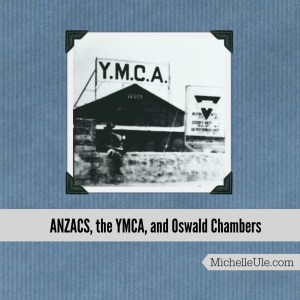 During their recreation time, some ANZAC soldiers visited the Zeitoun YMCA hut where Oswald Chambers served as a chaplain.
The ministry flourished and Oswald loved the soldiers.
Those who listened to Oswald preach at Zeitoun loved him back.
Why was Oswald Chambers in Egypt?
Oswald and Biddy Chambers ran a successful Bible Training College (BTC) in London for several years before World War I began.
Six months into the war, Oswald began to think he might be needed for “spiritual first aid,” to soldiers serving in the British Expeditionary Forces (BEF).
He applied for a spot with the Young Men’s Christian Association and they accepted him for work in Egypt.
He brought his family, and ultimately a half-dozen BTC students, with him over the course of WWI to serve in the YMCA.
While not all Oswald’s students ended up at Zeitoun, enough joined him in ministry to make a difference for the war-weary men who worked so hard in the desert heat during the two and a half years Oswald served.
What was the YMCA war work in Egypt?
The YMCA Middle East head, William Jessop, had just begun the YMCA ministry when WWI broke out.
With the support and encouragement of the BEF (and, ultimately, the Egyptian Expeditionary Forces–EEF), the YMCA provided letter writing tools, a place to visit away from the tents, refreshments and entertainment.
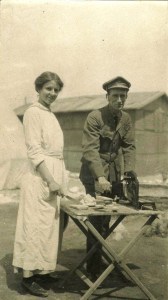
OC, Gladys Ingram Donnithorne and the bread slicer at Zeitoun. (Wheaton College photo)
Ultimately, Jessop oversaw six different “huts” serving various forces around Cairo. (The Australians, for example, set up camp near the base of the pyramids at Giza).
When Oswald arrived, Jessop sent him to a rough “hut” attached to the Egyptian General Mission alongside the Zeitoun army camp.
Huts or tents provided morale opportunities for the soldiers. The temperature in their white bell tents often reached 120 degrees in the desert heat.
The YMCA’s large downtown center at Ezbekiah Gardens provided books, tea, activities, games and ultimately a swimming pool. The YMCA also ran a hostel in the cosmopolitan city for ANZAC troops.
Oswald and the ANZACS
ANZAC soldiers were stationed at Zeitoun–mostly New Zealanders and others associated with the Desert Mounted Rifles.
Hard-charging and hard-living men, they did not respond well to Oswald’s first night at the “hut.”
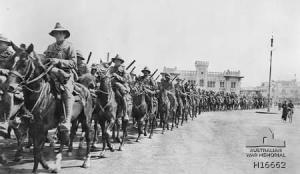
ANZACs leaving Zeitoun (Australian War Museum)
Oswald announced a prayer meeting in the hut his first night in camp. The ANZACs left.
But, Oswald’s no-nonsense and practical teaching began to work in their hearts. Many had recently returned from Gallipoli; they needed encouragement. They sought consolation in Oswald’s concern for them, personally.
When they discovered British women (Biddy and her friend Mary Riley) along with a toddler Kathleen were in the camp serving tea and fellowship, enthusiasm increased.
Soon, many men visited the hut for prayer, friendship, Oswald’s teaching and to play with Kathleen.
Out into the Desert
Ministry to the soldiers continued after they left Zeitoun.
The YMCA sponsored mobile units to travel with the troops.
Oswald’s BTC student Phil Hancock spent most of his service in Egypt near the front lines.
But it wasn’t just secretaries.
The ANZACs took Oswald’s ideas with them and formed small groups to continue reading and studying the Bible.
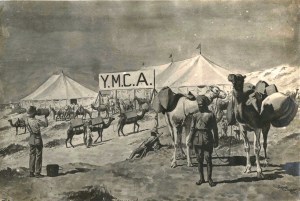
(Cadbury Research Library drawing)
Six months after arriving in Egypt, Oswald left Zeitoun for the summer to work in an even more primitive camp along the Suez Canal.
The Ismailia hut served men living in the sands along the western side of the canal. They learned to dig trenches, fire machine guns, and other battle tactics.
Once Biddy, Kathleen and Mary Riley joined him at Ismailia, Oswald organized free teas on Sunday for the men.
It was a place of relief and an opportunity to feel like civilized men with a tea cup–if only for a few hours.
Appreciation in Life
“It was almost worth enlisting to hear Oswald Chambers speak,” said one soldier
Many ANZACs came to faith and took their spiritual understanding into battle.
At least one Zeitoun favorite, Peter Kay, was at the Battle of Beersheba–an extraordinary charge that succeeded against all odds.
Oswald’s heart definitely followed the ANZACs into battle and beyond.
He had a long prayer list containing soldiers’ names–which he prayed through daily.
In 1917, the EEF made preparations toward taking Jerusalem–thus opening the door for the end of WWI in the Middle East.
Fearing casualties, the EEF asked the YMCA to provide a chaplain for every unit.
William Jessup organized his men to go, including Oswald. He would be at the front lines with American Dr. Gilvert Deaver.
Before Oswald could go, however, he fell ill.
Oswald Chambers died on November 15, 1917.
Appreciation in Death
Many ANZACs mourned Oswald’s death.
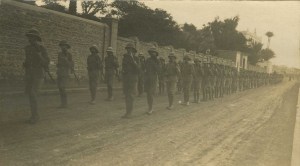
Riflemen, officers all, to honor Oswald Chambers in death. Cadbury Research Library photo
A thousand people attended a service in Oswald’s honor the next night at Zeitoun.
The YMCA’s Chambers ministry to the ANZACs did not end with Oswald’s death.
His wife Biddy stayed on to help run Zeitoun for the rest of the war with former BTC student/YMCA secretary Jimmy Hanson.
At Jimmy’s suggestion, Biddy put together a pamphlet of one of Oswald’s talks to send in response to condolence letters.
Many letters came from ANZACs whose lives were changed by Oswald’s teaching.
Within a few months, the YMCA stepped in and helped send out the pamphlets–to 10,000 people in all the theaters of war.
It was the beginning of what led to all the Oswald Chambers books, including My Utmost for His Highest.
An eternal ministry
By providing a place for spiritual first aid in the Egyptian desert, the YMCA ensured many ANZACS–and others–found respite and eternal life.
It was a partnership of a British teacher, Oswald Chambers; an organization founded in the United States, the YMCA; and men and women seeking the consolations of eternity with God.
Heaven must have applauded.
Tweetables
How the YMCA and Oswald Chambers teamed up to serve ANZACs during WWI. Click to Tweet
Fighting in the desert, but not lost to God; the YMCA, ANZACs, and Oswald Chambers. Click to Tweet
How did the YMCA minister to ANZACs in Egypt during WWI? Click to Tweet
The post ANZACS, the YMCA, and Oswald Chambers appeared first on Michelle Ule, Author.
October 16, 2018
The WWI Charge of a Light Brigade
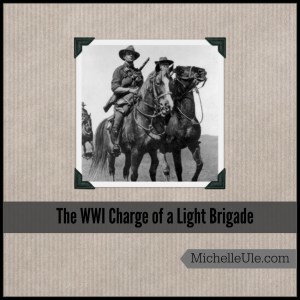
Australian War Memorial photo
October 31, 1917.
Undertaken by the 4th and 12th Australian Light Horse brigade the soldiers performed an astonishing feat at the Battle of Beersheba.
The results eventually led to the end of the war in the Middle East.
Desert Mounted Corps
The Australian Light Horse and New Zealand Mounted Rifles spent nearly two years out in the Sinai Desert.
Renamed the Desert Mounted Corps, they trained their horses and men to endure long periods of time without water.
Hard riding, hard-living men lived with few comforts in the boiling sun.
Often, the only shade was found under their standing horses.
They were often augmented by various versions of the Imperial Camel Corps, usually supplying much-needed water.
What’s a light brigade?
Infantrymen with rifles form a group of four. They ride toward a battle line, dismount and begin firing their rifles.
Only three men shoot and fight. The fourth soldier grabs the horse reins and takes them to a safe place until after the battle. They carry only rifles and an 18-inch bayonet.
(See the movie The Lighthorseman for a fairly accurate account of their lives and the Battle of Beersheba).
The horsemen do not charge on their horses. They alight from their mounts, about 800 yards out from battle lines and fight from the ground like infantrymen.
Early in the war, the EEF stationed many Desert Mounted Troops at Heliopolis and Zeitoun, Egypt, north of Cairo.
Some, including Australian Peter Kay, visited the YMCA camp at Zeitoun where Oswald Chambers worked.
Difficulties in the desert campaign
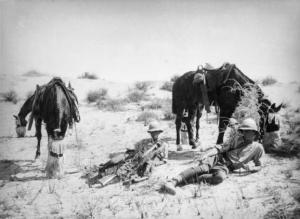
The light horse brigade toughened up in the desert. (Australian War Memorial)
Water is always an issue in the desert.
The Sinai and southern Judean desert consisted of empty stretches of sand (think the movie Lawrence of Arabia), inhabited by nomads and Bedouins.
Oases and deep wells were the only sources of water.
The Via Maris, the road leading from Egypt along the Palestinian coast up to Asia Minor was not a well-constructed road, and no railroad existed.
Starting in 1915, the Egyptian Expeditionary Forces (EEF) spent two years constructing both railheads to move stores and a lengthy water pipe.
In early 1917 they went into battle in an attempt to take Gaza, a German stronghold.
They failed twice and the British War Department replaced General Archibald Murray with General Edwin Allenby, fresh from France.
At Gaza and Beersheba
By fall 1917, Allenby put new plans into effect that involved fooling the Germans and Turks.
His officers prepared plans to sweep through the desert and attack the town of Gaza from the east.
It meant harrowing conditions for the soldiers, but the element of surprise necessary to take an entrenched town near the ocean.
The new plans centered on the sleepy town of Beersheba–where wells ran deep.
Heroics and determination made the difference for the EEF’s Desert Mounted Corps and some 50,000 allied troops.
Allenby ordered the navy to bombard Gaza to distract the Ottoman and Turkish high commands in late October.
EEF air squadrons assumed control of the skies to limit enemy intelligence.
Meanwhile, traveling only at night against a full moon, the massive EEF forces set out toward Beersheba.
According to Cameliers in Palestine:
“Transport columns established dumps of all kinds in advanced positions, and the whole country, after dark, appeared like a gigantic ant colony on the move. The transport column of Desert Mounted Corps alone, on the night of October 28, was fully six miles long.”
The two mounted divisions of the Desert Mounted Corps had to ride nearly 35 miles one night to reach their appointed spot.
On October 31, the EEF attacked Beersheba.
The battle raged all day against superior, well-dug-in Turkish forces. German officers assisted the local commandants. Despite the best efforts, as the day drew long, the EEF had not overpowered the Turks.
The high command knew the Germans would blow up the wells if the EEF took the town.
Enter the horses
By late afternoon, the Desert Mounted Corps, held in reserve, had gone 48 hours without watering their mounts.

Finally getting a drink of water! (Australian War Memorial)
Their commander, Colonel Harry Chauvel, knew the horses would die if the EEF did not take Beersheba and get water.
With only an hour left until sundown, he suggested an audacious attack. He’d send the 4th and 12th Australian Light Brigade on a two-mile charge over open fields to Beersheba.
The Turks had machine guns at the ready.
But Chauvel ordered the men not to stop and dismount.
They rode with their rifles on their backs, their 18-inch bayonets in hand.
His orders? Charge the line.
Obeying silent hand signals, the men rode off into the Turkish guns.
Charging. Or not?
Perhaps the horses smelled the water, but they raced across an open field for two miles toward the Turkish machine guns.
The Turkish commander held his men in check, waiting for the horsemen to dismount, and then pour the bullets into them. He told them to adjust the range on the machine guns to 800 yards–which is where light brigades dismounted.
Except, when the horses reached 800 yards, they did not stop.
They kept coming.
And the bullets passed over their heads.
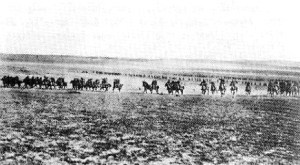
A recreation of the charge in 1918
According to history.net:
“Unnerved at the screaming apparitions galloping out of the red dust and coming dark, many of the Turkish riflemen had failed to adjust their sights and fired high, unwittingly saving countless Australian lives.
“In his after-action report Brig. Gen. William Grant, commanding the 4th Light Horse, wrote, “The rapidity of the attack seemed to demoralize the Turks, as they mostly fired high, and it was afterward found that the sights of their rifles were never lowered below 800 meters.”
At Beersheba
The first line of charging horses jumped the trenches and went into the town proper.
The objective? To capture the wells.
The second line jumped the trenches, over the machine guns and soldiers, and the infantrymen dismounted and began using their bayonets.
The Desert Mounted Brigade won the battle and took the town in less than an hour.
It was the final successful charge of a cavalry brigade in history.
Once the town was secured, the horses were the first to get a drink of water.
Tweetables
The final successful cavalry charge in history! Click to Tweet
How a cavalry charge led to the end of WWI in the Middle East. Click to Tweet
But light brigades don’t charge! Opening the war to take Jerusalem, 1917. Click to Tweet
The post The WWI Charge of a Light Brigade appeared first on Michelle Ule, Author.
October 12, 2018
Women Journalists in World War I
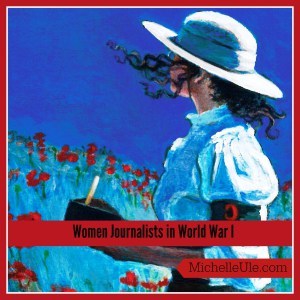 What do you know about women journalists during World War I?
Probably little.
Because there weren’t many.
Indeed, the most famous “name” from that era, roughly 1914-1919, was a mystery writer, Mary Roberts Rinehart.
Others may be familiar with Peggy Hull.
Why weren’t there many?
Some of it had to do with the nature of war and female journalists in general.
In 1914, most women journalists worked the “soft” aspects of a newspaper. They wrote society columns and covered more “feminine” stories.
Nellie Bly, who found her way into journalism before the turn of the century, was a brash investigative reporter, but few emulated her with any success.
It also became a question of did the Army want women reporting near the front lines?
Male reporters had a difficult time getting close; propaganda flourished. For the most part, British journalism reported what the Army told them.
Missing the story?
My agitated would-be reporter Claire reacted to Lord Northcliffe in A Poppy in Remembrance this way:
Lord Northcliffe grabbed the envelope, scanned the note, and shook his head. “This doesn’t even justify a formal response. Inform Meacham we trust the generals; they’ll tell us what we need to know.”
“Are they giving you the full story?” Claire asked. “Reporters need at least two sources.”
He looked down his aristocratic nose at her. “We are in a battle for our lives, miss. I don’t need an American girl telling me how to report our war. Improper information can be deadly.”
“But if other countries think you’re distorting the truth, they might question what else you’re not reporting correctly. You could undermine the whole effort if you limit information.” Claire couldn’t believe she had to remind him of basic journalism ethics.
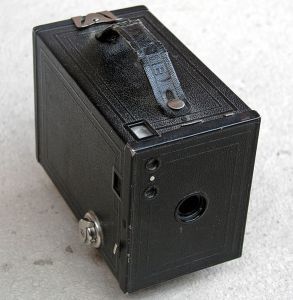
Even a Brownie camera was banned. Photo by Håkan Svensson (User:Xauxa).
Northcliffe threw her out of his office.
Many reporters snuck to the front lines but military authorities caught and returned them to safety.
Indeed, soldiers were not allowed to carry the new and clever Brownie cameras, or even keep a diary.
The armies on the western front held the information tight–for a variety of reasons.
Women journalists were not considered suited for viewing the wretched trenches, much less reporting on them.
Needing accreditation?
The military used the accreditation process as its first line of control over war correspondents, and the War Department refused outright to accredit women.
As Claire’s father explained to Claire when they worked in Egypt,
“The Boston News Service hasn’t paid a bond for you. Under military regulations all copy has to be sent in my name.”
Claire slammed shut the file drawer. “Why?”
“The government has to accredit war correspondents. The BNS paid a $10,000 bond for me to work here. I must prove I’m worth the money.”
My protagonist persisted (see the book cover!)
What did the job entail?
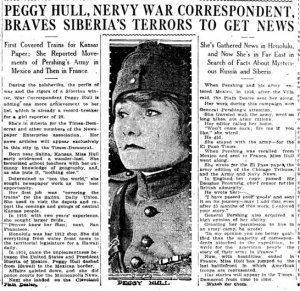
Front page Muskogee Times-Democrat, 03 Jan 1919.
Any reporter job means hunting down the story, questioning the facts and watching carefully.
Women could make good journalists because of their intuition–if they backed up their thoughts with facts.
As described in A Poppy in Remembrance:
“Claire picked up her pencil as an answer popped into her mind. “It’s one of the oldest reporter tricks. You remain silent and wait for your interviewee to blurt out information.”
You had to know when to be quiet and let the interviewee spill something important.
The sex factor could play a role, too, as Claire’s mother pointed out.
“You’ll strike gold eventually. Maybe you should flirt with higher-ranking officers.”
Claire winced. While guilt stabbed when she pumped innocents for information, she resented how the majors and their superiors patronized her. She wanted to be taken seriously, and it especially galled her when she realized she knew more than they did.
Anne studied her latest manicure. “A pretty young face could elicit important information from vain old men.”
Mostly, though, it included routine journalism work, hunting for the answers to “who, what, when, where, why and how?”
Where did women journalists go?
Rinehart got to the front lines because she traveled as a nurse (her prior profession) to visit hospitals in Belgium.
She just “happened” to get a tour of the western front
Even in her book written after her trip, Kings, Queens and Pawns, An American Woman at the Front, Rinehart couldn’t explain how she got access to travel and meet notables.
With propaganda raging on both sides of No-Man’s Land, she acknowledged she might have been used for propaganda purposes.
Roberts traveled under the auspices of the Red Cross with letters of transit and visas. Roberts also carried letters of recommendation from British Lord Admiral Winston Churchill and Field Marshal Sir John French, which opened doors.
Women journalists took any opportunity during the war to write a story. So, they covered orphanages, hospitals, YMCA entertainment, and even clothing drives if they could get near the front lines.
What types of magazines or newspapers hired women to cover WWI?
Knowing Rinehart’s past and connections, the Saturday Evening Post financed her trip to Europe three months after the war began.
Reporter Peggy Hull used her connections as a friend of General John Pershing (she covered the story of his 1916 hunt for Pancho Villa in Mexico) to cover World War I for the El Paso Morning Times.
She was the first female journalist accredited by the American Expeditionary Forces to cover the war. Hull designed and wore a female version of the AEF uniform while working.
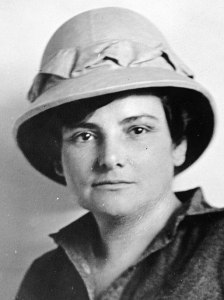
Harriet Chalmers Adams wrote for Harper’s
Harriet Chalmers Adams, a renowned explorer before the war, wrote for Harper’s Magazine in 1916 and reputably visited the trenches.
According to Kathryn Davis in The Forgotten Life of Harriet Chalmers Adams: Geographer, Explorer, Feminist:
“Adams was issued a permit to visit the trenches on the French front lines. She spent three months touring the front, hospitals and munitions plans where women working had replaced men who were fighting.
“Adams was not only the first woman war correspondent allowed at the front, but also one of the few, male or female, permitted by the French government to photograph actual battle scenes.”
Corra Harris, a novelist, wrote about the angle that seemed to work, as well as the frustration:
“Men’s sacrifice in war is at least recorded by history…while women’s story goes untold.” She recognized that “being banned from the front because of their sex proved to be the biggest obstacle to women journalists” for professional advancement.”
Three Canadian Women
Three Canadian women set aside their society news and traveled to Europe to cover some aspects of the war.
Firing Lines Three Canadian Women Writer the First World War tells the story of Beatrice Nasmyth, Mary MacLeod Moore, and Elizabeth Montizambert.
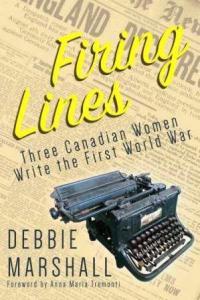 Author Debbie Marshall explained:
“They were very concerned with intimate details — how they [the soldiers] were doing in the hospital, their loneliness that they suffered overseas, the sacrifices that they were making … And often they [the reporters] would hear the less savory sides of war too. Because the men would trust them — you see, as women, they weren’t so scary to the men, they weren’t seen as being as serious in some senses.”
As for many reporters, the three women’s experiences lessened their enthusiasm for war. But, they got their stories despite overwhelming odds against them.
When did it change?
Women journalists showed enough chutzpah to get the attention of editors as the world struggled to make sense of the Great War.
The great humanitarian disaster of the war followed by the Spanish flu meant women gained opportunities to tell the stories.
Given a chance, just as the feminist of the time argued, women could do as good a job as a man in reporting the news.
By World War II, women journalists were more present and given more opportunities to get that elusive byline.
Some of them just had to survive World War I–like my heroine in A Poppy in Remembrance.
Tweetables
The trials of female journalists in World War I Click to Tweet
Did any female journalists make it to the front lines during WWI? Click to Tweet
How do you cover the story if you can’t get near it? Women in WWI. Click to Tweet
My monthly newsletter comes out on the 15th where I’ll offer the complete Ebook of my
Writing About Biddy and Oswald Chambers: Faith Affirming Stories and Serendipities
You can sign up for my newsletter here, free.
The post Women Journalists in World War I appeared first on Michelle Ule, Author.
October 9, 2018
Sonoma County Fires– One Year Later
I’ve spent a lot of time since thinking about what happened to my county, and particularly to my friends.
While no one in my family lost their home, we were all affected in one way or another.
 I didn’t realize how profoundly I felt until my husband suggested I change my reference.
“You’re too fixated on fire. Why not say, ‘the October events?'”
I laughed and told friends of his request. We all laughed and corrected ourselves.
“So, what happened to you during the fires? I mean, the October events?”
Silly?
Yes.
But for me, a start to healing.
If I’ll ever truly heal.
Why do I need to heal?
Survivor guilt is always present when you escape the horror of a natural disaster or calamity.
Fire came within five blocks of our house; we were evacuated for 13 days.
But that’s nothing compared to what our friends have gone through and continue to endure.
The stories drew me. They repelled me. They made me weep.
Especially now that so many have moved away.
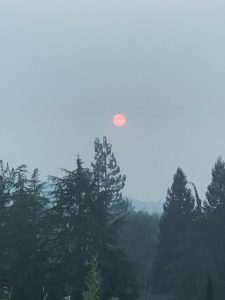
October 9, 2017
My life is riddled with holes. I miss my friends. I also miss the security of knowing people I loved were enduring this change in our community with me.
Too many have moved away. Too many.
No one I know, a year later, has even poured a foundation to start the rebuild.
What is there to say in the face of such trauma?
Sonoma County fires and the shadow of grief
I spent two weeks last June on a speaking/visiting tour in Virginia.
My husband sent me gladly. “You need to see another place besides Sonoma County.”
I didn’t realize how I felt–that I lived in a community overshadowed by grief.
We can see burned hillsides from our house.
Our friends’ horror of clearing property, dealing with the insurance companies (the insanity of having to list and value every possession you ever owned), and the frustration with our city’s planning department, weighed heavily on me.
And I didn’t lose a house.
When the smartest people we know don’t know what to do–who can solve the problems and rebuild?
In Virginia, old friends welcomed me with open arms.
They wanted to hear about my book, Mrs. Oswald Chambers–which released in the middle of our evacuation during the Sonoma County fires.
Mrs. OC was the point of the speaking trip, but I needed to talk about the fires with people who loved me and who cared enough to listen.
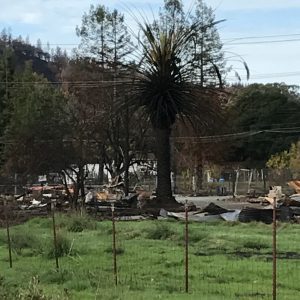
6 blocks from our house
The stories horrified them, but in talking about them and seeing a place untouched by fire, something in me began to relax.
The green hills of Virginia, the different life of my friends, the joy of being with them–it all helped.
Handling the emotions
One friend voiced her sadness that so many of us have “moved on” while her family remained stuck in limbo.
I’ve paid attention to her comments since the October events–as she talks about an incomprehensible experience.
I’ve tried to be a better listener. I ask my friends how they’re doing. I rejoice in small things and sometimes I weep with them at the enormity of what they face.
Often I wish I could trade my home for their empty shelter–if only for a week to help.
But when you’ve lost your home, someone else’s house won’t help.
I fear some of my cherished friends will make the same choice others have–and move on.
Ten months after the October events, I finally drove to the scraped home sites belonging to several friends.
Trying to respect their privacy, I hadn’t visited before–but now they gave me permission.
I’d heard the stories. I’ve witnessed their despair. I’ve cried over their decisions.
But that day I stopped to actually see.
How could those houses where I’ve attended so many parties simply be gone?
I’m not sure I’ll ever fully comprehend where all the granite countertops went that dreadful night of October 8-9, 2017.
Can someone explain how stone vaporized into thin air?
How am I different a year later?
I used to love the wind–the wilder the better. Now I don’t trust it.
My ability to concentrate is only slowly coming back. In the early months, it was impossible to read a long book.
I try not to sweat the small stuff.
I still carry a mask in the car.
The unexpected smell of smoke unnerves me.
I sign off my phone conversations by saying “love you.”
Standing by
 I pay attention to community activities by reading the Northern California Firestorm Update Facebook page.
Friends who moved away often comment.
I try to be sensitive to what fire survivors need. We pray for our friends and neighbors often at church.
I didn’t lose my home in the Sonoma County fires.
But I’ll never be the same.
Tweetables
Personal reflections 1 year after the Sonoma County fires. Click to Tweet
Survivor’s guilt, lost friends and how to cope with a natural disaster. Click to Tweet
How does granite evaporate? And other fire reflections 1 year later. Click to Tweet
The post Sonoma County Fires– One Year Later appeared first on Michelle Ule, Author.