Michelle Ule's Blog, page 41
August 31, 2018
Jesus’ Prayers– How They Can Change Your Life
You know, not just how he taught us to pray in the Lord’s Prayer but what He prayed about and how.
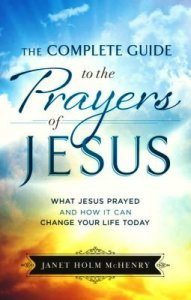
My friend Janet McHenry explains it all in her new book, The Complete Guide to the Prayers of Jesus: What He Prayed and How it Will Change Your Life Today.
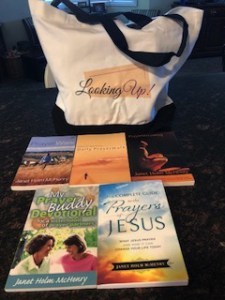
Janet is the author of six books on prayer (along with 17 other books!).
Her most famous bestseller is PrayerWalk: Becoming a Woman of Prayer, Strength and Discipline.
She had many insights into prayer and, in particular, Jesus’ prayers and His prayer life.
What impressed you the most about the prayers of Jesus?
“Jesus’ prayers were simple. No fancy words or long involved sentences. No flowery metaphors or tangents. That’s comforting to me, because as a journalist I prefer simple language.
“Also, his heart simply wanted to be aligned with his Father’s heart—which, to me, is the ultimate purpose of prayer—to be one with the Father in heart, mind, and soul.”
When did Jesus pray?
“Scripture tells us he prayed in the morning and he prayed at night.”
That’s not too surprising since we’re urged to pray without ceasing. Every indication is God and Jesus communed all day long.
Janet noted the same, “I have what I call an organic praying life. I pray all day long, as God brings the needs in front of me.”
That’s what I do, too.
 When I asked what position He prayed in, Janet remarked the Scriptures don’t really say.
Jewish tradition, of course, often included lying face down at the altar in Jerusalem.
Since Jesus prayed at the table, he may have been reclining (which is how they ate during the first century).
Traditionally, people kneel but Janet pointed out we don’t have to be on our knees to pray.
I seldom knee, though I appreciate an opportunity to do so in churches with kneelers.
If Jesus and the Father were one, why did he pray?
The practical reason:
“While Jesus was Emmanuel—God With Us– here on earth in human flesh, he was not in heaven with his Father.”
Janet noted “they were one but separated by form—one in Spirit, one in flesh.”
She likened the relationship to marriage. While a couple are “said to be one, they still need to communicate.”
“Communication is key for relationships. He depended on the Father to guide him. In fact, scripture says Jesus HAD to be with his Father.”
The prayers of Jesus, of course, were not limited to the famous prayer closet He advised His followers to seek.
He prayed whenever he needed to–often times leaving behind the hubbub of life with His disciplines to check in with God.
Prayer is the second most common topic Jesus taught on, eternal life being the first.
Why doesn’t God answer some prayers?
This is the question we hear often.
“The classic answer would be that he does answer them—but not necessarily as we would have preferred.”
Janet turned that around, however, and reminded me of Jesus’ prayers on the cross,
“My God, my God, why have you forsaken me?”—which he uttered on the cross. Forsaken is a tough word here. It means “abandoned” or “deserted” or colloquially, “dumped.”
Perhaps it’s better to look at the result of that forlorn prayer?
“We were given the opportunity to be adopted as sons and daughters of the Most High God. So, there was an answer, and while Jesus felt forsaken, he was not. There was a better answer for a higher good.”
Answers like that are often a long time in coming.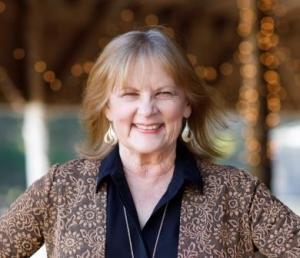
Some say you can best understand the will of God by looking backwards, but it takes a choice of faith.
“I don’t claim to know why people suffer. Suffering will exist whether we have a relationship with God or not. I choose to have a relationship with God and choose to communicate with him, because when I do, I am not alone in that suffering: he is with me.”
Why should we pray? Doesn’t God already know what we need?
There are many great reasons to pray. Janet explained we pray because:
We follow the example of Jesus.
We love God and should have an inherent need to be with the Creator who loves us.
Our relationship with the Father deepens as we communicate with him.
Jesus told us to: “Ask and you shall receive . . . .”
He taught us to pray: “When you pray . . . .”
Spending time with God aligns our heart and mind more closely with his.
That alignment is oneness—something that Jesus prayed for in our behalf.
When we turn to a posture of prayer—literally or figuratively—it’s an indicator that we do believe and have faith in the One who can move heaven and earth.
“Sure, we pray “Save me from this hour” a lot—the prayer Jesus said he would not pray. But that’s okay, too.”
How did Janet put her book together?
Like any good writer, Janet organized her notes and references as she intently studied Jesus’ prayer life.
 She paid close attention to what He taught about prayer, His personal prayers and practices.
How did writing the book affect Janet’s prayer life?
Over the course of writing five books about prayer, Janet has incorporated many practices into her personal life.
With this new book, however, she observed many of His prayers arose from troubled times.
When reflecting on events surrounding Jesus’ arrival on Palm Sunday, Janet saw Jesus’ heart was troubled.
But then He went on.
“What shall I say? ‘Save me from this hour?’ No, it was for this very reason.” And then his short prayer: “Father, glorify your name!”
“Jesus’ whole mission was to point people to his Father.
“But here’s another thought: ours should be, too.
“Glorify yourself through me” is a powerful prayer, but it can’t simply be a rote prayer—it has to come from the heart.”
Final thoughts
Janet McHenry’s book is an easy read, using daily circumstances to show how to apply Jesus’ prayersto our own lives.
Readers can find dozens of books on aspects of Jesus and prayer–especially on the Lord’s prayer.
But The Complete Guide to the Prayers of Jesus: What He Prayed and How it Will Change Your Life Today is the only book dedicated to Jesus’ prayer life.
Shouldn’t we follow the example of the Creator of all prayers?
Tweetables
What was Jesus’ prayer life like and how can we emulate it? Janet McHenry shows how. Click to Tweet
Did Jesus only pray when troubled? Click to Tweet
If Jesus and the Father are one, why did Jesus bother to pray? Click to Tweet
The post Jesus’ Prayers– How They Can Change Your Life appeared first on Michelle Ule, Author.


August 28, 2018
Isabel Craddock: BTC Missionary to India
Where she stayed for the rest of her life.
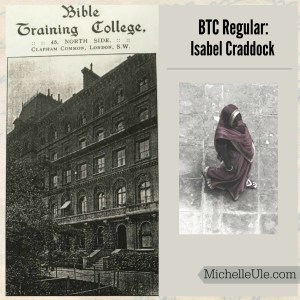 Nicknamed “Joan of Arc,” by Oswald Chambers, Jeannie Isabel was the daughter of Reverend Robert Craddock, a Methodist minister, and his wife Clara.
Born in Australia in 1889, she moved to England as a girl.
Records indicate the tall slender girl with bright blue eyes had an early heart for missions work.
At the age of 10 she donated 6 shillings, 2 pence for a Methodist Church’s missionary project.
(Her brother Fred donated 13 shillings, ten pence!)
It’s not clear when she began classes at the BTC, but Oswald and his teaching marked her for good.
At the BTC
Many students entered the BTC unsure of what they wanted to do in service to God.

Isabel was a member of the BTC student body.
Oswald inspired many of them. As Isabel wrote in 1934’s Oswald Chambers: His Life and Work:, long after her ministry overseas began:
“The remembrance of Oswald Chambers’ radiant trust in God’s almightiness, in spite of every obstacle that might arise to contradict it, gives courage and strength to believe even in the testings of today.”
His commitment to prayer left a mark:
“It was in the memorable B.T.C. days that we realized most how truly he lived and fulfilled the ‘ministry of the interior,’ as he called prayer.
“Nothing but this contact with the Father could have kept him so ready and prepared at all times to give help and advice.
“As he helped to solve our problems, or in times of crisis showed us our way through, the sense of panic disappeared, while we knew we were linked on to the Unseen and lost sight of the human element.”
Isabel used all those spiritual resources in her future as well.
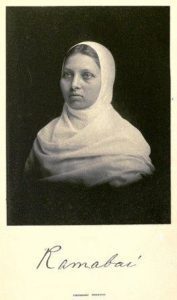
Pandita Ramabai’s Mission
Isabel first heard of Pandita Ramabai’s Mission while a student at the BTC when a Miss Hastie visited and talked about the mission.
Intrigued, Isabel applied to become a missionary with Pandita Ramabai’s Mission in Mukti, Southern India.
Pandita Ramabai‘s story is worth retelling–but not here!
Suffice it to say, she was a social reformer, champion for the emancipation of women, pioneer in education and a Sanskrit scholar. Everything changed when she became a Christian!
She began translating the Bible into her native language, Marathi, in 1904–the first woman to every do so!
Her Mission served women and children with the opening of a school in the early years of the 20th century.
It’s not clear where Isabel first heard of the school nor why she wanted to serve there, but Pandita welcomed her in late 1915.
As Isabel Craddock wrote in Snapshots of Mukti Mission,
“The Saturday morning I arrived at Mukti’s gate I found Pandita Ramabai waiting to receive me.
“Ramabai did not seem a stranger, for she looked exactly as if she had stepped out of one of the pictures I had seen of her, a white-robed figure, breathing serenity and strength.”
Pandita and her daughter Manoramabai, ran the ministry. After Isabel completed her studies in the Marathi language, they assigned her to work with blind girls.
Practical and Spiritual Life Skills Taught
She loved her work with the girls and used her training from the BTC to good effect.
“God’s Word was opened up in all its fullness and richness as we were brought to a clearer understanding of the mystery of His love, and of the claims of Jesus Christ our Lord and Saviour.”
Isabel devoted herself to teaching her students the same spiritual lessons.
She also brought life skills to the school:
“Isabel introduced Braille into the School for the Blind, spending long hours teaching the women and girls. Providing job training, she taught the blind residents to
make bead curtains, beaded handbags, bed tops, baskets made from banana trees, rope, and how to do cane work. She supervised all of this work personally.”
Furlough and surprise
Upon Isabel’s return from furlough to England in 1922, she discovered both Pandita and Manorambai had died.
She missed their leadership, but turned back to the Lord:
“It is impossible to put into words the feeling of desolation which came over me on returning from furlough and finding Ramabai’s and Manoramabai’s places empty.
We sorely missed Bai’s strong faith, but God…has continued through others what He purposed Ramabai and her daughter should begin.”
Working with blind girls and women, Isabel also shared her love for music and hymns.
“She was called “Stuti Moushe,” which means “Praise Auntie” because of her fondness for music.
“She taught hymns to the blind and practiced the Sunday hymns with them.
“Always aware of the needs of the girls and women, if Isabel noticed that someone was not singing, she would patiently teach her the hymn.”
Other than 1950, Isabel served as Mukti superintendent from 1945-1955 when she retired home to England.
Faithful to the end, she opened her home to anyone from the Mukti Mission who visited England
Isabel Craddock died in 1989, just a few months shy of her 100th birthday.
She wasn’t the only one of Oswald Chambers’ students to serve in India, but her tenure and devotion were the longest.
Isabel recalled many important lessons from her teacher, but perhaps this one served her the best:
“Our hearts are stirred afresh with the longing to ‘live most with Jesus Christ and be absorbingly taken up with Him,’ so that we may live the life God’s heart has planned for us and not be ashamed at His coming.”
Well done, good and faithful servant, Isabel Craddock!
Tweetables
Pandita Ramabai and Oswald Chambers: linked by one missionary. Click to Tweet
How one of Oswald Chambers’ students ended up a missionary in India for 39 years. Click to Tweet
The post Isabel Craddock: BTC Missionary to India appeared first on Michelle Ule, Author.
August 24, 2018
Egypt Research Challenges
 Egypt research provided me with many challenges as I wrote my two Chambers books.
Those spots I could physically visit, I did.
I stood on the steps of Oswald Chambers’ former Bible Training College at #45 Clapham Common in London.
My husband and I paused romantically in front of the “Light of the World” painting at St. Paul’s Cathedral.
We even visited trenches in the Somme and hiked all over Paris like Claire and Nigel.
“How did you learn so much about Egypt?” several people asked after reading Mrs. Oswald Chambers. “Did you go there?
I wrote A Poppy in Remembrance following the Arab Spring. How could I travel to north Africa?
I don’t think, at this point, I’ll ever go to Egypt–though I’d like to.
Instead, I turned to Egypt research materials where I could find them.
Books
Books, of course, led the way.
Since Oswald and Biddy Chambers lived in Egypt during World War I, I found books written about that time period.
Both fiction and nonfiction were invaluable.
Most notably in the fiction category, the Amelia Peabody stories by Elizabeth Peters.
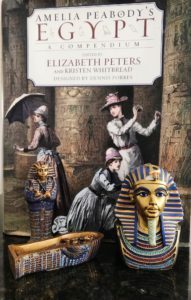 The stories take place from the 1880s until WWI.
Since I knew Peters, a pseudonym for Egyptologist Barbara Mertz, knew her facts, I trusted her observations.
T. E. Lawrence of Arabia also had descriptions of this time period. Since The Seven Pillars of Wisdom is one of my husband’s favorite books. I merely had to pluck it off the shelf!
I had a lot of trouble with Thomas Kenneally’s The Daughters of Mars (owing to an inexplicable non-use of quotations marks!).
The novel, however, provided me with insight into the Middle Eastern theater from the point of view of ANZAC nurses.
The most important book was Baedeker’s 1914 Egypt and the Sudan, which I read on line.
Since it was published in 1914, it provided information about life during the years my characters lived there.
In fact, both Claire and Biddy used the book when preparing for their trip overseas!
Egypt Research Through Movies
Many movies are set in Egypt and they can stretch from Raiders of the Lost Ark and The English Patient (WWII) to Cairo Time (modern day) to even Murder on the Nile (1920’s).
They all gave me a sense of the air, the country, the dress and where things are located.
Did you know the Sphinx looks across the Nile at a Pizza Hut Restaurant today?
Only one person in A Poppy in Remembrance went to Gallipoli--another film that provided a sense of the time and place.
I also watched a variety of documentaries set in the country, again for a feel for the land and what my characters would have endured.
Lawrence of Arabia was the major source in movies for World War I Egypt.
 Against David Lean’s telling, I could better follow the politics in the Ottoman Empire during WWI.
Beautifully photographed, I could see the type of British officers who walked through my story.
I even gave Captain Lawrence a cameo part in A Poppy in Remembrance.
The story of his life was one of the reasons I thought to write the novel in the first place.
What about the sense conveyed by books and movies?
Books and movies filled in my sight knowledge–what things looked like in the Middle East during WWI.
But what did the country smell like? How did food taste? Other than the horrors of sand dunes, what did the air feel like?
For that, I had to investigate a little more creatively.
Tweetables
How do you research Egypt if you can’t visit the country? Click to Tweet
Books and movies provide an eye-full of Egypt research opportunities. Click to Tweet
The post Egypt Research Challenges appeared first on Michelle Ule, Author.
August 21, 2018
Egypt Research: Food and Clothing
 When you can’t visit the country where a large chunk of your historical novel takes place, you have to adapt.
I’ve written before about Egypt research opportunities in books and films.
As a writer, I sought accuracy but also a way to set mood and place using the senses.
In addition to what I could see, I needed to be able to evoke other senses like taste, smell and feel.
Dinner almost always can help hit those markers!
Egypt research at restaurants
We do not have an Egyptian restaurant anywhere near my home, but we did visit Los Angeles.
It happened to be the night before Thanksgiving and six of us visited a spot featuring middle eastern food.
(The fact it was owned and run by Russians, we decided, was immaterial).
A hookah parlor took up the building next door, so it felt authentic!
We were familiar with humus, dates, flat breads and sizzling lamb.

I don’t remember what it is, but we ate it!
Falafel made the menu and various rice dishes. Several items were wrapped in date leaves.
We told them to bring us anything authentic and while we cleared our plates, none of us have returned to an Egyptian restaurant!
Still, I could describe a meal to provide a savory element to my story:
“They dined in a local restaurant on sayadeya, bluefish cooked with rice, onion and tomato sauce and baked in earthenware. She’d never eaten chick peas before, and new spices appeared with each dish. Claire savored cool yoghurt with a tang of cucumber and a date and honey baklava so sweet her teeth hurt.”
Best Egypt research
The best research I did came from interviewing friends who had been to Egypt.
Marianne, who pointed out she had visited only 60 years after the Chambers family left, explained why Biddy wore long sleeves in her photographs.
“I wore long sleeves to keep the sun off my skin and keep my perspiration from drying out immediately in the sun. Being hot and moist under clothes was much more comfortable and cooler than being hot and dry under the sun.”
She talked about visiting the pyramids and what she ate. Very helpful.
Another friend has run camps in Egypt. Wendy answered a question about smell:

We ate this, too.
“Ah, every country has a smell. Hard to describe. Date palms have a sweet-smelling shade. You know you are near the spice merchants at the bazaars by the aroma, or the perfumeries which are very ancient and unlike the cosmetic stores. Those are heavy and musky.”
She also waxed lyrical about food:
“I love kofta! Ground lamb in meatballs or sausage shape. Molihia (have no idea the spelling) we call it green slime, but it is delicious, heavy garlic for sure. Lots of fish and chicken and rice and lentils. Shwarma too, and fantastic flat bread, like pita.”
Judi described the white sand against the blue thread of the Suez Canal and mentioned the swarms of tour guides around the pyramids.
Family story
My favorite story came from my father long ago.
My parents and grandmother visited in 1975 when women did not appear on Cairo streets with bare arms and legs.
In their story, my mother, a determined girls physical education teacher wearing shorts on a hot day, announced she was going for a walk outside their Cairo hotel.
“I wouldn’t do that if I were you,” my father said. “As soon as you walk out that door, every man in the neighborhood is going to be after you.”
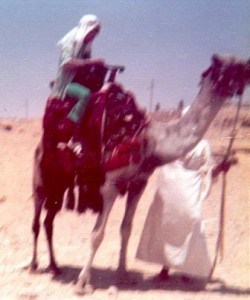
At least my grandmother knew what to wear!
Characteristically, my mother said. “I can do anything I want to. I don’t care what men say or do.”
She only lasted five minutes before running back into the hotel.
She wore a skirt the rest of her visit and always walked with my father after that!
Did I need to do Egypt research in the country?
Ideally, I would love to travel to Egypt and see the cemetery where Oswald Chambers is still buried.
A man attending one of my lectures was surprised to discover Chambers was in Zeitoun–his birthplace.
He shook his head over the photos from 100 years ago. It’s very changed, as you would expect.
But I feel like I’ve been there–and hope that comes out in A Poppy in Remembrance.
Tweetables
Tasting Egyptian food in a Los Angeles restaurant–it’s all research! Click to Tweet
The best research stories come from people who’ve been there–in this case, Egypt! Click to Tweet
The post Egypt Research: Food and Clothing appeared first on Michelle Ule, Author.
August 17, 2018
Poppies and World War I
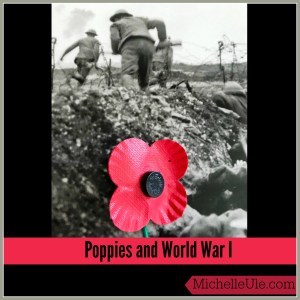 Why has a red poppy become the symbol of the War to End All Wars?
Several reasons
All about poppies
Poppies are short-lived perennial flowers.
They’re the native flower of my home state, California, though ours are orange.
Fragile, paper-thin flowers grow on the end of thin green stalks, about eight inches off the ground.
Their tasty seeds can be used as a mild sedative; some varieties relieve pain.
Dorothy and her friends passed through a poppy field in The Wizard of Oz and promptly fell asleep, for example.
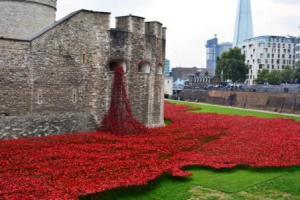
Tower of London, September 2014, by David Kronberg
When my husband served in the US Navy nuclear power program, sailors knew not to eat anything with poppy seeds.
During random drug screening, a sailor who ate something with poppy seeds can test positive for having used marijuana. (Such use meant exclusion from the nuclear program during those years)
Opium is derived from the opium poppy, a native of the eastern Mediterranean, in Asia MInor.
It’s grown all over the world, now.
Poppies in Greek mythology
Owing to its sedative effect, the flower is linked to sleep, peace and death in Greek mythology.
The goddess Demeter created the flower so she could sleep after the anguish of losing her daughter Persephone to Hades, the god of the Underworld.
In some mythology they’re considered symbols of the resurrection–and thus hope.
In my novel A Poppy in Remembrance, Claire explains their hopeful nature this way.
“They were a gift for Demeter, to remind her of Persephone left in the underground.
“Poppies symbolize remembering the hopeful in the midst of the difficult.”
As a World War I symbol
During World War I, poppies grew across the fields of Belgium.

Blue and red poppies both. Photo by Zbynek Burival on Unsplash
A sign of churned up battlefields, the flowers dotted the countryside usually in shades of red, though occasionally blue.
They became a famous symbol after the popularity of Canadian Lieutenant-Colonel John McCrae’s 1916 poem, In Flanders Field,which begins with the memorable line:
“In Flanders fields the poppies blow
Between the crosses, row on row,”
In honor of the war’s armistice in November, 1918, American YMCA worker Moina Michael responded with another poem, We Shall Keep the Faith.
The second stanza included this nod to McCrae’s poem:
“We cherish, too, the poppy red
That grows on fields where valor led;”
Michael announced she would wear a red poppy for the rest of her life to honor the dead.
Following the end of the war, she taught classes to veterans and recognized they needed assistance.
She came up with the idea of selling silk poppies to assist disabled soldiers–which a program the American Legion Auxiliary adopted in 1920.
War Remembrance
Red poppies are the universal remembrance to honor veterans lost to war and as part of Remembrance Day activities.
When you look at photos honoring war service or WWI centenary meetings, you always see a red poppy.
I’ve been handed plastic red poppies in England and at Arlington National Cemetery in Washington D. C.
Paintings, etchings, framed copies of In Flanders Field and lots of plastic poppies were evident when we toured the Somme battlefields.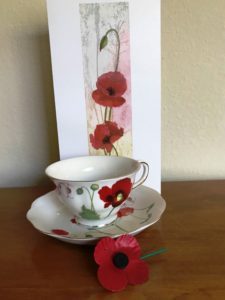
Friends have given me, a WWI novelist, pictures, cups and even a genuine red ceramic poppy that stood with the others at the Tower of London in August, 2014.
Red for resurrection, or blood, or for valor?
Red poppies are a symbol of honor, particularly for those who died in World War I.
Tweetables
Why are poppies associated with World War I? Click to Tweet
Greek mythology, WWI and red poppies. Click to Tweet
The post Poppies and World War I appeared first on Michelle Ule, Author.
August 14, 2018
What is a Coming of Age Story?
 What’s a coming of age story?
A coming of age story describes the changes that happen in a young person’s life as they mature from childhood to young adulthood.
It’s the tale of a hero or heroine’s transition from naiveté to wisdom against the backdrop of any setting.
It’s a common genre with many stellar novels.
Well known examples
Charles Dickens’ David Copperfield and Great Expectations are both tales of young men as they grow into adulthood with a crazy cast of characters and adventures along the way.
David Copperfield’s story paralleled some of Dickens’ own life. (Which may be why authors write coming of age stories; they already know the material.)
Jane Austen’s Emma is the wonderful novel of a would-be matchmaker whose foibles turn on her.
The stories are often told in first person so the reader stays in the protagonist’s point of view.
This adds emotional wallop as we identify with emotions and memories of our own youth.
Adults may enjoy such tales because it reminds them of their maturing–misconceptions and all.
Even The Wizard of Oz fills the definition as we watch Dorothy grow to appreciate her modest Kansas home while traveling through the craziness of Oz.
Coming of Age over a series of books
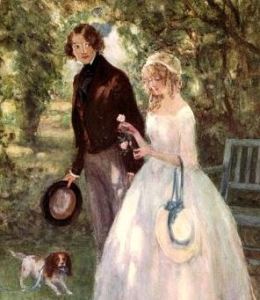 A series is the perfect place to watch a loved character grow up and mature.
Certainly that was part of Harry Potter‘s draw as each book heralded a new school year and growth.
Robin Jones Gunn matured her title character Christy Miller from a freshman at a new high school in California all the way to the present day.
Twenty years later, Robin’s writing stories about Christy as a new mother.
Like Harry Potter, Christy Miller grew up before our reading eyes.
Some of my frustration with books like Nancy Drew or the Hardy Boys stories is we didn’t see any growth or change.
My children were horrified when I pointed out the books took place during the same summer or two?
Did the Nancy Drew or the Hardy brothers ever change or mature?
Even my young boys didn’t think so.
My favorites?
The Beekeeper’s Apprentice by Laurie R. King.
In which a teenage orphan Mary Russell meets Sherlock Holmes. Mentored by the great detective, Mary grows into her intellect, physique and emotional satisfaction.
Lloyd Alexander’s The Chronicles of Prydain.
Taran comes of age over the course of five books. He collects a cast of unusual friends and sidekicks who help him grow into both his character and his destiny.
A Poppy in Remembrance as a coming of age story.
I describe my World War I historical novel as a coming of age story.
When the book opens, Claire Meacham hopes to “intern” with her journalist father.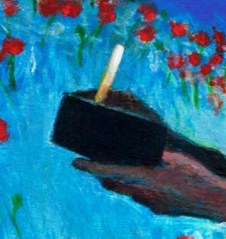
She’s been preparing herself by learning about history, geography, political events and even stenography and typing so she can do the job.
Unfortunately, few women worked as foreign correspondents, during the WWI era.
Most women were assigned spots on the women’s page covering “soft” stories.
Nellie Bly was an infamous exception.
But Claire perseveres, and as she thrusts herself into her father’s life, she also gets tripped up with other age-appropriate events.
She falls in love–or does she? What does that even mean?
Claire also meets her Savior through Oswald and Biddy Chambers, and her spiritual life explodes.
My husband likes to describe the story as “What would it have been like to have been one of Oswald Chambers’ students?”
But a novel, even one with three strands, often needs more than that to be interesting.
How about coming of age during a war–in three different theaters of conflict?
What happens in Claire’s life?
A Poppy in Remembrance comes out this fall; you can find out then.
Tweetables
What is a coming of age story? Click to Tweet
What’s your favorite coming of age story and why? Click to Tweet
The post What is a Coming of Age Story? appeared first on Michelle Ule, Author.
August 10, 2018
What Inspired a Novel About World War I?
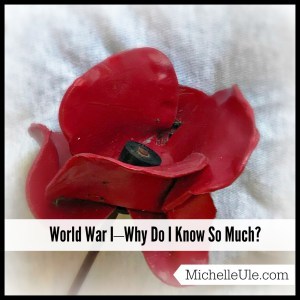 Why did I write a novel about World War I?
It’s an honest question and one people might be curious about.
Very simple.
I wrote a novel set during World War I.
A Poppy in Remembrance will be launched soon.
Why World War I?
I did not set out to write a novel about the war.
I just went to work one day.
It happened to be the day my boss and agent planned to discuss my next writing project with me.
We set the time for three, after I finished working as an editorial assistant.
But at 11 o’clock an editor called from New York City. She sought a story that began the day the war began, August 5, 1914, and ended on Armistice Day–November 11, 1918.
It needed to be historical romance and feature at least one American in the lead.
Go.
How can you fashion a legitimate romance out of World War I?

Everything is up for grabs
We batted around ideas: Wings, Snoopy and the Red Baron, trenches, Lawrence of Arabia.
Honestly, where’s the romance in that?
Shaking my head, I turned to leave her office and then paused, reflecting on Lawrence and the British Expeditionary Forces in the Middle East.
“Of course, there’s the Oswald Chambers story.”
I had recently read David McCasland’s excellent biography, Oswald Chambers: Abandoned to God.
“What Oswald Chambers story?” My agent asked.
“He basically led a revival among the ANZAC troops in Egypt during the war. There’s your story there, a spiritual tale of finding God in the midst of war.”
She looked at me. “Can you write it?”
What do you do when your agent asks a question like that?
“Yes.”
First you need a story
I went home and reviewed McCasland’s book for events in Chambers’ life.
Thinking and praying in my comfortable chair, I came up with an idea.
I passed the idea to my agent and she pointed out it didn’t include an American
For the next two days I stewed and tried to think of something, but nothing came.
I needed to write a complete proposal by Friday–which included two chapters, a synopsis and an explanation about the project.
Thursday morning I woke early, and prayed: “Lord, I’m willing to do this, but you’ll have to give me a plot. I’m not coming up with anything.”
Bing! I saw a story: the opening line, two main characters and a scene.
Sitting at the computer, I wrote the first chapter.
It looked good. I got the dog and met my prayer partner for a walk around the local lake, as usual.
As I told her about the chapter, a story formed in my mind. We prayed.
Returning home, I wrote the second chapter.
What about a plot?
Historical novels usually tip the word count at around 100,000 words.
While I understood the basic parameters: date story began, date it ended, I didn’t know what would happen between August 5, 1914 and November 11, 1918.
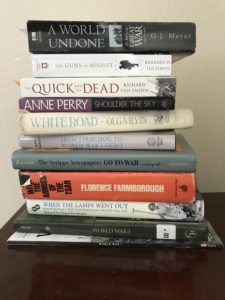
This doesn’t count the library books!
Indeed, I had limited knowledge about the war and my grandfather didn’t enlist until 1917.
So, I googled and printed out a timeline of World War I featuring the major events.
I scribbled a list of dates and events in Oswald Chambers’ life.
I spread the two long pieces of paper on my kitchen island and I placed paper between.
Then, I cross-referenced and wrote out a plot for my American character.
It took all day; I was exhausted at the end, but I had enough information to type up a 20-page synopsis of a story that would work.
Amazing.
The proposal
The next morning, I condensed that 50 paragraph synopsis into eight pages.
I added the two chapters, properly spell-checked and tightened.
Adjusting a former proposal, I formated it all and emailed it to my agent at 9:50.
I arrived at work at 10, ready to go.
The war?
Ever since January 2013, I’ve read, hunted on Pinterest, researched, prayed, thought, wrote and rewrote about the war.
The story morphed many times, but remained true to that initial synopsis.
I filled Pinterest boards with pictures about different aspects of the war.
Mrs. Oswald Chambers, Biddy, surprised me as I researched and wrote the novel. As often happens, she took a far stronger role in the story than I expected.
Once I finished writing that novel, I moved on to something I hadn’t imagined before I began: a biography of Mrs. Oswald Chambers.
Isn’t it curious how simply going to work one day can change your life?
Tweetables
A woman goes to work and her life changes thanks to Oswald Chambers. Click to Tweet
An entire WWI coming of age novel springs to life in one day. Click to Tweet
Where does the idea come from to write a WWI novel featuring Oswald Chambers? Click to Tweet
The post What Inspired a Novel About World War I? appeared first on Michelle Ule, Author.
August 7, 2018
The Importance of Nellie Bly
She was an inspiration to my heroine in A Poppy in Remembrance, for example.
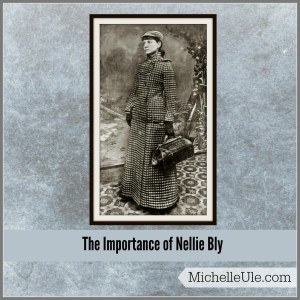 A resourceful and imaginative reporter, Nellie literally created a name for herself in the 19th century.
It wasn’t always pretty.
Finding her way into journalism
Born Elizabeth Jane Cochran during the Civil War, Nellie died a few years after World War I.
At her father’s death, the Pennsylvania family became impoverished. Her mother desperately tried to care for her family, but it was difficult.
Always observant and clear-eyed, Nellie’s determination to right wrongs resulted in her first writing.
In response to a local newspaper’s column depicting women as only good for child rearing and keeping house, Nellie wrote a piece calling herself “lonely orphan girl.”
The editor ran an advertisement to find her and offered her pay to write for the paper.
As customary at the time, the editor gave Elizabeth Jane a pen name: Nellie Bly.
It became both her name and her persona.
Off to the big city
After her family’s experiences, Nellie wrote about working conditions for women.
The articles generated anger from prominent employers and her editor relegated Nellie to the women’s section, to focus on “soft” stories.
She didn’t like it.
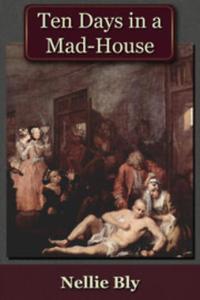 Once she’d saved up enough money, Nellie left Pennsylvania and headed to Mexico. The intrepid reporter styled herself as a foreign correspondent!
Nellie ruffled feathers in Mexico as well, while reporting on societal conditions. She returned with enough stories to write her first book, Six Months in Mexico at the age of twenty-one!
With clip sheets in hand, Nellie moved to New York City in 1887. The brash young woman eventually talked her way into working for Joseph Pulitzer’s New York World.
Nellie volunteered to go undercover as a madwoman to gain an insider look at a woman’s lunatic asylum!
Ten days after her admission, Pulitzer intervened to have her released and Nellie got a story!
(Did you see all those exclamation points? Stunt journalism at its finest!)
Nellie Bly races around the world!
Not content to write simple features, Nellie proposed a series of articles based on Jules Verne’s 1872 novel Around the World in Eighty Days.
The New York World agreed and funded the expedition and her trip ignited much interest.
It was the first time anyone had tried to see if it was possible to circumnavigate the world by local transportation in 80 days.
With the help of her editors, Nellie plotted her route carefully, but took a day off to a visit with Verne while in France.
The journey became even more exciting when a rival newspaper, the New York Cosmopolitan, launched their own female reporter on the same day.
Elizabeth Bisland caught a train that morning to travel around the globe in the opposite direction!
Who would win?
Both women wired stories as they traveled, alone, on a variety of trains, boats, ferries, rickshaws and even taxis.
The two women missed each other in Hong Kong by only three days.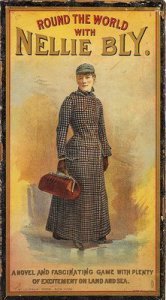
In the end, they both beat Phineas Fogg’s trip. Bly arrived back in New York City in 72 days. Bisland docked at the New York pier four days later.
Bisland wrote seven articles about her experience and collected them into a book, In Seven Stages: A Flying Trip Around the World. She continued writing but never participated in a stunt journalism exercise again!
Bly’s 1890 book Around the World in Seventy-two Days, sold well.
Both books demonstrated women could accomplish anything they set their minds to do!
Later years
Nellie continued writing, but retired from journalism in 1895 to marry a millionaire.
Her brain continued to whirr, however, and ultimately she patented a milk can!
By the end of her life, she’d picked up her pen again. Nellie Bly became an advice columnist for another New York paper.
She died in 1922.
However, in 2002, Nellie Bly was honored as one of four female journalists on a US postage stamp.
Why is Nellie Bly important?
Women have always worked as journalists, but few received Nellie’s fame.
Making herself part of the story grabbed headlines just as much as her articles.
Her youth and pluck also played a role her popularity with the public.
Nellie wrote at a time when working as a reporter was not always considered a respectable profession.
Indeed, for my heroine Claire, she became an inspiration–when Claire’s friends and family weren’t dismissing Bly as preposterous!
I enjoyed reading about her life and that of her race with Elizabeth Bisland in Jason Marks’ book Around the World in 72 Days: The race between Pulitzer’s Nellie Bly and Cosmopolitan’s Elizabeth Bisland.
Tweetables
Inspiring young woman or merely a stunt journalist? Click to Tweet
Nellie Bly as the first modern woman journalist who made a name for herself? Click to Tweet
The post The Importance of Nellie Bly appeared first on Michelle Ule, Author.
August 3, 2018
World War I Movies for Fun and Research
 I bet you’ve seen more World War I movies than you think you have.
Everyone knows about the classic All Quiet on the Western Front, of course. And a movie scholar could probably come up with the first Academy Award winner: Wings.
War Horse came out a few years ago, so you may know that one.
PBS fans could counter with Birdsong and probably Downton Abbey not to mention Upstairs, Downstairs.
How many of you know about Snoopy‘s escapes from the Red Baron? (Of course, he was quaffing root beer with the French mademoiselles in his off hours!)
I watched them all as I learned all I could about World War I.
Indeed, at one point my husband, a retired military officer, asked when we could watch movies on another theme?
He’d had enough of binge viewing!
Why watch a World War I movie?
Research, of course.
Many films were good examples of the types of clothing and machinery used during the war.
Another Masterpiece Theater presentation I remembered well (and bought on VHS) was Testament of Youth.
It provided me with an idea of the manners and attitudes of Vera Brittain‘s family during the war. (I read her book as well).
My husband’s favorite, Lawrence of Arabia, provided insight into a man who turned up as a marquee character in A Poppy in Remembrance.
It allowed me to see British Army life in Cairo during the war, and who can forget the desert and those camels?
A totally ridiculous choice was Julie Andrews as a spy and Rock Hudson as stupid pilot in Darling Lili. (Loved the music, hated the story).
World War I on the ground in film
My Boy Jack was so very sad–the story of how Rudyard Kipling brow-beat his only, near-sighted son into serving. The boy died almost immediately.
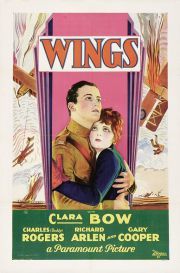
(Wikipedia Commons)
We enjoyed the fantastic aerial shots by intrepid pilots in The Flyboys‘ bi-planes.
I liked Wings better as a (silent) movie, perhaps because I knew they used pilots from the actual war (the movie was filmed about ten years after the end of the war).
Similarly, The Battle of the Somme film was shot by Pathe in 1916, before the end of the war and with another major battle to come at the Somme River Valley.
That film haunted–because many of the men depicted, real soldiers, died there months later.
Gary Cooper epitomized Sergeant York–based on the true story of one of the great Army heroes of the war. A terrific movie worth watching even if it did involve death and mayhem.
Anybody who loves Humphrey Bogart–who served in the Navy during WWI–may be surprised to discover The African Queen was set during WWI and involved blowing up a Germany ship in the middle of an African lake!
Who can forget King of Hearts, Paths of Glory, Gallipoli, In Love and War and The Blue Max?
You can see an entire list of World War I movies here.
Other films pertinent to World War I in the time period, but not the actual war.
Periphery films would include more favorites: Secondhand Lions and Chariots of Fire (post WWI, but includes several wounded veterans. Harold served in the King’s Army).
Even Doris Day’s On Moonlight Bay includes WWI references.
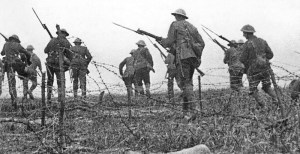
Then there’s a movie like The Battle of the Somme filmed in 1916–with more battles to come. (Wikipedia Commons)
Titanic, the liner, was sunk in 1912, but I gained some insight from the attitudes and clothing demonstrated in the film of the same name. (I detested the movie, by the way.)
What comes to mind when you think of World War I movies? How many of them have you seen?
Tweetables
A surprising list of WWI movies. Click to Tweet
Who knew The African Queen was set during WWI? Click to Tweet
Snoopy and the Red Baron, Lawrence of Arabia, what’s your favorite WWI movie? Click to Tweet
The post World War I Movies for Fun and Research appeared first on Michelle Ule, Author.
July 31, 2018
The Riley Family: BTC Regulars
Four members of the Riley family attended Oswald Chambers’ classes.
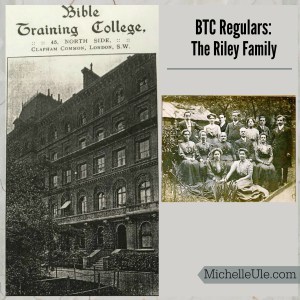 One is particularly significant, Mary Riley, and she will get her own blog post.
But the other three also did interesting work following attendance at the Bible Training College (BTC).
We’ll examine Kate, Arthur and Nellie’s work for God.
The Riley family as a whole
William and Rose Jane Carter Riley produced a dozen children between 1873 and 1891; five sons and seven daughters.
The family lived on the Warren Farm in Writtle, Essex where William worked as a coachman for James Christy, Esq.
Christy was a vice president of the East of England Temperance League in 1869 and he may have influenced the family’s faith. The second Riley son George Edwin eventually became a captain in the Salvation Army.
Eventually the family moved to the St. John Woods area of London where William apparently worked for horse dealer Daniel Bloom in 1911.
The sons generally worked as grooms; the girls as cooks, servants or dressmakers.
The Riley family may first have encountered Oswald Chambers through either the League of Prayer or gatherings at Essex Hall–where he often spoke.
Mary, Kate, Arthur and Nellie all became students.
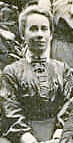
Kate Millicent Riley
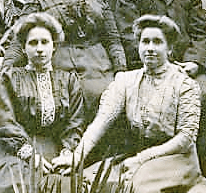
One of these two is Kate
Born in 1887, Kate worked as a cook prior to enrolling at the BTC.
We don’t know anything about her experience sitting under Oswald Chambers’ teachings.
However, in 1936, at the age of 49, she set sail from Liverpool to Port Said, Egypt.
Listing herself as a “social worker,” Kate probably joined Miss Katharine Ashe in Cairo.
Why else would an unmarried middle-aged dressmaker sail to Egypt?
Miss Ashe worked a very dangerous job helping prostitutes escape the sex trade and undoubtedly needed help, or at least encouragement.
If so, Kate only lasted a year before returning home to St. John Wood.
All the same, her motivation must have come from her faith–as encouraged through the BTC.
Reverend Arthur Charles Riley
Born in 1883, Arthur worked as a groom probably during his enrollment at the BTC.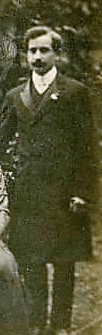
Arthur immigrated to British Columbia where he attended college and married in Toronto in 1916.
He and his wife Iva moved to Chicago to pursue a PhD after their marriage. Arthur served as a pastor in Baptist and Methodist parishes for their rest of his life
Their granddaughter wrote that Arthur and Iva’s spiritual influence on her life was powerful.
Ellen Rose “Nellie” Riley
The oldest daughter in the Riley family, Nellie was born in 1875. She served as a deaconess in a Congregational Church in 1911, the year the BTC began.
She wrote of Oswald in the 1934 book Oswald Chambers: His Life and Work:
“My first remembrance of Mr. Chambers was at a meeting in Exeter Hall, and I have never forgotten the words he spoke, or the power with which he spoke them—“If Thou canst! All things are possible to him that believeth.”
“These words have been the means of helping me go forward to do seemingly impossible things many a time.”
 About the BTC,
“One incident is implanted in my mind.
“One morning I felt very unwell but did not say a word to anyone. My place was near Mr. Chambers, and suddenly he leaned forward and whispered, “Psalm 87:7.”
“I did not know the reference, but when I looked it up I realized how wonderfully discerning he was—“All my fresh springs are in Thee.”
“You felt as if he could read you through and through, and many times I have felt ashamed of my failings in his presence.”
Nellie traveled the farthest in both culture and geography after her BTC studies.
Only 4 feet 11 inches tall, she sailed alone to Shanghai from London in March, 1920. Nellie served in Western China with the Friends’ Foreign Mission Association.
Her BTC friend Gladys Ingram Donnithorne also worked in the region and the two probably saw each other from time to time.
Originally listed as a voluntary worker in Tungchwan (now called Dongchuan; in the general area of Chung King in southwestern China), she served at other missionary sites and a hospital as needed.
Working with children
By the early 1930’s, Nellie ran an orphanage in Tungliang.
In 1936, she wrote an appeal that appeared in the West China Missionary News, asking for help in moving the orphanage to a safer place.
Her description tells of the challenges she faced serving Chinese orphans during the years prior to the Chinese Cultural Revolution.
“Our house is not healthy, the children are constantly ill. We need a place where we can keep a cow, goats and grow our own vegetables, as well as a drying ground and playground for the children.
“Where we are, we have a tiny garden which is always full of washing. This is not a very cheerful view.
“If the children are poorly, we can only put them outside in the midst of washing!
“We would like to be near a doctor in case of sickness, where we could get help in a few hours, instead of best part of two days. Also, not too far away from other missionaries; near Chengtu or Chung King seems suitable to us.”
Someone had already donated 50 pounds toward the move.
Her commitment to her calling remained true, 20 years after leaving the BTC.
“We want the orphanage to be a center for the spread of a full salvation, and we are prepared to do all in our power to make Jesus Christ known to those who know Him not.
“I remain yours in joyful service.”
Nellie left China in 1939, traveling to North America to see her brother Arthur and his family, before returning to England.
With the Chinese Revolution sealing off the nation, she remained in St. John Woods until her death in October 1959.
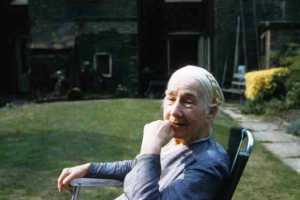
Well done, good and faithful Riley family!
Tweetables
The results of 4 Rileys attending Oswald Chambers’ Bible school? Click to Tweet
Oswald Chambers trained; 1 family covers the world with the Gospel. Click to Tweet
The post The Riley Family: BTC Regulars appeared first on Michelle Ule, Author.